Feeds:
Posts
Comments

Archive for the ‘wildlife’ Category

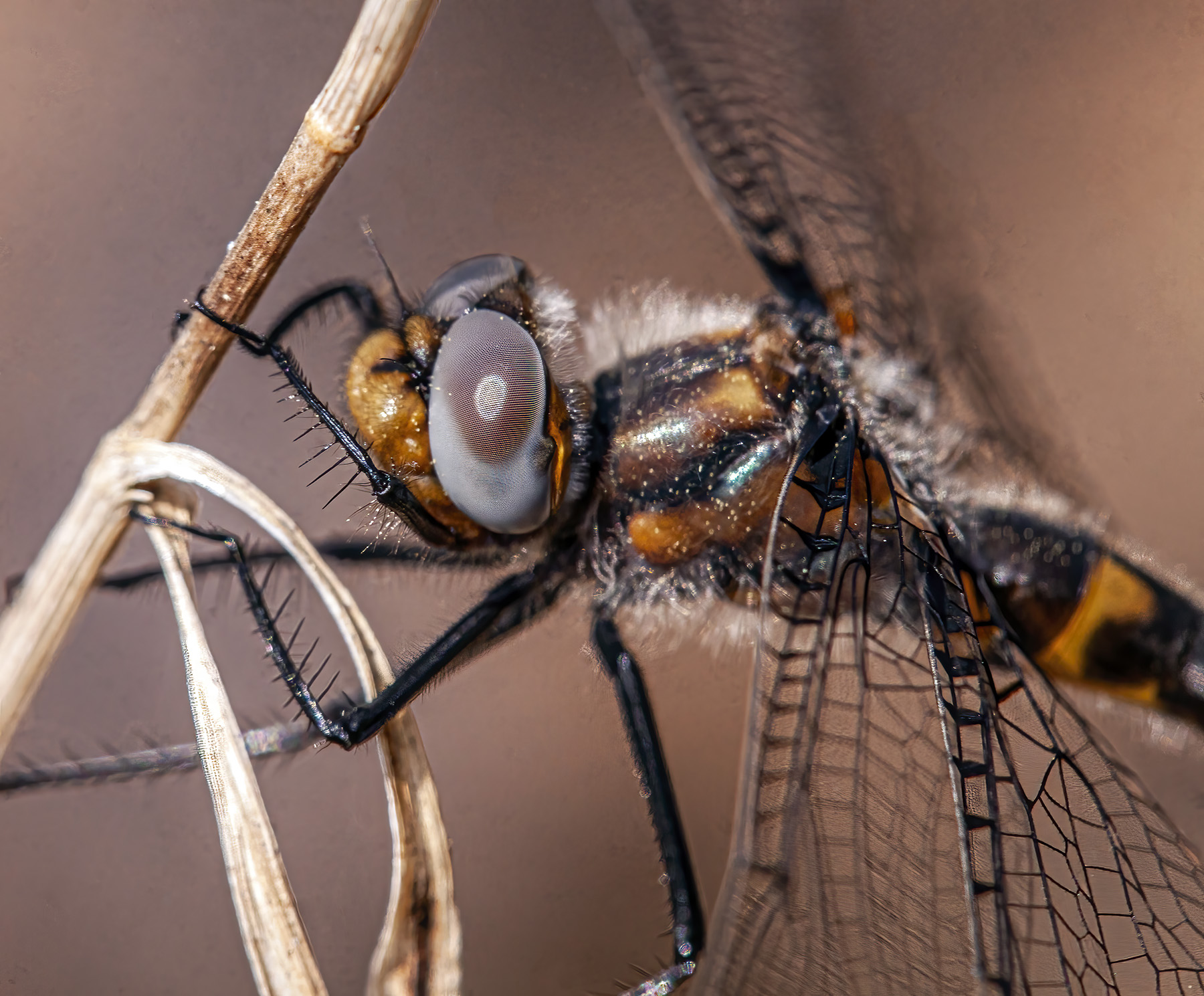
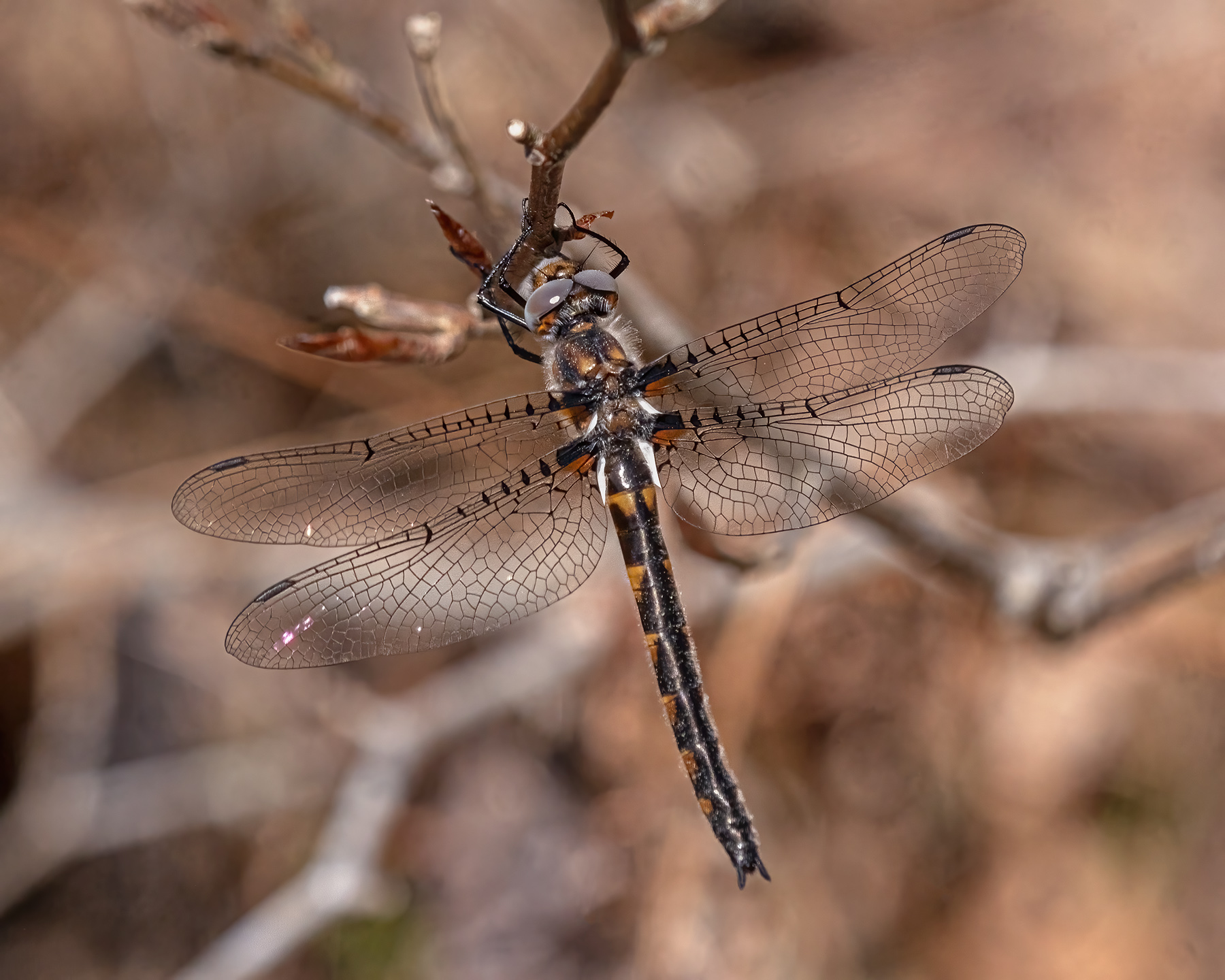
Normally when I photograph a new species of dragonfly I am immediately ecstatic, but that was not the case on Tuesday. After a long day of searching for Uhler’s Sundragons (Helocordulia uhleri) in Prince William County with fellow dragonfly enthusiast Walter Sanford, we were excited when we finally spotted a few of them. It had been an overcast day and it was only when the sun came out after noon that the dragonflies began to appear. Walter was thrilled, but my excitement was a little more muted, because I had photographed this species the previous week—check out my posting First dragonflies of the season for details and photos of my adventures that day.

After a while, Walter noted to me that all of the Uhler’s Sundragons that he had seen so far were female and that he hoped he would see a male. This may sound a little strange, but with some species of dragonflies, the females hang out in a separate area from the males until they are ready to mate, so you do not always see the genders intermixed.

I was wandering around the area a bit, as I am prone to do, when Walter called out to me that he had found a male. I rushed over and managed to get some shots of the specimen, including the first two images below. As it turns out, that was the only male that we saw all day.

The following day, Walter sent me an excited Facebook message informing me that the male dragonfly that we had both photographed was not a Uhler’s Sundragon, but was a Selys’s Sundragon (Helocordulia selysii), a similar species that neither of us had ever seen before. Walter did a records search and it looks the species had never before been documented in Prince William County. Finally I was ecstatic.

How did we not notice immediately that this was a different species? One of the primary differences between the species is that Uhler’s Sundragons have amber-colored markings mixed with dark ones at the base of their wings, while Selys’s Sundragons have only the dark markings. Given the small size of these dragonflies, these differences are hard to spot in the field, but are much easier to see when reviewing images afterwards.

For comparison purposes, I have included a photo of a male Uhler’s Sundragon that I photographed last week. If you look carefully, you can see the amber-colored markings in the final photo that are absent in the first two photos.

You may also notice that there is a spider on the branch in the final photo that appears to be reaching down and tapping the dragonfly on the “shoulder.” In this scenario, I am not sure which species would be the predator and which would be the prey. I have documented several cases in which dragonflies have been caught in spiderwebs and also a case when a jumping spider took down a much larger dragonfly (see my 2014 posting Spider captures dragonfly—the story for a fascinating series of images).

If you would like to see Walter’s account of our encounter with the Selys’s Sundragon, check out his blog posting today entitled Selys’s Sundragon dragonfly (male).

Sely's Sundragon

Selys’s Sundragon, 13 April 2021

Sely's Sundragon

Selys’s Sundragon, 13 April 2021

Uhler's Sundragon

Uhler’s Sundragon, 8 April 2021

© Michael Q. Powell. All rights reserved.

Read Full Post »

Most snakes tend to lie horizontally, but the Northern Watersnake (Nerodia sipedon) that I spotted last week felt inclined to slither its way up a protruding tree branch and bask in the sun at a rather sharp angle. I was exploring the edge of a stream in Prince William County and was somewhat shocked to stumble upon this snake—I had been keeping an eye on the vegetated areas, knowing there was a chance there might be a snake there, but did not really expect to see one out in the open.

Most of the Northern Watersnakes that I have seen in the past have been darker and duller in color than this one, which has a distinctive colorful pattern. Given the brightness of the colors and the snake’s relatively small size, I wonder if this might be a juvenile snake.

The snake seemed comfortable on its perch and did not react when I took these photos, though I must admit that I kept a respectful distance away. When I continued on, the snake stayed put, enjoying the warmth of the springtime sun.

Northern Watersnake

Northern Watersnake

© Michael Q. Powell. All rights reserved.

Read Full Post »

I love to stroll along the shore—the rhythmic sound of the waves relaxes me and often puts me into a contemplative frame of mind. When I spotted this crow on a recent trip to Occoquan Bay National Wildlife Refuge, I couldn’t help but think that the crow too was lost in its thoughts and enjoying the same therapeutic benefits of a stroll at the water’s edge.

I must confess that I do not know my crows very well. I assume that this is an American Crow (Corvus brachyrhynchos), but realize that it might instead be a Fish Crow (Corvus ossifragus). From what I have read, even experts sometimes have trouble visually distinguishing between the two species, though Fish Crows are substantially smaller than American Crows. Apparently some people can tell them apart by their calls, but this crow was silent, so I too will remain silent and simply identify the strolling bird as a crow.


crow

© Michael Q. Powell. All rights reserved.

Read Full Post »

On Thursday I finally photographed my first dragonflies of the season. I had previously spotted Common Green Darners several time, but they don’t really “count” because I was not able to capture images of them. I initially checked out several locations at a stream in Prince William County, Virginia, where I had seen Uhler’s Sundragon dragonflies (Helocordulia uhleri) in recent years and came up empty-handed.

However, I was thrilled when later in the day I spotted Uhler’s Sundragons at several locations further upstream from my previous locations. Uhler’s Sundragons have a brief and very early flight period and are considered rare in our area. They also are habitat specialists and “they need clean, small to medium, rocky forest streams with gravelly and/or sandy substrate, and a decent flow,” according to the wonderful Dragonflies of Northern Virginia website.

These three photos are indicative of the types of photos that I often try to capture of dragonflies. I love to try to get as close as I can and take extreme close-up shots, like the first one. You can easily see the spines on the legs of the dragonfly and even some of the ommatidia, the optical units that make up the amazing compound eyes of the dragonfly.

The second shot of a female Uhler’s Sundragon is a good illustration of the way that I try to separate my subjects from the background. The final shot of a male Uhler’s Sundragon shows more of the habitat in which I found the dragonfly. The background is a little busy, but I like the way that the image shows the transparency of the dragonfly’s wings.

In case you are curious about how I can tell the gender of these dragonflies, one of the primary keys is to look at the tips of the abdomens (the “tail”)—you will probably note the different anatomical shapes if you compare the second and third images.

Uhler's Sundragon

Uhler's Sundragon

Uhler's Sundragon

© Michael Q. Powell. All rights reserved.


Read Full Post »

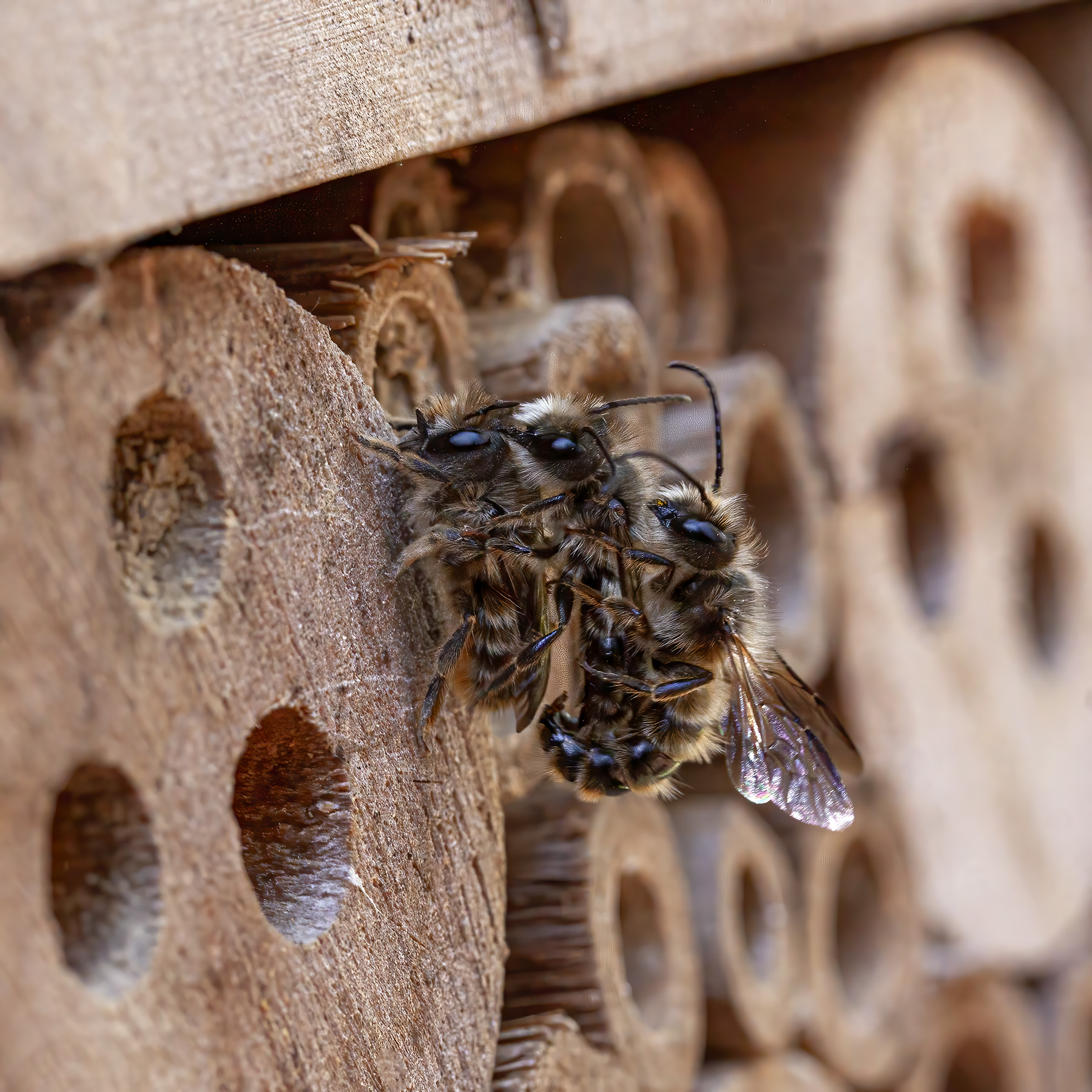
When it comes to mating, many male insects are really aggressive—they will do everything they can to prevent their rivals from hooking us with a desirable female. I think that is what was going on in this image I captured on Sunday of three bees outside of a bee house in the garden of my friend and neighbor Cindy Dyer. It looks to me that the top bee in this ménage à trois was trying to dislodge a rival and somehow gain access to the female. Yes, as the old song simply states, “birds do it, bees do it.”

Perhaps you have a better explanation of what was transpiring, like they were simply playing piggyback and wanted to see how strong the bottom bee was. What do you think? I encourage you to click on the image to see the details better.

I often tell you that I was not as close as it seems, because I generally shoot with a telephoto lens or a long macro lens. In this case, though, I was shooting with a 60mm macro lens and was only a few inches away from the “action” and had to dodge bees that were entering and exiting the tubes of the bee house.

bees

© Michael Q. Powell. All rights reserved.
Read Full Post »

Many of you know that dragonflies and damselflies are my favorite subjects to photograph in the warm months of the year. There is something magical about these colorful aerial acrobats that spend most of their lives underwater before undergoing a remarkable metamorphosis. If you are not familiar with a dragonfly’s total transformation, you may want to check out a posting I did a few years ago called Metamorphosis of a dragonfly that documents in photos and in words the step-by-step metamorphosis of a Common Sanddragon dragonfly (Progomphus obscurus).

It is still a bit early in the season, but I have already been searching for dragonflies and damselflies for a couple of weeks now. Yesterday I finally found my first damselfly, the female Fragile Forktail (Ischnura posita) in the first photo that I spotted as she perched on some skunk cabbage in a muddy seep at Occoquan Regional Park. I scoured the area and eventually spotted a few more Fragile Forktails, including the male in the second photo that was also perched on the leaves of a skunk cabbage.

As their name suggests, Fragile Forktail damselflies are quite small and delicate and are only .8 to 1.1 inches (21-29 mm) in length. This species is fairly easy to identify, once you manage to spot one, because both genders have interrupted pale shoulder stripes that look like exclamation marks. I encourage you to click on the images, especially the first one, in which you can see the incredible details of this little lady, including her amazing wings, spiny legs, and tiny feet.

The dragonfly/damselfly season has now officially started for me and I will now begin to intensify my search for spring species, many of which can be found only in specific habitats for a limited period of time. Can you feel my excitement? Yeah, I an unapologetically a bit geeky about these little creatures.


Fragile Forktail

Fragile Forktail

© Michael Q. Powell. All rights reserved.

Read Full Post »

What do you call a group of butterflies? There are apparently many collective nouns for butterflies in English, but my absolute favorite is “kaleidoscope.” The word combination “kaleidoscope of butterflies” captures well for me the magical and fanciful nature of these colorful creatures.

I was excited yesterday when I spotted an Eastern Tiger Swallowtail butterfly (Papilio glaucus) fluttering about near a stream at Prince William Forest Park—it was my first “big” butterfly of the spring season. I was even more thrilled later in the day when a spotted this kaleidoscope of Eastern Tiger Swallowtails clustered together on a rocky ledge at water’s edge, engaged in what is often referred to as “puddling.” Many species of butterflies congregate on wet sand and mud to partake in “puddling”, drinking water and extracting minerals from damp puddles or even from animal droppings.

According to a posting by Westborough Land Trust, “When tiger swallowtails emerge from their chrysalises, one of the first things they do – especially if they’re male – is to head for a mud puddle. There they fill up on water and get minerals needed for reproduction. They suck water and dissolved minerals up through their long “tongue” or proboscis, which they also use to drink nectar.”

It is really early in the season and all of the butterflies were in perfect condition, with fully intact wings and vibrant  colors. I am always energized to see the emergence of new life in the spring in plants and in all of the small and large creatures that I love to photograph.


Eastern Tiger Swallowtail

© Michael Q. Powell. All rights reserved.
Read Full Post »

It was cool and windy yesterday at Occoquan Bay National Wildlife Refuge and most of the birds seemed to be taking refuge from the elements. I was therefore especially thrilled to spot and photograph my first warbler of the season, this Yellow-throated Warbler (Setophaga dominica).

This is the time of the year when a lot of colorful warblers pass through our area on their northward migration. Many of the warbler stay for only a short time, so it is a hit-or-miss proposition for me to find them. This is also the time of the year when the trees are budding, flowering and pushing out new leaves. All of this new growth is beautiful, but it makes it harder for me to spot the little birds as they flit about, often at the tops of the trees.

We had some spring-like temperatures a week ago and I was walking around in a T-shirt or at most a sweatshirt. Yesterday, though, the day started with temperatures below freezing and eventually made it up to only 47 degrees (8 degrees C) with almost constant winds of 15 miles per hour making it feel much colder. I dug out my heavier coat, insulated boots, and thermal underwear and was comfortable walking about, though most of the wildlife seemed to have taken the much more commonsense approach of simply staying sheltered.

Yellow-throated Warbler

© Michael Q. Powell. All rights reserved.

Read Full Post »

Do spiders overwinter as adults? Most of the crawling creatures that I tend to spot this early in the spring are quite small, so it was a little surprising to spot several large Wolf Spiders ( probably Tigrosa georgicola) on Monday at Prince William Forest Park. I was pretty sure these spiders had not hatched recently, so I did a little research and learned that “a surprisingly large number of spider species overwinter as adults or immatures, forsaking the cozy shelter of an egg sac in which to endure the harsh, cold extremes,” according to a blog posting by Bug Eric entitled Spider Sunday: Spring Spiders.

The spider in the first photo was actively crawling about in the leaf litter when I first spotted it, probably searching for prey, given that wolf spiders do not spin webs and instead are opportunistic hunters. The second spider was scurrying down a trail at a surprisingly fast pace when it paused for a moment to let me capture an image.

I encourage you to click on the photos to get a closer look at the fascinating details of these spiders, including their multiple eyes and the spiky hairs on their legs.

Wolf Spider

Wolf Spider

© Michael Q. Powell. All rights reserved.

Read Full Post »

Is it a bee? Is it a fly? It is a Greater Bee Fly (Bombylius major), a parasitic bee mimic that is one of the earliest spring pollinators of wildflowers. I photographed this bee fly as it was feeding on the nectar of a Spring Beauty (Claytonia virginica) on Monday at Prince William Forest Park.

I was quite happy to be able to capture so many of the details of this curious creature, including its long proboscis, spindly legs, patterned wings, and fuzzy body. In case you are curious, the body of one of these bee flies is about six-tenths of an inch (15mm) in length and its wing span is about one inch (25mm). I recommend that you double-click on the image to get a better looks at the little details of this bee fly.

If you would like to learn more about these fascinating little bee flies, including their parasitic behavior, check out the article on the US Forest Service website by Beatriz Moisset entitled “A Pollinator with a Bad Reputation.”

Greater Bee Fly

© Michael Q. Powell. All rights reserved.

Read Full Post »

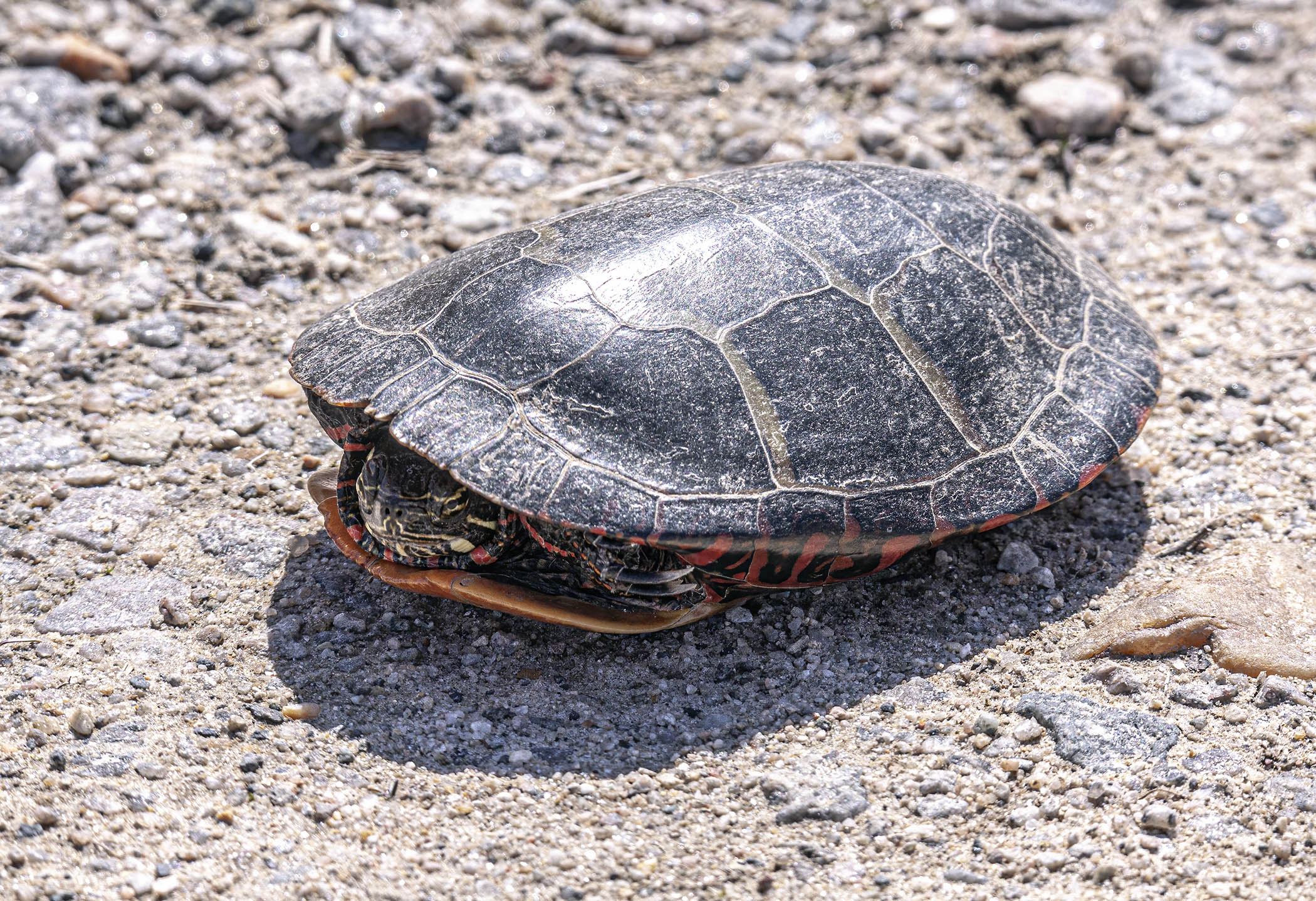
When I spotted this Eastern Painted Turtle (Chrysemys picta picta) on Monday at Occoquan Bay National Wildlife Refuge, I immediately thought how apt a visual metaphor it was for our lives this past year. Surrounded by its protective shell, the turtle tentatively looked out at a hostile world, wondering if it was safe to stick out its neck and move forward.

It is still not completely safe, but conditions appear to be improving somewhat in many parts of the world. Yesterday I had my second Pfizer-BioNTech vaccination shot and I hope that as many people as possible will choose to get vaccinated when they have the chance.

In the meantime, we owe it to each other to continue to wear our masks, to wash our hands, and to practice social distancing. None of us really like these restrictions, but they will protect us as we await the day when we can all come out of our shells.

Painted Turtle

© Michael Q. Powell. All rights reserved.

Read Full Post »

I was watching an Eastern Gray Squirrel (Sciurus carolinensis) on Monday at Occoquan Bay National Wildlife Refuge as it hung upside down and nibbled on the buds of a tree when suddenly its back legs lost their grip. The squirrel was dangling from its front paws only when I snapped this shot.

Initially the squirrel continued to chew on the bud it was holding. Realizing perhaps the precariousness of its position, it eventually stopped eating and successfully scrambled back up into the tree.

Eastern Gray Squirrel

© Michael Q. Powell. All rights reserved.

Read Full Post »

I tend to be a bit obsessive about trying to get my subject in sharp focus when capturing wildlife images. So I was a little disappointed, but not surprised, when I saw that the focus in this shot of a Carolina Chickadee (Poecile carolinensis) was a bit soft. I was quite a distance away when I saw this little bird moving about in the tree branches on Monday at Occoquan Bay National Wildlife Refuge and I was able to snap off only a couple of shots before it flew away.

The more I looked at this image, the more I have come to like it. There is something really pleasing about the bird’s upward-facing pose; the lighting around the chickadee; the out-of-focus background; the simple structure of the branches; and especially the spots of bright spring color in the flowering tree. This image conveys to me an overall feeling of the beauty of the emerging spring.

This type of shot also serves to remind me that photography is as much about art as it is about science, that it is ok to break whatever “rules” I choose to impose on myself. Beauty can be found in sharp, detailed photos, what I normally strive to create, but it can also be found in “artsy,” impressionistic images like this one.

What do you think? Does the soft focus on this chickadee bother you?

Carolina Chickadee

© Michael Q. Powell. All rights reserved.

Read Full Post »

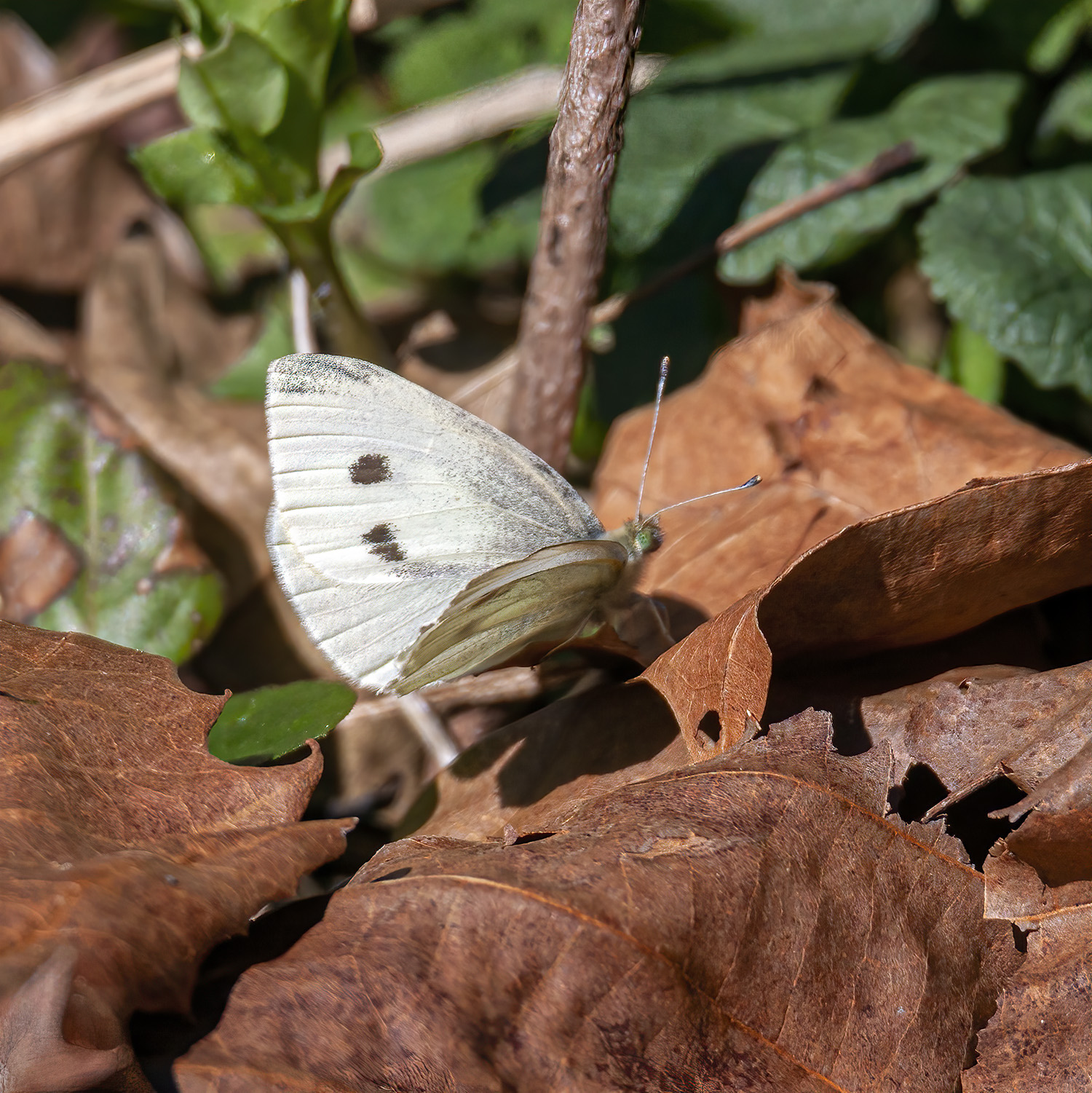
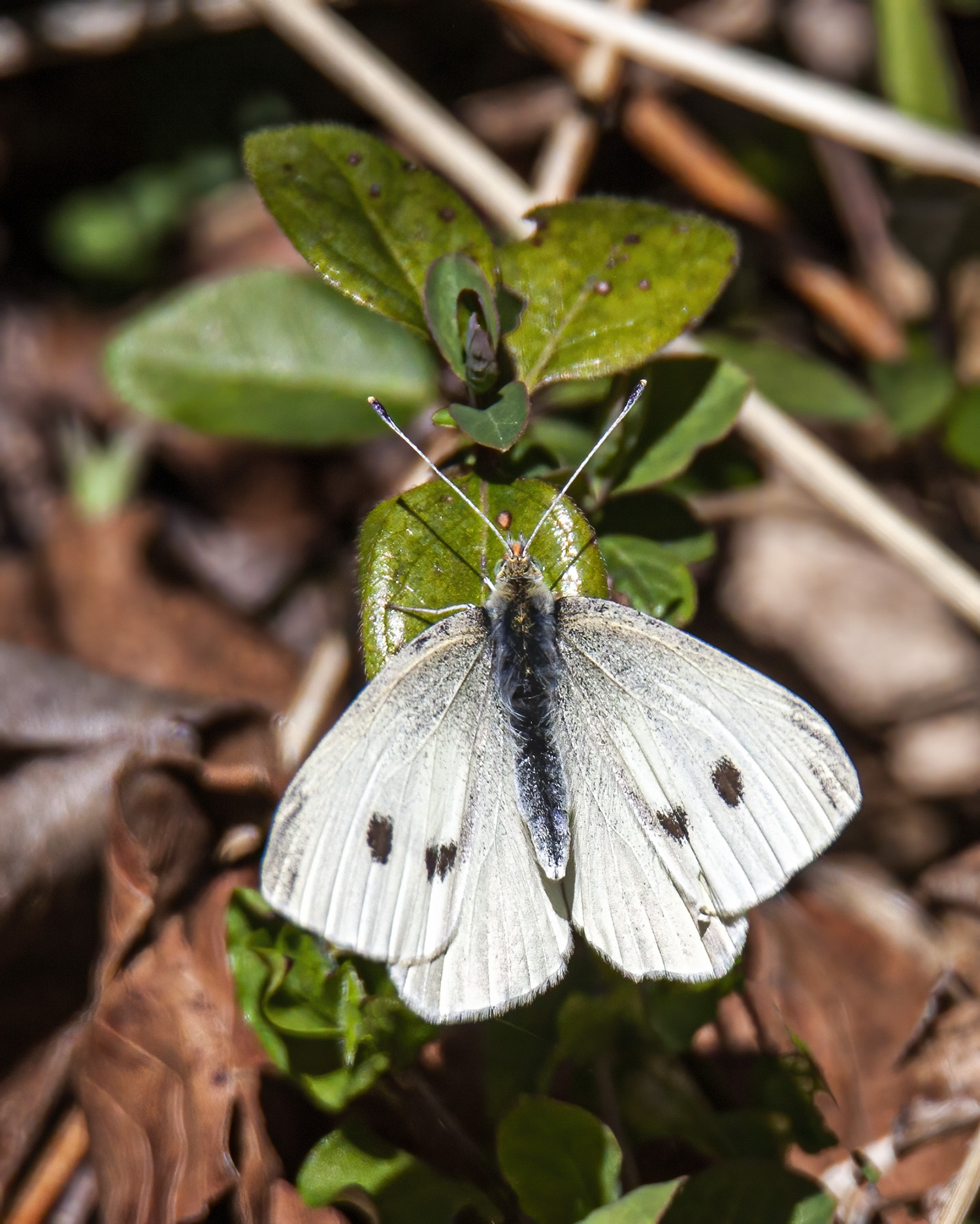
Yesterday was a beautiful spring day and I finally managed to photograph my first butterfly of the year, a Cabbage White (Pieris rapae) that I spotted in the underbrush at Occoquan Bay National Wildlife Refuge. Within the past two weeks I have had several sightings of larger butterflies that overwinter as adults, including the Mourning Cloak and the Question Mark/Eastern Comma butterflies, but was unable to capture images of them.

This little butterfly almost certainly emerged recently from a chrysalis and is a female, judging from the two black spots on each of the forewings (males have a single spot on each forewing). Cabbage White butterflies, known by many different names, originated in Europe and have now spread to many parts of the world including Australia and New Zealand, according to Wikipedia.

I look at the butterfly as a beautiful little creature, but in its caterpillar form it is considered to be a dangerous agricultural pest that is responsible for large-scale damage to the cruciferous plants on which it voraciously feeds. As adults, however, Cabbage Whites butterflies feed on nectar from many flowers, including dandelions, red clover, asters, mint, and strawberries and do not cause any damage.


Cabbage White

Cabbage White

© Michael Q. Powell. All rights reserved.


Read Full Post »

Wildlife photography is full of uncertainty—there are no guarantees of success. When I go out with my camera, I never know if I will find any subjects to photograph.

I stay alert and almost always something will appear, like this beautiful female Northern Cardinal (Cardinalis cardinalis) that I spotted a week ago at Occoquan Regional Park.

Beauty is everywhere—sometimes you just have to look a little harder to find it.

Northern Cardinal

© Michael Q. Powell. All rights reserved.
Read Full Post »

Some of the newly-returned Ospreys (Pandion haliaetus) at Occoquan Bay National Wildlife Refuge were busy on Friday building or renovating their nests. In past years I have seen ospreys make nests in a wide range of locations, both natural as well as man-made. This osprey was ferrying out sticks to a nest on a distant channel marker in the bay, where its mate waited patiently for each new delivery.

Osprey

Osprey

© Michael Q. Powell. All rights reserved.

Read Full Post »

I turned my head instinctively when I heard a splash in the water yesterday at Occoquan Bay National Wildlife Refuge? What had made the splash? There were no logs on which a turtle might have been sunning, so I assumed it was one of the many diving ducks that have spent the winter with us. I watched and waited for the duck to resurface so that I could identify its species.

Imagine my surprise when a furry rather than feathered head broke the surface of the water from below. I only had to hesitate a second before I decided that it was a muskrat (Ondatra zibethicus) rather than a North American Beaver (Castor canadensis). Why? It was midday and beavers are generally active only at dawn and dusk; the animal was really small and beavers tend to be a lot bigger in size; and I had a really good look at the tail that was a long, thin “rattail” and not flat like a beaver’s tail.

In the past most of the muskrats that I have seen swimming have kept their tails in the water, often using it for propulsion. Maybe this muskrat was simply treading water, watching me as I watched it. It has been a long time since I have seen a muskrat, so this sighting was a nice treat for me.

Muskrat

© Michael Q. Powell. All rights reserved.

Read Full Post »

Sometimes the colors in a photo draw me in as much as the actual subject, as is the case with this image of a Northern Mockingbird (Mimus polyglottos) that I spotted last Saturday at Occoquan Regional Park.

The soft shades of brown and gray harmoniously create a mood that I really like. Even the wispy, dried grasses in the foreground, which might have bothered me under most circumstances, add a nice texture and organic feel to this in situ portrait.

Northern Mockingbird

© Michael Q. Powell. All rights reserved.
Read Full Post »

Some people find Turkey Vultures (Cathartes aura) to be creepy, but I think they are handsome in their own way and fill a useful function in keeping our roads at least partially free from carrion. I spotted quite a few Turkey Vultures on Monday at Occoquan Bay National Wildlife Refuge, some clustered on the ground and some circling in the skies.

The two vultures in the first photo were part of a group of five that were spread across a trail near the partial remains of what looks to have been some kind of animal. I did not want to disturb them, so I gave them a wide berth and continued on my way after capturing the image.

I had no such worry with the vulture in the second shot that was effortless soaring overhead and did not seem disturbed at all by my presence. It probably was my imagination, but at times it seems like the vulture was tracking me. I think I watched too many cowboy movies as a child in which a lost cowboy stumbled through the desert as vultures circled overhead, waiting for him to die.

Turkey Vultures

Turkey Vulture

© Michael Q. Powell. All rights reserved.
Read Full Post »

Some birds return silently in the spring and you have to search hard to find them. Ospreys (Pandion haliaetus), on the other hand, make their presence known as they soar overhead, often calling out in their loud, high-pitched voices that the Cornell Lab of Ornithology compared to “the sound of a whistling kettle taken rapidly off a stove.”

I spotted only a few ospreys yesterday at Occoquan Bay National Wildlife Refuge, some of which I managed to photograph, but know from experience that they are only the advance guard of a larger group of osprey that will arrive soon and begin to build or repair their nests. As you may notice in the second photo, trees in our area are being to produce buds and it won’t be long before leaves begin to complicate my efforts to spot birds.

Osprey

osprey

© Michael Q. Powell. All rights reserved.

Read Full Post »

It was early in the morning when I spotted this Bald Eagle (Haliaeetus leucocephalus) on Tuesday at Occoquan Bay National Wildlife Refuge. Utterly fascinated, I watched the eagle methodically preening, moving from one area of its body to another, adjusting the feathers and removing some small wispy ones. When you are a national symbol, I guess you have to try to look majestic at all times.

This particular eagle was pretty relaxed and I managed to walk almost underneath the overhanging branch without disturbing it. If you look carefully at the final photo, you can tell that I was shooting almost straight up in order to get the shot. Remarkably the eagle remained in place when I continued on my way down the trail. I would like to be able to claim that I was really stealthy in my movements, but I think it was more likely that the eagle was simply willing to tolerate my presence, of which he was undoubtedly aware.

Bald Eagle


Bald Eagle

Bald Eagle

© Michael Q. Powell. All rights reserved.


Read Full Post »

Frost covered the ground early on Tuesday morning when I arrived at Occoquan Bay National Wildlife Refuge. The first creature that I spotted was an Eastern Cottontail rabbit (Sylvilagus floridanus) foraging in the wintery grass that has not yet turned green. The sunlight was soft and low, making the bunny glow.

It was a wonderfully gentle way to begin a new day.

Eastern Cottontail Rabbit

Eastern Cottontail Rabbit

Eastern Cottontail Rabbit

© Michael Q. Powell. All rights reserved.

Read Full Post »

It was great on Tuesday to see that some Tree Swallows (Tachycineta bicolor) have returned to Occoquan Bay National Wildlife Refuge. One was even checking out the local real estate market and was shocked at how expensive housing rentals are in this area.

In the wild, Tree Swallows nest in tree cavities, but they seem to adapt readily to using nesting boxes, like the one in the final photo. At this spot of the refuge there are two nesting boxes and each year there seems to be a competition between Tree Swallows and Easter Bluebirds for their use.

According to the Cornell Lab of Ornithology, “Tree Swallows winter farther north than any other American swallows and return to their nesting grounds long before other swallows come back. They can eat plant foods as well as their normal insect prey, which helps them survive the cold snaps and wintry weather of early spring.”

Welcome back, beautiful little swallows.

Tree Swallow

Tree Swallow

© Michael Q. Powell. All rights reserved.


Read Full Post »

I do not know about the reactions of the lady turkeys, but I was mighty impressed by the display of this male Wild Turkey (Meleagris gallopavo) early yesterday morning at Occoquan Bay National Wildlife Refuge. A lot of male birds go to great lengths to impress and attract females during the early spring, but this wild turkey’s presentation might take the prize for being so flamboyant and ostentatious. I guess he has truly embraced the motto, “Go big or go home.”

Wild Turkey

© Michael Q. Powell. All rights reserved.


Read Full Post »

When you look through the photos on my blog, you might get the mistaken impression that I have some magical power over birds, because your view of them is rarely obstructed by branches. I have a confession to make—those photos are not accurate representations of the way that I see birds most of the time. Today’s image of a beautiful little Golden-crowned Kinglet (Regulus satrapa) provides a more typical view of the way that I see birds in the wild as they move about in the thickets and underbrush foraging for food, rarely providing me with a good look.

Despite all of the branches that blocked my view, I managed to capture quite a lot of the kinglet’s details in this shot, including a sliver of its golden “crown,” a close look at its legs and feet as the small bird was hanging from a leaf, and some of the texture of the layers of feathers. I highly encourage you to click on the image to get a better looks at these wonderful detail. As you look at this bird, keep in mind that it is one of the smallest songbirds in my area, with a length of 3.1-4.3 in (8-11 cm) and a weight of 0.1-0.3 oz (4-8 g), according to the Cornell Lab of Ornithology.

I am fond of saying that beauty is everywhere, and I believe that to be true. Sometimes, though, you might not see it at first glance. If you slow down and look beyond those things that threaten to block your view, you may discover beauty hidden among the branches.


Golden-crowned Kinglet

© Michael Q. Powell. All rights reserved.


Read Full Post »

How good are you at identifying a bird by its silhouette? When you are shooting directly into the light, one of the challenges of photographing a bird is that many of the details, or even all of them, disappear into the shadows—you often have to rely more on the shapes than the colors to identify the bird.

I could not see the eyes or any of the facial features of this bird that I spotted last Saturday at Occoquan Bay National Wildlife Refuge, but its long bill and distinctive “punk rock” head feathers made it relatively easy to identify it as a Male Red-breasted Merganser (Mergus serrator), a type of diving duck that I see only occasionally. For the record, the white collar also helped in making the identification.

Red-breasted Mergansers are one of the bird species that spend their winters with us. I suspect that it will not be long before they depart for more more northern locations for the breeding season.


Red-breasted Merganser

© Michael Q. Powell. All rights reserved.

Read Full Post »

For the last six weeks or so, I have been monitoring two Bald Eagle couples (Haliaeetus leucocephalus) at Occoquan Bay National Wildlife Refuge as they have repaired and renovated two different nests. On Saturday morning I made my way to one of them and was delighted to see an eagle sitting low in the nest. I cannot be completely certain, but I think that the eagle is sitting on one or more eggs. If true, the eaglets should hatch in about 35 days or so.

This relatively small nest was damaged last summer when it looks like one of the supporting branches broke off and half of the nest fell to the ground. I observed some of the reconstructions efforts and documented it in an early February posting called Rebuilding the nest. It looks to me like the nest has grown considerably in size since that time.

This nest is located in a sycamore tree just off one of the major trails at the wildlife refuge. Each year the authorities block off all of the nearby roads to allow the eagles to nest in peace. The final photo shows the tree in which the nest is located and the current barrier across the trail from which I took the first photo. A telephoto lens tends to compress distances, so it is hard to judge exactly how far away the tree is from the barrier—I estimate that it is about a hundred yards (91 meters).

I will continue to keep an eye on this nest and hopefully will manage to get a glimpse of some eaglets in the upcoming months. Last year I believe that there was only a single eaglet (check out my May 2020 posting entitled One little eaglet), although in past years there were often two eaglets (check out this April 2018 posting called Baby bald eagles for a look at two adorable little eaglets).

Bald Eagle nest

Bald Eagle nest

© Michael Q. Powell. All rights reserved.

Read Full Post »

I really enjoy posting photos here on my blog because I have the freedom to post multiple images and spend as much time and text as I want talking about them—most other forms of social media have implicit or explicit limits on the content. I post a subset of my blog content on my personal Facebook page and in several Facebook groups.

Many of these Facebook groups are very specialized and are full of experts. I actually prefer to post to groups that are aimed more towards generalists who have a broad interest in nature and wildlife. One of my favorites is called “Nature Lovers of Virginia” and I was thrilled when one of my recent photos of a Bald Eagle (Haliaeetus leucocephalus) at Occoquan Bay National Wildlife Refuge was selected as the banner photo for the group for the month of March. The enclosed photo shows the banner photo as it looks in Facebook.

I take photos mostly for my own enjoyment, but do love to share them with others. It is a nice plus to get a little recognition from time to time.

banner image

© Michael Q. Powell. All rights reserved.

Read Full Post »

Sometimes you cannot get your subject to cooperate in posing and sometimes it simply does not matter, especially when you are focused primarily on capturing the mood of the moment, rather than the anatomical details of the wildlife creature.

On a recent early-morning trip to Occoquan Bay National Wildlife Refuge, I spotted a distant Great Blue Heron (Ardea herodias) perched in a tree. The heron was facing away from me and appeared to be basking in the sun, trying to warm up a little after what had been a frigid night. The morning light was beautiful as it illuminated the interlocking grid of branches—in many ways that light became the main subject of this image.

There is a kind of abstract feel to this image that I really like, though it is quite different from most of the photos that I normally take. Somehow it recaptures for me the serenity of that early-morning encounter in a way that a detailed close-up shot would not have been able to do.

Great Blue Heron

© Michael Q. Powell. All rights reserved.


Read Full Post »

Do you remember what it was like to be so totally in love that you wanted to be physically close to the other person every single moment of every single hour? That was the first thought that came to mind when I spotted these two Bald Eagles (Haliaeetus leucocephalus) close together in a tree last Tuesday at Occoquan Bay National Wildlife Refuge. I tend to think of eagles as being fierce, powerful, and independent, but this image suggests that they also have a tender, vulnerable side as well.

Look into the eyes of the eagle on the right, which I believe is the male. Doesn’t he look like he is totally smitten, wide-eyed and in love? This stage of total infatuation often happens when you are young, though it can strike you at any time in your life. It brings to mind a playground chant of my youth that was designed to embarrass the persons named in the song. Do you remember the song?

Imagine these two eagles were named Chris and Mike. It would go like this:

Chris and Mike
Sitting in a tree
K-I-S-S-I-N-G!
First comes love
Then comes marriage
Then comes baby
In a baby carriage!

Can you imagine an eagle with a baby carriage? Let your creative imagination run wild. If I had skills as a cartoonist, it would be fun to make a drawing with this eagle couple pushing a baby carriage. Alas, I have no such skills, but would encourage any of you who possess those skills to take on the challenge.

Have a wonderful weekend.

Bald Eagle

© Michael Q. Powell. All rights reserved.

Read Full Post »

The early morning sun was still low on the horizon last Tuesday when I spotted this Bald Eagle (Haliaeetus leucocephalus) at Occoquan Bay National Wildlife Refuge. The light at this time of the day is so warm, soft, and beautiful that I desperately wanted to get a shot of the eagle.

There was, however, one big problem—the eagle was looking away from me and the view of the back of its head was not very attractive. So I watched and waited and watched some more. Finally, the eagle made a quick glance over its shoulder, smiled, and seemed to ask if I was now satisfied. I was.

Bald Eagle

© Michael Q. Powell. All rights reserved.

Read Full Post »

« Newer Posts - Older Posts »