Feeds:
Posts
Comments

Archive for the ‘dragonfly’ Category

Dragonflies sometimes look like aliens to me, with their giant eyes and other worldly flying skills. My initial impression of this photo was that it looked like an alien landscape from a science fiction movie—the terrain perfectly matched the subject.

Common Whitetail

So what’s the reality? It’s a female Common Whitetail dragonfly (Plathemis lydia) in the process of depositing eggs in the shallow water at the edge of a pond. She is hovering over the water and then will drop down and dip the tip of her abdomen in the water, causing the concentric ripples you see in the image. A short while later, she repeats the process. What you don’t see in the photo is her mate, who is hovering nearby, keeping watch over her as she ensures the continuity of his genetic line.

There will be more aliens.

© Michael Q. Powell. All rights reserved.

Read Full Post »

New dragonflies continue to emerge as we move deeper into spring and yesterday I spotted my first Twelve-spotted Skimmer dragonfly (Libellula pulchella) of the season, a strikingly beautiful young male. It’s easy to tell that this one is a male because the female does not have the white spots. Local dragonfly expert and fellow photographer and blogger, Walter Sanford, commented to me that, “This guy is a “freshie.” His abdomen will turn white with pruinescence when he matures.”

I am a curious guy and I started to wonder how you are supposed to count the spots to get to the twelve in this species’ name. Do the white ones count? Do the interconnected brown ones in the middle count as one or as two? Who decides?

This is not as simple as it seems and this species is sometimes known as the Ten-spotted Skimmer. Really? A bugguide.net article explains it this way:

“Once upon a time, this was the Ten-spot(ted) Skimmer, and formerly appeared in most books under that common name. To make it so, the basal spot of opposite wings was counted as one spot crossing the thorax (and so it appears at a glance, especially when they are flying or seen from a distance). Some authors rationalize it as counting the cloudy white spots on the wings, but that’s only good for mature males, and it often doesn’t work (there are often only eight white spots, the two at the base of the hind wing either missing or having been rubbed off).”

Confused? Hopefully we all can agree on the distinctive beauty of the species.

I’ll be keeping my eyes open for more of these dragonflies, although I learned yesterday from Kevin Munroe’s wonderful Dragonflies of Northern Virginia website that it is unusual to see more than a few of them at any one site. Apparently the Twelve-spotted Skimmers are a bit more picky about their habitat needs than many of the other skimmers in our area.

Twelve-spotted Skimmer

© Michael Q. Powell. All rights reserved.

Read Full Post »

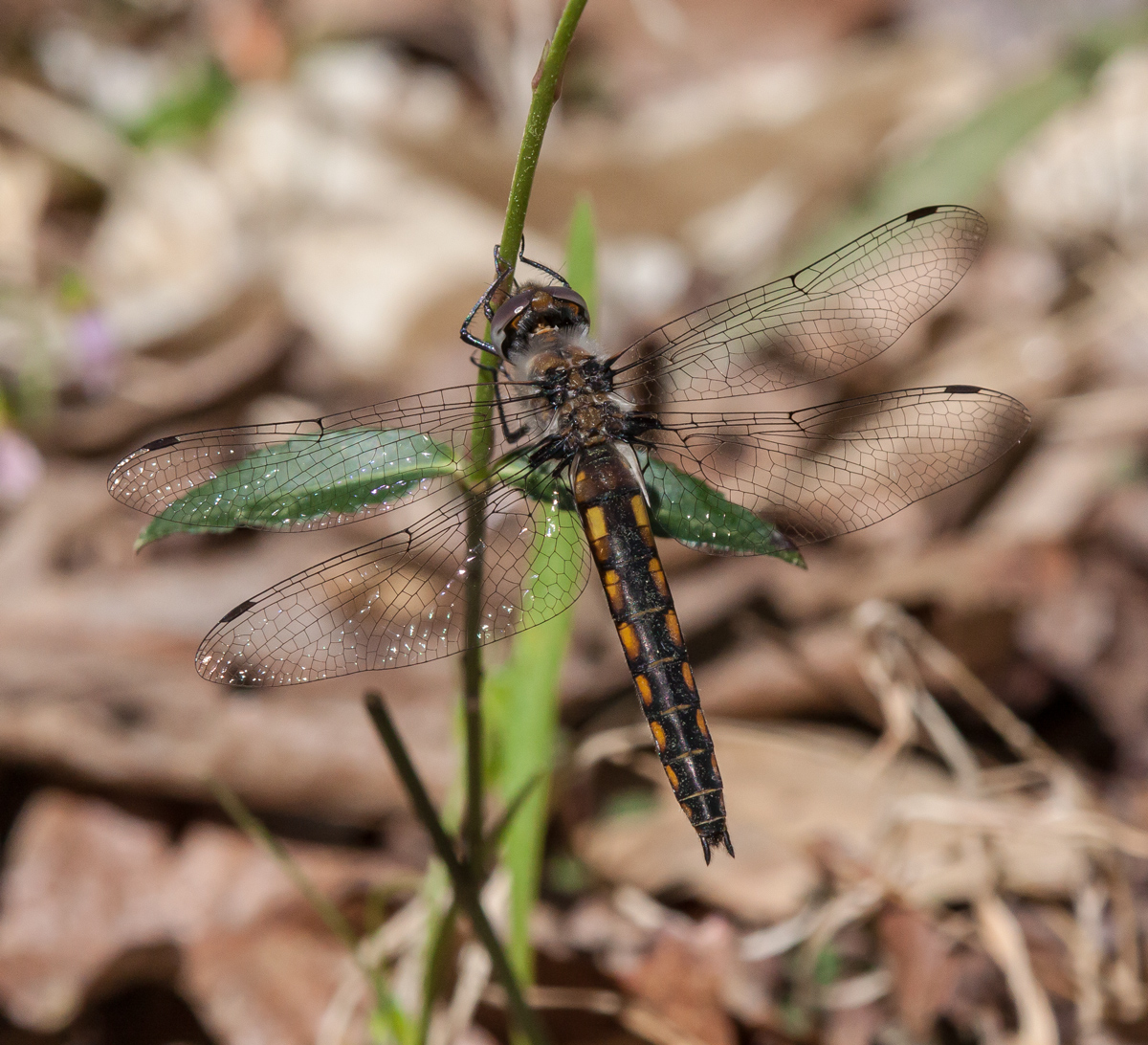
Despite its name, the Common Baskettail dragonfly (Epitheca cynosura), one of the first dragonflies of the spring, has been observed only infrequently at my local marshland park. Therefore I was pretty excited when sharp-eyed fellow blogger and photographer Walter Sanford spotted a Common Baskettail last week when we were out together searching for dragonflies.

Walter consulted with some experts and  was able to confirm his initial identification of this dragonfly as a female. How do you tell the gender of a dragonfly? Check out Walter’s recent posting What was your first clue? to learn how he did it.

If you are more interested in photography than in dragonfly anatomy, check out Walter’s initial posting on the Common Baskettail dragonfly. We both photographed the dragonfly at the same time, but our angles of view and equipment were different, so the resulting images are similar, but not identical.

Personally i enjoy seeing how the creative choices that a photographer makes can influence their images. Walter and I have done several complementary postings in the past and will probably continue to do so in the future.

Common Baskettail dragonfly

© Michael Q. Powell. All rights reserved.

Read Full Post »

« Newer Posts