Feeds:
Posts
Comments

Posts Tagged ‘Huntley Meadows Park’

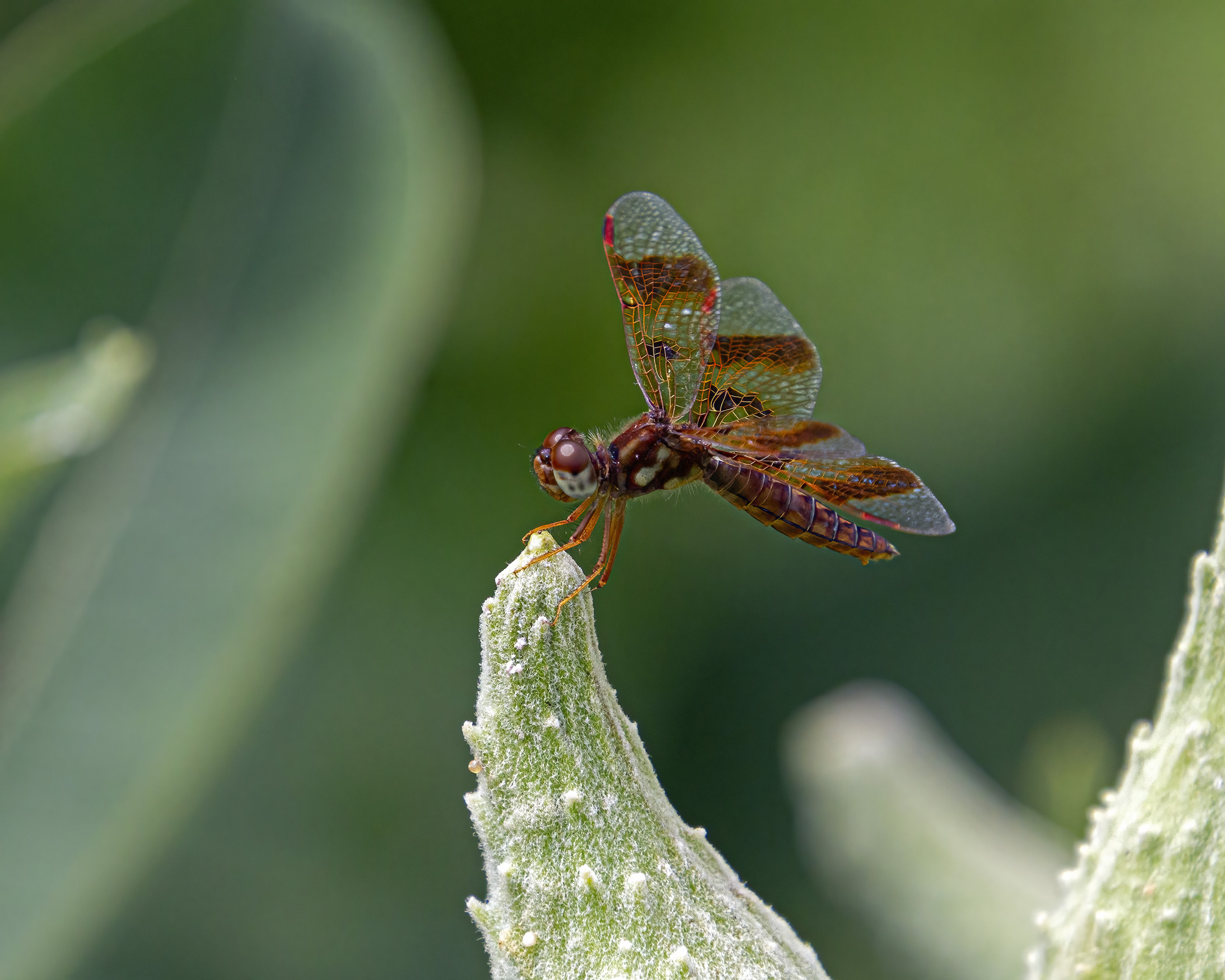
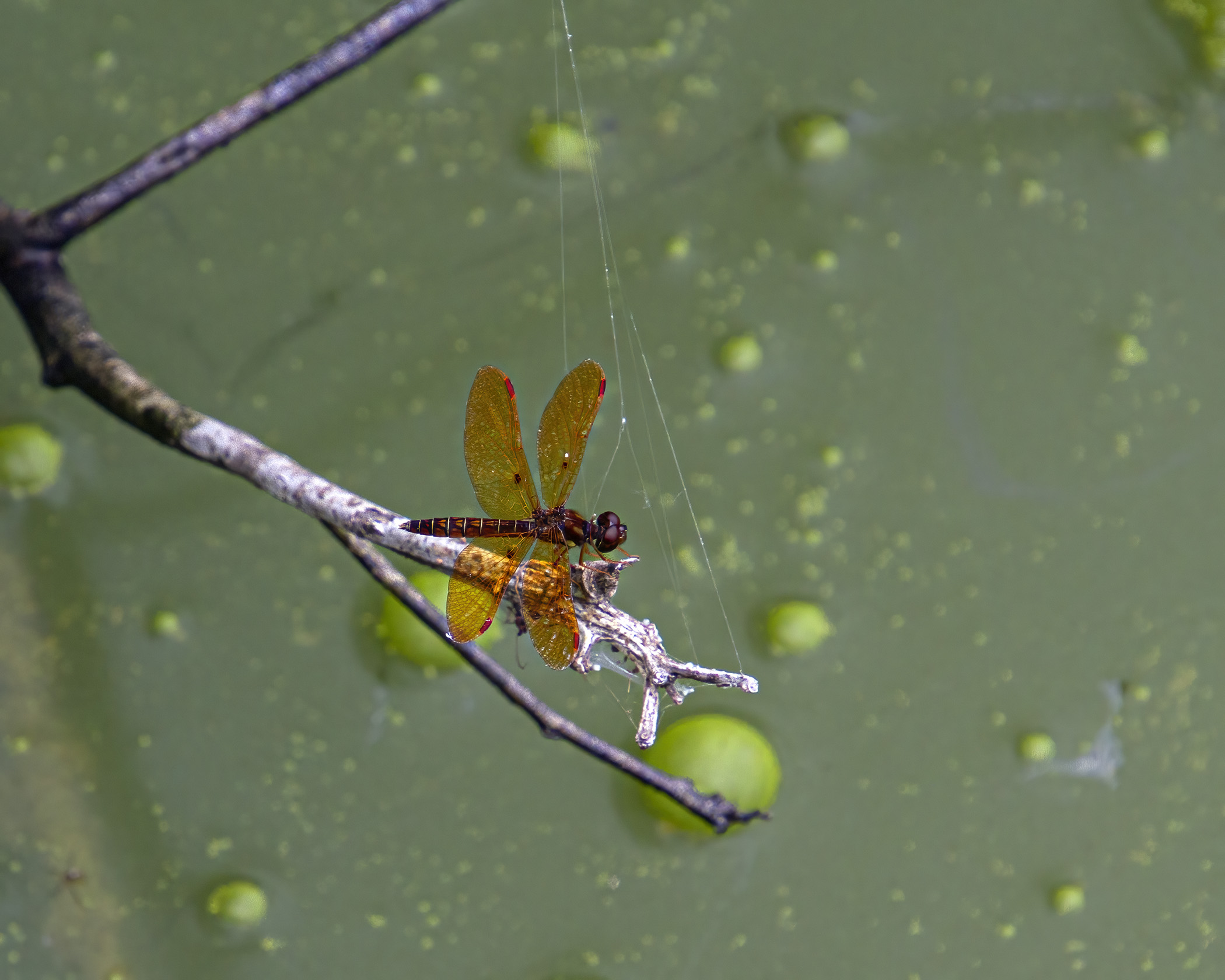
I was excited to spot this female Eastern Amberwing dragonfly (Perithemis tenera) last week at Huntley Meadows Park. Male dragonflies of this species, as you might suspect from its common name, have wings that are amber in coloration, as you can see in the second photo below. Usually the males buzz around over the water at the edges of ponds and I see them quite frequently. Females, however, are most often found in vegetation until they decide that it is time to mate and I don’t see them very often.

Eastern Amberwings are one of the smallest dragonflies in my area at about one inch in length (25 mm). They are considered by some to be wasp mimics.  When they are perched, they reportedly wiggle their abdomen and wings in a wasp-like fashion to deter other animals from eating them.

Female Eastern Amberwing

Eastern Amberwing

© Michael Q. Powell. All rights reserved.

Read Full Post »

When the background in a photo is cluttered, it is often hard to see the main subject, but that was not the case with this beautiful female Eastern Pondhawk dragonfly (Erythemis simplicicollis) that I photographed on Tuesday at Huntley Meadows Park, a local wetlands. I love the brilliant green of the this dragonfly’s thorax and the blackish banding on its abdomen (the “tail”).

You can’t really see it from this angle, but both female and male Eastern Pondhawks have green faces.  This is particularly important for mature males, because it helps to easily distinguish them from males of other species that have a similar bluish coloration on their bodies.

There is something soothing and cooling about this photo, probably because of the sea of green vegetation that surrounds the dragonfly. I can’t help but think of Kermit the Frog singing one of his iconic songs, “It’s not easy being green.” Initially Kermit laments the fact that he is green and blends in with so many ordinary things. Eventually, though, he comes to accept himself as he is, rather than wishing he were different, realizing the beauty of his greenness.

Without getting all preachy, I think there is a lesson there for all of us. Someone famously said that “Comparison is the thief of joy” and we can end up feeling really bad  when we compare ourselves with the curated versions of people we see on social media. Wouldn’t it be better if we could all recognize that we are all beautiful in our own unique ways? As I have repeatedly written on this blog, I believe that beauty is everywhere if we can slow down enough to see it,

On the off chance that you are not familiar with the lyrics of “It’s not easy being green,” I have included them below, as found on theteachersguide.com.

“It’s not that easy being green;
Having to spend each day the color of the leaves.
When I think it could be nicer being red, or yellow or gold…
or something much more colorful like that.

It’s not easy being green.
It seems you blend in with so many other ord’nary things.
And people tend to pass you over ’cause you’re
not standing out like flashy sparkles in the water
or stars in the sky.

But green’s the color of Spring.
And green can be cool and friendly-like.
And green can be big like an ocean, or important like a mountain,
or tall like a tree.

When green is all there is to be
It could make you wonder why, but why wonder why?
Wonder, I am green and it’ll do fine, it’s beautiful!
And I think it’s what I want to be.”
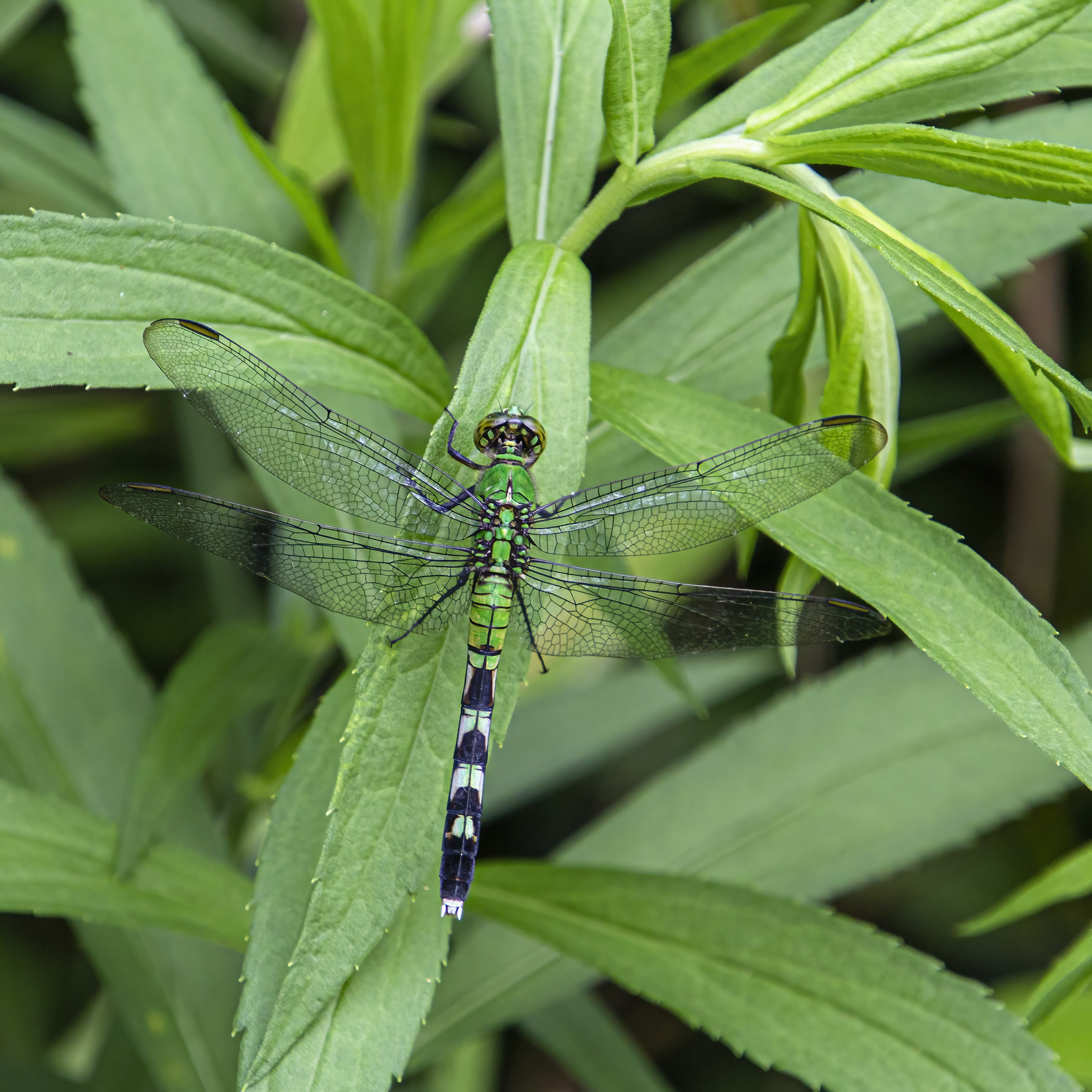
Eastern Pondhawk

© Michael Q. Powell. All rights reserved.


Read Full Post »
The temperatures were a bit lower yesterday and the air quality was better, so I finally ventured out with my camera. I managed to capture a number of fun images of things that caught my eye as I was walking along a hike-bike trail at Huntley Meadows Park, a local, county-run wetland park that I used to visit frequently until it became too popular and overcrowded.

This was my first photo expedition in the wild in more than a month and a half. I was busy with Pride things during parts of June, so I spent time in urban environments, enjoying the events, capturing only a few snapshots with my iPhone. Various combinations of high temperatures, thunderstorms, and unhealthy air quality have kept me indoors this month. To be perfectly honest, I have felt a bit sluggish and lazy, which is a bit unusual for me.

Yesterday I feel like I reconnected with my “mojo,” fully immersing myself in the environment with all of my senses engaged. I couldn’t help but notice, however, how many people that passed me had their eyes focused on their cell phones and were virtually oblivious to the beauties of nature that surrounded them.

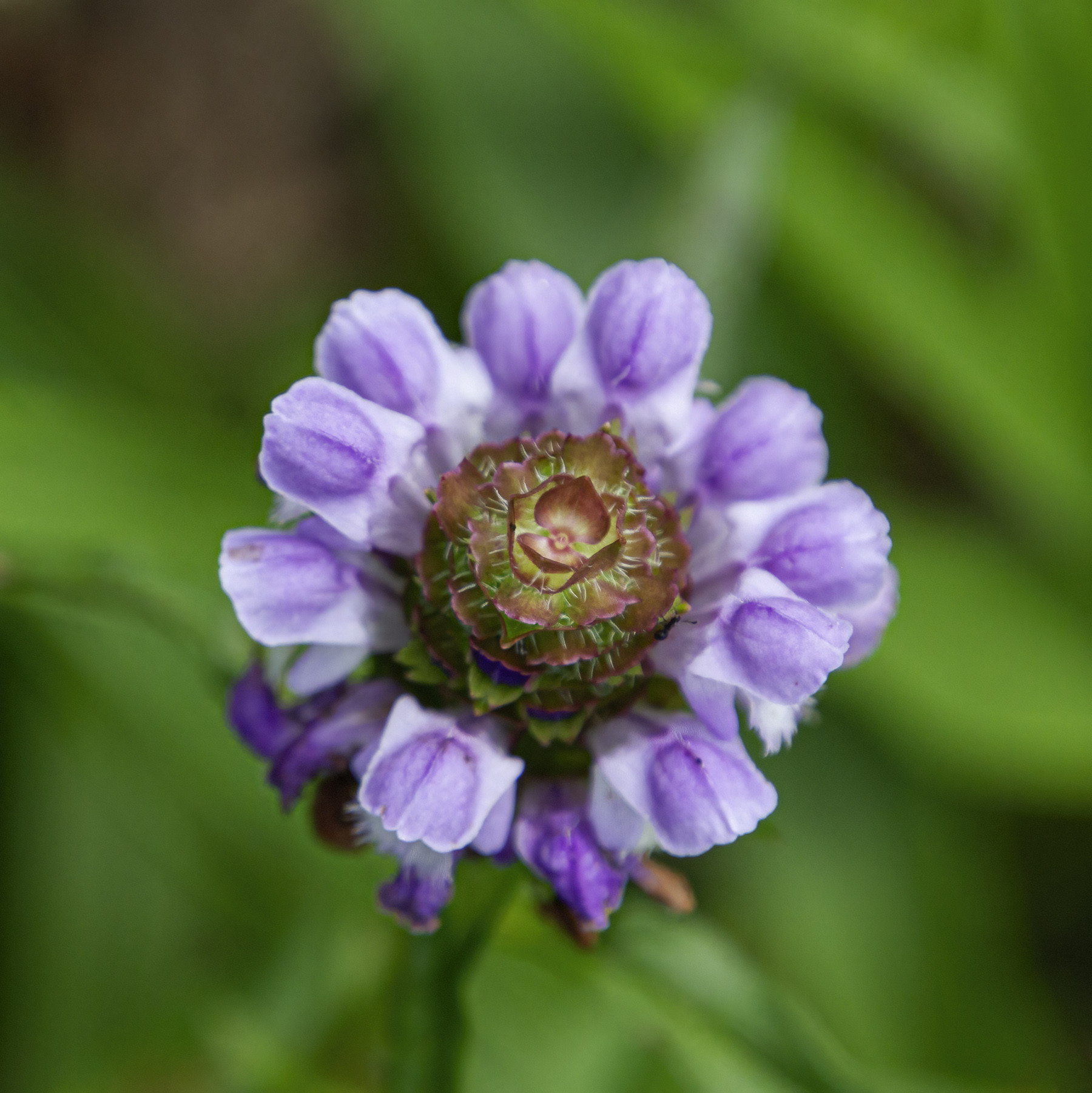
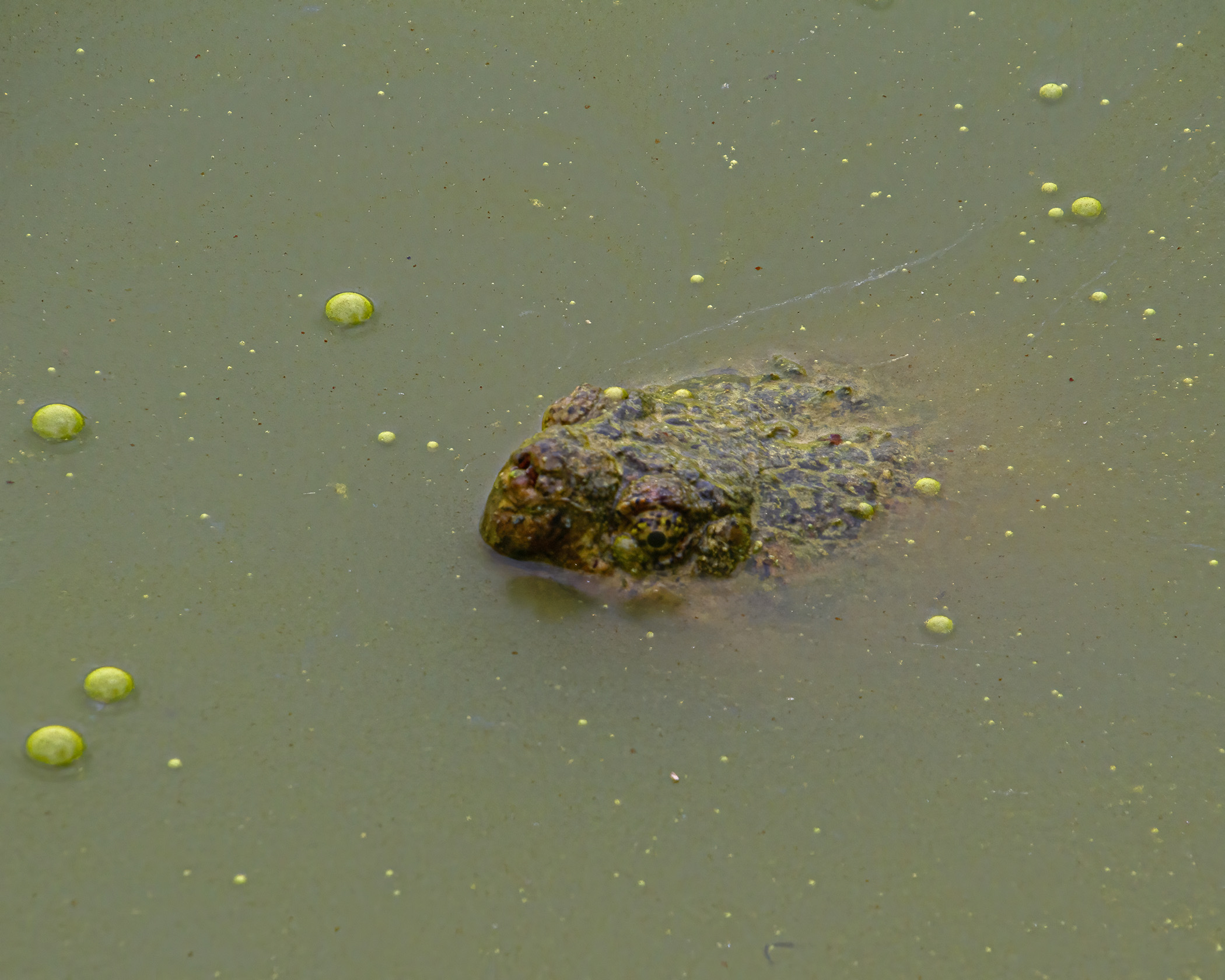
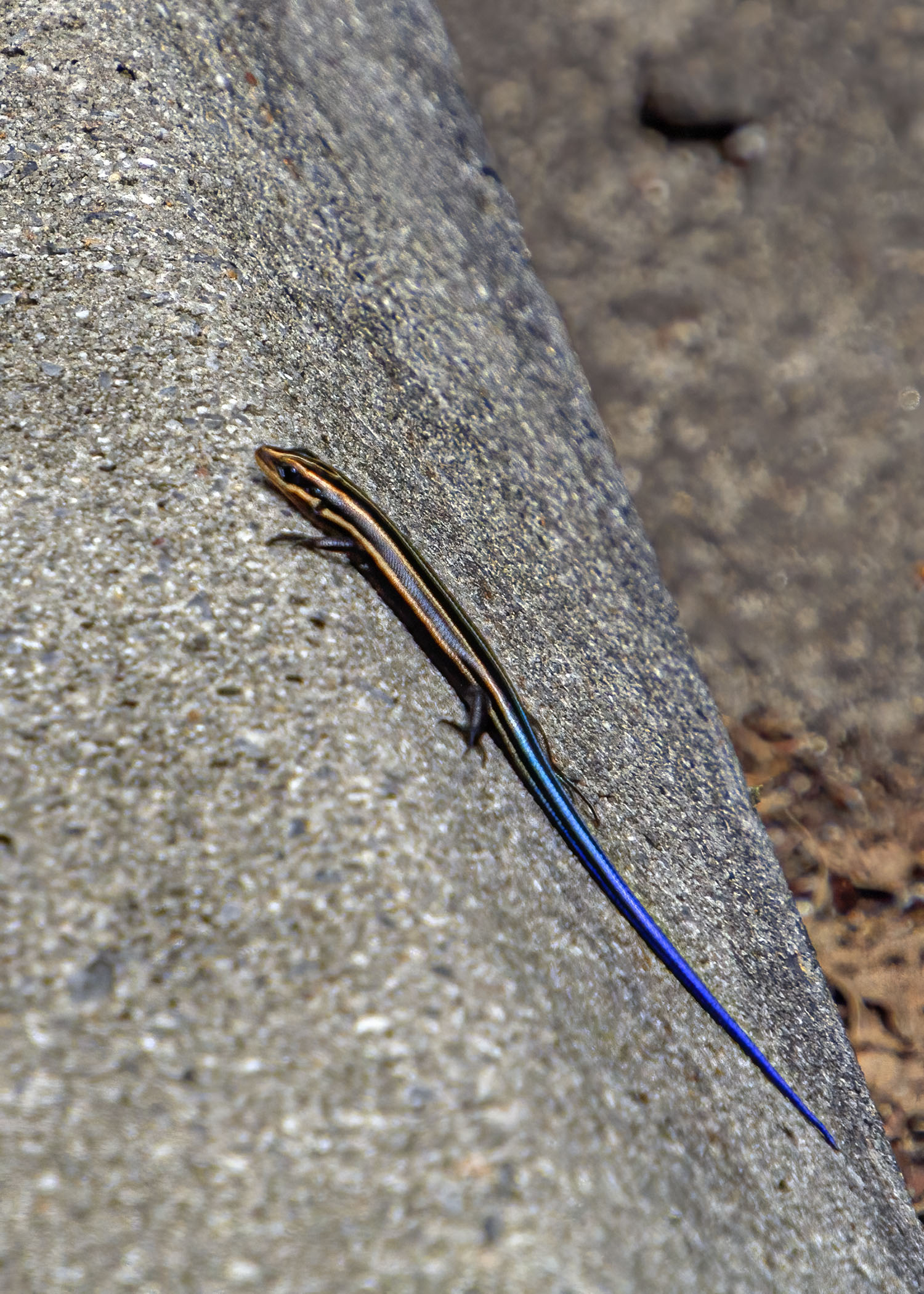
What about you? Would you have noticed the tiny flowering plant growing inches off of the ground? (Please let me know if you can identify it—I came up empty-handed after a cursory internet search.”) Would you have stared down at the murky waters of the pond long enough to spot the snapping turtle that had poked its eyes above the surface and seemed to be watching me? Would you have reacted quickly enough to capture a shot of the bright blue tail of the five-lined skink that momentarily flashed into view as I was walking back to the parking lot?

If you have walked along with me yesterday, different subjects might have caught your attention and you undoubtedly would have captured different images. This little set of photos gives you a general idea of how I view the natural world. What catches your eye?

Snapping Turtle

five-lined skink

© Michael Q. Powell. All rights reserved.


Read Full Post »
As we approach the end of August, some of the more common dragonfly species are becoming much less common. Some autumn species will soon take their places. At the moment the Common Whitetail dragonfly (Plathemis lydia) is the species that I see most often. During a recent visit to Huntley Meadows Park, I spotted this young male Common Whitetail perched vertically on some vegetation.

How do I know that it is a young male? Females of this species have a different pattern of dark patches on their wings, as you can see in the second image below from earlier in the season, and different terminal appendages. Males start out with a darker coloration like that of their female counterparts and as they age they develop a white powdery substance on their abdomens called pruinosity. The dragonfly in the first photo is currently a bluish white and some of the markings are still showing through—eventually he will turn a bright white in color.

Common Whitetail

Female Common Whitetail

© Michael Q. Powell. All rights reserved.

Read Full Post »
It is a bit early to be thinking of autumn, but early signs are beginning to appear. On Monday, classes begin for public school students in our county and traffic will be crazier than ever as commuters and school buses adjust to a changed dynamic.

Some species of summer dragonflies are beginning to disappear and I have begun to search for their autumn replacements. The trails at the wildlife refuges that I haunt are now littered with fallen leaves, making it hard to spot those species that perch on the ground.

This past Monday I captured this shot of a female Common Whitetail dragonfly (Plathemis lydia) at Huntley Meadows Park. This species is one of the most common in my area at this time of the year and I spotted a lot of them during my visit to the park. I particularly like the way that I was able to capture the texture and detail of the dried leaves on which the dragonfly was perched—I can almost hear the crunch of those leaves as I walked through them that day.

Truth be told, autumn is my favorite time of the year and I am patiently waiting for it to arrive. In the meantime, I am still enjoying the summer. “To everything there is a season, and a time to every purpose under heaven.”

Common Whitetail dragonfly

© Michael Q. Powell. All rights reserved.

Read Full Post »
On Monday I spotted this Great Blue Heron (Ardea herodias) on a stump in the middle of a pond at Huntley Meadows Park. The heron seemed to be fully attentive and somehow his pose struck me as regal, like that of a monarch surveying his kingdom. The wonderful reflections in the pond added additional visual interest to the image that I was able to capture.

Great Blue Heron

© Michael Q. Powell. All rights reserved.

Read Full Post »
It is tough to get a proper exposure during the harsh midday sunlight—all too often the image will be overexposed. I sometimes will deliberately compensate by underexposing the subject, which has the effect of significantly darkening the background of the image. This doesn’t always work, but I like the dramatic result that I got when I photographed this little skipper butterfly during a visit earlier this week to Huntley Meadows Park.

As I have noted in multiple post over the years, skipper butterflies are really tough to identify. I looked over lots of images on-line and have concluded that this might be a Zabulon Skipper butterfly (Poanes zabulon) or possibly a Peck’s Skipper butterfly (Polites peckius).

Why did I go with “Zabulon” in the title of this post rather than “Peck’s?” The answer is quite simple is not a scientific determination—I think the name “Zabulon” is a lot cooler than “Peck’s.”

Zabulon Skipper

© Michael Q. Powell. All rights reserved.

Read Full Post »

How do you handle the heat? For those of us who live in the Northern Hemisphere, the last few months have seen a series of unrelenting hot days. High temperatures have frequently been in the 90’s (33 degrees C) and have occasionally pushed past 100 degrees (38 degrees C).

Despite the heat, I ventured out yesterday with my camera during the middle of the day and visited Huntley Meadows Park, a local wetlands area. Wildlife activity seemed quite low—many of the creatures seemed to be sheltering out of sight in the shade. I did manage to spot this female Eastern Pondhawk dragonfly (Erythemis simplicicollis) that was perilously perched on a flimsy bit of vegetation. I don’t know for sure if she was taking a siesta or was simply chilling, but somehow her actions seemed make a bit more sense for dealing with the heat than those of this intrepid photographer.

Perhaps the old saying is true—”Mad dogs and Englishmen go out in the midday sun.” Technically I am not English, so what does that make me?

Eastern Pondhawk

© Michael Q. Powell. All rights reserved.

Read Full Post »

In those parts of the world that use a meteorological calendar, autumn arrived on the first day of September. The rest of us will have to wait until the 22nd of this month to mark the official changing of the season. As I have noted in some previous postings, I have already noted the decrease in several dragonfly species and the overall numbers of dragonflies will continue to drop during September.

It is also common for me to see butterflies with damaged wings at this time of the year. I marvel at the ability of butterflies to survive with a significant amount of damage to their wings. Last week I spotted this Common Buckeye butterfly (Junonia coenia) during a visit to Huntley Meadows Park. The butterfly was missing the lower portions of both of its wings, but somehow was still able to fly.

I recall reading somewhere that the purpose of the large eyespots on the wings of butterflies is to fool predators into attacking those portions of their bodies, thereby protecting their more vulnerable body parts. I don’t know it that was the case with this butterfly, but it may well be the cause of the damage that it has sustained.

Autumn often fills me with a vague sense of melancholy and I acutely feel the passage of time. Some aspects of life inexorably will come to a close or enter a state of dormancy.

I try desperately to hold on to the summer, but a part of me knows that change is inevitable. Enjoy the remaining portions of the season.

Common Buckeye

© Michael Q. Powell. All rights reserved.

Read Full Post »

I was delighted to spot this Great Spangled Fritillary butterfly (Speyeria cybele) feeding on a thistle flower during a recent visit to Huntley Meadows Park, a county-run wetland not far from where I live in Northern Virginia. I have not seen many of this species of butterfly this season, so I was happy to capture this artsy artsy shot of the Great Spangled Fritillary on the one open bloom of the thistle plant.

I love the way that they spiky unopened buds add visual interest to the image without drawing attention from the primary subject.

Great Spangled Fritillary

© Michael Q. Powell. All rights reserved.

Read Full Post »

Earlier this week I watched a distant Great Egret (Ardea alba) as he stared at the waters at Huntley Meadows Park. Initially he was standing tall, but slowly the egret bent over, carefully balancing himself on a floating tree trunk. We both watched and waited until the moment came when he plunged his head into the water. I fired off some shots, wondering if the egret had caught a fish.

I can’t say for certain that the egret was unsuccessful, but it sure looks to me like there was no fish in his bill as he withdrew his head from the water. It appeared to me like the egret was fishing for tiny fish, because he did not plunge his head very deep into the water. After this attempt, the egret stood upright and relaxed for a few moments, before eventually resuming his efforts.

I moved on, wishing him the best of luck in his pursuit of his next fish, as I continued to hunt for dragonflies.

Great Egret

© Michael Q. Powell. All rights reserved.


Read Full Post »

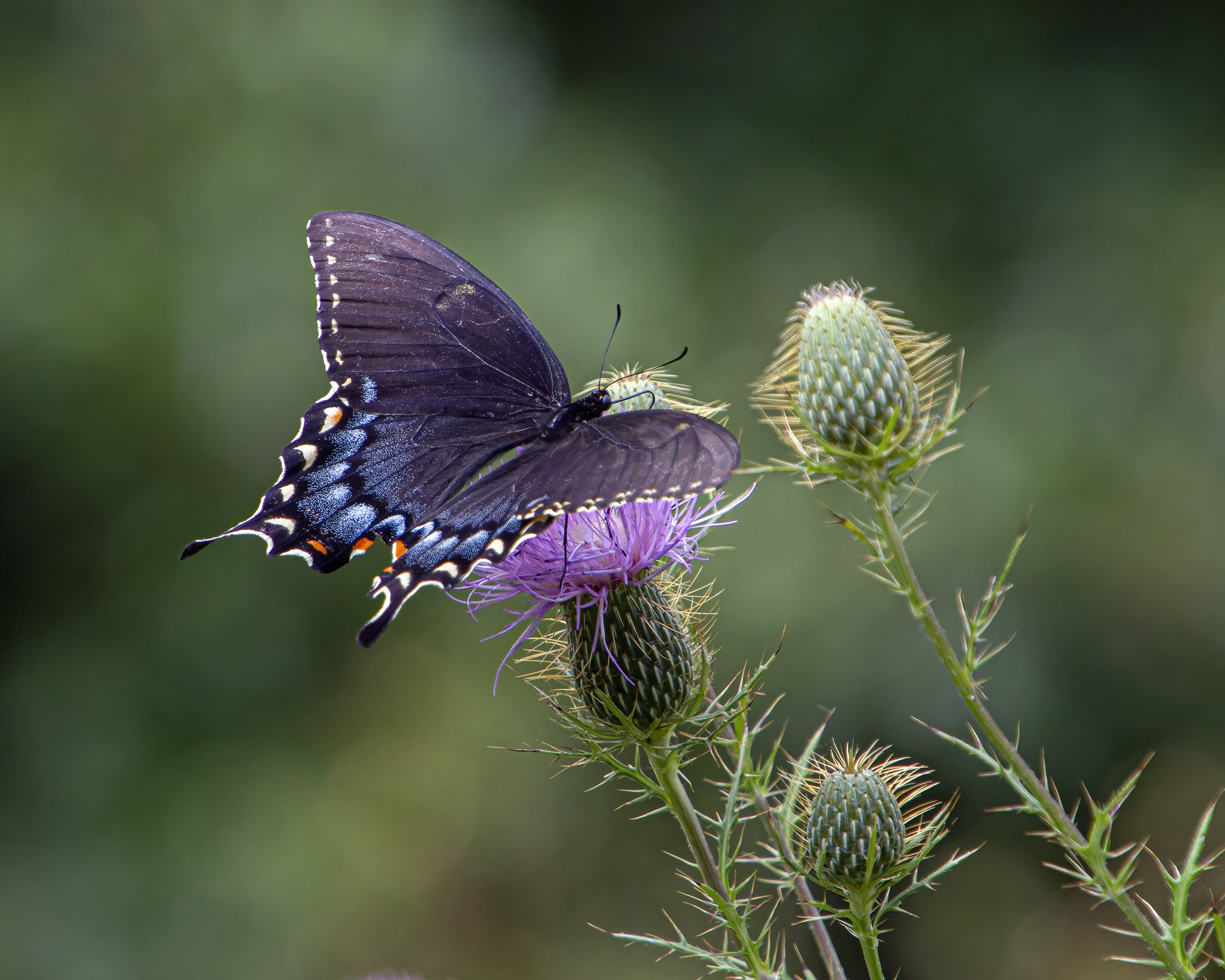
There must be something irresistible about thistle flowers, because on Tuesday I encountered multiple clusters of thistles with butterflies feeding on them during a short visit to Huntley Meadows Park. Sometimes the butterflies seemed to be socially distancing themselves, but at other times they were feeding side by side with other butterflies, including those of different species.

Of course, butterflies do not remain still while feeding—they move about constantly as they change their positions and flap their wings, complicating my efforts to capture images of them. The first photo below is one of my favorites. It shows a dark morph female Eastern Tiger Swallowtail (Papilio glaucus) sharing a thistle flower with two Great Spangled Fritillary butterflies (Speyeria cybele). I love the contrast between the colors of these two species that together provide a foretaste of the autumn season that is almost upon us.

The second photo provides a closer view of the dark morph Eastern Tiger Swallowtail. The final photo is a shot of what I believe is another female Eastern Tiger Swallowtail that has a yellow coloration similar to that of a male, but has an additional band of blue spots along the hindwings. I think it is really cool that there are two different color variants of females—in many insect and bird species, the males have more color and variation and the females are drab by comparison.

butterflies

Eastern Tiger Swallowtail

Eastern Tiger Swallowtail

© Michael Q. Powell. All rights reserved.

Read Full Post »

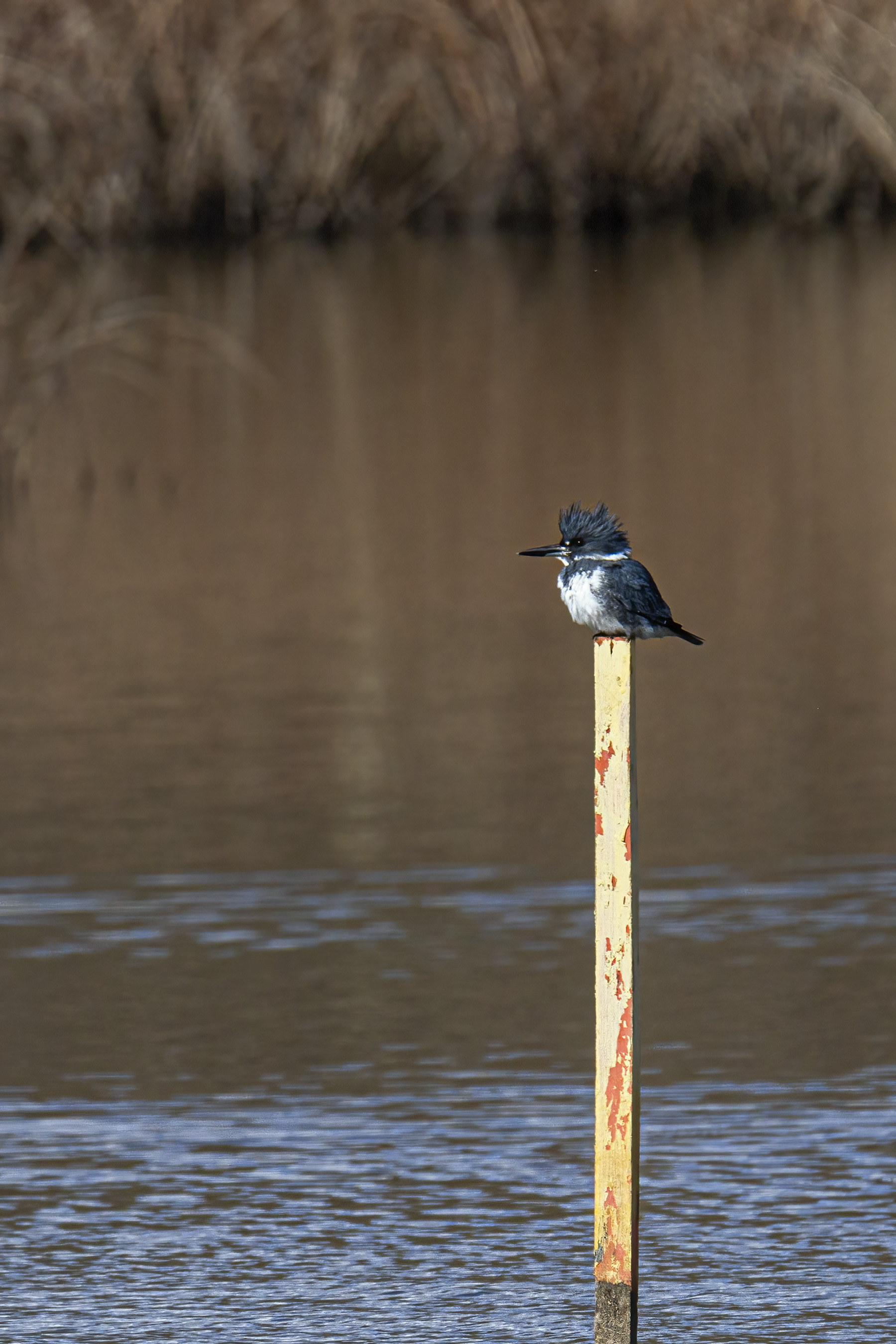
Belted Kingfishers (Megaceryle alcyon) are one of my nemesis birds. They are small and fast and incredibly skittish. I see (or hear) them quite often, but I am rarely able to get a decent shot of one.

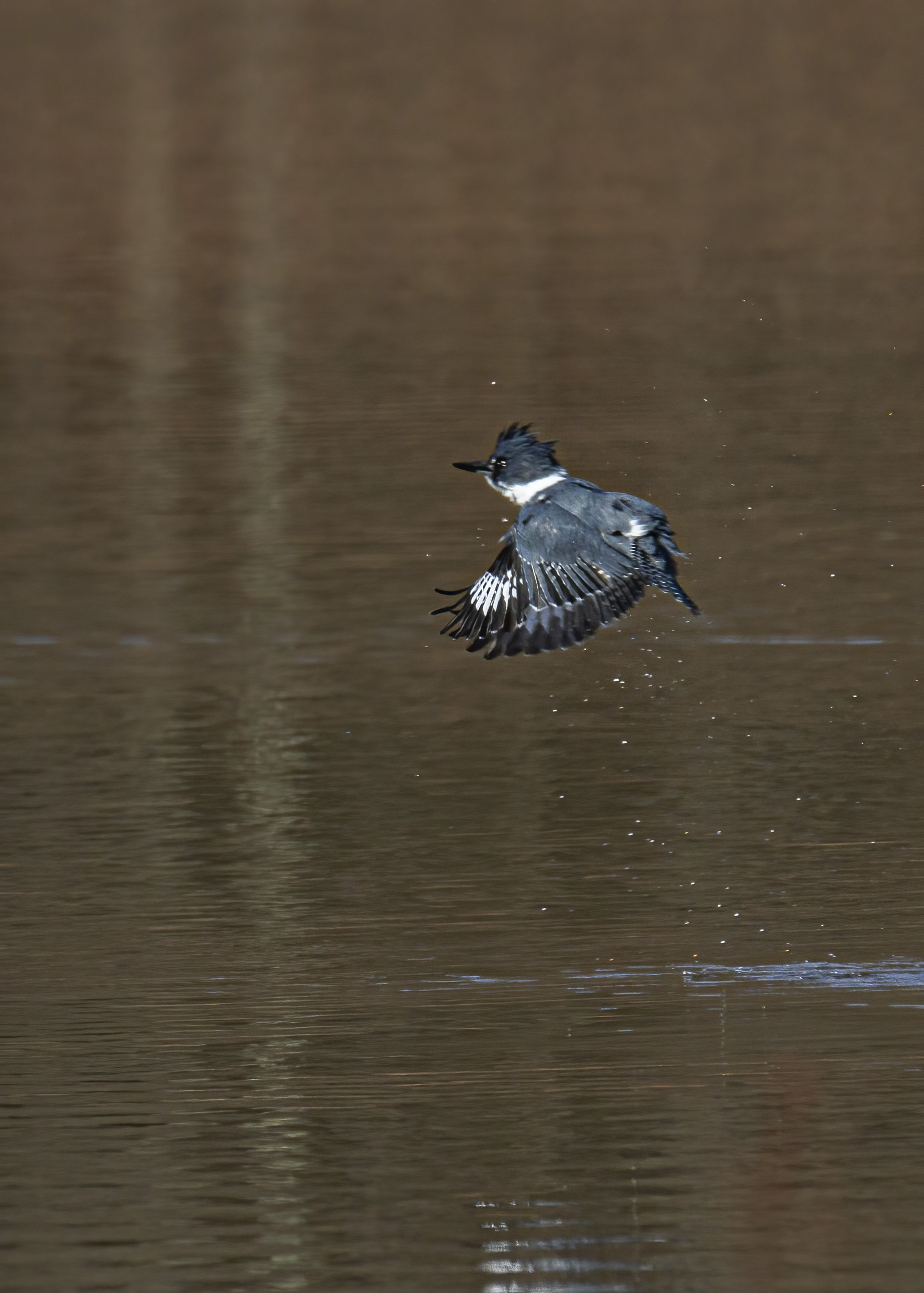
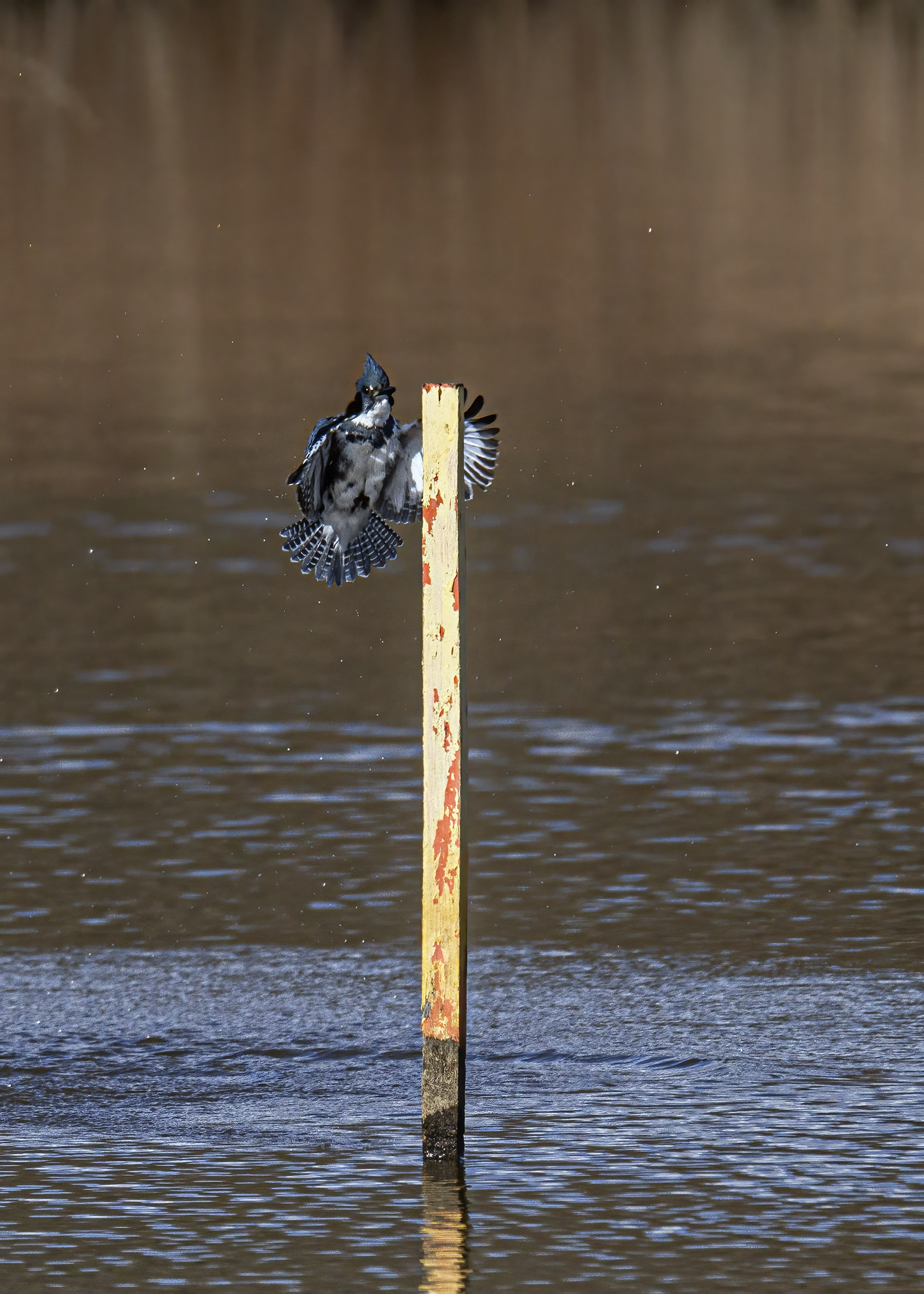
I spent a good amount of time last Friday at Huntley Meadows Park observing a male Belted Kingfisher trying to catch a fish. He was perched on some kind of board sticking out of the water and repeatedly dove into the water and returned to the same post. Eventually he caught a fish, but, alas, flew away with it before I could get a shot of him with his catch.

Unlike an eagle that grabs a fish with its talons without submerging itself, a kingfisher dives headfirst into the water, creating a big splash. According to the Cornell Lab of Ornithology, “When it spots a fish or crayfish near the surface, it takes flight, dives with closed eyes, and grabs the prey in its bill with a pincer motion. Returning with its prize, it pounds the prey against the perch before swallowing it head first.”

I was perched on am observation platform some distance away, but had a clear line of sight to the kingfisher. Over time I was able to capture some relatively sharp shots of the kingfisher in action. The first shot is my favorite—the kingfisher was rising up out of the water, surrounded by water droplets, after what appeared to have been an unsuccessful attempt.

The second photo shows the kingfisher on its perch. I am not sure why this board was sticking out of the water, but noted several similar boards nearby. The subsequent images show the kingfisher in various stages of action. I was fortunate that the kingfisher made several attempts, sometimes diving to the left and sometimes to the right, so I had multiple chances to get shots. Actions shots are a tough, but fun challenge. The kingfisher would take off without warning and after it dove into the water, I was never sure exactly when and where he would reemerge.

Belted Kingfisher

Belted Kingfisher

Belted Kingfisher

Belted Kingfisher

Belted Kingfisher

Belted Kingfisher

© Michael Q. Powell. All rights reserved.


Read Full Post »

Usually when I hear some rustling in the leaves and see a flash of rust-colored feathers, I assume that it is an American Robin. I was delighted last Friday at Huntley Meadows Park to be wrong in my assumption. When I zoomed in on the bird that had attracted my attention, I realized that it was an Eastern Towhee (Pipilo erythrophthalmus), a species that I see a lot less frequently than the American Robin,

This colorful little bird proved to be quite skittish and I managed to capture only a few shots of it before it flew deeper into the underbrush. Fortunately I was able to capture enough details that you can see the bird’s beautiful markings and coloration.

Eastern Towhee

© Michael Q. Powell. All rights reserved.

Read Full Post »

Last Friday at Huntley Meadows Park a host of turtles emerged from their winter sleep to bask in the unseasonably warm sun, including this beautiful Spotted Turtle (Clemmys guttata). Unlike most of the turtles where I live that prefer larger, more open bodies of water, Spotted Turtles are found most often in the shallow water of marshy areas and are considered to be semi-aquatic.

As I recall, turtles do not hibernate, but instead enter a period of brumation in which they bury themselves in the mud and slow down their metabolisms. According to the Pee Dee Wildlife Control website, “Brumation is different than hibernation as the animals who brumate can wake up on the random warm days to sun themselves and drink water to avoid dehydration, whereas a hibernating animal will not.”

The temperature last Friday soared to 80 degrees (27 degrees C) at Ronald Reagan National Airport here in the Washington D.C. area, a record high temperature for the month of January. The change in temperature was particularly jolting, because it came just one week after a snowstorm had dropped five inches (13 cm) of snow on us and a protracted period of sub-freezing temperatures that followed that storm.


Spotted Turtle

© Michael Q. Powell. All rights reserved.

Read Full Post »

When I was growing up in New England, American Robins (Turdus migratorius) were always viewed as a harbinger of spring. I don’t know if American Robins migrated out of our area and returned in the spring, but I do recall that seeing one of them foraging on a lawn meant that spring was on the way.

Here in Northern Virginia where I have lived for thirty years now, I have grown accustomed to seeing American Robins throughout almost the entire year. It gets cold enough here that the ground freezes most years, so I suspect that the robins have to adapt their diets to other food sources—I have a mental picture of robins pulling worms out of the ground and that would not be possible during the winter.

I spotted this American Robin last Thursday almost hidden in the vegetation at Huntley Meadows Park. I suspect that it is either a female or an immature male, given the rather pale coloration and the white patches of feathers on the belly.

American Robin

© Michael Q. Powell. All rights reserved.

Read Full Post »

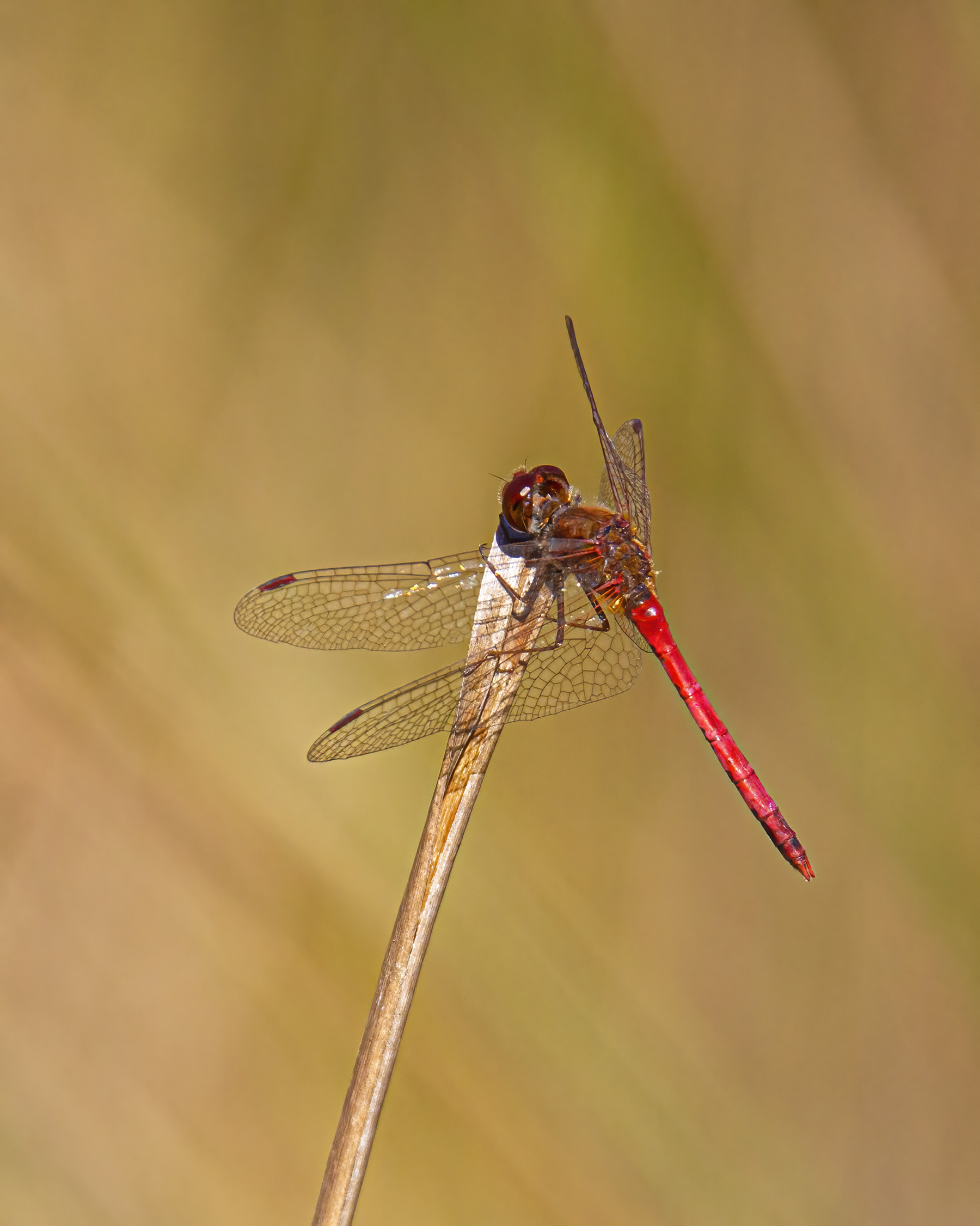
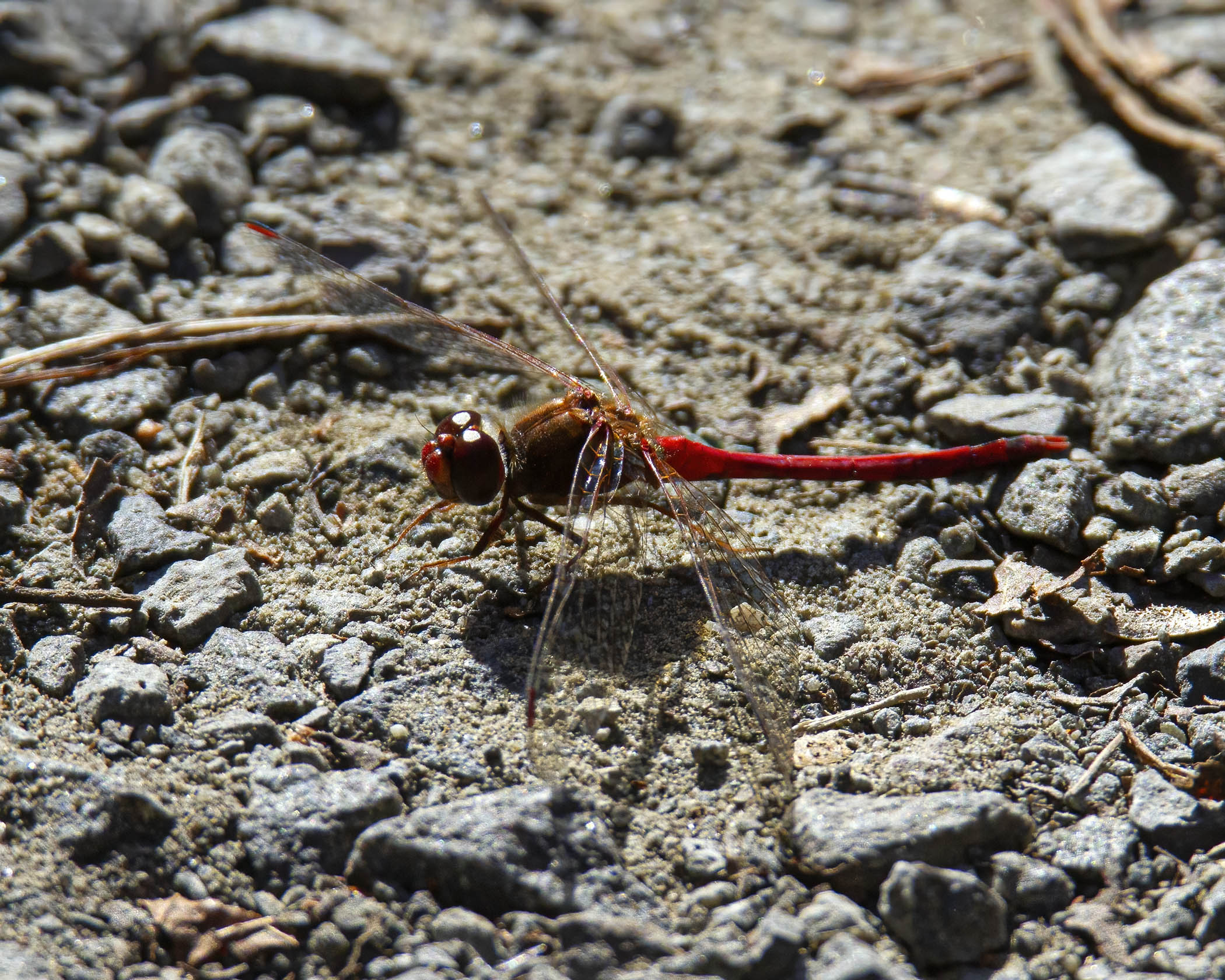
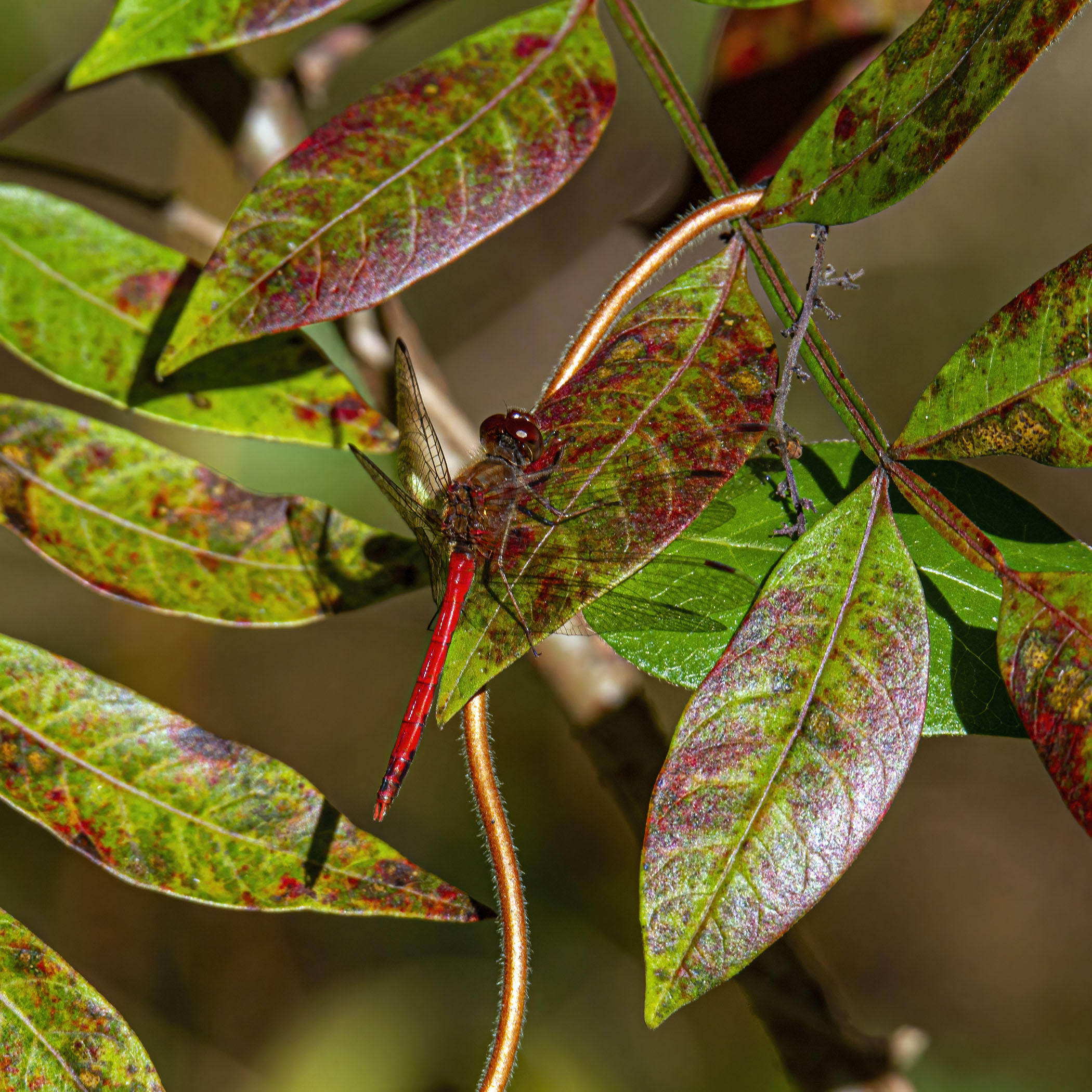
I can’t totally exclude the possibility that I may see a hardy survivor of another species, but it is beginning to look like Autumn Meadowhawks (Sympetrum vicinum) are the sole remaining dragonfly species. Last week I spotted quite a few of them during a visit to Huntley Meadows Park, a county-owned marshland not far from where I live.

I tried to capture images of these bright red beauties in as many different environments as I could. Autumn Meadowhawks often perch on the ground, which does not provide a very interesting background, as you can see in the final photo. It is much more interesting if they perch on fallen leaves, or even better if they choose a more elevated perch.

The photos below give you an idea of how I try to “work” a subject. I try to shooting from different angles and distances.  When possible, I try to selectively include or exclude background elements by choosing the appropriate camera settings, as you can see in the fourth photo, where I caused the background to be totally out of focus. Paying attention to the direction of the light really helps too, as you can see particularly in the second image in which the light is so directional that it almost looks like a studio portrait.

Autumn Meadowhawks will probably be around for another few weeks or maybe a month or so, depending in part on the severity of the local weather. At that point, I will rekuctantly turn my focus to birds, landscapes, and other non-insect subjects. I also hope to devote a bit more attention to learning more about creating videos—I have a modest YouTube channel that I have allowed to languish this past year.

Autumn Meadowhawk

Autumn Meadowhawk

Autumn Meadowhawk

Autumn Meadowhawk

Autumn Meadowhawk

© Michael Q. Powell. All rights reserved.

Read Full Post »
Now that Autumn Meadowhawk dragonflies (Sympetrum vicinum) have become the only dragonflies that I see regularly, I have been paying a great deal of attention to their perches when I am photographing them—when there are a limited number of subjects available, I try to make each encounter count. During a recent trip to Huntley Meadows Park, a county-run marshland park only a few miles from where I live, I managed to capture images of these colorful little dragonflies perching on a variety of different types of vegetation.

Often I have to choose between zooming in close to show the details of my subjects or pulling way back to show the environment in which I found them. In the case of these Autumn Meadowhawks, though, the images balance those competing priorities quite well, in part, I believe, because the dragonflies were so immersed in their environment, i.e. they do not choose high perches that produce “dragonfly on a stick” photos that isolate the subject too much from its surroundings.

Autumn Meadowhawk

Autumn Meadowhawk

Autumn Meadowhawk

© Michael Q. Powell. All rights reserved

Read Full Post »

The red bodies of male Autumn Meadowhawk dragonflies (Sympetrum vicinum) make them relatively easy to spot.  However, when they choose to perch on foliage that matches their coloration, they can sometimes be well camouflaged.

The first photo shows an Autumn Meadowhawk perched on some kind of red vegetation (Virginia Creeper ?) at Huntley Meadows Park last Thursday. The red leaves really help to give the image a feel of autumn.

In the second image, the dragonfly stands out a bit more, but the dying leaves provide an artistically pleasing backdrop for the beautiful little dragonfly—I love this composition a lot.

Autumn Meadowhawk

Autumn Meadowhawk

© Michael Q. Powell. All rights reserved.


Read Full Post »

Lots of wildflowers still in bloom as we move deeper into autumn here in Northern Virginia. Last night we had our first frost warning of the season, but I don’t think there was any frost this morning in my neighborhood—a hard frost may speed the demise of many of the remaining butterflies and dragonflies. I was therefore delighted last Thursday to spot this Clouded Sulphur butterfly (Colias philodice) feeding on the flowers of what I believe is a White Heath Aster (Symphyotrichum ericoides) plant at Huntley Meadows Park.

Although part of the butterfly is obscured by the stem and the leaves in the foreground of this image, I like the way that I was able to capture the details of the butterfly’s green eyes and its extended proboscis.

Clouded Sulphur

© Michael Q. Powell. All rights reserved.

Read Full Post »

I will often strive to photograph my wildlife subjects from as many different angles as I can in order to take advantage of the lighting or to highlight the details of their bodies. When I spot a subject, though, I initially try to capture whatever shot I can before I work to get a better shot—any of my subjects are skittish and there is always the chance that my initial shot will be my only one.

I spotted this perched male Belted Kingfisher (Megaceryle alcyon) last Thursday at Huntley Meadows Park in Alexandria, Virginia and one of my initial shots was the third one below. The perch was sticking out of a pond that was surrounded by a marshy wetland, so there was really no chance for me to get closer to the kingfisher—there was no way to work the angles in my usual way.

So what did I do? In the background I noticed there were some patches of colorful fall foliage, so I decided to see if I could include some of those colors in my images to give them an autumn vibe. By bending, twisting, crouching, and kneeling I was able to vary my shooting angle, while remaining more or less in the same spot, and eventually managed to get some photos that included portions of that autumn foliage. The kingfisher remained in place, but cooperated by changing his head position from time to time.

Belted Kingfisher

Belted Kingfisher

Belted Kingfisher

© Michael Q. Powell. All rights reserved.

Read Full Post »
I was thrilled yesterday on Thursday at Huntley Meadows Park, a local marshland park, when I finally spotted some Blue-faced Meadowhawk dragonflies (Sympetrum ambiguum), a stunning species that is one of my favorites, after searching in vain for them at other locations for over a month. The Blue-faced Meadowhawk is a late-season dragonfly that is somewhat similar in appearance to the more common Autumn Meadowhawk—males of both species have bright red bodies, but the Autumn Meadowhawks have brown eyes.

The females of both species are more muted in their coloration than their male counterparts, as is often the case with many dragonflies and birds, so they have more natural camouflage and are frequently more difficult to find. The second image shows a female Blue-faced Meadowhawk that I managed to spot in the same general area as the male in the first photo. I love the way that the female dragonfly appeared to be singing a song as she basked in the sunlight on some dried-out vegetation.

Blue-faced Meadowhawk

Blue-faced Meadowhawk

© Michael Q. Powell. All rights reserved.


Read Full Post »

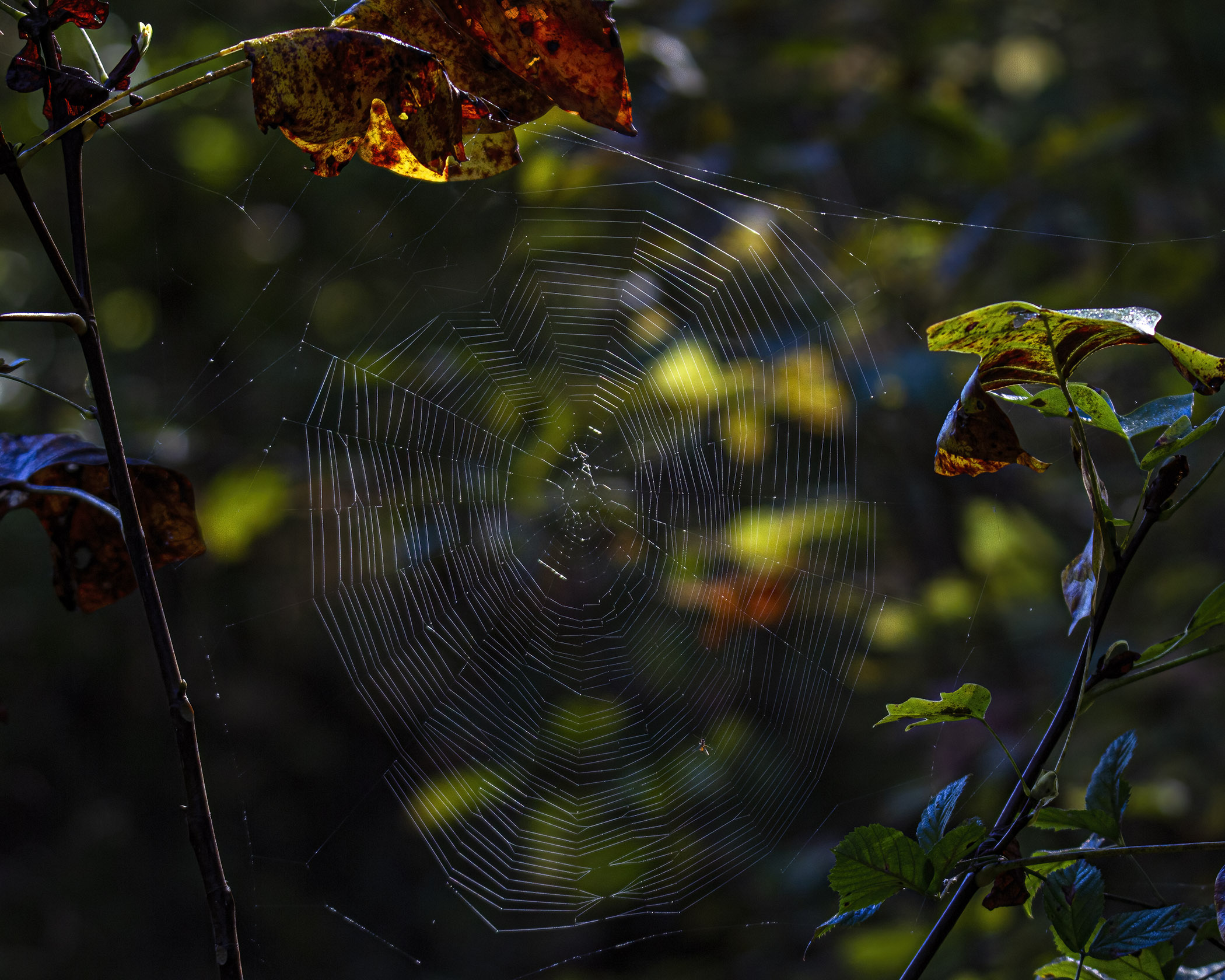
I have always admired the beauty and artistry of spider webs. It is so amazing to me that they can create such intricate patterns out of bodily secretions. I stumbled upon this beautiful little web on Thursday at Huntley Meadows Park and was thrilled that I was able to capture an image of it. I encourage you to click on the image for a closer view of the web design.

In order to make sure that the web did not disappear into the background completely, I deliberately underexposed the image, and focused manually on the web—there was no way that my camera’s autofocus would focus on the web.

spider web

© Michael Q. Powell. All rights reserved.

Read Full Post »

This late in the season, most of the large butterflies seem to be gone, but I continue to see some of the smaller ones, like this beautiful Variegated Fritillary butterfly (Euptoieta claudia) that I spotted on Thursday during a visit to Huntley Meadows Park, a county-run marshland park not far from where I live. Earlier in the year I encountered some Great Spangled Fritillaries, but I think this may well be my first sighting of a Variegated Fritillary in 2023.

The butterfly appeared to be basking in the sun as it perched with its wings wide open on some dried-out vegetation. I was using my Tamron 150-600mm telephoto zoom lens, which has a minimum focusing distance of almost nine feet (270 cm), so I was pretty far from the butterfly when I captured this image. I have read reviews that state that this lens is soft when fully extended to 600mm, but I have found that I can get acceptably sharp images if I pay a lot of attention to my focusing and shooting techniques, including remaining steady—in this case I was using a monopod.

Variegated Fritillary

© Michael Q. Powell. All rights reserved.


Read Full Post »
I was delighted to spot this Common Wood Nymph butterfly (Cercyonis pegala) this past Wednesday at the edge of the hike-bike trail on the back side of Huntley Meadows Park, a county-run marshland park in Alexandria, Virginia. I love the distinctive yellow patch on its wing and its really cool eyes with vertical stripes. Common Wood Nymphs usually like to hang around near the edges of the woods rather than in the fields that many butterflies seem to prefer.

Generally I like to get the plane of the sensor of my camera sensor as close to parallel as possible with my subject, so that the entire subject is in focus. In this case, though, a large mass of thorny vines kept me from being able to get my desired shooting angle and consequently the focus on the left-hand side of the subject is a little soft. That being said, I am nonetheless pretty happy with this shot of a cool-looking butterfly that I don’t see very often.

Common Wood Nymph

© Michael Q. Powell. All rights reserved.


Read Full Post »
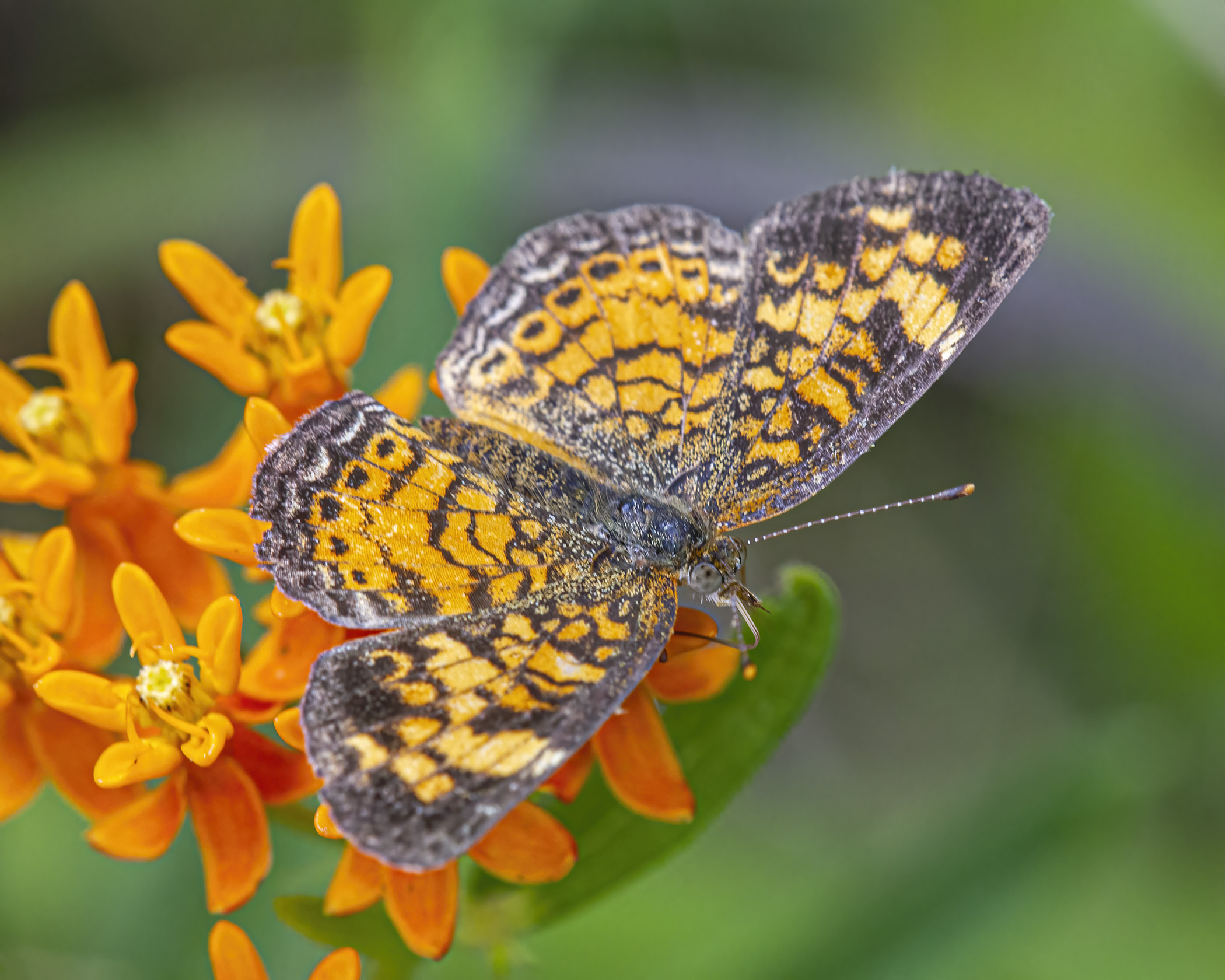
It is always a joy to see butterfly weed (Asclepias tuberosa), a bright orange species of milkweed that is full of nectar and attracts lots of butterflies. On Monday I spotted what I believe is a Pearl Crescent butterfly (Phyciodes tharos) feeding on some butterfly weed at Huntley Meadows Park in Alexandria, Virginia. I spotted some regular milkweed earlier in the day and was hoping to see my first Monarch butterfly of the season, but, alas, I came up empty-handed this time.

I love bright colors and some of you may recall that I drive an Ignition Orange KIA Soul. I was delighted to be able to capture some of the beautiful details and color of the butterfly weed and also some details of the butterfly, including its striking eyes and extended proboscis.

Pearl Crescent

© Michael Q. Powell. All rights reserved.

Read Full Post »

In the United States, today is Memorial Day, a federal holiday. For some people this day marks the unofficial beginning of summer, but for me, as someone who served for twenty years in the U.S Army, this day has a deeper meaning, a day to reflect on the lives of the brave men and women who died in the defense of this nation. Yesterday, Facebook reminded me of a posting I made on Memorial Day 2018, and I decided to share it again today in this blog posting.

“I was prompted this morning to read again the challenges to us in the Gettysburg Address, which seem so appropriate today as we remember the sacrifices of so many brave men and women. “It is for us the living, rather, to be dedicated here to the unfinished work which they who fought here have thus far so nobly advanced. It is rather for us to be here dedicated to the great task remaining before us—that from these honored dead we take increased devotion to that cause for which they gave the last full measure of devotion—that we here highly resolve that these dead shall not have died in vain—that this nation, under God, shall have a new birth of freedom—and that government of the people, by the people, for the people, shall not perish from the earth.” ”

For those of you who might be curious, the photo below is from a November 2014 blog posting entitled “Rescue of an injured Bald Eagle” that documented the capture of an injured eagle by an officer of the Fairfax County Animal Control Services at my local marshland park. Some of the photos from that posting were reprised in Washington D.C. media outlets and the posting has been my all-time most popular posting with 3472 views.

Bald Eagle

© Michael Q. Powell. All rights reserved.


Read Full Post »

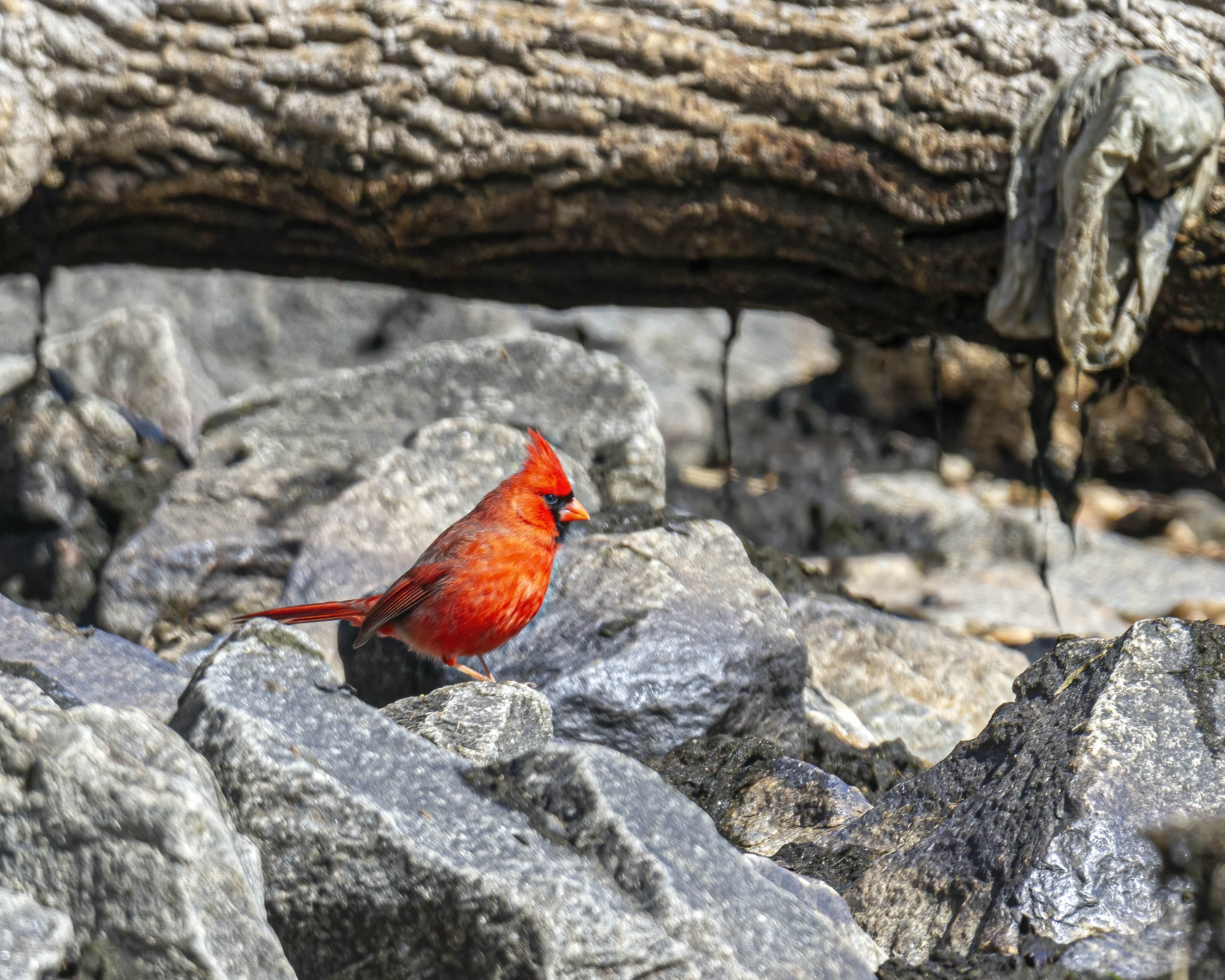
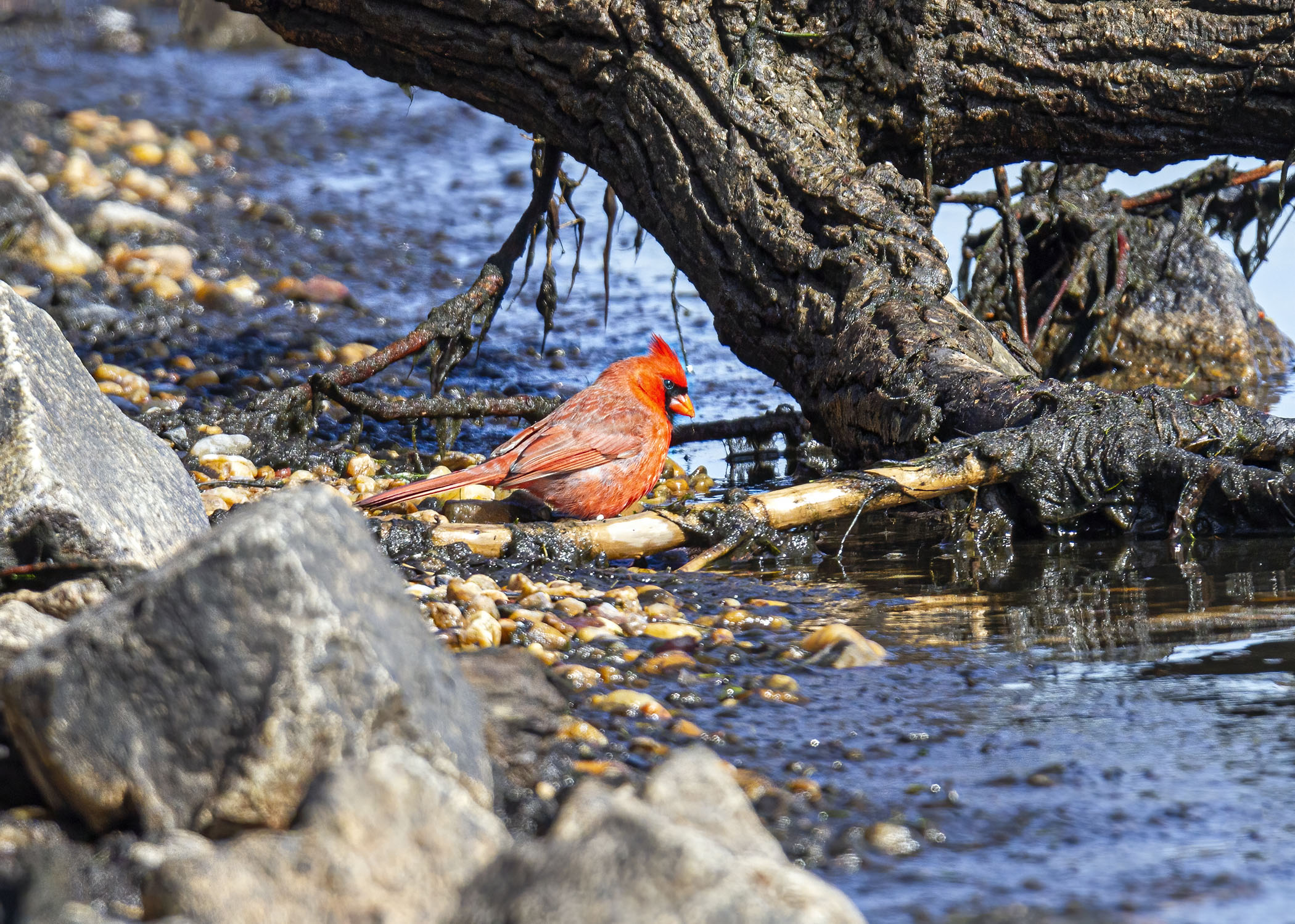
It is always fun to photograph familiar subjects in an unexpected environment. This past week I spotted a male Northern Cardinal (Cardinalis cardinalis) amidst the rocks and other debris at the edge of the water at Occoquan Bay National Wildlife Refuge rather than in the vegetation where I normally see cardinals.

I was delighted to be able to capture a series of images as the cardinal moved about on the rocks and eventually made his way to the water. He dipped his head to take a drink, but his face was completely hidden from view, so I was not able to capture that moment.

On the whole, though, I really like the balance I was able to achieve in showing both the primary subject and the environment in which I found him—the brightness of the cardinal’s red body definitely helped him to stand out from the somewhat cluttered background and foreground despite the fact that he filled only a small part of the frame.

Northern Cardinal

Northern Cardinal

Northern Cardinal

Northern Cardinal

© Michael Q. Powell. All rights reserved.

Read Full Post »

The colors of the fall foliage in my area of Northern Virginia are not very impressive. Generally we fade gradually from green to brown and then the leaves fall off of the trees. Fortunately, though, pops of bright color periodically remind me of the colors that I would see when I was growing up in New England.

It is still a bit early for those colors to appear, but I did notice a few traces of autumn color when I was out with my camera this week. Mostly it was individual colorful leaves, but I did notice a few trees as I gazed across the pond at Huntley Meadows Park that had jumped ahead of their compatriots and were already showing their blazing red autumn color.

Autumn is my favorite time of the year, especially the early days of autumn.

autumn color

autumn color

autumn color

© Michael Q. Powell. All rights reserved.

Read Full Post »
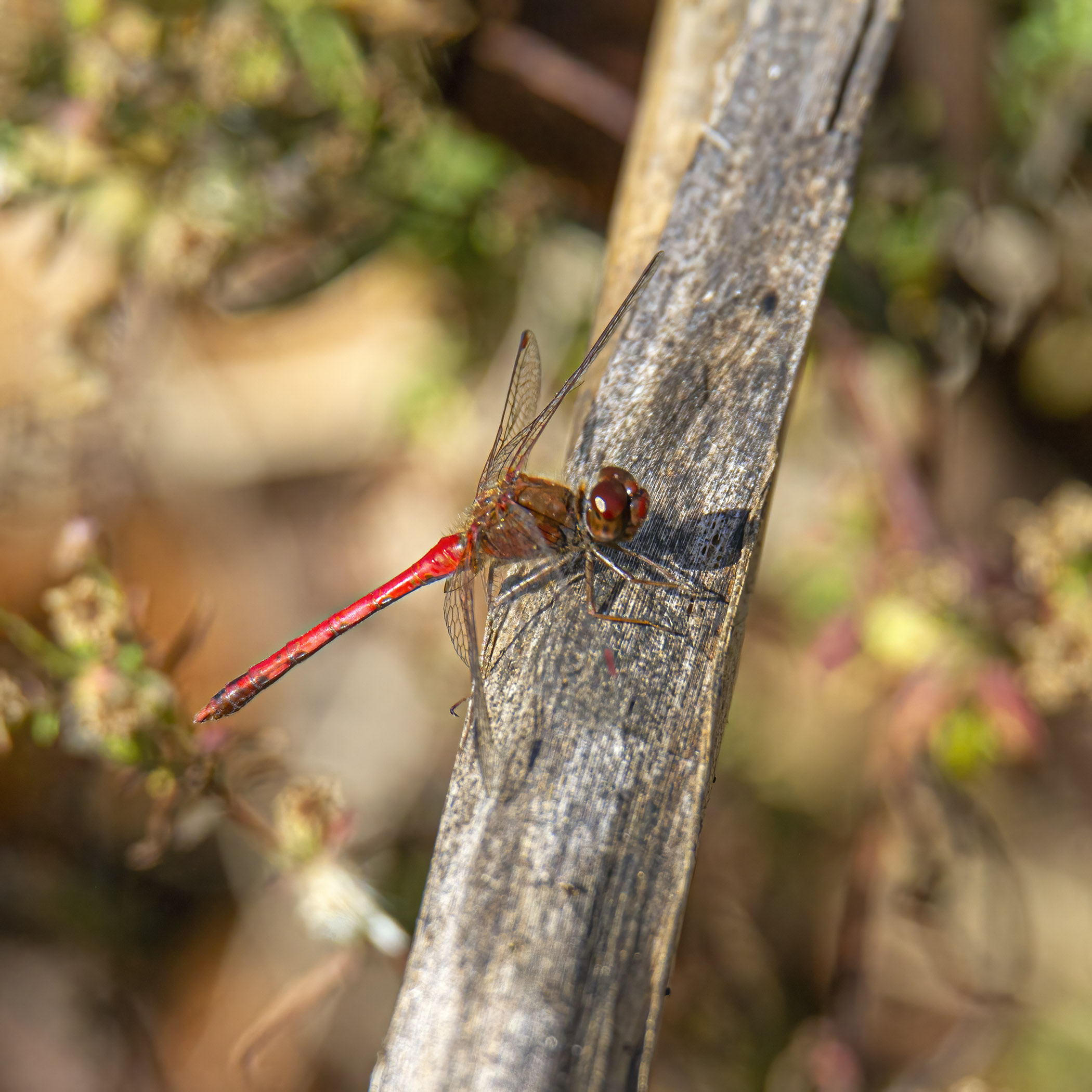
When I went out with my camera on Wednesday, it was cool and cloudy, but fortunately the rain had stopped falling. I was not optimistic that I would see a lot of wildlife, but it felt good to get out of the house and to spend some time in nature.

Most dragonflies prefer warm weather and become inactive when it is cool, so I did not expect to see many during my walk. I was thrilled therefore when I spotted this male Common Whitetail dragonfly (Plathemis lydia). I watched as he was flying and saw him land low in the vegetation, just off of the ground.

The background in this shot is really busy, but somehow the dragonfly really stands out. It’s kind of a fun little photo of one of the few remaining dragonflies as we move through October.

Common Whitetail

© Michael Q. Powell. All rights reserved.

Read Full Post »
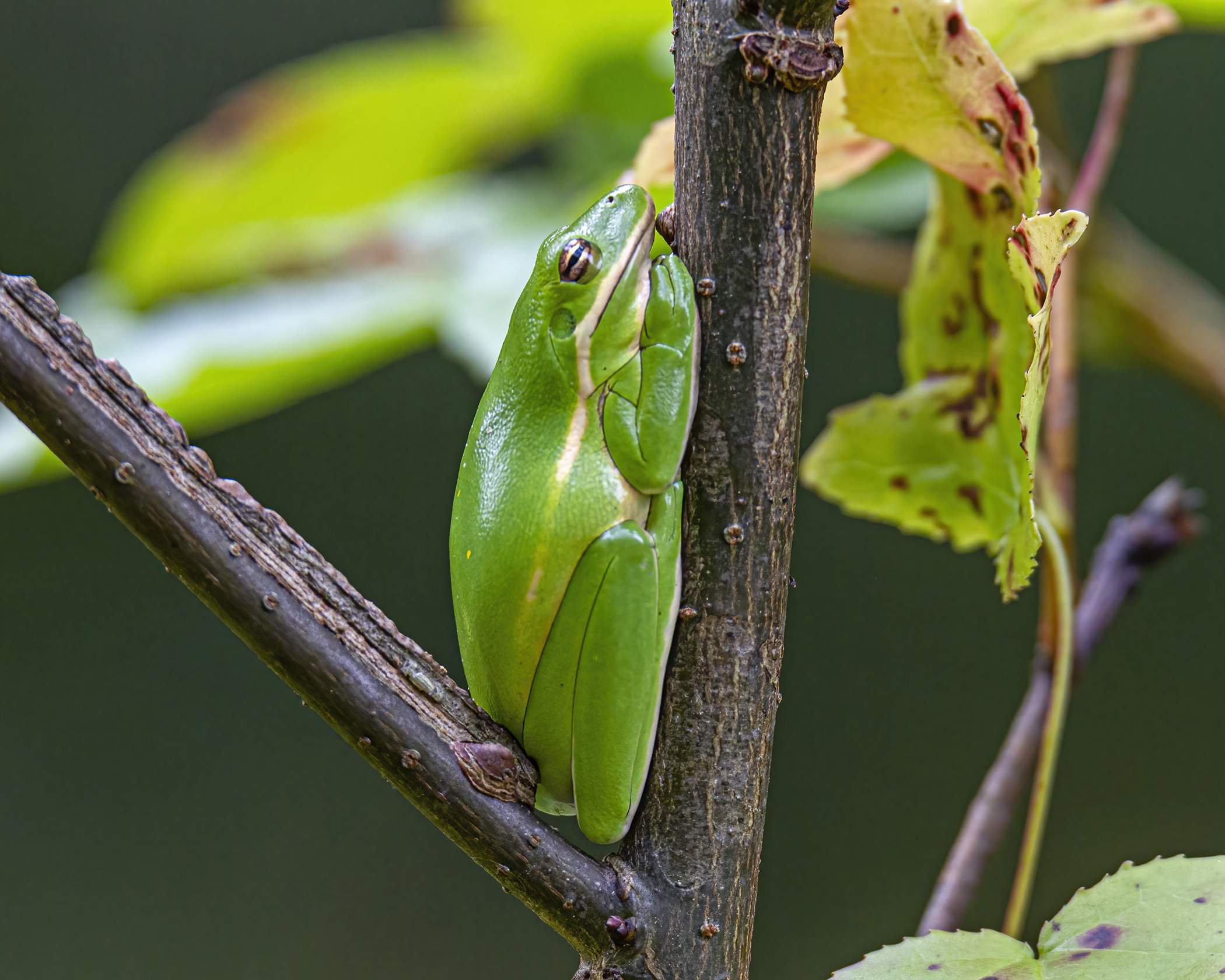
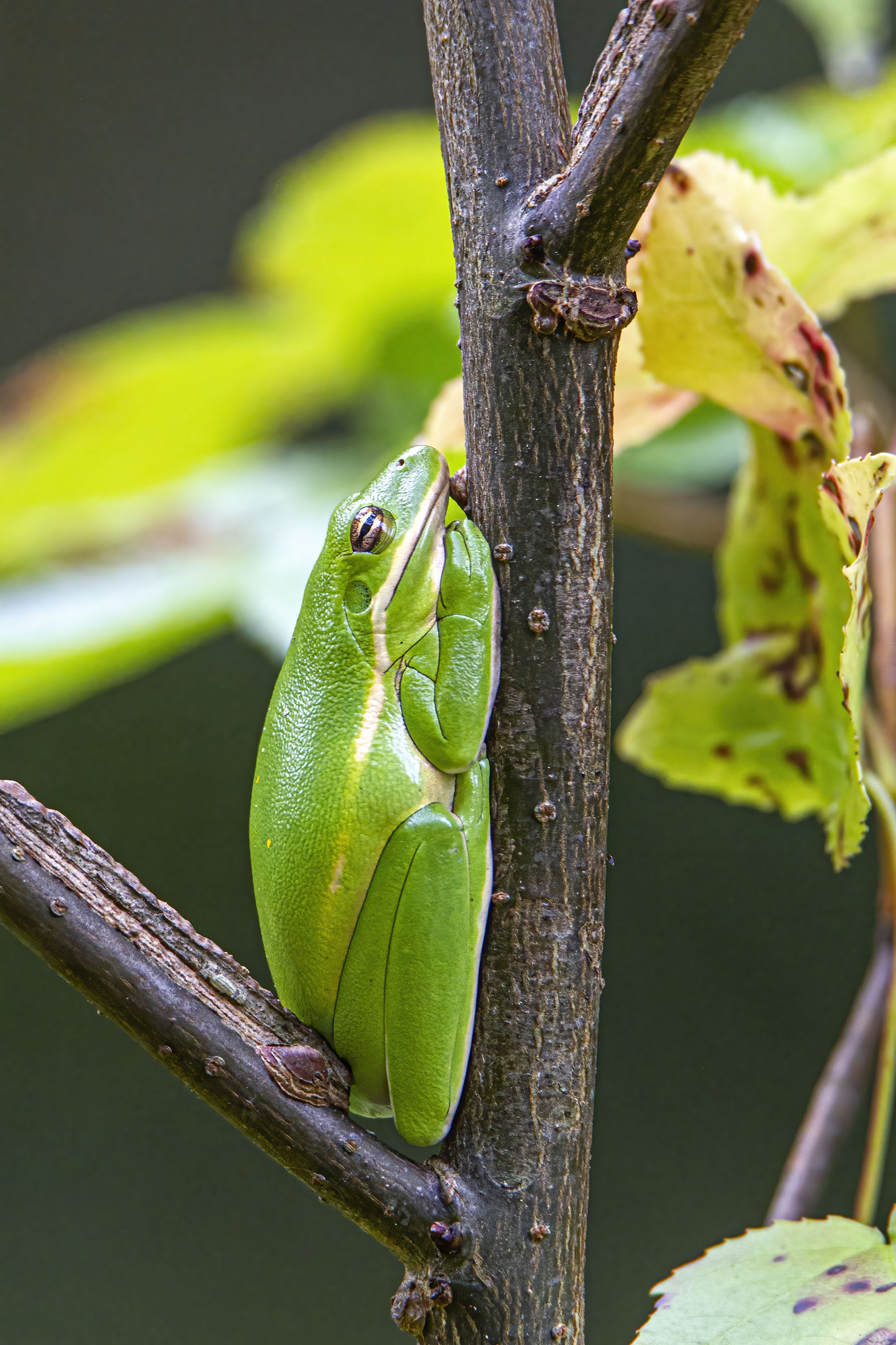
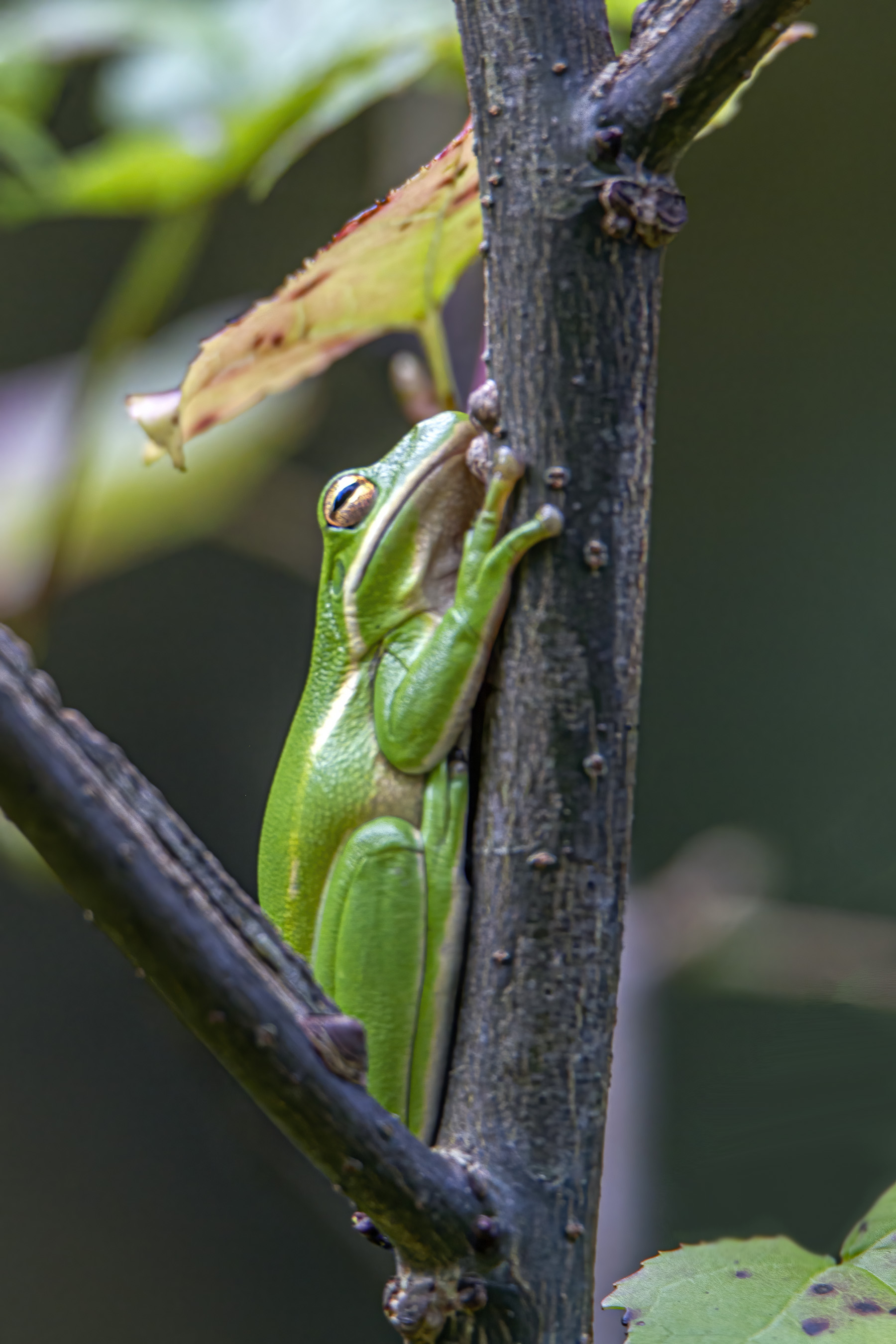
Most of the time when I am lucky enough to spot a Green Tree Frog (Hyla cinerea), the frog appears to be sleeping. Why is that the case? Many frogs spend their time in the water and have an easy way to regulate their body temperatures. Tree Frogs probably need to avoid direct sunlight and I suspect they are more active earlier and later during the day.

Yesterday afternoon the rain finally stopped and the skies were gradually clearing, so I decided to go out with my camera. I spotted this tree frog when I was walking along one of the trails at Huntley Meadows Park, a nearby marshland park that I have avoided the last few years because it tends to be overcrowded. The frog was perched in the crotch of a small tree just off of the trail.

When I first saw the tree frog, it had its front feet tucked under its head and appeared to be dozing, as you can see in the first two photos. I experimented with slightly different angles and formats and can’t decide if I like the landscape format of the first photo or the portrait format of the second one.

Later in the day I passed the frog again and it seemed to be a little more alert. The frog had pulled one of its feet out from under its head and appeared to be daydreaming.

When I returned home from my outing, I decided to take a cue from the frog and took a short nap.


Green Tree Frog

Green Tree Frog

Green Tree Frog

© Michael Q. Powell. All rights reserved.

Read Full Post »
Older Posts »