Feeds:
Posts
Comments

Archive for the ‘Dragonflies’ Category

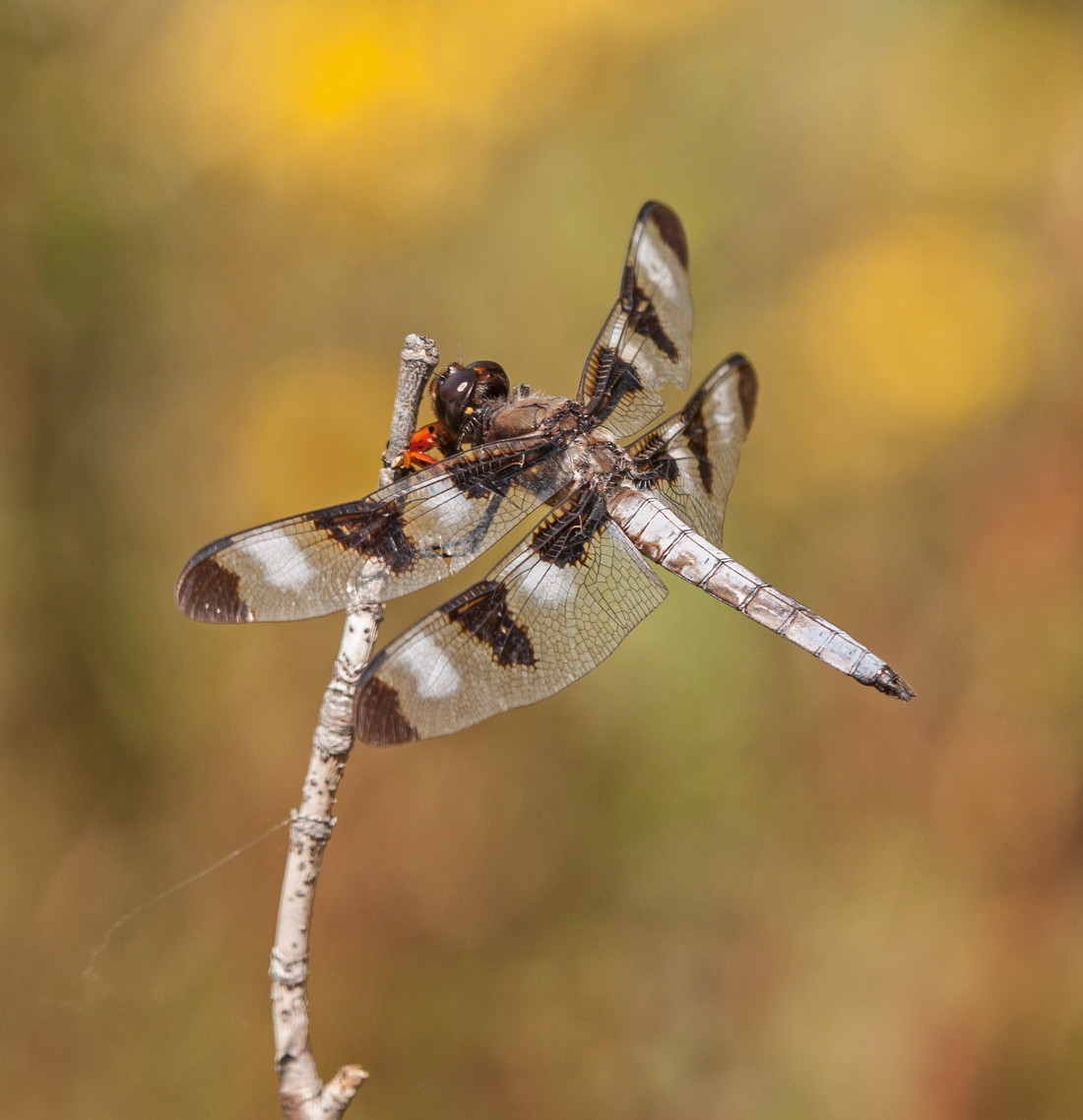
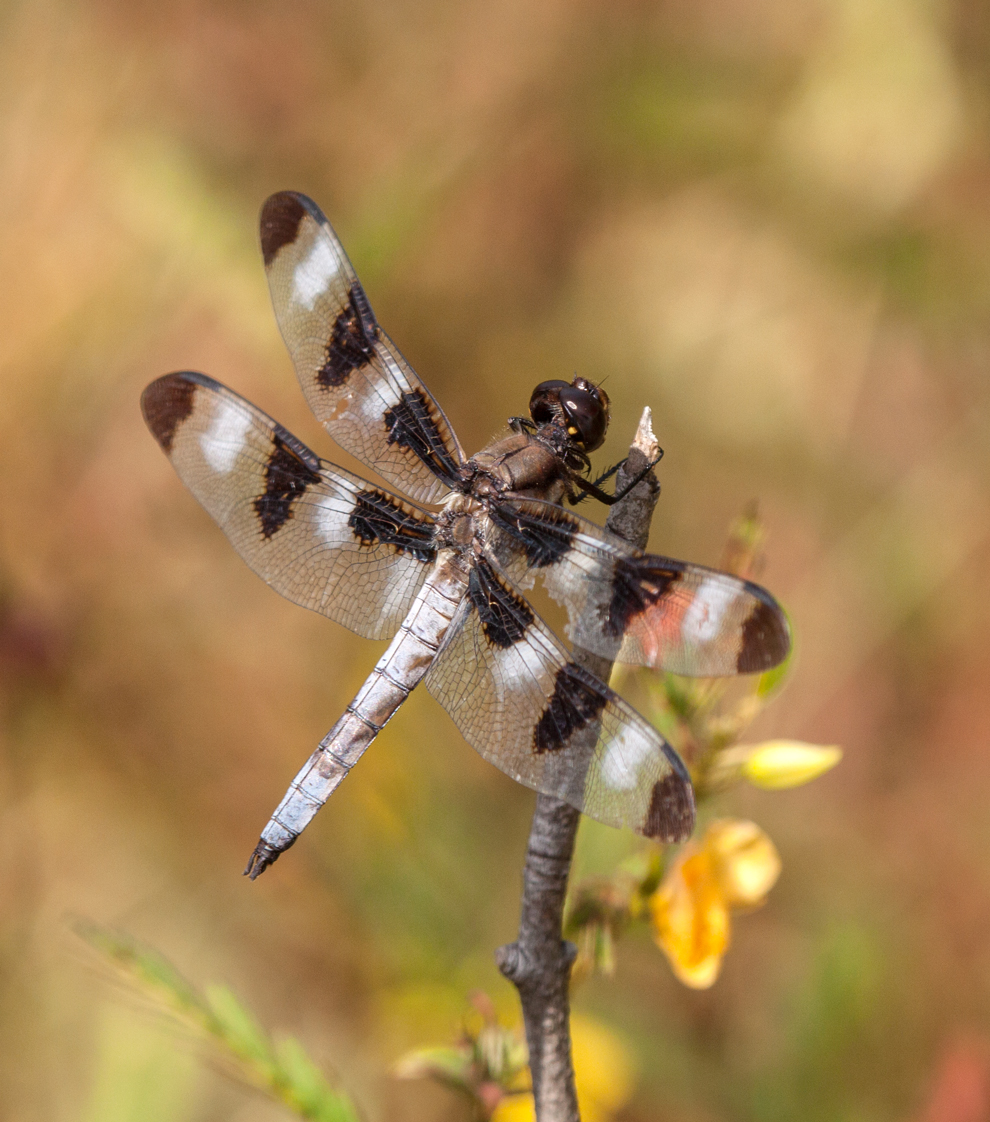
It won’t be long before most of the dragonflies are gone for the season, so I am really enjoying them while they are still around. A little over a week ago, I was able to capture images of some male Twelve-spotted Skimmer dragonflies (Libellula pulchella), a species that I had not seen previously this summer.

Twelve-spotted Skimmer

In the first shot, the dragonfly seems to be eating something that is bright red in color. I can’t tell for sure, but when I zoom in, it looks like it might be a ladybug. Whatever the case, I am happy that I was able to frame the shot to be able to get some of the yellow meadow flowers into the background.

In the other shots, I worked to get the wings into focus by shooting on a plane horizontal to their position. The dragonflies were reasonably cooperative and I am pretty happy with the resulting images.

12spot1_blog 12spot2_blog 12spot3_blog

© Michael Q. Powell. All rights reserved.

Read Full Post »

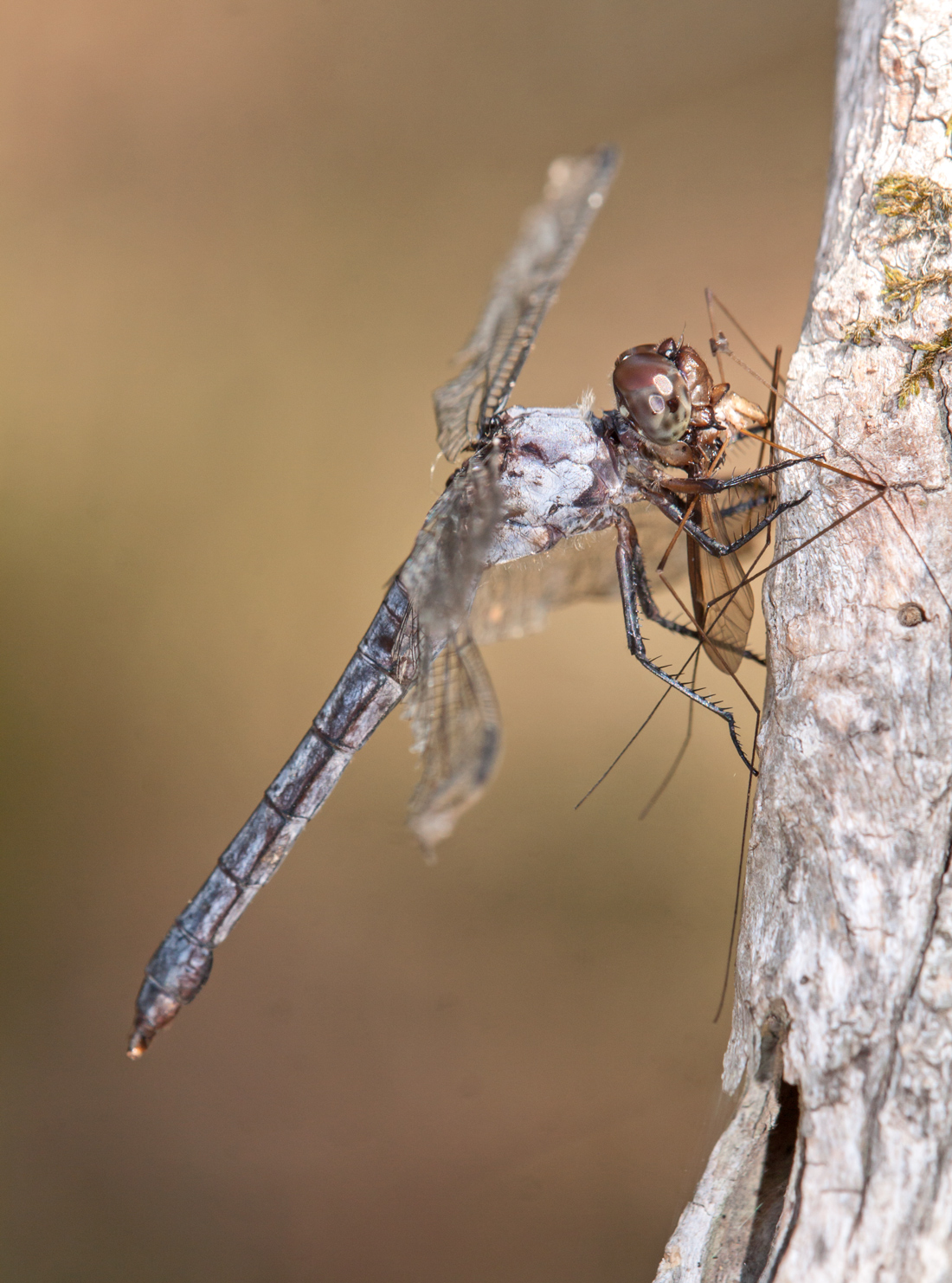
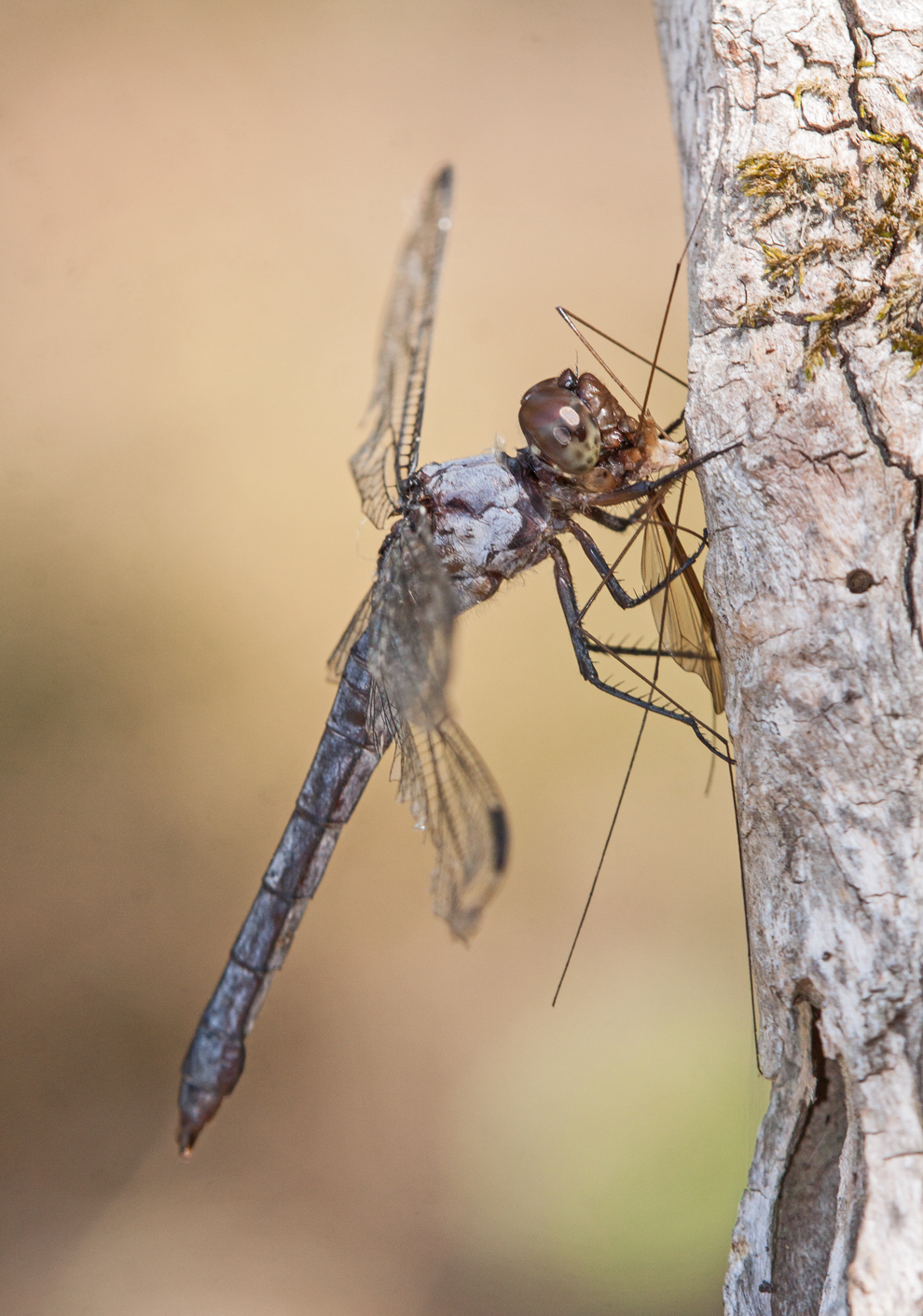
What do dragonflies eat for lunch? I stumbled upon this dragonfly earlier in September as it was beginning to enjoy a freshly caught insect. Judging from the long legs and wings of the prey, it looks like the dragonfly is munching on a crane fly.

The dragonfly was so focused on eating that it let me get pretty close without flying away and I was able to take a number of shots from different angles and with different settings. I defer to others on identification of the dragonfly species. I initially thought it was a Great Blue Skimmer, but the eye color seems wrong.

lunch3_bloglunch2_bloglunch1_blog

© Michael Q. Powell. All rights reserved.

Read Full Post »

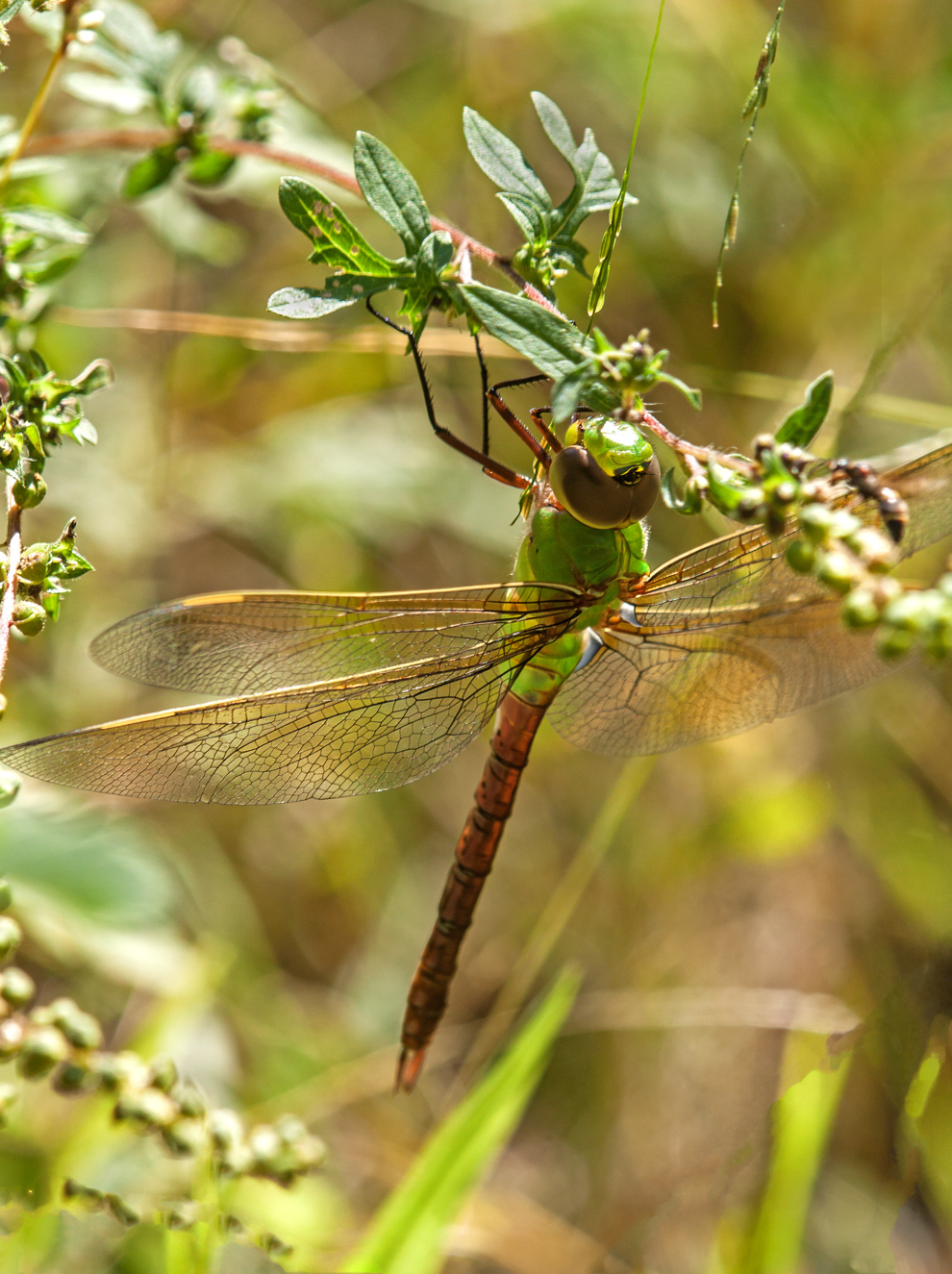
As I was walking through a meadow at my local marsh this past Monday, dragonflies would take off from the high grass and low vegetation as I approached. Most of them appeared to be Common Whitetail dragonflies (Plathemis lydia), a species that seems to like to perch on the ground.

One of the dragonflies, however, really caught my eye, because it was larger than the rest and was a pastel green in color. At first, I thought it might be a female Eastern Pondhawk (Erythemis simplicicollis), one of the few green dragonflies that I have encountered. The green dragonfly flew weakly away and came to rest on some low vegetation a short distance away. As I drew closer, I noted that the dragonfly was hanging from the vegetation and was not perching on it, so I knew it was not an Eastern Pondhawk, which perches horizontally.

When I got a clear look at the dragonfly’s body, I could see that it was shaped like a darner, and I concluded the beautifully-colored dragonfly was probably a young Common Green Darner (Anax junius), judging from its shape and pale coloration. I hadn’t really considered the possibility that this might be a Green Darner, because dragonflies of this species are really strong fliers and I had never seen one behave like this.

I’m going out shooting later today, searching for more beautiful butterflies and dragonflies, enjoying the good news that they are still here with us.

Common Green DarnerCommon Green Darner

© Michael Q. Powell. All rights reserved.

Read Full Post »

When you photograph something really cool, do you return to the same location with the hope of finding your subject again? In late August, I spotted a Mocha Emerald dragonfly (Somatochlora linearis) for the first time and was really excited, but I wanted to get some better shots.

Over the course of this summer, I have learned that some dragonflies are very habitat-specific—you can only find them in places where the water or vegetation have certain characteristics. So I returned on the 5th of September and followed the same shallow stream and was thrilled to find another Mocha Emerald. Initially I caught sight of the dragonfly in flight and wasn’t sure that it was a Mocha Emerald until it landed. Only them could I see the really narrow abdomen and unusual terminal appendage that are characteristic of this species.

Getting a shot was a bit of a technical challenge. The area was heavily shaded, but there was some light coming in from directly behind the dragonfly, creating a silhouette. I cranked up the ISO to 1250 and underexposed a bit and got the second image below after a bit of post processing. I decided to use my pop-up flash to try to balance the light coming from the back and got the first image, my favorite one.

However, I really wanted to get more of the wings into the photo and I started to circle around the perched dragonfly. Unfortunately, one foot slid into the water of the shallow stream and I composed the third shot with one foot in the water and one on the bank, not exactly an optimal shooting position.

When I tried to continue my movement to frame the dragonfly from a different angle, it flew away. I suspect that the Mocha Emeralds are now gone from the season, but I may return one last time to that location to see if there are any stragglers. I might get lucky again.

Mocha Emeraldmocha_2_blogmocha_3._blog

© Michael Q. Powell. All rights reserved.

Read Full Post »

One of the dangers of shooting with a macro lens is that I am often so focused on shooting close-up that I forget to step back and look at the bigger picture.

A couple of days ago, I posted a photo of a dragonfly basking in the sun and felt pretty content that I had been able to capture a detailed shot of its eyes and face. I had instantly gravitated to several close-up images to the point that I temporarily forgot that my initial shots had been from a greater distance. As a result, I made my preliminary identification on the basis of the facial shot alone.

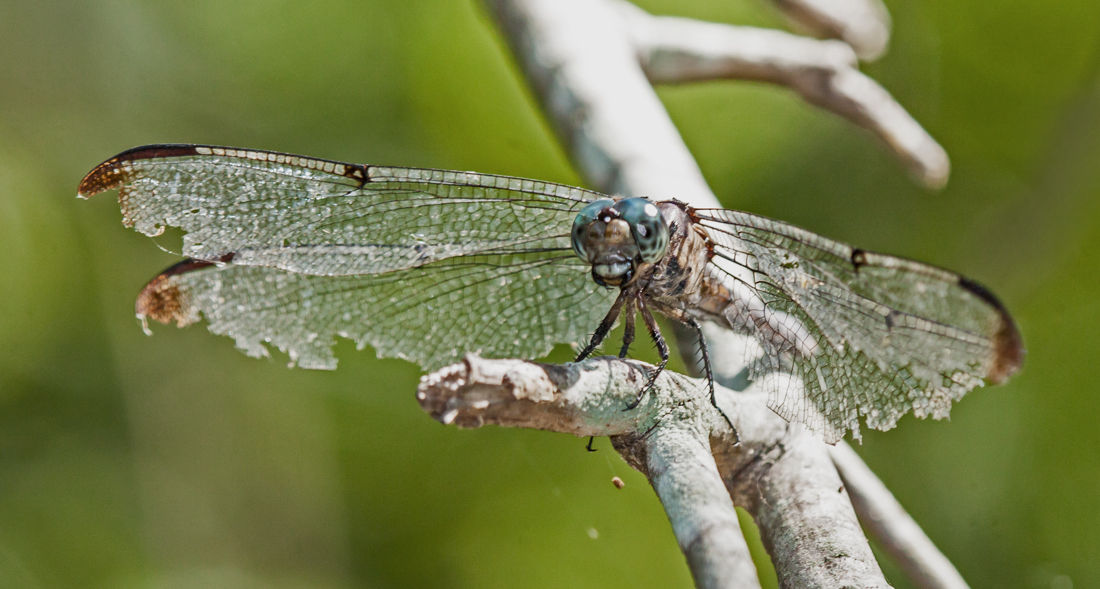
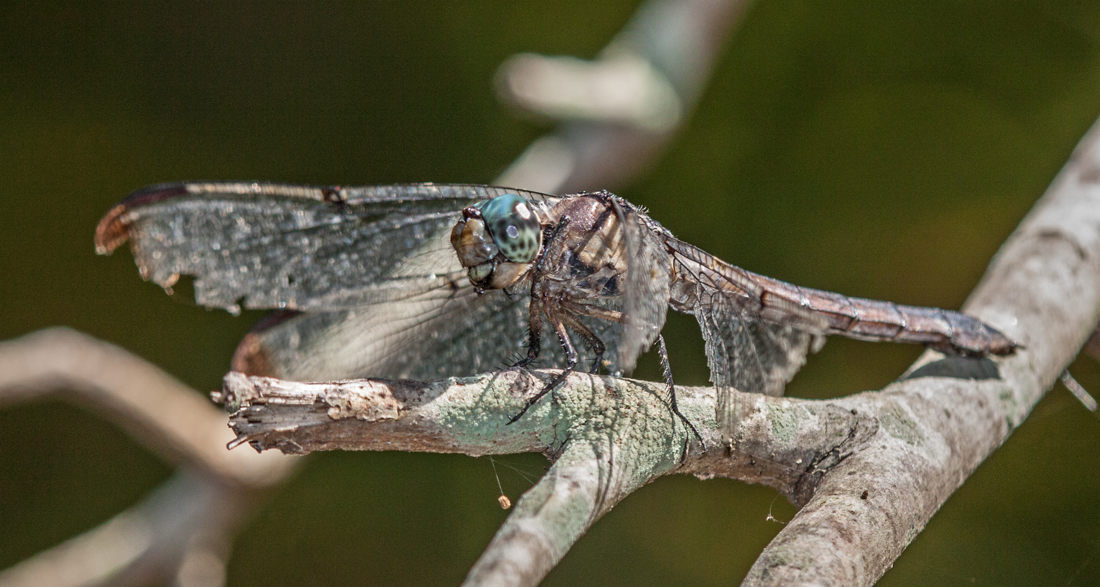
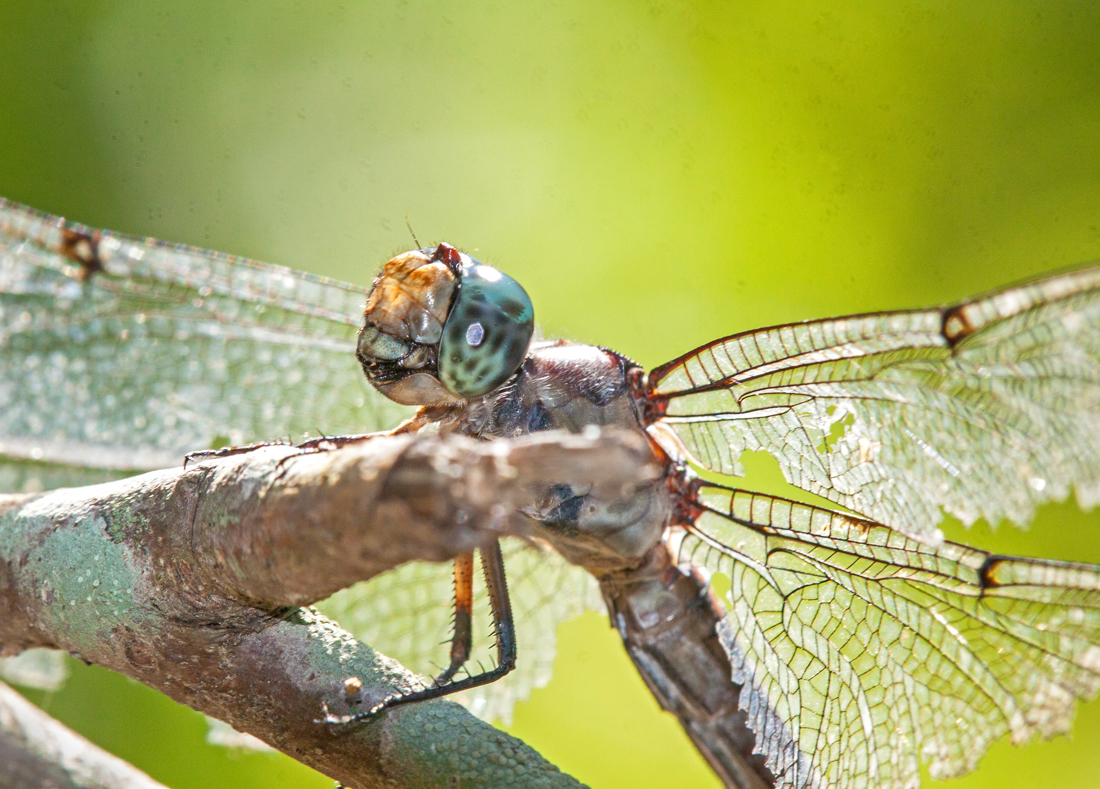
After I posted the image on Facebook, one of my fellow photographers, Walter Sanford, who is much more of an expert on dragonflies than I am, asked me if I had any shots of the dragonfly’s entire body, probably with a desire to check my identification. When I reviewed my more distant shots of the dragonfly, I was immediately struck by how tattered the wings were of this female Great Blue Skimmer (Libellula vibrans). Sure, I’ve seen lots of dragonflies with minor damage to the wings, but these are seriously tattered.

When I posted these follow-up images on Facebook, Walter replied, “Definitely an old female Great Blue Skimmer dragonfly, as indicated by its tattered wings, coloration, and flanges beneath the eighth abdominal segment. The flanges are used to scoop and hold a few drops of water when laying eggs (oviposition), hence the family name “skimmer.” ”

Be sure to check out Walter’s blog for his wonderful shots of dragonflies and his more  scientific descriptions of his subjects. My background was more in the liberal arts area rather than in science, and my writing in my blog tends to be a reflection of that background.
tattered_blog tattered2_blog


© Michael Q. Powell. All rights reserved.

Read Full Post »
I was suffering in the heat and humidity on Friday, but this dragonfly, which I think is a female Great Blue Skimmer (Libellula vibrans), seemed to enjoy basking in the sunlight and let me get really close for this shot.

dragon_superclose_blog

© Michael Q. Powell. All rights reserved.

Read Full Post »

You know that summer is coming to a close when the dragonflies that were in constant flight earlier in the season seem to be resting more often, like this Black Saddlebags dragonfly (Tramea lacerata) that one of my fellow photographers, Walter Sanford, pointed out this past weekend at my local marsh. This dragonfly kept flying back and forth between two perches that were tantalizingly just out of the range of the 180mm lens that I had on my camera. I didn’t dare to take the time to change my lens, knowing that the dragonfly would almost certainly fly away at the most inopportune moment, so I ended up cropping a lot, especially in the first image.

The only shots that I could get of Saddlebags dragonflies earlier in the summer were in-flight shots and I have already posted some shots of a Black Saddlebags in the air. I realized, though, that I had not posted an image of its more colorful counterpart, the Carolina Saddlebags (Tramea carolina) that I photographed during a visit to Lewis Ginter Botanical Gardens in Richmond, Virginia. I took that shot (the third one below) from a pretty long distance, but was able to achieve focus and capture some of the wonderful details of this beautiful red dragonfly.

Black Saddlebags dragonflyBlack Saddlebags dragonfly

Carolina Saddlebags dragonfly

© Michael Q. Powell. All rights reserved.

Read Full Post »
What’s a Mocha Emerald? No, it’s not the newest Seattle coffee craze—it’s a dragonfly.

I was thrilled this past Friday to spot a type of dragonfly at Huntley Meadows Park that I had never seen before—a Mocha Emerald (Somatochlora linearis). Fellow photographer and blogger, Walter Sanford, saw some in the park earlier in the summer, but I thought that it was probably too late for me to find one. It’s nice to be surprised.

Initially, I didn’t know what type of dragonfly I had photographed and knew only that its body shape was different from the ones that I had seen previously. Serendipitously, later in the day l ran into the manager of the park, Kevin Munroe, a noted dragonfly expert who runs the website Dragonflies of Northern Virginia, and he helped me make a tentative identification.

This one has somewhat tattered wings–it looks like he had a tough summer.

Mocha Emerald

© Michael Q. Powell. All rights reserved.

Read Full Post »

Dragonflies are so beautiful that I sometimes forget that they are also fierce predators. Last weekend at my local marsh, I captured this image of a female Eastern Pondhawk dragonfly (Erythemis simplicicollis) feeding on another dragonfly, which looks like it might be a female Blue Dasher (Pachydiplax longipennis).

The dragonfly is perched on the end of one of the slats of a railing that along the edge of an inclined section of the boardwalk. I cropped the image to focus viewers’ attention on the dragonfly, but I also like the second version of the same photo, which is close to the original view when I took the shot. Somehow those three slats remind me of a row of tombstones, a memorial to the predator’s prey.

Eastern Pondhawk

Eastern Pondhawk

© Michael Q. Powell. All rights reserved.

Read Full Post »
It’s not hard to figure out the source of its name when you spot a colorful Halloween Pennant dragonfly (Celithemis eponina) waving in the breeze. These dragonflies also remind me of pole vaulters, attempting to thrust their bodies over a crossbar while holding on to the very end of a long pole.

I have not seen one yet at Huntley Meadows Park, the place where I take the majority of my photos, though earlier this summer one of my fellow photographers, Walter Sanford, spotted one in the park for the first time in years. I shot this image at edge of a small pond during a recent trip to Lewis Ginter Botanical Garden in Richmond, Virginia.

pennant1_blog

© Michael Q. Powell. All rights reserved.

Read Full Post »

I know that damselflies come in many colors, but my brain wanted to cramp up when I was told that this stunning orange damselfly was a bluet. An orange bluet? Aren’t bluets blue?

Apparently that is not always the case, and this little beauty is in fact a male Orange Bluet damselfly (Enallagma signatum). This shot looks like it was done with flash, but I double checked the EXIF data and confirmed that it was simply an effect caused simply by using exposure compensation and metering carefully on the subject. Normally, I am not a big fan of a black background, which can be caused when the light from the flash overpowers the ambient light, but I think that it works well in this shot, which looks almost like it was shot in a studio.

In the second shot, the brown color of the muddy water shows through in a way that is a little more natural. I took this shot when the damselfly was farther away than in the first shot and I like the way that it shows a bit more of the environment than in the first image.

One of the advantages of shooting in bright light and on a tripod was that I was able to shoot at ISO 100 and at f/11, which gave me images that were a lot cleaner than I often get.

orange1_blogorange2_blog

© Michael Q. Powell. All rights reserved.


Read Full Post »
It’s hard to imagine a simpler composition—a tiny damselfly in the green growth of the marsh—but I find real beauty and power in this image.

Look closely at this damselfly, which I think is a female Fragile Forktail (Ischnura posita), and you will see some amazing colors and details, all packed into a body that is only about an inch long.

Click on the image to see a higher resolution view of the image.

Fragile Forktail

© Michael Q. Powell. All rights reserved.

Read Full Post »

I spend a lot of time chasing dragonflies and damselflies, but my efforts pale in comparison with those of fellow blogger and photographer Walter Sanford. He has so much experience with them that he focuses much of his attention on photographing females and mating pairs. This posting contains some amazing shots of mating damselflies in a mating position that looks like a heart, a position that I doubt exists in the Kama Sutra.

waltersanford's avatarwalter sanford's photoblog

I was looking for mating pairs of Eastern Pondhawk dragonflies (Erythemis simplicicollis) during a photowalk at Huntley Meadows Park on 10 August 2014. Meanwhile my friend Mark Jette spotted a mating pair of damselflies.

The Orange Bluet damselflies (Enallagma signatum) shown in the following photographs are “in wheel,” in which the male uses “claspers” (terminal appendages) at the end of his abdomen to hold the female by her neck/thorax while they are joined at their abdomens. The male, orange and black in color, is on top; the female, green and black in color, is on the bottom.

The copulatory, or wheel, position is unique to the Odonata, as is the distant separation of the male’s genital opening and copulatory organs. Source Credit: Paulson, Dennis (2011-12-19). Dragonflies and Damselflies of the East (Princeton Field Guides) (Kindle Locations 377-378). Princeton University Press. Kindle Edition.

The wheel position is…

View original post 149 more words

Read Full Post »

Yesterday on a photo expedition with some friends to Lewis Ginter Botanical Garden in Richmond, Virginia, I encountered a stunningly beautiful purple damselfly with gorgeous violet eyes that rival those of the late Elizabeth Taylor. I don’t think that I had ever seen a purple damselfly or dragonfly before and the striking purple color is wonderfully set off by its black markings and blue band at the end of its abdomen.

Fellow blogger and local  dragonfly expert Walter Sanford has identified this for me as a Violet Dancer damselfly (Argia fumipennis violacea), a subspecies of the Variable Dancer (Argia fumipennis).

purple_blog

© Michael Q. Powell. All rights reserved.

Read Full Post »
Generally I like to photograph wildlife subjects in a natural environment. When this female Common Whitetail dragonfly (Plathemis lydia) landed on a metal sprinkler cover, though, I couldn’t help but like the contrast between the natural subject and the industrial background.

Common Whitetail dragonfly

© Michael Q. Powell. All rights reserved.

Read Full Post »

There is something both creepy and compelling about the fearsomely-named Red-footed Cannibalfly (Promachus rufipes). I first spotted one last summer and noted in a posting that these insects, sometimes referred to as Bee Panthers, are reported to be capable of taking down a hummingbird.

I caught sight of this specimen earlier this week as I was making my way along a creek in the back area of my local marsh, searching for the equally fierce Dragonhunter dragonfly (Hagenius brevistylus). The Dragonhunter is a very large dragonfly that, as its name suggests, specializes in hunting other dragonflies (along with bees, wasps, and butterflies).

The Red-footed Cannibalfly is part of a larger group of giant robber flies of the genus Promachus, a name that in Greek means “who leads in battle,” according to Wikipedia. I am fairly confident of my identification, but would welcome any corrections from more experienced insect hunters.

Be sure to look carefully at the claws on the front legs in the image. I am sure that it’s almost impossible to escape when this predator sinks those claws into you and injects you with a toxin that paralyzes you and liquifies your insides.

As one blogger so eloquently put it, “Be thankful these insects aren’t the size of Sandhill Cranes.”

Red-footed Cannibalfly

© Michael Q. Powell. All rights reserved.

Read Full Post »

Watching insects is sometimes like watching a Cirque du Soleil production, very colorful and incredibly acrobatic, like these mating damselflies that I photographed recently at Meadowlark Botanical Gardens in Vienna, VA.

damsel1_mating_blog damsel2_mating_blog

© Michael Q. Powell. All rights reserved.

Read Full Post »

Am I the only one who remembers a poster from the 1970’s featuring the slogan “Fly United” and depicting two ducks mating in mid-air?

That’s what immediately came to mind earlier this week when a pair of Great Blue Skimmer dragonflies (Libellula vibrans) flew by me at my local marsh. Anyone who has ever watched dragonflies mate knows that it is an acrobatic endeavor, requiring tremendous flexibility by both parties. Imagine trying to fly while still in the “wheel” position. Amazingly all of the wings seemed to able to move freely, though I didn’t notice if they were both using their wings for propulsion.

I was able to snap off these shots as the pair flew toward me over the water of a pond, which reflected wonderfully the blue sky and the clouds up above us.

wheel1_blogwheel2_blog

© Michael Q. Powell. All rights reserved

Read Full Post »

Normally when I think of saddlebags, I think of cowboys and the Pony Express, but there is also a species of skimmer dragonflies known as Black Saddlebags (Tramea lacerata). Someone obviously thought the dark patches on the hind wings looked like saddlebags.

Unlike many of the dragonflies that I often observe, Black Saddlebag dragonflies like to fly high in the air (and not low over the water) and some of them even migrate. I was alerted to their presence at my local marsh by a recent posting by a local dragonfly expert and fellow photographer Walter Sanford, so yesterday I kept one eye to the sky yesterday as I searched for subjects to photograph.

Black Saddlebags flew over me several times and I was fortunate to get some shots of one of them in flight. It might have been nice to have used a longer lens than the 100mm macro lens that I had on my camera at the time, but the shots turned out pretty well nonetheless. The first image is the sharpest image, but I like the entire sequence of the three images and the way in which they convey a sense of the environment in which I was shooting.

saddlebags1_blog The fi

saddlebags2_blogsaddlebags3_blog

© Michael Q. Powell. All rights reserved

Read Full Post »

The light reflecting off the water in the background was really bright, creating these disco ball highlights when I took these shots of a male Blue Dasher dragonfly (Pachydiplax longipennis) recently at Green Spring Gardens. Normally I try to avoid distinctive specular highlights, but in this case I decided to embrace them.

Why do I suddenly feel an irresistible urge to watch Saturday Night Fever?

disco1_blogdisco2_blog

© Michael Q. Powell. All rights reserved

Read Full Post »

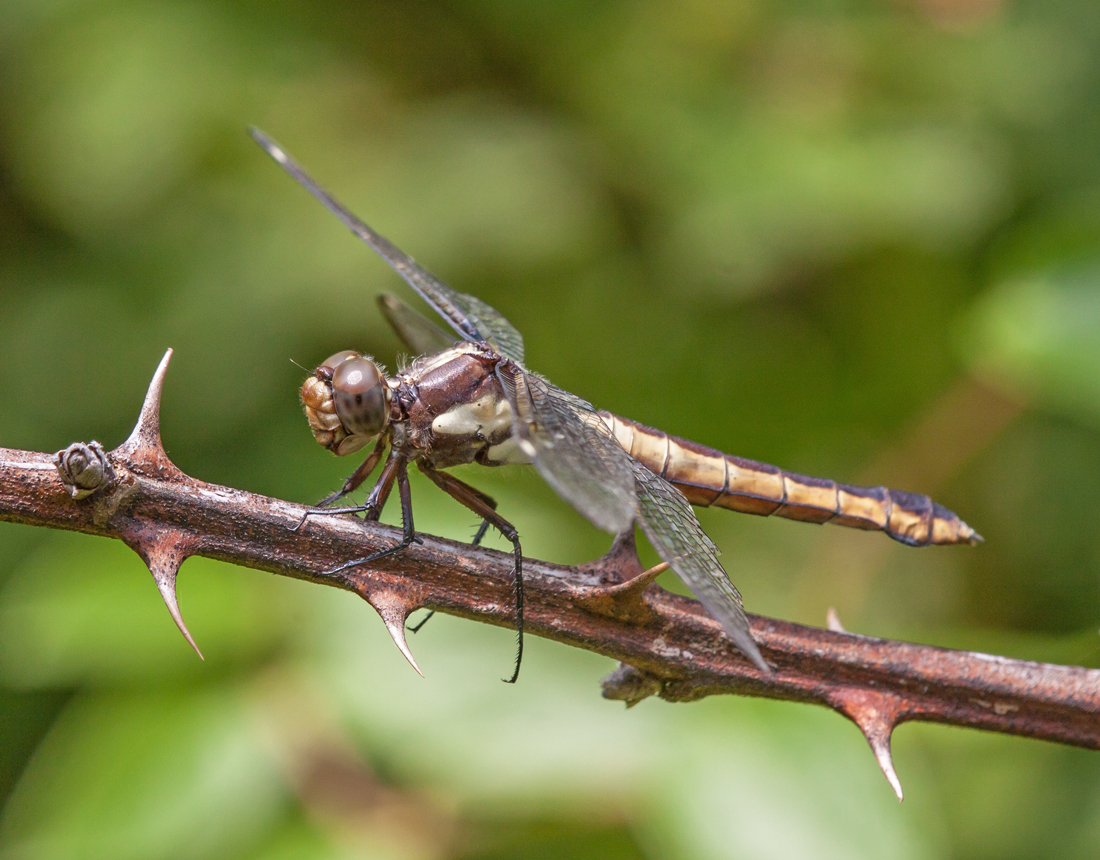
Have you ever found yourself in a thorny predicament? Last weekend, I came upon this female Spangled Skimmer dragonfly (Libellula cyanea) that had literally placed herself in such a situation.

Fortunately, dragonflies are so small, lightweight, and agile that she was able to place herself in between the thorns, out of harm’s way. If you look closely at her wings in the second image, however, you’ll see that they are tattered, suggesting that it’s been a tough season for her, probably as a result of predators, including overly aggressive male dragonflies.

thorny1_blogthorny2_blog

© Michael Q. Powell. All rights reserved

Read Full Post »

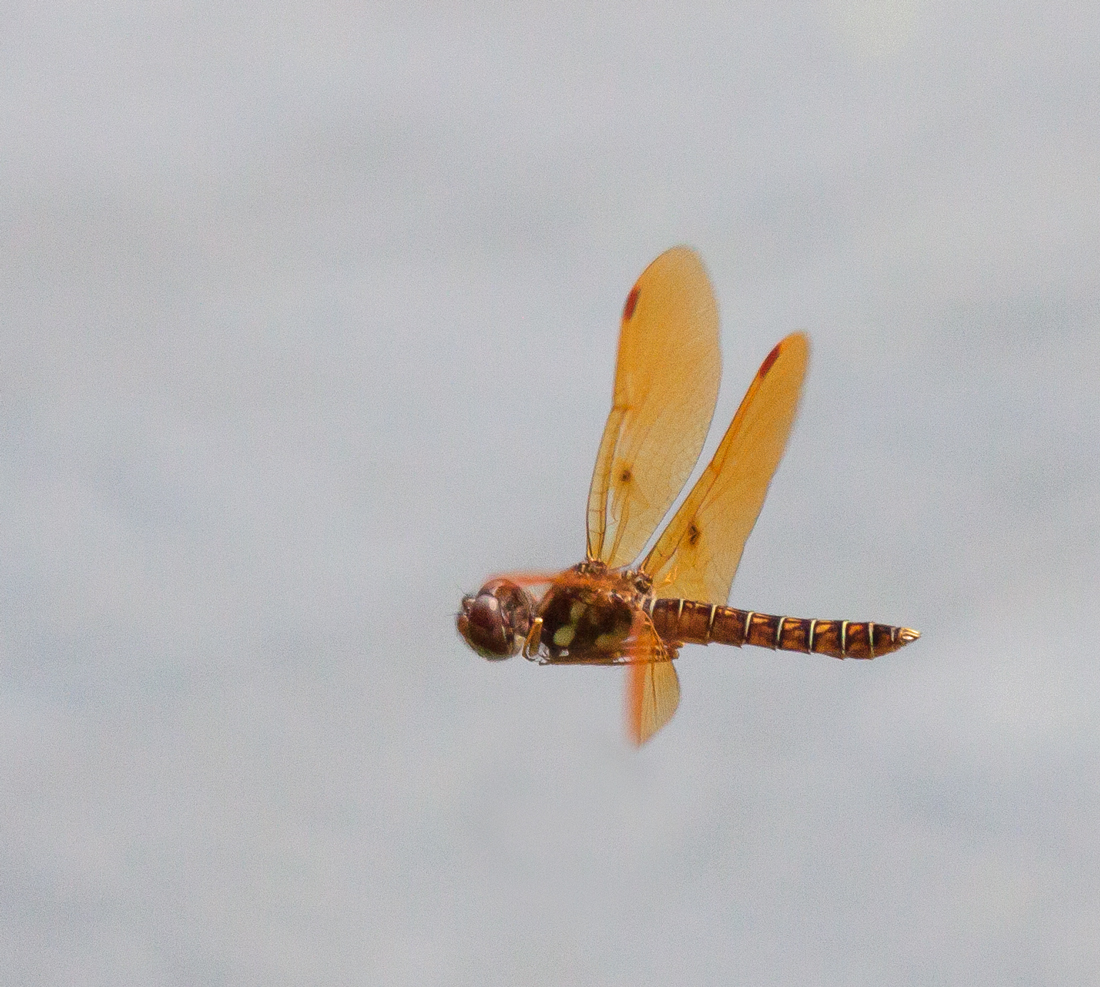
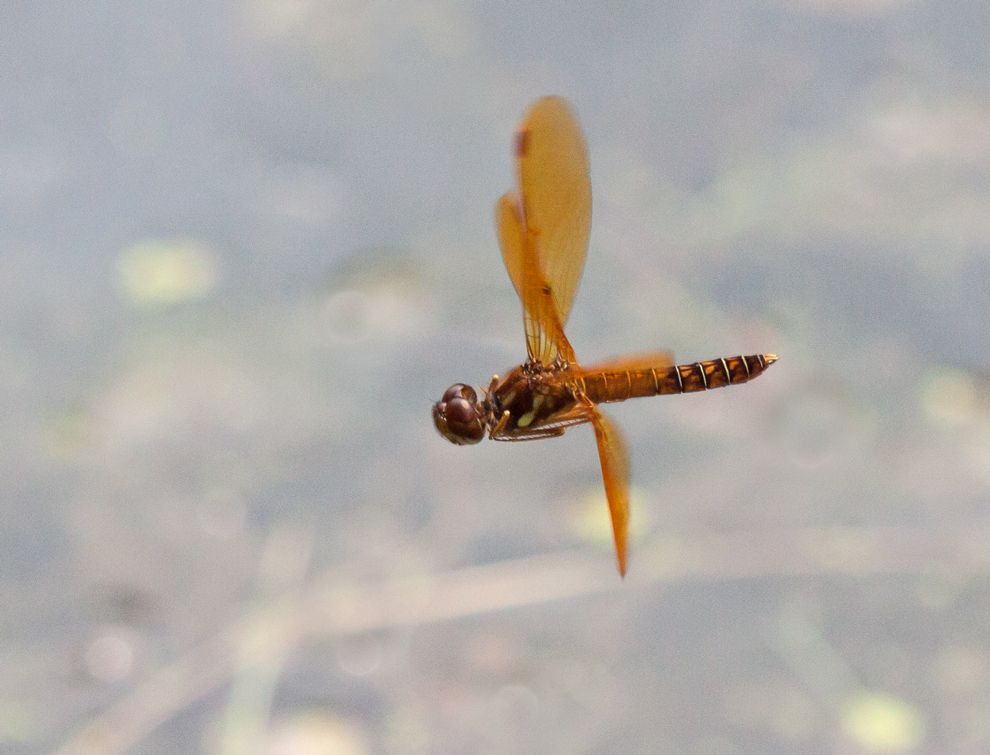
Photographing any dragonfly in flight is a real challenge, but this past weekend I spent time chasing after some of the smallest ones, the Eastern Amberwing dragonflies (Perithemis tenera). According to Bugguide, these dragonflies are typically 21-24mm in length, which is less than one inch, with a wingspan of maybe two inches or so.

amb2_fly_blog

There were lots of male Eastern Amberwings buzzing around the edges of a small pond at Green Spring Gardens, one of the local gardens that I like to visit. They were within range of the 180mm macro lens that I was using, but focusing and tracking were my biggest problems. The dragonflies did tend to hover a bit, which helped a little, but it was tough to get them in focus when focusing manually and almost impossible to do so with auto-focus.

I took a lot of shots and was happy that I managed to get some in decent focus, though I did have to crop the images. As I was preparing this posting, I noticed that I spent some time a year ago attempting to photograph the same dragonfly species. I think the results this year are marginally better, but you can make your own call by clicking on this link to the posting from July 2013.

amb4_fly_blogamb5_fly_blog amb3_fly_blog

amb1_fly_blog

© Michael Q. Powell. All rights reserved

Read Full Post »

A dragonfly perching on a heron? In real life it’s highly unlikely that you would see such a thing, but a male Blue Dasher dragonfly (Pachydiplax longipennis) decided that the metal silhouette of a Great Blue Heron (Ardea herodias) in a pond at Green Spring Gardens made a good spot to rest.

Click on any of the tiled images to see all of them full-sized in slide show mode.

Blue Dasher

© Michael Q. Powell. All rights reserved.


Read Full Post »
In the shade of the flowering lotus plants, these two Eastern Pondhawk dragonflies (Erythemis simplicicollis) found a few moments for some summer lovin’. Summer lovin’, it happened so fast.

Eastern Pondhawks mating

© Michael Q. Powell. All rights reserved.

Read Full Post »
It may sound like a new summer beverage sensation, but the title is meant to be literal. I encountered this tiny Eastern Amberwing dragonfly (Perithemis tenera) sunning itself on a rock in a small, muddy creek in the back area of my local marshland park.

It was a bit unusual for me to see a dragonfly on a rock (usually they perch on vegetation or on the ground) and I think the texture of the rock adds visual interest to the shot without being distracting the eye. I was pleased to capture so much beautiful detail of this cool little dragonfly and was particularly happy to see how well the amber wings turned out.

drag1_rocks_blog

© Michael Q. Powell. All rights reserved.

Read Full Post »
Two years ago today, my photography mentor and dear friend Cindy Dyer sat me down at her computer and told me that I was going to start a blog. We had just returned from a photo shoot at Kenilworth Aquatic Gardens in Washington D.C. and had taken lots of shots of waterlilies, lotus flowers, and dragonflies.

Cindy is a professional photographer and web designer and I had previously looked at her blog (which currently has had over 560,000 views), but I had never really thought about starting a blog myself. Inside I had all kinds of concerns about my inadequacies as a photographer and about not being ready to share my images with an audience broader than, but Cindy was undeterred and helped me choose a theme and a banner and set up my basic page.

My first posting was short, only 14 words and included a shot of a Blue Dasher dragonfly. I have reposted it below for your convenience or you can use the link in the first sentence of this paragraph.

Today’s posting is posting number 1,224. I never imagined that I would enjoy this blog as much as I have or that I would continue so faithfully to document my journey into photography. Thanks to so many of you readers who have encouraged and supported me along the way.

I may take a pause this week to reflect on that journey and possibly re-post some of my favorites from the last two years. Don’t worry, though, I be back to posting new images before long.

My first WordPress posting on 7 July 2012:

I photographed this Blue Dasher dragonfly (Pachydiplax longipennis) at Kenilworth Aquatic Gardens this morning.

© Michael Q. Powell. All rights reserved.

Read Full Post »

What adds drama to a photo? Sometimes it is the lighting of a scene or the positioning of a subject. These recent shots of Blue Dasher dragonflies (Pachydiplax longipennis) seem to have a bit more drama and are more “artsy” than many of my typical images.

Should I start wearing a beret now when I am shooting?

dramatic_blog dramatic2_blog dramatic3_blog

© Michael Q. Powell. All rights reserved.

Read Full Post »

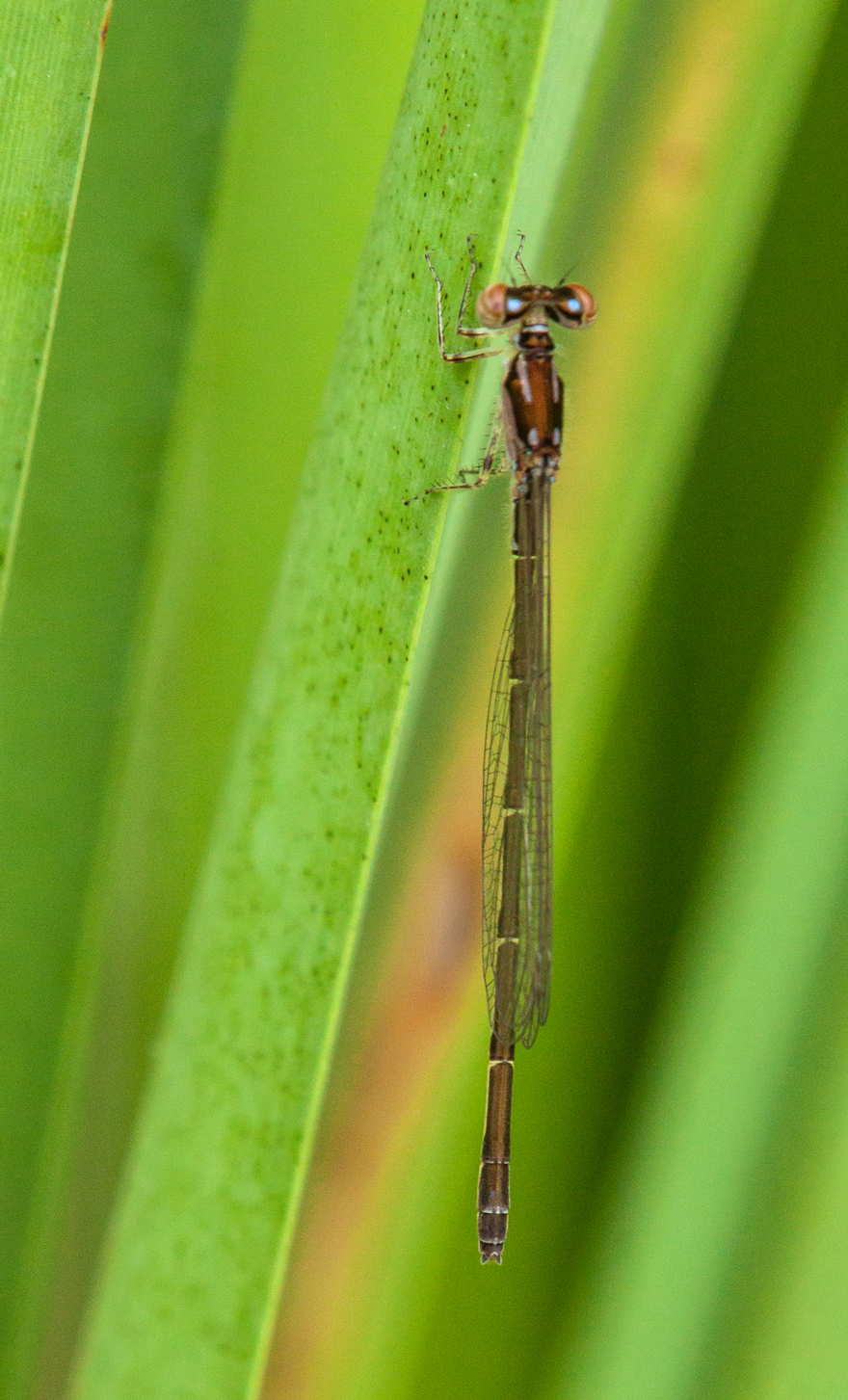
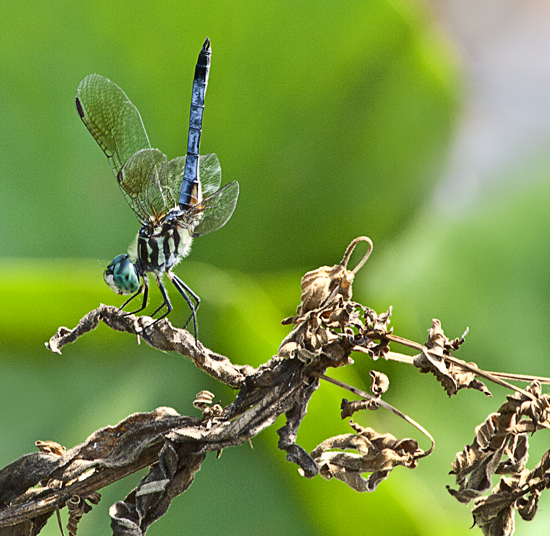
Two things really struck me when I first encountered this damselfly—its captivating blue eyes and its extraordinarily long abdomen.

Most damselfly fold in their wings when they are at rest, but damselflies of the Lestidae family keep them open and are commonly known as spreadwings. Only two members of this family are on the species list for my marshland park—the Swamp and the Slender Spreadwing—and this looks to me like might be a male Slender Spreadwing damselfly (Lestes rectangularis).

I would welcome a correction or confirmation of my identification, because I feel almost clueless when it comes to identifying damselflies.

damsel_blue1_blog

© Michael Q. Powell. All rights reserved.

Read Full Post »

Compared to the other dragonflies that I have photographed, the Eastern Amberwing (Perithemis tenera) is tiny, typically less than an inch in size (25mm), but it has such a distinctive look that it is easy to identify.

I was able to approach this dragonfly from the rear and from above as it was perched on some vegetation overhanging a muddy creek and I don’t think it sensed my presence, even though I was pretty close to it. .

amber1_blog

© Michael Q. Powell. All rights reserved.

Read Full Post »

It’s unusual for me to take a photograph of a dragonfly with my camera pointed upward, but this Bar-winged Skimmer (Libellula axilena) kept perching in the branches of a downed tree limb, enabling me to include a little patch of sky in some of the shots. This is a new species for me that was pointed out to me by fellow photographer Walter Sanford when we ran into each other at one of our favorite spots at our local marshland park. The second shot shows part of the wing pattern that is responsible for the common name of this species, “Bar-winged.”

barred1_blogbarred2_blog

© Michael Q. Powell. All rights reserved.


Read Full Post »

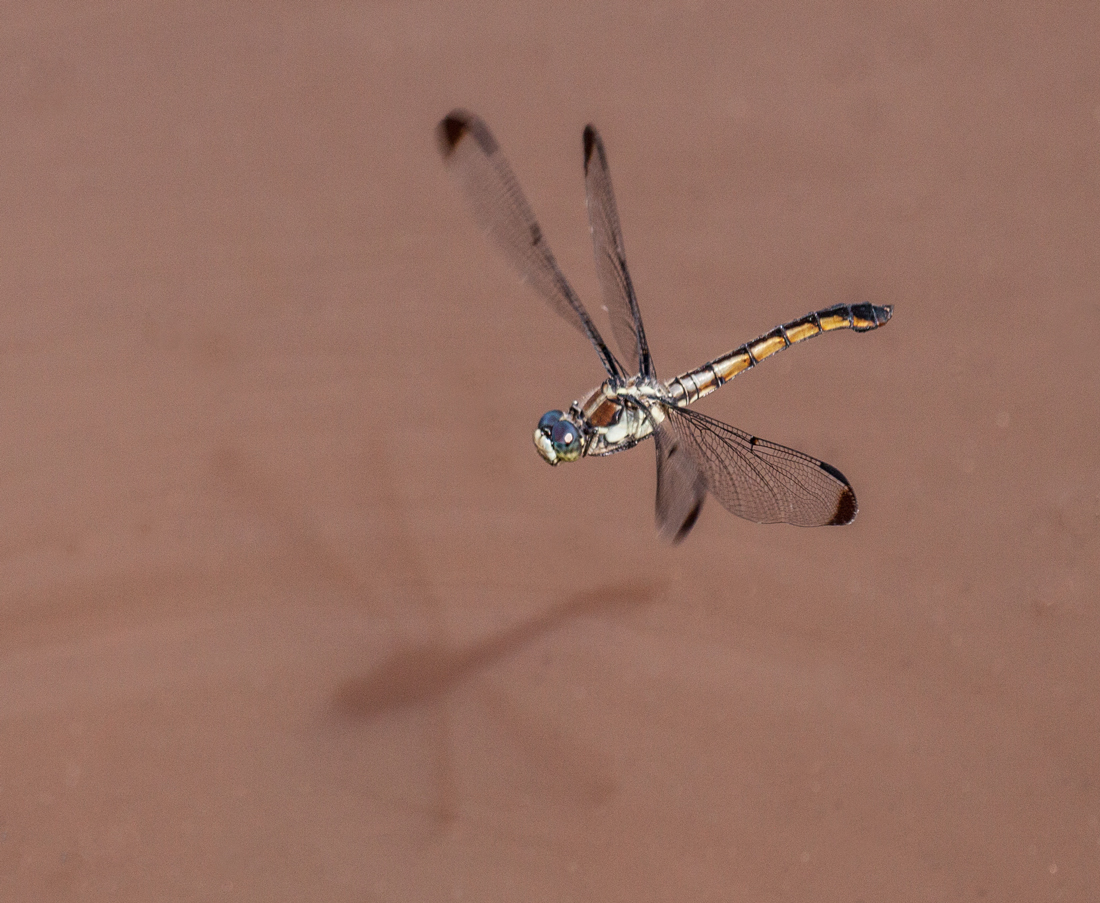
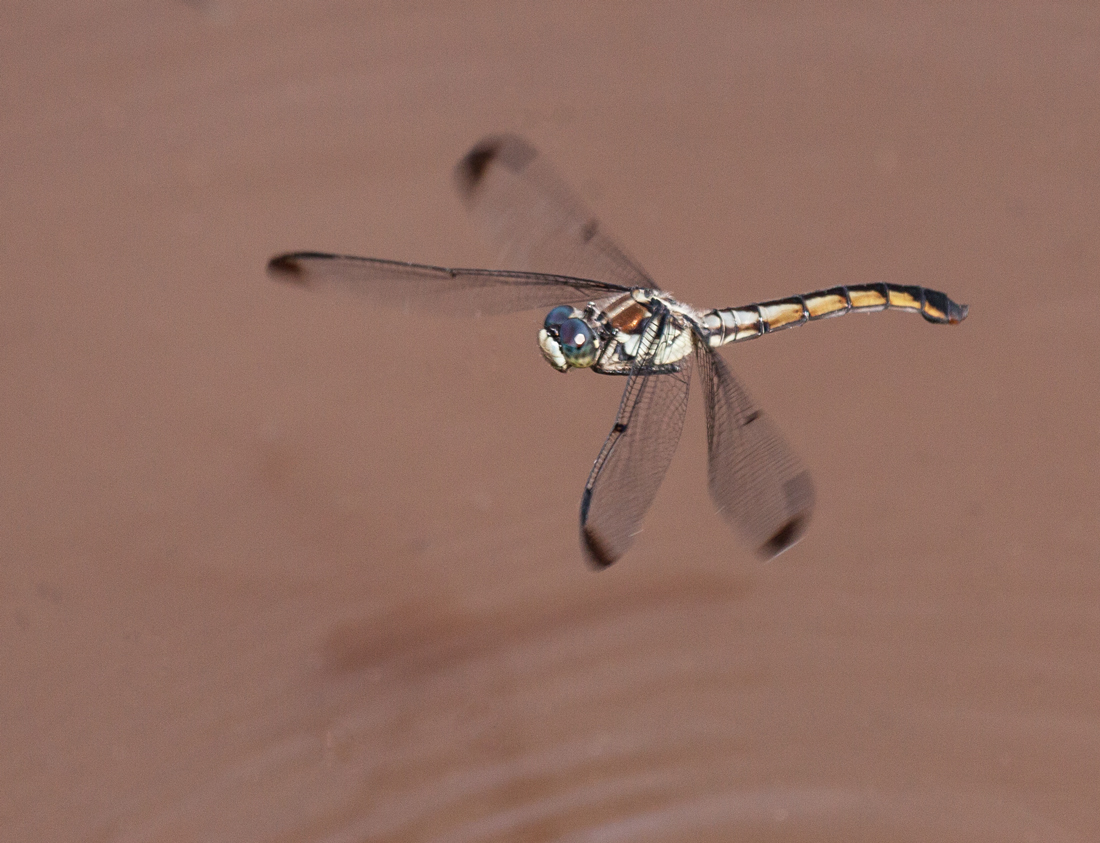
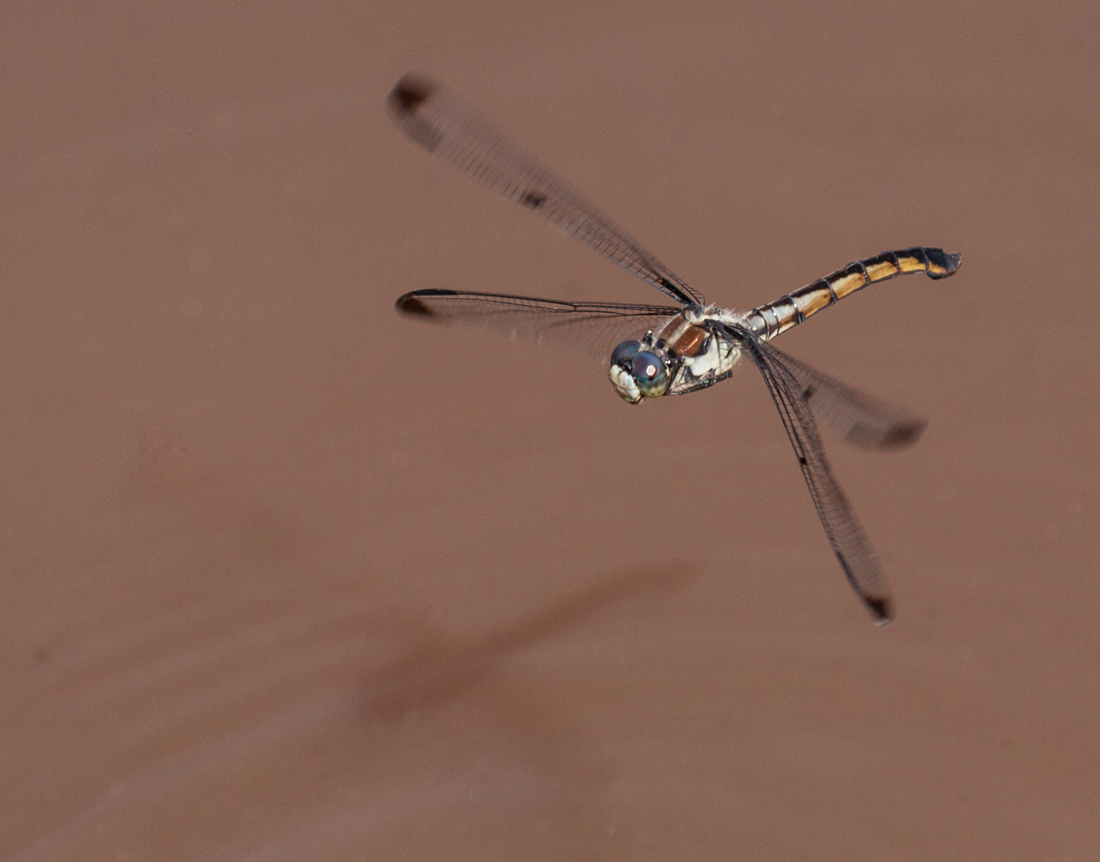
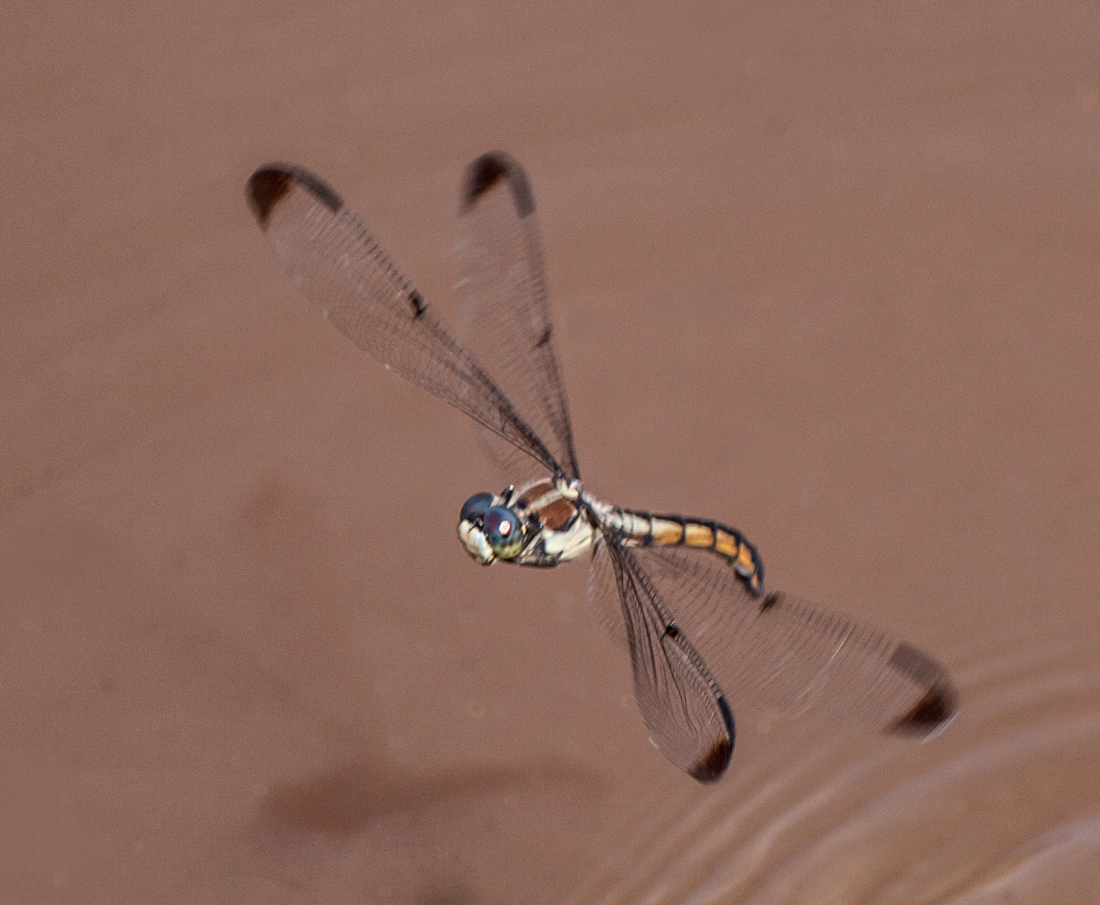
It’s tough to photograph a dragonfly in flight, but when it chooses to hover, there is a slightly better chance of getting a shot. That was the case recently when I encountered this female Great Blue Skimmer dragonfly (Libellula vibrans) that was in the process of depositing her eggs in the water. As her mate circled overhead, the female dragonfly would hover over the water and then periodically dip the tip of her tail in the water before returning to the hovering position. I was able to get several images of the hovering dragonfly, but got only a single image of her depositing the eggs.

flying1_skim_blogflying2_skim_blogflying3_skim_blogflying4_skim_blog

© Michael Q. Powell. All rights reserved.

Read Full Post »

« Newer Posts - Older Posts »