Feeds:
Posts
Comments

Archive for the ‘Dragonflies’ Category

Looking at my recent postings, you might come to the conclusion that I neglect damselflies, the smaller, less colorful members of the Odonata family, in favor of dragonflies. Actually, I really like damselflies, but they are so small that it is difficult to see them most of the time and quite a challenge to get a clear shot of one.

As I was searching for dragonflies, I came upon this beautiful black and blue damselfly perched on a small branch near the edge of a muddy creek and was able to get an unobstructed shot. You might think that identification would be easy, but there is a whole group of damselflies, the bluets, whose members have various combinations of black and blue.

So far, I haven’t been able to identify this damselfly, but I find its combination of black and turquoise to be elegant and really attractive.

damsel_bnb_blog

© Michael Q. Powell. All rights reserved.


Read Full Post »

A few days after I stumbled upon a Common Sanddragon dragonfly, a new species for my favorite marshland park, I returned to the remote location with fellow photographer and local dragonfly expert Walter Sanford (who made the initial identification for me). Walter has a science background and his posting today of our encounter with the Sanddragons is full of fascinating scientific information as well as awesome photos of these beautiful little dragonflies. Be sure to check out his complete posting.

waltersanford's avatarwalter sanford's photoblog

Common Sanddragon dragonflies (Progomphus obscurus) are anything but common.

Despite its name, this species is rare in Northern Virginia. Source Credit: Common Sanddragon, Dragonflies of Northern Virginia, by Kevin Munroe, Park Manager, Huntley Meadows Park.

Kevin goes on to cite Bull Run and Goose Creek, two streams where he has seen Common Sanddragons, and speculates they may be found at two other locations in Northern Virginia. Well, you can add a third location where sanddragons have been seen and it’s right in Kevin’s wheelhouse!

Mike Powell, a fellow amateur wildlife photographer and blogger, photographed a clubtail dragonfly at Huntley Meadows Park on 17 June 2014 that he was unable to identify. Mike’s description of the habitat where he saw the dragonfly piqued my curiosity, so I asked him to send me a photo of the unknown dragon. Turns out Mike discovered a Common Sanddragon —…

View original post 247 more words

Read Full Post »

Female dragonflies are often less colorful and visible than their male counterparts, but are equally beautiful.

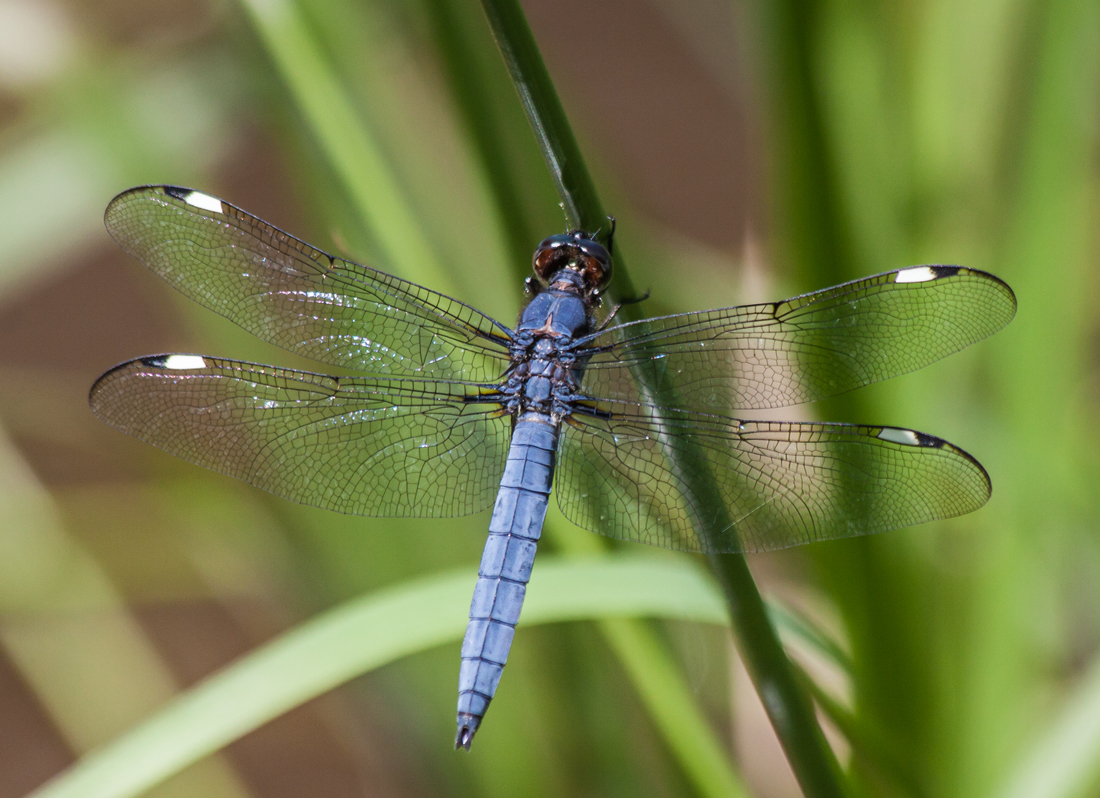
A week ago, I did a posting featuring the dark blue male Spangled Skimmer dragonfly (Libellula cyanea) and noted that the white stigma (markings) on the wings help in identifying this species. In today’s image, a female Spangled Skimmer appears to be a natural model as she smiles and poses for the camera

spangled_fem_blog

© Michael Q. Powell. All rights reserved

Read Full Post »

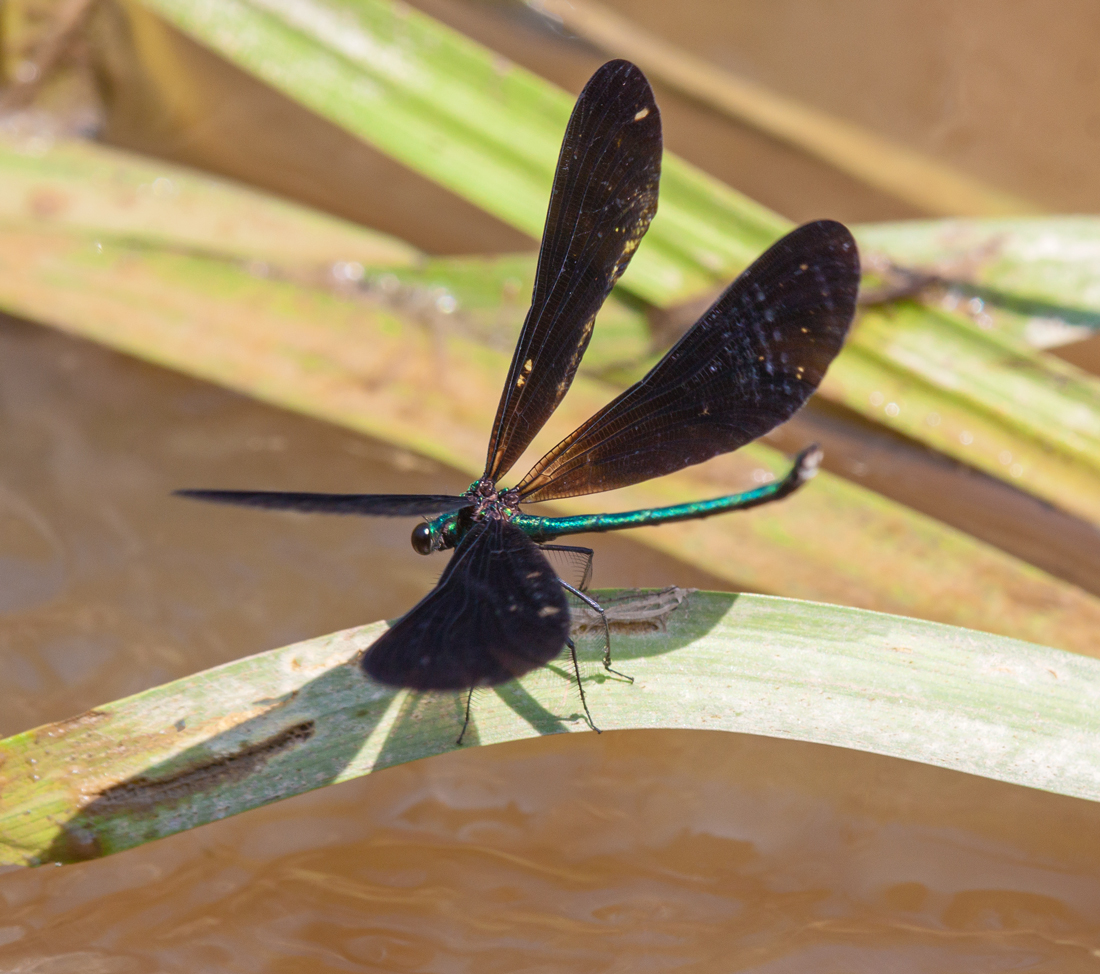
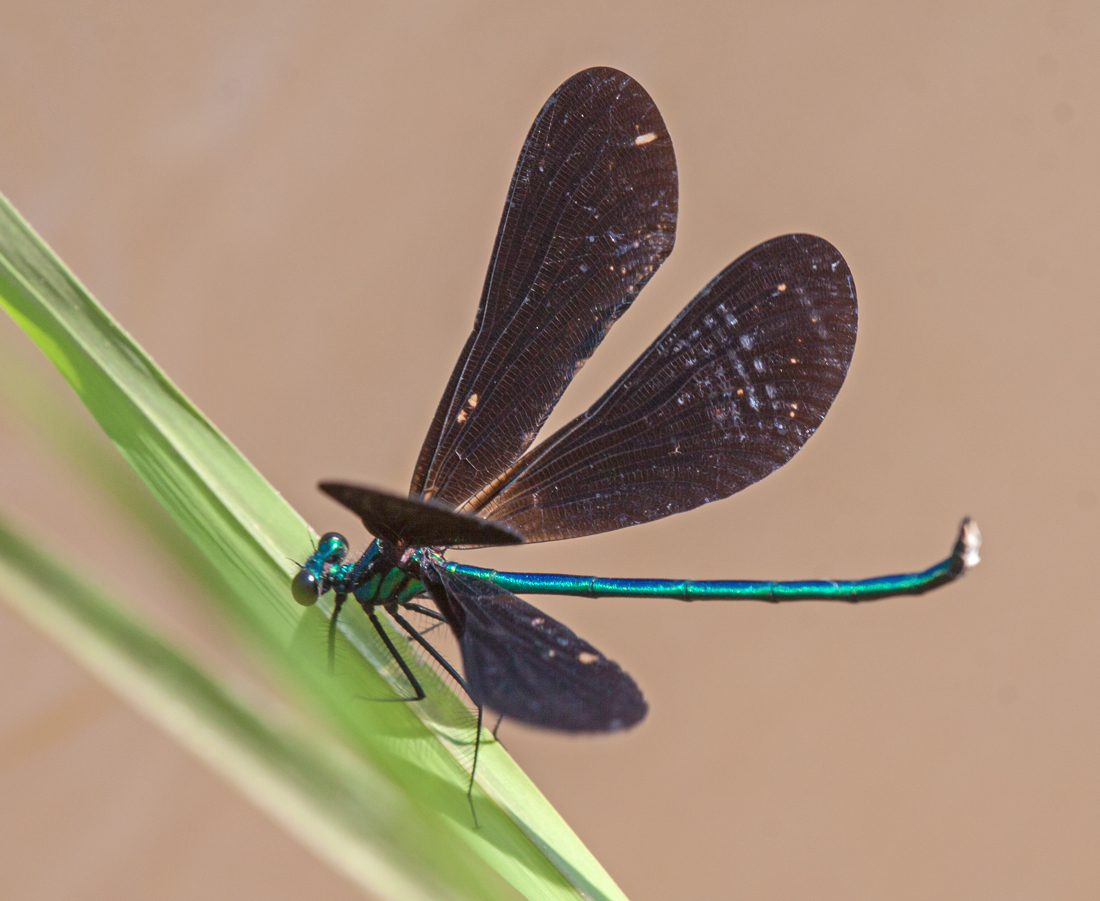
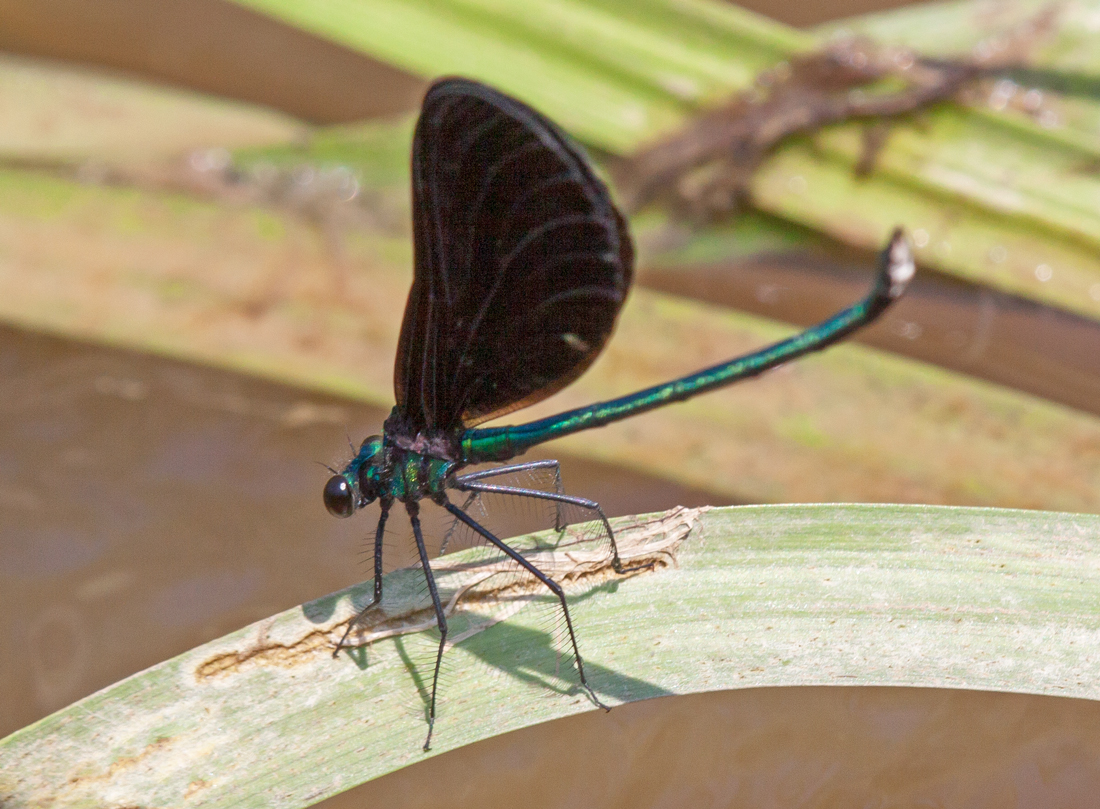
When you first catch sight of the fluttering flight of an Ebony Jewelwing damselfly (Calopteryx maculata) from a distance, it’s easy to think that it is a butterfly.

These damselflies are really weak fliers and they flutter slowly from one location to another nearby spot. Although they perch, they tend to do so on low vegetation and they don’t remain in one spot for very long, which makes it a challenge to get a decent photograph of one of them.

Their dark wings make them unusual and distinctive—all of the other damselflies that I have seen had clear wings—and help to set off the beautiful emerald color of their bodies.

According to bugguide.com, the Ebony Jewelwing’s scientific name Calopteryx maculata comes from the Greek “kalos” (beautiful) + “pteron” (wing or feather) and “macula” (a spot), a reference to the white spot near the tip of the female’s wing.

ebony1_blog

Ebony Jewelwing damselfly with opened wings

Ebony Jewelwing damselfly with opened wings

Ebony Jewelwing damselfly in a raised position with closed wings

Ebony Jewelwing damselfly in a raised position with closed wings

© Michael Q. Powell. All rights reserved


Read Full Post »

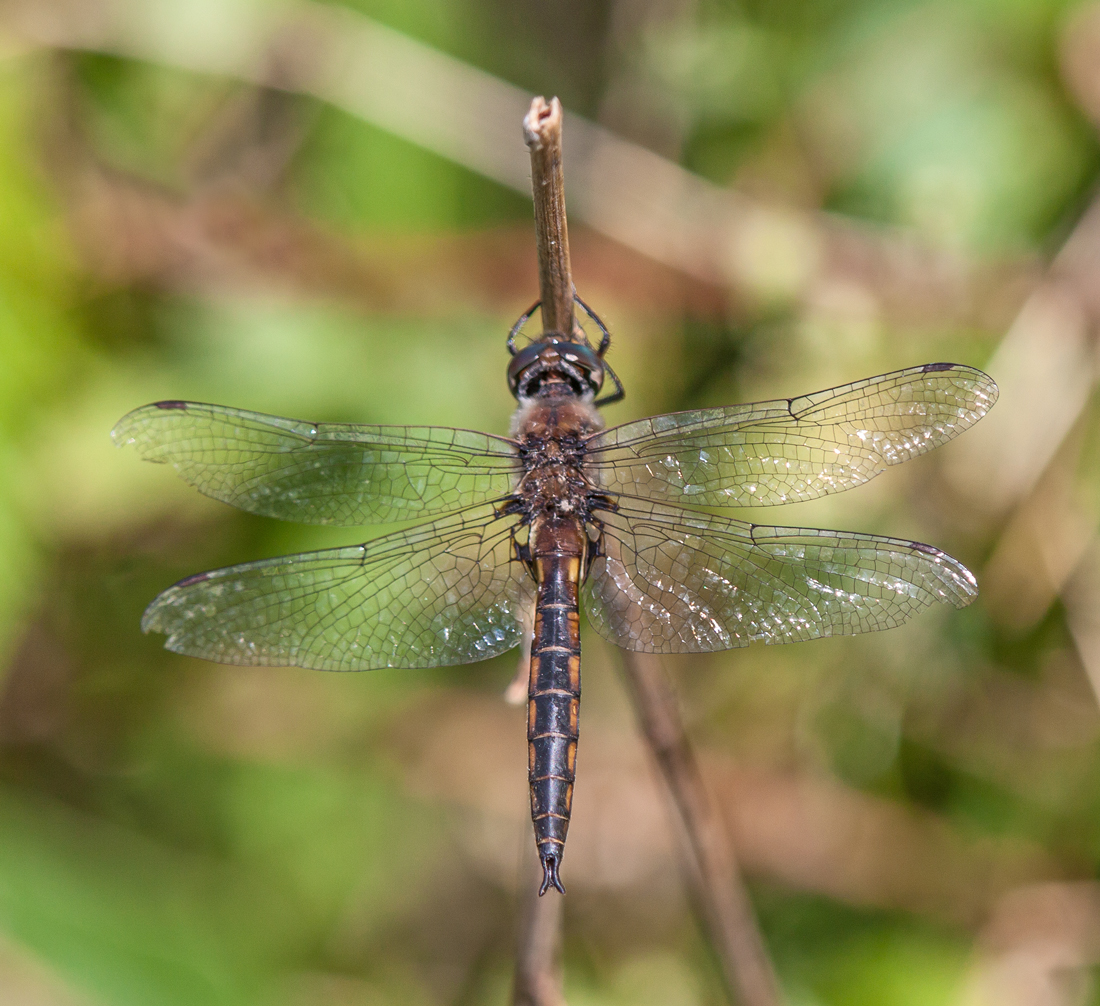
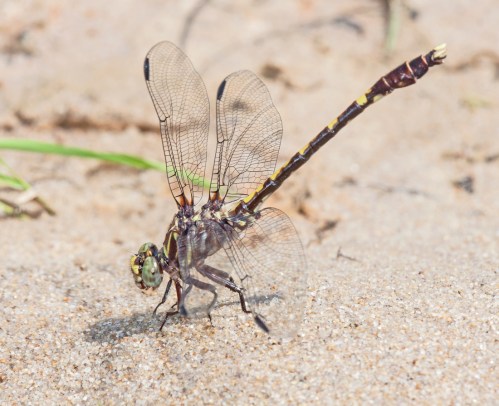
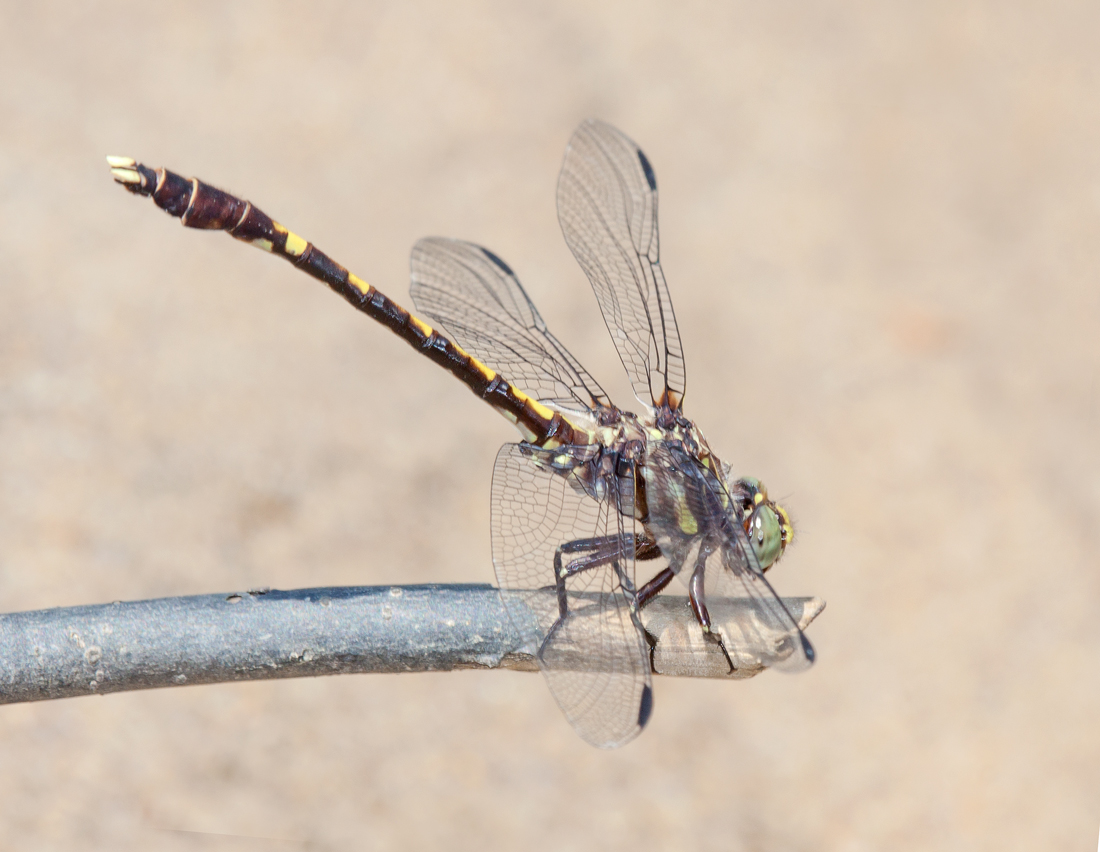
Last week I added the Common Sanddragon dragonfly (Progomphus obscurus) to the species list at Huntley Meadows Park, the marsh where I spend a lot of time walking and photographing. The park keeps a comprehensive list of species and it appears that this particular dragonfly had never before been observed and photographed within the park.
sand1_blog


I came across this dragonfly, which I recognized as some kind of clubtail, when I was hiking through a back area of the park. I was struck by the way the dragonfly was patrolling a small sandy stretch of a creek and kept returning to perches on that little beach. I took quite a few photos of the dragonfly, though I really wasn’t sure of its identity.

sand3_blog

The images would have remained unviewed on my computer for several days, but I mentioned my discovery to fellow blogger and photographer, Walter Sanford, who seemed to sense that I had captured something a bit out of the ordinary. He insisted that I send him a couple of images immediately, which I did. Walter tentatively identified the dragonfly as a Common Sanddragon and confirmed the identification with Kevin Munroe, who manages Huntley Meadows Park and is a dragonfly expert.

Kevin has a wonderful website, Dragonflies of Northern Virginia, that is full of fun and useful information about dragonflies in our area. In the section about Common Sanddragons, he notes, “Despite its name, this species is rare in Northern VA. In other parts of the country, where clean, sunny, shallow creeks with plenty of sandy/gravely banks are common, so too are Common Sanddragons. Our urban waterways are too influenced by stormwater, flowing fast and unchecked off impervious surfaces (roads, parking lots, roofs, etc.). This creates deeply incised, eroded banks and streambeds with excess silt, unstable flows.”

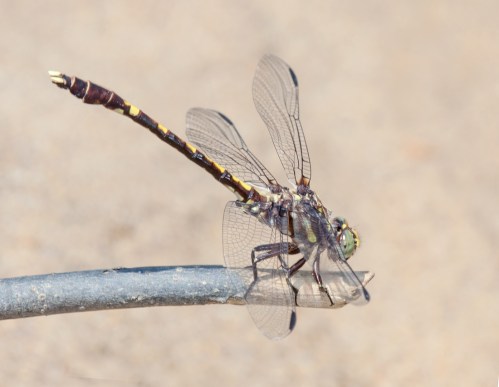
As a kind of experiment, I angled a couple of sticks in the sand to see if I could get one of them to perch on the stick. Although they kept returning primarily to the sand, a couple of times one perched on the stick and I got this shot.
sand2_blog

You may have noticed the raised tail in several of the shots. In other dragonflies, the “obelisk” position is a method of thermoregulation, but I am not sure if this is the case here—it might be related to efforts to attract a mate.

© Michael Q. Powell. All rights reserved


Read Full Post »

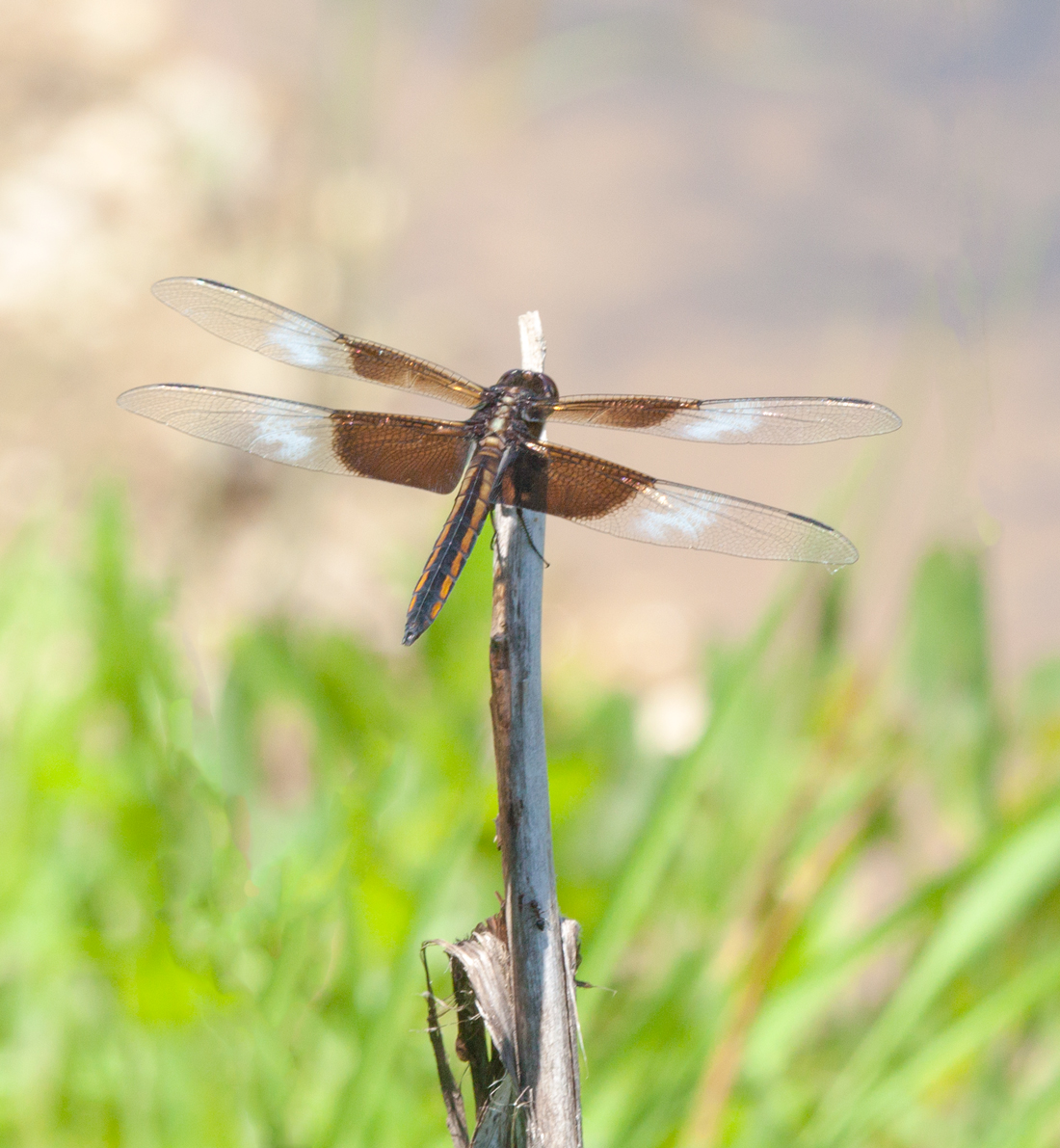
Although I usually try to get close up for my dragonfly photos, I am unusually pleased with this image I took yesterday of an immature male Widow Skimmer dragonfly (Libellula luctuosa), which has an artistic quality that is not always found in my close-ups.

For those who might be curious about the identification, the white on the wings indicates that it is a male (females have only dark blotches) and the yellow and black body indicates that it is immature,because adult males have bluish-colored bodies.

widow1_blog

© Michael Q. Powell. All rights reserved

Read Full Post »

Do you believe in unicorns? I spent part of yesterday chasing a flying unicorn, although it was the Unicorn Clubtail dragonfly (Arigomphus villosipes), not the one that looks like a horse.

Normally Unicorn Clubtails like to perch on flat surfaces, but this one chose to perch on a dead branch overlooking the muddy stream, allowing me to get a good look at it and a decent photograph.

Many people seem to like unicorns and rainbows. Now that I have captured a unicorn, I’m on the lookout for a rainbow–and it looks like it may rain later today.

unicorn1_blog

© Michael Q. Powell. All rights reserved.


Read Full Post »

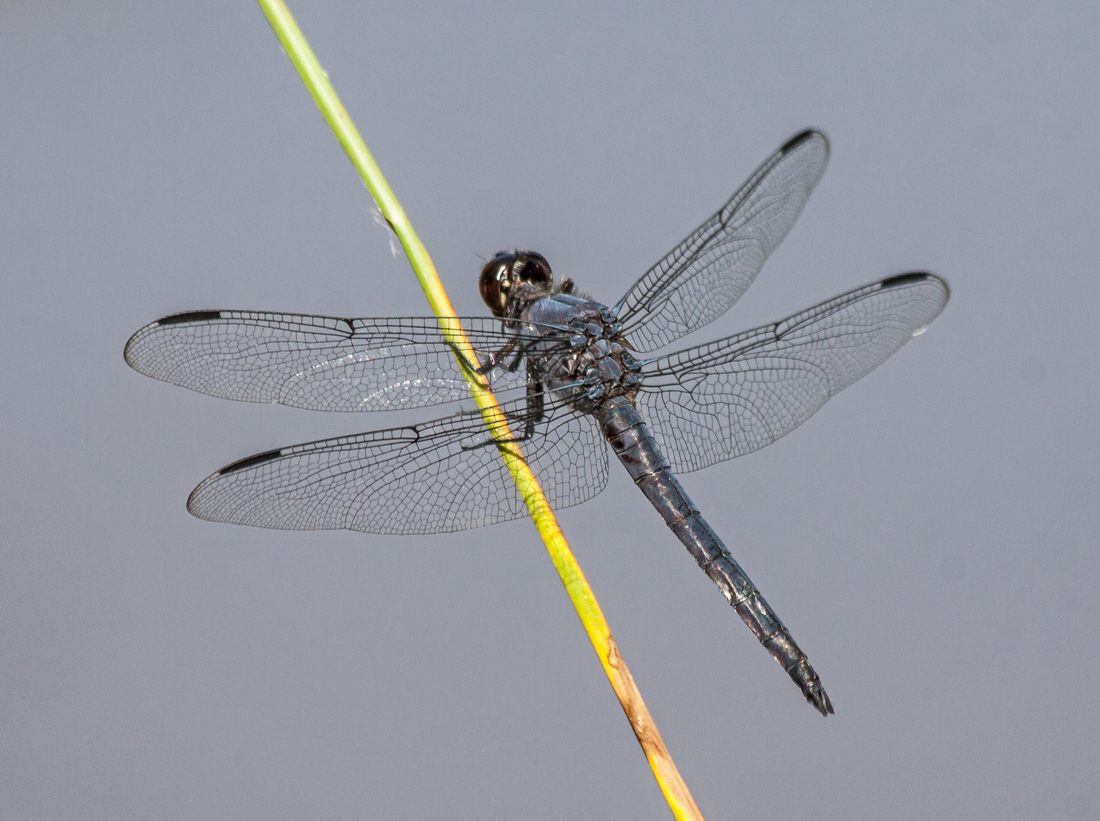
It’s prime season now for dragonflies and there are lots of them flying about. Some are brightly colored and gaudy, while others, like this Slaty Skimmer (Libellula incesta) that I encountered Tuesday at Huntley Meadows Park, have a more subdued and refined beauty.

I have been experimenting a bit with lenses and with camera settings as I chase after dragonflies. Although I often use my macro lens for this kind of shot, I took this one at 270mm of my 70-300mm telephoto zoom. I have been told that most telephoto lenses are a little soft at their extreme ends, so I pulled back a little from 300mm. Similarly, I shot this at f/10 to try to get a balance between sharpness and depth of field, while keeping the shutter speed high enough for me to easily handhold the camera.

Most of the time I use evaluative metering on my camera, but for most of my shots on Tuesday, I had the camera set for spot metering. In doing so, I realized quickly that I had to pay a lot more attention to the precise spot on which I was focusing, because that was going to play a disproportionate role in determining the exposure.

I realize, of course, that a lot of the choices will be situationally dependent, but it’s fun and instructive to try out new settings and combinations of settings in trying to improve the quality of my images. (Click on the image to see a higher resolution view of this dragonfly.)

slaty_skimmer1_blog

© Michael Q. Powell. All rights reserved.

Read Full Post »

A few weeks ago, I did a posting with some close-up images of a Common Baskettail dragonfly (Epitheca cynosura), but one of my fellow photographers keeps reminding me that I have not posted any shots of the entire dragonfly, which it turns out is not all that common in our local marshland park.

This small collection of images highlights some of the notable features of the Common Baskettail dragonfly, including its beautiful blue eyes and unusual tail. I took these photographs a month ago (on 19 May), but I have fallen a bit behind on viewing and processing my shots.

baskettail1_blogbaskettail2_blogbaskettail3_blog

© Michael Q. Powell. All rights reserved.


Read Full Post »

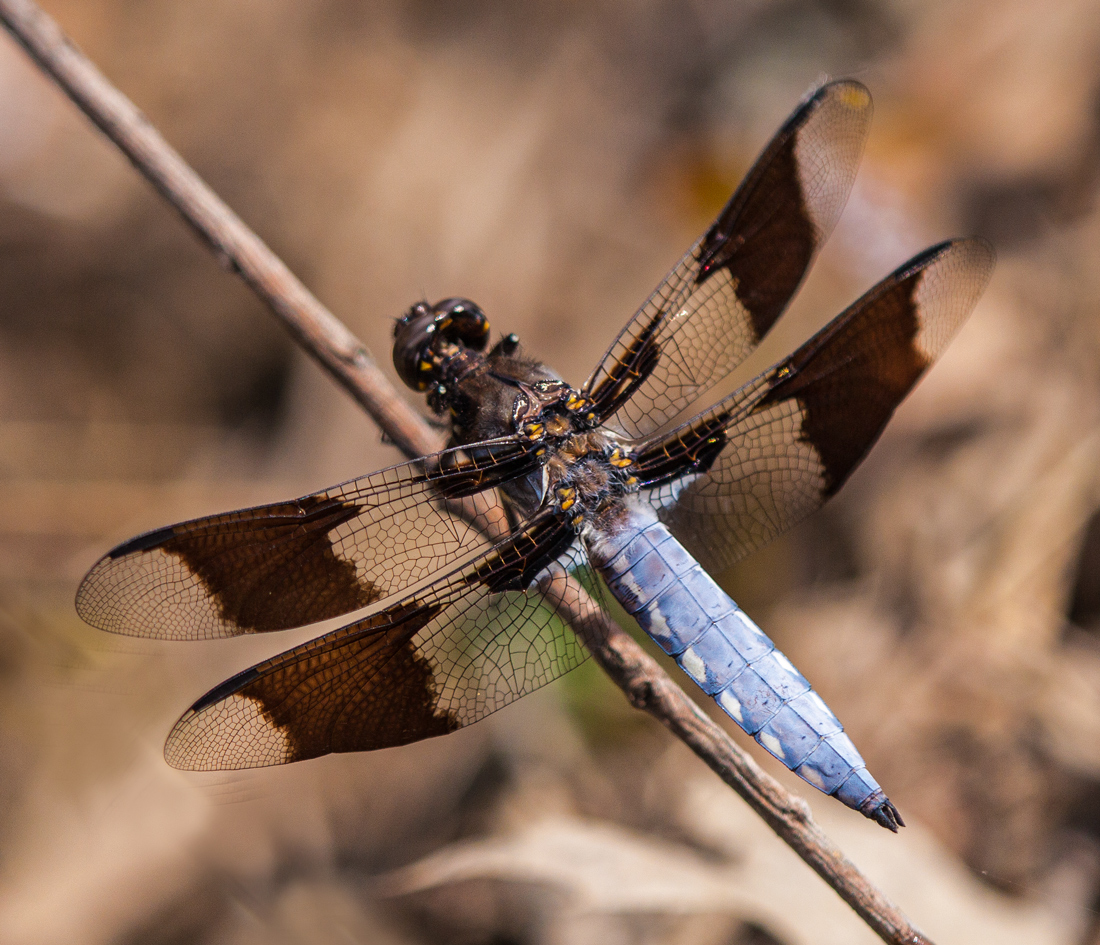
This dragonfly has such distinctive markings that I should have been able to identify it easily, but I had never seen one like it before, so I didn’t know what it was.

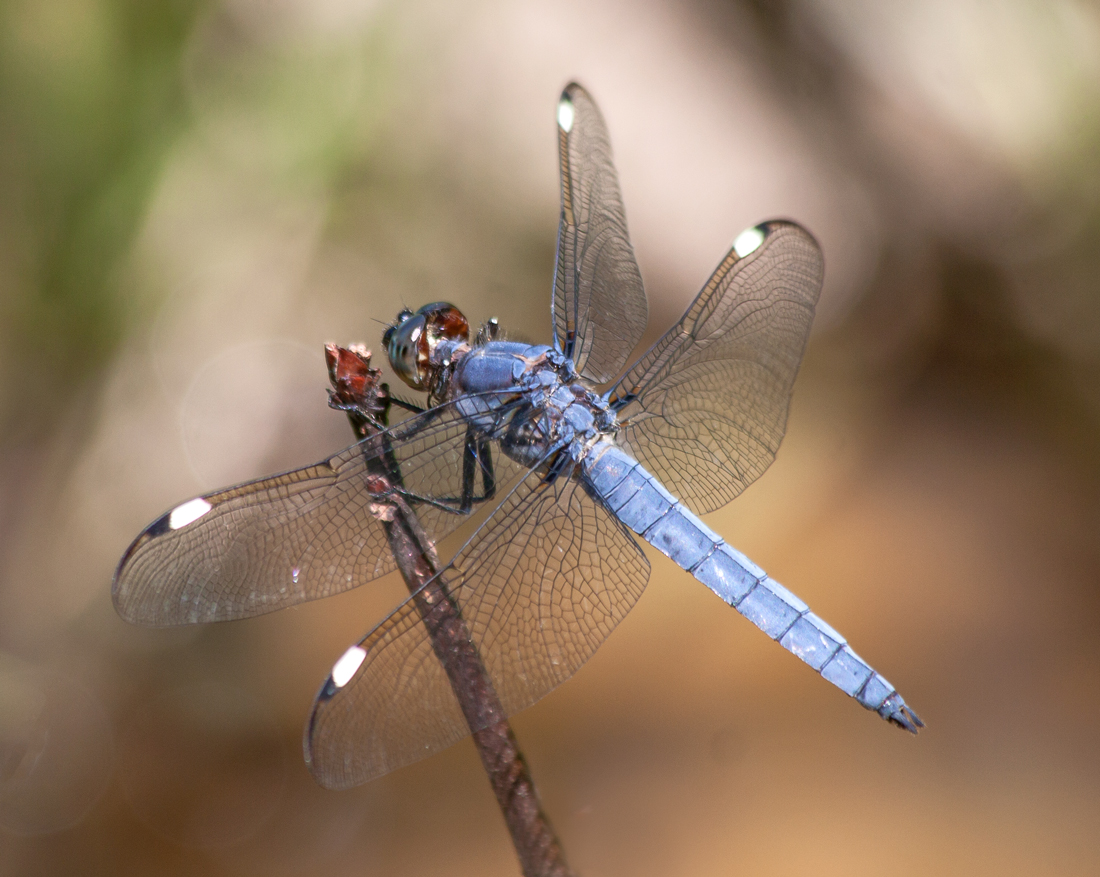
Fortunately, a short time later that day I ran into local dragonfly expert and fellow blogger Walter Sanford, who informed me that it was a Spangled Skimmer dragonfly (Libellula cyanea). Spangled Skimmers have black and white stigmas on their wings, which makes them unique among dragonflies in my part of Northern Virginia. As you may be able to guess from my images, Spangled Skimmers are among the species of dragonflies that like to perch, which makes it easier to photograph them—if you can find them.

spangled1_blogspangled2_blog

© Michael Q. Powell. All rights reserved.

Read Full Post »

What do you think about when you hear the word “dasher?”  From my early childhood days, the word meant only one thing—it was the name of one of Santa’s reindeer.

Many of us grew up hearing these familiar words from the poem “Twas the Night Before Christmas” (“A Visit From St. Nicholas“) by Clement Clarke Moore:

More rapid than eagles his coursers they came,

And he whistled, and shouted, and called them by name;

“Now, Dasher! now, Dancer! now, Prancer and Vixen!

On, Comet! on, Cupid! on, Donder and Blitzen!

To the top of the porch! to the top of the wall!

Now dash away! dash away! dash away all!”

So, every time I see a Blue Dasher dragonfly (Pachydiplax longipennis), like this beautiful male that I photographed this weekend, I can’t help but have a little thought of Christmas, even on the hottest days of summer.

But Santa, some may complain, didn’t have a blue Dasher. That’s true, of course, but Elvis had no problem singing of a Blue Christmas, the perfect setting for a Blue Dasher. (Click here to watch a You Tube video of Elvis singing this signature tune.)

dasher1_june_blog

© Michael Q. Powell. All rights reserved.

Read Full Post »

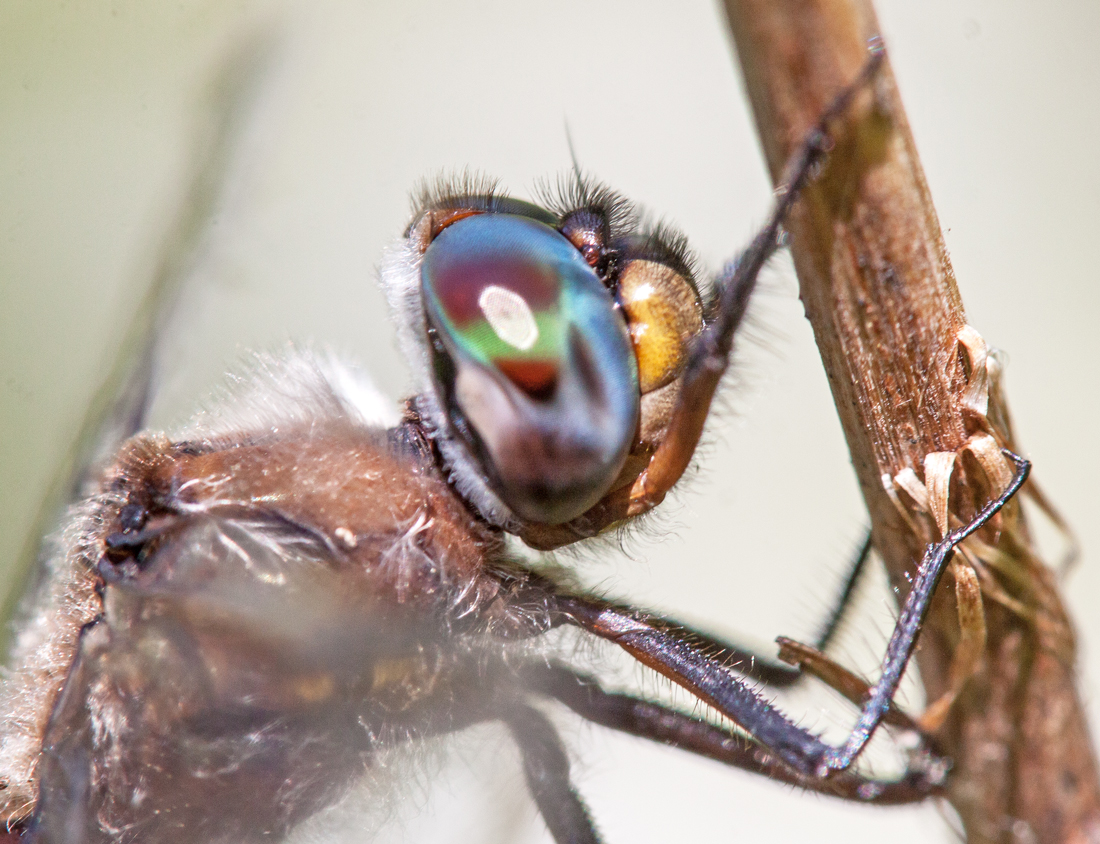
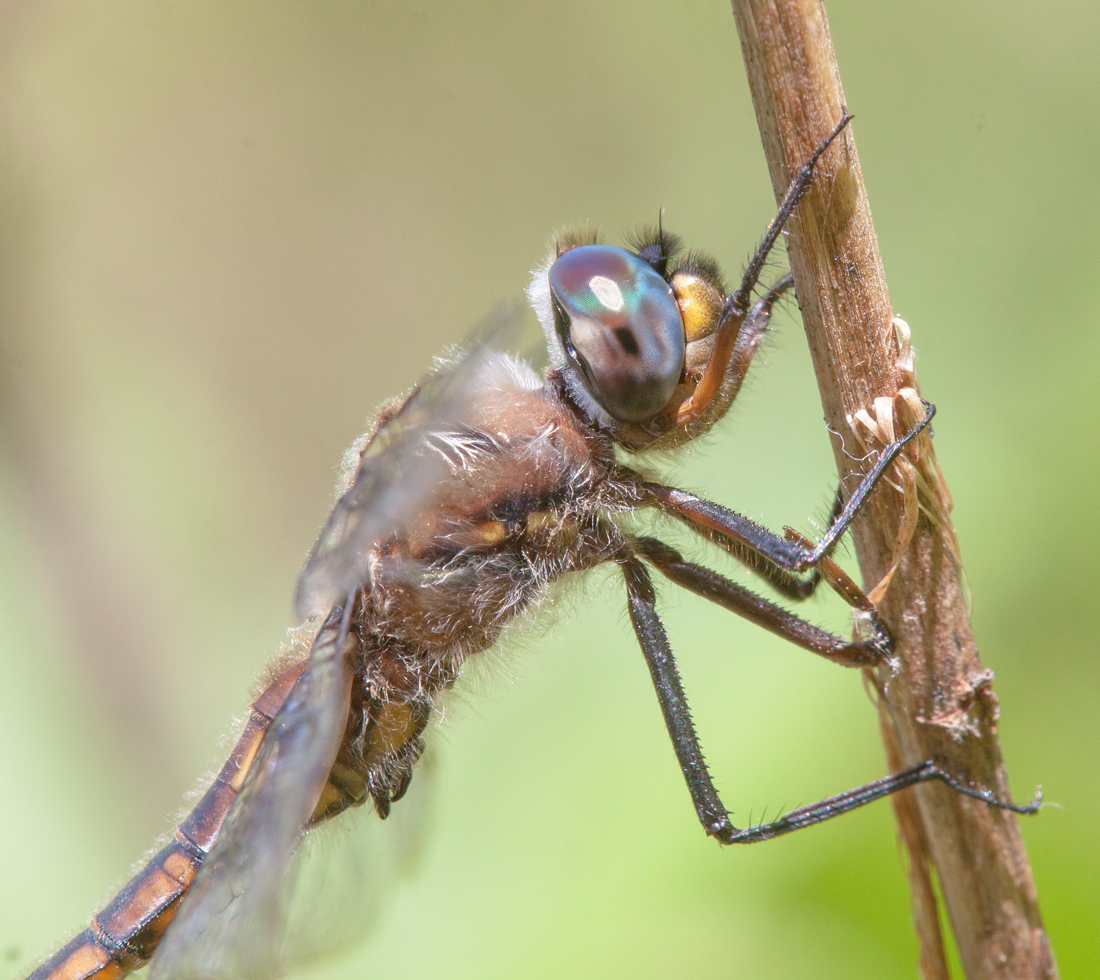
Have you ever looked really closely at a dragonfly? I expected to be able to see its beautiful colors, but I was a little surprise to see how many little hairs were present on the face and body of this Common Baskettail dragonfly (Epitheca cynosura) that I encountered in mid-May at my local marsh.

I was standing in one of my favorite spots, at the edge of a beaver pond, when this dragonfly flew in and perched a few feet away from me. I don’t know if it was resting or napping or simply didn’t mind my presence, but it allowed me to get amazingly close to it. I was able to take quite a few shots of it and even was able to set up my tripod (although there was so much underbrush that it was tough to get a really stable base).

As you can see from the first shot, depth of field was an issue for me when I moved in this close and I didn’t manage to keep all of the legs in focus. I took the second shot from a bit further back and more of the dragonfly is in focus.

Want a new view on life? Try looking at the world through a macro lens and you’ll see some amazing things.

drag1a_close_blogdrag2_close_blog

© Michael Q. Powell. All rights reserved.

Read Full Post »

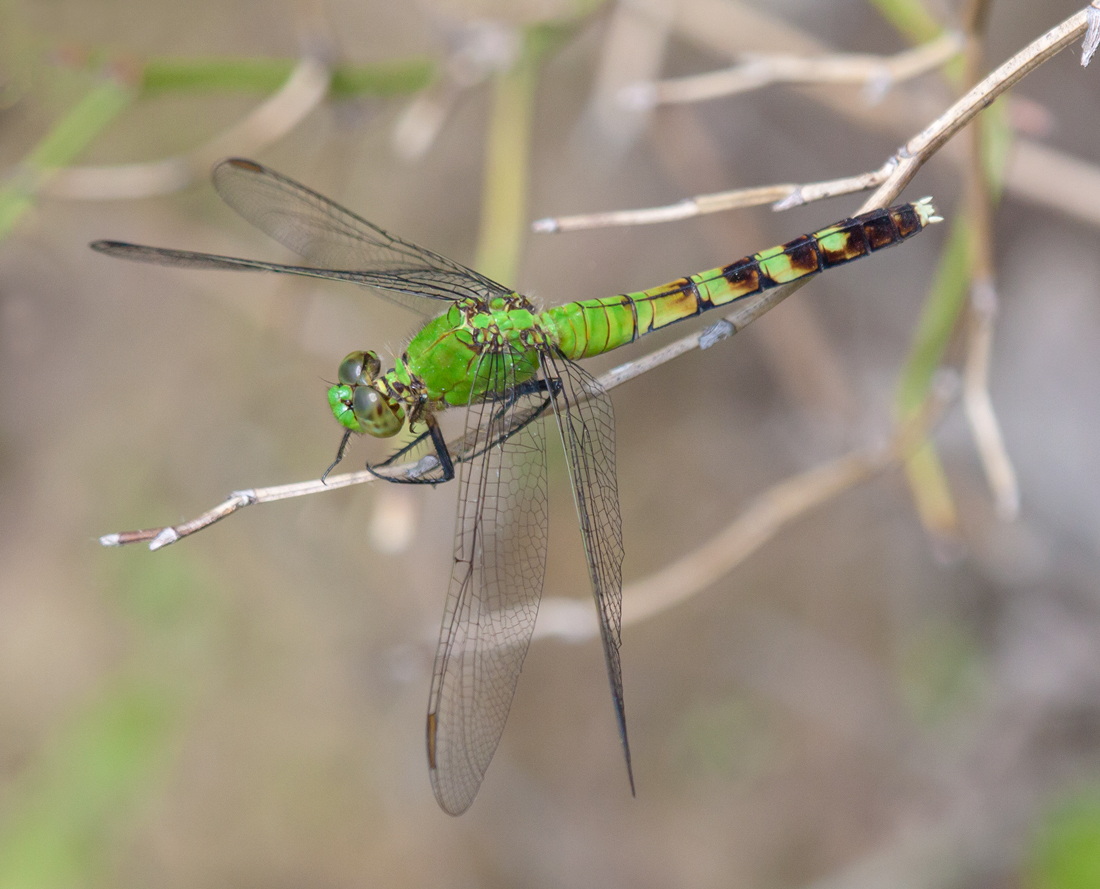
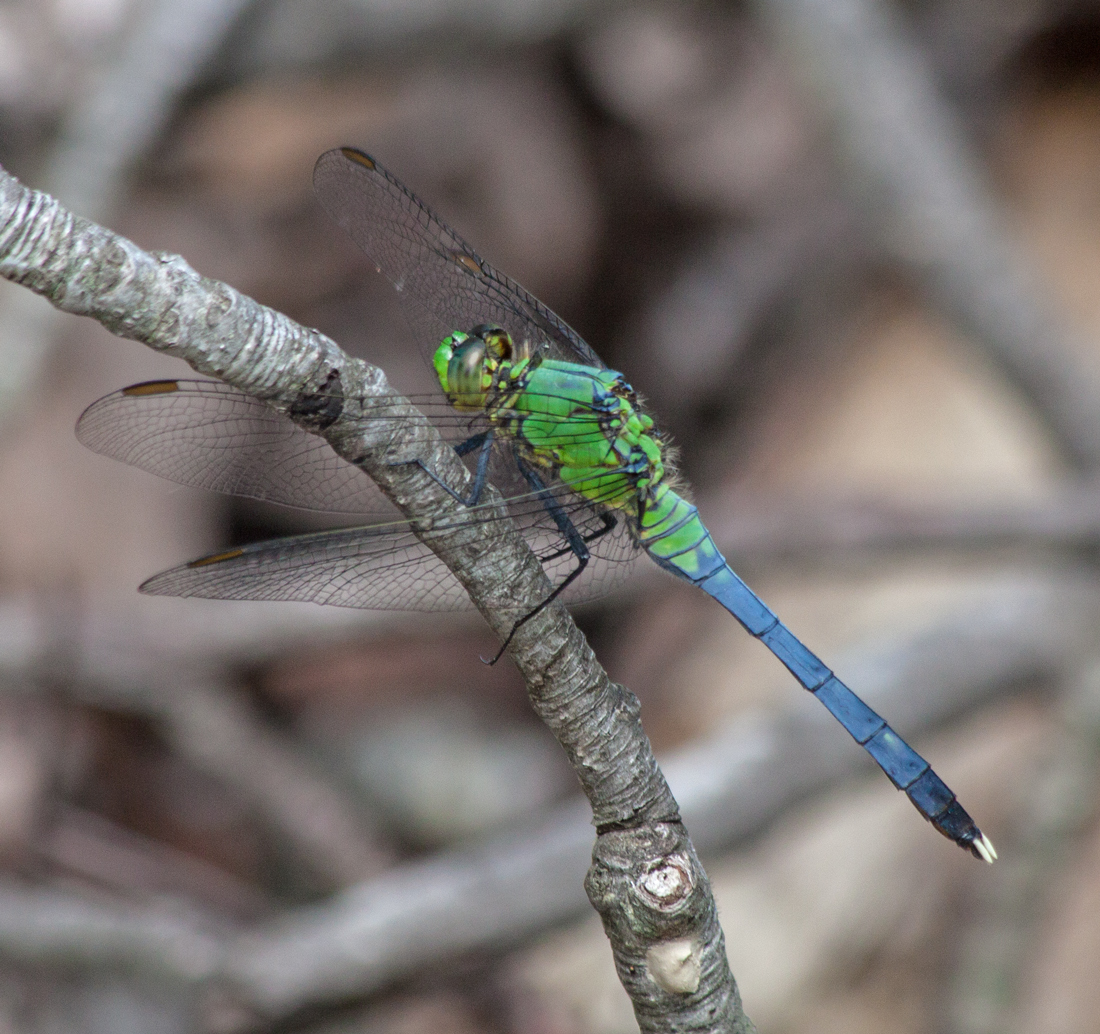
Yesterday I wrote of a male Eastern Pondhawk dragonfly (Erythemis simplicicollis) transitioning to adulthood, but I realized this morning that not all viewers know what an adult male pondhawk looks like.

This first shot shows an adult male Eastern Pondhawk perched above a big mass of algae, duckweed, and other “stuff” at a small pond at a local garden. Originally I was frustrated when the dragonfly flew into this mess and did not perch above the cleaner water of the pond. I wasn’t sure if I could get a clear shot with all of the clutter, but was pleasantly surprised with the result. I actually like the bubbles in the foreground and the texture and visual interest that it adds to the shot.

pondhawk1_blog

I took the second shot in a totally different environment, at the edge of a field. It shows the bright green coloration of the Eastern Pondhawk female (and young males). My local dragonfly expert, Walter Sanford, keeps reminding me that one of the keys to differentiating the genders is the terminal appendages and I think this one is a female.

pondhawk2_blogWhen you take the blue from the top photo and the green from the bottom one, you get the color combination of yesterday’s posting. As for me, I find the colors to be exceptionally beautifully individually as well as in combination.

© Michael Q. Powell. All rights reserved.

Read Full Post »

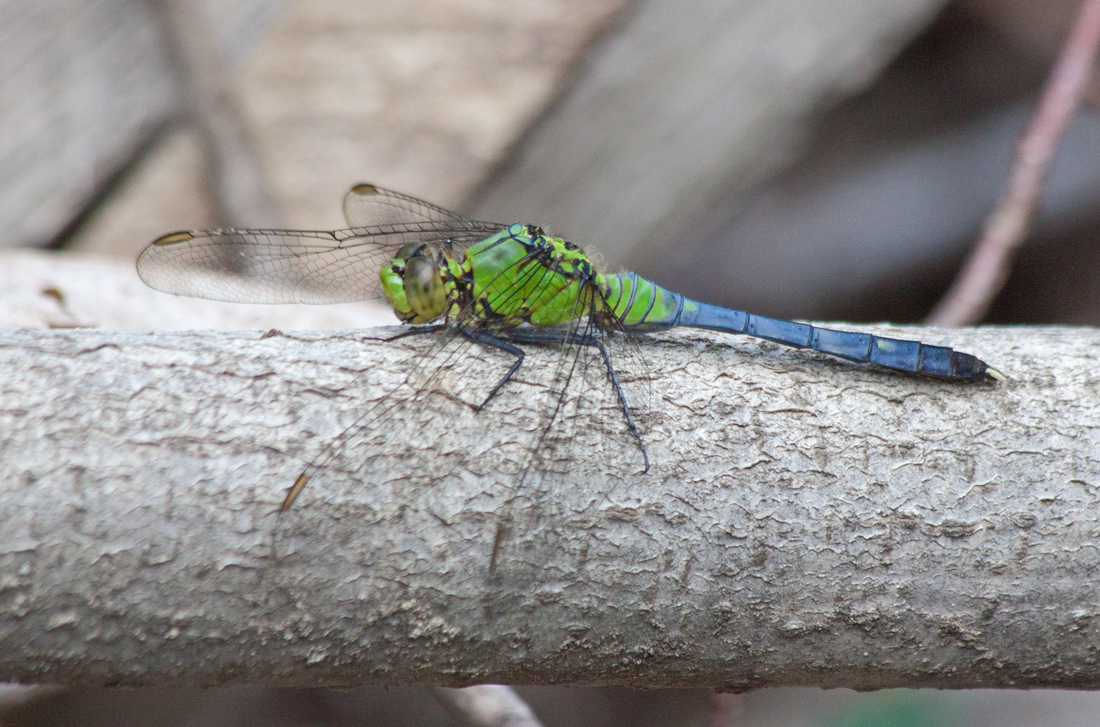
I have always been intrigued by the fact that many male dragonflies start out looking like females and over time acquire their male coloration. It’s a bit of an oversimplification, but male Eastern Pondhawk dragonflies (Erythemis simplicicollis) are blue and females are green. Males of this species initially are green and gradually turn blue. Last weekend I managed to get some shots of a dragonfly who is in midst of this transitional period.

I really like his current two-toned look, but before long he’ll be almost completely blue, (though he will retain the green face.

drag_bg1_blogdrag_bg2_blog

© Michael Q. Powell. All rights reserved.

Read Full Post »

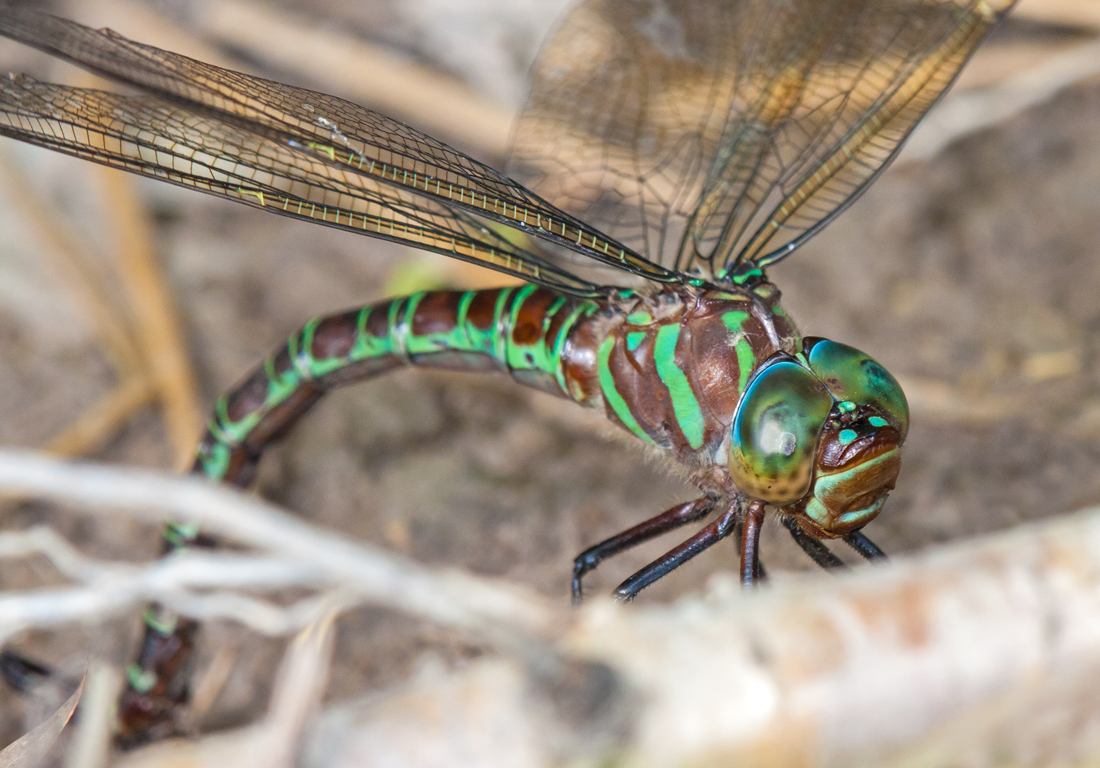
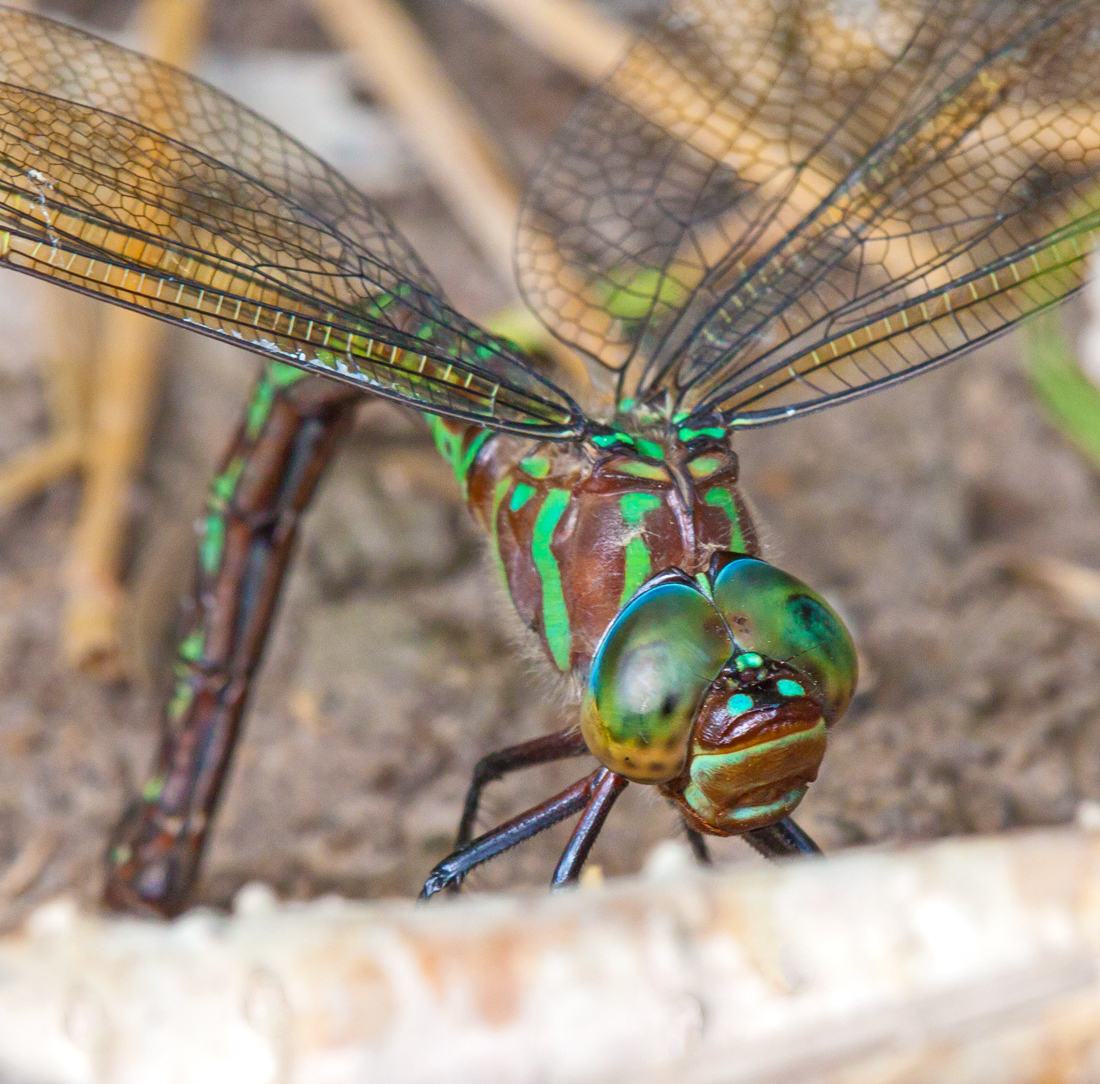
As I was observing dragonflies on Friday at Huntley Meadows Park, a female Swamp Darner dragonfly (Epiaeschna heros) decided that the spot right next to me was the perfect place for her to deposit some eggs. She seemed to fly right at me and then veered just slightly to the left and began to arch her back in the way that dragonflies do when ovipositing.

I was really close to this female dragonfly, so close that my 180mm macro lens might actually have been too much lens for the situation. This was an unusual situation for me—I am usually trying to get closer and closer to a subject. As dragonflies go, Swamp Darners are really large, as much as 4 inches (10 cm) in length.

I didn’t dare move back for fear of scaring her away, so I slowly moved my upper body to try to frame the action. These shots show a couple of the different body positions of the dragonfly as she deposits her eggs.

drag1_ovp_blogdrag2_ovp_blog

© Michael Q. Powell. All rights reserved.


Read Full Post »

To crop, or not to crop—that is the question. At a certain point in time when we are processing our images, we are all come face to face with this question. To some photographers, composing perfectly in the camera is the ultimate virtue, and they take pride in the fact that they do not crop (and object when their images are cropped).

Moose Peterson is one prominent photographer who does not crop and he explained his views in a fascinating blog posting in 2012 entitled, “The Crop Revisited.” I am still pondering one of his conclusions, “When you don’t give yourself the option to “fix it in post,” photographers push themselves. This always make a better click and the story telling, the subject, that passion of that click becomes clearer and clearer.”

Most of us could not live with such a high standard and for various reasons we choose to crop. I am so used to cropping my images that even when I compose an image just the way that I want it, I am tempted to move in closer with my crop. That was my dilemma with this image of a damselfly on the edge of a lily pad, as it was framed when it came out of the camera.

damsel_pad_blogI really like the long sinuous curve on the left and the large expanse of green on the right. I worry, however, that the damselfly is taking up too little space of the image and is not prominent enough. So I cropped a bit and produced a second version.

damsel_pad_crop_blog

That’s not a very extreme crop, but somehow the image feels different to me. Does it make any difference to you? Do you prefer one of the two over the other?

UPDATE: Fellow blogger and local dragonfly expert, Walter Sanford, has identified this for me as an Eastern Forktail damselfly (Ischnura verticalis). Thanks, Walter.

© Michael Q. Powell. All rights reserved.


Read Full Post »

This past weekend I finally saw one of my favorite dragonflies, the male Blue Dasher (Pachydiplax longipennis), at Green Spring Gardens in Alexandria, Virginia. The Blue Dasher is bright and colorful and likes to perch on protruding vegetation, thereby providing lots of photographic opportunities.

Now that I have seen my first Blue Dashers, I know for sure that summer is almost here.

dasher_may_blog

© Michael Q. Powell. All rights reserved.

Read Full Post »

As a follow-up to last week’s preview, here is the complete story of my recent encounter with a Bold Jumping Spider (Phidippus audax) and a female Eastern Pondhawk dragonfly (Erythemis simplicicollis). The photos are a bit graphic, particularly for those of us who like dragonflies, but they illustrate the reality of nature that even super predators like dragonflies can easily become prey.

dragon1A_spider_blogAs I was walking at my local marshland park, I spotted a bright green dragonfly perched on the boardwalk and suspected immediately that it was a female Eastern Pondhawk. I moved in slowly to get a shot and was a bit surprised when the dragonfly did not take off when I got close. This is the initial view I had of the dragonfly.

dragon3_spider_blogI looked closely at the dragonfly and noticed that it was lying on its side and appeared to be dead. Wondering what might have caused its demise, I picked up the dragonfly’s body to do some amateur forensic analysis. (I obviously watched to many televisions shows about crime scene investigations.) As I lifted the body toward my eyes, I was shocked to find that a fuzzy black spider was still attached to it. Apparently the spider had been hiding in the gap between the boards as it feasted on the dragonfly.

Somewhat in shock, I dropped the dragonfly back onto the boardwalk and the fall caused the spider to be separated from its prey. Undeterred, it quickly set off to recapture the dragonfly.

dragon4_spider_blogThe spider grabbed the dragonfly in a headlock and began to drag it back toward the gap between the synthetic boards of the boardwalk. It seemed totally oblivious to my presence.dragon6_spider_blog

When it reached the gap, the spider paused for a few seconds, as though considering possibility of dragging the body through the gap.

dragon7_spider_blog

The spider decided to give it a try and did its best to pull the body in, starting with the head.

dragon9_spider_blog

Despite the spider’s best efforts, however, the dragonfly’s body was simply too big.

dragon12_spider_blog

As I left the scene, the spider had again settled down out of sight below the surface of the boardwalk, happily enjoying its meal and presumably hoping that it would not be disturbed again.

dragon10_spider_blog

© Michael Q. Powell. All rights reserved.


Read Full Post »

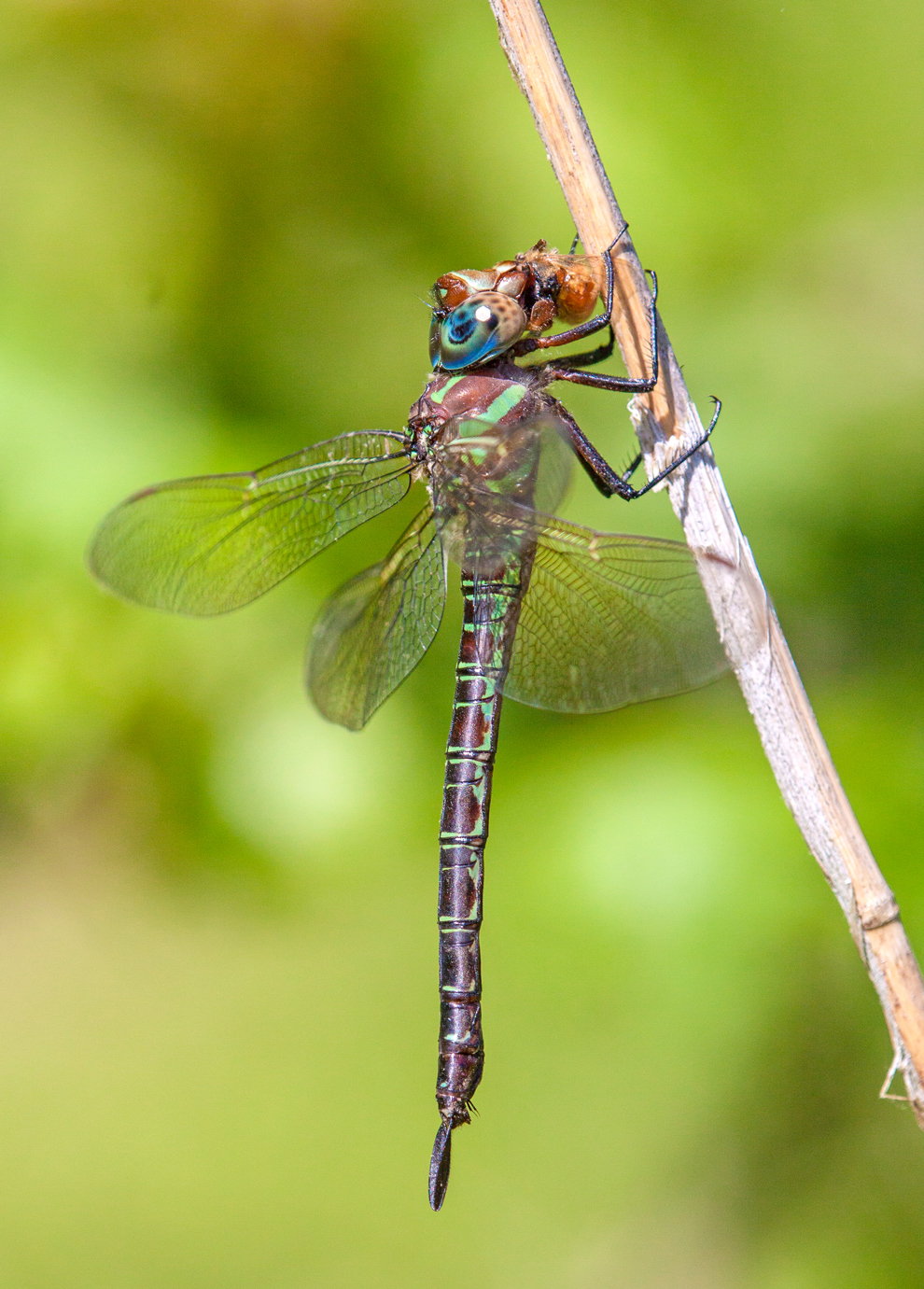
This might be the most beautiful dragonfly that I have ever photographed, a Swamp Darner (Epiaeschna heros) that I encountered yesterday at Huntley Meadows Park in Alexandria, Virginia. Swamp Darners have gorgeous colors, including incredibly striking blue eyes—be sure to click on the image to get a higher resolution view of the dragonfly.

swamp2_darner_blog

© Michael Q. Powell. All rights reserved.

Read Full Post »

My breathing stopped for a moment on Monday when I first caught sight of the colors and patterns of this beautiful dragonfly, a species that I had never seen before.  The dragonfly was flying around near a drainage area just off one of the main trails at my local marshland park. Fortunately for me, the dragonfly landed and I was able to move in pretty close to investigate.

This dragonfly reminded me a little of a Halloween Pennant dragonfly (Celithemis eponina), a gorgeous species with orange veins and brown patches on its wings, but I was pretty certain that this was a different kind of dragonfly. (For comparison, check out my posting on the Halloween Pennant from August 2012 with one of the best photos that I have taken of any dragonfly.)

I am no expert on dragonfly identification, but the wing pattern here is distinctive and I have concluded that this is probably a Painted Skimmer dragonfly (Libellula semifasciata). Not long ago, a friend introduced me to a wonderful resource for dragonflies in my area, a website on Dragonflies of Northern Virginia that is run by Kevin Munroe, the manager of Huntley Meadows Park, the marsh where I take many of my nature photographs, including this one. Here is a link to the portion of that website that covers the Painted Skimmer, including identification features and other fascinating bits of information.

As I maneuvered around composing this shot, I realized how tricky it is to get the proper depth of field for a dragonfly, especially if I want to have the face visible. In this case, the two wings closest to the camera are in focus and the wings farther away are out of focus, along with the background.

dragon_veined_blog

© Michael Q. Powell. All rights reserved.

Read Full Post »

How does a jumping spider, a spider that does not build a web, manage to capture a dragonfly? I don’t know how this Bold Jumping Spider (Phidippus audax) snagged an Eastern Pondhawk dragonfly (Erythemis simplicicollis), but I came upon the two of them after the capture had been completed and managed to snap a series of photographs of the action.

I am still working on the images and plan to do a longer posting, but wanted to give you a sneak preview.

dragon8_spider_blogdragon11_spider_blog

© Michael Q. Powell. All rights reserved.

Read Full Post »

Do you want to learn patience? If so, try photographing dragonflies in flight, those speedy little flyers that patrol the edge of a pond without ever seeming to need a rest.

Several readers commented that I must have lots of patience after they saw the photos of dragonflies and damselflies that I recently posted. Comparatively speaking, however, it is a whole lot easier to photograph these insects when they are perched on a stationary object than when they are in constant motion.

My fellow blogger and photographer, Walter Sanford, a true dragonfly stalker, emphasized to me recently that many of the early spring dragonflies are found only in limited locations for very short periods of time. (Check out his blog for lots of wonderful shots of dragonflies and other wildlife creatures.) I decided to return to Hidden Pond Nature Center, a county-run park in Springfield, Virginia that is only a few miles from where I live. Last year I spotted a few common dragonflies there, and it seemed to be a good place to broaden my search for spring dragonflies.

Sure enough, I caught sight of a few dragonflies, flying low over the surface of the small pond. They seemed to have fairly well defined patrol areas and tended to move about in large, lazy circles. I tried tracking several of them using my camera’s autofocus, but that proved to be impossible, so I switched to manual focusing, which was merely difficult.

I took a few breaks to get some shots of the more cooperative damselflies, but persisted in my quixotic efforts to capture the dragonflies in flight. Over the course of a couple of hours, I managed to fewer than a dozen images that are more or less in focus. I think that my subjects for this shoot might be Common Baskettail dragonflies (Epitheca cynosura), but I’m not very confident in that identification.

My adventures with dragonflies (and wildlife photography in general) continue teach important lessons about the value of patience and persistence.


flying5_blog

flying4_blogflying3_blogflying2_blogflying1_blog

© Michael Q. Powell. All rights reserved.


Read Full Post »

As we move deeper into spring, dragonfly nymphs are emerging from the water and starting their transformed lives as acrobatic flyers. This past weekend I spotted some young male Common Whitetail dragonflies (Plathemis lydia) in different stages of development.

Not surprisingly, adult male Common Whitetail dragonflies have white tails—it seems like most species are named after the characteristics of the male. Check out one of my postings from last year to see what a mature adult male looks like. When they first emerge, however, the males have the same body colors and patterns as the females. Fortunately, it’s easy to tell them apart, because the wing patterns are different in the male and female whitetails. (For more information about these dragonflies, take a look at the pages at bugguide.net.)

The dragonfly in the first shot is well on his way to becoming an adult and was bold enough to be flying over the water. The one in the second shot is younger, and seemed to content to remain in the vegetation at a distance from the open water.

A "tween" male--the abdomen is beginning to turn blue, but the adolescent body pattern still shows

A “tween” male–the abdomen is beginning to turn blue, but the adolescent body pattern still shows

An immature male, with the body pattern of a female and the wing pattern of an adult male

An immature male, with the body pattern of a female and the wing pattern of an adult male

© Michael Q. Powell. All rights reserved.

Read Full Post »

This is the last image in my mini-series on insect eyes from this past Friday—a close-up of a beautiful little damselfly at Huntley Meadows Park, the local marshland where I take many of my nature photographs. 

Photographing damselflies is particularly challenging for me, because they are so long and skinny (not to mention the fact that they are really small in size). About the only way to get their bodies completely in focus is to be absolutely perpendicular to them. When I took this image, I couldn’t get into the optimal position, thanks to a sharp, thorny bush, so the lower half of the body was out of focus. That is one of the reasons why I chose to crop this image as I did, though the main reason was to focus viewers’ attention on the eyes.

This image shows the wide separation of the damselfly’s eyes, which is one of the ways to tell them apart from dragonflies, the other members of the Odonata family. Dragonflies have eyes that are very close together or even touching each other.

If you missed the earlier postings on insect eyes, check out the images of a fly’s eyes and a dragonfly’s eyes. In all three cases, click on the images, if you want to get a higher resolution view of the insects’ beautiful eyes.

damsel_eyes_blog

© Michael Q. Powell. All rights reserved

Read Full Post »

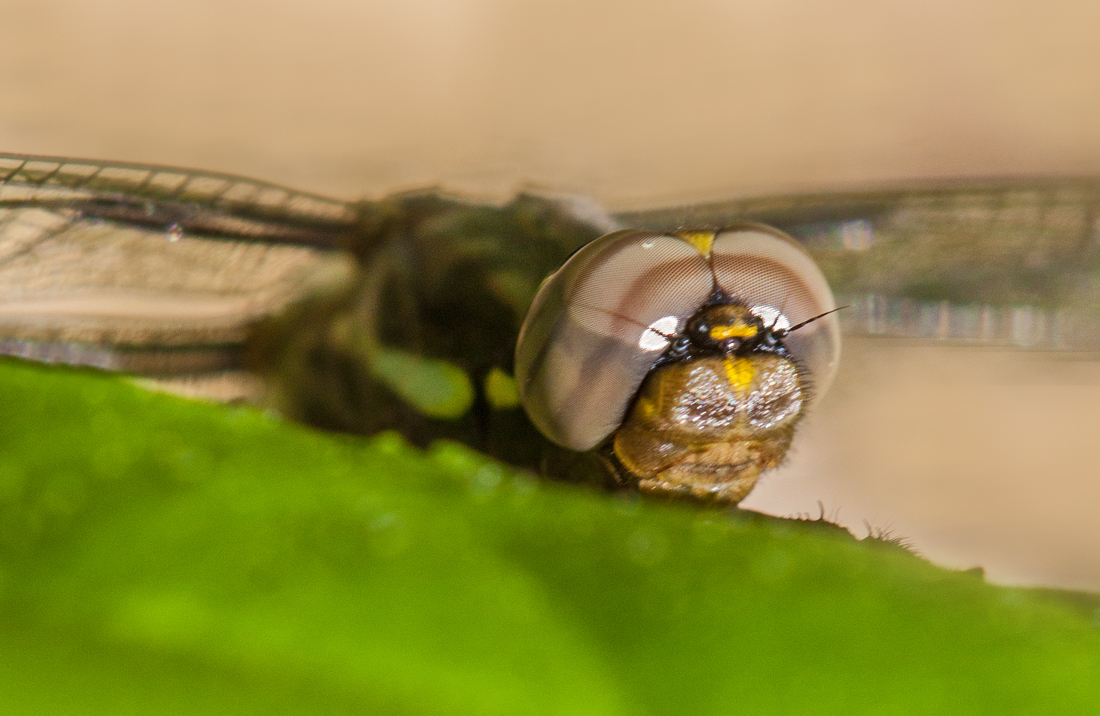
Yesterday, I seemed to be particularly fascinated by insect eyes and did a posting on a fly, whose compound eyes were pretty amazing. However, dragonflies have the largest compound eyes of any insect and I was thrilled to be able to capture this face-to-face shot of a Common Whitetail dragonfly (Plathemis lydia), peering right at me over the edge of a leaf.

A dragonfly’s eyes can have as many as 30,000 facets, known as ommatidia, that contain light-sensitive proteins, according to an article in ScienceBlogs. Although, humans also have these kind of proteins, called opsins, we have only three (red, green, and blue), whereas a dragonfly has four or five, giving it the capability to see colors beyond human visual capabilities. A dragonfly’s eyes also wrap around its head, giving it an incredible field of view. For more information and a more scientific explanation, check out a posting entitled “Super-predators” that Sue did last June in her Backyard Biology blog.

I took this shot in a wooded grassy area adjacent to a pond. It seems that the Common Whitetail dragonflies are hanging out there early in the season and not too many of them are patrolling over the water, as I commonly saw them do last summer. The fact that the dragonfly was not perched on a branch coming out of the water proved to and advantage as I was able to approach pretty closely to it in order to take this shot.

dragonfly_eyes_blog

© Michael Q. Powell. All rights reserved

Read Full Post »
Some of the common species of dragonflies are around throughout much of the summer. Other dragonflies, sometimes referred to as “spring ephemeral” dragonflies,  are around for only brief periods of time in the early spring, like this male Blue Corporal dragonfly (Ladona deplanata) that I spotted last week on the boardwalk at my local marsh.

I had never seen this species before, but fortunately my fellow blogger and local dragonfly expert, Walter Sanford, was able to assist me with the identification. Check out his blog to see some awesome shots of dragonflies and other nature subjects.

I would love to be able to photograph this species the next time in a more natural environment, but I am pretty excited any time I have the chance to get a recognizable photo of a new species.

dragonfly2_may_blogdragonfly_may_blog

© Michael Q. Powell. All rights reserved

Read Full Post »
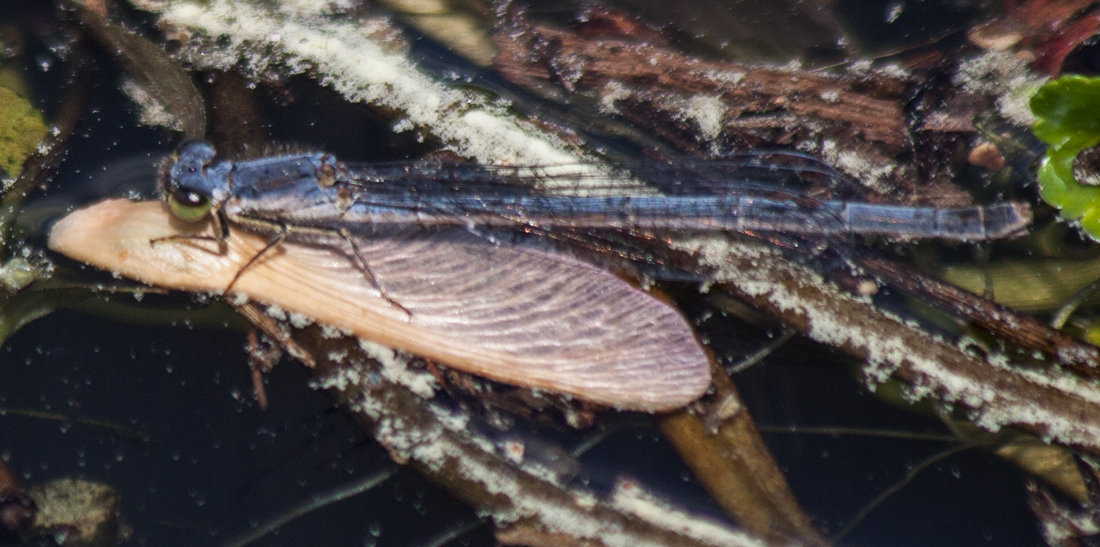
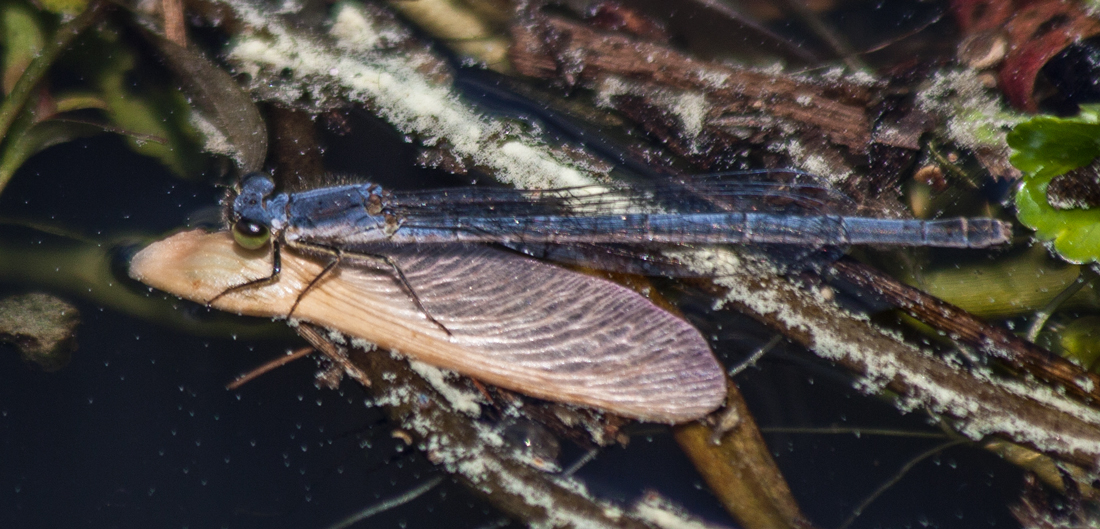
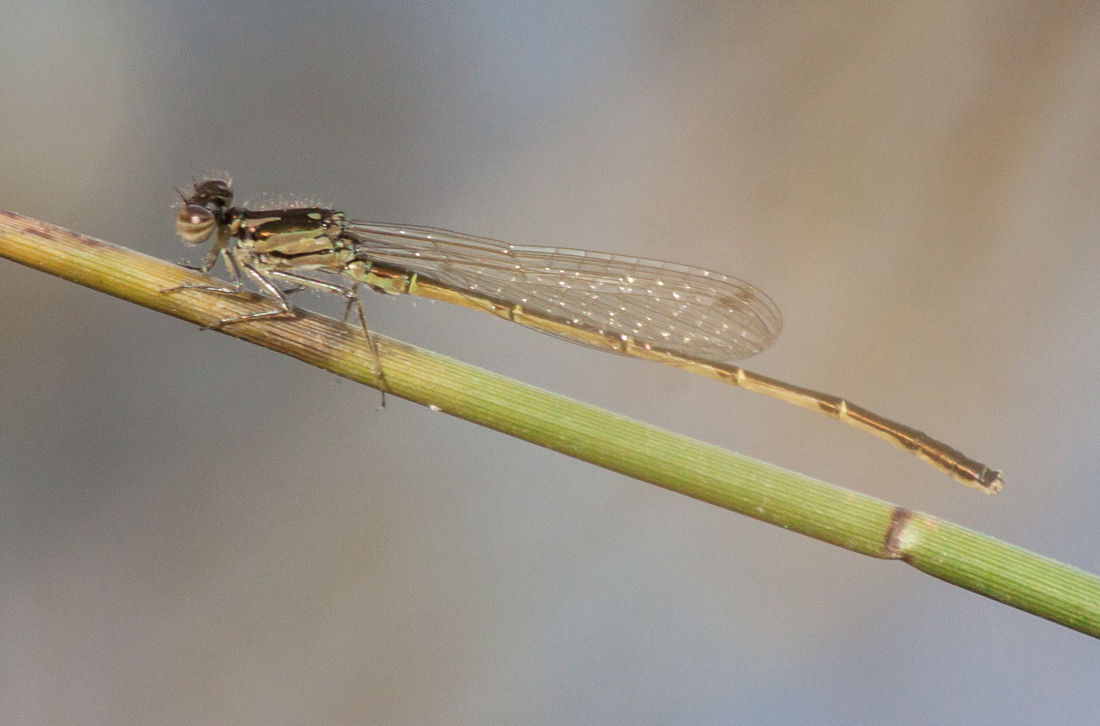
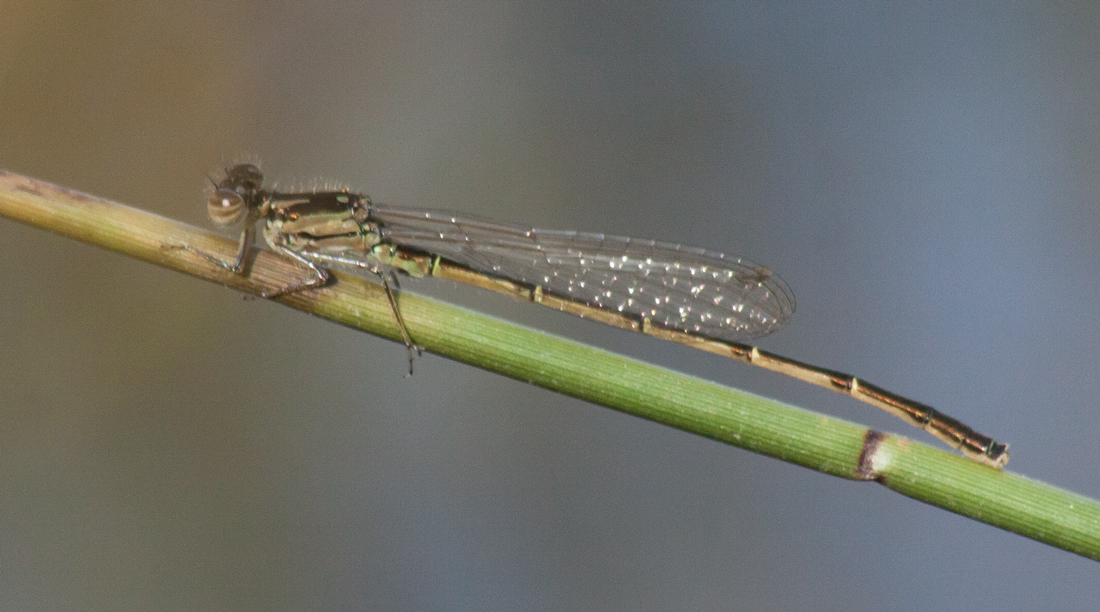
Most folks are familiar with dragonflies, but damselflies, the smaller members of the Odonata family, are equally impressive. I spotted this little beauty yesterday in the pond debris at Huntley Meadows Park, the local marshland area where I take many of my nature photographs.

I don’t know damselfly behavior very well, but noted that the very end of the damselfly’s tail is in different positions in this series of photos. In the first image, the tip is curved upward and then gradually returns to a more straight position in the final shot. Sometimes movements like this indicate that the damselfly could be laying eggs, but I haven’t been able to determine yet the gender or species of the damselfly. There seem to be a lot of different species of damselflies that are blue. (If I had to guess, I’d say that it looks like a female Eastern Forktail (Ischnura verticalis), because of the color, the forked end of the tail, and the two-tone eyes).

Although this looks like a macro shot (and the subject was really small), this is another case in which I was able to use my telephoto zoom lens to get macro-like results. Click on any of the photos to get a higher-resolution view of the damselfly and you may be surprised to see how many of the details the telephoto lens was able to capture.

damselfly1_may_blogdamselfly2_may_blogdamselfly3_may_blog

© Michael Q. Powell. All rights reserved

Read Full Post »
Damselflies are beautiful, delicate insects that are often hard to see and photograph. I captured this image of my first damselfly of the year at Huntley Meadows Park this past Friday. I am not very good at identifying these tiny insects, but think this might be a Fragile Forktail (Ischnura posita).

I was standing my the edge of my favorite beaver pond when I saw the damselfly in flight. I followed it with my eyes and was delighted when it landed on a nearby stalk of grass. I didn’t have a lot of maneuver, because much of the area at the pond’s edge is covered with thorny bushes, and I had to pull back a bit to get within the minimum focusing distance of my 70-300mm telephoto lens , i.e. 4.9 feet (1.5 meters). At that range, the dragonfly filled a reasonable amount of the frame.

Lighting was a bit of a challenge and I tried a couple of different settings as the damselfly lifted its tail from time to time. Eventually, it climbed to the end of the stalk and I changed position too and tried a couple of shots (including the final shot) using my pop-up flash.

Most of the time the first shot below is my favorite, but sometimes I like the others as well or more. In any case, I am happy that I was able to get some good shots of my first damselfly of the spring.

damselfly2a_blogdamselfly1a_blogdamselfly3_blog

© Michael Q. Powell. All rights reserved

Read Full Post »

Spring is here and I am once again chasing dragonflies, on a quest to capture images of these beautiful insects. Common Green Darners (Anax junius) rarely seem to perch, so I was forced to try to photograph them in flight.

This early in the spring, there aren’t yet a lot of dragonflies, so my patience was tested as I waited for one to fly by. I tried a lot of different approaches and the one that worked best on this day was to focus manually, which is a bit of a challenge at 300mm when the subject is moving pretty fast.

I hope I’ll get some better shots later this season—this is my best one so far.

dragonfly_flight_blog

© Michael Q. Powell. All rights reserved

Read Full Post »

The weather has gotten warmer, but I was still a bit surprised when I saw my first dragonfly of the year yesterday at Huntley Meadows Park, my local marsh. I think that it is a female Common Green Darner dragonfly (Anax junius), one of the species that migrates north after spending the winter in warmer places. This is the only dragonfly that I saw yesterday and I was able to squeeze off a couple of shots before it disappeared. I’m hoping that it won’t be long before I see more dragonflies and butterflies, some of my favorite photographic subjects.

dragonfly_april_blog

© Michael Q. Powell. All rights reserved

Read Full Post »
I never expected to encounter a dragonfly when I went walking in the snow in my neighborhood yesterday.

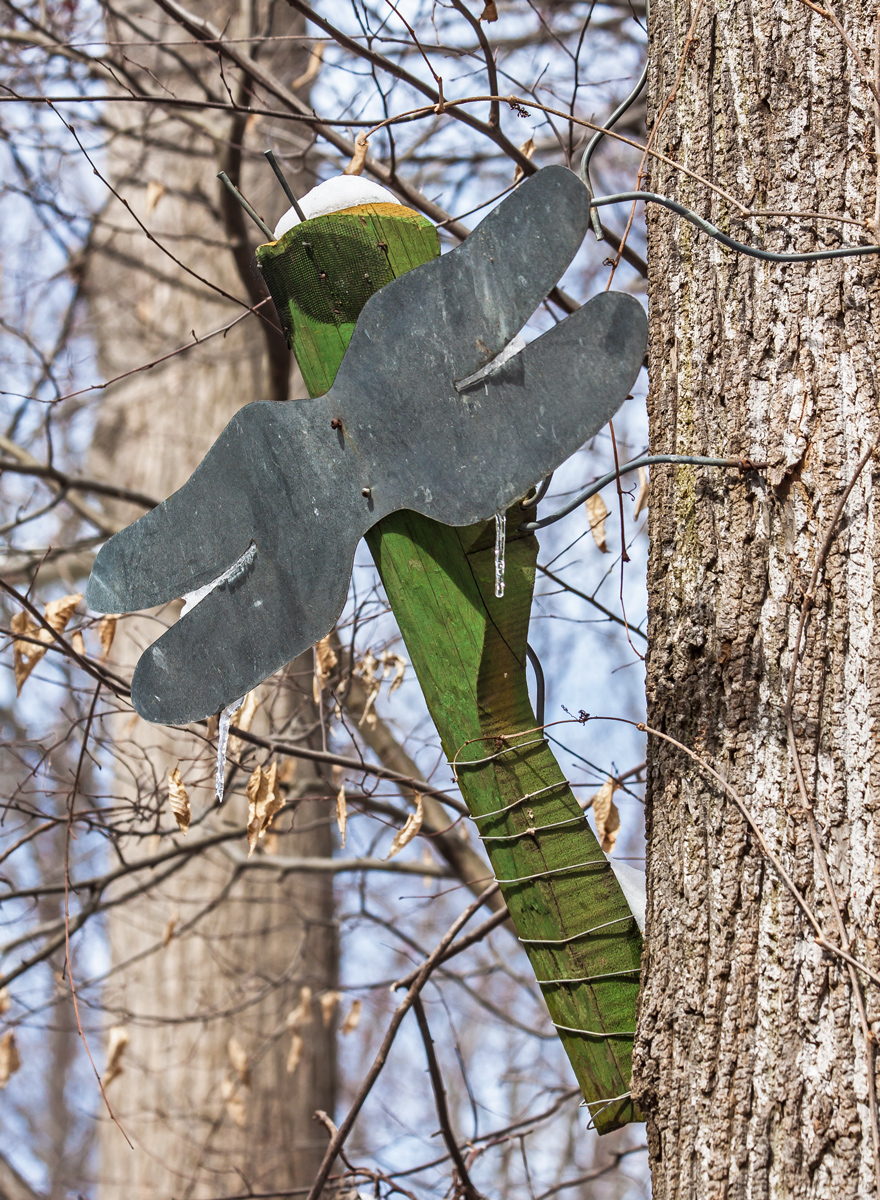
My eyes were scanning the trees for birds,  when right it front of me I detected the unmistakable shape of a dragonfly, a giant green dragonfly perched on a tree. I approached it quietly and was able to get this shot, my first shot of a dragonfly in a long time.

With snow still covering the ground and the temperatures below freezing, it’s hard to imagine that the real dragonflies will be appearing in a few short months.

dragonfly_winter_blog

© Michael Q. Powell. All rights reserved

Read Full Post »
« Newer Posts - Older Posts »