One of the dangers of shooting with a macro lens is that I am often so focused on shooting close-up that I forget to step back and look at the bigger picture.
A couple of days ago, I posted a photo of a dragonfly basking in the sun and felt pretty content that I had been able to capture a detailed shot of its eyes and face. I had instantly gravitated to several close-up images to the point that I temporarily forgot that my initial shots had been from a greater distance. As a result, I made my preliminary identification on the basis of the facial shot alone.
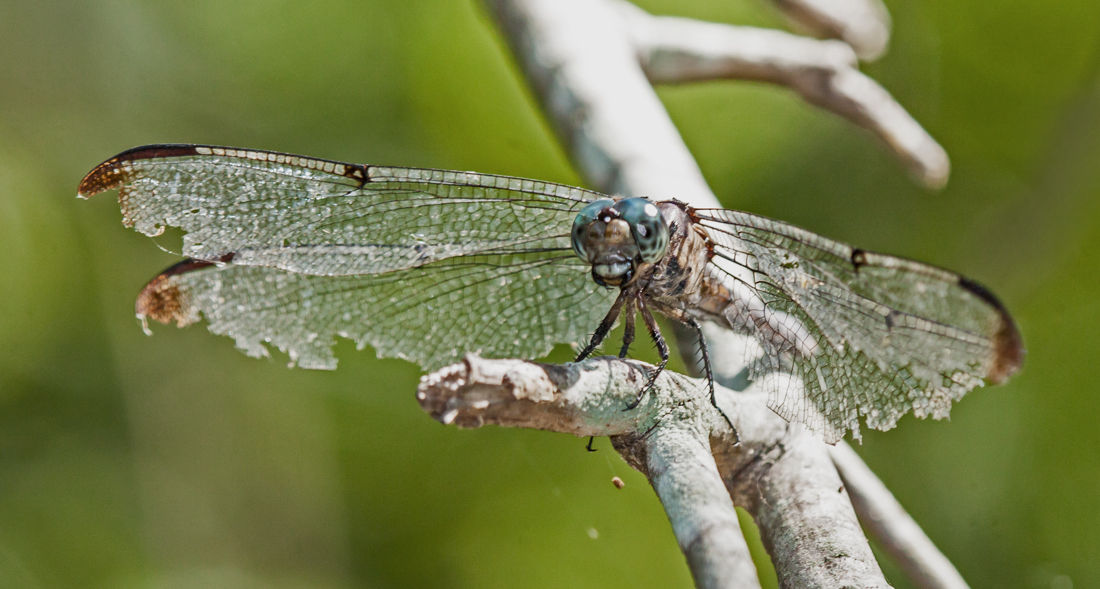
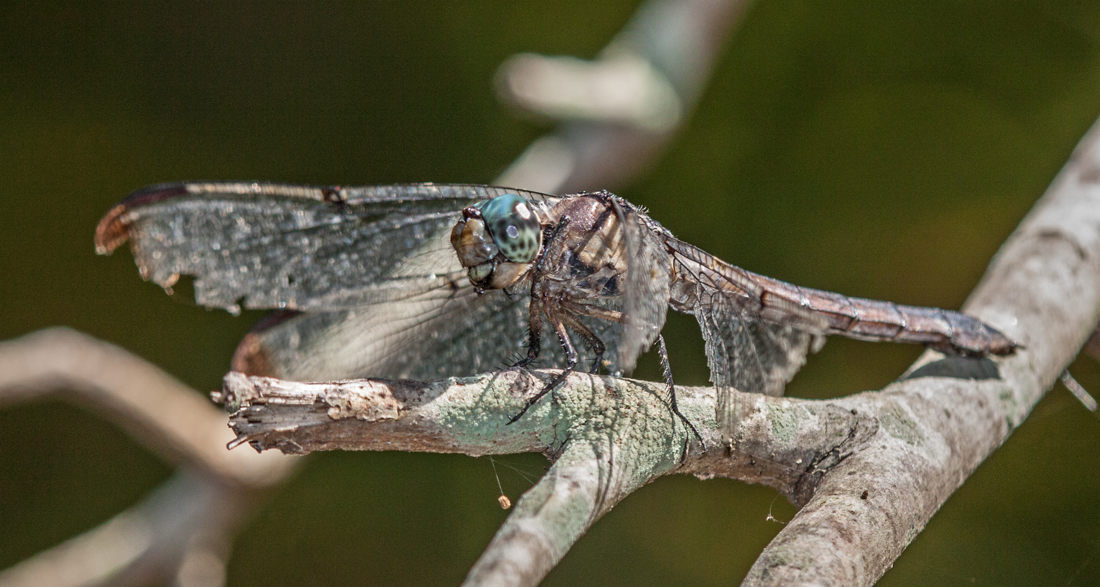
After I posted the image on Facebook, one of my fellow photographers, Walter Sanford, who is much more of an expert on dragonflies than I am, asked me if I had any shots of the dragonfly’s entire body, probably with a desire to check my identification. When I reviewed my more distant shots of the dragonfly, I was immediately struck by how tattered the wings were of this female Great Blue Skimmer (Libellula vibrans). Sure, I’ve seen lots of dragonflies with minor damage to the wings, but these are seriously tattered.
When I posted these follow-up images on Facebook, Walter replied, “Definitely an old female Great Blue Skimmer dragonfly, as indicated by its tattered wings, coloration, and flanges beneath the eighth abdominal segment. The flanges are used to scoop and hold a few drops of water when laying eggs (oviposition), hence the family name “skimmer.” ”
Be sure to check out Walter’s blog for his wonderful shots of dragonflies and his more scientific descriptions of his subjects. My background was more in the liberal arts area rather than in science, and my writing in my blog tends to be a reflection of that background.
© Michael Q. Powell. All rights reserved.
 Mike Powell
It always amazes me that something that looks so fragile is able to hold up at all.
I wonder if she has to work so much harder as the wings get more tattered.
I imagine that some of her acrobatic flying skills are compromised a bit when the wings are damaged so much, but she seemed to be hanging in there just fine.
One can almost imagine a drop of tear forming in the compound eye. Lovely
Thanks. I am always entranced by the eyes of dragonflies and am amazed when I read about the capabilities of the compound eyes.
Yes they are mesmerising. Apparently the mantis shrimp has the most complex and advanced compound eyes!
Thanks for the kind words, Mike. The female dragonfly you photo’d may be old and tattered, but she’s still getting it done! 😉
She could serve as a very good inspiration for many of us as wear, tear, and other signs of inevitable entropy set in.
Your comment hit’s a bit close to home for me and various parts of my body seem to creak and complain with ever greater frequency.