Feeds:
Posts
Comments

Posts Tagged ‘Woodbridge VA’

I tend to be an opportunistic photographer, content to wander about and shoot whatever I happen to find. For the last couple of weeks, though, I have been searching diligently for a particular species of dragonfly, the Fine-lined Emerald (Somatochlora filosa), and yesterday, the final day of August, I finally found one at Occoquan Bay National Wildlife Refuge.

What makes this dragonfly so special? In his excellent website Dragonflies of Northern Virginia, Kevin Munroe described some of the allure of this particular species— “One of Northern Virginia’s most rare dragonflies, possibly our rarest, this species is seldom seen and little known throughout its range, from New Jersey to Florida, and west to Kentucky and Texas. Most field guides describe its breeding habitat as “unknown”.”

Last year I was lucky enough to see a Fine-lined Emerald several times, but I wanted more. As befits its name, my first glimpse yesterday of the dragonfly was of its brilliant green eyes as it flew by me. Unlike some species that fly high the air, Fine-lined Emeralds often patrol at waist to eye level. I was able to follow and track the dragonfly until it perched. This species hangs vertically from vegetation when perching, so it can be tough to spot one unless you have seen it land.

I was fortunate to be able to photograph this beautiful dragonfly on several different perches until it finally disappeared from sight. Here are a couple of my favorite shots from our altogether too brief encounter yesterday.

Fine-lined Emerald

Fine-lined Emerald

© Michael Q. Powell. All rights reserved

Read Full Post »

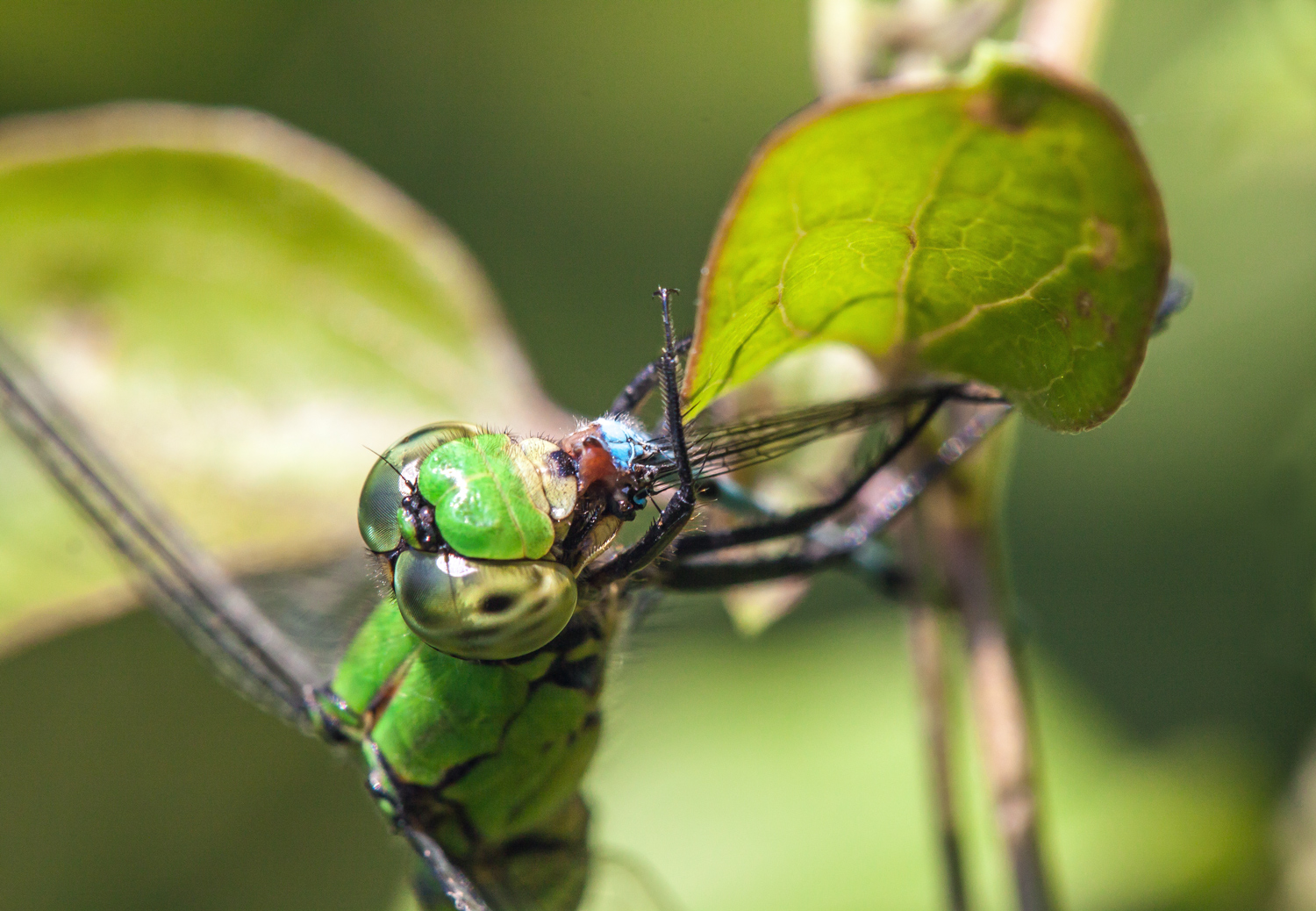
When recently at Occoquan Bay National Wildlife Refuge I spotted these two damselflies, which an expert identified as probable Big Bluets (Enallagma durum), I initially thought they were mating. Then I realized that the positions were all wrong and the nibbling on the neck was probably indicative of a literal hunger. Yikes.

As Tina Turner once sang, “What’s love got to do with it?”

damselflies

daamselflies

© Michael Q. Powell. All rights reserved

Read Full Post »

Two different colored dragonflies, a Needham’s Skimmer (Libellula needhami) and a Great Blue Skimmer (Libellula vibrans), were peacefully sharing a prime perch on Monday at Occoquan Bay National Wildlife Refuge.

Why is it so hard for us to peacefully coexist with one another?

peaceful co-existence

© Michael Q. Powell. All rights reserved

Read Full Post »

Have you ever gotten into a staring contest with a dragonfly? Dragonfly eyes can have an almost hypnotic effect on you when you look directly into them..

I went eye-to-eye with this Eastern Pondhawk dragonfly (Erythemis simplicicollis) on Monday at Occoquan Bay National Wildlife Refuge. She was the one to break eye contact first as she cocked her head, smiled at me, and decided the contest was over.

Eastern Pondhawk

Eastern Pondhawk

© Michael Q. Powell. All rights reserved

Read Full Post »

When you check out spider webs really carefully, you can often discover really cool-looking tiny spiders, like this Arrowhead Orb Weaver spider (Verrucosa arenata) that I spotted yesterday at Occoquan Bay National Wildlife Refuge. If you look really closely in between its uppermost legs, you can see some of its multiple eyes looking straight at you. Information on BugGuide.net indicates that this spider is unusual because it rests in the web with its head up, not head down like most other Orb Weavers.

It’s hard to get a sense of scale when you look at this image, but I’d estimate that this little spider was less than an inch in length (25 mm). It was hanging in the air in its web at the edge of a trail when I first spotted it. I was able to move in pretty close with my macro lens—unlike many other spiders, it did not scurry away to the edge of the web. Sharpness is always an issue when shooting at at close range, but my monopod helped to steady me enough to get a relatively sharp image.

You may not like spiders, but you have to admit that this is a cool-looking spider.

Arrowhead Orb Weaver

© Michael Q. Powell. All rights reserved

Read Full Post »

It is great to see that at least a few colorful Calico Pennant dragonflies (Celithemis elisa) are still around. I photographed this handsome male last Friday as he perched at water’s edge at the small pond at Occoquan Bay National Wildlife Refuge.

Summer is slowly slipping away. Some species of dragonflies are already gone for the year and others will soon follow suit. A few species have yet to appear, so all of the news is not bad. Still, as kids return to school and the daylight hours become noticeably shorter, it’s hard not to have the feeling that the lazy days of summer are coming to a close.

Autumn is my favorite season for a number of different reasons, but I am not quite ready to give up on summer. So I’ll keep sweating and searching, seeking to capture the summer beauty that still surrounds us. Like this dragonfly, I’m still holding on.

calico pennant

© Michael Q. Powell. All rights reserved

Read Full Post »

This little buck seemed more curious than fearful when he spotted me on Monday at Occoquan Bay National Wildlife Refuge. He continued to forage in a marshy area for a while before he finally disappeared from sight.

I know that we have a herd of White-tailed Deer (Odocoileus virginianus) on the wildlife refuge, though I see deer only on rare occasions. This little deer seemed to be alone and I was really struck by the shape of his antlers. It looks to me like they might be his first set of antlers, though I confess to knowing almost nothing about the stages of development of a deer.  The shape of the antlers reminds me of photos that I have seen of several species of antelope in Africa.

white-tailed deer

© Michael Q. Powell. All rights reserved

Read Full Post »

Dragonflies have amazing compound eyes that wrap around their heads. With up to 30,000 facets (ommatidia, to be technical), dragonflies have incredible vision and can even see colors beyond human visual capabilities, like UV light. For an easy to read discussion about dragonfly eyes, i.e. not overly scientific, check out this posting by “grrl Scientist” that was posted on scienceblogs.com.

I captured this close-up image of a Great Blue Skimmer dragonfly (Libellula vibrans) yesterday at Occoquan Bay National Wildlife Refuge. At least once a season, I manage to get a shot like this when a cooperative dragonfly lets me get close. I captured the image below with my trusty Tamron 180mm macro lens on my Canon 50D DSLR. This lens, which has a longer focal length than most macro lenses, gives me some stand-off distance so I can get a macro shot like this without actually being on top of the subject. The only downside to the lens is that it has no built-in image stabilization, so I have to pay extra attention to remaining steady when shooting with it—I generally use a monopod to help reduce camera shake and I think it helped for this image.

The image is framed just as I saw it in my viewfinder. Most of the time I end up cropping my images as part of my normal post-processing, but in this case it looked pretty good without any cropping whatsoever.

Great Blue Skimmer

© Michael Q. Powell. All rights reserved

Read Full Post »

Sometimes when I have my camera in my hands, my attention is drawn to the amazing shapes, colors, and pattern of the natural world—I don’t need a specific animate subject to shoot. Here are a few of my more abstract shots from Monday at Occoquan Bay National Wildlife Refuge.

Even though I may not have had a main subject, in the traditional sense,I wouldn’t say that I was photographing nothing—au contraire, I was photographing everything.

ferns

grass

lily pads

© Michael Q. Powell. All rights reserved

Read Full Post »

I just love the colors of this Red Admiral butterfly (Vanessa atalanta) that I photographed on Monday at Occoquan Bay National Wildlife Refuge. I mean, really, how can you not like an insect that sports the red, white, and blue?

You don’t have to be American to like those three colors—it seems like there are an awful lot of countries that use them in various shades and patterns in their national flags.

Red Admiral

© Michael Q. Powell. All rights reserved

Read Full Post »

The vegetation at Occoquan Bay National Wildlife Refuge was so high recently that these two foraging wild turkeys (Meleagris gallopavo) disappeared from view each time they leaned forward. It was like a game trying to figure out where they would pop up next. I played the game for for quite some time before I was able to capture them both in a single frame with their eyes visible—in most of the other shots the turkeys were looking away from me.

wild turkeys

© Michael Q. Powell. All rights reserved.


Read Full Post »

Imagine an insect so powerful that it is reportedly able to take down a hummingbird. Then give it the macabre monniker of Red-footed Cannibalfly (Promachus rufipes). If I were an insect, I would be really worried. Actually I don’t think that I would want to allow one to bite me, because a cannibalfly stabs its prey with its proboscis and injects saliva that help to liquify the prey’s insides. Then the cannibalfly sucks out the liquid through its proboscis.

I don’t know why exactly, but the last week or so I have seen a lot of Red-footed Cannibalflies during my trips to Occoquan Bay National Wildlife Refuge. Here are a few of my recent shots. The first one reminded one of my Facebook viewers of The Lorax, a Dr. Seuss character with a big mustache. Maybe this insect needs to overhaul its public image so that it is viewed as being less threatening. One possible first step might be to change its name to the Bee Panther, a nickname that is sometimes used for this species.

On a side note, each of the last four years, including this year, a 2013 posting entitled simply Red-footed Cannibalfly has been my most viewed posting. If I calculated correctly, the posting has been viewed almost 2400 times, including 293 times in 2018.

Why is that posting so popular? Apparently a lot of people do Google searches for “red-footed cannibalfly” and stumble onto my blog posting. I’m proud of a number of my postings and the images that I have captured, but I must confess that I don’t consider that 2013 posting as one of my best.

It’s a little scary to think that I may be inextricably linked in some people’s minds with Red-footed Cannibalflies. Yikes!

Red-footed Cannibalfly

Red-footed Cannibalfly

Red-footed Cannibalfly

© Michael Q. Powell. All rights reserved.

Read Full Post »

Many of us are old enough to remember when wall phones had long coiled cords that usually ended up stretched out and elongated. That’s exactly what I was thinking of when I spotted these coiled tendrils of some kind of flower yesterday when I was exploring Occoquan Bay National Wildlife Refuge.

I wasn’t sure how to capture them in an image and tried a couple of different approaches. The image below was my favorite. It is kind of a natural abstract image, but I included the flower in the corner of it to give the image a sense of context.

Those who read my postings regularly know that this is not the usual kind of photo that I post—sometimes it is fun to venture outside of my normal box.

coil

© Michael Q. Powell. All rights reserved.

Read Full Post »

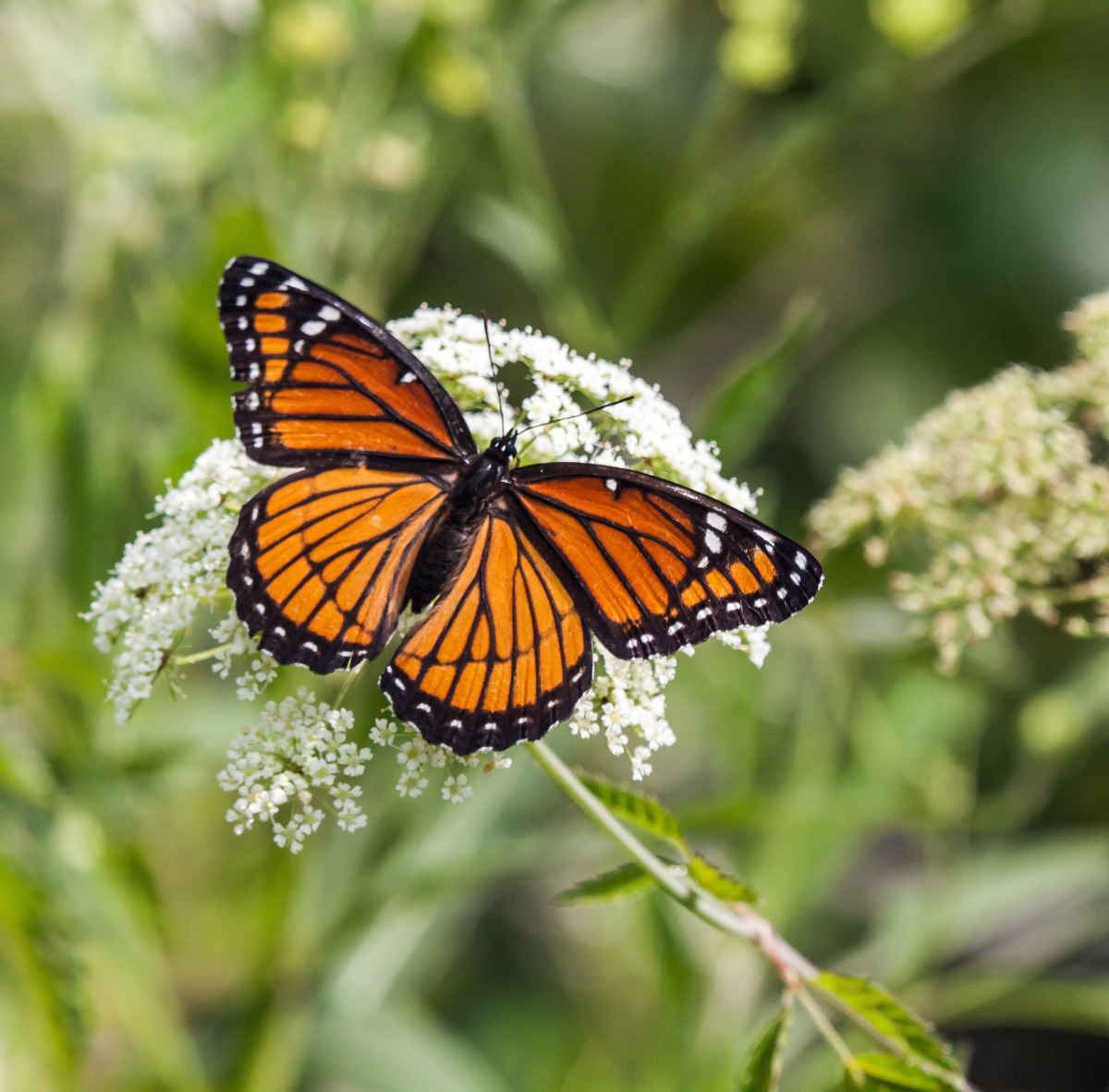
I suppose that I should call this a royal posting for it features both a viceroy and a queen. Of course, here in the USA we don’t have a monarchy, but that doesn’t keep us from having Viceroy butterflies (Limenitis archippus) and Queen Anne’s Lace (Daucus carota). I spotted this royal pair on Monday at Occoquan Bay National Wildlife Refuge where the Viceroy repeated probed the clusters of Queen Anne’s Lace.

You probably have noticed that the coloration of the Viceroy butterfly matches that of the Monarch butterfly. One of the easiest ways to tell them apart is the black line across the hind wings which is present with Viceroys but not with Monarchs.

Viceroy butterfly

Viceroy butterfly

© Michael Q. Powell. All rights reserved.

Read Full Post »

Unlike those that construct elaborate webs, some spiders instead perch at the shore with extended legs and sense prey through vibrations on the surface of the water. When the prey is detected, the spider runs across the top of the water, prompting some to call it the “Jesus spider.”

I spotted this cool-looking Six-spotted Fishing Spider (Dolomedes triton) in the shallow water of a pond this past Monday at Occoquan Bay National Wildlife Refuge.

Six-spotted Fishing Spider

© Michael Q. Powell. All rights reserved.

Read Full Post »

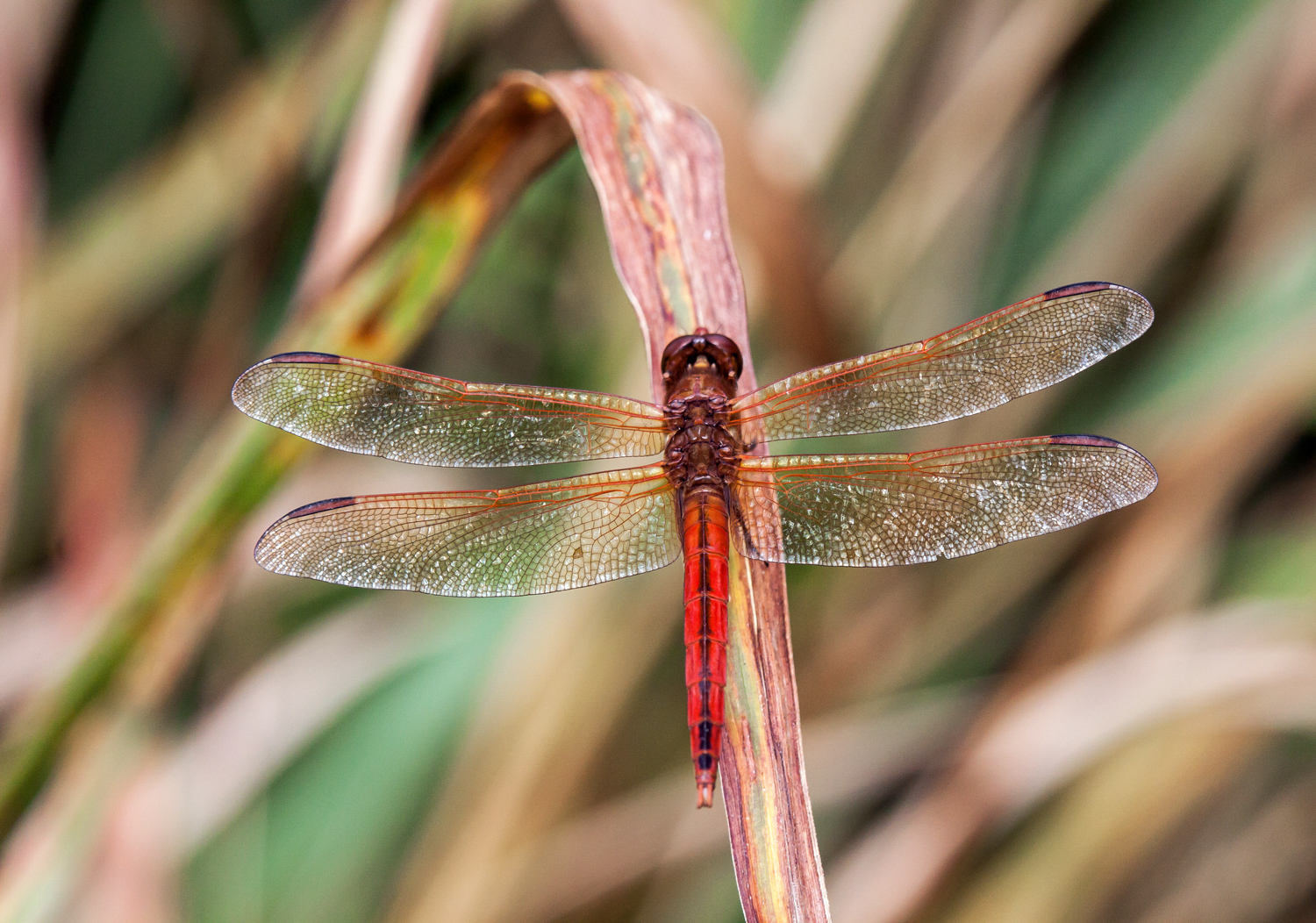
I love the stunning red-orange coloration of a male Needham’s Skimmer dragonfly (Libellula needhami), especially when the sunlight dances across its gold-tinged wings, as it did on Monday morning at Occoquan Bay National Wildlife Refuge.

Generally I prefer an uncluttered background for my subjects, but in this case I think the soft patterns of the grasses in the background enhance the image more than would have been the case with a uniform single color.

Needham's Skimmer

© Michael Q. Powell. All rights reserved.


Read Full Post »

This past Monday I spotted this Wild Turkey (Meleagris gallopavo) at Occoquan Bay National Wildlife Refuge as it basked in the warmth of the early morning sunlight. Earlier this year I would see turkeys regularly as I walked the trails at the wildlife refuge, but the last couple of months such sightings have been rare.

wild turkey

© Michael Q. Powell. All rights reserved.

Read Full Post »

What is your favorite dragonfly? Most people would have trouble answering a question like that. If they do happen to notice dragonflies, they generally have not looked closely enough at them to identify species—at best they might be able to say something like, “I like the big green ones that I see flying overhead” or “I like the little blue ones that perch on the reeds.”

Most of you know that I somewhat obsessed with dragonflies (and those who know me well might question my use of the qualifier “somewhat” in the first half of the sentence). I love the beauty and aerial agility of these flying insects and I spend endless hours searching for them for months on end.

How do I choose a favorite dragonfly? It’s kind of like asking a parent to choose a favorite child. There are different things that I like about different dragonfly species.

If I were asked the question directly, I would probably say that the Blue-faced Meadowhawk (Sympetrum ambiguum) is my favorite dragonfly. I absolutely love the striking combination of the turquoise blue eyes and the striking red body. Blue-faced Meadowhawks are also special to me for a personal reason—I was awarded second place in a local photo contest several years ago for a macro shot of a Blue-faced Meadowhawk. (Here is a link to the 2015 posting Second place in a local photo competition that shows that prize-winning entry and tells some of the back story of the image.)

Yesterday at Occoquan Bay National Wildlife Refuge I photographed my first Blue-faced Meadowhawk of the season, a handsome male with bright coloration. Even if you are not a big fan of dragonflies, I hope that you can agree this little dragonfly is strikingly beautiful—welcome to my world.


Blue-faced Meadowhawk

© Michael Q. Powell. All rights reserved.


Read Full Post »

Recently I spotted this small orange and brown butterfly while I was roaming the trails at Occoquan Bay National Wildlife Refuge. I initially thought it was a Pearl Crescent butterfly, a familiar species, and posted a photo on Facebook. One of my friends there, however, pointed out that my little butterfly was actually a Silvery Checkerspot butterfly (Chlosyne nycteis), a new species for me.

The composition in my image is pretty simple, but I really like the way that it turned out, with the soft contours of the butterfly juxtaposed with the linear veins of the leaf and the sharp contrast between the dominant green and orange tones. The shadows are a real bonus, adding additional interest to the photo.

Silvery Checkerspot

© Michael Q. Powell. All rights reserved.

Read Full Post »

This image is a little gruesome, but here is a close-up look at an Eastern Pondhawk dragonfly (Erythemis simplicicollis) as it consumed a damselfly that it had captured this past Monday at Occoquan Bay National Wildlife Refuge in Northern Virginia. The second image shows a different Eastern Pondhawk with a different damselfly—the pondhawks seemed to have a particularly voracious appetite that day.

Eastern Pondhawk

Eastern Pondhawk

© Michael Q. Powell. All rights reserved.


Read Full Post »

I was simultaneously fascinated and horrified yesterday at Occoquan Bay National Wildlife Refuge as I watched this Eastern Pondhawk dragonfly (Erythemis simplicicollis) gnaw on the head of a colorful Calico Pennant dragonfly (Celithemis elisa) that it had captured. I know that dragonflies eat other insects, but in my mind I tend to think of them consuming mosquitoes and other such smaller insects. Some of them, however, apparently prefer larger prey, including other dragonflies.

Eastern Pondhawk versus Calico Pennant

© Michael Q. Powell. All rights reserved.

Read Full Post »

Normally when I see a Common Green Darner dragonfly (Anax junius) it is patrolling in the air and it is mostly a greenish blur. This past Friday, however, I was fortunate enough to spot one on the ground, nestled low in the vegetation at Occoquan Bay National Wildlife Refuge. At this closer distance I was able to marvel at all of the wonderful colors of this beautiful dragonfly.

Be sure to click on the images to see the details of this dragonfly at higher resolution.  Did you notice the blue color near the tip of its “nose?”

Common Green Darner

Common Green Darner

© Michael Q. Powell. All rights reserved.


Read Full Post »

This Prince Baskettail dragonfly (Epitheca princeps) almost looks like it was flying at an airplane’s cruising altitude and was looking down at a landscape with rivers, mountains, and lakes. I spotted this dragonfly last weekend at Occoquan Bay National Wildlife Refuge and spent quite a while trying to get a shot of it in flight.

The dragonfly, however, never ventured close enough to shore for me to get a detailed shot of it. I was a little disappointed until I opened up the image on my computer and discovered that I had managed to capture a wonderful, fanciful background. Sometimes I try to document the reality that I see and other times it seems like it is just my imagination running away with me.

Prince Baskettail

© Michael Q. Powell. All rights reserved.

Read Full Post »

When you closely at flowers, you discover all kinds of cool insects, like this Ailanthus Webworm Moth (Atteva aurea) that I spotted yesterday at Occoquan Bay National Wildlife Refuge. My eyes were drawn to the colorful pattern on the body of this insect, which I initially assumed was some kind of beetle. Because of the distinctiveness of the pattern, it was not hard to identify it after a Google search, but I was a bit surprised to learn that it is a moth, not a beetle.

I thought that this was my first time spotting this moth, but a search of my blog shows that I saw one in 2016 and did a posting entitled Not a Beetle. Although my memory may not be perfect, apparently my reaction was almost identical both times.

Ailanthus Webworm moth

© Michael Q. Powell. All rights reserved.

Read Full Post »

Most folks are familiar with the comic book hero the Green Hornet, but have you ever seen a green bee? I don’t see them very often, so I was pretty excited to spot this one in some flowers last weekend at Occoquan Bay National Wildlife Refuge. I think this kind of bee is generally known as a metallic green sweat bee and is of the genus Agapostemon.

green bee

© Michael Q. Powell. All rights reserved.

Read Full Post »

Sometimes the dragonfly is the predator and sometimes it is the prey—it appears to be primarily a matter of circumstances and timing. This male Common Whitetail dragonfly (Plathemis lydia) met his demise this past Friday at Occoquan Bay National Wildlife Refuge.

I am not sure how exactly the spider managed to snag the dragonfly, but I assume the dragonfly flew into the spider’s web, which was high in the air, spanning a gap between some tall trees. Interesting enough, I was only able to see a few strands of the web, so I wonder if this action took place at the extreme edge of the web.

common whitetail dragonfly

© Michael Q. Powell. All rights reserved.


Read Full Post »

I love photographing the nondescript butterflies that are so common that they fly by virtually unnoticed, like this beautiful little sulphur butterfly that I spotted last week at Occoquan Bay National Wildlife Refuge. I believe it is an Orange Sulphur butterfly (Colias eurytheme), though it is often hard to distinguish that species from the Clouded Sulphur (Colias philodice), so I am a little uncertain of the identification.

What I am certain of, however, is the delicate beauty of this butterfly and I am happy that I was able to capture some of that beauty in this image. As I gaze at this photo, I am reminded of the moment when I took it, a moment when I was enveloped by a sense of deep tranquility as the gorgeous sunlight illuminated the wings of the butterfly. Quite often when I am pursuing a subject, I can feel my heart racing a little as adrenaline kicks in.  This was one of the rare circumstances when I had the opposite physical reaction.

It is hard to describe in words what I was feeling, though it was definitely cool to experience. I hope that some of you will get a sense of that tranquility from this image. Iam becoming more and more convinced of the value of taking life a little more slowly, of opening myself up to experiencing the beauty that surrounds us every day.

sulphur butterfly

© Michael Q. Powell. All rights reserved.

Read Full Post »

Eastern Amberwings (Perithemis tenera) are the smallest dragonflies in our area. You can often find males buzzing around at the water’s edge, but females are harder to spot because they hang out in vegetation away from the water. I was thrilled therefore to see a beautiful female this past Friday at Occoquan Bay National Wildlife Refuge in some beautiful morning sunlight.

I decided to give a male Eastern Amberwing dragonfly equal billing in this post, because I really like the way that the shadows and the reflections make it look like he has an elongated body and extra sets of wings.

Eastern Amberwing

Eastern Amberwing

© Michael Q. Powell. All rights reserved.

Read Full Post »

I love the dark, slate-blue tones of the male Slaty Skimmer (Libellula incesta), one of the most common dragonflies in our area.  The beauty of this handsome Slaty Skimmer was further enhanced by the colorful backdrop that I managed to capture this past Friday at Occoquan Bay National Wildlife Refuge.

It is hard to come up with a composition that is more basic—beauty can often be found in simplicity.

Slaty Skimmer

© Michael Q. Powell. All rights reserved.

Read Full Post »

Many of my photographer friends have been posting photos of hummingbirds and I felt a little left out. I didn’t see any yesterday, but did spot several Snowberry Clearwing moths (Hemaris diffinis) at Occoquan Bay National Wildlife Refuge. This species, along with other clearwing moths, is sometimes called a “hummingbird moth” because of its appearance and behavior, which reminds some folks of a hummingbird.

Most of the times in the past that I have seen a hummingbird clearwing moth, it has been a “cousin” of this species, the very similar Hemaris thysbe. That species, however, has more red on its body and has lighter colored legs, according to the butterfliesandmoths.org website.

As you might suspect, these moths are in almost constant motion.  Its is quite a challenge, therefore, to track them and keep them in focus as they dart among the flowering plants.

As I was tracking one, a second one flew in and seemed intent on dislodging the first one. I reflexively I pressed the shutter button and was a little shocked to see that I managed to capture them both in a single frame. It’s cool that they both had their long proboscises curled up at the moment I took the shot.

Snowberry Clearwing Moth

Snowberry Clearwing moth

Snowberry Clearwing moth

© Michael Q. Powell. All rights reserved.

Read Full Post »

When I came upon this little praying mantis during a recent trip to Occoquan Bay National Wildlife Refuge, I couldn’t decide if it was the predator or the prey. Although the mantis seemed to be at least partially trapped in a spider’s web, the spider no longer seemed to be present. In addition, the mantis appeared to be trying to work its way out of the web.

There is definitely a story here, but I can’t figure out for sure what it is. You’ll have to choose an ending to the story on your own.

praying mantis


praying mantis

© Michael Q. Powell. All rights reserved.

Read Full Post »

« Newer Posts - Older Posts »