Feeds:
Posts
Comments

Posts Tagged ‘Occoquan Bay National Wildlife Refuge’

This image is a little gruesome, but here is a close-up look at an Eastern Pondhawk dragonfly (Erythemis simplicicollis) as it consumed a damselfly that it had captured this past Monday at Occoquan Bay National Wildlife Refuge in Northern Virginia. The second image shows a different Eastern Pondhawk with a different damselfly—the pondhawks seemed to have a particularly voracious appetite that day.

Eastern Pondhawk

Eastern Pondhawk

© Michael Q. Powell. All rights reserved.


Read Full Post »

I was simultaneously fascinated and horrified yesterday at Occoquan Bay National Wildlife Refuge as I watched this Eastern Pondhawk dragonfly (Erythemis simplicicollis) gnaw on the head of a colorful Calico Pennant dragonfly (Celithemis elisa) that it had captured. I know that dragonflies eat other insects, but in my mind I tend to think of them consuming mosquitoes and other such smaller insects. Some of them, however, apparently prefer larger prey, including other dragonflies.

Eastern Pondhawk versus Calico Pennant

© Michael Q. Powell. All rights reserved.
Read Full Post »

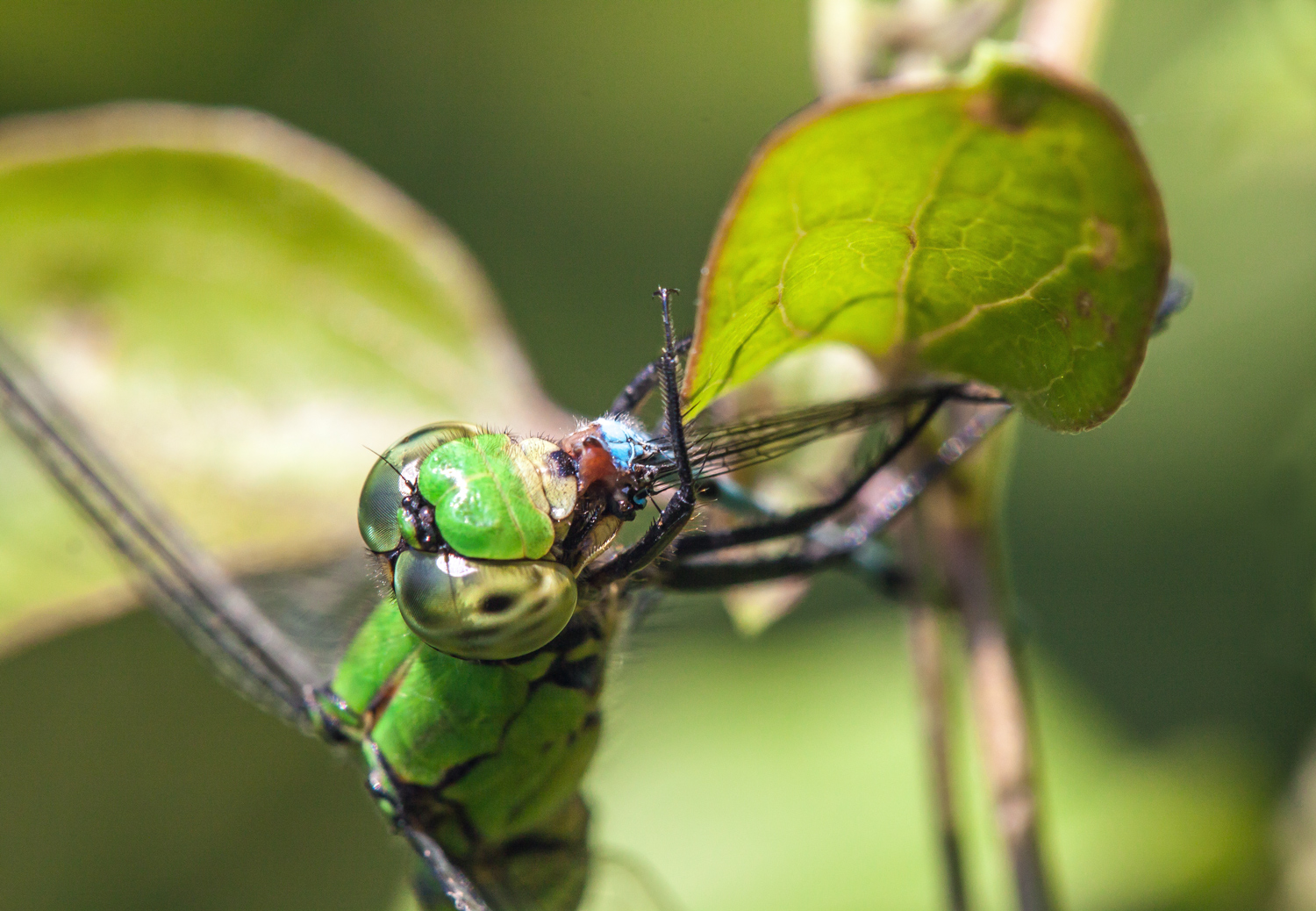
Normally when I see a Common Green Darner dragonfly (Anax junius) it is patrolling in the air and it is mostly a greenish blur. This past Friday, however, I was fortunate enough to spot one on the ground, nestled low in the vegetation at Occoquan Bay National Wildlife Refuge. At this closer distance I was able to marvel at all of the wonderful colors of this beautiful dragonfly.

Be sure to click on the images to see the details of this dragonfly at higher resolution.  Did you notice the blue color near the tip of its “nose?”

Common Green Darner

Common Green Darner

© Michael Q. Powell. All rights reserved.


Read Full Post »

This Prince Baskettail dragonfly (Epitheca princeps) almost looks like it was flying at an airplane’s cruising altitude and was looking down at a landscape with rivers, mountains, and lakes. I spotted this dragonfly last weekend at Occoquan Bay National Wildlife Refuge and spent quite a while trying to get a shot of it in flight.

The dragonfly, however, never ventured close enough to shore for me to get a detailed shot of it. I was a little disappointed until I opened up the image on my computer and discovered that I had managed to capture a wonderful, fanciful background. Sometimes I try to document the reality that I see and other times it seems like it is just my imagination running away with me.

Prince Baskettail

© Michael Q. Powell. All rights reserved.
Read Full Post »

When you closely at flowers, you discover all kinds of cool insects, like this Ailanthus Webworm Moth (Atteva aurea) that I spotted yesterday at Occoquan Bay National Wildlife Refuge. My eyes were drawn to the colorful pattern on the body of this insect, which I initially assumed was some kind of beetle. Because of the distinctiveness of the pattern, it was not hard to identify it after a Google search, but I was a bit surprised to learn that it is a moth, not a beetle.

I thought that this was my first time spotting this moth, but a search of my blog shows that I saw one in 2016 and did a posting entitled Not a Beetle. Although my memory may not be perfect, apparently my reaction was almost identical both times.

Ailanthus Webworm moth

© Michael Q. Powell. All rights reserved.

Read Full Post »

Most folks are familiar with the comic book hero the Green Hornet, but have you ever seen a green bee? I don’t see them very often, so I was pretty excited to spot this one in some flowers last weekend at Occoquan Bay National Wildlife Refuge. I think this kind of bee is generally known as a metallic green sweat bee and is of the genus Agapostemon.

green bee

© Michael Q. Powell. All rights reserved.

Read Full Post »

Sometimes the dragonfly is the predator and sometimes it is the prey—it appears to be primarily a matter of circumstances and timing. This male Common Whitetail dragonfly (Plathemis lydia) met his demise this past Friday at Occoquan Bay National Wildlife Refuge.

I am not sure how exactly the spider managed to snag the dragonfly, but I assume the dragonfly flew into the spider’s web, which was high in the air, spanning a gap between some tall trees. Interesting enough, I was only able to see a few strands of the web, so I wonder if this action took place at the extreme edge of the web.

common whitetail dragonfly

© Michael Q. Powell. All rights reserved.


Read Full Post »

I love photographing the nondescript butterflies that are so common that they fly by virtually unnoticed, like this beautiful little sulphur butterfly that I spotted last week at Occoquan Bay National Wildlife Refuge. I believe it is an Orange Sulphur butterfly (Colias eurytheme), though it is often hard to distinguish that species from the Clouded Sulphur (Colias philodice), so I am a little uncertain of the identification.

What I am certain of, however, is the delicate beauty of this butterfly and I am happy that I was able to capture some of that beauty in this image. As I gaze at this photo, I am reminded of the moment when I took it, a moment when I was enveloped by a sense of deep tranquility as the gorgeous sunlight illuminated the wings of the butterfly. Quite often when I am pursuing a subject, I can feel my heart racing a little as adrenaline kicks in.  This was one of the rare circumstances when I had the opposite physical reaction.

It is hard to describe in words what I was feeling, though it was definitely cool to experience. I hope that some of you will get a sense of that tranquility from this image. Iam becoming more and more convinced of the value of taking life a little more slowly, of opening myself up to experiencing the beauty that surrounds us every day.

sulphur butterfly

© Michael Q. Powell. All rights reserved.
Read Full Post »

Eastern Amberwings (Perithemis tenera) are the smallest dragonflies in our area. You can often find males buzzing around at the water’s edge, but females are harder to spot because they hang out in vegetation away from the water. I was thrilled therefore to see a beautiful female this past Friday at Occoquan Bay National Wildlife Refuge in some beautiful morning sunlight.

I decided to give a male Eastern Amberwing dragonfly equal billing in this post, because I really like the way that the shadows and the reflections make it look like he has an elongated body and extra sets of wings.

Eastern Amberwing

Eastern Amberwing

© Michael Q. Powell. All rights reserved.

Read Full Post »

I love the dark, slate-blue tones of the male Slaty Skimmer (Libellula incesta), one of the most common dragonflies in our area.  The beauty of this handsome Slaty Skimmer was further enhanced by the colorful backdrop that I managed to capture this past Friday at Occoquan Bay National Wildlife Refuge.

It is hard to come up with a composition that is more basic—beauty can often be found in simplicity.

Slaty Skimmer

© Michael Q. Powell. All rights reserved.

Read Full Post »

Many of my photographer friends have been posting photos of hummingbirds and I felt a little left out. I didn’t see any yesterday, but did spot several Snowberry Clearwing moths (Hemaris diffinis) at Occoquan Bay National Wildlife Refuge. This species, along with other clearwing moths, is sometimes called a “hummingbird moth” because of its appearance and behavior, which reminds some folks of a hummingbird.

Most of the times in the past that I have seen a hummingbird clearwing moth, it has been a “cousin” of this species, the very similar Hemaris thysbe. That species, however, has more red on its body and has lighter colored legs, according to the butterfliesandmoths.org website.

As you might suspect, these moths are in almost constant motion.  Its is quite a challenge, therefore, to track them and keep them in focus as they dart among the flowering plants.

As I was tracking one, a second one flew in and seemed intent on dislodging the first one. I reflexively I pressed the shutter button and was a little shocked to see that I managed to capture them both in a single frame. It’s cool that they both had their long proboscises curled up at the moment I took the shot.

Snowberry Clearwing Moth

Snowberry Clearwing moth

Snowberry Clearwing moth

© Michael Q. Powell. All rights reserved.

Read Full Post »

When I came upon this little praying mantis during a recent trip to Occoquan Bay National Wildlife Refuge, I couldn’t decide if it was the predator or the prey. Although the mantis seemed to be at least partially trapped in a spider’s web, the spider no longer seemed to be present. In addition, the mantis appeared to be trying to work its way out of the web.

There is definitely a story here, but I can’t figure out for sure what it is. You’ll have to choose an ending to the story on your own.

praying mantis


praying mantis

© Michael Q. Powell. All rights reserved.

Read Full Post »

You never know for sure when a dragonfly will let you get close. Although some species tend to be less skittish than others, each individual dragonfly seems to have its own sense of “personal space.” Some will let you get really close and may even perch on you, but others will take flight or keep their distance as soon as they detect your presence.

On a recent trip to Occoquan Bay National Wildlife Refuge I was able to see eye to eye with this handsome male Widow Skimmer (Libellula luctuosa). I love the wonderful symmetry of looking straight into the multi-faceted eyes of a dragonfly, as in the first photo below, though I will admit that it really limits the depth of field in the image and does not let you see much of its body. For the second photo, I moved a little and shot if from a slight angle.

I tend to prefer the first image. What do you think?

Widow Skimmer

Widow Skimmer

© Michael Q. Powell. All rights reserved.

Read Full Post »

When they are immature, the males and females of many dragonfly species are very similar in coloration. To make matters worse, immature dragonflies of several different species are also similar in appearance, with only subtle differences to distinguish one species from another, like the color of the upper portions of their legs.

As a result, I am not really sure of my identification of this particular dragonfly. I lean towards it being an immature male Great Blue Skimmer (Libellula vibrans), but it might instead be a Slaty Skimmer (Libellula incesta). (The adults of these two species, by contrast, are very different in appearance and would never be mistaken for each other.)

Whatever the case, I love the two-toned eyes and overall body position of this beautiful dragonfly. It might be my imagination, but it seemed to me that the dragonfly had tilted its head a bit to check me out.

Great Blue Skimmer

© Michael Q. Powell. All rights reserved.

Read Full Post »

Water lilies are now blooming at Occoquan Bay National Wildlife Refuge, which recently has become my favorite place to explore with my camera.  Yesterday I could see lots of them in a distant pond that was not accessible. I was happy, though, to be able to capture this image of one that was just within range of my zoom lens.

Water lilies are so exquisite that a single bloom is sufficient to fill me with a sense of beauty and tranquility. Is it any wonder that water lilies were the main focus of Monet’s artistic production during the last thirty years of his life?

water lily

© Michael Q. Powell. All rights reserved.

Read Full Post »

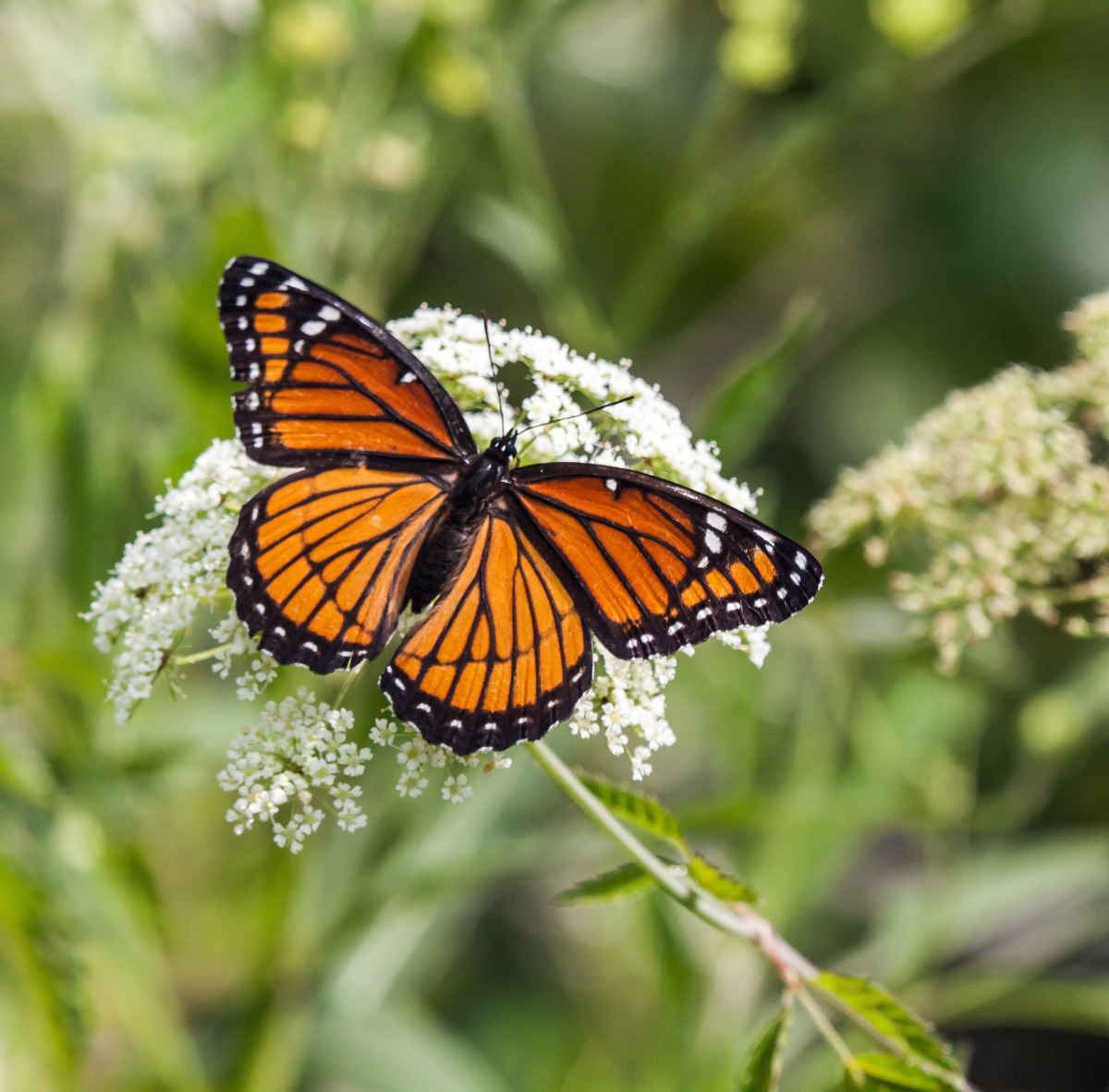
Whenever I see a patch of milkweed I will usually stop and and watch and wait. Milkweed attracts such a colorful cast of insect characters that it reminds me a little of the Mos Eisley Cantina in the original Star Wars movie.

My patience was rewarded this past Saturday at Occoquan Bay National Wildlife Refuge when a Monarch Butterfly (Danaus plexippus) stopped by for a visit and I was able to capture this image.

Monarch butterfly

© Michael Q. Powell. All rights reserved.

Read Full Post »

A breeze was blowing on Saturday morning at Occoquan Bay National Wildlife Refuge and this male Halloween Pennant dragonfly (Celithemis eponina) seemed to be struggling to maintain its perch as it was buffeted from side to side.

Halloween Pennant

© Michael Q. Powell. All rights reserved.


Read Full Post »

Even if you find spiders a bit creepy (which I don’t), you can’t help but admire the beauty and artistry of their webs. This spider, which I think is a Black and Yellow Garden Spider (Argiope aurantia), went a little crazy with its zigzag pattern this past weekend at Occoquan Bay National Wildlife Refuge.

Most of the time the webs of these spiders have a single zigzag pattern that leads to the center of the web. This spider, which seemed smaller than many of the others of this species that I have seen, for some unknown reason decided to repeat the pattern multiple times, which helped me to spot the web more easily.

© Michael Q. Powell. All rights reserved.


Read Full Post »

The combination of springtime rain and summertime heat in our area has caused a real explosion of insects. Some of them, like deer flies and mosquitoes, mercilessly harass me when I go out with my camera, but a lot of them are amazingly beautiful, like this spectacular Common Wood Nymph butterfly (Cercyonis pegala) that I spotted this past weekend at Occoquan Bay National Wildlife Refuge.

Many woodland butterflies are rather drab in appearance and it is hard for me to identify their species. With the Common Wood Nymph, though, the yellow patch on the wings makes them almost instantly recognizable.

Common Wood Nymph

© Michael Q. Powell. All rights reserved.


Read Full Post »

Technically speaking, “great” is not a part of the name of the Green Heron (Butorides virescens), but I would argue that this diminutive bundle of personality is just as deserving of the honor as the more common Great Blue Heron.

I was thrilled to see my first Green Heron in quite some time on Saturday at Occoquan Bay National Wildlife Refuge. The little heron was perched on some vegetation growing out of the marshy, duckweed-covered water as it took a break from fishing to do a bit of preening. While the heron was grooming itself, it often had its head tucked out of view, so I had to wait for quite some time to capture this pose, a pose that highlights the beautiful colors and patterns of this great Green Heron

Green Heron

© Michael Q. Powell. All rights reserved.

Read Full Post »

I watched a dragonfly flying around in the air for quite some time yesterday morning at Occoquan Bay National Wildlife Refuge and was thrilled when it finally perched for a moment on some vegetation low to the ground. Initially I thought that it was a Wandering Glider, a migratory species that I had seen a few times previously at this wildlife refuge.

After I posted an image to a couple of Facebook dragonfly fora, I learned that the dragonfly was in fact not a Wandering Glider, but instead was a close relative, a Spot-winged Glider (Pantala hymenaea). I like the way that Kevin Munroe described this species on his website Dragonflies of Northern Virginia—”Along with the Wandering Glider, this is the albatross of the dragonfly world. Both species are highly-evolved for sustained, efficient flight, drifting over summer fields for hours, like sea birds over a green ocean.”

If you look closely at this dragonfly’s hind wings, you will see that they are broader and appear less fragile than those of many other dragonflies. According to Dennis Paulson in his book Dragonflies and Damselflies of the East, within the genus Pantala, “The very broad hindwings represent an important adaptation for gliding, as does the ability to deposit fat and then use it for energy during a long flight just as a migratory bird does.”

It boggles my mind to think of these tiny creatures migrating for hundreds and in some cases thousands of miles. Wow!


Spot-winged Glider

© Michael Q. Powell. All rights reserved.

Read Full Post »

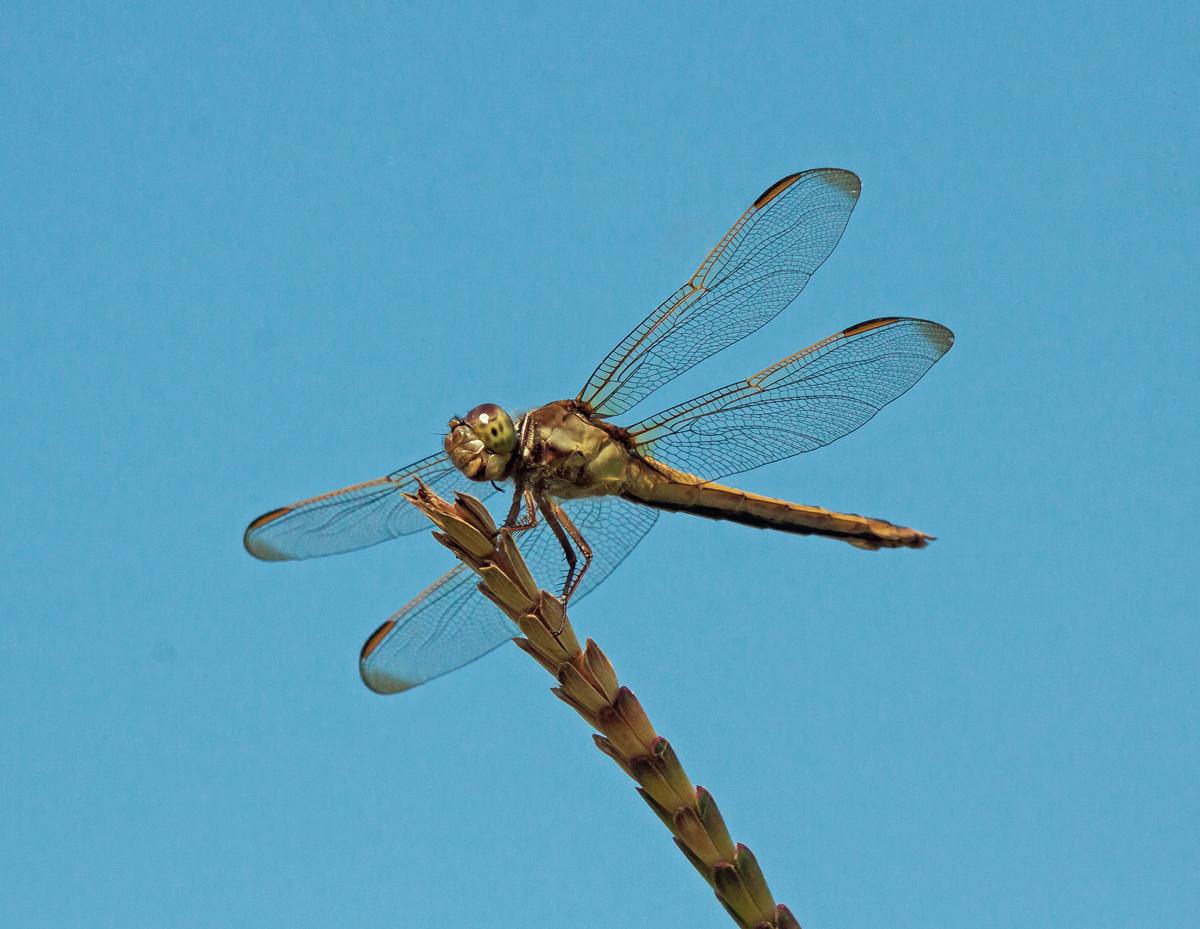
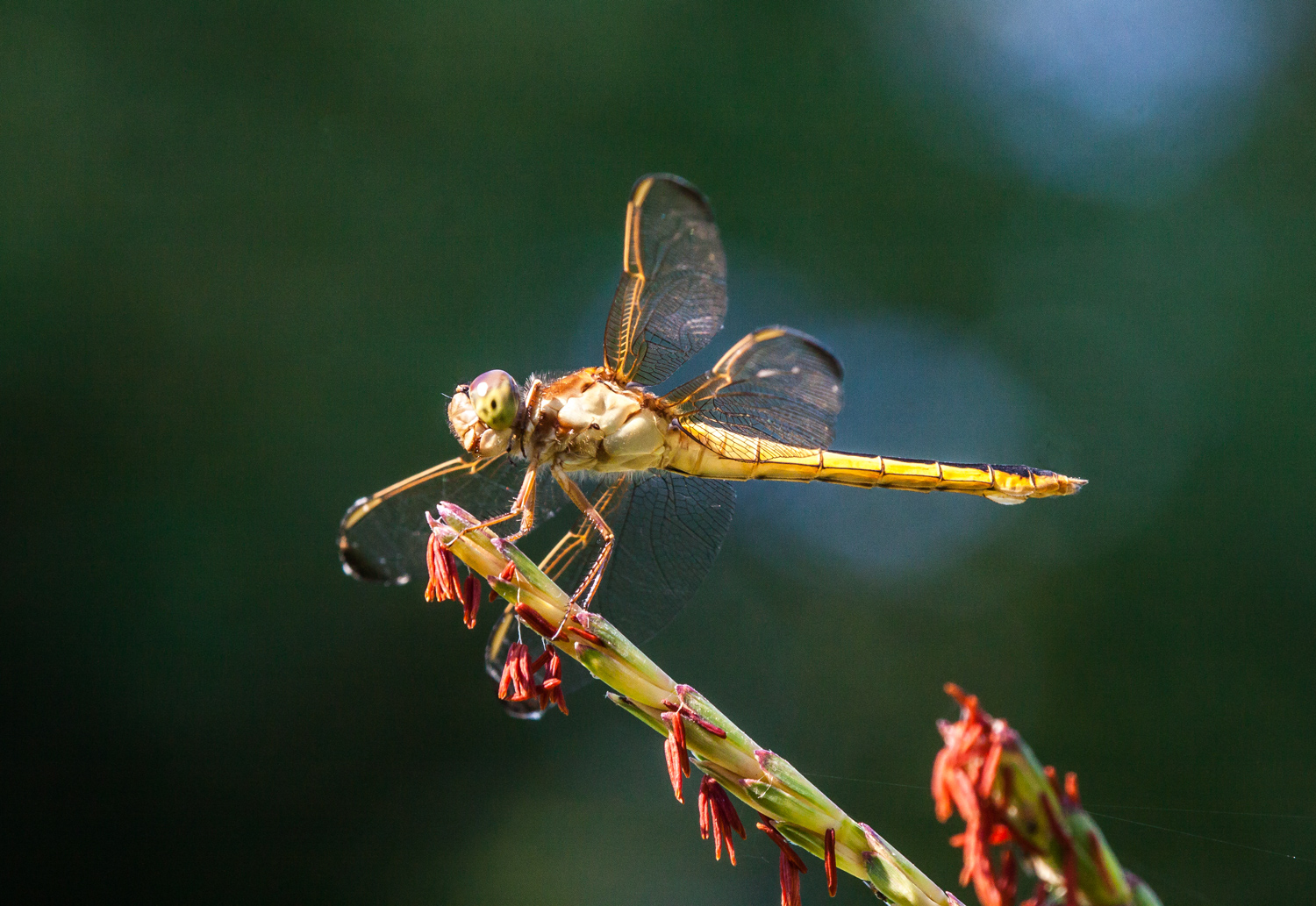
What a difference a background makes. Recently I have been seeing a lot of beautiful female Needham’s Skimmer dragonflies (Libellula needhami) at Occoquan Bay National Wildlife Refuge. It is often a challenge to try to separate them from the background vegetation so that you can focus in on the dragonfly’s wonderful details, like its gorgeous speckled green eyes.

Here are two images that I was able to capture with uncluttered backdrops, one with sky and one with vegetation. I tend to like the first shot a little bit more because of the beautiful blue sky, though I like the lighting and the wonderful Eastern gamagrass in the second shot.

It is fascinating to see what a different feel the background gives to images of similar subjects. Do you prefer one image over the other?

Needham's Skimmer

Needham's Skimmer

© Michael Q. Powell. All rights reserved.

Read Full Post »

Happy 4th of July! It is Independence Day here in the USA and in honor of this holiday I thought I’d post this shot of a patriotic Blue Dasher dragonfly (Pachydiplax longipennis) that was sporting a bit of red, white, and blue on its head this past Monday at Occoquan Bay National Wildlife Refuge. (Be sure to click on the image to see a higher resolution version of the dragonfly that shows the tiny hairs on its thorax (the torso) and its legs.)

Blue Dasher

© Michael Q. Powell. All rights reserved.


Read Full Post »

Some of my readers know that I especially love dragonflies with patterned wings and one of my favorites is the Halloween Pennnant (Celithemis eponina). Despite its name, it is a summertime dragonfly and I was thrilled to spot a beautiful female Halloween Pennant yesterday at Occoquan Bay National Wildlife Refuge.

The “Halloween” part of its name comes from the orange-brown color of its wings. The “pennant” comes from this predisposition of members of this genus to perch on the very tip of vegetation, which causes them to wave back in forth in even the slightest breeze.

In the photo below, the Halloween Pennant is perched on a stalk of very distinctive Eastern gamagrass (Tripsacum dactyloides). I have frequently seen this kind of grass with red bits hanging from its stalks, but it was only yesterday that I learned what it was called from fellow dragonfly enthusiast Walter Sanford.

Halloween Pennant

© Michael Q. Powell. All rights reserved.


Read Full Post »

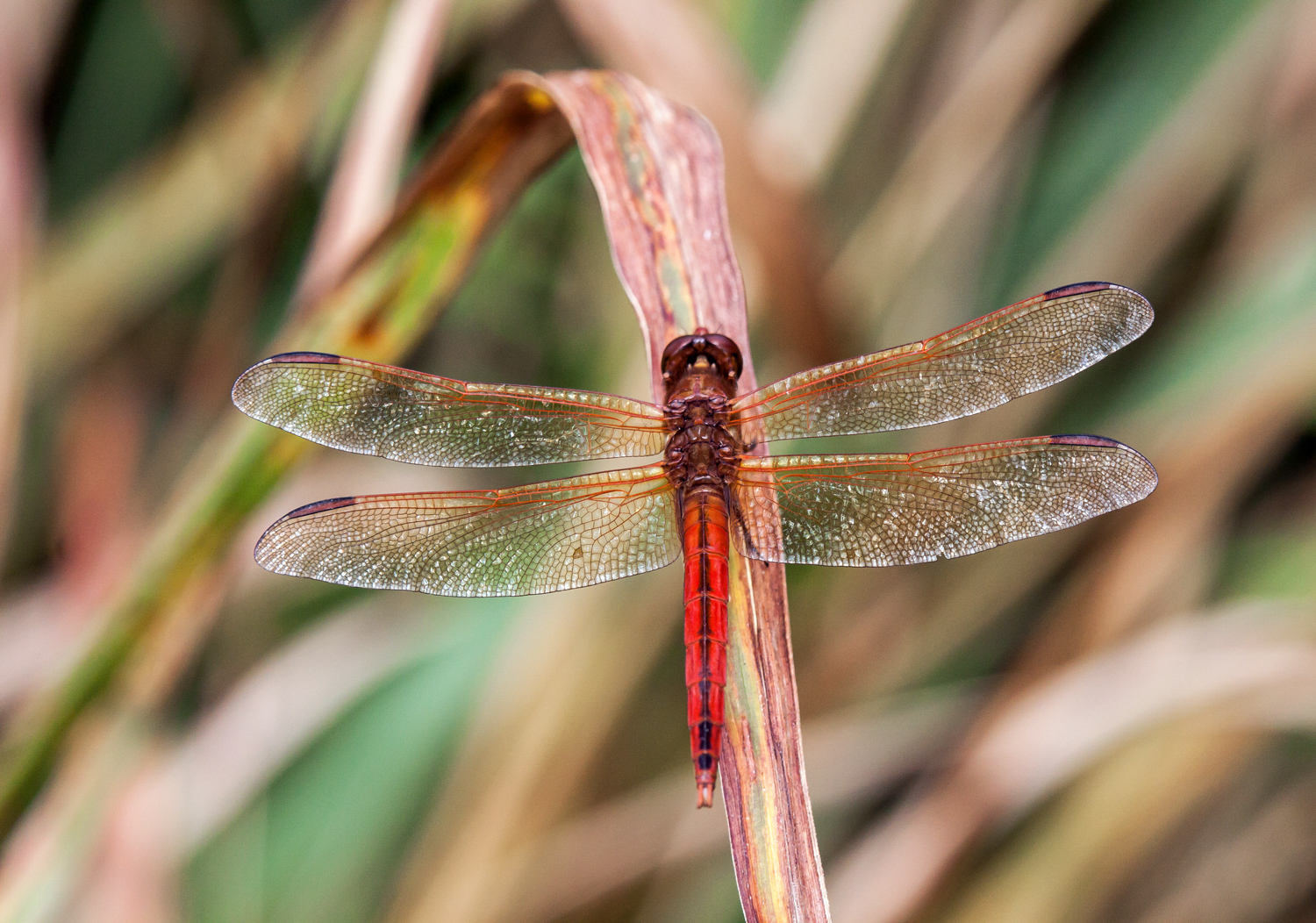
With the temperatures today reaching almost 100 degrees (38 C), I long for the cooler weather of autumn, my favorite season of the year. The aptly named Autumn Meadowhawk (Sympetrum vicinum) is generally one of the last surviving dragonfly species each year and I was therefore a bit surprised last week when I spotted this young female Autumn Meadowhawk. The very clear wings and pale body coloration are an indication that it had only recently emerged.

Summer, though, is the prime season for dragonflies and I hope to be able to take advantage of this season to see lots more of them. I’ll just have to make sure that I pace myself and stay well hydrated as we move through a period of exceptionally hot weather.


© Michael Q. Powell. All rights reserved.

Read Full Post »

Even from a distance it is easy to see that the eaglets in one of nests at Occoquan Bay National Wildlife Refuge are no longer babies. When I saw them this past weekend, one of them was still hanging around in the nest, but the other had ventured out to a higher limb. I am posting an image of each of the two eaglets as well as a shot that shows their relative positions. As you can see, there are now a lot of leaves on the trees and I suspect that most folks walking by on the trail are not even aware of the presence of the nest.

The little eagles are still mostly brown in color—it will take almost five years for them to acquire the white feathers on their heads and on their tails that we associate with adult Bald Eagles (Haliaeetus leucocephalus).

Bald Eagle

Bald Eagle

Bald Eagle

© Michael Q. Powell. All rights reserved.

Read Full Post »

We have been having so much rain this month that I have taken to carrying an umbrella with me much of the time, including when I am going out with my camera. It’s a challenge to take photos in the rain, because of the juggling required to hold a camera steady while holding an umbrella and also because there are fewer subjects to photograph—most creatures have the common sense to seek shelter when it is raining.

Here are a few photos from a walk I took this past Friday at Occoquan Bay National Wildlife Refuge. They are a different style than most of the photos that I post on this blog, but I really like the way they turned out.

In the first image an Eastern Box Turtle (Terrapene carolina) had a different way for handling the rain than the umbrella I was carrying—it simply pulled its legs and head inside of its shell. In the second image a Tree Swallow (Tachycineta bicolor) decided to brave the rain to get a breath of fresh air while perched atop a nesting box. The final photo shows a hummingbird view of a trumpet vine flower, one of its favorites. Alas, no hummingbirds were flying in the rain.

Eastern Box Turtle

Tree Swallow

trumpet vine

© Michael Q. Powell. All rights reserved.

Read Full Post »

Do you ever go out to shoot photos when it is raining? It was already raining when I set out on a photo walk yesterday morning at Occoquan Bay National Wildlife Refuge and it kept raining for several hours as I sought subjects to photograph. My camera is somewhat waterproof, but my lenses are not, so I carried an umbrella. It must have been quite a sight to see me balancing my umbrella and my camera, which was attached to an extended monopod.

Dragonflies generally do not fly in the rain, but I decided to search the edge of a small pond to see if I could spot any particularly hardy specimens. As I was doing so, I caught sight of a small flicker of yellow. As I drew closer to it, I could see that it was a tiny damselfly. Now damselflies are always pretty small, but this one was even smaller than normal. Since many damselflies are a combination of black and blue, the brighter coloration of this one really made this one stand out.

It was not hard to find this damselfly in my guidebook because of its coloring. It is a Citrine Forktail damselfly (Ischnura hastata), a diminutive damselfly that is only .8-1.1 inches (20 to 27 mm) in length. I am really happy that I was able to capture so many of the details of this cool damselfly: the tiny blue eyespots; the narrow green shoulder stripes; and the mostly yellow abdomen.

Citrine Forktail

© Michael Q. Powell. All rights reserved.

Read Full Post »

Do you have rainbows and unicorns in your life? Despite all of the recent rain, I haven’t seen a rainbow in a long time, but I did spot a unicorn last Saturday at Occoquan Bay National Wildlife Refuge, this beautiful Unicorn Clubtail dragonfly (Arigomphus villosipes).

It’s a little hard to tell from these shots, but Unicorn Clubtails have a little “horn” between their eyes that gives rise to the species’ common name. (If you want a view of the “horn,” check out this posting that I did in 2017.)

There is always a certain tension between isolating your subject in a photo and showing it in its natural surroundings. It’s a whole lot easier to focus on the perched dragonfly in the first image below, but I love the color and the texture of the green leaves in the second image and don’t find them to be distracting. Sometimes in life you have to choose and make an either/or decision, but I think that it is often best to leave the options open and let the viewers decide which images they prefer.

Unicorn Clubtail

Unicorn Clubtail

© Michael Q. Powell. All rights reserved.


Read Full Post »

The eaglets in one of the two nests that I have been monitoring at Occoquan Bay National Wildlife Refuge appear to be almost full grown, but both of the parents were still keeping a watchful eye on them this past Saturday.

On this day I was shooting with my Canon SX50 superzoom camera and was able to zoom out and give you a sense of the relative position of the nest and the branches on which the adult Bald Eagles (Haliaeetus leucocephalus) were perched. I have featured this perch, which appears to be a favorite spot for these eagles, several times in this blog, but to the best of my knowledge this is the first time to show you the nest itself.

As you can see, the leaves have returned to the trees and it is getting harder and harder to get unobstructed shots of the eagle nest. I was hoping to get a shot of both of the eaglets, but the second one remained elusive and was hidden from view the entire time that I observed the eagles.

It would also have been nice to shoot from an angle in which the lighting was better, but essentially there was only a single location from which I had a clear visual path to the nest. I did change position for the shot of the two adults—the lighting was somewhat better, though I was still shooting through a tangle of branches. Sometimes you just have to take what you get and make the best of it.

Bald Eagle eaglet

Bald Eagle

Bald Eagle

© Michael Q. Powell. All rights reserved.

Read Full Post »

Most dragonflies have clear wings and different colors and patterns on their bodies. Some dragonflies, however, have patterns on their wings too that I think really accentuates their beauty and makes them particularly striking.

The first shot below shows a female Calico Pennant dragonfly (Celithemis elisa) that I spotted in mid-May at Occoquan Bay National Wildlife Refuge. The second shot shows a male Painted Skimmer dragonfly (Libellula semifasciata) that I spotted in late May at a small pond in Prince William County in Northern Virginia.

Calico Pennant

Painted Skimmer

© Michael Q. Powell. All rights reserved.


Read Full Post »

« Newer Posts - Older Posts »