Feeds:
Posts
Comments

Posts Tagged ‘Occoquan Bay National Wildlife Refuge’

This must be egg-laying season for Eastern Snapping Turtles (Chelydra serpentina serpentina) for I have seen them on multiple occasions this past week far away from the water that is their normal habitat. I spotted this venerable one in a grassy field at Occoquan Bay National Wildlife Refuge.

I am happy that I was able to capture some of the turtle’s wonderful skin texture  and serious expression in this head-and-shoulders portrait. I do realize, of course, that turtles do not really have shoulders—I used a bit of artistic license in characterizing the portrait with those words (and in calling myself an “artist”).

Many people say that snapping turtles look prehistoric to them, but I tend to think of Yoda every time that I see one. In my mind, I imagine a snapping turtle speaking with Yoda’s wisdom and unusual grammar structure with expressions like, “Named must your fear be before banish it you can.” (Lots of wonderful Yoda quotes like this one can be found at yodaquotes.net.)

Snapping Turtle

© Michael Q. Powell. All rights reserved.

Read Full Post »

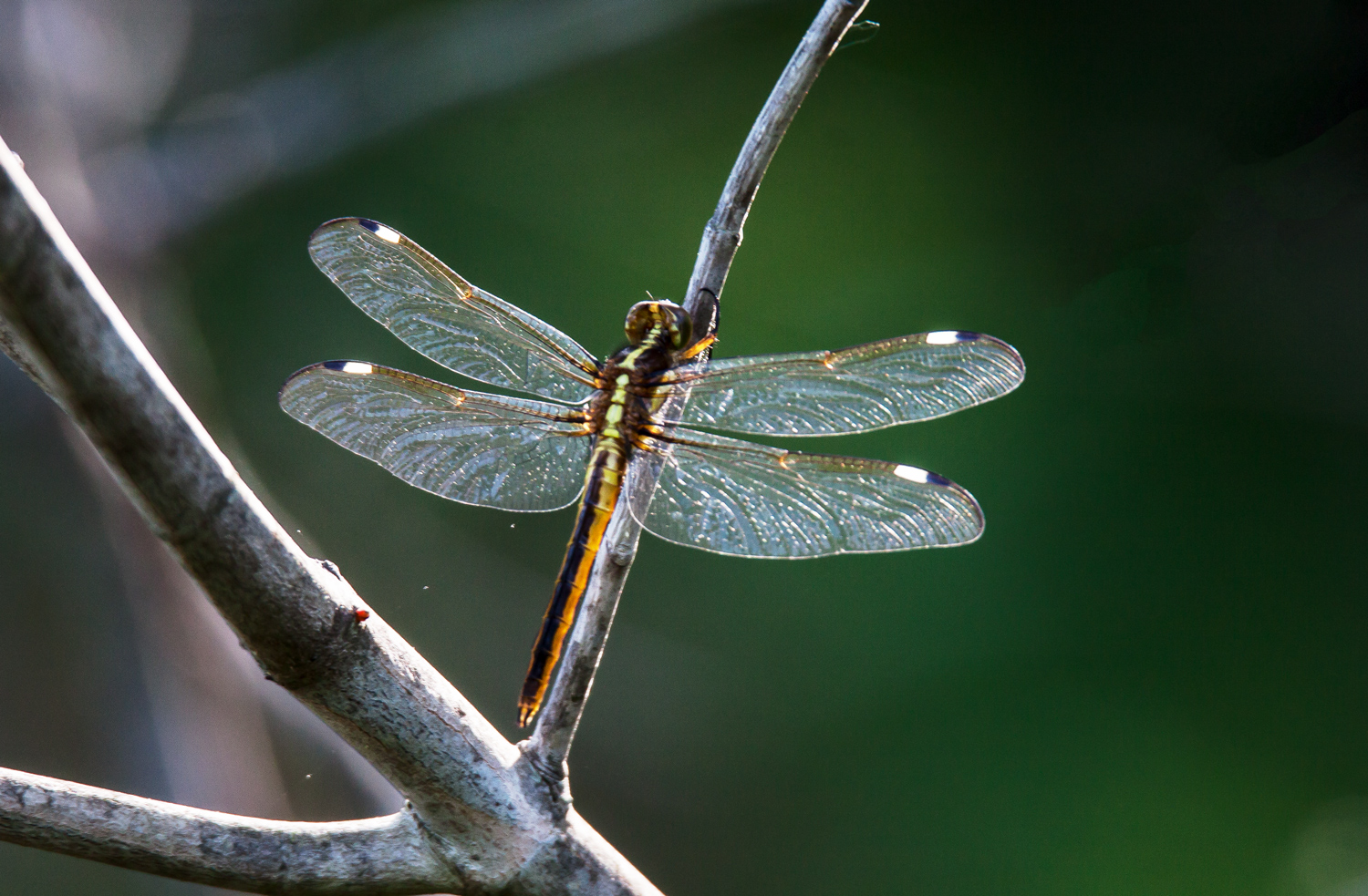
Many dragonflies like to perch on or near the ground, but some prefer to relax at the top of the trees, like this Black Saddlebags dragonfly (Tramea lacerata) that I spotted last Monday at Occoquan Bay National Wildlife Refuge. From this angle you can easily see the dark patches on the rear wings that someone decided looked like “saddlebags.”

Those patches somehow remind me of the famous inkblots of the Rorschach test. I suspect that. if asked, people have widely varying ideas about what they look like, though I know that I personally would not want to have any psychological interpretations attributed to my perceptions or to my imagination.

Black Saddlebags

© Michael Q. Powell. All rights reserved.

Read Full Post »

This Bald Eagle (Haliaeetus leucocephalus) couldn’t seem to decide if it wanted to yawn or scream this past Monday at Occoquan Bay National Wildlife Refuge. Either reaction could have been a response to my presence.

Bald Eagle

© Michael Q. Powell. All rights reserved.

Read Full Post »

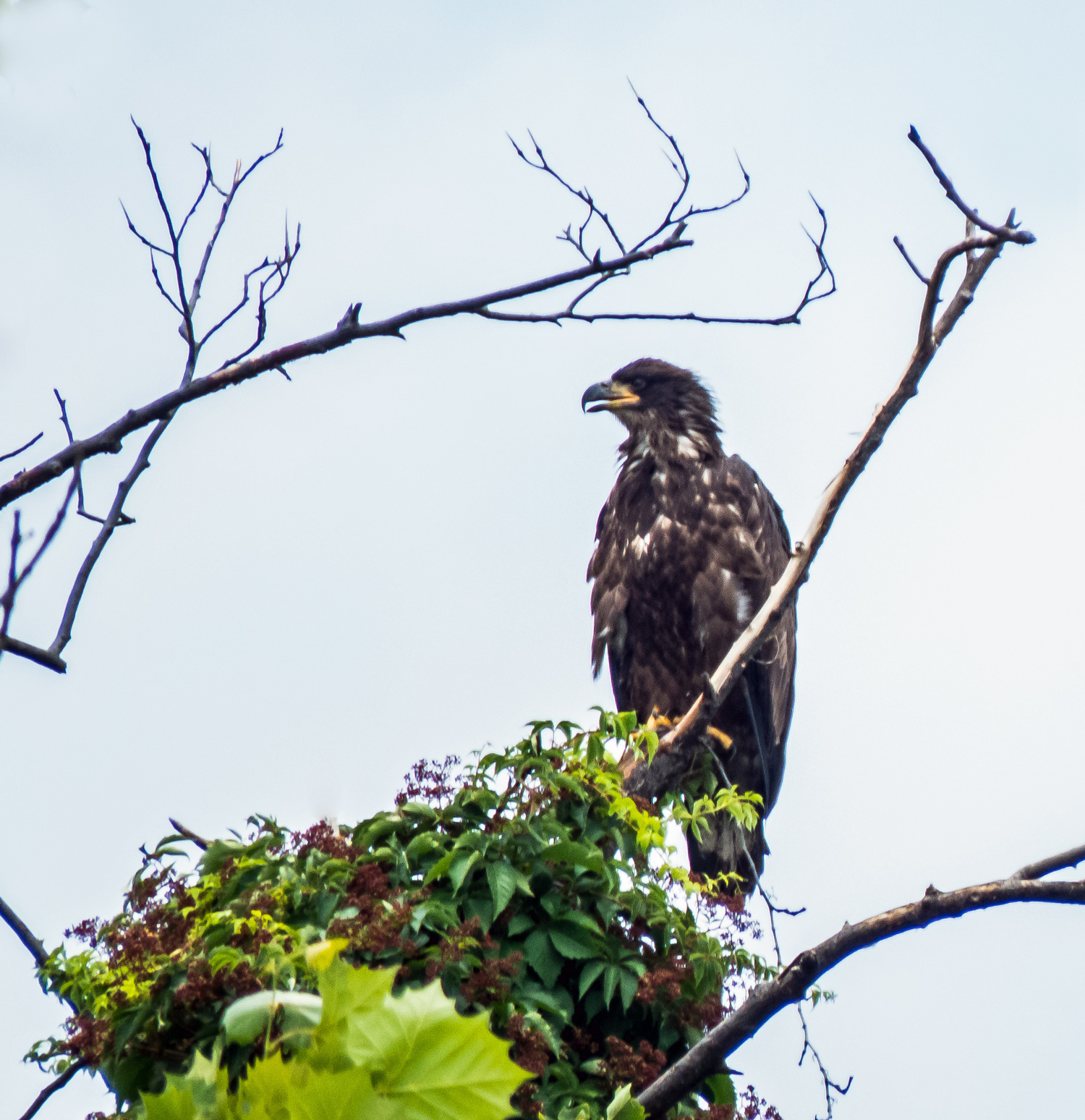
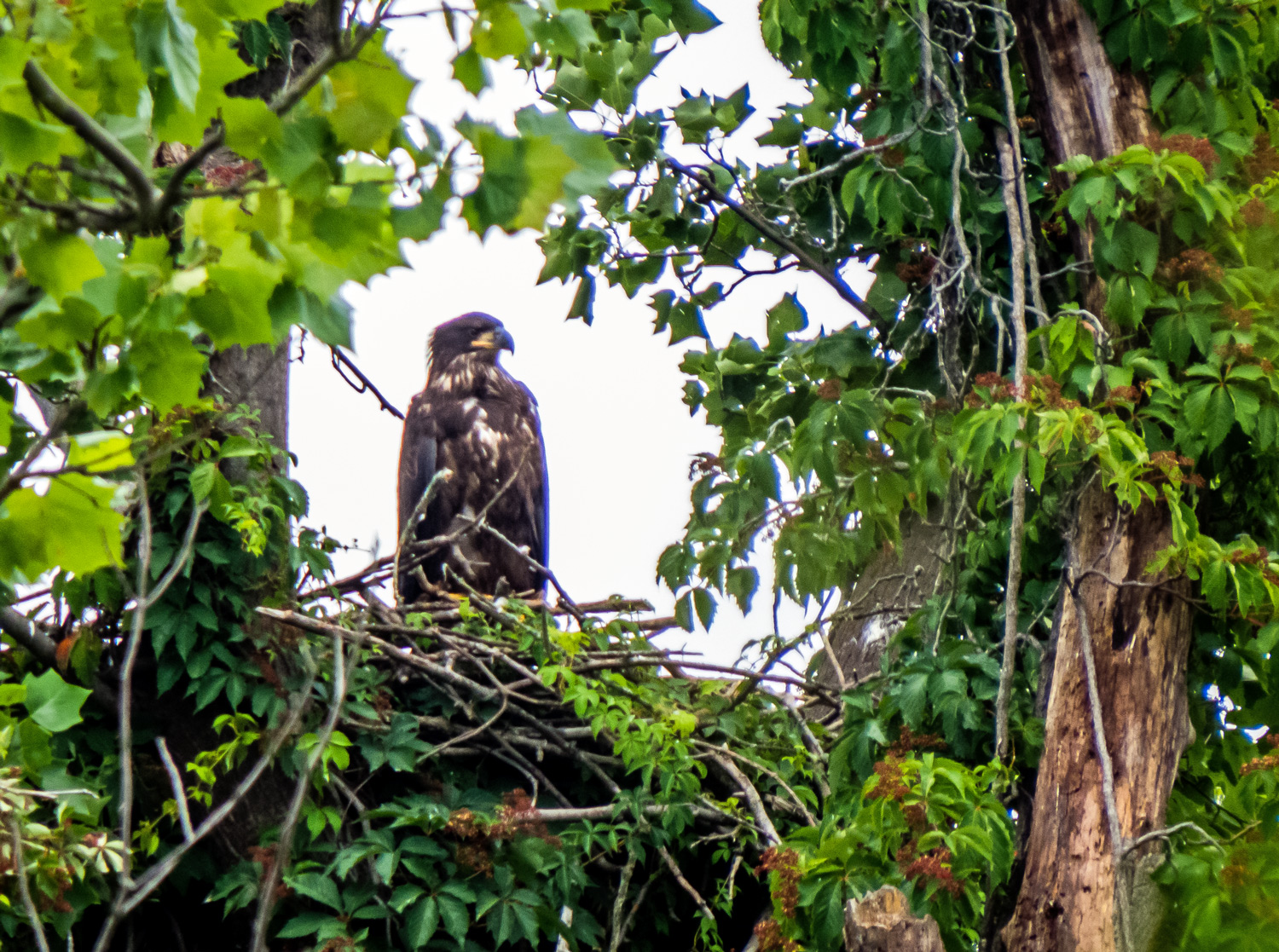
The two Bald Eagle eaglets whose development I have been following are getting really big—it looks like they are about ready to attempt to fly. In the upper left corner of the first image, you can see that one of the parents was perched just above the nest. It seems like there is no longer room for either of the parents in the nest, but at least one of them always seems to be nearby, watching over the eaglets

There is a barrier at the Occoquan Bay National Wildlife Refuge near the eagle nest that keeps people from getting close and protects the Bald Eagles (Haliaeetus leucocephalus) from human interference., From that barrier, however, I am able to see into the nest with my 150-600mm telephoto zoom lens, though the leaves on the trees are now making it quite a bit tougher to get an unobstructed shot than a  month ago. For comparison purposes, I am including a shot of the eaglets that I took three weeks earlier than the more recent image that I captured this past Monday.

Bald Eagle eaglets

Bald Eagle eaglets

© Michael Q. Powell. All rights reserved.

Read Full Post »

When I am capturing wildlife images, I am usually driven by multiple motivations that sometimes come in conflict with each other. On the one hand, I am trying to capture reality, to record the presence of a given subject in a way that makes it recognizable and identifiable. On the other hand, I am trying to create art, by choosing compositional elements and camera settings that make an image that is visually pleasing to me.

At this time of the year, dragonflies become one of my favorite subjects and I eagerly await the emergence of new species as we move deeper into spring and eventually into summer. This past Monday at Occoquan Bay National Wildlife Refuge, I noted that Spangled Skimmer  dragonflies (Libellula cyanea) are now with us. This species is pretty easy to identify because it is the only local species that has black and white stigmas—stigmas are the narrow rectangular patches of color that can be found on the front edges of the wings.

In the first image, a male Spangled Skimmer was pretty cooperative and let me capture one of my favorite type of dragonfly images—a head-on shot. In this kind of shot, the dragonfly’s body is almost always out of focus, but I am ok with that, because it forces the viewer to focus on the dragonfly’s amazing eyes.

The dragonfly in the second shot, which is an immature male Spangled Skimmer, had flown into a tree after I inadvertently spooked it. I loved the way that it was clinging to a branch. Shooting at an upward angle, I tried to simplify the background to draw attention to the branches as well as to the dragonfly. (As is often the case with dragonflies, immature male Spangled Skimmers initially have the coloration of adult females—eventually the dragonfly in the second photo will look like the one in the first image.)

Spangled Skimmer

Spangled Skimmer

© Michael Q. Powell. All rights reserved.

Read Full Post »

Cormorants are usually really skittish. Even when they are fishing far away from the shore, they will usually take off as soon as they sense my presence. When I spotted the unmistakable silhouette of a cormorant perched on the remnants of a duck blind in the waters off of Occoquan Bay National Wildlife Refuge this past Monday, I fully expected that it would fly away before I got within range to take a decent shot.

As I was approaching, I could see that it was a juvenile Double-crested Cormorant (Phalacrocorax auritus)—juveniles are paler around the neck and breast than adults and have more exposed orange skin around the bill. Perhaps this young cormorant had not yet developed a fear of humans, but whatever the reasons was, the beautiful blue-eyed bird remained in place as I took some shots from different angles and was still there when I silently moved away.


Double-crested Cormorant

© Michael Q. Powell. All rights reserved.

Read Full Post »

When I was growing up, my parents had a carved wood cuckoo clock from Germany. The bird that popped out of the clock, however, looked nothing like the Yellow-billed Cuckoos (Coccyzus americanus) that I spotted this past weekend at Occoquan Bay National Wildlife Refuge. More significantly, the cuckoos that I saw did not make the familiar cuckoo sound that was part of my childhood.

When I did a little research, I learned that the cuckoo family is quite large and spread out all over the world and that the Yellow-billed Cuckoo belongs to a different subfamily from the Common Cuckoo (Cuculus canorus) from Europe. That cuckoo is the one that makes the cuckoo sound used in all of those clocks.

Yellow-billed Cuckoo

Yellow-billed Cuckoo

Yellow-billed Cuckoo


© Michael Q. Powell. All rights reserved.


Read Full Post »

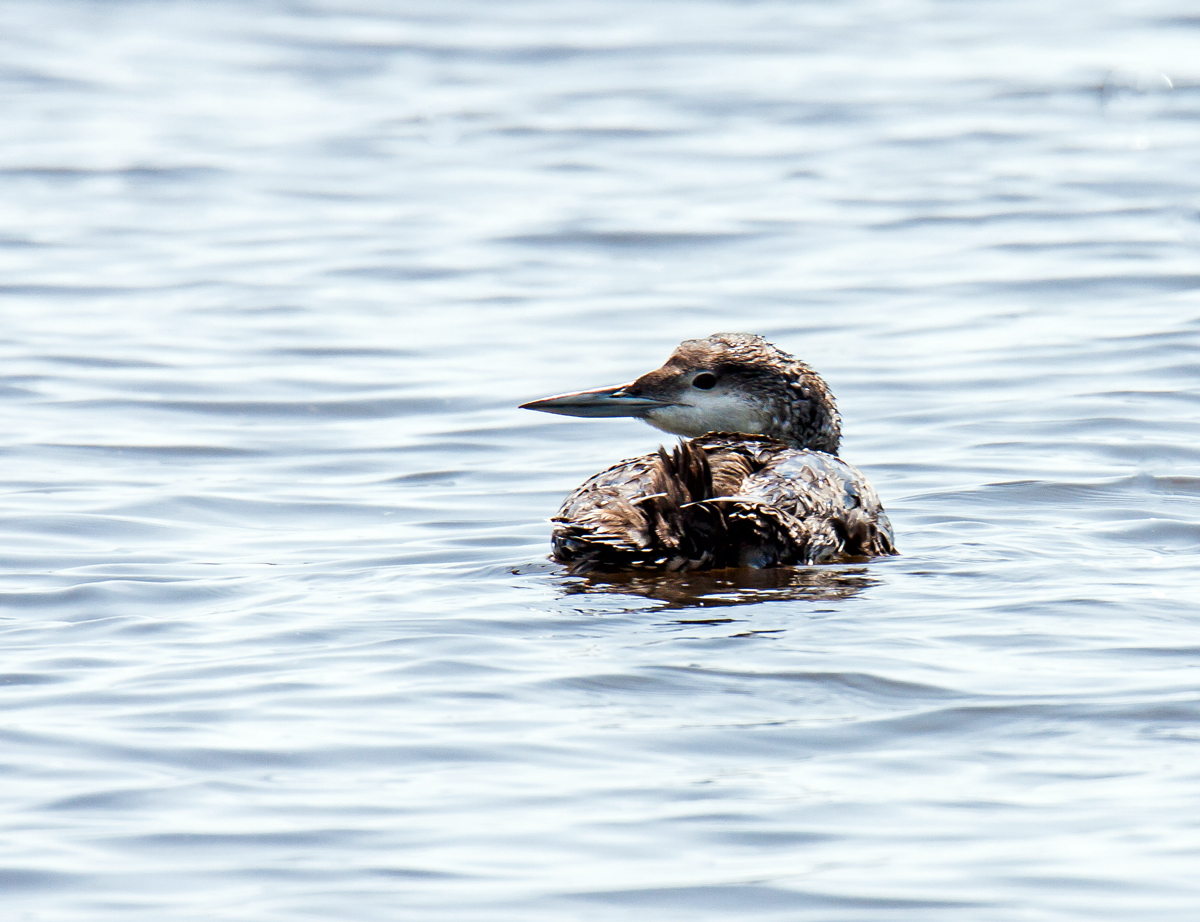
When I first saw this bird yesterday in the waters off of Occoquan Bay National Wildlife Refuge, I thought it might be some kind of grebe. The more I watched it though, the more skeptical I became of my initial identification. It seemed bigger than the grebes that I had previously seen and its bill seemed considerably longer. Additionally, it acted differently. Rather than diving, it poked its head under the water and then would swim for a bit with its head submerged.

So I did what I usually do in this kinds of situation and posted some photos in the What’s This Bird? forum on Facebook. Within a few minutes I received a chorus of responses, all indicating that this was a Common Loon (Gavia immer). I have absolutely no experience with loons, but tend to associate them with northern lakes. Mentally, I think of them as dark colored with distinctive patterns, which is true when they are in breeding plumage. It turns out that they are much more subdued in coloration when they are in non-breeding or immature plumage.

In other parts of North America, loons are a more common and popular sight than in Northern Virginia where I live. According to Wikipedia, the Common Loon is the provincial bird of Ontario, and it appears on Canadian currency, including the one-dollar “loonie” coin and the previous series of $20 bills. In 1961, it was designated the state bird of Minnesota, and appears on the Minnesota State Quarter.

Common Loon

Common Loon

Common Loon

© Michael Q. Powell. All rights reserved.


Read Full Post »

I have spotted Common Yellowthroats (Geothlypis trichas) repeatedly this spring, but, despite my best efforts, have not been able to get a close-up shot of one. They seem to like to perch in the middle of a particular field at Occoquan Bay National Wildlife Refuge and seem to taunt me from a distance with their sweet songs.

I love the distinctive black Lone Ranger-style mask of the male Common Yellowthroat that contrasts wonderfully with sunny hues of its eponymous throat. Even though I recently couldn’t get close to this yellowthroat, I managed to capture this image that has a painterly feel to it.

I’ll still be trying for a close-up of this species, but for now I am quite content with this environmental portrait of this beautiful bird.

Common Yellowthroat

© Michael Q. Powell. All rights reserved.

Read Full Post »

When I spotted this Eastern Snapping Turtle (Chelydra serpentina serpentina) from a distance yesterday at Occoquan Bay National Wildlife Refuge, I thought it might be a fox, because of its reddish-brown color. It was only when I got closer that I realized that it was a snapping turtle covered with mud—I suspect that she had recently been digging a nest to bury eggs. I got low trying to do an eye-level shot and am pleased with the expression that I was able to capture.

snapping turtle

© Michael Q. Powell. All rights reserved.

Read Full Post »

There are often a few moments in the early morning when the world seems completely at peace. The waters are calm and reflections are almost perfectly mirror-like. Sometimes there is enough light to take photographs, but even when there is not, I enjoy getting up early simply to savor those moments.

This past Monday morning, when I arrived at a small pond at Occoquan Bay National Wildlife Refuge, I noticed the beautiful reflections and my attention was drawn to a stick protruding out of the water. As I zoomed in on the stick, I noticed a damselfly perched on it. Damselflies belong to the same order of Odonata as dragonflies, but usually are smaller in size, often 1 to 1.5 inches in length (25–38 mm).

I decided to take some shots of the stick and the perching damselfly and as I was doing so, the damselfly flew away. I managed to capture the image below as the dragonfly was returning to its perch.

An expert on a Facebook forum identified the damselfly for me as an Orange Bluet (Enallagma signatum). Most members of the bluet family of damselflies are colored with various combinations of blue (as the name suggests) and black, but some family members are also orange or red. I shake my head and smile every time that I use the curious word combination “orange bluet.”

This image is somewhat atypical for me in the sense that it is not a close-up portrait. Most of the time I try to use my telephoto zoom or macro lens to capture as many details of my subject as I can. In cases like this, though, I am content to capture an image that evokes the mood of the moment. There is a kind of minimalist simplicity in this photo that really appeals to me.

Orange Bluet

© Michael Q. Powell. All rights reserved.

Read Full Post »

When I first spotted a small flock of dark-colored birds this past Monday at Occoquan Bay National Wildlife Refuge, I thought that they were blackbirds of maybe grackles. When the light illuminated them better, however, I could see that they were two-toned—their heads were brown and their bodies were black. I wasn’t sure what they were, but their distinctive color pattern made it easy to find them in my bird identification guide as Brown-headed Cowbirds (Molothrus ater).

I found the name “cowbird” to be a bit strange and wondered if perhaps they mooed like cows. After all, catbirds are reported to make sounds like those of a cat. As far as I can determine, though, they were called “cowbirds” simply because this species was often seen near cattle.

As I was poking about on the internet trying to learn more about this species, I was shocked to learn that cowbirds do not make their own nests. Where then do they lay their eggs? The Cornell Lab of Ornithology website explained this phenomenon as follows:

“The Brown-headed Cowbird is North America’s most common “brood parasite.” A female cowbird makes no nest of her own, but instead lays her eggs in the nests of other bird species, who then raise the young cowbirds. Brown-headed Cowbird lay eggs in the nests of more than 220 species of birds.”

I have not yet seen it, but apparently it is not unusual to see parents of one species busily trying to feed a baby cowbird that hatched in its nest.

The first two shots below show adult male cowbirds and the third image looks to be a juvenile cowbird or possibly a female

Brown-headed Cowbird

Brown-headed Cowbird

Brown-headed Cowbird

© Michael Q. Powell. All rights reserved.


Read Full Post »

After a series of dreary days this week, I feel the need for some brighter, more cheerful colors. Here are a couple of shots of a Yellow Warbler (Setophaga petechia) that I spotted on Monday at Occoquan Bay National Wildlife Refuge. A lot of warblers have yellow on their bodies and have long, complicated names, but this one is known simply as a “Yellow Warbler”—a straightforward name for a beautiful little bird.

Yellow Warbler

Yellow Warbler

© Michael Q. Powell. All rights reserved.

Read Full Post »
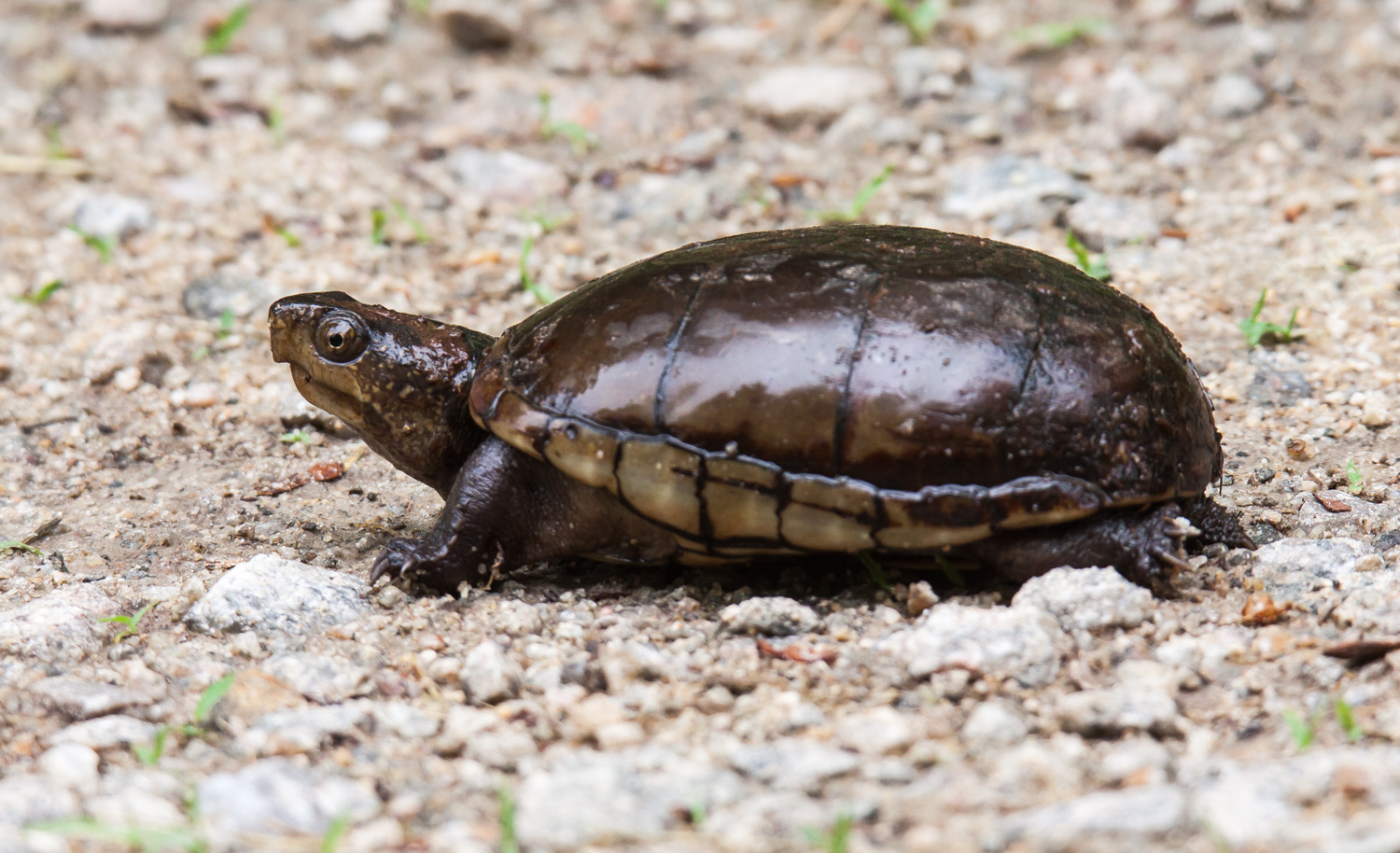
I had no idea what kind of turtle this was when I first encountered it sitting in the middle of a trail at Occoquan Bay National Wildlife Refuge this past Monday. Most of the time that I see turtles they are in the water or are sunning themselves at the water’s edge. This turtle was small and dark and lacked distinctive markings that would have aided me in identifying it.

I noticed that the turtle had a really large head and what looked to be sharp claws, so I initially thought it might be a baby snapping turtle. Uncertain of the identification, I posted a photo to a Facebook group for Nature Lovers of Virginia. The consensus of the group is that this is Eastern Mud Turtle (Kinosternon subrubrum), a new species for me.

I did a little checking on this species in Wikipedia and learned that mating occurs in the early spring followed by egg laying in May to early June. As was this case with a snapping turtle that I recently saw on dry land, I wonder if this turtle was looking for a place to lay its eggs.

Eastern Mud Turtle

© Michael Q. Powell. All rights reserved.

Read Full Post »
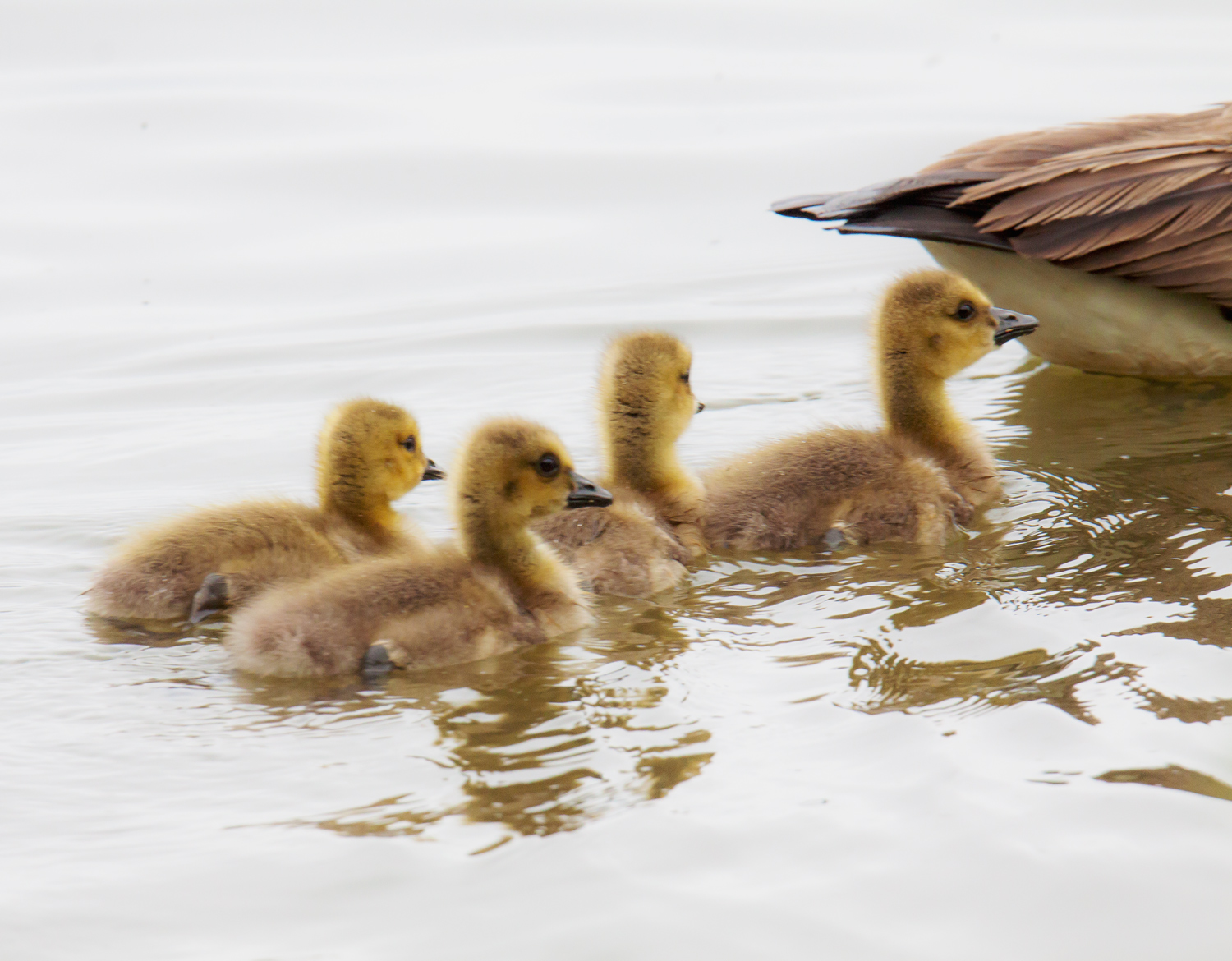
It is almost impossible to take a good portrait of a group of youngsters, irrespective of species—they are invariably energetic and inquisitive, almost incapable of simultaneously looking at the camera.

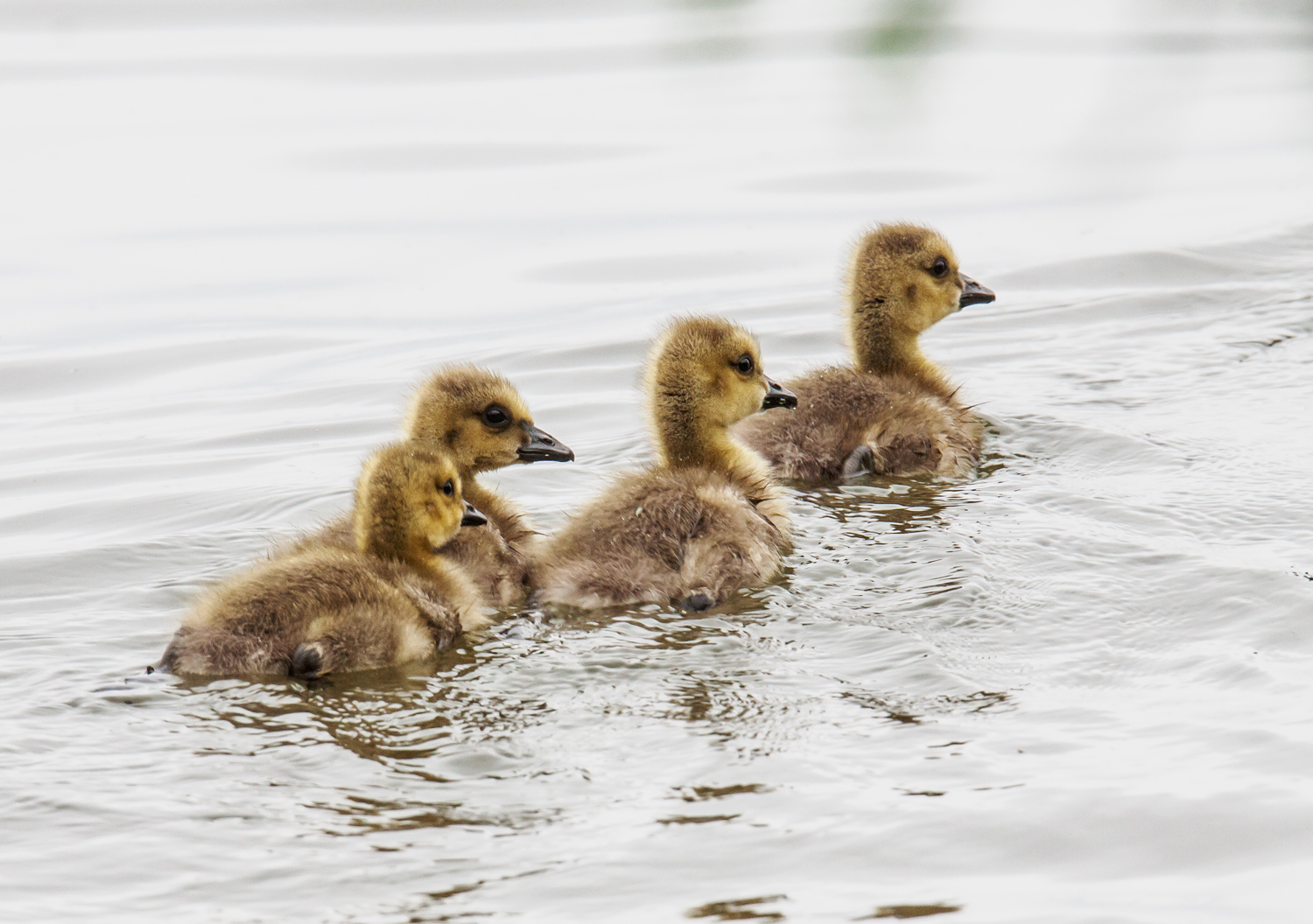
Yesterday I encountered a family of Canada Geese (Branta canadensis) as I walked down a path at Occoquan Bay National Wildlife Refuge. They too were strolling down the path, stopping to peck at the vegetation along the way. When they became aware of my presence, they slowly made their way to the water’s edge and slipped into the water.

The cute little goslings had already learned their lessons well and stayed in a tight little group right behind one of their parents. Once they had paddled a little way from shore, the babies, however, seemed to lose their focus and started to wander a bit. The adult in the rear of the little group, though, helped to bring them back into line as they silently swam away.

Canada Geese

Canada Geese

© Michael Q. Powell. All rights reserved.

Read Full Post »

I couldn’t help but notice Friday at Occoquan Bay National Wildlife Refuge how closely the green on the body of this Eastern Pondhawk dragonfly (Erythemis simplicicollis) matched the color of the vegetation on which it chose to perch. It won’t be long before pondhawks are all around us, but it was still nice to spot my first one of the season.

Eastern Pondhawk

© Michael Q. Powell. All rights reserved.

Read Full Post »

I was excited early on Friday morning to see my first Calico Pennant dragonflies (Celithemis elisa) of the season while exploring Occoquan Bay National Wildlife Refuge.  These small, brightly-colored dragonflies have become one of my favorites over the past year.

It is pretty early in their season and all of the ones that I spotted appeared to be immature—the patterns on the wings will soon get darker and more pronounced and bodies of the males, which start out yellow like those of the females, will turn red.

I have long wanted to capture shots of a dragonfly covered in morning dew or raindrops and the quest for these images helps motivate me to venture out early in the morning. If you click on the final photo and examine it at higher resolution, you will see tiny drops of water on the vegetation and a drop or two on the dragonfly’s wings. It’s not quite as I have imagined, but it is a good start.

Calico Pennant dragonfly

Calico Pennant dragonfly

Calico Pennant

© Michael Q. Powell. All rights reserved.

Read Full Post »

Can turtles smile? It is always cool to see turtles in the wild, especially Woodland Box Turtles (Terrapene carolina carolina), like this beauty that I spotted yesterday at Occoquan Bay National Wildlife Refuge. She seemed to be trying to smile when I snapped her portrait. (I think the turtle is a female because of her brown eyes—males usually have red eyes.)

There is something really special for me about seeing the color, patterns, and even the shape of this turtle’s shell, which is quite distinctive and unlike that of any other turtle that I see. These turtles, which are also known as Eastern Box Turtles, can live for a long time, as much as 100 years when in captivity, according to Wikipedia. In the wild, though, their life span is considerably shorter. Why? According to the same article in Wikipedia, “Box turtles are slow crawlers, extremely long lived, slow to mature, and have relatively few offspring per year. These characteristics, along with a propensity to get hit by cars and agricultural machinery, make all box turtle species particularly susceptible to anthropogenic, or human-induced, mortality.”

Woodland Box Turtle

Woodland Box Turtle

© Michael Q. Powell. All rights reserved.


Read Full Post »

Early Monday morning at Occoquan Bay National Wildlife Refuge I spotted my first Monarch Butterfly (Danaus plexippus) of the spring. It seemed really skittish and flew up into the trees. I was happy to be able to capture this image from an unusual angle—it is not often that I photograph a butterfly while aiming my camera in an upwards direction.

Some years I see only a few Monarchs and I read quite often about their threatened habitats. I am therefore excigted each time that I am blessed to see one of these beautiful butterflies.

Monarch butterfly

© Michael Q. Powell. All rights reserved.


Read Full Post »

I never know what I will see when I visit Occoquan Bay National Wildlife Refuge. I encountered this large Eastern Snapping Turtle (Chelydra serpentina serpentina) right in the middle of one of the paths at the refuge last Friday. I generally see snapping turtles in the water or sunning themselves at the water’s edge. I only recall a single instance when I have seen a snapping turtle this far out of the water and on that occasion it was digging a hole and getting ready to lay eggs. I wonder if that was why this one was on dry land.

The turtle looked like it was relaxing, but I gave it a wide berth after I snapped its photo, wanting to make sure that I was the only one snapping.

Snapping Turtle

© Michael Q. Powell. All rights reserved.


Read Full Post »

When I saw a flash of bright blue this past Friday at Occoquan Bay National Wildlife Refuge, I thought for sure that it was a male Eastern Bluebird, but when I looked more closely, I was thrilled to see that it was an Indigo Bunting (Passerina cyanea). Ever since one of my youngest viewers, a four year old named Benjamin, commented that bluebirds have as much orange as blue, I have been very conscious of species that have colors associated with their names.

In the bird world, most of the species names are associated with mature males, which tend to be a lot more colorful than females. The female Indigo Bunting, for example, is not blue at all, but is brownish in color. When I was just getting started in photographing birds, I remember being confused when I was told that a sparrow-looking bird at which I was pointing my camera was a Red-winged Blackbird—it was neither black, nor did it have red wings.

Some of the photographers in my area have recently posted images of a Blue Grosbeak, another bird that has bright blue feathers. They tend to be uncommon, but I will certainly be keeping my eyes open for flashes of blue, a color that seems to be relatively rare in the world of wildlife.

Indigo Bunting

© Michael Q. Powell. All rights reserved.

Read Full Post »

On the last day of April I spotted a Blue Corporal dragonfly (Ladona deplanata) that was newly emerged and was not yet blue. This past Friday I went back to the same location at Occoquan Bay National Wildlife Refuge and found a young male Blue Corporal that had already gained his blue coloration.

Additionally, he was now perching on some vegetation rather than on the ground, which allowed me to get a more artistic shot—I really like the arc of the vegetation and how it helped make for an interesting composition.

Blue Corporal

© Michael Q. Powell. All rights reserved.


Read Full Post »

I thought that this was some kind of warbler when I saw it yesterday at Occoquan Bay National Wildlife Refuge, but some folks on the Facebook “What’s This Bird” forum  identified it for me as an immature male Orchard Oriole (Icterus spurius). I think that I was fooled by the yellow color, since most warbler have at least a touch of yellow. Now when I look more closely at the photos, I realize that the bill is shaped differently from those of warblers.

Orchard Oriole

Orchard Oriole

© Michael Q. Powell. All rights reserved.

Read Full Post »

It seems like I am increasingly spending my time trying to track small birds as they energetically flit about in a tangle of newly-emerged leaves. In their aggressive foraging for food, they rarely seem to pause and pose for me on isolated branches, so I am figuring out ways to integrate the foliage into my photos.

Here are a couple of images of Blue-gray Gnatcatchers (Polioptila caerulea) from this past weekend at Occoquan Bay National Wildlife Refuge that show not only the birds, but also a part of their environment. As I was doing a little research on this gnatcatcher on the Cornell Lab of Ornithology website, I was a bit surprised to learn that gnats do not form a significant part of the Blue-gray Gnatcatcher’s diet—they eat all kinds of insects and spiders.

Blue-gray Gnatcatcher

Blue-gray Gnatcatcher

© Michael Q. Powell. All rights reserved.

Read Full Post »

“You look like an angel…” I am not sure what was so special about that particular spot on that specific tree, but this Yellow-rumped Warbler (Setophaga coronata) used all of its aerial and acrobatic skills to peck away at it on Monday at Occoquan Bay National Wildlife Refuge. From what I could tell, the warbler held on to the branch with its feet and used its outspread wings for balance. In the second image, it looks like the warbler was using a pendulum-like motion to generate momentum.

The bird’s body positions remind me of artistic portrays of angelic beings that I have a seen in multiple museums and books and I felt blessed to have had the chance to see this relatively common bird in an unusual way.

Yellow-rumped Warbler

Yellow-rumped Warbler

© Michael Q. Powell. All rights reserved.


Read Full Post »

It’s taken a while, but I have finally spotted my first locally-born dragonfly of the season. Previously I had seen some Common Green Darner dragonflies, which were probably migrants from the south, but on Monday, the last day of April, I spotted this newly-emerged Blue Corporal dragonfly (Ladona deplanata) at Occoquan Bay National Wildlife Refuge.

I did not get a really good angle for this shot, so I can’t be absolutely certain of the dragonfly’s gender, but I think that it may be a male. One of the tricky things about identifying the gender of dragonflies is that immature males often look similar in coloration to females. If this is a male its abdomen will eventually turn blue in color, which helps explain the first part of the species name. As for the “corporal,” I have been told that this is a reference to the two whitish lines on the dragonfly’s thorax that resemble the two stripes that corporals wear as their rank insignia in the US Army.

The weather is warming up and I expect to be seeing a whole lot more dragonflies in the upcoming weeks and months. Unlike this Blue Corporal, some of them will perch above the ground rather than on in, which should permit me to get some more photogenic shots. Our weather this spring has been a bit crazy and the emergence of dragonflies seems to have been delayed, but with this spotting I can confidently state that the dragonfly season has started for me.

Blue Corporal dragonfly

© Michael Q. Powell. All rights reserved.

Read Full Post »

Most warblers seem to have some yellow on their bodies, but I had never before seen one with as much yellow as the Prothonotary Warbler (Protonotaria citrea) that I spotted on Monday at Occoquan Bay National Wildlife Refuge. The yellow coloration helped me in tracking the bird, although it stayed high in a tree and was in almost constant motion. Now that there are leaves on many of the trees, I’m finding it to be harder and harder to get unobstructed shots of birds.

I will definitely be trying to get some more shots of this spectacular bird, hopefully in the near future.

Prothonotary Warbler

Prothonotary Warbler

Prothonotary Warbler

© Michael Q. Powell. All rights reserved.

Read Full Post »

As I was looking over some images from about a month ago, I realized that I had not posted any views of this North American Beaver (Castor canadensis) that I spotted swimming off of Occoquan Bay National Wildlife Refuge one early morning. At that hour we both were moving pretty slowly—one of us on land and the other in the water.

As the beaver altered its course , the light falling on its face and body changed, occasionally catching a bit of sunlight from the just-risen sun. I love the way that the water was tinged with light blue and pink and how the mostly still water picked up the reflections of the swimming beaver.

North American Beaver

North American Beaver

North American Beaver

© Michael Q. Powell. All rights reserved.

Read Full Post »

Earlier this year I encountered an unfamiliar bird that turned out to be a Horned Grebe (Podiceps auritus). On-line photos showed that the bird has really cool plumage during mating season and I remember hoping that I would see one this spring.

Well, this past Friday I spotted one in the distance in the waters off of Occoquan Bay National Wildlife Refuge. The light was coming from almost in front of me and the grebe was a long way off, but I did manage to capture the sunlight glistening off of the blonde “horns” of this beautiful bird. I especially like the first shot in which you can see just a bit of the grebe’s red eyes and the feathers really do look like horns.

Horned Grebe

Horned Grebe

© Michael Q. Powell. All rights reserved.

Read Full Post »

I was thrilled yesterday morning to spot an American Kestrel (Falco sparverius) at Occoquan Bay National Wildlife Refuge. It’s pretty rare for me to see this beautiful little falcon and the lighting was good enough for me to see some of its wonderful colors and patterns. From the photos that I have seen on-line, I think this is a female—males have wings that are slate blue in color.

I was also able to watch it hunting for a little while over a distant field. A kestrel hovers in mid-air as it searches for prey below. Although the kestrel dove low a couple of times, I did not see it catch anything.

Both times that I have seen a kestrel, it has been perched in the same tree and I plan to return there regularly during my treks through the wildlife refuge.

American Kestrel

© Michael Q. Powell. All rights reserved.

Read Full Post »

Sometimes the view from the back is just as spectacular as the view from the front. I spotted this male Wild Turkey (Meleagris gallopavo) in full display this past Friday at Occoquan Bay National Wildlife Refuge. There were no females around to impress, but somehow, like a vain bodybuilder, this guy seemed compelled to flex and show off, even while doing something as mundane as foraging for food.

Initially I was disappointed that this turkey steadfastly refused to turn around and show me his face. As I surveyed the scene, though, I realized that I really loved the perfect fan shape of the displayed tail and the geometric abstractness of the the turkey from this angle. In fact, this kind of a shot might cause viewers to linger a little longer on the image as they gradually figure out what the main subject is, i.e. that it is a wild turkey.

 Wild Turkey
© Michael Q. Powell. All rights reserved.

Read Full Post »

« Newer Posts - Older Posts »