Feeds:
Posts
Comments

Archive for the ‘Insects’ Category

Orange and brown seem to be the perfect color combination for the autumn and this Question Mark butterfly (Polygonia interrogationis) was suitably celebrating the season this past Friday at Occoquan Bay National Wildlife Refuge.

Question Mark butterfly

© Michael Q. Powell. All rights reserved.

Read Full Post »

Orange is one of the colors that I tend to associate with autumn. Some leaves are already turning orange and pumpkin decorations and displays have started to appear on my neighbors’ doorsteps.

As I was exploring Occoquan Bay National Wildlife Refuge yesterday morning, my eyes detected some motion in the nearby grass. I leaned forward and was delighted to see this tiny damselfly decked out in the colors of Halloween—orange and black. I had no idea what species it was, but fortunately I have a really good guide for damselflies and was able to identify it as an immature female Eastern Forktail damselfly (Ischnura verticalis).

Although there are already lots of symbols for autumn, I think this tiny damselfly could be added to the list.

Eastern Forktail

© Michael Q. Powell. All rights reserved.

Read Full Post »

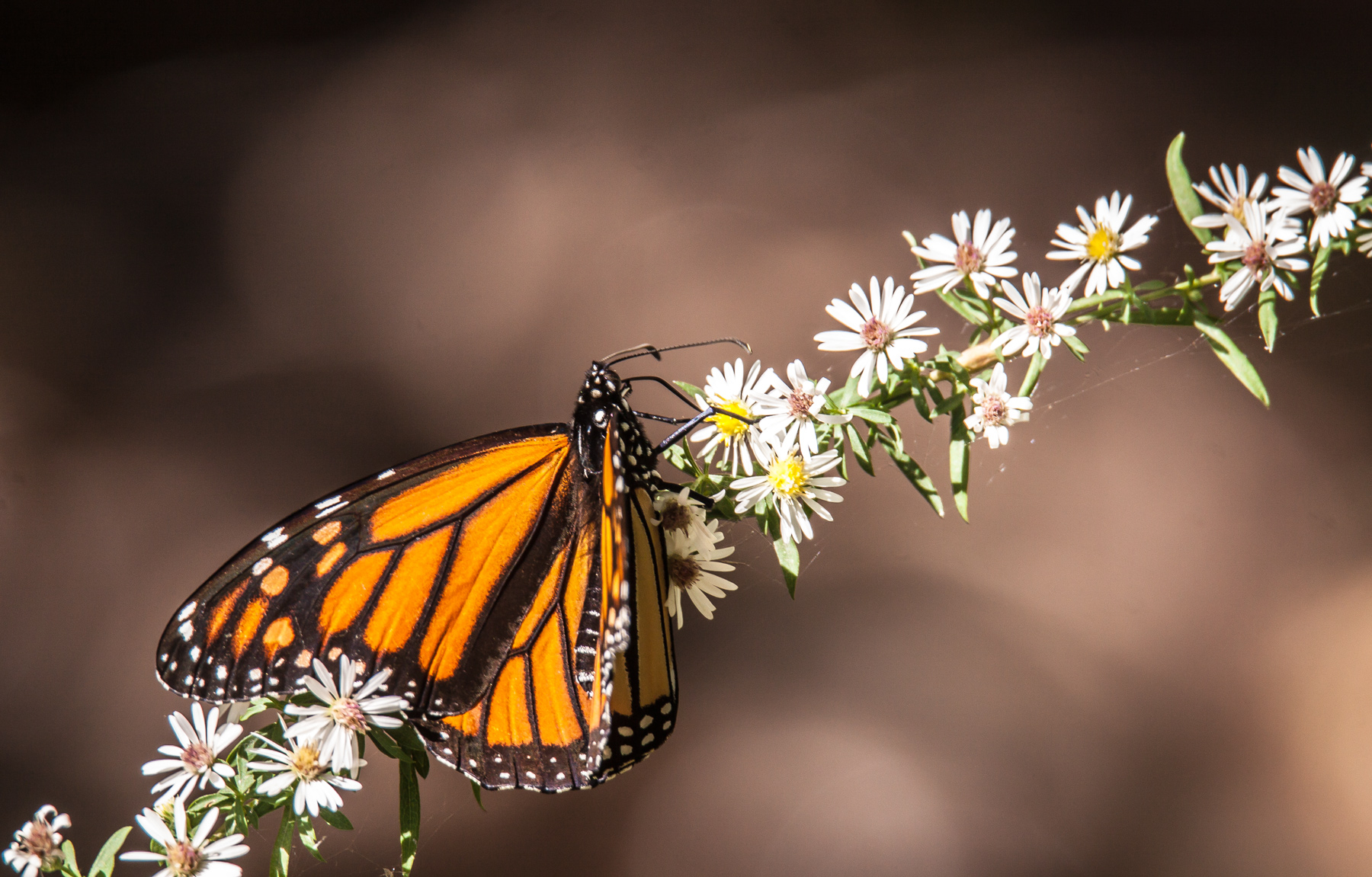
I suspect that all of the Monarch butterflies (Danaus plexippus) will soon be leaving our area for warmer places, so I am really trying to enjoy each and every encounter with one. I spotted this beauty feeding on some kind of thistle plant thispast weekend at Occoquan Bay National Wildlife Refuge.

monarch butterfly

© Michael Q. Powell. All rights reserved.

Read Full Post »

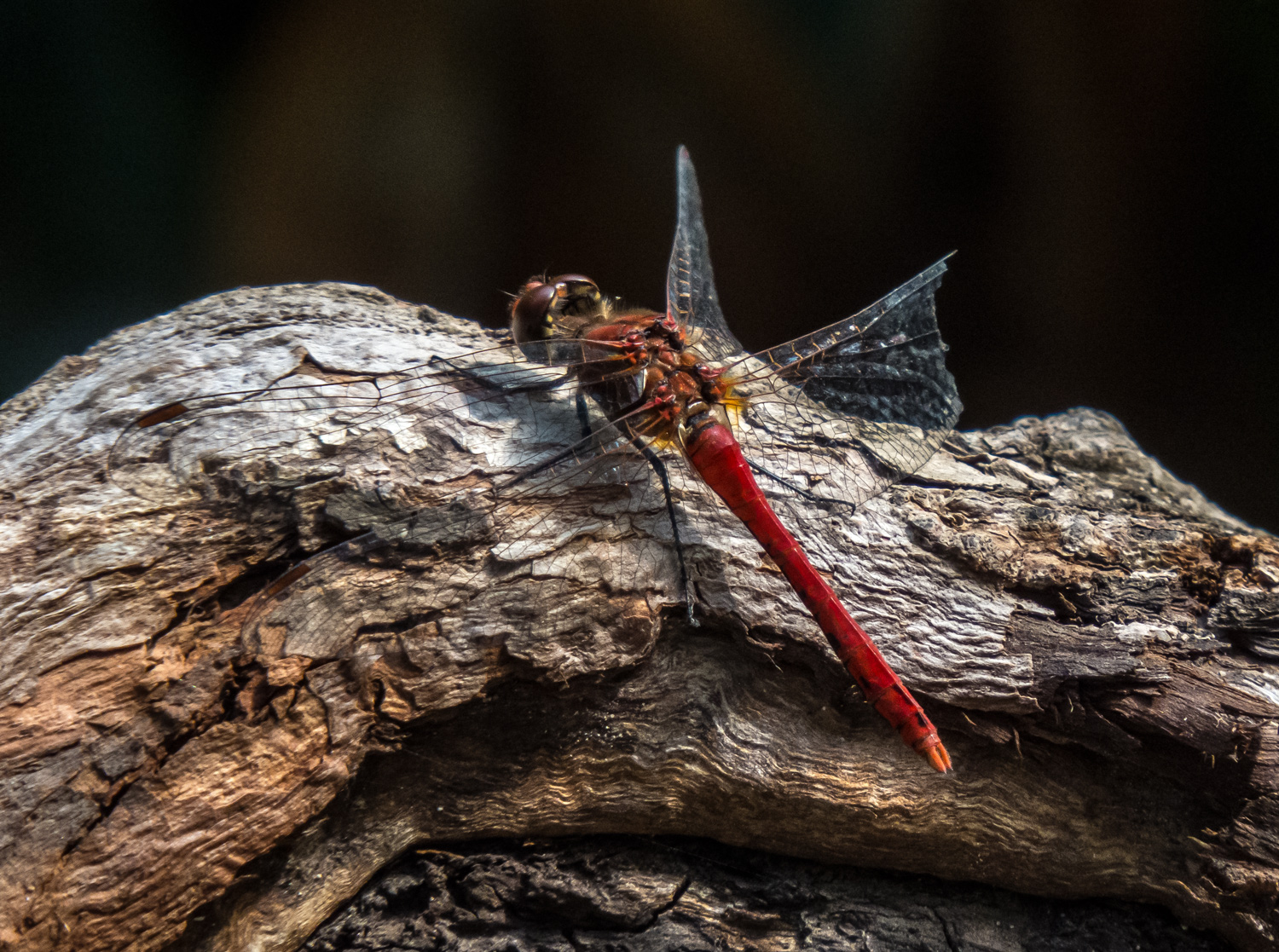
Now that fall has officially arrived, I look forward to seeing more Autumn Meadowhawk dragonflies (Sympetrum vicinum), like this stunning female that I spotted last Friday at Occoquan Bay National Wildlife Refuge. Adult males of this dragonfly species are bright red in color, but females can be either tan or red. The “spike” near the end of the abdomen makes it easy. though, to identify this one as a female.

In Northern Virginia, where I live, the Autumn Meadowhawk tends to be the latest surviving dragonflies—I have spotted them in mid-December and others have seen them in early January.

Autumn Meadowhawk

© Michael Q. Powell. All rights reserved

Read Full Post »

I hear cicadas all of the time—it is hard to ignore that background buzzing noise. It is rare, however, for me to get an unobstructed view of one.

I spotted this cicada perched on a branch overhanging a pond on Friday at Occoquan Bay National Wildlife Refuge. I couldn’t tell for sure if it was still alive. It was not moving, but it simply may not have detected my presence. While it was great to capture an image of this cool insect, I particularly like how the water in the background turned out—those wispy cloud-like whites were a nice bonus.

cicada

© Michael Q. Powell. All rights reserved

Read Full Post »

Milkweed plants provide a wonderful habitat for all kinds of creatures, including this Large Milkweed Bug (Oncopeltus fasciatus) that I spotted earlier this week at Green Spring Gardens. These  bugs go through a fascinating series of physical transformations as they move though different nymph phases. A little over six years ago, I studied these bugs  pretty closely and documented their stages of development in a posting that I called Life phases of the large milkweed beetle. Be sure to check it out for more information and fascinating photos of these colorful little bugs.

I really like the combination of colors in this simple shot, colors that remind me a little of Christmas. However, I doubt that anyone would choose to feature this image on their annual Christmas card. 🙂

Large Milkweed Bug

© Michael Q. Powell. All rights reserved

Read Full Post »

Today I decided to feature two butterflies that I have seen over the past week. I saw them at different times and at different places, so normally I would not put them together in a posting.

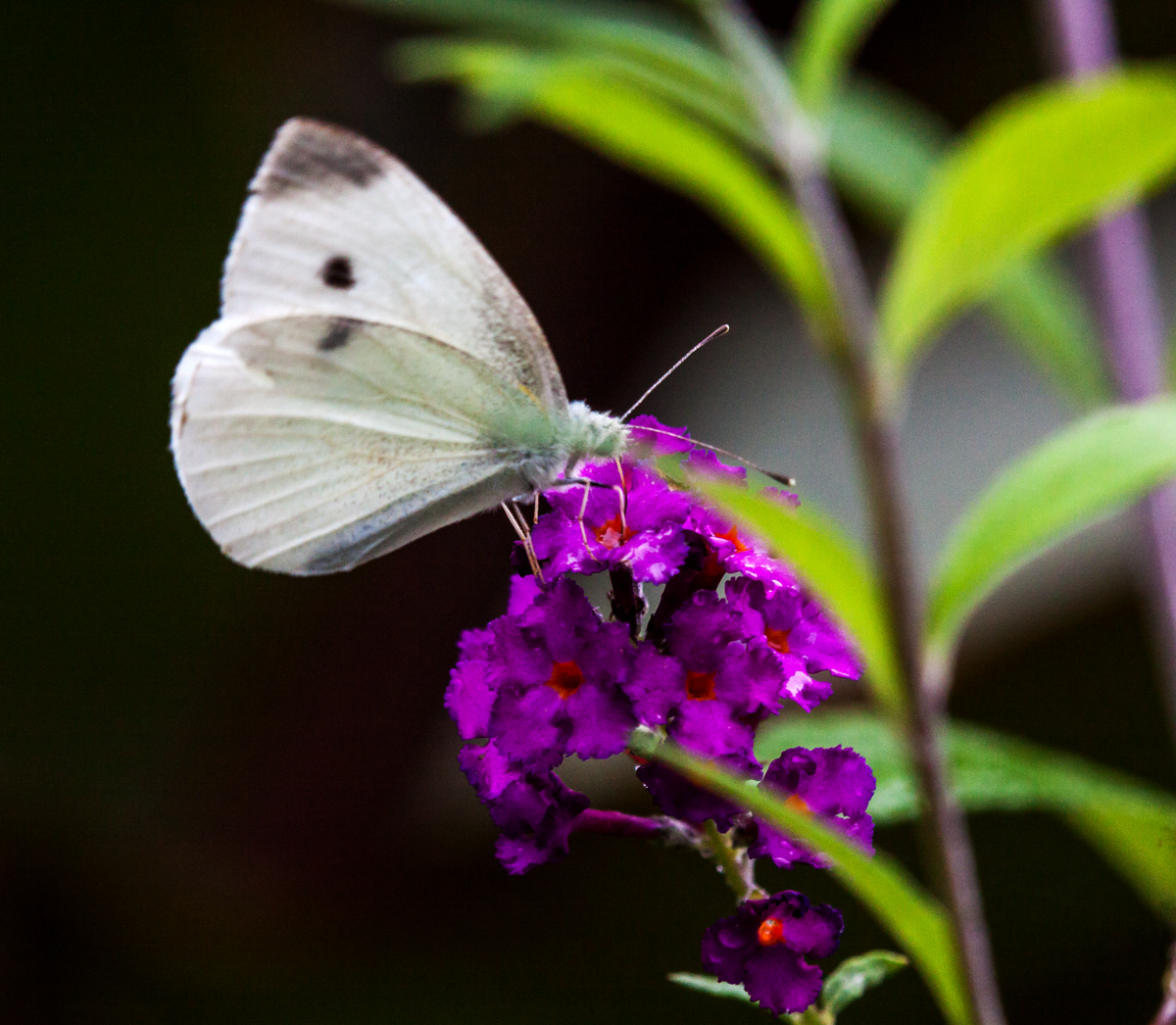
I was struck, however, by the contrast between the two of them. One of them, a Viceroy butterfly (Limenitis archippus), is brightly colored and hard to miss. The other, a Cabbage White (Pieris rapae) is so pale and nondescript that many people don’t notice it at all or dismiss it as being “only” a moth.

Beauty speaks to people in individual deeply personal ways. I find these two butterflies to be equally beautiful.

What do you think? Instinctively do you find one of these two to be more beautiful than the other?

Of course, there is no “right” answer. It seems to me that beauty is almost always subjective rather than universal. Our assessments of beauty tend to be influenced by a whole host of internal factors including our mood, personality, and background as much as by the external characteristics of the subject being considered.

Viceroy butterfly

Cabbage White butterfly

© Michael Q. Powell. All rights reserved


Read Full Post »

I tend to look at my own images in a kind of vacuum, but one of the bloggers that I love to follow, Liz of Exploring Colour, likes to look for themes across different blogs and puts images from them into a single posting. I was honored today when she matched up one of my images with one by Pete Hillman. Pete and I often use a similar approach to shooting subjects even though we are separated by the Atlantic Ocean. Check out Liz’s posting to see the juxtaposition of two beautiful images. The color palettes in the two images are a bit different, with mine having a cooler tone than Pete’s, but the pinkish red in each shot tends to unify the two images, which work amazingly well together.

Ms. Liz's avatarExploring Colour

I dance with these guys, but not literally of course…I “follow” their blogs, I love their photography and from time-to-time I profile their work on my blog. So in this rather fanciful piece of writing I dance with them, its a joy!

This morning I found they’d both posted exceptionally fine photos and I felt moved to profile both in a special post. Pete blogs from Staffordshire in the UK and Mike blogs from Virginia in the US. Both blogs are fantastic!


September dancer by Mike Powell

Damselfly. Variable Dancer (Argia fumipennis). Click on photo to enlarge

variable1_14sep_blog

By Mike Powell. See Mike’s original post for more information.

Mike blogs at:  Mike Powell | My journey through photography


Chequered Hoverfly Melanostoma scalare by Pete Hillman

Female of the species, rear garden, Staffordshire. Click on photo to enlarge

chequered-hoverfly-melanostoma-scalare

By Pete Hillman. See Pete’s original post for more photos of this…

View original post 15 more words
Read Full Post »

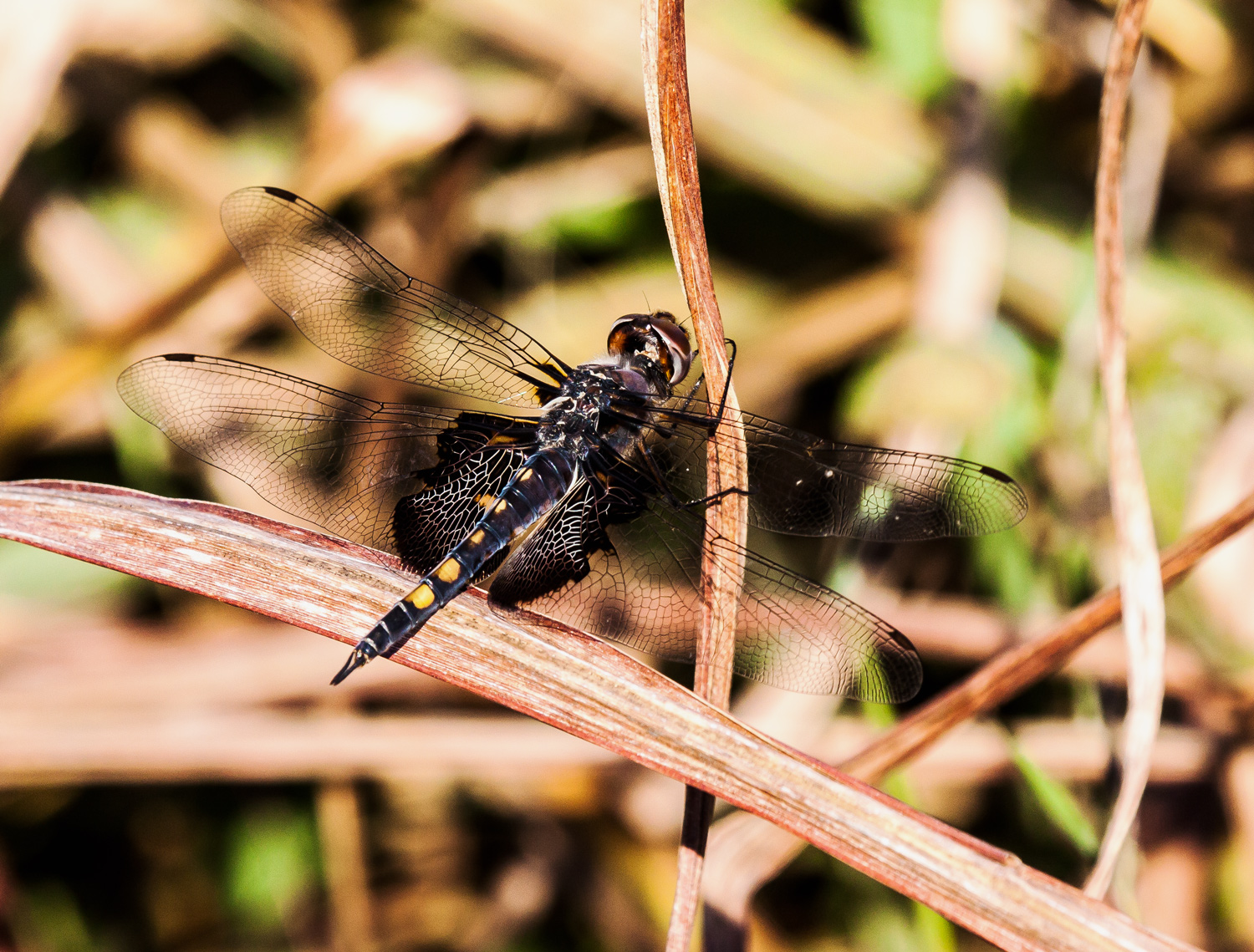
I was thrilled yesterday to see that at least one Swift Setwing dragonfly (Dythemis velox) is still present at Jackson Miles Abbott Wetland Refuge. Based on past records, the Swift Setwings should be with us at least until the end of September, but this has been a crazy year weatherwise, so I never know whether the different dragonflies will appear and disappear on schedule.

If you look really closely at the wings of this dragonfly, you’ll discover some really cool shapes and patterns—-not all of the individual “cells” in the wings are of the same shape and size. Together they form an intricate mosaic that reminds me of a stained glass window. (I encourage you to click on the image to see it in higher resolution.)

Swift Setwing

© Michael Q. Powell. All rights reserved

Read Full Post »

It was cool and wet on Monday and clouds covered the entire sky, but I felt an irresistible need to return to the wild after a week in the urban confines of Brussels, Belgium. Many of the trails at Occoquan Bay National Wildlife Refuge, my recent favorite shooting location, were blocked by standing water and there was not a great abundance of wildlife to be seen.

Most dragonflies prefer warm, sunny weather, so I was not surprised when I did not see many of them. I was happy, though, to see that damselflies were active and I spent quite a bit of time trying to capture images of them. They seemed more skittish than normal and the poor lighting made it tough to keep my shutter speed high enough to keep my images from being blurry.

This is one of my favorite damselfly shots of the day. I was able to isolate the subject, which I believe is a male Big Bluet (Enallagma durum) damselfly, while still including enough of the vegetation to give you a sense of the environment in which I found him.

Big Bluet

© Michael Q. Powell. All rights reserved

Read Full Post »

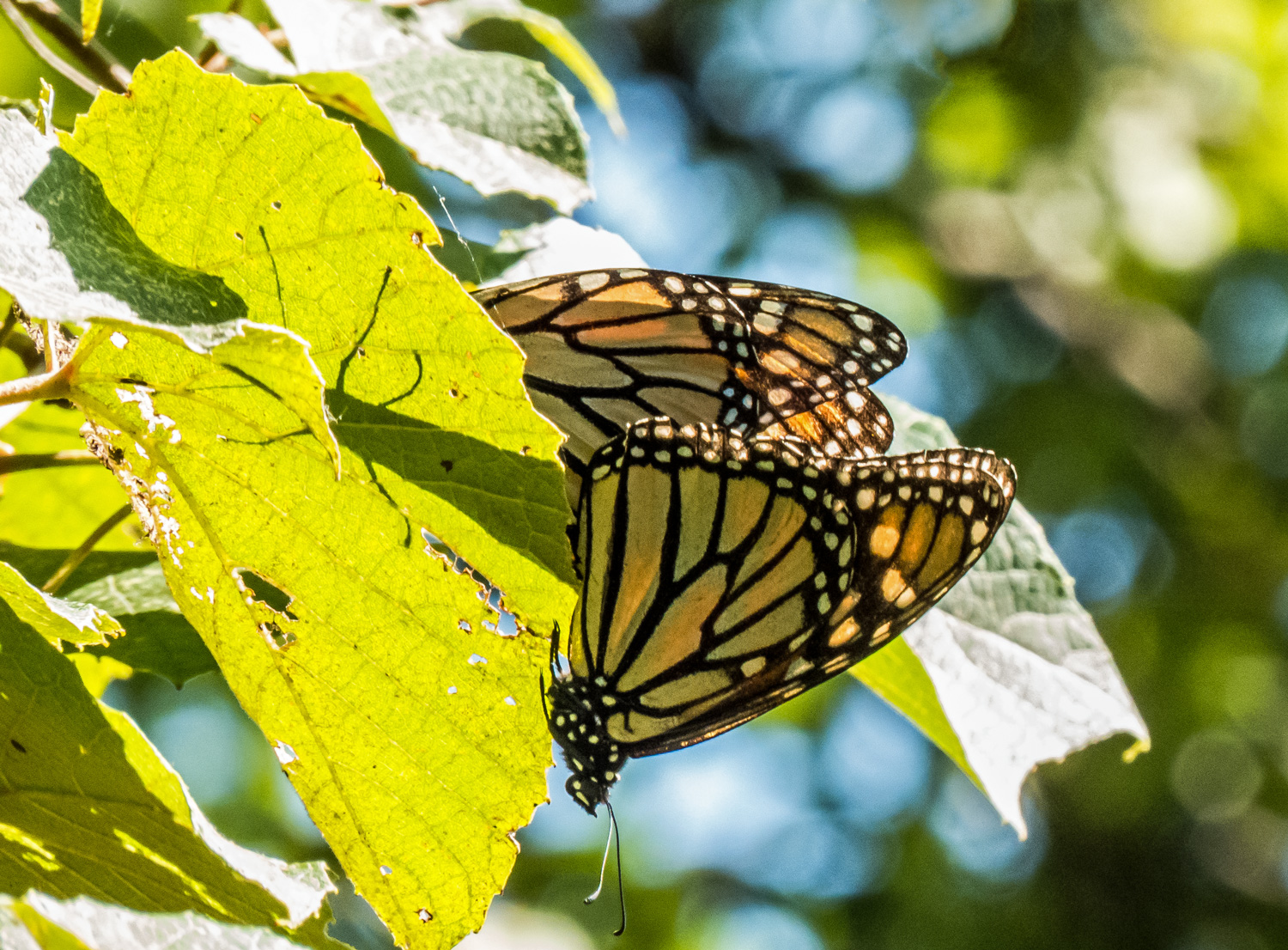
Nestled gently in the leaves of a tall tree, these two Monarch butterflies (Danaus plexippus) were mating, doing their part to perpetuate a species often considered at risk. I captured this image in late August at Occoquan Bay National Wildlife Refuge and re-discovered it yesterday when I was going through my photos from the week before my recent trip to Brussels.

I love the way that the upper butterfly is discreetly hidden by the leaves, but is revealed in its shadow. I find the colors in this image to be especially beautiful. with a wonderful contrast between the warmth of the orange and the coolness of the blue. Most of all, though, I love the way that the background turned out, with its soft circles of out-of-focus highlights.

This is the kind of image that I strive to capture, one that gently draws in viewers and speaks to them softly, reminding them of the undiscovered beauty that surrounds them all of the time.

mating monarchs

© Michael Q. Powell. All rights reserved

Read Full Post »

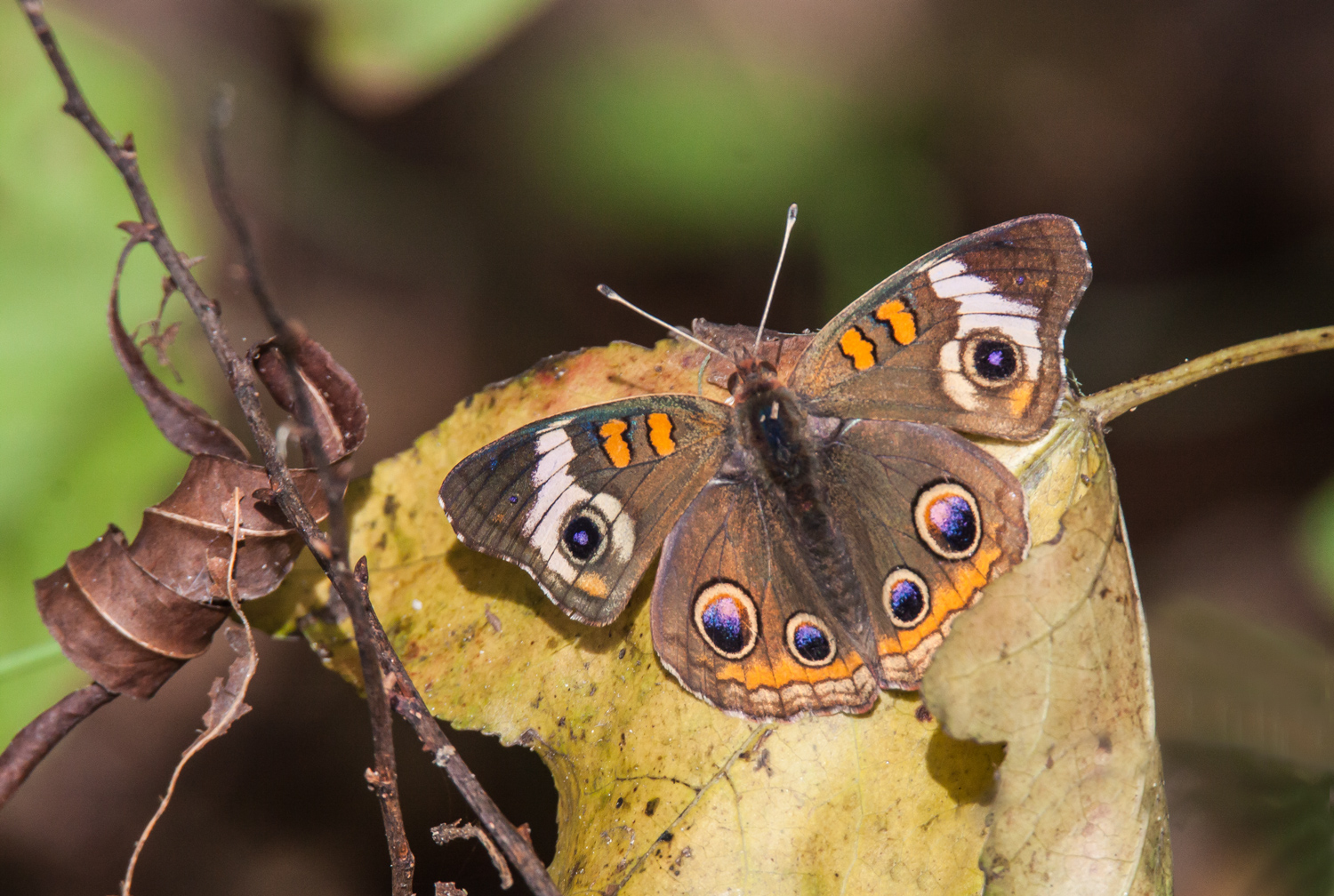
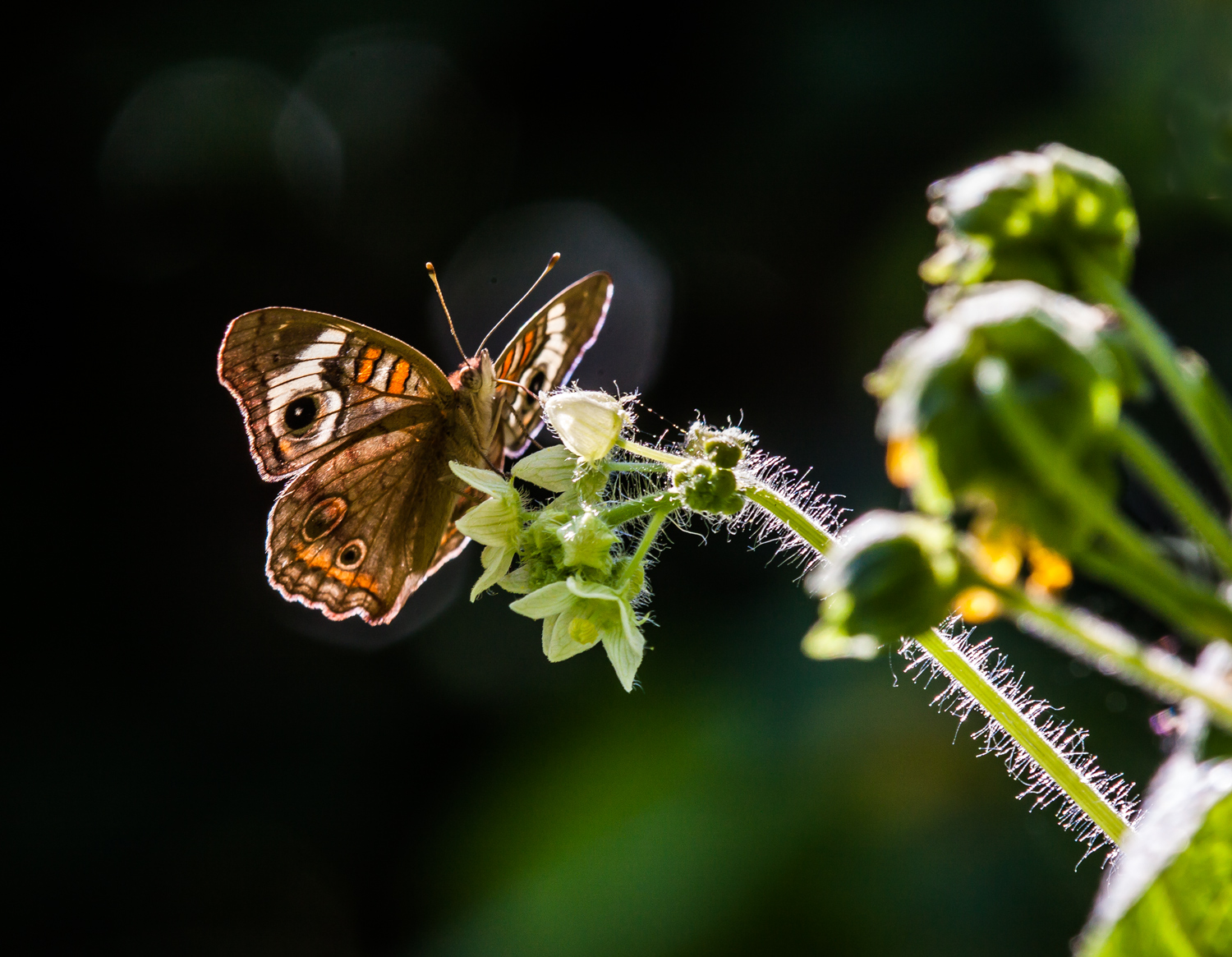
The directional lighting from the back and side gave a cool and dramatically uncommon vibe to this image of a Common Buckeye butterfly (Junonia coenia) that I photographed on 31 August at Occoquan Bay National Wildlife Refuge.

The ground is saturated and rain continues to fall, so I am not sure that I will be out and about today with my camera. It is actually a good thing, I think, to go back and look over my photos—I sometimes get so caught up in taking new photos that I don’t stop and look over my slightly older ones. I am often pleasantly surprised to discover some jewels, like this image.

Common Buckeye

© Michael Q. Powell. All rights reserved

Read Full Post »

The incessant rain and cooler weather since my return from Brussels make it feel like it’s already autumn. Like this Monarch butterfly (Danaus plexippus) at Occoquan Bay National Wildlife Refuge, however, I am not quite ready to cease sipping the sweet nectar of summer.

I captured this image on 31 August, the day before my departure for my recent overseas trip. The combination of rainy weather can jet lag have so far kept me from venturing out with my camera, but I hope to do so this coming week.

monarch butterfly

© Michael Q. Powell. All rights reserved

Read Full Post »

Later today I will board an airplane and fly across the Atlantic Ocean with the assistance of a significant amount of sophisticated machinery. I can’t help but marvel at the way that dragonflies and damselflies, by contrast, maneuver through the air so skillfully and effortlessly. Wouldn’t it be cool to be able to fly like that?

This past weekend I spent a good amount of time in one of my favorite photographic pursuits—trying to capture images of a dragonfly in flight. When I am traveling I usually don’t have my best camera gear with me and opt instead to use a Canon SX50, a superzoom point-and-shoot camera. It gives me a lot of reach, but is sometimes slow to focus and has a low frame rate. What that means is that I have to be even more careful than usual, because I can’t capture a lot of shots in an extended burst.

Mostly I was trying to photograph Migrant Hawker dragonflies (Aeshna mixta) at the botanical garden in Brussels. The good news is that Migrant Hawkers are relatively large in size and will sometimes hover a bit over the water. That increases slightly my chances of getting a shot, though many of my attempts resulted in cut-off or out-of-focus shots of the dragonflies.

This was probably my best shot of the session. I like the way that I captured a pretty clear view of the body, including the legs that are tucked in during the flight and managed to get the eyes in relatively sharp focus. One of my Facebook friends commented that it would make a handsome piece of jewelry made with gold, turquoise and onyx—I totally agree with her.

Migrant Hawker


© Michael Q. Powell. All rights reserved

Read Full Post »

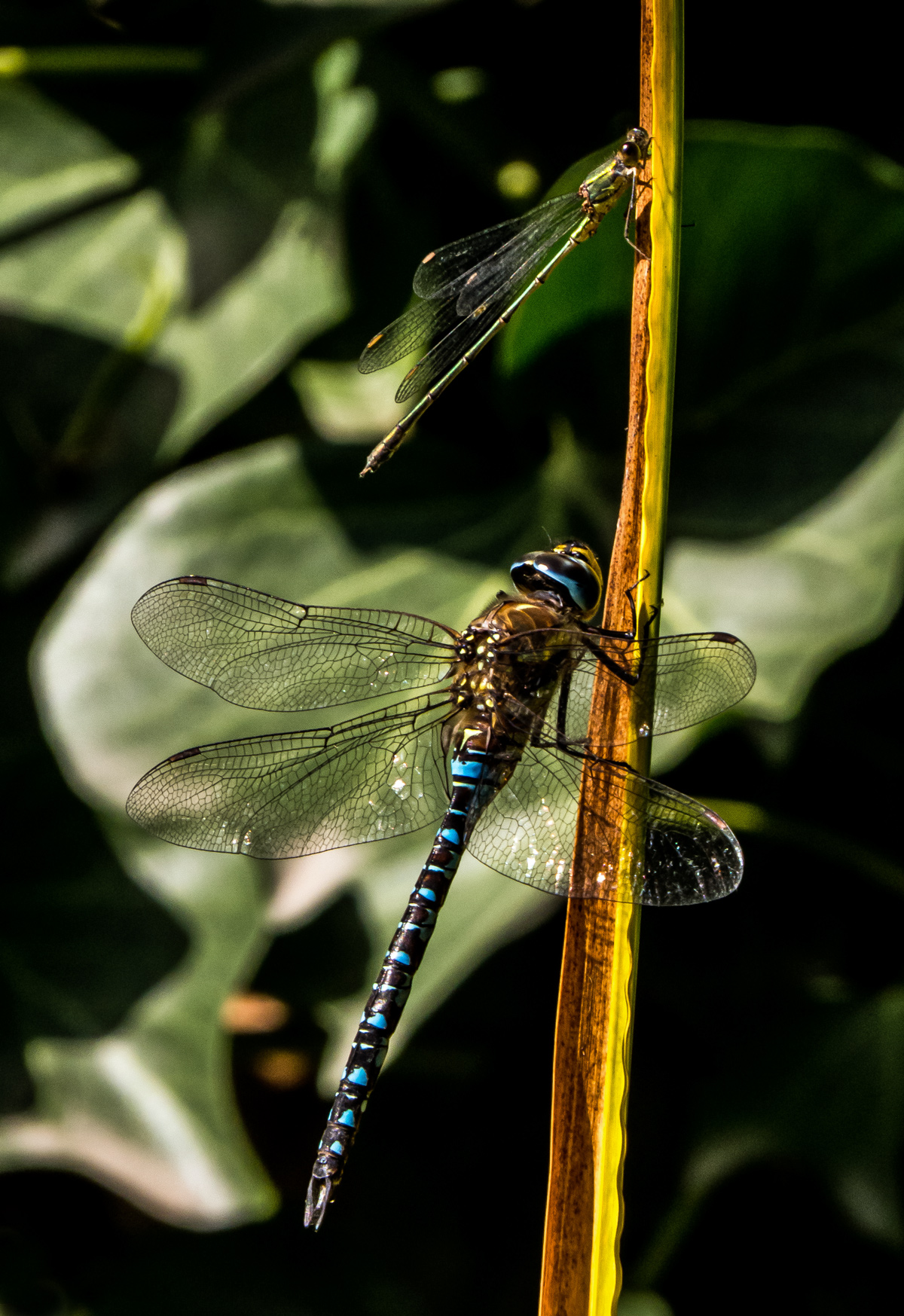
I can’t help but wonder what was going through the minds of these two insects as they perched on the same stalk of vegetation this past weekend at the botanical garden in Brussels, Belgium. Their postures suggest to me a heightened sense of alertness and a kind of wariness. The much smaller damselfly at the top seems to be cautiously looking down over its shoulder at the Migrant Hawker (Aeshna mixta), who appears to be focusing his attention upward. Was it a sign of curiosity or one of hunger? There was never any sign of direct aggression, but I note that the damselfly was the first one to take off and the dragonfly did not pursue it.

For those of you who are not as hooked on dragonflies as I am, this image shows pretty clearly some of the differences in the body shape and eye positions of a damselfly versus a dragonfly. It is important, though, to keep in mind the amazing diversity within the community of dragonflies and damselflies in terms of color, size, and behavior—these are some of the reasons why I am drawn to them as subjects for my photography.

friend or foe

© Michael Q. Powell. All rights reserved

Read Full Post »

Its colors are not quite as ostentatious as those of the Migrant Hawker dragonfly that I featured yesterday, but the bright red bodies of what I believe are Common Darter dragonflies (Sympetrum striolatum) made them equally hard to miss at the botanical garden in Brussels, Belgium. The colors of these beautiful little dragonflies remind me of those of the Autumn Meadowhawk (Sympetrum vicinum), a species that I see quite often in my home area of Northern Virginia and the shared Latin genus name of Sympetrum indicates their relationship.

I was able to photograph male Common Darters perched in several different spots and I particularly like the way that the fiery red of their bodies contrasts with the cooler green of the backgrounds.

Common Darter

Common Darter

Common Darter

© Michael Q. Powell. All rights reserved


Read Full Post »

Last year when visiting Brussels, Belgium in early September, I was excited to discover dragonflies at the botanical garden in the center of the city. I headed back to the same location on Sunday right after checking into my hotel to see if I could find some dragonflies there this year.

As soon as I arrived at the small pond at the botanical garden, I was thrilled to see a number of large, colorful dragonflies flying about. Although they spent most of their time flying patrols over the water, occasionally one of the dragonflies would perch on the vegetation at water’s edge, which allowed me to capture some images of them.

I absolutely love the beautiful colors and patterns of these dragonflies, which I believe are Migrant Hawker dragonflies (Aeshna mixta). I am definitely not an expert on European dragonflies, however, and there are a number of other hawker species that are somewhat similar in appearance. In North America, there are dragonflies of this same Aeshna genus, which are usually referred to as mosaic darners, but I don’t think that this particular species can be found on the other side of the Atlantic.

Migrant Hawker

Migrant Hawker

Migrant Hawker

© Michael Q. Powell. All rights reserved


Read Full Post »

It almost looks like this Great Blue Skimmer dragonfly (Libellula vibrans) was wearing cool wraparound sunglasses this past weekend when I spotted him chilling out at Occoquan Bay National Wildlife Refuge. From a distance, it looks like dragonflies have smooth bodies, but when you get a good look up close, you discover that they have tiny hairs covering various parts of their bodies.

Great Blue Skimmer

© Michael Q. Powell. All rights reserved


Read Full Post »

As a nature photographer, I am used to living with compromises. Unlike some other kinds of photographers, I don’t have the luxury of waiting for perfect light or photographing only perfect subjects. I can make a few adjustments or move about a bit to improve my composition, but most of the time I deal with imperfections of one sort or another.

Every once and a while, though, I’ll take a photo that doesn’t require any substantial adjustments or even cropping–it looks just like I imagined it would. That was the case with a recent image I captured of a female Eastern Amberwing dragonfly (Perithemis tenera) at Occoquan Bay National Wildlife Refuge.  I like the way that I captured the subject, I like the curved of the vegetation on which it is perched, and I like the background. It’s a bonus that I didn’t need to crop.

Perfection is elusive in any pursuit—this is about as close as I can come to it in my photography.

Eastern Amberwing

© Michael Q. Powell. All rights reserved

Read Full Post »

I tend to be an opportunistic photographer, content to wander about and shoot whatever I happen to find. For the last couple of weeks, though, I have been searching diligently for a particular species of dragonfly, the Fine-lined Emerald (Somatochlora filosa), and yesterday, the final day of August, I finally found one at Occoquan Bay National Wildlife Refuge.

What makes this dragonfly so special? In his excellent website Dragonflies of Northern Virginia, Kevin Munroe described some of the allure of this particular species— “One of Northern Virginia’s most rare dragonflies, possibly our rarest, this species is seldom seen and little known throughout its range, from New Jersey to Florida, and west to Kentucky and Texas. Most field guides describe its breeding habitat as “unknown”.”

Last year I was lucky enough to see a Fine-lined Emerald several times, but I wanted more. As befits its name, my first glimpse yesterday of the dragonfly was of its brilliant green eyes as it flew by me. Unlike some species that fly high the air, Fine-lined Emeralds often patrol at waist to eye level. I was able to follow and track the dragonfly until it perched. This species hangs vertically from vegetation when perching, so it can be tough to spot one unless you have seen it land.

I was fortunate to be able to photograph this beautiful dragonfly on several different perches until it finally disappeared from sight. Here are a couple of my favorite shots from our altogether too brief encounter yesterday.

Fine-lined Emerald

Fine-lined Emerald

© Michael Q. Powell. All rights reserved

Read Full Post »

When recently at Occoquan Bay National Wildlife Refuge I spotted these two damselflies, which an expert identified as probable Big Bluets (Enallagma durum), I initially thought they were mating. Then I realized that the positions were all wrong and the nibbling on the neck was probably indicative of a literal hunger. Yikes.

As Tina Turner once sang, “What’s love got to do with it?”

damselflies

daamselflies

© Michael Q. Powell. All rights reserved

Read Full Post »

Two different colored dragonflies, a Needham’s Skimmer (Libellula needhami) and a Great Blue Skimmer (Libellula vibrans), were peacefully sharing a prime perch on Monday at Occoquan Bay National Wildlife Refuge.

Why is it so hard for us to peacefully coexist with one another?

peaceful co-existence

© Michael Q. Powell. All rights reserved

Read Full Post »

Have you ever gotten into a staring contest with a dragonfly? Dragonfly eyes can have an almost hypnotic effect on you when you look directly into them..

I went eye-to-eye with this Eastern Pondhawk dragonfly (Erythemis simplicicollis) on Monday at Occoquan Bay National Wildlife Refuge. She was the one to break eye contact first as she cocked her head, smiled at me, and decided the contest was over.

Eastern Pondhawk

Eastern Pondhawk

© Michael Q. Powell. All rights reserved

Read Full Post »

It is great to see that at least a few colorful Calico Pennant dragonflies (Celithemis elisa) are still around. I photographed this handsome male last Friday as he perched at water’s edge at the small pond at Occoquan Bay National Wildlife Refuge.

Summer is slowly slipping away. Some species of dragonflies are already gone for the year and others will soon follow suit. A few species have yet to appear, so all of the news is not bad. Still, as kids return to school and the daylight hours become noticeably shorter, it’s hard not to have the feeling that the lazy days of summer are coming to a close.

Autumn is my favorite season for a number of different reasons, but I am not quite ready to give up on summer. So I’ll keep sweating and searching, seeking to capture the summer beauty that still surrounds us. Like this dragonfly, I’m still holding on.

calico pennant

© Michael Q. Powell. All rights reserved

Read Full Post »

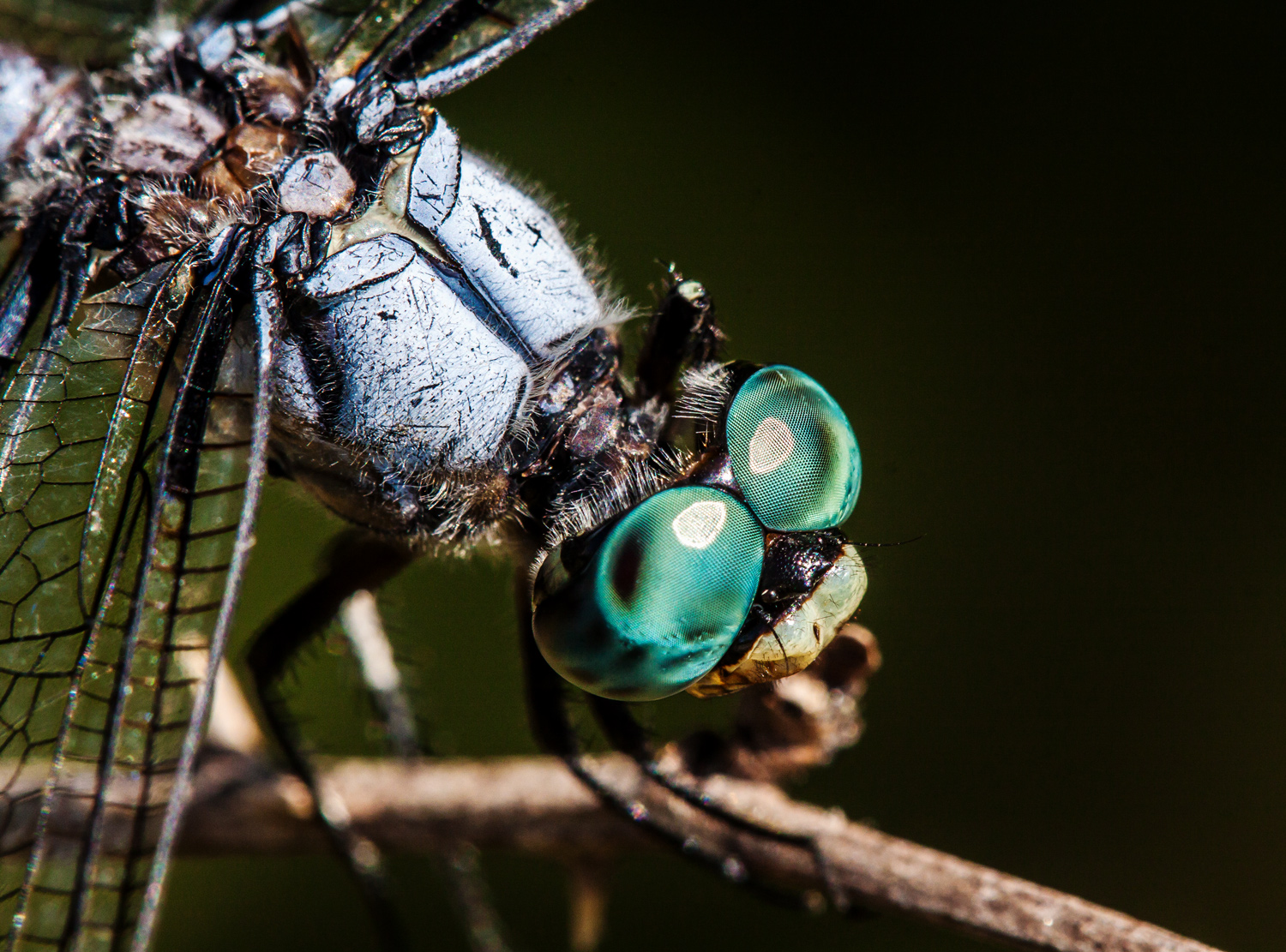
Dragonflies have amazing compound eyes that wrap around their heads. With up to 30,000 facets (ommatidia, to be technical), dragonflies have incredible vision and can even see colors beyond human visual capabilities, like UV light. For an easy to read discussion about dragonfly eyes, i.e. not overly scientific, check out this posting by “grrl Scientist” that was posted on scienceblogs.com.

I captured this close-up image of a Great Blue Skimmer dragonfly (Libellula vibrans) yesterday at Occoquan Bay National Wildlife Refuge. At least once a season, I manage to get a shot like this when a cooperative dragonfly lets me get close. I captured the image below with my trusty Tamron 180mm macro lens on my Canon 50D DSLR. This lens, which has a longer focal length than most macro lenses, gives me some stand-off distance so I can get a macro shot like this without actually being on top of the subject. The only downside to the lens is that it has no built-in image stabilization, so I have to pay extra attention to remaining steady when shooting with it—I generally use a monopod to help reduce camera shake and I think it helped for this image.

The image is framed just as I saw it in my viewfinder. Most of the time I end up cropping my images as part of my normal post-processing, but in this case it looked pretty good without any cropping whatsoever.

Great Blue Skimmer

© Michael Q. Powell. All rights reserved

Read Full Post »

I just love the colors of this Red Admiral butterfly (Vanessa atalanta) that I photographed on Monday at Occoquan Bay National Wildlife Refuge. I mean, really, how can you not like an insect that sports the red, white, and blue?

You don’t have to be American to like those three colors—it seems like there are an awful lot of countries that use them in various shades and patterns in their national flags.

Red Admiral

© Michael Q. Powell. All rights reserved

Read Full Post »

I was thrilled to capture some shot of a Spicebush Swallowtail butterfly (Papilio troilus) this past weekend at Green Spring Gardens as it fed on a lantana flower. I am so used to more muted colors when I am shooting in the “wild” that the brightness of these flowers seem almost unnatural.

If you look closely at the butterfly’s legs in the first image, you will see that one of them is blurred. Obviously the butterfly was moving about and my camera’s shutter speed was too slow to stop the motion. In many cases I would be disappointed with that lack of sharpness, but I find that it acceptable here, because it doesn’t really distract the viewer’s eyes.

There are a number of dark-colored swallowtails in our area, but the Spicebush Swallowtail is the only one with a blue swoosh on its wings in the middle of a row of orange spots.

Spicebush Swallowtail

Spicebush Swallowtail

© Michael Q. Powell. All rights reserved.

Read Full Post »

Imagine an insect so powerful that it is reportedly able to take down a hummingbird. Then give it the macabre monniker of Red-footed Cannibalfly (Promachus rufipes). If I were an insect, I would be really worried. Actually I don’t think that I would want to allow one to bite me, because a cannibalfly stabs its prey with its proboscis and injects saliva that help to liquify the prey’s insides. Then the cannibalfly sucks out the liquid through its proboscis.

I don’t know why exactly, but the last week or so I have seen a lot of Red-footed Cannibalflies during my trips to Occoquan Bay National Wildlife Refuge. Here are a few of my recent shots. The first one reminded one of my Facebook viewers of The Lorax, a Dr. Seuss character with a big mustache. Maybe this insect needs to overhaul its public image so that it is viewed as being less threatening. One possible first step might be to change its name to the Bee Panther, a nickname that is sometimes used for this species.

On a side note, each of the last four years, including this year, a 2013 posting entitled simply Red-footed Cannibalfly has been my most viewed posting. If I calculated correctly, the posting has been viewed almost 2400 times, including 293 times in 2018.

Why is that posting so popular? Apparently a lot of people do Google searches for “red-footed cannibalfly” and stumble onto my blog posting. I’m proud of a number of my postings and the images that I have captured, but I must confess that I don’t consider that 2013 posting as one of my best.

It’s a little scary to think that I may be inextricably linked in some people’s minds with Red-footed Cannibalflies. Yikes!

Red-footed Cannibalfly

Red-footed Cannibalfly

Red-footed Cannibalfly

© Michael Q. Powell. All rights reserved.

Read Full Post »

There were only a few water lilies in bloom at the small pond at a local garden that I visited this past weekend. Surprisingly, they were all pink in color and not the white ones that I am more used to seeing—perhaps it is late in the season for the white ones. Not surprisingly, there were quite a few dragonflies buzzing about and I decided that I wanted to get a shot of one of them perched on one of the water lilies.

So I waited and hoped and waited some more. My patience was eventually rewarded when a tiny male Eastern Amberwing dragonfly (Perithemis tenera) landed on a partially open water lily bud and perched momentarily.

I really like the image that I managed to capture because of the way it conveys a sense of the mood of the moment, a calm, almost zen-like feeling of tranquility. The colors are subdued and the composition is minimalist—there is a real beauty in simplicity.

Dragonfly and water lily

© Michael Q. Powell. All rights reserved.


Read Full Post »

Last night I was playing again with watercolors and found inspiration in some videos about Chinese sumi-e brush painting, particularly one by Daleflix on YouTube that showed him painting a dragonfly and a frog. I really like the way that sumi-e painting, which is often done in ink on rice paper, emphasizes the importance of each brush stroke.

My painting skills still need a lot of work, but I especially like how the dragonfly turned out. There is a kind of minimalism in the dragonfly that appeals to me. It was really all-or-nothing when I painted it. Each of the wings, for example, was a single brush stroke, with a little bit of outlining done later. Similarly, the segmented body was done in a single pass.

I kind of got a little lost after I had painted the frog and the dragonfly and tried to add some contextual elements. The water ended up way too dark and some of the branches got too thick. In case you are curious, the painting is 4 x 6 inches in size (10 x 15 cm), so the brush strokes were pretty small.

Still, I like the overall feel of this little painting, which represents a new step for me as I explore watercolors. I think that I may explore this style of painting some more.

dragonfly and frog

© Michael Q. Powell. All rights reserved.

Read Full Post »

There were lots of flowers in bloom yesterday at Green Spring Gardens, a historic county-run garden not far from where I live. One of my favorites was the Zowie Zinnia and a Monarch butterfly (Danaus plexippus) seemed to like it a lot too.

I was at the garden with my dear friend and photography mentor, Cindy Dyer, and her husband. We were all taking a break at one point and I told Cindy that I was going to return to a patch of Zowie Zinnias to see if I could get a shot of a butterfly landing on one. We both recalled a photo that she took in 2010 (check out her blog posting) when an Easter Tiger Swallowtail butterfly appeared out of nowhere and landed on one of the two Zowie Zinnias that she was focusing on with her camera on a tripod.

Imagine her surprise when a couple of minutes later I returned with this photo. She grabbed her camera and went to the patch of zinnia, but, alas, the butterflies were not as cooperative for her as they had been for me.

Monarch butterfly and Zowie Zinnia

© Michael Q. Powell. All rights reserved.

Read Full Post »

« Newer Posts - Older Posts »