August 3, 2022 by Mike Powell
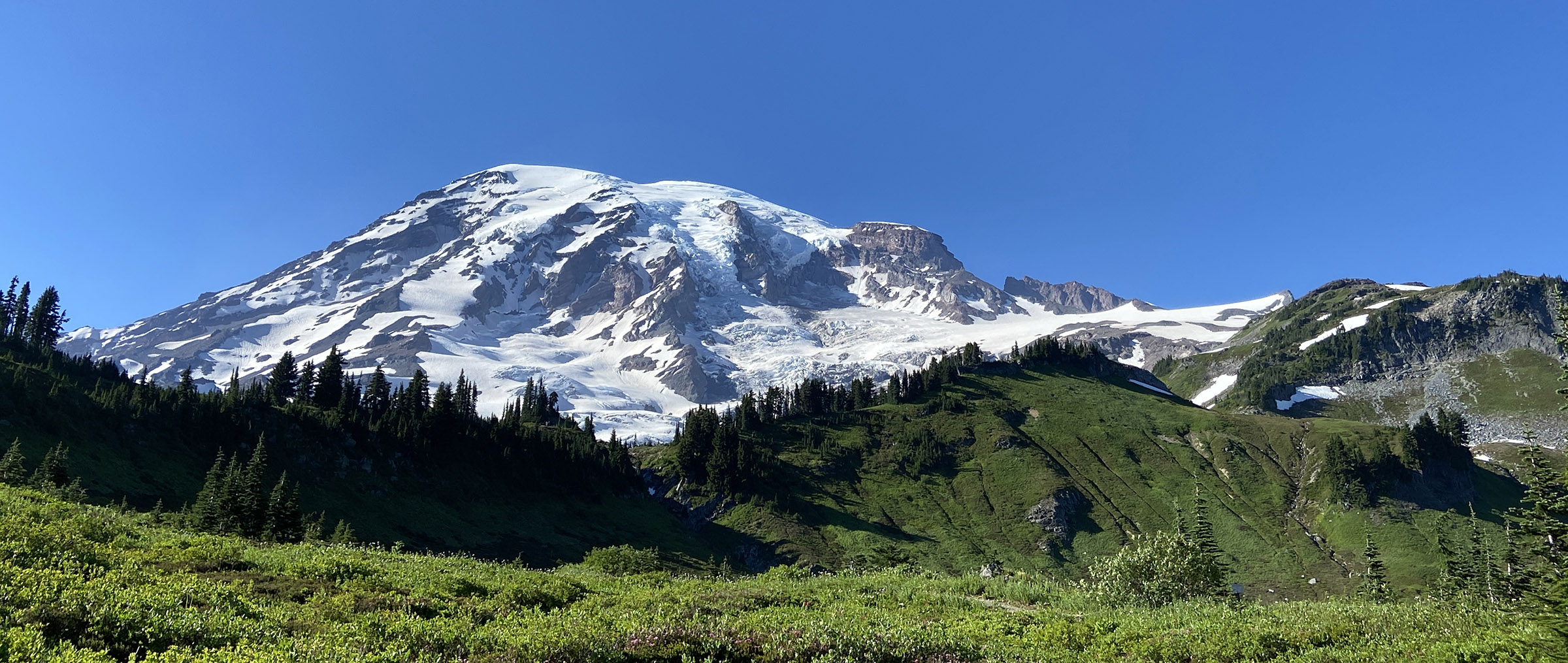
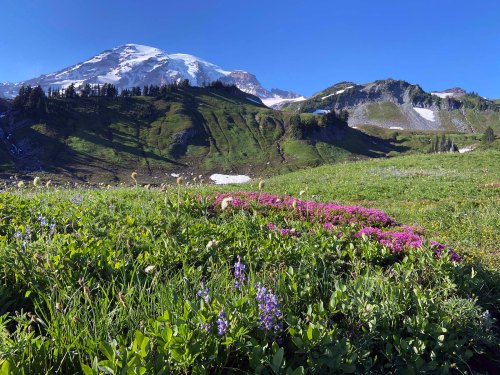
Yesterday I visited Mount Rainier National Park in Washington State. The namesake mountain is one of the most prominent features of the park and it is a real challenge trying to figure out a creative way to capture the beauty of the snow-covered mountain.
Different vantage points and different altitudes give you different views of the mountain. I also played around a bit with aspect ratios too.
I was particularly delighted to see that some of the wildflowers were still in bloom and the first photo is one of my favorites. I worked hard to frame the composition with the flowers in the foreground. The fact that all three of these photos were taken with my iPhone 11 meant that almost the entire image in focus. It would have been a bit of a challenge to get that kind of depth of field with my DSLR.
I took the second shot from much lower on the mountain. I love the way that the image is almost abstract, reduced to shapes of the mountain and the trees.
The final image is a panoramic-type shot, which somehow seems suitable for the sweeping mountain views. It is a cropped version of a “normal” photo in which I tried to emphasize the mountains—too much of the original image was taken up by sky.
I may have some more images of Mount Rainier to share with you when I go through my images from my DSLR, but I have to say that I am more than happy with these images from my iPhone.


© Michael Q. Powell. All rights reserved.
Posted in Flowers, Landscape, Nature, Photography, Summer, Travel | Tagged Ashford WA, iPhone 11, Mount Rainier, Mount Rainier National Park, Washington state, wildflowers | 14 Comments »
August 2, 2022 by Mike Powell
Theodore Roosevelt National Park in North Dakota is one of the few national parks where visitors can observe free-roaming horses. According to the National Park Service, “their presence represents Theodore Roosevelt’s experiences here during the open-range ranching era. Ranchers turned horses out on the open range to live and breed. When needed, they would round up horses and their offspring for use as ranch horses. For generations, ranchers used land that would later become the park for open-range grazing.”
Once the park was fenced in, one of the issues was what to do with the horses. Initially the authorities tried to capture and remove all of the horses, but some small bands of horses eluded capture and continued to live free-range in the park. “In 1970, a change of park policy recognized the horse as part of the historical setting. New policies were written and enacted to manage the horses as a historic demonstration herd.”
I had multiple sightings of wild horses during my visit to the national park. Most of the time it was only one or two horses, but on my final day I ran into a larger group. As I was observing them, another visitor told me that this was Xander’s band, named for the lead stallion.
The other visitor turned out to be a member of a group that tracks the bands of wild horses in the park. She patiently explained to me that the horses travel in groups of 5 to 15 horses, known as bands, with a well-established social hierarchy. The bands are pretty stable—young colts and fillies are kicked out of their groups at the age of 2-3 and form new bands. Some of the individual horses that I observed, she said, were likely to be bachelors.
The first photo shows the band all grouped up together in a shadow of a rock formation where I first saw them. They were packed together so tightly that it was hard to get an accurate head count. I believe that the gray horse in the front is Xander, the leader. Eventually the individuals of the group spread out a bit (it looks like there are ten members in the band) and began to graze, as you can see in the second and third photos.
The National Park Service tries to manage the number of wild horses in this park tor prevent overpopulation. “Historically, the park conducted roundups every three to four years using helicopters to herd horses to a handling facility and then sold them at public auction. More recently, the park has tried new methods for herd management including contraceptives, low-stress capture techniques, genetics research, and partnerships with nonprofit horse advocacy groups. Horses are currently captured using tranquilizer darts and sold in online auctions.”


© Michael Q. Powell. All rights reserved.
Posted in animals, Nature, Photography, Summer, Travel, wildlife | Tagged Canon 7D, feral horses, Medora ND, National Park Service, North Dakota, Tamron 18-400mm, Theodore Roosevelt National Park, wild horses, Xander, Xander's band | 4 Comments »
August 1, 2022 by Mike Powell
As many of you know, I have spent the last week driving across the United States to spend some time with family outside of Seattle, Washington. I departed from Virginia at midday last Monday and by the time that I finally arrived on Saturday afternoon, I had traveled a distance of 3085 miles (4964 km).
I spent a lot of time driving, but made an extended stop at Theodore Roosevelt National Park in western North Dakota, where I camped out for two nights. During my visit, I had multiple encounters with American Bison (Bison bison), including one memorable moment when my car was almost surrounded as a small herd of bison moved past me on the road.
It was a bit strange for me to take wildlife photos from inside my car, but that definitely was the safest thing to do with these bison. Some of the bulls looked to be as large as my KIA Soul. I noted that there were a good number of calves too, and definitely did not want to mess with a potentially mad mamma bison if I got between her and her baby.
I am still sorting through my images, but I thought I would lead with these little portraits that show some of the personality of the individual bison.
In addition to the bison at the national park, I was able to photograph wild horses, prairie dogs, birds, and even a few dragonflies. You should see some of them in the near future.


© Michael Q. Powell. All rights reserved.
Posted in animals, Nature, Photography, Portraits, Travel, wildlife | Tagged American Bison, bison, Bison bison, buffalo, Canon 7D, North Dakota, Tamron 18-400mm, Theodore Roosevelt National Park | 8 Comments »
July 25, 2022 by Mike Powell
Normally I try to do a posting to my blog every day, but for the next three weeks my posting schedule will be much more erratic. I am in the final stages of packing my car for a trip to visit my son and his family outside of Seattle, Washington. There are multiple decision points along the way and I have not yet decided on my final route, but no matter how I go, it is likely to be about 3,000 miles (4828 km) each way.
I have some camping gear with me, including a water jug that holds six gallon (23 liter), so I may well be spending some time disconnected from the virtual world. I’ll try to take some photos along the way and will share them when I am able.
I am leaving you with a shot of a pretty little butterfly, which I think is a Pearl Crescent (Phyciodes tharos) perched on some Butterfly Weed (Asclepias tuberosa). I love the different shades of orange in the image.
In case some of you do not know it, my KIA Soul, in which I am driving out West, is orange in color. It is a coppery orange and not a pumpkin orange and it definitely stands out in a parking lot. My license plate holder has SOUL on it and my license plate itself is “BLESS MY.”
I am attaching a couple of photos of my car from January 2016, after a big snow storm. So many of us throughout the Northern Hemisphere are suffering from oppressive heat and I thought that the sight of snow might cool us off a little. I’ll close with a joke that I say on-line today that is a perfect fit for my quirky sense of humor—”Just be thankful that it is not snowing. Imagine shoveling snow in this heat!”


© Michael Q. Powell. All rights reserved.
Posted in Butterflies, Flowers, Insects, Nature, Photography, Summer, Travel, wildlife | Tagged Asclepias tuberosa, Butterfly Weed, Canon 50D, Fort Belvoir VA, Jackson Miles Abbott Wetland Refuge, Pearl Crescent, pearl crescent butterfly, Phyciodes tharos, Tamron 180mm | 16 Comments »
July 25, 2022 by Mike Powell
I have not seen very many Monarch butterflies (Danaus plexippus) this summer, though I did spot a similar-looking Viceroy butterfly (Limenitis archippus) on Tuesday at Occoquan Bay National Wildlife Refuge. Monarchs were in the news last week. According to the Smithsonian Magazine, “The International Union for Conservation of Nature (IUCN), a Switzerland-based conservation organization that monitors the status of wildlife, added migratory monarchs (Danaus plexippus plexippus) to its list of threatened species this week.”
I decided to include an image of a Monarch that I captured earlier this month as it was feeding on a cone flower. I thought I would have more chances to photograph more monarchs, but this one was the only one that I have seen in July.
How do you tell the two species apart? The main visual difference between the two species is the black line across the Viceroy’s hind wings, which Monarch butterflies do not have. Both are stunningly beautiful.


© Michael Q. Powell. All rights reserved.
Posted in Butterflies, Insects, Nature, Photography, Summer, wildlife | Tagged Canon 7D, Danaus plexippus, Limenitis archippus, monarch butterfly, Occoquan Bay National Wildlife Refuge, Tamron 18-400mm, Viceroy butterfly, Woodbridge VA | 5 Comments »
July 24, 2022 by Mike Powell
I was delighted to encounter this group of butterflies last Tuesday at Occoquan Bay National Wildlife Refuge. Several Zebra Swallowtails (Eurytides marcellus) and one prominent Spicebush Swallowtail (Papilio troilus) were poking among the rocks, drinking in salts and other nutrients. If you look carefully at the image, you will see that one of the Zebra Swallowtails (the one to the right of the Spicebush Swallowtail flying—apparently it wanted to join the party.
Did you know that one of the collective nouns for a group of butterflies is “kaleidoscope?” I think the word is a a perfect descriptor for these multi-colored swirling beauties.

© Michael Q. Powell. All rights reserved.
Posted in Butterflies, Insects, Nature, Photography, Summer, wildlife | Tagged Canon 7D, Eurytides marcellus, kaleidoscope, kaleidoscope of butterflies, Occoquan Bay National Wildlife Refuge, Papilio troilus, Spicebush Swallowtail, Tamron 18-400mm, Woodbridge VA, Zebra Swallowtail | 11 Comments »
July 24, 2022 by Mike Powell
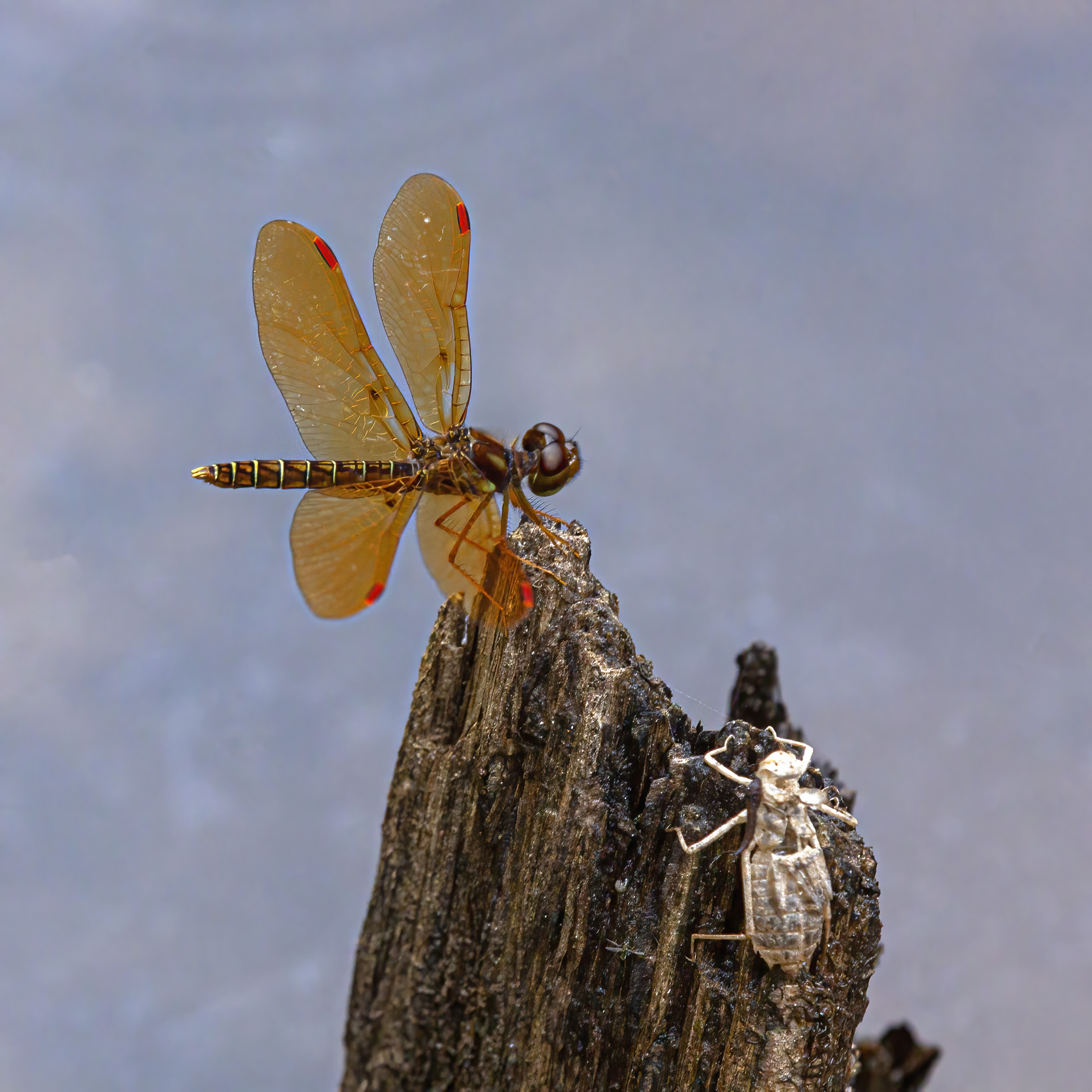
Dragonflies are amazing creatures. They spend most of their lives underwater as nymphs. When the time is right, they crawl out of the water and begin an incredible transformation. They burst out of their exoskeletons and in a short period of time their bodies lengthen and their wings unfurl. Suddenly they are breathing air and can fly. Six years ago I was able to document this entire process in a posting called Metamorphosis of a dragonfly, which you may want to check out.
If you wander along the edge of a pond, you may spot some of the discarded exoskeletons, often referred to as exuviae—they look sort of like desiccated bugs. Earlier this month during a visit to Green Spring Gardens, I was able to capture this image of a Eastern Amberwing dragonfly (Perithemis tenera) perched alongside an exuvia. I am not certain that the exoskeleton is from the same species as the dragonfly, but I suspect that it is.
Although it is hard to see very many details of the exuvia, you can’t help but notice how much smaller it is than the adult dragonfly and how the shape of the body is different. It you look closely, you can see the shape of little wing pads that eventually turn into wings. The only body parts that appear to remain the same are the legs.

© Michael Q. Powell. All rights reserved.
Posted in Dragonflies, dragonfly, Nature, Photography, Summer, wildlife | Tagged Alexandria VA, Canon 50D, Eastern Amberwing, Eastern Amberwing dragonfly, exuvia, green spring gardens, metamorphosis, Perithemis tenera, Tamron 180mm | 11 Comments »
July 23, 2022 by Mike Powell
Some crows were harassing an osprey (Pandion haliaetus) on Tuesday at Occoquan Bay National Wildlife Refuge. The osprey kept looking to the sky and crying out. Was it yelling at the crows or perhaps calling out to its mate?
Eventually one of the crows flew up onto the same branch as the osprey and continued to pester the larger bird. When I captured the final image, the crow looked away with a look of feigned innocence. The osprey, however, was not buying the act and appeared to be looking over its shoulder, keeping an eye on the crow.
Have a wonderful weekend.


© Michael Q. Powell. All rights reserved.
Posted in Birds, Nature, Photography, Summer, wildlife | Tagged Canon 7D, Occoquan Bay National Wildlife Refuge, Osprey, osprey and crow, Pandion haliaetus, Tamron 18-400mm, Woodbridge VA | 4 Comments »
July 22, 2022 by Mike Powell
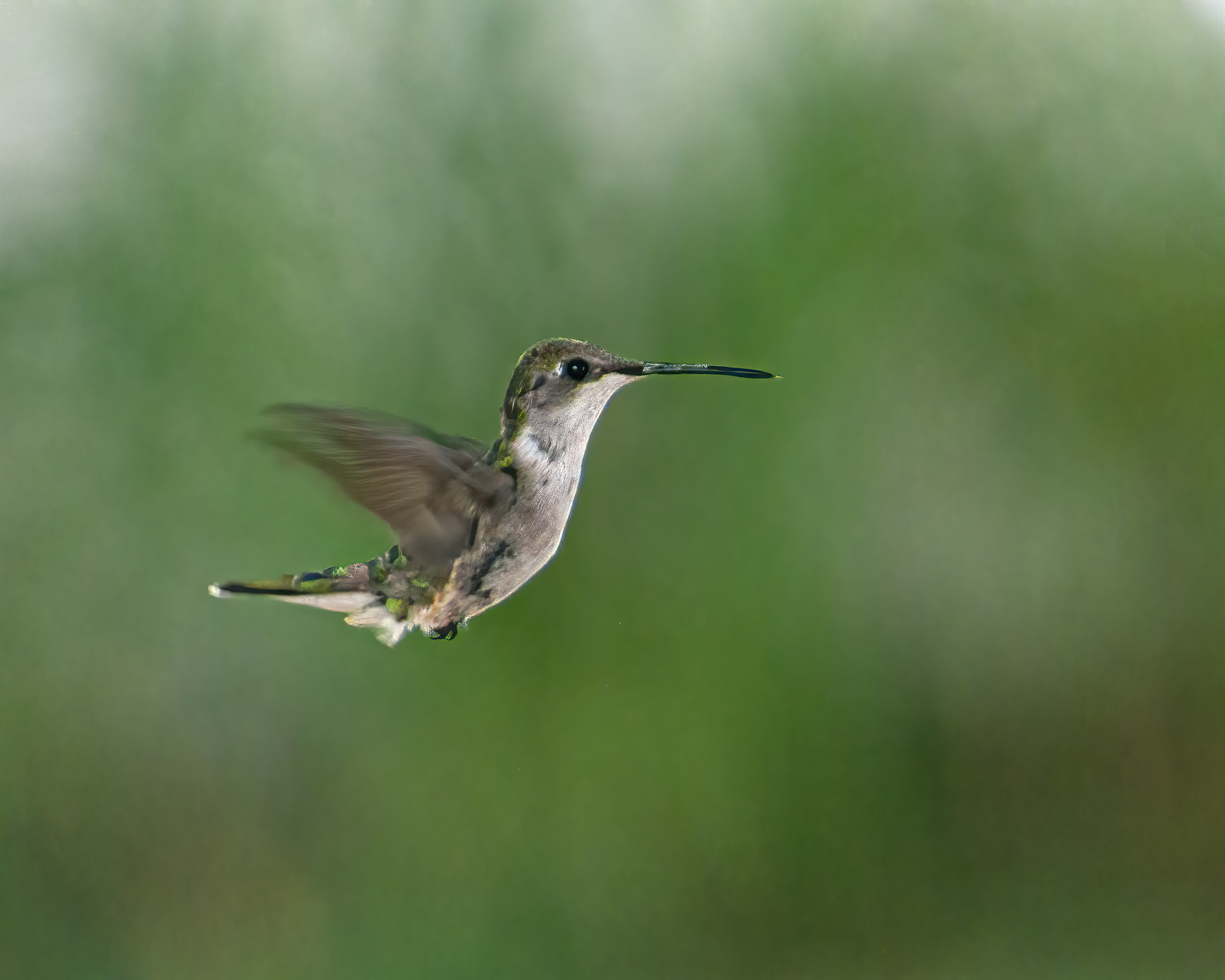
Yesterday I visited some family members who live on a farm. They have hummingbird feeders set up at various spots around the farmhouse and I was delighted to see Ruby-throated Hummingbirds (Archilochus colubris) zipping about throughout the time of my visit. I would have liked to have gotten shots of the hummingbirds feeding on some beautiful flowers, but they seemed content to use the feeders.
Ruby-throated Hummingbirds, the only hummingbirds where I live, are small at about 2.8-3.5 inches in length (7-9 cm), so it is not easy to capture shots of them in flight. Most of my shots include the feeders, but I generally prefer a more natural-looking backdrop whenever possible, so I used these shots. It was a hot, humid day and I quickly wore myself out chasing after these energetic little birds.
In case you are curious, I was once again using my new Tamron 18-400mm lens. I would have liked to have had a bit more reach to get closer shots—these shots are significantly cropped—but I think that is the constant complaint of most wildlife photographers, even those with super telephoto lens. I’m pretty happy with the shots that I was able to get of these hummingbirds that look to be either females or juvenile males—I did see some adult males with their brilliant ruby throats, but, alas, was unable to get any shots of them.


© Michael Q. Powell. All rights reserved.
Posted in Birds, Nature, Photography, Summer, wildlife | Tagged Archilochus colubris, birds in flight, Canon 7D, hummingbird, Montpelier VA, Ruby-throated Hummingbird, Tamron 18-400mm | 17 Comments »
July 21, 2022 by Mike Powell
It is a fun challenge to try to photograph dragonflies in flight—I will usually try to meet this challenge at least a few times each dragonfly season. It requires a lot of patience and persistence, as you can probably imagine, and results are certainly not guaranteed.
I captured these shots of Prince Baskettail dragonflies (Epitheca cynosura) as they was flew more or less toward me on Tuesday at Jackson Miles Abbott Wetland Refuge. Normally I use manual focus for these kinds of shots when I am shooting with my Tamron 180mm macro lens because it is really slow in acquiring focus.
For these shots, though, I used my Tamron 18-400mm lens and the longer reach let me acquire and track my subjects when they were farther away. Amazingly I was able to use auto focus. The first two shots were taken with the zoom lens fully extended to 400mm and the lens was at 265mm for the final photo.
None of these photos will win any prizes, but they are kind of fun. As one of my friends commented in Facebook, the view is “kind of like being a tail gunner in a B17 over France during WWII.” More importantly for me, though, these shots provide an indication that I am not giving up too many capabilities if I choose to walk around with this lens alone. It will never fully replace my macro lens or my longer telephoto zoom lens, but the Tamron 18-400mm lens is continuing to impress me with its versatility.


© Michael Q. Powell. All rights reserved.
Posted in Dragonflies, dragonfly, Insects, Nature, Photography, Summer, wildlife | Tagged Canon 7D, Epitheca cynosura, Fort Belvoir VA, Jackson Miles Abbott Wetland Refuge, Prince Baskettail, Prince Baskettail dragonfly, Tamron 18-400mm | 19 Comments »
July 20, 2022 by Mike Powell
I try to pay a lot of attention to the background when I am composing a photo. If it is too cluttered, the background can draw attention from the primary subject, but if it is too plain, it can remove all sense of the environment in which the shot was taken. Ideally, the background adds visual interest to an image without being distracting.
For most of my wildlife shots, I have only a very limited control over my physical environment. Birds and insects will choose their perches or their flight paths and I am the one who has to adapt. It is amazing, though, how a slight change in the angle of view can improve an image. Sometimes I am able to improve my shot by moving a little to one side or the other or by shooting a little higher or a little lower.
Camera settings can help a bit too—by making the depth of field more shallow, for example, I can blur out the background. I have to be careful, however, in using this technique, because important parts of my subject to be blurred as well if I do not pay attention to my relationship to my subject. There are a lot of creative choices to make in choosing camera settings. I remember feeling overwhelmed by the number of choices when I first started becoming more intentional in my photography—it is now second nature and I make my choices instinctively, knowing pretty well what the effect will be of changing a setting.
In the first photo, I tried to be sure that the plane of my camera sensor was parallel to the body of the male Slaty Skimmer dragonfly (Libellula incesta), which meant that most of the dragonfly was in focus, while the background was blurry. You can certainly tell that there were branches all around, but the blurry branches, I think, make this image a whole lot more interesting than the traditional “dragonfly on a stick” shot.
The second image shows a Big Bluet damselfly (Enallagma durum) perched on some vegetation. I really like this shot because of the way that the background gradually fades away, unlike in the first image in which there was a sharp distinction between the foreground and the background. I also like the linear nature of the stalks of vegetation and their varying angles.
I took both of these shots using my Tamron 18-400mm lens during a visit to Occoquan Bay National Wildlife Refuge last week. As I mentioned in some other recent posts, I am experimenting with this lens to see if it can serve as an all-in-one lens for those times when I want to travel light, while retaining the capability to photograph a variety of subjects. These two shots proved to me that with this lens I can capture images of some small creatures with a good amount of detail. So far I am quite happy with its performance and I will continue playing around with it to learn about its capabilities and limitations.


© Michael Q. Powell. All rights reserved.
Posted in damselfly, Dragonflies, dragonfly, Insects, Nature, Photography, Summer, wildlife | Tagged Big Bluet, Big Bluet damselfly, Canon 7D, Enallagma durum, Libellula incesta, Occoquan Bay National Wildlife Refuge, Slaty Skimmer, Slaty Skimmer dragonfly, Tamron 18-400mm, Woodbridge VA | 13 Comments »
July 19, 2022 by Mike Powell
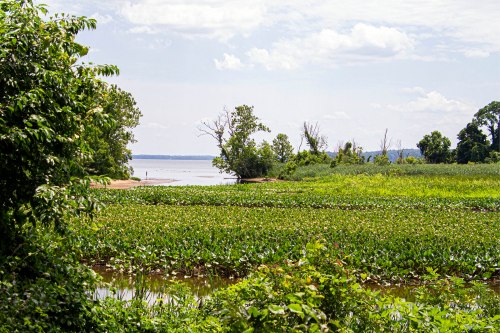
Every now and then one of my readers will ask me to post photos of Occoquan Bay National Wildlife Refuge, my favorite local wildlife photography spot. Usually I have either a telephoto or macro lens on my camera, neither of which is all that suitable for landscape-type shots. If I thought about it, I could switch to a wider lens and generally have one with me in my backpack, but it is kind of a hassle to do so.
This past week I have been finally shooting with my Tamron 18-400mm zoom lens, which I bought months and months ago, but had rarely used. This lens gives me good all-round capability in terms of focal length, but I wasn’t sure how it would handle the kinds of shots that I like to take. Could it handle macro-style shots of dragonflies? How would it handle birds, especially birds in flight?
I am still working on the answering those questions, but so far the results look promising. The dragonfly photos in my past two postings were taken with this lens, as were the landscape photos in this posting. One of the challenges of using this kind of all-in-one lens is that I have to retrain my eyes to look everywhere—when I have a long telephoto lens on my camera, I look mostly into the distance and when I use a macro lens, I look mostly at areas that are close to me.
As you can see in these photos, water is one of the features of this wildlife refuge. Sometimes I search for subjects near the ponds and streams and at other times I focus my attention on the wider waters of the bay. At this time of the year, the vegetation is green and lush. Fortunately the foliage on the trees provides some respite from the oppressive heat that is common here in the summers.


© Michael Q. Powell. All rights reserved.
Posted in Landscape, Nature, Photography, Summer | Tagged Canon 7D, Occoquan Bay, Occoquan Bay National Wildlife Refuge, Tamron 18-400mm, Woodbridge VA | 8 Comments »
July 18, 2022 by Mike Powell
We are at a time of the summer, when it is unlikely that I will see any new dragonflies for the season. Several species will emerge towards the end of the summer, but for now I see the same familiar faces over and over again.
I really am content, though, with photographing the beauty of these wonderful aerial acrobats and never grow tired of photographing the same ones over and over. Each outing with my camera is an opportunity to capture images in a different way, in different environments, and in situations with different lighting.
Last week I was delighted to capture these images of male Widow Skimmer dragonflies (Libellula luctuosa) during a visit to Occoquan Bay National Wildlife Refuge. I just love the brown and white patches on the wings of these dragonflies that make them really stand out from all other dragonflies in our area.
These shots also illustrate the fact that the shapes of the front wings of most dragonflies are different from the rear wings. I suspect that the different shapes play a role in enabling the amazing flight capabilities of dragonflies, although I confess that I do not understand very well the aerodynamics of dragonfly flight—their flight seems almost magical to me.


© Michael Q. Powell. All rights reserved.
Posted in Dragonflies, dragonfly, Insects, Nature, Photography, Summer, wildlife | Tagged Canon 7D, Libellula luctuosa, male Widow Skimmer, Occoquan Bay National Wildlife Refuge, Tamron 18-400mm, Widow Skimmer, Widow Skimmer dragonfly, Woodbridge VA | 12 Comments »
July 17, 2022 by Mike Powell
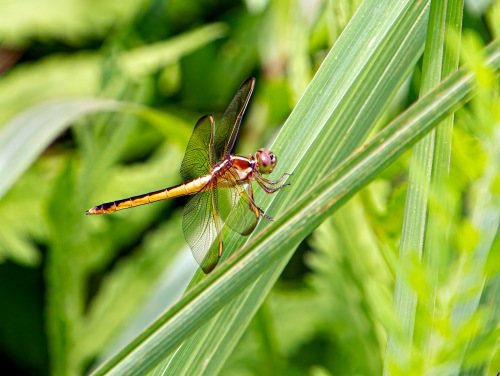
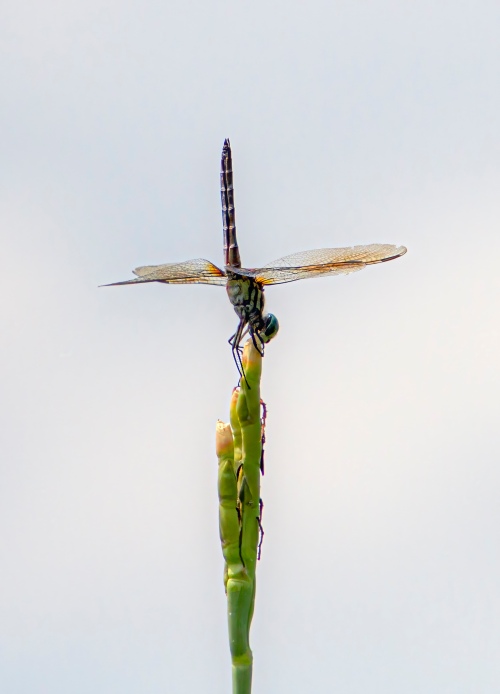
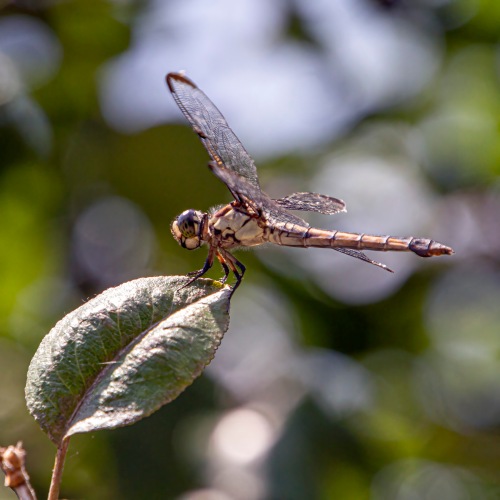
Dragonflies perch in many different ways and in many different places. Here are some simple shots of three dragonflies that I encountered last Thursday at Occoquan Bay National Wildlife Refuge.
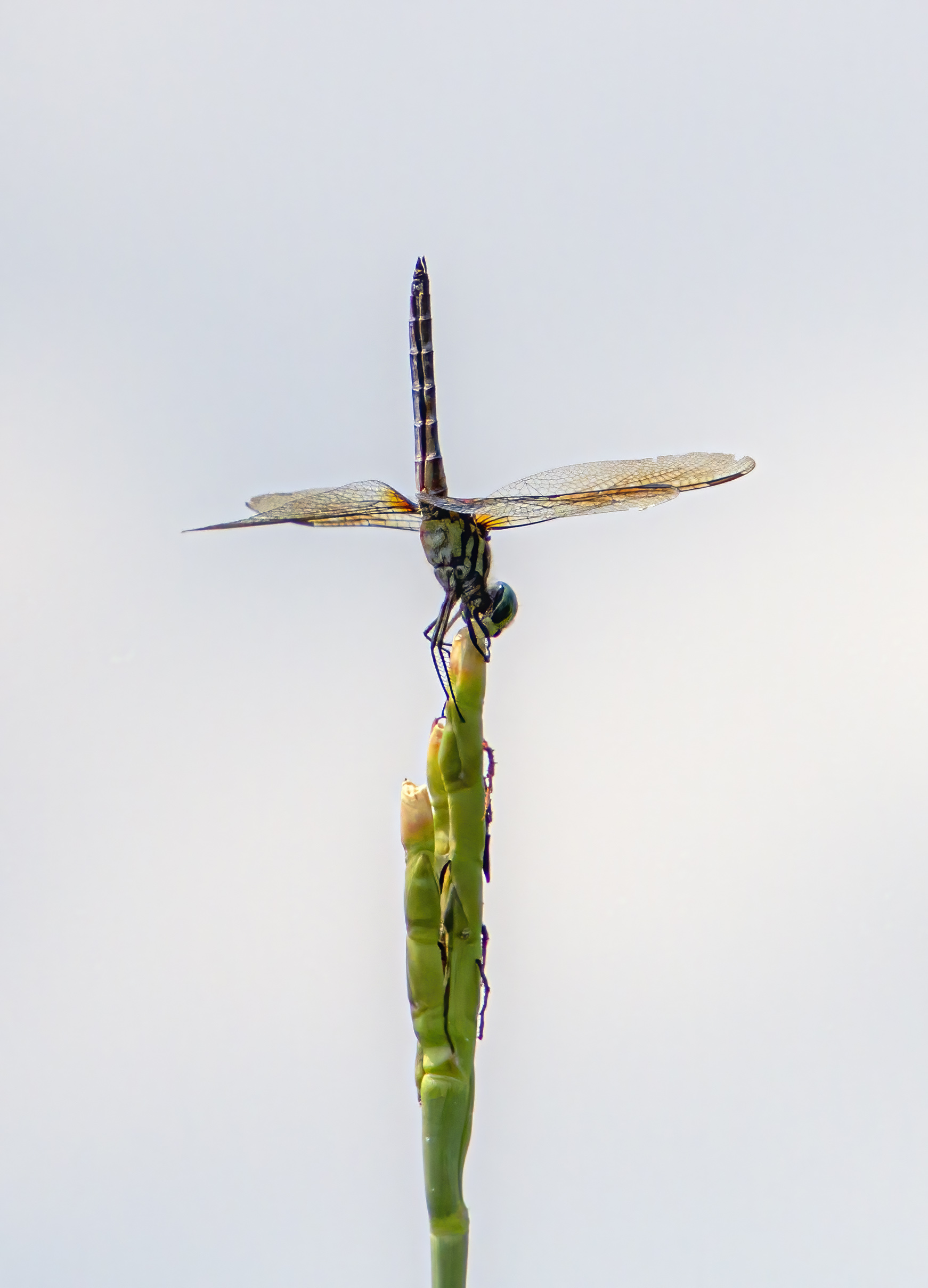
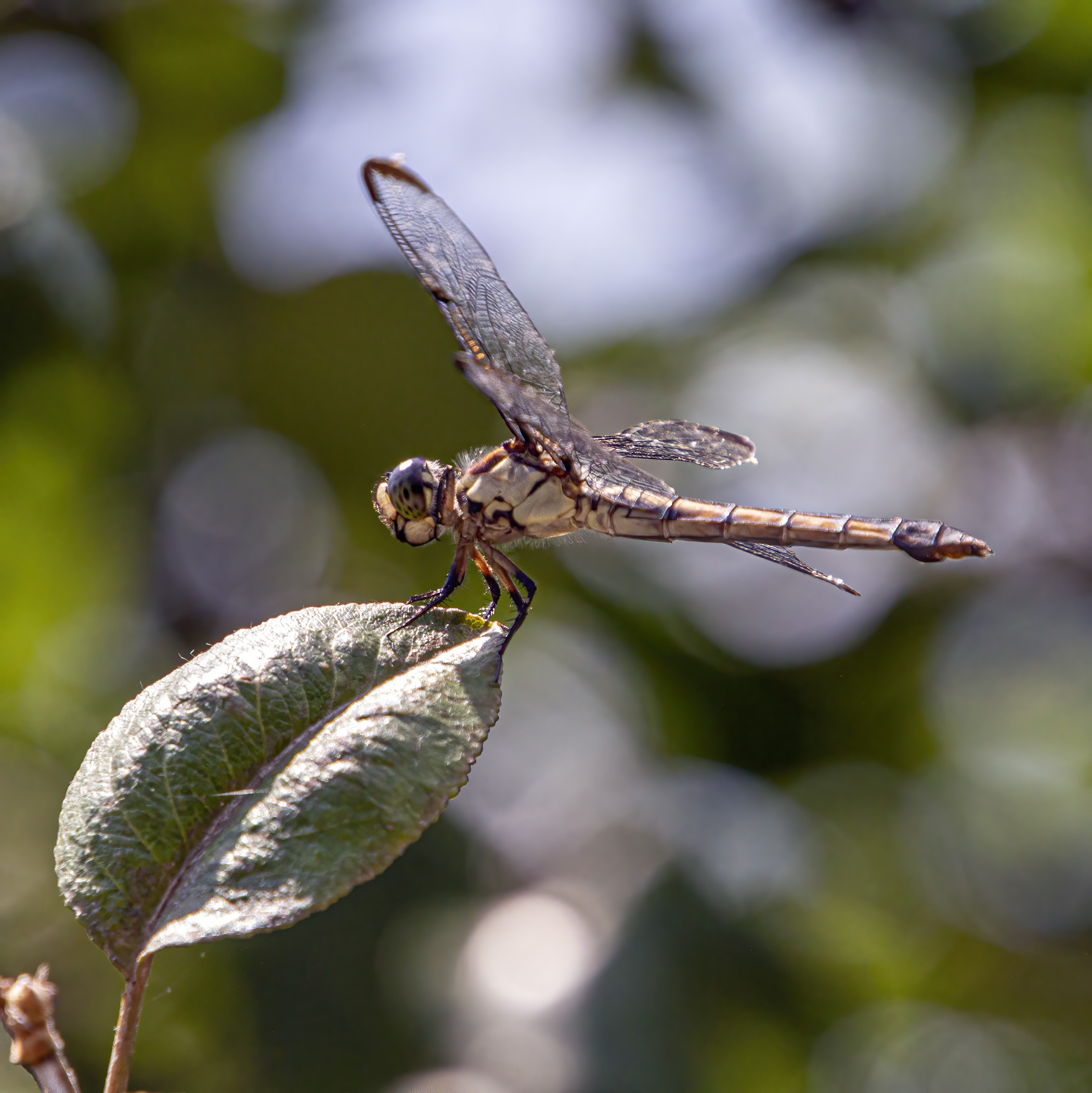
The first one is a Needham’s Skimmer (Libellula needhami) and I love the way that its coloration contrasts so well with the sea of green vegetation in which it is perched. The dragonfly in the second photo, my personal favorite of the three images, is a Blue Dasher (Pachydiplax longipennis). When it’s hot outside, some dragonflies, like this one, like to assume a handstand-like pose, often called the “obelisk” position, to reduce their exposure to the direct sunlight. The final photo shows a Great Blue Skimmer (Libellula vibrans) perched on the tip of a leaf.
Each of these shots represents my efforts to isolate a dragonfly a bit from its surroundings and to highlight its beauty and its behavior. None of theme is spectacular or award-worthy, but they are pleasing little portraits of some of my summer companions.
© Michael Q. Powell. All rights reserved.
Posted in Dragonflies, dragonfly, Insects, Nature, Photography, Portraits, Summer, wildlife | Tagged Blue Dasher, Canon 7D, Great Blue Skimmer, Libellula needhami, Libellula vibrans, Needham's Skimmer, Occoquan Bay National Wildlife Refuge, Pachydiplax longipennis, Tamron 18-400mm, Woodbridge VA | 13 Comments »
July 16, 2022 by Mike Powell
It was hot and humid when I went trekking with my camera this past Wednesday and most of the wildlife seemed to be taking siestas in the shade at Occoquan Bay National Wildlife Refuge. I could hear the sounds of birds, but spotted only a few of them. Even the dragonfly activity seemed to be lower than normal.
Fortunately, a good number of butterflies were active. In fact they were so active, that I expended a lot of energy chasing after them. I noticed that several of them were showing some wear and tear, with visible damage to their wings.
The first and third photos show Black Swallowtail butterflies (Papilio polyxenes), while the butterfly in the middle shot is a Zebra Swallowtail butterfly (Eurytides marcellus). None of these images is spectacular, but I like the way that they work together as a set, with the green vegetation in the background of each of them serving as a unifying element.
Have a happy weekend and chase a few butterflies if you can find them—it will make you feel like a child again.


© Michael Q. Powell. All rights reserved.
Posted in Butterflies, Insects, Nature, Photography, Summer, wildlife | Tagged black swallowtail, black swallowtail butterfly, Canon 7D, Eurytides marcellus, Occoquan Bay National Wildlife Refuge, Papilio polyxenes, Tamron 18-400mm, Woodbridge VA, Zebra Swallowtail, Zebra Swallowtail butterfly | 6 Comments »
July 15, 2022 by Mike Powell
I have not yet made it to Kenilworth Aquatic Gardens this year, so I was especially happy to see that a dozen or so lotuses were in bloom last week at Green Spring Gardens. Kenilworth Aquatic Gardens in Washington D.C. is a National Park Service site with several dozen ponds with a variety of water lilies and lotuses—it is the go-to place in my area to see this kind of aquatic vegetation.
However, I am pretty content with the smaller selection at Green Spring Gardens, which is only a couple of miles from my home. Every time that I see lotuses, I am faced with the dilemma of how to photograph them. Should I try to get a group shot or should I photograph a single flower? Should I try to capture an image of a whole flower or of some of its parts? When I am trying to photographic birds and insects, I usually do not have the luxury of thinking about all of these compositional considerations, so it feels a little strange to be so intentional when photographing flowers.
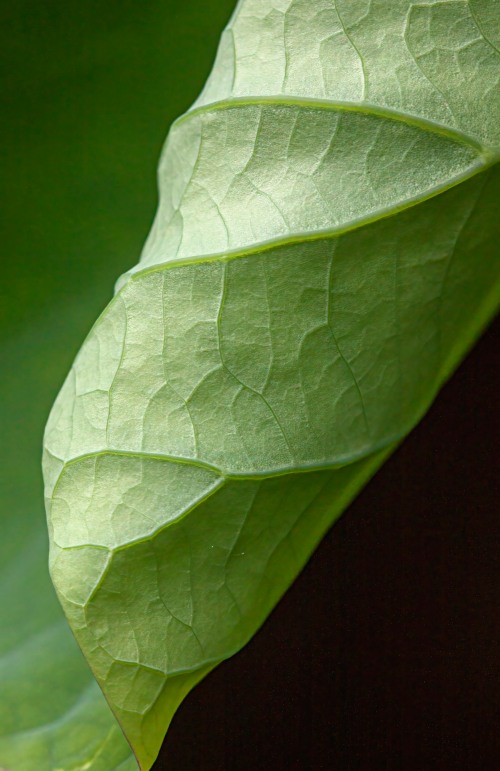
Here are three photos from my outing that day that represent several different ways that I approached my subject. The first image is a kind of traditional portrait of a lotus that I took when the sun had slipped behind the clouds and softened the harshness of the light. For the second shot, I moved in closer and focused on the center of a lotus, creating an image that simultaneously realistic and abstract. For the final photo, I moved even closer and tried to emphasize the texture of a lotus leaf and all of its interlocking veins.
It’s fun to play around with my camera and try some different creative approaches that I do not regularly use in photographing wildlife.
Have a wonderful weekend and consider trying a new approach to something you regularly do. It may not necessarily work, but it will undoubtedly be fun.


© Michael Q. Powell. All rights reserved.
Posted in abstract, Flowers, Nature, Photography, Summer | Tagged Alexandria VA, Canon 50D, green spring gardens, lotus, lotus center, lotus leaves, Tamron 180mm | 16 Comments »
July 14, 2022 by Mike Powell
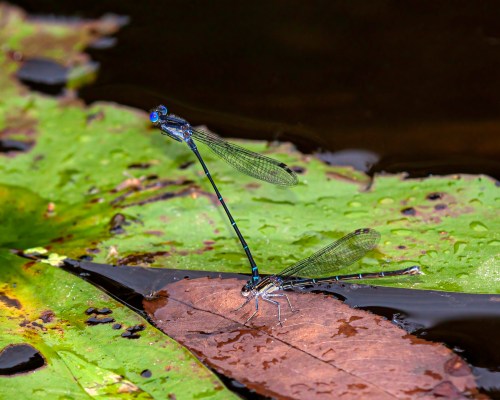
I was not sure of the species of these damselflies when they flew by me in tandem last week at Green Spring Gardens, but I managed to track them visually until they landed on some floating vegetation. As some of you may recall, when damselflies mate, their bodies form a shape that resembles a sidewards heart, a position sometimes referred to as the “wheel” position. When mating is completed, the damselfly couples fly off together with the male still grasping the female by the back of her head and the male stays attached as the female deposits her eggs—that may have been why they landed on this vegetation.
When I returned home and was able to examine the damselflies closely, I was delighted to see that they were Dusky Dancers (Argia translata), a species that I rarely see. If you click on the photos, you can get a closer look at the stunning eyes and beautiful markings of these damselflies. I am particularly drawn to the pattern of thin blue rings around the abdomen of the male, the damselfly on the left that is perched almost vertically.
© Michael Q. Powell. All rights reserved.
Posted in damselfly, Insects, Macro Photography, Nature, Photography, Summer, wildlife | Tagged Alexandria VA, Argia translata, Canon 50D, damselflies in tandem, damselfly mating, Dusky Dancer, dusky dancer damselfly, green spring gardens, Tamron 180mm, tandem position | 1 Comment »
July 13, 2022 by Mike Powell
I love the way that this acrobatic bee was able to position its antennae for optimized access to the nectar in this bee balm flower last Friday at Green Spring Gardens. The bee was so focused on the flower that it paid me no attention, allowing me to get really close to it to capture this image.
I believe that the bee is an Eastern Carpenter Bee (Xylocopa virginica). As for the flower, there was quite a variety of flowers in different colors that looked like this one. I think that it is a type of bee balm (g. Monarda), though I really do not know flowers very well.

© Michael Q. Powell. All rights reserved.
Posted in Bees, Flowers, Insects, Macro Photography, Nature, Photography, Summer, wildlife | Tagged Alexandria VA, bee, bee balm, Canon 50D, carpenter bee, Eastern Carpenter Bee, g. Monarda, green spring gardens, Tamron 180mm, Xylocopa virginica | 7 Comments »
July 12, 2022 by Mike Powell
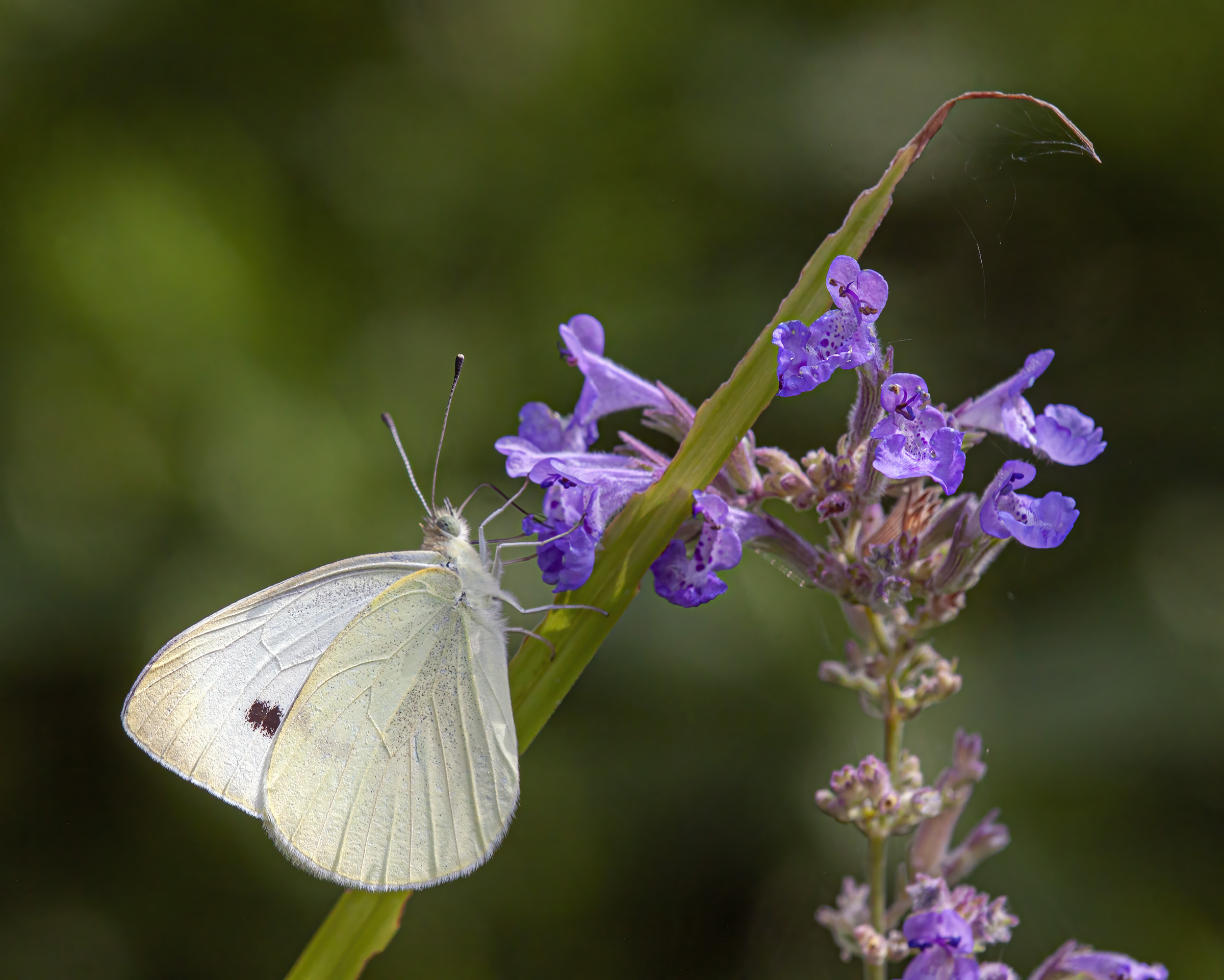
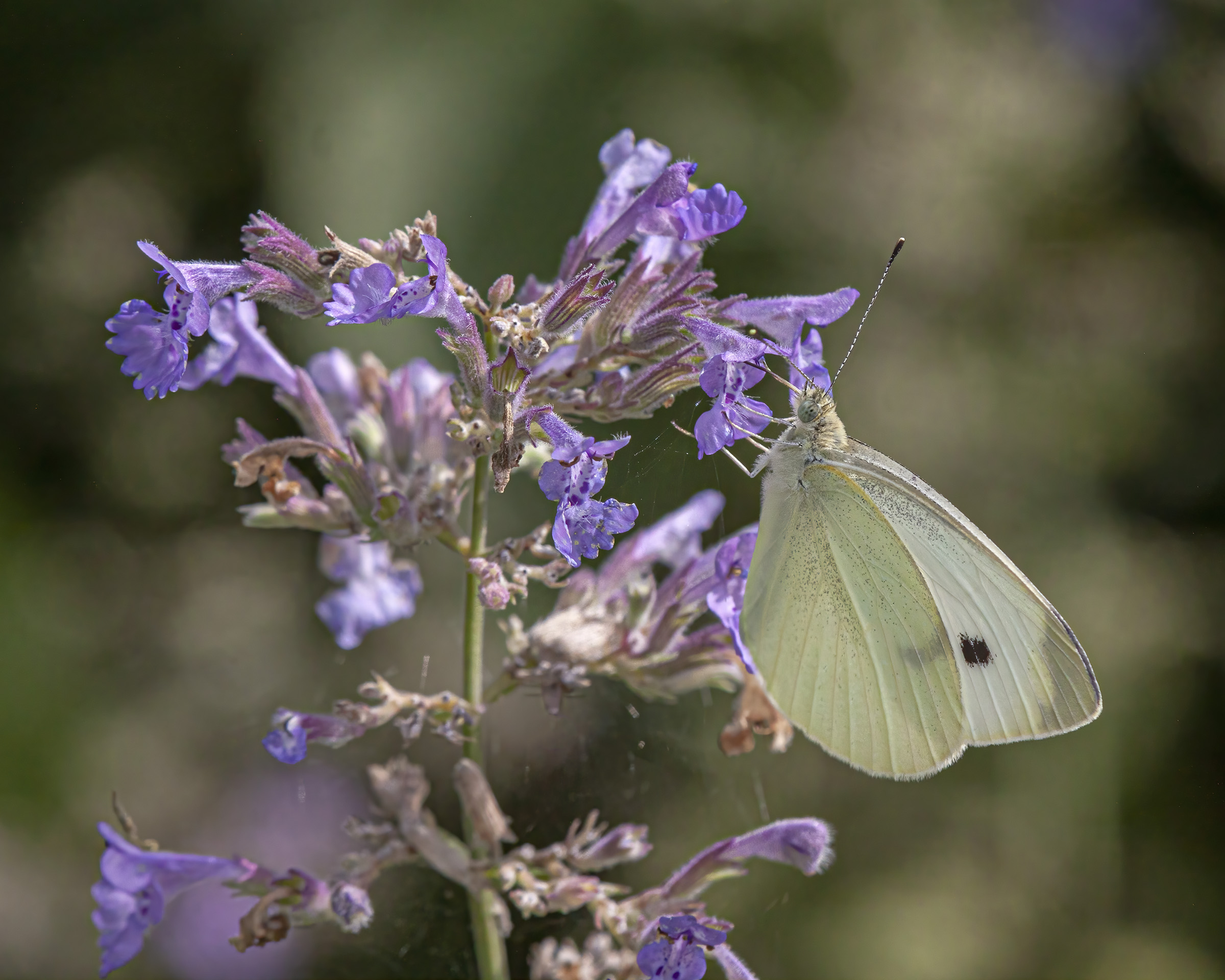
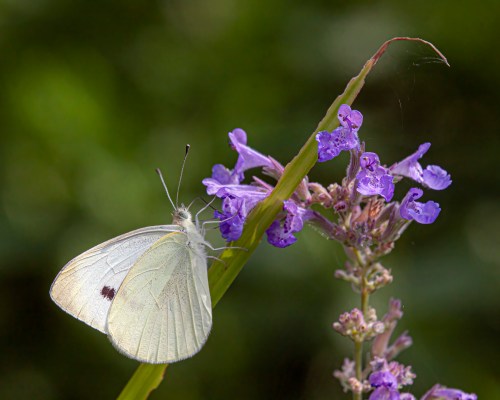
I love the simple beauty of Cabbage White butterflies (Pieris rapae). They are mostly white with a few touches of black, but if you get a close-up look, you discover that they have stunningly speckled green eyes. Cabbage Whites, in my experience, tend to be pretty skittish and do not stay in one place for very long. If you were to track my movements, you would probably discover that I spend a good amount of time chasing after these little beauties.
Last Friday I was able to capture these images of a Cabbage White butterfly as it flitted about some pretty purple flowers at Green Spring Gardens. The first shot is my clear favorite of the three thanks to its saturated colors, out-of-focus background, and interesting composition. The other two images, however, are interesting in their own ways, showing a more dynamic view of the butterfly at work.
I am not a gardener, so I tend to view this butterfly almost exclusively from the perspective of its beauty—the same is true with invasive species of animals and insects. I fully recognize that this butterfly is considered to be an agricultural pest and can cause damage to crops, but that, in my eyes, does not diminish its beauty.


© Michael Q. Powell. All rights reserved.
Posted in Butterflies, Insects, Macro Photography, Nature, Photography, Summer, wildlife | Tagged Alexandria VA, Cabbage White, Cabbage White butterfly, Canon 50D, green spring gardens, Pieris rapae, Tamron 180mm | 4 Comments »
July 11, 2022 by Mike Powell
I am always fascinated by interactions between species. It is impossible to know exactly what is going on in the minds of the participants, but sometimes the behavior is one of curiosity, co-existence, or confrontation.
As I was preparing to photograph a pretty pink water lily at Green Spring Gardens last Friday, a honey bee flew into the frame. The bee dove right into the center of the flower, so I waited for it to emerge and continued to watch through the viewfinder of my camera.
I was just getting ready to finally take a shot when suddenly a small hover fly flew into the frame. I timed it right and managed to captured this image when the hover fly was right above the honey bee.
The hover fly seemed to be on a reconnaissance mission and the honey bee seemed to be telling him to buzz off. Somehow the posture of the bee reminded me of that of a policeman at the scene of a crime as he repeatedly tells onlookers, “Move along, there is nothing to see here.” Was this a confrontation? I don’t think that it rose to that level, but it was clear to me (and probably to the hover fly) that the bee did not want to share his golden treasure with anyone else.

© Michael Q. Powell. All rights reserved.
Posted in Bees, Insects, Nature, Photography, Summer, Water Lilies, wildlife | Tagged Alexandria VA, Canon 50D, green spring gardens, honey bee, honeybee, hover fly, hoverfly, pink water lily, Tamron 180mm, water lily | 9 Comments »
July 10, 2022 by Mike Powell
I had no idea that Eastern Gray Squirrels (Sciurus carolinensis) liked mushrooms, but this squirrel certainly seemed to be nibbling on one when I spotted him on Wednesday at Green Spring Gardens. I love the way that he was holding the mushroom in his “hands” as he gently chewed on the stem—I think he may have already consumed the mushroom cap.

© Michael Q. Powell. All rights reserved.
Posted in animals, Nature, Photography, Portraits, Summer, wildlife | Tagged Alexandria VA, Canon 50D, Eastern Gray Squirrel, green spring gardens, mushroom, Sciurus carolinensis, squirrel, Tamron 180mm | 14 Comments »
July 10, 2022 by Mike Powell
I love the distinctive coloration of Orange Bluet damselflies (Enallagma signatum), whose name always causes me to smile at the apparent oxymoron. How can a bluet be orange? As the name “bluet” suggests, most of the 35 members of the genus American Bluet (Enallagma), the largest damselfly genus in North America, are blue. However, certain species come in other colors including red, orange, and green and the Rainbow Bluet combines red, yellow, and green.
I spotted this handsome male Orange Bluet last Wednesday as he was perching on a lily pad in a small pond at Green Spring Gardens. He posed beautifully for me and I was able to capture quite a few details of this little damselfly. I recommend that you click on the image to get a closer look at this Orange Blue, including his wonderful orange markings.

© Michael Q. Powell. All rights reserved.
Posted in damselfly, Insects, Nature, Photography, Summer, wildlife | Tagged Alexandria VA, bluet, Canon 50D, Enallagma signatum, green spring gardens, Orange Bluet, Orange Bluet damselfly, Tamron 180mm | 3 Comments »
July 9, 2022 by Mike Powell
Eastern Amberwings (Perithemis tenera) are very small dragonflies, with an overall length of no more than one inch (25 mm). Males of this species are easy to identify because of their amber-colored wings. Males are quite common and I ofter see them buzzing around the edges of the ponds that I visit. Females have brown patches on their clearer wings and often hunt far from the water, so I do not see them very often.
Despite their small size, Eastern Amberwings are one of the easiest dragonflies to photograph in flight. They often hover low, close to the water surface near the shore, which gives me a fighting chance to focus on them. It requires a steady hand and quick reactions, but the first two images show the kind of results you can get. The second shot is a little quirky, but I like the way that it shows two male Amberwings passing each other, flying in opposite directions.
The final shot is an “artsy” shot of a perched Amberwing. The dragonfly was flying among the lotus flowers last Wednesday at Green Spring Gardens and perched for a moment on a lotus leaf that had not yet unfurled. I tried to compose the image so that the viewer gets a sense of the habitat, which gives the shot a completely different feel from the first two photos in which the subjects are completely separated from their environment.


© Michael Q. Powell. All rights reserved.
Posted in Dragonflies, dragonfly, Insects, Nature, Photography, Summer, wildlife | Tagged Canon 50D, dragonflies in flight, Eastern Amberwing, Eastern Amberwing dragonfly, green spring gardens, Perithemis tenera, Tamron 180mm | 6 Comments »
July 8, 2022 by Mike Powell
I was absolutely thrilled on Wednesday when I streaks of bright yellow flashed in front of my eyes while walking among the flowers at Green Spring Gardens—goldfinches were present. Few other birds in my area can match the brilliant yellow color of the male American Goldfinch (Spinus tristis) in breeding plumage. It is easy to spot these birds, but it is a challenge to photograph them, because they are small, fast, and skittish.
My camera was equipped with my 180mm macro, which can also serve as a short telephoto lens, so I had to use all of my stalking skills to get as close as possible. Fortunately, the goldfinches were preoccupied with feeding and I was able to capture these images. I had to be quite patient, though, because the goldfinches spent most of their time with their heads buried in the flowers and only rarely gave me a good view of their faces
Together with the goldfinches, the abundance of blooming flowers helped me to create images that have a happy feel to them, a welcome antidote to the gloom of these troubled times.


© Michael Q. Powell. All rights reserved.
Posted in Birds, Flowers, Nature, Photography, Summer, wildlife | Tagged Alexandria VA, American Goldfinch, Canon 50D, goldfinch, goldfinches, green spring gardens, Spinus tristis, Tamron 180mm | 13 Comments »
July 7, 2022 by Mike Powell
Ten years ago today I started this blog. After reviewing some of my photos from earlier that fateful day, my dear friend and photography mentor Cindy Dyer told me I needed a blog. I was a little skeptical, but we sat down at a computer and she helped me to set up this blog. I could not come up with a cute or creative name, so I simply called it “Mike Powell—My journey through photography.”
My first posting was a modest one that showcased a single photo of a Blue Dasher dragonfly (Pachydiplax longipennis). In case you are curious, here is a link to that first posting that was entitled “Blue Dasher dragonfly.”
I figured that my blog would be primarily a place to display my photos. I rapidly realized, however, that I enjoyed expressing myself with my words as much as with my images. My postings are often a direct reflection of my thoughts or feelings at the very moments when I am composing the post. I do not compose them in advance, so my postings sometimes ramble around a bit, but I have found that many of my readers enjoy this conversational, stream-of-consciousness style.
According to WordPress statistics, I have done 4462 postings, with almost three hundred sixty thousand total views. I have written most of these postings myself, though occasionally I have reblogged the postings of others. My favorite subjects over the years have been insects and birds, but I have also done postings on a wide range of other topics including animals, travel, poetry, and painting.
Today it seemed appropriate to post a photo of a male Blue Dasher—the dragonfly that started it all—that I photographed yesterday at Green Spring Gardens, a local, county-run historical garden. When I was starting to get more serious about photography ten years ago, Cindy and I would often photograph flowers and insects at this garden.
I owe a special debt of gratitude to Cindy for the initial push to start this blog and for her continued encouragement and inspiration. However, I am equally indebted to so many readers who have provided thoughtful comments, support, and motivation as we have made this journey together. Thanks to all of you—I could not have done it without you.

© Michael Q. Powell. All rights reserved.
Posted in Blogging, Dragonflies, dragonfly, Insects, Nature, Photography, Summer, wildlife | Tagged 10th anniversary, Alexandria VA, anniversary, Blue Dasher, Blue Dasher dragonfly, Canon 50D, green spring gardens, Pachydiplax longipennis, Tamron 180mm | 33 Comments »
July 6, 2022 by Mike Powell
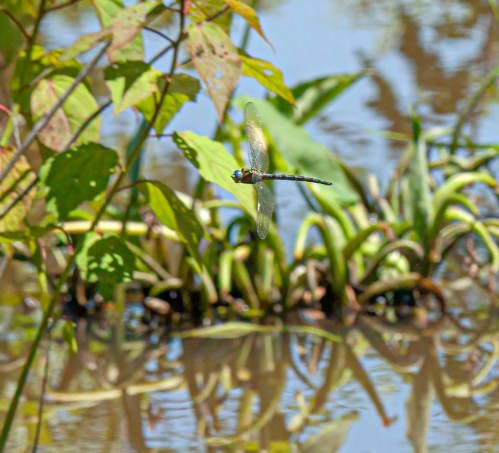
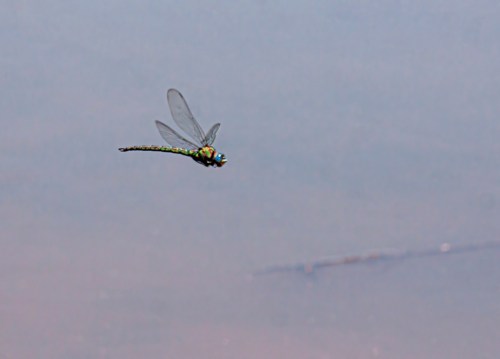
It is fairly uncommon for me to see a Cyrano Darner dragonfly (Nasiaeschna pentacantha), so when I do, I try my best to get a shot of it. The problem, though, is that they always seem to be patrolling over the water far from the shore and rarely seem to perch.
Last Wednesday I spotted this Cyrano Darner flying around a heavily vegetated area, which made it even tougher to focus on the dragonfly. I was thrilled to be able to get a recognizable shot of the dragonfly, though the background is so cluttered that you may have to look hard to see it in the first image. The second image is a little less sharp, but gives you a clearer view of the dragonfly.
In case you are curious, the species is named for its long, protruding, greenish forehead that is somewhat reminiscent of the long nose of literary character Cyrano de Bergerac. This is the only species that I have encountered where the “nose” helps me to identify it—most of the time I focus on other parts of a dragonfly’s anatomy.
© Michael Q. Powell. All rights reserved.
Posted in Dragonflies, dragonfly, Insects, Nature, Photography, Summer, wildlife | Tagged Canon 50D, Cyrano Darner, Cyrano Darner dragonfly, dragonflies in flight, Fort Belvoir VA, Jackson Miles Abbott Wetland Refuge, Nasiaeschna pentacantha, Tamron 180mm macro | 11 Comments »
July 5, 2022 by Mike Powell
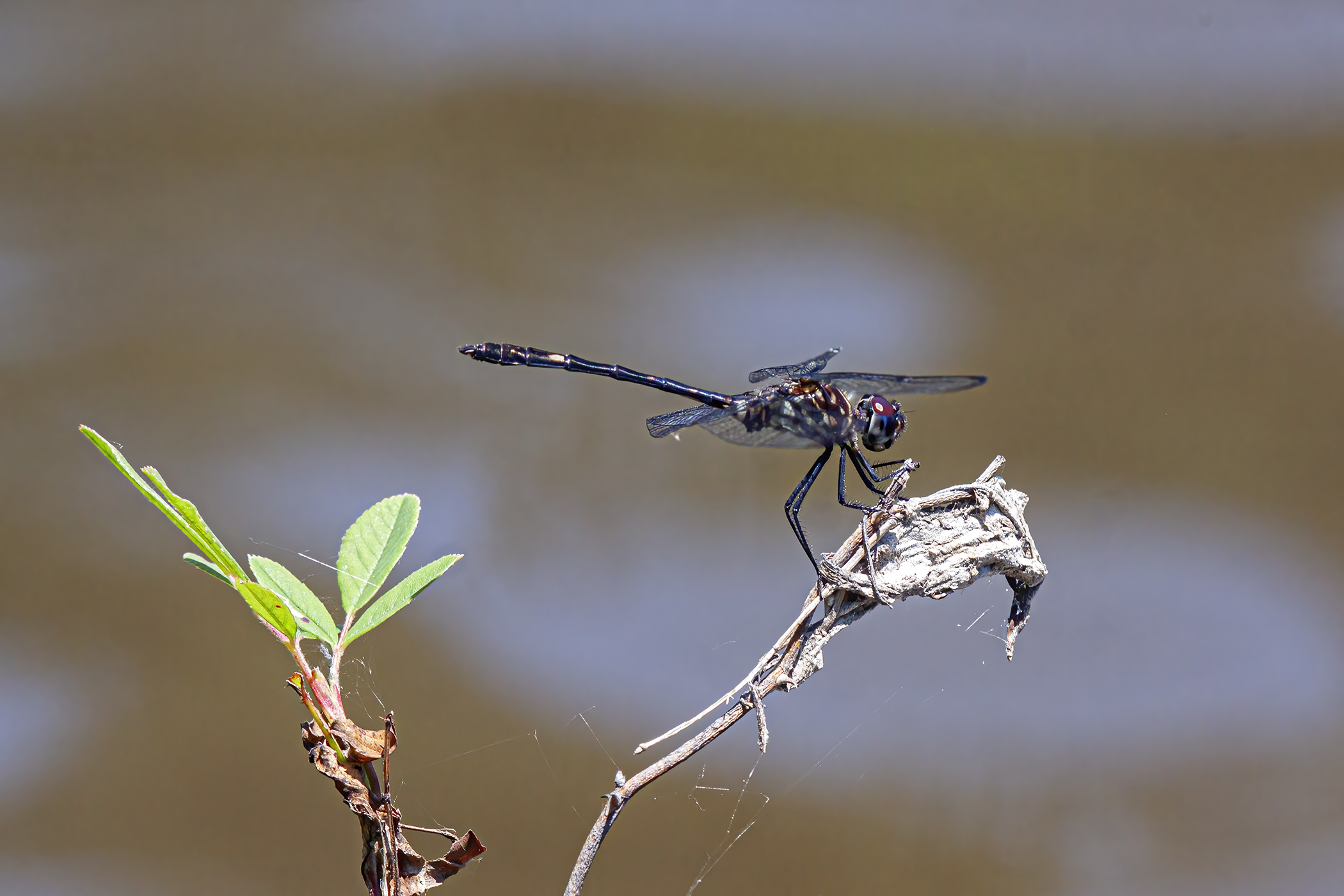
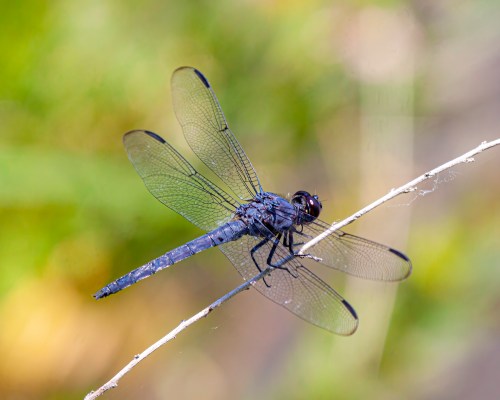
I sometimes feel like male Slaty Skimmer dragonflies are checking me out—they often seem to hover and look right at me when I encounter them. Perhaps it is is a sign of curiosity or maybe one of territoriality. Whatever the case, I love their dark, good looks, like those of these Slaty Skimmers (Libellula incesta) that I encountered last Wednesday at Jackson Miles Abbott Wetland Refuge.
The first image is a traditional shot of a perching Slaty Skimmer. In the second shot, I attempt to capture an image of a Slaty Skimmer as he zoomed on past me. I like the feel of the shot, even though I was a little slow in pressing the shutter and caught him as he was flying away. As many of you know, I love to try to photograph dragonflies while they are flying. It is possible to do so, but the degree of difficulty is pretty high.

© Michael Q. Powell. All rights reserved.
Posted in Dragonflies, dragonfly, Nature, Photography, Summer, wildlife | Tagged Canon 50D, Jackson Miles Abbott Wetland Refuge, Libellula incesta, male Slaty Skimmer, Slaty Skimmer, Slaty Skimmer dragonfly, Tamron 180mm | 1 Comment »
July 4, 2022 by Mike Powell
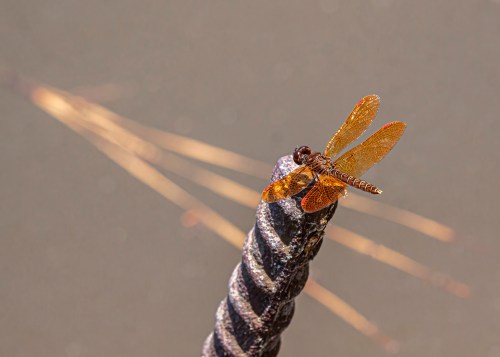
I generally prefer to photograph dragonflies on natural perches, not on manmade ones. However, whenever I visit Jackson Miles Abbott Wetland Refuge I always check a piece of rebar that sticks out of the water of Mulligan Pond near one of the fishing platforms, because I have found that dragonflies love this photogenic perch.
Last Wednesday, I spotted a male Eastern Amberwing dragonfly (Perithemis tenera) perched on the rebar. It flew away as I approached, but I waited patiently and it eventually returned. I tried a number of different approaches in framing my shots, taking advantage of the changing background caused by the movement of the brownish waters of the pond.
I love the contrast between the colors, patterns, and textures of the natural object, the dragonfly, and those of the man-made subject, the rebar. The muddy waters of the pond provide a mostly uniform background color that really complements the amber and rust tones of the primary subjects.


© Michael Q. Powell. All rights reserved.
Posted in Dragonflies, dragonfly, Insects, Nature, Photography, Summer, wildlife | Tagged Canon 50D, Eastern Amberwing, Eastern Amberwing dragonfly, Fort Belvoir VA, Jackson Miles Abbott Wetland Refuge, Mulligan Pond, Perithemis tenera, rebar, Tamron 180mm | 7 Comments »
July 3, 2022 by Mike Powell
Each summer season I look forward to photographing Swift Setwing dragonflies (Dythemis velox) at Jackson Miles Abbott Wetland Refuge. These little dragonflies perch in a distinctive pose with their wings pulled forward, which looked to some scientist like the “ready-set-go” position of a sprinter and is reportedly the reason for the name of the species. One of my fellow photographers recently posted some photos of the species in Facebook, prompting me to set out last Wednesday to see if I could find some of them myself.
Six years ago I spotted my first Swift Setwing dragonfly at this same location. This primarily southern species had never before have been documented in Fairfax County, Virginia, the county where I live, so it is kind of special for me to see them each year. (You can see details of that first sighting in my 25 June 2016 posting Swift Setwing dragonfly.)
Members of this species like to perch at the very tip of vegetation overhanging the water and almost always face the water. It can therefore be quite a challenge to get profile shots and almost impossible to get the kind of head-on shots that I love to take.
I had a number of encounters with Swift Setwings and tried a variety of compositions to capture images of these cool little dragonflies. My favorite shot is probably the first one—I really like the way that the colors of the dragonfly’s head are mirrored in the colors of the berries in the background.


© Michael Q. Powell. All rights reserved.
Posted in Dragonflies, dragonfly, Insects, Nature, Photography, Summer, wildlife | Tagged Canon 50D, Dythemis velox, Fort Belvoir VA, Jackson Miles Abbott Wetland Refuge, Swift Setwing, Swift Setwing dragonfly, Tamron 180mm | 4 Comments »
July 2, 2022 by Mike Powell
This past Thursday I was privileged to attend an exhibition/demonstration “From Conflict to Creativity” that featured amazing works of art by military veterans. The event was held in Washington D.C. in the Thomas Jefferson Building of the Library of Congress. I managed to capture a few images of the buildings’s Great Hall with my iPhone as I passed through it on the way to the event room.
There was so much color and pattern and detail everywhere in the Great Hall that I felt almost overwhelmed. One of my favorite elements was the skylights in the ceiling that I have shown in the second image—I love stained glass windows. The final photo shows a painting called Melpomene by Edward Emerson Simmons.
“When its doors opened to the public in 1897, the Library of Congress represented an unparalleled national achievement, the “largest, costliest, and safest” library in the world. Its elaborately decorated interior, embellished by works of art from nearly fifty American painters and sculptors, linked the United States to classical traditions of learning and simultaneously flexed American cultural and technological muscle.” If you want additional information on the art and architecture of this Great Hall, check out this link on the Library of Congress website, the source of the quotation that I used to begin this paragraph.


© Michael Q. Powell. All rights reserved.
Posted in Architecture, Art, Photography, Travel | Tagged Great Hall, iPhone 11, Library of Congress, Thomas Jefferson Building, Washington D.C. | 14 Comments »
July 2, 2022 by Mike Powell
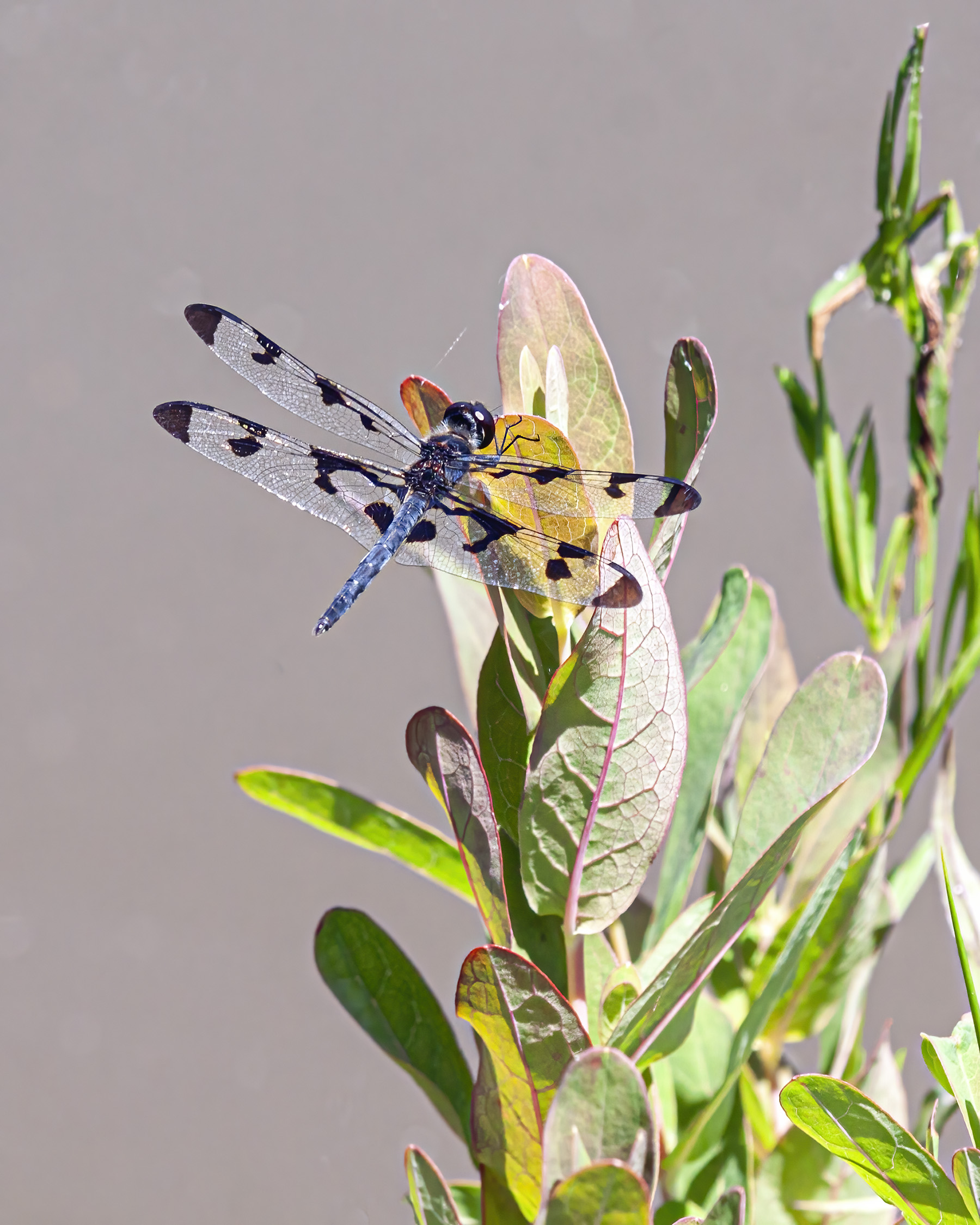
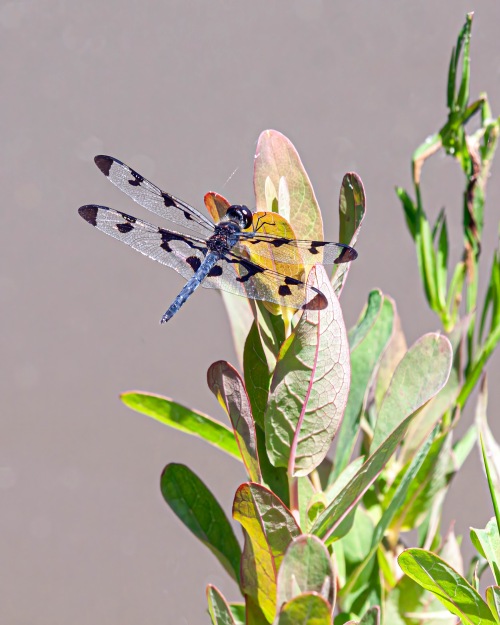
I was thrilled on Wednesday to spot some Banded Pennant dragonflies (Celithemis fasciata) at Jackson Miles Abbott Wetland Refuge. Earlier this season I photographed Calico Pennants and a Halloween Pennant and it is nice to capture images of another “pennant” species with patterned wings. This is the only local spot where I have reliably seen them in the past, and in some years I have not see a single one.
Adult male Banded Pennants are blue, like so many other dragonflies, but the distinctive pattern on their wings make them easy to distinguish from the others. They may be easy to identify, but they are small in size—about 1.3 inches (34 mm) in length—and perch in vegetation right at the edge of the water, so you have to look carefully to spot them.
I was fortunate to have multiple opportunities to photograph Banded Pennants that day. The colorful little dragonflies would make short forays over the deeper waters of the pond, but would sometimes would return to the same clumps of vegetation. The banks of the pond are pretty steep in many spots, so I had to really pay attention as I leaned over the edge to capture some of these images, but I managed to stay dry.
Have a wonderful weekend.


© Michael Q. Powell. All rights reserved.
Posted in Dragonflies, dragonfly, Nature, Photography, Summer, wildlife | Tagged Banded Pennant, Banded Pennant dragonfly, Canon 50D, Celithemis fasciata, Fort Belvoir VA, Jackson Miles Abbott Wetland Refuge, Tamron 180mm | 16 Comments »
« Newer Posts - Older Posts »