Feeds:
Posts
Comments

Archive for the ‘wildlife’ Category

On Monday I saw a surprisingly large number of Eastern Tiger Swallowtail butterflies (Papilio glaucus) as I explored a stream in Prince William County, Virginia. I used to associate these butterflies with gardens, because that is where I had previously seen them most of the time. Over the past years, though, as I have searched for early spring dragonflies, I have gotten used to seeing these colorful butterflies alongside the streams, often congregating in groups to drink and extract minerals from puddles (see my blog post from last year called A kaleidoscope of butterflies for more information and a photo of this phenomenon).

These swallowtails seemed content to fly about continuously, searching and exploring, but rarely perching. When they did come to the ground, they often landed in patches of fallen leaves, as you can see in the second and third images. I was happy when one of the butterflies opted to perch on a fern, which made it a little easier for me to photograph it.

Eastern Tiger Swallowtail

Eastern Tiger Swallowtail

Eastern Tiger Swallowtail

© Michael Q. Powell. All rights reserved.

Read Full Post »

There are not very many insects that could be mistaken for a dragonfly, but the color and pattern on the abdomen of this crane fly made me do a double take when I spotted it from a distance on Monday in Prince William County. At that time I had not yet seen my first dragonfly of the year and was anxious to see one. An expert in a Facebook group identified this as a Crane Fly (Tipula noveboracensis).

The first image is a cropped version of the photo that allows you to focus on the wonderful patterns on the wings and the body. If you click on the image, you can see that the crane fly has antennae. The second shot is much less cropped and gives you an idea of the length of the extremely long legs of this insect.

When I am out in the winter looking for birds, I sometimes end up taking photos of odd branches or clumps of leaves, because their shapes make me think that they might be birds. I have the same “problem” with dragonflies—I am likely to photograph anything that remotely resembles a dragonfly, knowing that later I will be able to sort the images and remove the oddball results. Sometimes, as was the case here, my strange results are worth posting.

Crane Fly

Crane Fly

© Michael Q. Powell. All rights reserved.


Read Full Post »

I finally found my first dragonfly of the season yesterday—a female Uhler’s Sundragon—while I was exploring a stream in Prince William County. Uhler’s Sundragons (Helocordulia uhleri) are considered to be rare in our area. This species requires a very specific type of habitat and has an early and very brief flight period.

So where would you find one? According to the wonderful Dragonflies of Northern Virginia website, “Uhler’s need clean, small to medium, rocky forest streams with gravelly and/or sandy substrate, and a decent flow. They can be found in sunny clearings and forest edges near their streams.”

Fortunately I have found this species at a particular stream the last several years, so that is where I headed yesterday. I searched the spots where I had found Uhler’s Sundragons in the past, but came up empty-handed. I walked along extended lengths of the stream and eventually found the one in the photograph below—it was the only dragonfly that I spotted all day.

My hike yesterday lasted 4 hours and 42 minutes and covered 7.18 miles (11.55 km), according to my GPS app. My pace was pretty slow, partly because I was scanning for dragonflies, but also because the terrain was full of ups and downs. I pasted in a chart from the GPS readout to give you an idea of the type of terrain that I covered. According to my iPhone, I walked up the equivalent of 21 floors, which explains why my legs are a little sore this morning.

As many of you know, dragonflies are my favorite subjects during the warm months—there is something almost magical about these beautiful aerial acrobats. I am therefore super excited that the 2022 dragonfly season has officially started for me.

Uhler's Sundragon

Hike 11 April 2022

© Michael Q. Powell. All rights reserved.

Read Full Post »

Some people speak figuratively about a “snake in the grass,” but that is literally what I encountered last Friday at Lewis Ginter Botanical Garden in Richmond, Virginia. The Northern Water Snake (Nerodia sipedon) was moving about in a grass patch at the edge of a small stream when I first spotted it.

When the snake raised its head to look around, I got down low and moved closer. How close was I? I was using a relatively long macro lens, which makes it look like I was closer than I actually was, but I was close enough that you can see my reflection in the snake’s eye. The second image image is merely a cropped version of the first image that lets you focus more closely on the eye.

Photographically, though, I prefer the first image. I like the way that I was able to capture blurry grass in both the foreground and the background. The rocky area at the bottom of the image helps to ground the snake and provides a sense of the environment.

I recognize that some people find snakes to be creepy, but I am fascinated by them. It was interesting to note that as I was moving closer to the snake when I saw it, others were moving farther away from it.

Northern Water Snake

Northern Water Snake

© Michael Q. Powell. All rights reserved.

Read Full Post »

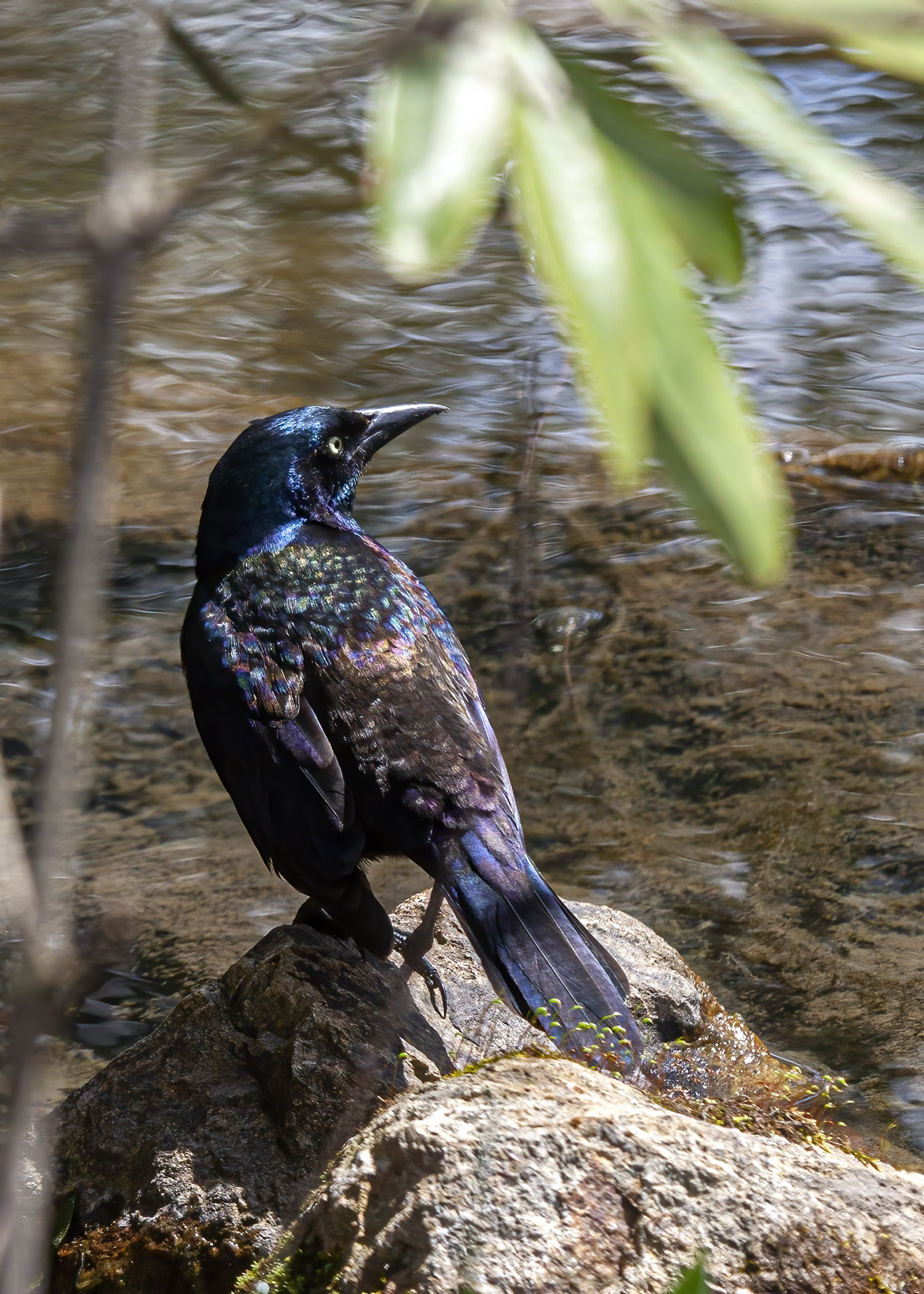
From a distance Common Grackles (Quiscalus quiscula) often appear to be black, but often you can spot their distinctive yellow eyes. When you get closer, especially when the lighting is good, you discover that the grackles are covered with an array of multi-colored iridescent feathers.

On Friday I spotted this grackle while I was exploring Lewis Ginter Botanical Garden in Richmond, Virginia with fellow photographer Cindy Dyer. The grackle was poking around at the edge of the water of a small pond and moving about a lot. I had to maneuver around to get a clear shot of the bird, which was a bit of challenge, because overhanging vegetation partially obstructed my view.

Eventually I was able to capture this image. I had my macro lens on my camera at the time, but fortunately its focal length of 180mm means that it also works as a short telephoto lens. I often tell people that it is best to take a photo with whatever camera gear you have in your hand when a situation arises, even if it does not appear to be the ideal option. If I had stopped to change lenses—I had a longer lens in my backpack—I am pretty sure I would missed this fun little shot of the grackle.

Grackle

© Michael Q. Powell. All rights reserved.

Read Full Post »

Yesterday I travelled with fellow photographer Cindy Dyer to Lewis Ginter Botanical Garden in Richmond, Virginia. While Cindy focused on the numerous tulips and other spring flowers that were in bloom, I immediately headed for the ponds in search of frogs, turtles, snakes, and dragonflies.

On one of my trips around a small pond I finally encounter my first damselfly of the season—a male Fragile Forktail damselfly (Ischnura posita). Most damselflies are hard to identify, but Fragile Forktails of both sexes are pretty easy to identify because both sexes have interrupted pale should stripes that look like exclamation points.

Eventually I spotted several other Fragile Forktails and was able to get some decent shots of them, despite their small size—they are a very small species with a body length of only 0.8 to 1.1 inches (21-29 mm). I was hoping to get some shots of the damselflies perched on vegetation, but in all of the photos I managed to get the damselflies were perched on rocks.

I was happy later in the to spot a Common Green Darner dragonfly in flight, but was not able to get a shot of it. From my perspective, my first dragonfly of the season does not “count” unless I am able to capture a photo of it. So this week I will be out in the wild again, seeking to capture my first dragonfly shot of the season.

Fragile Forktail

Fragile Forktail

Fragile Forktail

© Michael Q. Powell. All rights reserved.

Read Full Post »

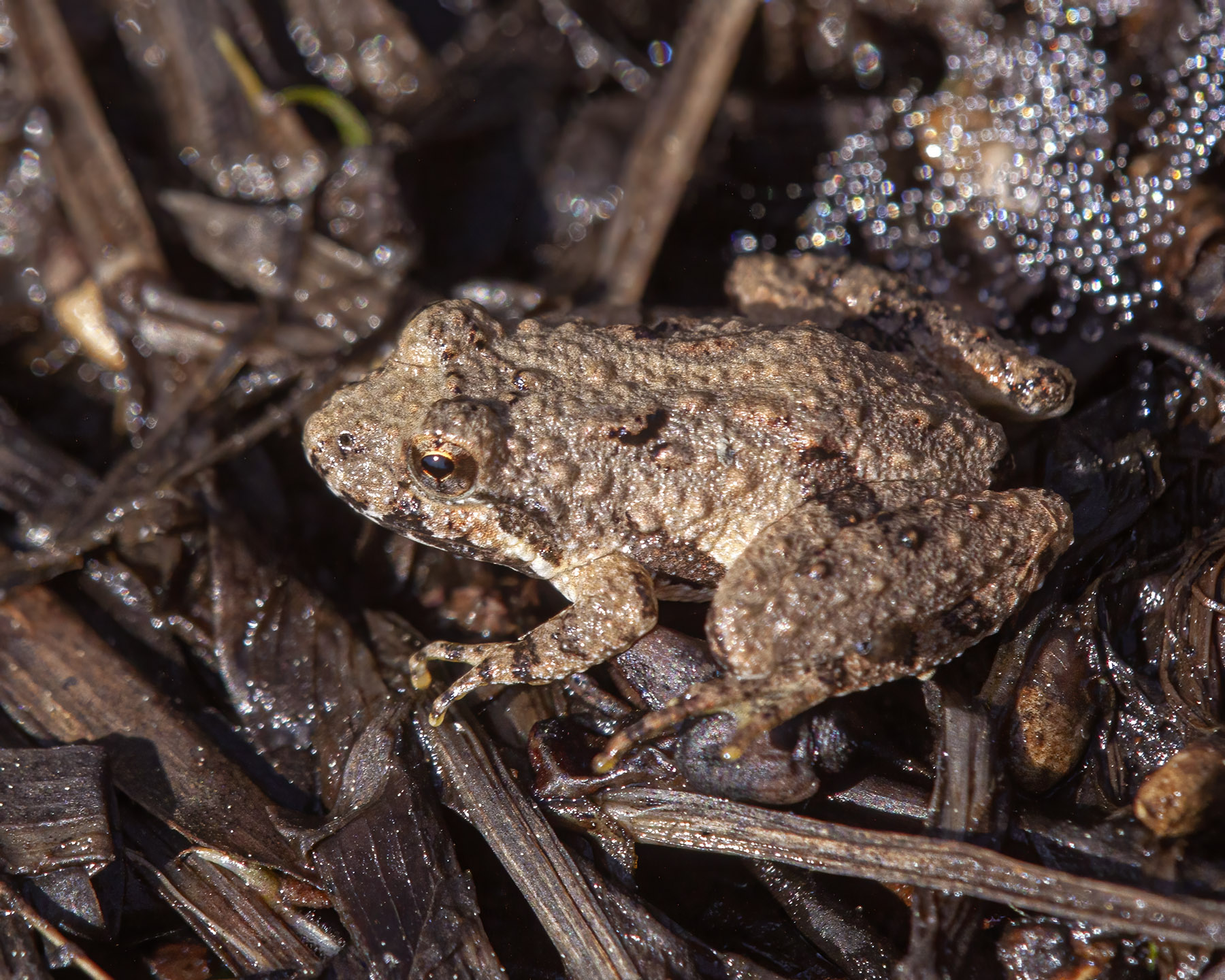
Following the lead of fellow photographer Steve Gingold, I decided that today is a Frog Friday. I spotted these Eastern Cricket Frog (Acris crepitans), one of the smallest frogs in Virginia, on Monday as I was exploring in Prince William County. I really like frogs and was happy to capture some of the cool details of these frogs in these shots, like their tiny toes.

Be sure to check out Steve’s blog posting for today entitled Frog Friday—before and after. While you are there, I encourage you to poke about on his site—Steve has an amazing array of nature photos that he has taken, primarily in the western part of Massachusetts.

Cricket Frog

Cricket Frog

Cricket Frog

© Michael Q. Powell. All rights reserved.
Read Full Post »

The ground in the forest is covered with fallen leaves at this time of the year, making it really easy to spot a Six-spotted Tiger Beetle (Cicindela sexguttata). The metallic green of their bodies shines so brightly that it is almost impossible to miss them as they scurry in and out of the underbrush.

I spotted this little beauty on Monday as I searched for dragonflies in Prince William County, Virginia. After months of photographing birds, often at a great distance, my eyes are gradually readjusting to searching for small subjects at close range. In the springtime I switch to using a macro lens most of the time rather than the long telephoto zoom lens that has been my constant companion throughout the cold, dark days of winter.

I also tend to slow down my pace as I search for tiny insects, scanning for changes in colors and patterns and, most importantly, for movement. In this style of photography, I cannot afford to be in a hurry and often my patience are persistence are rewarded.

Six-spotted Tiger Beetle


Six-spotted Tiger Beetle

© Michael Q. Powell. All rights reserved.

Read Full Post »

Ospreys (Pandion haliaetus) were really vocal and active last week at Occoquan Bay National Wildlife Refuge.  Most often, though, the ospreys were flying out of range of my lenses, so getting shots of them was a bit of a challenge.

Eventually I manage to get a shot of some  perched ospreys. In the first and third photos, the osprey appeared to have a fish that it kept hidden from me. Perhaps it had had a recent experience with an eagle trying to steal its catch and consequently was hyper-possessive now. I think that attitude also explains why the bird was in a defensive, crouched position and would look around before taking a bite of the unseen fish.

The middle photo shows an osprey on a nest that is being constructed on a channel marker in the waters off of the wildlife refuge. In the past,I have photographed much larger nests on this same buoy—check out my blog posting entitle Defying gravity from last year to see a photo of a previous iteration of a nest at this spot.

In the last few days some local photographers have posted photos of warblers at this wildlife refuge, so I will be looking for small birds as well as the larger, more visible ones like these ospreys. Insect activity is beginning to pick up too, so it looks like April will be a busy time for me and my camera.

osprey

Osprey

osprey

© Michael Q. Powell. All rights reserved.


Read Full Post »

I love seeing the differences between juvenile and adult Bald Eagles—the coloration and markings of the eagles change dramatically over time. Earlier this week I did a posting called Two eagles that showed two juvenile eagles perched in a tree. One of them was quite young and the other was almost an adult. It was really easy to see the differences between the two stages of development, with only the older one showing the distinctive white head feathers.

Today I am featuring in-flight photos of two eagles that I spotted last Monday while exploring Occoquan Bay National Wildlife Refuge. The first photo shows a juvenile Bald Eagle that looks to be about two to three years old. The head appears to be dark and the there is a mottled mixture of white and brown feathers. The second image shows a mature Bald Eagle with a white head and uniformly dark feathers.

It is an awesome experience for me when eagles fly almost directly over me and I love trying to get shots of them. I never fail to be impressed by their amazing wingspans, which can reach more than seven feet (213 cm).

Bald Eagle

Bald Eagle

© Michael Q. Powell. All rights reserved.

Read Full Post »

Most of the times when I photograph an Osprey (Pandion haliaetus), the bird appears to be long and lanky. The angle at which I photographed this osprey, however, distorted its proportions, making it seem more short and squat than normal. The spherical head and the osprey’s exaggerated expression of curiosity and surprise help to make this image feel comical and cartoonish—I can’t help but smile every time that I look at the photo.

There are quite a few ospreys now at Occoquan Bay National Wildlife Refuge and quite soon they will be working on their nests. I hope to be able to capture some shots of that activity. Now that we have moved into April, I will start to switch some of my focus to searching for dragonflies. With a bit of luck, I will see my first dragonflies of the year with a week or two.

Osprey

© Michael Q. Powell. All rights reserved.
Read Full Post »

When it comes to aerial skills, Tree Swallows (Tachycineta bicolor) are some of the most agile fliers that I have ever observed. On Monday I watched in awe and amazement as a small group of tree swallows swooped and zoomed over the waters off of Occoquan Bay National Wildlife Refuge. The flight of these tiny birds was graceful and mesmerizing, full of acrobatic twists and turns.

It was a real challenge, though, to take photos of birds that are so small and so fast. I was especially happy when I managed to capture the first image that shows a pair of swallows with their wings fully extended. The second shot shows a swallow gliding low over the water—the shape of the bird reminds me of a stealth aircraft skimming low over the earth to avoid being detected by radar.

I did not realize that Tree Swallows had returned to our area. There are several nesting boxes at this wildlife refuge that Tree Swallows regularly use, so I will have to check them out soon.  Sometimes there is a competition between Tree Swallows and Eastern Bluebirds for the nesting boxes. I am not sure how they decide who will get to use the boxes, but somehow they figure it out. Tree Swallows

tree swallow

© Michael Q. Powell. All rights reserved.


Read Full Post »

I was excited to spot quite a few Bald Eagles (Haliaeetus leucocephalus) on Monday at Occoquan Bay National Wildlife Refuge. It was especially cool because the eagles that I observed were at different stages of development. Bald Eagles are mostly brown in color when they are born and it takes almost five years for them to mature and develop the white feathers on their head that we associate with Bald Eagles.

The eagle on the left in both of the photos is a really young one. I initially thought it might be a fledging that was born this year, but it seems too early for one to have already reached this stage of development. Perhaps this eagle is a year old, judging from its coloration and markings.

I thought that the other eagle was the same one in both photos, but the markings in the first photo show some dark feather on the head and some mottled coloration on the body that seems to me missing on the adult bald eagle in the second photo. I would guess that the “other” eagle in the first photo is about four years old.


Bald Eagles

Bald Eagles

© Michael Q. Powell. All rights reserved.

Read Full Post »

I could not get an angle that let me see what this Eastern Gray Squirrel (Sciurus carolinensis) was eating earlier this month at Occoquan Bay National Wildlife Refuge, but I was very much taken by the cute way that it had curled up its tail as it was eating. Normally I think of a squirrel with its long fluffy tail trailing behind it, so I was surprised to see the tail pulled into the squirrel’s body, making the small animal look even smaller.

In addition to the curious tail position, I like the way that I was able to capture the texture of the branch. The color of the branch was almost a perfect match for the squirrel’s fur and the brownish buds were almost the same color as the fur surrounding the squirrel’s eye.

squirrel

© Michael Q. Powell. All rights reserved.


Read Full Post »

As I was scanning my neighbor’s garden for new growth yesterday, a small bit of bright orange caught my eye. I moved closer to see what it was and was shocked to find a tiny ladybug crawling around one of the plants.

The ladybug was pretty active, moving up and down the leaf, so it was challenging to get a shot of it. Eventually, though, my patience paid off and I was able to capture this image. Later in the year photos like this will become more commonplace, but during the month of March I am overjoyed whenever I have a chance to photograph an insect.

I did not get a good look at the face of this insect, so I cannot tell if it is an Asian Lady Beetle (Harmonia axyridis) or one of the native ladybugs, which are less common in most areas. Whatever the case, there is something whimsical about ladybugs that makes me smile, so I was happy to spot this one.

ladybug

© Michael Q. Powell. All rights reserved.

Read Full Post »

I note the transition to spring in small ways, quite often in the reappearance of familiar species of plants, insects, and other living creatures. I was delighted on Monday to discover that tiny Virginia Spring Beauty wildflowers (Claytonia virginica) have already started to push their way up from the forest floor in Prince William County. According to Wikipedia, the individual flowers bloom for three days, although the five stamens on each flower are only active for a single day.

On the same day, I spotted an Eastern Comma butterfly (Polygonia comma), the first full-sized butterfly that I have been able to photograph this year. I was not able to get very close to the butterfly, but you can see the beautiful orange pattern of its inner wings in the middle shot below.

The final image shows a Spotted Turtle (Clemmys guttata) that I spotted last week. This species seems to be found only in shallow marshy areas and I rarely encounter one, so it was exciting to be able to photograph it.

We all celebrate different signs of spring at this time of the year (or of autumn if you live in the Southern Hemisphere). What indications do you look for that signal the change of the season?

Spring Beauty

Eastern Comma

spotted turtle

© Michael Q. Powell. All rights reserved.


Read Full Post »

I was happy on Monday to photograph my first butterfly of the year, which appears to be the appropriately named Spring Azure butterfly (Celastrina ladon). Earlier this season I have spotted several Mourning Cloak butterflies, but was not able to get a shot of any of them.

The Spring Azure butterfly is only about an inch (25 mm) in size, but has some wonderful details that I was able to capture. It is fairly nondescript in color until it opens its wings and reveals a beautiful shade of blue—you get a small glimpse of that wonderful blue in the second image.

I had to pursue this butterfly for quite a while before it finally landed. An outside observer might have have wondered what it the world I was doing, but chasing butterflies always makes me feel like a child again.

It won’t be long before I see much bigger and more colorful butterflies, but this one is special to me as the first butterfly of the spring that I was able to photograph.

Spring Azure

Spring Azure

Spring Azure

© Michael Q. Powell. All rights reserved.


Read Full Post »

It was sunny and warm on Monday, so I went off in search of dragonflies. There has already been at least one sighting of a dragonfly this month in Virginia, but it realistically is still a bit early for any to appear in the northern part of the state where I live. I searched diligently at a pond and at several small streams in Prince William County, but did not find any dragonflies or damselflies.

I was happy, however, to spot several Eastern Cricket Frogs (Acris crepitans crepitans). These frogs are tiny, with a length of about 5/8 to 1-3/8 inches (16-35 mm). One of the most distinctive things about this species is the male mating call that resembles the sound of two stones being hit together or perhaps is similar to the sound of a cricket.

According to the Virginia Herpetological Society, “This species prefers grassy margins of ponds, ditches and wetlands. Permanent bodies of water with emergent or shoreline vegetation and exposure to the sun are preferred habitat,” a perfect description of the locations where I spotted these frogs.

Each year I am confused when researching this species, because I see references to Eastern Cricket Frogs and Northern Cricket Frogs used almost interchangeably. If I understand it correctly Northern Cricket Frog (Acris crepitans) is the species name and Eastern Cricket Frog (Acris crepitans crepitans) is one of the subspecies.

As you can see from these images, cricket frogs blend in really well with their surroundings. If I had not seen these frogs jump to their new locations, I am pretty sure that I would not have seen them. I walked around all day with my 180mm macro lens attached to my camera and it served me well to capture some of the details on the bodies of the little frogs. I attempted to get as low as I could and to shoot from the side in order to get as much of the frog in focus as I could, so muddy knees were inevitably one of the “benefits” of getting these shots.

cricket frog

cricket frog

© Michael Q. Powell. All rights reserved.


Read Full Post »

I don’t see Ring-necked Ducks (Aythya collaris) very often, so I was happy to spot this little group of them last week at Occoquan Bay National Wildlife Refuge. Although this looks like a ménage à trois situation with a male duck in the middle of two females, there actually was another male who was out of the frame when I took this photo. Ring-necked Ducks are a migratory species that overwinters with us and I suspect that these ducks will soon be leaving our area for more northern locations.

Ring-necked Duck

© Michael Q. Powell. All rights reserved.

Read Full Post »

Sometimes I feel compelled to throw back my head and sing at the top of my lungs, as this Bald Eagle (Haliaeetus leucocephalus) was doing when I spotted it last week at Occoquan Bay National Wildlife Refuge. It might be somewhat of an exaggeration to call it “singing”—the eagle was calling out to its mate, I believe, in a somewhat unmelodious way, but it was a cool experience nonetheless.

The Cornell Lab of Ornithology had the following description of a bald eagle’s calls, “For such a powerful bird, the Bald Eagle emits surprisingly weak-sounding calls—usually a series of high-pitched whistling or piping notes.” Check out this link to a Cornell Lab webpage that has several sound samples of an eagle’s call. According to a National Public Radio report, Hollywood movies often dub over an eagle’s call with a Red-tailed Hawk’s cry, which is much more majestic, so you may be surprised to hear what a bald eagle actually sounds like.

bald eagle

bald eagle

bald eagle

© Michael Q. Powell. All rights reserved.

Read Full Post »

Turtles were out in force on Wednesday at Jackson Miles Abbott Wetland Refuge, including these three that appeared to be practicing social distancing. They looked to me to be different species—a Red-eared Slider, maybe a Northern Red-bellied Cooter, and one that I’m really not sure about.

I must confess that I am not very good at identifying different types of turtles, especially when they are covered in dried mud. The middle turtle was shockingly clean and had especially beautiful and colorful markings. Be sure to click on the image to get a better look at the turtles. If you know a lot about turtles, I would welcome your assistance in identifying the species of these three turtle that were basking in the sunlight on an unusually warm March day.

turtles

© Michael Q. Powell. All rights reserved.

Read Full Post »

There was a lot of activity on Tuesday at the large Bald Eagle (Haliaeetus leucocephalus) nest at Occoquan Bay National Wildlife Refuge. I still cannot determine if any eaglets have hatched, but several times I observed an eagle fly into the nest or fly out of it. The nest is so deep that an eagle is often hidden from view when sitting on an egg—the only way to know for sure that an eagle is present is when one of them arrives or departs.

The eagle in the first photo was arriving and had spread its wings to slow down its speed and forward momentum. In the second photo, an eagle that was in nest had popped its head up and was looking towards a nearby tree where its mate was perched. After the eagle had reassured itself that everything was ready, the two eagles executed a changing of the guard ceremony—the eagle in the nest flew away and the perched eagle took its place. I captured the third image just as the eagle was taking off from its perch to take its turn watching over the nest.

Bald Eagle

Bald Eagle

bald eagle


© Michael Q. Powell. All rights reserved.

Read Full Post »

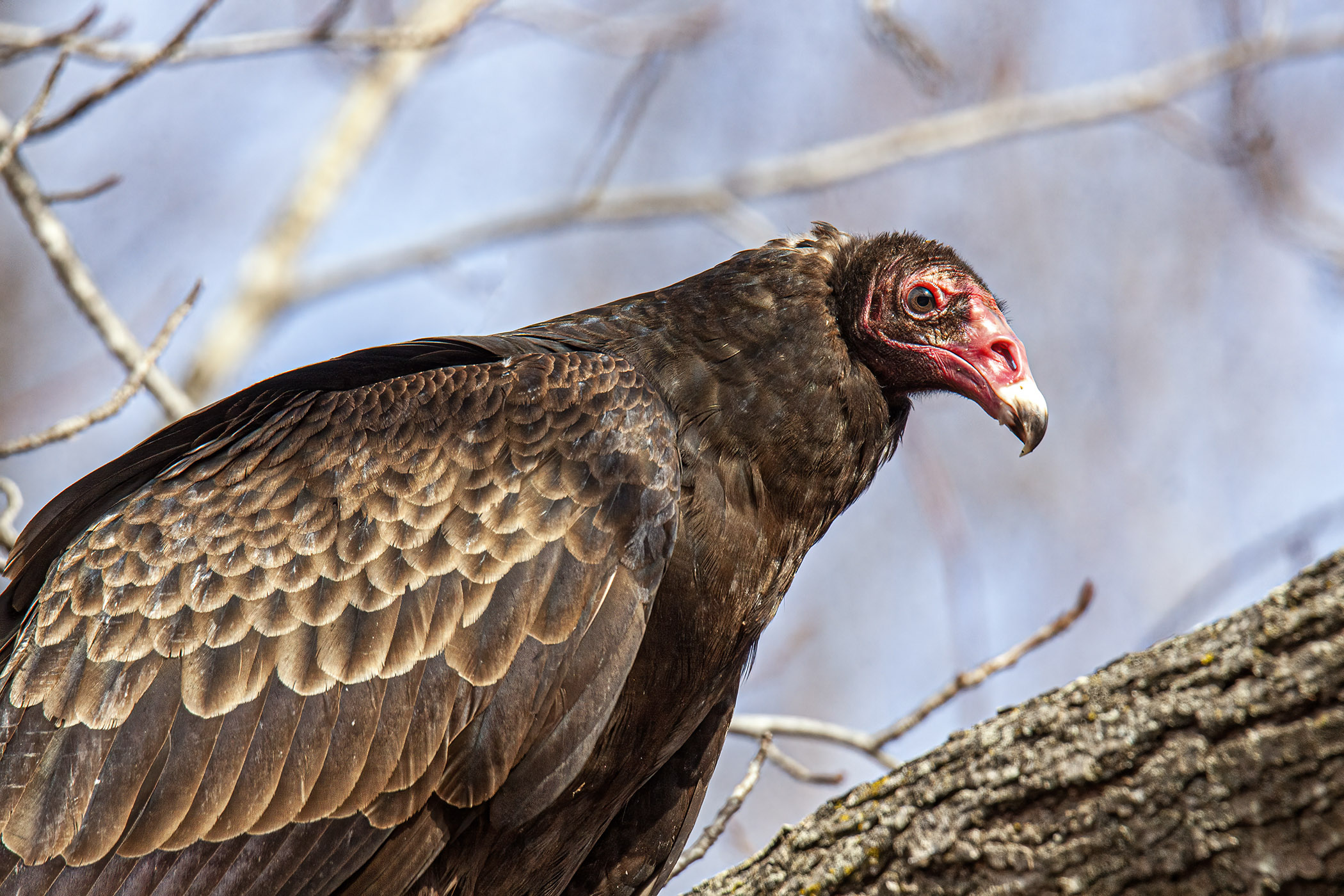
I would not necessarily call this Turkey Vulture (Cathartes aura) handsome, but I am happy with the way that I was able to capture a bit of the bird’s personality in this close-up portrait shot. I spotted this vulture last week as it perched low in a tree just off the edge of a trail that I was following at Occoquan Bay National Wildlife Refuge.

Some people are freaked out by the fact that vultures eat carrion, but most people acknowledge that these scavengers play a valuable role in our ecosystems. I am ok with a turkey vulture’s dietary choices, though I would probably refuse to join a turkey vulture in a meal if one of them made such an offer.

Turkey Vulture

© Michael Q. Powell. All rights reserved.

Read Full Post »

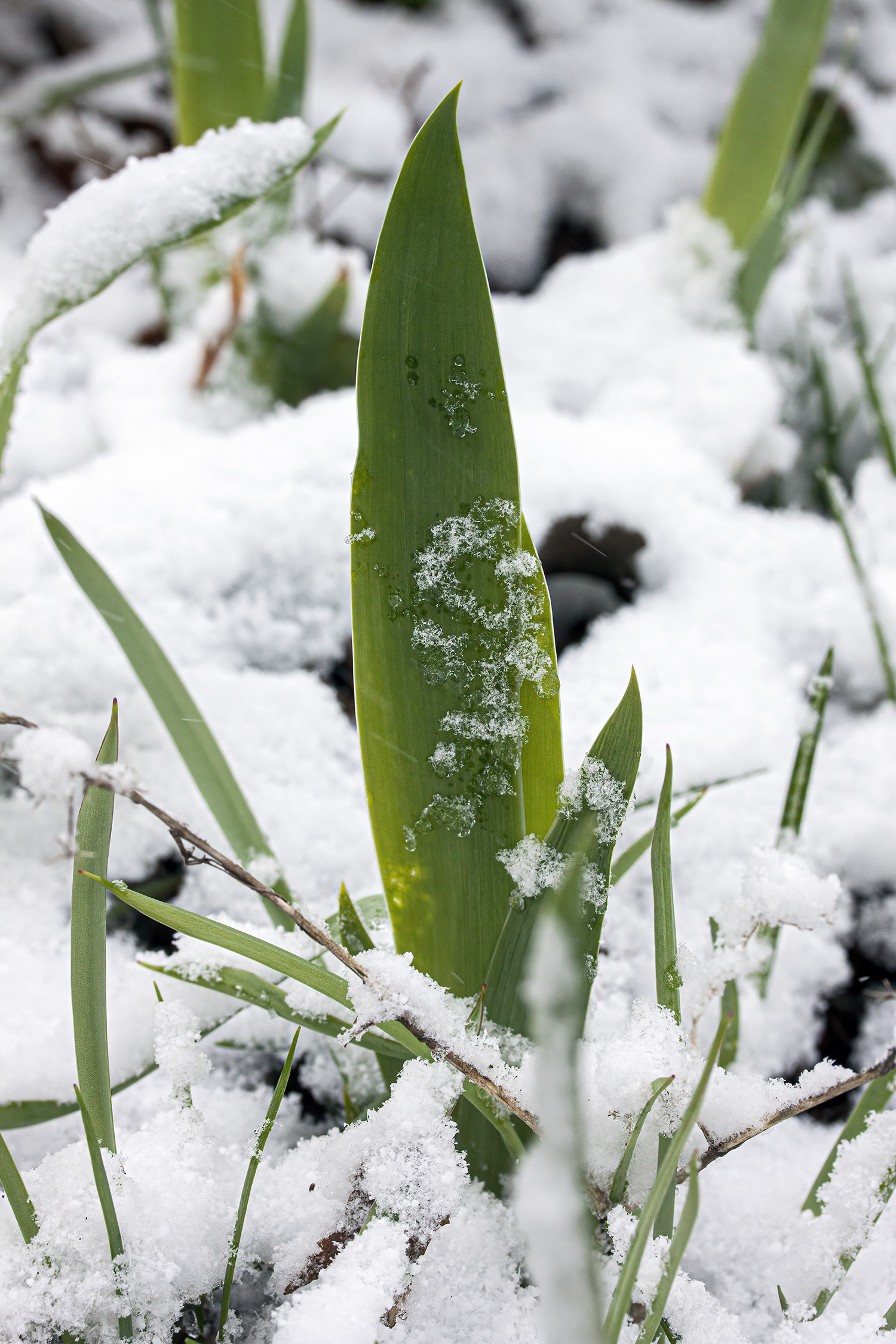
My thoughts have already turned to spring, with visions of colorful flowers and dragonflies dancing in my head. However, it turns out that winter was not quite done and last weekend we had a couple of inches of snow, a final hurrah for the season of winter.

Here are a couple of shots of my “winter dragonfly,” a metal sprinkler in my front yard that I featured in a previous post that showed the intricate detail of the dragonfly. I am also including a shot of some of the green shoots in the garden of my neighbor and fellow photographer Cindy Dyer. I think some of these might be tulips, but must confess that I am pretty clueless when it comes to plants.

Many of you know that I am somewhat obsessed with dragonflies. In 2020 I saw my first dragonflies of spring on the 3rd of April, the earliest I have ever seen dragonflies—see my 6 April 2020 posting First dragonflies of the season. I will probably go out and search for them in earnest during the final week of March. There are a couple of early emerging local species that I will be searching for along with migrant species like the Common Green Darner that might be passing through our area.


dragonfly

dragonfly

plant

© Michael Q. Powell. All rights reserved.

Read Full Post »

Some of the Ospreys (Pandion haliaetus) that I spotted last week at Occoquan Bay National Wildlife Refuge seemed to be making early claims on the existing nests from last year, while others were simply perched on trees throughout the refuge. Mostly they kept their distance, though, so I had to be content with relatively distant shots of these recently returned raptors.

osprey

Osprey

© Michael Q. Powell. All rights reserved.

Read Full Post »

Quite a few ospreys (Pandion haliaetus) have returned to Occoquan Bay National Wildlife Refuge and I spent a lot of time last Thursday trying to photograph them. Most of my efforts were focused on trying to capture images of them in flight.

Ospreys will fly in circles over the water and occasionally will hover and glide a little as they search for prey, which makes it somewhat easier to focus on them than on many other birds. However, it’s still a pretty formidable challenge to get shots in which the eyes are visible and in focus and in which the wing positions are good.

For the first image, I did not react quickly enough to zoom out when the osprey flew overhead, so I clipped its wings in the photo. I think that it is nonetheless a cool shot that provides a good look at the feather details of the osprey and at its eye and beak.

In the second shot, I captured the osprey at a moment when it had its wings fully extended. I like the way that the osprey’s yellow eye really stands out in the image.

I am sure that I will get lots of chances to photograph ospreys in the upcoming months, but it is always exciting me to them again for the first time each year—another sign that the seasons are changing.

osprey

osprey

© Michael Q. Powell. All rights reserved.

Read Full Post »

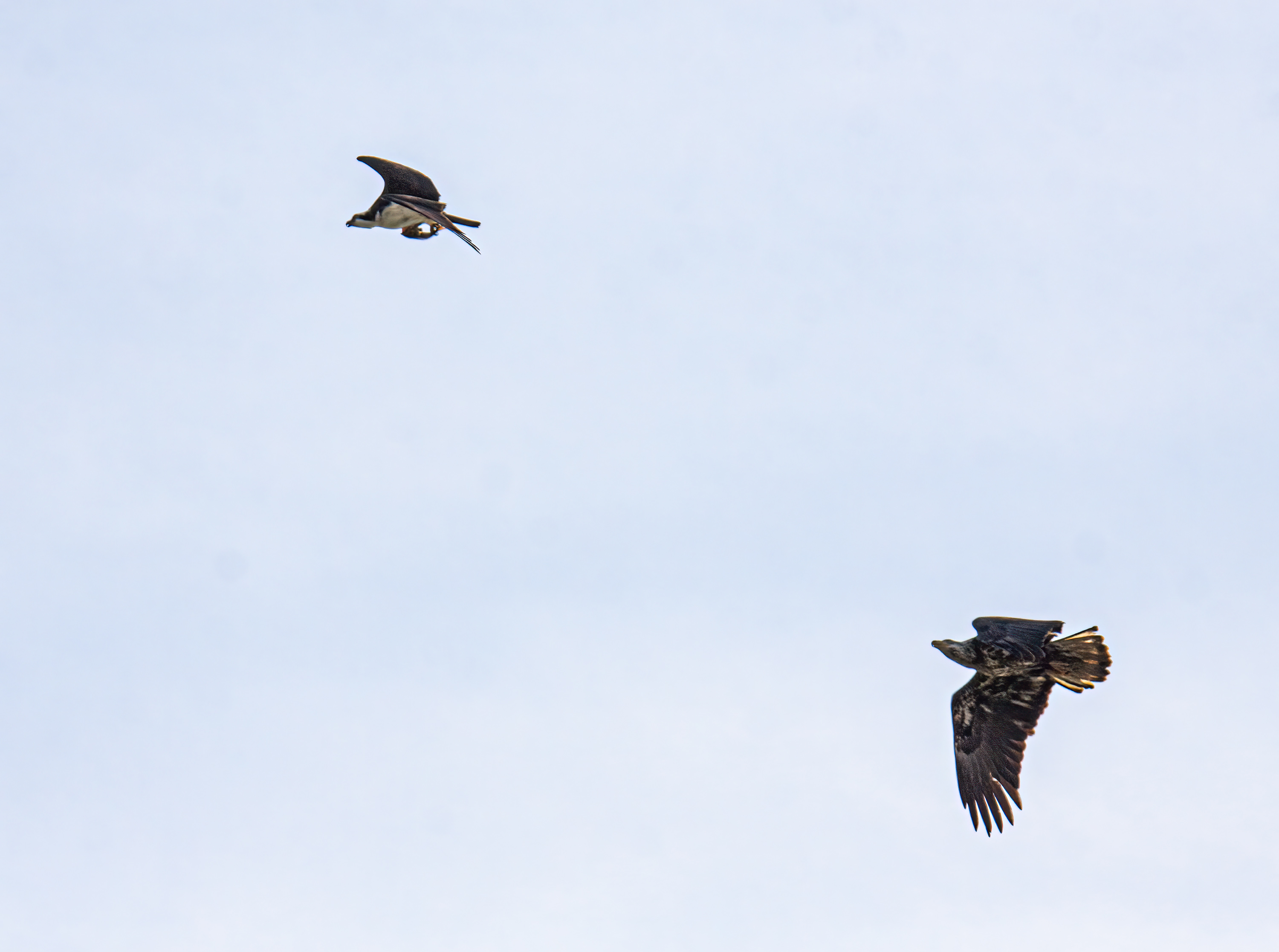
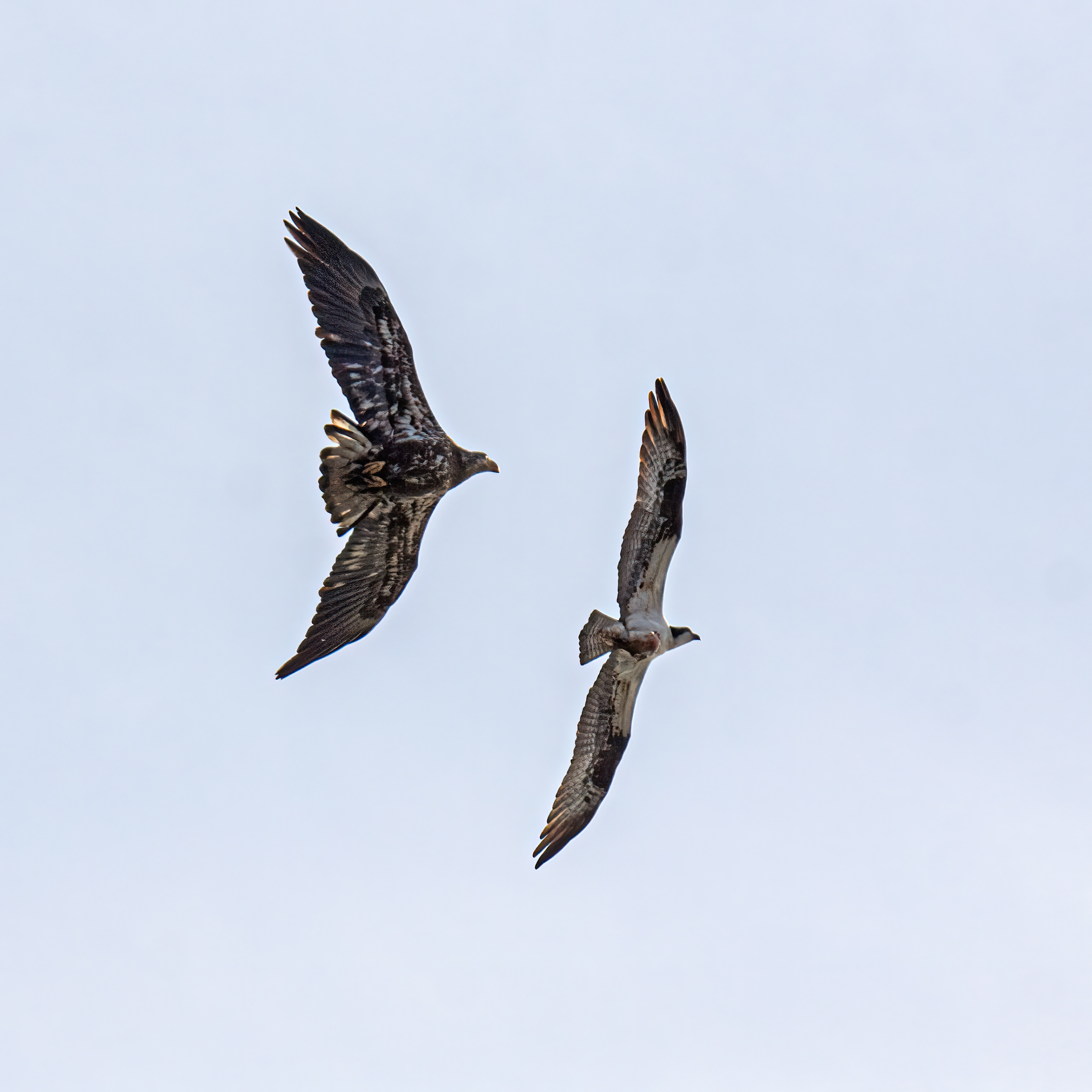
A juvenile Bald Eagle (Haliaeetus leucocephalus) tried to steal a fish from an Osprey (Pandion haliaetus) on Thursday at Occoquan Bay National Wildlife Refuge and chased it across the sky. It was quite an aerial dogfight. In the end, I think that the osprey dropped the fish and both birds ended up “empty-handed.”

Ospreys migrate away from my area for the winter and I was delighted to see that they had returned. I spotted at least a half-dozen or more ospreys and they were both active and vocal. Ospreys have high-pitched, distinctive voices that the Cornell Lab of Ornithology described in these words, ” Their calls can be given as a slow succession of chirps during flight or as an alarm call—or strung together into a series that rises in intensity and then falls away, similar to the sound of a whistling kettle taken rapidly off a stove.” Here is a link to a Cornell Lab webpage where you can listen to recordings of various osprey calls.

These three photos give you a general sense of the chase. In the first shot, you can definitely see the “prize,” the fish that the osprey had caught. In the second shot, the eagle has closed the distance separating it from the osprey. In the third shot, the osprey is doing its best to maneuver away from the eagle, but the eagle was able to match the osprey turn by turn. All of this took place over the water and eventually the two birds flew out of range.

eagle osprey chase

eagle osprey chase

eagle osprey chase

© Michael Q. Powell. All rights reserved.

Read Full Post »

This Bald Eagle (Haliaeetus leucocephalus) definitely had something to say when I spotted it last week at Occoquan Bay National Wildlife Refuge. I think I may have been guilty of eavesdropping, though, because the eagle appeared to be calling out to its mate.

One of the things that I really like about this image is the way that I was able to capture a sense of the rough texture of both the bark on the tree and the feathers on the eagle’s body.

Bald Eagle

© Michael Q. Powell. All rights reserved.


Read Full Post »

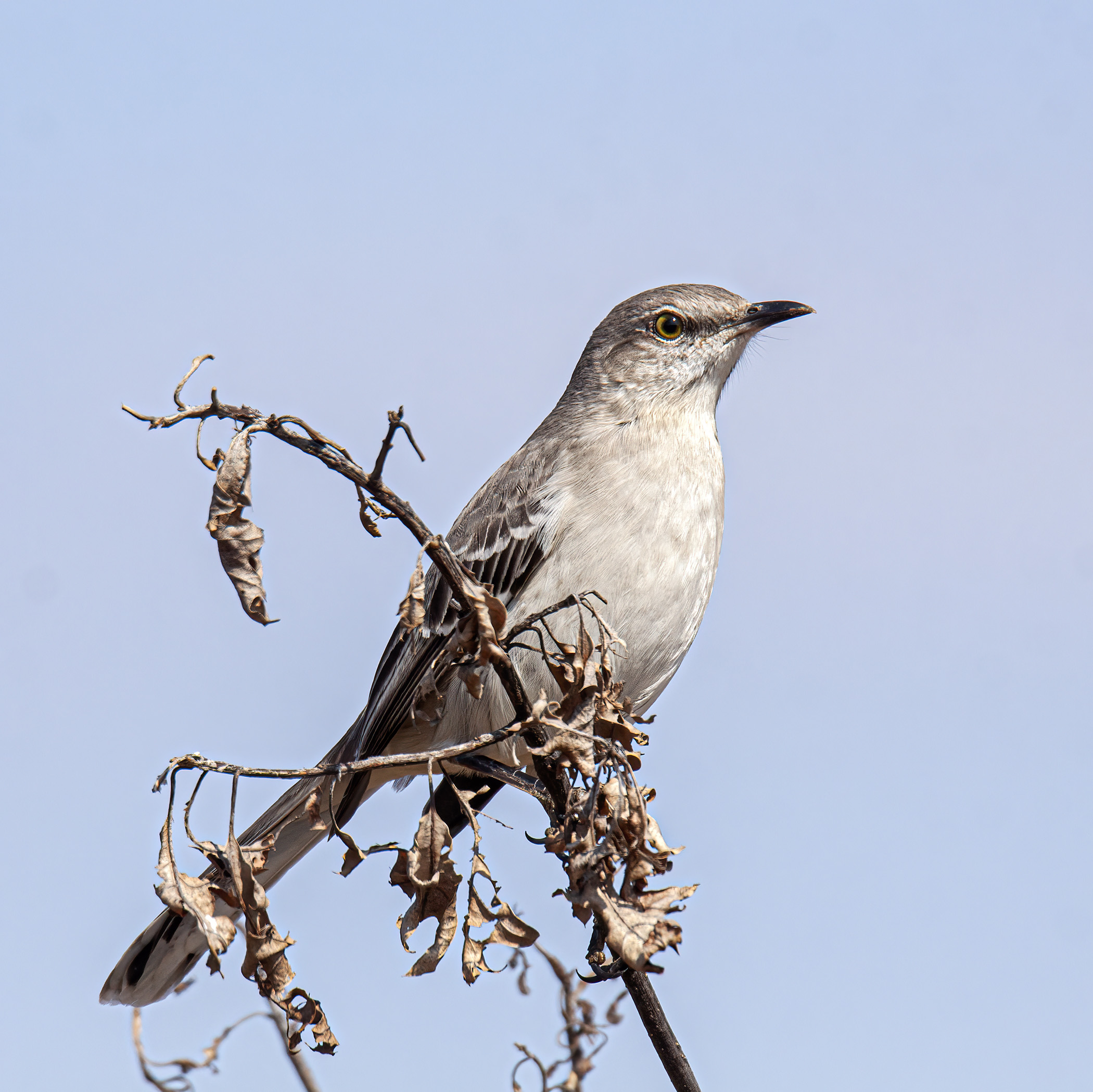
Perched high atop the vegetation, this Northern Mockingbird (Mimus polyglottos) posed for me during a recent portrait session at Occoquan Bay National Wildlife Refuge. The mockingbird could not decide which side was its best side, so I took profile shots with the bird looking in both directions.

I think the bird liked the results and tweeted them on Twitter.

Northern Mockingbird

Northern Mockingbird

© Michael Q. Powell. All rights reserved.

Read Full Post »

I was blessed to see multiple Bald Eagles (Haliaeetus leucocephalus) last Friday during a visit to Occoquan Bay National Wildlife Refuge. I am used to seeing two eagle couples that occupy the nests plus a few other from time to time. On this day, though, there seemed to be a whole lot more eagles than normal.

Seeing eagles is great, of course, but getting photos of them is not always easy. In the first photo, the eagle was flying almost directly over me and it is challenging to hold a long telephoto lens upright and track a moving subject. I am pretty happy with the way that this one turned out. If you click on the photo you can see the wonderful details of the eagle more closely, including what looks to a band on at least one leg and possibly on both of them—to me it looks like the eagle is flying with leg shackles.

In the second image, I captured an eagle as it was preparing to land on its nest. There was a lot of activity at that nest on that day, with both eagles flying in and out of that nest. It seems a bit early, but I wonder if there is a change that the eaglets have already hatched. The only way that I will know for sure that there are eaglets is if they pop their heads up. However, the nest is so deep that it will probably be a while before the eaglets are big and strong enough to be seen.

Bald Eagle

Bald Eagle

© Michael Q. Powell. All rights reserved.

Read Full Post »

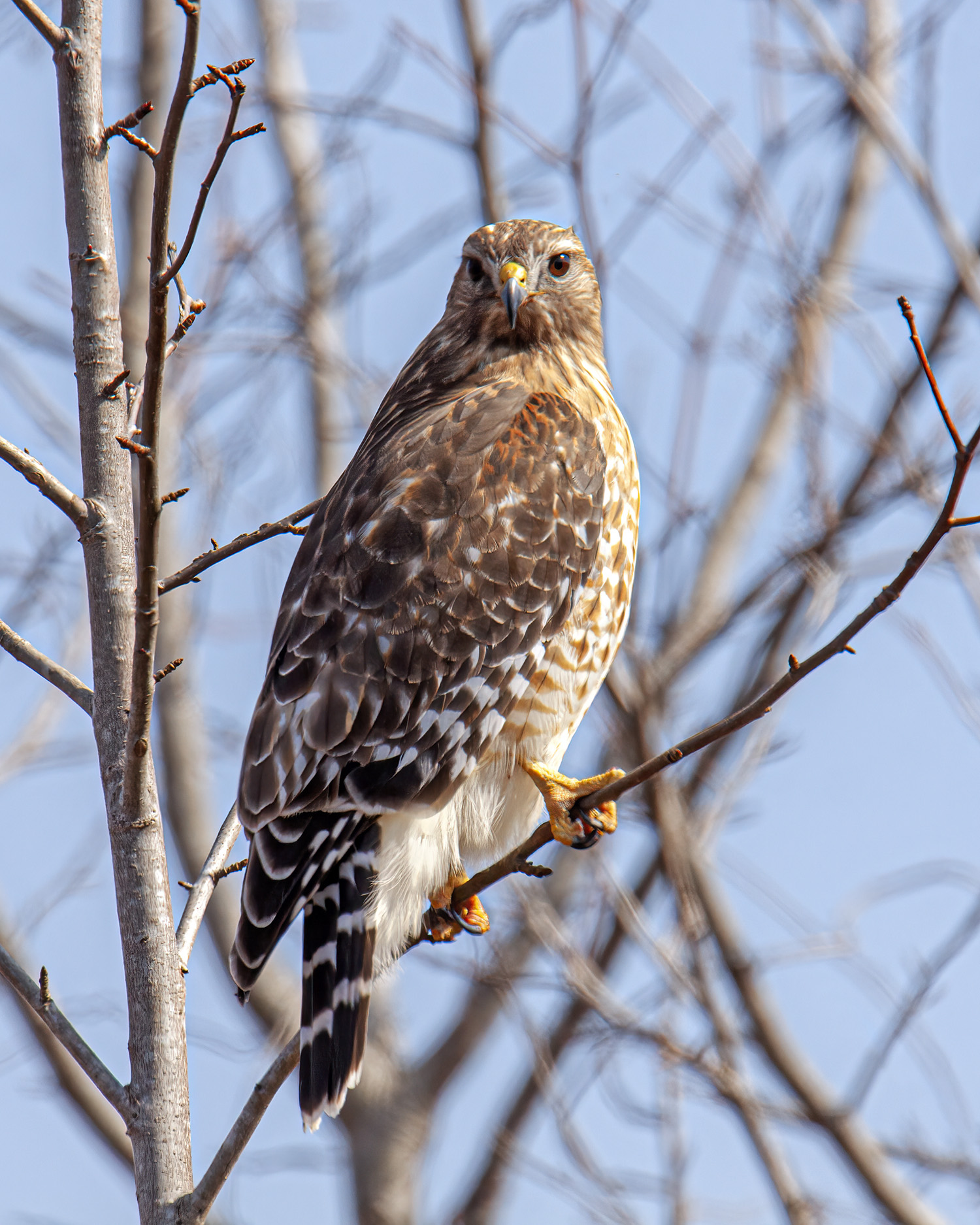
Normally when I see hawks, they are perched high in the trees, but last week I was fortunate to spot perched relatively low in some vegetation in a field at Occoquan Bay National Wildlife Refuge. When you have to shoot upwards at a sharp angle, you don’t miss a lot of details on the bodies of these beautiful birds—in this case I was able to shoot at a much lower angle at which I was almost eye to eye with the hawk.

The hawk, which I am pretty sure is a Red-shouldered Hawk (Buteo lineatus) was quite tolerant of my presence and allowed me to get shots from several different angles before it flew away. The middle image in particular suggests that it was well aware of my presence, but did not view me as a threat. I really like the way that I was able to capture the different colors and patterns in the feathers on the various parts of this hawk’s body.

If you compare the three shots, you can see how a subtle movement of a bird’s head or body position can alter the feel of the image in much the same way that a change in facial expression does with human subjects. The major difference, of course, is that you have a bit more control over your subject when it is a person. I must admit, though, that I sometimes try to telepathically instruct a wild subject, but it rarely seems to work.

Red-shouldered Hawk

Red-shouldered Hawk

Red-shouldered Hawk

© Michael Q. Powell. All rights reserved.

Read Full Post »

« Newer Posts - Older Posts »