Feeds:
Posts
Comments

Archive for the ‘wildlife’ Category

This past week I managed to get some more shots of American Rubyspot damselflies (Hetaerina americana) along the Colorado River in Bastrop, Texas. The sun was shining that day, unlike during my previous encounter with this species when the weather was overcast. This extra light helped to bring out the amazing colors and patterns on these spectacular damselflies.

The male in the first image displays well the bright ruby patch for which this species is named. Though they do not have such a distinctive red spot, the females in the second and third images are equally beautiful. I encourage you to click on the images to get a closer look at the wonderful details of these damselflies.

American Rubyspot

American Rubyspot

American Rubyspot

© Michael Q. Powell. All rights reserved.

Read Full Post »

I have always admired photos of Roseate Skimmers (Orthemis ferruginea), a spectacular dragonfly species in which mature males are bright pink in color. There have been a handful of sighting over the years of Roseate Skimmers at one of the parks I visit in Northern Virginia, but until last week I had never seen one.

A little over a week ago, when I spotted the dragonfly in the first photo, I knew almost immediately that it was a Roseate Skimmer, because of the shockingly pink color of its body. Later that day and on a subsequent walk along the Colorado River in Bastrop, Texas, I spotted other Roseate Skimmers, but did not realize that was what they were until much later.

Why did I have such trouble with their identification? When it comes to dragonflies, mature males tend to be brighter in color and have more distinctive markings than their female counterparts that have drab colors that are somewhat similar across species. Additionally, immature males often have the same coloration as the females.

So, when I posted the second photo below in an earlier posting and thought is might be a Variegated Meadowhawk, I was absolutely wrong. According to some experts in Facebook groups and at Odonata Central, the dragonfly is an immature male Roseate Skimmer.

The dragonfly in the final photo is a female Roseate Skimmer that I photographed a few days ago. Note how the coloration is similar to that of the dragonfly in the second photo. How do you tell them apart? If you look closely at the terminal appendages at the end of the abdomen (the “tail”) of the two dragonflies, you should be able to see that they are quite different in shape. Most often, those terminal appendage are key in distinguishing immature male dragonflies from females.

In a few days I will be heading home from Texas. It has been fascinating to see quite a few dragonflies, some of which have been new for me. Even here, though, I suspect that the season may be coming to a close soon. Earlier in the week temperatures were in the mid-80’s (29 degrees C), but I awoke this morning to a temperature of 41 degrees (5 degrees C) and we will drop even closer to the freezing level over the next couple of days.

Roseate Skimmer

Roseate Skimmer

Roseate Skimmer

© Michael Q. Powell. All rights reserved.

Read Full Post »

I have been a bit befuddled by the dragonflies that I have seen here in Bastrop, Texas and have misidentified about half of them. I was therefore delighted on Wednesday when I managed to get a few shots of a familiar species—a Common Green Darner.

The Common Green Darner dragonfly (Anax junius) had been patrolling overhead and I managed to track it when it came down to earth and perched low in the vegetation. I only had a little latitude in trying to frame my shot, because I know from experience that Common Green Darners can be very skittish. I varied my angle a little between shots by moving slightly, but most of the shots ended up looking pretty similar.

Common Green Darners are a migratory species and are one of the most common and abundant dragonfly species in North America. I love the beautiful colors of this species and am happy when I can get a shot, like the first one, in which you can see the bullseye marking on the “nose” of the dragonfly.

Common Green Darner

Common Green Darner

© Michael Q. Powell. All rights reserved.

Read Full Post »

Yesterday I spotted this really cool-looking dragonfly as I was exploring a meadow area beneath some power lines just off a trail along the Colorado River in Bastrop, Texas. My primary purpose for coming to Texas was to participate in a wedding last Saturday, but I am staying a few extra days to watch the couple’s two dogs while they are away on their honeymoon.

In a recent post, I featured photos of some dragonflies that I had spotted here in Bastrop last week. I identified one as a Russet-tipped Clubtail, a species I am used to seeing, but when I posted a photo in Odonata Central, an expert informed me that it was a female Narrow-striped Forceptail dragonfly (Aphylla protracta)

I believe that the dragonfly in this image is from that same species, possibly a male. I am not at all familiar with forceptail dragonflies, so I can’t tell if the terminal appendages (the “tail”) are the right shape. Whatever its identity, I love the image that I managed to capture of this beautiful dragonfly as it was briefly perching.

Narrow-striped Forceptail


© Michael Q. Powell. All rights reserved.

Read Full Post »
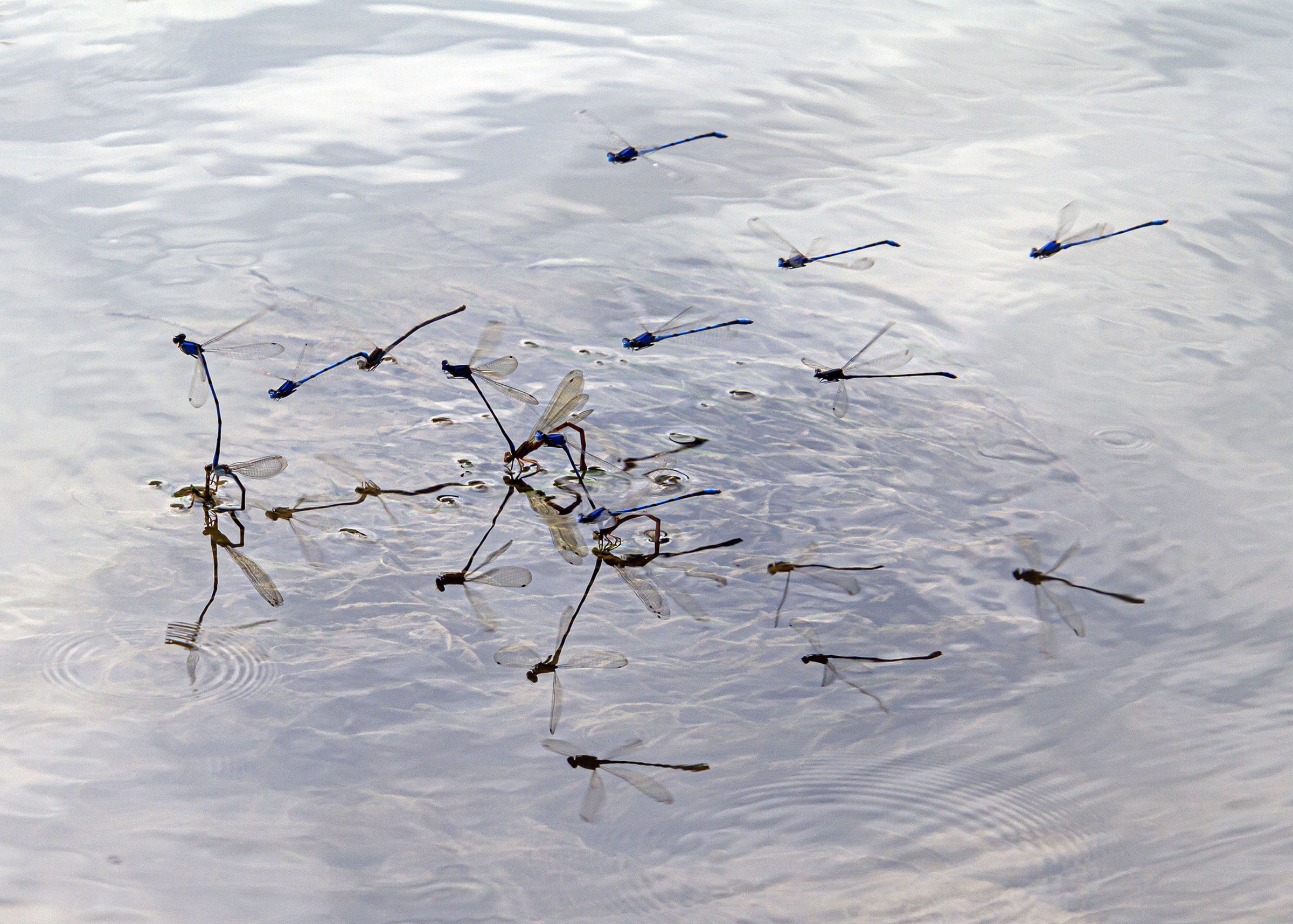
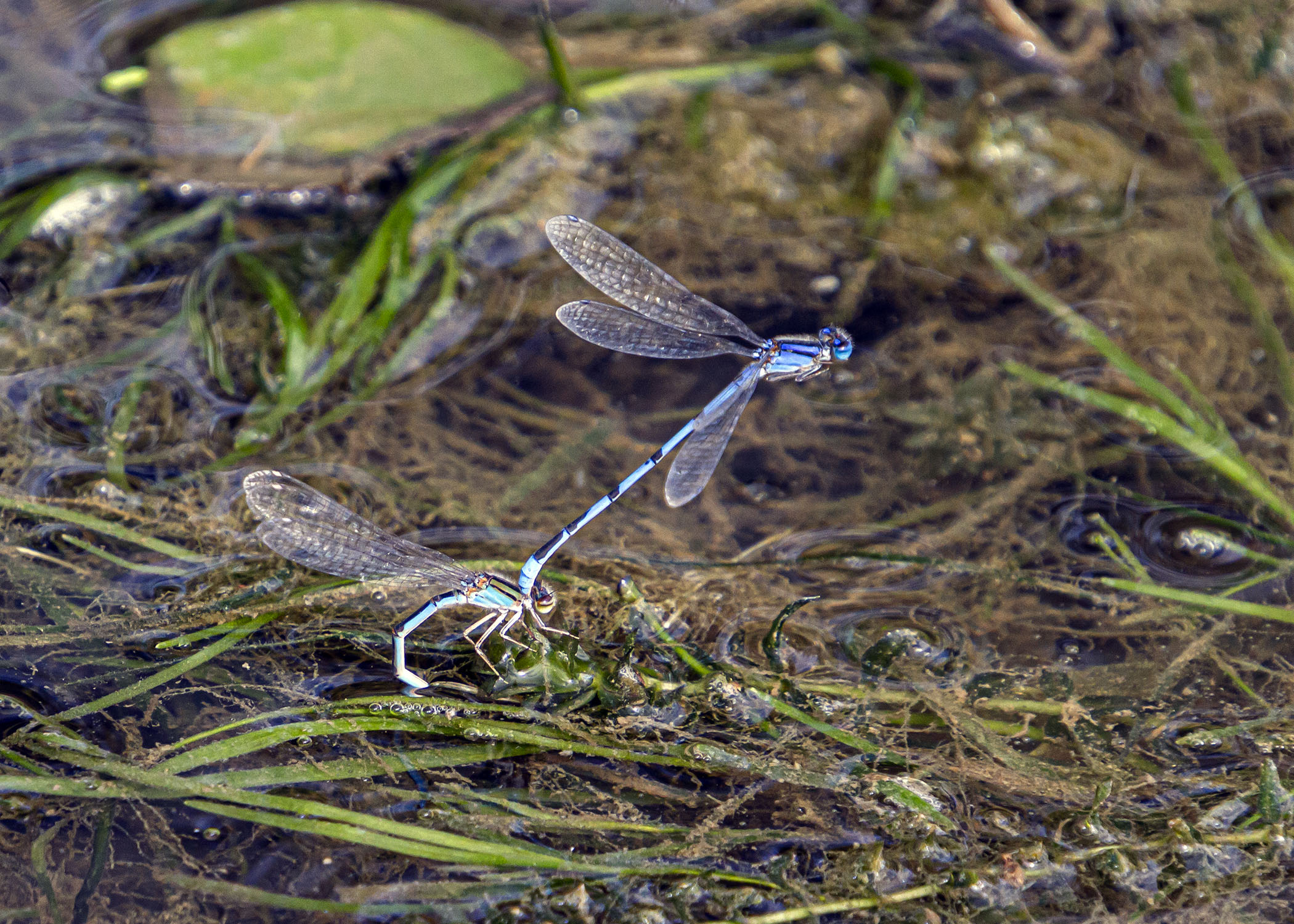
I don’t know what was so special about this spot on the Colorado River in Bastrop, Texas, but lots of couples in tandem as well as some single damselflies were concentrated in one small area last week. I love the way that the reflections in the water of the various flying damselflies makes it look like there were twice as many damselflies as were actually present.

The couple in the second image found a somewhat more private spot where the female can deposit her eggs underwater in the vegetation, while the male continues to grasp her head.

damselflies

damselflies

© Michael Q. Powell. All rights reserved.


Read Full Post »

I spotted this colorful Gulf Fritillary butterfly (Agraulis vanillae) perched on a cactus last week as I was exploring some trails along the Colorado River in Bastrop, Texas. This is the kind of shot that it would be impossible to capture in my home area, since neither the butterfly nor the cactus is found in the wild in Virginia.

Gulf  Fritillary

© Michael Q. Powell. All rights reserved.

Read Full Post »

Here are a couple of shots of what I believe are American Snout butterflies (Libytheana carinenta) that I spotted on 2 November in Bastrop, Texas. Although you can’t see the butterfly very well in the first shot, I really like the “artsy” feel of the image. The second shot has a completely different feel to me, perhaps because of the coolness of the green background vice the warmth of the yellow in the first image.

American Snout

American Snout

© Michael Q. Powell. All rights reserved.

Read Full Post »

Last Wednesday, 2 November, I took a walk along the Columbia River in Bastrop, Texas, not far from where I am staying, and was delighted to spot a number of different dragonflies. As I have found in the past, it is difficult to identify dragonflies (and birds) when I am outside of my home area. Sometimes the species are the same, but there may be regional variations. At other times, though, I have found species that are not present at all where I live.

The dragonfly in the first image looks like a female Russet-tipped Clubtail (Stylurus plagiatus), but I must admit that I am not very confident about that call. In the second, the dragonfly looks a bit like a female Eastern Ringtail (Erpetogomphus designatus). When it comes to the third dragonfly, I am not sure that I can even make a guess, other than the fact that it looks like some kind of skimmer.

It was really nice to extend my dragonfly season by traveling briefly to a warmer southern location. By early November, there will only a few dragonflies left in Northern Virginia when I return home next week.

Russet-tipped Clubtail

Eastern Ringtail

Eastern Ringtail dragonfly

© Michael Q. Powell. All rights reserved.

Read Full Post »

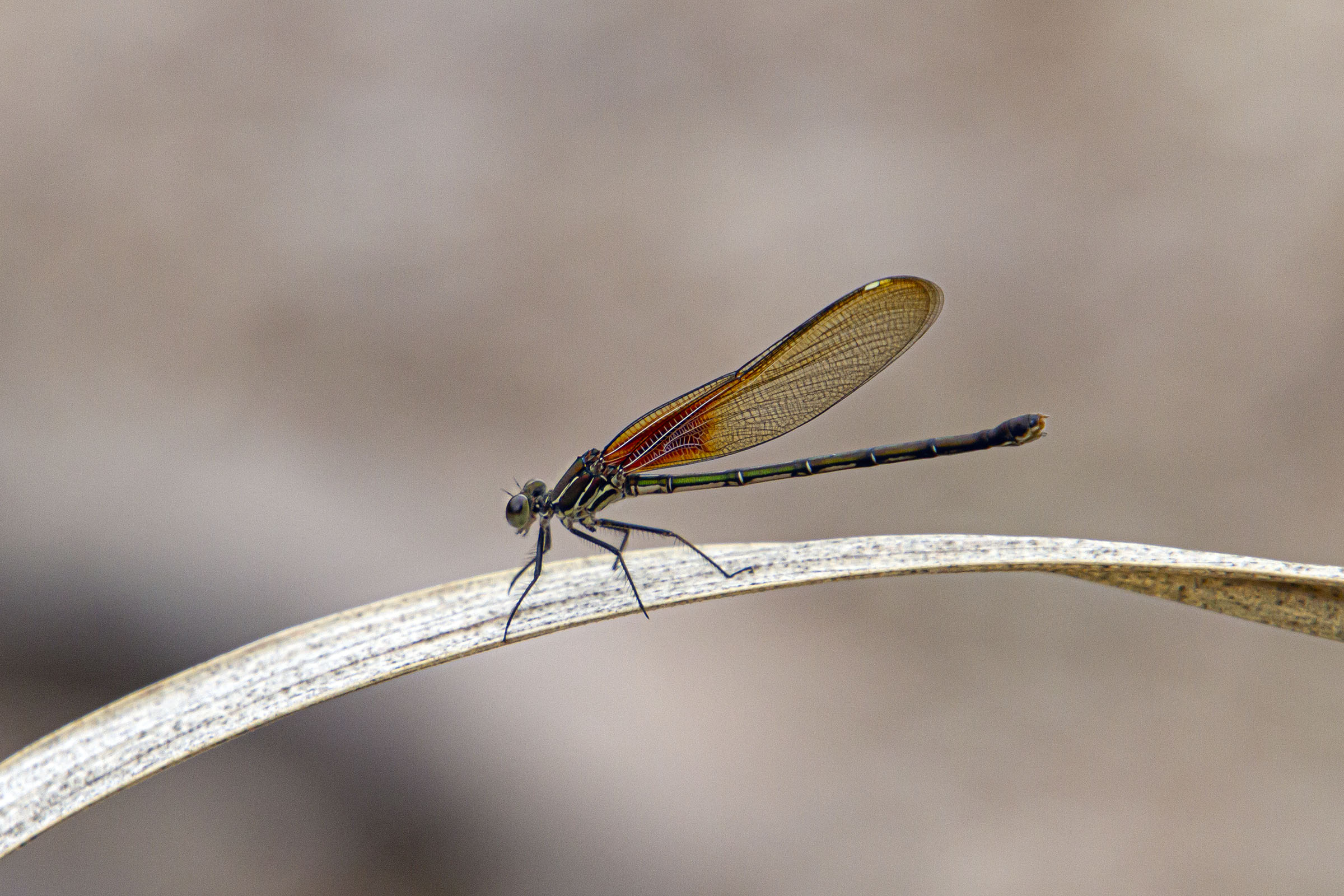
I was delighted on Tuesday to spot some damselflies along the edge of the Colorado River in Bastrop, Texas. I believe that they are American Rubyspot damselflies (Hetaerina americana), with a female in the first photo and males in the other two photos.

Normally I prefer natural perches vice manmade ones when photographing wildlife, but I really like the texture and color of the rusty corrugated drainage pipe on which the damselfly chose to perch for the final photo.

American Rubyspot

American Rubyspot

American Rubyspot

© Michael Q. Powell. All rights reserved.


Read Full Post »

I was thrilled yesterday afternoon to spot this Barred Owl (Strix varia) as I was walking on a trail along the Colorado River in Bastrop, Texas, within walking distance of my friends’ house where I am staying. The owl  appeared to be busy eating something when I first spotted it, as you can see in the second photo below, and may have been a little distracted.

I am not at all certain what was in owl’s mouth. Any ideas?

Barred Owl

Barred Owl

© Michael Q. Powell. All rights reserved.

Read Full Post »

I have arrived safely in Bastrop, Texas (just outside of Austin) for a family wedding after a long drive from Virginia that turned out to be 1560 miles (2510 km).

I don’t have any new photos to post, but thought I would feature an image of a female Autumn Meadowhawk dragonfly (Sympetrum vicinum) that I photographed a little over a week ago. I spotted this beautiful dragonfly at Occoquan Bay National Wildlife Refuge and was delighted to capture the shadow that the little dragonfly was casting on a colorful fallen leaf.

Thanks to all of you who responded to my recent request to subscribe to the YouTube channel of young UK-based wildlife photographer Toby Wood. He has now surpassed the required level of one thousand subscribers and his channel is now presumably eligible for monetization on YouTube.

Autumn Meadowhawk

© Michael Q. Powell. All rights reserved.

Read Full Post »
I have been pretty lucky recently in capturing images of birds in settings that include colorful fall foliage. On Tuesday I photographed a Yellow-rumped Warbler (Steophaga coronata) perched in a tree in full of persimmons at Occoquan Bay National Wildlife Refuge. I am not sure if the warbler was interested in the persimmons or if it was more interested in the poison ivy berries that you can see in the upper left portion of the image.

I do not know much about persimmons and can’t tell if the ones in the photo are ripe. I have been told that persimmons can be very tasty when ripe, but are very bitter when not yet ripe. To the best of my recollection I have never tasted one, but I know that the raccoons in another local park love to feed on these fruits.

Yellow-rumped Warbler

© Michael Q. Powell. All rights reserved.

Read Full Post »
I saw lots of Eastern Cottontail Rabbits (Sylvilagus floridanus) on Tuesday at Occoquan Bay National Wildlife Refuge. Usually I see the rabbits during the early and late hours of the day, but these ones were active at midday. There is something really gentle about these creatures that really calms and soothes me.

In the first photo, one of the rabbit lifted its head to check me out and stared right at me. Deciding that I was not a threat, it returned to contentedly nibbling on the grass. I love the way that the rabbit’s ears look like mini-antlers, making it look like a cross between a rabbit and a deer.

In the second image, I captured a view of two rabbits contentedly chewing on the grass in an area adjacent to the parking lot. Perhaps they were used to the presence of people or perhaps they were less alert because they were eating. Whatever the reason, I was able to get my shots without disturbing them. The two rabbits were too far apart to get them both in focus, so I chose to focus on the nearest one and like the effect that I achieved.

Eastern Cottontail Rabbit

Eastern Cottontail Rabbits

© Michael Q. Powell. All rights reserved.


Read Full Post »

I was amazed on Tuesday when I saw a Great Blue Heron (Ardea herodias) snag a really large fish in the shallow waters off of Occoquan Bay National Wildlife Refuge. The heron carefully made its way to a secluded area of the shore where it was hidden from view to enjoy its big catch. It might have been a bit of a struggle for the heron to swallow a fish that large, but I have seen Great Blue Herons swallow fish almost that big in the past.

I had been observing the heron for quite a while and had seen it catch numerous tiny fish as it waded about in the shallow water. Gradually the heron moved to slightly deeper water and continued to look for fish. All of the sudden the heron extended its neck and plunged its head forcefully into the water, extending its wings as it did so. The third image shows how committed the heron was as it submerged its entire upper body.

Once it had grabbed the fish underwater, the heron flapped its mighty wings, as you can see in the final photo, to generate enough force to pull the large fish out of the water. The first image shows the moment when the fish first came out of the water. The second image shows the heron as it slowly and gingerly walked to the shore—it apparently did not want to take the chance of losing its catch.

Tuesday was overcast and cool and up to that point in the day I had not had much success in finding subjects to photograph—this encounter priduced the catch of the day for me and probably for the heron too.

Great Blue Heron

Great Blue Heron

Great Blue Heron

Great Blue Heron

© Michael Q. Powell. All rights reserved.

Read Full Post »

I thought that the ospreys (Pandion haliaetus) in our area had already headed south, so I was pleasantly surprised to spot one last Friday at Occoquan Bay National Wildlife Refuge and was thrilled to be able to capture this image as it zoomed by me. During the summer there are multiple pairs of mating ospreys throughout the refuge and the ospreys are vocal and visible, but it had been at least a month since I had last seen an osprey.

Osprey

© Michael Q. Powell. All rights reserved.


Read Full Post »

I haven’t seen an American Goldfinch (Spinus tristis) for quite some time, so I was happy when I spotted this one last Friday at Occoquan Bay National Wildlife Refuge. The vegetation was mostly dried-out, but the goldfinch had no problem finding lots of little seeds. I love the way that the dull colors of the goldfinch were a match for those of the seed heads that surrounded the little bird.

American Goldfinch

© Michael Q. Powell. All rights reserved.

Read Full Post »

I enjoy watching videos on YouTube about all types of photography, especially about wildlife photography. Some of the channels feature well-established professional photographers with expensive gear who produce mind-blowing images. These photographers inspire me, but they are in such a different place on their photography journey than I am that I don’t feel a personal connection.

Increasingly I am drawn to small YouTube channels run by young wildlife photographers who are just starting out as professionals. It is hard to make a living as a photographer, but these photographers are passionate about photography and are energetically trying to turn their passion into a profession.

A while back I started following a young British wildlife photographer named Toby Wood. On his channel page he describes himself in these words, “I am a Photographer based in the UK who is passionate about turning memories tangible with photographs. On this channel you will predominantly see wildlife photography as this is where my true passion for photography began. Since turning photography into my job I also do events, portraits and business shoots to make ends meet.” Toby has an engaging personality and he takes his viewers along in many of his videos as he searches for wildlife subjects to photograph.

Over the past year, Toby has produced several hundred videos and is on the cusp of reaching a major YouTube milestone. In order to be monetized, a channel much have 1,000 subscribers and have a total of 4,000 watch hours during the past 365 days. When a channel is monetized, the content creator receives a portion of the advertising revenue for the ads shown by YouTube. Toby recently met the requirement for watch hours and currently has 963 subscribers.

Toby needs only 37 more subscribers and I wonder if I can get some of you to check out his channel at https://www.youtube.com/c/TAWoodPhotography and consider subscribing to his channel. It would mean an awful lot to this talented young photographer. Here is a copy of his request on Instagram for help in reaching this milestone.


I am also embedding a link here to one of Toby’s recent videos (https://www.youtube.com/watch?v=gBdFd3iWnoI) in which he takes on a challenge to take wildlife photos using a 50mm lens. This will give you a glimpse into his style of videos and I encourage you to explore some of the other videos on his channel. You can also check out his work on his website.

Thanks in advance for any on you who are willing to jump in and help Toby reach this significant milestone.

© Michael Q. Powell. All rights reserved.


Read Full Post »

As we move to colder temperatures, I am taking fewer photos of insects and more of birds, like this cool-looking House Finch that I spotted last Wednesday at Occoquan Bay National Wildlife Refuge. From a distance, I though that this perched bird might be a sparrow, judging from its basic coloration. When I got a little closer, I could see the conical-shaped bill and reddish tinge on the bird’s head and breast, so I immediately was able to tell that it was definitely not a sparrow.

At first glance, the two photos may look identical, but if you look closely, you’ll see that the bird’s head is in a different position in each image. Although the second image is a better profile shot, the birds’s face is in the shadows. In the first image, the bird had turned its head a little bit and the light was shining more directly on its face and produced a nice catchlight in its eye.

When I am taking photos of birds, I usually shoot in short bursts, because even perched birds around a lot and each movement may result in a different expression and pose.

House Finch

House Finch

© Michael Q. Powell. All rights reserved.

Read Full Post »

Last Friday at Occoquan Bay National Wildlife Refuge I captured this fun little image of a Yellow-rumped Warbler (Setophaga coronata) in mid-air as it hopped to a new position on a tree with colorful fall foliage. I am pretty sure that the warbler was stationary when I clicked off a short burst of shots and luck played a big role in me being able to capture this moment. Yellow-rumped Warbler

© Michael Q. Powell. All rights reserved.

Read Full Post »

As I was walking along on one of the trails at Occoquan Bay National Wildlife Refuge last Friday, I noticed a large spider coming in my direction at a pretty good clip. I gave the spider plenty of space, but managed to capture this image of what I believe is a Wolf Spider with my long telephoto lens.

Wolf spiders belong to the family Lycosidae and are among the most common spider species found around the world. According to an article entitled “Wolf Spider: Friend or Foe?” wolf spiders “are keen hunters that chase or pounce on prey like wolves rather than spin a web and wait for a meal. Unlike wolves hunting as packs, wolf spiders generally live and hunt alone. Hunting occurs both day and night.”

wolf spider

© Michael Q. Powell. All rights reserved.

Read Full Post »

Autumn Meadowhawk dragonflies (Sympetrum vicinum) love to perch on the ground and at this time of the year the ground is covered with fallen leaves in many places. Most of those leaves are brown, which makes for pretty good shots, but I am always hoping that an Autumn Meadowhawk will choose to perch on a more colorful red or yellow leaf. Last Wednesday at Occoquan Bay National Wildlife Refuge, I was fortunate when one of these colorful little dragonflies landed on a yellow leaf and I captured the first image.

Although the second and third images feature brown leaves, I love the textures and shapes of those leaves. I also like the way that the drabness of the leaves helps the bright red of the dragonfly’s body really stand out.

At this time of the year, most of my photographic subjects are likely to be birds, so I tend to walk around with my Tamron 150-600mm telephoto zoom lens on my camera. Although a long telephoto lens my not be my first choice for photographing such a small subject—an Autumn Meadowhawk is about 1.3 inches (33 mm) in length—I can get pretty good results if I am really careful in steadying the lens and paying attention to the focus point. All three of these images, for example, were shot with the lens fully extended to 600mm.

Autumn Meadowhawk

Autumn Meadowhawk

Autumn Meadowhawk

© Michael Q. Powell. All rights reserved.


Read Full Post »

I almost never get an unobstructed view of a warbler. Most of the time I see them flitting about in the foliage, making it difficult to get a clear shot of one. If I am lucky, I manage to capture an image, like the final one, when the warbler pokes its head out of the brush for a moment.

Last Wednesday at Occoquan Bay National Wildlife Refuge, I was shocked and delighted when I was able to take a series of unobstructed shots of a Yellow-rumped Warbler (Setophaga coronata) as it was feeding on some poison ivy berries. The first three images shows some moments from that encounter.

As I look at these four images, I am strangely drawn most to the final one. Despite the clutter of the branches in that shot, the warbler stand out—the branches serve as a kind of frame for the central subject. Now I really do like the way that the first two images capture the action of the bird and the way the third shot provides the best view of the perching warbler, but someone the environmental shot appeals to me most this morning as I am composing this posting. What do you think?

Yellow-rumped Warbler

Yellow-rumped Warbler

Yellow-rumped Warbler

Yellow-rumped Warbler

© Michael Q. Powell. All rights reserved.

Read Full Post »

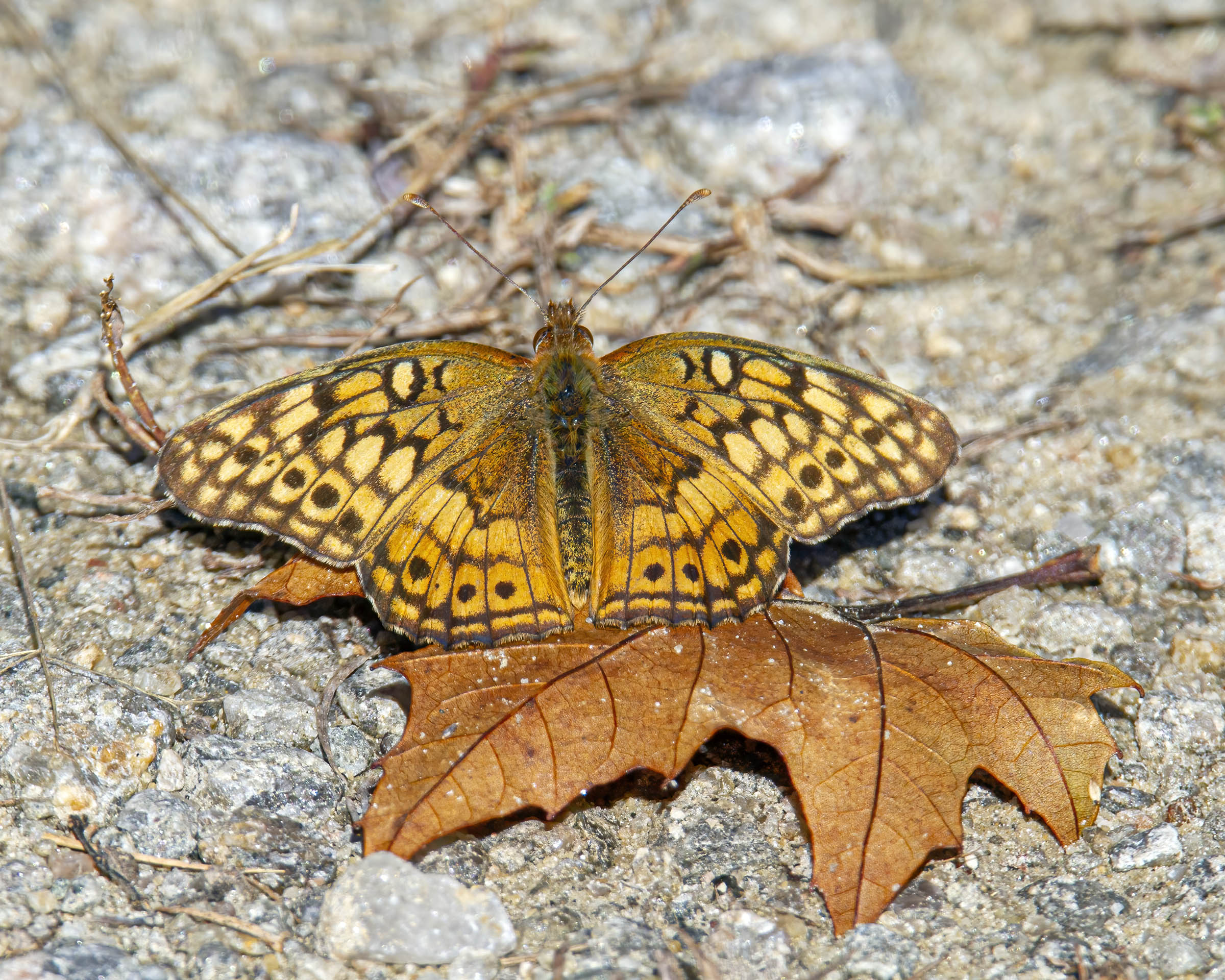
I chased this orange butterfly for quite some time on Wednesday at Occoquan Bay National Wildlife Refuge and was delighted when it chose to land on top of a fallen leaf. The warm oranges and browns of the butterfly are a wonderful match for the autumn season and the fallen down leaves that now litter the landscape.

I could not immediately identify the butterfly, but when I got home I was able to determine that it is a Variegated Fritillary butterfly (Euptoieta claudia). My car windshield was covered with frost yesterday morning—autumn is definitely here and I suspect that my insect sightings will be decreasing sharply soon.

Variegated Fritillary

© Michael Q. Powell. All rights reserved.


Read Full Post »

I couldn’t get very close to this Belted Kingfisher (Megaceryle alcyon) at Occoquan Bay National Wildlife Refuge last week, but I was happy to get a few long-distance shots before it flew away. Kingfishers are incredibly skittish and often my first indication of the presence of one is when I see or hear it flying away from me.

Generally I prefer to photograph birds that are perched on natural objects, but in this case I really like the geometric shape of the wooden structure that was sticking out of the water. Considering that I took these shots from a long way off, I was happy to be able to capture some of the grain of the wood and the bolt that held the boards to the post. I think this might have been part of a former duck blind, though it is hard to know for sure where it came from.

I am hoping to see this kingfisher again and perhaps will manage to get some closer shots the next time. Like most wildlife photographers, I am always thinking of my next shots, confident that I can capture better images on future outings.

Belted Kingfisher


Belted Kingfisher

© Michael Q. Powell. All rights reserved.

Read Full Post »

I was concentrating so intently on photographing the large eagle nest at Occoquan Bay National Wildlife Refuge last Wednesday that I almost missed the Bald Eagle (Haliaeetus leucocephalus) that was sitting in the nest. This nest is really deep and during nesting season it is hard to tell if one or more of the eagles are inside of it. The nesting season ended quite some time ago, so I definitely did not expect to see the nest occupied at this time of the year.

The second shot is the one that I was intending to capture. I liked the way that the red leaves were creeping up the side of the trees holding the nest and that was what I was I was photographing. If you look really carefully, you can just see a bit of the yellow beak of the eagle stick out from behind the leftmost tree, but I did not notice it at the time I took the shot.

After I had taken a few shots, I continued on the trail a half dozen steps, seeking to photograph the nest from a different angle. It was only then that I spotted a bit of bright white that turned out to be the eagle’s head. The eagle was hidden really well, but appeared have positioned itself so as to be able to keep an eye on what was happening around it.

I captured a series of images, but the eagle’s head was blocked by the nest and/or the leaves in most of them. Fortunately, the eagle was moving its head from side to side and eventually I managed to capture a shot in which we can see the eagle’s eye pretty clearly.

Quite often in my wildlife photography, I detect the subject only because of its movement, but in this case, the subject was stationary and it was the difference in color of the eagle’s head that allowed me to spot it. As you can probably guess, my eyes are moving constantly when I am out with my camera, searching high and low, near and far, and left to right for potential subjects to photograph.

eagle nest

eagle nest

© Michael Q. Powell. All rights reserved.


Read Full Post »

Last Wednesday I spotted this beautiful little Eastern Comma butterfly (Polygonia interrogationis) at Occoquan Bay National Wildlife Refuge. It struck me that the butterfly’s colors are a perfect match for this autumn season.

I really like this image. When I posted in on my Facebook page, the word “contrast” keep coming up in the comments of my viewers. Some noted the contrast in colors, while others commented on the contrast in textures. I think that the downward-facing pose of the butterfly and the rather unusual shape of its wings also causes people to pause for a moment as their brains try to process what they are seeing.

Years ago I remember reading a post by a fellow blogger, Lyle Krahn, who used the term “stopping power.” Although he was referring to subjects that you found interesting enough that you would stop to take a photo, I think that it applies equally well to viewers. What makes a photo compelling enough that a viewer will stop and examine it, rather than simply scrolling on to the next posting?

We are constantly inundated with visual images that compete for our attention, but so often they affect us only superficially. It is my challenge as a photographer to capture and/or create images that help you to see the world in a different, deeper way, that prompt you to slow down and experience the beauty that surrounds you.

As noted American photographer Dorothea Lange stated, ““The camera is an instrument that teaches people how to see without a camera.”

Eastern Comma

© Michael Q. Powell. All rights reserved.

Read Full Post »

I was thrilled to spot this Blue-faced Meadowhawk dragonfly (Sympetrum ambiguum), one of my favorite species, this past Wednesday at Occoquan Bay National Wildlife Refuge. The dragonfly was cooperative and let me get pretty close with my Tamron 180mm macro lens and capture some of the amazing details of this colorful dragonfly, like its tiny feet and the little hairs on its legs.

I personally find the combination of the bright red body and the blue eyes to be stunningly irresistible and I look forward to spotting this species each autumn. If you click on either of the two images, you will be able to see some of the individual facets that make up the compound eyes. I have always wondered what it would be like to see the world through the eyes of a dragonfly.

I really like the description of a dragonfly’s sight that I found in a fascinating article by a writer called GrrlScientist that I encourage you to read. She wrote,

“Each compound eye is comprised of several thousand elements known as facets or ommatidia. These ommatidia contain light sensitive opsin proteins, thereby functioning as the visual sensing element in the compound eye. But unlike humans, day-flying dragonfly species have four or five different opsins, allowing them to see colors that are beyond human visual capabilities, such as ultraviolet (UV) light. Together, these thousands of ommatidia produce a mosaic of “pictures” but how this visual mosaic is integrated in the insect brain is still not known.”

I had to search hard to find this dragonfly and it was the only one of its species that I saw that day. At this time of the year few dragonflies are still flying. However, I am not ready to call it quits for the dragonfly season, though the end is drawing near.


Blue-faced Meadowhawk

Blue-faced Meadowhawk

© Michael Q. Powell. All rights reserved.


Read Full Post »

It looks like all of the summer dragonflies are gone. During three treks with my camera this week, I have not spotted any of the species that were common during the summer.

Fortunately, there are a few autumn species that hang on long after the summer species are gone. This week I was pleased to see some Autumn Meadowhawk dragonflies (Sympetrum vicinum), which in the past have been present as late as December.

The dragonfly in the first photo is a male Autumn Meadowhawk that I photographed yesterday at Jackson Miles Abbott Wetland Refuge. Each year when I see them I are struck by their small size—they are only about 1.3 inches (33mm) in length. Mature males are a bright reddish-orange in color and have beautiful brown eyes, a perfect color combination for the season.

Female Autumn Meadowhawks are less conspicuous and have a two-toned tan and red coloration. I spotted the female in the second photo on Wednesday at Occoquan Bay National Wildlife Refuge. Generally I see a lot more male Autumn Meadowhawks than females, so I was happy to be able to photograph this one, which also happened to be my first Autumn Meadowhawk of the season.

Autumn Meadowhawk

Autumn Meadowhawk

© Michael Q. Powell. All rights reserved.


Read Full Post »

Warblers have tiny feet, though I usually can’t see them in my photos, because they are perched high in the trees. On Monday I was fortunate to capture a series of images of a Yellow-rumped Warbler (Setophaga coronata) at Occoquan Bay National Wildlife Refuge that was perched relatively low in the vegetation and you can actually see its feet.

The warbler was in almost constant motion and gave me a whole variety of poses in a very short period of time. Here are some of my favorites from my mini portrait session with this beautiful little Yellow-rumped Warbler.

Yellow-rumped Warbler

Yellow-rumped Warbler

Yellow-rumped Warbler

Yellow-rumped Warbler

© Michael Q. Powell. All rights reserved.


Read Full Post »

Warblers in the fall tend to be pretty drab, compared to those that pass through in the spring in their bright breeding plumage. However, the colorful fall foliage more than makes up for the birds’ lack of color when I am lucky enough to get clear shots of these little beauties.

On Monday I spotted quite a few Yellow-rumped Warblers (Setophaga coronata) at Occoquan Bay National Wildlife Refuge . Unlike most other warblers that are in our area for only a short period of time as they migrate, Yellow-rumped Warblers overwinter with us, according to a conversation I had in the past with a birder. I have photographed them, for example, in mid-January.

These three images show different types of autumn color. The first photo is full of bright pops of cheerful colors. The second one isolates a single color of the foliage and features a warbler feeding on what I believe are poison ivy berries. The final photo provides a more somber take on the autumn colors, evoking in me a wistful sense of the passing of the summer season.

I was quite happy with these shots of the warblers, especially considering my relative lack of success in the past, when I have often heard warblers singing, but have rarely been able to capture images of them.

Yellow-rumped Warbler

Yellow-rumped Warbler

Yellow-rumped Warbler

© Michael Q. Powell. All rights reserved.


Read Full Post »

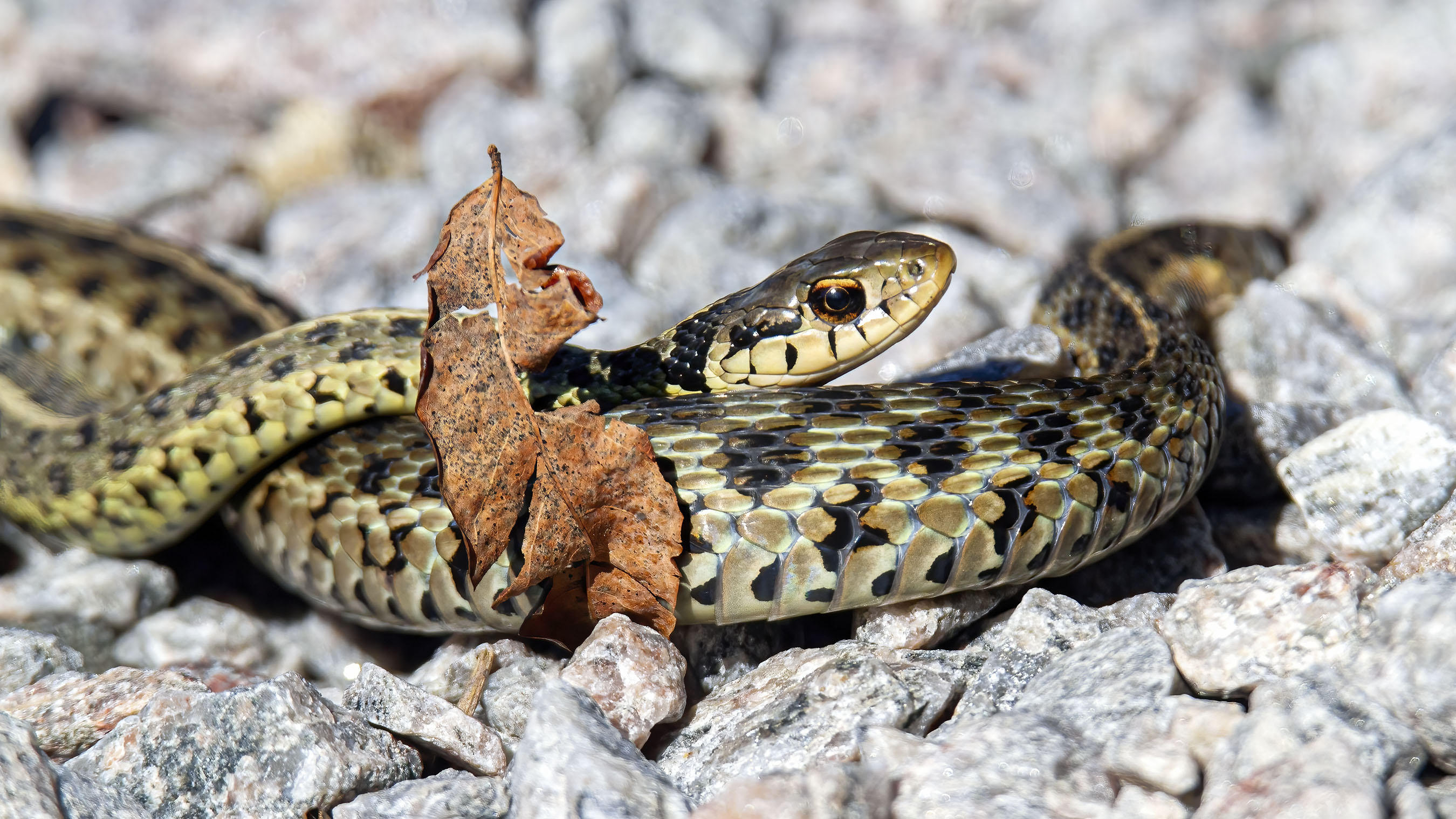
On Monday at Occoquan Bay National Wildlife Refuge I stumbled upon a pair of Eastern Garter Snakes (Thamnophis sirtalis sirtalis). Their bodies were intertwined and were undulating. Now I do not know much about the mating practices of snakes, but I assume that was what they were doing.

I got down really low to take the first shot, which gives a close-up view of the head of one of the snakes that appears to be smiling—I believe that this one, which is clearly the smaller of the two, is the male snake.

According to an article by Sue Pike, “Garter snakes bear live young instead of laying eggs. In fact, in most live-bearing snakes, the females are considerably larger than the males. Since a larger female can carry more babies, and larger litter size mean a greater chance of survival for some of the offspring; natural selection will favor larger females. Females also tend to be more bulky and less active than males since they need to conserve their energy for reproduction. Males tend to be skinnier, more active and smaller than the females because, in the wild, their excess energy is used to chase females.”

The second shot shows the bodies of the two snakes when I came upon them—they look almost like they were braided together. I encourage you to click on the image to get a closer look at the beautiful patterns on the bodies of these snakes.

As I was making a little video of the two snakes, they were joined by a third garter snake. This snake, which I think is another male, slithered along the entire length of the intertwined bodies, looking for an opening. Somehow I thought the new snake would be more aggressive, but he was actually quite gentle. He ended up with his body stretched out as part of the intricate braid.

I have embedded the one-minute-long YouTube video at the end of this posting. In the video you can see the undulating bodies of the two snakes and the arrival and subsequent actions of the third snake. If you cannot see the embedded video, you can use this link  (https://www.youtube.com/watch?v=bgKIKLVeOVg) to access it directly on YouTube.

mating garter snakes

mating garter snakes

© Michael Q. Powell. All rights reserved.


Read Full Post »

« Newer Posts - Older Posts »