Feeds:
Posts
Comments

Archive for the ‘wildlife’ Category

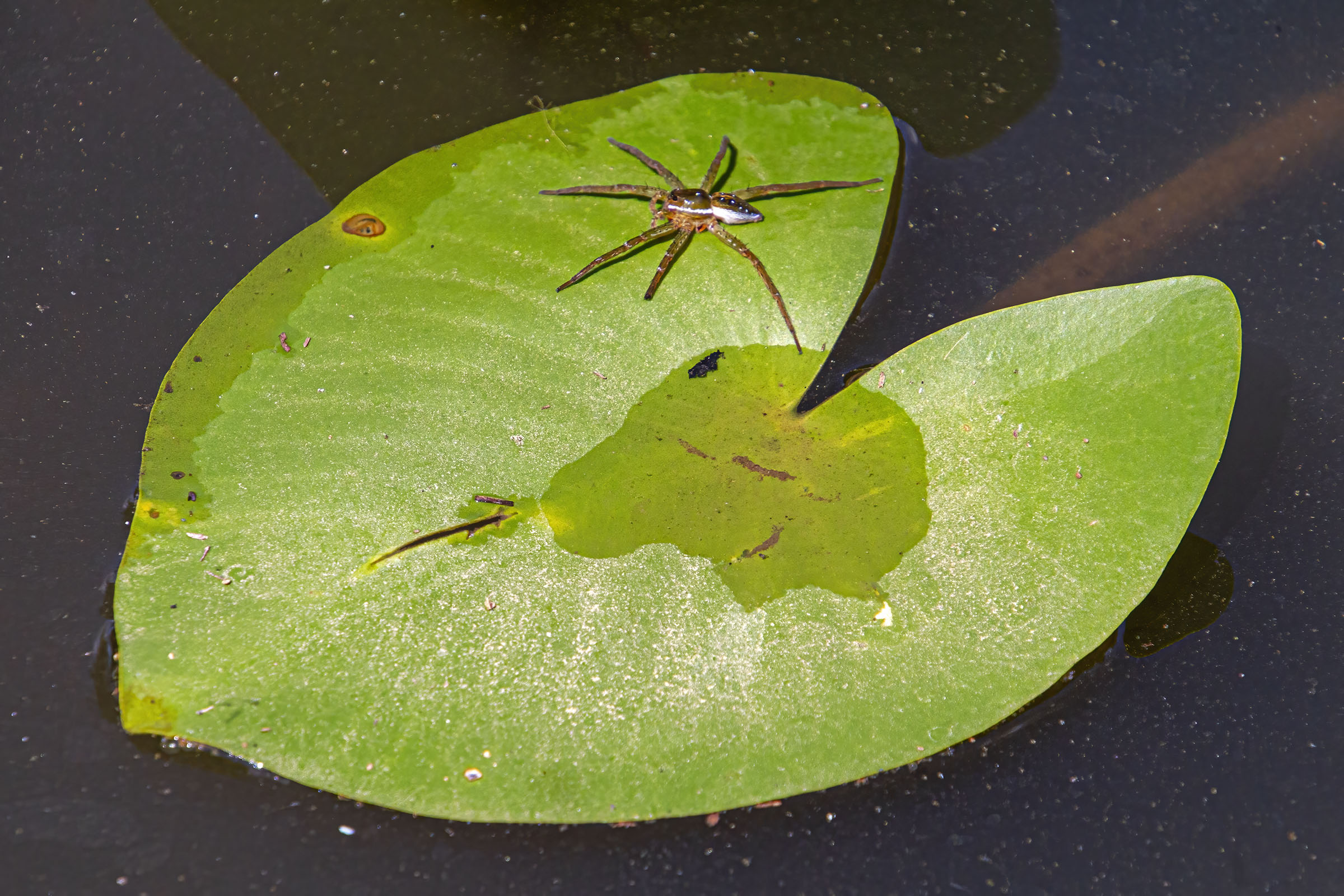
I usually scan the surfaces of lily pads whenever I see them, hoping to spot frogs perched on them. I did not see any frogs last week during a visit to Jackson Miles Abbott Wetland Refuge, but I did spot a cool-looking Six-spotted Fishing Spider (Dolomedes triton).

Normally I see these fishing spiders in shallow water at the edge of ponds with some of their legs on the surface of the water to sense the vibrations of potential prey. When they do, they capture the prey by walking across the water, prompting some people to refer to them as “Jesus spiders.”

Six-spotted Fishing Spider

© Michael Q. Powell. All rights reserved.

Read Full Post »

On Monday I spent several hours at Jackson Miles Abbott Wetland Refuge, focusing my attention primarily on trying to capture shots of Prince Baskettail dragonflies (Epitheca cynosura) in flight. There appeared to be several of them patrolling over the waters of the small pond and I managed to find some good vantage points that gave me unobstructed views of them as they passed by.

One of the locations where I spotted a Prince Baskettail included some lily pads and I decided to try to include them in the shots to give a sense of the environment. The downside of this approach, though, was that it made it even harder to keep my camera’s focus on the dragonfly—the camera kept trying to focus on the background. I was persistent, however, and managed to get a few good shots, as you can see in the first three images below.

I took the final image at a different spot where there were no lily pads. This shot is undoubtedly the sharpest one of today’s photos. Although you can’t see much of the environment in the image, the ripples in the water do add some visual interest.

I couldn’t help but notice that the dragonfly in the final photo had its legs in a lower position than normally—generally a Prince Baskettail flies with its legs held tightly against its thorax to present the most aerodynamic profile. I know that some dragonfly species catch prey on the fly with their legs extended like a basket and wonder if that was what this dragonfly was attempting to do.

Prince Baskettail

Prince Baskettail

Prince Baskettail

Prince Baskettail

© Michael Q. Powell. All rights reserved.


Read Full Post »

Eastern Amberwing (Perithemis tenera) dragonflies are the smallest dragonflies in my area at less than an inch (25 mm) in length, but are quite common. I often spot the distinctive amber wings of the males as they fly low over the waters of many ponds. Females of this species, however, do not have amber wings—they have brown patches on their wings—and I rarely see them.

According to the Dragonflies of Northern Virginia website, female Eastern Amberwings are often found far from water, in meadows among summer wildflowers. “They’re probably hunting even smaller visitors to these summer blooms like midges, flower flies and tiny bees. They also share their colorful perches with hornets and other wasps. Perhaps, this is how their mimicry behavior evolved, and may explain why females appear to practice it more than males.”

On Monday I was thrilled to spot this female while I was exploring a pond at Jackson Miles Abbott Wetland Refuge. I am not sure if she had ventured down to the pond to mate, but whatever the case I was happy to capture some shots of her as she buzzed about the vegetation surrounding the pond. I love her two-toned eyes and the beautiful markings on her body.

Eastern Amberwing

Eastern Amberwing

Eastern Amberwing

© Michael Q. Powell. All rights reserved.

Read Full Post »

When the weather is nice, many turtles emerge from the waters of the ponds to bask in the sunlight. Often I will see turtles jammed so close together on logs that it looks like a mall parking lot just before Christmas.

During a recent visit to Jackson Miles Abbott Wetland Refuge, I spotted an Eastern Painted Turtle (Chrysemys picta picta) that had found a solitary perch that was just big enough for a single turtle. The only problem was that the tree was sticking out from the water at a sharp angle. I could not tell, but suspect that the turtle had dug the claws in its front feet into the bark to keep from sliding into the water.

I love the serene look on the face of this turtle—it seemed to be in a meditative state, a picture of peaceful contentment.

Painted Turtle

© Michael Q. Powell. All rights reserved.

Read Full Post »

July is finally coming to an end, a month of endless hot, hazy, and humid days. It has been tough to get myself motivated to go out with my camera and I have been forced to keep my outings relatively short. Weather-wise autumn is my favorite time of the year, but we have a lot more summer weather to endure before the cooling temperatures of autumn arrive.

During a recent visit to Jackson Miles Abbott Wetland Refuge I was delighted to spot this Pearl Crescent butterfly (Phyciodes tharos). It was feeding in a patch of what looked to be Black-eyed Susan flowers (Rudbeckia hirta), although I must confess that I am not very good at identifying flowers, so my identification may not be accurate.

Initially the little butterfly perched with its wings only partially open, but I waited patiently and eventually it fully extended its wings and I was able to capture this image. It is a relatively simple composition, but I really like the way that it gives you a sense of the environment while also showing you the beautiful markings of the Pearl Crescent butterfly.

pearl crescent

© Michael Q. Powell. All rights reserved.


Read Full Post »

I was excited to spot several Swift Setwing dragonflies (Dythemis velox) last Saturday along the edges of the pond at Jackson Miles Abbott Wetland Refuge. This species gets its name from the way that the way the Swift Setwings perch with their wings forward and abdomens up, like the “ready, set, go” position of a runner at a track meet.

The Swift Setwing is primarily a southern species that may never before have been spotted in Fairfax County, Virginia, the county where I live, until June 2016, when I spotted one at the same wetland refuge. (See my 25 June 2016 blog posting for details on my first sighting of the species.) Every year since then, I have excitedly looked forward to seeing these little dragonflies—it is pretty clear by now that there is an established breeding population at this pond. This is the only location where I have seen Swift Setwings, though I heard from a friend that they may have also been found at another local spot.

I am driving up to Massachusetts and Maine on Tuesday to handle some family issues and suspect that I will not be posting a blog until my return late on Saturday. After then I hope to return to my normal schedule of doing a blog posting almost every day.

Swift Setwing

Swift Setwing

Swift Setwing

© Michael Q. Powell. All rights reserved.


Read Full Post »

During the summer, most of my dragonfly photos tend to be variations of the stereotypical “dragonfly on a stick.” I am always on the lookout, though, for more interesting or photogenic perching places and behaviors.

The first shot shows a male Eastern Amberwing dragonfly (Perithemis tenera) perched on the end of a piece of rebar that sticks out of the water near a small fishing dock at Jackson Miles Abbott Wetland Refuge. Generally I try to avoid having manmade objects in my nature photos, but in this case I really like the juxtaposition of the natural and manmade elements in this shot. The warm tones of the amber wings contrast nicely with the cooler rust color of the rebar and the lines on the rebar are mirrored by those on the dragonfly’s body. Almost every year I return to this spot to capture a similar image, though each encounter is unique in its own way.

The second image shows another male Eastern Amberwing perched on a large rock jutting out from the water. I couldn’t get close to the dragonfly so I took the opposite approach and zoomed out to capture the dragonfly’s reflection (as well as the amber shadow it was casting on the rock). I really like the contrast between the diminutive size of the dragonfly and the large jagged rock—it seems almost like a visual metaphor for life’s challenges.

These two shots are examples of how I try, when possible, to visualize a shot before I take it. Frequently, though, I am forced to react instantaneously to a given situation, with a primary goal of keeping my subject within the frame and hopefully in focus. It’s a weird mental juggling act to simultaneously attempt to think creatively, instinctively, instinctively, and analytically—that’s wildlife photography in a nutshell.

Eastern Amberwing

Eastern Amberwing

© Michael Q. Powell. All rights reserved.


Read Full Post »

I have gotten so caught up in posting photos of insects and flowers, that I nearly forgot that I had managed to capture this shot of a Bald Eagle (Haliaeetus leucocephalus) a week or so ago during a visit to Occoquan Bay National Wildlife Refuge. I have a really problem spotting small birds because of the abundance of leaves on the trees, but this eagle cooperated by perching in the open on a branch where he was quite visible.

At certain times of the year I worry about oversaturating my blog with photos of eagles, but numerous readers have told me that they never get tired of seeing eagles. My oft-stated view is that any day that I spot a bald eagle is a good day.

Personally, I hold the same view about I dragonflies, which is why they appear in this blog more often than any other creatures during the warm months of the year.

Bald Eagle

© Michael Q. Powell. All rights reserved.


Read Full Post »

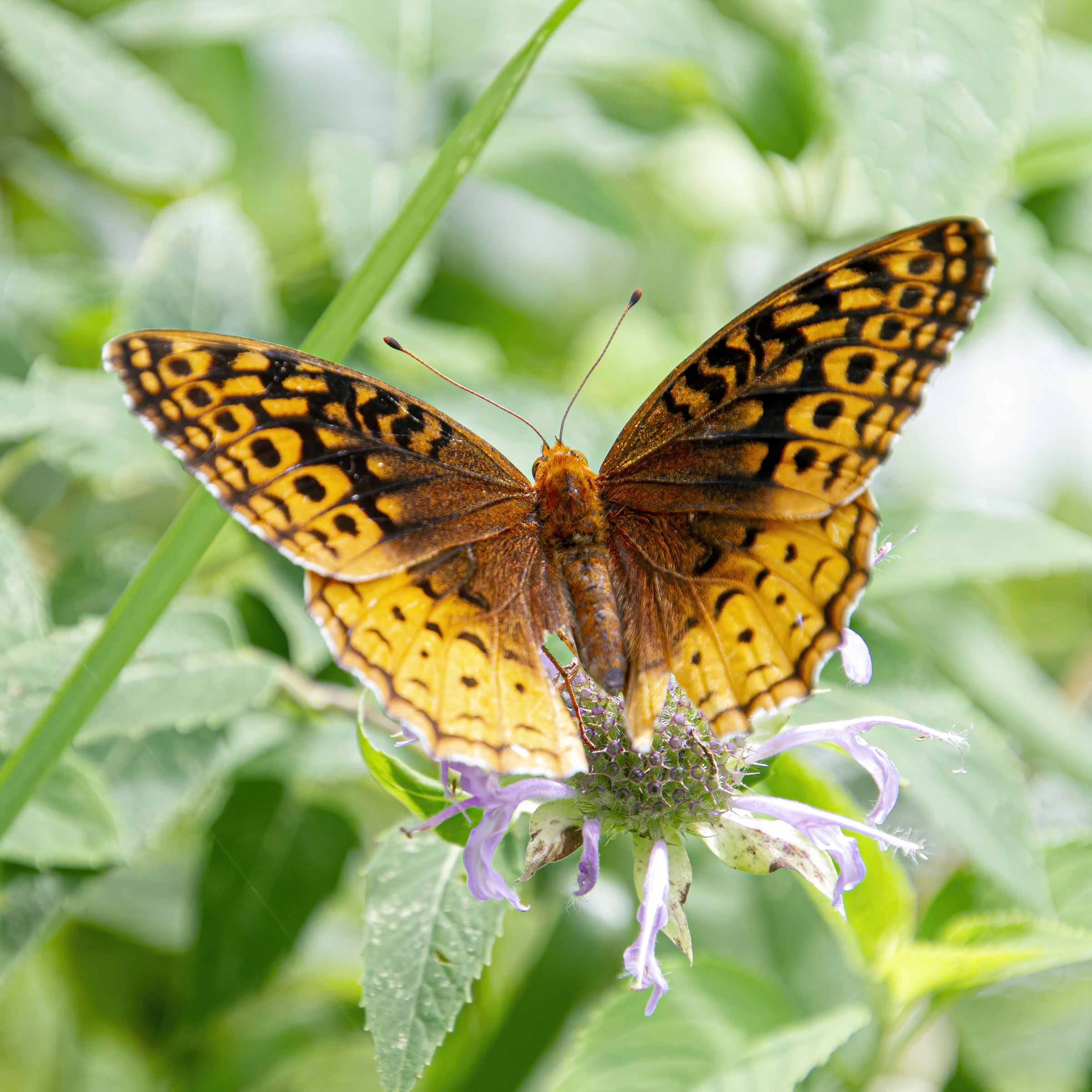
It seems like large butterflies have been more scarce than normal this summer. I was therefore thrilled to spot this Great Spangled Fritillary butterfly (Speyeria cybele) yesterday during a brief visit to Jackson Miles Abbott Wetland Refuge. Most of the time the butterfly had its head buried in the flower, but for a brief moment the butterfly raised its head, spread its wings, and let me capture this pretty little portrait image.

Great Spangled Fritillary

© Michael Q. Powell. All rights reserved.


Read Full Post »

There is only one local location where I have found Banded Pennant dragonflies (Celithemis fasciata) in the past and in some years I have not seen a single one there. I was hopeful that I would see some on Thursday when I returned to Jackson Miles Abbott Wetland Refuge and my hopes were rewarded. Not only did I spot several Banded Pennants, but they were cooperative in choosing some photogenic perching locations for me.

Like other pennant dragonflies, Banded Pennants like to perch on the very tips of vegetation, which causes them to flap around a bit in the slightest breeze, like a pennant. I love the patterned wings of Banded Pennants, which cause them to stand out from several other small blue dragonflies that I saw that day. As you can see from the photos, the Banded Pennants mostly perched on plants overhanging the water or on vegetation growing out of the water.

At the last minute I decided to add the final photo, despite the fact that the dragonfly occupies only a small part of the frame. I really like the reflections of the plants in the water and did not want to zoom in and lose them. I also like the way that the image shows a Banded Pennant zooming low over the water in between the plants. If you look closely you can see the way that the dragonfly has tucked in its legs in order to be a bit more aerodynamic when flying.

Banded Pennant

Banded Pennant

Banded Pennant

Banded Pennant

© Michael Q. Powell. All rights reserved.


Read Full Post »

Yesterday I visited Jackson Miles Abbott Wetland Refuge and spent a lot of my time there trying to get shots of dragonflies in flight. The dragonflies were not very cooperative and kept their distance most of the time, but eventually I managed to get a few decent shots. What was especially cool was that I captured images of dragonflies from three different families—Skimmer, Darner, and Emerald.

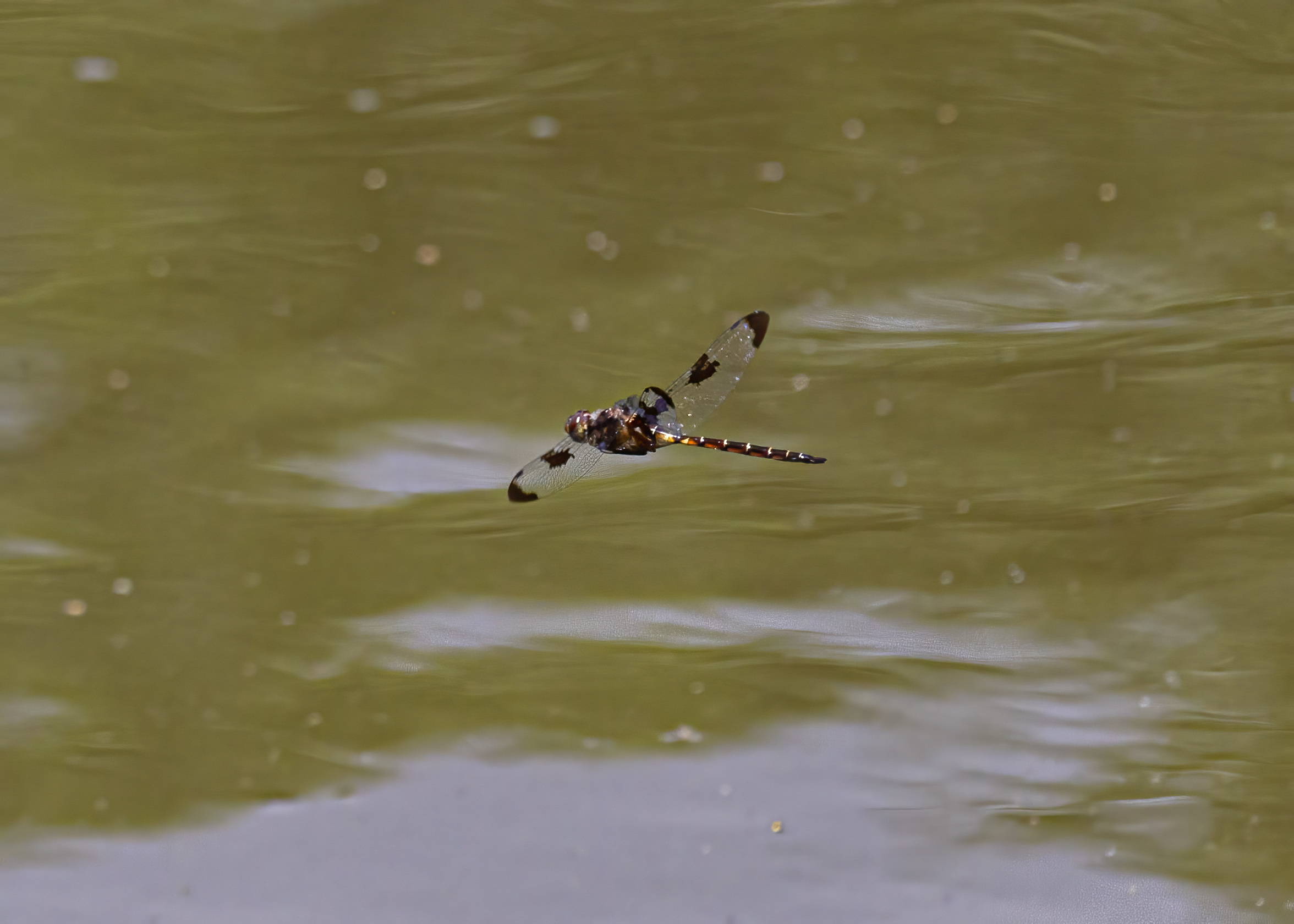
The first photo shows a Banded Pennant (Celithemis fasciata), a Skimmer, as he was flying toward me. Banded Pennants are pretty small at about 1.3 inches (33 mm) in length, so I was pretty thrilled to capture this shot as he was flying toward me. This was actually the first time that I had seen a Banded Skimmer this season.

The second photo shows a Cyrano Darner (Nasiaeschna pentacantha). Despite the fact that I took the shot from a long distance away, you can still see the prominent “nose” that is supposedly reminiscent of the long nose of literary character Cyrano de Bergerac.

The last two photos show Prince Baskettails (Epitheca cynosura) that are members of the Emerald family. Prince Baskettails, which are about 2.9 inches (74 mm) are quite easy to identify, because they are the only large dragonfly in our area with patterned wings. I had more opportunities with this species that with the others, because several Prince Baskettails were flying repetitive patrols only various parts of the pond and passed by me multiple times. Although it is a little easier to focus on a dragonfly in flight when the background is clear, I think it is even cooler when I manage to include reflections in the water in a photo, as was the case with the reflections of the branches in the final photo.

Banded Pennant

Cyrano Darner

Prince Baskettail

Prince Baskettail

© Michael Q. Powell. All rights reserved.


Read Full Post »

I was delighted to spot several frogs sitting on lily pads during my recent trip to Washington D.C. to visit Kenilworth Park and Aquatic Gardens. In the first photo, the cute little frog was perched on some large lily pads from a water lily species from South America. These lily pads have raised edges that always remind me of a tart pan. Reportedly this type of lily pad can grow to as much as 10 feet (3 meters) in diameter and can support a considerable amount of weight if it is evenly distributed.

The second and third photos show the same frog perched on a flatter-style lily pad. I think that this frog is a Green Frog (Lithobates clamitans), although I must confess that I have trouble telling green frogs from bullfrogs. I really like the eye-to-eye pose in the final photo in which the frog’s face reminds me a lot of Kermit the Frog from the Muppets.

frog on lily pad

frog on lily pad

frog on lily pad

© Michael Q. Powell. All rights reserved.

Read Full Post »

Recently I featured some shots of a Monarch butterfly (Danaus plexippus) feeding on some milkweed. I feared that it might be the only Monarch that I would see this year, because there have been some years in the recent past when I have not spotted a single Monarch butterfly.

I was absolutely delighted this past Wednesday when I spotted another Monarch. I was walking along one of the trails at Occoquan Bay National Wildlife Refuge when my eyes were attracted by a flash of bright orange. I assumed incorrectly that it was “only” a Viceroy, but when I zoomed in, I could see that it was a Monarch.

I was using my long 150-600mm lens with a monopod, so I had to scramble a bit to get a good shooting angle. I was thrilled with the shot that I captured of the Monarch in action with its proboscis extended. I am not sure what kind of flower this is, but I really like the way that it was drooping a little as the butterfly perched lightly on it, helping to create a nice triangular composition.

Monarch butterfly

© Michael Q. Powell. All rights reserved.

Read Full Post »

For the first time in a month or so, on Wednesday I put my 150-600mm zoom lens on my camera in place of my trusty 180mm macro lens and visited Occoquan Bay National Wildlife Refuge. Rather than focusing on insects, as I have been doing since early spring, I decided to try to get some shots of birds. Several local photographers have recently posted photos of the juvenile bald eagles at the wildlife refuge that are now much larger that when I saw them last and I was hoping that I might have a chance of seeing them myself.

As it turned out, I did not see the juvenile eagles that day, but I did catch a glimpse of at least two Osprey babies (Pandion haliaetus) that were in the nest with one of their parents. I don’t know how old the little ospreys are, but they seemed curious and energetic. One of them stretched out his wings a bit while I was watching, but the babies don’t appear to ready to fly on their own quite yet.

The rather loosely constructed nest has branches sticking out in all directions that often blocked my view of the trio of ospreys and this is one of the few photos that I took in which I had a clear view of all three of their faces. I did not have very much luck getting photos of other birds that day, many of which I could hear but could not see amidst the abundant foliage.

Osprey

© Michael Q. Powell. All rights reserved.


Read Full Post »

I love the abstract feel of this image that I captured last week at Occoquan Regional Park. The shapes and colors in the photo are much more important than the details of the subject, which I think is a Needham’s Skimmer dragonfly (Libellula needhami). From this angle, dragonflies often remind me of the biplanes of World War One, like the Sopwith Camel that was sometimes featured in Snoopy comic strips.

Photography allows for such a wide range of approaches to express myself creatively. I can be geeky and technical, as I usually am, striving to capture the minute details of my often tiny subjects or I can be as “artsy” as I choose, focusing on capturing and creating moods or feelings with the basic elements of light and darkness, of colors, lines, and shapes.

Professional photographer’s are sometimes advised to create a signature style and to stick with it. I am proudly an amateur, who captures images for love—the root word in “amateur”—and I defiantly refuse to stick to a single style. My photos and words help you to see the world through my eyes and hopefully my unbounded curiosity and enthusiasm about the world are evident in my postings. If you meet me in person, you’ll see that the “me” in my postings is not a social media persona—it is genuinely who I am.

Needham's Skimmer

© Michael Q. Powell. All rights reserved.

Read Full Post »

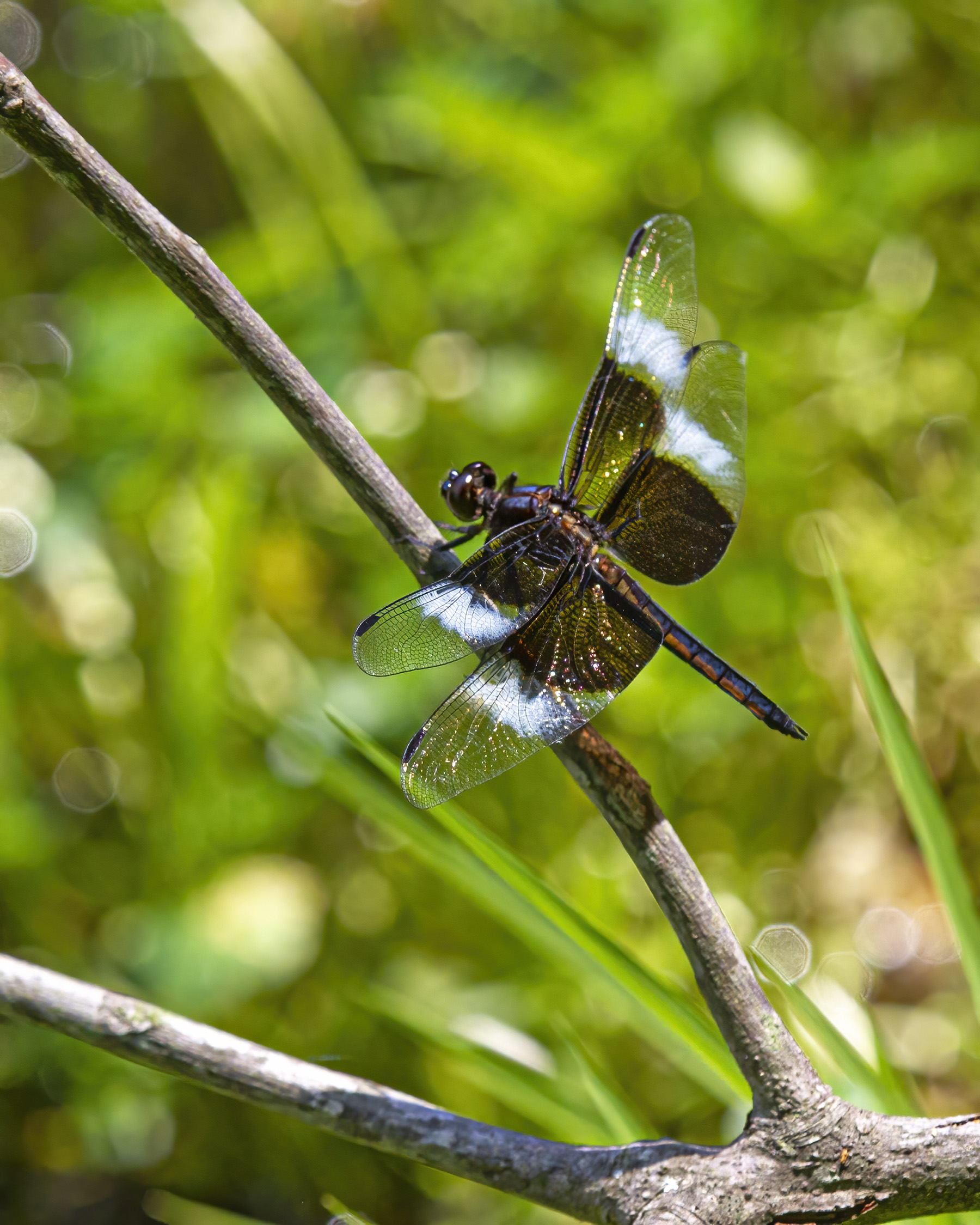
I love the distinctive wing markings on male Widow Skimmer dragonflies, one of only a few dragonfly species that I have encountered with both light and dark patches on their wings. I spotted this handsome male Widow Skimmer last week during a brief visit to Occoquan Regional Park in Lorton, Virginia.

One of the cool things about this dragonfly is that it looks almost like a butterfly when it is flying. With most dragonflies, the transparent wings seem to almost disappear when they are flying, but with the male Widow Skimmer, the wings are much more visible when the dragonfly is in motion.

Widow Skimmer

© Michael Q. Powell. All rights reserved.

Read Full Post »

I was excited to spot my first Monarch Butterfly (Danaus plexippus) of the season last Friday at Occoquan Regional Park in Lorton, Virginia. The milkweed was barely in bloom, but the Monarch nonetheless seemed to be really enjoying it.

I love the beauty of the Monarch, of course, but I am also very conscious of the fact that this species is considered to be endangered, threatened by the loss of habitat and by climate change. Some years I have not seen any Monarchs at all, so each sighting is special to me, reassuring me that Monarchs are continuing to survive.

As you can see, I attempted to get shots of the Monarch, the only one that I saw that day, from varying distances. When I first spotted the Monarch, I took several long distance shots like the third one below that show some of the habitat. Then I slowly moved forward, attempting to use the milkweed in my compositions.

It was a bit of a challenge to get good shots, because the butterfly was in almost constant motion, moving all around the little clumps of milkweed and changing its wing and body positions. I had to work quickly too, fully aware that the butterfly could fly off at any moment.

Monarch butterfly

Monarch butterfly

Monarch butterfly

© Michael Q. Powell. All rights reserved.


Read Full Post »

I was delighted to spot this Common Wood Nymph butterfly (Cercyonis pegala) this past Wednesday at the edge of the hike-bike trail on the back side of Huntley Meadows Park, a county-run marshland park in Alexandria, Virginia. I love the distinctive yellow patch on its wing and its really cool eyes with vertical stripes. Common Wood Nymphs usually like to hang around near the edges of the woods rather than in the fields that many butterflies seem to prefer.

Generally I like to get the plane of the sensor of my camera sensor as close to parallel as possible with my subject, so that the entire subject is in focus. In this case, though, a large mass of thorny vines kept me from being able to get my desired shooting angle and consequently the focus on the left-hand side of the subject is a little soft. That being said, I am nonetheless pretty happy with this shot of a cool-looking butterfly that I don’t see very often.

Common Wood Nymph

© Michael Q. Powell. All rights reserved.


Read Full Post »

I was thrilled on Wednesday to photograph my first Common Sanddragon dragonfly (Progomphus obscurus) of the year as he was enjoying a sandy beach near Wickford Park in Alexandria, Virginia. Unlike most dragonflies that prefer to perch on vegetation, Common Sanddragons are usually found perched flat on the sunny, sandy sections of shallow creeks.

According to the Dragonflies of Northern Virginia website, “Despite its name, this species is rare in Northern VA. In other parts of the country, where clean, sunny, shallow creeks with plenty of sandy/gravely banks are common, so too are Common Sanddragons. Our urban waterways are too influenced by stormwater, flowing fast and unchecked off impervious surfaces (roads, parking lots, roofs, etc.). This creates deeply incised, eroded banks and streambeds, with excess silt, unstable flows.”

This species is special to me because I was the first person to document its presence at Huntley Meadows Park, a county-run marshland park where I used to do a lot of my photography before it became overcrowded with photographers. Check out my June 2014 blog posting New dragonfly species in the park for the details of how I stumbled upon this “new” species.

Common Sanddragons are also special to me because in June 2016 I was lucky enough to observe and document the thirty minute metamorphosis of a water-dwelling nymph into a Common Sanddragon dragonfly. I had been collecting some discarded exoskeletons of already emerged dragonflies on a sandy bank of a stream when suddenly I felt one moving in my hand. I quickly placed it on the sand and was able to photograph the dragonfly as it was emerging. It was a remarkable encounter and I encourage you to check out my blog posting Metamorphosis of a dragonfly.

Nothing quite that exciting happened during my most recent encounter. I was able to capture some images of the dragonfly on various parts of the “beach” where I initially spotted him. He was pretty skittish and flew away multiple times, but kept returning to the same general are of the creek, sometimes choosing the sandy areas and sometimes opting for the more rocky spots. I particularly like the first photo that has a mixture of rocks and sand and has some green algae that matches the stunning eyes of this Common Sanddragon.


Common Sanddragon

Common Sanddragon

Common Sanddragon

© Michael Q. Powell. All rights reserved.

Read Full Post »

On Monday I was thrilled to spot this Prince Baskettail dragonfly (Epitheca cynosura) flying patrols over the small pond at Jackson Miles Abbott Wetland Refuge. Previously I had spotted Common Baskettails doing the same thing at this location—see my recent posting Common Baskettails in flight—but they seem to have been supplanted by the Prince Baskettails. How do you tell them apart? Although they are both part of the Emerald family, only Prince Baskettails have patterned wings, as you can see in these photos.

I really like the description of this species on the Dragonflies of Northern Virginia website:

“This sleek, elegant dragonfly could in fact be called King Baskettail, as it is the largest member of the Emerald family. There are seven families of dragonflies in the US–Emeralds are known for their glowing green eyes (hence the family name), and their endless, acrobatic flight. Like other members of this family, Prince Baskettails rarely land and can spend many hours in ceaseless flight. Look for this powerful flier making long, repeated, low patrols over open water habitats such as lakes, ponds, canals, and sluggish river sections.”

As a result of the repeated patrols, I was able to track the dragonfly as it flew by me and capture these images. The dragonfly did not get really close to the bank on which I was standing, so my autofocus would not detect my subject and I had to resort to focusing manually. I am pretty happy with the results and I encourage you to click on the images to see the beautiful markings on the body of this Prince Baskettail dragonfly.

Prince Baskettail

Prince Baskettail

Prince Baskettail

© Michael Q. Powell. All rights reserved.

Read Full Post »

Although Blue Dashers (Pachydiplax longipennis) are among the most common dragonflies in my area during the summer, they are very special to me. I remember visiting a photography show by my dear friend Cindy Dyer in 2012, I believe, and marveling at the photos that she had taken of Blue Dasher dragonflies. I decided that I wanted to be able to take photos like hers of these beautiful creatures.

I went out on numerous occasions and she taught me a lot about both the creative and technical sides of photography. She also served as a muse to me, encouraging me and gently pushing me along my path. She had a well-established blog and decided that I needed one too, so on 7 July 2012, she sat me down I created my blog. My first blog posting on the same day was entitled Blue Dasher dragonfly and it featured a male Blue Dasher dragonfly in the obelisk position, similar to the pose of the dragonfly in the final photo in today’s post. That’s one of the main reasons why Blue Dashers are so special to me.

I spotted these Blue Dashers, all of which are males, on Monday during a brief visit to Jackson Miles Abbott Wetland Refuge. Each of the three photos represents a different approach I used in attempting to capture the”feel” of my encounters with these dragonflies. The first image shows the details of colors and patterns of the body quite well. The second image gives you a sense of their environment. The final photo focuses on the obelisk pose that is believed to be a form of thermoregulation—by raising its abdomen the dragonfly reduces its exposure to the direct sunlight on hot days.

Some days I will post only a single photo, but most often I enjoy posting a small set of photos that complement each other and provide different perspectives on the living creatures that I love to photograph. Beauty is everywhere.


Blue Dasher

Blue Dasher

Blue Dasher

© Michael Q. Powell. All rights reserved.

Read Full Post »

How many views does one of my blog posts need to get for me to consider it “successful” or “popular?” On a good day, my blog receives about 100 views, of which 60 may be related to that day’s post. If a post receives over a 100 views over time, I’ll consider it to be one of my top posts.

However, WordPress has a mind of its own, and the most-viewed postings, in my view, are not necessarily the best-written ones or the ones with my best photos. Some of the posts continue to receive views years after they were written thanks to searches on Google and other search engines. Even then, some subjects seem to go in and out of popularity on the search engines as a result of ever-changing algorithms.

For many years, my most popular blog posting was one from 4 November 2014 entitled Rescue of an Injured Bald Eagle that documented the rescue of the eagle by an a county animal control officer at my local marshland park. I was lucky enough to be present during the rescue operation and my photos (including a link to my blog posting) were picked up by several on-line news organizations in the Washington D.C. area. As a result, that posting has had 3,475 views to date, including 3,290 views during the initial month of the posting.

Bald Eagle rescue

This month, another blog posting has taken over the lead from the posting of the eagle rescue. My new top post is now a 9 May 2016 blog posting called Blue-eyed Garter Snake. Although this posting had only 70 views during its initial month, it now has had 3,512 views, including 438 views in 2023.

garter snake

Another posting may soon overtake the eagle rescue posting. The 3 August 2013 posting entitled Fuzzy White Caterpillar currently has had a total of 3,442, only 72 of which came during its initial month. Neither the writing or the photos in that posting are all that great, but I suspect that the title is so generic that it comes up often in Google searches.

fuzzy white caterpillar

One final contender for the top post is a 31 August 2013 posting entitled Red-footed Cannibalfly. This posting has had 3,169 views, of which 61 came in its initial month. For five years in a row it had over 350 annual views and appeared on the first page of Google results. Something changed, however, and it has fallen in the Google rankings since 2018, though it still appears as the fifth entry in a Bing search of “Red-footed Cannibalfly.”

red-footed cannibalfly

To be perfectly honest, I do not really care that much about views. I use this blog as a means to express myself creatively in my writing and in my photos. I am grateful for the modest success that I have enjoyed and even more thankful for the community of supportive people who have encouraged and supported me over the years.

I made my first posting on 7 July 2012, so I will soon be celebrating an anniversary. According to WordPress, my postings have had 403,801 views to date and I am thankful for each and every one of them and for all of you.

© Michael Q. Powell. All rights reserved.


Read Full Post »
During a recent visit to Jackson Miles Abbott Wetland Refuge I was delighted to spot a female Eastern Amberwing dragonfly (Perithemis tenera) as she was depositing her eggs in the vegetation in a small pond. Initially she would hover for a moment, as you can see in the first image, and then dip the tip of her abdomen straight downwards to release some eggs, as shown in the second image. The dragonfly repeated this process multiple times at this spot before moving on to other spots.

I have observed this process multiple times, but have rarely been able to photograph it. Eastern Amberwings are the smallest dragonflies in my area and are only about an inch (25 mm) in length, so they are a challenge to photograph. Fortunately when the female is ovipositing, she hovers a bit, which gives me time to focus on her. Sharp-eyed viewers may have noticed that the wings of this dragonfly have patterns, but are not amber in color—only male Eastern Amberwings have amber wings.

Eastern Amberwing

Eastern Amberwing

© Michael Q. Powell. All rights reserved.


Read Full Post »

Whenever I see a dragonfly in flight when I am traipsing about with my camera, I can’t help but stop and try to get a photograph of the dragonfly in the air. My success rate in not high, but sometimes I am able to capture a good image as the dragonfly zooms by me.

In mid-June I spotted a Common Baskettail dragonfly (Epitheca cynosura) as it flew back and forth over the pond at Jackson Miles Wetland Refuge. During one of its passes I managed to freeze its motion in this shot. I like the way that you can see all four wings and also the distinctive markings on its body. The bluish-green eyes really “pop” and if you look really closely, you can see the that the dragonfly folds its legs under its thorax (the torso part of its body) while it is flying.

I returned yesterday from my five-day trip up to Massachusetts and Maine to deal with a family emergency. Hopefully I will be able to get out this week and capture some new images. It’s hard to believe that it is already July.

Common Baskettail

© Michael Q. Powell. All rights reserved.

Read Full Post »

I just wanted to alert readers who may be used to me publishing a blog posting almost every day that I will be absent from this space for the rest of this week. A family emergency requires me to travel to Massachusetts and Maine and I will not have access to the internet for most of this time.

I decided though to leave you with a shot of a dragonfly facing away. While I was exploring Occoquan Regional Park earlier this month, I managed to get only a single angled view of this dragonfly before it flew away, but it was enough to confirm that it was my first Carolina Saddlebags dragonfly (Tramea carolina) of the season. Despite the odd angle, I was able to capture the patches on the hind wings that are thought to resemble “saddlebags” and its distinctive red color, so identification was not a problem.

I really like the colors and patterns of this shot, which has more of an “artsy” feel rather than a “scientific” one. Normally eye contact is desirable with a subject, but I look at that “rule” as more of a suggestion than a requirement.

Carolina Saddlebags

© Michael Q. Powell. All rights reserved.


Read Full Post »

Dragonflies and damselflies have rather limited lifespans after they emerge from the water and are transformed from aquatic nymphs into aerial acrobats. One of their biological imperatives is to perpetuate their species, so it is not unusual to see mating activity during this time of the year that is primetime for dragonflies and damselflies.

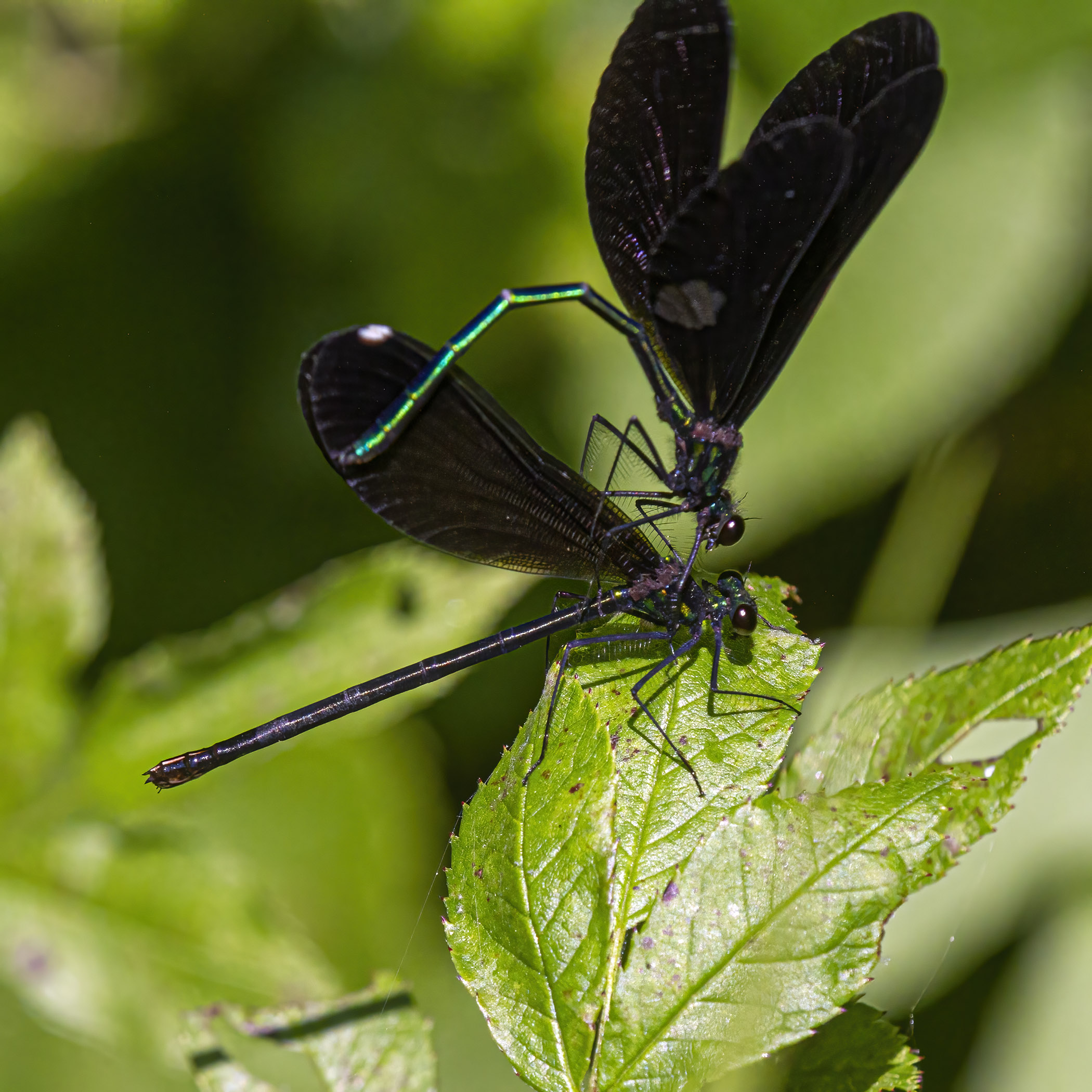
On a trip earlier this month to Occoquan Regional Park, I spotted this pair of Ebony Jewelwing damselflies (Calopteryx maculata) in their distinctive sidewards-heart mating position. I am really happy with this image because I was able to use my shooting angle and camera settings to keep the bodies of both damselflies in focus and achieve a blurry background that allows a viewer to focus on the damselflies without any visual distractions.

In case you are curious, the damselfly to the left is the female and the one with the shiny green body is the male. You can tell the genders from the mating position and from the little white patch on the wings that is present on female Ebony Jewelwings and not on the completely dark wings of the males


Ebony Jewelwing

© Michael Q. Powell. All rights reserved.

Read Full Post »

This handsome Common Green Darner dragonfly (Anax junius) does not have all of the colors of the rainbow, but it does have many of them and I love its mix of vibrant colors. The dragonfly was perched vertically really low in the vegetation when I spotted it during a recent to Occoquan Regional Park. I ended up sprawled almost flat on the ground to get this shot—my position would have made for an amusing photo, but fortunately no one else was around to capture that moment.

Mature male Common Green Darners have bright blue abdomens. The reddish pink color of this dragonfly’s abdomen suggest to me that it is an immature male. Early and late in the season, the abdomens of male Common Green Darners may appear purple. Common Green Darners have dark-colored platelets in their blood that rise to the surface when it is cold, darkening their abdomen color and attracting more sun. On bright, hot days, those dark platelets sink, and the abdomen turns bright blue again, now reflecting light.

Common Green Darner

© Michael Q. Powell. All rights reserved.

Read Full Post »

Last week I managed to capture a series of images of a hook-up between two Ebony Jewelwing damselflies (Calopteryx maculata). Initially I was focused on a female that was perched on a leaf, but then noticed a male who was circling around her. According to Wikipedia, “Calopteryx males will hover in front of a female with alternating fast and slow wingbeats; if she is receptive she will remain perched, otherwise she will fly off.” This female remained in place, so the male moved in, as you can see in the first three photos.

During mating, the male uses claspers at the tip of his abdomen to grasp the female behind her head tightly enough to resist the attempts by other males to dislodge him, a position sometimes called “tandem.” The male then flexes his abdomen to encourage the female to loop her abdomen round to interlock with him, forming the “wheel’ position,” the sidewards-heart position shown in the final photo.

I suppose that I could leave the description here, but the process that was taking place was so weird and fascinating that I thought I should explain what is going on. In order to keep from getting too graphic, I will borrow some language from Wikipedia.

“Mating in damselflies, as in dragonflies, is a complex, precisely choreographed process involving both indirect insemination and delayed fertilization….When he (the male) is ready to mate, he transfers a packet of sperm from his primary genital opening on segment 9, near the end of his abdomen, to his secondary genitalia on segments 2–3, near the base of his abdomen. The male then grasps the female by the head with the claspers at the end of his abdomen; the structure of the claspers varies between species, and may help to prevent interspecific mating… The female then curls her abdomen downwards and forwards under her body to pick up the sperm from the male’s secondary genitalia, while the male uses his “tail” claspers to grip the female behind the head: this distinctive posture is called the “heart” or “wheel.”

Wow! I think I will leave it at that. Suffice it to say that the process is complicated and the participants have to be incredibly flexible.

Ebony Jewelwing

Ebony Jewelwing

Ebony Jewelwing

Ebony Jewelwing

Ebony Jewelwing

Ebony Jewelwing

© Michael Q. Powell. All rights reserved.

Read Full Post »

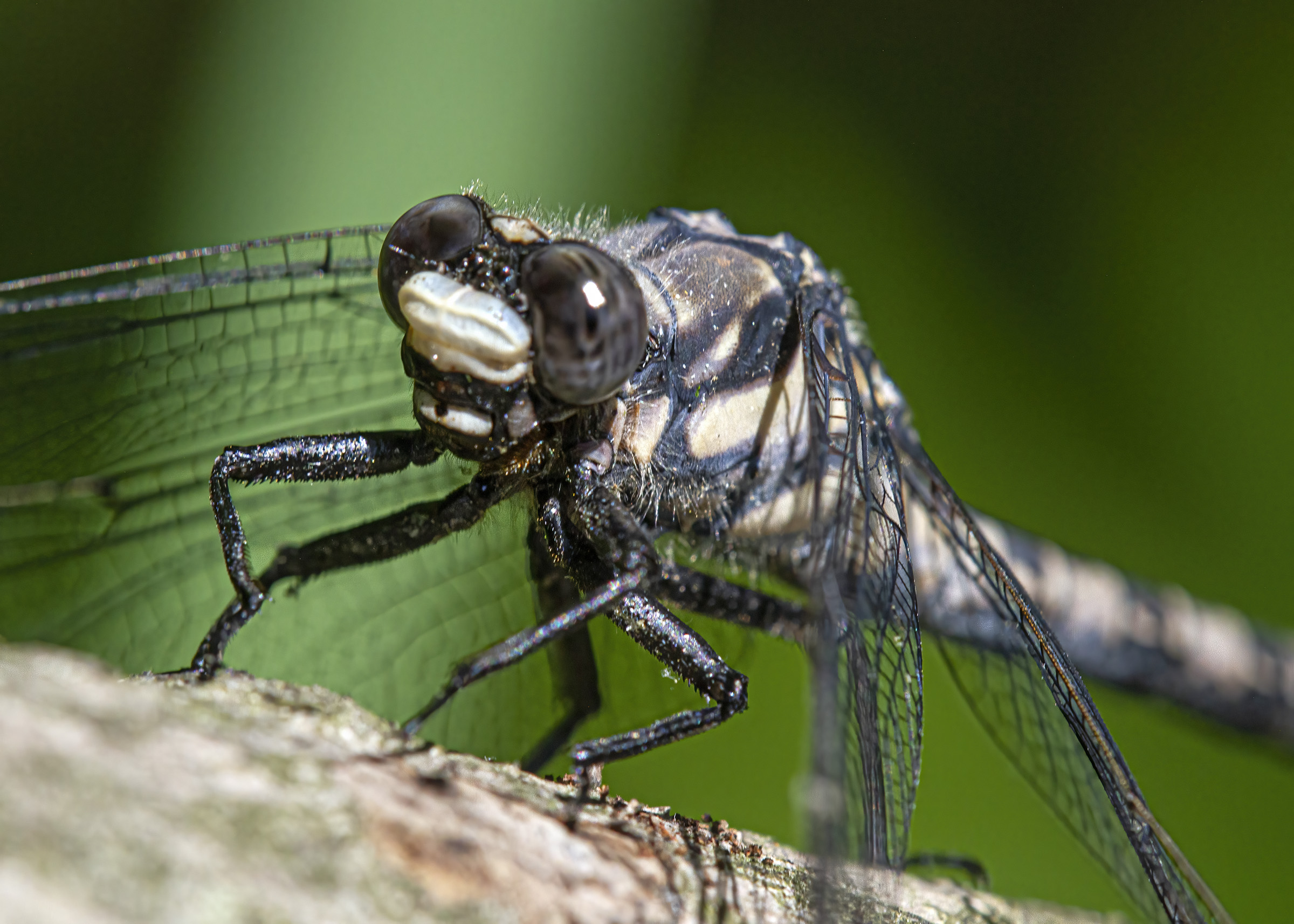
This Gray Petaltail dragonfly (Tachopteryx thoreyi) was quite cooperative and let me take a close-up portrait last week as I was exploring a small pond in Fairfax County, Virginia. Gray Petaltails are known to be quite friendly and inquisitive and I have had one perch on me on multiple occasions. During one such encounter in 2019, fellow dragonfly enthusiast Walter Sanford snapped a couple of photos of one perched on me when I was wearing a gray sweatshirt that must have made me look like a tree to the dragonfly. If you want to see the photos, check out Walter’s blog post entitled “You look like a tree to me.”

Most of the time I am not able to approach a dragonfly from this angle to get a close-up shot. Dragonflies have incredible vision and I am certain that this one could see me coming. However, he apparently did not see me as a threat and stayed in place while I took several shots. As you can see, the depth of field was incredibly shallow for this shot—only a small portion of the dragonfly’s body was in focus—but I was able to keep the striking gray eyes in focus and capture a lot of details that highlight their beauty.

Gray Petaltail

© Michael Q. Powell. All rights reserved.

Read Full Post »

There were lots of Slaty Skimmers (Libellula incesta) flying about on Tuesday at the small pond at Jackson Miles Abbott Wetland Refuge, but none of them were cooperative in perching within range. They seemed to content to buzz around over the lily pads and land occasionally in vegetation overhanging the water—I was willing to lean a little to get closer to the dragonflies, but did not want to risk falling into the water.

Slaty Skimmers are one of our most common summer dragonfly species and they find themselves at home in almost any habitat. The mature males are really easy to identify because of their dark bodies and eyes. Immature males and females are a lot harder to distinguish from a number of other species in the skimmer family, like the Great Blue Skimmer and the Bar-winged Skimmer.

Slaty Skimmer

Slaty Skimmer

© Michael Q. Powell. All rights reserved.


Read Full Post »

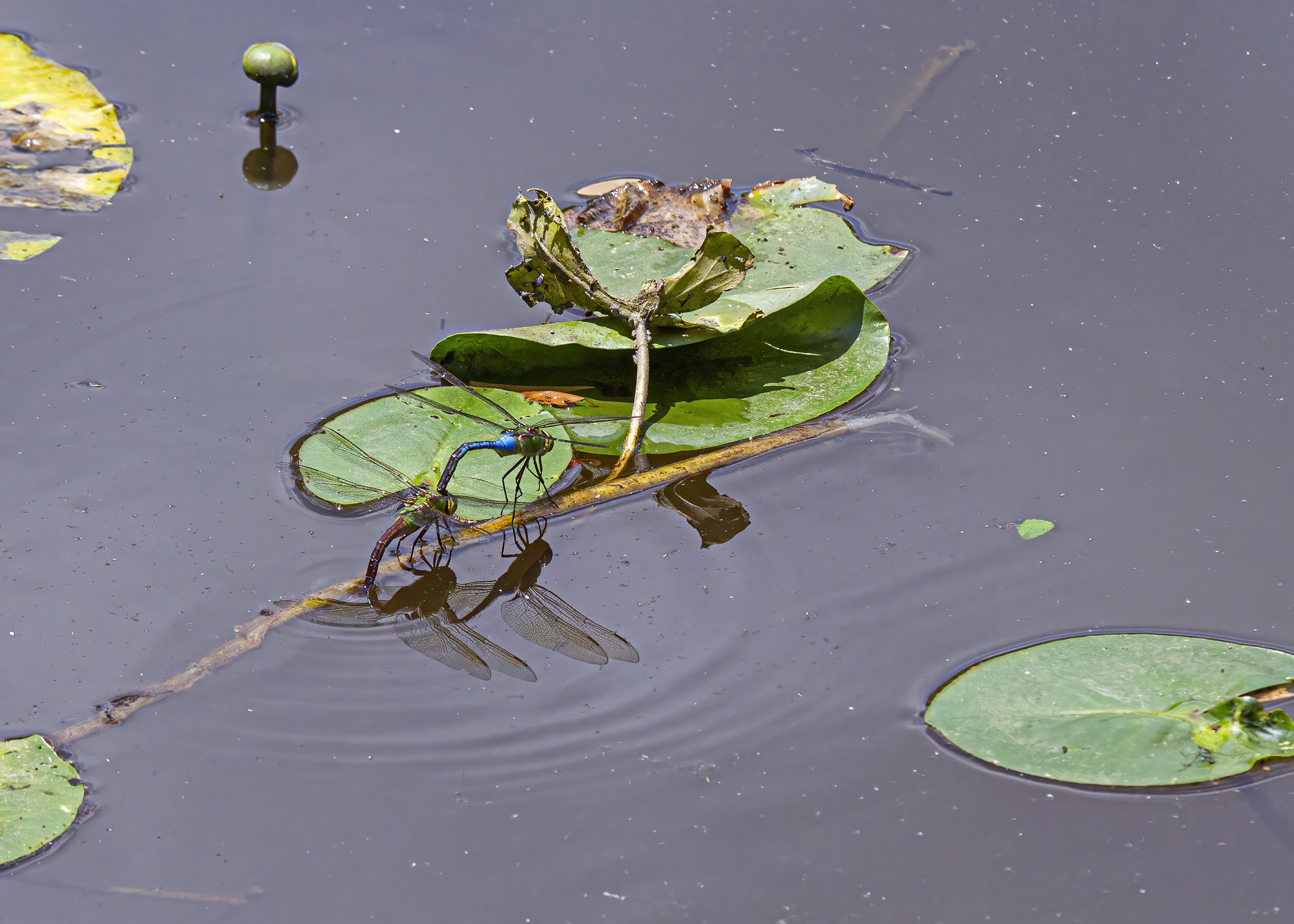
I spotted a female Common Green Darner dragonfly (Anax junius) as she was ovipositing while her male partner held onto her last Saturday at the edge of the small pond at Jackson Miles Abbott Wetland Refuge. Common Green Darners are large dragonflies—about 3 inches (76 mm) in length—so it was relatively easy to track the pair as they moved about placing eggs in various patches of vegetation in the water.

After mating takes place, the males of some species of dragonflies disappear.  In other species, the male stays nearby, guarding the female and fending off other males that might remove the initial suitor’s sperm and replace it with their own.  Some species, like this Common Green Darner, remain attached to the female in a position known as “tandem.” while egg-laying takes place.  The female Common Green Darner submerges her abdomen and lays her eggs in or on the aquatic vegetation, as you can see in these images. If you look really closely at the first image, you can see what I believe is the dragonfly’s curved ovipositor that she uses to make a little slit into the vegetation in which to place the eggs.

According to an article on Animal Diversity Web, there are two different lifecycles for Common Green Darners, one for the dragonflies that have migrated northward and one for the resident population. “Migratory adults mate and oviposit in June. Unlike resident populations, nymphal development for migrant offspring takes only 3 to 5 months, and they do not overwinter. They emerge as tenerals typically around late-August and September. They often begin their migration as tenerals, feeding along the way and developing into adults.” The timing of the activity that I observed suggests that these could be migrant Common Green Darners.

“For residents in the north, the adults mate and oviposit in late July to August. The resulting offspring hatch and develop to mid-instars and then overwinter when temperatures drop. Total nymphal development time can take 11 to 12 months for residents, as the nymphs finish development when temperatures warm in the spring and then emerge as adults in the following June and July.”

I highly recommend the article that I referenced, which has lots more fascinating information about this colorful dragonfly species.

Common Green Darner

Common Green Darner

Common Green Darner

Common Green Darner

© Michael Q. Powell. All rights reserved


Read Full Post »

« Newer Posts - Older Posts »