Feeds:
Posts
Comments

Archive for the ‘wildlife’ Category

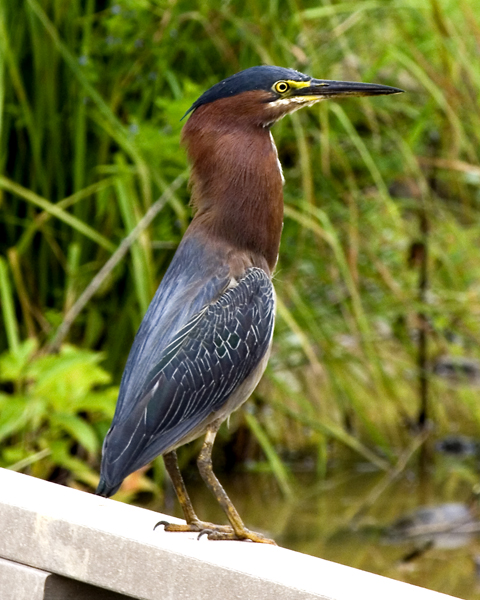
It may sound like a new summer beverage sensation, but the title is meant to be literal.

I captured this shot of a green heron  just as the rain was beginning to fall this afternoon. I was at the same pond at a local garden where I had previously seen a juvenile green heron (and that was right after the rain). Maybe green herons like to come out to play in the rain—I’ll have to remember that in the future.

There really wasn’t enough light for a high quality image, but I think that I managed to capture the unique look and style of the green heron.

(I also got some photos of a juvenile green heron this afternoon but I’ll save them for another posting.)

© Michael Q. Powell. All rights reserved.

Read Full Post »

Is it really possible to find inspiration and motivation in an insect?

Take a really close look at this photo of an male Eastern Tiger Swallowtail butterfly (Papilio glaucus).

Do you see the delicate beauty of his colors and shapes or are your eyes drawn immediately to his infirmity? His wings are virtually shredded and there is a large portion of one of them missing.

Somehow, despite all of those limitations, he can still fly. He can defy gravity and the laws of aerodynamics.

I don’t know how he does it, but he is able to overcome adversity.  Some of the lyrics of the song “Defying Gravity” from the musical “Wicked” come into my head as I think about it.

“I’m through accepting limits ’cause someone says they’re so. Some things I cannot change but til I try I’ll never know….I’d sooner buy defying gravity. Kiss me goodbye I’m defying gravity and you can’t pull me down.”

Inspiration and motivation can come from many places, I would posit, even from insects.

Take these broken wings and learn to fly…

© Michael Q. Powell. All rights reserved.

Read Full Post »

I came across this tiny damselfly yesterday when I was visiting a local garden in the late afternoon. Initially I spotted her when she was flying and I was thrilled when she chose to land in a spot where I could photograph her. I apologize to the experts for not identifying the type but I find it impossible to identify damselflies (and even dragonflies are not easy).

Damselflies are particularly challenging for me to photograph because they are so long and skinny. If I photograph them from the side, the eye is often out of focus and if I try to shoot head-on, depth of field is an issue.

I ended up with a photo that I shot from above and to the side. Somehow I managed to reduce the composition to the damselfly, the branch to which she is clinging, and a couple of leaves.

I find special beauty in that kind of simplicity in nature and in my photography.

Unidentified damselfly

© Michael Q. Powell. All rights reserved.

Read Full Post »

Four weeks ago today my friend and mentor Cindy Dyer helped me to start this blog. She has been teaching me and encouraging me as I seek to express myself through my photography. I owe her my thanks.

Over the past month I’ve tried a lot of different things: short posts and long ones; serious posts and funny ones; scientific posts and artistic ones; and scarey posts and beautiful ones. Some have been successful and others less so. The best thing about this blog, however, is that I have encountered a wide array of fellow bloggers. You have taught me so much and supported me with words of encouragement and inspiration. Thanks to all of you.

My first blog posting featured a Blue Dasher dragonfly, one of my favorite subjects. It somehow seems appropriate to feature another one as I celebrate my four-week anniversary. I photographed this Blue Dasher dragonfly (Pachydiplax longipennis) in late June at Green Spring Garden, a county-run facility that has a pond as well as a garden. It is only a few miles from my house and has been a kind of laboratory for me as I have worked on my photography.

Today is a hot, humid day here in the Washington DC area and I have stayed indoors poring over some of my images from the past month or so. I came across this one and after I adjusted the exposure a bit I realized that it was a pretty good shot. The lighting and background help to make it stand out from some of my other dragonfly photos (and I have lots). I uploaded a higher resolution image to allow viewers to see some more of the details, including the “eyelashes” of the dragonfly. Be sure to click on the image.

Click on the photo for a more detailed view of the dragonfly

© Michael Q. Powell. All rights reserved.

Read Full Post »

A few minutes ago I was vacuuming when I suddenly noticed that there was an insect on the screen of my sliding glass patio door.  Of course, I immediately stopped working and grabbed my camera (with macro lens) and tripod.

I decided to try some face-to-face shots, which was a little tricky for the insect (which I think is a katydid) was less that two feet above ground level. I am glad that nobody could see me as I contorted my body with considerably less grace than the Olympic gymnasts I watched earlier this week.

When I looked at my closeup shots of the eyes, I realized they were a little creepy. No, they were more than a little creepy. So, of course, I am sharing them with you. Hopefully this image does not cause anyone to lose sleep or have nightmares and I certainly would not advise blowing this up and hanging it on your wall. (And yes, I know my macro technique still needs work, but I am still just learning.)

Now I can return to my chores, unless some other photo opportunity literally falls at my door step.

© Michael Q. Powell. All rights reserved.

Read Full Post »

I have always been fascinated by light and shadows.

Shadows often hide or mask details of a subject, although they also may reveal elements of a subject that might otherwise be concealed. Sometimes shadows are an accurate reflection of the subject (like a silhouette), but other times they distort reality. Shadows intrigue me too because they often pick up characteristics of the surfaces on which they are cast in addition to those of the subject.

My musings on shadows were prompted by this photo of an unidentified wasp (I think it is some kind of wasp) that I shot yesterday morning. The wasp was back lit by the morning sun, causing a hidden part of his body to be revealed in the shadow.

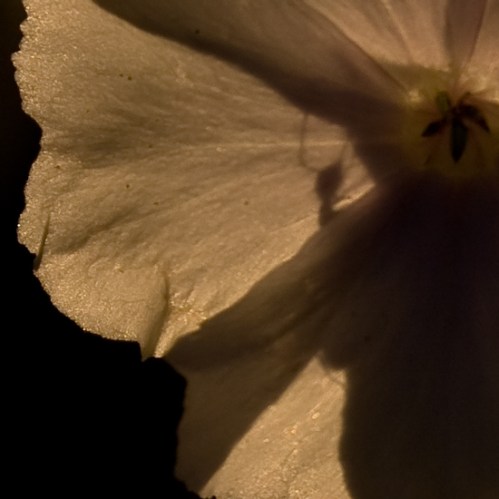
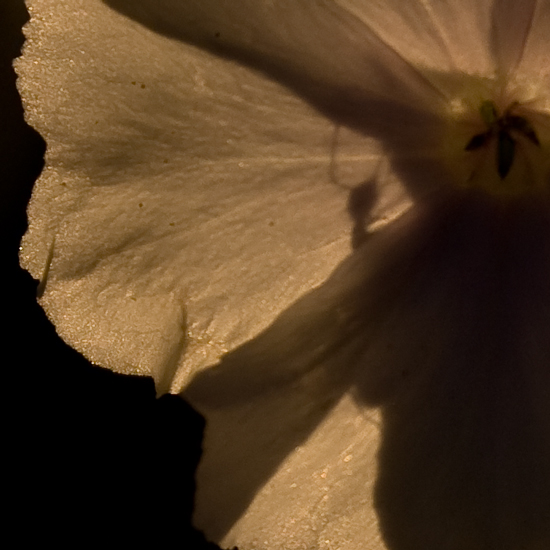
A few months ago I decided to photograph the morning light coming through a small flower in my neighbor’s garden. As I getting ready to shoot, an ant started walking across the back of the flower. It’s not a technically good shot but I like the effect that was produced by the ant’s shadow.
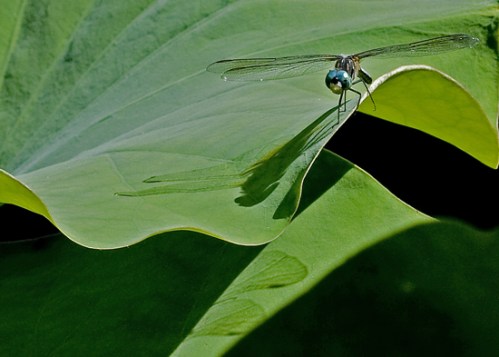
Folks who follow this blog know that I love dragonflies. In early June I took some photos of dragonflies on a sunny day, resulting in lots of shadows. The dragonfly’s shadow makes me think of the position of a person hang gliding and it even looks like the dragonfly is wearing a little helmet.

The undulating surfaces on which the shadow falls really make a difference in the shape of the shadow. I especially like how the shadows of the wings fall on a separate leaf from the shadow of the main body. The shadows of the leaves themselves make this image even more interesting for me.
In this final photo a dragonfly literally is casting a long shadow. The distortion caused by the angle of the sunlight causes his legs to appear much longer and I find that this dragonfly looks much more menacing than is typical of a dragonfly.

Can a dragonfly actually look menacing?

© Michael Q. Powell. All rights reserved.

Read Full Post »

Painted Lady butterfly (Vanessa cardui) photographed today at Green Spring Gardens, Alexandria, Virginia.

© Michael Q. Powell. All rights reserved.

Read Full Post »

Female Eastern Tiger Swallowtail butterfly (Papilio glaucus) photographed today at Green Spring Gardens, Alexandria, Virginia.

© Michael Q. Powell. All rights reserved.

Read Full Post »

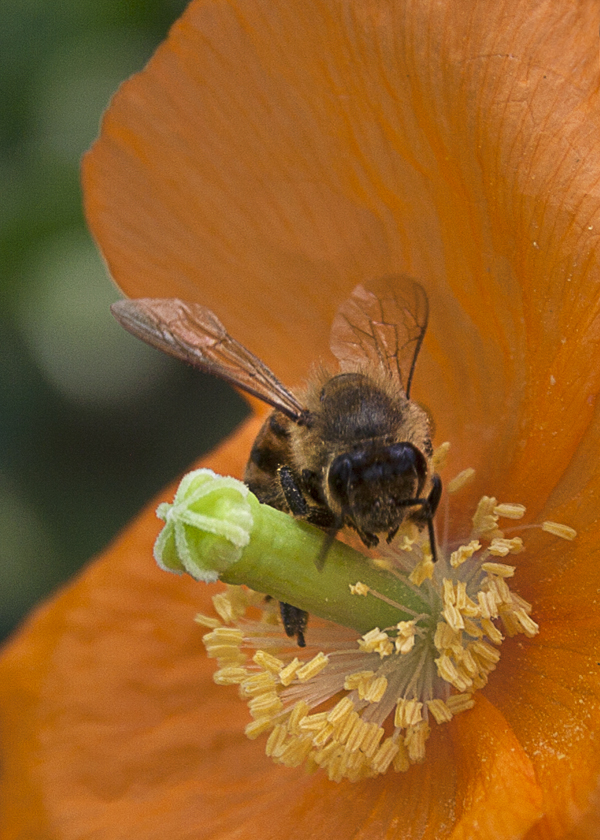
Do you ever get in the mood for a single color? This evening I am in an orange mood. (As a disclaimer I should mention that I drive an orange car, so orange plays a larger role in my daily life than it probably does for most others.) To scratch that itch, I decided to post some photos from late May of an orange poppy and some of the insects that visited it.

May was the month when I first started getting more serious about photography and these photos were an early indication to me that I was improving. I still enjoy looking at them, remembering some of the early twists and turns of the photography journey on which I have embarked.

As I think back, I feel like I was just learning to walk. Now I can walk with much greater confidence. I look forward to being able to run.

Visiting bee

Visiting hoverfly (flower fly)

Visiting ant

© Michael Q. Powell. All rights reserved.

Read Full Post »

This butterfly looks so drab until he opens his wings and reveals his hidden beauty. It was there all the time but we couldn’t see it.

I haven’t been able to identify this butterfly that I photographed this past weekend in a meadow in Massachusetts but like the way the shot turned out.

UPDATE: I am now pretty sure this butterfly is a Common Wood Nymph (Cercyonis pegala).  Check out the Butterflies and Moths of North America website for additional details.

How much beauty do we miss each day because we fail to see past the ordinary exteriors of things (and people) in our lives and neglect to look more deeply?

© Michael Q. Powell. All rights reserved.

Read Full Post »

I know that this sounds like a trick question but I asked myself this very question when I encountered the dragonfly pictured below this afternoon.  I have had lots of practice observing and photographing Blue Dasher dragonflies (Pachydiplax longipennis) and they have always been blue.

From the “waist” up this looks like a typical Blue Dasher with the distinctive chest markings. (I realize that I am not using the anatomically correct language so I apologize if anyone is offended by my ignorance.) The tail, though, is completely different in color—it is not blue.

A little research on the internet reveals that the female Blue Dasher, as shown above, is not blue. She (and juvenile males) have the yellow stripes on the tail as shown.

I am still left wondering, though, about the male-female ratio for Blue Dashers and have no explanation why until now I have seen only males.

I will leave you to ponder that mystery as you look at one of my favorite photo from yesterday of a male Blue Dasher.

© Michael Q. Powell. All rights reserved.

Read Full Post »

A flash of emerald green whizzed past my eyes as I was walking in a meadow near my hotel in Massachusetts. What could it be? I waited a few minutes and recognized the familiar flight patterns of a dragonfly.

Most of the dragonflies that I see are drab by comparison with this one that is almost tropical in the brightness of its color. I am pretty sure this is a female Eastern Pondhawk (Erythemis simplicicollis). For more details about this dragonfly check out BugGuide.

Female Eastern Pondhawk

I stayed for a while longer in the meadow to see what else might appear and was pleased when a pretty bluish-green dragonfly flew into view. At first I thought it was a Blue Dasher but after examining him more closely I realized he was a different type.  I think he is a male Eastern Pondhawk (Erythemis simplicicollis).

Male Eastern Pondhawk

© Michael Q. Powell. All rights reserved.

Read Full Post »

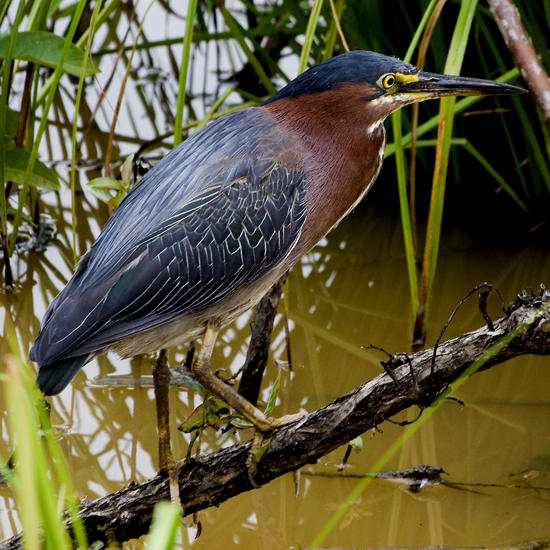
Yesterday’s blog entry featured the adventures of a young green heron catching and swallowing a frog. After the snack was consumed, though, the heron moved from the boardwalk into the marshy area. There he perched on a branch and seemed to pose for me, maybe figuring that his exploits were worthy of a magazine feature.

The resulting photograph is one of my favorite shots of the whole day, because I think it captures well the rugged beauty of this young bird. The background is a little distracting but I like the reflections in the water and the angle of the ranch.

I decided to include two additional action shots from yesterday. The photos seem to show that I probably was incorrect when I stated that the heron had speared the frog when he initially caught it. It looks like the heron was merely holding the frog with his beak as he adjusted its position. Now that I think about it, the process of swallowing the frog would have been complicated if the frog had been speared.

© Michael Q. Powell. All rights reserved.

Read Full Post »
One can only imagine what is going through the frog’s mind as he looks into the crazed eyes of the green heron who has just speared him. Is he looking for mercy? Is he resigned to his fate?

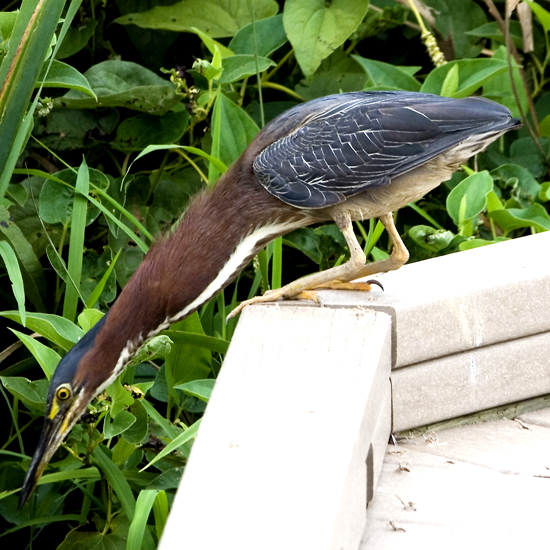
I watched the prelude to this moment unfold this afternoon at Huntley Meadows Park, a marshland park here in Virginia. The green heron was intently scanning the water from the edge of a boardwalk that runs through the march. Periodically he would extend his neck down toward the water.

Several times we heard an excited “eeep” sound followed by a splash, indicating another frog had escaped. After a few more minutes, however, the heron dived into the water and reappeared on the boardwalk with the speared frog you see in the first photo.

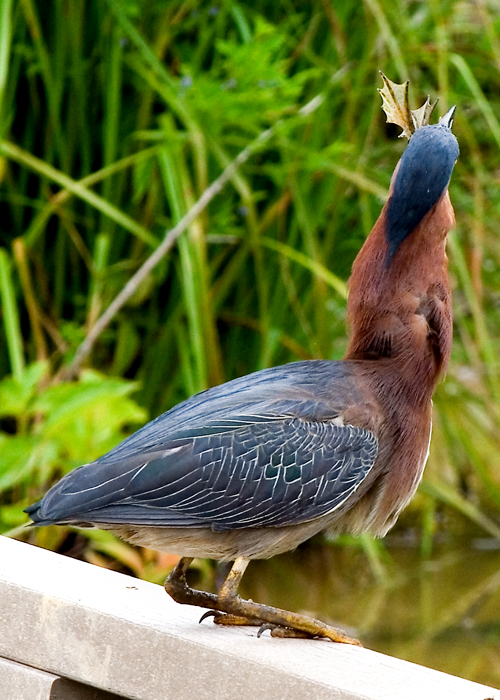
When you look at the comparative size of the heron’s mouth and the frog, it hardly seems possible that the green heron could swallow the entire frog. The heron took his time shifting the position of the frog and then all at once he turned his head, bent his neck back a little, and down went the frog. It happened so quickly that I was able to snap only a single photo that shows the frog’s webbed feet as the only remaining parts that have not yet been swallowed.

In this final photo the heron no longer has a slim neck. I have no idea how long it will take for the frog to reach the heron’s stomach but I am pretty sure he was not yet there when I took this photo.

And don’t try to talk with the heron during this period. Why not? Read the caption of the last photo!

I can’t talk now. I have a frog in my throat.

© Michael Q. Powell. All rights reserved.

Read Full Post »

« Newer Posts