Feeds:
Posts
Comments

Archive for the ‘wildlife’ Category

I am never sure if it’s appropriate to post photos of mating insects, but decided to overlook my inhibitions and post this unusual photo of a pair of mating Eastern Amberwing dragonflies (Perithemis tenera).

Normally I have trouble getting good shots of these dragonflies because of their small size. According to BugGuide, their total length typically is 21-24 mm long (about 3/4-1 inch). In addition, they always seem to land on plants that away from the shoreline (unlike the Blue Dasher dragonflies that seem to like the plants at the very edge of the water).

This past Friday I was photographing dragonflies with Cindy Dyer at a local garden (Green Spring Gardens in Alexandria, VA) when this pair dropped from the sky and landed on a lily pad right in front of me. I happened to be shooting with a telephoto zoom so I had to back up a little to try to get a picture in focus. For those who are technically-minded, the exposure was shot at f11, 1/50 second, ISO 400, at 179mm of a 55-250mm zoom lens.

The photo is not perfectly sharp, but it gives an interesting view into the mating habits of Eastern Amberwing dragonflies. I don’t know my dragonfly anatomy very well, so it took some research to figure out who is who in this photo. The female is the one with the brown spots on her wings and she is holding on to the male’s tail. I think I’ll stop my description there and leave the rest to your imagination.

One thing that this photo taught me is that dragonflies are a whole lot more flexible and gymnastic than I realized!

Mating Eastern Amberwing dragonflies (click for a higher resolution view)

© Michael Q. Powell. All rights reserved.

Read Full Post »

I took this shot of a Red Admiral butterfly (Vanessa atalanta) at Green Spring Gardens in Alexandria, VA on 17 August 2012. It was a little surprising to me that the butterfly chose such a shriveled up, dead leaf as the place to stop, rather than a flower or bush. In a lot of ways, though, I like the simpler setting. It allows me to focus on the beauty of the butterfly without any competing attention from a colorful flower.

The colors and patterns of the Red Admiral butterfly would look good on a necktie. The colors are bright, but not gaudy, and the abstract patterns convey a sense of sophistication.

Red Admiral butterfly (Vanessa atalanta)

© Michael Q. Powell. All rights reserved.

Read Full Post »

This is a shot of a green heron in the third different location where I have seen a green heron within the past month or so, all within a five mile radius of where I live in suburban Northern Virginia, outside of Washington DC. I came upon this little guy while I was walking down a stream bed and he flew into a tree when he became aware of my presence. Luckily he was still very visible in the foliage and, in fact, the green leaves serve as a nice backdrop to highlight the beauty of this green heron.

Green Heron in a tree

© Michael Q. Powell. All rights reserved.
Read Full Post »

Sometimes when I open my images on my computer I am pleasantly surprised. I was going through my images from yesterday afternoon and came upon this one.

Click on the image for greater resolution and details

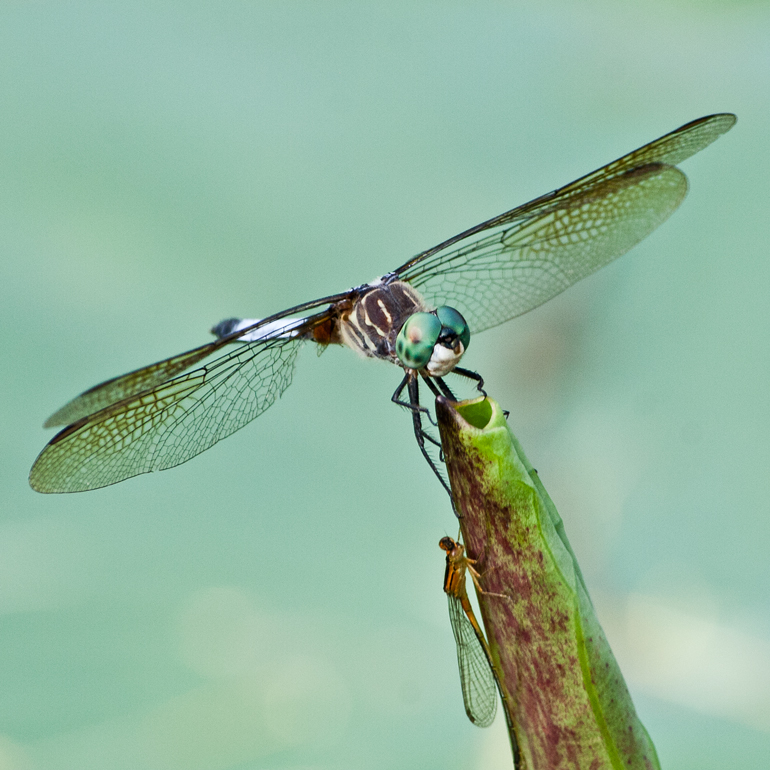
I had been focusing on shooting dragonflies that had stopped to pose on various objects. In this case I am certain that I was looking at the Blue Dasher dragonfly (Pachydiplax longipennis) perched on the rolled-up leaf of a lotus plant and never noticed the damselfly in the photo. The damselfly appears to be scaling the leaf, ready to do battle with the dragonfly. The dragonfly seems to be looking down with a little concern, wondering who is trying to challenge his position. When I compare the relative sizes of the two insects, I can’t help but think of the Biblical story of the boy David taking on the giant Goliath. In this case it would essentially be a family feud, since both dragonflies and damselflies are part of the Odonata family.

It’s a lesson to me to check my images carefully when I process them—there may be all kinds of hidden treasures waiting to be discovered.

© Michael Q. Powell. All rights reserved.
Read Full Post »

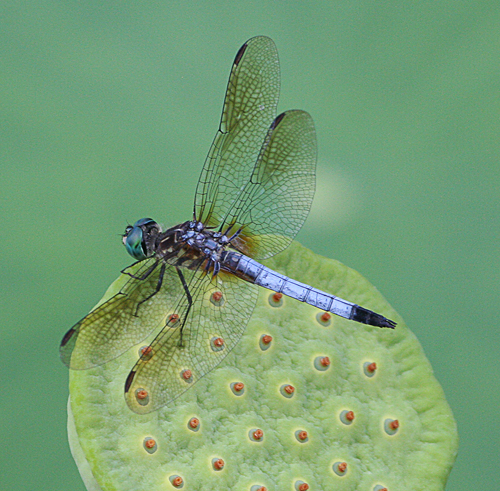
My friend and photography mentor Cindy Dyer and I went out yesterday to photograph dragonflies at Green Spring Gardens in Alexandria, VA, a local garden that is my favorite place to go when the urge to shoot some photos overwhelms me. We were often taking photos side by side. I was really beneficial for me to watch how Cindy, an experienced professional, approached the  photographic task, what things drew her attention, and the way in which she composed her shots. At one point I even got to put my memory card into her camera, a Nikon D300 with a Tamron 180mm macro lens, and shoot for a while. It was definitely a big change from my Canon Rebel XT with a 55-250mm telephoto with which I was shooting at the time. Her set-up was a lot heavier but had a much brighter, bigger viewfinder, and faster focusing.

We were both excited when one Blue Dasher dragonfly (Pachydiplax longipennis), the most common dragonfly that we saw all day, decided to use a lotus seed pod as his home base. He would periodically fly away, but always seemed to come back to the seed pod. She and I were both able to get shots of this dragonfly against the backdrop of a lotus leaf. The light colored circular object you can see is the center of that leaf. I love the crimped edges of this particular pod—it reminds me of a home-made pie crust.

This photo came out so good that I though it probably had been shot with her camera. However, when I checked out the RAW file information I realized it was from my camera. For those who might wonder about the exposure, it was shot at f11, 1/125 sec, ISO 800, at 163mm of the 55-250mm zoom lens. If you are interested in checking out Cindy’s comparable shot (her’s is even sharper) as well as some other wonderful shots she’s taken of dragonflies the last couple of days, check out her blog postings.

Blue Dasher dragonfly on a lotus seed pod

© Michael Q. Powell. All rights reserved.

Read Full Post »

Yesterday I was at a nearby pond photographing mostly dragonflies. After shooting them I decided to make a quick walk around the pond (it’s only a small man-made pond) to see what other subjects I could find. I managed to find a colorful butterfly, a small green heron, and some lotus flowers that I will post later, assuming the photos came out ok.

The subject that really caught my attention, though, was a frog. Really? Yes, really.

I was leaning over the green-colored pond water, gazing at a distant dragonfly when I happened to glance down to my right. There, almost camouflaged in what my friends say is duckweed, was a semi-submerged frog. I was able to get my camera’s lens down pretty low and got in close and captured an image I really like. The frog’s gold-ringed eyes shine out clearly amidst all of the individual particles of duckweed that cover much of his expressionless face.

There are a couple of blades of grass that were partially blocking my view to the frog but they blurred out and are not really much of a problem.  After I took some shots, though, I decided to try to carefully remove one of those offending blades. As I made the effort,  the frog, who had remained motionless up to then, literally leaped into action. He sprung powerfully into the air and skipped across the surface of the water, like a rock throw by a dad showing his son how to skip rocks.

I was so startled by his sudden motion that I almost fell over into the water. Later in the day I did end up getting wet when I belatedly noticed that one foot was planted in the water while I was intently focusing on composing a shot. I guess that’s the price of being a photographer.

Hiding frog

© Michael Q. Powell. All rights reserved.

Read Full Post »

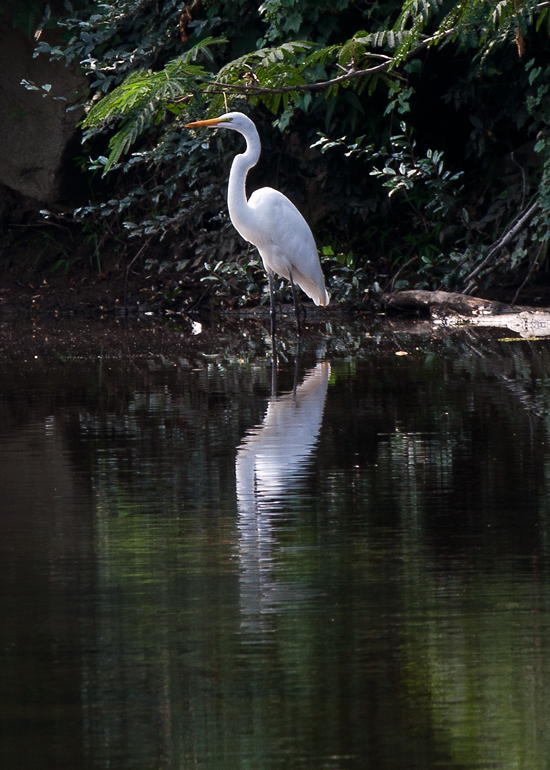
This morning I went shooting at Cameron Run, a tributary stream of the Potomac River in Alexandria, VA. I frequently commute along a road that parallels this stream and have often seen large white wading birds as I drove by. Today I decided to investigate and see if I could get some photos and determine if they were herons or egrets or some other kind of bird.

I did manage to get some shots of the birds in the water and even in the trees, but learned how difficult it is to get a proper exposure with a pure white bird. I’m pretty confident that the birds are Great Egrets (Ardea alba), which are also known as Great White Egrets. A passerby with binoculars (who seemed to know what he was talking about) told me that the orange beak is one of the characteristics that distinguishes the egret from the heron. If you want to know more, there is lots of interesting information about the Great Egret in an article on the website of the Cornell Lab of Ornithology.

The Great Egret is a really impressive looking bird, so much so that it is the symbol of the National Audubon Society, according to Wikipedia.  The Cornell Lab article points out that Great Egrets were hunted nearly to extinction for their plumes in the late nineteenth century, sparking conservation movements and some of the first laws to protect birds.

I was struck by the fact that the Great Egret roosts in the trees and seems to enjoy doing so with other egrets. In one cluster of trees I saw three egrets that appeared to be grooming themselves—they definitely did not seem territorial. I was impressed too by the wingspan that I got to see when I startled one of them and he flew up to a nearby tree.

Now that I know what kind of birds these are and where they hang out, I’m sure I’ll be back to watch them and, hopefully, to photograph them.

Great Egret in a tree

Great Egret in the shade

Great Egret fishing in the stream

Reflections of a Great Egret

© Michael Q. Powell. All rights reserved.
Read Full Post »

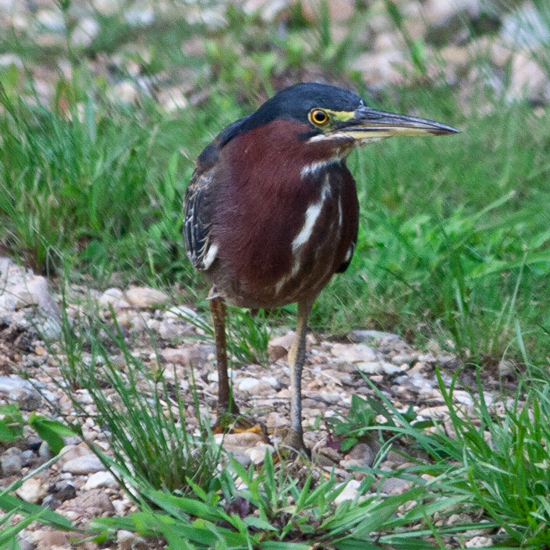
After I got home from work today I rushed to a nearby garden to get in a few shots before the light disappeared totally. I was happy to spot a green heron (I’ve photographed them before at the pond area of this garden) and managed to take a photo of him that I really like. The green heron is standing the edge of a rocky cliff and appears to be keeping watch.  (In reality it’s more like a rock wall).

Green Heron Sentinel

I decided to add one other photo of the green heron that I managed to take before he flew across the little pond to the rock wall. It is a little more of an unposed shot than the first one, which almost looks staged, and captures him in his more natural environment.

Candid shot of a green heron

© Michael Q. Powell. All rights reserved.

Read Full Post »

Almost everywhere that I have seen flowers the last few weeks I have seen skippers. One of the few varieties that I can identify is the Silver-spotted Skipper butterfly (Epargyreus clarus) which I feature in my first photo.

Silver-spotted Skipper

Many of the other skippers, however, look almost the same to me. Wikipedia says that there are more 3500 recognized species of skippers, so I don’t feel too bad about my identification difficulties. Here’s a photo of one of the 3499 non-Silver-spotted Skippers on a sunflower.

Unidentified skipper on a sunflower

This must be the season for the Eastern Tiger Swallowtail (Papilio glaucus), because I see them almost everywhere too. I’ve posted lots of photos of swallowtails recently, but I figure that the bright color of the swallowtails will complement the more muted tones of the skippers. Besides, the different lighting and angles of the shots makes them very different photos for me, even when the subject is the same.

Male Eastern Tiger Swallowtail against the sky

Looking downward at a female Eastern Tiger Swallowtail

© Michael Q. Powell. All rights reserved.

Read Full Post »

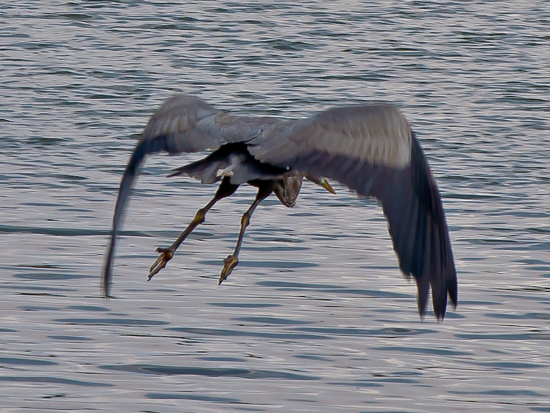
I haven never really paid attention to how birds take off. This past weekend I was photographing a Great Blue heron wading in the water of a nearby pond.  Without any prior indications, he suddenly took to the air. I happened to be in a good position to get a few shots of the different positions his wings assumed as he lifted off from the water. As you can see, I was almost directly behind the heron.

The first photo is my favorite because of the way in which the wings frame the extended legs and the barely visible head. Out of the three photos I have posted here, this was the second one shot.

The photo below shows the heron just as he was taking off from the water. The wings are blurry and are almost like a silhouette. It seems like he had to flap them really hard to lift out of the water. I like the fact that I was able to capture part of his reflection in the water.

Lifting off from the water

This final shot shows his wings in what I consider to be a normal flying position. I haven’t observed herons enough to know if they eventually pull in their legs tighter when they fly higher, but I assume that to be the case. In this photo I managed to get more of a complete reflection in the water than in the previous one.

Spreading his wings

I learned a few things when shooting these photos. First, and perhaps most importantly, I learned how important it is to be ready at all times, because a static situation can become very dynamic very quickly. Secondly, I now understand better why serious wildlife photographers have really big (and expensive) telephoto lens—it’s tough to get in close enough. Finally, I appreciate much more the abilities of those who are able to capture moving subjects like this heron with perfect focus and sharpness. My photos are not very sharp and clear, but I still found them interesting enough to want to share them.

© Michael Q. Powell. All rights reserved.

Read Full Post »

Some days it seems like anything that catches my eye is a potentially viable subject. This was the case last Friday when I was walking in a marsh in a local park and came upon this snake. Much of his body was concealed, but the upper body was exposed enough for me to attempt a head-and-shoulders portrait. Oh, wait a minute, I guess a snake does not really have shoulders, so I guess I was attempting a head-and-neck portrait.

The snake was beautiful in his own way, with wonderfully textured skin and stunning gold accents around his eyes. I thought he was probably a garter snake, but after a bit of research I am now convinced he is an Eastern Ribbon snake (Thamnophis sauritus), not a Common Garter snake (Thamnophis sirtalis). If you are at all interested in the differences, there is a wonderful article entitled “Telling Garter Snakes and Ribbon Snakes Apart” at http://www.gartersnake.info (yes, that’s the actual web address).

As I was admiring his beauty, he may have decided to remind me that he is a predator as suddenly he opened his mouth wide, really wide. I was looking through the lens at him and the effect was magnified because his head filled a good portion of the frame of the viewfinder. My first thought was that he was sizing me up as a potential snack. I had the presence of mind to snap a picture before his mouth snapped shut. A vine covers part of his mouth in the photo, but I decided to include it to show you how wide his mouth really is.

Now I understand how he is able to do things like swallow frogs whole. I’m glad I’m a lot bigger than a frog.

Eastern Ribbon Snake Posing for Portrait

Eastern Ribbon Snake Sizing Me Up

© Michael Q. Powell. All rights reserved.
Read Full Post »

Prior to this past weekend I had never seen an American Painted Lady butterfly (Vanessa virginiensis) and now it seems like they are everywhere, if you define “everywhere” as two separate locations within a few days.

Previously I posted a photo of the American Painted Lady butterfly in beautiful soft light in a shot taken from the side. On Sunday, just as I was getting ready to leave Meadowlark Botanical Gardens in Vienna, Virginia, I saw a flash of color and realized that it was a beautiful butterfly. Upon closer examination I recognized the now familiar coloration of the American Painted Lady.

She settled onto a plant and seemed to pose for me, as though she could put aside the normal activities of feeding for a moment. The late afternoon light was behind her and was still bright, causing some of the highlights to be blown out. However, the light also gave her a glow, partially illuminated her wings, and highlighted her reddish hair. The angle of he shot provides an unusual, but pleasing, view of this butterfly.

The shot may not be perfect, but you can’t help but admire the beauty of this American Painted Lady.

The lady is a redhead

© Michael Q. Powell. All rights reserved.

Read Full Post »

This past weekend seems to have been my heron weekend. I posted some photos of a great blue heron that I saw on Saturday. However, I realize that hadn’t yet gone through all of my photos from Friday, which included this shot of a green heron perched on the dead limb of a tree.

The tree was overlooking a muddy pond and I couldn’t tell if the green heron was just resting or whether he was preparing to hunt for prey. The situation afforded me an unobstructed view of the green heron and I quickly started taking some shots, suspecting (as turned out to be the case) that my luck would not hold for long. The green heron soon jumped from his perch and moved farther away into some undergrowth when he focused his attention on the water.

I was totally fascinated and watched him from a distance for quite a while. Several times he “alerted” by extending his neck and leaning toward the water, but I didn’t managed to see him catch anything.

This image captures some of  of the green heron’s gorgeous colors. I especially like the chestnut color around his neck and the intensity of the yellow of his eyes.

© Michael Q. Powell. All rights reserved.

Read Full Post »

I took this photo at Huntley Meadows Park in Alexandria, Virginia, a marshland area that has lots of wildlife. I have managed to get lots of shots of Blue Dasher dragonflies but have had trouble getting a properly exposed image of the Common Whitetail dragonfly. The white body is usually blown out and overexposed in my images. (If you want to know some more about this type of dragonfly, check out the article in Wikipedia as a start.) This past Friday was mostly overcast and I finally got some decent photos.

I like the way this particular image turned out because of the dragonfly’s reflection in the muddy brown pond water, the little stump that pokes out of the water, and the green stalk that runs diagonally across the photo.

Male Common Whitetail dragonfly (Plathemis lydia), also known as a Long-tailed Skimmer.

© Michael Q. Powell. All rights reserved.

Read Full Post »

Here is a close-up of a Great Blue Heron (Ardea herodias) who has just speared a fish of an unknown type. I was able to watch the whole process from the shoreline of the pond and took some shots.

I note that the photo here is not a super crisp, clear image. It is a crop of a shot that I had to tweak because of some problems getting the exposure right (reflected light off the water and shadows were both problem), but I like the fact that you can see both the heron’s and the fish’s faces.

In a posting on 24 July I showed a green heron swallowing a frog whole. I was not able to see how this blue heron consumed the fish because he carried it into a shaded area along the shoreline.

© Michael Q. Powell. All rights reserved.

Read Full Post »

Here is another shot of a Great Blue Heron (Ardea herodias) that I photographed 11 August 2012 in Alexandria, Virginia.

At first I couldn’t figure out why he had his mouth open in so many of my pictures. As I went over the photos, however, it looks like he may have had a stick or bone stuck in his mouth. Is that possible? Earlier in the day I watched as he speared and ate a fish and it’s possible he picked up some debris when he caught the fish (my photos of him spearing the fish turned out really dark but I’ll see if I can salvage any to post).

Eventually he did close his mouth.

Click on the image for greater details.

© Michael Q. Powell. All rights reserved.
Read Full Post »

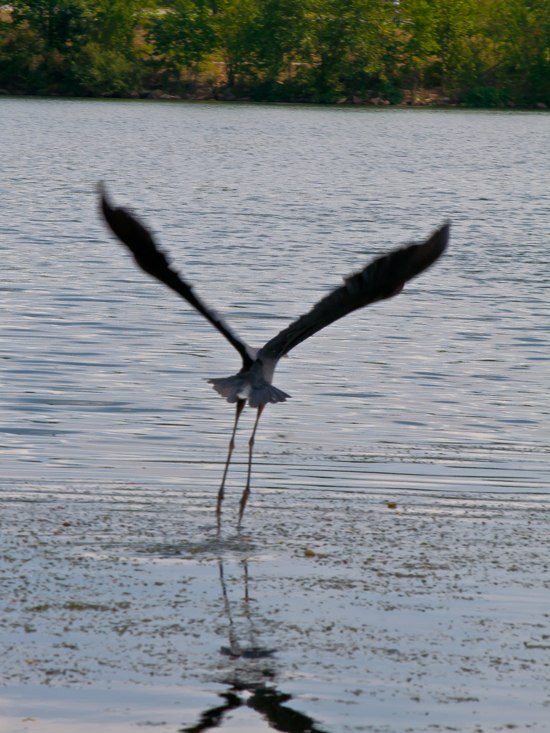
Great Blue Heron (Ardea herodias) photographed 11 August 2012 in Alexandria, Virginia.

Click on photo for greater details.

© Michael Q. Powell. All rights reserved.
Read Full Post »

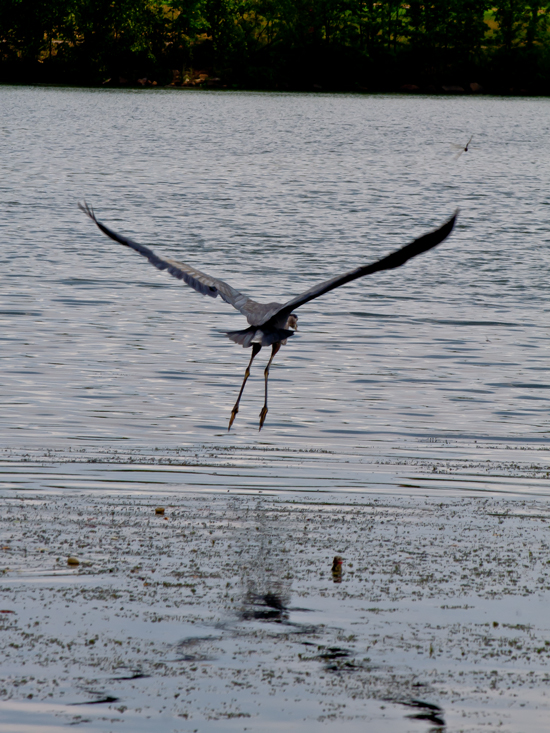
The angle of the lighting and the unusual framing of this photograph of a female Eastern Tiger Swallowtail butterfly (Papilio glaucus) set it apart from other photos I have taken of the same species. (See my postings from 8 August and 21 July for other shots of the Eastern Tiger Swallowtail.)

The light is uneven and there are areas that are not sharp, but I like the overall effect of the photograph.

Click on the image to see more details.

© Michael Q. Powell. All rights reserved.
Read Full Post »

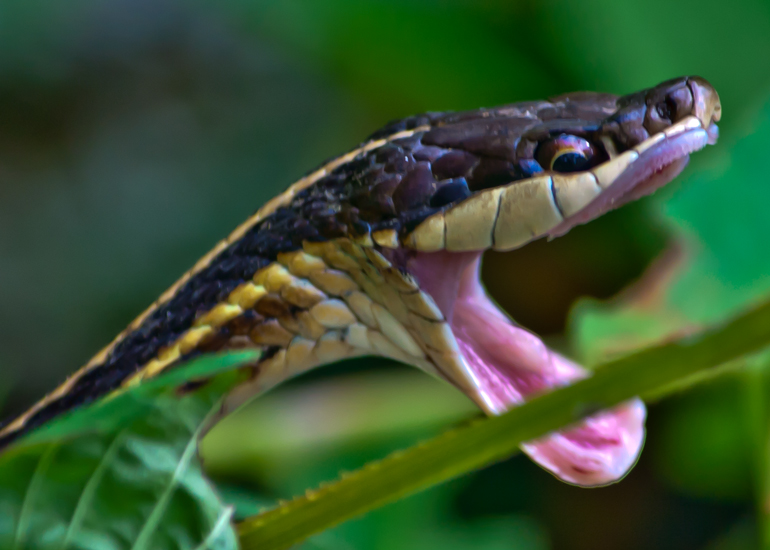
Today I photographed an American Painted Lady butterfly (Vanessa virginiensis), which is also know as an American Lady.

At first I thought it was a Painted Lady butterfly (Vanessa cardui), a type that I had previously photographed (see my posting from 3 August). A closer examination and some internet research showed it was not the same butterfly.  You can find more information in Wikipedia but the easiest identification features for me were the eyespots on the ventral side—the American Painted Lady has two large eyespots and the Painted Lady has four smaller ones.

I learned a good lesson today too about the need to carry a camera with me as often as possible. I took this photo at the outdoor sales area at a local Home Depot store.

American Painted Lady butterfly (Vanessa virginiensis)

© Michael Q. Powell. All rights reserved.

Read Full Post »

I came across some ducks this afternoon while walking around a man-made pond in my suburban neighborhood and decided to take a few shots.

This is my favorite photo. I think is a juvenile male mallard duck (corrections are welcome) on the basis of some quick internet searching. I am particularly struck by the expression on his face and in his eyes as well as by the beautiful, iridescent blue feathers on his tail.

He definitely seems shy, or perhaps he is merely being coy, being an inexperienced young drake.

© Michael Q. Powell. All rights reserved.
Read Full Post »

I came across this colorful specimen while on a nature walk at a local marsh. He was close enough to the edge of the path that I was able to set up my tripod and shoot with my macro lens, so I was able to get a reasonable depth of field.

I don’t have the slightest idea what kind of a caterpillar this is, but I really like his colors and all of the hairy, spiny things sticking out of his body (even if they made focusing a bit of a challenge).

© Michael Q. Powell. All rights reserved.

Read Full Post »

When I came upon this scene this afternoon I couldn’t help but think of some blog posts that I had read recently. Steven Schwartzman had a beautiful artistic image of a damselfly caught in a spider’s web entitled “Three Orbs, Three Colors.”  Daniel Proud had a wonderfully informative Four part series on Harvestmen (Daddy Longlegs) in late July that included colorful images of different harvestmen. Both of those bloggers caused me to be much more attentive today as I took in my surroundings during a nature walk at a local marsh.

I managed to capture an image of the spider moving in on his captured prey, a daddy longlegs, that had become stuck in the spider’s web.  Some may find the photo to be a little disturbing, but to me it is a simple fact of natural life.

Shortly after taking this photo, I moved in a little closer and must have disturbed the web. The spider quickly climbed up the web and took refuge inside the curled-up leaf. I waited for quite some time but the spider did not reappear.

I think the daddylongs was still alive when I left him, but his prospects do not appear to be good.

Caught in the web

© Michael Q. Powell. All rights reserved.

Read Full Post »

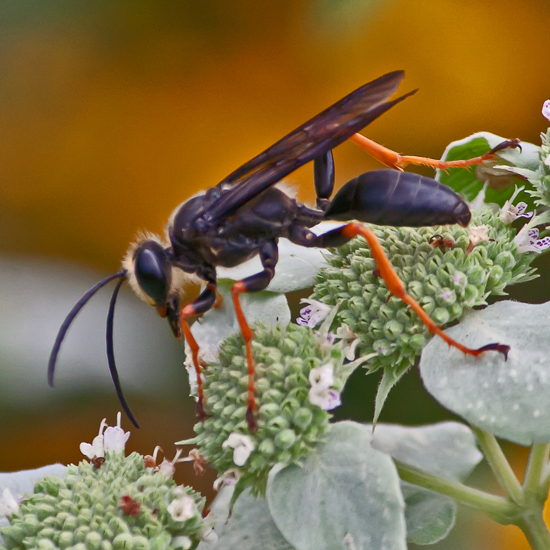
Bees and butterflies seem to get all the love. Where is the love for the lowly wasp? Maybe wasps need a public relations firm to give them a new image.

This photo from a recent shoot suggests one approach to that new image—an edgy, radical image. The wasp already appears to be sporting a mohawk hairstyle and large, dark sunglasses. Some piercings and a few tattoos and the new image would be complete.

The result—a cool new image for the wasp to match the attitude he already possesses.

© Michael Q. Powell. All rights reserved.

Read Full Post »

Whenever I am shooting flowers of any sort I am inevitably drawn to bees. I love watching them flying and hovering, back and forth and in and out of the flowers.  Sometimes a bee seems to be systematically covering a group of flowers and other times he seems to be choosing randomly where to touch down before moving on, relentlessly in motion.

Here are a couple of recent shots of carpenter bees on a plant that I have been told is called salvia. I love its deep purple color and simple flowers. The first shot is a closeup of a bee. The second one gives you a better idea of the shape of the flower. Note that in both cases the bee is getting the nectar from the side of the flower and is therefore not pollinating it.

© Michael Q. Powell. All rights reserved.

Read Full Post »

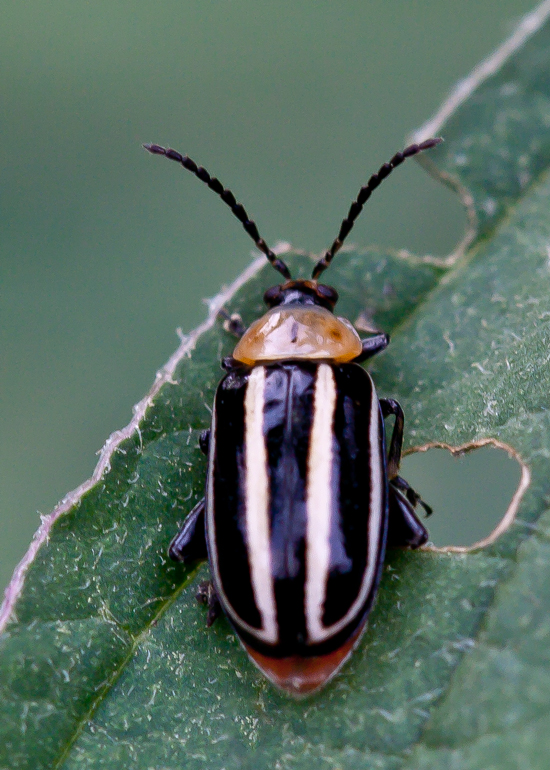
Last month I first encountered the Striped Cucumber Beetle (Acalymma vittata) in a neighbor’s garden. I was immediately taken by his cool, sophisticated, man-about-town look. The black and light yellow stripes down his back make him look like he is dressed formally. The translucent orange high collar, though, adds a splash of color to his ensemble and causes him to really stand out in a crowd. This well-dressed dandy, however, has a deep dark secret. Beneath the surface of this Dr. Jekyll lurks a Mr. Hyde.

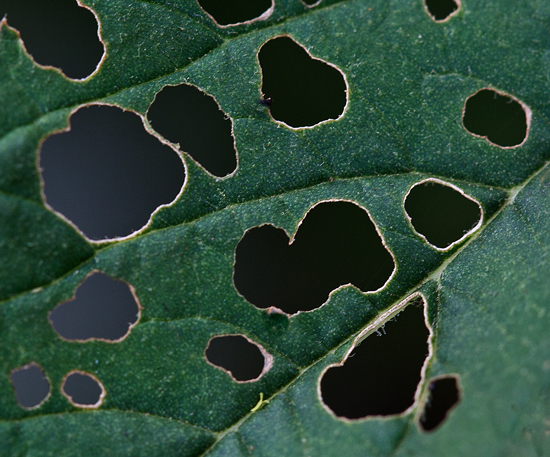
I ran into him today in my friend’s garden. Previously, the garden had been green and flowering. Now the garden looked like a war zone, with signs of devastation everywhere. The leaves of the plants had all been ravaged and looked like the image below.

So I confronted the striped cucumber beetle about what had happened to the leaves. I asked him to swear an oath to tell the hole truth, and nothing but the truth. Initially he resisted and then he admitted to a hole in one. Finally he confessed and named the other beetles who had participated. The judge, however,  may be lenient with him because he took personal responsibility for his actions and acknowledged that the hole thing had been his idea.

© Michael Q. Powell. All rights reserved.

Read Full Post »

The subject is simple and familiar, a bee and a flower. My eye was drawn, however, to the way this bee had latched on to the entire center of this flower in a full-bodied bee hug. The X-shape of the splayed legs and the radiating petals combine to produce a graphic effect that goes beyond the literal subject matter.

© Michael Q. Powell. All rights reserved.

Read Full Post »

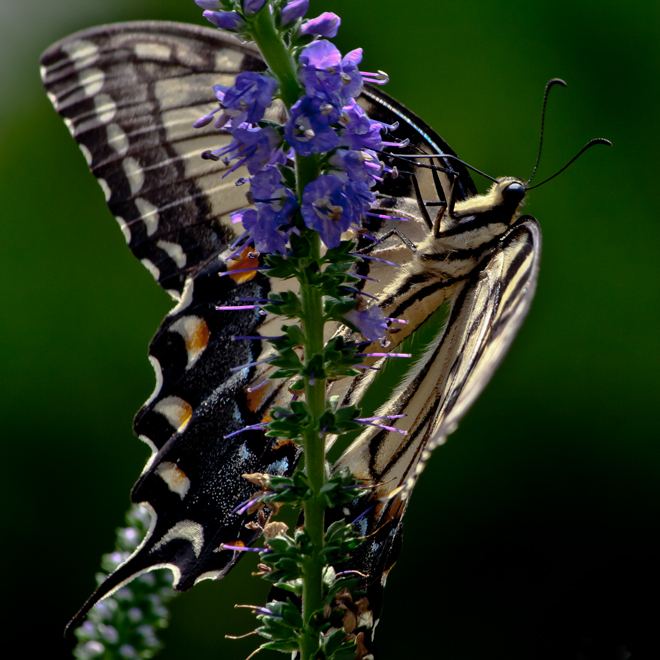
One of the coolest things about female Eastern Tiger Swallowtail butterflies (Papilio glaucus) is that they come in two distinctly different colors, black and yellow. According to Wikipedia, that characteristic makes them dimorphic. I’m no scientist, so I had to do some research  to see what “dimorphic” means. If I understand it right, it means that there are two different phenotypes (called morphs) that exist in the same population of a species and they have to be in the same habitat at the same time to qualify.

I was thrilled yesterday to observe and photograph both variants at a local garden. The yellow ones resemble the male, although the male is only yellow and black and has no additional orange and blue markings. I have seen a lot of the yellow female swallowtails this summer. The black swallowtails, which have black bodies as well as black wings, seem to be more rare, or at least I have seen them only rarely this summer.

Which one is more beautiful? I’ll leave that call to each of you.

black_swallowtail1_6x8blog

Female Eastern Tiger Swallowtail butterfly (black variant) UPDATE in 2020: I think that I misidentified this as an Eastern Tiger Swallowtail and now think it might be a Black Swallowtail, though the angle keeps me from being sure about the identification

© Michael Q. Powell. All rights reserved.
Read Full Post »

Some bees are hairy and some bees are really hairy.

Seriously, this bee looks like he could use a beauty makeover. At a minimum he needs a trip to a barber or hair stylist to trim away some of that excess hair. Look at his legs, his forehead, and his neckline. Yikes! The worst area may be the swirly hair on his back. I haven’t seen anything that bad since the days when the comb-over was a popular hair style.

Maybe he is wearing his hair long to conceal the fact that he is going thin on his back. If that’s the case, I have news for you, Mr. Bee. “You’re not fooling anyone.”  It’s time to get with modern styles, perhaps, and shave it all off.

What would a bald bee look like?

Fuzzy Wuzzy was a bee…

© Michael Q. Powell. All rights reserved.

Read Full Post »

Monarch butterfly (Danaus plexippus) feeding on a marigold flower at Green Spring Gardens, Alexandria, VA on 6 August 2012.

Click on the photo for greater color and clarity

© Michael Q. Powell. All rights reserved.

Read Full Post »

Does a bee ever get stuck when he flies (or climbs) into a flower with a narrow opening?

This question arose this afternoon when I watched a bee enter a flower so deeply that only his legs were visible. He remained in that position for some time and then he somehow was able to get back out of the flower. I am still not sure if he was stuck or how he was able to extricate himself. From my perspective, it was a feat worthy of an insect Houdini.

I shot a series of photos that illustrate the whole process. In this case the old adage is true about a picture being worth a thousand words. You will notice that I changed my vantage point part way through the shoot. (I had plenty of time while the bee was inside the flower.) I would also draw your special attention to the details of the last photo in which the bee has to act like a contortionist to get his legs out of the tight spot.

Who knew that bees were so flexible?

© Michael Q. Powell. All rights reserved.

Read Full Post »

You might think that I am going to talk philosophically about a bee, but my title is meant to be taken literally. If you click on the photo, you can actually see reflections of the sky and bushes on the shiny surface of the abdomen end of this bee.

I am pretty sure that this is a carpenter bee for two main reasons. First, the abdomen area is shiny and hairless, unlike a bumblebee who is more hairy. Secondly, the bee is sucking nectar out of the side of the flower rather than going in from the front, a process sometimes referred to as “nectar robbing.” Carpenter bees are notorious for circumventing pollination in certain plants by slitting open the side of the flower.

Perhaps others can see more reflections on the bee. It’s like looking at clouds and trying to see shapes—it’s a lot of fun and everyone sees something different. Life is like that sometimes.

Click the photo to see more details

© Michael Q. Powell. All rights reserved.

Read Full Post »

« Newer Posts - Older Posts »