Feeds:
Posts
Comments

Archive for the ‘wildlife’ Category

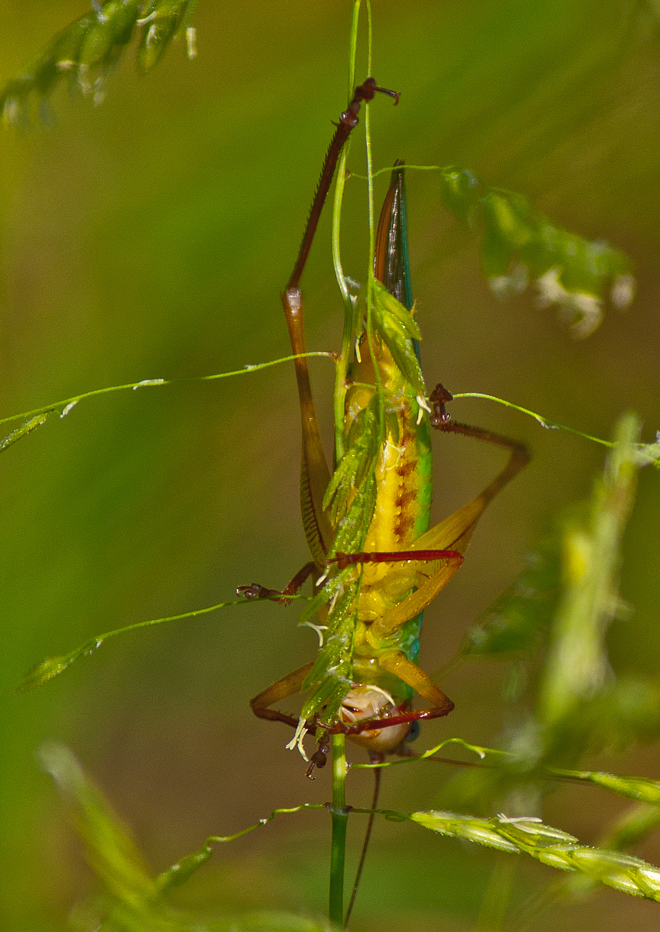
Several years ago I saw one of the Cirque du Soleil productions, an event full of dazzling costumes and amazing acrobatic feats. Memories of that unforgettable experience were triggered when I first viewed this photo of another Handsome Meadow Katydid (Orchelimum pulchellum) at Huntley Meadows Park. I have previously posted a number of different images of this very photogenic insect, but this one shows my beautiful friend in action, rather than in a static pose.

Acrobatic Handsome Meadow Katydid

I recall how the acrobats of the Cirque du Soleil were suspended high in mid-air, holding on (often with what seemed to be a single toe) to a trapeze or to a slender rope. My little katydid is not risking his life in that way, but I do find it amazing how he is clinging to the single stalk of grass. His brilliant colors continue to amaze me and the red blotches on his face accentuate the circus-like effect, as you can see in this close-up view of his face.

Close-up view of a Handsome Meadow Katydid

I will be a little sad when I stop seeing my colorful little friends at Huntley Meadows Park, but the memories will remain. Perhaps  in the future, some brightly colored object or acrobatic pose will trigger memories of these katydids, nature’s own Cirque du Soleil.

© Michael Q. Powell. All rights reserved.

Read Full Post »

As I was reaching down one recent morning to pick up my newspaper from the small concrete stoop of my townhouse, I happened to look up and saw a beautiful spider web reflected in the early morning sun. In the center of the web was a small, fuzzy brown spider with what appeared to be short legs.

The spider was positioned in such a way that I could use my macro lens to get some close-up shots, but he was too high in the air for me to use a tripod or to brace my arms for optimal steadiness.  I also did not have a choice of too many angles, because the spider was suspended over a large bush that impeded my access. I took a lot of photos, many of which came out really out of focus.

Here are my favorite shots, two of which show the underside of the spider and two show a side view. I really like the markings and texture of this little spider, though I am not at all sure what kind he is. The unidentified spider is living proof, however, that the most interesting things are sometimes literally just outside our front door—all we have to do is open our eyes as we open the door.

© Michael Q. Powell. All rights reserved.

Read Full Post »

I was observing three cheetahs at the National Zoo for quite some time when one of them decided to enter the dug out area of their habitat where two cheetahs were already lying down. Just before he entered it, he turned in my direction and stuck out his tongue. I have no idea what he might have been trying to communicate to me. Perhaps he was no longer interested in my antics and was trying to tell me so or maybe it was his way of saying goodnight. Whatever his intention, it makes for an interesting photo.

Cheetah sticking out his tongue

© Michael Q. Powell. All rights reserved.

Read Full Post »

A month ago the National Zoo in Washington, D.C. opened up a newly renovated, $42 million exhibit called the American Trail that highlights species of North American wildlife. The zoo’s website (which contains lots of information about the animals and great photos) notes that the majority of the American Trail species have rebounded after facing serious threats, thanks to the conservation efforts of many organizations, including the National Zoo.

This brown pelican is part of the American Trail exhibit. I don’t think that I had ever seen one live, and certainly not so close up. I love the beautiful colors of this bird and its wonderful pose, and it seemed willing to cooperate when I was taking the photographs.

Brown pelican at National Zoo

Unlike my photos of the red panda and cheetahs, I was not shooting without obstructions—here was a fence between me and the pelican. Following instructions that I read somewhere recently, I got as close to the fence as I could and opened up the aperture (to F5.6 in this case) and the fence seems to have disappeared.

Now that I have taken a few photographs at the zoo and had some success, I think that I will probably add it to my list of local places where I can find interesting subjects to photograph.

© Michael Q. Powell. All rights reserved.

Read Full Post »

I photographed this red panda (Ailurus fulgens) this past weekend in Washington, D.C. at the National Zoo. According to Wikipedia, red pandas are native to the Himalayas and southwestern China. Like the better-known giant pandas, red pandas eat mostly bamboo, although they may also eat eggs, insects, birds, and small mammals.

I will probably post a few more shots of this red panda in the next few days, when I have gone through my zoo photos. However, I wanted to make a preliminary introduction of this delightful animal, suspecting that many of you may be unaware of the existence of a red panda. (Previously red pandas were classified in the families of racoons and bears, but now they have their own family and are the only extant species of the genus Ailurus.)

Red panda at the National Zoo

© Michael Q. Powell. All rights reserved.

Read Full Post »

Photographed yesterday at the National Zoo in Washington, D.C. where I spent hours observing the cheetahs. There is so much to love about cheetahs—their elegance, speed, coloration, and strength. This image shows that they also have beautiful eyes.

Portrait of a cheetah at the National Zoo

© Michael Q. Powell. All rights reserved.

Read Full Post »

Walking along Rock Creek in Washington, D.C. on my way to the National Zoo yesterday, I came upon some ducks in a area of the creek where the water was still. I knew that they were ducks, but when I zoomed in on them I was surprised. One of them was the most unusually colored duck that I have ever seen, with a strangely shaped head, brightly colored feathers, and red eyes.

Male wood duck in Rock Creek

I did some research and discovered that this is a male wood duck. If you had asked me yesterday about wood ducks, I would have thought you were talking about those hand-painted decoys.

I managed to get a shot of the male wood duck swimming along with a female wood duck. The photo is not quite as clear as the first one, but it shows the difference in coloration between the male and the female. The female is more delicately beautiful than the male, who is really ostentatious in appearance.

Female and male wood ducks in Rock Creek

I seem to have a knack in discovering brightly colored creatures, whether they be grasshoppers or duck. I hope my good fortune continues.

© Michael Q. Powell. All rights reserved.

Read Full Post »
I visited the National Zoo in Washington, D.C. this afternoon and spent the lion’s share of the time with the cheetahs. National Zoo has a very active cheetah conservation program that you can lean more about on its website. At the moment there are six cheetahs (three brothers, one female, and two cubs) that live at the zoo, according to the website.

Most of my time was spent with what I believe was the three brothers (named Draco, Granger, and Zabini), who were  together in a single outdoor enclosure. If they were brothers, one of them seemed to be considerably larger than the other two. The zoo website indicates that the brothers were born in 2005.

I haven’t had a chance to go through all my photos, but thought I’d post a couple as a kind of sneak preview. I know that some folks object to photographing animals in captivity and apologize if I have offended anyone.  However, especially in the case of the cheetahs, I encourage you to check out the work that is being done to preserve this magnificent species as well as others.

Cheetah in the grass

Cheetah walking

© Michael Q. Powell. All rights reserved.

Read Full Post »
Wandering yesterday through the marshy area of Huntley Meadows Park, I spotted a large bug perched near the top of one of the cattails. I could not really see for sure what it was and it flew away as soon as I took one photo. When I opened the image on my computer, I saw that I had captured an image of a strange-looking bug that seemed to have the blade of a circular saw embedded in its back.

It did not take much of a search on the internet for me to discover that it is a wheel bug (Arilus cristatus). The University of Florida Entomology Department website notes that the wheel bug is an assassin bug that administers a very painful bite, described as worse than the bite of a bee, wasp, or hornet. Wheel bug saliva contains a toxic, paralytic substance that immobilizes and kills its victims (caterpillars, bees, aphids, and other insects) usually within 15 to 30 seconds after injection.

Personally, I think this insect looks like a miniature dinosaur or something out of a low-budget science fiction movie. In any case, it is certainly one of the strangest looking creatures that I have ever encountered.

Wheel bug surveys the situation from a cattail

© Michael Q. Powell. All rights reserved.

Read Full Post »
As we move deeper into autumn, I expect to find the colors orange and yellow only in the fall foliage or an occasional sunset. Yesterday, I was surprised to see this orange-and-yellow butterfly flitting from flower to flower, seemingly oblivious to the changing seasons. Doesn’t he know it’s almost October? Is it eternally spring for a butterfly?

Butterfly in late September

© Michael Q. Powell. All rights reserved.

Read Full Post »

Damseflies are really small and if they were not brightly colored, they would be difficult to see. However, when there are two of them flying together (really together), they are slightly easier to detect. Anatomically speaking, I am having a little trouble figuring how the mating takes place with the damselflies as pictured below, but suffice it to say that damselflies are more flexible and acrobatic than I had previously thought.

I took these shots this afternoon at Huntley Meadows Park in Alexandria, VA.  Getting a decent image was a bit of a challenge because I was shooting from a raised boardwalk almost two feet above the water level and the damselflies keep landing on vegetation that was just in the shadows underneath the boardwalk. As a result, my position sometimes resembled that of the lighter-colored damselfly.

Close-up of mating damselflies

Mating damselflies

Acrobatic mating damselflies

© Michael Q. Powell. All rights reserved.

Read Full Post »

I have recently been making a lot of attempts to photograph birds, but none of the photos comes close to matching the visual impact of this female red-winged blackbird that I photographed in early June at Brookside Gardens in Wheaton, MD.

Normally you are not supposed to photograph a bird from the front, but in this case it seems to heighten the intensity of the bird’s stare. The sky was almost white that day and it disappeared when tweaks were made, but that seemed to fit with the industrial look provided by the rebar that was used to form a trellis.

Intense female red-winged blackbird

Here is another shot of the blackbird on the trellis, with some greenery in the background. You can see some of the details of the trellis, and it looks like the rusted metal is almost a perfect color match for some parts of the bird.

Bird on a wire

My blog is still less than three months old, so I have a number of my pre-blog favorites that you have not yet seen. I will occasionally share some of them when I don’t have any new material or don’t have time to prepare the new photos.

© Michael Q. Powell. All rights reserved.

Read Full Post »

This shot has some great elements—a Great White Egret and a Great Blue Heron,  practicing together in the trees for their audition for “Dancing With the Stars.” They look to be almost perfectly synchronized, though the heron may need to work on his neck position. From a technical perspective, alas, the shot is far from great, but it was interesting enough that I decided to share it.

I frequently see egrets roosting in the trees along Cameron Run, a stream in Alexandria, Virginia that feeds into the Potomac River, but this is the first time that I had seen a blue heron fly into the trees. I was shooting from a running path that parallels one side of the stream.  Shooting across a considerable amount of growth as well as the stream itself, I find it difficult to get a close-up shot. In this photo, I had startled the heron and he took off into the trees, startling the egret, who was already perched there.

Dancing in the trees

I continue to have difficulties getting good shost of the egret, because there is often glare and it is hard to keep the highlights from blowing out. Here is a shot of an egret in partial shade that has some detail, but I can’t seem to keep the detail without imparting a grayish tinge to what is a really white bird. I will definitely keep trying, though, because I find the egrets and herons to be fascinating to watch in their almost geeky gawkiness.

Egret in a tree along Cameron Run

© Michael Q. Powell. All rights reserved.

Read Full Post »

The bright green leaves of the plants in the marsh have faded and most of the colors are more subdued than in early summer. Against that muted backdrop, I was surprised to come across a brightly colored caterpillar this past weekend. It looks a bit like the Cattail Caterpillar (Simyra insularis) that I photographed and described earlier this year, although the spiky red tufts are more extreme on this caterpillar. I think I can detect the prominent black and white pattern that was so visible in the image that I posted previously.

This is the first year that I have paid close attention to the cyclical changes in plants, animals, birds, and insects. I am excited to see what new species will come into my field of vision as we move through the fall.

UPDATE: I did a little more research and now think that this caterpillar is actually a Smeared Dagger Moth caterpillar (Acronicta oblinita).

Colorful caterpillar in late September

© Michael Q. Powell. All rights reserved.

Read Full Post »

Yesterday I went out to a local garden with the monster Mamiya 500mm telephoto lens mated to a Nikon D300 to see if I could get some reasonably focused shots. A few days ago I did a posting outlining my initial difficulties in mastering the requirements of shooting in a totally manual mode and I wanted to see if things would be a little easier for me.

It was once again a lot of fun experimenting and I tried taking shots of a wide variety of subjects, including soccer-playing kids, flowers (yes, flowers with a 500mm lens), and a rabbit. Other than the rabbit, I had only limited success. The real test for me, though, was whether I could capture some shots of birds. I noticed a couple of birds perched high up in a tree in a relatively open area and I was able to set up my tripod on the grass and began to make a few exposures. The birds were far enough away that they were not distracted by the sound of the shutter and they stayed in place as I made adjustments. Here are some of my best shots of a crow (I cropped him so you can see the details, including the catch light in his eye) and a mourning dove. I am also including a shot of a bird that almost got away. He flew away just as I tripped the shutter and ended up in the lower left hand corner of the image in an unusual position. I decided also to post a shot of a rabbit that seems to have some personality. In this garden setting, it was the wildest animal to be found.

I have satisfied myself that it is possible to get some good images with this setup, although it requires both patiience and persistence. Is it worth the additional aggravation? My friend, Cindy Dyer, for whom I am testing this configuration will have to make that call for herself.

Close-up of a crow

Mourning dove

The one that almost got away

Rabbit on the grass

© Michael Q. Powell. All rights reserved.

Read Full Post »

Basking in the warmth and light of the fall sun, turtles of all sizes were perched on the logs and other chunks of wood in the muddy waters of a local marsh pond. I was struck by the attitude of this red-eared slider turtle (Trachemys scripta elegans), whose stiff-necked and imperious pose seemed almost aristocratic. He had gained this prime piece of real estate by crawling over one of his fellow turtles and was now standing on that turtle’s back to provide himself better access to the sun.

I have to admit that he is beautiful and I suspect that he would be the first to tell me so if he could speak.

Red-eared slider turtle basking in the sun

© Michael Q. Powell. All rights reserved.

Read Full Post »

It’s been at least a few weeks since I last photographed the Great White Egrets that inhabit the Cameron Run area of Alexandria, VA.  It was immediately obvious to me this past weekend that the dry summer has affected this tributary of the Potomac River and the water was really low in many places.

I was happy to stumble upon an egret standing out of the water on some rocks. The sky was a brilliant blue and it was reflected beautifully into the water, as was the egret itself. Behind the egret, the water was in the shadows and was a deep shade of green, contrasting nicely with the blue and white of the sky and the clouds. The rocks reflected the light and their highlights were a little blown out, but not outrageously so.

As we move into the fall, I am not sure if the Great Blue Herons and Great White Egrets will remain in the area. I hope that I will have the chance to photographs these wonderful birds later in the year.

Great White Egret in Cameron Run, Alexandria VA

© Michael Q. Powell. All rights reserved.

Read Full Post »

Yesterday I spent several hours completely out of my comfort zone photographically as I used unfamiliar equipment in a way that stretched my skills and knowledge. This image is one of the few that I produced that I liked. I am pretty sure that this is a grackle, probably a Common Grackle (Quiscalus quiscula).  It was taken at the bird feeder at a local wildlife park—not exactly a natural habitat.

Common Grackle

I was shooting with a friend’s Nikon D300 camera rather than my Canon Rebel XT. The size, weight, and feel of the camera was different and the buttons and dials were a mystery to me. It was like trying to speak in an unfamiliar foreign language. I kept having to ask my photography mentor Cindy Dyer to translate my Canon language into Nikon language as I sought to change the ISO or use exposure compensation.

More significantly, though, I was using a large, heavy 500mm Mamiya telephoto lens. Yes, I was using a lens designed for a medium format camera with an adapter for the Nikon.

The lens was really cool, so much so that it is featured (at least temporarily) in the long skinny banner of my blog.  However, it was hard to use effectively because everything was manual and took a lot of time to set up. My eyes have been so attuned to looking at subjects close up that it was hard to adjust to the new reality of a minimum focusing distance of 30 feet. It was equally startling to see a lens marking for 500 feet, which preceded the marking for infinity. Focusing was manual and I longed for the split prism viewfinder of my old SLR as I tried to figure out if things were in focus. I had to guess at aperture settings and make adjustments as I went along, checking and rechecking my images. As I stopped down the lens, the viewfinder got progressively darker, meaning I had to focus with a wide open aperture and then manually switch to the desired aperture setting. Interestingly enough, the lens had aperture settings beyond F22 up to F45.

We were testing the lens because one of Cindy’s friends is trying to sell it to her. When she asked me what I thought at the end of our little shoot, I responded that I needed at least one more session before I could come to a conclusion. We started out late in the morning and there were few birds visible in the sun and the heat. I think that I need to be able to try to capture some images of birds to determine in this lens would be of any use at all. With a little more practice, estimating exposures and getting clear images would probably get easier for me. In addition, it may be possible to input information on the lens into her D300 and enable metering and focus confirmation, if I read correctly the information in the user’s manual (yes, I am one of those guys who actually reads instruction manuals). If the camera displayed the correct aperture, it would make things a lot easier and I would be able to focus on focusing. I also learned that her Nikon has Live View, a feature that I am not sure she has used. That might also help with my difficulty in focusing.

So, stay tuned and perhaps you will see me do battle once again with a heavyweight Mamiya lens.

© Michael Q. Powell. All rights reserved.

Read Full Post »

Yesterday was a common day for finding subjects to photograph. I already posted a photo of a Common Whitetail dragonfly. Here’s a photo of the Common Buckeye butterfly (Junonia coenia).

A month ago I featured the Common Buckeye in a posting after my first encounter with this type of butterfly. Yesterday I was shooting in the middle of the day and there was more sunlight that I would have liked when. However, I managed to get a shot of the butterfly in which the sun is shining through one of its wings, highlighting the beauty of those wings. There are still some harsh shadows in the photo and the colors are not as saturated as they would have been with more diffused light, but I find that the colors and patterns of this butterfly make it uncommonly beautiful.

Common Buckeye butterfly in mid-September

© Michael Q. Powell. All rights reserved.

Read Full Post »

The length and small size of damselflies make then a challenge for me to photograph clearly. Moreover, it is my experience that they rarely choose to land in places where I can isolate them against an uncluttered background. Yesterday I was fortunate when this Bluet damselfly perched near the end of an interesting budded branch overhanging the water and I managed to get a shot that I like.

Bluets are a whole group of damselflies of the genus Enallagma that often are very difficult to identify down to the species level, so I don’t feel back that I can’t decide whether or not this is an Atlantic bluet or an American bluet or some other kind. Apparently the only way to tell them apart is to capture them and examine them with a magnifying glass. In my case, I am not sure a magnifying glass would help.

I am thinking of buying a guide to dragonflies and damselflies that I can study during the winter so that I’ll be better prepared next year to identify more correctly some of the subjects that I shoot (and I love to photograph dragonflies and damselflies, challenges notwithstanding.

Bluet damselfly in mid-September

© Michael Q. Powell. All rights reserved.

Read Full Post »

Walking along a boardwalk in the center of a marsh, I suddenly heard a sound that I had never heard before, a strange and eerie squeak. I had no idea of the source of the sound, but a man who was walking by with his family pointed it out to me. It was a frog that had been captured by a snake and was slowly being swallowed whole.

I leaned over the edge of the boardwalk and tried to take some shots of this terrifying spectacle, but there was too much grass between me and the two protagonists in this drama for me to get a really clear shot. The shot below shows the snake working to get past the frog’s hind legs. As you can see, the snake is swallowing the frog beginning with the legs. In a previous post, I showed a green heron swallowing a frog. The heron slid the frog down his throat in a single gulp beginning with the head. The process with the snake was more protracted and therefore more gruesome.

Eventually it was over. I continued on with my day, feeling a mixture of awe and horror for what I had just witnessed.

Frog being swallowed by a snake (click for higher resolution)

© Michael Q. Powell. All rights reserved.

Read Full Post »

I was at a local garden when I happened to hear this bird singing. My bird identification skills are so weak at this point that I won’t even hazard a guess about what kind of bird he is (I seem to be wrong more than I am right, with the exception of really common birds like robins and cardinals). His song was pleasant, however, and his brown eyes were captivating. He was perched up high enough that the sky provided a clear background and the green leaves and bright red berries added some interest and color in the foreground, although they partially hide his body. I like the way the shot turned out and it required only a minimum amount of cropping.

I finally managed to get a decent bird image in relatively good focus. What happened? I’m learning that I need plenty of light with the camera and lenses that I have to get an optimal image and I need to avoid the extreme end of my telephoto zoom and aperture range too.  Most of all, I need to be really lucky.

© Michael Q. Powell. All rights reserved.

Read Full Post »

My day began with a brightly colored Monarch butterfly in a field of flowers and is ending with the more subdued colors of an Appalachian Brown butterfly (Lethe appalachia) perched on a tree. Together they provide us with some sense of the diversity of the coloration and habitats of butterflies. (I confess that I am not certain of the identification of the brown butterfly, because there are a number of species that are pretty similar.)

Perhaps you like to stand out from the crowd and the gaudy colors of the Monarch are more your style.  Maybe you prefer to blend in a little better like the Appalachian Brown and find its colors and patterns to be more refined and dignified.

Whatever your taste, there is almost certainly a butterfly that fits you and I encourage to join me in chasing the butterflies through the woods, the gardens, and the meadows.

Appalachian Brown butterfly in early September

© Michael Q. Powell. All rights reserved.

Read Full Post »

Growing up in New England, I used to love this time of the year, when the fall foliage featured brilliant displays of red, orange, and yellow. I now live outside of Washington, D.C. and somehow the colors don’t seem as intense (and the colors change a lot later in the fall season). Sometimes, it seems that we simply fade to brown.

I was thrilled earlier this week to find relief from the fading fall colors when a flash of bright orange grabbed my attention. Somehow I thought it was too late in the season and that the weather was too cool for butterflies, but I was wrong. A Monarch butterfly, in all of his brilliant glory, was busily at work, flitting from flower to flower.

This fall I probably will not see the amazing oranges and yellow leaves of my childhood memories. The presence of  those same fall colors in the wings of a butterfly, however, help to trigger those memories. Isn’t it amazing how certain sights, sounds, colors, or smells can transport us back to a different time and a different place?

Monarch butterfly in mid-September

© Michael Q. Powell. All rights reserved.

Read Full Post »

Recently I have become fascinated with spiders, and in particular the Black and Yellow Garden Orbweaver spiders (Argiope aurantia). I’ve spent an amazing amount of time observing them and their webs. Already I have posted photos of the spiders themselves, their webs, and several types of prey that they have captured and wrapped in silk.

This past Monday I observed what I think was a spider actually feeding on a victim that I can’t quite identify. For some reason I used to think that spiders ate solid food, but now I understand that they have a mostly liquid diet. According to an article at earthlife.net, the mouth parts of these spiders have a serrated edge to cut into the prey and a filtering edge covered in fine hairs that prevents solid particles from entering the spider’s mouth. This filtering system is so fine that only particles smaller than 1 micron (0.001 of a mm) can pass through. The spider’s venom has enzymes which can help liquify the insides of a victim and the spider may also excrete digestive juices onto the victim. Spiders then have a sucking stomach that helps them ingest the liquids.

Argiope aurantia feeding on captured prey

Sharp-eyed viewers will notice that I rotated the image 90 degrees counterclockwise to make it easier to see what is going on. Note the positions of some of the spider’s legs as she cradles her victim. If you click on the image, you will get a higher-resolution view of the spider. My apologies if I have been too graphic in describing this spider’s digestive process.

© Michael Q. Powell. All rights reserved.

Read Full Post »

It’s only a grasshopper, not an exotic insect, but I really like the way that his portrait turned out.

The grasshopper’s pose suggests that he is ready for action and his slightly cocked head helps to give him personality. I was able to get sufficient depth of field and sharpness by using an F8 aperture, ISO 200,  and 1/200 sec and by moving in a bit from the far end of my telephoto zoom (I was at 229mm of a 55-250mm lens). Both the foreground and the background are simple and are made up of a minimum of colors, mostly green and brown. The day was mostly cloudy, so the shadows are soft.

All these elements seemed to work in harmony and I was able to produce this nice, open-air portrait of a grasshopper.

Grasshopper portrait (click for a higher-resolution view)

© Michael Q. Powell. All rights reserved.

Read Full Post »

Birds were out this past Monday and once again I went through the mostly frustrating process of trying to get some shots. I managed to get this unintentionally soft-focused image that I like. The angle of the shot is strange and the bird seems almost distorted, possibly because of the way in which he is sticking out his neck, but I love the blue markings on the wings. The blue color, in fact, helped me to identify the bird as most likely a Cerulean Warbler (Setophaga cerulea) for it turns out that there are not that many blue-colored birds.

UPDATE: Joel Eagle has corrected my false identification. It’s a Nuthatch, not a Cerulean Warbler. The name may not be as cool-sounding, but the bird is still as beautiful. Check out Joel’s blog “Pops & Mojo Photos” for some wonderful insect photos (and birds too).

Nuthatch

© Michael Q. Powell. All rights reserved.

Read Full Post »

I have repeatedly observed a small spider or two hanging around the periphery of the web of the large Yellow Garden Orbweaver spiders (Argiope aurantia) that I have been photographing recently. Initially I thought it might be the male of the species, which is considerably smaller than the female, but when I finally took a clear enough photo of one of these small spiders, I realized it was a different species.

My research suggests that this is a kleptoparasitic spider. Let me explain. It may sound like I’m trying to sound like a scientist, but “kleptoparasitism” is a single word that captures the idea that this spider steals or feed on the prey captured by another spider. According to Wikipedia, kleptoparasitic spiders occur in five different families and I am pretty sure the little spider below is of the genus Argyrodes, which are also called dewdrop spiders.

Kleptoparastic spider eyes another spider’s catch

Let me set the scene for you. The much larger Yellow Garden Orbweaver spider caught what looks like a bee and returned to the center of the web, leaving the wrapped bee on the periphery. The little spider moved in and appears to be checking out this potential new food source. Compare the relative size of the spider and the bee—the spider is tiny. That made it tougher to get a clear shot of both the spider and the captured bee. My shot is far from perfect, but it does allow you to see some of the details (and you can get a higher resolution view if you click on the image).

It seems to me that the little spider plays a risky game, living with (and maybe stealing food from) a larger, more dangerous spider. Maybe he’s a thrill-seeker, an adrenaline junkie who enjoys living in a state of constant danger.

© Michael Q. Powell. All rights reserved.

Read Full Post »

Throughout this dry summer, the water level in the marsh area of Huntley Meadows Park has continued to drop. I was shocked to see how low the levels were today. In an area where the water had previously been deep enough to support large snapping turtles (an open area outside of a beaver lodge), I now saw snakes, at least four or five of them. They were swimming in the shallow water and even burrowing into the soft mud in search of food. I am pretty sure they were all Northern Water snakes (Nerodia sipedon), a fairly large, non-venomous snake.

Face-to-face with a Northern Water snake

As I was watching the snakes, a couple came by and they said that they sometimes like to pick up these kind of snakes, examine them, and then release them. In passing, they mentioned that the snakes will bite hard and will release musk when handled. I don’t know why they thought I wanted to play with the snakes (trust me, I had no such desire), but they warned me not to be surprised if the bite wound bled a lot. According to the Wikipedia article on Northern Water snakes, the snake’s saliva contains a mild anticoagulant.

Northern Water snake, full-body shot

I did not see the snakes catch any prey, but the Wikipedia article states that during the day they hunt among plants at the water’s edge, looking for small fish, frogs, worms, leeches, crayfish, salamanders, birds, and small mammals. At night, they concentrate on minnows and other small fish sleeping in shallow water.

Northern Water snake focusing on a potential prey

One other interesting fact about the Northern Water snake is that—unlike many other snakes—they do not lay eggs. According to one academic article, the mother carries the eggs inside her body for three to five months and, on average, gives birth to 26 babies, each about 7-9 inches long. Once they are born, the babies are on their own; the mother does not care for them at all.

© Michael Q. Powell. All rights reserved.

Read Full Post »

The weather is getting cooler and it’s getting darker earlier, but it’s nice to see that there are still lots of insects around to photograph. Here’s a recent shot of a bee, still busily at work in mid-September.

Bee in mid-September

© Michael Q. Powell. All rights reserved.

Read Full Post »

I’ve already posted some photos of spider webs from last Friday morning when I visited Huntley Meadows Park. When I looked over the photos again today, however, I realized I have some more pretty good ones. Once again I am struck by the complexity and the diversity of the webs. Some have primarily straight lines and others have mostly curves. Some are large and intricate, others are smaller and simpler.

All of them are breathtakingly beautiful to me.

A view from a jail cell (not really, but it almost looks like that)

An unusually-shaped spider web

An incomplete spider web

Scallop-curved web

© Michael Q. Powell. All rights reserved.

Read Full Post »

« Newer Posts - Older Posts »