Feeds:
Posts
Comments

Archive for the ‘wildlife’ Category

When they were soaring through the sky, the vultures were beautiful, even majestic, but when they started to swoop down toward a nearby location, I couldn’t help but feel a little uneasy.

This past weekend, I was walking along the C&O Canal path, approaching Washington D.C., when a number of large black birds started swooping down in my direction. I could tell immediately that they were Turkey Vultures (Cathartes aura), because of their red heads and distinctive feather pattern.  As they got closer, they veered off toward the road that parallels the path—perhaps there was a recent bit of road kill that attracted their attention.

I don’t know why, but everywhere that I go, I seem to see vultures. In this case it was an urban setting, but I see them often when I am in the wild too. I’m trying not to develop a complex about this, but I do make sure that I take a shower before I go shooting.

vulture5_blogvulture3_blogvulture4_blog

© Michael Q. Powell. All rights reserved

Read Full Post »
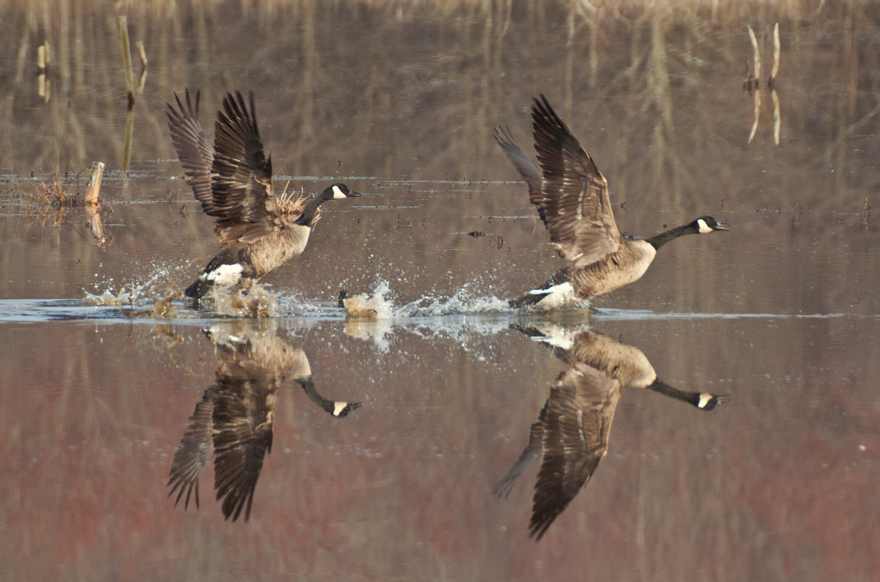
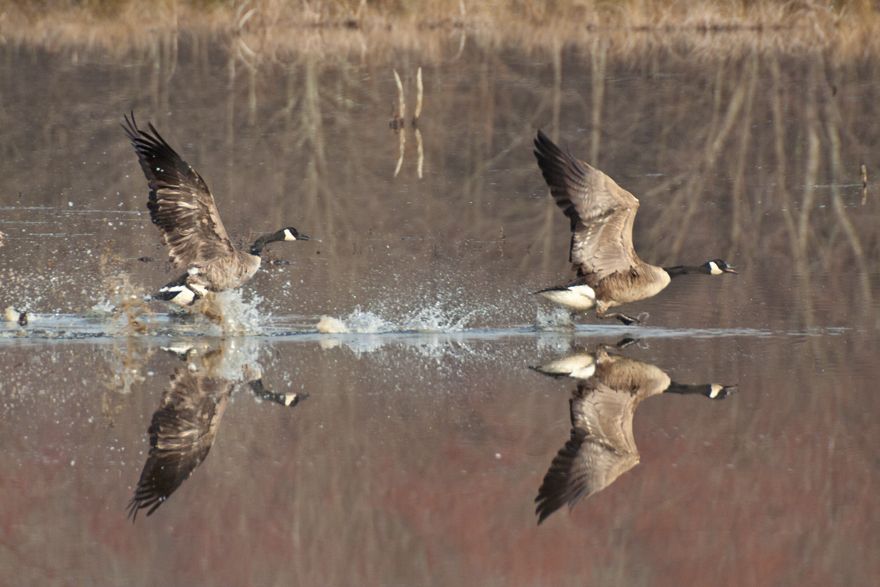
Continuing the theme of transitions from this morning, I thought I’d post a photo of several geese transitioning from rapid flight through the air to a complete halt on a frozen pond.

I love to watch geese coming in for a landing as they noisily announce their arrival, which is often accompanied with a big splash and energetic flapping of wings.

The situation is a bit more problematic when the ice is solid and any miscalculation could lead to physical injury.  It appears to me that the geese flap their wings as hard as they can to decelerate and attempt to carefully place their webbed feet. That is what the goose on the left appears to be doing. If that doesn’t work, as a last resort the goose can lower his tail to slow down his forward momentum, as the goose on the right is doing.

Judging from my observations, some geese are much more adept at this type of landings than others, who slip and slide and skid for a while until they finally stop moving forward.

skidding_blog

© Michael Q. Powell. All rights reserved

Read Full Post »
Can you figure out what is going on in this photo of a goose posing in an unusual position?

transition_blog

The pre-spring season is a often a period of transitions, as winter gradually looses its hold and gives way to spring. The old lingers, but is gradually replaced with the new.

In the first photo, the goose is transitioning from the ice, which still covers much of the pond, into a small pool of open water. I captured him at the moment when he took the plunge and gradually eased his body into the icy water.

I watched him as he approached this area slowly and cautiously, staring intently at the ice, as shown in the second photo. He seemed to hesitated, uncertain about whether to continue to move forward.

reflection1_blog

I know that I approach transitions in much the same way as this goose, hesitating and cautious, frozen in uncertainty. He had the courage to move forward and embrace the change. Will I be able to do the same when these moments arrive?

© Michael Q. Powell. All rights reserved

Read Full Post »
How do Great Blue Herons manage to stay warm when it’s bitterly cold outside?

Yesterday morning was cold and windy and the beaver pond was iced over again. As I scanned the area, looking for activity, I noticed this Great Blue Heron (Ardea herodias) perched on the limbs of a fallen tree in a back area surrounded with undergrowth. He was hunched over with his wings wrapped tightly around himself and he seemed to be doing his best to maintain his body heat.

When I moved a little, he lifted his head slightly from his chest to look in my direction. Eventually he decided I was not a threat and he placed his bill back on his chest, between the feathers, and resumed his rest. Perhaps he was sleeping, though it seemed to me that the perch was a bit precarious for serious sleeping.

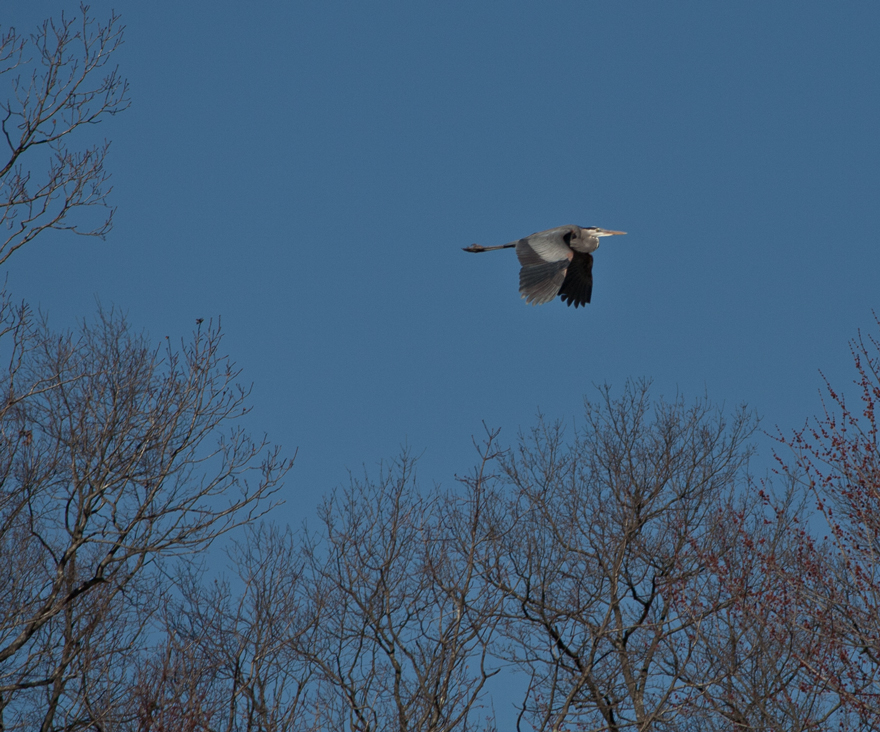
A few hours later, after it had warmed a bit, I saw a heron flying in the distance. Perhaps it was this blue heron, who had decided that it was time to begin his day’s activities, which I am sure included finding some unfrozen water where he might be able to locate something to eat.

GBH1_blog

© Michael Q. Powell. All rights reserved

Read Full Post »

Spring is not here yet, but we had a foretaste of its pleasures yesterday, when the skies were sunny and the temperature rose to 60 degrees (15.5 degrees C). As I was walking along the Potomac River, I encountered a group of American Robins (Turdus migratorius), a traditional harbinger of spring, and got these shots.

Today is about twenty degrees colder and there’s a possibility of snow showers later in the day. Spring has not yet arrived, but we are moving inexorably toward the moment when winter finally gives way to spring.

Robin1_blogRobin2_blog

© Michael Q. Powell. All rights reserved

Read Full Post »
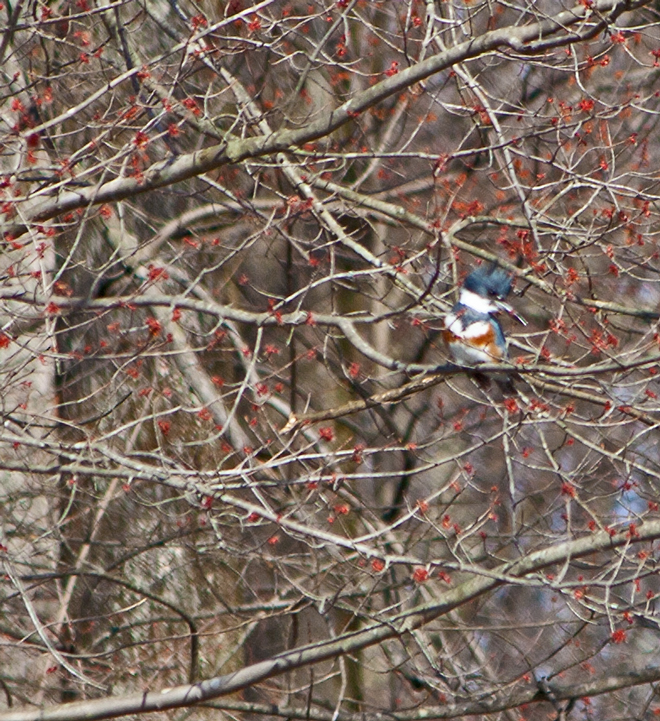
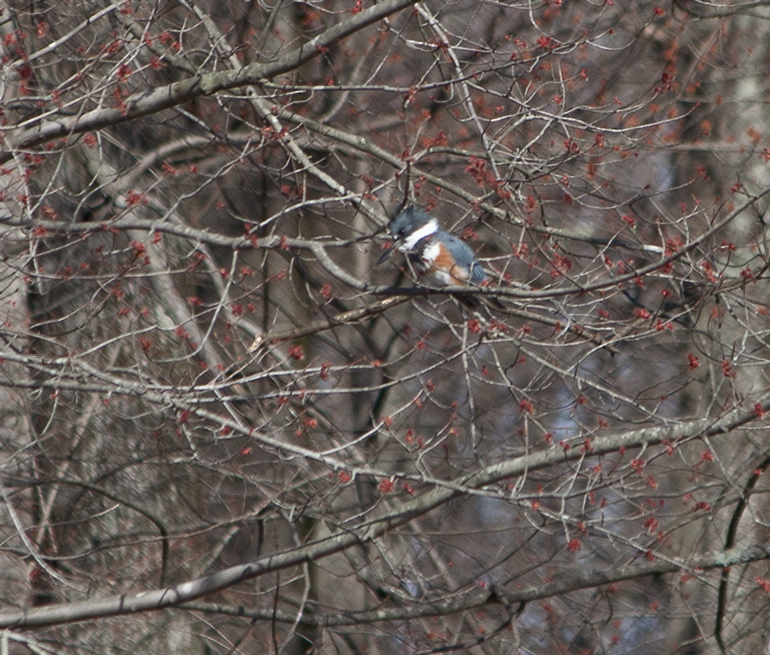
Although I was excited to discover a male Belted Kingfisher (Megaceryle alcyon) in an industrial setting, later that day I returned to my first love, a female kingfisher in a more natural environment.

Previously I posted photos of the male kingfisher and female kingfisher as I continue in my quest to get some really good photos of these amazing birds. If you compare the male and the female, you can see that the chestnut stripe really makes the female stand out (and the Belted Kingfisher is one of the few birds in which the female is more colorful than the male).

I continue to get interesting photos (and I am posting some new ones here), but I still am trying to get some better ones (these are grainy and a bit soft). By the way, can anyone figure out what she has in her bill in the last photo?

kingfisher_F2_blogkingfisher-F1_blogkingfisher_F3_blog

© Michael Q. Powell. All rights reserved

Read Full Post »

I love the dreamy look of the morning mist that provided such a beautiful backdrop for the flight of these two Canada Geese this past weekend.

geese_mist

© Michael Q. Powell. All rights reserved

Read Full Post »

As I was focusing on some ducks yesterday on a misty, gray morning, one of them suddenly decided to take to the air and I managed to capture him just as he was starting to come out of the water.

The ducks were a little closer to the shore of a little pond at my local marshland park than is usually the case and I was squinting through the viewfinder trying to identify their types. The bright white neck of one of them made me pretty sure that it was a Northern Pintail (Anas acuta), but I wasn’t quite so sure about the pair of ducks that sort of looked like mallards, but turned out to be Northern Shovelers (Anas clypeata).

I was trying to be as quiet as I could as I took some photos, when the male Northern Shoveler somehow detected me and took off. I managed to snap a photo at a really interesting moment as the male is just starting to flap his wings. The female and the pintail aren’t  paying much attention to the male’s actions and eventually just swam away.

liftoff_blog

I tried to follow the male Northern Shoveler in flight as he headed off into the distance. Most of my shots were pretty blurry, but I got a couple that I really like. The first one is just after take off and I like the splash and the fact that his reflection is still visible. In the second one,the background is a soft blur, providing a nice backdrop for the vivid colors of the shoveler. He is in a photogenic position as he flies away and I like the fact that a portion of his head and one of his yellow eyes are still visible.

flight3_blog

flight_blogI’ll probably post some separate photos of the Northern Shoveler and the Northern Pintail a bit later, but wanted to share my good fortune in capturing this moment.

© Michael Q. Powell. All rights reserved

Read Full Post »
This past weekend I had a chance to observe the singing techniques of a newly arrived Red-winged Blackbird in my local marshland park.

I was curious to watch the blackbird as he was singing and see if I could determine how he is able to achieve such amazing volume and duration in his calls. As a singer, I have been taught to concentrate on breathing from my diaphragm when I am singing, which fills up the lungs more completely than the shallow chest breathing that most people do. In practice, what this means is that you throw out your abdomen to allow more air in and then gently squeeze with the abdominal muscles to slowly expel the air.

It looks to me that the blackbird uses similar singing techniques. I could actually see his abdomen expand as he was getting ready to sing and he engaged his entire body when he was singing.

I have some images of blackbirds simply sitting on cattails from this weekend, but I thought it would be more interesting to share a couple of the ones in which the blackbird is singing.

blackbird2_blogblackbird1_blog© Michael Q. Powell. All rights reserved

Read Full Post »
I usually think of Canada Geese as extroverts. They are loud and gregarious and announce their presence when they arrive. I captured this one making a big splash, literally.

Looking at the photo, I think that I must have had my focusing point on an area between the wings, because there are a lot of beautiful details in the feathers. In some ways I am using these geese as test subjects as I learn to track birds in flight (and landing) and try to time my exposures for maximum effect. They don’t seem to mind (though I am waiting for one to ask me for copies of the photos to show to his friends).

splash_blog

© Michael Q. Powell. All rights reserved

Read Full Post »
On a cold, windy day I was looking out into the beaver pond, when suddenly my eyes detected movement. Initially, it looked like some debris on the surface was being blown about, but gradually it became apparent that the little pile of debris was headed toward me. Uncertain of what I was looking at, I focused my camera on the unknown material and began to shoot.

Eventually, I realized that what I was seeing was a muskrat (Ondatra zibethicus) swimming, pushing along some plants and what looks like some berries. My guess is that he had gone out to gather food and was returning home with the results of his efforts. You can get a better  what he is transporting if you click on the photos.

The muskrat was putting so much effort into swimming on the surface that he did not seem to notice me until he was pretty close. By then, however, he was almost home, so he would have had to go underwater anyways.

I don’t know enough about what muskrats eat to hazard a guess about what exactly the muskrat was carrying across the water, but hopefully it looked more tasty to him than it does to me.

muskrat_blogmuskrat2_blog

© Michael Q. Powell. All rights reserved

Read Full Post »
I continue to try to photograph every hawk that I see. This past weekend I encountered a hawk that was perched relatively low in a tree that was pretty far away. I got a couple of shots of the hawk in the tree that had a surprisingly large number of leaves still on it.

As I was setting up my tripod to try to get a steadier shot, the hawk took off. Instead of flying up, he flew down low across a field with trees in the background. Although I didn’t really think I would be able to get a decent shot, I kept shooting and got the shot below. I like the position of the hawk and the contrast between its light brown color and the darker tones of the tree. It not often that I get a chance to take a photo of a hawk in flight at that angle.

I am also including one of the shots of the hawk in the tree in the hope that someone will be able to help me identify his type.

hawk1_bloghawk2_blog

© Michael Q. Powell. All rights reserved

Read Full Post »

Although this looks like a fall shot, with the faded leaves still on the trees and the squirrel gathering materials to insulate his nest, I took the photo this past weekend.

When I first saw the squirrel, I couldn’t figure out what he had in his mouth, but I could see that it was bigger than the acorns on which I usually see squirrels gnawing. With our recent cold weather, I thought that perhaps the squirrel had become an omnivore and had snatched up a field mouse or other such creature to supplement his diet.

The reality is much more benign. It looks like he is merely gathering materials for his nest. According to Wikipedia, one of the breeding seasons for the Eastern Gray Squirrel (Sciurus carolinensis) runs from December to February. It is likely that the activity that I photographed is related to preparations for the potentially imminent arrival of baby squirrels, which normally are born in February or March (or May to June).

squirrel_blog

© Michael Q. Powell. All rights reserved

Read Full Post »

I was fortunate enough this past weekend to be present as one of the beavers at my local marsh first emerged from the icy waters of the beaver pond and got a series of shots of that process.

It was late in the afternoon and a thin layer of ice covered the small area of open water that the beavers had cleared about 30-35 feet (9-10 meters) from their lodge. I could hear some activity in the beaver lodge and then I saw the shadow of a beaver swimming toward the hole in the ice.

When he reached the opening, the beaver stuck his head out of the ice and then more of his body. The beaver never did come out of the water completely, but seemed content to breathe in the cool, fresh air. From what I have been able to learn, the inside of the beaver lodge is pretty crowded and the air probably gets fetid, which may explain why fresh air was the beaver’s first priority.

I like all three of these shots, but the third one is my favorite. The beaver’s position is especially interesting, as he tips his head back and arches his back a little, as if to let in even more fresh air.

emerging1_blogemerging2_blog emerging3_blog

© Michael Q. Powell. All rights reserved

Read Full Post »

I really like to show contrasts, like the difference in the expressions and body positions of these two Canada Geese.

What prompted the one on the right to get so vocal and in the face of the other? Is this the kind of taunting that I see so often in professional sports? Is it some kind of marital misunderstanding? Is the one on the right playing the role of a drill sergeant dealing with a recruit?

Whatever the cause, one I know for sure—at close range the honking was earsplittingly loud. I can only imagine the goose on the right reprising the line from a television commercial for a phone company, “Can you hear me now?”

now_blog

© Michael Q. Powell. All rights reserved

Read Full Post »

In my last posting, there were photos of what might have been a muskrat or maybe a beaver—this time I know it is a muskrat, because I can see its skinny tail.

I watched as this muskrat ferried back supplies of what I assume is food from the cattail field to the area where he lives. I was standing on a boardwalk and was able to photograph him from above as he swam right toward me. Because of the size of the stalk he was carrying, he swam mostly above water, rather than swimming under water as he normally does.

Once he got closer to me, he dove and I lost sight of him.

muskratA2_blogmuskratA1_blog

© Michael Q. Powell. All rights reserved

Read Full Post »

On days when I am trying to get photos of the beavers at my local marshland park, I sometimes see muskrats (Ondatra zibethicus) swimming in the beaver pond. The muskrats seem to be swimming from the direction of the beaver lodge so often that I wonder if they are sharing the lodge with the beavers.

Today, there was a thin layer of ice on the beaver pond, but the muskrats had created an open-water channel that they seemed to be using to get to the cattails, one of the foods they eat. Frequently the muskrats will dive and swim away when they become aware of my presence.

Today, however, I was able to get a couple of shots of what I think is one of the muskrats partially out of the water on the ice. It was getting close to sunset and the animal was some distance away, so my photos ended up a a bit grainy and soft. The more I look at the photos, the more I am conflicted about whether this is a large muskrat or a small beaver. Since I haven’t seen a muskrat out of water, I am not sure about its body shape.

Whatever he is, I especially like the pose of the animal in the first image. In the second shot, he almost looks like he is praying—it was a Sunday, after all.

muskratA4_blogmuskratA3_blog

© Michael Q. Powell. All rights reserved

Read Full Post »
On days when no other birds are visibly active, I can always count on the sparrows to be hard at work, often accompanying their work with a song. As I watched, this sparrow (which seems to be either a Song or Swamp Sparrow) took a break from his activities and burst into song, as though compelled to share his joy and excitement with the rest of the world.

Wouldn’t it be great if we felt that way too and felt free enough to share it with others?

sparrow2_blogsparrow_blog

© Michael Q. Powell. All rights reserved

Read Full Post »

My curiosity turned to discomfort yesterday when I realized that the large bird diving in my direction was a Turkey Vulture (Cathartes aura).

In the past, the only Turkey Vultures that I had seen were soaring high in the sky, but this one got close enough for me to see his red head. As he got a bit closer, I realized that his angle of flight would take him farther away from me than I had initially thought. Just to be sure that he did alter his course and head toward me, however, I moved around vigorously to let him know that I was still alive.

You can never be too cautious when it comes to vultures.

vulture1_blog vulture2_blog© Michael Q. Powell. All rights reserved

Read Full Post »

As the insistent honking got louder, I scanned the horizon for approaching geese and saw none.

Suddenly a pair of Canada Geese swooped over a nearby treeline and headed right at me as I stood on the boardwalk at my local marshland park. They were closing so quickly that it was hard to get my focus to lock on. At the same time I also had to adjust my zoom lens. Normally I photograph birds at the far end of my 55-250mm zoom lens, but the geese were filling up so much of the frame that I had to zoom out.

This is my best shot from the encounter. The goose and I were able to look each other straight in the eye at that moment.  The background has a nice blur, because I was shooting at f5.6, and a fair amount of the goose is in focus. I like the goose’s position too as he strains forward in preparation for the water landing. (Click on the photo to see more details)

Incoming_blog

© Michael Q. Powell. All rights reserved

Read Full Post »

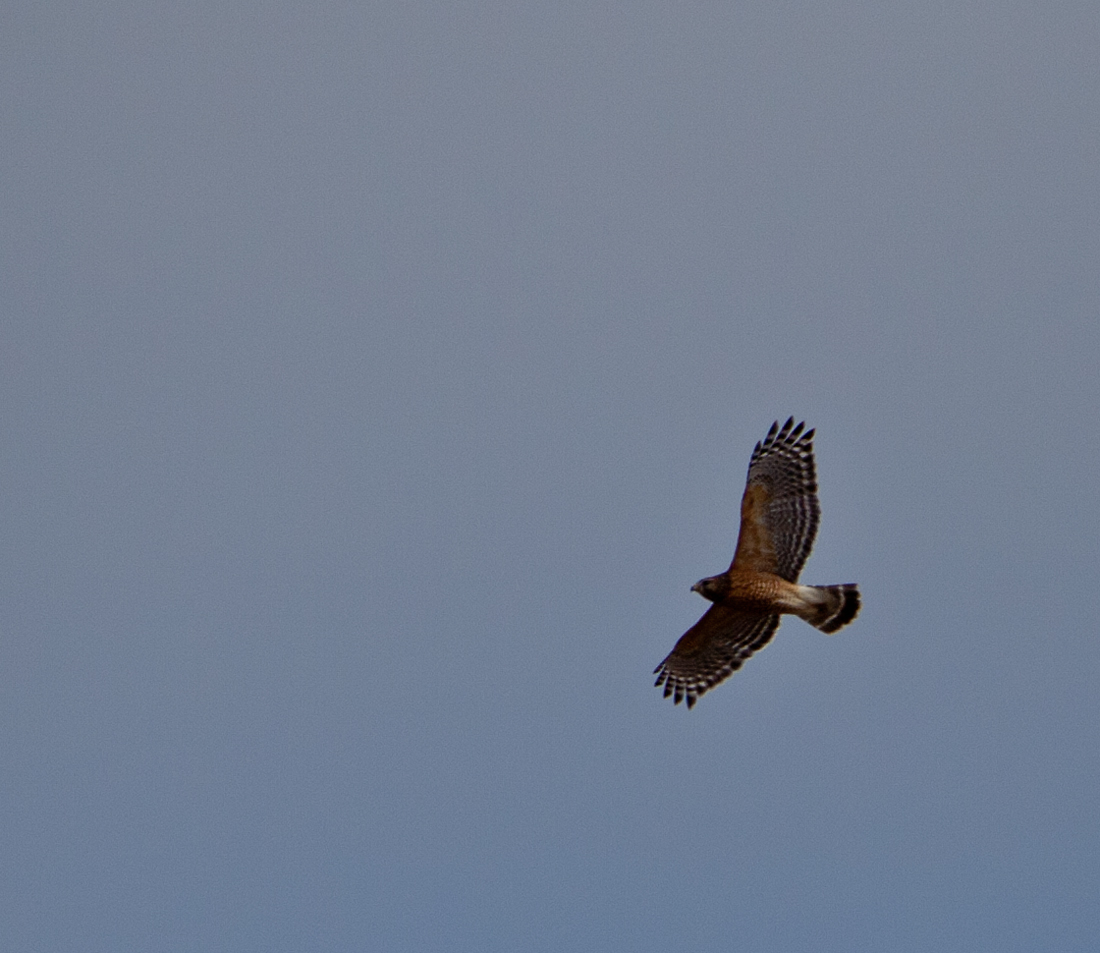
Why do some hawks fan their tails out when they are soaring and others don’t?

On an overcast day earlier this week, I was watching two hawks soaring through the air together, when I happened to notice that one of them kept his tail fanned out all of the time. His tail was so noticeably striped that I am pretty sure that he is a Red-Shouldered Hawk (Buteo lineatus).  The other hawk, however, never fanned out his tail. Looking at the wings of the two hawks, I think they are probably the same kind, although one of them looks to have a somewhat longer body.

So I am left wondering why, under the same  conditions, they each chose to us their tails differently.

doublehawk1_blogdoublehawk2_blog

© Michael Q. Powell. All rights reserved

Read Full Post »
Most of the time I like to focus on individual birds, but in this case I think I prefer this panoramic-style shot of Canada Geese coming in for a landing on a snow-covered field. The expansive white backdrop allows us to see better the different body and wing positions of the geese (and I recommend clicking on the photo to see the details).

The snow is now gone from Northern Virginia, a victim of warmer temperatures and heavy rains. For many readers, snow is much more an everyday reality of the winter, but it’s rare enough here that it has a special beauty (as long as I don’t have to drive to work in it, in which case I tend to forget its beauty and view more as a nuisance).

landing_blog

© Michael Q. Powell. All rights reserved

Read Full Post »

The beaver had disappeared from the small open water area of the ice-covered beaver pond.  Wondering if he would resurface, I stood in silent readiness with my camera still in my hand.

My eyes were focused on one area of the pond, but my ears detected a sound emanating from another location near the edge of the pond. Somehow I knew instantly what was about to happen—the beaver was about to achieve a breakthrough. The light had faded a bit and I couldn’t see well enough to focus perfectly, but I aimed at the source of the sound and got this shot of the beaver poking his head through a newly-created hole in the ice. From this perspective, it looks like the beaver is pretty small.

breakthrough1_blog

As I watched, the beaver placed his front paws on the ice, which appeared to be able to support his weight, and gradually pulled his body out of the water. Naturally, the small hole became a lot bigger as his large body came increasingly into view.

breakthrough4_blogbreakthrough2_blogAfter the beaver was completely out of the water, he bent down over the opening that he had just created. Perhaps he was trying to decide if he needed to enlarge it further or was trying to free a tasty-looking stick from the ice. It almost looks to me, though, that he is peering into the water, wondering if one of his fellow beavers is going to be popping up to join him.

breakthrough3_blog

The beaver did not linger long at the new location. After a few seconds on the “outside,” he dove back into the icy waters of the pond.

There are few moments in life that are truly “once-in-a-lifetime” experiences, ones that would be impossible to replicate, but I have the sense that this was one of them. So many things had to work together to make these photos happen—the timing, the location, and the ice, to name a few.

It is supposed to get up to 70 degrees (21 degrees C) today and the ice will almost certainly be gone by the time I am able to return to the marsh this weekend. Perhaps I will get to observe the beavers eating or working or playing or maybe they will remain in the lodge. In either case, I can be happy, knowing that we shared a really special moment together.

© Michael Q. Powell. All rights reserved

Read Full Post »

Who knew that a beaver could be so cute while he is eating?

I am still working on putting together a series of photos of the local beavers, but thought I’d post another one of my favorite images in the interim. I was surprised that the beaver did not notice me (or simply didn’t care) when I was taking this photo. Not only was I looking straight at him, but I also got as close to the level of the ice as I could to get this low-angle shot.

round_beaver3_blog

© Michael Q. Powell. All rights reserved

Read Full Post »
I got down pretty low to take this shot of a beaver at my local marshland park as he swam in my direction. I especially like the the reflection of his face in the water and the fact that his tail is visible. The ice in the foreground helps to give some interesting context to the photo.

During other seasons, the beavers would immediately dive whenever they sensed my presence, but the last week or so the beavers have been much more wiling to tolerate me (and others). Maybe the ice on the pond forces them to stay closer to home and to venture out more during the daylight hours rather than at night.

swimming_blog

© Michael Q. Powell. All rights reserved

Read Full Post »

The beavers at Huntley Meadows Park, my local marshland park, have been unusually active during daylight hours the last few days and I managed to get some pretty good shots of them feeding. I am still going through my photos and probably will post some more later, but I thought I would give a sneak preview by posting this image. Spoiler alert—my photos today, which I am still uploading, included some shots of a beaver pushing its way up through the ice and I hope they look as good on my computer screen as they did on the back of my camera.

Here is a profile shot from this weekend of one of the beavers munching on a stick (more like a twig) in the icy waters of the pond outside their lodge. I love the delicate way the beaver is holding the twig in his front paws, which look a lot like hands to me. Be sure to check out the nails on the left paw—they look to me like they were manicured.

Who knew that beavers have lips (at least that’s what it looks like in this photo)?

beaver_profile_blog

© Michael Q. Powell. All rights reserved

Read Full Post »
When I saw a Wilson’s Snipe (Gallinago delicata) on Friday, I expected that it was a once-in-a-lifetime sighting and was really happy to have gotten some photos. I never imagined that I would see the bird (possibly the same one) the very next day in even better lighting conditions. I may eventually post some other photos, but I wanted to share this one in which he is visible against a snowy background that is mostly blown out. I think it helps to highlight some of the wonderful colors and textures of this long-billed shorebird.

Somehow the word “snipe,” which is used in all kinds of other contexts, doesn’t seem dignified enough for this beautiful bird, so I have taken to calling him the “Pinnochio bird”—for obvious reasons.

wilson_snow_blog

© Michael Q. Powell. All rights reserved

Read Full Post »
Yesterday I encountered the strangest-looking bird I have ever seen in the wild.

As I was marveling at the fact that some of the water surrounding the beaver pond at my local marshland park had not frozen despite multiple days of temperatures in the 20’s (minus 4-6 degrees C), I heard a sound in the water. Most of the birds that I had seen earlier in the day were sparrows, pecking away in the undergrowth, but it was clear that this was no sparrow.

The bird was standing in the shallow water and was bent over. When he withdrew his bill from the water, I was amazed at its length—it looked to be almost freakishly long. When I first looked at my images on the computer screen, I though of a recent posting of fellow blogger Calee in which she comment that an orchid she had photographed looked like a cartoon character. Truly, this bird looked like he could have been playing the role of Pinnochio.

I think that this bird is a Wilson’s Snipe (Gallinago delicata), judging from the information that I was able to find on the internet and in my Peterson’s guide. I really like the way that he blends in with the surroundings in which I found him.  The Cornell Lab of Ornithology lists some fascinating facts about the bird’s extra-long bill, “The long bill of the Wilson’s Snipe is flexible. The tips can be opened and closed with no movement at the base of the bill. Sensory pits at the tip of the bill allow the snipe to feel its prey deep in the mud.”

It’s a bit early for the mating season, but it seems that the family life of the Wilson’s Snipes is as  dysfunctional as that of some humans. According to the Cornell Lab, “The clutch size of the Wilson’s Snipe is almost always four eggs. The male snipe takes the first two chicks to hatch and leaves the nest with them. The female takes the last two and cares for them. Apparently the parents have no contact after that point.”

The range maps for this bird show that I am close to the northern edge of the wintering area for these migratory birds, so I am hoping that I’ll have a chance to see one again.

long_bill2_bloglong_bill1_blog

© Michael Q. Powell. All rights reserved

Read Full Post »

It was cold (about 24 degrees F or minus 4.4 C) this morning and the sky was completely covered with clouds as we awaited the coming snowstorm. Nonetheless, I went out with my camera to my marshland park to see what animals and birds were active.

Previously I had identified a tree where a hawk is frequently present and one was there today. The perch is pretty high up and there is a field of cattails between the boardwalk and the tree, so I can’t get very close to the hawk. As I stood watching the hawk, he suddenly flew almost straight down into the field and returned to a different tree after what had obviously been a successful hunt. I attempted to photograph the action, but my camera was not adjusted properly for the reduced light in the field and my photos were blurry and out of focus.

All was not lost, however, because a short time later a hawk came flying from the same area and I was able to get some photos of him. When I looked at the photos on my computer, I discovered that the hawk, which I am pretty sure is a Red-shouldered Hawk (Buteo lineatus), is carrying  a rodent in his talons.

I am not sure why he chose to transport his prey to another location, but it provided me a really cool photo opportunity.

prey5_blog

© Michael Q. Powell. All rights reserved

Read Full Post »
This week I have been posting a lot of photos of soaring birds that I photographed last weekend. This last batch, which includes some of my favorites, features a young hawk soaring in a number of different positions. I was fortunate that he flew almost directly overhead and the light was reasonably good.

The strength and beauty of a bird like this is hard to capture in photos, but it was really impressive to watch him effortlessly soaring on the winds.

flight3_blogflight1_blogflight2_blogflight4_blog

© Michael Q. Powell. All rights reserved

Read Full Post »
This past weekend I saw more hawks than I have ever encountered before. I am not sure if some are migrating through the area or if the ones already here were more active than before.

This hawk, who looks to be immature, was sitting on a tree limb across a small field from me and I was able to get shots of him a few different positions. I need to figure out a way to get closer to him or use a longer lens in order to get clearer images, but I am still at a stage in my photographic journey at which I am excited to take any photos of hawks and eagles in which they are recognizable. As some readers are well aware, I have been trying to take photos of birds in flight and I managed one so-s0 image of this hawk when he flew away.

hawk4_blogHawk3_bloghawk2_bloghawk1_blog

© Michael Q. Powell. All rights reserved

Read Full Post »

« Newer Posts - Older Posts »