Feeds:
Posts
Comments

Archive for the ‘wildlife’ Category

The Black Vulture (Coragyps atratus) needs to improve its public image and what could be better in these times of economic difficulty than emphasizing its energy efficiency?  The Cornell Lab of Ornithology states that the Black Vulture “soars on thermals to gain altitude and to cover large distances with little energy expenditure.”

This past weekend we had warm weather and a breeze, which made it perfect for soaring. Normally I see Black Vultures very high in the sky and in groups, but this time I spotted a solitary vulture soaring at a a lower altitude, which permitted me to get some decent photos. The Cornell Lab notes that Black Vultures have a less well-developed sense of smell than Turkey Vultures and rely more on sight than smell to find carrion, which may be why they soar at greater heights than Turkey Vultures.

I propose that the Black Vulture become the new symbol for energy-saving practices. What do you think?

vulture1_blogvulture2_blogvulture3_blog

© Michael Q. Powell. All rights reserved

Read Full Post »

Have you ever tried to will a bird or animal to change its position slightly to enable you to get a better photo? That happened to me this weekend when I came upon this Northern Mockingbird (Mimus polyglottos).

I crept close to him and positioned myself for an unobstructed shot with a beautiful blue sky in the background. The only problem was that the mockingbird was facing the wrong direction and his head was in the shadows.

So I started a mental conversation with the mockingbird, imploring him to turn slightly in my direction so that the light coming from the right would put a catch light in his eye. I didn’t dare to get any closer and continued to repeat the thought, “Please turn your head toward me, but don’t look directly at me.” Without moving his body, the mockingbird slowly turned his head and offered me an almost perfect profile shot and held the pose.

I like the way his tail and his claws turned out, but most of all I like his face. I think the mockingbird would be happy with this portrait.

mockingbird_blog

© Michael Q. Powell. All rights reserved

Read Full Post »

I spent several hours on Sunday and Monday stalking a female Belted Kingfisher (Megaceryle alcyon). Does that make me a bad person?

I first encountered this beautiful bird a couple of weeks ago and was immediately smitten. Like a paparazzi photographer, I started snapping photos frantically when I saw her. I included some of those photos in a previous posting that I creatively entitled “Belted Kingfisher.”

Now I have started to hang out what I think are some of her favorite places, hoping desperately to catch a glimpse of her. She is still quite standoffish and won’t let me get close, but perhaps she will get used to having me around. Maybe she has commitment issues.

Here are a few shots from my recent encounters, including two in which I captured her as she was flying away.

For now, it is a classic case of unrequited love.

kingfisher1_blogkingfisher2_blogkingfisher3_blogkingfisher4_blog

© Michael Q. Powell. All rights reserved

Read Full Post »

Yesterday I returned to the little lake near where I live in hopes of seeing the Belted Kingfisher again. As I was scanning the trees near the water’s edge, I caught sight of a Great Blue Heron.

Most of the time when I see Great Blue Herons, they are in the water. This one, however, seemed quite content to just stand in the shade of a tree on a slanted bank, surrounded by all kinds of roots and vines.

As I was inching my way down the slope of the opposite bank, he caught sight of me and took off immediately. Acting on instinct, I raised my camera to try to capture him in flight and lost my footing.  Sliding down the bank. I dug in my heels and managed to stop just before I reached the water.

Needless to say, I did not get any good shots of the heron’s departing flight.

GBH1_blog

© Michael Q. Powell. All rights reserved

Read Full Post »
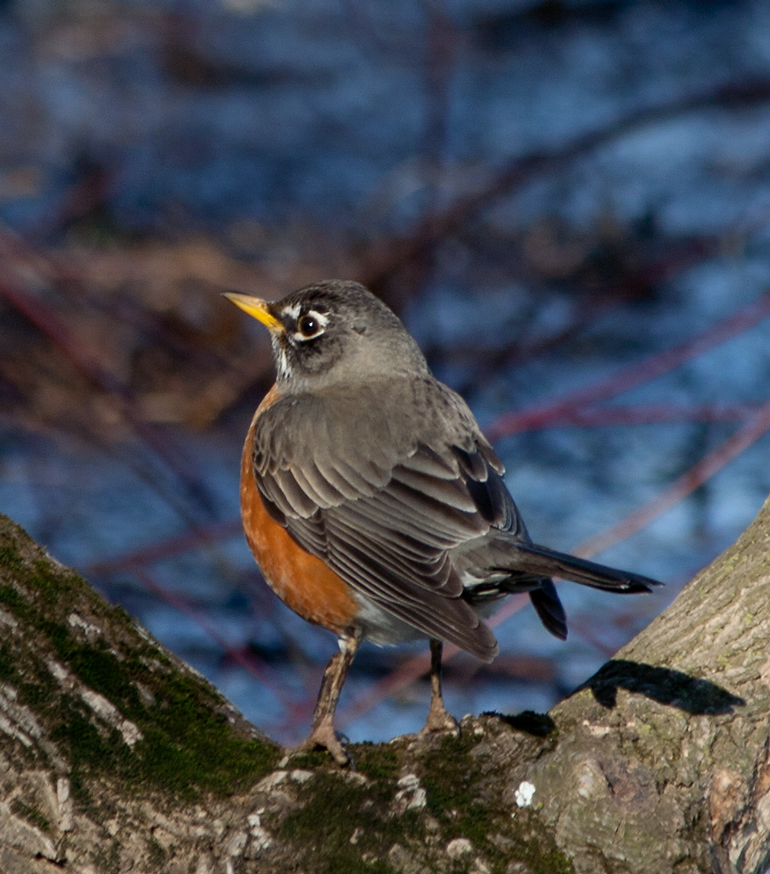
This past weekend I was fortunate enough to see a few hawks. I am still having trouble identifying the different types of hawks, especially when they are immature, as I think this hawk might be.

I spotted this one perched on the top of a old broken-off tree overlooking one of the fields of the marsh and was able to creep close enough to get a clear shot (although nor close enough to get an image that didn’t require significant cropping). For me, there is something regal about the hawk’s position, as though he is a monarch surveying his domain.

I have a few more shots of a hawk in a tree that I probably will post later, but wanted to share this one first.

stump_blog

© Michael Q. Powell. All rights reserved

Read Full Post »

Today when I was observing Canada Geese at Cameron Run, a tributary stream of the Potomac River, I noticed one goose that looked really different. His bill and his legs were pinkish in color, unlike his companions, who had black bills and legs; his cheek patch was brownish in color rather than bright white; and there was a black and white mottled area between his eyes and his beak.

I went searching through identification guides on the internet and it seems likely to me that this is a hybrid goose and not a separate species. One of the problems with hybrids, of course, is that there are lots of different combinations that are possible. I saw one photo that looked a little like this goose that was a probable hybrid of a Canada Goose and a Greylag Goose, but it was from the United Kingdom. Some of the photos of the dark morph of the Snow Goose also look a little like this goose.

If anyone has any ideas, I’d love to have assistance in identifying this goose.

strange_goose1_blogstrange_goose2_blogstrange_goose3_blog

© Michael Q. Powell. All rights reserved

Read Full Post »

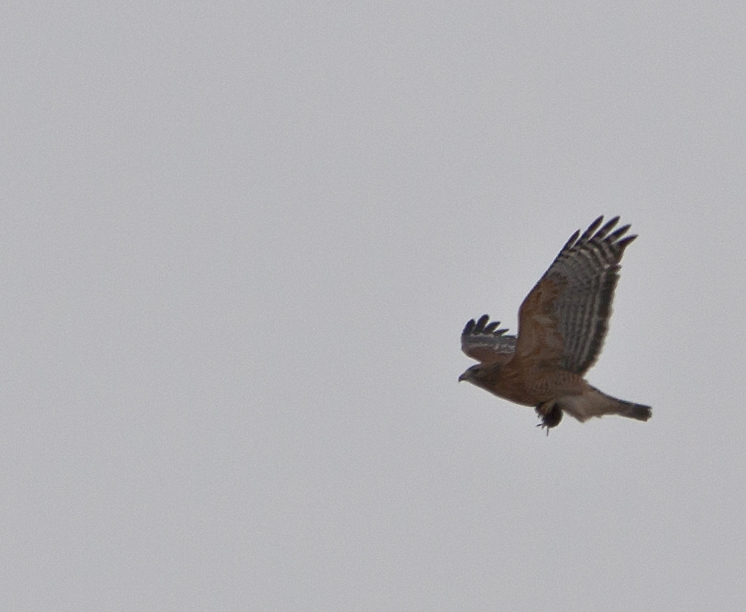
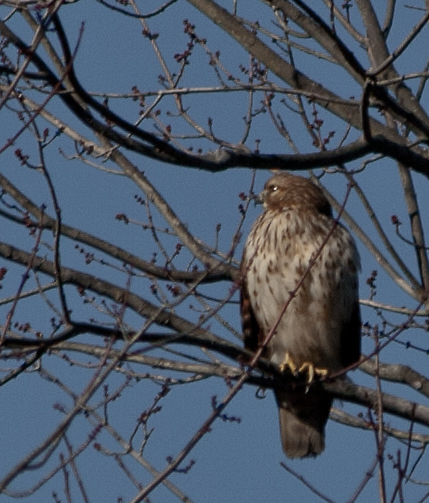
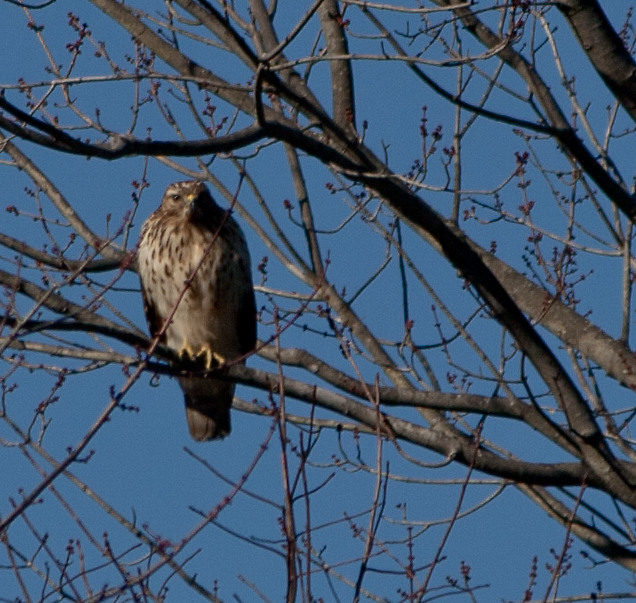
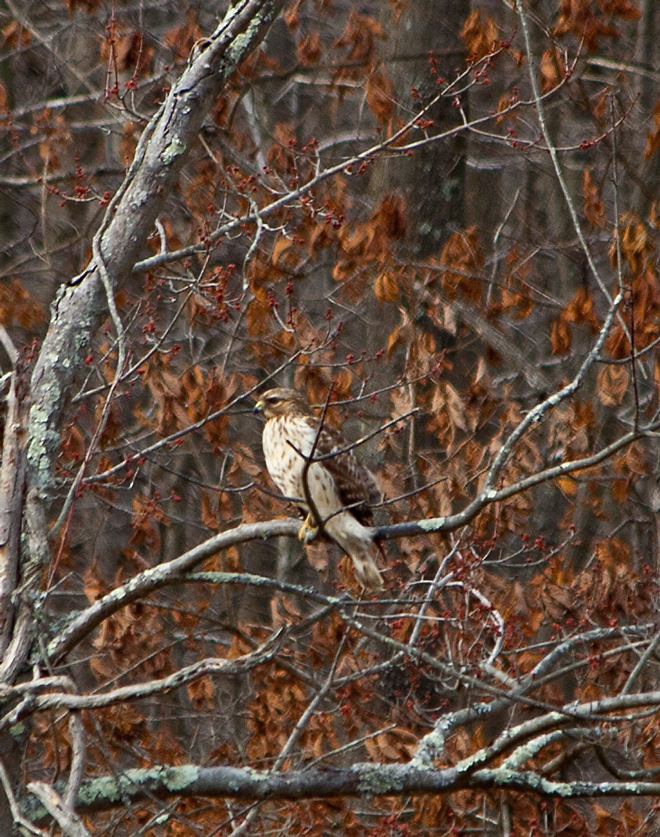
Yesterday I encountered this big bird in a tree and I’m pretty sure that it is a hawk, probably a Red-shouldered Hawk (Buteo lineatus). I was a happy that he was perched relatively low in the tree, so that I could get a relatively normal perspective view of his head and body. His coloration doesn’t match exactly any of the photo identification keys I looked at, so I am not one hundred percent sure of the identification. The photo is a bit soft and grainy, because of the distance and lighting, but I like that fact that I was able to get a relatively unobstructed view of this beautiful bird.

Hawk in a tree

Hawk in a tree

© Michael Q. Powell. All rights reserved

Read Full Post »
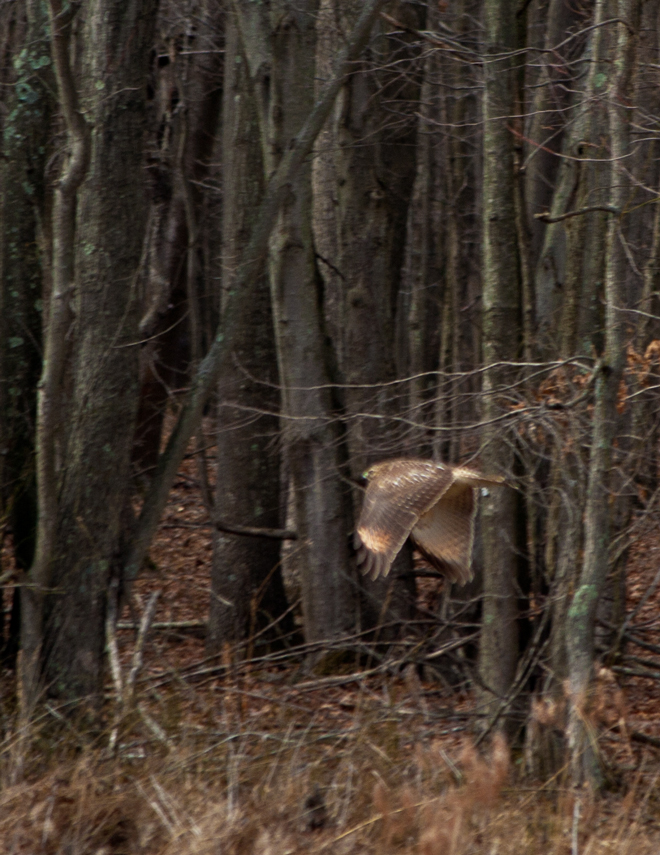
Yesterday I was observing ducks, geese, and gulls in one of the ponds at my local marshland, when suddenly they all took to the air. It seemed to me that something had spooked them and I quickly scanned the ground area and the water and found nothing. When I turned my eyes to the sky, however, I discovered a relatively large bird flying  across my field of vision in the distance

The day was dark and gray and rain clouds covered the sky, so the lighting was not very good. The poor lighting and the fact that the bird was so far away made it tough for me to lock on the focus of the camera, so I was able to snap off only a couple of shots before the bird disappeared completely in the distance.

The flight of the bird did not look like that of the vultures that I have photographed, so I thought that perhaps I had photographed a hawk, though it was hard to know for sure from the image on the little LCD screen of my camera. When I viewed the images on my computer, I was thrilled to discover that I had finally photographed a Bald Eagle (Haliaeetus leucocephalus). Maybe it’s because of the symbolism attached with the bald eagle—all I know is that I felt really happy with my discovery.

These two images are not really that clear and I hope to get better ones in the future. In many ways, I am continuing what I recognize as a pattern in my shooting. The first time I capture a new subject, I am so excited that I will share the image, irrespective of its quality. The second time, the quality of the image normally increases dramatically.

eagle2_blogeagle1_blog

© Michael Q. Powell. All rights reserved

Read Full Post »

Nowadays when I see a little brown bird, my first thought is that it’s probably some kind of sparrow. In this case, however, the beak seemed to be too long to be a sparrow, so I had to so some research. I’m pretty sure this pretty little bird is a Carolina Wren (Thryothorus ludovicianus). In addition to the beak, I was able to use the white eye stripe and uplifted tail as identification features.

In addition to the internet, I now have my first hardcopy identification guide, Peterson Field Guide to Birds of North America, a thank-you gift from friends for catsitting. I suspect that this may turn out to be the first of a series of guides that I’ll end up acquiring.

Carolina Wren

Carolina Wren

© Michael Q. Powell. All rights reserved

Read Full Post »
One thing that I have learned since I started watching birds is that birds seem to enjoy the company of other species of birds. In the past, for example, I might have assumed that a flock of birds was made up of a single species—now I know better. As a result, I’ve started to pay more attention to the individual birds in a group and determine if there are some that look “different.”

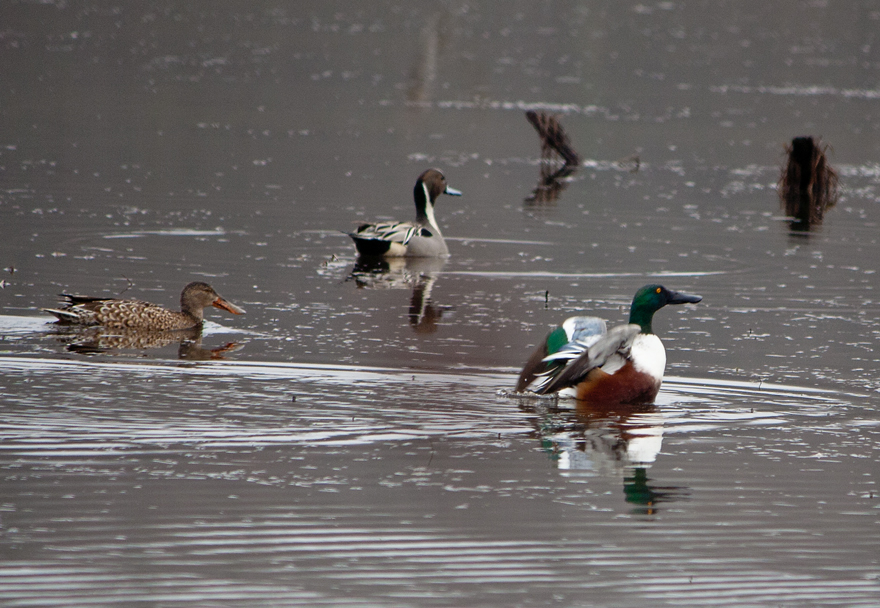
That was the case last weekend, when I was looking at a group of mallard ducks from a pretty good distance. One of them had a streak of bright white, which seemed unusual for a mallard. Clueless to what kind he might be, I took some photos, following my usual practice of “shoot first and ask questions later.” Returning home and doing a little research, I discovered that my mystery duck is a male Northern Pintail Duck (Anas acuta), a new species to me.

My first photo permits you to compare him with a mallard and it’s pretty obvious why he stood out. I like the way that he hold his long white neck upright in almost a military posture.

The second shot was my attempt to capture him in flight when he took off. My view was obscured a bit as I shot from a distance and the focus was not great, but I at least managed to catch him in flight. This is the kind of shot I aspire to shoot, so you’re getting to see my practice shots as I try to master the techniques of capturing photos of birds in flight.

pintail_blogpintail2_blog

© Michael Q. Powell. All rights reserved

Read Full Post »

I stumbled upon a pair of Hooded Merganser ducks (Lophodytes cucullatus) at Lake Cook, a tiny urban lake, shortly after I photographed a Belted Kingfisher this past weekend. As soon I spotted them, they also became aware of my presence and immediately took evasive action. In most cases in the past, that has meant that they started swimming away. This time they seemed to have decided that more decisive action was needed and they immediately took off.

Fortunately my camera was already in my hands and the settings were about the right ones for the situation. When I started photographing birds, one of the more experienced birders whom I met recommended keeping the camera set for burst mode and that’s where I keep it most of the time now. Occasionally that means I shoot off a few extra exposures unintentionally when my trigger finger is a little heavy, but sometimes it lets me get an exposure I might not have gotten otherwise. Now, let me be clear that my almost ancient Canon Rebel XT is not a professional DSLR, so burst mode means about three frames a second, which worked out this time.

I fired off a half-dozen frames as the two ducks, a male and a female, took off from the water and I am pretty pleased with the results. It looks like the ducks get a running start on the water before they take to the air. The photo of the male duck that I featured at the start is the second one in the chronological sequence, but I thought it was the most interesting in showing the little water “explosions” as the ducks skipped across the surface. The rest are pretty much self-explanatory. I especially like the way that the heads flatten out into more aerodynamic shapes as the ducks start flying and the reflections are pretty nice. A couple of the shots are cropped to show only the male duck, because his position happened to bemore interesting than that of the female in the image (no discrimination intended).

Takeoff2_blogTakeoff1_blogtakeoff3_blog Takeoff4_blog

© Michael Q. Powell. All rights reserved

Read Full Post »

I really enjoy watching woodpeckers at work—they are so determined and industrious. I find their simple black and white coloration (sometimes accented with a bit of red) to be tasteful and elegant. Usually I end up watching them from a distance or with my neck at an uncomfortable angle as I look high up into the trees or low near the ground.

This weekend, though, I observed a woodpecker—I think he was a Downy Woodpecker—at relatively close range and at eye level. He was hanging upside down on a branch and was systematically pecking away at it. I really like the lighting in this shot and the way it is reflected in his eye. My favorite element, however, is the feathers on the breast area. The texture is simply amazing and looks like almost like a loosely woven fabric. It is a nice contrast to the black-and-white feathers on his back that look like they are stacked from this angle.

I never tire of photographing the same subjects, whether they be birds, insects, or flowers. Familiar subjects somehow seem different when viewed from new angles or in different light.

Downy feather texture

Downy feather texture

© Michael Q. Powell. All rights reserved

Read Full Post »

This past weekend I decided to return to a little lake (it’s actually more like a pond) where I had previously seen some Hooded Merganser Ducks. This lake is part of a regional park and, according to posted signs, is stocked with trout.

As I was looking down at the water, I was surprised when a powder blue bird flew across my field of view. It was a pretty good size bird, but I didn’t have a clue what it was. It perched on a tree across the small lake and I was able to get a couple of shots to help me identify it. I came back later in the weekend and found the bird again and was able to take some additional photos. None of the photos yet is very good, but I thought I would share some of them, because I find the bird to be exceptionally cool.

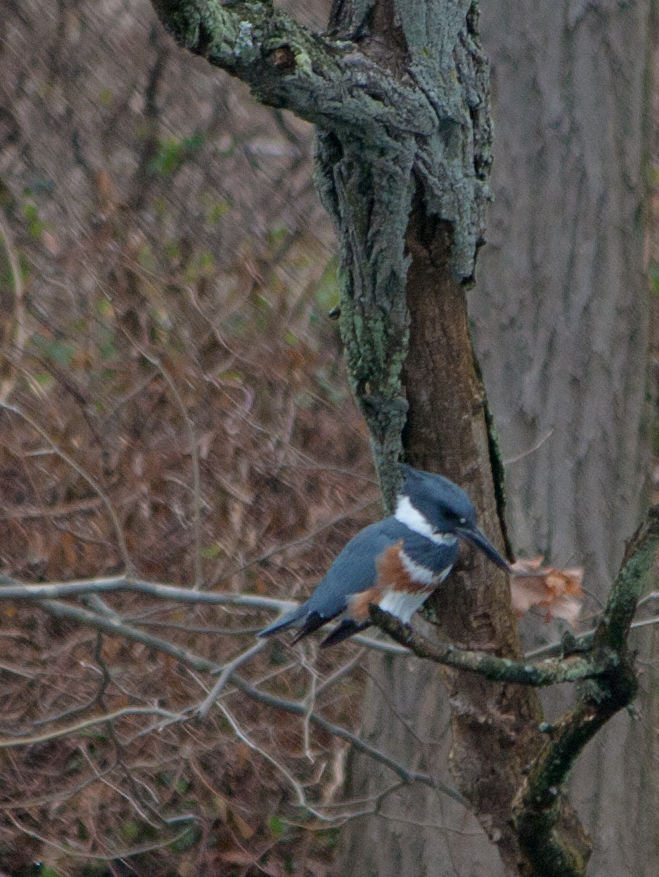
What is the bird that has me so excited? It is a female Belted Kingfisher (Megaceryle alcyon). According to the Cornell Lab of Ornithology article, the Belted Kingfisher is one of the few bird species in which the female is more colorful than the male.  In a couple of my photos you can see the blue and chestnut bands across the breast of the female kingfisher (the male has only the blue band).

The Belted Kingfishers eat mostly fish and you can see a fish in the mouth of the bird in a couple of my photos. I suspected that the kingfisher swallows the fish whole, but I was too far away to see it happen. The same Cornell Lab article states that the kingfisher often dives from a perch, catches a fish and returns to the perch. It then pounds the prey against the perch before swallowing it head first.

As I mentioned, these photos were heavily cropped and are not that great in quality, but I hope to be able to take some better ones in the future. In addition to the shots of the bird in the tree, I am including one in which I attempted to photograph the bird in flight.

kingfisher5_blogkingfisher3_blog kingfisher1_blogkingfisher2

© Michael Q. Powell. All rights reserved

Read Full Post »

I generally have had difficulties getting good photos of Hooded Merganser ducks (Lophodytes cucullatus), because of their size, speed, and skittishness. These little ducks also hang out in different bodies of water than the Mallard Ducks and Canada Geese that I regularly feature and the little streams where they can be found are pretty inaccessible and offer obstructed views of the water.

I did manage yesterday to finally get some decent photos of a Hooded Merganser couple together and separately. I ended up having to walk and down the banks of a stream repeatedly as the ducks changes directions every time they seemed to sense me (and eventually flew away) The first photo is probably my favorite, but I like all three of them.

Merganser(C)_blogMerganser(M)_blogMerganser(F)_blog

© Michael Q. Powell. All rights reserved

Read Full Post »

Last month I featured a photo of an American Tree Sparrow (Spizella arborea), a species that is among the most visible and active during the cold, gray days of winter. I should probably caveat my statement about the sparrows being visible, because they are usually only partially visible as they root around in the tangled undergrowth and move quickly from place to place.

Occasionally I manage to get a somewhat clear shot of the American Tree Sparrow and I decided to share a couple of them this morning. The first one shows the sparrow in what I consider his most “natural” environment, mostly surrounded by vines and branches. I like the way he just poked out his head, permitting me to get a clear profile shot. The second image shows a sparrow at the top of cattail, a place where I rarely see them, which made it a little easier to get a clear shot.

Although I may not show photos of some of these smaller birds as often as I post photos of ducks, geese, and herons, I am attempting to photograph them almost every time that I am out shooting. I enjoy the challenge, even if my success rate is relatively low.

sparrow_blogsparrow2_blog

© Michael Q. Powell. All rights reserved

Read Full Post »

As I was out shooting today, I was happy to encounter Hooded Merganser ducks (Lophodytes cucullatus) a couple of times, They are the coolest-looking ducks in my opinion (although Wood Ducks are in the running too). It’s a real challenge to get good shots of them, because they are small, fast, and skittish. I would love to find myself in a position like Phil Lanoue, a fellow blogger and incredible photographer, who recently photographed a Hooded Merganser duck coming in for a landing next to him (check out his blog posting).

I’m still going through my photos, but this one jumped out at me. It shows two duck couples swimming in formation. What is unusual is that one of the pairs appears to me a male Mallard and a female Merganser. Oh, I know that some of you are thinking that such a relationship could never work, but true love always finds a way.

I can only imagine what their children will look like.

Mixed couple

Mixed couple (click for higher resolution view)

© Michael Q. Powell. All rights reserved

Read Full Post »

A few days ago I featured a Black-crowned Night Heron in a posting called Heron of a different color. One of the most unusual things about that heron was the location where I found him—a man-made canal at the edge of the runways at Reagan National Airport, across the Potomac River from Washington D.C.

That day there was another heron, a Great Blue Heron, fishing just opposite the night heron. I thought that herons preferred clear water, to help them see their prey better, but this water did not look to be very clear.

The first photo shows part of the canal, with a concrete wall in the lower right and the peeling paint of a bridge support in the upper left. I captured the image as the heron was moving around a freshly-caught little fish in his beak prior to swallowing it.

Urban_GBH2_blog

In the second shot, the heron had just dipped his beak into the water. I like the concentric ripples in the water and the drops of water visibly dripping off of the heron’s beak. This may have been an unsuccessful strike or he may have decided to rinse out his mouth (to get rid of the fish taste?).

urban_GBH3_blog

In this final photo, the heron is crossing the canal. As you can see, the water is fairly deep. I particularly like the heron’s reflection and how the details of the long feathers in the front are visible.

Urban_GBH4_blog

Six months ago, I didn’t realize that there were Great Blue Herons in the area in which I live, but now I seem to find them with some regularity. As long I continue to see them, there’s a pretty good chance you’ll be seeing them again in this blog.

© Michael Q. Powell. All rights reserved

Read Full Post »
Earlier this week I posted a photograph of a Great Blue Heron (Ardea herodias) that I encountered while walking along the Potomac River here in Virginia. As I looked over the images from that day I came across another one that I really like.  The heron’s posture and his feathers make this image stand out for me, especially the way the feathers merge with his reflection in the water.

It’s probably clear to many readers that Great Blue Herons are among my favorite birds and that I never tire of finding opportunities to photograph them.

Great Blue Heron on Potomac River, Take 2

Great Blue Heron on Potomac River, Take 2

© Michael Q. Powell. All rights reserved

Read Full Post »
In the past six months I have photographed Great Blue Herons and little Green Herons, but I had never encountered a black-and-white heron like the one that I saw yesterday.

He was about the size of a green heron, but the coloration was different. At first I wasn’t sure that it was a heron, but as I watched him, he perched on the bank and stared intently at the water, just like I had seen the Green Herons do.

Actually, I am exaggerating a little when I call it a “bank,” for the little heron was in what appeared to be a man-made canal at the edge of the runways at Reagan National Airport. The water was muddy and slow-moving, but there must have been some kind of sustenance in it, because there were also ducks nearby.

What kind of a bird was it? Judging from the photos that I took, it was a Black-crowned Night Heron (Nycticorax nycticorax). The scientific name, Nycticorax, means “night raven”, according to Wikipedia, and refers to this species’ nocturnal habits and harsh crow-like call. This “Night Heron” was actively hunting for food during the day, despite his name. Maybe he was hungry or the noise of the nearby jet engines was too loud for him to sleep. The Black-crowned Night Heron is the most widespread heron in the world and has a range that spans five continents, according to the Cornell Lab of Ornithology.

This photo of the heron shows part of the concrete wall of the canal in the background and the netting that was being used to contain the rocks. The lighting was not that great, but I think that you can see some of the details of this interesting-looking bird, including his red eyes.

I don’t know why, but every time that I look at this photo, it looks to me like the heron is wearing an ill-fitting toupee.

Black-crowned Night Heron

Black-crowned Night Heron

© Michael Q. Powell. All rights reserved

Read Full Post »

This past weekend there was a thin layer of ice on many of the little ponds at my local marshland park. I thought the ice would deter the migrating ducks and geese from stopping in, but I was wrong. Perhaps they just needed a break from flying.

It seemed unusual enough that I took some photos of the ducks walking on the frozen water. The first two images are pretty straightforward, but I tried to be a little creative in framing the third image, as a female duck contemplates the vast expanse of the ice in front of her.

I even tried to capture a duck landing on the ice in the last photo. A female duck is making a soft landing as her male companion prepares to come in right behind her. It’s not really sharp, but it gives you the idea. I had previously thought that the ducks would aim to land in the water that had not yet frozen, but obviously the ducks know what they are doing.

I never know what I will find when I venture out into nature—it’s one of the reasons that I keep returning to the same places, in hopefeil expectation of new surprises.

cold_duck1_blogduckwalk_blogice_duck_blogice_landing_blog

© Michael Q. Powell. All rights reserved

Read Full Post »

The weather was overcast today, but I decided to take a long walk along the Potomac River. There is a bike/walking path that parallels the river and I set out for Washington D.C. from Old Town Alexandria, Virginia.

I stumbled upon a Great Blue Heron (Ardea herodias) late in the afternoon, in one of the inlets just off the bike path that was raised above the water at that point. I have taken multiple photos of Great Blue Herons in the past, but I think that this image is my best to date. The pose is interesting and there are a lot of details. In addition the reflection is nice and the background is simple.

For me, this is about as close to a “great” shot as I can get at the moment, but this year I am hoping to raise my personal bar even higher.

Great Blue Heron in the Potomac River

Great Blue Heron in the Potomac River

© Michael Q. Powell. All rights reserved

Read Full Post »

We have had temperatures below freezing most nights recently and many of the ponds at my local marshland are now covered with a thin sheet of ice. I was a little shocked today to see that ducks and geese continue to fly in and out of the pond, in some cases landing on the ice itself (some of the birds find areas that are not frozen over in which to land).

I am working on a number of photos showing these migrating birds on ice, but I thought I’d share this initial image. The goose to the left seemed to be sounding the alarm, signalling the others that it was time to fly away. As you can see from his open mouth, he was honking loudly and was flapping his wings. If you focus your attention on his feet, it looks like he may be slipping on the ice as a result of his vigorous actions. The two geese in the background appear to be ignoring him and all of his noise, although they may have joined him when he took off a few seconds later.

alarm

© Michael Q. Powell. All rights reserved

Read Full Post »

This past weekend I spent some more time watching migrating geese and and attempting to photograph them in flight. Often the geese flew in large formations, though sometimes they would arrive and depart in pairs. As I looked overt my photos, though, my favorite photos of the day feature geese trios.

I love shots like these in which it’s fun to compare the positions of the different birds, and the degree to which they are synchronizing or varying their body positions and wing movements. Each of these photos seems to form a mini-progression within itself, as though they were made up of multiple exposures of a single bird.

goose triogoose trio 2

© Michael Q. Powell. All rights reserved

Read Full Post »

This past Friday I was up before the dawn to try to photograph the almost-full moon and already posted some photos of the moonlight reflected in the water and of the sunrise. As I was making my way along the boardwalk in the marsh, I saw that geese were asleep in the fields. With my camera on a tripod, I took some photos. This was shot at ISO100, f11, and a 25 second exposure. I like the fact that the moonlight was strong enough to cause a reflection in the water and illuminated what looks to be a thin sheet of ice on the water.

Goose asleep in the moonlight

Goose asleep in the moonlight

© Michael Q. Powell. All rights reserved

Read Full Post »

Another squirrel photo? In the past few months I have posted a number of photos of Eastern Gray Squirrels (Sciurus carolinensis). yet I  continue to attempt to photograph them whenever I can. Each time, the light is different, the environment is different, and the squirrel is different.

I really like the colors in this photo, the shades of brown and red, especially the way the brown-red surrounding the squirrel’s eyes is repeated in the exposed wood of the branch. I also like the unique characteristics of this squirrel, his cute pose and his little notched ear.

Another squirrel? I’m sure that squirrels will be featured again in my blog. In my suburban lifestyle, many days they may be my only link to nature.

Squirrel in tree

© Michael Q. Powell. All rights reserved

Read Full Post »
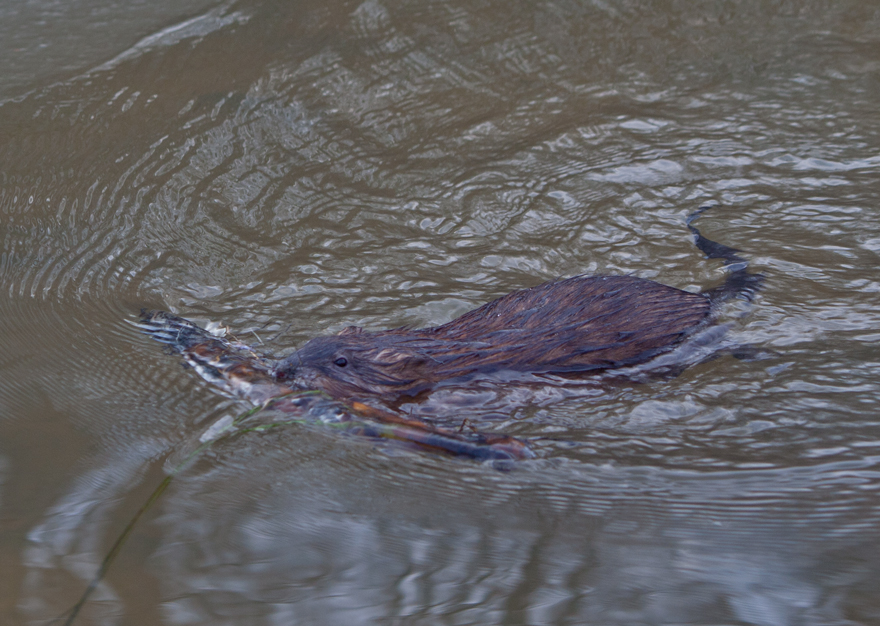
I haven’t been out shooting in nature for almost a week, so I ventured out into my marshland park early this morning. I have not yet had a chance to go through all of my shots, but I knew I really liked this one as soon as I took it and did a quick review on the LCD of my camera.

I found myself in a good position when several Canada Geese (Branta canadensis) were coming in for a water landing and was able to track them and get a good focus. The buffer of my camera fills up pretty fast, so I didn’t want to start shooting too early. Just before they hit the water, I snapped off a few exposures and managed to get this shot in which one of the geese has landed and created a splash.  A goose in the foreground is landing in the midst of the splashing water. My shutter speed (1/320 sec) was fast enough to freeze most of the motion, with the exception of a slightly blurred wing. I like the blurry wing and thing it helps give the sense of motion, as do the droplets of water.

I have been trying to shoot a scene like this for quite some time and think that this is my best result to date. (I recommend clicking on the image to get a higher resolution view.)

Splashdown

Splashdown

© Michael Q. Powell. All rights reserved

Read Full Post »

A few days ago I featured a photo of a mockingbird in a posting entitled Song of Hope. That photo was unusual for me, because the bird was perched on the top of the bushes and not buried inside.

My goal, of course, is to show the beauty of the birds as clearly as possibly, ideally with an unobstructed view. Sometimes, though, you can catch a glimpse of a bird’s unique characteristics even when the view is partly blocked.

That was the case in these photos of a Northern Mockingbird (Mimus polyglottos). I took the shots on the same day in the same general location as the photo I mentioned earlier, so it may have been the same mockingbird, but he looks a little different in a different setting.

My favorite parts of these images are the wispy, downy feathers on the bird’s stomach. In some places, they stick out like a sidewards cowlick (back in the days when I had hair, it would stand out at odd angles like that if it grew too long). The bird was accommodating enough in posing for me that I have included both left and right profiles.

I have been told that most people have asymmetrical faces and have a preference for one profile over the other. Which profile would this mockingbird choose?

fuzzy_blog

fuzzy2_blog

© Michael Q. Powell. All rights reserved

Read Full Post »

As of last week, Canada Geese continued to populate the pond and fields of my local marshland pond in great numbers. Many were engaged in foraging for food, but some look like they have been assigned sentinel duty. The photos are pretty self-explanatory—I’ll let them speak for themselves and make this posting short.

Goose in waterSentinel goosegoose_grass_blog

© Michael Q. Powell. All rights reserved

Read Full Post »

I keep trying to photograph geese and  ducks taking off and landing, using a variety of techniques. Normally I will try to catch the birds in flight, though sometimes I have trouble getting my lens to acquire focus quickly enough. I stumbled onto a panning technique when I tried to photograph geese landing in the early morning. This weekend I experimented using both techniques.

I took this first shot when several geese took off without warning almost directly in front of me. I didn’t intend to cut off the goose to the left, but I like the effect of him entering into the frame. In this image, the action is completely frozen.

Geese takeoff

Geese takeoff

The second image is an example of the panning technique. The geese are not quite in as sharp focus as I would have liked, but you can see some details. I like the way that the background is blurred and provides a sense of motion. This panning was much more deliberate than the photos that I posted previously with motion blur.

Geese liftoff

Geese liftoff

It’s so much fun experimenting with different techniques—photography is still new enough to me that I often feel like a little kid on a voyage of discovery.

© Michael Q. Powell. All rights reserved

Read Full Post »
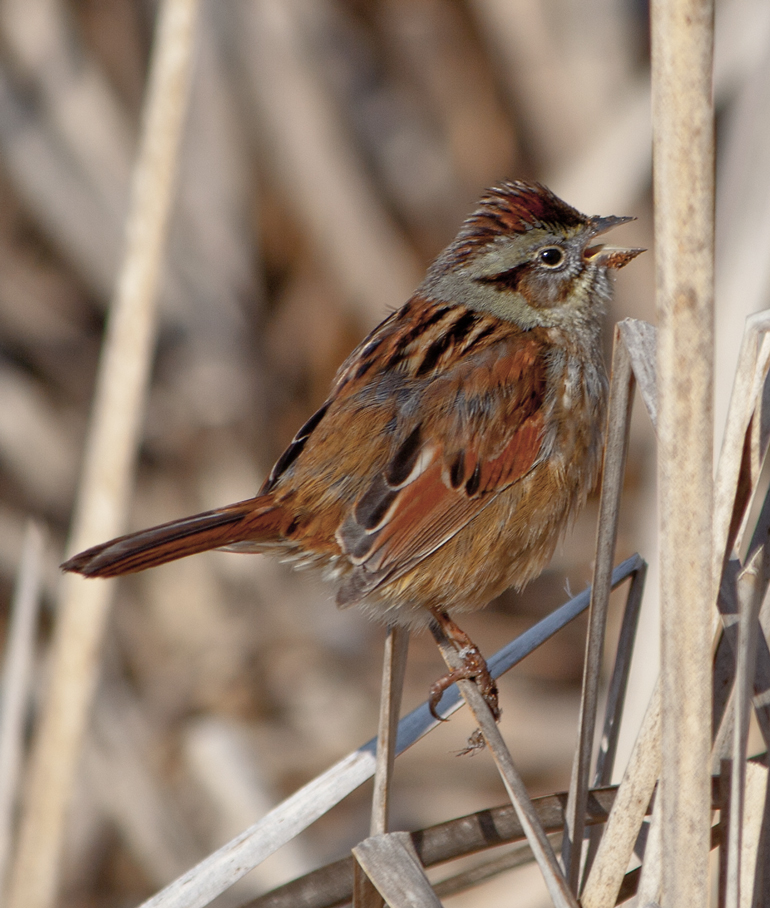
Do your find yourself shooting the same subjects over and over, hoping that you will find the perfect combination of lighting, pose, and background? That is certainly the case for me when it comes to photographing birds. It is both frustrating and challenging to realize that the only variables over which I have any control are me and my trusty camera. I can try to creep closer to birds or adjust the exposure and composition, but luck and perseverance are the overwhelmingly dominant factors in achieving success, however you choose to definite it.

Walking along a path at my local marshland park this past Friday, I heard the now-familiar tap-tap of a woodpecker. I looked up and saw a male Downy Woodpecker (Picoides pubescens) at work in the upper branches of a tree. Instantly I knew I had a chance for a pretty good shot, because the lighting was good, the view was uncluttered,  and the sky was blue in the background. The woodpecker was persistent as he moved along the branch and so was I, snapping away with my head bent back at an uncomfortable angle.

Downy Woodpecker portrait

How did I do? Well, you can judge for yourself, but I think that this is about as close to perfection as I can achieve with my current skills and equipment. The elements fell into place and I managed to take an image with which I am pretty happy, a nice portrait of a Downy Woodpecker.

© Michael Q. Powell. All rights reserved

Read Full Post »

Have you ever looked at your photos and realized that you captured two very different species in similar poses?

When I was reviewing my photos from this morning, I realized that a White-breasted Nuthatch (Sitta carolinensis) and an Eastern Gray Squirrel (Sciurus carolinensis) had each assumed the same pose as I photographed them. Strangely enough, they happened to be on the same tree at slightly different times.

I like how the lightness of the background matches the coloration of the bird. It wasn’t that long ago that I saw my first nuthatch, and I continue to be amazed by their acrobatic behavior and incredible flexibility. Imagine trying to hold yourself in a position like this!

White-breasted Nuthatch

White-breasted Nuthatch

The squirrel seems to be hyper-focused and intense, scanning his surroundings and ready to move at the sign of any danger. There are only a limited number of colors in this photo and I like it so much that I considered posting it separately with a title of Study in Gray and Brown.

Eastern Gray Squirrel

Eastern Gray Squirrel

The poses of the two wild creatures are similar, but their individual characteristics and the different color palettes of the two photos give each of the two images a distinctive feel.

© Michael Q. Powell. All rights reserved

Read Full Post »

« Newer Posts - Older Posts »