Feeds:
Posts
Comments

Archive for the ‘wildlife’ Category

I am old enough to remember the 1977 Captain and Tenille hit song “Muskrat Love,” but inexperienced enough with muskrats not to know if the one that I photographed yesterday is a male or female.

I’ve had the chance to get photos of muskrats in the past, but the muskrat has always been swimming in the water or had been a long way away. Yesterday I came across this as he was eating no more than six to eight feet from where I was standing.

I had my long telephoto on my camera and had to back way down from the 400mm end of the zoom to get this frame-filling shot. I should have been able to get more good shots, but I didn’t notice at the time that my shutter speed was approximately 1/100 of a second and most of my images are blurred. It’s ironic that I had the chance for a close-up at a moment when I had replaced my image-stabilized lens for one with greater reach (but no stabilization).

Still, I got a pretty good shot that captured many of the muskrat’s details, so I am content (until the next time).

muskrat1_blog

Michael Q. Powell. All rights reserved

Read Full Post »

At a moment when the lighting was particularly beautiful yesterday morning, I sensed that the pair of geese was getting ready to take off from the pond. I readied myself and somehow my timing, composition, and focus clicked together with my shutter.

I ended up with some images that required almost no adjustments or cropping. I was particularly happy, because I have been experiencing difficulties capturing motion with my newest lens, a Sigma 135-400mm telephoto zoom.

Luck played a big role too, since I had no control over the way that the geese would move their wings (though I guessed correctly the direction in which they would take off).

geese_takeoff_bloggeese_takeoff2_blog

Michael Q. Powell. All rights reserved

Read Full Post »

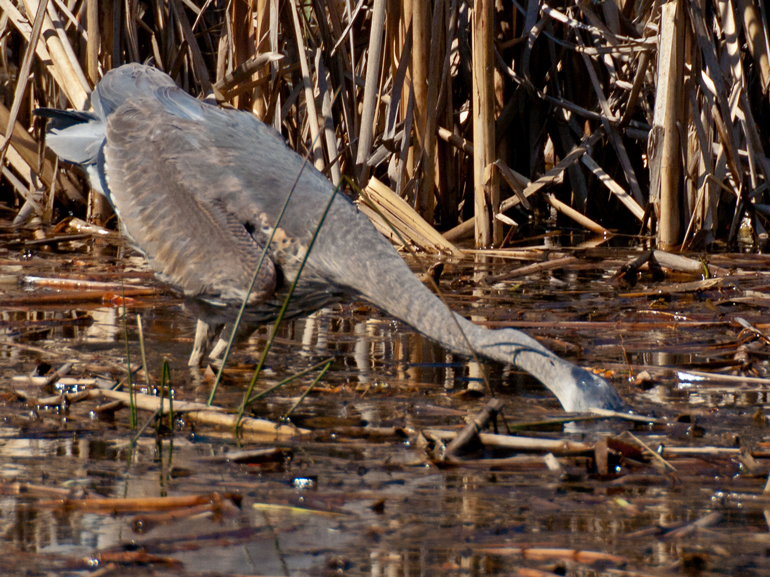
What was the mission that prompted this Great Egret to launch himself into the air?  His mission, it seems, was to continue to harass a Great Blue Heron that he had previous forced out of a prime fishing spot. As you can see from the second photo onward, the egret headed straight for the heron and only at the last minute did he veer off. (I may post some photos later of the initial encounter, but I especially like these in-flight photos.)

I took this series of photos a couple of weeks ago, when I was in Augusta, Georgia, at the Phinizy Swamp Nature Park.

takeoff_blogattack_blogattack2_blogattack3_blogattack4_blog

Michael Q. Powell. All rights reserved

Read Full Post »

The setting and the perspective were not completely natural, but somehow I ended up with an image of a female Northern Cardinal (Cardinalis cardinalis) that I really like.

I ran across this cardinal almost two weeks ago when I was just starting my exploration of the Phinizy Swamp Nature Park in Augusta, Georgia. She was perched almost directly overhead on a wire and seemed to be warming herself in the rays of the morning sun. It was the start of a beautiful sunny day and already the skies were blue.

Georgia was already well into spring and you can see some of beautiful colors of the flowering trees in the blurred background. I managed to get the facial area of the cardinal in pretty sharp focus, which contrasts nicely with the background.

It won’t be long before we have flowering trees in Northern Virginia, where I live, but at least we have daffodils in bloom to remind us that spring is finally here.

cardinal_wire_blog

Michael Q. Powell. All rights reserved

Read Full Post »
A fellow photographer informed me this past weekend that the little bird that I was preparing to photograph was not a Black-capped Chickadee—it was a Carolina Chickadee.

I am a neophyte when it comes to bird identification, but I confess to being confused. I have been trying to photograph this bird for months and have been calling it a Black-capped Chickadee (Poecile atricapillus) in my postings. To my eyes, it looked like the photographs I’ve seen others post of the Black-eyed Chickadee.

I turned to the Cornell Lab of Ornithology website, my favorite resource for bird identification, to try to resolved this conundrum. The site confirmed that the Black-capped Chickadee and the Carolina Chickadee (Poecile carolinensis) look a lot alike, but the two species probably diverged more than 250,000 years ago.

There are some differences between the two in the edging of the wings and the bib and the songs are different too, but apparently the range is one of the most critical factors, since the ranges of these two species don’t overlap much. I appear to be within the range of the Carolina Chickadee, but Virginia seems to be near the northernmost edge of the range, so I can’t exclude the possibility that I will run into a Black-capped Chickadee.

Here are a couple of my favorite chickadee photos. The first one was taken a couple of weeks ago with my recently acquired 135-400mm lens. It did a pretty good job in capturing some of the details of the chickadee in the tree. The second one was taken this past Monday with my 55-250mm lens. I managed to get a little closer to the chickadee that was clutching a stalk in the cattail field and was able to isolate the background a little.

I got started watching and photographing birds this past fall, probably after many birds had left the area. I can’t wait to see what new ones (for me) show up this spring.

chickadee_blogchickadee2_blog

Michael Q. Powell. All rights reserved

Read Full Post »

Yesterday I spotted a little grayish-brown bird that I have never seen before and I have concluded that it is probably an Eastern Phoebe (Sayornis phoebe).

I am getting a little better in figuring out how to identify birds, but this is a case where I had to depend exclusively on color and size to begin my search, without any real idea of what it could be. The colors are about right and the bill shape seems to fit. Information on the internet suggests too that they are one of the earliest birds to return in the spring.

I hope that more experienced birders will correct me if my identification is incorrect. Whatever the case, though, I like the way this image came out—it helped when the bird hopped up onto the bent stalk, a pose which makes it stand out from the somewhat clutter ground-level background.

littlebird1_blog

Michael Q. Powell. All rights reserved

Read Full Post »

Have you ever tried to take photos with an umbrella in one hand and your camera in the other? Mixed snow and rain fell during most of today and things were pretty quiet in the marsh today. I walked along the slushy boardwalk with an open umbrella, trying desperately to find something to photograph.

I was surprised to come across an American Coot (Fulica americana) for the first time in the park, although I saw lots of them earlier in the month when I was visiting in Georgia. This coot was by himself—I didn’t see any other coots and he was not hanging out with ducks either.

coot_blog

Michael Q. Powell. All rights reserved

Read Full Post »

This past weekend I was fortunate enough to see a female Hooded Merganser duck (Lophodytes cucullatus) again enter a nesting box at my local marshland park. If you want to see some photos of my first such incident, check out my previous posting.

It is proving to be quite a challenge to capture this fascinating encounter in photographs, even with my camera trained on the nesting box. I think I get my best shots when the female chooses to land on the box prior to entering it. At that moment, the subject is relatively stationary and I can refocus my camera on the duck itself, and not on the box. When she flies into and out of the box, my camera and lens have trouble maintaining focus and stopping the action, even at exposures of 1/1000 and greater.

She paused a moment when exiting and I was able to get a shot with her head sticking out of the nesting box. I also got a photo of her flying out of the box, which is pretty blurry, but I thought the shadow was pretty cool.

The last two shots are aspirational shots for me—they give you an idea of what I am trying to shoot, even if I have not yet been able to do so successfully.

box2a_blogbox2b_blogbox2d_blogbox2c_blog

Michael Q. Powell. All rights reserved

Read Full Post »

I was thrilled yesterday to see a Great Egret (Ardea alba) at my local marshland park for the first time in months. Unlike the Great Blue Herons, which stayed with us all winter, the Great Egrets flew south when the weather grew cold.

This egret was standing and fishing in a small pool of water near the boardwalk that runs through the marsh, undeterred by the crowd of photographers busily snapping away. I was a late arrival to the encounter and missed seeing the egret catch a frog, but I was happy that I was managed to get some good shots.

Egrets are always beautiful, but the wispy plumes they have at this time of year are especially spectacular. Normally I have problems with blowing out the highlights when I try to photograph egrets, but I think that the closeness of the bird helped me to get a decent exposure.

I can’t wait to see what other surprises are in store for me as we move into spring.

egret2_blogegret1_blog

Michael Q. Powell. All rights reserved

Read Full Post »

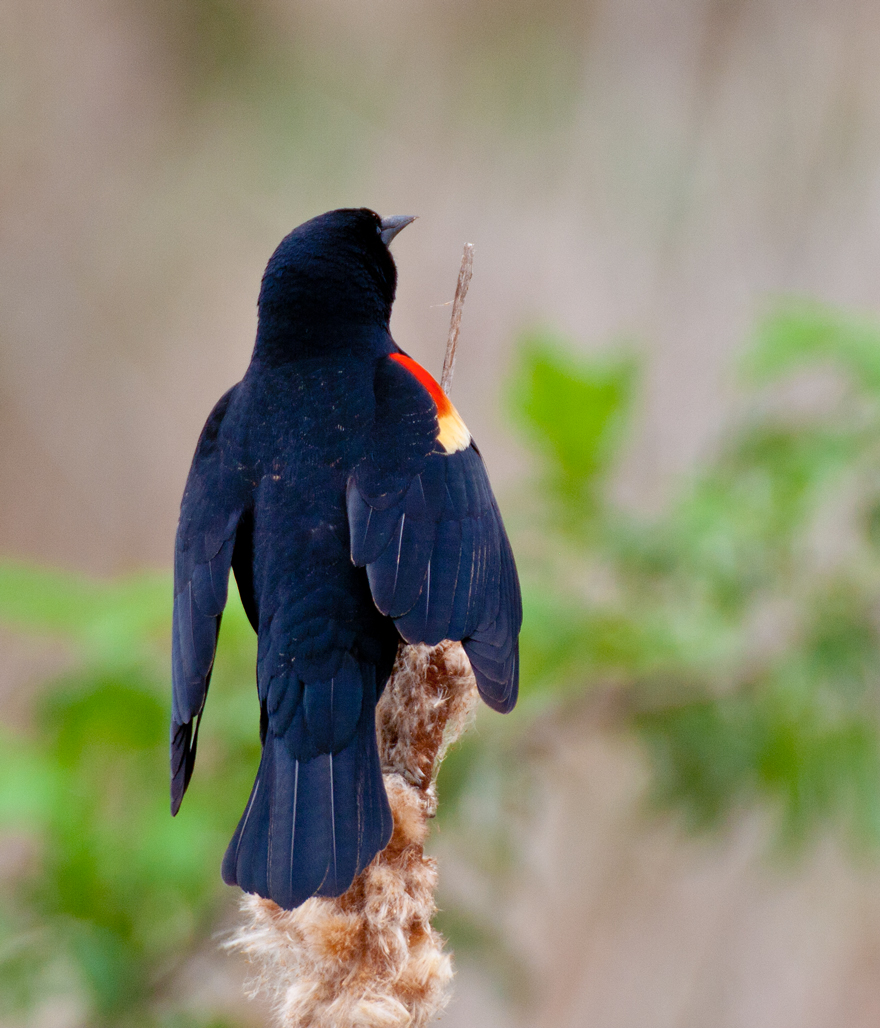
There is just something about this Red-winged Blackbird that makes me laugh. Perhaps it is his whimsical little half-smile or the way that he has cocked his head. Maybe it is the way that his feathers stick out like a little boy’s cowlick or the glint in his eyes or the way he is perched on the cattail. All of these features give him an almost comical look that I really enjoy.

blackbird1_blog

Michael Q. Powell. All rights reserved

Read Full Post »

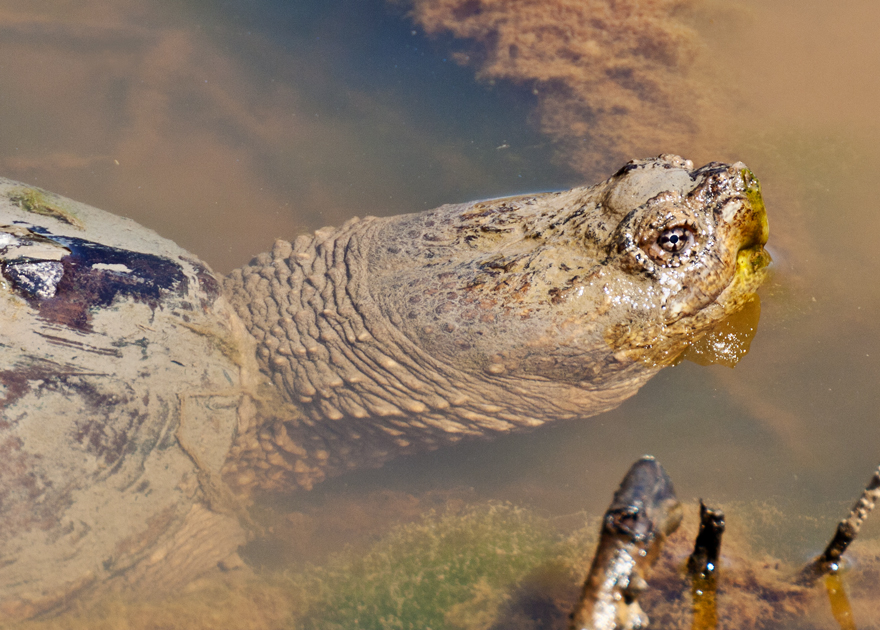
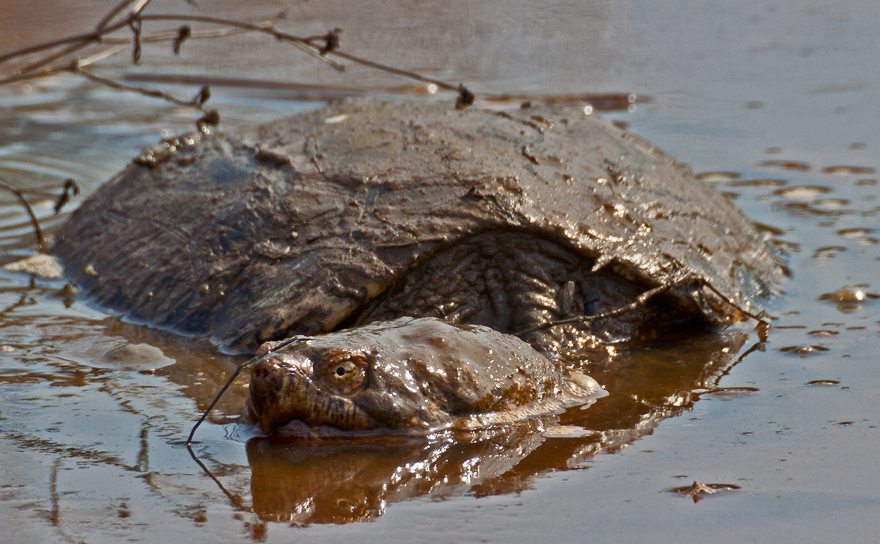
Yesterday I decided to take some close-up shots of some of the turtles sunning themselves at my local marsh.

I am pretty sure that the first one is a painted turtle, but I am not sure if the turtle in the second photo is a different species. I was intrigued by the contrast between the clean, bright colors of the first turtle and the muddy, muted colors of the second one. The turtles were pretty cooperative and let me get close enough to fill the frame of my camera.

It’s not quite warm enough for humans to be sunbathing, but now that spring is officially here, it won’t be long.

turtle1_blogturtle2_blog

Michael Q. Powell. All rights reserved

Read Full Post »

I was really struck by the unusual poses of these Black Vultures (Coragyps atratus) that I encountered while walking along the canal path in Augusta, GA. The only other time that I saw Black Vultures in a tree, they were roosting and looked large and menacing.

These two vultures look like they have adopted a hawk’s approach to hunting by perching on a tree and waiting,  rather than by circling endlessly in the skies as other vultures do.

Vultures_blog

© Michael Q. Powell. All rights reserved

Read Full Post »

As I was walking on a low boardwalk yesterday at the Phinizy Swamp Nature Park in Augusta, GA, I spotted this Six-spotted Fishing spider (Dolomedes triton) at the edge of the water on a leaf. These spiders wait for prey with several of their legs in the water and capture other invertebrates, tadpoles, and sometimes even small fish, according to Wikipedia, when they feel the vibrations in the water.

It will probably be several months before I begin to see insects in Northern Virginia, but my brief trip to Georgia has given me a foretaste of things to come.

spider1_blog

© Michael Q. Powell. All rights reserved

Read Full Post »

Today I visited the Phinizy Swamp Nature Park in Augusta, GA, hoping that I might see an alligator. Although I did not spot an alligator, I did encounter this Nine-banded Armadillo (Dasypus novemcinctus) in the Park. (You can actually count the nine bands).

Initially the armadillo was rooting about in the grass and he startled me a bit when he stood up. I was close to ground level and was looking through my telephoto lens, which made the movement seem a little threatening.

I was surprised to see an armadillo in Georgia—I tend to associate them with places like Texas and Oklahoma—but apparently their range is expanding. Information on the internet suggests that armadillos are mostly nocturnal and come out around dusk. I have no idea why this one chose to be out in the middle of the day.

I may post some other photos of the armadillo, but I thought that this pose was unusual enough to justify posting an image immediately.

armadillo_standing1_blog

© Michael Q. Powell. All rights reserved

Read Full Post »
As I was standing next to the beaver lodge at my local marsh, I heard the unmistakable call of a Belted Kingfisher (Megaceryle alcyon), a sound I had never heard before at that location. After you have heard its sound, described by the Cornell Lab of Ornithology as a “strident, mechanical rattle,” you can’t help but remember it.

I was a bit surprised to see a kingfisher at that location, because kingfishers usually prefer clear waters, so they can see their prey. The water in the beaver pond is somewhat muddy, but perhaps it is teeming with new life.

I watched  for a while as the female Belted Kingfisher (females have orange chest stripe and males don’t) changed positions several times in the tree, perhaps hoping to get a better view of the water. Eventually she dove into the water, but I was unable to tell if she was successful in catching something before she flew away.

The kingfisher was across the pond from me, so the photos are not perfectly sharp, but they do show some of the different positions of this fascinating bird as she gazed intently at the water.

  kingfisher3_blog

kingfisher1_blog

kingfisher2_blog

© Michael Q. Powell. All rights reserved

Read Full Post »
Have you ever watched a frog as he was croaking?

Apparently he closes his mouth and nostrils, squeezes his lungs, and his vocal sacs expand, looking a lot like a bubblegum bubble.

Southern Leopard Frogs (Lithobates sphenocephalus) have a vocal sac on either side of their head, although some other frogs have only a single sac under their chin,

Here’s a shot I took on Monday of one as he was croaking. You can see the vocal sac bubble pretty wellif you look closely at the side of the head nearest the camera.

croaking1_blog

I am including this additional frog photo, because I really like the way that the bubbles surround his head.

bubbles1_blog

© Michael Q. Powell. All rights reserved

Read Full Post »

Yesterday I was out again in the marsh, hoping to photograph frogs as they were croaking.  Of course, the first problem was finding them. I could hear them throughout the marsh, but many of them were hidden from view in the cattails or far out in the water.

Eventually I was able to locate a few frogs that were within the range of my camera and I am still going through those images. What I was looking to capture was the vocal sacs that expand like little bubbles when they make the croaking sound. I am still not sure if I captured that phenomenon well enough, but plan to post some images later.

One of the frogs that I spotted, a Southern Leopard Frog (Lithobates sphenocephalus), was apparently unaware of my presence and began swimming slowly in my direction. He seemed to be trying to keep his head above the water and doing a version of what I used to call the “dog paddle”—I may start calling it the “frog paddle” from now on.

This photo shows the swimming frog in mid-stroke, surrounded by lots of bubbles. I am not sure if he is responsible for the bubbles, but they add a nice touch to the photo.

I’m pretty sure that I will be off again soon in search of frogs, snakes, and turtles as me move into spring. Stay tuned, there’s more to come.

frog_paddle_blog

© Michael Q. Powell. All rights reserved

Read Full Post »

It’s a little ironic that I took these photos of a Ring-necked Duck (Aythya collaris), some of my best duck photos, in a man-made pond in my neighborhood, rather than in a more natural setting. I have never seen any Ring-necked Ducks at my marshland park—perhaps the water is not deep enough for these diving ducks—but found them in a very suburban setting.

The light was bright on the day when I watched some of these ducks diving and resurfacing every couple of minutes. The glare was pretty intense on some of my initial photos and I didn’t like the way they turned out.

However, there is a walking trail all of the way around the pond, so I went off in search of a better lighting situation.  When I reached an area of open shade, I encountered this duck near the shore. Unlike his fellow ducks, he seemed to be relaxing and was remarkably cooperative in letting me take his portrait.

If you are like most people, you may wonder why this duck is not called a ring-billed duck, because there doesn’t seem to be any ring around his neck. According to the Cornell Lab of Ornithology, the bird’s name refers to the hard-to-see chestnut collar on its black neck, which apparently jumped out to the nineteenth century biologists that described the species using dead specimens.

ring_neck2_blogring_neck1_blog

© Michael Q. Powell. All rights reserved

Read Full Post »

Do you ever take shots that you really like, despite technical flaws, because one aspect of the photo came out really cool?

That was the case with this photo of a robin from this past weekend. It was in the middle of the day and the light was pretty harsh, coming in through the leaves almost directly in front of me. As you can see from the robin’s shoulders, the light bleached out most of the color. However, the light also illuminated the robin’s bill, actually shining through it in a really cool way. I also like the way the background turned out.

I am always willing to look for subjects in all directions, and not just for ones in optimal light. You never know when the light will reward you in unexpected ways.

Backlit_robin_blog

© Michael Q. Powell. All rights reserved

Read Full Post »

I’m starting to see hawks—primarily Red-shouldered Hawks (Buteo lineatus) with some regularity, but really good shots of these powerful birds have proven to be elusive so far.

I am happy that I am beginning to capture images of the hawks while they are flying, but virtually all of the time they are flying away from me and not toward me, so the hawks do not fill up much of the frame.

Perhaps when the weather is warmer, there will be more prey for the hawks, thereby giving me more chances to get good shots. At a minimum, I’ll have more hours of daylight in which to make my attempts.

hawk2_bloghawk1_blog

© Michael Q. Powell. All rights reserved

Read Full Post »

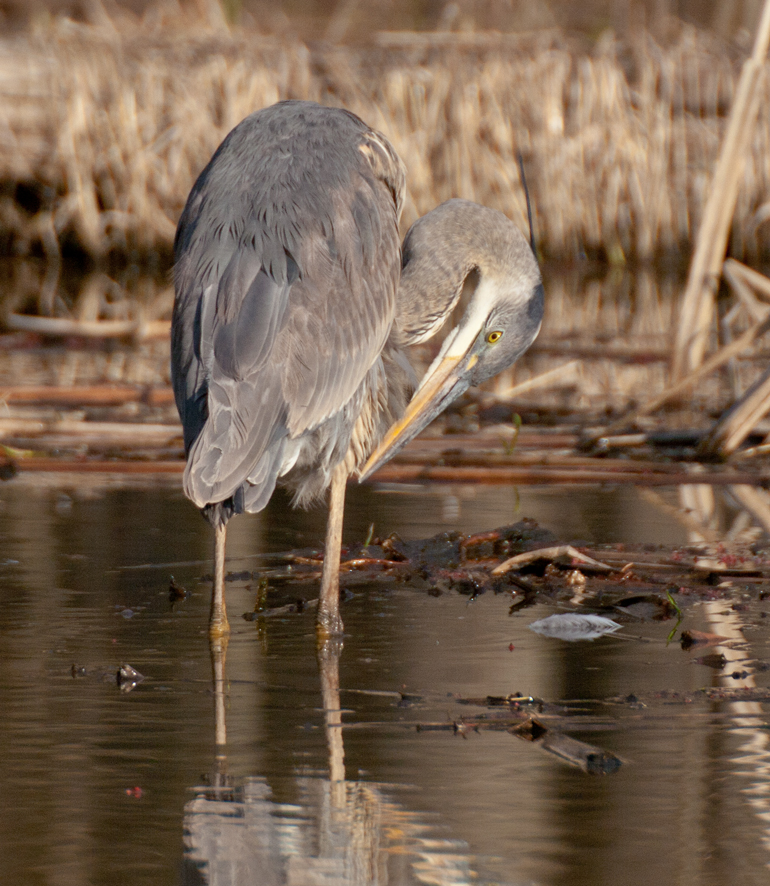
I was staring intently at some ducks in a secluded area of the marsh, when suddenly my eyes caught sight of movement in one of the trees overlooking the pond. The next think I knew a Great Blue Heron (Ardea herodias), who had apparently been perched on the tree,  was flying through the air.

This is the best of the shots that I was able to take. Most of the times that I have attempted a similar shot in the past, the white in the face has been totally blown out. I still need to work on getting a better exposure, but feel like I am making progress. Now if I can just find a cooperative heron.

heron_blog

© Michael Q. Powell. All rights reserved

Read Full Post »

Yesterday, the marsh was alive with the sound of music, frog music. Entire areas of the marshland seemed to resound with waves of sounds, some it high-pitched and some of it lower in range. The warm weather, in the low 60’s (16 degrees C), seemed to have roused the frogs from their sleep and they were in the mood to sing.

Although I could identify the general areas of the frog activity, it proved to be very difficult to spot the frogs themselves. My eyes scanned and rescanned the shallow waters near the cattails until at last I spotted a frog.

I think this frog is a Southern Leopard Frog (Lithobates sphenocephalus), but I am not entirely sure of my identification. You can see from the photo how effectively he is camouflaged.

Frogs and turtles are starting to be active, can the dragonflies be far behind?

springfrog1_blog

© Michael Q. Powell. All rights reserved

Read Full Post »

After endless gray winter days, the beauty of a sunny day seemed magnified and the vivid colors of this mallard duck looked even brighter. I love the shade of blue of the feathers that show through when the ducks are in flight, especially when they are taking off and landing.

mallard_blog

© Michael Q. Powell. All rights reserved

Read Full Post »
At the edge of a cattail patch, this male Downy Woodpecker (Picoides pubescens) was pecking away at the branches of a small tree, moving upward until he had reached the tip of the branch. For a short moment, he took a break from his work and turned his head to the side, which let me take a nice profile shot.

Perhaps he was searching for the next plant to peck, maybe the cattail in the distance.

downy1_blog

© Michael Q. Powell. All rights reserved

Read Full Post »

Walking through the woods on Monday, I heard the sound of a woodpecker and was pleasantly surprised to see that it was a Red-bellied Woodpecker (Melanerpes carolinus).

Most of the woodpeckers that I see are Downy Woodpeckers, which are cute in their own way, but I had been longing to see some of the bigger woodpeckers. Although the woodpecker was fairly high in the tree, I was happy that I managed to get some recognizable shots in different poses.

red_bellied4_blogred_bellied3_blogred_bellied2_blog

I stopped in the visitor center as I was leaving the park and happened to glance through the window at the bird feeders. The birds at the feeders tend to be fairly small, including nuthatches, chickadees and tufted titmice. Imagine my surprise when a big woodpecker showed up at the suet feeder—it was another Red-Bellied Woodpecker.

Although I was indoors, I decided to take a few shots of the woodpecker.  I think I ended up with a pretty cool image, in which the shadow of the wire cage imparted a striped pattern to the bird’s bill. When you first look at the image, you may not even realize that the stripes are added.

Now that I have photographed a medium-sized woodpecker, I will be in search of a Pileated Woodpecker—the superstar of woodpeckers.

red_bellied1_blog© Michael Q. Powell. All rights reserved

Read Full Post »

I am not absolutely sure what this muskrat (Ondatra zibethicus) was doing when I took these photos yesterday, but it look to me like he was grooming himself.

I really like the way that you can see his two little front paws in the first photo—he almost looks like he is praying. In the second photo, it appears that he is rubbing something onto his cheek. Was he putting on make-up because he knew that I was photographing him?

I don’t know the beauty secrets of muskrats, but maybe rubbing cattails on your face helps to reduce wrinkles.

muskrat1_blogmuskrat2_blog

© Michael Q. Powell. All rights reserved

Read Full Post »
Yesterday was the first time that I was able to get some shots of a muskrat (Ondatra zibethicus) out of the water, eating and grooming.

The muskrat was at the edge of a patch of cattails that grow in the middle of the beaver pond at my local marshland park and I actually heard his feeding sounds before I was able to see him. He was a pretty good distance away, but the late afternoon sun illuminated the scene from the left and provided enough light for me to focus the camera.

I am going through the other shots that I was able to snap off before he slid into the water, but thought I’d share this image of the muskrat chewing on what looks to be a cattail stalk. I like the way in which the cattails help to frame the image, rather than block the view, which is usually the case.

I went to the marsh yesterday with the hope of getting some photos of the beavers, which did not make an appearance while I was there, but I ended up with something a bit better—one of the serendipitous joys of photographing wildlife.

muskrat3_blog

© Michael Q. Powell. All rights reserved

Read Full Post »

Capturing images of ducks in flight has been a lot more difficult for me that photographing geese. Geese are larger, fly more slowly, and are more predictable than their skittish duck counterparts.

My camera also seems to have a problem grabbing the focus of these smaller birds when they are moving. Nonetheless, I still spring into action whenever ducks take to the air and occasionally I manage to get shots that are pretty much in focus. Here are a few such images of mallard ducks from this past Friday.

ducks1_blogducks2_blogducks3_blog

© Michael Q. Powell. All rights reserved

Read Full Post »

What is the best way to capture motion and have the subject in focus? Recently I have been experimenting with different camera settings and shooting techniques in trying to photograph birds in flight.

Yesterday I concentrated a large part of my efforts on Canada Geese (Branta canadensis). They make good test subjects because they are large and relatively slow-flying birds (and there are lots of them). I have done a number of postings of geese taking off and landing and in those cases I usually try to freeze the action. Getting the photo in focus is not always easy, but the action is usually taking place in a small geographic space and that helps a little with getting the focus locked in.

Capturing the geese before they being the landing process or after they are in flight has always been tough for me, but I think my skills are improving with practice. Generally I will try to focus on a single goose to make things easier. Yesterday, though, I decided to try to capture a group of geese flying together and had some success using a panning technique. The background blurred nicely, the necks of the geese are in focus, the wings have a bit of motion blur, and the geese themselves have assumed interesting poses. As I recall, I had my focusing point on one of the geese in the center. Some of the photographers I see with really long telephoto lenses have special mounts on their tripods that let the lenses swing freely as they track the birds, but for the most part I have been taking these shots hand-held.

panning_blog

I used a slightly different technique with a couple of geese that were closer. Using one of the first rules I learned about photographing people and animals, I tried to focus on the nearest eye of one of the geese. Well, actually I probably was trying to keep my focusing point on the goose’s head in reality, but I was thinking of the eye. As you can see, there was not a lot of depth of field, but things worked out well with the face of the nearest goose in pretty sharp focus. The blurry wings provide a nice contrast with the sharper elements and my eyes are drawn to the goose’s eyes and open bill.

goose_pair_blog

For me, experimentation is one of the best ways to learn new things and I am definitely learning more and more about my camera and my techniques, which will help me when I try to photograph subjects, like hawks, that are less cooperative than the Canada Geese.

© Michael Q. Powell. All rights reserved

Read Full Post »

Borrowing a longer telephoto lens earlier this week,  I was able to get some shots of the tiny birds that I often see, but rarely am able to photograph.

On Monday, my photography mentor, Cindy Dyer, lent me a Nikon D300 with a Nikon 80-400mm lens. It was a lot of fun to experiment with a much longer telephoto than I am accustomed to using. We spent only a limited time at a local nature center, so I did not have a chance to photograph anything too exotic, but I did get some shots of a Downy Woodpecker (Picoides pubescens), a Black-capped Chickadee (Poecile atricapillus),  and a Tufted Titmouse (Baeolophus bicolor).

The background in the first image really grabbed my attention when I pulled up the image on the computer—the tree branches look an awful lot like a suspension bridge.

I included the blurry final image of the chickadee flying away just for fun. I get this kind of image on a regular basis, although usually the bird is out of the frame. The Nikon I was using has a much higher frame rate (up to 7 images a second) than my Canon (a more modest three frames a second), so the chickadee is still in the frame.

I am pretty sure that I will stick with Canon and not switch to Nikon, but, as fellow blogger Lyle Krahn predicted, I am starting to hear the siren call of a longer lens.

Downy Woodpecker lorez

Chickadee 2 lorezTuftedTitmouse lorez

feeder_blogBlurryBird lorez

© Michael Q. Powell. All rights reserved

Read Full Post »

Lately I have been playing around with the auto-focus settings on my camera, trying to figure out how they work and deciding when it is appropriate to use each of the modes.

After doing some reading and watching some videos on the internet, I decided to remap one of the buttons on my camera. As a result, I no longer engage the autofocus by pushing down halfway on the shutter release—I engage it by pushing on the * button with my thumb. If you are interested in the reasoning behind this process, you can Google “back-button autofocus.”

Next I decided to experiment with AI Servo mode, which is supposed to be the best mode for moving subjects. Previously, I had been shooting in One Shot mode or AI Focus (which is a hybrid mode). Most of the time, that meant I had to achieve focus separately for each image. I am still having some difficulties with the Servo mode, in part because it’s hard to know for sure if the focus has locked on the subject, since, unlike the other modes, the camera will shoot even if nothing is in focus.

The way that it is supposed to work is that you focus on the subject with the center focus point for 1-2 seconds and then the camera will follow that subject as it moves. In the situation below, I focused on the front goose that looked like he was about to take off. When he took off, I took a sequence of six photos, only two of which were in focus. They were the second and fifth in the sequence and they came out pretty sharp.

I may be overtaxing my ancient Canon Rebel XT by shooting in RAW, shooting bursts, and having the autofocus engaged continuously. Still, it’s fascinating to experiment with the different settings and see what works best for me.

flight1_blogflight2_blog

© Michael Q. Powell. All rights reserved

Read Full Post »
« Newer Posts - Older Posts »