Photography seems to be easy. Nowadays anyone with a cell phone can capture images. Many people do so every day and all of the social media filled with those images. Is that really photography? That’s a huge question and your response to it is significantly influenced by the way that you look at the purpose of photography.
Is photography simply about recording and documenting a moment in time? If so, a simple box camera of the past or almost any modern camera or cell phone can easily fulfill that role. Underlying that view is the assumption that somehow reality is objective. Police interviews of eyewitnesses, however, have repeatedly shown each person has an individual perception of reality. In essence, we all have built-in filters that alter and shape our perceptions and interpretations of what our eyes are seeing.
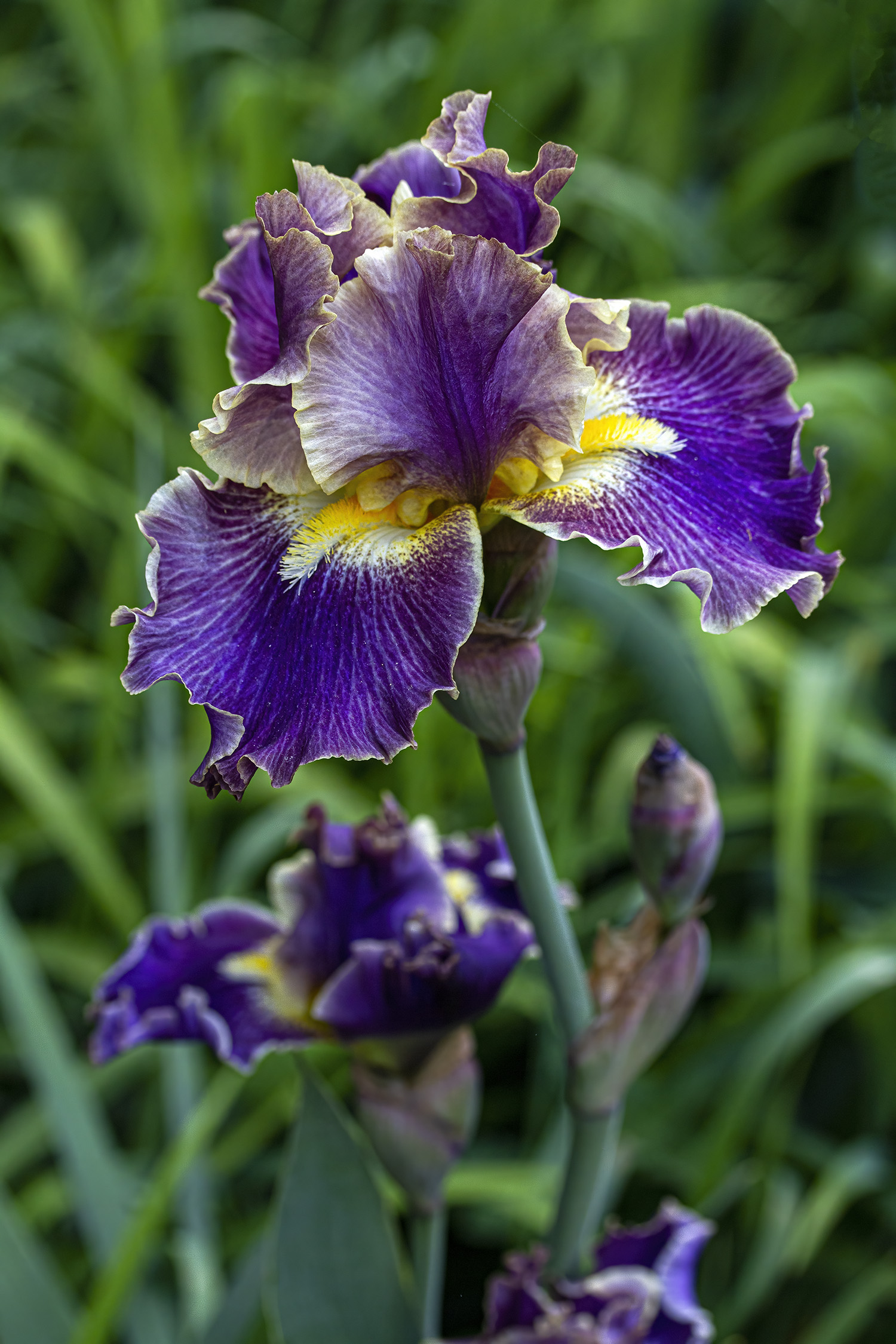
In my personal view, photographers are trying to shape your perceptions of a subject through a series of creative choices they make. As I was reviewing some recent photos I took of irises in a neighbor’s garden, I really liked the one below and thought about what was going on in my mind when I took the shot.
When I first looked through the camera’s viewfinder, I realized the background was really cluttered, which I knew would distract the viewer’s focus from the flower and therefore changed the camera’s aperture setting to f/5.0 and moved closer to the flower to provide a more blurred background. I wanted to be sure that I did not get any motion blur, because I was shooting at an awkward angle, so I settled on a shutter speed of 1/400 sec (at an ISO setting of 400). The sunshine was a bit bright and I used exposure compensation of minus 2/3 of a stop to darken the image a bit from what the camera wanted to use.
The final, and arguably most important, step was composing the shot. With a static subject like this, I try to compose the shot in the camera, so minimal cropping is necessary when processing the image on my computer. In this case, the image below was not cropped at all. (With wildlife subjects, I do not have the luxury of carefully composing the shot, so cropping is often necessary.)
I wanted to draw the viewer’s full attention to the fully open iris flower, so I focused on its yellow beards. However, I also wanted the viewer to get a sense of the partially opened blooms and buds and chose to include them in the composition. When I saw them with my own eyes, all of the flowers were equally in focus, but as you can see in the photo, I used the camera settings to ensure that deliberately chosen elements were in focus, while others elements remained visible, albeit blurred.
Over a dozen years ago, when I was first starting to get serious about my photography, I had to consciously make the kinds of decisions I have tried to describe above. Now I am familiar enough with my camera’s settings and know what effect they will have on the photos that I make many of these decisions simultaneously and instinctively. I usually have an idea in my head of the kind of image I want to produce and use most of my conscious mind to think about the composition.
So, is photography hard? Taking a picture is easy, but bringing a vision to life is harder. It may not be possible for another person to walk in your shoes, but photography can help another person to see with your eyes (or at a minimum to experience the world in a way in which you want them to.)
© Michael Q. Powell. All rights reserved.


Your images always rise to the level of photography, Mike.
Thanks, Dan. For many folks, it’s point and pray or point and shoot, but you increase the odds of getting a good photo if you actually know how your gear works and can take advantage of its capabilities and compensate for its weaknesses. That’s how I manage to get decent shots with a camera that is more than 10 years old. 🙂
I’m not using the greatest gear, but, like you say, I try to get the photo as good as I can in the camera.
I have a blast with my real cameras trying to get the perfect shot which is not often as the one I use is a Nikon Coolpix 900 it is a beast and I can not place it on a tripod. Love my Nikon with all my lenes as well as my 1st 35mm Kodak 🙂
I can’t be bothered with photoshoot I do have Topaz on my computer but last used it 3 or 4 years ago. I like playing with AI but have yet to use my own photos in CHATgbt. Can not wait until more blooms up here.
It’s a beautiful, thoughtful image, Mike. In the few classes I’ve attended on photography, I was always told it is the eye behind the camera that ‘sees’. In that thought, photography is an art. Which, btw, you are very good at. Thank you.
Thanks, Mitzy. One of my favorite photography quotes comes from Dorothea Lang who said “The camera is an instrument that teaches people how to see without a camera.” I sometimes talk to people who visit the same places that I do and are amazed by the things I encounter there and ask me how is it that I see them. Often I’ll answer with a Zen-like response, “And how is it that you do not see.” 🙂
Good response, Mike. Make it a gre
BTW, I like th
Very nicely captured. (Suzanne)
Thanks, Suzanne. I generally post the images that I personally like and enjoy asking myself the question of why I like them. Sometimes I can’t come up with logical reasons rather than purely emotions-based responses, but often as I ponder the question, I can name some of the contributing factors (like lighting or subject or angle of view or colors, etc.).
What a beautiful response!!!!!! Well Done!
Thanks, Sally.
Very nice.
Sir, you underestimate yourself and your talent. “Is photography hard? Taking a picture is easy, but bringing a vision to life is harder.” Your mention of f stops and aperatures makes my brain spin. Your work is incredibly gorgeous and obviously well thought out. (I live with a photographer so I have a bit of experience on this.)
The iris are gorgeous and you portray them with a vision that few of us possess on our own. Words would fail me. Many people would walk past that vision and perhaps note “flower.” Carry on in good faith that what you do is blessing the world.
I always enjoy catching up on your images, and your thoughtful reflections on photography invariably draw me deeper into what I’m looking at. Thanks for the delightful combination.
Wow. Thanks so much for your kind words. I never know how others will react to what I write and your comments show the kind of response that I am seeking to prompt.
As I delve more and more into photography, I’ve learned just how complicated it can be. Beautiful shot and great discussion. I’m learning so much, but I know this will be a life long pursuit.
Thanks so much, Bridgette. It is a lifelong pursuit, always in pursuit of newer and better photographs, no matter how good the previous ones were. Photography is kind of addictive in that way.