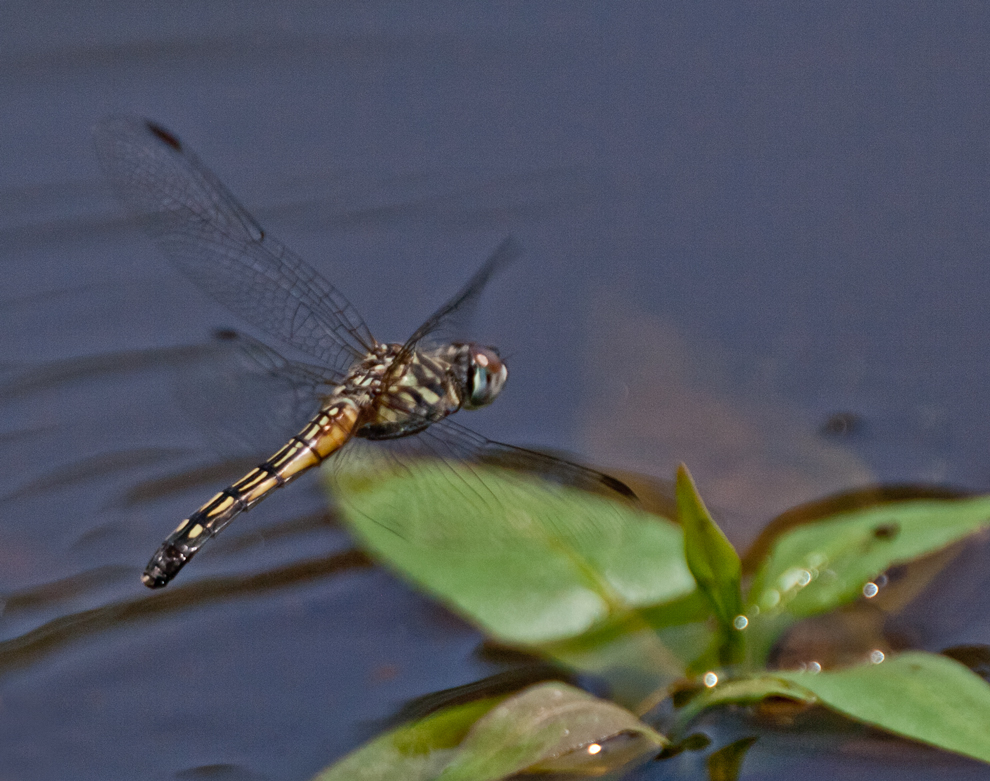
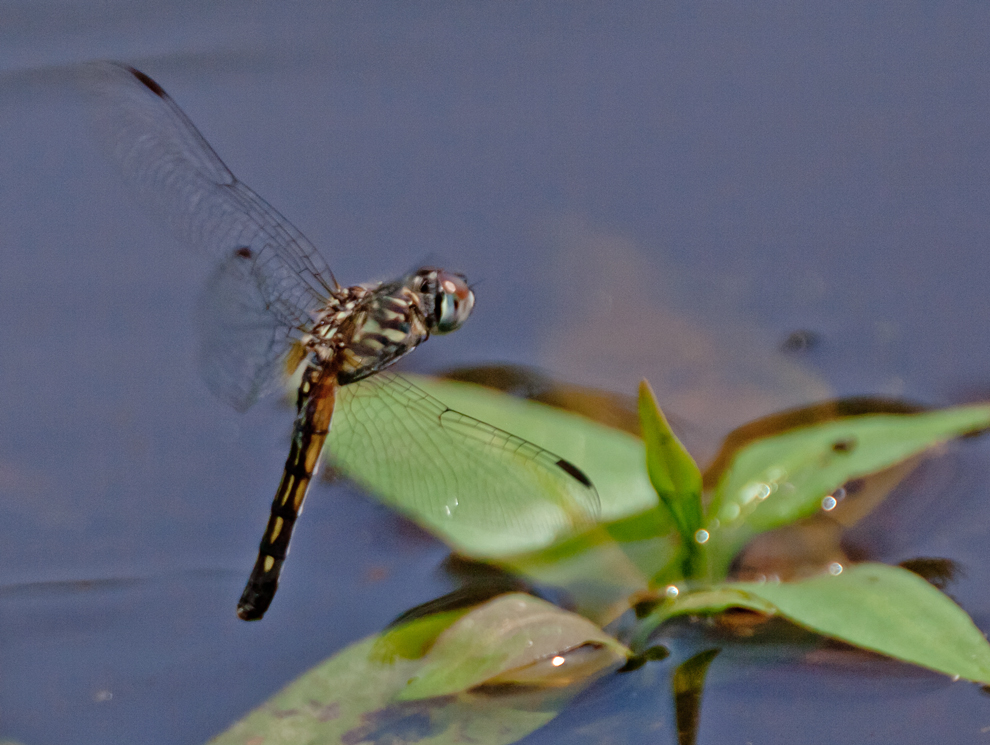
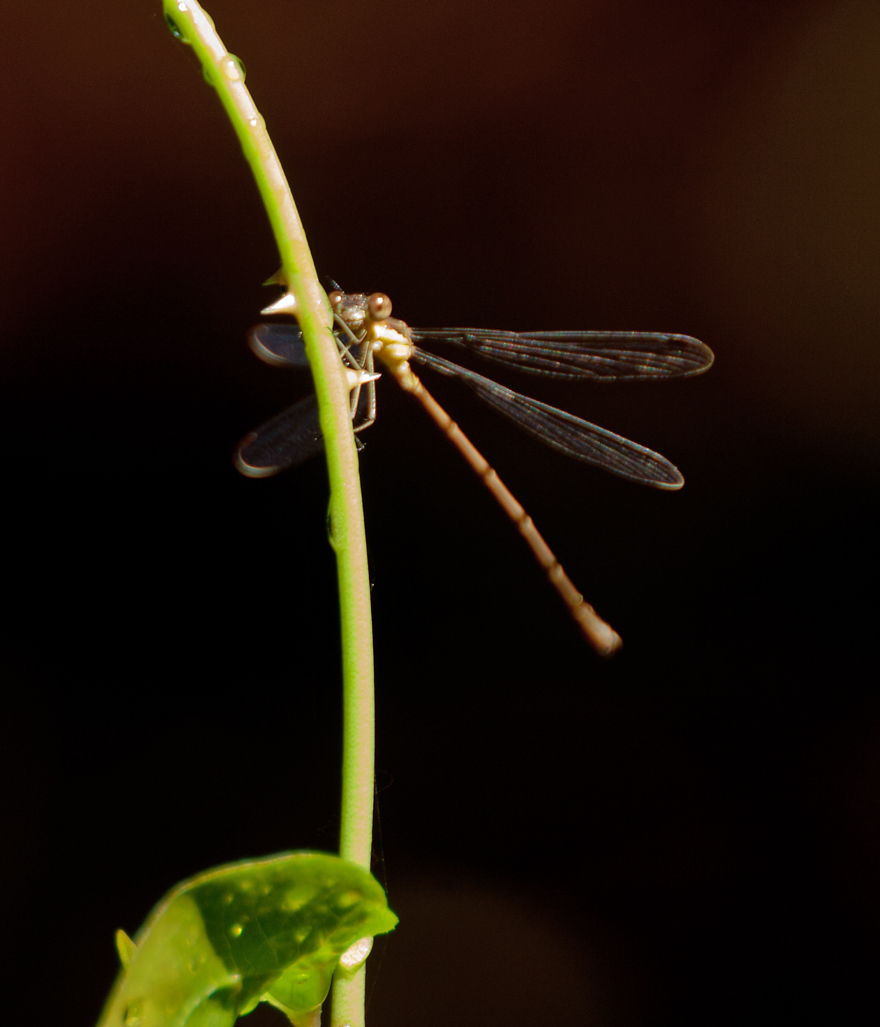
Continuing my quixotic quest to photograph dragonflies in flight, I went boldly out into the wild, armed with my trusty 100mm macro lens, and managed to capture this cool image of a dragonfly as it hovered over the water.
In previous attempts, I used longer telephoto zoom lenses, which increased the number of potential subjects but gave only mixed results. Using a shorter, fixed focal-length lens, I had to change my strategy a little and try to get closer to the subject.
I noticed this dragonfly hovering about the water to the side of the boardwalk on which I was walking. I crept as close as I could and tried to shoot as close to straight down as I could (the boardwalk was at least a foot (30 cm) above the level of the water and it looked like the dragonfly was hovering almost level with the boards of the boardwalk). I was really sensitive to my shadow, because I have learned that nothing scares away an insect faster than casting a shadow on it.
I used autofocus and was a little surprised to see that my dragonfly is in pretty clear focus, although the shutter speed was not fast enough to stop the action of the wings. I shot this handheld and really tried to pay attention to my technique, because my macro lens does not have any built-in image stabilization. As I thought about it afterwards, I realized that the auto focusing on the macro lens (using what Canon calls an ultrasonic motor) is much faster and better than the focusing on my Canon 55-250 or my Sigma 135-400mm zoom lens.
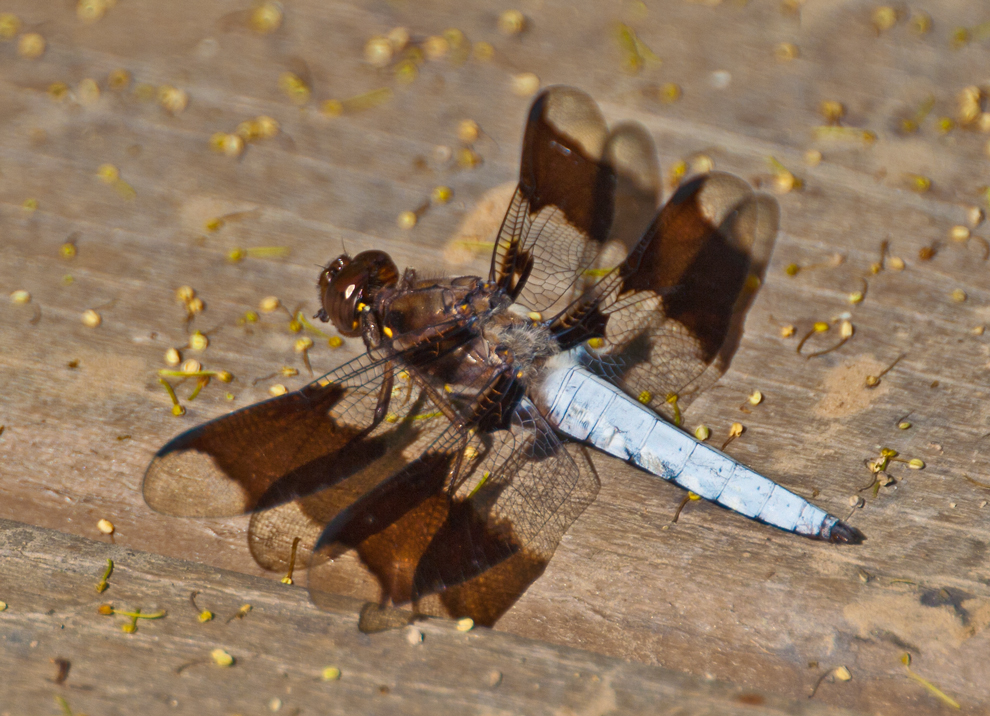
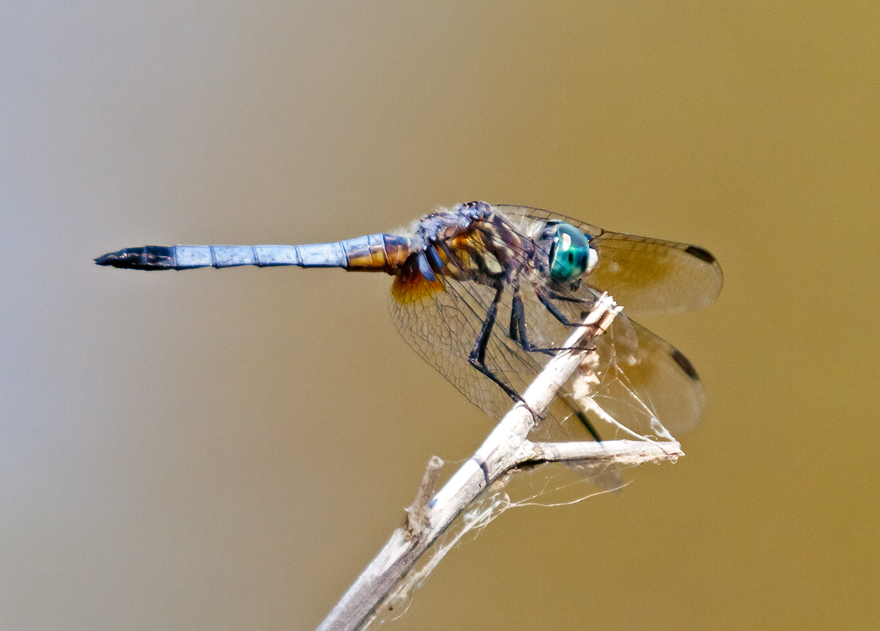
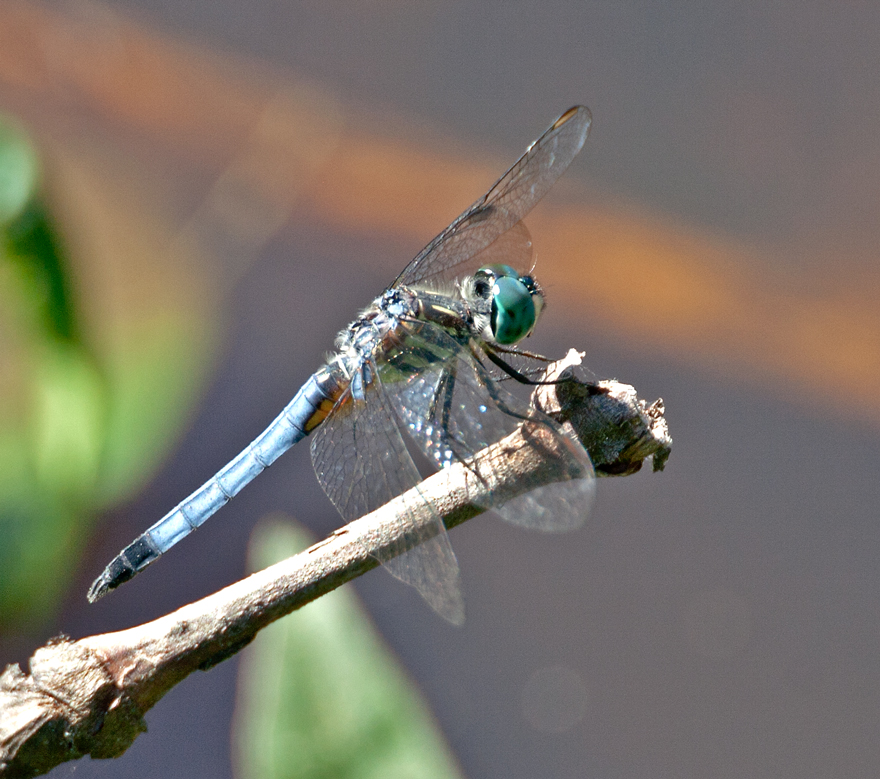
I have been having some difficulties identifying this dragonfly. The coloration of the tail looks a little like a female Blue Dasher, but the beautiful blue eyes do not seem right for the female. The tip of the tail should be a help, but I can’t seem to find one that matches it.
Although I can’t identify the dragonfly, it’s my best shot to date of a dragonfly in flight and I’m pretty content with it today, though my quixotic quest is likely to continue this weekend.

Michael Q. Powell. All rights reserved

















Heron and blackbird
Posted in Birds, commentary, Nature, Photography, wildlife, tagged Agelaius phoeniceus, Ardea herodias, Canon 55-250mm zoom lens, Canon Rebel XT, confrontation, Great Blue Heron, Huntley Meadows Park, interaction, red-winged blackbird, territoriality on June 8, 2013| 12 Comments »
Yesterday, I was observing a Great Blue Heron (Ardea herodias) as he flew to a new location. As soon as the heron landed, a male Red-winged Blackbird (Agelaius phoeniceus) started buzzing him, obviously feeling possessive of the territory. I captured this photo as the heron took off in search of a more peaceful fishing spot.
I love watching the interaction between different species, whether it be birds, reptiles, animals, or insects. Sometimes there is a kind of peaceful coexistence and sometimes, as was the case here, there is confrontation. Previously, I observed a group of blackbirds harassing a juvenile eagle, but this time the blackbird seemed to be alone.
One of my favorite bloggers, Sue of Back Yard Biology, did a wonderful posting recently on the Red-winged Blackbird’s sense of territoriality that is worth checking out. She called it “Angy Bird” and the post includes some cool photos that illustrate her main point.
I tend to think of blackbirds as aggressive and herons as peaceful and prone to avoid confrontation. Another one of my favorite bloggers, Phil Lanoue, who posts gorgeous shots of birds and alligators in his local marsh, has shown me, however, that Great Blue Herons will harass other birds and sometimes steal their catches, including this posting that he called “Stolen Treasure.”
Initially I was focused on catching this heron in the air, but I am glad that I kept my eyes and camera trained on the bird after he landed, for it turned out that the most exciting action was just starting.
Michael Q. Powell. All rights reserved
Share this:
Read Full Post »