Feeds:
Posts
Comments

Posts Tagged ‘Woodbridge VA’

Do all sparrows look the same to you? I am definitely no bird expert, but I could immediately see that the sparrow that I spotted yesterday at Occoquan Bay National Wildlife Refuge was different from the ones that I am used to seeing. The first thing that I noticed was that it was lighter in color than the usual sparrows and that the cap on its head was red, rather than the typical brown.

When I returned home and looked at the images on my computer, I also noted the two-toned bill and the black spot in the middle of its chest. All of these characteristics made it relatively easy to identify it as an American Tree Sparrow (Spizella arborea). I could not remember if I had seen this species before, so I checked my blog postings and found that it has been more than five years since I last photographed one.

It is easy to dismiss commonplace subjects, like sparrows, as not worthy of your time and attention. If you do so, though, you will miss the chance to discover their beauty. Like people, birds are not merely members of their species—they are unique individuals. I recommend spending time with them and getting to know them better.
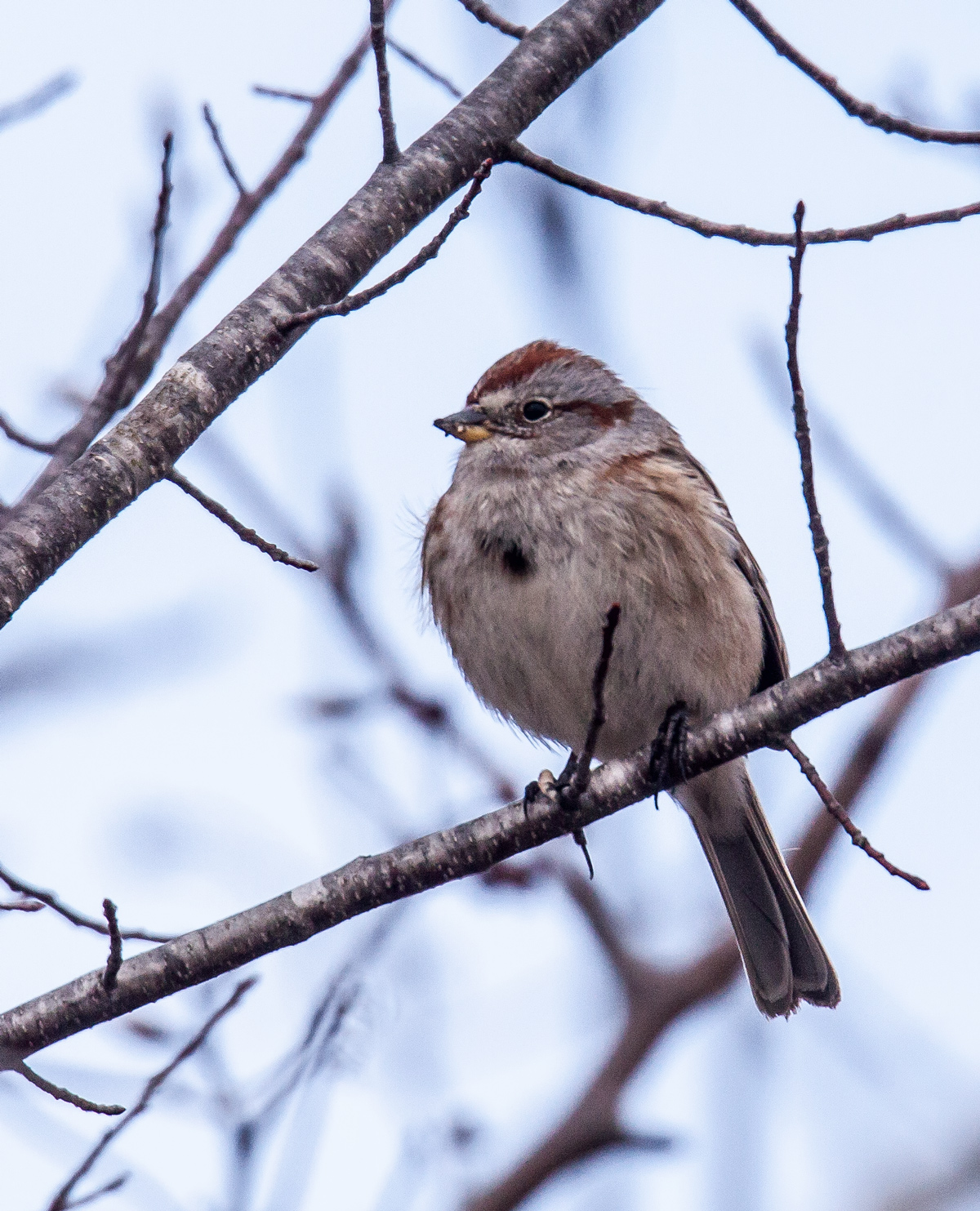
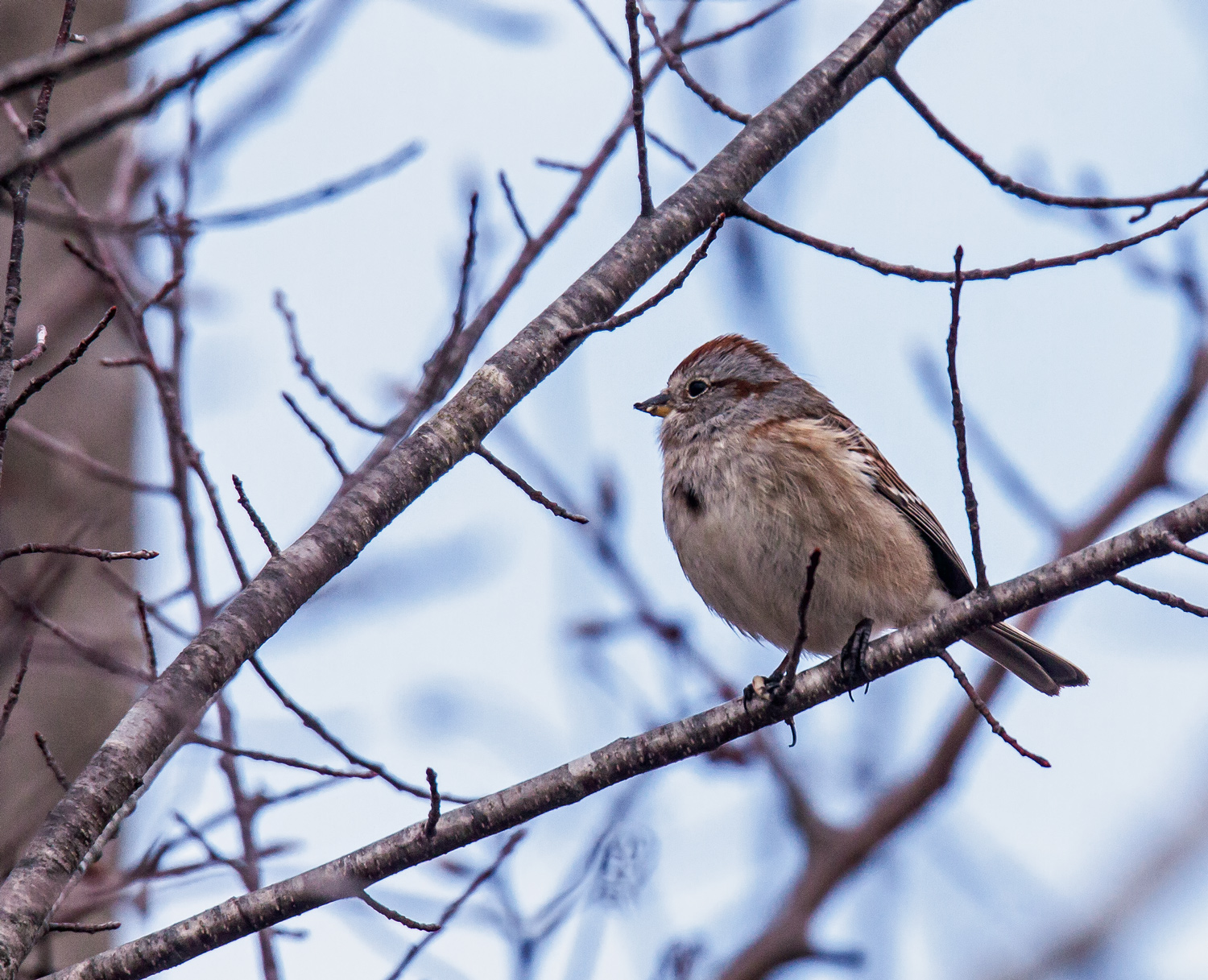
American Tree Sparrow

American Tree Sparrow

© Michael Q. Powell. All rights reserved.
Read Full Post »

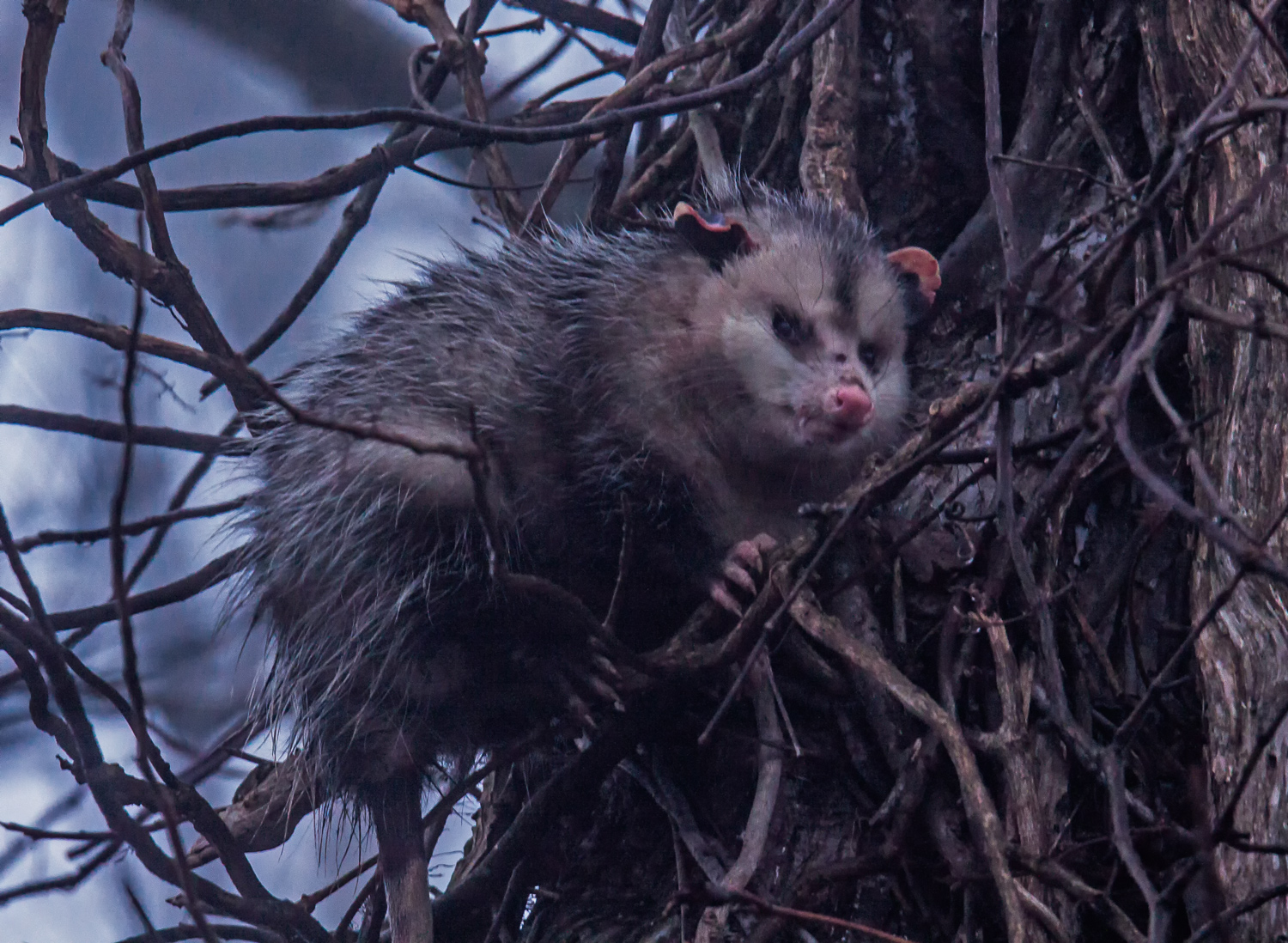
I have been to Occoquan Bay National Wildlife Refuge dozens and dozens of times, but had never seen an opossum there until yesterday. I am pretty sure that I would not have seen this one almost hidden in the trees if fellow photographer Ricky Kresslein had not pointed it out to me. Initially I was incredulous, suspecting that he had misidentified a raccoon, but as soon as I looked closely at the animal, I realized he was right.

The Virginia Opossum (Didelphis virginiana), the animal that I photographed, is the only marsupial found in North America north of Mexico. I had to double-check, but was able to confirm my remembrance that a marsupial is an animal with a pouch, like a kangaroo or a koala.

The connection to Australia and New Zealand is occasionally a source of some confusion, because the “possums” in those locations are entirely different species. Here in North American, “opossum” and “possum” are used interchangeably.

One of the most common references to this animal is the expression “playing possum.” In the literal sense, it refers to the Virginia Opossum’s reaction sometimes when threatened—it may roll over, become stiff, drool, breathe slowly and shallowly, and appear to be dead. In a more general sense, the expression has come to mean pretending to be dead or asleep to avoid having to deal with a problem.

Virginia Opossum

© Michael Q. Powell. All rights reserved.


Read Full Post »

Normally I plan my photo expeditions so that I arrive after the sun has already risen. After all, if I want to photograph wildlife subjects, I need to have enough light to be able to see them. Recently, however, I have been trying to get there before sunrise in order to capture images of the color in the sky. This is becoming a problem for me, because the gates of the wildlife refuge where I like to explore do not open until 7:00 in the morning and we have almost reached the point in the year where the sun rises even earlier than that.

On Tuesday, I arrived at Occoquan Bay Wildlife Refuge at about 7:05 and the color in the sky was amazing, a beautiful red color tinged the clouds. My view of the most colorful parts of the sky was blocked by trees, so I did my best to frame the sky with those trees. My the time I reached the water, the most saturated colors had disappeared, but in some directions I could still see some glorious pastel colors and I captured the second image. I love the abstract quality of that image, a depiction of nature at its simplest, a series of wonderful shapes and colors.

colorful dawn

colorful dawn

© Michael Q. Powell. All rights reserved.

Read Full Post »

I watched and waited for an extended period of time yesterday as this Bald Eagle (Haliaeetus leucocephalus) groomed itself in a tree overlooking one of the trails at Occoquan Bay National Wildlife Refuge. I was pretty much in the open at the edge of the trail and did not dare to move forward for fear of spooking the eagle. Fortunately I had my camera and long telephoto zoom lens on a monopod, because I know from experience that I would not have been able to hold it pointed upwards for that long a period of time.

I tried to stay as alert and ready as I could, which can be quite a challenge after a while. Sometimes a bird will signal its intent to take off, but this eagle took off without a warning. Acting on instinct mostly, I managed to capture the first image when the eagle was just clearing the edge of the branches. In the second shot, I clipped off the edge of the wings, but decided to include it to give you an idea of the challenge of trying to track the speed a bird when it first takes off. The final image shows you what the eagle looked like when it was perched in the tree before the takeoff.

bald eagle

Bald Eagle

Bald Eagle

© Michael Q. Powell. All rights reserved.

Read Full Post »

This Red-shouldered Hawk (Buteo lineatus) was so puffed up early last Saturday morning at Occoquan Bay National Wildlife Refuge trying to stay warm that I couldn’t even see its feet—it was about 18 degrees (minus 8 degrees C) when I captured the image. The hawk seemed to be hunched over a bit and it looks like some of its lower feathers were draped over its feet.

Red-shouldered Hawk

© Michael Q. Powell. All rights reserved.


Read Full Post »

The sun had risen before I reached the water at Occoquan Bay National Wildlife Refuge this past Saturday morning, but there still was some color in the sky that was reflected by the ice along the shoreline, imparting blue and orange tinges to the ice.

In the second shot, I used the wide-angle capabilities of my Canon SX50 superzoom camera to give you an overall feel for the moment. As you can see, the sun was not yet very high in the sky and the clouds helped to direct the sun’s rays directly down onto the distant water, giving it a kind of shimmer. I am now accustomed to carrying both my DSLR and the SX50 to give me greater flexibility in capturing different situations.

winter sunrise

winter sunrise

© Michael Q. Powell. All rights reserved.

Read Full Post »

The sun was rising as I pulled into Occoquan Bay National Wildlife Refuge early yesterday morning. My view to the east was obstructed, but I did manage to capture this image of the fiery sun through the trees.

It was a fun challenge trying to choose settings for the camera that let me capture both the sun and the shapes of some of the individual trees. In some of my images, the trees became one dark indistinct mass, so I kept making adjustments as quickly as I could, because the sun seemed to be moving amazingly fast.

winter sunrise

© Michael Q. Powell. All rights reserved.

Read Full Post »

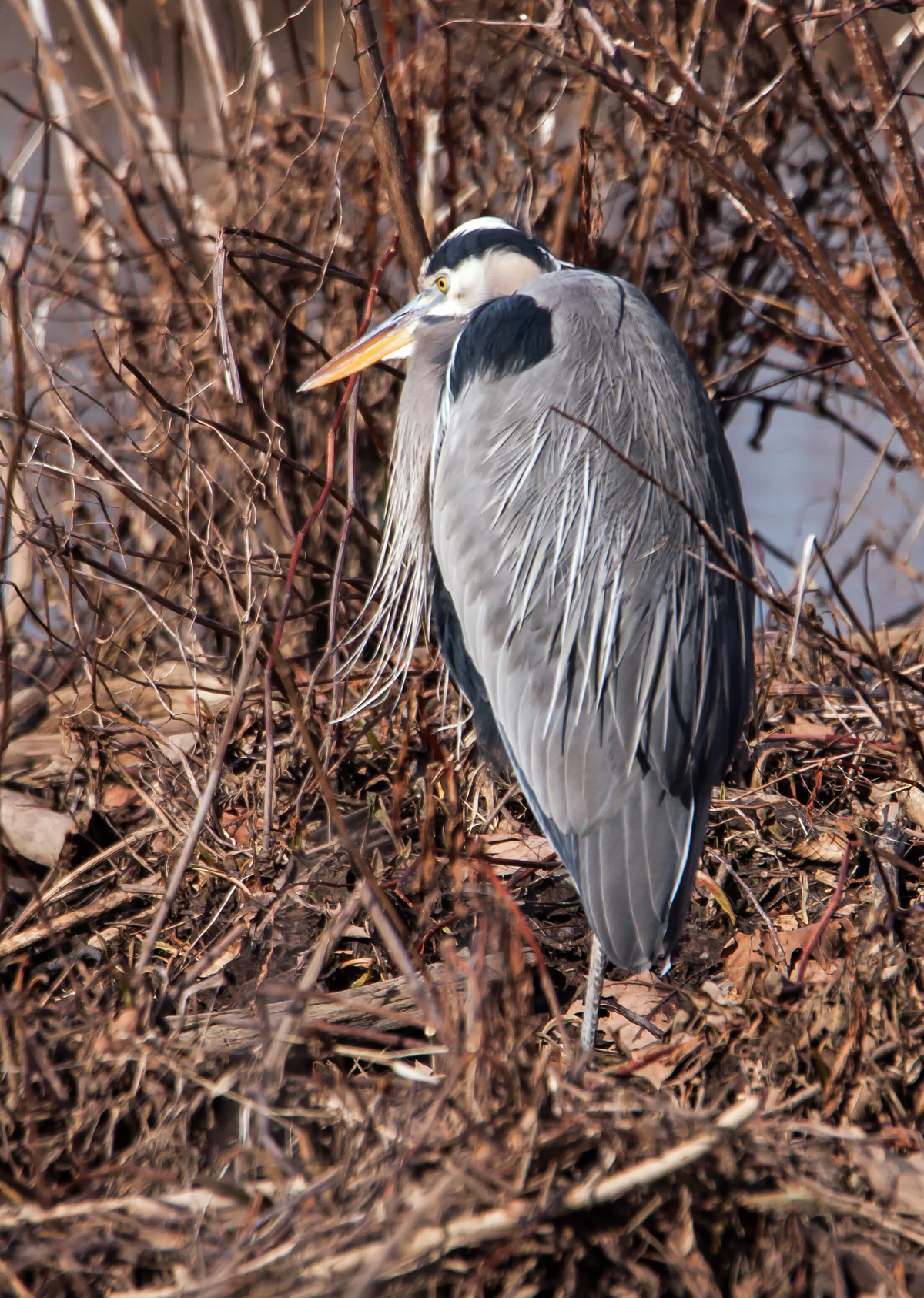
It was not as bitterly cold on Monday as it is today, but this Great Blue Heron (Ardea herodias) nonetheless seemed to be hunkered down at the edge of a pond as it sought to stay warm at Occoquan Bay National Wildlife Refuge. It almost looks like the heron is wrapped in a cloak of fluffed-up feathers with only a minimum amount of its body exposed to the elements.

Great Blue Heron

© Michael Q. Powell. All rights reserved.

Read Full Post »

It’s nesting time for eagles at Occoquan Bay National Wildlife Refuge. On Monday I spotted this Bald Eagle couple in a nest that I know has been used the for at least the last two years. The tree is adjacent to one of the main trails at the refuge and is pretty prominent. Shortly after my sighting, I encountered one of the law enforcement officers who was putting up barriers to block access on the roads near the nesting site to protect them from human interference.

Each year they put up the barriers in slightly different locations. I am hoping that this year’s barriers are about the same distance from the nest as last year’s. At that distance, I was able to photograph the eagles from a distance that let me get photos about the same as the first image below and also monitor the eagles. I was fortunately last year to be able to even get some distant shots of the two eaglets after they were born. Perhaps I will be equally lucky this year.

Bald Eagle

Bald Eagle

© Michael Q. Powell. All rights reserved.

Read Full Post »

Brown Creepers (Certhia americana) are tough to photograph as they spiral their way up tree trunks, so I was thrilled when I managed to get a mostly unobscured shot of one of these little birds on Monday at Occoquan Bay National Wildlife Refuge.

How small are Brown Creepers? According to information on the Cornell Lab of Ornithology website, Brown Creepers are 4.7 to 5.5 inches in length (12 to 14 cm) and weigh 0.2 to 0.3 ounces (5 to 10 grams). For the sake of comparison, the birds that I featured yesterday, Bald Eagles, are 27.9 to 37.8 inches in length (71 to 96 cm) and weigh 105.8 to 222.2 ounces (3000 to 6300 grams).

Brown Creeper

© Michael Q. Powell. All rights reserved.

Read Full Post »

How willing are you to show others your unedited images? When I first started getting more serious about taking photos six and a half years ago, I used to go out shooting with my mentor Cindy Dyer. When we were finished, we would immediately download my images and she would go through them with me.

It is a very humbling experience to let someone see all of your shots, but in doing so Cindy was able to see what I was attempting to do and how well I was succeeding in things like composition and camera settings. Her view was that I should try to get it as correct as I could in camera and not rely on software to fix my problems.

Earlier today I posted an image of a Bald Eagle (Haliaeetus leucocephalus) in a blog posting that I titled Unexpected eagle. In response to the posting, Liz of Exploring Colour asked me how much I had cropped the image. I answered her verbally, but then realized it would be more effective to show her the uncropped image and then the cropped one that I used in this morning’s post.

I was shooting with a Tamron 150-600mm lens at 600mm for this shot and that was what allowed me to fill so much of the frame with the eagle. It is very unusual for me to be able to get that close to an eagle without spooking it. When I am uncertain of the amount of time that I will have with a subject, I will usually use the center focus point of my camera and I think that is what I did here.

My DSLR is getting a bit long in the tooth and doesn’t have as many megapixels as some of the really new ones, which means I can’t crop as severely as some other photographers can without degrading the quality of my images. I have no objections to cropping, though I usually try to keep it as minimal as possible.

Bald Eagle

Uncropped image

bald eagle

Cropped image

© Michael Q. Powell. All rights reserved.
Read Full Post »

As I rounded a curve on a trail yesterday morning at Occoquan Bay National Wildlife Refuge, I looked up and realized there was a Bald Eagle (Haliaeetus leucocephalus) right in front of me. I reacted pretty quickly and managed to capture this image before the eagle spotted me and flew away.

Most of the time when I have been in similar situations, the eagle has spotted me before I spotted him and reacted before I did. In this case, I suspect that the eagle was either distracted or was looking in another direction when I first came into view.

bald eagle

© Michael Q. Powell. All rights reserved.

Read Full Post »

One of my faithful viewers, Jet Eliot, commented on a recent posting that she was glad to get some views of the wildlife refuge where I take so many of my photos. (Jet has a wonderful blog that focuses on travel and wildlife adventures that is definitely worth checking out.) The problem is not that I don’t take shots of Occoquan Bay National Wildlife Refuge, it is simply that I get so excited about posting photos of the wildlife that I forget about the more static shots of the land and water.

Here are a few shot of the refuge from this past Monday that help give you a better idea of the environment in which I am operating. The first image shows you what part of the shoreline at the refuge looks like during low tide. The refuge is located where Occoquan Bay meets the Potomac River and during tidal surges, some of the shoreline paths are underwater. Those surges tend to bring lots of debris onto the shore, including trash, like the beer bottle that you can see in the photo.

The second shot gives you an idea of how close some of the trees are to the shore. After big storms, downed trees often block some of the paths. As you probably noticed, there was a full moon visible that morning as the sun was rising and adding a little color in the sky.

The final image shows one of the streams that runs through the refuge. It is not unusual to see herons or ducks in these streams and at certain times, when I am really lucky, I have managed to spot muskrats, beavers, and otters.

So that is a brief introduction to “my” wildlife refuge. I used to most of my shooting at another nearby location, Huntley Meadows Park, but it became really popular and crowded. I prefer the solitude of this location—I am overjoyed sometimes when I arrive at the refuge and find that my car is the only one in parking lot.

Occoquan Bay National Wildlife Refuge

Occoquan Bay National Wildlife Refuge

Occoquan Bay National Wildlife Refuge

© Michael Q. Powell. All rights reserved.


Read Full Post »

I focus my attention so much on photographing living creatures that I feel somewhat helpless when it comes to taking landscape shots. How do you figure out what the main subjects is, assuming that there is a main subject? As a result, I tend to take simplified landscape shots, ones in which lines and shapes take on an almost abstract value.

The absence of color in a cloud-covered sky last Friday rendered the world even more simplified and monochromatic when I took this photograph at Occoquan Bay National Wildlife Refuge. Despite the tire tracks in the snow, I was definitely alone that morning, taking the road less traveled. It was that feeling that I tried to capture with this image.

snowscape

© Michael Q. Powell. All rights reserved.


Read Full Post »

It was frigid this morning—11 degrees F (minus 12 C) when I first got into my car—and windy, but I was out at Occoquan Bay National Wildlife Refuge and captured these images as the sun was rising. It was wonderfully tranquil, with the silence broken periodically by the sounds of cracking ice and the creaking trees.

frigid dawn

frigid dawn

frigid dawn

© Michael Q. Powell. All rights reserved.

Read Full Post »

Even when the weather is bad and other birds are hunkered down, sparrows are invariably active. Most of the time they are at ground level, but occasionally one will perch a bit higher off of the ground and give me a chance to get a decent shot.

That was the case this past Friday at Occoquan Bay National Wildlife Refuge, when a Song Sparrow (Melospiza melodia) took a break and posed for me briefly on the end of a log. I liked the composition when I took the shot and decided to post it without any cropping. I also couldn’t help noticing as I was working on the image that the sparrow’s colors are almost a perfect match for those in the background.

Sparrows are really special to me too because both on my parents loved His Eye Is On The Sparrow, a hymn that reminds us that God cares for each one of us. That is a message I think we all can use right now, at a time when so many of us are stressed out over the situation in our respective countries and in the world in general.

Song Sparrow

© Michael Q. Powell. All rights reserved.

Read Full Post »

Yesterday I finally made my way out into the wilds of Occoquan Bay National Wildlife Refuge for the first time following our recent snowfall. The wildlife refuge is open despite the partial federal government shutdown, but I was pretty sure that the access road had not been plowed, so I waited a few day for road conditions to improve.

It was heavily overcast for much of the day and the wildlife seemed to have hunkered down. Sightings were pretty scarce, so I was really happy when I spotted this duck. It was already a good distance away from me and I think it sensed my presence about the same time as I saw it and started swimming away immediately. I had a pretty good idea that this was a female Common Merganser duck (Mergus merganser) and some friendly folks on a Facebook forum confirmed the identification.

As far as I know, this is the first time that I have spotted this species—I am more used to seeing the Hooded Merganser, whose female sports a similar hairstyle to that of the Common Merganser.

Common Merganser

Common Merganser

© Michael Q. Powell. All rights reserved.

Read Full Post »

Although I focus mostly on my attention on wildlife in this blog, many of you know that I am likely to take photos of almost anything that catches my eye. Early in the morning this past Saturday as I was scanning the waters off of Occoquan Bay Wildlife Refuge, I caught sight of some lights in the distance. As they grew larger and larger, I realized that it was some sort of ship and I was happy to get a shot of it as it passed by.

A close examination of the image and a quick search on the internet revealed that this is a twin-screw tugboat named the D. Gray Kimel. It was built in 1982 and has had several different names. When I saw it the tugboat did not appear to be assisting another boat, but I did learn that it is rated at 1350 horsepower, so it seems to be pretty powerful.

tugboat D. Gray Kimel

© Michael Q. Powell. All rights reserved.

Read Full Post »

I love the way that Bufflehead ducks (Bucephala albeola) run across the surface of the water to gain speed before taking off, like this male bufflehead that I spotted last Saturday at Occoquan Bay National Wildlife Refuge. The images were already pretty much monochromatic because of the limited light, so I decided to do a black-and-white conversion of them.

If you look closely at the first image, you will see that my camera’s shutter speed was fast enough to freeze the motion of the water, but slow enough that the wings are blurred, which I think enhances the sense of speed. The wing tips are blurred in the second image as well and we also have a really cool reflection of the bufflehead after it has successfully taken to the air.

bufflehead

bufflehead

© Michael Q. Powell. All rights reserved.

Read Full Post »

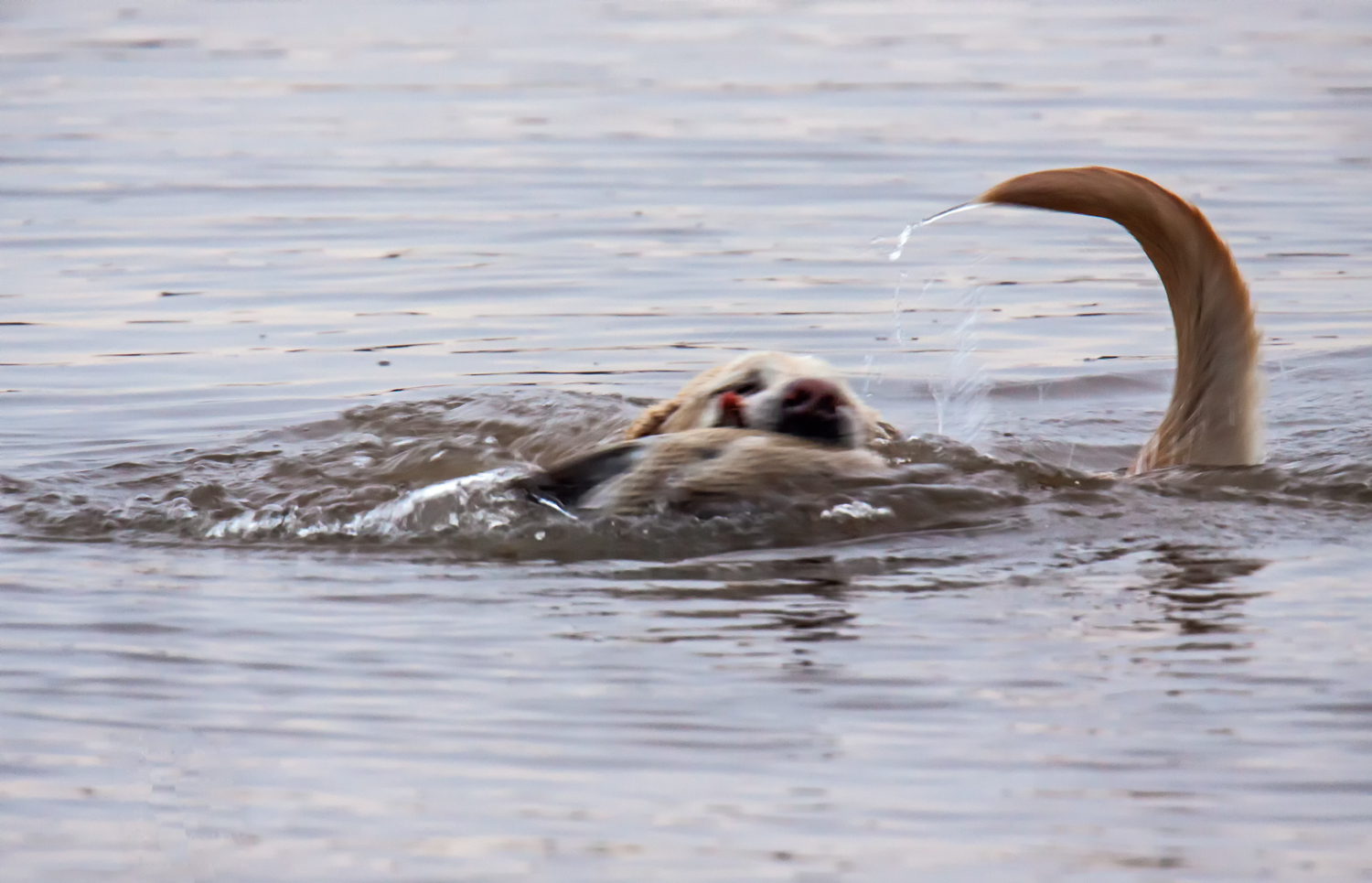
Passing by one of the duck blinds in the waters of Occoquan Bay this past Saturday, I saw a larger number of decoys set out and realized it was occupied. Consequently I braced myself when I heard the sound of approaching ducks and sure enough shots rang out. A few seconds later, I saw a duck hit the water not far from where I was standing.

I was focusing on the flailing duck with my telephoto lens when suddenly a dog swam into the frame. The dog, which appears to be a Labrador Retriever, approached the duck, circled around it so it would be heading in the right direction, and then swam back to the blind with the duck in its mouth.

I am not a hunter and prefer to do my shooting with a camera. However, I can appreciate the skill of both the hunter and the retriever in securing the duck that will probably make a tasty meal.


retriever

retriever

retriever

© Michael Q. Powell. All rights reserved.

Read Full Post »

I love male Northern Cardinals in the winter. They add such a wonderful pop of bright color on a cloudy day, like yesterday when I took this shot, or on a snowy day like today (when I hope to see one in my neighborhood).

I spotted this Northern Cardinal (Cardinalis cardinalis) while exploring Occoquan Bay National Wildlife Refuge, my current favorite spot for walking about with my camera. We have already had about 6 inches (10 cm) of snow and more is falling, so I probably will not make it out of the neighborhood today. The streets are not yet clear and people in this area tend to drive even more crazily than normal when there is snow.

I took a number of shots of the cardinal while he was perched in a distant tree. Although he remained relatively stationary, he kept changing his tail position, so I decided to include shots with different “poses.”

Northern cardinal

Northern Cardinal

Northern Cardinal

© Michael Q. Powell. All rights reserved.

Read Full Post »

Do eagles kiss? I am not sure if they do, but these two Bald Eagles (Haliaeetus leucocephalus) were definitely beak-to-beak this morning at Occoquan Bay National Wildlife Refuge.

After a week in the urban confines of Brussels, Belgium, it was nice to get out in the wild again, though I must confess that I was still somewhat jet-lagged. Not long ago I posted a photo of an eagle couple on this same perch and I suspect that this is the same pair. Earlier I had seen another eagle couple near another nesting site. Last year I was thrilled to get a peek at some young eaglets and I am hoping to be able to do the same this year.

kissing eagles

© Michael Q. Powell. All rights reserved.

Read Full Post »

Most of the year I tend to see individual Bald Eagles (Haliaeetus leucocephalus), but recently I have been seeing them in pairs, like this couple that I spotted last week perched on a nesting platform for ospreys at Occoquan Bay National Wildlife Refuge. It will soon be time to occupy a nearby nest.

If you look closely at the two eagles, you will notice that one that the one on the left is smaller in size—I believe that is the male. I do not know if this is the same couple, but an eagle couple successfully raised two eaglets in a nest in a tree that is not that far away from this platform, which housed an active osprey nest last year.

bald eagles

© Michael Q. Powell. All rights reserved.


Read Full Post »

At this time of the year my peaceful pursuit of photos is often punctuated with the sound of shotgun blasts as I walk along the trails parallel to the water at Occoquan Bay National Wildlife Refuge—it is duck hunting season. As you might suspect, duck hunting is not permitted on the territory of the wildlife refuge itself, but there is a series of duck blinds not far from the shore.

Some hunters simply take their boats and occupy the blinds, while others take the additional step of putting out duck decoys. In previous years I was fooled into taking photos of the decoys, thinking they were real ducks, but my decoy identification skills seem to have improved.

Here are a couple of photos of one of the blinds to give you an idea of what they look out and how close they are to the shore. I took the final shot of a group of hunters as they slowly motored by me. I don’t know the hunting rules, but I don’t think that they can hunt from a moving boat.

I am not against hunting per se, but I am definitely a bit edgy when I hear shots fired not far from where I am walking and will definitely welcome the eventual end of the hunting season.

duck blind

duck blind

duck hunting

© Michael Q. Powell. All rights reserved.

Read Full Post »

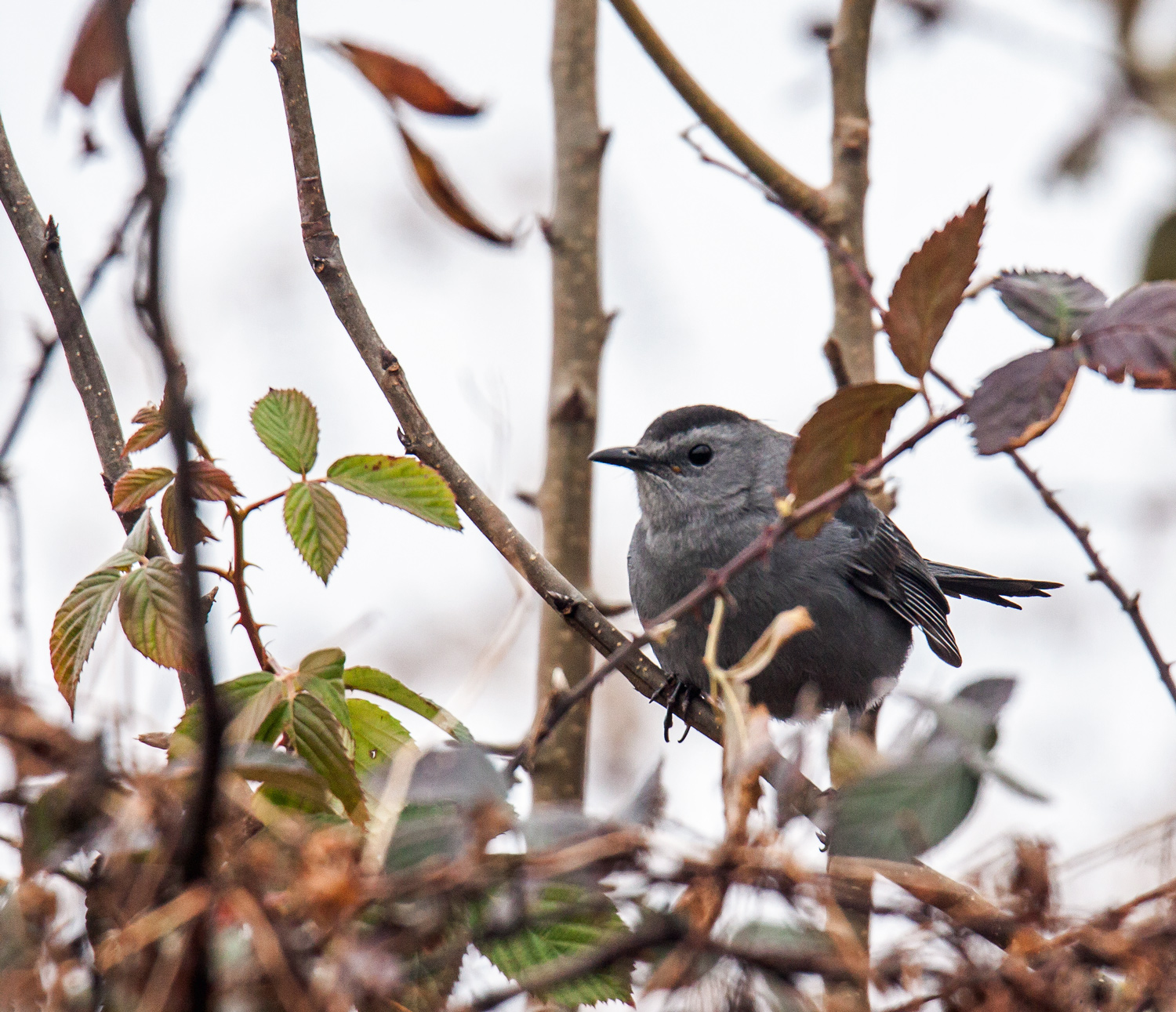
I’ve read that a Gray Catbird (Dumetella carolinensis) makes a distinctive cat-like mewing sound, but I don’t recall ever having heard a catbird make any sound whatsoever. According to the Cornell Lab of Ornithology, Gray Catbirds can also copy the sounds of other species and string them together to make their own song that can last as long as ten minutes.

Even without hearing its song, I was able to spot this Gray Catbird earlier this week at Occoquan Bay National Wildlife Refuge. As is most often the case with catbirds, this one was in thick vegetation, but I did manage to get a relatively clear shot of its head and body.

Gray Catbird

© Michael Q. Powell. All rights reserved.


Read Full Post »

The long sloping shape of the bills of these ducks in the waters off of Occoquan Bay National Wildlife Refuge indicated to me that they are Canvasbacks ducks (Aythya valisineria). Most of the time I rely primarily on colors when trying to identify birds, but during the non-breeding season, many ducks share the same subdued colors, especially when viewed from a distance. This was a rare case when a single distinctive characteristic—in this case the bill—was enough for me to identify the birds with a reasonable degree of confidence.

According to Wikipedia, the duck’s common name is based on early European inhabitants of North America’s assertion that its back was a canvas-like color. In other languages it is just a white-backed duck; for example in French, morillon à dos blanc, or in Spanish, pato lomo blanco.

canvasback

© Michael Q. Powell. All rights reserved.

Read Full Post »

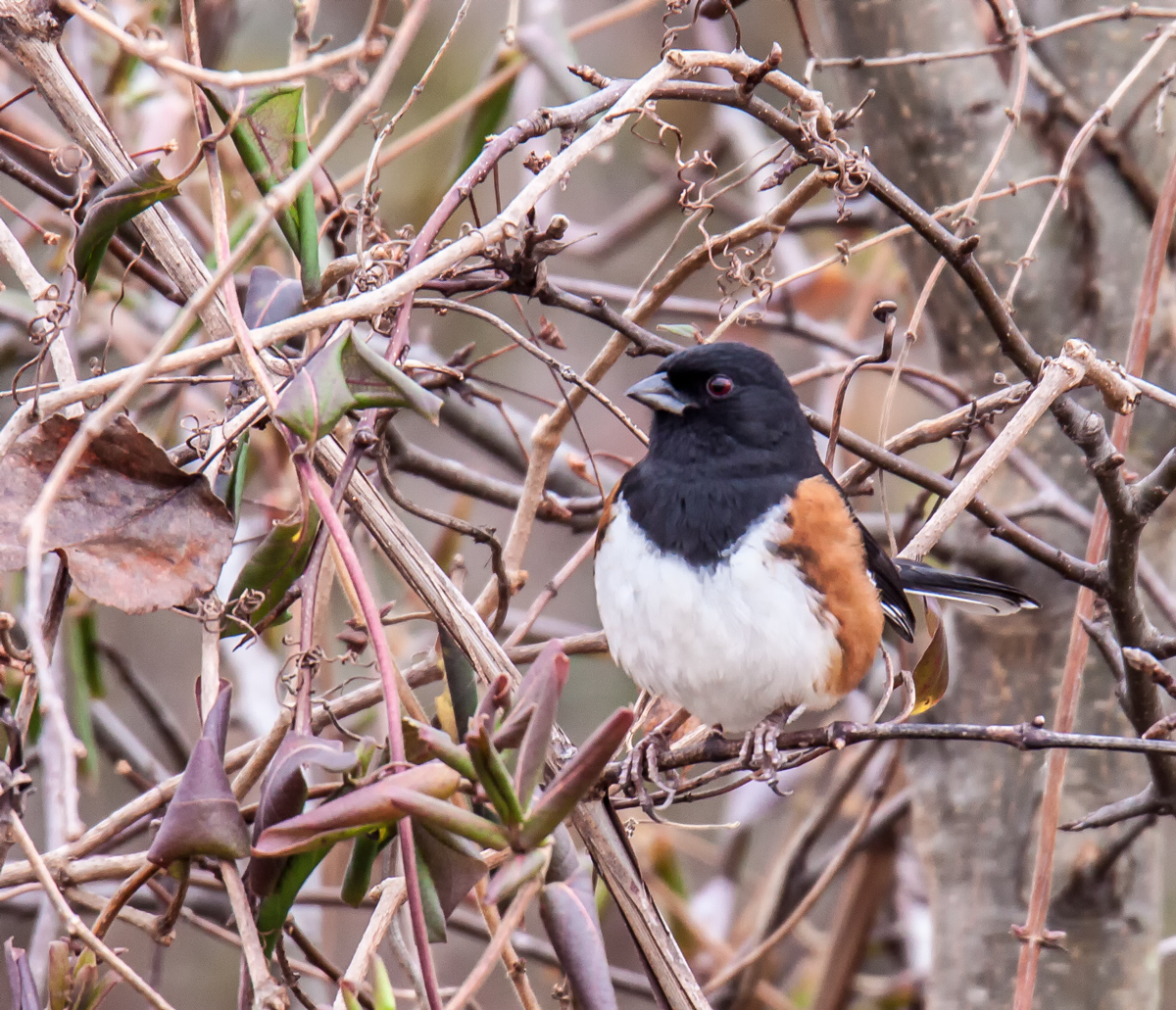
During the winter months you sometimes have to search a little harder to find birds, but they are definitely still with us. When I caught a glimpse of this bird’s rust-colored feathers earlier this week at Occoquan Bay National Wildlife Refuge, I assumed it was an American Robin.

When I zoomed in, however, I was thrilled to see like that the bird was an Eastern Towhee (Pipilo erythrophthalmus). Towhees share many of the same colors with the robins, but they are arranged in a completely different way. I think that towhees are supposed to be relatively common, although I personally do not see them very often.

I love to play with words and “towhee” for some reason is fun to say out loud. Try it yourself—it is virtually guaranteed to put a smile on your face.

Eastern Towhee

© Michael Q. Powell. All rights reserved.


Read Full Post »

Many of you know that I normally post every day—in 2018 I think that I missed only 12 days.  I used to be really obsessive about this and would get anxious if I didn’t have an image to post. Over time, though,I have mellowed a bit and so I am not at all concerned that I write a posting on New Year’s Day.

I have been in a contemplative mood ever since I did the retrospective look at some of my favorite photos from last year. As I looked back I simultaneously looked forward. I have never been a big fan of New Year’s resolutions, but my hopes and plans for this new year can be summed up in two words “more” and “better.”

Those two words are non-specific and subjective, but for me, that is the nature of my approach to photography. I strive to spend as much time as I can in the wild, opportunistically looking for subjects. When situations present themselves, I try to react as quickly and creatively as I can.

That was the case earlier today when I visited Occoquan Bay National Wildlife Refuge. Despite the partial federal government shutdown, the wildlife refuge is still open. It was a cool and gray day, and there was not too much activity. I was therefore thrilled when I spotted this Red-bellied Woodpecker (Melanerpes carolinus) feverishly pecking away at a distant tree.

The woodpecker kept its head down as it circled the branch, but finally paused for a moment when it was upright and I was able to capture this shot. Although the woodpecker is relatively common, the organic shapes of the branches really caught my eye.

I’m ok with shooting familiar subjects over and over again. What about you? Some people like to live “widely,” seeing lots of different things in different places, while others prefer to live “deeply,” seeing the same places in different ways and in different seasons. I tend to be in the latter group, but recognize that each person has his/her own comfort zone.

Red-bellied Woodpecker

© Michael Q. Powell. All rights reserved.

Read Full Post »

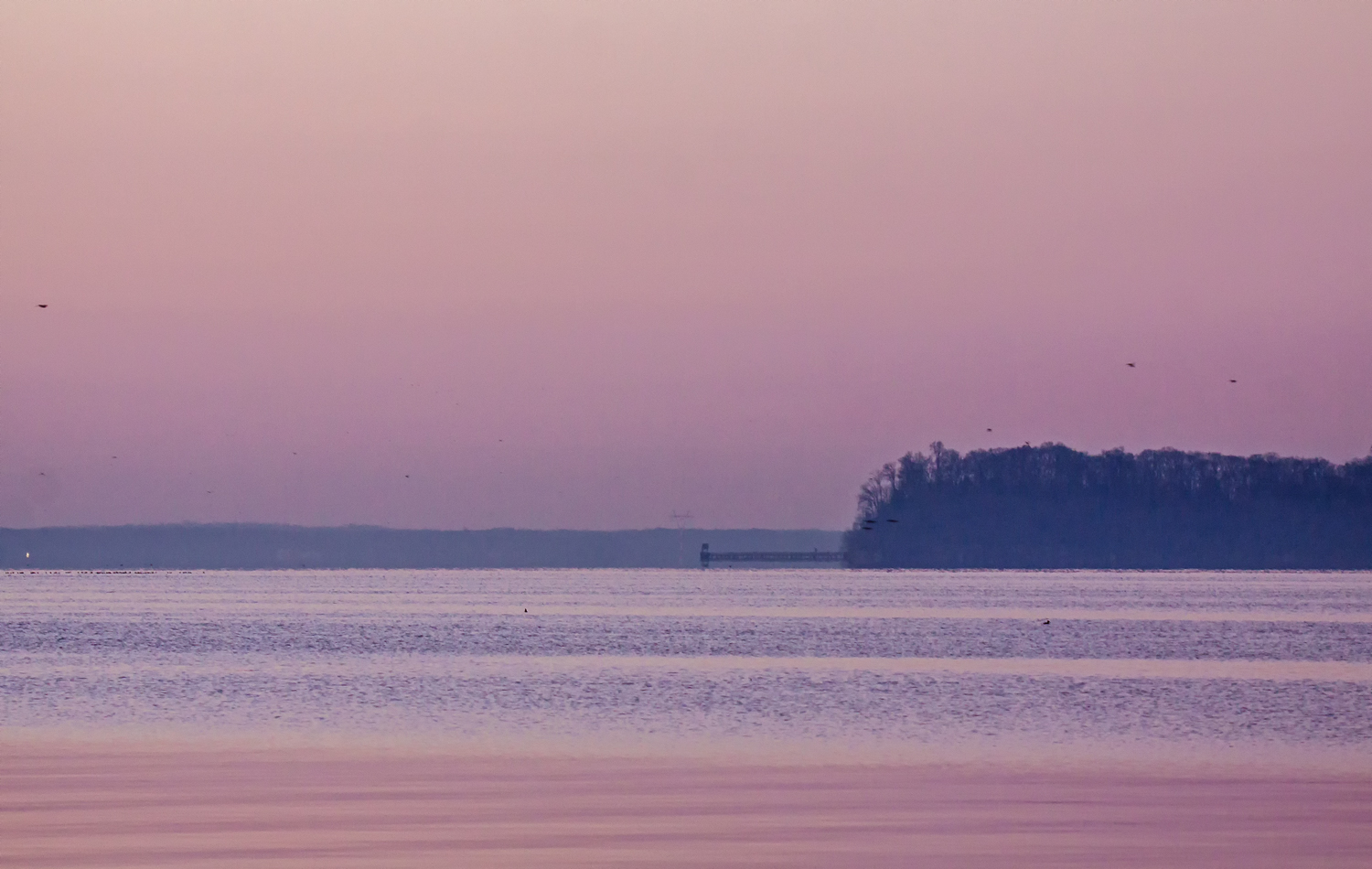
A few days ago I posted a shot of a sunrise over Occoquan Bay and I remember waiting somewhat impatiently for the sun to rise. Fortunately I took some shots as I was waiting and as I finally went over those shots today, I was happy that they showed some of the beautiful colors as the night finally turned into day.

The sunrise was by no means spectacular—its beauty was more subdued and subtle. You’ll probably notice that the color changes a bit in each of the images. I think that the colors were influenced by the direction in which I was pointing my camera and the amount of light present in the scene.

pre-dawn light

pre-dawn light

pre-dawn light

© Michael Q. Powell. All rights reserved.

Read Full Post »

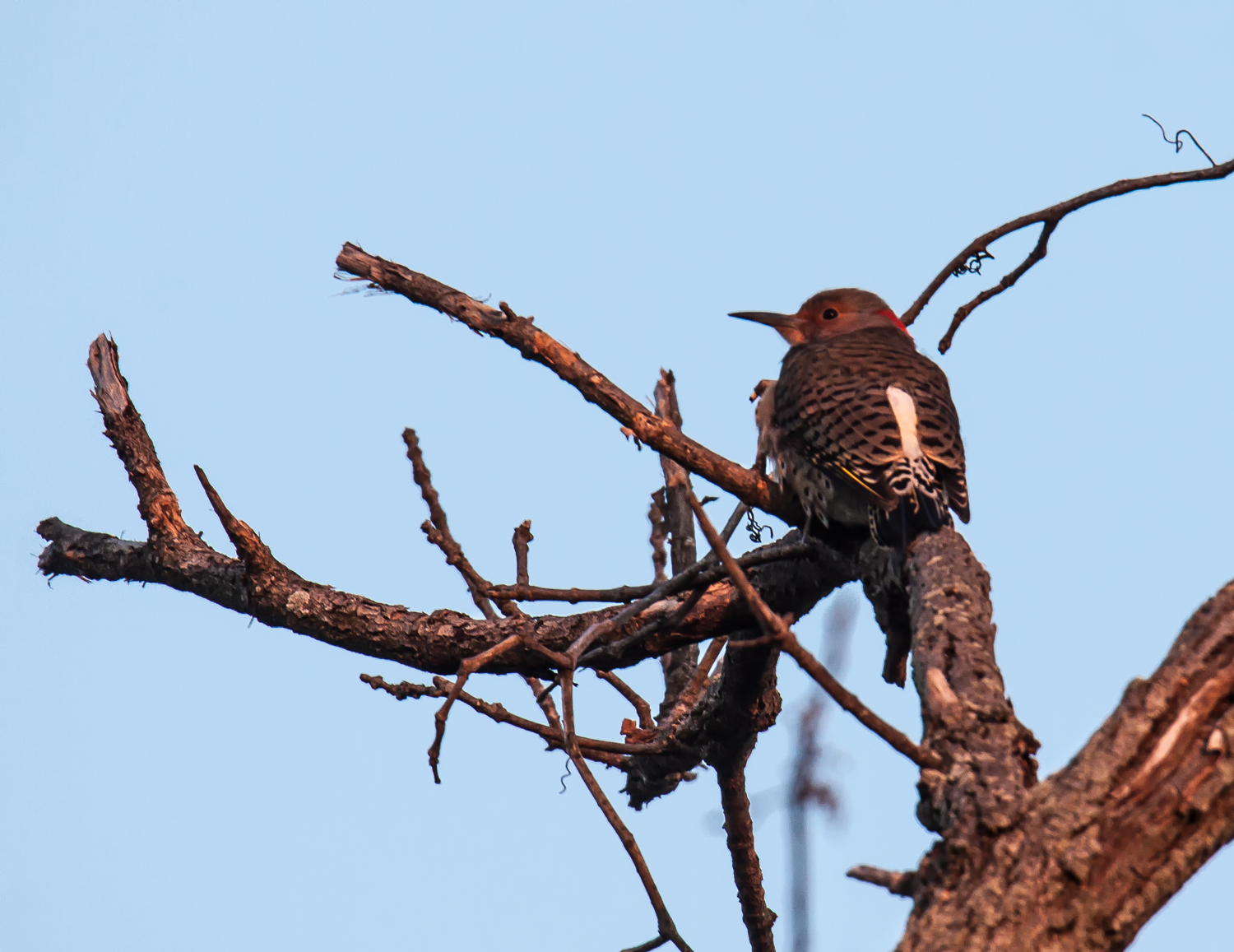
Northern Flickers (Colaptes auratus) have very distinctive patterns and colors, but in the early morning light this one blended in well with the bark and branches of the tree on which it was perched earlier this week at Occoquan Bay National Wildlife Refuge.

I was able to detect the bird’s presence only when it moved its head a bit from side to side. Some of my friends are able to spot birds in the trees on the basis of their shapes, but for the most part I need some movement to be able to do so.

Northern Flicker

© Michael Q. Powell. All rights reserved.


Read Full Post »

White-throated Sparrows (Zonotrichia albicollis) always remind me of Santa Claus because of their white “beards.” The effect was magnified on a recent frigid morning at Occoquan Bay National Wildlife Refuge, when a White-throated Sparrow had fluffed up its feathers to retain heat and looked even chubbier than normal.

White-throated Sparrow

© Michael Q. Powell. All rights reserved.
Read Full Post »

« Newer Posts - Older Posts »