June 26, 2024 by Mike Powell
After mating, many male damselflies hold on to the female as she deposits eggs in order to keep any rival males from interfering with the process. The male grasps the head of the female with the terminal appendages of his abdomen in the “tandem” position and the two linked damselflies move about from spot to spot as the female inserts eggs into floating vegetation.
Last Friday at Jackson Miles Abbott Wetland Refuge I managed to capture this image of a Slender Bluet (Enallagma traviatum) couple as the female arched her body, made a little slit in the vegetation and inserted eggs, a process known as “ovipositing.”
I am not absolutely certain I have correctly identified the damselfly species—there are a lot of bluet species—but I have made my call primarily on the basis of the markings on the abdomens of the male and the female. I intend to post this shot in a dragonfly/damselfly forum on Facebook and will update this posting if one of the experts in the group corrects my initial identification.

© Michael Q. Powell. All rights reserved.
Posted in damselfly, Insects, Macro Photography, Nature, Photography, Summer, wildlife | Tagged Canon 7D, damselfly ovipositing, Enallagma traviatum, Fort Belvoir VA, Jackson Miles Abbott Wetland Refuge, slender bluet, Slender Bluet damselfly, Tamron 18-400mm | 5 Comments »
June 25, 2024 by Mike Powell
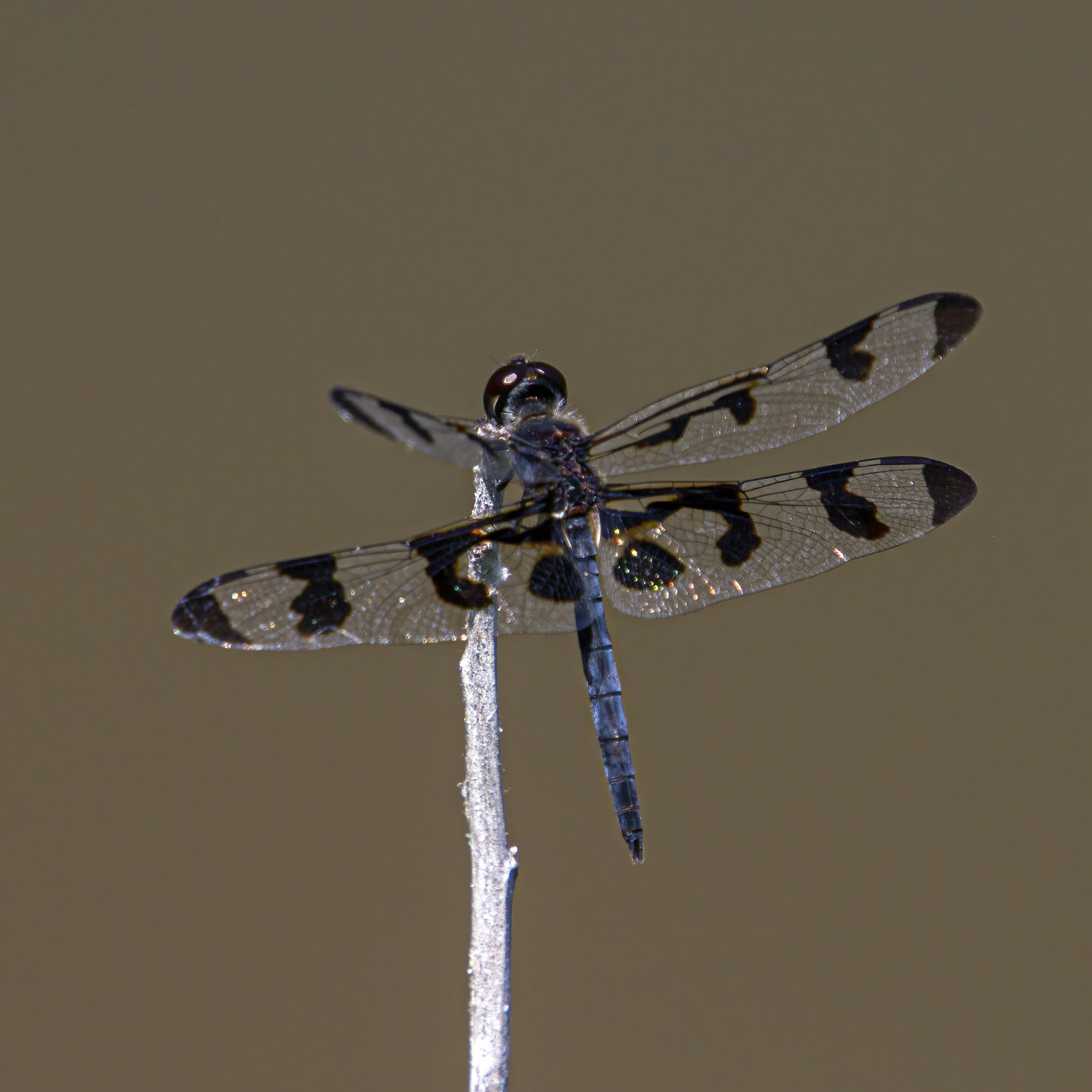
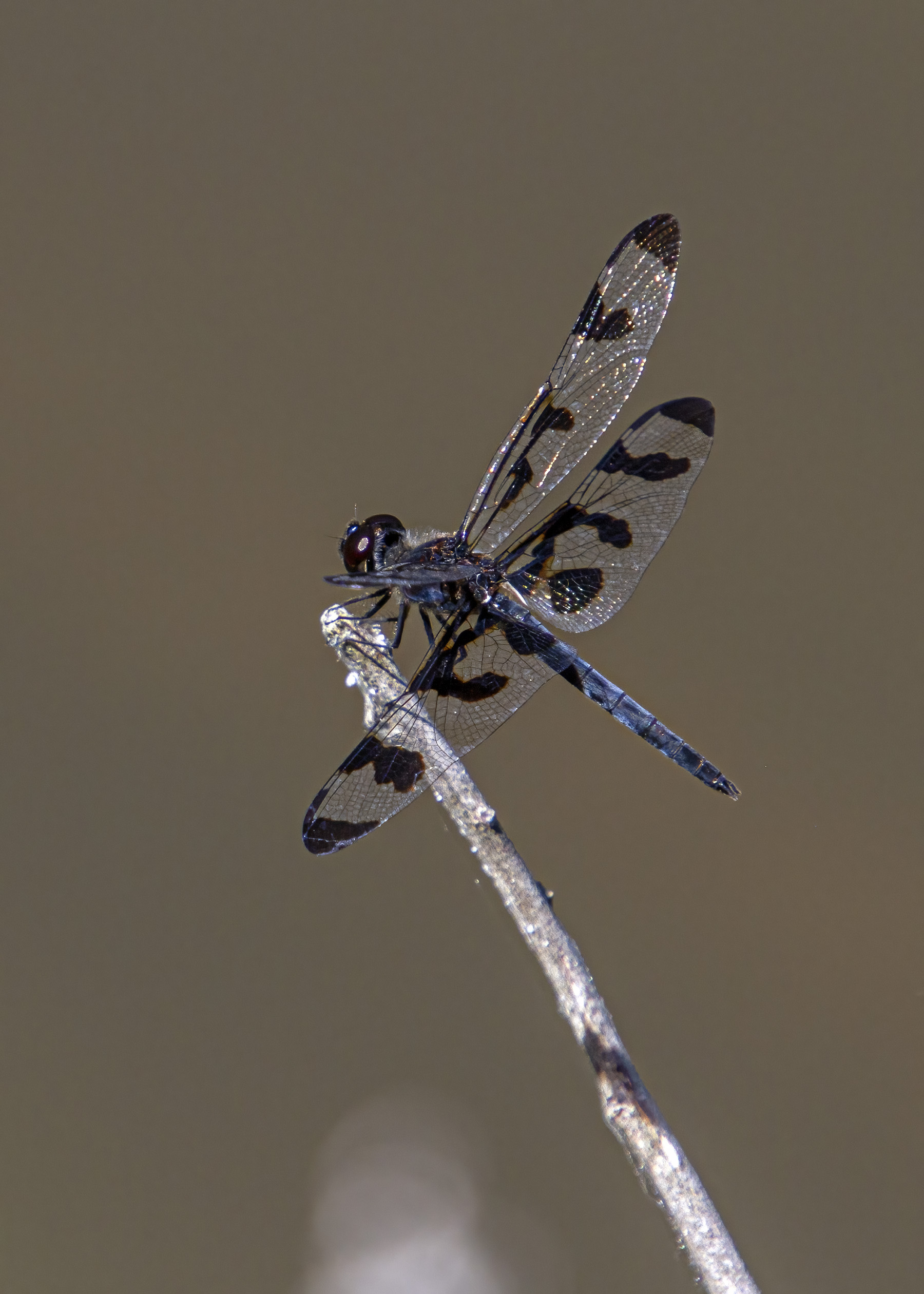
During a short visit to Jackson Miles Abbott Wetland Refuge last Friday I spotted my first Banded Pennant dragonfly (Celithemis fasciata) of the year. Pennant dragonflies like this one often perch precariously on the very tips of vegetation, which causes them to flap about in even the slightest of breezes, like a pennant.
Banded Pennants are somewhat uncommon and in some years I have not seen a single one, so I was happy to encounter this handsome male, the only one I saw all day. As you can see in all of the photos below, the dragonfly’s upper left wing did not seem to straighten out as much as the other three wings. From what I could see, though, the dragonfly was able to fly quite well despite this injury or deformity.

© Michael Q. Powell. All rights reserved.
Posted in Dragonflies, dragonfly, Insects, Nature, Photography, Summer, wildlife | Tagged Banded Pennant, Banded Pennant dragonfly, Canon 7D, Celithemis fasciata, Fort Belvoir VA, Jackson Miles Abbott Wetland Refuge, Tamron 18-400mm | 4 Comments »
June 24, 2024 by Mike Powell
I was thrilled to spot my first Swift Setwing dragonfly (Dythemis velox) of the season this past Friday at Jackson Miles Abbott Wetland Refuge. These little dragonflies perch in a distinctive pose with their wings pulled forward, which looked to some scientist like the “ready-set-go” position of a sprinter and is reportedly the reason for the name of the species.
Eight years ago I spotted my first Swift Setwing dragonfly ever at this same location. This primarily southern species had never before have been documented in Fairfax County, Virginia, the county where I live, so it is kind of special for me to see them each year. (You can see details of that first sighting in my 25 June 2016 posting Swift Setwing dragonfly.)
Swift Setwings like to perch facing the water on overhanging vegetation, so it is a challenge to get a shot of one without getting my feet wet. I had to find a little visual tunnel through the vegetation to get this shot, but I did manage to stay dry.

© Michael Q. Powell. All rights reserved.
Posted in Dragonflies, dragonfly, Insects, Nature, Photography, Summer, wildlife | Tagged Canon 7D, Dythemis velox, Jackson Miles Abbott Wetland Refuge, Swift Setwing, Swift Setwing dragonfly, Tamron 18-400mm | 2 Comments »
June 22, 2024 by Mike Powell
There must be something special about this perch. One week after I photographed a Unicorn Clubtail dragonfly (Arigomphus villosipes) on a log at the edge of a small pond at Occoquan Regional Park, I spotted another Unicorn Clubtail in the exact same spot. Perhaps it was even the same individual, hanging out in the same old places, as this wildlife photographer is wont to do.
The edge of the pond is very mucky, so I couldn’t get any closer to give you a better view of the little “horn” that sticks up between the eyes and gives rise to the name “unicorn.” You’ll have to trust me on that point or check out a 2017 blog post entitled Unicorn in Northern Virginia that includes a better view of the unicorn “horn.”
We are in the midst of a real heat wave, with daily temperatures soaring into the mid-90’s (35 degrees C), so my wildlife forays are shorter than normal. Don’t worry, I am taking it slow, seeking shade whenever possible, and carrying water with me. Forecasters predict that this heat wave will continue for at least another week. Yikes!

© Michael Q. Powell. All rights reserved.
Posted in Dragonflies, dragonfly, Insects, Nature, Photography, Summer, wildlife | Tagged Arigomphus villosipes, Canon 7D, Lorton VA, Occoquan Regional Park, Tamron 18-400mm, Unicorn Clubtail, Unicorn Clubtail dragonfly | Leave a Comment »
June 21, 2024 by Mike Powell
When I spotted this Gray Petaltail dragonfly (Tachopteryx thoreyi) on Monday at Occoquan Regional Park, I could see that it was feasting on some kind of insect that it had caught, but I could not get close enough to identify the prey. Dragonflies are fierce predators that feed on a wide variety of insects, sometimes including other dragonflies or damselflies.
When I examine the image carefully I can just make out the wings and legs and possibly an eye of the victim, but that does not help me to identify it. The dragonfly was perched high on the trunk of the tree and when I tried to move closer to get a better shot, the sharp angle made it even harder to see what was going on. I was happy enough to capture this profile view of the Gray Petaltail, which would otherwise have been pretty well camouflaged by the rough bark of the tree.

© Michael Q. Powell. All rights reserved.
Posted in Dragonflies, dragonfly, Insects, Nature, Photography, spring, Summer, wildlife | Tagged Canon 7D, Lorton VA, Occoquan Regional Park, Tachopteryx thoreyi, Tamron 18-400mm | 3 Comments »
June 20, 2024 by Mike Powell
Many dragonflies have transparent wings that seem to disappear when they are flying, making them look even smaller and hard to detect. Male Widow Skimmer dragonflies (Libellula luctuosa), however, have such large bi-colored patches on their wings that they look almost like butterflies when in flight, an impression heightened by the fluttering way that they fly.
I was thrilled when I spotted this male Widow Skimmer—the females of this species do not have the white wing patches—on Monday at Occoquan Regional Park. The dragonfly flew by me numerous times and I watched and waiting, hoping that it would land. My patience eventually paid off and I was able to capture this shot that shows off its wings beautifully. This may not be the most artistic image that I have ever captured, but it is a good one to use for the purpose of identification.
One of the coolest things about photography is that it can be both scientific and artistic, allowing me to be as geeky as I want in either domain.

© Michael Q. Powell. All rights reserved.
Posted in Dragonflies, dragonfly, Insects, Nature, Photography, spring, Summer, wildlife | Tagged Canon 7D, Libellula luctuosa, Lorton VA, male Widow Skimmer, Occoquan Regional Park, Tamron 18-400mm, Widow Skimmer, Widow Skimmer dragonfly | 6 Comments »
June 19, 2024 by Mike Powell
Sable Clubtail dragonflies (Stenogomphurus rogersi) are uncommon in my area. This dragonfly species is generally found only in very small numbers, has a short flight period, and requires very specific habitats, preferably a small, clean forest stream. There is only one location in my area where I have found Sable Clubtails in the past and some years I have not seen a single one.
I was therefore really excited on Monday when I spotted what I thought might be a Sable Clubtail. I was not sure of my identification, though, because this dragonfly was in a different location at the park, not along the stream where I had seen Sable Clubtails in the past.
When I returned home and examined my photos on my computer, I was shocked to see that the dragonfly was a female–I am pretty sure that all of the Sable Clubtails that I have previously seen were males. For the sake of comparison, I have added a photo of a male that was part of a posting I did on 10 June 2024 entitled Sable Clubtail dragonfly (male). If you look closely at the tip of the abdomen (the “tail”) of each dragonfly, you will see different shaped terminal appendages, which are key factors in helping to identify the gender of a dragonfly.
Different dragonfly species have different courting behaviors. In some cases, the males and females are present in the same area, but in other cases, the females remain in a different area until they are actually ready for mating. I looked through my resources and on-line to see if I could find any information about the behavior of Sable Clubtail females, but came up empty-handed.
Where do female Sable Clubtails like to hang out? With a sample size of only one, I certainly can’t come to any conclusions, but I will continue to keep my eyes open and perhaps I will encounter another one.


© Michael Q. Powell. All rights reserved.
Posted in Dragonflies, dragonfly, Insects, Nature, Photography, spring, wildlife | Tagged Canon 7D, Female Sable Clubtail, Lorton VA, Occoquan Regional Park, Sable Clubtail, Sable Clubtail dragonfly, Stenogomphurus rogersi, Tamron 18-400mm | 2 Comments »
June 18, 2024 by Mike Powell
How does the Google search engine work? What causes information that you post to show in the first page of Google results? There are plenty of people on-line who claim to understand the Google algorithm and are willing to sell you there services for something called Search Engine Optimization, but for most of us, Google is a bit of a mystery.
When I do a daily blog posting, I expect that most of my views for that day will be from that posting, primarily from subscribers to my blog, or maybe for postings from the previous few days. Over the past ten years, I have learned that other viewers may be drawn to my site as a result of searches using Google or other search engines. In 2023, for example, 34 percent (14,473) of my 43,661 total views came from Google searches.
In the last couple of months, however, I have noticed a rise in daily views that seems to be driven largely by an increase in Google searches. I have a modest goal for my blog of about 120 daily views and in May and June the daily views have averaged over 200. I’d like to think that my blog postings have been better than average recently, but the numbers don’t bear that out.
So far this month, 59 percent of my 4,074 views came from Google searches, including 562 views of a 2013 posting called Fuzzy White Caterpillar and 217 views of a 2019 posting called Groundhog in a tree. In the case of the latter posting, when I do a Google search of “Groundhog in a tree,” my posting shows up as the first result. Yikes!
I really don’t care that much about the number of views that my blog gets, but my analytic mind is fascinated by the data. As I have noted repeatedly in the past, I use the words and images in my blog postings to share a bit of the world as I experience it, showcasing with a sense of wonder and curiosity the amazing world in which we live, as filtered through my eyes and through my brain.
In case you are curious, this white water lily was one of several that I encountered during a recent visit to Green Spring Gardens. Somehow this simple image conveys a sense of the peace and serenity that I felt as I captured the image. My hope is that we can all experience a bit more of that peace in our daily lives.
As for Google, I am somewhat perplexed and a little amused that Google seems to like me a bit more recently and is sending additional viewers my way and suspect that it is only a passing fancy. As Andy Warhol is reported to have said, “In the future, everyone will be famous for 15 minutes.”

© Michael Q. Powell. All rights reserved.
Posted in Flowers, Inspiration, Nature, Photography, plants | Tagged Alexandria VA, Canon 7D, Google, Google search, green spring gardens, search engine algorithm, Tamron 18-400mm, water lily | 3 Comments »
June 17, 2024 by Mike Powell
I love the way that water lilies seem to glow, as though there were a light emanating from their centers. I photographed this pretty pink water lily during a recent visit to Green Spring Gardens, a county-run historical garden not far from where I live. Several white water lilies were also in bloom, but somehow I was drawn to the solitary pink one that was surrounded by lily pads.
Whenever I see Water Lilies in bloom, I immediately think of one of my favorite artists—Claude Monet. During the last thirty years of his life, water lilies (Nymphéas in French) were the main focus of his artistic production.

© Michael Q. Powell. All rights reserved.
Posted in Flowers, Nature, Photography, spring | Tagged Alexandria VA, Canon 7D, Claude Monet, green spring gardens, pink water lily, Tamron 18-400mm, water lilies, water lily | 5 Comments »
June 16, 2024 by Mike Powell
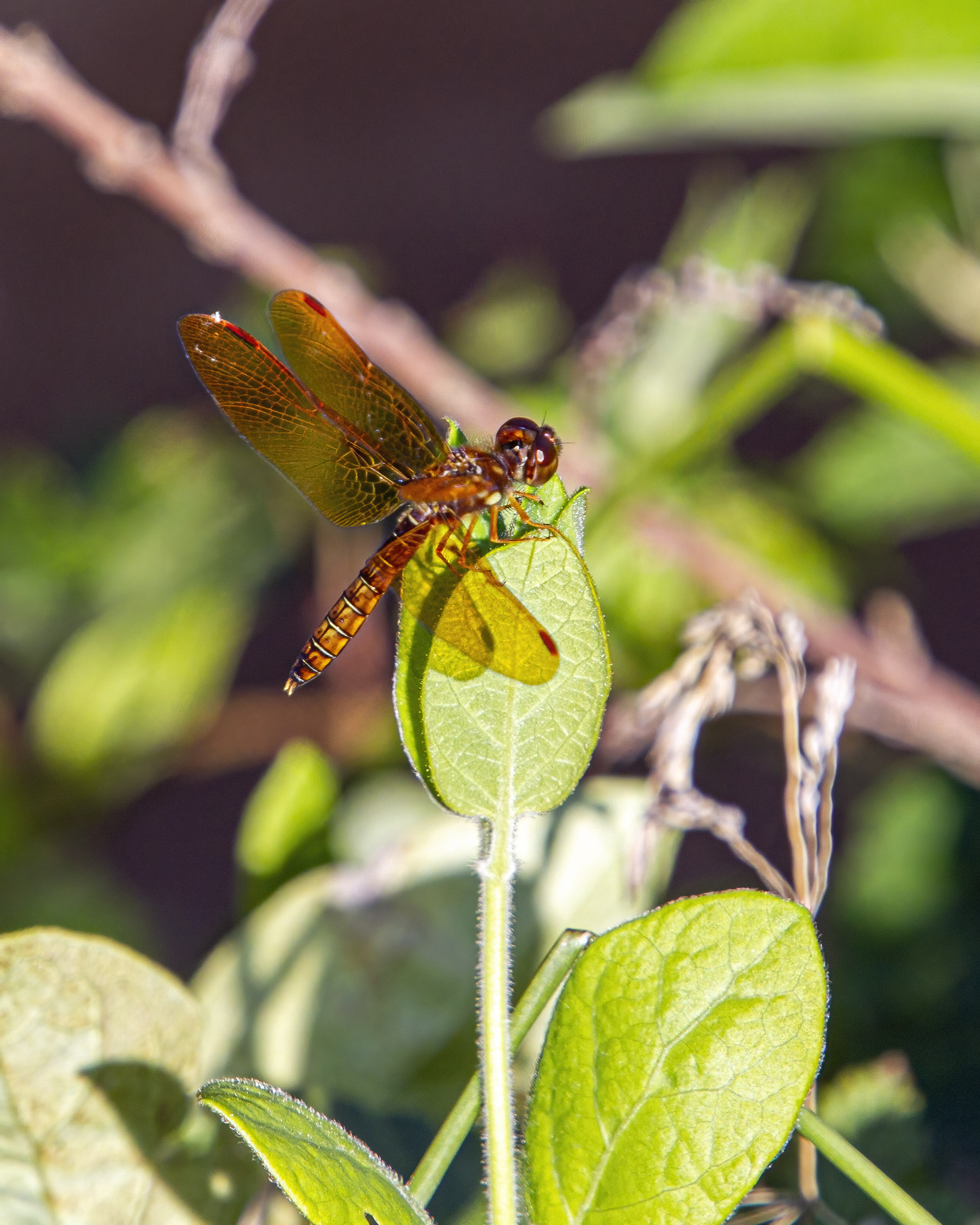
Most of the time when I spot Eastern Amberwing dragonflies (Perithemis tenera) they are busily flying about over the water, but this handsome little guy decided to rest a bit in the vegetation at the water’s edge on Thursday at Jackson Miles Abbott Wetland Refuge.
Most of the summer dragonflies have now arrived on the scene, so I may not be featuring any new species for a while. However, I am content to photograph my familiar “friends,” always hoping to capture them in different perches, activities, or lighting conditions. Each moment gives me a new chance to capture something beautiful and/or unusual. Beauty is everywhere.
© Michael Q. Powell. All rights reserved.
Posted in Dragonflies, dragonfly, Nature, Photography, spring, wildlife | Tagged Canon 7D, Eastern Amberwing, Eastern Amberwing dragonfly, Fort Belvoir VA, Jackson Miles Abbott Wetland Refuge, Perithemis tenera, Tamron 18-400mm | 3 Comments »
June 15, 2024 by Mike Powell
Slaty Skimmers (Libellula incesta) have now started to appear at Jackson Miles Abbott Wetland Refuge, signaling to me that summer is almost here. During the hottest months of the year, Slaty Skimmers are one of the commonly seen dragonfly species in my area, in part because they are habitat generalists—you can find them everywhere,
The greyish-blue bodies and dark eyes of the mature male Slaty Skimmers make them easy to identify. The immature members of this species, however, are a lot harder to identify, because they are similar in appearance to the young of several other species in the area. Fortunately for me, the Slaty Skimmers in these two photos, the first that I have photographed in 2024, are both mature males.


© Michael Q. Powell. All rights reserved.
Posted in Dragonflies, dragonfly, Insects, Nature, Photography, spring, wildlife | Tagged Canon 7D, Fort Belvoir VA, Jackson Miles Abbott Wetland Refuge, Libellula incesta, Slaty Skimmer, Slaty Skimmer dragonfly, Tamron 18-400mm | Leave a Comment »
June 14, 2024 by Mike Powell
When I spotted a dragonfly patrolling over the water of a small pond yesterday at Jackson Miles Abbott Wetland Refuge, I knew almost immediately that it was a Prince Baskettail dragonfly (Epitheca princeps). How could I tell? As it flew by, I could catch glimpses of the dark patches on its wings and the Prince Baskettail is the only large dragonfly with patterned wings in our area. (Prince Baskettails are almost three inches (76 mm) in length).
Seeing the dragonfly in flight was easy, but getting a clear shot of it was a considerable challenge. I watched the dragonfly and was able to determine its approximate patrol area. When it flew into that area, I attempted to track it, sometimes using my camera’s autofocus and sometimes focusing manually. Most of my shots were out of focus or did not include the dragonfly in the frame, but I managed to get a few decent shots, with the image below being the best of the lot.
Some of my fellow wildlife photographers marvel at images like this and think that high end gear or special techniques are necessary. The reality, though, is that I use relatively modest equipment and the “secret” to my success quite often is a combination of patience, practice, and persistence.

© Michael Q. Powell. All rights reserved.
Posted in Dragonflies, dragonfly, Insects, Nature, Photography, spring, wildlife | Tagged Canon 7D, dragonfly in flight, Epitheca princeps, Fort Belvoir VA, Jackson Miles Abbott Wetland Refuge, Prince Baskettail, Prince Baskettail dragonfly, Tamron 18-400mm | 5 Comments »
June 13, 2024 by Mike Powell
The poppies at Green Spring Gardens were well past their prime when I spotted them during a visit last week. Nonetheless I was drawn in by the shapes and colors of these cool flowers and captured some fun photos. The images have a kind of abstract feel to them that I really enjoy, a departure from my normal realistic style.
If you look closely at the final photo, you will notice that a bee really liked the flower too and was busily collecting pollen.


© Michael Q. Powell. All rights reserved
Posted in Bees, Flowers, Nature, Photography | Tagged Alexandria VA, Canon 7D, green spring gardens, poppies, poppy, poppy love, Tamron 18-400mm | 4 Comments »
June 12, 2024 by Mike Powell
Most people know that Monarch butterflies love milkweed, but if you move in closer to the plants, you’ll discover a world of fascinating little creatures, like this Red Milkweed Beetle (Tetraopes tetrophthalmus) that I spotted last week at Green Spring Gardens, a county-run historical garden not far from where I live.
I first encountered these little red beetles a dozen or so years ago and became a bit obsessed with them. I am not sure if it is their “longhorn” antennae or the bold pattern on their bodies or the bright color that attracts me most—I just know that I love seeing them in all of their developmental forms (they go through several interesting instars as they grow).
This milkweed beetle was crawling around a lot, so it was hard to get a shot of it. Fortunately, it stopped for a moment when it reached the end of the leaf and I was able to capture this simple environmental portrait..
The next time you see some milkweed, stop for a moment, examine it closely, and prepare to enter a fascinating little world as the scent of the flowers envelops you.

© Michael Q. Powell. All rights reserved
Posted in Insects, Nature, Photography, plants, spring, wildlife | Tagged Alexandria VA, Canon 7D, green spring gardens, milkweed, red milkweed beetle, Tamron 18-400mm, Tetraopes tetrophthalmus | 3 Comments »
June 11, 2024 by Mike Powell
I love photographing dragonflies as they perch on lotus flowers and lotus buds. Alas, the lotuses were not yet in bloom last week when I visited Green Spring Gardens, a nearby county-run garden that has a small pond with a few lotuses and water lilies.
Fortunately quite a few dragonflies were buzzing around the pond and I managed to capture this image of a male Blue Dasher dragonfly (Pachydiplax longipennis) as he perched on the tip of a rolled-up lotus leaf. I like the way that the texture of the leaf adds visual interest to the image, something that would be absent if the dragonfly had perched on a bare branch.
I will probably return to the gardens in a few weeks to see if I can get some shots of the lotuses when they are blooming. As I recall, lotuses seem to enjoy the hazy, hot, and humid days that are far too common during the summer in the Washington D.C. area.

© Michael Q. Powell. All rights reserved.
Posted in Dragonflies, dragonfly, Flowers, Nature, Photography, plants, spring, wildlife | Tagged Alexandria VA, Blue Dasher, Blue Dasher dragonfly, green spring gardens, lotus, lotus leaves, lotus pose, Pachydiplax longipennis | Leave a Comment »
June 10, 2024 by Mike Powell
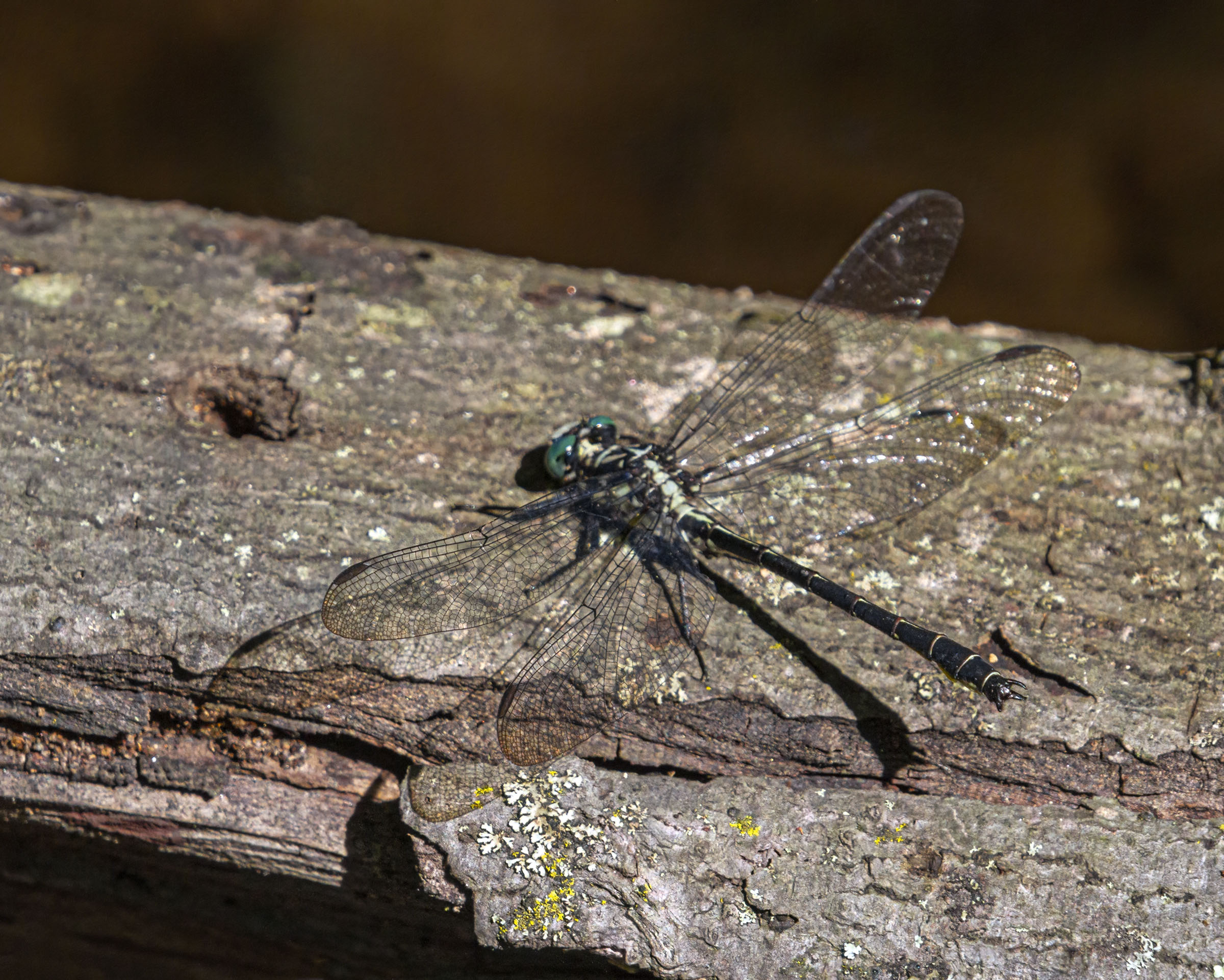
I love the stunning green eyes of this male Sable Clubtail dragonfly (Stenogomphurus rogersi) that I spotted last week while exploring a small stream in Fairfax County, Virginia. The eyes look like they are made out of malachite or some similar semi-precious stone.
Sable Clubtails are generally found only in very small numbers, have a short flight period, and require very specific habitats—this species prefers small, clean forest streams. There is only one location in my area where I have found this species in the past and some years I have not seen a single one. I was therefore really excited when I manage to get some shots of this somewhat uncommon dragonfly species last Monday.

© Michael Q. Powell. All rights reserved.
Posted in Dragonflies, dragonfly, Insects, Nature, Photography, spring, wildlife | Tagged Canon 7D, Fairfax County Virginia, Sable Clubtail, Sable Clubtail dragonfly, Stenogomphurus rogersi, Tamron 18-400mm | 4 Comments »
June 9, 2024 by Mike Powell
Do you believe in unicorns? I am always delighted when I manage to spot a Unicorn Clubtail (Arigomphus villosipes), a beautiful dragonfly species in which both sexes have a small hornlike projection between their eyes that gives rise to their common name—you can’t really see the “horn” in these photos, so you’ll have to take my word on it. I spotted the dragonfly in this posting while exploring a small pond in Fairfax County, where I live.
It is fairly easy to identify this species, because of the rusty-edged club at the bottom portion of the dragonfly’s abdomen and its very visible bright tip. Male Unicorn Clubtails tend to fly short patrols and perch quite often on low vegetation. It is not hard to spot them if I am in the appropriate environment, which is usually a pond or marsh, unlike most other clubtail dragonflies that prefer rivers and streams.
Chasing unicorns and dragons? That is how I enjoy spending my time in the wild.


© Michael Q. Powell. All rights reserved.
Posted in Dragonflies, dragonfly, Insects, Nature, Photography, spring, wildlife | Tagged Arigomphus villosipes, Canon 7D, chasing unicorns, Lorton VA, Occoquan Regional Park, Tamron 18-400mm, Unicorn Clubtail, Unicorn Clubtail dragonfly | 5 Comments »
June 8, 2024 by Mike Powell
When male Eastern Pondhawk dragonflies (Erythemis simplicicollis) are very young, they have green bodies with dark banding on the abdomen, just like their female counterparts. Over time male Eastern Pondhawks are gradually transformed into a duller shade of blue and finally a powdery bluish-grey.
From an aesthetic point of view, my favorite stage of development is when they are young males and their thoraxes are a beautiful shade of green that contrasts wonderfully with their blue abdomens. Eastern Pondhawks of both genders have cool-looking green faces that help to distinguish them immediately from other dragonfly species.
I spotted this Eastern Pondhawk during a recent visit to Jackson Miles Abbott Wetland Refuge, a small refuge that belongs to a nearby military installation. It is not a contiguous part of that installation, however, and is open to the public. The composition of this shot is quite simple, but I like the way that the Y-shape of the forked branch helps to divide up the frame and lead the viewer’s eyes to the main subject.

© Michael Q. Powell. All rights reserved.
Posted in Dragonflies, dragonfly, Insects, Nature, Photography, spring, wildlife | Tagged Canon 7D, Eastern Pondhawk, Eastern Pondhawk dragonfly, Erythemis simplicicollis, Fort Belvoir VA, Jackson Miles Abbott Wetland Refuge, male Eastern Pondhawk, Tamron 18-400mm | 6 Comments »
June 7, 2024 by Mike Powell
On Monday I photographed this female Widow Skimmer dragonfly (Libellula luctuosa) at Occoquan Regional Park, my first sighting of this species in 2024. Why is it called a “Widow Skimmer?” Someone apparently thought the dark patches on the wings of this species looked like the mourning crepe that historically widows wore and even a portion of its Latin name “luctuosa” means “sorrowful.”
The dark wing patches are quite distinctive and may it relatively easy to identify this species. The males of the species, which I did not see at all that day, have patches of white in addition to the same dark wing patches of the female and their bodies are blue in color when they are mature. Click on this link to see some photos of a male Widow Skimmer from a few years ago.

© Michael Q. Powell. All rights reserved.
Posted in Dragonflies, dragonfly, Insects, Nature, Photography, spring, wildlife | Tagged Canon 7D, female Widow Skimmer, Libellula luctuosa, Lorton VA, Occoquan Regional Park, Tamron 18-400mm, Widow Skimmer, Widow Skimmer dragonfly | 3 Comments »
June 6, 2024 by Mike Powell
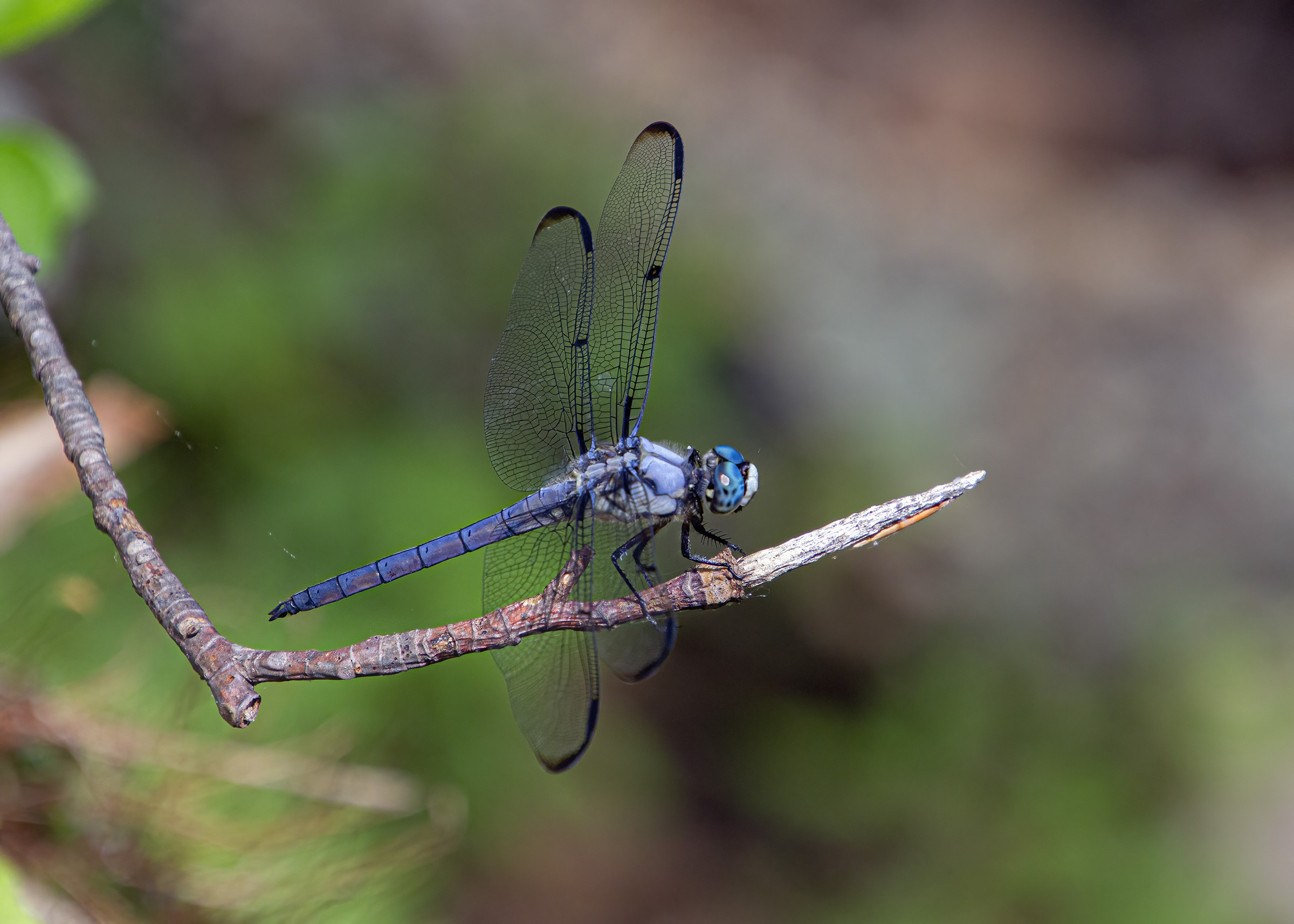
On Monday I played a little game of peekaboo with this Great Blue Skimmer (Libellula vibrans) dragonfly at Occoquan Regional Park. As I approached, the dragonfly hunkered down and was almost hidden from view. I stopped and waited and eventually the Great Blue Skimmer lifted its head, looked right at me, and appeared to smile.
The second shot provides a more traditional view of this species, highlighting its beautiful speckled eyes and white face that help in distinguishing it from other blue dragonflies in our area. Great Blue Skimmers are quite common in my area during the summer, but this was one of first ones that I spotted this year.

© Michael Q. Powell. All rights reserved.
Posted in Dragonflies, dragonfly, Nature, Photography, Portraits, spring, wildlife | Tagged Canon 7D, Great Blue Skimmer, Great Blue Skimmer dragonfly, Libellula vibrans, Lorton VA, Occoquan Regional Park, Tamron 18-400mm | Leave a Comment »
June 5, 2024 by Mike Powell
This Gray Petaltail dragonfly (Tachopteryx thoreyi) looked like it was trying to climb a small tree when I spotted it from a distance on Monday at Occoquan Regional Park in Lorton, Virginia. I was happy to be able to capture this shot from the side, because when Gray Petaltails perch flat against a tree, they become virtually invisible—their black and gray coloration causes them to blend in perfectly with the rough bark of a tree.

© Michael Q. Powell. All rights reserved.
Posted in Dragonflies, dragonfly, Insects, Nature, Photography, spring, wildlife | Tagged Canon 7D, Gray Petaltail, Gray Petaltail dragonfly, Lorton VA, Occoquan Regional Park, Tachopteryx thoreyi, Tamron 18-400mm, tree climber | 3 Comments »
June 4, 2024 by Mike Powell
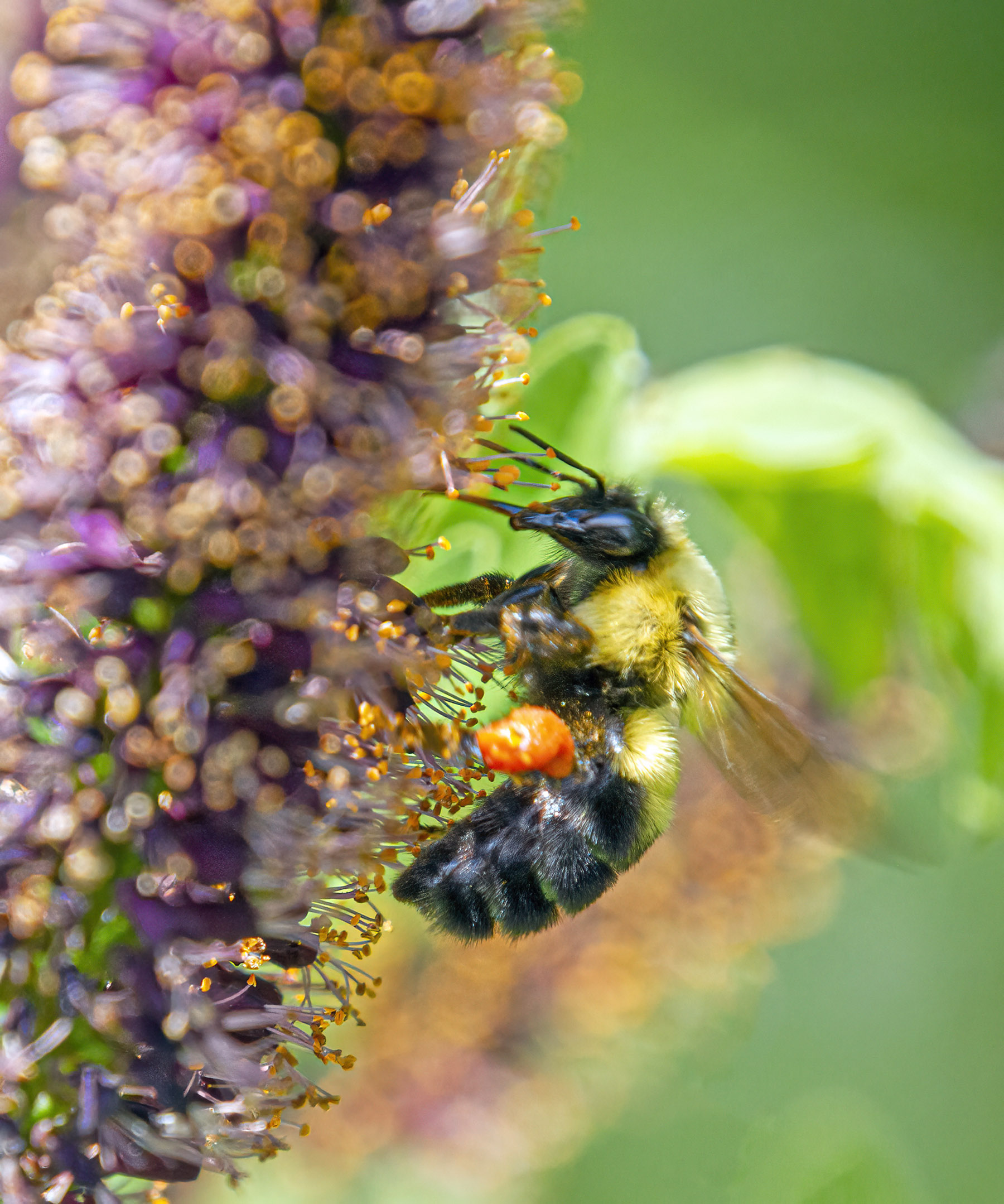
This bumble bee was busily filling its pollen sacs and sucking up nectar when I spotted it recently during a visit to Occoquan Bay National Wildlife Refuge. I cannot identify the plant on which the bee was feeding, but I love its beautiful colors and the blurry bokeh balls that were created in the out-of-focus areas of the plant.
As many of you know, when you move in close to a subject, the depth of field becomes really narrow, which means that only certain elements will be in sharp focus. My goal as a photographer is to try to make sure that the most critical areas, which usually include the eyes of the subject, are in focus. In this case, I was delighted that both the eye and the extended proboscis are relatively sharp.
© Michael Q. Powell. All rights reserved.
Posted in Bees, Insects, Nature, Photography, spring, wildlife | Tagged bumble bee, bumblebee, Canon 7D, gathering pollen, Occoquan Bay National Wildlife Refuge, pollen, pollen sacs, Tamron 18-400mm, Woodbridge VA | 3 Comments »
June 3, 2024 by Mike Powell
Dragonfly identification can sometimes be quite difficult—many species, and especially the females of the species, are similar in color and in markings. There are, for example, quite a few blue male dragonflies with females that are yellow and brown, like these Spangled Skimmers (Libellula cyanea) that I spotted last week at Occoquan Regional Park.
Fortunately, however, this dragonfly is quite easy to identify because of its unique black and white stigmata, the spots on the outer leading edge of each wing. As far as I know, no other dragonfly in our area has bicolor stigmata. The stigmata are not there for decoration, but serve an important role in the flight of dragonflies. I do not really understand the physics of flight, but have read that the stigmata are heavier than the adjoining cells and help to stabilize the vibrations of the wings.
Now that we are into June, I have noticed that most of the summer dragonflies have appeared on the scene. There are a few that I have not yet spotted, but with a little luck I will see (and photograph) them soon.


© Michael Q. Powell. All rights reserved.
Posted in Dragonflies, dragonfly, Insects, Nature, Photography, spring, wildlife | Tagged Canon 7D, Libellula cyanea, Lorton VA, Occoquan Regional Park, Spangled Skimmer, Spangled Skimmer dragonfly, Tamron 18-400mm | 5 Comments »
June 2, 2024 by Mike Powell
Male dragonflies can be quite aggressive in fighting off potential rivals, but they seem somewhat more tolerant of males from a different species. This past Wednesday I spotted two dragonflies peacefully coexisting and sharing a perch at Occoquan Regional Park.
The dragonfly perched near the top of the branch is a male Spangled Skimmer (Libellula cyanea) and the one perched a bit lower is a male Common Whitetail (Plathemis lydia). I have already seen quite a few Common Whitetails this season, but this Spangled Skimmer was one of the first that I have spotted this yea.

© Michael Q. Powell. All rights reserved.
Posted in Dragonflies, dragonfly, Insects, Nature, Photography, spring, wildlife | Tagged Canon 7D, Common Whitetail, Common Whitetail dragonfly, Libellula cyanea, Lorton VA, Occoquan Regional Park, Plathemis lydia, Spangled Skimmer, Spangled Skimmer dragonfly, Tamron 18-400mm | Leave a Comment »
June 1, 2024 by Mike Powell
I was delighted this week to spot my first Ebony Jewelwing damselflies (Calopteryx maculata) of the season while I was exploring at Occoquan Regional Park. Members of this species have distinctive dark wings and are generally found in shaded forest streams where the mixed lighting makes it challenging to photograph them.
When things work out, though, I can sometimes get a good shot of one, like this dramatic portrait of a female perched on a sunlit piece of vegetation. Only females have the little white patches (known as pseudostigmas) on their wings that along with their terminal appendages make them easy to identify.

© Michael Q. Powell. All rights reserved.
Posted in damselfly, Insects, Nature, Photography, spring, wildlife | Tagged Calopteryx maculata, Canon 7D, Ebony Jewelwing, Ebony Jewelwing damselfly, female Ebony Jewelwing, Lorton VA, Occoquan Regional Park, Tamron 18-400mm | 3 Comments »
May 31, 2024 by Mike Powell
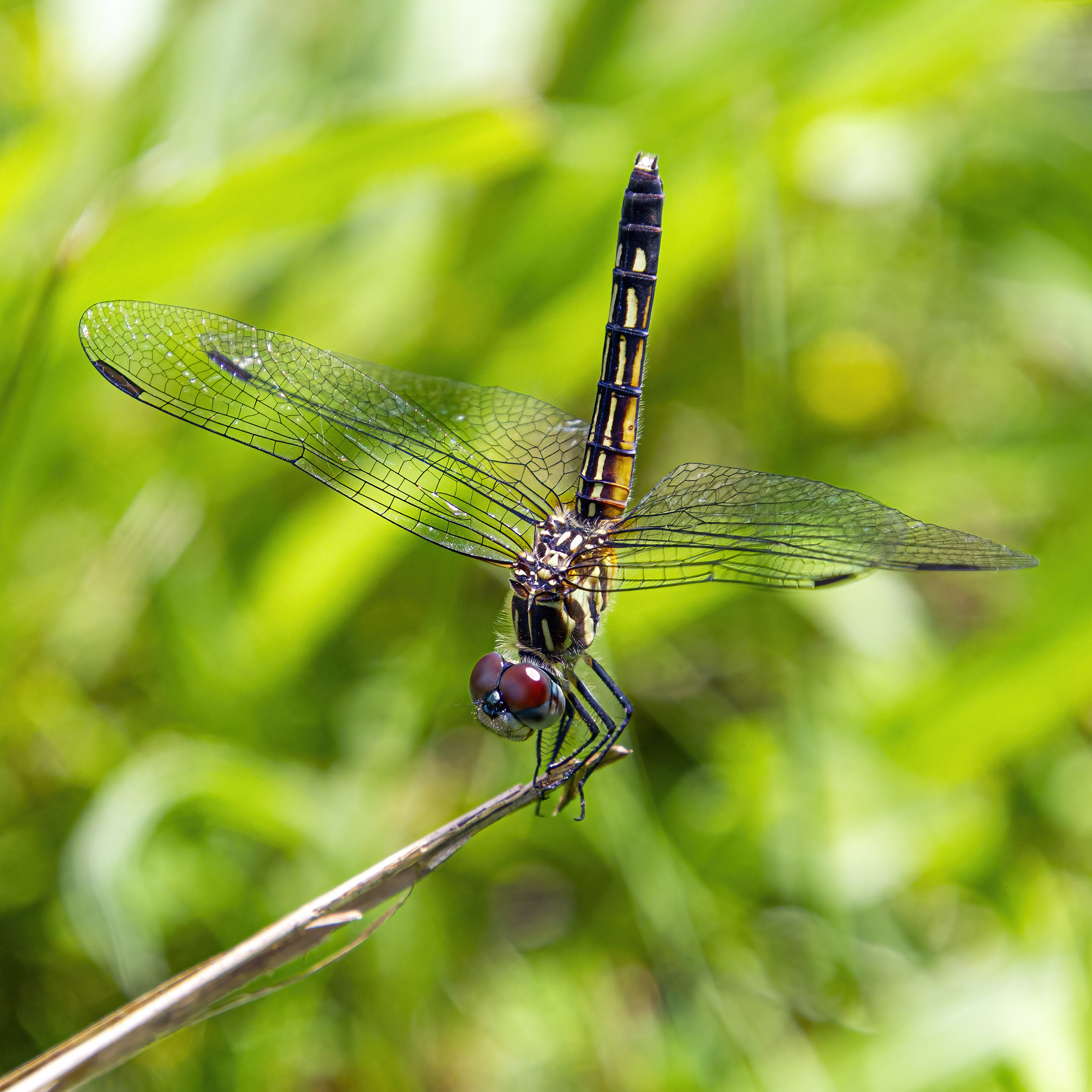
I know that summer is almost here when I start to see Blue Dasher dragonflies (Pachydiplax longipennis) at my local ponds and they will some become our the most abundant dragonfly species in our area. Mature Male Blue Dashers are blue, as their name suggests, but females have a black and yellow pattern on their abdomens, like the one pictured below that I photographed on Tuesday at Jackson Mile Abbott Wetland Refuge.
Quite often Blue Dashers perch on vegetation in the “obelisk” pose, with their abdomens raised up into an almost vertical position. It is thought that this pose is a type of thermoregulation, with the raised abdomen reducing the amount of exposure to the direct sunlight and thereby keeping the dragonfly’s body a bit cooler.
Blue Dashers are sentimentally special to me because my very first posting on this blog on July 7, 2012 featured a male Blue Dasher dragonfly in an obelisk pose. In case you are curious, here is a link to that posting that was simply entitled Blue Dasher dragonfly.
© Michael Q. Powell. All rights reserved.
Posted in Dragonflies, dragonfly, Insects, Nature, Photography, spring, wildlife | Tagged Blue Dasher, Blue Dasher dragonfly, Canon 7D, female Blue Dasher, Fort Belvoir VA, Jackson Miles Abbott Wetland Refuge, obelisk pose, Pachydiplax longipennis, Tamron 18-400mm | 2 Comments »
May 30, 2024 by Mike Powell
Whenever I visit Jackson Miles Abbott Wetland Refuge, I never fail to check a spot near a fishing platform where there is a piece of twisted rebar sticking out of the water. In the past, I have seen dragonflies of various species perching on the rebar and it provides a wonderful photographic opportunity, assuming that the dragonfly does not immediately fly away. I generally prefer to photograph dragonflies on natural perches, not on manmade ones, but this is a case when I am more than happy to break that “rule.”
On Tuesday I was delighted to spot a male Eastern Amberwing dragonfly (Perithemis tenera) perched on the aforementioned piece of rebar. I love the contrast between the colors, patterns, and textures of the natural object, the dragonfly, and those of the man-made subject, the rebar. The floating debris on the surface of the pond helps to break up the mostly uniform background without being visually distracting.
I have taken similar shots to this one multiple times, but I don’t mind repeating myself. Each encounter is unique and subtly different. As the Greek philosopher Heraclitus of Ephesus is reported to have said, “No man ever steps in the same river twice, for it is not the same river and he is not the same man.”

© Michael Q. Powell. All rights reserved.
Posted in Art, Dragonflies, dragonfly, Nature, Photography, spring, wildlife | Tagged Canon 7D, Eastern Amberwing, Eastern Amberwing dragonfly, Fort Belvoir VA, Heraclitus of Ephesus, Jackson Miles Abbott Wetland Refuge, male Eastern Amberwing, Perithemis tenera, rebar, Tamron 18-400mm | Leave a Comment »
May 29, 2024 by Mike Powell
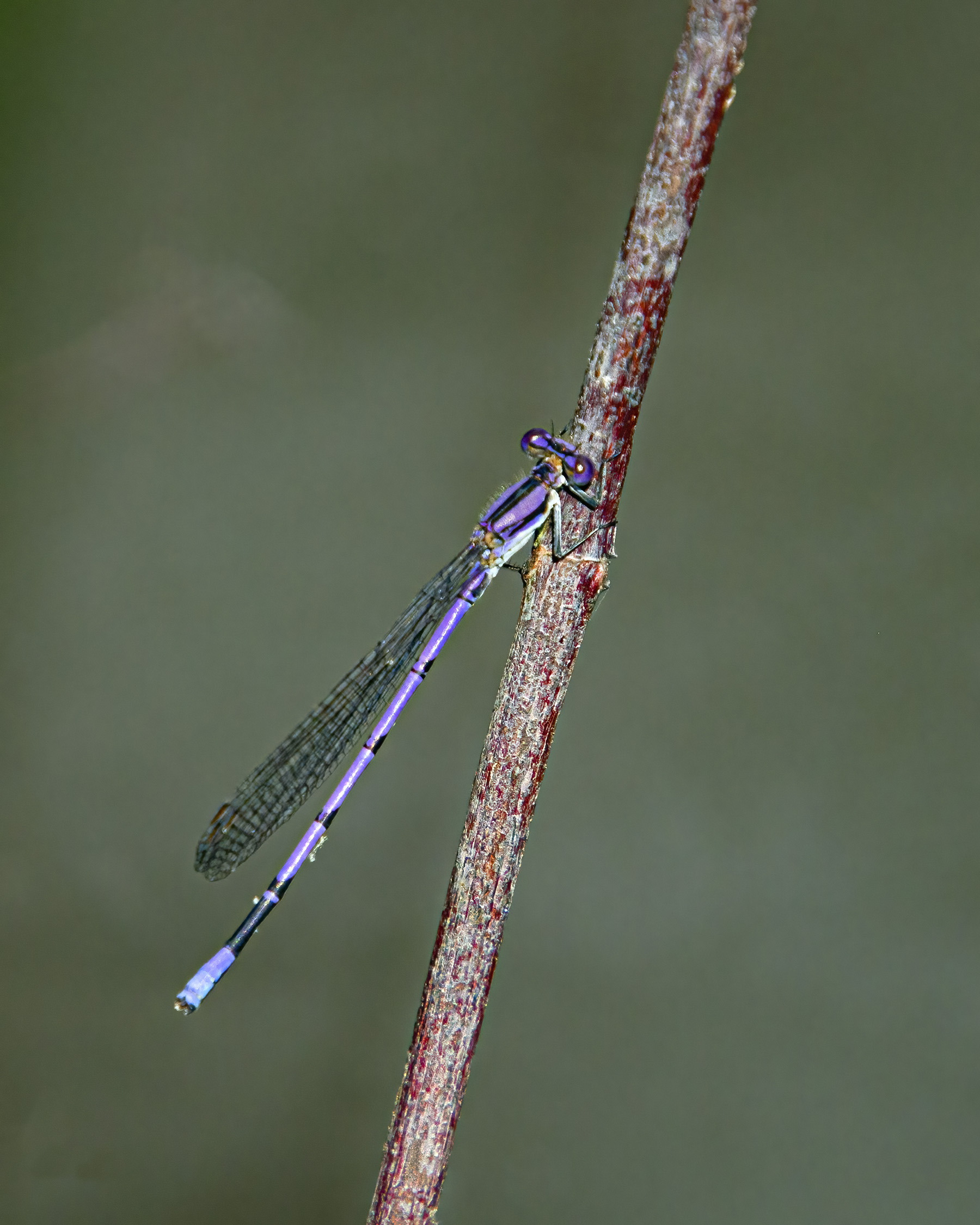
Yesterday at Jackson Miles Abbott Wetland Refuge I spotted some Variable Dancer damselflies (Argia fumipennis), one of my favorite damselfly species. I never fail to be shocked and delighted by the brilliant purple of eyes and body of the male of the subspecies known as the Violet Dancer (Argia fumipennis violacea). Some of you may have even noticed that I have used an image of a Violet Dancer as the banner image for the home page of my blog for a number of years.
Dancers are a genus of damselflies named for the distinctive jerky form of flight they use which contrasts with the straightforward direct flight of many other pond damselflies. I must confess that I don’t pay much attention to the way that particular damselflies fly, but instead rely primarily on their coloration to identify them,
© Michael Q. Powell. All rights reserved.
Posted in damselfly, Macro Photography, Nature, Photography, spring, wildlife | Tagged Argia fumipennis, Argia fumipennis violacea, Canon 7D, Fort Belvoir VA, Jackson Miles Abbott Wetland Refuge, Tamron 18-400mm, Variable Dancer, Variable Dancer damselfly, Violet Dancer | 8 Comments »
May 28, 2024 by Mike Powell
I love the light and delicate pose of this handsome male Calico Pennant dragonfly (Celithemis elisa) that I spotted during a recent visit to Occoquan Bay National Wildlife Refuge. Pennant dragonflies, like the Calico Pennant, usually perch on the very tips of vegetation where they sway in the slightest breeze—like a pennant.
The red of the dragonfly’s body and the green of the vegetation help the dragonfly to “pop,” because red and green are complementary colors, i.e. they are directly opposite each other on the traditional color wheel that artists use.

© Michael Q. Powell. All rights reserved.
Posted in Dragonflies, dragonfly, Insects, Nature, Photography, spring, wildlife | Tagged Calico Pennant, Calico Pennant dragonfly, Canon 7D, Celithemis elisa, male Calico Pennant, Occoquan Bay National Wildlife Refuge, Tamron 18-400mm, Woodbridge VA | 3 Comments »
May 27, 2024 by Mike Powell
Today in the United States we are commemorating Memorial Day, a day set aside to honor, mourn, and remember those who died while serving our country, especially in the armed forces. As some of you know, I spent 20 years in the U.S. Army and I personally feel a sense of gratitude to those who gave what Lincoln so poignantly called “the last full measure of devotion” in his address at Gettysburg in 1863. He challenged his listeners and continues to challenge us with these words, “It is for us the living, rather, to be dedicated here to the unfinished work which they who fought here have thus far so nobly advanced.”
A little over a week ago I spent the weekend at a retreat at Shrine Mont in Orkney Springs, Virginia with a group from my church, St. Martin de Porres Episcopal Church. I was mostly unplugged all weekend in order to be more fully engaged with others and with the beautiful mountain setting. With my iPhone, though, I captured these images that give you a small sense of the beauty and serenity of Shrine Mont, including the outdoor cathedral that I visited each day in the early morning hours and at which we celebrated Pentecost Sunday with several other churches. Repeatedly throughout the weekend, I was captured by a sense of introspection and contemplation.
The third photo shows an extract from The Sermon to the Birds attributed to St. Francis of Assisi. Here is the full text, “My little sisters, the birds, much bounden are ye unto God, your creator, and always in every place ought ye to praise him, for that he hath given you liberty to fly about everywhere, and hath also given you double and triple raiment; moreover he preserved your seed in the ark of Noah, that your race might not perish out of the world; still more are ye beholden to him for the element of the air which he hath appointed for you; beyond all this, ye sow not, neither do you reap; and God feedeth you, and giveth you the streams and fountains for your drink; the mountains and valleys for your refuge and the high trees whereon to make your nests; and because ye know not how to spin or sow, God clotheth you, you and your children; wherefore your creator loveth you much, seeing that he hath bestowed on you so many benefits; and therefore, my little sisters, beware of the sin of ingratitude, and study always to give praises unto God.”
Today is a day set aside for us be thankful, an attitude which I believe we should cultivate every day and not just on special holidays. I can’t help but think of the Bible verses (Thessalonians 5:16-18) that say, “Rejoice always, pray continually, and give thanks in all circumstances.” Not long ago I heard a sermon that has prompted me to look at that verse in a new way—the pastor reminded us that the verse says to give thanks in all circumstances, not for all circumstances. We definitely cannot control our circumstances, no matter how hard we try, but we can control our response to those circumstances.


© Michael Q. Powell. All rights reserved.
Posted in Architecture, commentary, Nature, Photography | Tagged Gettysburg Address, iPhone 11, Memorial Day 2024, Orkney Springs VA, Saint Francis of Assisi, Shrine Mont, Shrine Mont Retreat Center | 8 Comments »
May 26, 2024 by Mike Powell
I haven’t seen any Monarch butterflies yet this season, but I did spot this similar-looking Viceroy butterfly last week at Occoquan Bay National Wildlife Refuge. Viceroy butterflies are generally much smaller than Monarchs, so I can often tell them apart from a distance. When I get closer though, the most obvious distinguishing feature is that Viceroys nave a thin black line across their hind wings that Monarchs do not have.

© Michael Q. Powell. All rights reserved.
Posted in Butterflies, Insects, Nature, Photography, spring, wildlife | Tagged Canon 7D, Limenitis archippus, Occoquan Bay National Wildlife Refuge, Tamron 18-400mm, Viceroy, Viceroy butterfly, Woodbridge VA | 2 Comments »
« Newer Posts - Older Posts »


Memorial Day 2024
May 27, 2024 by Mike Powell
Today in the United States we are commemorating Memorial Day, a day set aside to honor, mourn, and remember those who died while serving our country, especially in the armed forces. As some of you know, I spent 20 years in the U.S. Army and I personally feel a sense of gratitude to those who gave what Lincoln so poignantly called “the last full measure of devotion” in his address at Gettysburg in 1863. He challenged his listeners and continues to challenge us with these words, “It is for us the living, rather, to be dedicated here to the unfinished work which they who fought here have thus far so nobly advanced.”
A little over a week ago I spent the weekend at a retreat at Shrine Mont in Orkney Springs, Virginia with a group from my church, St. Martin de Porres Episcopal Church. I was mostly unplugged all weekend in order to be more fully engaged with others and with the beautiful mountain setting. With my iPhone, though, I captured these images that give you a small sense of the beauty and serenity of Shrine Mont, including the outdoor cathedral that I visited each day in the early morning hours and at which we celebrated Pentecost Sunday with several other churches. Repeatedly throughout the weekend, I was captured by a sense of introspection and contemplation.
The third photo shows an extract from The Sermon to the Birds attributed to St. Francis of Assisi. Here is the full text, “My little sisters, the birds, much bounden are ye unto God, your creator, and always in every place ought ye to praise him, for that he hath given you liberty to fly about everywhere, and hath also given you double and triple raiment; moreover he preserved your seed in the ark of Noah, that your race might not perish out of the world; still more are ye beholden to him for the element of the air which he hath appointed for you; beyond all this, ye sow not, neither do you reap; and God feedeth you, and giveth you the streams and fountains for your drink; the mountains and valleys for your refuge and the high trees whereon to make your nests; and because ye know not how to spin or sow, God clotheth you, you and your children; wherefore your creator loveth you much, seeing that he hath bestowed on you so many benefits; and therefore, my little sisters, beware of the sin of ingratitude, and study always to give praises unto God.”
Today is a day set aside for us be thankful, an attitude which I believe we should cultivate every day and not just on special holidays. I can’t help but think of the Bible verses (Thessalonians 5:16-18) that say, “Rejoice always, pray continually, and give thanks in all circumstances.” Not long ago I heard a sermon that has prompted me to look at that verse in a new way—the pastor reminded us that the verse says to give thanks in all circumstances, not for all circumstances. We definitely cannot control our circumstances, no matter how hard we try, but we can control our response to those circumstances.
© Michael Q. Powell. All rights reserved.
Share this:
Posted in Architecture, commentary, Nature, Photography | Tagged Gettysburg Address, iPhone 11, Memorial Day 2024, Orkney Springs VA, Saint Francis of Assisi, Shrine Mont, Shrine Mont Retreat Center | 8 Comments »