Feeds:
Posts
Comments

Archive for the ‘wildlife’ Category

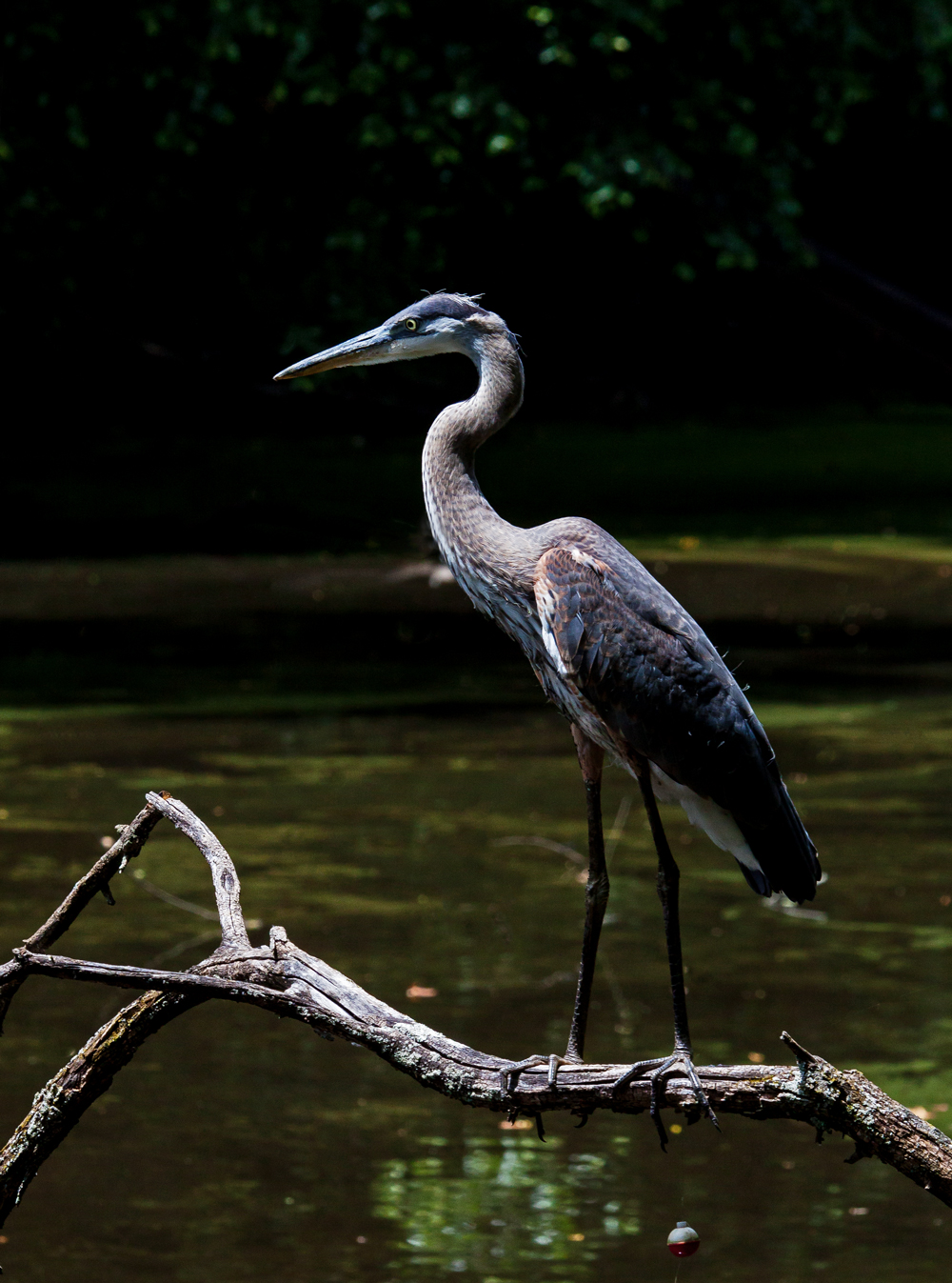
A Great Egret (Ardea alba) and a Great Blue Heron (Ardea herodias) started goofing around yesterday at Huntley Meadows Park when I was trying to take their photo together—I think they are great friends. They looked like they were posing for a selfie.

I cropped the image to a square to make it easier for them to post to their Instagram pages.

great friends


© Michael Q. Powell. All rights reserved.

Read Full Post »

A Green Heron (Butorides virescens) was perched this morning on the raised edge of the boardwalk at Huntley Meadows Park, peering down into the murky water. Apparently the heron didn’t like what it saw, for it turned abruptly and decided to cross the boardwalk. I captured this shot as the heron was taking its first tentative step in the new direction.

Green Heron

© Michael Q. Powell. All rights reserved.

Read Full Post »

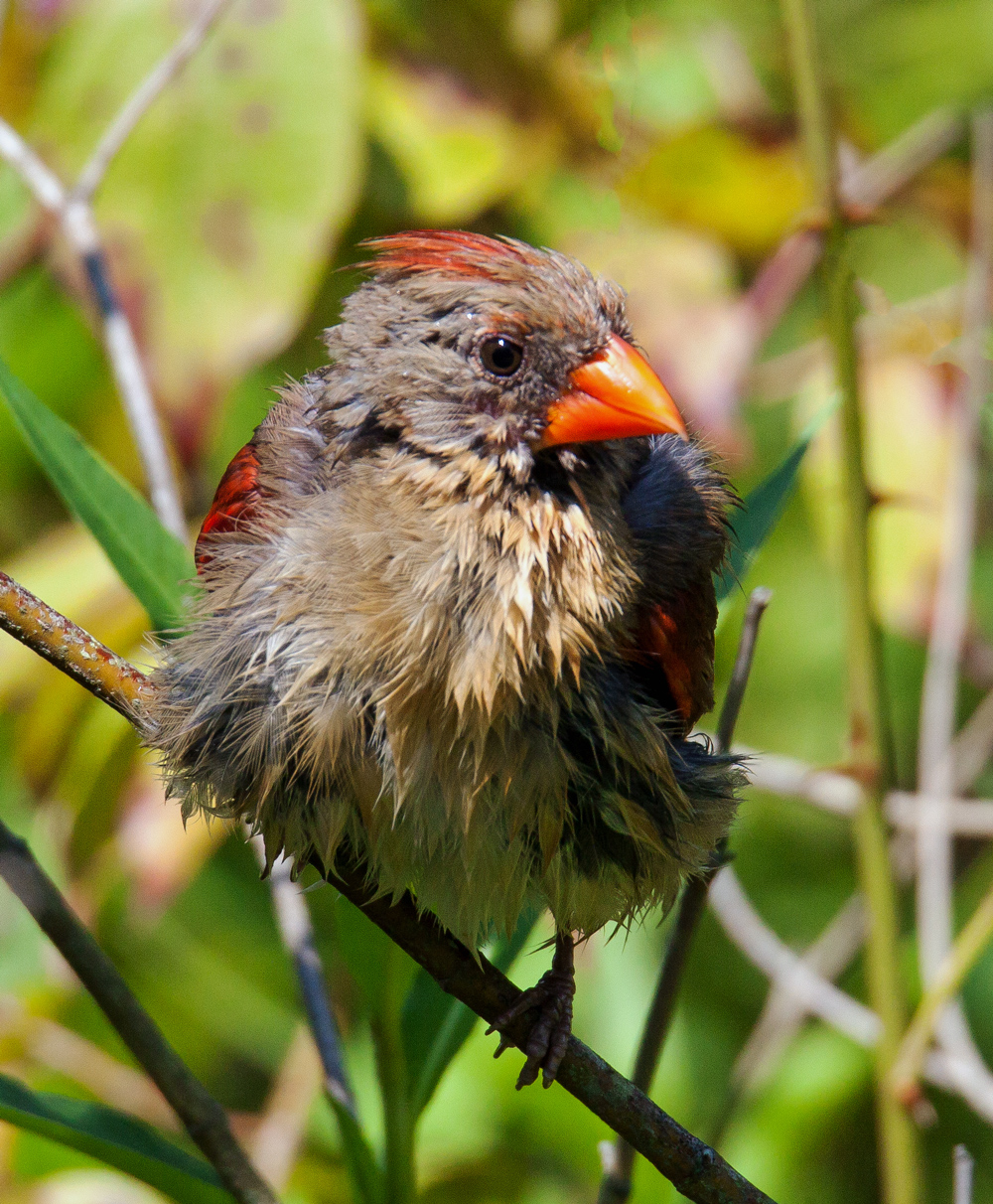
How do birds manage to survive the unbearable heat of summer? Monday, on a day when temperatures soared to 100 degrees (38 degrees C), I spotted this Northern Cardinal (Cardinalis cardinalis) at Huntley Meadows Park. It was sitting in the shade and looked like it had fluffed up its feathers or was drying off after a dip in the pond in an effort to stay cool.

I was the crazy one standing in the sun.

Northern Cardinal

Northern Cardinal

© Michael Q. Powell. All rights reserved.

Read Full Post »

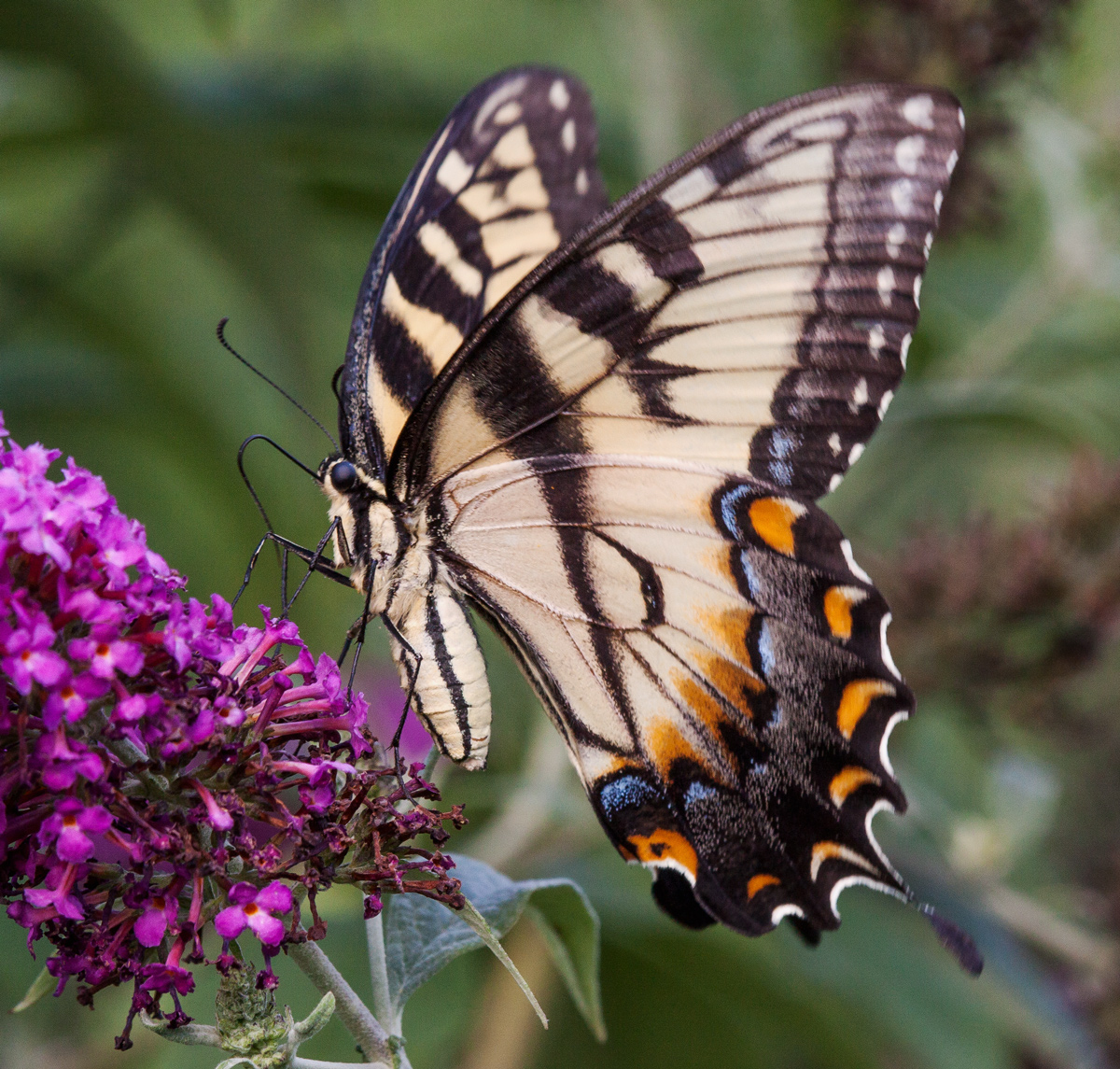
Some folks are really into chasing imaginary creatures with their cellphones. I prefer to chase living creatures with my camera and captured this image of a beautiful Eastern Tiger Swallowtail butterfly (Papilio glaucus) yesterday as it was feeding at Green Spring Gardens, a county-run historic garden in Northern Virginia.

The butterfly gave me multiple opportunities to get shots as it flew around a small area of the gardens, but it rarely gave me an obstructed view. Often it was partially buried in the flowers or turned away from me at an angle. When I took this shot, the butterfly had opened its wings and offered me a rare look at its body as well as its amazingly long proboscis.

Eastern Tiger Swallowtail

© Michael Q. Powell. All rights reserved.


Read Full Post »

What do you want to be when you grow up? I wonder if these ducklings were dreaming of growing to be as big as a Great Blue Heron (Ardea herodias) when they swam toward its reflection yesterday at Huntley Meadows Park.

growing up

© Michael Q. Powell. All rights reserved.

Read Full Post »

Yesterday I spotted this spectacular female Swamp Darner dragonfly (Epiaeschna heros) at Huntley Meadows Park. At almost 3 1/2 inches long (90 mm), Swamp Darners are one of the largest dragonflies in our area.

It was a rare treat for me to capture shots of one perching—usually I see them only in flight. Like most darners, Swamp Darners hand vertically from vegetation, often low to the ground. I was fortunate to see this beautiful dragonfly fly to the perch and it remained there long enough for me to maneuver into position for a clear shot with my long zoom lens. I actually had to pull back from the maximum 600mm focal length of the lens in order to be able to fit the dragonfly’s entire body in the frame.

If you want to get a higher-resolution look at some of the wonderful details of this dragonfly, including the amazing colors of its eyes, be sure to click on the image.

Swamp Darner

© Michael Q. Powell. All rights reserved.

Read Full Post »

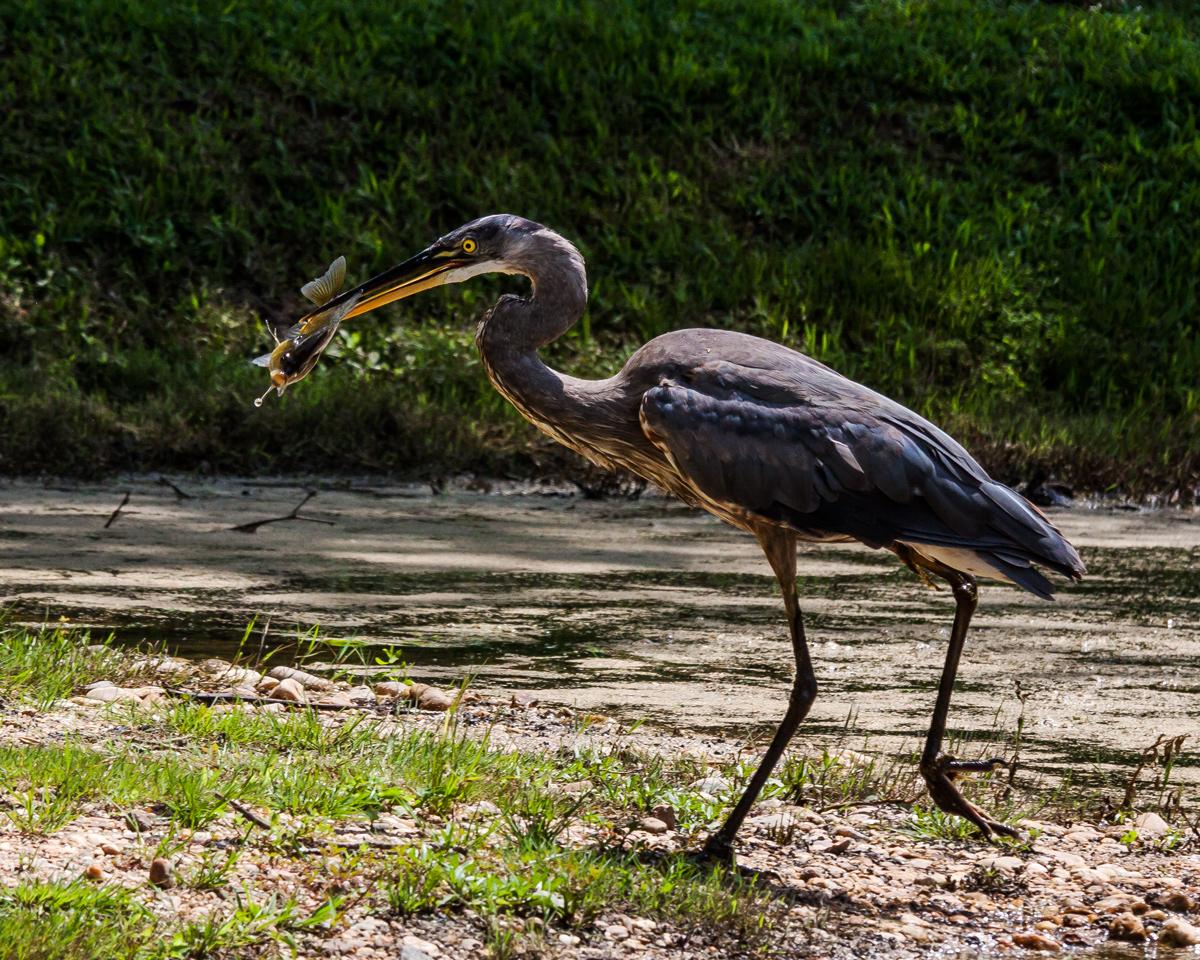
How many large fish can there possibly be in the tiny man-made pond at Green Spring Gardens? That was my initial thought when I stumbled upon a Great Blue Heron (Ardea herodias) intently focused on the water at one end of the pond. I crept as close as I could, acutely aware that I had a non-zooming macro lens on my camera, and watched and waited.

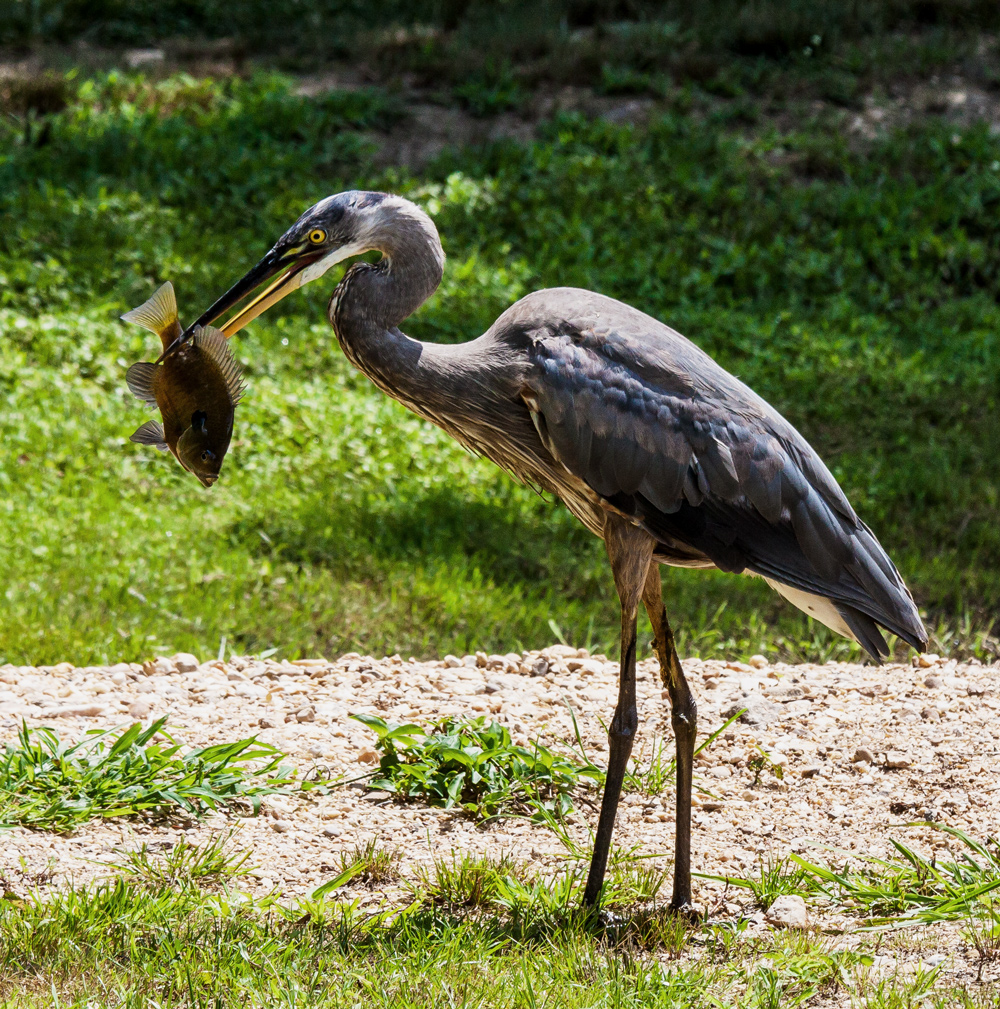
I was somewhat surprised when the heron finally made a strike and was amazed when it pulled out a large fish. Almost immediately, the heron headed for dry land, probably fearing that it might drop the fish into the water. Playing it safe proved to be a good choice for the heron subsequently did drop the fish onto the ground. I am not sure if it was an accidental drop or if it was an intentional maneuver to grab the fish, but the heron had no trouble retrieving the fish.

It took a little while for the heron to position the fish, but once the fish was in place, the heron swallowed the fish in a single gulp. The heron then stretched out its neck and I could almost watch as the fish made its way down the neck and into the heron’s stomach.

Great Blue Heron

Pulling the fish out of the water

Great Blue Heron

Heading for dry land

Great Blue Heron

Initial positioning

Great Blue Heron

Dropped fish

Great Blue Heron

The end is near

Great Blue Heron

Trying to swallow

© Michael Q. Powell. All rights reserved.


Read Full Post »

Early yesterday morning, an immature Little Blue Heron (Egretta caerulea) flew up to the top of a nearby tree as I slowly approached it on the boardwalk at Huntley Meadows Park. From its elevated perch, the beautiful little bird seemed to be surveying the landscape, contemplating the start of a new day.

At this time of the year there are quite a few large white wading birds at my favorite marshland park. I think that most of them are Great Egrets (Ardea alba), but the coloration and shape of the bill of the bird in this photo suggest to me that this is a Little Blue Heron. When Little Blue Herons are mature, they are a dark grayish blue and would never be mistaken for Great Egrets, but when they are young, the feathers of a Little Blue Heron are all white.

Little Blue Heron

© Michael Q. Powell. All rights reserved.

Read Full Post »

I should probably be able to remember my own anniversary, but I am a guy. Therefore I was caught a bit by surprise yesterday evening when WordPress notified me that it was the fourth anniversary of the start of my blog. Where has the time gone?

Blogging has become part of my daily life since I first started. I never suspected that I would get such joy and satisfaction from exploring my creativity in words and in photos and from sharing that journey with the wonderful folks that I have encountered through the blog. Thanks to all of you for your support, encouragement, and helpful tips. I sometimes like to say that I write this blog primarily for me, but I know that is not entirely true—I write it for all of you too. My photography mentor, Cindy Dyer, deserves special thanks. She helped me to start the blog and has been a continuous source of inspiration for me.

WordPress statistics indicate that I have made 2030 postings (which includes a dozen or more repostings of  posts written by friends) and have had 110749 views from well over 100 countries. Statistics are only a relative measure of success and I know that my best postings and my best photos are not necessarily the ones that have had the most views.

Over the past four years my skill and my confidence with my camera have grown. I now consider myself a photographer, albeit not a professional. My interests have expanded and my winters are now spent chasing birds, something I never imagined that I would find interesting. My fascination with dragonflies has remained constant and I have learned a lot about them. I think it is altogether appropriate to reprise today the short text and photo from my first posting

Text of my first posting in WordPress on July 7, 2012:

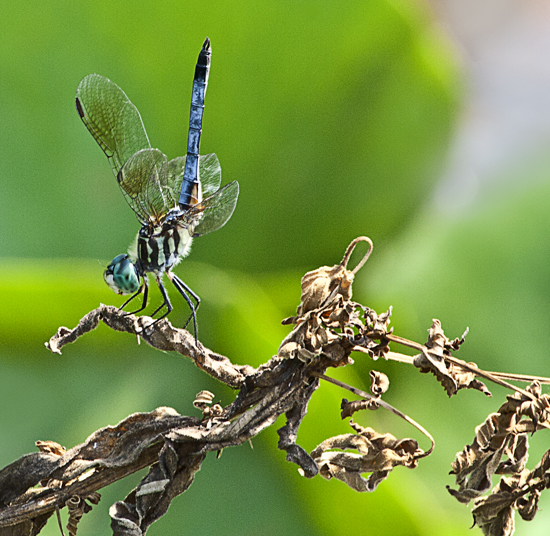
I photographed this Blue Dasher dragonfly (Pachydiplax longipennis) at Kenilworth Aquatic Gardens this morning.

© Michael Q. Powell. All rights reserved.


Blue Dasher

Read Full Post »

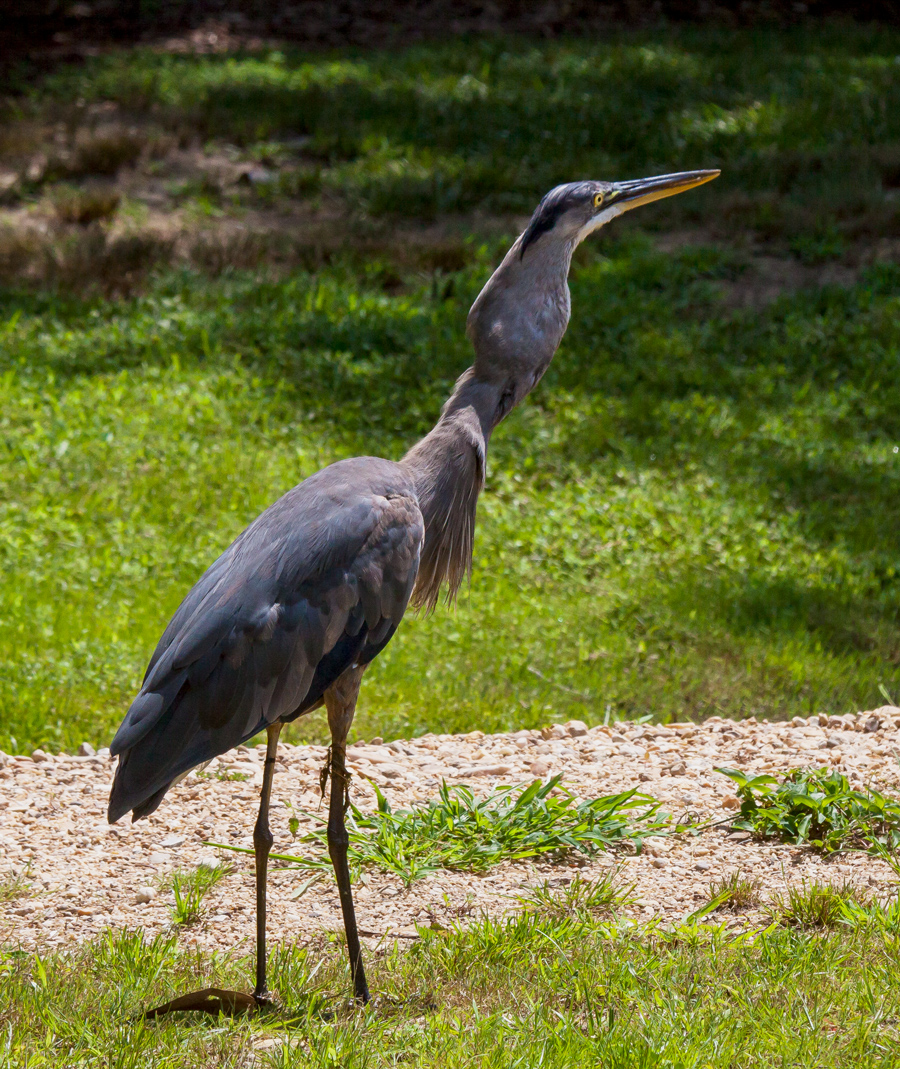
I didn’t really intend to photograph birds this weekend and had my macro lens on my camera. As I was walking around Hidden Pond Nature Center, however, I came face to face with a Great Blue Heron (Ardea herodias) and actually had to back up a little to take this shot.

My macro lens is a 180mm Tamron and can serve pretty well as a telephoto lens in certain circumstances, though normally when I am planning to photograph birds I will use a longer lens. Sometimes you just have to shoot a subject with the lens on your camera at that moment. I had a zoom lens in my camera bag, but suspect that the heron would have flown away before I would have been able to switch lenses.

Great Blue Heron

© Michael Q. Powell. All rights reserved.

Read Full Post »

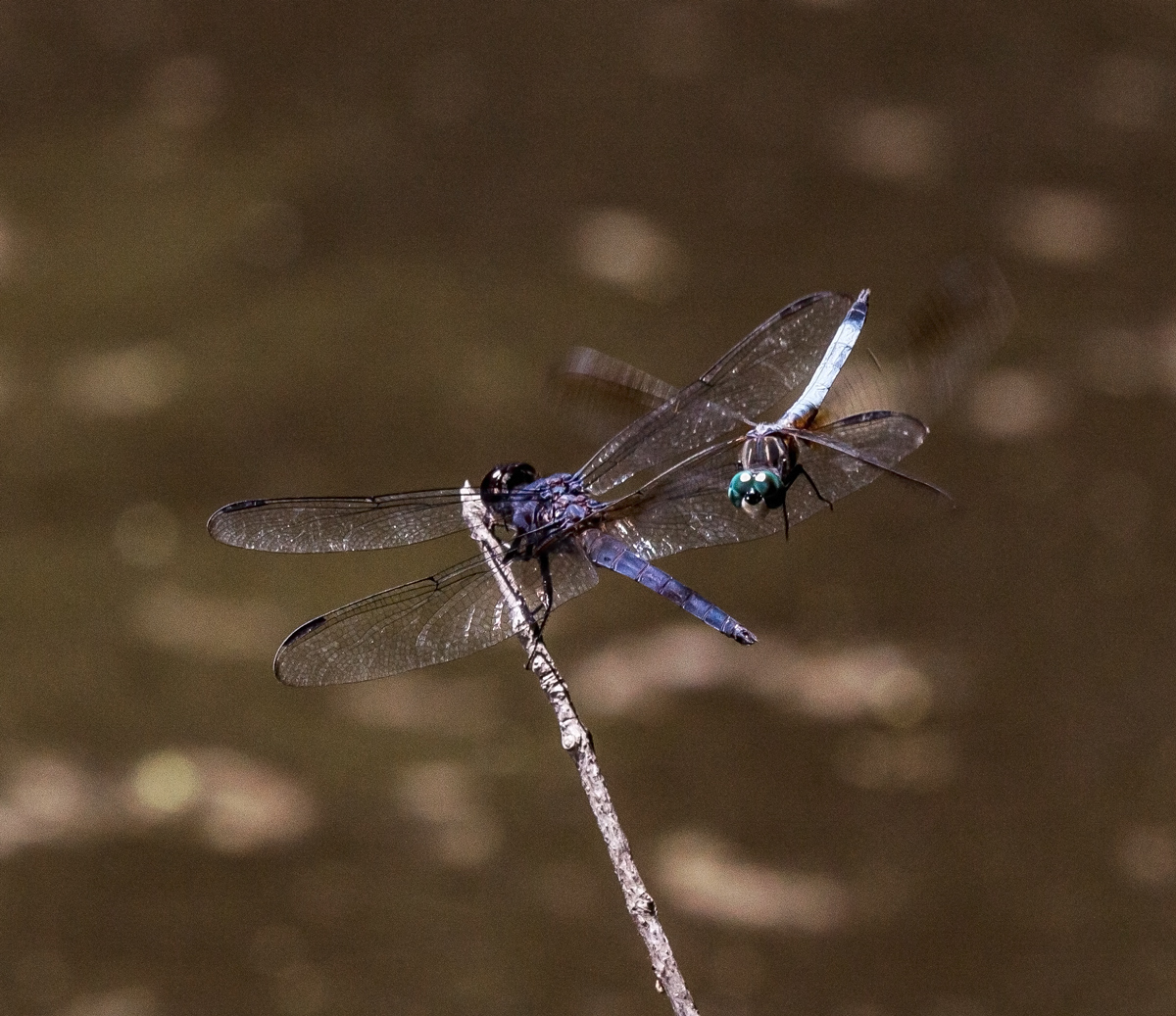
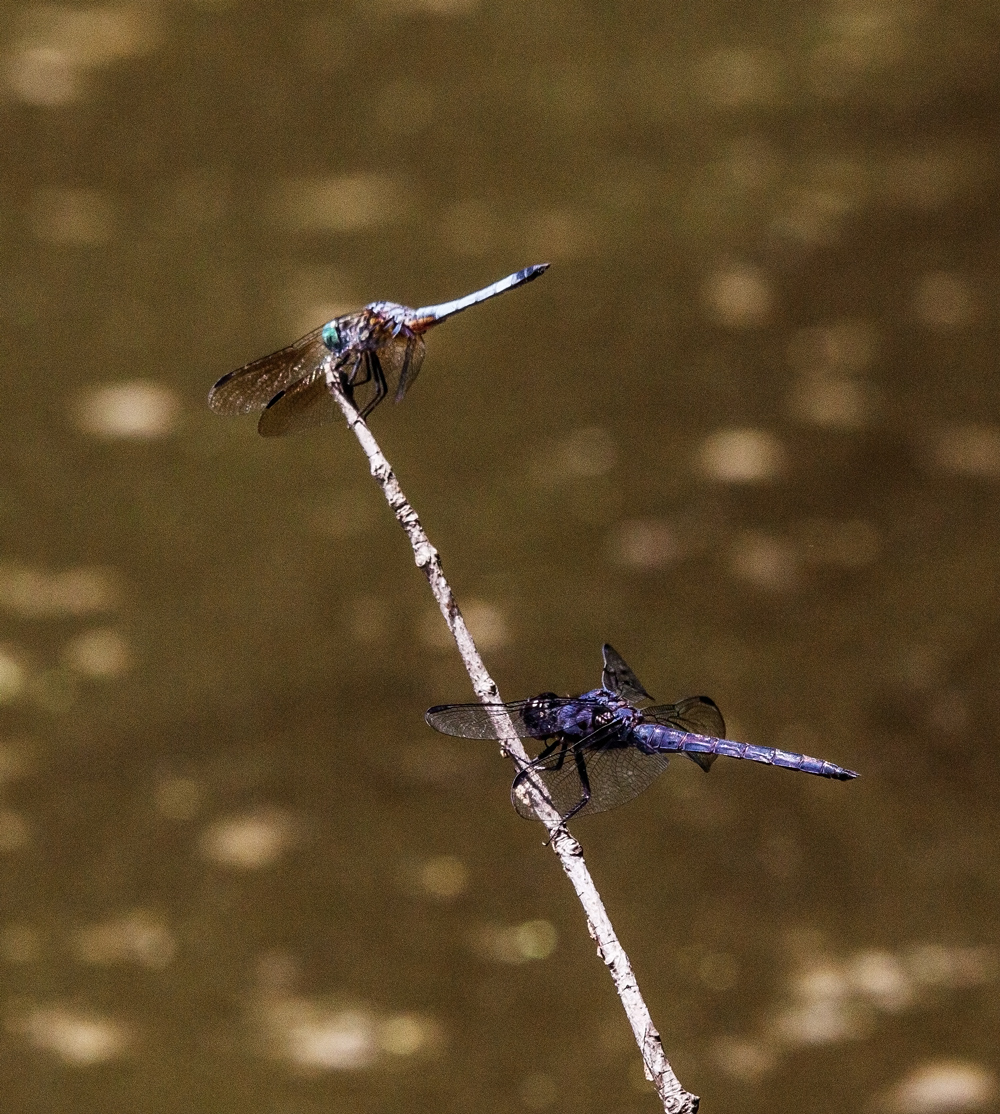
A Blue Dasher dragonfly (Pachydiplax longipennis) seemed to covet a prime perching position yesterday at Hidden Pond Nature Center in Springfield, Virginia and took action to try to dislodge the Slaty Skimmer dragonfly (Libellula incesta) that was occupying the perch.

The Blue Dasher was successful and occupied the top position for a little while, but eventually the larger Slaty Skimmer resumed the position at the top and the Blue Dasher was relegated to a lower spot on the plant.

Coming in for the attack

Coming in for the attack

The attack

The attack

Temporarily on top

Temporarily on top

battle4_blog

Relegated to the bottom

© Michael Q. Powell. All rights reserved.


Read Full Post »

How much of the environment do you show when your primary subject is a bird? Normally I try to fill as much of the frame as possible with the bird through a combination of zooming and cropping.

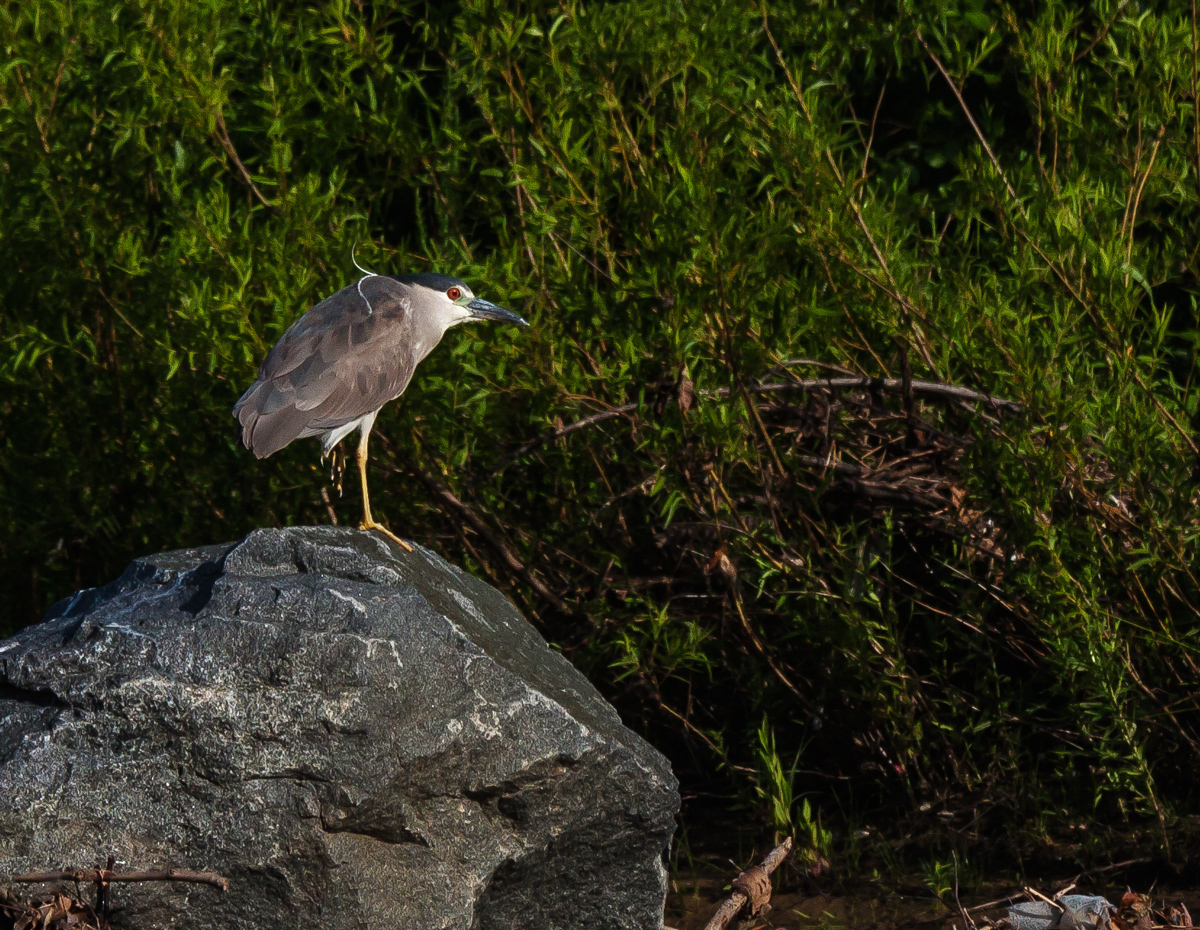
Yesterday as I walking along Cameron Run, a suburban waterway that feeds into the Potomac River, I spooked a Great Blue Heron when I took a few steps in its direction. A smaller bird was also spooked and it flew to a rock in the middle of the stream. I was thrilled when I realized that it was a Black-crowned Night Heron (Nycticorax nycticorax), a bird species that I don’t see very often.

It would have been easier to get a shot if I had been carrying my long zoom lens, but instead I had my 180mm macro lens on my camera. Fearful that the bird would take flight again, I took some initial shots and then slowly moved forward. As I climbed over large rocks toward the water’s edge, I’d stop and take a few more shots. After I reached the water, I decided to change lenses and put on the 70-300mm lens that was in my camera bag and, of course, the night heron flew off as I was changing lenses.

When I was at the closest point, I was able to capture an image that, with a lot of cropping, shows some of the beautiful details of the heron, including its startlingly red eyes, but as I looked over my images, that was not my favorite one. My eyes kept returning to the landscape shot. in which the heron is only one element of a beautiful composition of rocks and water.

What do you think? I’m posting three different shots of the night heron with varying amounts of background context, so you can see how the scene changed as I zoomed with my feet (and cropped in post processing).

Black-crowned Night Heron

Black-crowned Night Heron

Black-crowned Night Heron

© Michael Q. Powell. All rights reserved.

Read Full Post »

Yesterday I spotted a very cool-looking, but unfamiliar dragonfly. I ended up posting an image in several Facebook groups in an effort to get an identification from some of the experts and was a little shocked to learn that it is a male Swift Setwing dragonfly (Dythemis velox), a primarily southern species that may never before have been spotted in Fairfax County, the county where I live.

It looks like this species is spreading northward. According to a posting on an Ohio natural history blog, this dragonfly species was spotted for the first time in Ohio in 2014 and a photo was posted today of a teneral female Swift Setwing in Champaign County, Ohio.

Why are these dragonflies called “setwings?” According to the blog posting cited above, setwings “spend a lot of time perched, typically on the tip of branches and frequently with their wings angled down and forward and their abdomen slightly raised…(the) English name of “setwings” (came) from this posture, which reminded them of a sprinter at a track meet on the blocks in the “ready, set, go” position.”

Swift Setwing

Swift Setwing

Swift Setwing


© Michael Q. Powell. All rights reserved.

Read Full Post »

If you want a really lesson in patience, trying photographing dragonflies in flight. Yesterday I spent several hours trying to capture images of Prince Baskettail dragonflies (Epitheca princeps) as they conducted long, low patrols over a small pond at Jackson Miles Abbott Wetlands Refuge in Fort Belvoir, Virginia.

The Prince Baskettails didn’t always follow the same flight paths and their changes in flight direction often were unpredictable, but they kept coming back, giving me lots of chances to attempt to get shots. With some species you can wait for the flying dragonflies to take a break and perch for a moment or two, but Prince Baskettails have amazing stamina—I have never seen one stationary.

There are a number of different approaches to capturing in-flight images. Some folks like to pre-focus on a zone and wait until the dragonfly comes into that area. I like to acquire my target with my naked eye as it approaches and then track it through the camera’s viewfinder for as long as I can. The biggest problem is acquiring focus.  My preferred lens for shooting dragonflies is my trusty Tamron 180mm macro lens. Its focal length lets me use it as both a telephoto and a macro lens, but it is somewhat slow in focusing, so I ended up with lots of blurry shots.

However, I was able to capture some shots that were in focus, including this image that shows the amazing eyes and beautiful markings of this spectacular dragonfly. It’s probably my imagination, but the dragonfly in the photo almost seemed to be glancing in my direction as it flew by and giving me a little smile.

Prince Baskettail

© Michael Q. Powell. All rights reserved.


Read Full Post »

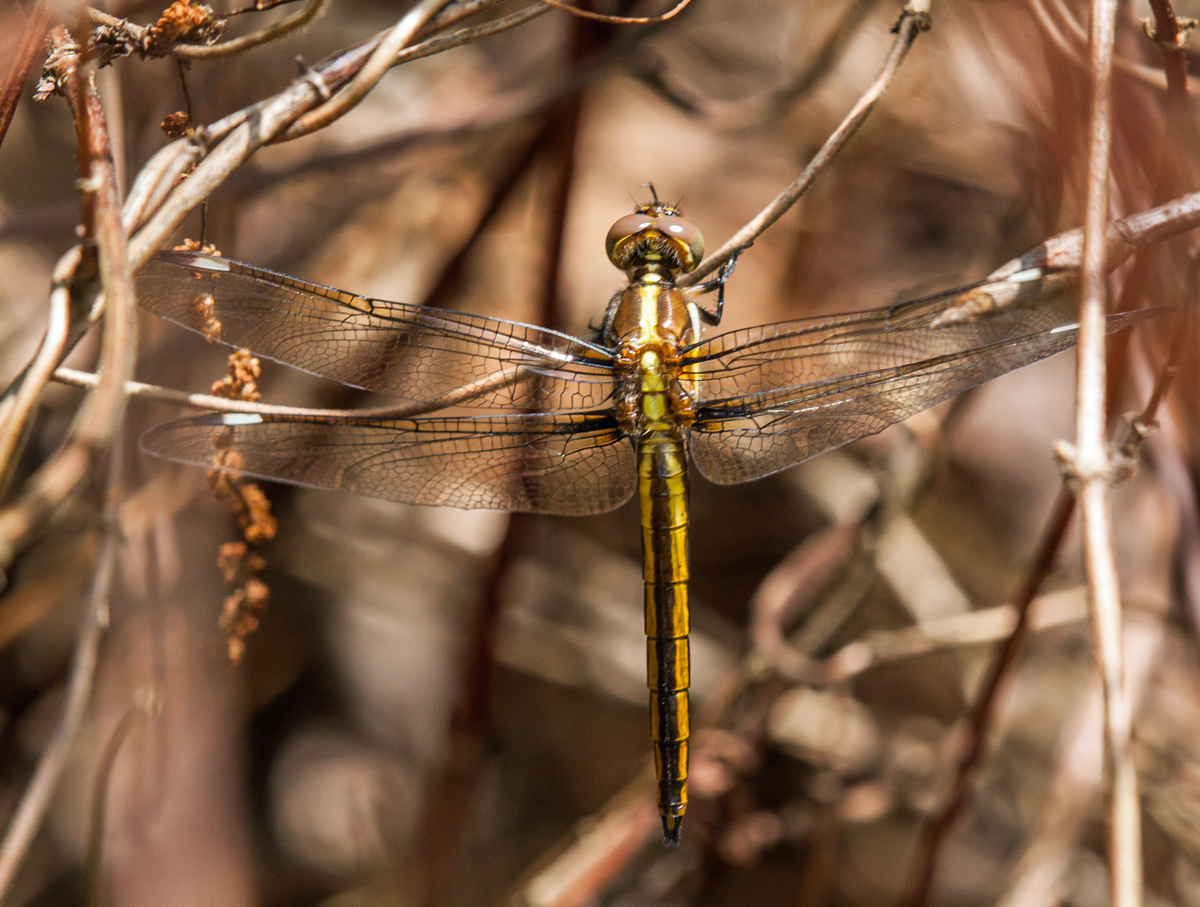
Females are a real mystery to me, especially when it comes to dragonflies. At this time of the year I see a lot of different dragonflies and I have featured a number of the colorful males over the past few weeks. They are relatively easy to identify when they are mature—immature males, however, often have the same coloration as females.

The challenge with females, particularly a number of the members of the Skimmer family, is that they all look pretty much the same.  This past Friday I photographed this beautiful female dragonfly and I love the two-toned coloration of her eyes. After consulting with my local dragonfly expert Walter Sanford, I have concluded that she is probably a Great Blue Skimmer (Libellula vibrans), though she doesn’t have a spot of blue on her

Great Blue Skimmer

© Michael Q. Powell. All rights reserved.

Read Full Post »

I love the speckled blue eyes of the male Great Blue Skimmer dragonfly (Libellula vibrans), like this spectacular specimen I spotted Monday at Huntley Meadows Park in Alexandria, Virginia.

Great Blue Skimmer

Great Blue Skimmer

© Michael Q. Powell. All rights reserved.

Read Full Post »

When I noted in a recent posting called Transformation, that I had not yet witnessed the remarkable metamorphosis of a dragonfly, I never suspected that only a few day later I would somehow manage to observe such a transformation of a Common Sanddragon dragonfly (Progomphus obscurus) from start to finish at relatively close range.

Nymphs of this species of dragonfly crawl out of the water onto a sandy beach to begin the process and I knew of the bank of a stream where this had been taking place over the past week or so, having observed there newly emerged teneral dragonflies and the discarded exoskeletons known as exuviae. However, what were the chances that I would be able to be at the right location at precisely the right time? I figured the odds were about the same as winning the lottery.

Last Friday around noon I spotted several exuviae in the sand as I was walking along that section of the stream. I bent down, picked them up, and placed them in the palm of my hand in order to get a good look at them. Having spotted Unicorn Clubtails in this location along with Common Sanddragons, I wondered if these was a way to tell which species of dragonfly had emerged from a given exuvia. As I continued to walk, I suddenly became aware that something was crawling around in my hand—one of my presumed exuviae was in fact a live nymph.

I experienced an initial moment of shock, but realized pretty quickly that I needed to get the nymph back onto the sand. If I had been thinking a little more clearly, I might have chosen a spot that optimized my chances for capturing good images, but instead I selected a location where I could see another exuvia and gently placed the nymph there.

I placed my eye to the viewfinder of my camera and began to wait and to watch. Within a very short period of time I began to see signs of movement in the thorax area of the nymph, just behind the eyes, and before long the head of the dragonfly appeared as it began to pull its body out of the soon-to-be-discarded shell. It took about eight minutes for the body to be entirely free of the exoskeleton.

The dragonfly changed positions so that it could extend its abdomen and begin the process of extending its wings, which at this stage were merely nubs. Over the next twenty minutes or so, the wings and the abdomen grew larger and larger. My original shooting position was no longer optimal, so I ended up standing in the stream to get a view of what was happening. The water was about six to eight inches deep (15 to 20 cm) and my non-waterproof boots were quickly soaked. As I crouched to get as close as I could to the eye level of the dragonfly, I suddenly realized that the seat of my pants was getting wetter.

Twenty seven minutes after the process had started, the wings of the newly emerged dragonfly snapped open to the familiar position of dragonfly wings. At this moment they were very clear and obviously very fragile and I experienced a moment of concern for the vulnerable dragonfly when a slight wind kicked up. Fortunately, though, I had chosen a somewhat sheltered position and the dragonfly was safe. The wings continued to harden and six minutes later the dragonfly flew off to some nearby vegetation to begin its new life.

I took a lot of photos of the process of metamorphosis and it was hard to choose which ones to post. In the caption area of each of them,I have indicated the time at which the photo was taken. The transformation began at 12:19 and the dragonfly flew away at 12:52.

Fellow dragonfly enthusiast and photographer Walter Sanford witnessed the emergence of a Common Sanddragon at a nearby, but different location on 1 June and did a blog posting on it today. Be sure to check out his posting for some great photos and a detailed explanation of what is happening within the dragonfly’s body as it undergoes this dramatic metamorphosis.
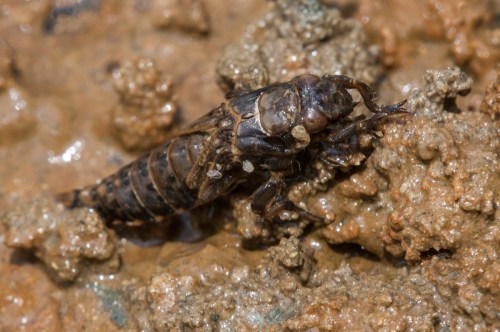
Common Sanddragon

12:19 indications of first movement

Common Sanddragon

12:21 head starts to become visible


Common Sanddragon

12:22 dragonfly starts to pull out of shell

Common Sanddragon

12:22 body of dragonfly starts to be visible

Common Sanddragon

12:23 body significantly out of shell

Common Sanddragon

12:24 side view of dragonfly pulling body out of shell
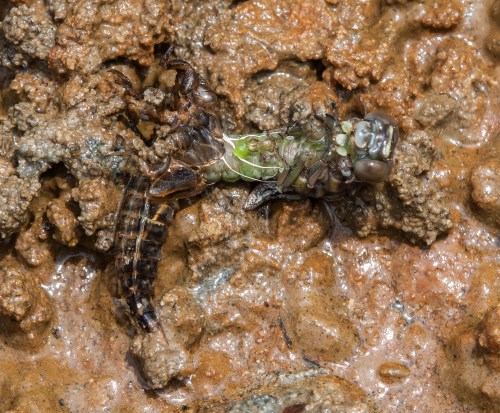
Common Sanddragon

12:25 struggling to get abdomen out of shell

Common Sanddragon

12:27 body completely freed

Common Sanddragon

12:27 straightening the abdomen

Common Sanddragon

12:28 starting to extend wings

Common Sanddragon

12:29 continuing to extend wings

Common Sanddragon

12:31 wings extended

Common Sanddragon

12:40 wings reach final length

Common Sanddragon

12:48 wings fully opened

Common Sanddragon

12:52 close-up of newly emerged dragonfly

© Michael Q. Powell. All rights reserved.


Read Full Post »

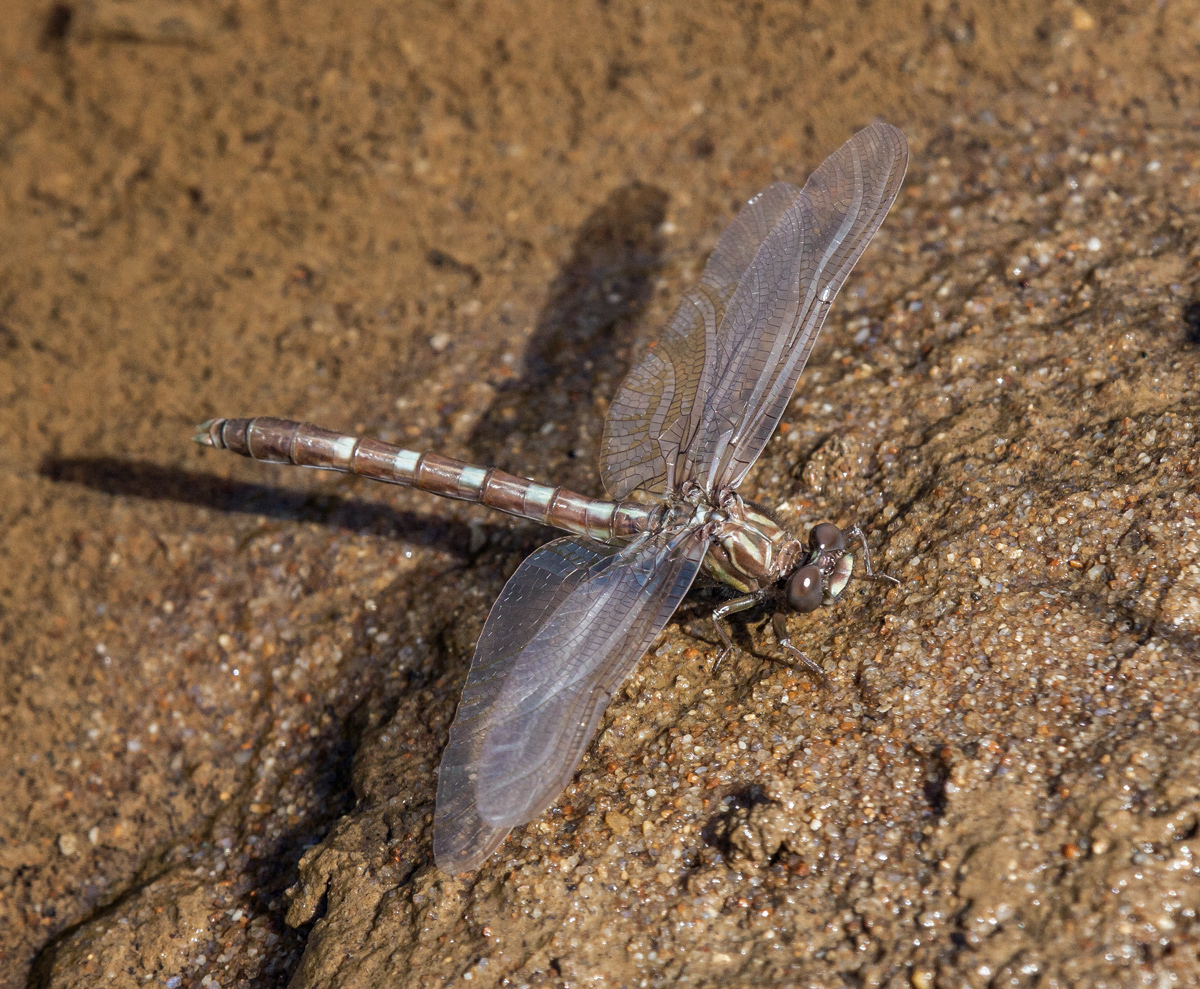
Where do you go to find sanddragons? Although it sounds like a trick question, the correct response is the obvious one—you generally find Common Sanddragon dragonflies (Progomphus obscurus) perched on the sandy bank of a stream. Sometimes Common Sanddragons will perch almost flat on the sand, but often they will raise their abdomens up, sometimes assuming the obelisk position, in which the tip of the abdomen is pointing almost straight up. Why do they do this? The most frequent explanation for this behavior that I have seen is that it is a method of thermoregulation. The dragonfly keeps from overheating by reducing the amount of its body that is directly exposed to the sun.

Common Sanddragon

Common Sanddragon

© Michael Q. Powell. All rights reserved.

Read Full Post »

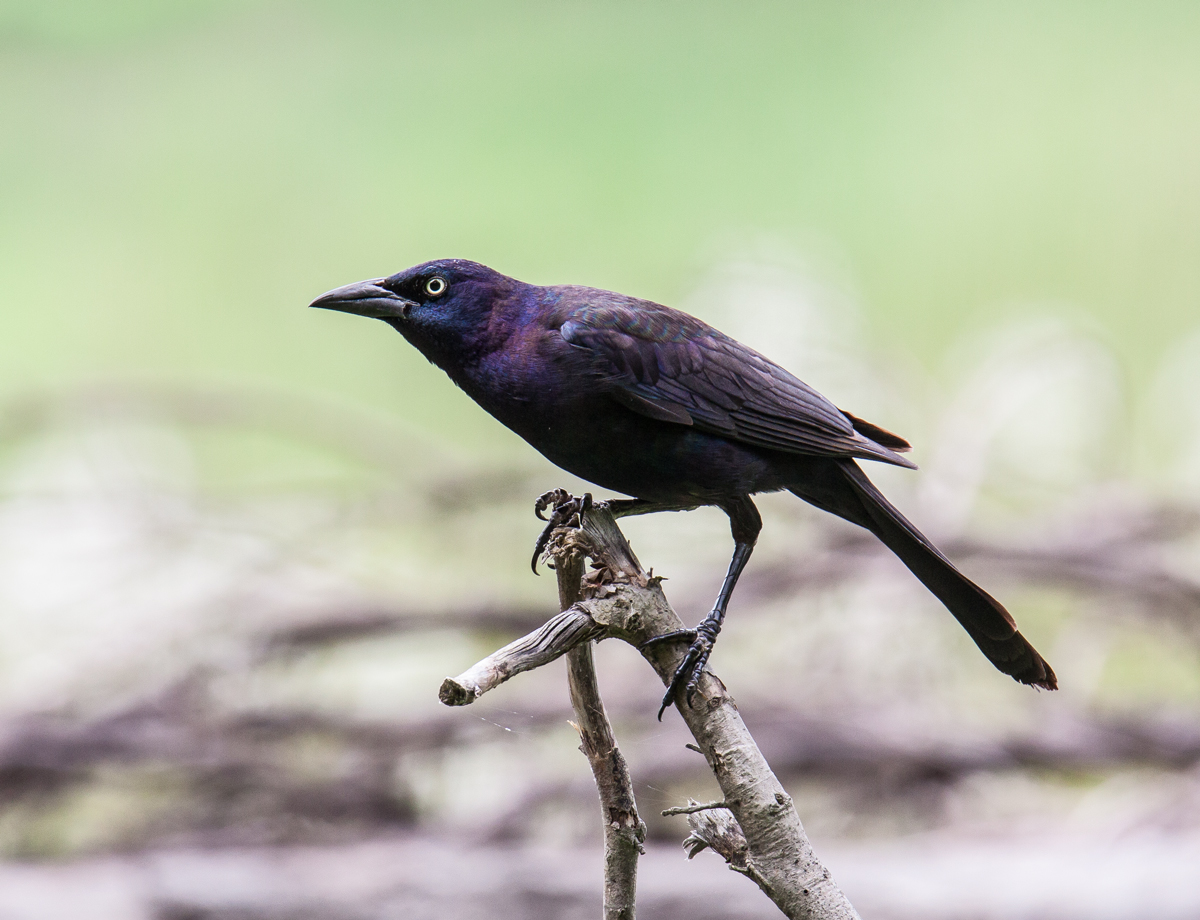
There were lots of Common Grackles (Quiscalus quiscula) foraging Friday at Huntley Meadows Park and I was thrilled when one of the stood still for a moment and I was able to snap off this shot. At times grackles appear to be almost pure black, but when the light is right, they shimmer with shades of green and pink.

Common Grackle

© Michael Q. Powell. All rights reserved.

Read Full Post »
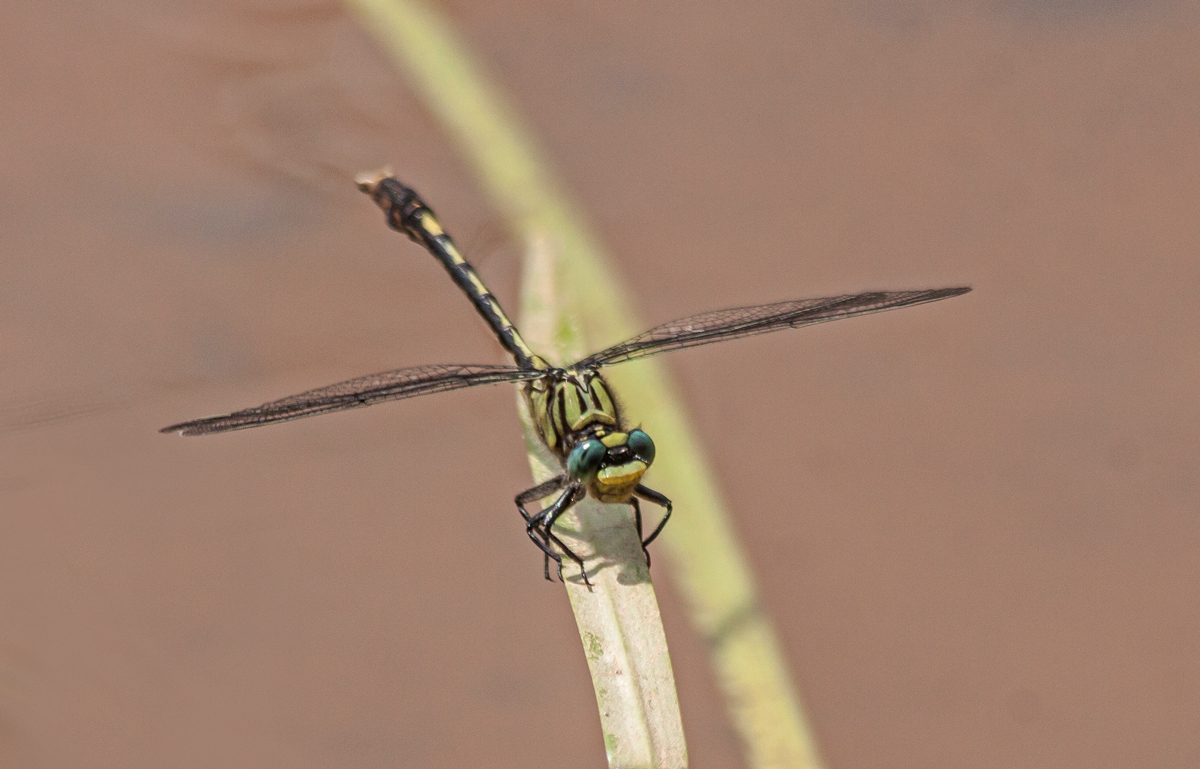
Do you have a favorite dragonfly? One of my favorites is the Unicorn Clubtail (Arigomphus villosipes)—I love both its appearance and its name. Earlier this week, on the last day of May, I spent some time chasing an elusive unicorn at Huntley Meadows Park and captured a few photos of it. The second shot gives you a glimpse of the “horn” between the dragonfly’s eyes that is responsible for the first part of its name.

Unicorn Clubtail

Unicorn Clubtail

© Michael Q. Powell. All rights reserved.

Read Full Post »

Dragonflies spend most of their lives as nymphs in the water.  When the time is right, they crawl out of the water, break out of their exoskeletons, and turn into the colorful aerial acrobats that I love to watch and to photograph.

Although I have seen photos and videos of this amazing transformation, I have not yet witnessed the entire process in person. However, this past weekend I did spot some newly emerged Common Sanddragon dragonflies (Progomphus obscurus) at Huntley Meadows Park. Nymphs of many dragonfly species attach themselves to vegetation as they undergo their metamorphosis, but Common Sanddragon nymphs merely crawl out of the water onto a sandy area at the edge of a stream.

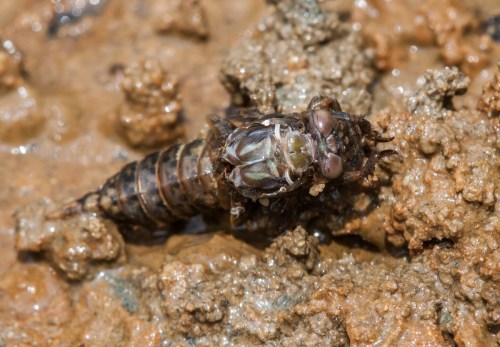
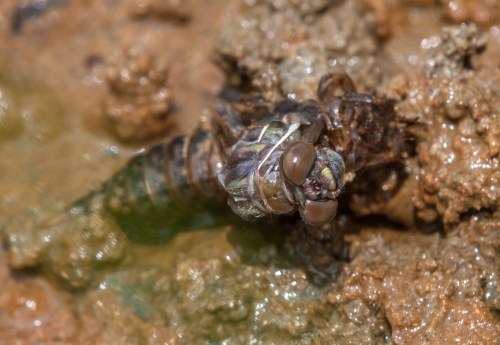
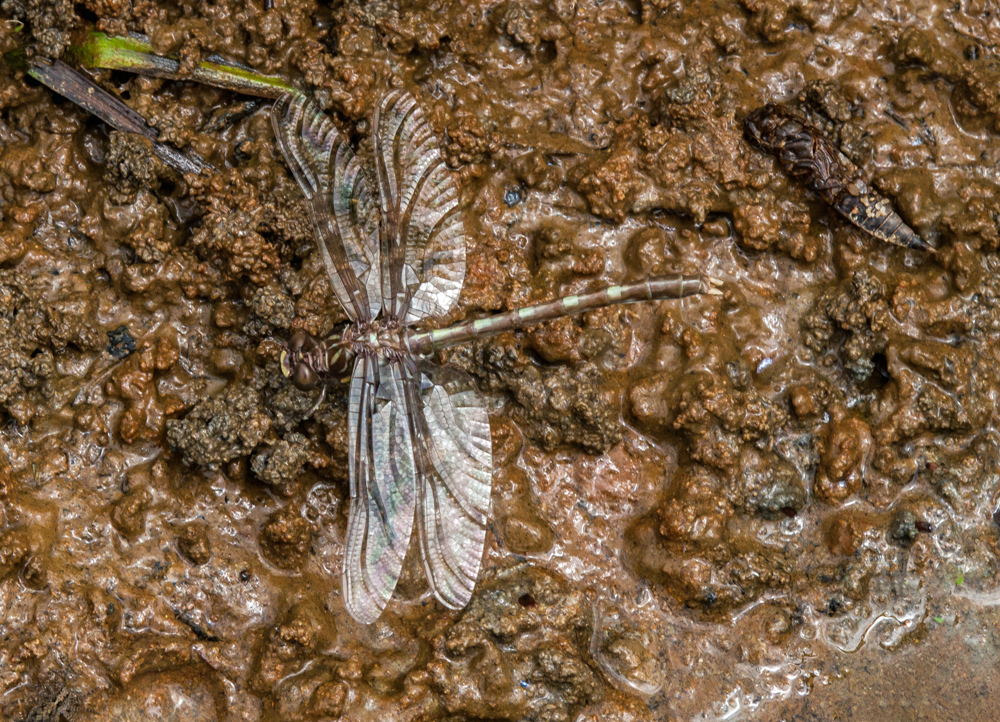
After I had spotted the dragonflies, I scoured the sandy stream bank and managed to find some cast-off skins (exuviae). Looking at the exuvia in the photo, you can see how the nymph has broken through the shell just behind the eyes and crawled out. The stringy white things on the top of the exuvia are breathing tubes used by the nymphs.

My last image is a visual reminder of how complicated and delicate this transformation can be be. The dragonfly obviously had some kind of a problem in expanding its wings and it is doubtful that it was able to survive for very long.

Common Sanddragon

Common Sanddragon

Common Sanddragon

Common Sanddragon exuvia

Common Sanddragon

© Michael Q. Powell. All rights reserved.


Read Full Post »
Many damselfly species look so much alike that they are visually indistinguishable for me. I never have that problem, however, with the Ebony Jewelwing (Calopteryx maculata)—its dark wings and emerald body set it apart from all other damselflies in my area.

I spotted this distinctive little beauty yesterday, the last day of May, at Huntley Meadows Park in Alexandria, Virginia alongside one of the creeks in a remote area of the park. As I went through my photos I was drawn to this one, because of the wing positions.

When I showed a similar shot to my local dragonfly expert Walter Sanford, he immediately noticed the curve in the abdomen, something that I hadn’t even seen. I initially dismissed it as some kind of flexing by the damselfly, but when I noted the same curve in all of my images, I realized that it may be a deformity, as Walter initially suggested. Fortunately, the damselfly appeared to be able to fly normally despite the curved abdomen.

Ebony Jewelwing

© Michael Q. Powell. All rights reserved.


Read Full Post »

I don’t see deer very often at my local marshland park. When I do, it is generally only a flash of their white tails as they bound out of sight. On Friday, however, I spotted a young White-tailed Deer (Odocoileus virginianus) foraging in the forest at Huntley Meadows Park on the other side of a small stream from where I was located.

I stopped and crouched and the deer slowly moved closer and closer to me. I think that the deer was aware of my presence, but did not seem to view me as a threat. I did not want to move around too much for fear of spooking the deer, so I used the lens that was on my camera at that moment and stayed in place. A 180mm macro lens would not have been my first choice for photographing a deer, but it worked out surprisingly well.

As the deer moved forward, I thought it might try to hop over the stream right where I was at, but eventually the deer moved upstream a bit and made its way to the side of the stream on which I was standing. It lingered for a while in a field before it finally disappeared from sight.

Here are a few shots from my encounter with the young deer. My favorite one might be the first one—I had no idea that deer were so flexible. The third image, which I only cropped a little gives you an idea of how close the deer was to me.

White-tailed Deer

White-tailed Deer

White-tailed Deer

White-tailed Deer

© Michael Q. Powell. All rights reserved.

Read Full Post »

Occasionally I complain that some species with names that include “common” are rare, but Common Whitetail dragonflies (Plathemis lydia) are in fact quite common. They are among the first dragonflies to appear in the spring and among the last to disappear in the autumn.

Even though I see them all of the time, I’ll frequently photograph Common Whitetails, with the hope of capturing a new or different view of the dragonfly. Yesterday was sunny and I knew that I would have trouble photographing male Common Whitetails, because their bodies are so white. Usually they end up overexposed with the highlights blown out.

To try to compensate for that problem, I set the metering mode on my camera for spot metering and I was able to capture this shot. The dragonfly is a male, but has not yet acquired the bright white of an adult male, which made things a little easier. I managed to get a proper exposure for the body and the rest of the image is a bit underexposed. The result was a kind of dramatic lighting effect that helps me to highlight the uncommon beauty of this common species.

Common Whitetail

© Michael Q. Powell. All rights reserved.


Read Full Post »

I love watching Green Herons (Butorides virescens) stalk a prey. Their movements are so focused, cautious, and deliberate they appear to be moving in slow motion.

Like the Great Egret that I featured yesterday, Green Herons migrate out of my area during the fall and it is always exciting to welcome back these colorful little herons. Green Herons often are often hidden in the vegetation at water’s edge, but this one cooperated by moving along a log in the water as it tracked its potential prey. This particular hunt was not successful and shortly after I took this photo, the heron flew off to a more distant location.

Green Heron

© Michael Q. Powell. All rights reserved.

Read Full Post »
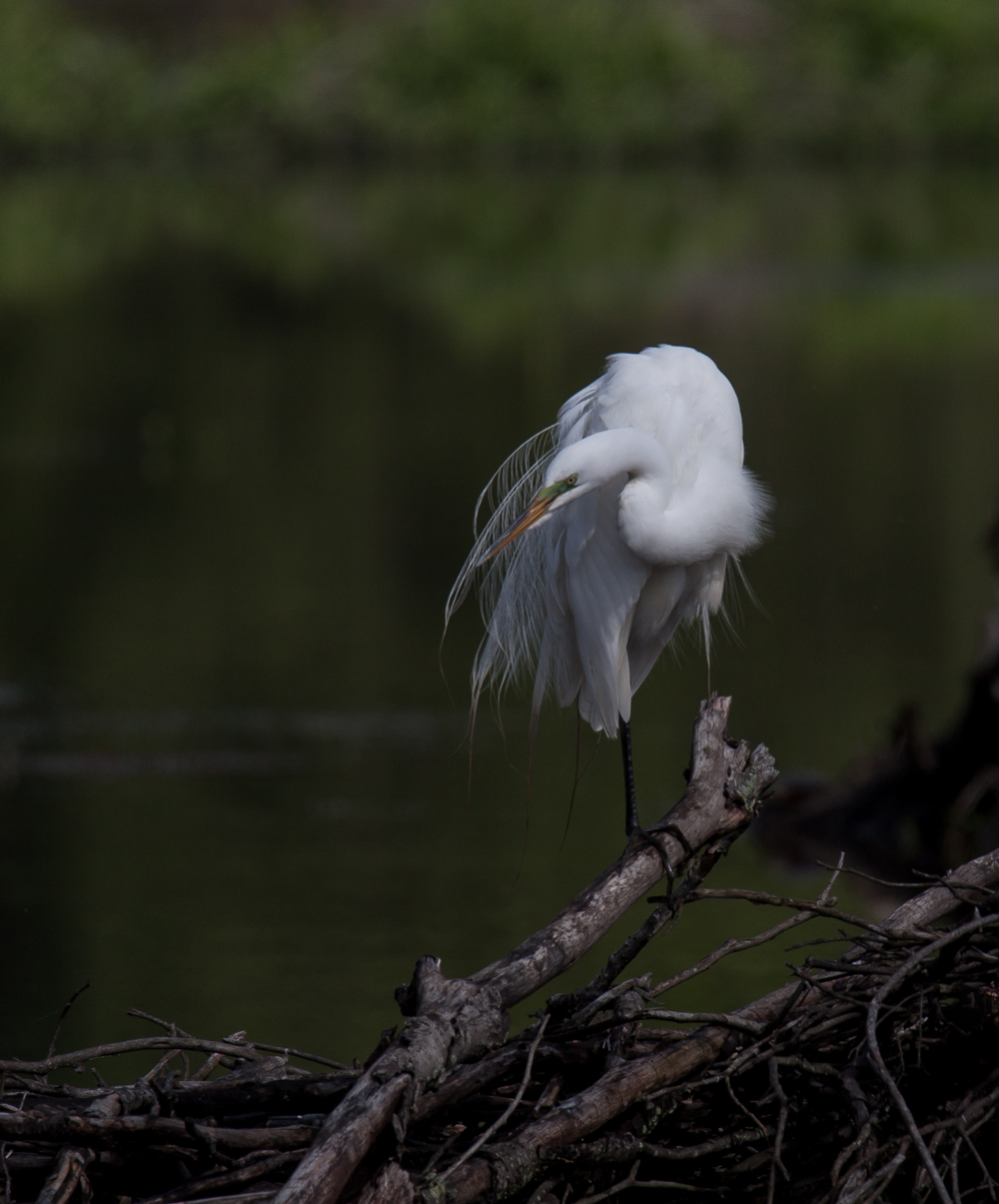
Every spring I look forward to the return of the elegant Great Egrets (Ardea alba) to our area. Unlike Great Blue Herons, which are with us throughout the winter, the egrets migrate south and return only in mid-spring when the weather has warmed up a bit.

One of the highlight of egrets at this time of the year is their beautiful breeding plumage and the green lores (the area between the bill and eye). When I spotted an egret grooming itself in the early morning, I was able to capture a sense of the long additional plumes that it was sporting.

Great Egret

Unlike Great Blue Herons, which patiently wait for a big catch, this Great Egret at Huntley Meadows Park seemed content with a series of small bites. I think that it is a little fish, but I am not entirely certain what the egret is consuming as a snack.

Great Egret

© Michael Q. Powell. All rights reserved.

Read Full Post »
Necrophila americana—what a creepy Latin name for this beetle, known in English as the American Carrion Beetle, that feeds on dead and decaying flesh. Fortunately the backdrop was more pleasant for this specimen that I spotted on Monday in one of the fields at Huntley Meadows Park.

American Carrion Beetle

© Michael Q. Powell. All rights reserved.

Read Full Post »

It’s dragonfly season and this past Friday fellow dragonfly enthusiast and photographer Walter Sanford guided me to a new spot to search for the elusive beauties. Accotink Bay Wildlife Refuge is a nature preserve located on Fort Belvoir, a nearby military base in Fairfax County, Virginia.

We are in a lull period of sorts for dragonflies—some of the early dragonflies are gone and others have not yet appeared. As we were making one final swing through likely locations, having come up almost empty-handed in our search, Walter spotted a dragonfly. The wings were so clear and shiny that it was obviously a teneral dragonfly, one that had only recently emerged.

Identification (and photography) was a bit of a challenge, because the young dragonfly was perched inside of a tangled mass of vegetation, making it almost impossible to get an unobstructed view. Eventually we were able to find a visual tunnel and I was able to get the first shot below. It gives a pretty good view of the dragonfly, which after the fact I could clearly see is a Spangled Skimmer (Libellula cyanea), but I really wasn’t satisfied with it.

Eventually I managed to get a second shot. It doesn’t show the dragonfly’s entire body and many element are out of focus, but it has an artistic sense that I find really appealing. I’m not sure if it’s because of the more vibrant colors or the unusual angle—I just know I like that image a whole lot more than the first one.

Spangled Skimmer

Spangled Skimmer

© Michael Q. Powell. All rights reserved.


Read Full Post »

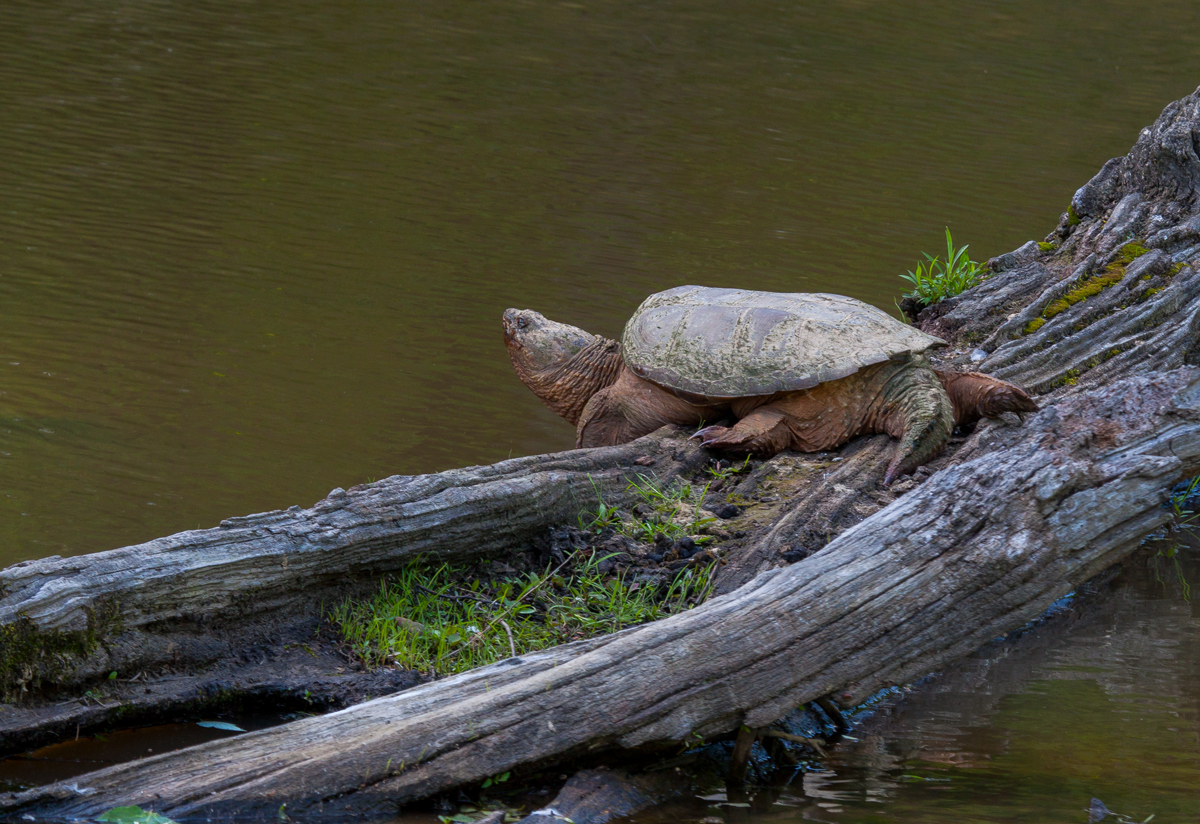
As a child, I remember thinking that turtles could all pull their bodies inside of their shells for protection. Clearly that is not the case with this prehistoric-looking Snapping Turtle (Chelydra serpentina) that I spotted last week lounging on a fallen tree at Huntley Meadows Park in Alexandria, Virginia.

We kept little turtles as pets several times in my family as I was growing up and I remember the clear flat plastic habitat that we used that had a small plastic palm tree. As a product of the suburbs of Boston, I didn’t have a whole lot of experience with wildlife, though I was Boy Scout for a while.

To this day I am amazed by the size and apparent power of snapping turtles, which are pretty common in my favorite marshland park. Most of the time I see them moving slowly in the water and only occasionally do I see one sunning itself on a log as the smaller turtles regularly are wont to do—I imagine that it is quite a chore to haul that massive body out of the water.

snapping turtle

© Michael Q. Powell. All rights reserved.

Read Full Post »
As I was wandering through the woods of Huntley Meadows Park last Friday, I came upon a giant Luna Moth (Actias luna) that seemed to be almost as big as my hand. I was trying to get a close-up of its really cool antennae when an ant crawled onto one of the moth’s legs. I thought the ant might become lunch until I learned that Luna Moths don’t eat—they have no mouths and they only live for about a week as adults, with a sole purpose of mating, according to a Fairfax County Public Schools webpage.

Luna Moth

Luna Moth

Luna Moth

© Michael Q. Powell. All rights reserved.

Read Full Post »

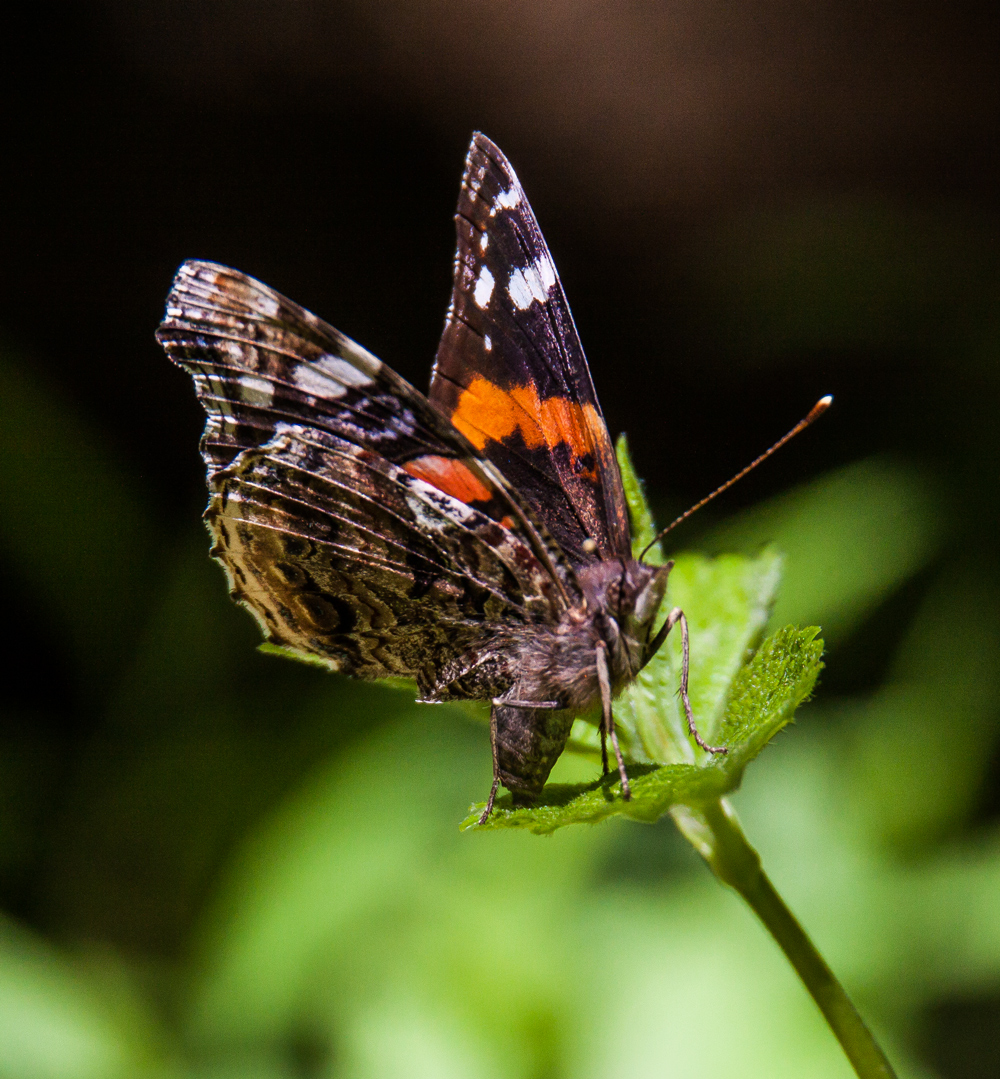
With the return of the sun, butterflies have started to reappear, like this handsome Red Admiral (Vanessa atalanta) that I spotted yesterday afternoon at Huntley Meadows Park.

It’s been gloomy and rainy for most of the past few weeks, so it was a particular joy when the sun was shining brightly yesterday. As I wandered through the woods and fields of my favorite park, butterflies flitted by a number of times, including several Red Admirals. Most of them kept moving and I was unable to capture them with my camera, but one of them perched a few times and gave me a chance to get some shots.

I’ve posted two of my favorite shots. The first is a little unconventional—the butterfly is upside down on a fallen log and I love the way it looks a bit like a heart. The second shot is a little more conventional, but it has a dynamic quality in the half-open wings and overall pose and I love the background blur.

Red Admiral

Red Admiral

© Michael Q. Powell. All rights reserved.

Read Full Post »
« Newer Posts - Older Posts »