Feeds:
Posts
Comments

Archive for the ‘Summer’ Category

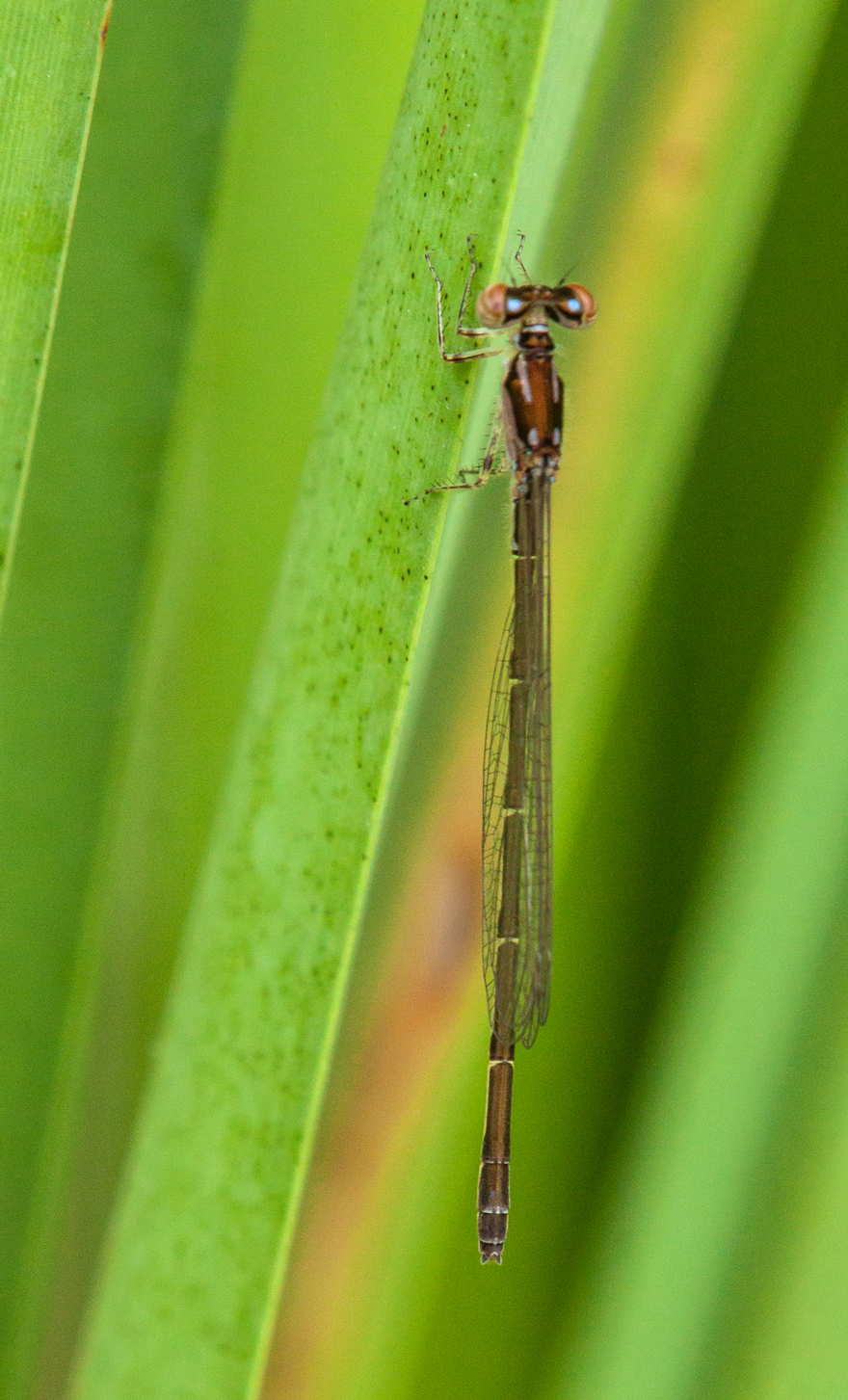
It’s hard to imagine a simpler composition—a tiny damselfly in the green growth of the marsh—but I find real beauty and power in this image.

Look closely at this damselfly, which I think is a female Fragile Forktail (Ischnura posita), and you will see some amazing colors and details, all packed into a body that is only about an inch long.

Click on the image to see a higher resolution view of the image.

Fragile Forktail

© Michael Q. Powell. All rights reserved.

Read Full Post »

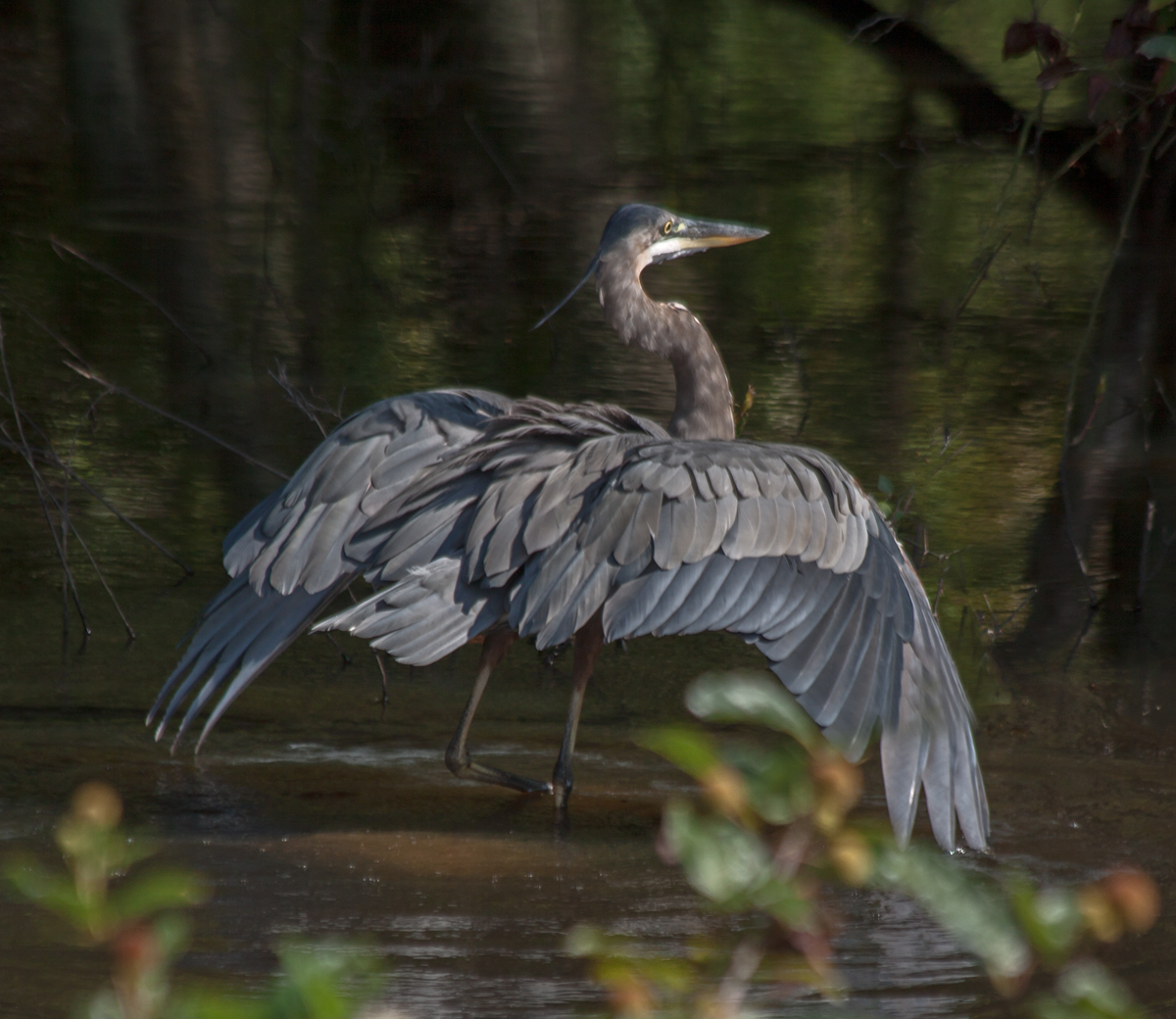
Several Great Blue Herons (Ardea herodias) were very active yesterday at my local marsh, chasing each other around and squawking loudly. One of them flew up into a tree near to where I was standing and perched for a little while. I got this shot shortly after the heron flew down from the tree into the water and extended its wings to arrest its momentum.

Great Blue Heron

© Michael Q. Powell. All rights reserved.

Read Full Post »

Generally I like to photograph wildlife subjects in a natural environment. When this female Common Whitetail dragonfly (Plathemis lydia) landed on a metal sprinkler cover, though, I couldn’t help but like the contrast between the natural subject and the industrial background.

Common Whitetail dragonfly

© Michael Q. Powell. All rights reserved.

Read Full Post »

I used to think that there were only one or two varieties of black-colored swallowtails, but as I learned there were more such species (some deliberating mimicking each other), I’d sometimes get confused and frustrated when trying to distinguish among them.

For example, I encountered this beautiful black swallowtail butterfly feeding on a Cardinal Flower (Lobelia cardinalis) this past weekend at my local marsh. It is definitely an unusual circumstance when I can identify a flower, but not the insect.

So, I asked myself, is this a female Eastern Tiger Swallowtail or a Pipevine Swallowtail or a Spicebush Swallowtail or a Black Swallowtail? How can you tell them apart, given they are all black and all have swallowtails?

While searching on the internet, I came across a wonderful blog posting on a site called Louisiana Naturalist that compared all four of these swallowtail species and pointed out clearly the distinguishing marks. Once I looked at the posting, it was pretty clear that “my” butterfly is a Spicebush Swallowtail (Papilio troilus). Why am I so confident? One of the identifying marks is the blue comet-like marking that interrupts the inner row of orange spots.

It’s interesting to see this butterfly feeding on the Cardinal Flower. The website of the Lady Bird Johnson Wildflower Center at the University of Texas states that the Cardinal Flower depends on hummingbirds for pollination, because most insects find its long tubular flowers difficult to navigate. I suspect that butterflies play a role in pollinating these plants, even if they are not as efficient as bees would be (or maybe even hummingbirds).

Spicebush Swallowtail

© Michael Q. Powell. All rights reserved.

Read Full Post »
Can you name the most recognized Skipper butterfly in North America?  According to Wikipedia, it’s the Silver-spotted Skipper butterfly (Epargyreus clarus), like this one that I photographed recently at Brookside Gardens in Wheaton, Maryland.

I have been seeing a lot of skippers this month and many of them look so much alike that it is difficult for me to identify them  The Silver-spotted Skipper’s colors may be a little drab, but I am happy that it is easy to identify it, which makes me happy, given that there are over 3500 different species of skippers worldwide, according to a separate article in Wikipedia.

silver_blogsilver3_blog

© Michael Q. Powell. All rights reserved.

Read Full Post »
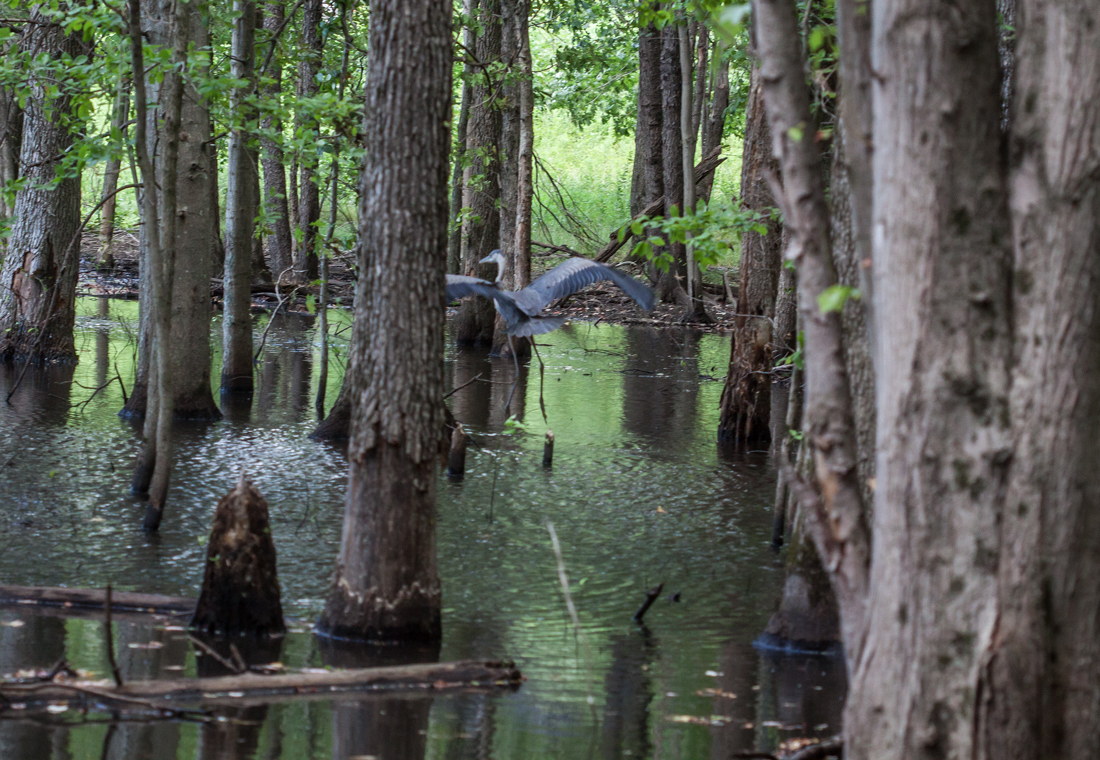
After a considerable amount of conservation construction at my local marsh, one wooded area is now flooded. It is cool and shaded and offered me respite from the hot sun on a recent summer afternoon.  Apparently a Great Blue Heron (Ardea herodias) had the same idea and I inadvertently flushed him from his calm repose.

In many ways, this is more of a landscape shot than a wildlife one, which is unusual for me. Normally I try to zoom in really close to the action, but at that moment I was simply enjoying the beautiful light that was coming into this scene. Besides, I had my 100mm macro lens on my camera, so zooming was not an option.

I really like the way the trees turned out in the image—it’s hard to explain why. In the foreground, you can see what I believe is some of the local beavers’ efforts. Last fall, the beavers felled a number of trees in this area and I wonder if they are the ones that stripped the bark off of part of one of the trees.

Click on the image if you want to see a higher resolution view of this shot.

takeoff_blog

© Michael Q. Powell. All rights reserved.


Read Full Post »

Last week I turned 60, but I am happy to confess that I still chase butterflies with much of the exuberance (if not quite the energy) of a child. There is something really special about the delicate beauty of butterflies that draws me in and the idea of their metamorphosis inspires me.

During a recent trip to Meadowlark Botanical Gardens in Vienna, Virginia, I was thrilled to spot this female Eastern Tiger Swallowtail butterfly (Papilio glaucus). She was feeding on an identified plant that must have been tasty, because she kept moving from spot to spot on the plant, offering me multiple opportunities to get some shots.

I especially like the fact that I was able to get the sky into some of the images, reinforcing for me the idea of butterflies flying freely and lightly through the open air. Now that’s the way to live a life.

swallowtail1_blogswallowtail2_blogswallowtail3_blogswallowtail4_blog

© Michael Q. Powell. All rights reserved.

Read Full Post »

The lighting was breathtakingly beautiful and the reflections were amazing when I caught sight of this Great Blue Heron (Ardea herodias) late last month at my local marsh. The heron was close enough that the 100mm macro lens that i had on my camera was the perfect lens for a portrait of this beautiful bird.

Great Blue Heron

© Michael Q. Powell. All rights reserved.

Read Full Post »

I used to think that all black-and-yellow insects circling around flowers were bees, but quickly learned that many of them are flower flies (also known as hoverflies). There are a lot of different varieties of flower flies, but I think that they all belong to the Syrphidae family.

Yesterday when I was visiting Brookside Gardens in Wheaton, Maryland, I managed to capture this image of a flower fly just as it had inserted its head into a small purple flower. It’s a pretty simple composition, but I really like the way that it turned out, with a good amount of detail on the fly’s body.

hover fly

© Michael Q. Powell. All rights reserved.

Read Full Post »

Chasing a nymph through the woods–it may sound like I was living out some fantasy as a character in Shakespeare’s A Midsummer Night’s Dream, but I was only running after a butterfly, a Common Wood Nymph (Cercyonis pegala).

As is usually the case, I had never seen this “Common” butterfly before, but the large, yellow-ringed eyespots on the forewings make it pretty distinctive and I had no trouble finding it in an on-line identification guide.

I chased after the butterfly for quite some time before it finally came to a stop and perched on a tree. I am not sure why, but the butterfly chose to perch upside down. When I processed my images, I couldn’t decided if I should flip the image 180 degrees or not. Ultimately I decided that the flipped image, which is the first one, looked more “normal.”

Which one do you think works better, the flipped image, i.e. the first one, or the one with the original perspective, i.e. the second one?

nymph1A_blognymph1_blog

© Michael Q. Powell. All rights reserved

Read Full Post »

How often do you find yourself taking a shot of a subject with the wrong lens? If you are an opportunistic wildlife shooter like I am, it happens pretty regularly.

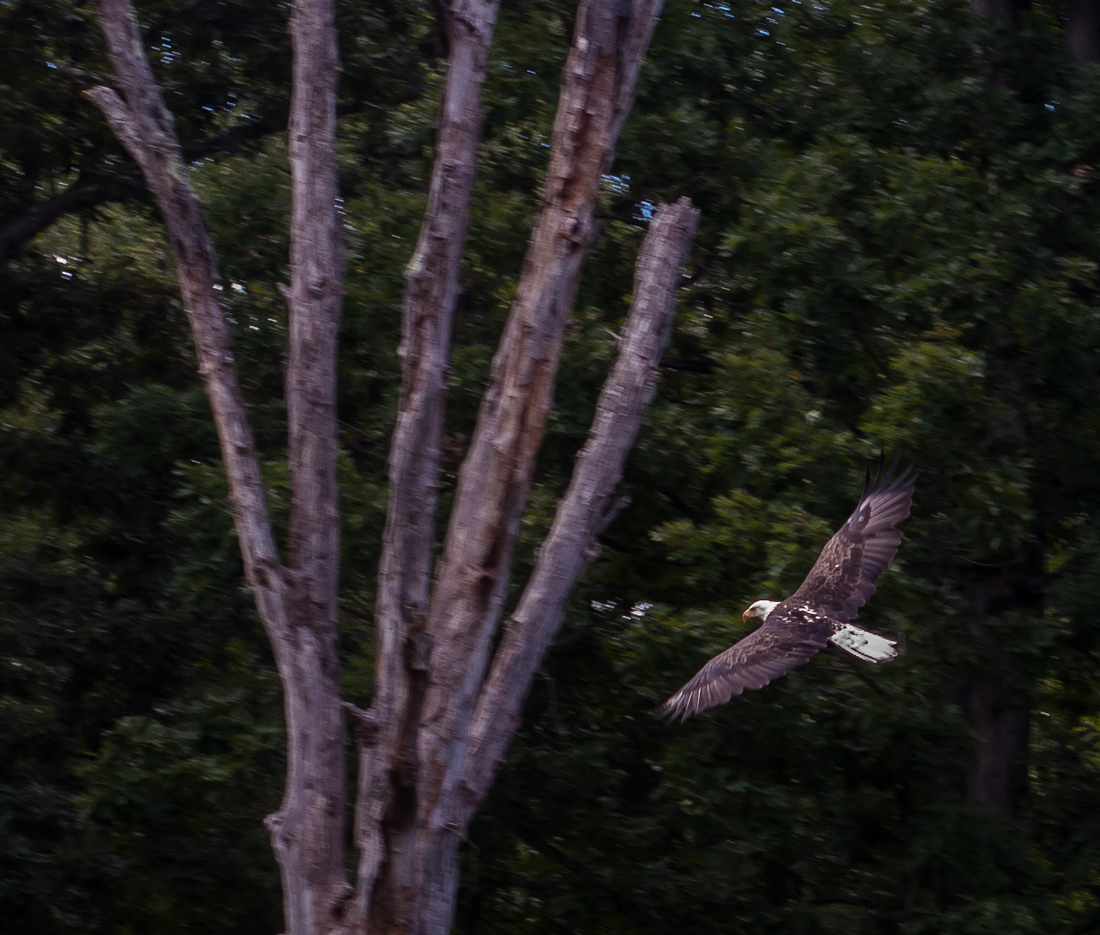
At this time of the year, most of the time I have a macro lens on my camera and I focus a lot on insects. Earlier this week, I was attempting to photograph a dragonfly with a 100mm macro lens when I heard the squawking on an approaching bird. Thinking perhaps that it was a hawk, I raised my camera and clicked off a series of shots as the bird flew by on the other side of a small pond.

Imagine my surprise when I looked at my images and realized that the bird was actually a Bald Eagle (Haliaeetus leucocephalus). There is something really special about Bald Eagles and I am thrilled every single time I see one.

Even with a crop sensor camera, a 100mm lens is not the right lens for shooting birds in flight at a distance, especially against a background of trees. I am posting a couple of shots simply to show that it is sometimes possible to get recognizable images of cool subjects even when the conditions and equipment are not optimal.

The images are also a reminder to myself to keep shooting and not wait for the perfect conditions to come together. If I wear out the camera, I can always get another one.

eagle1_blogeagle2_blog

© Michael Q. Powell. All rights reserved

Read Full Post »

Am I the only one who remembers a poster from the 1970’s featuring the slogan “Fly United” and depicting two ducks mating in mid-air?

That’s what immediately came to mind earlier this week when a pair of Great Blue Skimmer dragonflies (Libellula vibrans) flew by me at my local marsh. Anyone who has ever watched dragonflies mate knows that it is an acrobatic endeavor, requiring tremendous flexibility by both parties. Imagine trying to fly while still in the “wheel” position. Amazingly all of the wings seemed to able to move freely, though I didn’t notice if they were both using their wings for propulsion.

I was able to snap off these shots as the pair flew toward me over the water of a pond, which reflected wonderfully the blue sky and the clouds up above us.

wheel1_blogwheel2_blog

© Michael Q. Powell. All rights reserved

Read Full Post »

Normally when I think of saddlebags, I think of cowboys and the Pony Express, but there is also a species of skimmer dragonflies known as Black Saddlebags (Tramea lacerata). Someone obviously thought the dark patches on the hind wings looked like saddlebags.

Unlike many of the dragonflies that I often observe, Black Saddlebag dragonflies like to fly high in the air (and not low over the water) and some of them even migrate. I was alerted to their presence at my local marsh by a recent posting by a local dragonfly expert and fellow photographer Walter Sanford, so yesterday I kept one eye to the sky yesterday as I searched for subjects to photograph.

Black Saddlebags flew over me several times and I was fortunate to get some shots of one of them in flight. It might have been nice to have used a longer lens than the 100mm macro lens that I had on my camera at the time, but the shots turned out pretty well nonetheless. The first image is the sharpest image, but I like the entire sequence of the three images and the way in which they convey a sense of the environment in which I was shooting.

saddlebags1_blog The fi

saddlebags2_blogsaddlebags3_blog

© Michael Q. Powell. All rights reserved

Read Full Post »

The light reflecting off the water in the background was really bright, creating these disco ball highlights when I took these shots of a male Blue Dasher dragonfly (Pachydiplax longipennis) recently at Green Spring Gardens. Normally I try to avoid distinctive specular highlights, but in this case I decided to embrace them.

Why do I suddenly feel an irresistible urge to watch Saturday Night Fever?

disco1_blogdisco2_blog

© Michael Q. Powell. All rights reserved

Read Full Post »

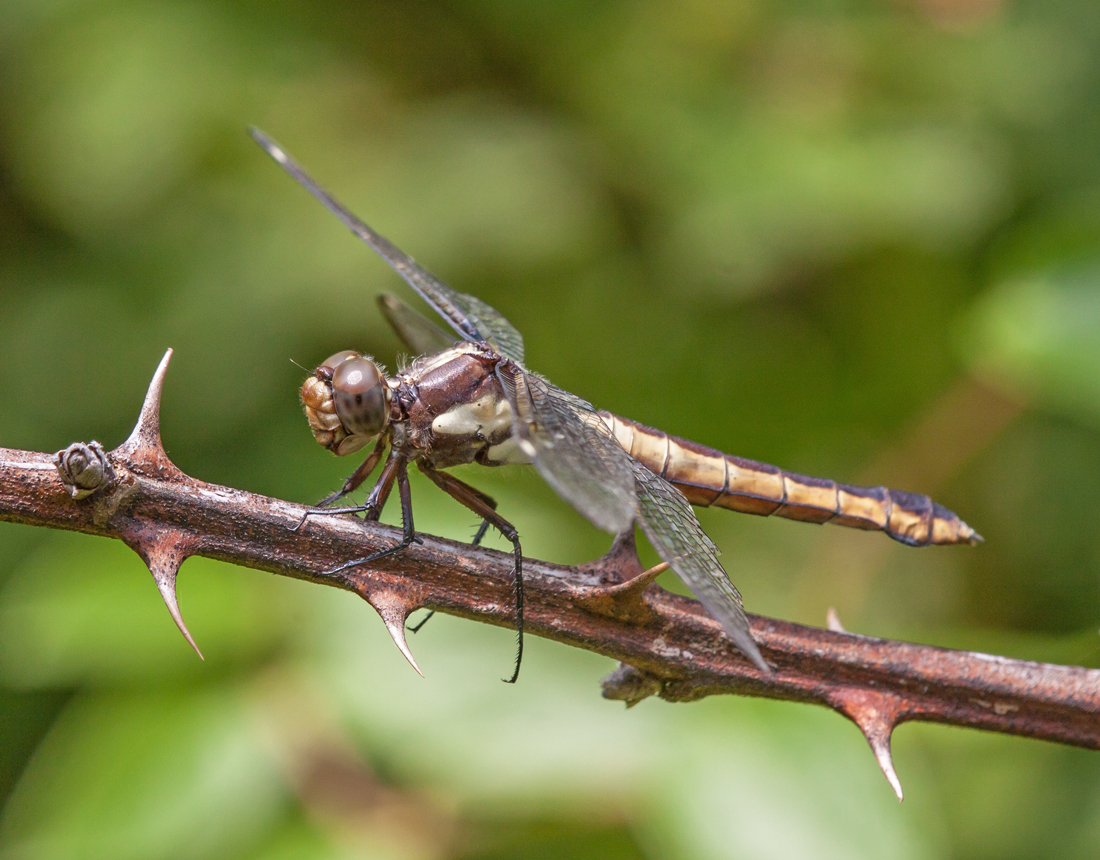
Have you ever found yourself in a thorny predicament? Last weekend, I came upon this female Spangled Skimmer dragonfly (Libellula cyanea) that had literally placed herself in such a situation.

Fortunately, dragonflies are so small, lightweight, and agile that she was able to place herself in between the thorns, out of harm’s way. If you look closely at her wings in the second image, however, you’ll see that they are tattered, suggesting that it’s been a tough season for her, probably as a result of predators, including overly aggressive male dragonflies.

thorny1_blogthorny2_blog

© Michael Q. Powell. All rights reserved

Read Full Post »

As I search in vain for larger, colorful butterflies, I continue to be amazed by the beauty of the smaller ones, like this Clouded Sulphur butterfly (Colias philodice) that I observed last week at Green Spring Gardens in Alexandria, Virginia.

Generally I like my closest shots the best when I am shooting with my macro lens, but in this case, I think I prefer the first shot below, that I took from a bit farther back. I like the way in which you can see the shadowy representations in the background of the stalks of the same kind of floweras the one one which the butterfly is feeding.

clouded2_blogclouded1_blog

© Michael Q. Powell. All rights reserved

Read Full Post »

When I started shooting regularly two years ago, I followed the lead of my mentor, Cindy Dyer, who specializes in flower photography, and spent a lot of time in gardens. (She photographs a wide range of  subjects, though, and I encourage readers to click on her name and check out the photos on her blog from a recent trip to Iceland.)

Last weekend I went back to my roots and visited a local garden with Cindy, where I spent some time with flowers and was only occasionally distracted by insects. Cindy helped me identify a toad lily and some zinnias, but we think the yellow flower is some kind of rudbeckia.

As I was shooting, I was particularly fascinated by the structure and patterns of the petals and by the amazing colors. The colors proved to be a challenge to render correctly and I am not entirely certain that I got the pinkish color of the zinnias true to life.

If you are viewing the original posting (and not it the Reader), click on any one of the thumbnail images to see the images in succession in larger size in slide show format. (I am still experimenting with using the Gallery options for displaying multiple images.)

toad_lily1_blog

© Michael Q. Powell. All rights reserved


Read Full Post »

Two years ago in a posting, I confessed to being obsessed with photographing Red milkweed beetles (Tetraopes tetraophthalmus). Inexorably I kept finding myself being drawn back to these bright red beetles.

I thought I had outgrown my obsession, until I encountered several of my little red friend this past weekend at Green Spring Gardens. I immediately reverted to my old behavior and began to stalk them like a paparazzo, trying to get a good shot or any shot at all.

My obsession continues.

Red Milkweed BeetleRed Milkweed BeetleRed Milkweed Beetle

© Michael Q. Powell. All rights reserved


Read Full Post »

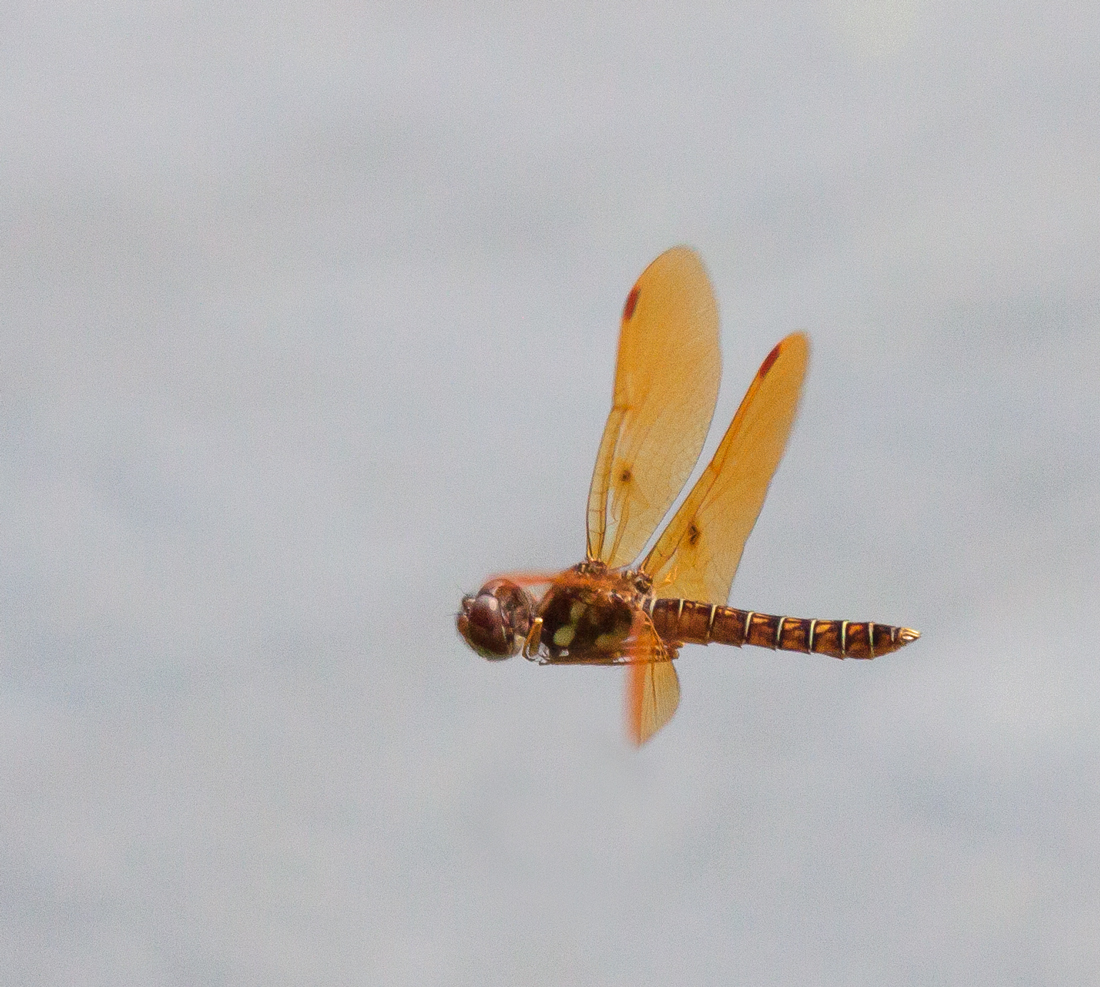
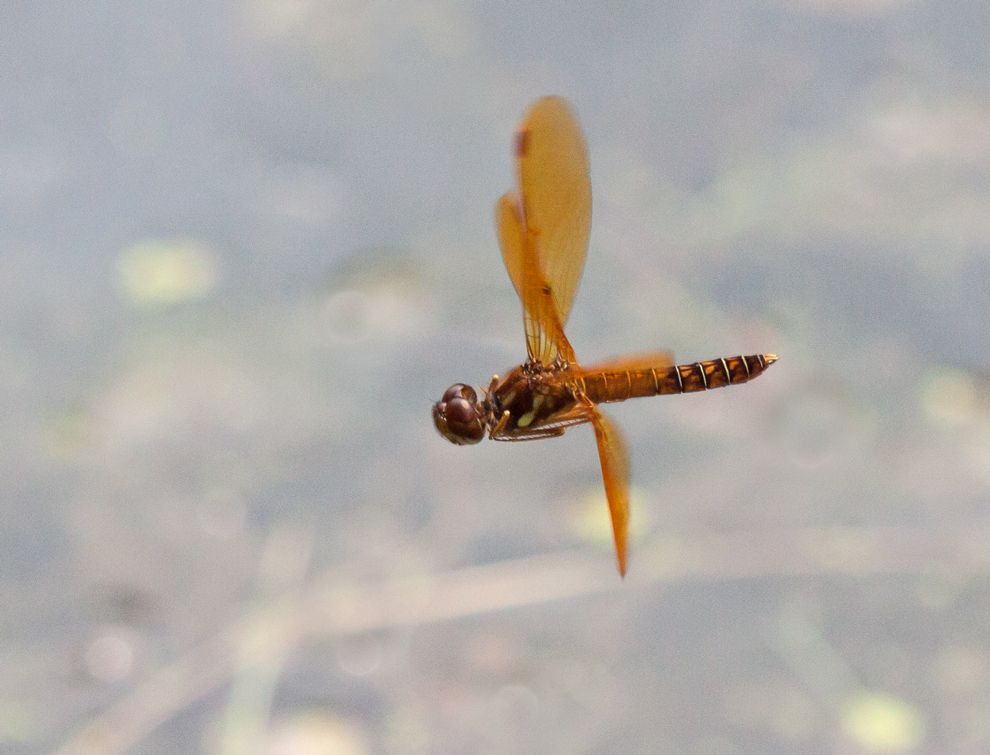
Photographing any dragonfly in flight is a real challenge, but this past weekend I spent time chasing after some of the smallest ones, the Eastern Amberwing dragonflies (Perithemis tenera). According to Bugguide, these dragonflies are typically 21-24mm in length, which is less than one inch, with a wingspan of maybe two inches or so.

amb2_fly_blog

There were lots of male Eastern Amberwings buzzing around the edges of a small pond at Green Spring Gardens, one of the local gardens that I like to visit. They were within range of the 180mm macro lens that I was using, but focusing and tracking were my biggest problems. The dragonflies did tend to hover a bit, which helped a little, but it was tough to get them in focus when focusing manually and almost impossible to do so with auto-focus.

I took a lot of shots and was happy that I managed to get some in decent focus, though I did have to crop the images. As I was preparing this posting, I noticed that I spent some time a year ago attempting to photograph the same dragonfly species. I think the results this year are marginally better, but you can make your own call by clicking on this link to the posting from July 2013.

amb4_fly_blogamb5_fly_blog amb3_fly_blog

amb1_fly_blog

© Michael Q. Powell. All rights reserved

Read Full Post »

A dragonfly perching on a heron? In real life it’s highly unlikely that you would see such a thing, but a male Blue Dasher dragonfly (Pachydiplax longipennis) decided that the metal silhouette of a Great Blue Heron (Ardea herodias) in a pond at Green Spring Gardens made a good spot to rest.

Click on any of the tiled images to see all of them full-sized in slide show mode.

Blue Dasher

© Michael Q. Powell. All rights reserved.


Read Full Post »
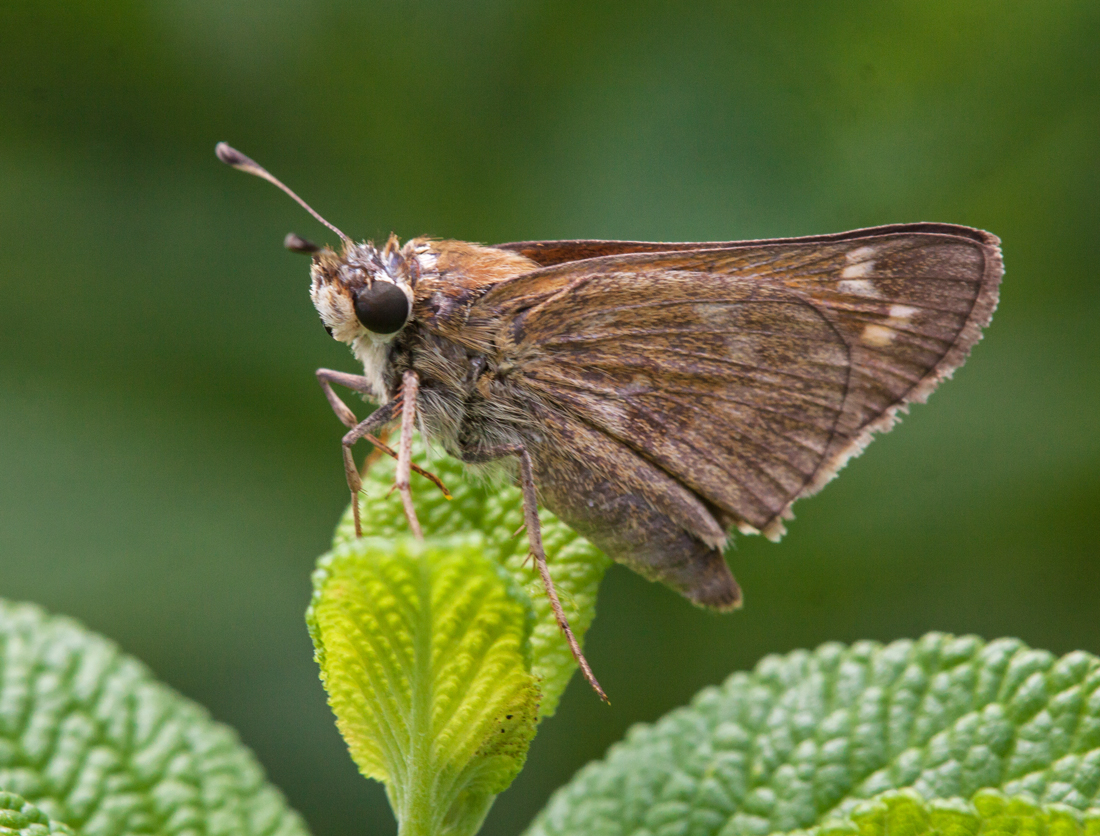
Small skipper butterflies don’t stand out as much as their larger, more colorful brethren, but they have an understated beauty that I find striking. It’s a daunting challenge, however, to identify them.

According to Wikipedia, there are more than 3500 recognized species of skippers worldwide, so I don’t feel too bad that my identification skills are weak in this area. As I looked through images on-line, I came across one identified as a Little Glassywing (Pompeius verna) that looks a bit like the one that I photographed, though my confidence level in this identification is pretty low.

I am confident, however, that I like the image I captured of the little skipper. There is a pretty good amount of detail, the background is blurred, and the leaves on which the butterfly is perched makes for an interesting pose.

UPDATE: A butterfly expert has definitively identified this as a female Sachem (Atalopedes campestris). Thanks to Joe Schelling and Jim Brock for their assistance in identifying this little skipper.

skipper1_blog

© Michael Q. Powell. All rights reserved.


Read Full Post »

In the shade of the flowering lotus plants, these two Eastern Pondhawk dragonflies (Erythemis simplicicollis) found a few moments for some summer lovin’. Summer lovin’, it happened so fast.

Eastern Pondhawks mating

© Michael Q. Powell. All rights reserved.

Read Full Post »

Even before they have bloomed, the buds of the Lotus flower (Nelumbo nucifera) can be spectacularly beautiful, like this one I photographed this past Monday at Green Spring Gardens, just a few miles from where I live in Northern Virginia.

lotus bud

© Michael Q. Powell. All rights reserved.

Read Full Post »

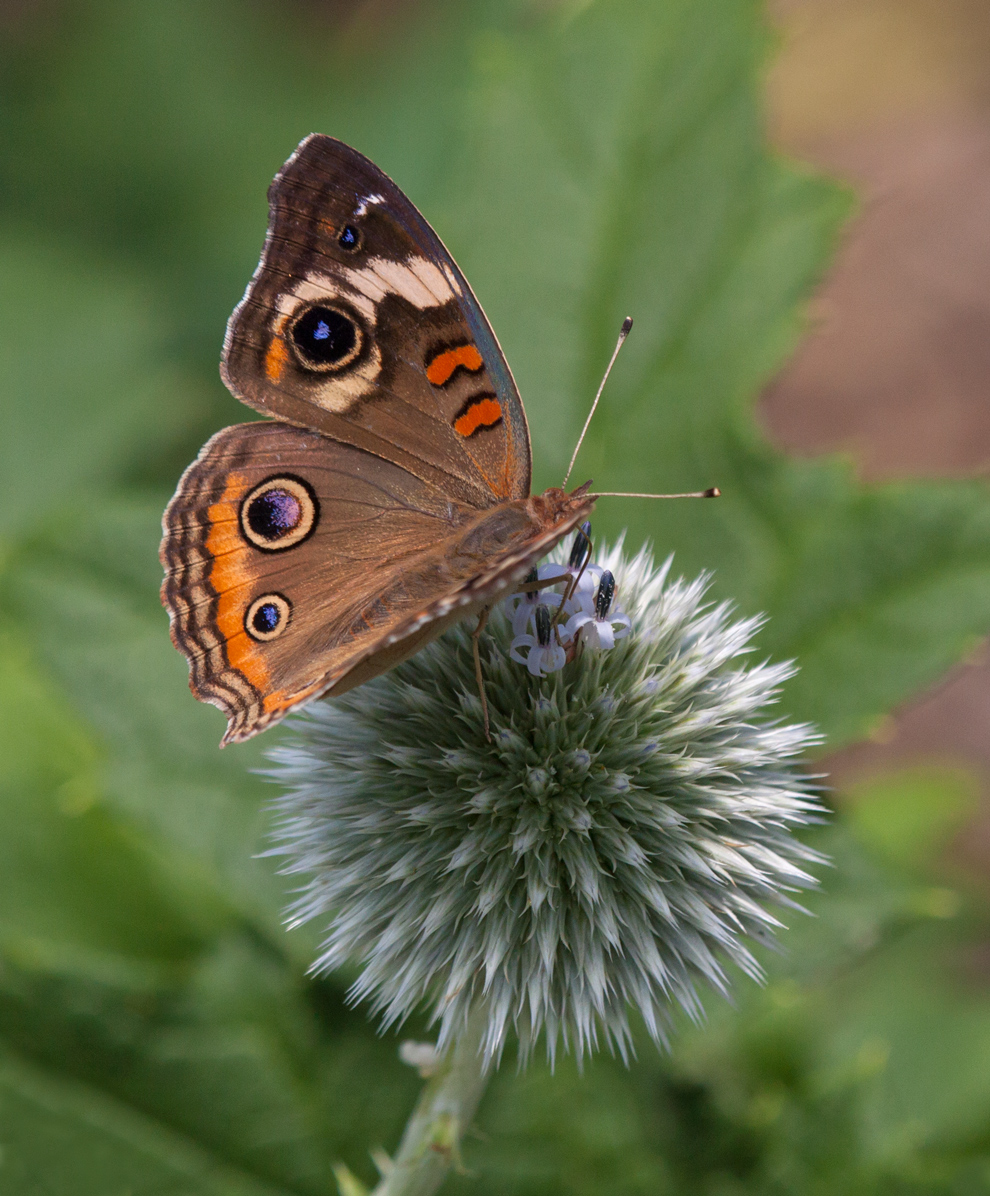
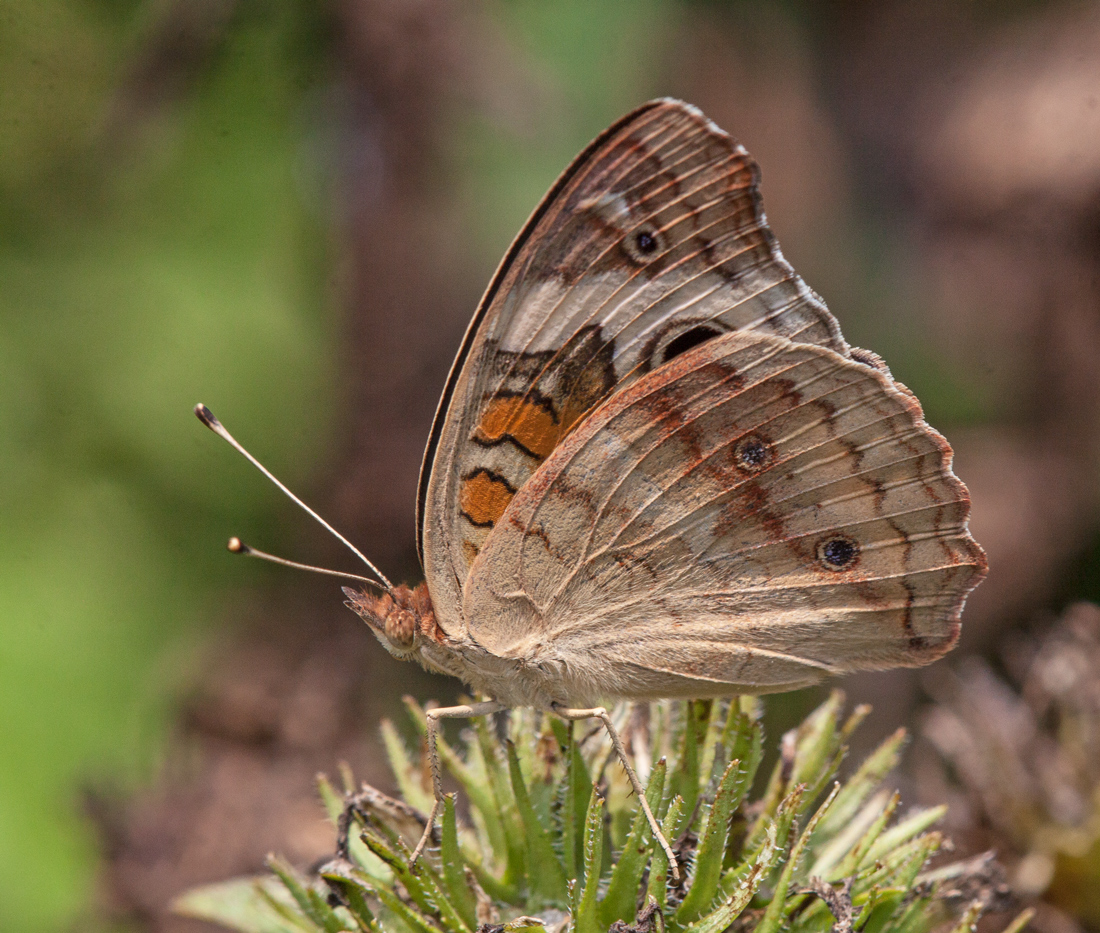
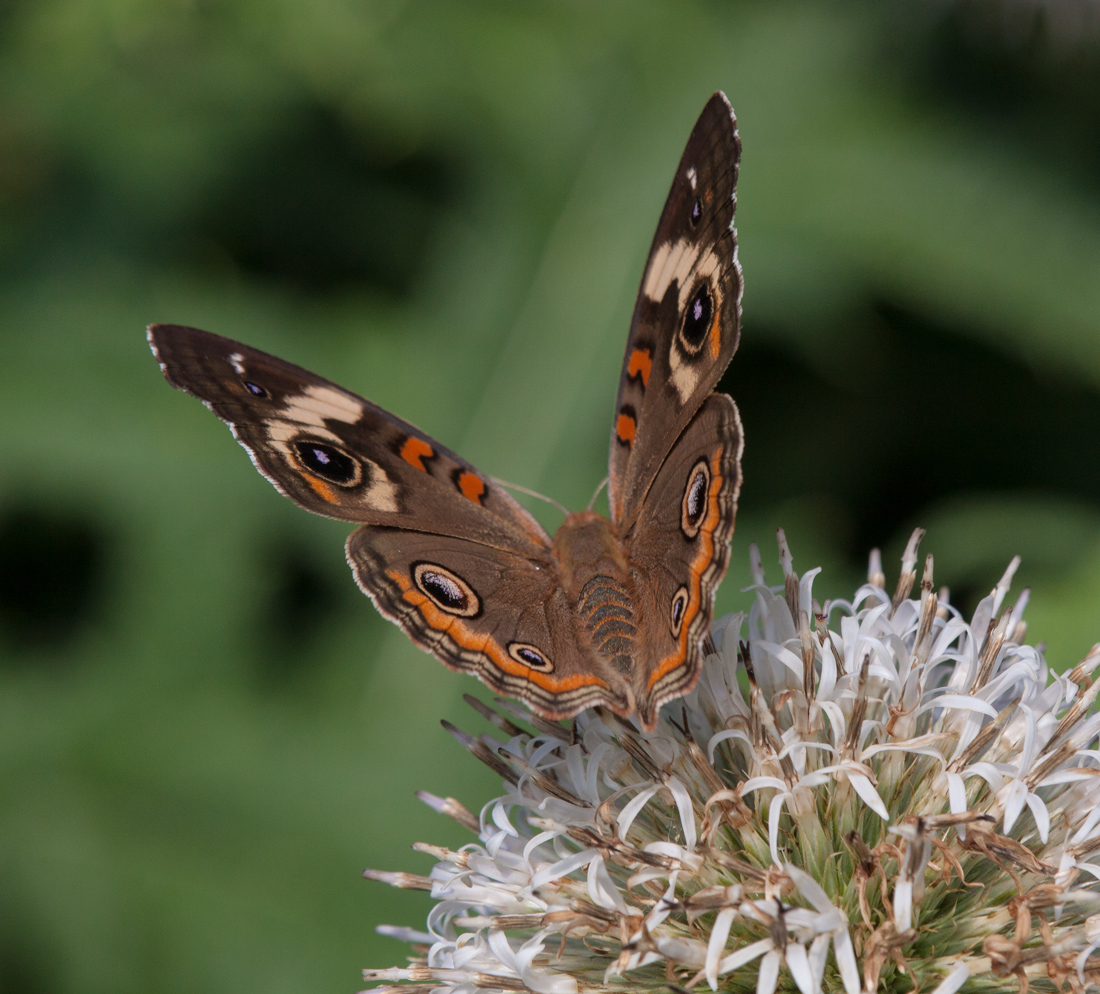
Although I don’t live in Ohio, nicknamed “The Buckeye State,” I think that I can claim that Virginia also is a Buckeye state, because we are a home to the uncommonly beautiful Common Buckeye butterfly (Junonia coenia).

Common Buckeye butterfly

I have seen few colorful butterflies so far this summer, besides the Great Spangled Fritillary butterflies that I featured in a posting in June. Where are all the Monarchs and Eastern Swallowtails? I don’t know if they were affected by the polar vortex of this past winter or if I am merely looking for them in all the wrong places, but their numbers seem to be unusually low this summer.

I was therefore thrilled this past Monday, when I caught sight of this Common Buckeye. Its coloration is so distinctive that I immediately recognized it and chased after it a bit. Fortunately I was able to capture several images of this beautiful creature before it flew out of sight.

Looking at these images, I am happy to proclaim that I live in a Buckeye state.

buckeye3_blog

buckeye2_blog

© Michael Q. Powell. All rights reserved.

Read Full Post »

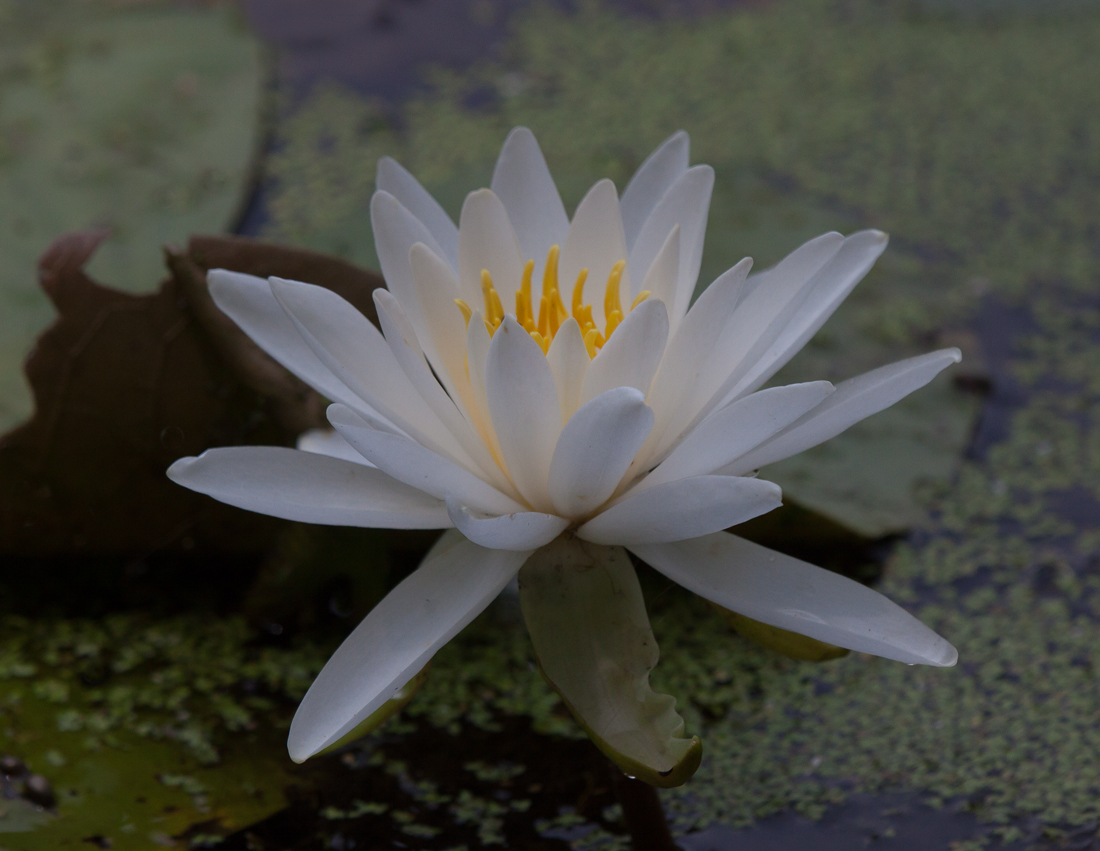
Some amazingly beautiful water lilies were in bloom at a local garden yesterday morning and seemed to be glowing from within.

Green Spring Gardens is a county-run historic garden just a few miles from where I live. I used to shoot there really often, but have been spending more time instead at my local marshland park. A couple of recent postings by Rob Paine on his blog I see beauty all around reminded me of the beauty of this garden and I spent several hours there yesterday, getting shots, primarily of the water lilies, lotus flowers, and dragonflies.

This image is a sneak preview of yesterday’s shoot, with more to follow in the near future.

lily1_blog

© Michael Q. Powell. All rights reserved.


Read Full Post »

« Newer Posts