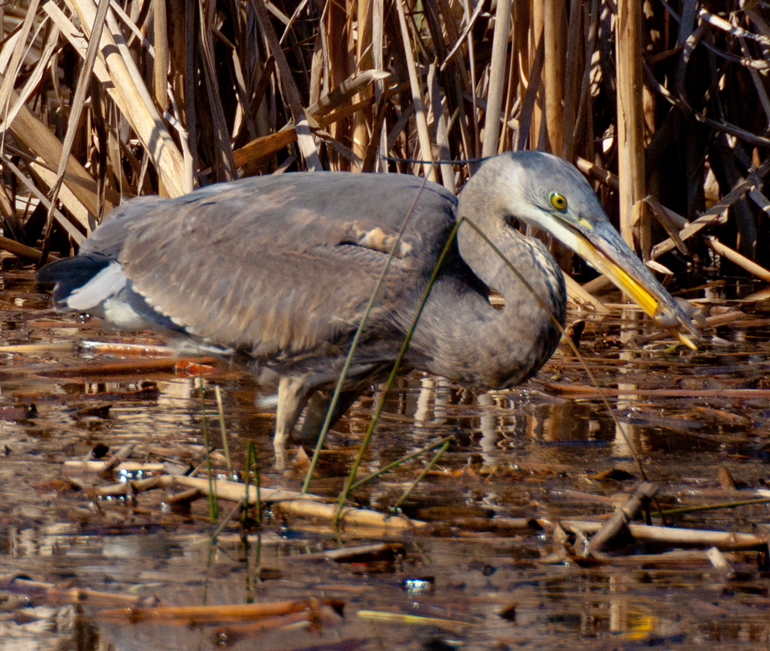
A Great Blue Heron this weekend was poised, waiting to strike, and I waited with my camera and my tripod, hoping to capture the moment of triumphal success.
I had visions of the heron pulling some big fish out of the water, like I see in Phil Lanoue‘s incredible photos, and watching as he struggled to swallow it whole.
The reality, as you can see, was much more modest. After all, the Great Blue Heron (Ardea herodias) was fishing in the beaver pond at my local marsh and the pickings were pretty slim. Initially, I though he had caught a frog, but the photo suggests it was a small fish, though it is hard to tell for sure because of the catch’s small size.
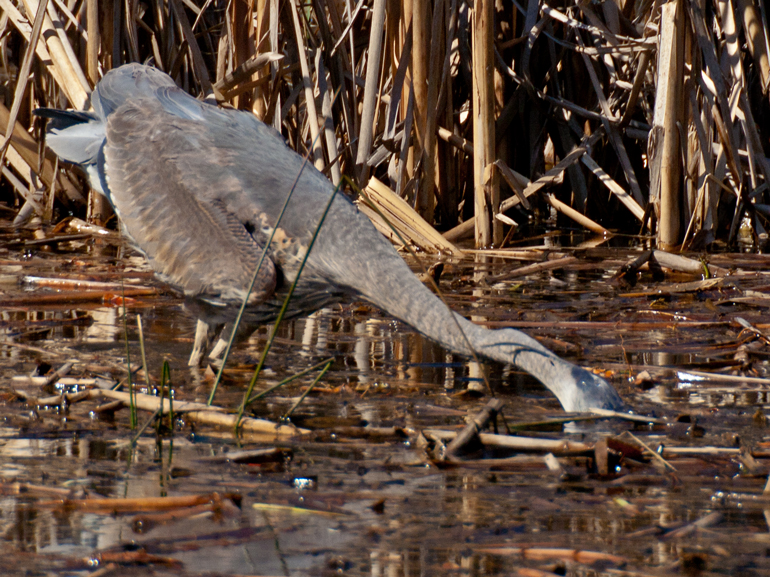
The second photo shows his pre-strike position. The heron stood motionless in this position for what seemed like an eternity. I am amazed that he could see anything in the shallow, reed-covered water.
When he struck, he didn’t even have to put his head very deeply into the water or use a lot of force to catch the fish. The final shot shows the heron swallowing his catch. It did not take any special maneuvering to get the little fish down his throat.
I saw a heron hanging around the same beaver pond the following day. I hope he is not spending all of his time in this one location or I may end up photographing a really skinny heron in the future.


Michael Q. Powell. All rights reserved



















Daunting challenge
Posted in Birds, commentary, Nature, Photography, Winter, tagged Canon Rebel XT, Dryocopus pileatus, Huntley Meadows Park, Melanerpes carolinus, Pileated Woodpecker, Red-bellied Woodpecker, Sigma 135-400mm telephoto zoom lens, woodpecker on April 11, 2013| 8 Comments »
Most often I see small woodpeckers high up in the trees, pecking at the smaller branches there, but this male Red-bellied Woodpecker (Melanerpes carolinus) seemed determined to take on the challenge of the trunk of this substantial-sized tree. I really like his pose, as he appears to be contemplating how best to tackle this problem.
Does he dream of great things, like excavating holes in trees like those in the second and third photos? Maybe he was an orphan and was raised by a family of Pileated Woodpeckers and doesn’t recognize any limitations in his size.
I am still trying to get photos of the larger woodpeckers that made the impressive series of holes. I hear a jackhammer-like sound when they are working, but they manage to elude me each time.
For now, I am content with my photo of the smaller woodpecker, attempting to punch above his weight class.
Michael Q. Powell. All rights reserved
Share this:
Read Full Post »