Feeds:
Posts
Comments

Archive for the ‘dragonfly’ Category

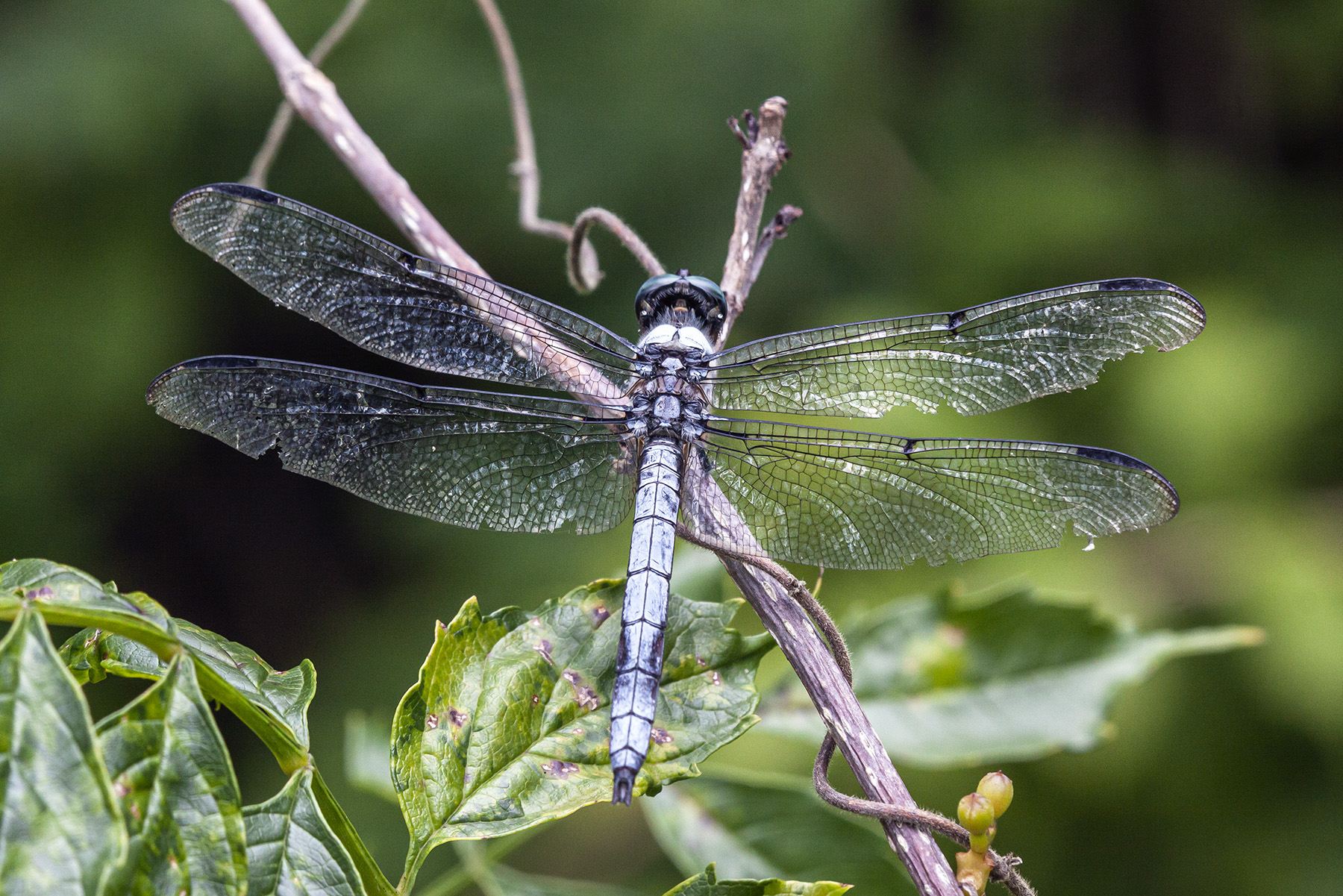
Great Blue Skimmer dragonflies (Libellula vibrans) are really common, but I enjoy photographing them anyways, like this grizzled male that I spotted earlier this week at Jackson Miles Abbott Wetland Refuge. The curling vines of the plant on which this dragonfly chose to perch add some additional visual interest to these photos.

I must confess that ordinary blue dragonflies have a special place in my heart, because my very first blog posting on July 7, 2012 featured a photo of a Blue Dasher, another common species. My photography skills and my knowledge about dragonflies have increased significantly since that time, though I am still quite proud of that initial photo that started me on this long journey into photography.


blue dasher

Blue Dasher

© Michael Q. Powell. All rights reserved.

Read Full Post »

As many of you know, I love trying to capture images of dragonflies in flight. This Slaty Skimmer dragonfly (Libellula incesta) cooperated by periodically hovering a bit during a recent trip that I made to Jackson Miles Abbott Wetland Refuge. The first two images show you some of the details of the dragonfly’s body, including the way it tucks in its legs when in flight, and the final image gives you a wider view of the environment in which I was shooting.

Slaty Skimmer

slaty skimmer

slaty skimmer

© Michael Q. Powell. All rights reserved.

Read Full Post »

Last Friday I spotted this handsome adult male Calico Pennant dragonfly (Celithemis elisa) while exploring Occoquan Bay National Wildlife Refuge with my friend and fellow dragonfly enthusiast Walter Sanford.  Earlier this month I did a posting entitled Mosaic Wings that featured a photo of an immature male of this same species that had a bright yellow body. This image gives you an idea of how the body color changes to red as the male Calico Pennant dragonfly matures.


Calico Pennant

© Michael Q. Powell. All rights reserved.

Read Full Post »

This tattered male Great Blue Skimmer dragonfly (Libellula vibrans) seemed to be auditioning for a role as a replacement for the goose on this sign on Monday at Occoquan Bay National Wildlife Refuge. Or perhaps he was merely seeking a place of refuge—all dragonflies are welcome here.

Great Blue Skimmer

© Michael Q. Powell. All rights reserved.

Read Full Post »

Dragonfly wings are amazing, but most of the time they are so transparent that it is hard to see all of the tiny little “cells” that make up the wings. Last Friday, though, I captured this shot of an immature male Calico Pennant dragonfly (Celithemis elisa) at Occoquan Bay National Wildlife Refuge that really highlights the beautiful mosaic-like pattern of its hind wings. Wow!

Calico Pennant

© Michael Q. Powell. All rights reserved.


Read Full Post »

Does you mood affect how you react to images? When I am reviewing images that I have captured, most of the time I use an analytical approach. I seek to identify the species of my subject and then look at the technical aspects of the photo, such as the sharpness of the focus. Finally I will see if I can improve the composition by cropping the image.

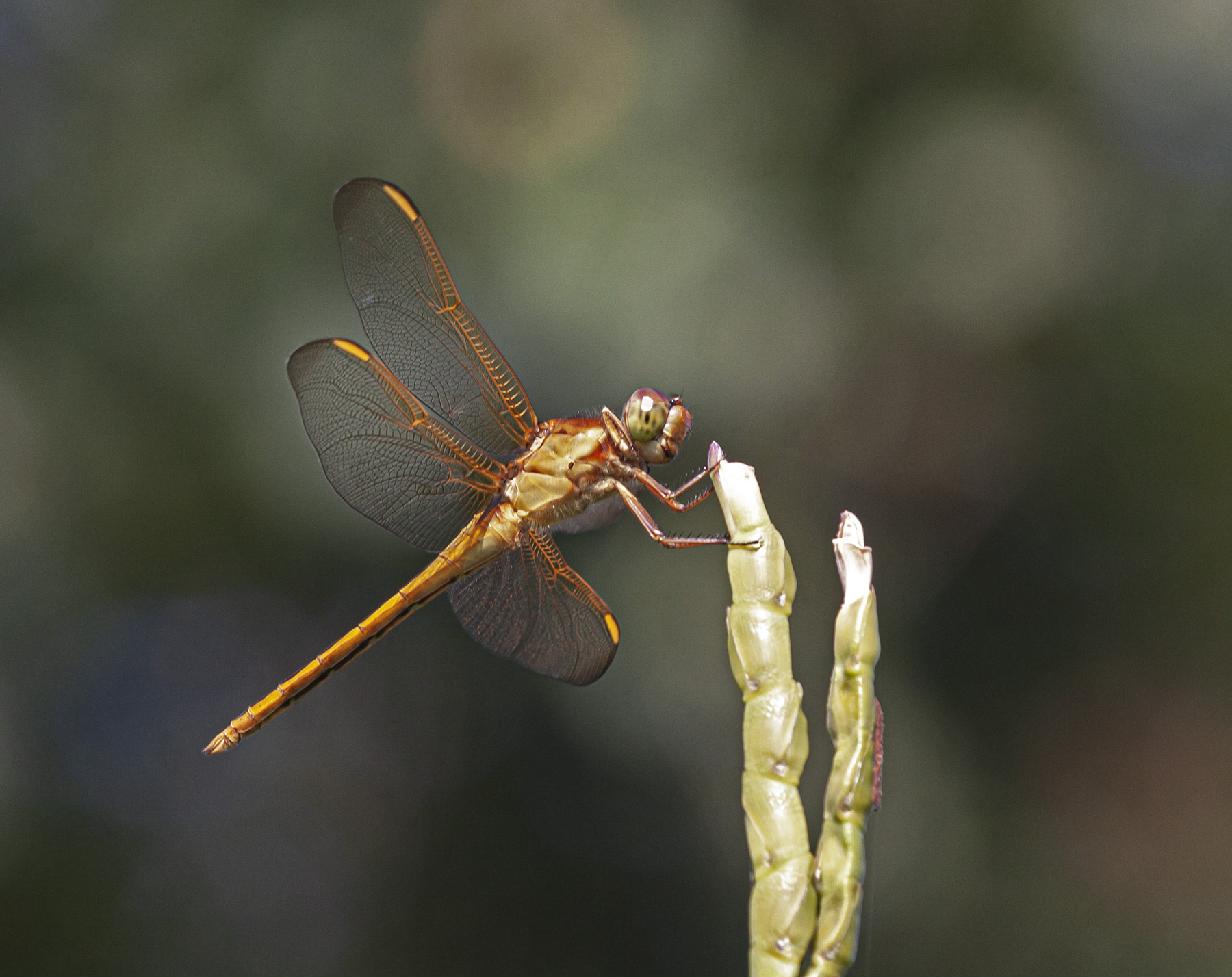
For some images, though, I respond initially with my heart and not my head. I don’t worry about “what” it is and simply enjoy the beauty of the shapes and colors that make up the image. That was the case with this shot of a male Needham’s Skimmer dragonfly (Libellula needhami) that I captured during a recent visit to Occoquan Bay National Wildlife Refuge.

I love the contrast between the orangish-red of the dragonfly’s body and the green background. The shape and texture of the vegetation, which I believe is Eastern Gamagrass (Tripsacum dactyloides), also really grabbed my eye (in part because I missed focus a little and the sharpest part of the image is the grass in front of the dragonfly). The composition is simple and straightforward and is pretty much the way I shot it.

We all like what we like. Most often we don’t even ask ourselves why we like something. I personally find it beneficial to try to articulate why I like something. Words fail me quite often when attempting to describe with words what is primarily an emotional reaction, but I think that the effort itself makes the process worthwhile.

Needham's Skimmer

© Michael Q. Powell. All rights reserved.

Read Full Post »

Are you always in search of new subjects or are you content to photograph the same subjects over and over again? Several years ago I came across an author who described two different types of people—those who prefer to live “widely” and those who prefer to live “deeply.” Those in the first group are always seeking new experiences and traveling to new places and, as photographers, are constantly looking for new things to photograph. By contrast, those in the second group are looking for a deeper experience and are likely to repeatedly return to the same locations over and over and photograph the same limited set of subjects.

As you might suspect, I see myself primarily as a member of the second group. Many of you have undoubtedly noted that I tend to hang out a lot in the same wildlife refuges throughout the year and often photograph familiar subjects. Why? For me, each encounter is unique—the lighting is different, the poses are different, and the age and genders of my subjects vary. I enjoy documenting the seasonal changes in fora and fauna at these locations. Each time I strive to capture different and, if possible, better images.

So, I am posting another photo of a Halloween Pennant dragonfly (Celithemis eponina), even though I posted several images of this species last week. My angle of view for this image from this past weekend was better; the lighting was coming from a better direction; and the slight breeze prompted the dragonfly to move its wings in a way that created a better pose. Consequently, I like this image more than the ones I posted earlier.

My simple approach to blog postings is to present something that is interesting to viewers. The photos may be visually appealing or show details or behavior that you may not have noticed before. You may learn something from my words or may have a better understanding of how the images came into being. Each day we have new opportunities to fill our lives with beauty and meaning. Photography and blogging have become part of my daily journey and I feel blessed to be able to share my experiences with so many of you.

Halloween Pennant

© Michael Q. Powell. All rights reserved.

Read Full Post »

What is the best way to photograph a dragonfly that perches low to the ground? How can you create an image in which the dragonfly is not lost amidst the clutter of the vegetation? That was the challenge that fellow dragonfly enthusiast Walter Sanford and I faced last Monday when we journeyed to Riverbend Park in Great Falls, Virginia  in search of Eastern Ringtail dragonflies (Erpetogomphus designatus).

Walter has a lot of experience with dragonflies and knew where to find Eastern Ringtails in the park. He knew, for example, that they like to perch on a section of concrete aggregate and indeed we spotted one not long after we arrived. Walter likes to maximize the chance of getting the entire dragonfly in focus by shooting downwards, ideally from as close to overhead as possible. For him, the concrete background is uncluttered and allows him to capture all of details of the dragonfly.

Although I prefer to photograph dragonflies on natural vice manmade surfaces, I took some photos, including the third one below, while the dragonfly was on the concrete—you have to shoot when the opportunity arises and I was not confident that I could wait for the dragonfly to choose a better perch. Rather than shooting from above when the dragonfly is on the ground, I usually choose to get down with the dragonfly.

Eventually I was able to get some shots of Eastern Ringtails perched in the grass. The middle image shows the dragonfly tilting its head to look towards me as I photographed it. I like the pose, but I was not fully satisfied. Those of you who have followed my blog for a while know that I like to get as close to a dragonfly as it will let me. The initial photo of this posting was one of my final shots of my session with the Eastern Ringtails and it is probably my favorite.

I began this post with a question and feel like I owe you a response. In reality, there is no “best” way to photograph a dragonfly on the ground, but my preferred option is to get low to the ground and close to the subject so that I am able to focus on part of the dragonfly, hopefully the eyes, and blur out the background because of the shallow depth of field when shooting that close. If you would like to see Walter’s wonderful photos of Eastern Ringtails from the same trip, I encourage you to check out his blog postings Eastern Ringtail reunion, continued and  Reconnecting with Eastern Ringtail. Those postings provide his visual response to the question that I posed.

Eastern Ringtail


Eastern Ringtail

Eastern Ringtail

© Michael Q. Powell. All rights reserved.

Read Full Post »
Although we still have quite a lot of summer remaining, some of my favorite dragonfly species have already disappeared for the season. I have been fortunate this year to see Gray Petaltail dragonflies (Tachopteryx thoreyi) on multiple occasions in several different locations. A little over a week ago I spotted this one at Occoquan Regional Park on the date that the Dragonflies of Northern Virginia website lists as the tail end of the season for this species. It is quite possible that I will have to wait until next year to see another one.

Gray Petaltails are remarkable dragonflies. They will sometime perch on you, which can be a bit disconcerting because they are so large and you can hear them when they fly by your head. Additionally, many scientists view this species as an ancient one. According to the website cited above, Gray Petaltails are “our oldest and most primitive dragonfly; species almost identical to petaltails flew alongside dinosaurs during the Jurassic period. Imagine petaltails and a herd of Brontosaurus sharing the same giant, fern-filled forests.”

It is hard to know exactly how long dragonflies have been around, but according to Wikipedia, fossils of very large dragonfly ancestors with wingspans of 30 inches (750 mm) have been found that are 325 million old. Given the ferocity of most dragonflies as predators, I am happy that modern day dragonflies are quite a bit smaller in size.


Gray Petaltail


© Michael Q. Powell. All rights reserved.


Read Full Post »

Last Thursday I spotted this beautiful Halloween Pennant dragonfly (Celithemis eponina) perched on a very photogenic plant at Occoquan Bay National Wildlife Refuge. I love the curlicue curves of the plant that remind me of ornamental wrought iron.

The perch in the second and third images is not as interesting, but I thought that I would share those images because of the way that I was able to capture the sky and the clouds in the background. As you can probably tell, the vegetation was really high and I was shooting at an upwards angle.


Halloween Pennant

Halloween Pennant

Halloween Pennant

© Michael Q. Powell. All rights reserved.

Read Full Post »

Calico Pennants (Celithemis elisa) have really distinctive markings and are among the prettiest dragonflies in our area. I spotted this female Calico Pennant on Thursday at Occoquan Bay National Wildlife Refuge. As is usually the case for pennant dragonflies, she was perched on the very tip of the vegetation. As a slight breeze began to blow, she seemed to be holding on tightly with her tiny feet.

Calico Pennant

© Michael Q. Powell. All rights reserved.

Read Full Post »

Eastern Amberwings (Perithemis tenera) are one of the smallest dragonfly species where I live—less than one inch (25 mm) in length. I often see the amber-colored males buzzing around at the ponds that I visit, but it is rare for me to find a female.

According to the wonderful website Dragonflies of Northern Virginia, female Eastern Amberwing dragonflies are often found far from the water in meadows where they share perches with hornet and other wasps. When they are threatened, these dragonflies will rhythmically move their wings up and down while pulsing their abdomens in imitation of a wasp in order. Their goal is to scare off potential predators that believe they are about to be stung.

I spotted this tiny beauty yesterday while I was exploring Occoquan Bay National Wildlife Refuge. I was, in fact, far from the water when I photographed her.  She posed briefly, it seemed, when I raised my camera and seemed to smile a little.

Eastern Amberwing

© Michael Q. Powell. All rights reserved.

Read Full Post »

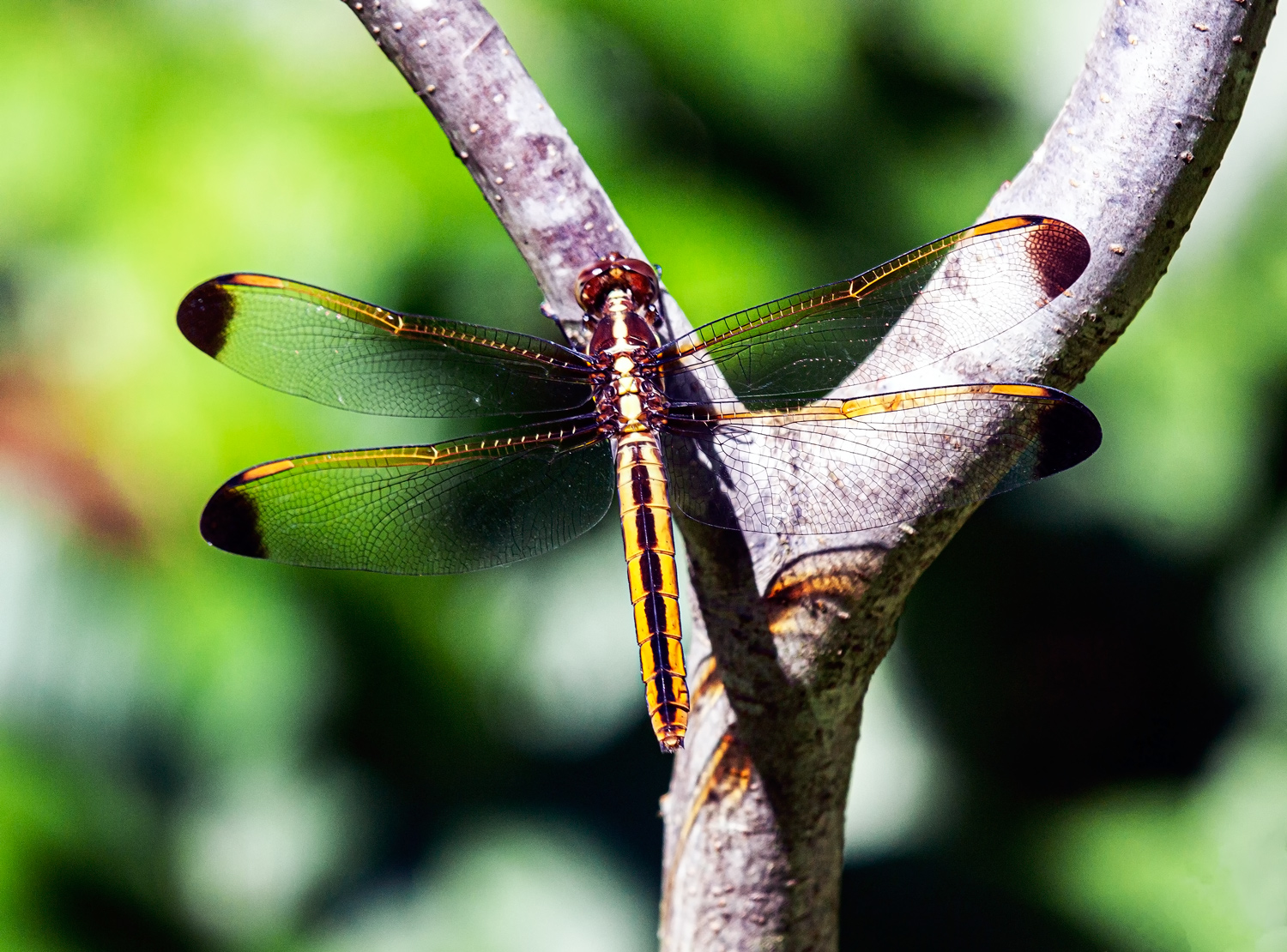
Last week I spotted this female Needham’s Skimmer dragonfly (Libellula needhami) at Occoquan Bay National Wildlife Refuge. The direct sunlight was a little harsh, but the high perch of the dragonfly allowed me to capture a beautiful, uncluttered background.

I love the golden edges of the wings of this species and the wonderful two-toned eyes of the females like this one. It was an additional bonus that she seemed to be smiling for her moment in the spotlight.

Needham's Skimmer

© Michael Q. Powell. All rights reserved.

Read Full Post »

Eastern Pondhawk dragonflies (Erythemis simplicicollis) are voracious predators and I spotted this female pondhawk munching on another insect this past Tuesday at Occoquan Bay National Wildlife Refuge. At this time of the year the vegetation has grown high in many of the locations that I visit and I am now seeing more dragonflies perching at eye level or even higher. This heightened perspective allows me to get some cool, uncluttered backgrounds, like the one in this image that reminds me of a watercolor painting.

Eastern Pondhawk

© Michael Q. Powell. All rights reserved.

Read Full Post »

Dragonflies perch in a lot of different ways. Some perch at the top of vegetation, some perch in the middle, and some, like this Unicorn Clubtail dragonfly (Arigomphus villosipes) like to perch low to the ground or, in this case, to the surface of the water. I don’t see Unicorn Clubtails very often, so I was excited to see this one on Tuesday at Occoquan Bay National Wildlife Refuge in a marshy pond filled with lily pads.

I had two cameras with me when I encountered the dragonfly. The second image below shows the view from my DSLR with a 180mm macro lens. I really like the way that the shot gives you a sense of the environment and when I was processing the image I paid as much attention to the surroundings as I did to the dragonfly.

My Canon SX50 let me zoom in a lot closer to the dragonfly, as you can see in the first shot, and captured more details of the dragonfly. I like aspects of both images and think that together they provided complementary views of this wonderful dragonfly. You can’t really see it in these shots, but members of this species have a little protrusion in between their eyes, which prompted someone to name them “unicorns.”


Unicorn Clubtail

unicorn clubtail

© Michael Q. Powell. All rights reserved.


Read Full Post »

Life can be tough and can wear you down if you are a prince, at least if you are a Prince Baskettail dragonfly (Epitheca princeps). Last Saturday I spent a pretty good amount of time observing Prince Baskettails patrolling a pond at Jackson Miles Abbott Wetland Refuge.

As I am wont to do, I tried to photograph them in flight and managed to get a few shots in focus. As I reviewed the images, I couldn’t help but notice that the wings of all of the dragonflies were worn down and/or damaged. I am used to seeing such damage with dragonflies that fly through thickets and heavy vegetation, but I was a little surprised to see it with dragonflies that seem to spend most of the time flying over open water.

As we move deeper into summer, I am certain to encounter more and more dragonflies with damaged wings. I am always amazed to see that such dragonflies are still capable of amazing aerial acrobatics despite their physical limitations—somehow they manage.

Prince Baskettail

Prince Baskettail

Prince Baskettail

© Michael Q. Powell. All rights reserved.

Read Full Post »
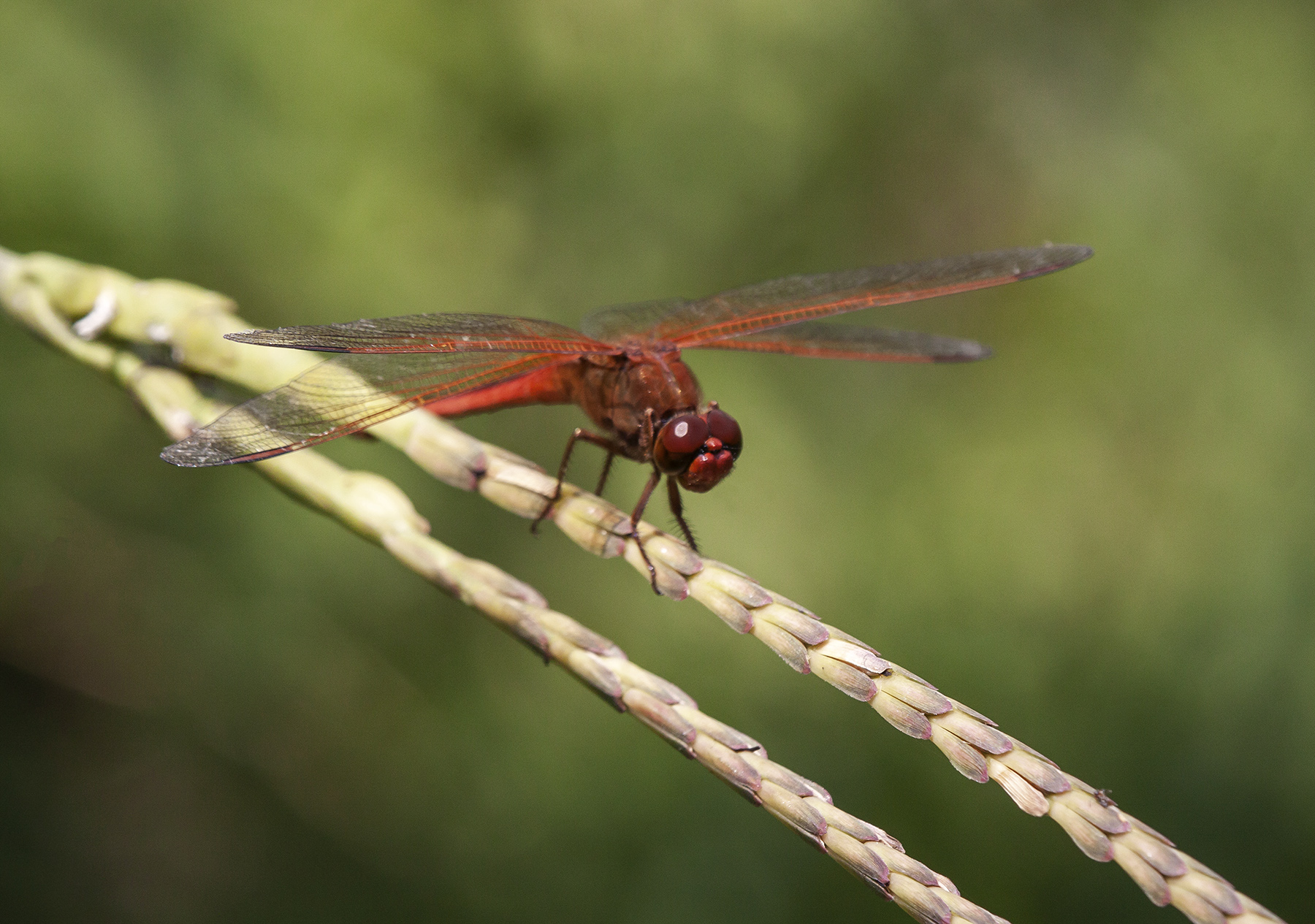
Normally a dragonfly’s abdomen is straight. Occasionally, though, I encounter one with an abdomen that has a noticeable curve, like this male Eastern Pondhawk dragonfly (Erythemis simplicicollis) that I spotted yesterday at Jackson Miles Abbott Wetland Refuge. (For those of you not familiar with dragonfly anatomy, the upper portion of the body is the thorax and the lower two-thirds is the abdomen.)

I suspect that the curvature was the result of a problem that occurred when the dragonfly was first emerging. It does not seem to have any effect on his ability to fly or to catch prey, but it might pose a problem when he attempts to mate.

Eastern Pondhawk

© Michael Q. Powell. All rights reserved.

Read Full Post »

Should I present a subject in landscape mode or portrait mode? That is a question I face frequently when I am composing photos initially and later when I am processing the images. Some subjects or scenes lend themselves naturally to one of the modes, but often it is not clear which one will be more effective. I remember reading somewhere that it is best to take shots from multiple angles, at varying distances, and using multiple modes and I try to follow that advice whenever I can.

This past week I encountered a large dragonfly as I was exploring a small creek in Prince William County, Virginia. The creek was mostly in the shadows and I was unable to identify the species of the dragonfly until it perched on a sun-lit tree. Then it was easy to determine that it was a Gray Petaltail dragonfly (Tachopteryx thoreyi).

The dragonfly was pretty cooperative and I was able to take multiple shots, two of which I have included in this posting. From an artistic perspective I particularly like the first image, which gives equal weight to the dragonfly and to the environmental elements. The second image draws your attention more to the details of the dragonfly and give greater emphasis to the texture of the tree.

Are you drawn more to one of the two images? If so, why? I know how I react to my own images and am always curious to hear what you think and/or feel about them.

Gray Petaltail

Gray Petaltail

© Michael Q. Powell. All rights reserved.

Read Full Post »

A couple of weeks ago I posted a photo of a Black-shouldered Spinyleg dragonfly (Dromogomphus spinosus) that prompted one of my readers, Molly Lin Dutina of Treasures in Plain Sight, to comment, “Spinyleg —sounds like something a child would be afraid of!” That photo, alas, did not give a very good view of the spiny legs.

This week, however, as I was exploring a creek in Prince William County, Virginia, I was fortunate to capture some images of a Black-shouldered Spinyleg that show off those fearsome spines. If you click on the image below and focus your attention on the back legs, you will see the long pointed spines that help the dragonfly hold on to prey.

Ouch! 

Black-shouldered Spinyleg

© Michael Q. Powell. All rights reserved.

Read Full Post »
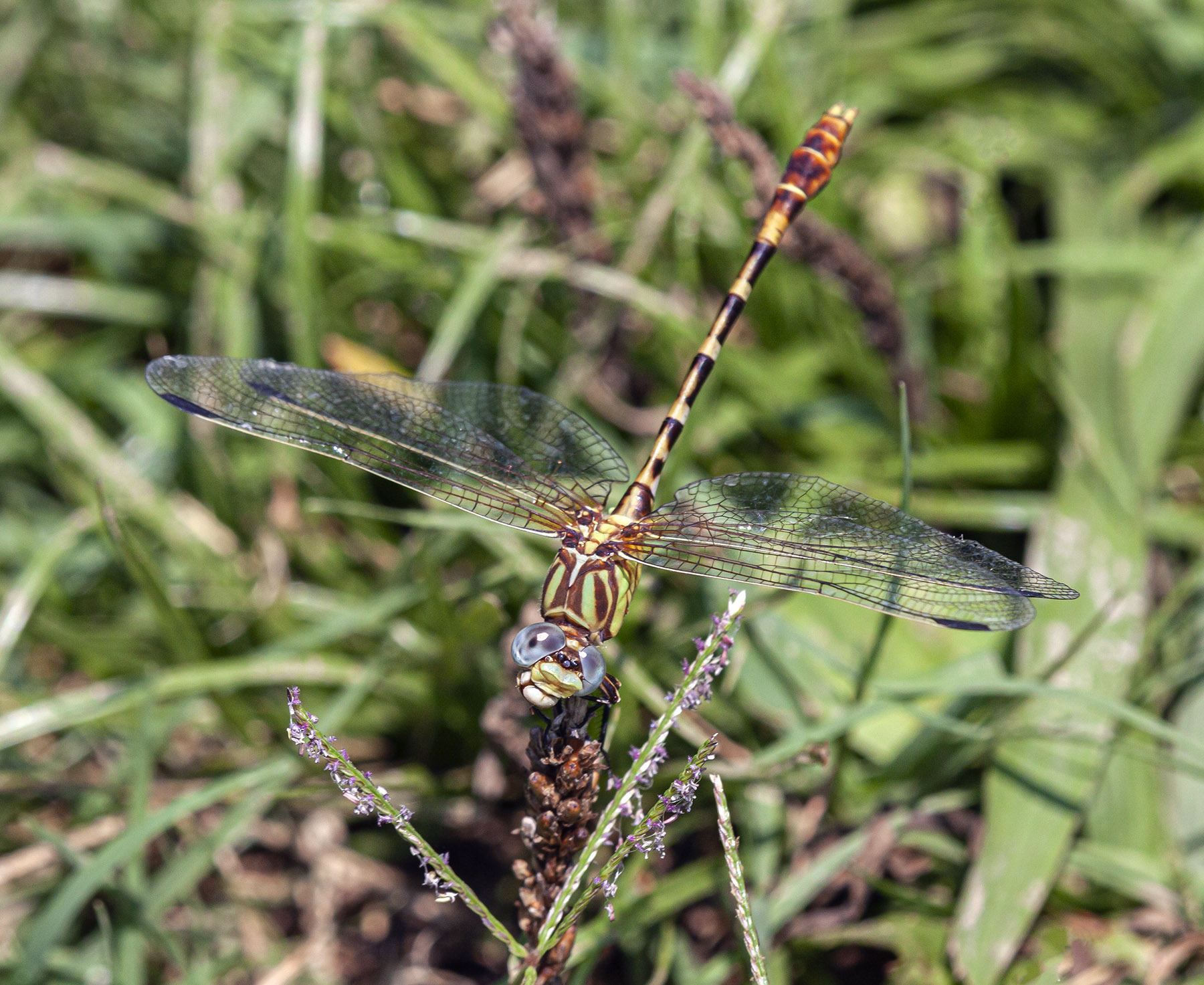
Thanks to a reminder from WordPress, I realized this morning that I am starting my 8th year with this blog. On July 7, 2012 I made my first posting “Blue Dasher dragonfly” and, as they say, the rest is history. According to WordPress stats, I have had 205,209 views of 3,177 posts. Some of those were re-reposts of blogs written by others, but I figure that I have written over 3,100 individual posts with well over 5,000 photos.

This morning I decided to share three of my all-time favorite photos—a singing Red-winged Blackbird (Agelaius phoeniceus); a Red Fox (Vulpes vulpes) on a frozen pond; and a close-up shot of a Blue-faced Meadowhawk dragonfly (Sympetrum ambiguum). I think that these three images taken together give you a good idea of my approach to photography.

I could not have made it this far on my journey in photography without the support and encouragements of so many of you. You have helped to make blogging part of my daily life. Thanks so much to you for enriching my life in a whole range of different ways.

I owe a special debt of gratitude to Cindy Dyer, my dear friend and photography mentor. She was the one who sat me down seven years ago and helped me with the mechanics of starting this blog. She continues to inspire me and to support me in both my personal life and in my photography. Thanks, Cindy.

What’s ahead? For the foreseeable future I plan to continue my adventures in photography. Having recently retired, I may start to venture to somewhat more distant locations, but mostly I anticipate more and more hours of walking around with my camera in hand, trying to capture all of the beauty of the natural world.

Red-winged Blackbird

Red Fox

Blue-faced Meadowhawk

© Michael Q. Powell. All rights reserved.

Read Full Post »

Do dragonflies have noses? That sounds like a crazy question, but it is the first one that came to mind when I looked at the image that I had captured of a dragonfly in flight this past week at Jackson Miles Abbott Wetland Refuge. I could not immediately identify it, so I consulted with experts in a Facebook group and learned that it is a Cyrano Darner (Nasiaeschna pentacantha). This species has a protruding forehead—it’s not a nose— that is reminiscent of the long nose of literary character Cyrano de Bergerac.

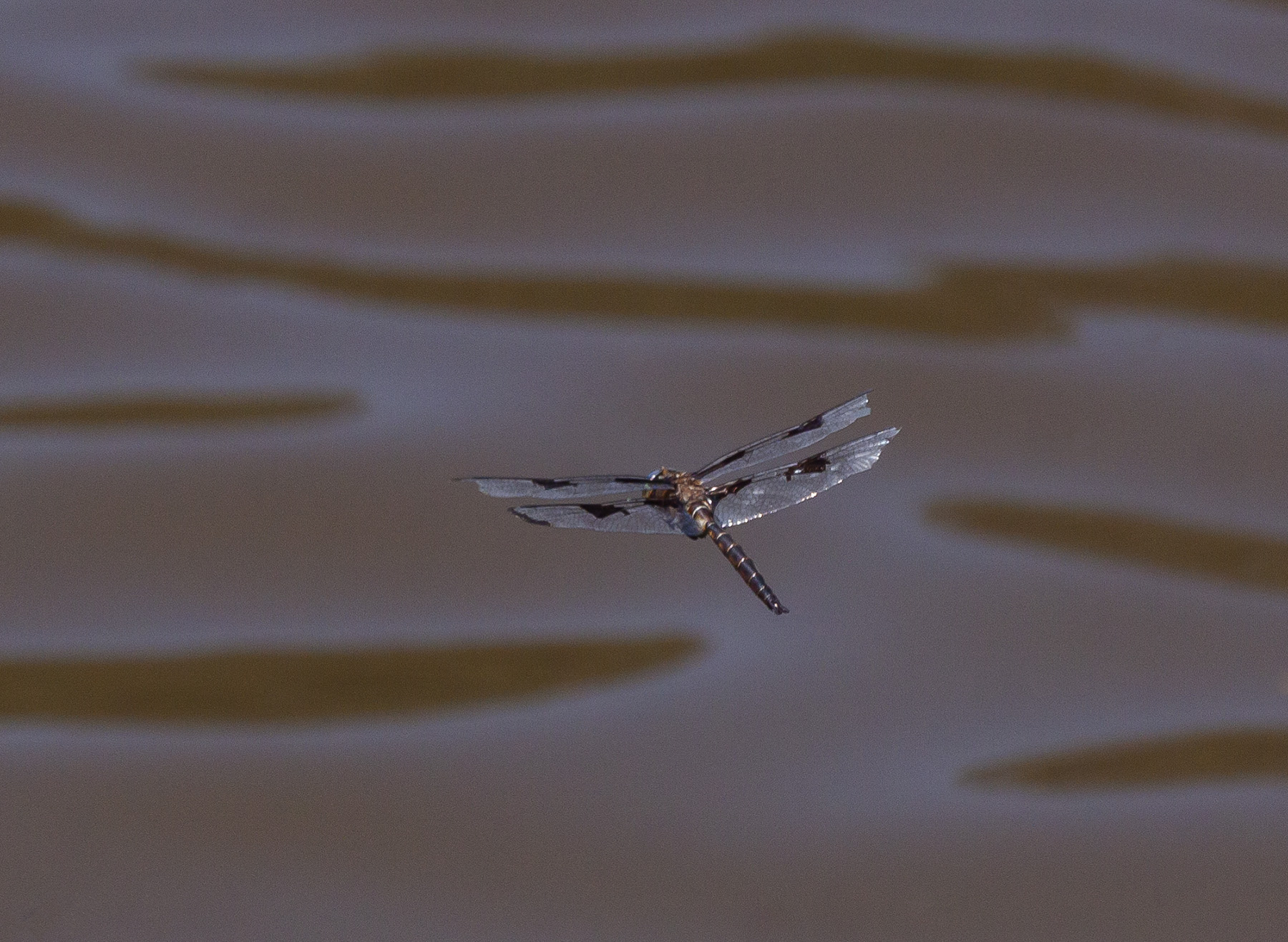
The species in the second shot is a Prince Baskettail (Epitheca cynosura), a species that I have featured multiple times in this blog. During much of the summer, I can usually spot one or two Prince Baskettail dragonflies patrolling over the pond at the same wetland refuge and I love trying to capture shots of them in flight. What makes this image distinctive, though, is not so much the dragonfly, but the background. There were ripples in the pond and the way that I shot and processed the image turned them into a wonderfully abstract background.

When I post photos like these, I often get questions about how I am able to capture images of flying dragonflies. Luck and persistence are the keys to getting shots like these. I use my 180mm macro lens and focus manually as the dragonflies zoom by, because the dragonflies don’t fill enough of the frame for my auto-focus to engage quickly and accurately. I have found that is almost impossible for me to use a zoom lens in this task—I get overwhelmed when I try to zoom, track, and focus simultaneously.

Cyrano Darner

Prince Baskettail

© Michael Q. Powell. All rights reserved.


Read Full Post »
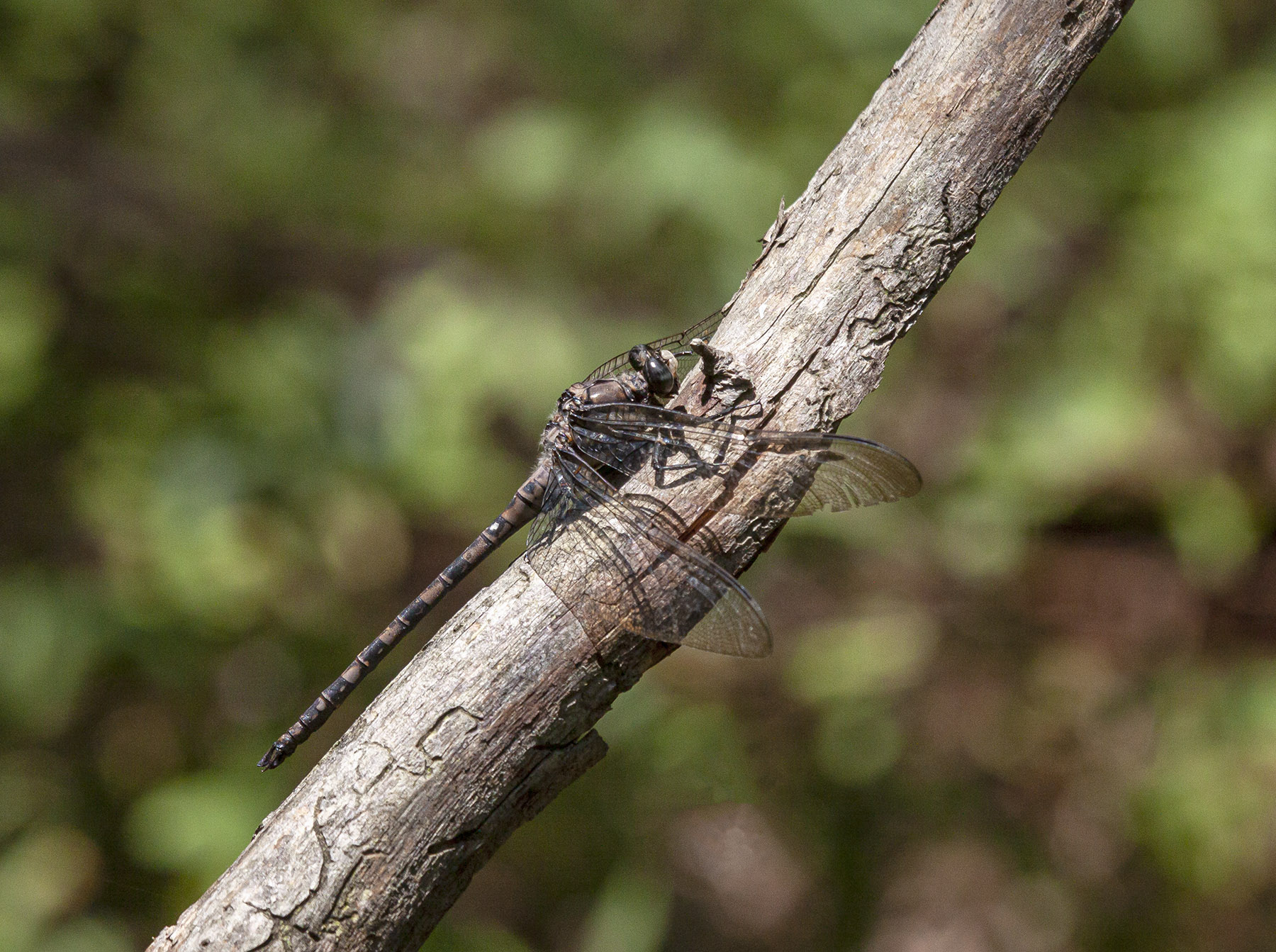
Do you suffer from recency bias? Recency bias is a type of cognitive bias that causes you to give greater weight in decision-making to things that have happened recently than to those that happened in the past, even the recent past. It is the only explanation I can come up with for not having already posted these shots of a Sable Clubtail dragonfly (Stenogomphurus rogersi) that I observed on 12 June.  Essentially, I got so caught up in excitement over newer photos that that I pushed this dragonfly out of my mind or at least off of my “To-do” list.

Sable Clubtails are rare in our area. Although I have searched for them repeatedly this season, including in a location where I saw some last year, this is the only one that I have seen in 2019. According to the website Dragonflies of Northern Virginia, “Sables appears to prefer small, relatively clean, shallow and stable forest streams, with plenty of low vegetation and a gentle flow.” That is a pretty good description of the stream in Prince William County, Virginia where I spotted this Sable Clubtail, but it also means that I am unlikely to stumble upon a member of this species at the ponds and marshes that I often visit.

In addition to being found only in a very specific type of habitat, Sable Clubtails have a very limited flight season—only a few weeks in length. That window of opportunity has almost certainly closed for the year. If you would like to see some additional photos of Sable Clubtails or read of my thoughts about chasing after rare dragonflies, check out this posting from a year ago.


Sable Clubtail

Sable Clubtail

© Michael Q. Powell. All rights reserved.

Read Full Post »

Yesterday I spotted this male Swift Setwing dragonfly (Dythemis velox) at Jackson Miles Abbott Wetland Refuge. Unlike most dragonflies that hold their wings straight out to the side, this species pulls its wings forward and adopts a ready-set-go position when perching.

This species is really special to me. A few years ago I had the first documented sighting of a Swift Setwing in the county in which I live and each year I am thrilled to see them again. Late in June I saw my first one this year, but was not able to capture any decent images, so these are my first successful Swift Setwing shots this season.

Swift Setwings like to perch on the end of vegetation overhanging the water and are always almost facing the water, which makes it tough to get shots without getting wet. One of the cool things about their perching patterns is that it usually allows me to get uncluttered backgrounds in the shots that I am able to take. In both of these images, the water forms a neutral background that almost makes them look like they were shot in a studio setting.

Swift Setwing

Swift Setwing

© Michael Q. Powell. All rights reserved.

Read Full Post »
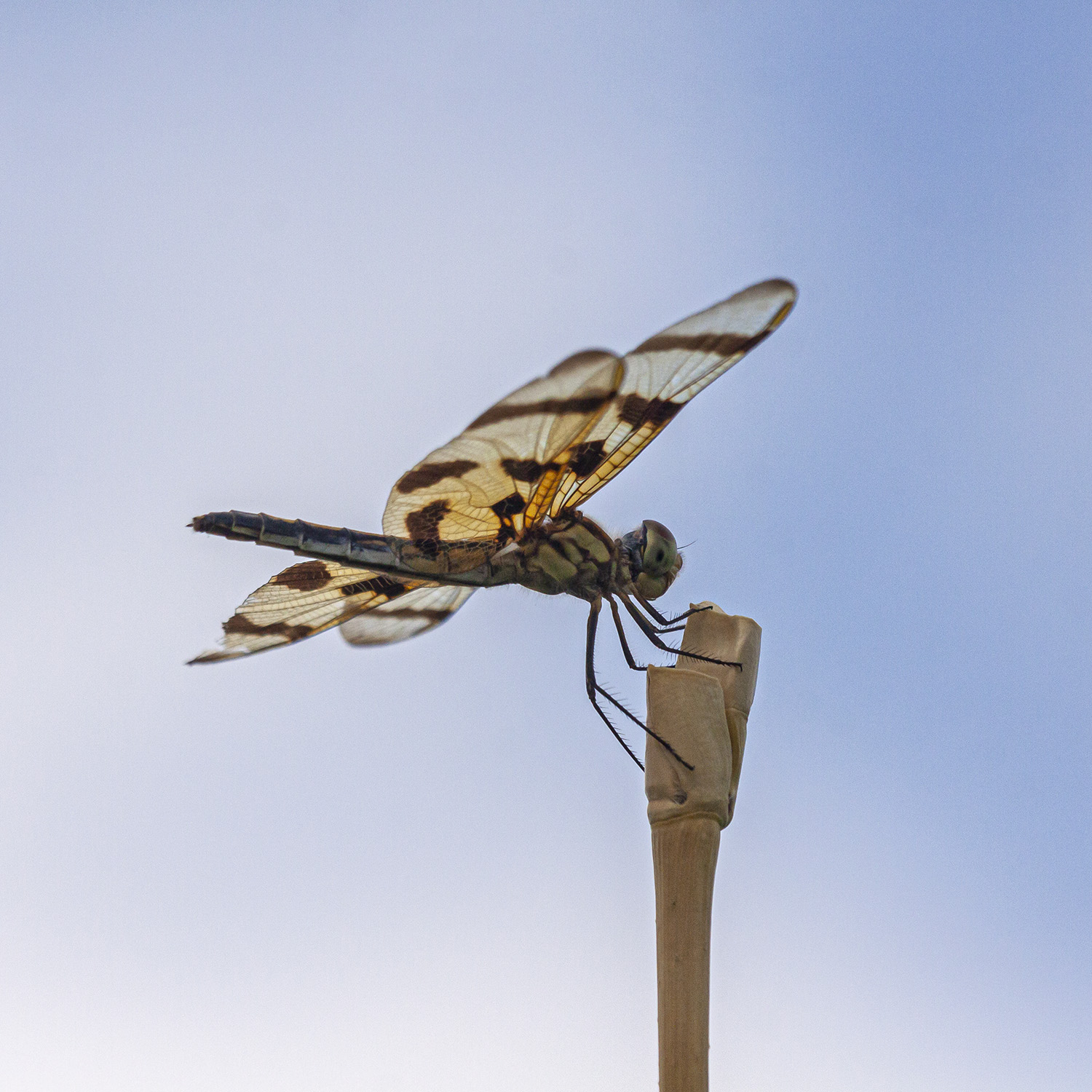
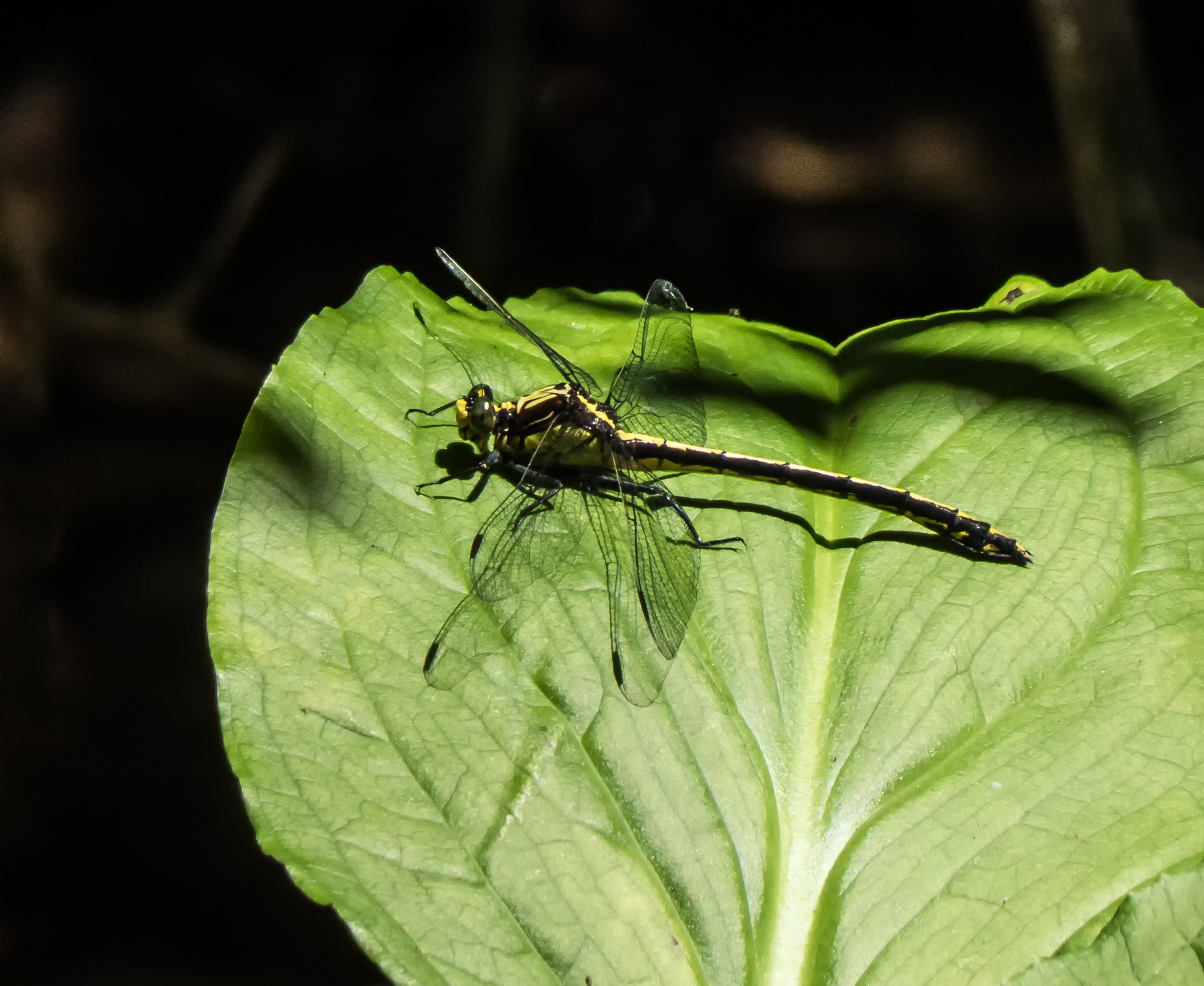
Perhaps there are dragonflies with longer names than the Black-shouldered Spinyleg dragonfly (Dromogomphus spinosus), but none of them immediately come to mind. Sometimes I will complain about the inaccurate names given to various species, but in this case the descriptors are accurate. Alas, when I spotted this dragonfly in a boggy area of Prince William County, Virginia last week, I couldn’t get close enough to capture those details very well.

The vegetation on which the dragonfly is perched is skunk cabbage, a plant that grows in the mucky confines of seeps and swamps. It is said that bruised leaves present a fragrance reminiscent of skunk, so I try to step carefully  whenever I am near any skunk cabbage.

Black-shouldered Spinyleg

© Michael Q. Powell. All rights reserved.

Read Full Post »

Last Tuesday as I was exploring Occoquan Bay National Wildlife Refuge I spotted this handsome male Calico Pennant dragonfly (Celithemis elisa). Unlike some species that perch close to the ground and are hard to see, Calico Pennants perch on the uttermost tips of vegetation. Although they are visible, they are often hard to photograph, because their precarious perches start to sway at the slightest hint of a breeze.

Calico Pennant

© Michael Q. Powell. All rights reserved.

Read Full Post »

Although I love seeing my old familiar dragonfly friends, it is always exciting to observe new species. Last week while I was exploring in Prince William County, Virginia with fellow dragonfly enthusiast Walter Sanford, I spotted this dragonfly perched on a small tree. I really liked the pose and moved closer for some shots.

I initially thought it was a Needham’s Skimmer, a fairly common species in our area, but the more I looked at my photos afterwards on my computer screen, the more I began to note some differences in the colors and patterns on wings and the body. After consultations with some dragonfly experts on Facebook, I learned that it is a Yellow-sided Skimmer (Libellula flavida).

As far as I know, this is the first time that I have seen a Yellow-sided Skimmer. There is a possibility that I have unwittingly seen one in the past and dismissed it as “only” a common species.  I try not to do that, because this is not the first time that I have photographed something new without realizing until later that it was in fact new.


Yellow-sided Skimmer

© Michael Q. Powell. All rights reserved.


Read Full Post »

Dragonhunter dragonflies (Hagenius brevistylus) love to perch and wait for their prey to come by and then use their powerful back legs to snag that prey, which is often another dragonfly. Those legs are so long and ungainly, though, that Dragonhunters’ poses often seem awkward when they are perched—they remind me of teenage males who have undergone a recent growth spurt and haven’t gotten used to their longer limbs.

Last Friday as I was exploring a stream at Prince William Forest Park with fellow blogger and dragonfly enthusiast Walter Sanford, he spotted this female Dragonhunter perched at the edge of the water. I was walking toward him when I spotted the Dragonhunter on the rocks that I featured yesterday and was delayed in getting to see this dragonfly. Fortunately, she was relatively tolerant of our presence and remained in place long enough for me to get some shots.

All of the images that I captured show a side view of the Dragonhunter, because she was facing toward the water and I was trying not to get wet. Walter, however, wanted more of a frontal view  and waded into the water to get that shot. Check out today’s posting on his blog and you can compare the results of our different approaches.

dragonhunter

© Michael Q. Powell. All rights reserved.


Read Full Post »
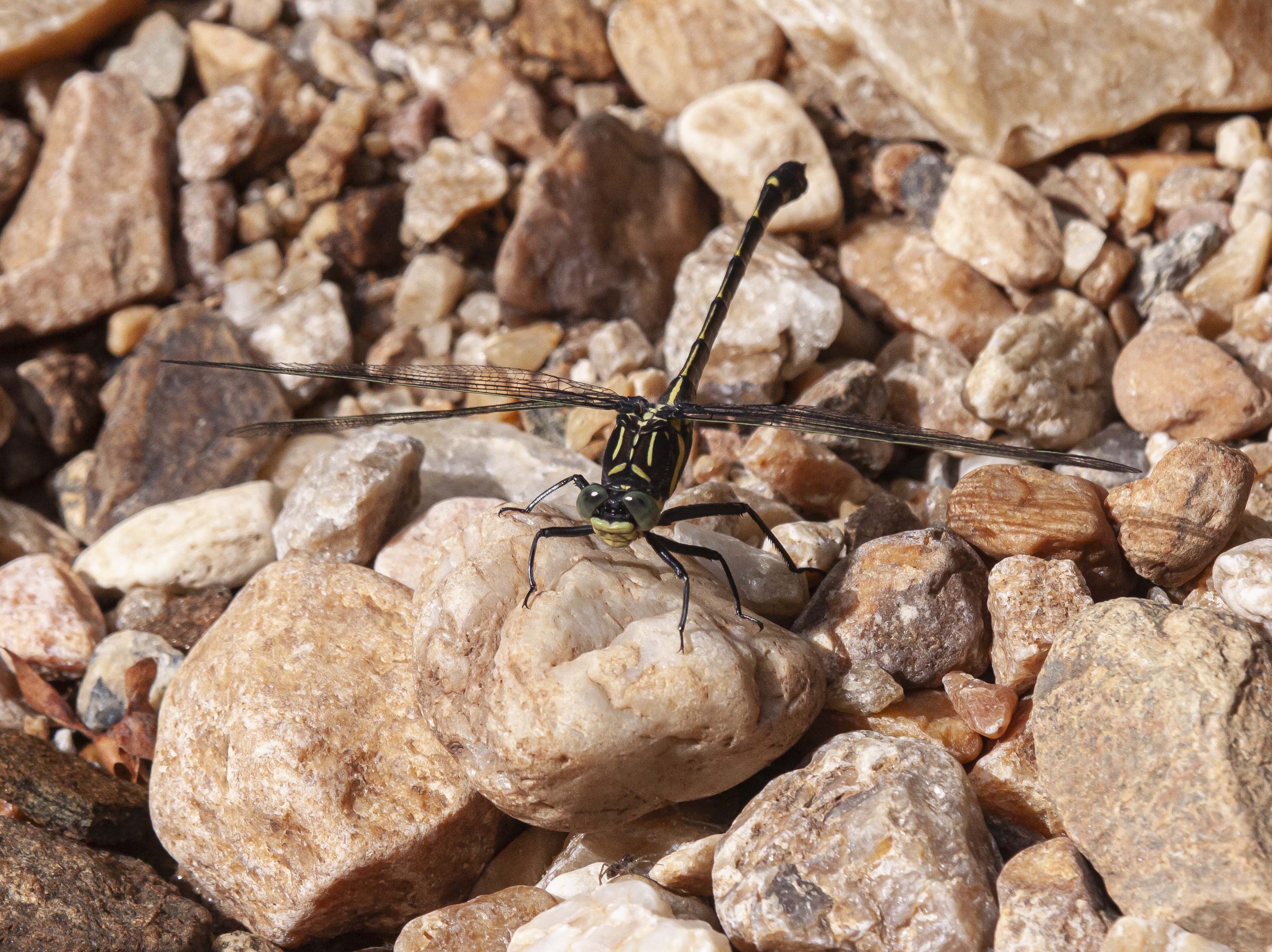
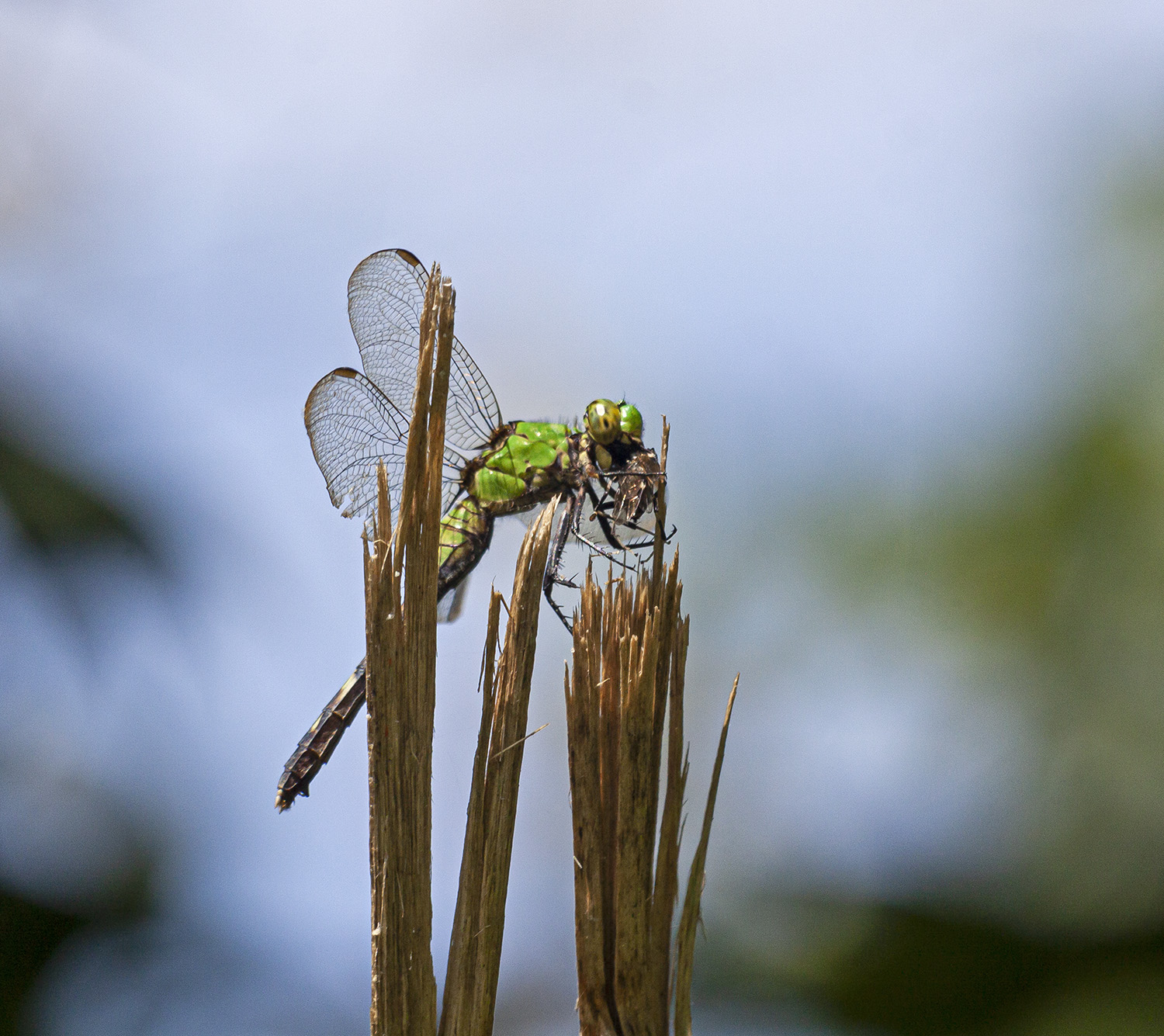
Dragonfly on the rocks? It sounds like a summertime beverage, but it accurately describes what I saw last Friday while exploring a stream in Prince William County, Virginia with fellow dragonfly enthusiast Walter Sanford. I think it is a Dragonhunter dragonfly (Hagenius brevistylus), but the unusual angle makes it tough to made a definitive determination of the species, because I am not able to see critical portions of the dragonfly’s anatomy.

In the past when I have spotted Dragonhunters, they have been perched on branches overhanging the water and that is where I expect to find them. This encounter is a good reminder for me to stay alert at all times—my subjects may not have read the identification guides about how they are supposed to behave.

dragonhunter

© Michael Q. Powell. All rights reserved.

Read Full Post »
When the weather gets hot, some dragonflies will raise their abdomens (the “tail”) in what is believed to be an attempt at thermoregulation. I can’t say for sure if it works, but the theory is that in this position, sometimes referred to as the “obelisk,” dragonflies are able to stay cooler by reducing the amount of their bodies subject to direct sunlight.

Earlier this week I spotted this male Eastern Amberwing dragonfly (Perithemis tenera) in a modest obelisk position at Jackson Miles Abbott Wetland Refuge. I characterized the position as “modest,” because sometimes a dragonfly will elevated its abdomen until is almost vertical.Eastern Amberwing

© Michael Q. Powell. All rights reserved.


Read Full Post »

Most of the times that I have observed a Common Sanddragon dragonfly (Progomphus obscurus) it has been perched directly on the sand, which makes sense, given its name. Last week, however, I spotted this Common Sanddragon perched in some vegetation overhanging the water of a stream in Prince William County, Virginia.

I like the way that the dragonfly almost looks like he is flying, because I managed to take the photograph from almost directly overhead, causing the perch almost to disappear. I also really like the look of rocky portion of the stream that makes up most of the background of this image.

Common Sanddragon

© Michael Q. Powell. All rights reserved.

Read Full Post »

Last week as I was exploring Prince William County, I encountered this large dragonfly  perched in a tree overhanging a fairly large stream. When I captured these images, I was not sure what kind of dragonfly it was. After consultations with some experienced dragonfly experts, I learned that this is a female Dragonhunter dragonfly (Hagenius brevistylus).

Dragonhunters are among the largest dragonflies in our area. Unlike darners, another group of large dragonflies that fly almost continuously as they seek prey, dragonhunters prefer to perch and wait patiently before they strike. As their name suggests, they specialize in hunting other dragonflies, reportedly including members of their own species.

Dragonhunter

Dragonhunter

Dragonhunter

© Michael Q. Powell. All rights reserved.


Read Full Post »
« Newer Posts - Older Posts »