Feeds:
Posts
Comments

Archive for the ‘Amphibians’ Category

Last Wednesday I went on a hike in Prince William Forest Park, a National Park Service site in nearby Triangle, Virginia. Unlike the coastal plains and marshes where I spent a lot of my time in nature, Prince William Forest Park, as its name suggests, is a forested area that is full of hills and valleys with numerous creeks.

One of the highlights of my hike was seeing my first Eastern Cricket Frogs (Acris crepitans crepitans) of the season. Cricket frogs of the genus Acris are quite small (about one inch (25 mm) in length) and I often spot them at the edge of the creeks in the park. On this occasion I spotted the frog when it hopped right in front of me, though most often I hear the frogs before I see them. Cricket frogs have a distinctive call that sounds like two pebbles being clicked against each other—some scientist thought it sounded like a cricket, which accounts for the common name for the species .

Eastern Cricket Frog

© Michael Q. Powell. All rights reserved.

Read Full Post »

When it comes to camouflage, size does not always matter. Last Wednesday as I was exploring in Prince William County here in Virginia, both a large toad and a small frog were so well hidden that I did not see either of them until I almost literally stepped on them, which prompted them to move and reveal their presence.

I was really startled on Wednesday when a large toad suddenly leaped upwards right in front of me, exploding out of a covering of fallen leaves. I think that this is an Eastern American Toad (Anaxyrus americanus americanus), judging by its large size, but there is a chance that it is a Fowler’s Toad.

The tiny Eastern Cricket Frog (Acris crepitans) in the second photo blended in so well with the sandy edge of a stream that I initially did not see him until he moved a bit. The texture and color of his skin made him so hard to spot that when I focused on his eye in my camera’s viewfinder, I could not see the contours of the frog’s body.

toad

Cricket frog

© Michael Q. Powell. All rights reserved.

Read Full Post »

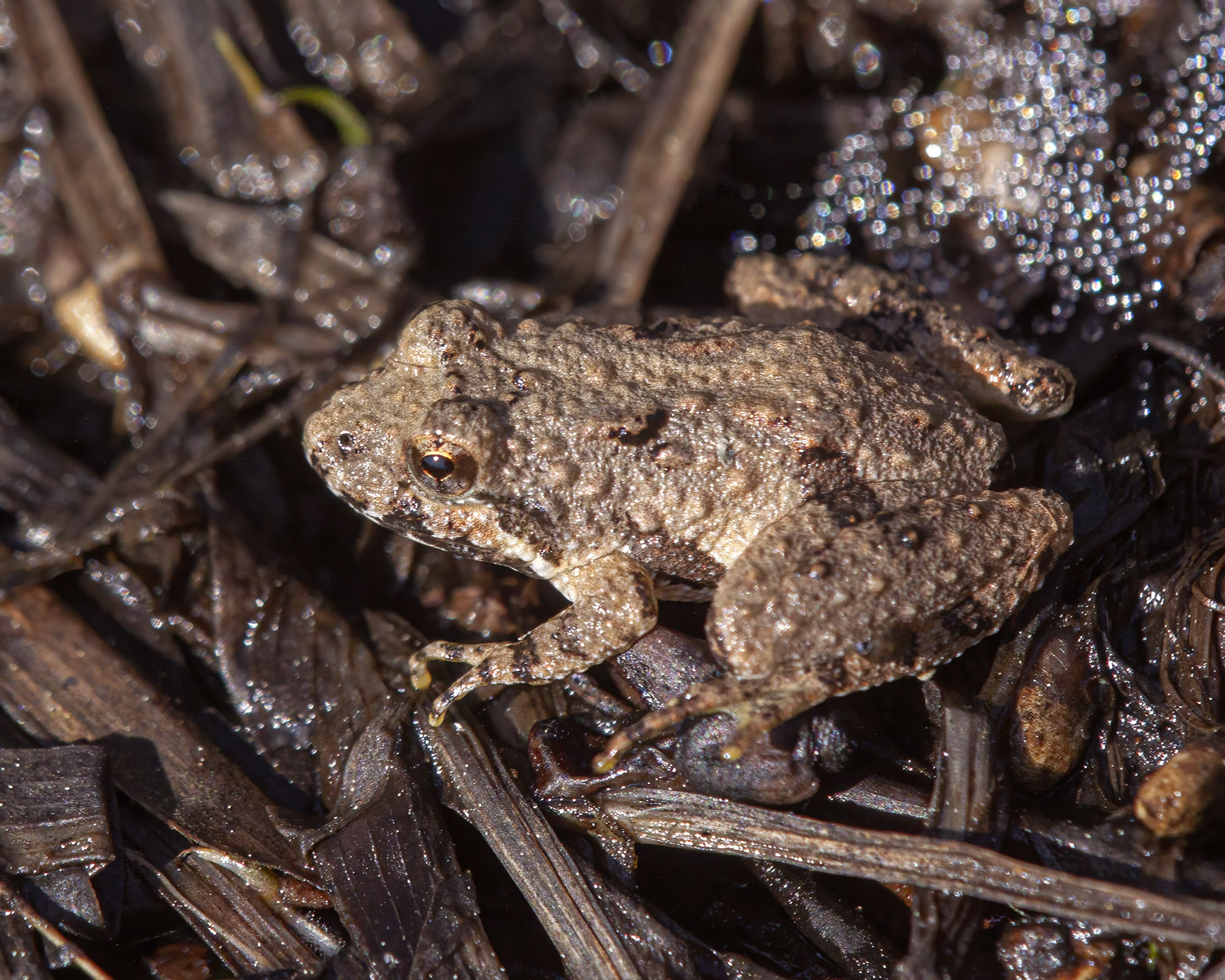
As I was walking along a creek on Monday at Prince William Forest Park, several tiny frogs unexpectedly jumped out of my way. I was able to visually track one of those frogs and saw where it landed. After a single leap, the frog froze in place and I was able to slowly maneuver myself into position to capture this image.

I am pretty sure that this is a Northern Cricket Frog (Acris crepitans). A bit later in the season, I will be able to hear the cricket frog’s distinctive call, which sounds to me like two marbles being clicked together, but the frogs that I encountered that day were silent.

According to the Virginia Department of Wildlife Resources, the Northern Cricket Frog is one of the smallest frogs in Virginia, ranging from .87 inches to 1.14 inches (22-29 mm) in length. Their typical life span is four to twelve months, though sometimes they can live as long as three years. Cricket frogs hatch from their eggs in 29-90 days between July and August and metamorphosize into adults in late summer. In early autumn, the frogs burrow into the soil to hibernate until spring comes.

I was quite pleased with the amount of detail that I was able to capture in this image, from the bumpy warts of the frog’s back to the stripes on its tiny toes. My Tamron 18-400mm lens is quite versatile and is capable of providing macro-like capability in certain circumstances. I encourage you to click on this image to get a better look at the tiny cricket frog.

Northern Cricket Frog

© Michael Q. Powell. All rights reserved.

Read Full Post »

I was delighted to spot several frogs sitting on lily pads during my recent trip to Washington D.C. to visit Kenilworth Park and Aquatic Gardens. In the first photo, the cute little frog was perched on some large lily pads from a water lily species from South America. These lily pads have raised edges that always remind me of a tart pan. Reportedly this type of lily pad can grow to as much as 10 feet (3 meters) in diameter and can support a considerable amount of weight if it is evenly distributed.

The second and third photos show the same frog perched on a flatter-style lily pad. I think that this frog is a Green Frog (Lithobates clamitans), although I must confess that I have trouble telling green frogs from bullfrogs. I really like the eye-to-eye pose in the final photo in which the frog’s face reminds me a lot of Kermit the Frog from the Muppets.

frog on lily pad

frog on lily pad

frog on lily pad

© Michael Q. Powell. All rights reserved.

Read Full Post »

As I was exploring the edges of a small pond in Prince William County in Virginia on Tuesday, I spotted a lizard-like creature walking along the pond bottom underwater. I had no idea what this was, but had the presence of mind to snap a photo. The water was clear enough that I was able to capture a decent amount of detail.

I did some research and learned that this is the adult aquatic form of an Eastern Red-spotted Newt (Notophthalmus viridescens). That set me off on another series of internet searches, because I am not sure what a newt is. When I hear the word “newt” I immediately think of the three witches in Shakespeare’s Macbeth. As they stirred their cauldrons, they described the contents of the potion that included a newt, although it turns out that the witches were using codes words to refer to various plants.

Eye of newt and toe of frog,
Wool of bat and tongue of dog,
Adder’s fork and blind-worm’s sting,
Lizard’s leg and howlet’s wing,
For a charm of powerful trouble,
Like a hell-broth boil and bubble.”

Newts are a kind of salamander and are considered to be amphibians, not reptiles. Eastern Red-spotted Newts have an amazing life cycle, according to an article by the University of Virginia Mountain Lake Biological Station. They hatch from eggs and then spend the next 2-5 months of their lives living in the sediment and debris at the bottom of the pond, breathing through gills.

When they metamorphose into terrestrial red efts, the juvenile form of the aquatic newt, they acquire a pair of lungs which they use for the rest of their life. After 2-7 years as terrestrial efts, the newts return to the water to breed. They can live for up to 15 years in total, sometimes spending the entirety of their adulthood as aquatic newts.

Eastern Red-spotted Newt

© Michael Q. Powell. All rights reserved.

Read Full Post »

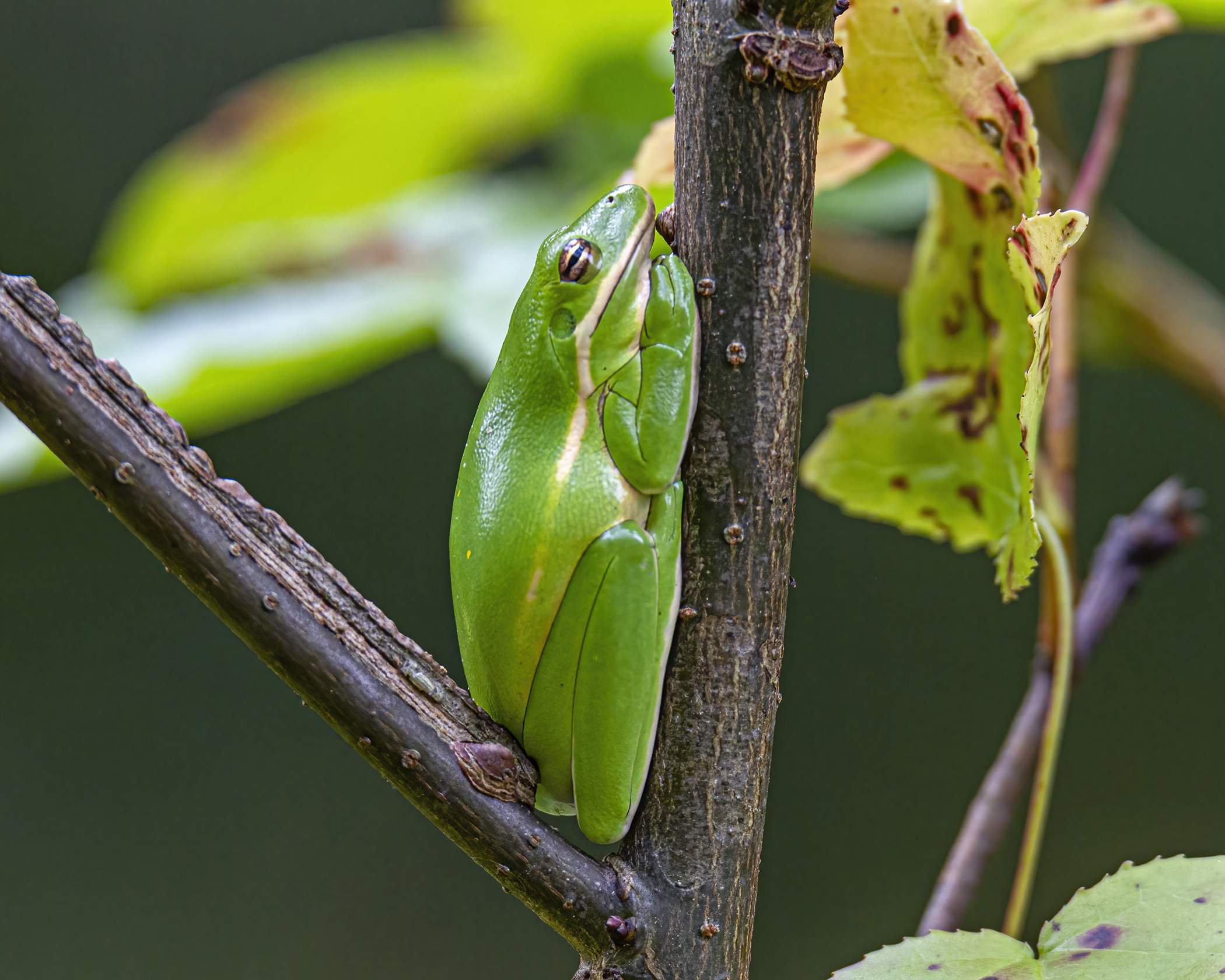
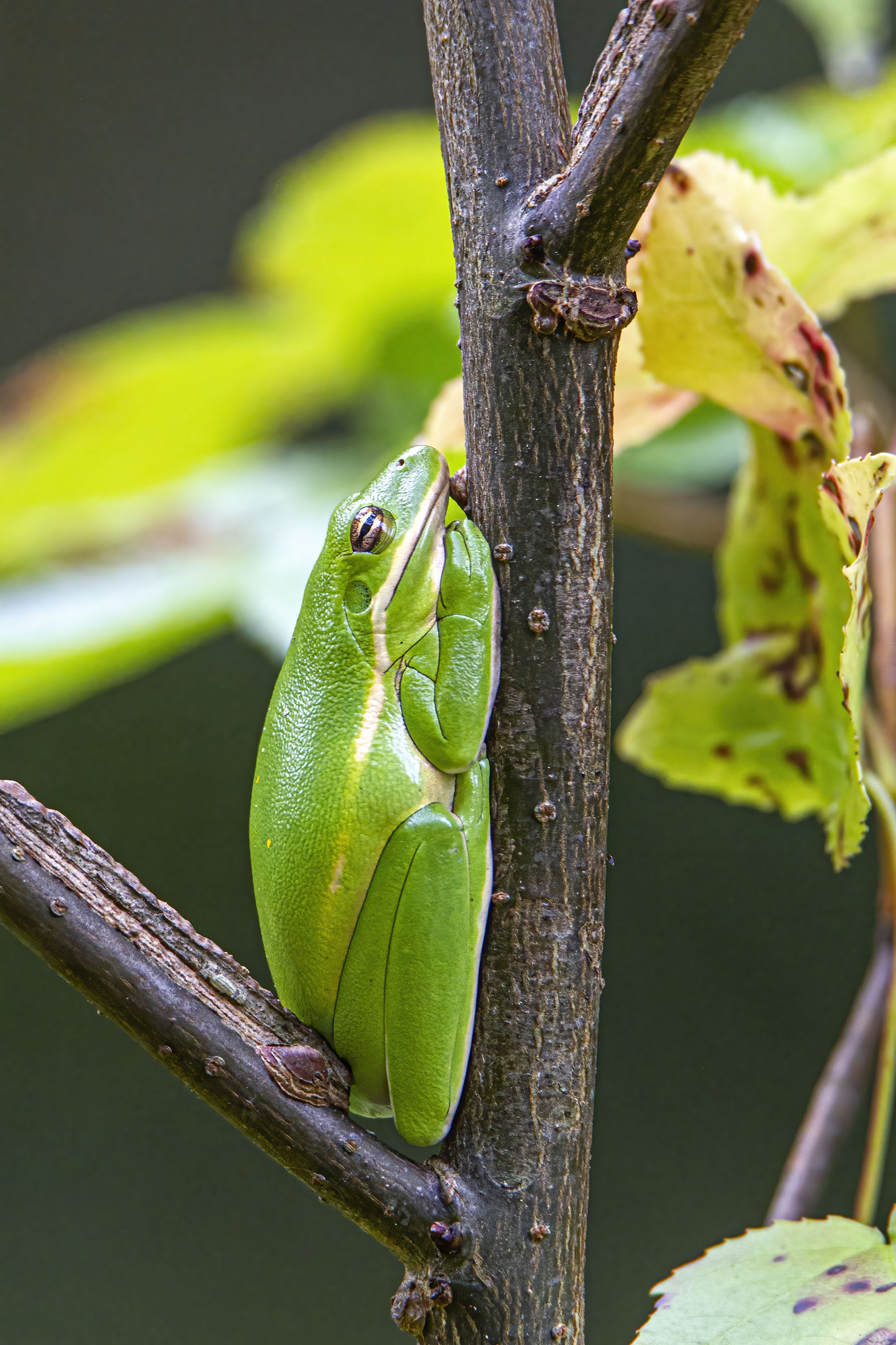
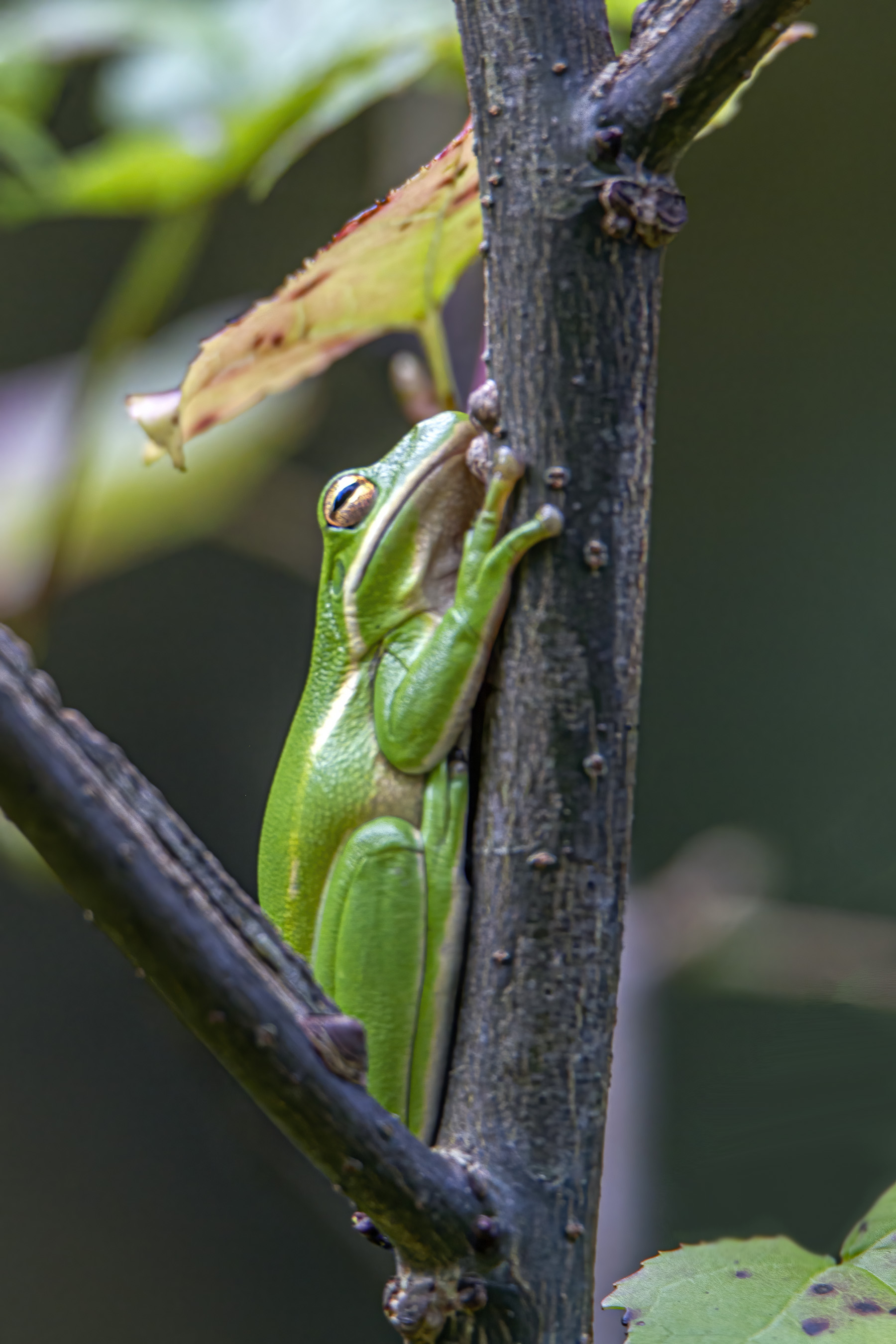
Most of the time when I am lucky enough to spot a Green Tree Frog (Hyla cinerea), the frog appears to be sleeping. Why is that the case? Many frogs spend their time in the water and have an easy way to regulate their body temperatures. Tree Frogs probably need to avoid direct sunlight and I suspect they are more active earlier and later during the day.

Yesterday afternoon the rain finally stopped and the skies were gradually clearing, so I decided to go out with my camera. I spotted this tree frog when I was walking along one of the trails at Huntley Meadows Park, a nearby marshland park that I have avoided the last few years because it tends to be overcrowded. The frog was perched in the crotch of a small tree just off of the trail.

When I first saw the tree frog, it had its front feet tucked under its head and appeared to be dozing, as you can see in the first two photos. I experimented with slightly different angles and formats and can’t decide if I like the landscape format of the first photo or the portrait format of the second one.

Later in the day I passed the frog again and it seemed to be a little more alert. The frog had pulled one of its feet out from under its head and appeared to be daydreaming.

When I returned home from my outing, I decided to take a cue from the frog and took a short nap.


Green Tree Frog

Green Tree Frog

Green Tree Frog

© Michael Q. Powell. All rights reserved.

Read Full Post »

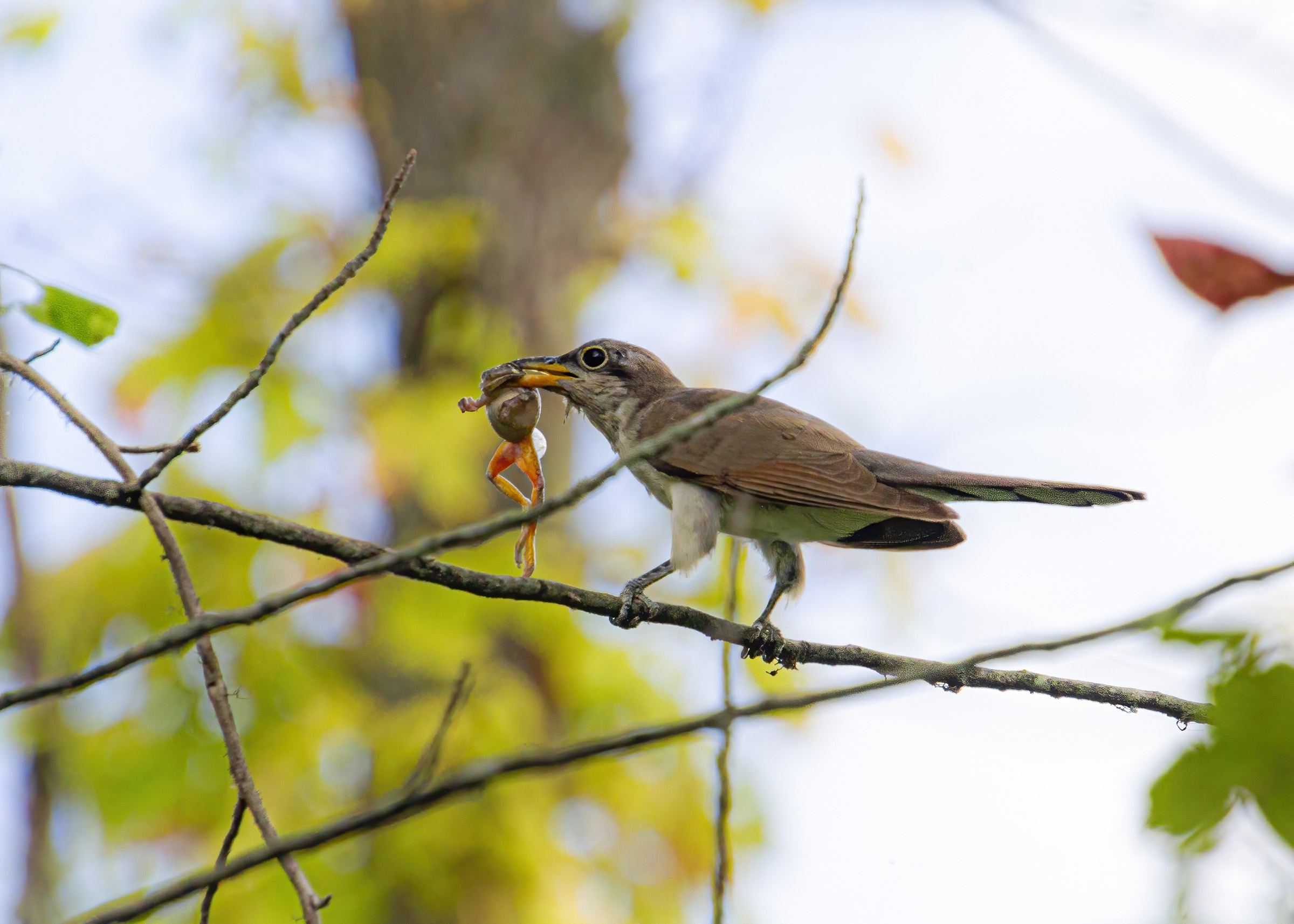
I was quite shocked when I spotted this Yellow-billed Cuckoo (Coccyzus americanus) with a frog in its mouth on this past Tuesday at Occoquan Bay National Wildlife Refuge. When I first spotted the bird, it was mostly hidden in the foliage of the tree, but I could clearly see the dangling frog. I stopped in my tracks, quickly adjusted the settings on my camera, and took some shots. When I moved slightly to the side to try to get a better angle, alas, the bird detected my presence and flew away with its prey.

I had no idea that a bird like a cuckoo would consume a frog. Wow! According to the Cornell Lab of Ornithology, “Caterpillars top the list of Yellow-Billed Cuckoo prey: individual cuckoos eat thousands of caterpillars per season. On the East coast, periodic outbreaks of tent caterpillars draw cuckoos to the tentlike webs, where they may eat as many as 100 caterpillars at a sitting. Fall webworms and the larvae of spongy (formerly gypsy), brown-tailed, and white-marked tussock moths are also part of the cuckoo’s lepidopteran diet, often supplemented with beetles, ants, and spiders. They also take advantage of the annual outbreaks of cicadas, katydids, and crickets, and will hop to the ground to chase frogs and lizards. In summer and fall, cuckoos forage on small wild fruits, including elderberries, blackberries and wild grapes. In winter, fruit and seeds become a larger part of the diet.”

I love to capture images like this one. No how many times I visit a familiar location, there always seems to be something new to see.  My favorite encounters most often seem to occur when I am by myself and moving slowly, immersed in the natural world. Fortunately I am quick to react with my camera, for these moments tend to be ephemeral and fleeting.

Yellow-billed Cuckoo

© Michael Q. Powell. All rights reserved.


Read Full Post »

Following the lead of fellow photographer Steve Gingold, I decided that today is a Frog Friday. I spotted these Eastern Cricket Frog (Acris crepitans), one of the smallest frogs in Virginia, on Monday as I was exploring in Prince William County. I really like frogs and was happy to capture some of the cool details of these frogs in these shots, like their tiny toes.

Be sure to check out Steve’s blog posting for today entitled Frog Friday—before and after. While you are there, I encourage you to poke about on his site—Steve has an amazing array of nature photos that he has taken, primarily in the western part of Massachusetts.

Cricket Frog

Cricket Frog

Cricket Frog

© Michael Q. Powell. All rights reserved.
Read Full Post »

It was sunny and warm on Monday, so I went off in search of dragonflies. There has already been at least one sighting of a dragonfly this month in Virginia, but it realistically is still a bit early for any to appear in the northern part of the state where I live. I searched diligently at a pond and at several small streams in Prince William County, but did not find any dragonflies or damselflies.

I was happy, however, to spot several Eastern Cricket Frogs (Acris crepitans crepitans). These frogs are tiny, with a length of about 5/8 to 1-3/8 inches (16-35 mm). One of the most distinctive things about this species is the male mating call that resembles the sound of two stones being hit together or perhaps is similar to the sound of a cricket.

According to the Virginia Herpetological Society, “This species prefers grassy margins of ponds, ditches and wetlands. Permanent bodies of water with emergent or shoreline vegetation and exposure to the sun are preferred habitat,” a perfect description of the locations where I spotted these frogs.

Each year I am confused when researching this species, because I see references to Eastern Cricket Frogs and Northern Cricket Frogs used almost interchangeably. If I understand it correctly Northern Cricket Frog (Acris crepitans) is the species name and Eastern Cricket Frog (Acris crepitans crepitans) is one of the subspecies.

As you can see from these images, cricket frogs blend in really well with their surroundings. If I had not seen these frogs jump to their new locations, I am pretty sure that I would not have seen them. I walked around all day with my 180mm macro lens attached to my camera and it served me well to capture some of the details on the bodies of the little frogs. I attempted to get as low as I could and to shoot from the side in order to get as much of the frog in focus as I could, so muddy knees were inevitably one of the “benefits” of getting these shots.

cricket frog

cricket frog

© Michael Q. Powell. All rights reserved.


Read Full Post »

Most of the time frogs hop away as soon as they sense my approaching footsteps. This male Green Frog (Lithobates clamitans), however, stayed in his sunny spot in the shallow waters at the edge of the pond, patiently posing for his portrait on Thursday. With a little encouragement, he even smiled a bit.

When I posted this photo on Facebook, one of my friends commented, “I’ve kissed a few of those.” Her words brought back memories of the role that I played in a theater production of The Frog Prince more than 35 years ago when I was in the military. A cast of adults put on several plays for children, which was a lot of fun, because over-the-top acting was encouraged to keep the kids in the audience engaged—I must admit that I am a bit of a ham when in the spotlight.

Wearing a mask, flippers, green tights, and a leotard, I played the role of the frog, agilely hopping about on the stage. When I was kissed and magically transformed into the handsome prince, a younger, cute blond actor continued in the role—there is only so much you can do with stage make-up.

Be bold today and go out and kiss a friendly frog or at least do something that takes you out of your normal comfort zone.

Green Frog

© Michael Q. Powell. All rights reserved.
Read Full Post »

As temperatures rise, the springtime air is frequently filled with the sounds of frogs, ranging all the way from the high-pitched choruses of spring peepers to the solitary bass notes of croaking bullfrogs. When I walk along the edge of marshes and ponds at this time of the year, the ground in front of me often seems to explode as well-camouflaged frogs arc through the air seeking to escape me.

On Monday as I wandered about in Prince William Forest Park, I spotted quite a number of tiny frogs at the edge of the water, but did not hear them calling, so I had to rely on their physical appearance to identify them. On the basis of the dark triangle between their eyes and their other markings, I believe the frogs in the photos below are both Eastern Cricket frogs (Acris crepitans crepitans).

Eastern Cricket frogs are small frogs,  reaching lengths of 5/8 to 1-3/8 inches (16-35 mm), which make them a challenge to photograph. According to the Virginia Herpetological Society, part of the scientific name for the species is derived from the Latin word crepit which means “rattle” and the call of these frogs sounds like pebbles being clicked together. Perhaps they will be calling, the next time that I visit the park.

The evidence is mounting that spring is really here. What are your favorite signs of the arrival of spring?

Eastern Cricket Frog

Eastern Cricket Frog

© Michael Q. Powell. All rights reserved.
 

Read Full Post »

Whenever I see a Green Tree Frog (Hyla cinerea), the frog appears to be sleeping. Why is that the case? Many frogs spend their time in the water and have an easy way to regulate their body temperatures. Tree Frogs probably need to avoid direct sunlight and I suspect they are more active earlier and later during the day.

I photographed these beautiful tree frogs on consecutive days last week during trips to different parts of Huntley Meadows Park. I love the simplified V-shaped tree crotch that makes a photogenic perch for the frog in the first photo. I am sure that I am imagining things, but the frog appears to be pensive or possibly daydreaming.

The previous day I was on the boardwalk with my friend Walter Sanford on the boardwalk when a passing woman with two young children, Dante and Aria, asked us if we wanted to see a tree frog. It had been a slow day for us photographically, so of course we said yes. The kids were really excited to talk with us and to show us their find.

Walter asked them to come up with a name for the frog and Aria chose the name “Sleepy.” Unlike the frog in the first photo that seemed semi-alert, the second frog seemed to be sound asleep, so the name certainly fit. Check out Walter’s posting on the encounter in his recent blog posting called “Sleepy” for more info and another photo of the sleeping tree frog.


Green Tree Frog

Green Tree Frog

© Michael Q. Powell. All rights reserved.
Read Full Post »

I was very excited last Thursday when a passing photographer pointed out this little tree frog to me last Thursday as I was walking along a trail at Huntley Meadows Park. I think that it is a Gray Tree Frog (Hyla versicolor), through there is a chance that it could be a Cope’s Gray Tree Frog (Hyla chrysoscelis). According to the Virginia Herpetologcal Society, “Our two native gray treefrogs are identical in appearance. In the field the only two ways to distinguish H. chrysoscelis from H. versicolor is by their call and in some cases geographic location.”

The green and gray pattern on its body looks unusual to me and makes it look like the frog has lichen on its back. The Smithsonian National Zoo & Conservation Biology Institute website notes that, “The gray tree frog’s scientific name is Hyla versicolor, which comes from the Latin for “variable color.” It is named for its ability to alter its skin color based on the time of day and surrounding temperature. The skin becomes much lighter at night and darker during the day.”

I was starting to feel a little cold as I was observing the tree frog and wondered what would happen to it in the winter. I was shocked to discover that Gray Tree Frogs hibernate during the cold weather. The Smithsonian website mentioned above states that, “The gray tree frog hibernates in the winter by taking refuge in trees. It survives freezing temperatures by producing glycerol to “freeze” itself while maintaining interior metabolic processes at a very slow rate.” Wow!


Gray Tree Frog

Gray Tree Frog

© Michael Q. Powell. All rights reserved.


Read Full Post »

How sticky are the toe pads of a tree frog? This Green Tree Frog (Hyla cinerea) had no problems clinging to the painted surface of a sign when I spotted it last Thursday at Occoquan Bay National Wildlife Refuge.

Was it technically in violation of the access policy?

Green Tree Frog

Green Tree Frog

© Michael Q. Powell. All rights reserved.

Read Full Post »

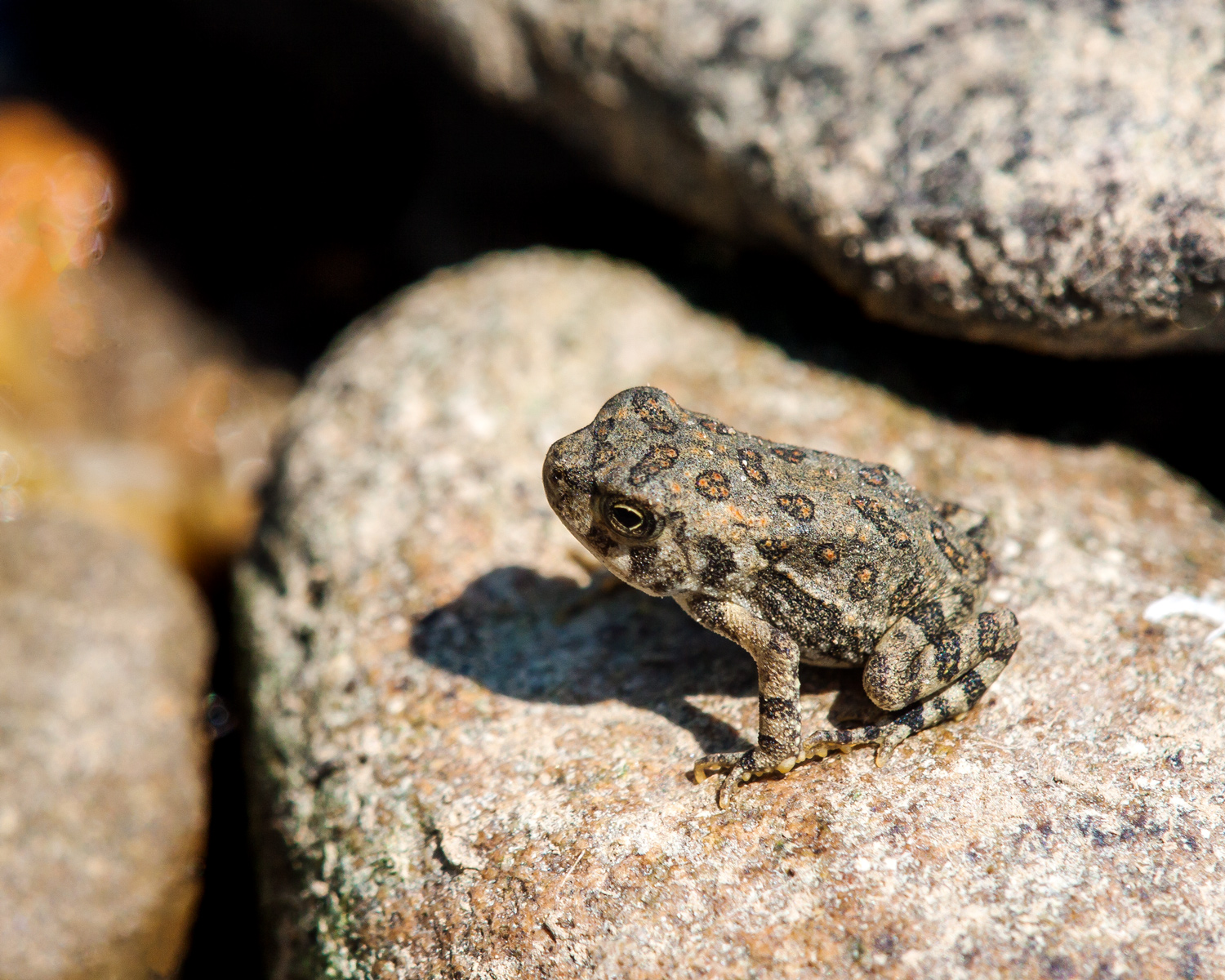
Last Tuesday I spotted this cute little toad—I think it may be a Fowler’s Toad (Anaxyrus fowleri)—while exploring the wilds of Fairfax County. The toad was just chilling (or more accurately may have been warming itself) on a rock ledge with a bumpy texture and mottled coloration that matched those of the toad pretty well.

It is hard to know what the frog was thinking, but it appeared to be in deep contemplation. “I think, therefore I am.”

Fowler's Toad

© Michael Q. Powell. All rights reserved.


Read Full Post »

The frog in the photo does have a few spots, but the spots on the leaves are what really draw my attention to this image—they provide an almost visually perfect background for the main subject. I spotted this little frog earlier this week while hunting for dragonflies in Prince William County, Virginia.

I believe that this is an Eastern Cricket Frog (Acris crepitans crepitans), but was a little confused when I saw repeated references to a Northern Cricket Frog.  I think I finally sorted it out in my mind and if I understand it correctly the Eastern Cricket Frog is one of the subspecies of the Northern Cricket Frog (Acris crepitans). Logically it seems odd that east would be a subset of north, but that seems to be the case here.

Eastern Cricket Frog

© Michael Q. Powell. All rights reserved.

Read Full Post »

Yesterday I captured this shot of an Eastern Cricket Frog (Acris crepitans) while exploring a seepy area in Prince William County, Virginia. The frog was tiny, only an inch or so (25 mm) in length. I was thankful for the green markings or I might otherwise have missed seeing the frog. The markings look very much like an arrow point towards the frog’s head. They also gave me something on which to focus since the rest of the frog’s body was pretty well camouflaged.

Eastern Cricket Frog

© Michael Q. Powell. All rights reserved.

Read Full Post »

Frogs have begun to sing their springtime songs. Although they are loud, most of the frogs are small and well-hidden. I was happy to spot this tiny one, which I believe is an Eastern Cricket Frog (Acris crepitans), last Wednesday at Prince William Forest Park in Triangle, Virginia.

According to the Virginia Herpetological website, the Eastern Cricket Frog, which some other sources call the Northern Cricket Frog, is 5/8 to 1-3/8 inches  in length (16-35 mm). I am pretty certain that I would not have been able to spot the little frog if it had not jumped into the air and landed at a spot that I could see. Even then, I had trouble finding it in the viewfinder of my extended telephoto lens.

The referenced website notes that the male mating call resembles the sound of two stones being hit together and a single call usually lasts through 20-30 beats. Is it music? You will have to answer that question for yourself, but I suspect that the call is music to the ears of lady frogs.

Eastern Cricket Frog

© Michael Q. Powell. All rights reserved.

Read Full Post »

At the end of each year I am faced with a decision about whether to do a review of the year and/or select my favorite photos. Some years I have done a selection based on the number of views received; some years I have chosen my personal favorites; and some years I have opted to do no yearly retrospective whatsoever.

This year I went through my postings month by month and selected two photos for each month. Rather than give an explanation for each selection, I have provided links to the postings themselves to make it easier for interested readers to see the images in the context of the original postings that often include additional photos and explanatory information.

This has been a rewarding year for me in so many ways and I have had a lot of wonderful experiences capturing images. Thanks so much to all of you for your support and encouragement. Stay tuned for part two, which should appear in the next few days.


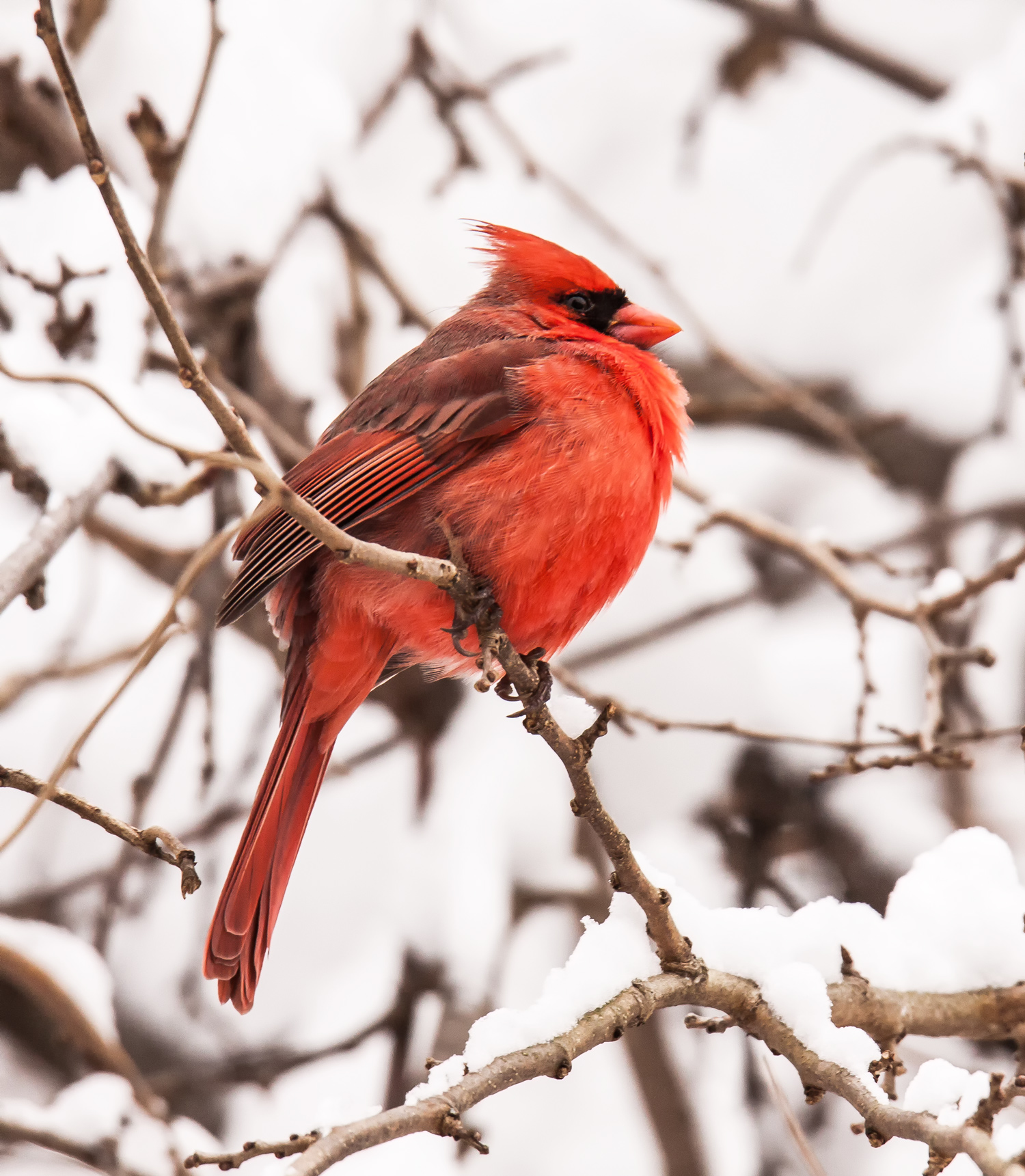
Northern Cardinal

January 16, 2019 Cardinal in the snow (https://michaelqpowell.com/2019/01/16/cardinal-in-the-snow-3/


winter sunrise

February 4, 2019 Reflected sunrise colors (https://michaelqpowell.com/2019/02/04/reflected-sunrise-colors/)


mountains in Germany

February 22, 2019 Mountain views in Germany (https://michaelqpowell.com/2019/02/22/mountain-views-in-germany/)


Northern Mockingbird

March 30, 2019 Mockingbird seeking seeds (https://michaelqpowell.com/2019/03/30/mockingbird-seeking-seeds/)


Uhler's Sundragon

April 12, 2019 Uhler’s Sundragon dragonfly (https://michaelqpowell.com/2019/04/12/uhlers-sundragon-dragonfly/)


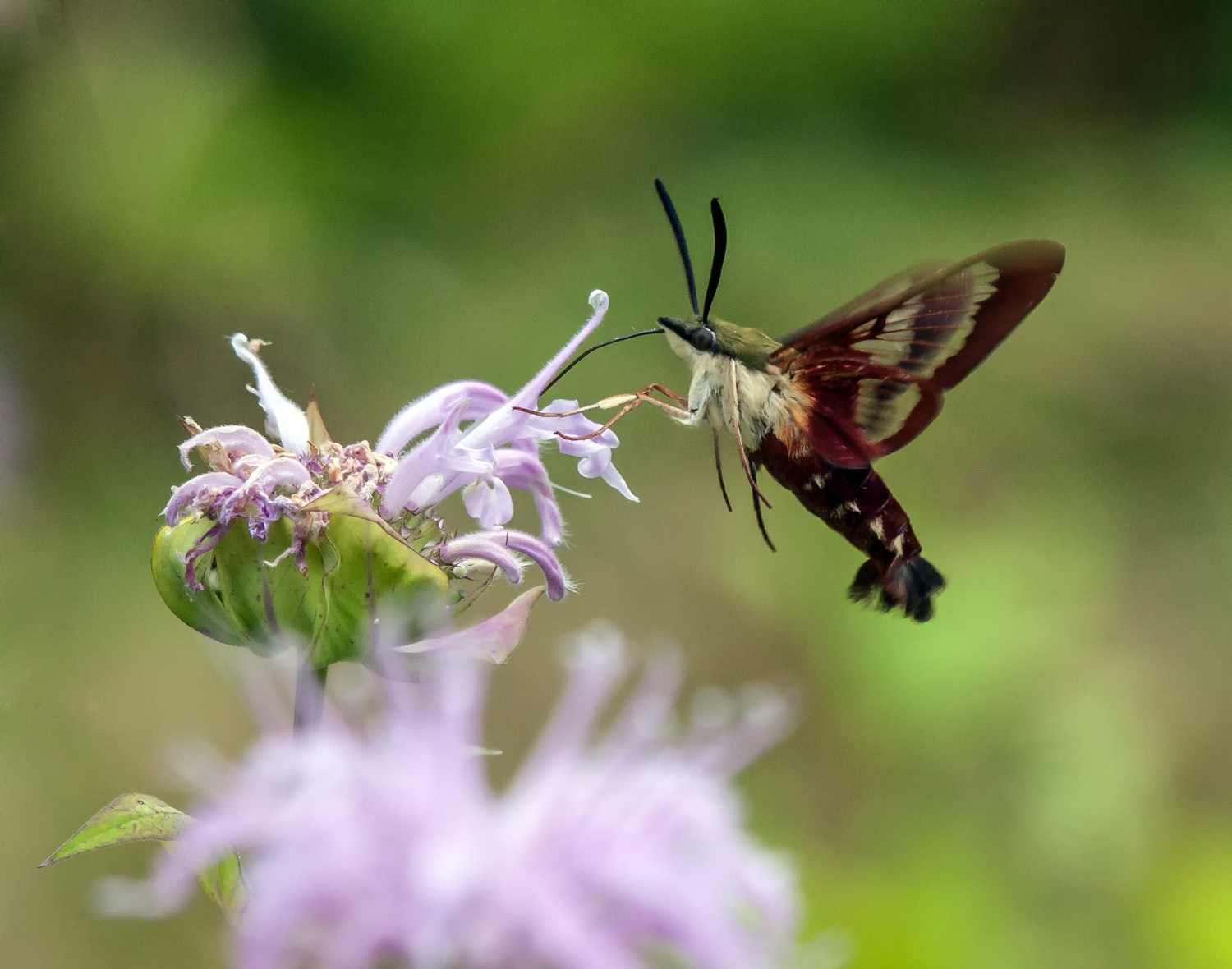
Hummingbird Clearwing Moth

June 24, 2019 Hummingbird Moth (the posting was on 2 July, but the photo was taken on June 24) (https://michaelqpowell.com/2019/07/02/hummingbird-moth/)

© Michael Q. Powell. All rights reserved.


Read Full Post »

When you truly love someone, you love them warts and all (and as the second image shows, American Toads (Anaxyrus americanus) have lots of warts). I spotted these amorous amphibians earlier this week at Prince William Forest Park in Triangle, Virginia.

American Toads

American Toad

© Michael Q. Powell. All rights reserved.

Read Full Post »

Can you actually see a sound? Yesterday while I was exploring Prince William Forest Park, I heard a whole lot of croaking. Eventually I spotted one really loud male toad with an inflated vocal sac, which was pretty cool. What were even cooler were the concentric ripples in the water generated by the toad’s croaking.

The second image shows the toad resting in between performances, whose main purpose is to attract mates. His song did not appear to have had any immediate benefits, although I was certainly impressed.

UPDATE: I initially identified this as a frog, but fellow blogger and wildlife enthusiast Walter Sanford pointed out to me that this is probably an American Toad (Anaxyrus americanus).

frog

frog

© Michael Q. Powell. All rights reserved.


Read Full Post »

Last night I was playing again with watercolors and found inspiration in some videos about Chinese sumi-e brush painting, particularly one by Daleflix on YouTube that showed him painting a dragonfly and a frog. I really like the way that sumi-e painting, which is often done in ink on rice paper, emphasizes the importance of each brush stroke.

My painting skills still need a lot of work, but I especially like how the dragonfly turned out. There is a kind of minimalism in the dragonfly that appeals to me. It was really all-or-nothing when I painted it. Each of the wings, for example, was a single brush stroke, with a little bit of outlining done later. Similarly, the segmented body was done in a single pass.

I kind of got a little lost after I had painted the frog and the dragonfly and tried to add some contextual elements. The water ended up way too dark and some of the branches got too thick. In case you are curious, the painting is 4 x 6 inches in size (10 x 15 cm), so the brush strokes were pretty small.

Still, I like the overall feel of this little painting, which represents a new step for me as I explore watercolors. I think that I may explore this style of painting some more.

dragonfly and frog

© Michael Q. Powell. All rights reserved.

Read Full Post »

Do you think about your photographic subjects one at a time? That’s the way that I tend to operate. One of my blogging friends, though, likes to organize photos of others around themes that transcend the boundaries of individual species. In this posting, Liz of Exploring Colour focused on the theme of Predators and Prey with photos that capture this reality of nature without becoming gruesome. Be sure to check out her other wonderful postings too that include her own photos as well of those of some other awesome photographers.

Ms. Liz's avatarExploring Colour

The reality of the natural world is that some creatures eat other creatures to survive. Nature photographers spend a lot of time outside and sometimes capture dramatic moments in the struggle for survival. Their photos and stories may shock us but we can learn so much from these encounters – animals seem capable of much more planning, strategy and applied knowledge than what most of us humans ever give them credit for.


** Click on any photo to view large-size version **

Note: Each photographer’s website/blog is listed at the bottom of this blog-post.


snake2_fish_blog

Mike Powell | Snake catches catfish | 20 July, 2017

  • Story plus 5 Photos showing the snake in various positions holding his catch, all the time in the water, until all of a sudden the snake somehow ingests the large fish and the last photo shows the snake with only the fish tail sticking out of…

View original post 409 more words

Read Full Post »

I will be heading home soon after my brief stay in Vienna, Austria and thought I would post a few last wildlife photos that I took here. These images help reinforce to me the notion that there is always something interesting in nature to photograph, no matter where I happen to be.

The first image is an unidentified species of frog that I encountered at the edge of a pond while wandering about the Donau-Auen National Park. It reminds me of the Southern Leopard Frog that I often see at home in Northern Virginia.

frog in VIenna

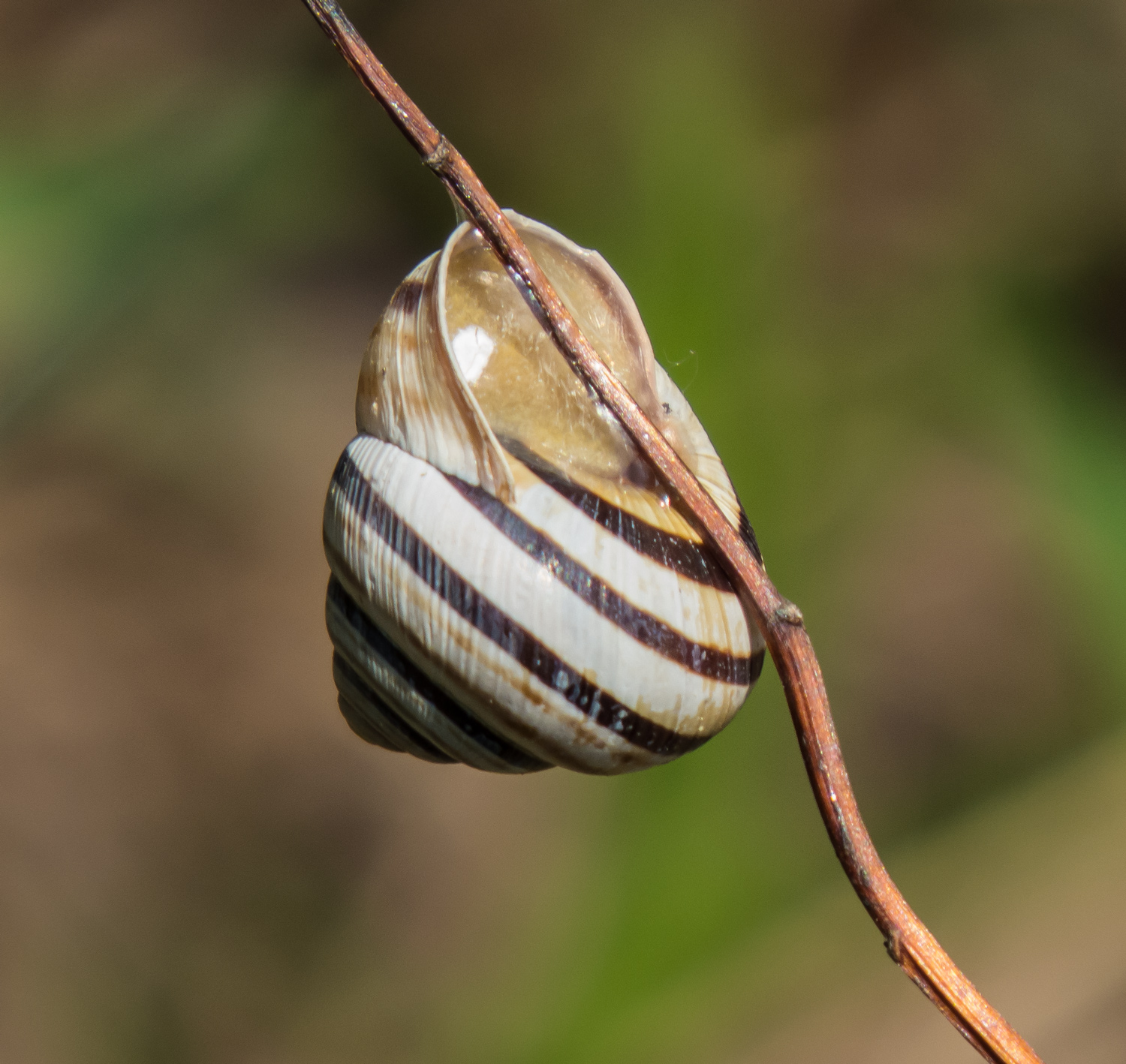
The second image appears to be a Viennese Banded Snail (Cepaea vindobonensis) that I also spotted in the National Park.  I thought that it was really cool the way that it had attached itself to the vegetation.

Viennese Banded Snail

The final image shows what I believe to be a Mute Swan (Cygnus olor) that I saw at the Stadtpark (“city park”) not far from the hotel where I am staying. I always find swans to be beautiful and graceful, even when located in an urban environment.

swan in Vienna

© Michael Q. Powell. All rights reserved.

Read Full Post »

The bright blue color of a juvenile skink’s tail is so startling and whimsical that I never fail to smile whenever I see one. When I first spotted this Common Five-lined Skink (Plestiodon fasciatus), it was basking in the sun on top of a concrete fishing platform at Jackson Miles Abbott Wetland Refuge. As I approach, it scurried under the platform and I stopped and waited. Eventually the skink poked its head out and cautiously crawled forward and I was able to capture this image.

Generally I prefer a more natural backdrop for my shots of insects and amphibians, but in this case I really like the varied colors and textures of the man-made materials. I also like the angular lines that contrast nicely with the curves of the skink’s body. Finally the neutral colors of the image help to draw the viewer’s eyes to the beautiful blue tail.

juvenile skink

© Michael Q. Powell. All rights reserved

Read Full Post »

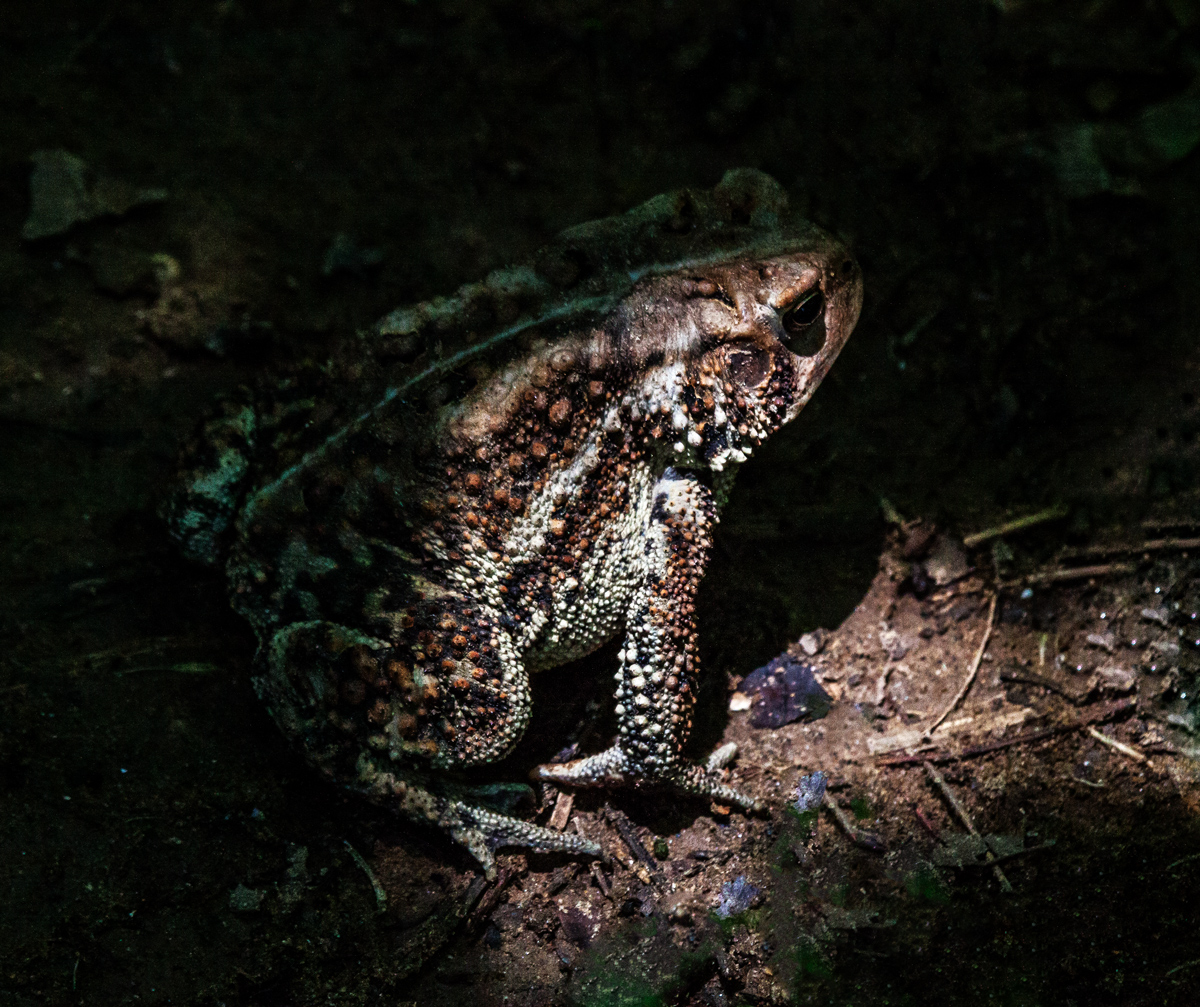
As I was walking along the Potomac River one day last month, I came upon this large toad, which I think might be a Fowler’s Toad (Anaxyrus fowleri). I was really struck by the way that the light and shadows helped to emphasize the very bumpy texture of the toad’s skin.

Fowler's Toad

© Michael Q. Powell. All rights reserved

Read Full Post »

As I walked along a trail paralleling the Potomac River one morning last week, I noticed some movement near the water’s edge. Moving closer, I spotted some tiny frogs—they seemed to be only about an inch or so in size (25 mm). Many of them hopped away as I continued my approach, but one of them jumped onto a rock and posed for me.

I was able to capture a lot of details of this frog, but am having trouble identifying its species. I have a lot more experience identifying birds and insects—I am not a frogman. Despite my ineptitude at identification, I really like the photo and the way that the background seems to mirror the colors, patterns, and texture of this tiny frog.

frog

© Michael Q. Powell. All rights reserved

Read Full Post »

I have always been fascinated with frogs. As a child, I remember my amazement at seeing photos of colorful tropical frogs in National Geographic, especially the green tree frogs with big red eyes.  Growing older, I loved Kermit the Frog, especially his quirky sense of humor and his propensity for bursting out in song. Even now, one of my all-time favorite movie scenes is from the beginning of The Muppet Movie, where the view begins high above the trees and gradually zooms in on Kermit, who is sitting on a log playing the banjo and singing The Rainbow Connection. I try to hold on to the innocent, wide-eyed optimism of that song.

As a photographer, I have list of aspirational shots, made up of images, subjects, and situations that I would love to photograph. For a long time, I longed to capture a photo of a frog perched on a lily pad. After numerous unsuccessful attempts, I managed to capture such an image a couple of years ago. Despite that “success” I still keep my eyes open for frogs whenever I am in an area with lily pads.

This past weekend I hit the jackpot when I spotted three frogs on a single lily pad. I was exploring a small lake at Ben Brennan Park, a small suburban park in Alexandria, Virginia with a variety of recreational facilities. There is a small elevated bridge over one section of the lake and it was from this vantage point that I was able to capture this image. Initially the three frogs were all facing outwards, looking like they were defending their pad from outside intruders. Just before I took this shot, however, the frog in the back turned toward the middle and looked like he was trying to sneak up on his buddy.

Perhaps he simply wanted to play a game of leapfrog.

leapfrog

© Michael Q. Powell. All rights reserved

Read Full Post »

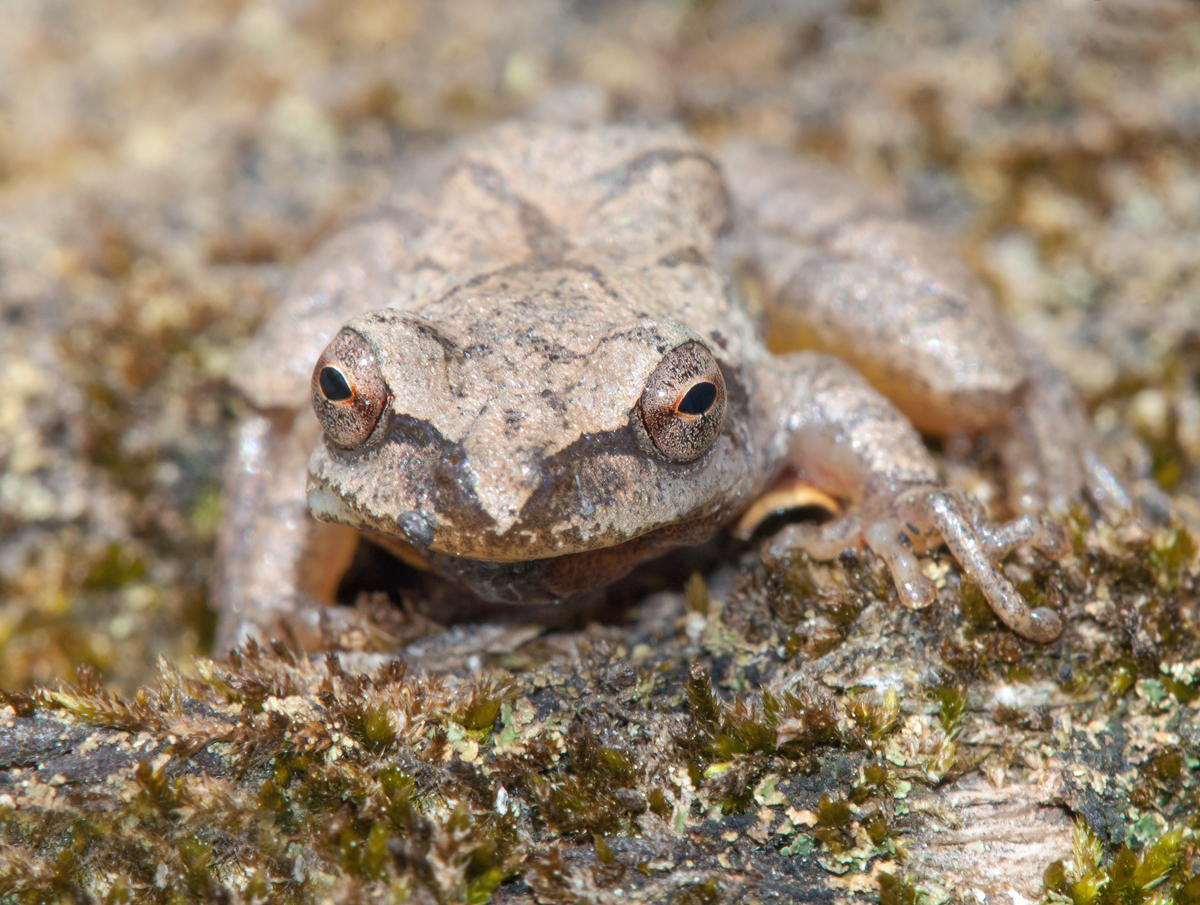
The high-pitched calls of the Spring Peeper frog (Pseudacris crucifer) are one of the harbingers of spring for many of us, but have you ever actually seen one of these diminutive songsters? Even when there was a loud chorus of Spring Peepers, these tiny frogs seemed to be invisible.

Last Friday, while hunting for dragonflies at Huntley Meadows Park with my friend and fellow photographer Walter Sanford, we almost literally stumbled upon a Spring Peeper near the edge of the water. As we were photographing one peeper, another jumped into view. The thing that struck me most about the spring peepers was how small they are, a bit over one inch and certainly less than two inches in length (about 3-5 cm). The other thing that I noticed was how low they were to the ground—it was tough getting a good viewing angle even when my elbows and knees were submerged in the marshy soil.

Here are three of my favorite shots of the Spring Peepers in a couple of different settings. You can’t help but notice how well the frog blends in with its surroundings, which helps explain why I had never been able to spot one previously. My one regret is that we never heard a peep from the frogs. Perhaps next time I will be able to get a shot of a Spring Peeper with its vocal sac inflated.

Spring Peeper

Spring Peeper

Spring Peeper

© Michael Q. Powell. All rights reserved.


Read Full Post »

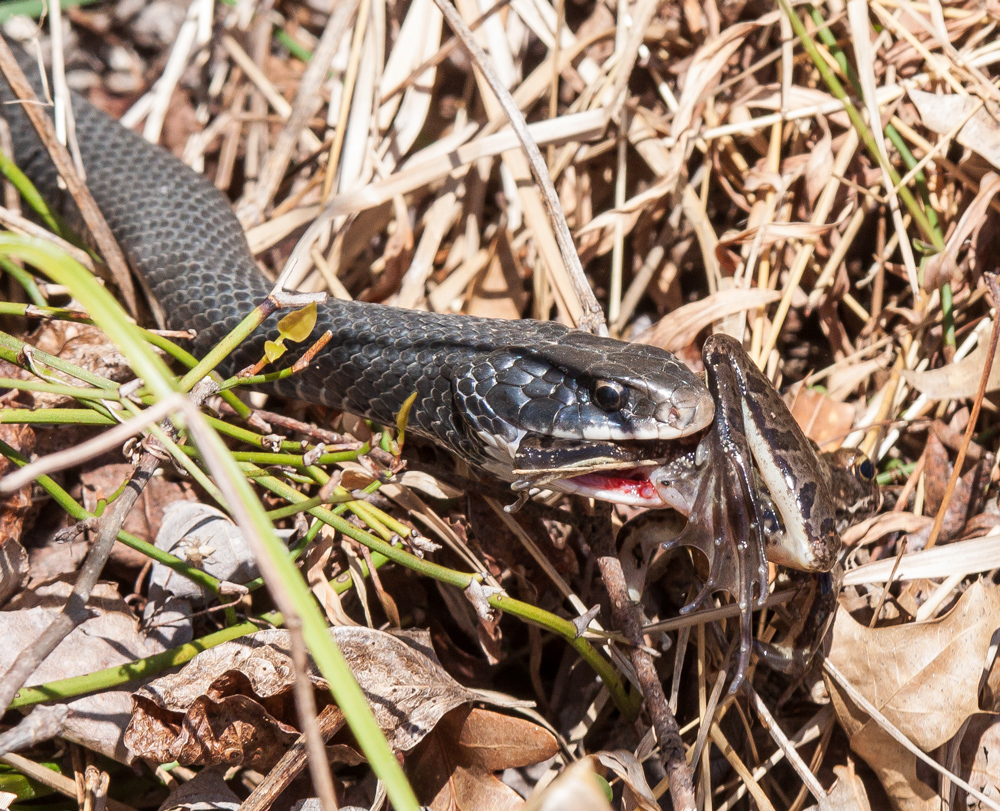
With a mixture of horror and fascination, I watched as a large black snake slowly ingested a Southern Leopard Frog (Lithobates sphenocephalus) that it had caught on Friday at Huntley Meadows Park. The frog was struggling and crying out loudly and then suddenly it was free. The lucky frog hopped away and the snake could only tell its friends about the one that got away.

When I first spotted the snake, it was holding the frog in the air. It appeared to have grabbed the frog by one of its back legs and was trying to adjust the frog so that it could swallow it. Unlike a Great Blue Heron that swallows its prey in a single gulp, the snake has to pull its prey in slowly. Little by little the snake seemed to get more of the frog’s leg in its mouth.

The frog continued to struggle, seeking to get some leverage so that it could pull its way out of the snake’s death grip. I didn’t see exactly how it happened, but all of the sudden the frog was free. It almost looked like that snake had released the frog, though that just seems so unlikely to have happened. Whatever the case, the frog was extremely fortunate—all of the previous encounters that I have observed between snakes and frogs have ended with the frog inside of the snake.

I was shooting with my macro lens, so I couldn’t zoom in closer, but I did manage to capture a sequence of shots that show some of the action.

release2_15Apr_blog

release3_15Apr_blog

release1_15Apr_blog

release5_blog_blog

© Michael Q. Powell. All rights reserved.

Read Full Post »

Now that spring is here, you can see and hear frogs throughout Huntley Meadows Park. One of the most common types in our area is the Southern Leopard Frog (Lithobates sphenocephalus), like this one that I spotted this past weekend.

Southern Leopard Frog

© Michael Q. Powell. All rights reserved.

Read Full Post »

Older Posts »