Feeds:
Posts
Comments

Posts Tagged ‘Tamron 18-400mm’

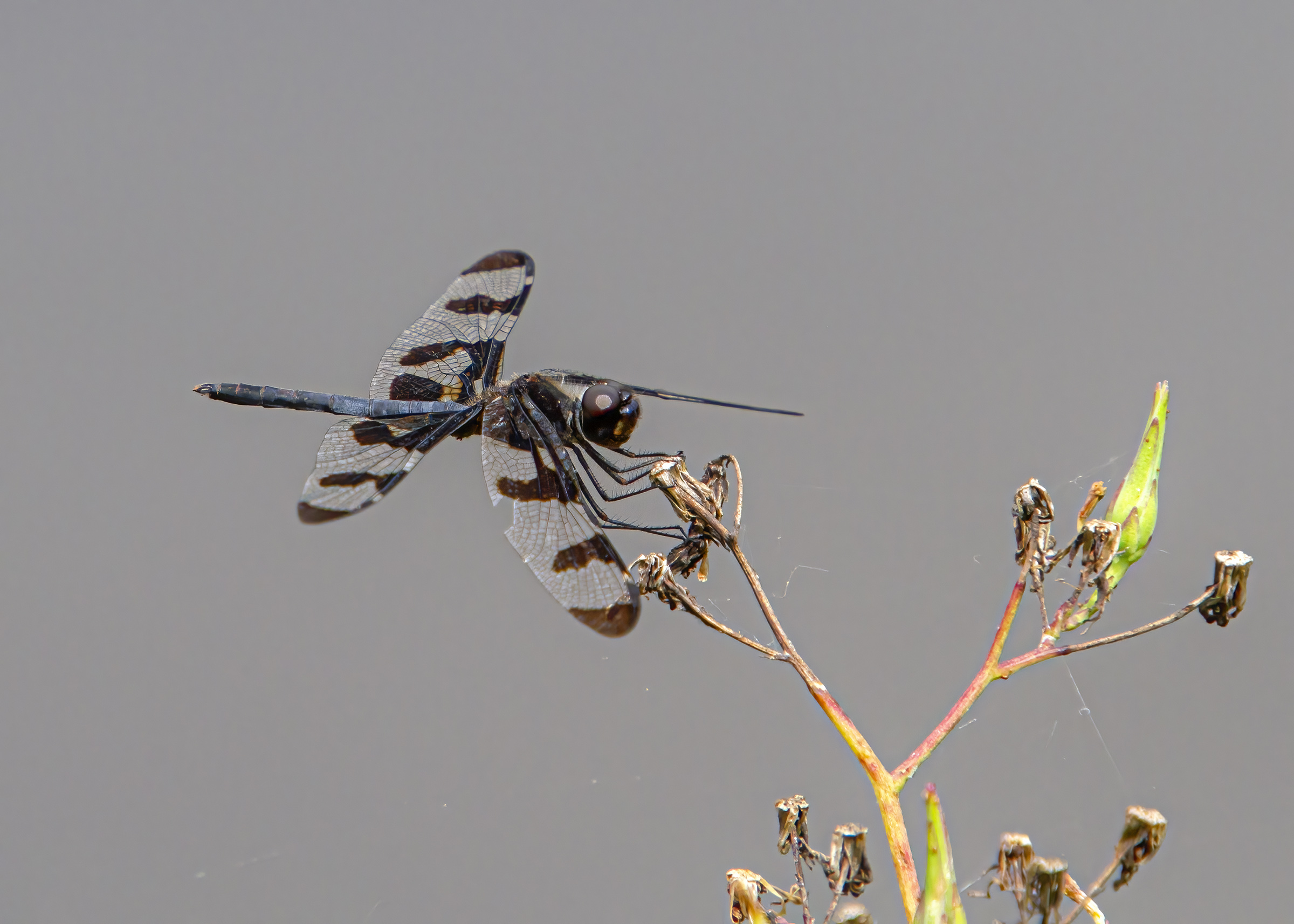
I spotted this cool-looking dragonfly yesterday when it flew to a hanging perch in some shaded vegetation along a creek in Prince William County. I was walking along a trail parallel to the creek and was primarily looking towards the water. Out of the corner of my eye, I detected some movement and spotted where the dragonfly had landed.

A couple of things immediately stood out to me. The dragonfly was hanging vertically, which meant that it was probably not one of the more common skimmers that I am used to seeing at this time of the year. I noted too that the dragonfly was long and skinny and, realizing that my camera was going to have trouble focusing on the dragonfly, I switched to manual focusing. I was able to snap off only a couple of shots before the dragonfly flew away and despite my efforts to relocate it, I was not able to find the dragonfly again.

When I looked on the back of my camera at the images that I had captured, I was not able to identify the dragonfly. When I returned home, I looked through my dragonfly guides and determined that it was a Fawn Darner dragonfly (Boyeria vinosa), a new species for me. Some experts in a Facebook dragonfly group confirmed my identification.

According to the Dragonflies of Northern Virginia website, “Unlike most other darners, and in fact most dragonflies, Fawns shun open, sunny areas. They spend the day hiding in dense, shady underbrush, hanging from the branches of shrubs and young trees. Around 4PM they start venturing out to patrol their shady, forest streams, peaking from about 6PM-8PM.” I encountered the Fawn Darner around midday, so I may have been disturbing its resting period.

Wildlife and nature photographers use many different approaches. Some of them go out to researched locations with a goal of seeing specific species—they are very targeted in their tactics. Others, like me, are opportunistic photographers who wander about, ready to react to whatever they encounter. Although I do love to spot species that are new to me, as was the case with this Fawn Darner, such encounters tend to be almost serendipitous—I tend to stumble upon new species.

Fawn Darner

© Michael Q. Powell. All rights reserved.
Read Full Post »

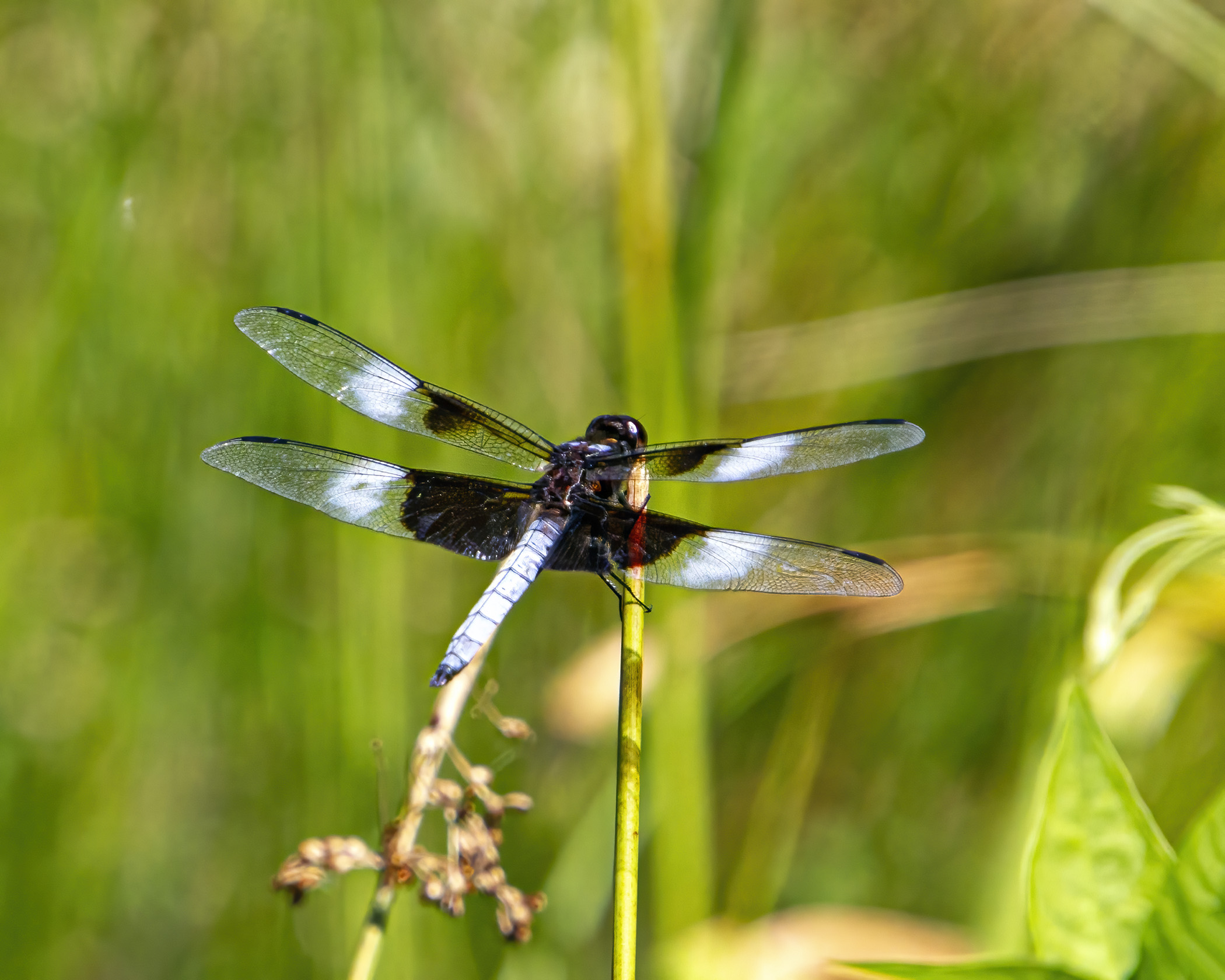
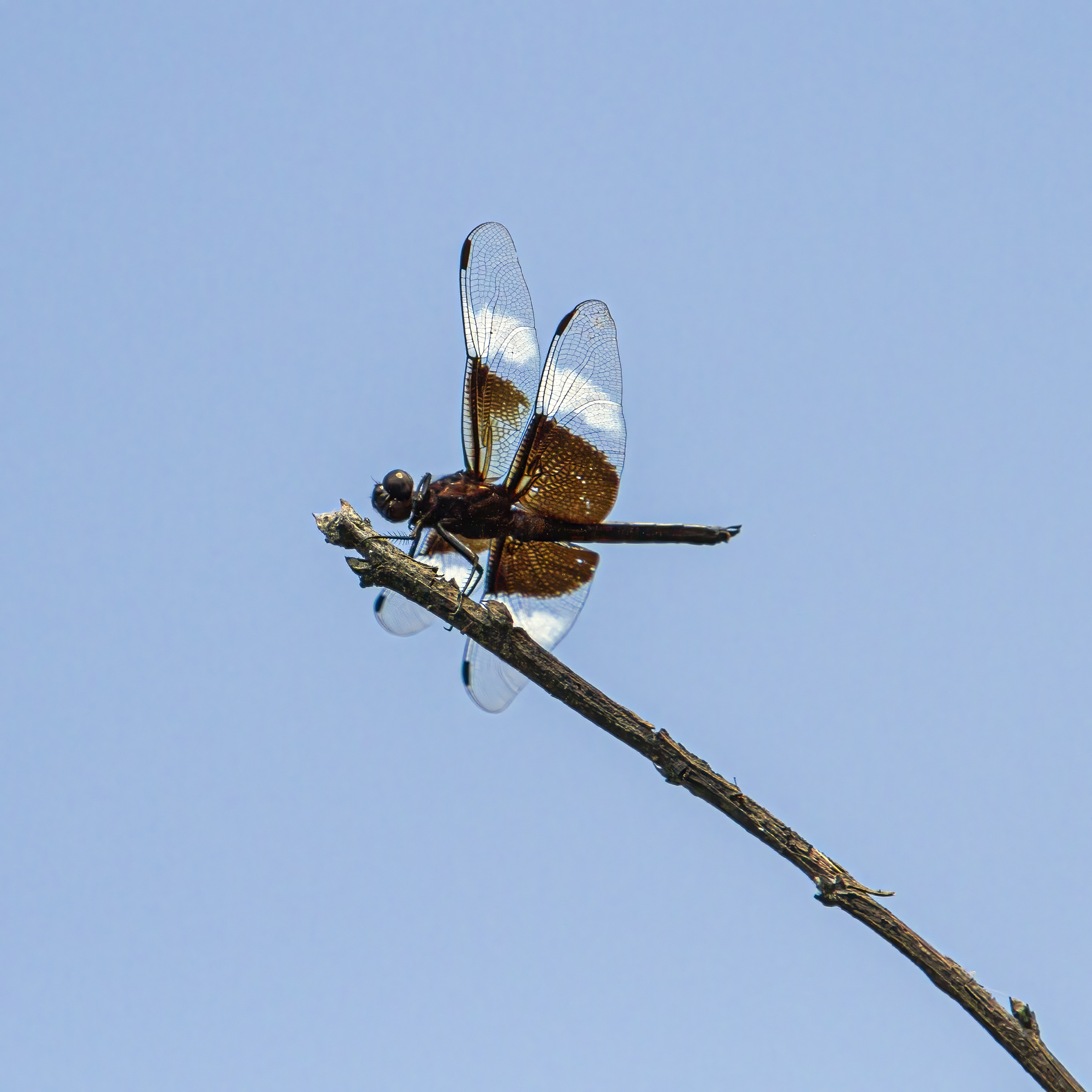
Here’s a shot of a handsome male Widow Skimmer dragonfly (Libellula luctuosa) that I spotted this past Monday at Jackson Miles Abbott Wetland Refuge. The Widow Skimmer is one of only a few dragonfly species that I have encountered that has both white and brown markings on its wings. (the male Twelve-spotted Skimmer dragonfly is the only other one that immediately comes to mind and you can see what one looks like in my 31 May 2021 posting entitled Twelve-spotted Skimmer.

Backgrounds are always tricky when photographing insects perched in highly vegetated areas. I think the stalks of vegetation are blurred enough in the first image that they do not draw attention away from the main subject. I think, in fact, the the green and tan lines add some visual interest to the image that would be lacking if the entire background were a solid color. The background in the second image is a bit busier, but you get a much better view of the dragonfly’s wing patterns—wildlife photography is often a matter of compromise in which “perfection” is often unachievable.

Widow Skimmer

Widow Skimmer

© Michael Q. Powell. All rights reserved.


Read Full Post »

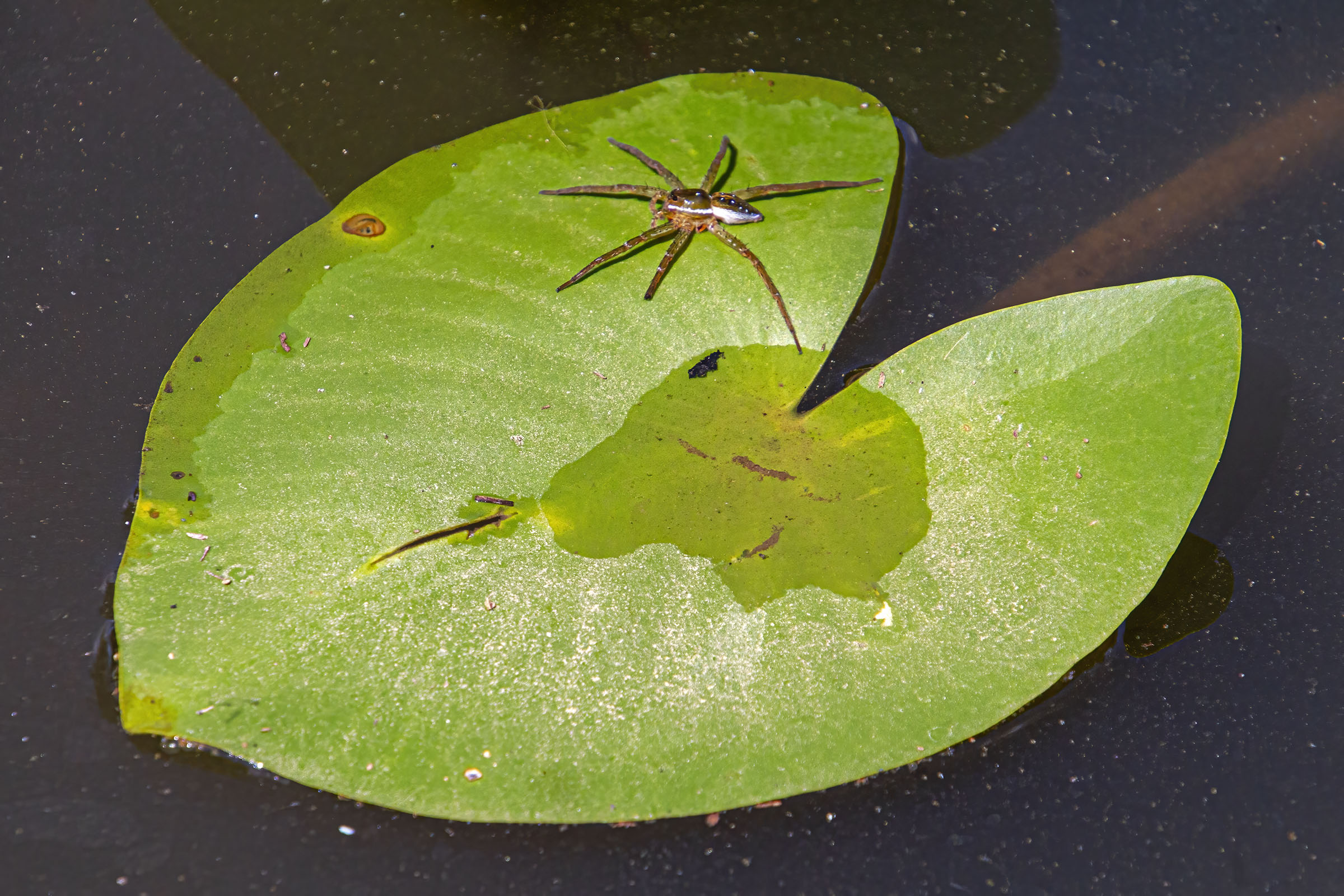
I usually scan the surfaces of lily pads whenever I see them, hoping to spot frogs perched on them. I did not see any frogs last week during a visit to Jackson Miles Abbott Wetland Refuge, but I did spot a cool-looking Six-spotted Fishing Spider (Dolomedes triton).

Normally I see these fishing spiders in shallow water at the edge of ponds with some of their legs on the surface of the water to sense the vibrations of potential prey. When they do, they capture the prey by walking across the water, prompting some people to refer to them as “Jesus spiders.”

Six-spotted Fishing Spider

© Michael Q. Powell. All rights reserved.

Read Full Post »

On Monday I spent several hours at Jackson Miles Abbott Wetland Refuge, focusing my attention primarily on trying to capture shots of Prince Baskettail dragonflies (Epitheca cynosura) in flight. There appeared to be several of them patrolling over the waters of the small pond and I managed to find some good vantage points that gave me unobstructed views of them as they passed by.

One of the locations where I spotted a Prince Baskettail included some lily pads and I decided to try to include them in the shots to give a sense of the environment. The downside of this approach, though, was that it made it even harder to keep my camera’s focus on the dragonfly—the camera kept trying to focus on the background. I was persistent, however, and managed to get a few good shots, as you can see in the first three images below.

I took the final image at a different spot where there were no lily pads. This shot is undoubtedly the sharpest one of today’s photos. Although you can’t see much of the environment in the image, the ripples in the water do add some visual interest.

I couldn’t help but notice that the dragonfly in the final photo had its legs in a lower position than normally—generally a Prince Baskettail flies with its legs held tightly against its thorax to present the most aerodynamic profile. I know that some dragonfly species catch prey on the fly with their legs extended like a basket and wonder if that was what this dragonfly was attempting to do.

Prince Baskettail

Prince Baskettail

Prince Baskettail

Prince Baskettail

© Michael Q. Powell. All rights reserved.


Read Full Post »

Eastern Amberwing (Perithemis tenera) dragonflies are the smallest dragonflies in my area at less than an inch (25 mm) in length, but are quite common. I often spot the distinctive amber wings of the males as they fly low over the waters of many ponds. Females of this species, however, do not have amber wings—they have brown patches on their wings—and I rarely see them.

According to the Dragonflies of Northern Virginia website, female Eastern Amberwings are often found far from water, in meadows among summer wildflowers. “They’re probably hunting even smaller visitors to these summer blooms like midges, flower flies and tiny bees. They also share their colorful perches with hornets and other wasps. Perhaps, this is how their mimicry behavior evolved, and may explain why females appear to practice it more than males.”

On Monday I was thrilled to spot this female while I was exploring a pond at Jackson Miles Abbott Wetland Refuge. I am not sure if she had ventured down to the pond to mate, but whatever the case I was happy to capture some shots of her as she buzzed about the vegetation surrounding the pond. I love her two-toned eyes and the beautiful markings on her body.

Eastern Amberwing

Eastern Amberwing

Eastern Amberwing

© Michael Q. Powell. All rights reserved.
Read Full Post »

When the weather is nice, many turtles emerge from the waters of the ponds to bask in the sunlight. Often I will see turtles jammed so close together on logs that it looks like a mall parking lot just before Christmas.

During a recent visit to Jackson Miles Abbott Wetland Refuge, I spotted an Eastern Painted Turtle (Chrysemys picta picta) that had found a solitary perch that was just big enough for a single turtle. The only problem was that the tree was sticking out from the water at a sharp angle. I could not tell, but suspect that the turtle had dug the claws in its front feet into the bark to keep from sliding into the water.

I love the serene look on the face of this turtle—it seemed to be in a meditative state, a picture of peaceful contentment.

Painted Turtle

© Michael Q. Powell. All rights reserved.

Read Full Post »

July is finally coming to an end, a month of endless hot, hazy, and humid days. It has been tough to get myself motivated to go out with my camera and I have been forced to keep my outings relatively short. Weather-wise autumn is my favorite time of the year, but we have a lot more summer weather to endure before the cooling temperatures of autumn arrive.

During a recent visit to Jackson Miles Abbott Wetland Refuge I was delighted to spot this Pearl Crescent butterfly (Phyciodes tharos). It was feeding in a patch of what looked to be Black-eyed Susan flowers (Rudbeckia hirta), although I must confess that I am not very good at identifying flowers, so my identification may not be accurate.

Initially the little butterfly perched with its wings only partially open, but I waited patiently and eventually it fully extended its wings and I was able to capture this image. It is a relatively simple composition, but I really like the way that it gives you a sense of the environment while also showing you the beautiful markings of the Pearl Crescent butterfly.

pearl crescent

© Michael Q. Powell. All rights reserved.


Read Full Post »

Whenever I see Water Lilies in bloom, I immediately think of one of my favorite artists—Claude Monet. During the last thirty years of his life, water lilies (Nymphéas in French) were the main focus of his artistic production. One of the museums that I most love visiting is the Musée de l’Orangerie in Paris, because it houses eight massive water lily murals by Monet in two specially-built oval rooms. It is incredibly peaceful to just sit in one of those rooms, surrounded by those amazing paintings.

During a visit to Kenilworth Park and Aquatic Gardens in Washington D.C. in mid-July, I chose to focus my attention on capturing portraits of individual flowers (or a couple, in the case of the first photo), rather than trying to capture the expanse of water lilies in multiple ponds. There is something really peaceful and pure about water lilies that calms and soothes me and tends to put me into a contemplative mood.

I have returned from my short road trip to Massachusetts and Maine and am still feeling a bit of residual fatigue after spending almost twelve hours in my car yesterday. I hope to resume my normal posting schedule with some new photos soon. Thanks to all of you who have continued to read some of my older postings while I have been mostly absent from the internet this past week.

water lily

water lily

water lily

© Michael Q. Powell. All rights reserved.


Read Full Post »

I was excited to spot several Swift Setwing dragonflies (Dythemis velox) last Saturday along the edges of the pond at Jackson Miles Abbott Wetland Refuge. This species gets its name from the way that the way the Swift Setwings perch with their wings forward and abdomens up, like the “ready, set, go” position of a runner at a track meet.

The Swift Setwing is primarily a southern species that may never before have been spotted in Fairfax County, Virginia, the county where I live, until June 2016, when I spotted one at the same wetland refuge. (See my 25 June 2016 blog posting for details on my first sighting of the species.) Every year since then, I have excitedly looked forward to seeing these little dragonflies—it is pretty clear by now that there is an established breeding population at this pond. This is the only location where I have seen Swift Setwings, though I heard from a friend that they may have also been found at another local spot.

I am driving up to Massachusetts and Maine on Tuesday to handle some family issues and suspect that I will not be posting a blog until my return late on Saturday. After then I hope to return to my normal schedule of doing a blog posting almost every day.

Swift Setwing

Swift Setwing

Swift Setwing

© Michael Q. Powell. All rights reserved.


Read Full Post »

During the summer, most of my dragonfly photos tend to be variations of the stereotypical “dragonfly on a stick.” I am always on the lookout, though, for more interesting or photogenic perching places and behaviors.

The first shot shows a male Eastern Amberwing dragonfly (Perithemis tenera) perched on the end of a piece of rebar that sticks out of the water near a small fishing dock at Jackson Miles Abbott Wetland Refuge. Generally I try to avoid having manmade objects in my nature photos, but in this case I really like the juxtaposition of the natural and manmade elements in this shot. The warm tones of the amber wings contrast nicely with the cooler rust color of the rebar and the lines on the rebar are mirrored by those on the dragonfly’s body. Almost every year I return to this spot to capture a similar image, though each encounter is unique in its own way.

The second image shows another male Eastern Amberwing perched on a large rock jutting out from the water. I couldn’t get close to the dragonfly so I took the opposite approach and zoomed out to capture the dragonfly’s reflection (as well as the amber shadow it was casting on the rock). I really like the contrast between the diminutive size of the dragonfly and the large jagged rock—it seems almost like a visual metaphor for life’s challenges.

These two shots are examples of how I try, when possible, to visualize a shot before I take it. Frequently, though, I am forced to react instantaneously to a given situation, with a primary goal of keeping my subject within the frame and hopefully in focus. It’s a weird mental juggling act to simultaneously attempt to think creatively, instinctively, instinctively, and analytically—that’s wildlife photography in a nutshell.

Eastern Amberwing

Eastern Amberwing

© Michael Q. Powell. All rights reserved.


Read Full Post »

It seems like large butterflies have been more scarce than normal this summer. I was therefore thrilled to spot this Great Spangled Fritillary butterfly (Speyeria cybele) yesterday during a brief visit to Jackson Miles Abbott Wetland Refuge. Most of the time the butterfly had its head buried in the flower, but for a brief moment the butterfly raised its head, spread its wings, and let me capture this pretty little portrait image.

Great Spangled Fritillary

© Michael Q. Powell. All rights reserved.


Read Full Post »

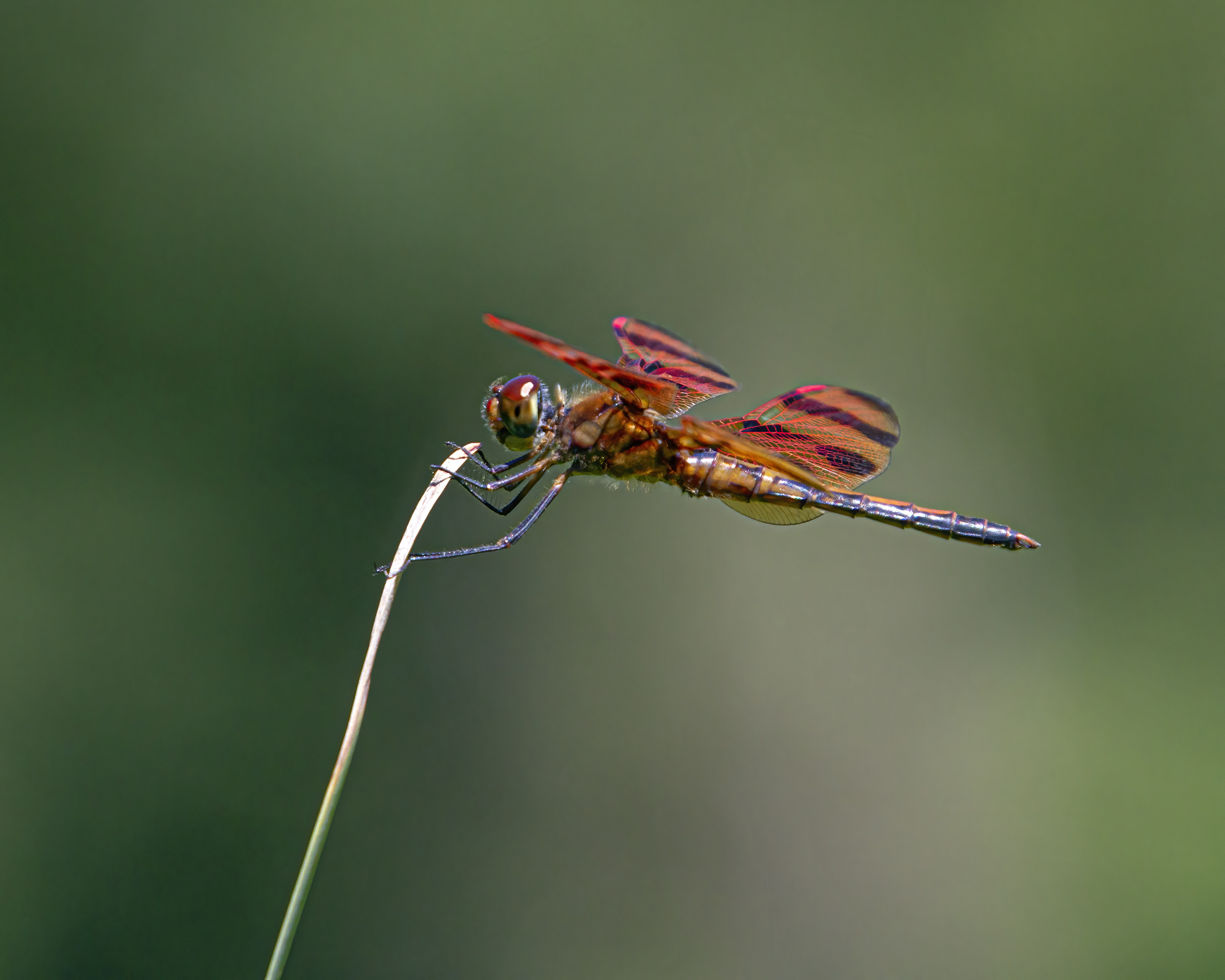
There is only one local location where I have found Banded Pennant dragonflies (Celithemis fasciata) in the past and in some years I have not seen a single one there. I was hopeful that I would see some on Thursday when I returned to Jackson Miles Abbott Wetland Refuge and my hopes were rewarded. Not only did I spot several Banded Pennants, but they were cooperative in choosing some photogenic perching locations for me.

Like other pennant dragonflies, Banded Pennants like to perch on the very tips of vegetation, which causes them to flap around a bit in the slightest breeze, like a pennant. I love the patterned wings of Banded Pennants, which cause them to stand out from several other small blue dragonflies that I saw that day. As you can see from the photos, the Banded Pennants mostly perched on plants overhanging the water or on vegetation growing out of the water.

At the last minute I decided to add the final photo, despite the fact that the dragonfly occupies only a small part of the frame. I really like the reflections of the plants in the water and did not want to zoom in and lose them. I also like the way that the image shows a Banded Pennant zooming low over the water in between the plants. If you look closely you can see the way that the dragonfly has tucked in its legs in order to be a bit more aerodynamic when flying.

Banded Pennant

Banded Pennant

Banded Pennant

Banded Pennant

© Michael Q. Powell. All rights reserved.


Read Full Post »

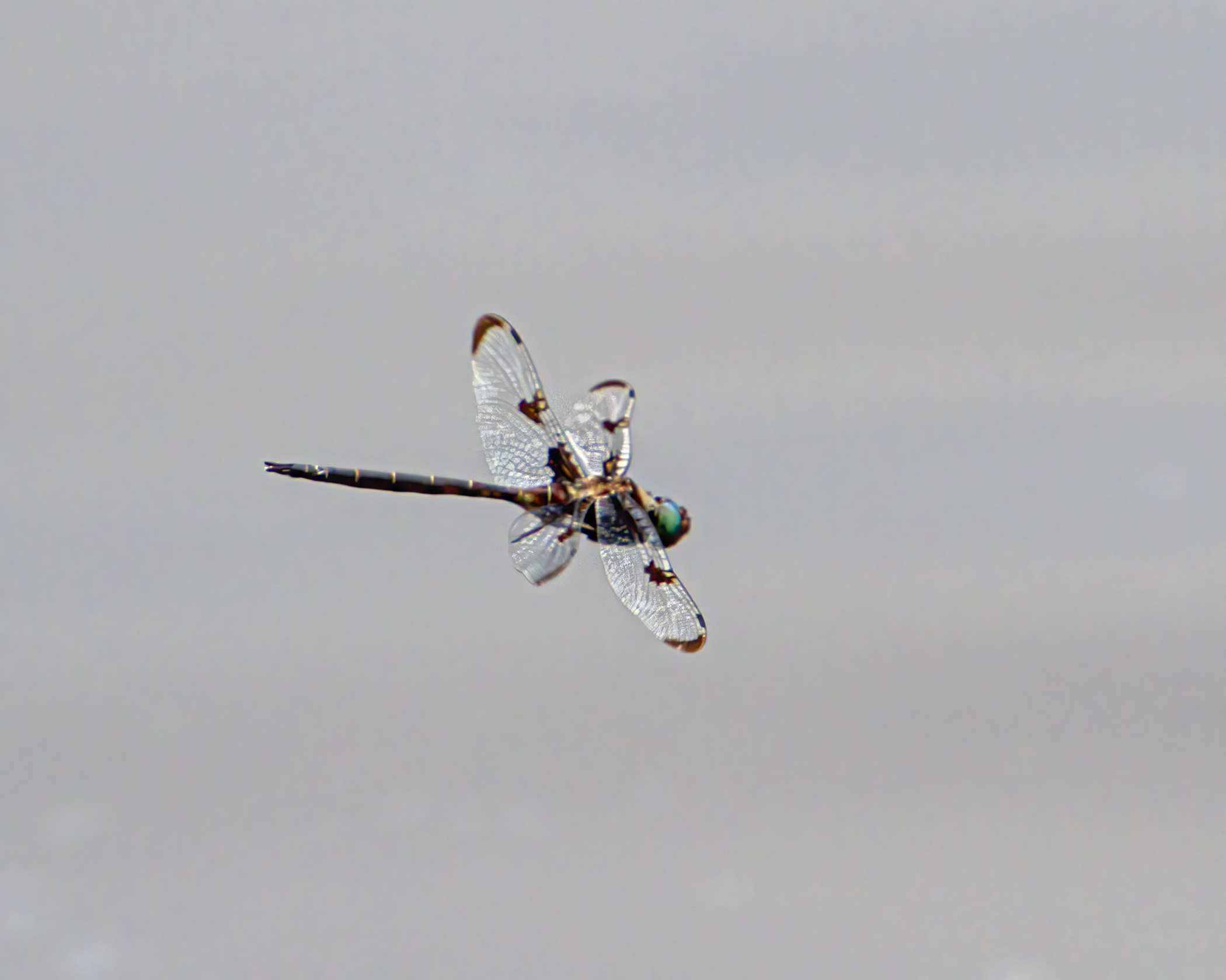
Yesterday I visited Jackson Miles Abbott Wetland Refuge and spent a lot of my time there trying to get shots of dragonflies in flight. The dragonflies were not very cooperative and kept their distance most of the time, but eventually I managed to get a few decent shots. What was especially cool was that I captured images of dragonflies from three different families—Skimmer, Darner, and Emerald.

The first photo shows a Banded Pennant (Celithemis fasciata), a Skimmer, as he was flying toward me. Banded Pennants are pretty small at about 1.3 inches (33 mm) in length, so I was pretty thrilled to capture this shot as he was flying toward me. This was actually the first time that I had seen a Banded Skimmer this season.

The second photo shows a Cyrano Darner (Nasiaeschna pentacantha). Despite the fact that I took the shot from a long distance away, you can still see the prominent “nose” that is supposedly reminiscent of the long nose of literary character Cyrano de Bergerac.

The last two photos show Prince Baskettails (Epitheca cynosura) that are members of the Emerald family. Prince Baskettails, which are about 2.9 inches (74 mm) are quite easy to identify, because they are the only large dragonfly in our area with patterned wings. I had more opportunities with this species that with the others, because several Prince Baskettails were flying repetitive patrols only various parts of the pond and passed by me multiple times. Although it is a little easier to focus on a dragonfly in flight when the background is clear, I think it is even cooler when I manage to include reflections in the water in a photo, as was the case with the reflections of the branches in the final photo.

Banded Pennant

Cyrano Darner

Prince Baskettail

Prince Baskettail

© Michael Q. Powell. All rights reserved.


Read Full Post »

There must have been something really special about this pretty pink water lily at Kenilworth Aquatic Gardens. A honey bee was attracted to it and plunged headfirst into the center of the flower after perching momentarily on a petal. A bumble bee decided to join in the action and for a brief period worked side-by-side with its smaller cousin gathering pollen and nectar.

As I was looking at the photos on my computer, I couldn’t help but notice the cluster of tiny insects on the stem of the water lily. What were they? I posed the question in a Facebook forum and it turns out that they are probably Common Waterlily Planthoppers (Megamelus davisi).  I took photos of several other nearby water lilies, but this was the only one in which I saw the planthoppers. There must have been something really special about this pink water lily that caused it to attract so many insects.

water lily

water lily

© Michael Q. Powell. All rights reserved.
Read Full Post »

Beauty expresses itself in so many different ways. That was the thought that was running through my head as I reviewed my photos from my recent visit to Washington D.C. to photograph lotuses and water lilies at Kenilworth Park and Aquatic Gardens. Actually I had a similar thought when I was there with my camera—how could I possibly capture a sense of the moment, of the shapes and colors that were overwhelming my senses?

I have already shared some photos of Sacred Lotuses and American Lotuses in previous blog postings, but I have so many more images that I like that I feel compelled to share a few more images of Sacred Lotuses (Nelumbo nucifera). I hope you don’t mind.

Sometimes I describe what I like about the photos in a blog posting, but this time I will let you enjoy them without my commentary. My only recommendation is that you click on the images to see more of the details of these wonderful flowers. Enjoy the experience as seen through my eyes and the lens of my camera.

Sacred Lotus

Sacred Lotus

Sacred Lotus

Sacred Lotus

© Michael Q. Powell. All rights reserved.


Read Full Post »

Most of the beautiful lotus flowers that I photographed last week at Kenilworth Park and Aquatic Gardens in Washington D.C. were Sacred Lotuses (Nelumbo nucifera), a plant that is native to Asia. In one small area of the gardens, I spotted some American Lotuses (Nelumbo lutea), a species that is native to North America. Unlike Sacred Lotuses, which tend to be pinkish in color, the flowers of American Lotuses are white or pale yellow in color and the American Lotus is sometimes called a Yellow Lotus.

It was mid-morning when I took these shots and the sun was shining brightly, so I had to deliberately underexpose the shots to keep the white highlights from getting blown out—that is why the backgrounds look so dark. I like the effect and find that it adds a bit of drama to the images, especially the first one.

American Lotus

American Lotus

American Lotus

© Michael Q. Powell. All rights reserved.


Read Full Post »

I was delighted to spot several frogs sitting on lily pads during my recent trip to Washington D.C. to visit Kenilworth Park and Aquatic Gardens. In the first photo, the cute little frog was perched on some large lily pads from a water lily species from South America. These lily pads have raised edges that always remind me of a tart pan. Reportedly this type of lily pad can grow to as much as 10 feet (3 meters) in diameter and can support a considerable amount of weight if it is evenly distributed.

The second and third photos show the same frog perched on a flatter-style lily pad. I think that this frog is a Green Frog (Lithobates clamitans), although I must confess that I have trouble telling green frogs from bullfrogs. I really like the eye-to-eye pose in the final photo in which the frog’s face reminds me a lot of Kermit the Frog from the Muppets.

frog on lily pad

frog on lily pad

frog on lily pad

© Michael Q. Powell. All rights reserved.

Read Full Post »

Last Thursday I visited Kenilworth Park and Aquatic Gardens in Washington D.C. with my photography mentor Cindy Dyer to photograph the lotuses and waterlilies that we knew would be in bloom. This facility is the only national park site devoted to cultivated water-loving plants and features over 45 ponds filled with a variety of water lilies and lotuses, according to the Friends of Kenilworth Aquatic Gardens website. Sacred Lotus (Nelumbo nucifera)

The official website of the park describes it more poetically as a place “where water and wind dance.” “Deep within Kenilworth lies an oasis, hidden behind trees and cattails. It’s a place where beavers build their homes and turtles sleep on logs. Lotus blooms rise from the muck and lilies sit on the water. The wind dances with the dragonflies, rustling through the trees, carrying the song of the birds until it brushes across your face, fading to a whisper, saying “come join.” ”

One of the “stars” of the aquatic gardens is the Sacred Lotus (Nelumbo nucifera) and I spent a good amount of time trying to capture images of these spectacular flowers. We arrived at the gardens relatively early, but it was still a challenge to photograph the flowers without getting harsh highlights. I particularly like the first photo in which I managed to capture both a flower and the showerhead-like seedpod that remains after the petals have fallen away.

In my final photo, I zoomed in to create a Georgia O’Keeffe-like vibe. My friend Cindy used a handheld diffuser to block some of the sunlight, which allowed me to capture the saturated color of this particular flower—most of the other flowers were a lighter pink, like the ones in the first and second photos.

Sacred Lotus

Sacred Lotus

Sacred Lotus

© Michael Q. Powell. All rights reserved.

Read Full Post »

Several Common Baskettail dragonflies (Epitheca cynosura) were patrolling over the pond at Jackson Miles Abbott Wetland Refuge last Thursday and I spent a lot of time trying to capture images of one of them as they zoomed by me. I made attempts with both my 180mm macro lens and my 18-400mm zoom lens, sometimes using focusing manually and sometimes using auto focus. Needless to say, there is also a lot of luck involved in getting a somewhat sharp photo of a dragonfly in flight

I spent a lot of time trying to track the dragonflies. They didn’t exactly fly in a pattern, but they seemed to have a territory that they were patrolling, so they came by me at irregular intervals. In the first two shots below, I was able to get a bit of the habitat in the photo, but most of the time I was focusing solely on the dragonfly and there is nothing in the background but the somewhat muddy water of the pond.

I was happy that I was able to get some shots from a number of different angles. In some of the shots, the dragonfly was flying by me, but in other cases I manage to capture images in which the dragonfly was flying towards me or away from me. The angle was often dependent on the speed with which I was able to acquire my target in the viewfinder of my camera and successfully track it as I tried to focus on it—hand-t0-eye coordination is critical.

I used to think that it was impossible to get shots like these. It has gotten a little easier over time as I have gained experience, but it still is pretty hard. No matter how skilled I get, patience and persistence are still the most critical factors in this type of photography.

Common Baskettail

Common Baskettail

Common Baskettail

Common Baskettail

© Michael Q. Powell. All rights reserved.

Read Full Post »

I can’t help myself. Whenever I see dragonflies flying over the water, I feel compelled to try to photograph them in flight. This past weekend I spotted several Common Baskettail dragonflies (Epitheca cynosura) flying patrols over a small pond in Orkney Springs, Virginia. The dragonflies flew by numerous times, giving me a lot of opportunities to take shots.

As is usually the case, most of my shots were out of focus or included only a portion of the dragonfly at the edge of the frame. However, as most of you know, I am quite persistent and eventually I managed to get some decent shots of the dragonflies.

Several of my sharpest shots show the dragonfly against a gray background, but lack a sense of the environment. The last three shots include patches of algae and give you a really cool perspective that reminds me of the view that you get from an airplane window when you look out and see another airplane along with the ground below.

Common Baskettail

Common Baskettail

Common Baskettail

Common Baskettail

Common Baskettail

© Michael Q. Powell. All rights reserved.


Read Full Post »

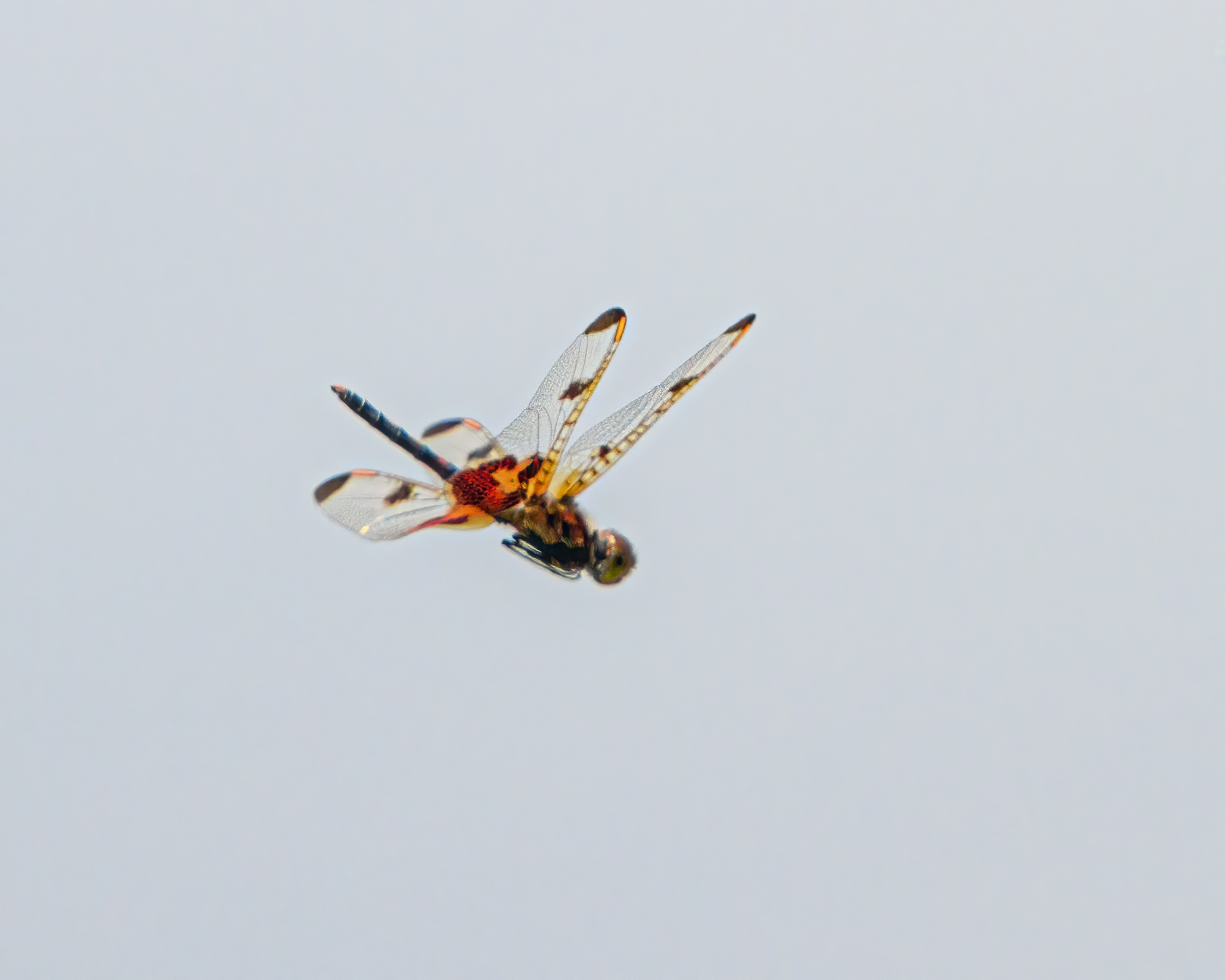
I was delighted last Thursday to see quite a few Calico Pennant (Celithemis elisa) dragonflies during a visit to Occoquan Bay National Wildlife Refuge. The markings and wing patterns on this species are really striking, making this one of the most attractive species that I see during the dragonfly season.

Some of the Calico Pennants appeared to have newly emerged—when dragonflies initially break through the exoskeleton of their water-dwelling larvae selves, their wings are really shiny and fragile and their coloration is often pale. The dragonfly in the first photo appears to be in that stage of development, which is sometimes referred to as “teneral.” It you look closely at the place where the dragonfly is grasping the vegetation, you can see what is quite probably its discarded exoskeleton from which it had recently emerged.

The Calico Pennants in the second and third photo are females, as was the one in the first photo. The patterns on the wings of these more mature females are more distinct and their yellow coloration is somewhat brighter. How do I know that they are females? If you look closely at the ends of their abdomens (the “tails”) you can see the terminal appendages that indicate their gender.

Female Calico Pennants have yellow markings on their abdomens, but that is not a reliable indicator of their gender, because immature males have that same coloration. The dragonfly in the fourth photo, for example, is an immature male Calico Pennant. If you compare the tip of the abdomen of this dragonfly with the one in the third photo, you may be able to see that there are differences.

What does a mature male Calico Pennant look like? I managed to spot only a single mature male that day, but fortunately was able to capture a shot of it. As you can see in the final photo, adult male Calico Pennants have red marking on their abdomens and the veining on their wings is pinkish in color.

We are gradually transitioning to the summer dragonfly species and some of the early spring ones are starting to disappear. I’ll be keeping my eyes open for the “new” species, so don’t be surprised to see more dragonfly photos in the upcoming months.

Calico Pennant

Calico Pennant

Calico Pennant

Calico Pennant

Calico Pennant

© Michael Q. Powell. All rights reserved.
Read Full Post »

I love the poses of this bright yellow Prothonotary Warbler (Protonotaria citrea) that I spotted last Thursday at Occoquan Bay National Wildlife Refuge. The warbler was actively twisting, turning, and stretching as it foraged for food and amazingly was perched quite low in the vegetation—most of the times in the past I have seen Prothonotary Warblers high in the trees and was forced to shoot them from an unflattering sharp upward angle.

Quite often when I am focusing on a wildlife subject, it moves. Most of the time the result is a blurry image, but sometimes I end up with a really cool shot. The Prothonotary Warbler took off just as I pressed the shutter release and I was lucky to capture it in action, as you can see in the final photo.

The yellow plumage of a Prothonotary Warbler is startlingly bright and cheerful. Invariably the sight of a Prothonotary Warbler makes me think of Tweety Bird, a character from Warner Brothers Looney Tunes cartoons that I remember from my childhood. I think that Tweety was supposed to be a canary, but he didn’t really look like a canary. Often Tweety had adventures with Sylvester the cat, the subject of Tweety’s signature line, ” “I tawt I taw a puddy tat!””


Prothonotary Warbler

Prothonotary Warbler

Prothonotary Warbler

Prothonotary Warbler

© Michael Q. Powell. All rights reserved.

Read Full Post »

As I was scanning the trees for small birds last Thursday at Occoquan Bay National Wildlife Refuge, I spotted this Great Blue Heron (Ardea herodias) surveying its surroundings from its high perch. I have occasionally seen herons roosting in the trees in the past, but it has usually been earlier in the day—this heron might have decided that it wanted a mid-afternoon nap or at least a few peaceful moments.

Now that I am retired, I have rediscovered the pleasure of naps and a Sunday afternoon nap has become part of my weekly routine.

Great Blue Heron

© Michael Q. Powell. All rights reserved.

Read Full Post »

I patiently watched the large Bald Eagle (Haliaeetus leucocephalus) nest last Thursday at Occoquan Bay National Wildlife Refuge and eventually caught a glimpse of an eaglet. As some of you may recall, I have been keeping an eye on three eagle nests at this refuge and have already seen eaglets at the other two nests. This nest is significantly larger than the other two nests, as you can see in the second photo, and it is difficult to see activity in the nest.

I was zoomed in as close as I could with my telephoto lens and still had to crop the image in the first photo quite a bit so you can see the eaglet with its open mouth—I suspect it wanted to be fed. As you can see, one of the parents was in the nest with the eaglet and the other parent was perched in a nearby tree. It is possible that there are more eaglets in the nest, but I was really happy to spot one.

In case you are curious, I did not have my longest telephoto lens with me that day. Normally I use my Tamron 150-600mm lens when I know that I will be photographing birds. I was anticipating that I would be focusing on both large and small creatures, so I was using my Tamron 18-400mm lens on this occasion.  This lens gives me a great deal of flexibility in photographing dragonflies as well as birds and in capturing landscape shots like the shot of the nest—I was standing in the same spot for both photos in this blog posting.

Bald Eagle

eagle nest

© Michael Q. Powell. All rights reserved.

Read Full Post »

On Thursday I was blessed to photograph a beautiful little Prairie Warbler (Setophaga discolor) as it was singing in a small tree at Occoquan Bay National Wildlife Refuge. At this time of the year I can often hear the birds, but have trouble spotting them amidst the abundant foliage. Even when I am able to locate a warbler, it is usually perched really high in a tree, out of range of my telephoto lens. In this case, the warbler was almost at eye level when I took these photos.

Despite its name, the Prairie Warbler is not found on a prairie. According to the Cornell Lab of Ornithology, “Finding this bird during the breeding season is often as simple as finding the scrubby second-growth forests, young pine stands, and overgrown pastures that it prefers. In spring, listen for males singing from a mostly exposed perch in one of the tallest trees in its territory, a distinctive sputtering buzz that starts low and climbs high up the scale, beyond human hearing.”


Prairie Warbler

Prairie Warbler

© Michael Q. Powell. All rights reserved.

Read Full Post »

Throughout the winter I searched in vain for a Winter Wren (Troglodytes hiemalis), but finally managed to spot one last Thursday as I was exploring a stream in Prince William County, Virginia on a sunny spring day. According to the Audubon Field Guide, the Winter Wren is “A secretive little bird of dense woods. It often creeps about among fallen logs and dense tangles, behaving more like a mouse than a bird, remaining out of sight but giving an occasional kimp-kimp callnote.”

When I took these photos, I was standing in a dried-up stream bed, so I was almost at eye-level with this tiny bird. This angle of view allowed me to get much better shots that I would have gotten if I had been shooting downwards at the subject. I recommend that you click on the images to get a closer look at the beautiful details on this wren, including its speckled feathers, upturned tail, large feet, and sharp bill.

Winter Wren

Winter Wren

© Michael Q. Powell. All rights reserved.

Read Full Post »

It is always fun to photograph familiar subjects in an unexpected environment. This past week I spotted a male Northern Cardinal (Cardinalis cardinalis) amidst the rocks and other debris at the edge of the water at Occoquan Bay National Wildlife Refuge rather than in the vegetation where I normally see cardinals.

I was delighted to be able to capture a series of images as the cardinal moved about on the rocks and eventually made his way to the water. He dipped his head to take a drink, but his face was completely hidden from view, so I was not able to capture that moment.

On the whole, though, I really like the balance I was able to achieve in showing both the primary subject and the environment in which I found him—the brightness of the cardinal’s red body definitely helped him to stand out from the somewhat cluttered background and foreground despite the fact that he filled only a small part of the frame.

Northern Cardinal

Northern Cardinal

Northern Cardinal

Northern Cardinal

© Michael Q. Powell. All rights reserved.

Read Full Post »

During a recent visit to Green Spring Gardens, a county-run historic garden in my area, I spotted a Great Blue Heron (Ardea herodias) that looked extra fluffy. I suspect that the heron had just fluffed up its feathers in an effort to stay warm.

Despite the cold weather, the heron was standing in the shallow water of a small, man-made pond, attempting to catch something to eat. The heron seemed to be carefully tracking some prey and plunged its beak into the water several times. During the time that I was observing it, however, the heron was unsuccessful in its fishing efforts.

Great Blue Heron

Great Blue Heron

© Michael Q. Powell. All rights reserved.

Read Full Post »

Although it may seem a little strange to make a trip to a garden to photograph flowers, I set off for Green Spring Gardens, a county-run historic garden last Friday. I suspected that snowdrops (g. Galanthus) would be in bloom and I was not disappointed. I spotted several large clusters of these small white flowers scattered throughout the garden beds.

Some years you can find snowdrops peeking out of a covering of snow, but we have not yet had any snow this winter. Instead I found the snowdrops poking out of the reddish-brown ground cover of fallen leaves and pine needles. I did not have my macro lens with me, but managed to get some decent close-up shots with my Tamron 18-400mm lens as well as an overview of one of the patches of snowdrops that I encountered.

When spring comes, I hope to see the somewhat similar-looking snowflake flower (g. Leucojum). The way that I usually tell them apart is to look at the individual petals. The snowdrop petals are pure white, but the petal of each of the snowflake flowers has a little green dot.


snowdrop

snowdrop

snowdrop

snowdrops

© Michael Q. Powell. All rights reserved.

Read Full Post »

I suspect that the species is gone for the season by now, but here are a couple of shots of a female Blue-faced Meadowhawk dragonfly (Sympetrum ambiguum) that I spotted at Occoquan Bay National Wildlife Refuge on 21 October 2022, before my trip to Texas. Many of the females are tan in color, like the one in these shots, which makes them hard to spot among the fallen leaves.  Some female Blue-faced Meadowhawks, however, are male-like in color, i.e. they are red, and are sometimes referred to as andromorphs.

Since my return from Texas, we have had cold temperatures that have often dipped below the freezing level. This week I will be out looking for some late season dragonflies. In the past I have sometimes seen Autumn Meadowhawks in November and occasionally even in December. It is quite possible, though, that I have seen my final dragonflies of the season and will switch to photographing birds most of the time.

Blue-faced Meadowhawk

Blue-faced Meadowhawk

© Michael Q. Powell. All rights reserved.
Read Full Post »

Last Sunday I encountered this young buck in the woods while I was exploring a trail in Bastrop, Texas. I think that we spotted each other about the same time and we eyed each other with curiosity. After the deer had checked me out, it slowly walked into the woods and disappeared from sight.

I believe that this is a Texas White-tailed Deer (Odocoileus virginianus texana). According to the Texas Parks and Wildlife website, there are estimated to be some three to four million white-tailed deer in the state.

Texas white-tailed deer

Texas white-tailed deer

© Michael Q. Powell. All rights reserved.

Read Full Post »

« Newer Posts - Older Posts »