As I was exploring Occoquan Regional Park in nearby Lorton, Virginia last week, a large dark bird caught my attention. I tracked the bird in the air and watched as it landed atop a broken-off tree in the distance. I could see the bird’s grayish-black head and immediately identified it as a Black Vulture (Coragyps atratus). In my area, Turkey Vultures, which have a reddish head, are much more common, but from time to time I also see Black Vultures, sometimes in a mixed group.
According to the Cornell Lab of Ornithology, “Turkey Vultures have an excellent sense of smell, but Black Vultures aren’t nearly as accomplished sniffers. To find food they soar high in the sky and keep an eye on the lower-soaring Turkey Vultures. When a Turkey Vulture’s nose detects the delicious aroma of decaying flesh and descends on a carcass, the Black Vulture follows close behind.”
On this day, the Black Vulture seems to be on its own, content to bask for a little while in the warmth of the sun. After capturing a few images, I quietly departed, leaving the culture on its solitary perch.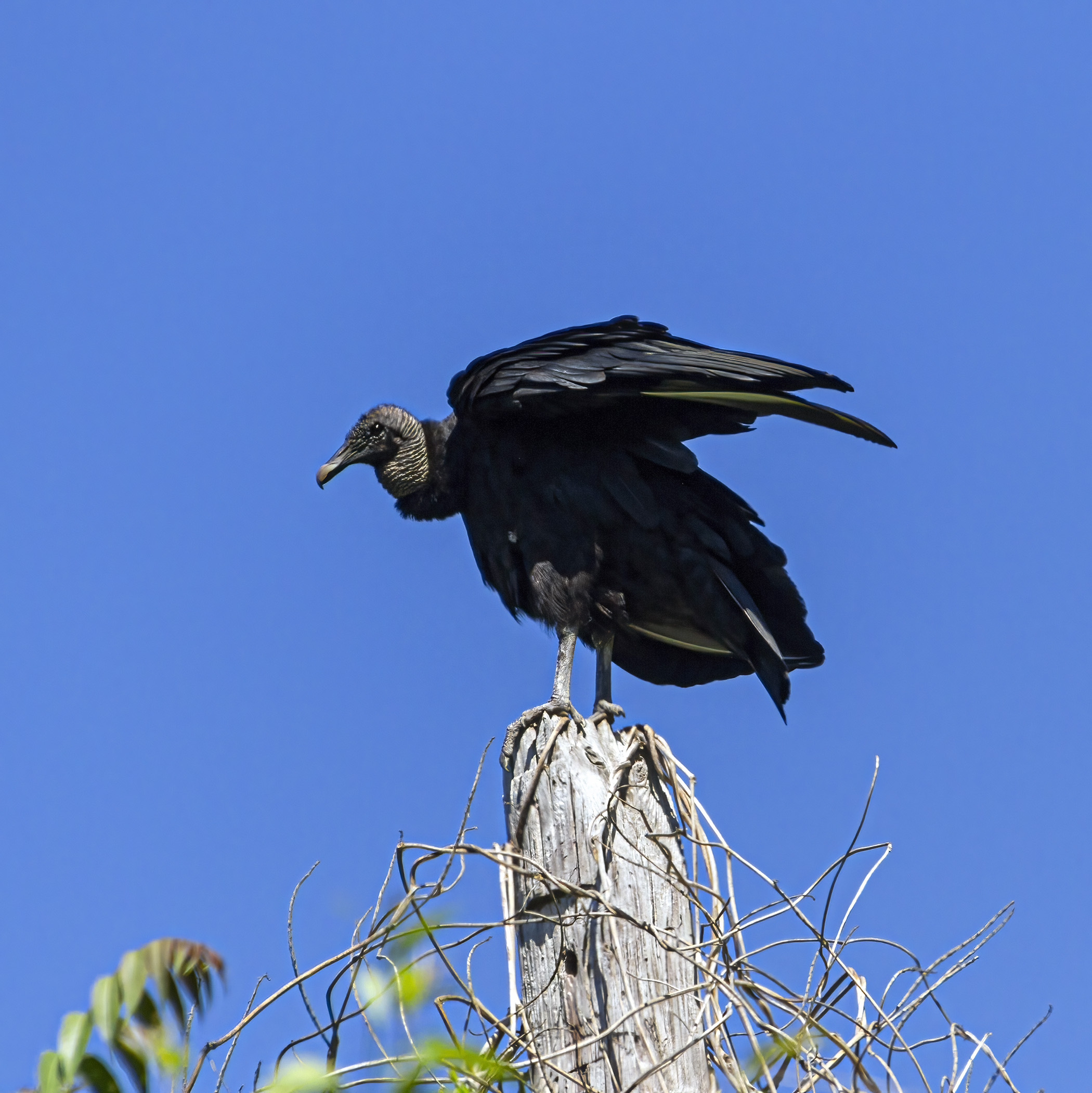
© Michael Q. Powell. All rights reserved.
 Mike Powell
Oooo, wow! What a cool find!!