Feeds:
Posts
Comments

Posts Tagged ‘Occoquan Bay National Wildlife Refuge’

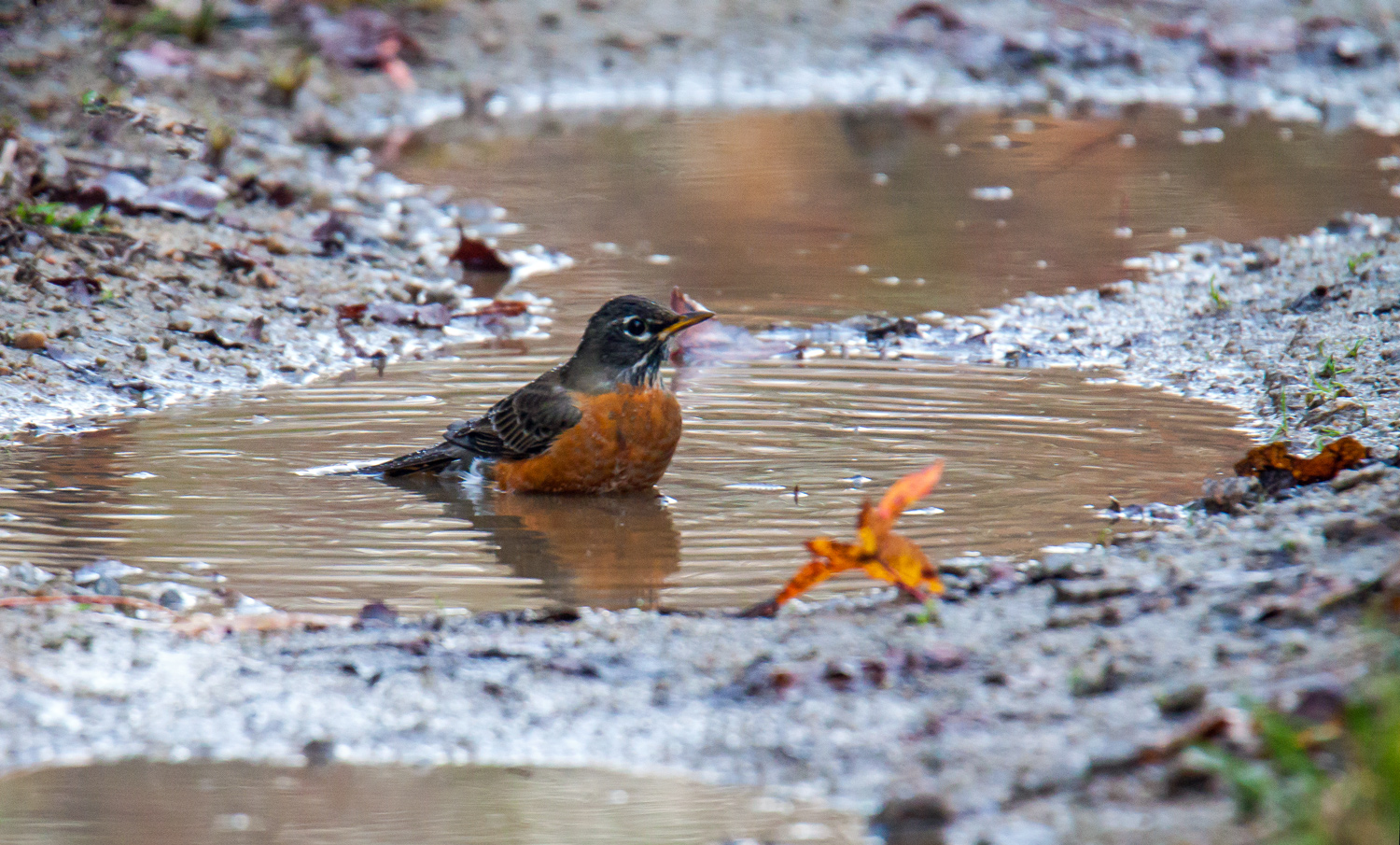
There were lots of American Robins (Turdus migratorius) on Monday at Occoquan Bay National Wildlife Refuge, including one that decided to take a bath in a puddle in the middle of the path. A couple of years ago  I probably would not have bothered to identify the bird as an “American Robin,” but now I know that there is a European Robin, which is a completely different bird.

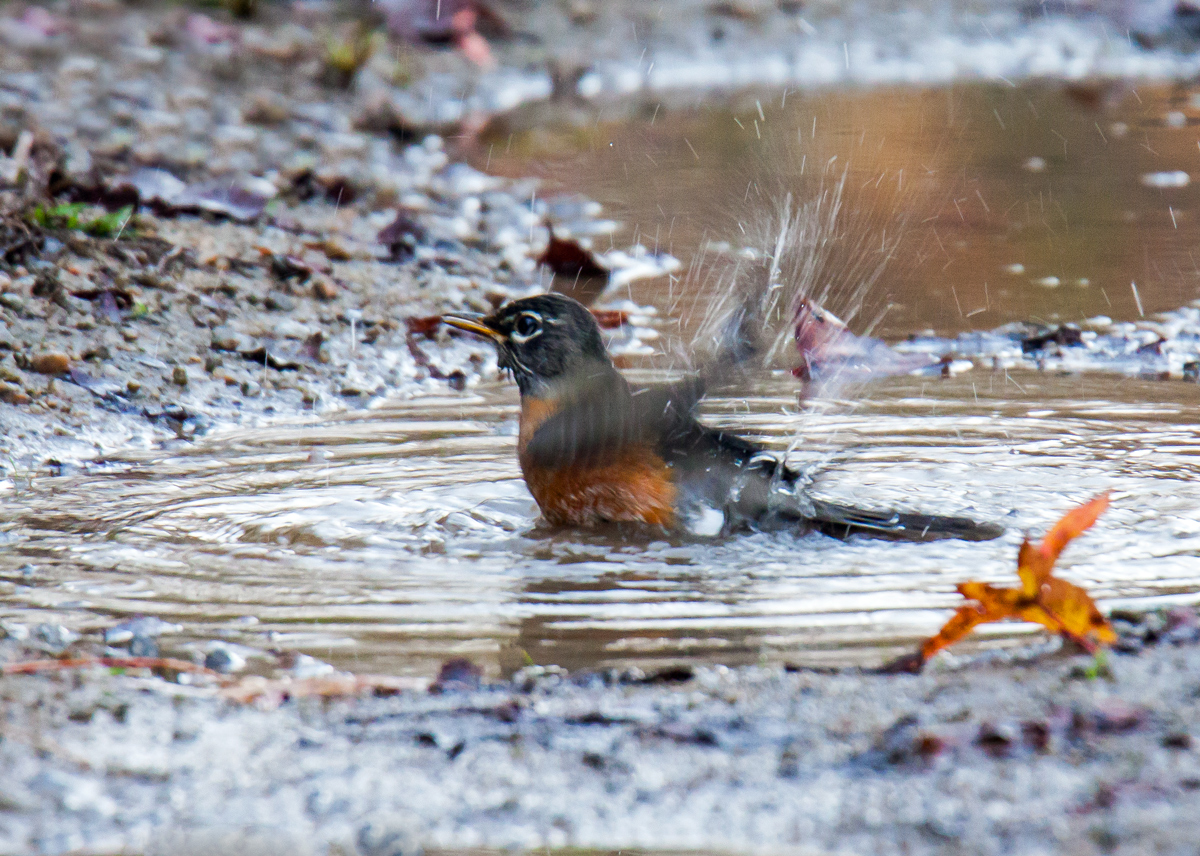
The first shot of these three is the sharpest and I like the way that you can see the succession of puddles and the robin’s reflection. I am equally drawn, however, to the action shots with the water splashing into the air. The light was pretty limited at the time and only afterwards did I realize that my shutter speed had dropped to 1/125 of a second.  That is why you can see some motion blur in the second shot, an effect that I think helps to give a dynamic feel to the image. I couldn’t decide if I wanted to include the third shot, but decided that I liked the out of focus robin in the background, whose peaceful pose is in sharp contrast with that of the frenetic flailing of the bathing robin.

bathing robin

bathing robin

bathing robin

© Michael Q. Powell. All rights reserved.

Read Full Post »

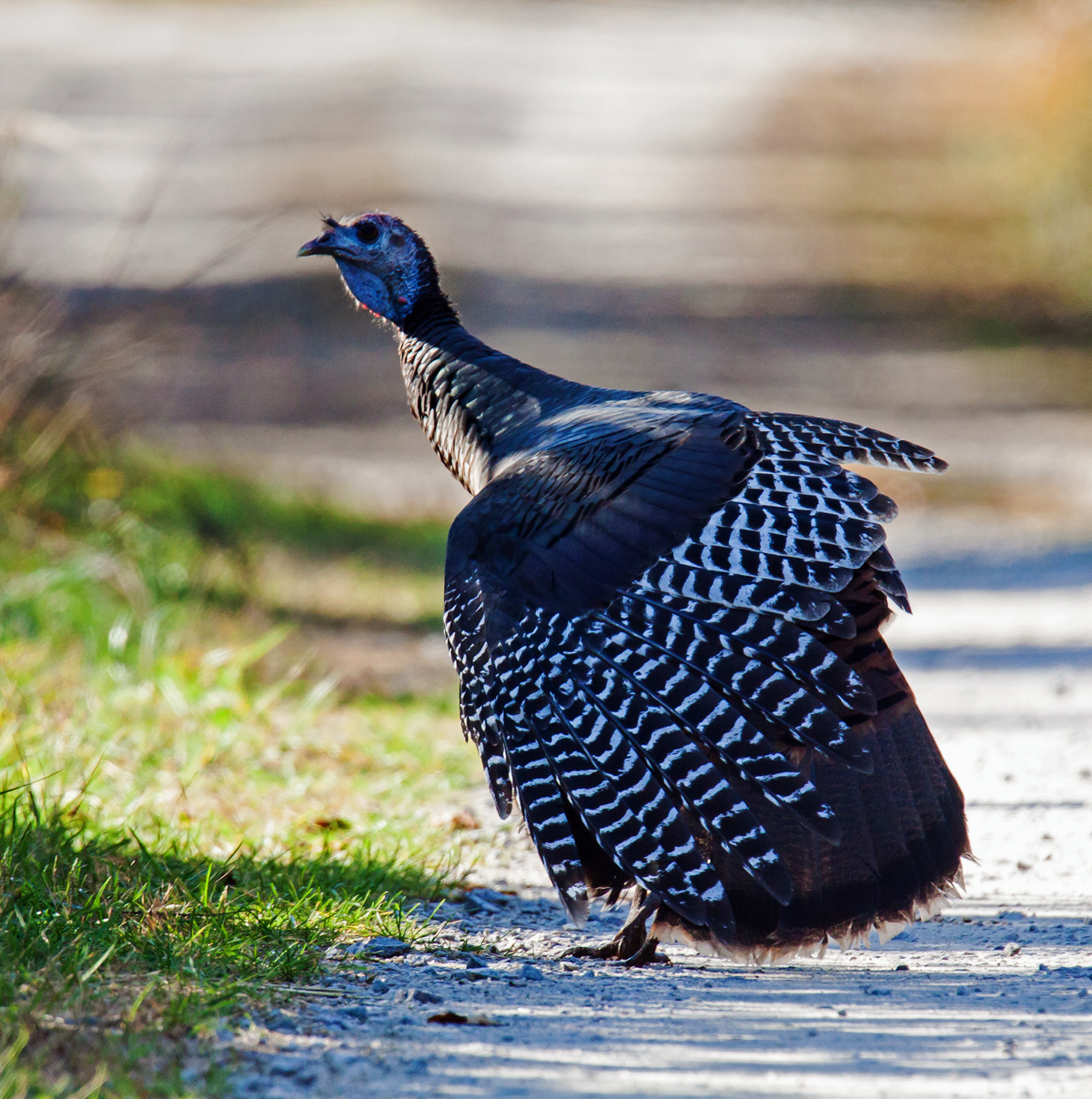
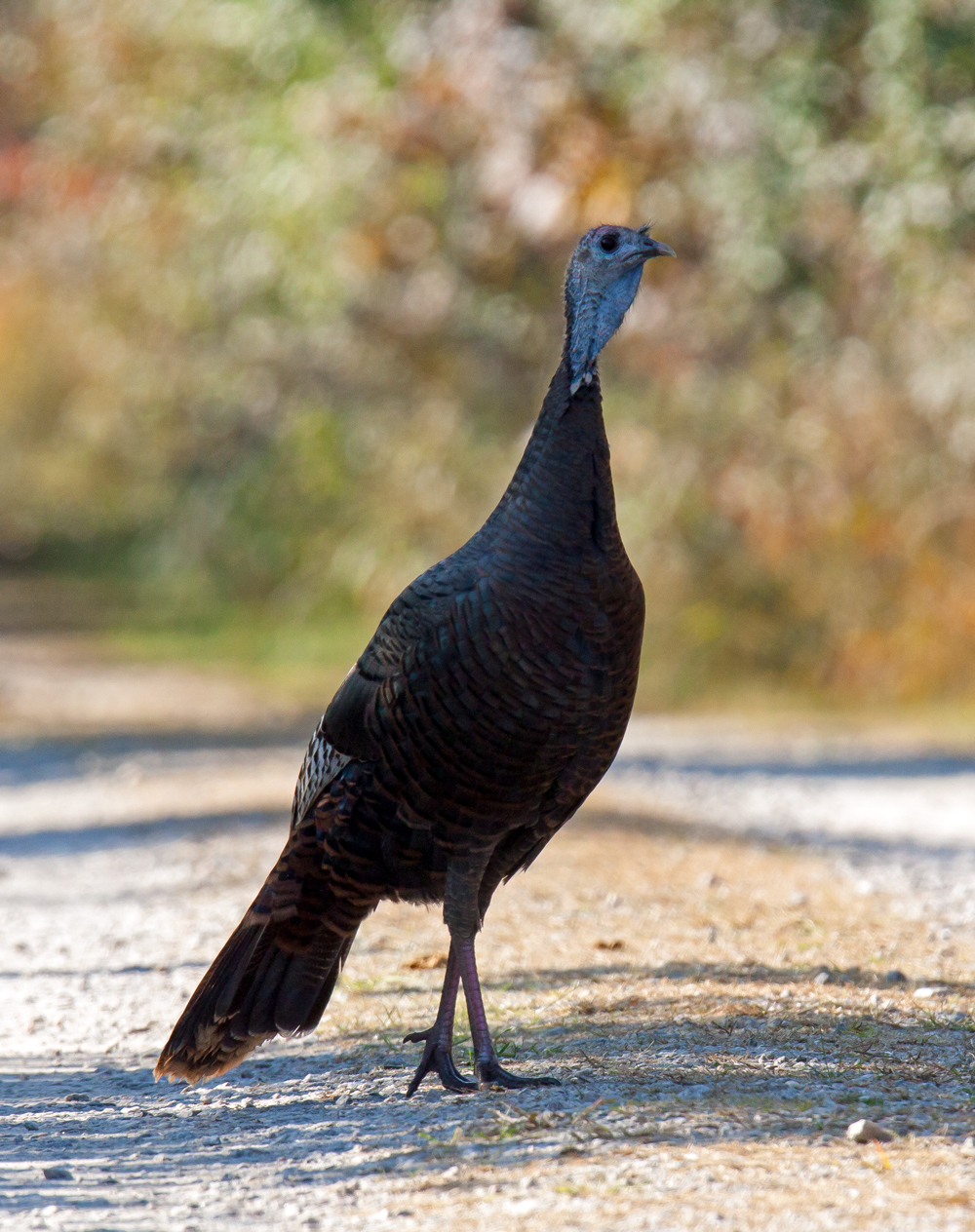
Now that it is November, many Americans will start to think of turkeys, and in particular the ones that they will consume on Thanksgiving Day.  I have nothing against eating turkey, but I shudder to think of the conditions under which domesticated turkeys are raised—it is much more exciting to see Wild Turkeys in the wild.

As I wander the trails at Occoquan Bay National Wildlife Refuge, I have gotten used to encountering small flocks of Wild Turkeys (Meleagris gallopavo) from time to time at several different locations. One of the volunteers with whom I talked estimated that there are over a hundred Wild Turkeys within the 642 acres (2.6 sq km) of the refuge.

When I see them, the turkeys are usually foraging along the paths and in open areas of the woods. Most often the turkeys move into the woods as soon as they sense my presence, but occasionally I can move close enough to them to get shots of individual turkeys. Lighting is often a challenge, because the sunlight filtering through the trees creates bands of intense light and shadows.

Here are a couple of my favorite shots from this past Monday—I really like the display of feathers in the first image and the regal upright pose in the second shot.

Wild Turkey

Wild Turkey

© Michael Q. Powell. All rights reserved.


Read Full Post »

The red on the back of the head of this Red-bellied Woodpecker (Melanerpes carolinus) seemed to be a perfect match for the colorful fall foliage this past Friday at Occoquan Bay National Wildlife Refuge. Autumn is my favorite season of the year and the weather on the day that I took this shot was almost perfect—even the woodpecker seems to be smiling.

© Michael Q. Powell. All rights reserved.

Read Full Post »

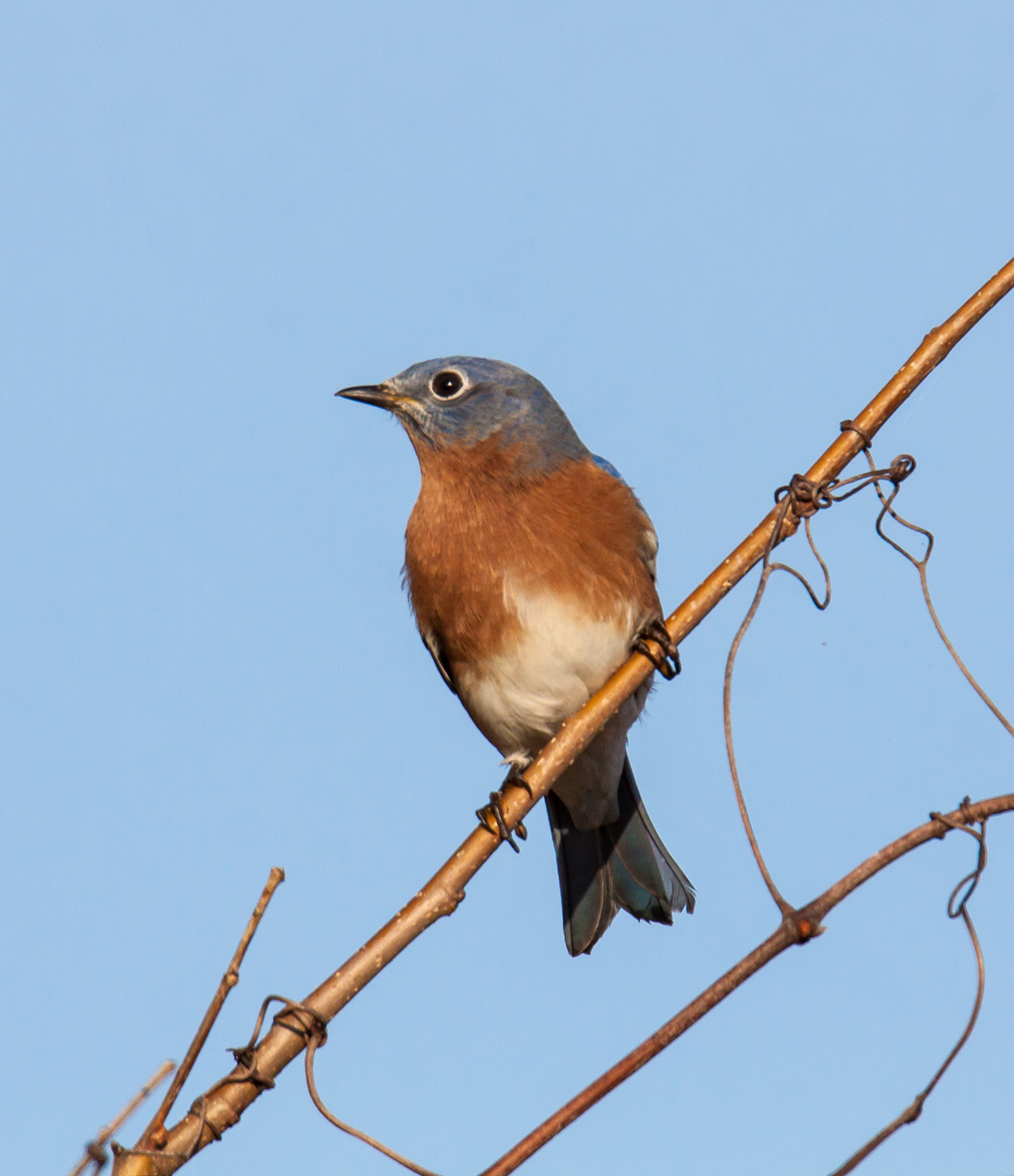
Bluebirds make me happy. There is something about their beautiful colors and energetic personalities that never fails to put a smile on my face. I spotted these beautiful little Eastern Bluebirds (Sialia sialis) on 3 November at Occoquan Bay National Wildlife Refuge in Northern Virginia.

Bluebirds often perch in a tangle of branches or really high in the trees, so I was happy on this occasion to get some relatively unobstructed shots of them.

Eastern Bluebird

Eastern Bluebird

Eastern Bluebird

© Michael Q. Powell. All rights reserved.


Read Full Post »

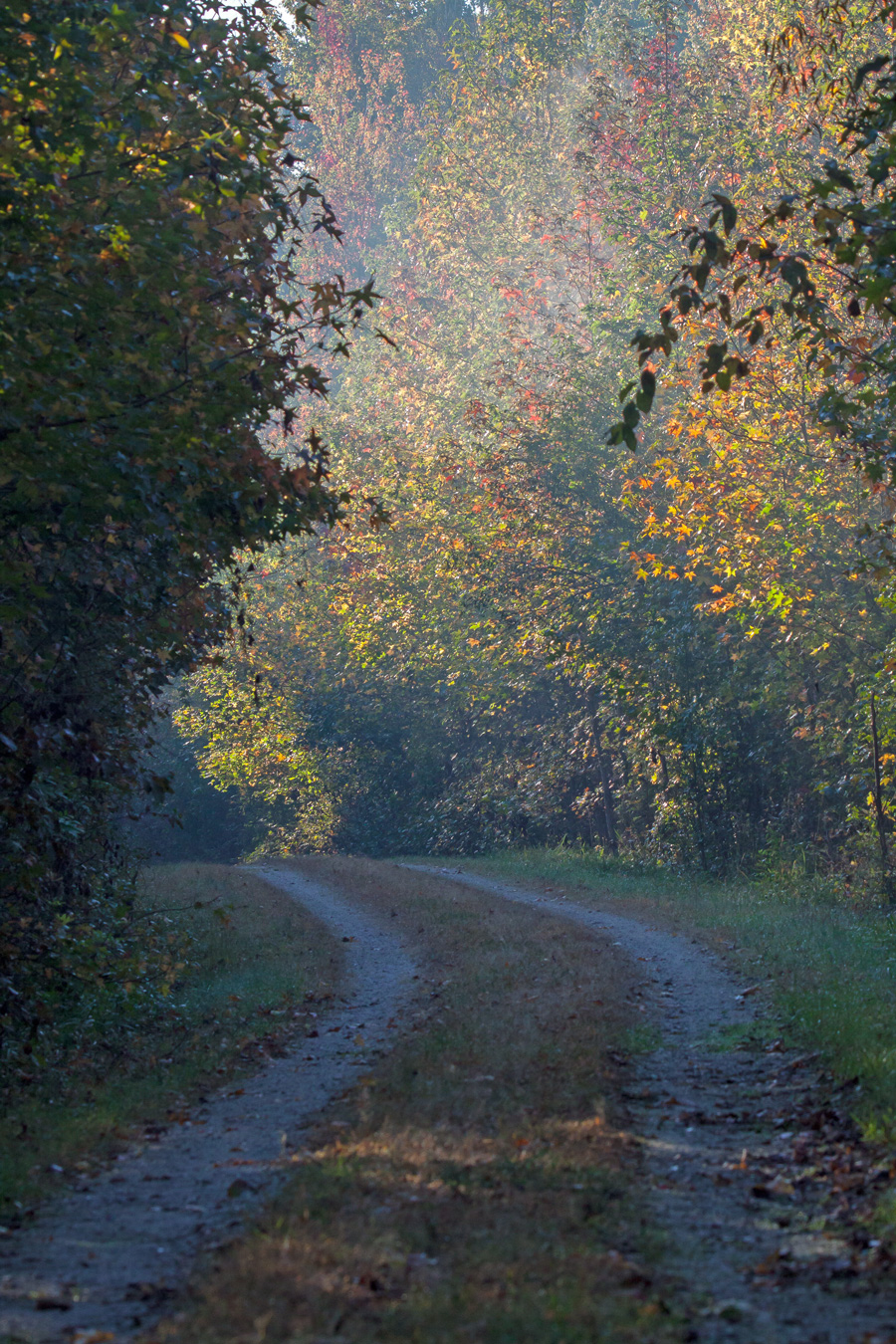
As I drove through the gates at Occoquan Bay National Wildlife Refuge this past Friday, a thick fog (or mist) was hanging low over the fields. The sun was just beginning to rise and it was still pretty dark. Although my goal for the day was to photograph birds, I decided to make an attempt at capturing the feeling of the moment and quickly realized the difficulty of that task—it’s a real challenge to capture the delicate nuances of light and shadows and the subtle shades of the rising sun when there is so little available light.

I felt a bit uncomfortable as I was shooting these images, a clear indication that I was way outside of my comfort zone, but I think it is good to try new approaches and subjects in order for me to keep on growing and learning as a photographer.


misty morning

autumn mist

autumn path

© Michael Q. Powell. All rights reserved.


Read Full Post »

I was facing almost directly east in the early morning hours at Occoquan Bay National Wildlife Refuge and the colors of the rising sun filtering through the trees made it look like the woods were ablaze. Fortunately, they were not.

sunlight

© Michael Q. Powell. All rights reserved.

Read Full Post »

As I scanned a field this morning at Occoquan Bay National Wildlife Refuge, I suddenly became aware of a pair of eyes staring back at me from the high vegetation. We shared a couple of moments of eye-to-eye contact before the handsome buck turned around and disappeared from sight.

There is an overabundance of White-tailed Deer (Odocoileus virginianus) in our area and as part of an effort to maintain the deer herd at a healthy level compatible with planned habitat goals and objectives, the wildlife refuge will be closed for several days in December for deer hunting. I know that topic of deer hunting is controversial to some, but the unfortunate alternative would be deer starving to death or being hit by cars as they seek to forage elsewhere. Still, it’s a little hard for me emotionally to look at this beautiful animal with the knowledge that someone else might soon be shooting at him with a gun rather than with a camera.

White-tailed Deer

© Michael Q. Powell. All rights reserved.

Read Full Post »

Ordinary birds like this American Crow (Corvus brachyrhynchos) take on added beauty when surrounded by colorful fall foliage. (Photo taken 27 October at Occoquan Bay National Wildlife Refuge.)

The sky was blue, the light was beautiful, and the leaves were colorful—I really couldn’t have asked for more. Well, actually I was hoping to see a bald eagle on that particular perch, but was more than happy with what I got.

autumn crow

autumn crow

© Michael Q. Powell. All rights reserved.

Read Full Post »

As the early morning light began to filter through the trees and the mist was rising, I was filled with an overwhelming sense of tranquility last Friday at Occoquan Bay National Wildlife Refuge. Was there any way that I could possibly capture that feeling in an image?

Many of you know that I rarely shoot landscape photos. I normally do not carry with me the kind of wide angle lens that is traditionally associated with landscape photography and instead carry a long telephoto zoom lens and a macro lens almost all of the time. The first two photos below were not cropped and were shot with the telephoto zoom lens set at 150mm, its widest setting. I have started carrying my Canon SX50 with me most of the time and this super zoom camera allowed me to get a much wider view and a greater depth of field.

I am not sure that any of these images adequately capture the feeling of the moment, but I wanted to share some of my different approaches in trying to capture the light, shadows, shapes, and colors of one early morning in the autumn.

early autumn morning

early autumn morning

early autumn morning

© Michael Q. Powell. All rights reserved.


Read Full Post »

How do you start your mornings? This Great Blue Heron (Ardea herodias) faced into the morning sun for quite a while last Friday as it stood amidst the foliage atop a tree at Occoquan Bay National Wildlife Refuge. The heron looked around a bit before deciding it was finally time to start its morning grooming routine.

The light was especially beautiful that morning and the heron was either unaware of my presence or simply did not view me as a threat. After I took some shots, I continued on my way and the heron remained in the tree and continued its morning preparations.


Great Blue Heron

Great Blue Heron

Great Blue Heron

© Michael Q. Powell. All rights reserved.


Read Full Post »

A flock of noisy, black-colored birds was active this past weekend at Occoquan Bay National Wildlife Refuge. I initially thought they were blackbirds or grackles, but a closer look showed them to be European Starlings (Sturnus vulgaris), a species introduced into the US from Europe by Shakespeare enthusiasts late in the nineteenth century.

I was intrigued when I saw the reference to Shakespeare and learned the following information about the history of starlings in the United States from the Cornell Lab of Ornithology website:

“All the European Starlings in North America descended from 100 birds set loose in New York’s Central Park in the early 1890s. The birds were intentionally released by a group who wanted America to have all the birds that Shakespeare ever mentioned. It took several tries, but eventually the population took off. Today, more than 200 million European Starlings range from Alaska to Mexico, and many people consider them pests.”

To be or not to be? Whether you like them or not, it looks like European Starlings are here to stay. As for me, I find the dotted pattern on these birds to be quite attractive.


European Starling

European Starling

© Michael Q. Powell. All rights reserved.


Read Full Post »

This past Friday I was thrilled to spot a Northern Harrier (Circus hudsonius) at Occoquan Bay National Wildlife Refuge. I had never seen one in action before and it was cool to watch it patrol low over a field at the refuge. Harriers, unlike other hawks,  rely on their sense of hearing to help capture prey, which is why they stay so close to the ground. If you want to learn more about Northern Harriers, check out the Cornell Lab of Ornithology website, one of my favorite sources of information about birds.

It was exciting to see this bird, but it sure was a challenge getting any decent shots. The harrier was a good distance away and seemed to vary its altitude in an unpredictable way. When it zoomed low, my camera wanted to focus on the ground vegetation and when it flew a bit higher, the camera sought to focus on the more distant trees, rather than on the bird that filled only a small part of the frame.

The two images below were the best that I took before the harrier disappeared from sight and show some of the features of this awesome raptor pretty well, including the face that guides sometimes describe as owl-like. It is always exciting to photograph a new species, but an inner desire to get more and better images of a new subject is sufficient motivation for me to go out again and again with my camera.

Northern Harrier

Northern Harrier

© Michael Q. Powell. All rights reserved.


Read Full Post »

As I zoomed in on a bright white splotch of color in a distant tree at Occoquan Bay National Wildlife Refuge on Friday, I realized it was a Bald Eagle (Haliaeetus leucocephalus). almost hidden in the autumn foliage. The eagle reacted quickly to my presence and took to the air, but I was able to capture a few images of this majestic bird.

Photographing a bald eagle is always a challenge. One of the biggest issues is the contrast between its bright white head and dark body, making it tough to get a good exposure. In this case, if I had had a little more time to check my exposure, I might have been able to avoid blowing out the details in the eagle’s head. Time, though is something that I usually don’t have. The eagle’s vision and reaction time are so far superior to mine that I have to react immediately when I spot an eagle, usually with the settings that already dialed into the camera. On multiple occasions I have missed opportunities as I scrambled to make adjustments to my camera.

Finally, it is often hard to predict an eagle’s actions and the direction in which it will choose to fly. This was a somewhat unusual situation in that the eagle initially flew right at me. You have to have really steady hands and a lot of luck to maintain focus when a bird is coming at you that fast. I didn’t quite nail the focus on the eagle’s eyes in the final shot, but am happy at the way that I was able to capture its fully extended wings.

This situation reinforces in me the continuing applicability of the Boy Scout motto that was drilled into me as a youth—”Be Prepared.” You never know when you might stumble upon a Bald Eagle.


Bald Eagle

Bald Eagle

Bald Eagle

© Michael Q. Powell. All rights reserved.

Read Full Post »

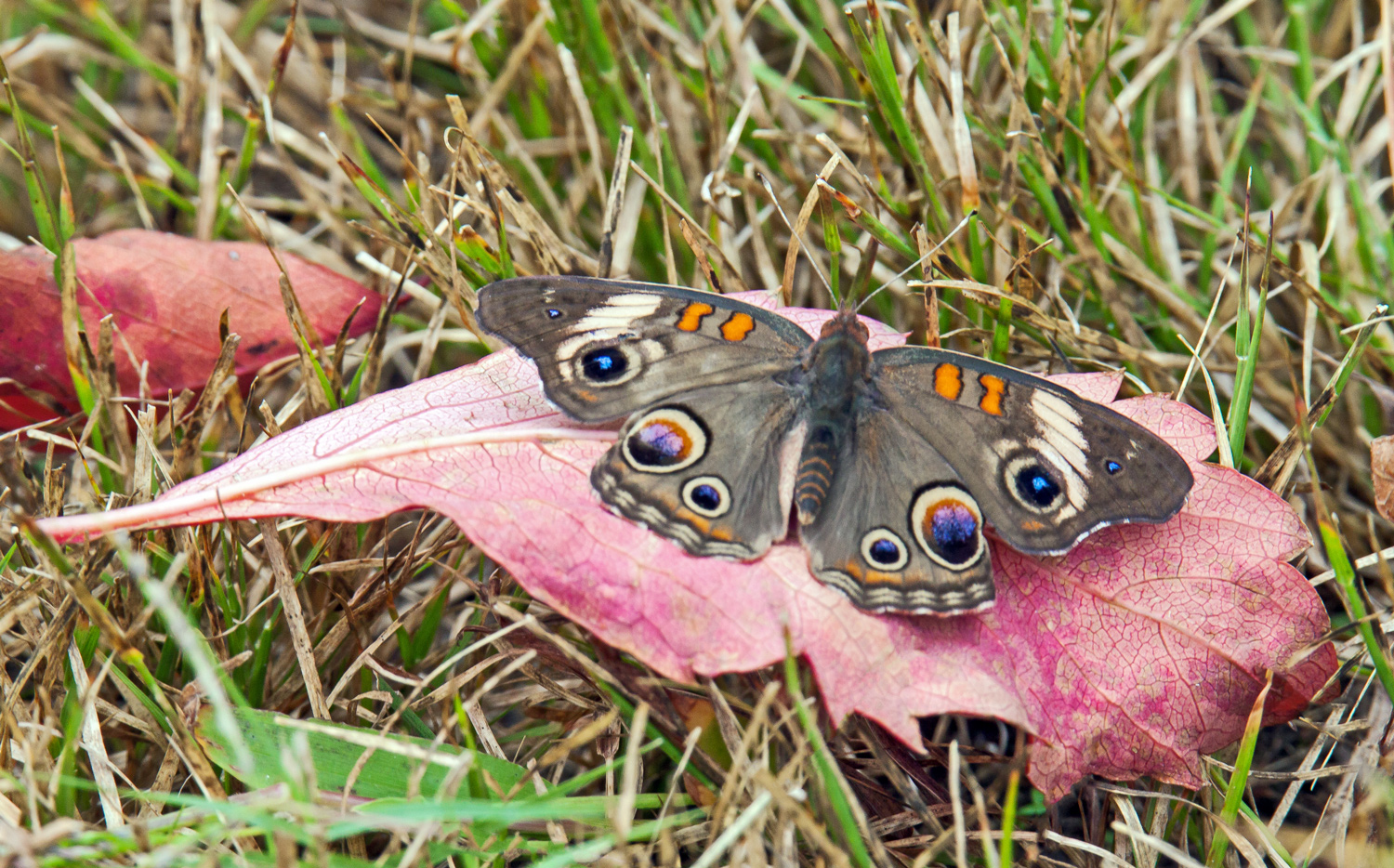
We are deep into autumn now, but some butterflies are still hanging in there, like this beautiful Common Buckeye (Junonia coenia) that I spotted during a recent trip to Occoquan Bay National Wildlife Refuge. I was actually a little shocked to see quite a few of these butterflies flying along the paths of the wildlife refuge and in some of the open areas. The challenge for me was getting one to pose in a way that would convey a sense of autumn. I was therefore thrilled when this one perched on a fallen leaf and and kept its wings wide open long enough for me to capture this shot.

Common Buckeye

© Michael Q. Powell. All rights reserved.

Read Full Post »

It was inevitable as we moved deeper into autumn that all of the summer dragonflies would eventually disappear. The nights have been getting colder and not long ago we went through a spell of rainy weather. Over the past two weeks I have searched all over Occoquan Bay Wildlife Refuge, my recent favorite photography location, desperately hoping each time to find a few survivors.

Well, it is beginning to look like the male Twelve-spotted Skimmer (Libellula pulchella) that I spotted on the 15th of October will be the last summer dragonfly for me, at least at that location. Earlier this month I had seen multiple Twelve-spotted Skimmers patrolling over a small pond at the wildlife refuge, but this old guy was perching alone in the vegetation adjacent to the pond and seemed reluctant to take to the air. It appeared that there were no rivals to fight off and no females to attract.

The colorful pattern on its wings is still very distinctive and the wings are amazingly intact. You may notice the uneven color on its body. As the males get older, their bodies develop a waxy blue powder called pruinescence. (Check out this link to get more information on this dragonfly from the wonderful website Dragonflies of Norther Virginia (dragonfliesnva.com).

It’s hard for me not to feel a little wistful as I bid farewell to the summer dragonflies, with whom I have spent so many pleasant moments this year. There are still autumn dragonflies around, most notably the little red Autumn Meadowhawks and Blue-faced Meadowhawks, and an occasional migrating dragonfly, like a Wandering Glider or Common Green Darner, so dragonfly season is not yet over. You will notice, however, that the proportion of postings on birds will continue to increase and those on insects will decrease in the upcoming months.

Twelve-spotted Skimmer

Twelve-spotted Skimmer

© Michael Q. Powell. All rights reserved.

Read Full Post »

One of the coolest turtles in our area is the Eastern Box Turtle (Terrapene carolina carolina), also known as the Woodland Box Turtle. Unlike many turtles, this one spends most of its time on land rather than in the water. I spotted this beauty, which is probably a male,  last weekend at Occoquan Bay National Wildlife Refuge as it was slowly making its way across a trail—males generally have red eyes and the females have brown eyes.

As I was doing a little research, I discovered that the Eastern Box Turtle is the official state reptile of North Carolina and Tennessee. Who even knew that states had official reptiles? According to an article in ncpedia.org, the General Assembly of 1979 designated the Eastern Box Turtle as the official State Reptile for North Carolina. Given that this was agreed in a legislative body, debates were held about the relative merits of this reptile versus other potential candidates.

I couldn’t help but laugh as I read the words of the preamble to the legislative bill that cited a variety of reasons why the box turtle was selected:

“Whereas, the turtle is a most useful creature who serves to control harmful and
pestiferous insects, and acts as one of nature’s clean-up crew, helping to preserve
the purity and beauty of our waters; and

Whereas, the turtle is derided by some who have missed the finer things of life,
but in some species has provided food that is a gourmet’s delight; and

Whereas, the turtle, which at a superficial glance appears to be a mundane and
uninteresting creature, is actually a most fascinating creature, ranging from
species well adapted to modern conditions to species which have existed
virtually unchanged since prehistoric times; and

Whereas, the turtle watches undisturbed as countless generations of faster hares
run by to quick oblivion, and is thus a model of patience for mankind, and a
symbol of this State’s unrelenting pursuit of great and lofty goals; and

Whereas, the woodlands, marshes, and inland and coastal waters of North
Carolina are the abode of many species of turtles; Now, therefore. . .”

As an interesting sidenote, Virginia, the state in which I live, has twice considered adopting this turtle as the state’s official reptile, but rejected the legislative proposals in 1999 and 2009. A posting on nbcwashington.com reported that during discussions in 2009, one delegate asked why Virginia would make an official emblem of an animal that retreats into its shell when frightened and dies by the thousands crawling across roads and counterproposed that the rattlesnake be chosen. The fatal blow, according to the posting, might have been the disclosure that the Latin name for the Eastern Box Turtle—Terrapene carolina carolina—implied too close a relation to a Virginia regional rival.
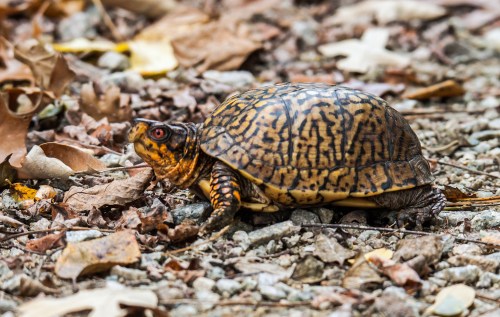
Eastern Box Turtle

© Michael Q. Powell. All rights reserved.

Read Full Post »

As I turned the corner of a trail at Occoquan Bay National Wildlife Refuge on Monday, I spotted a large bird perched high in a tree. It didn’t immediately fly away, so I figured it wasn’t an eagle. Zooming in, I realized I was wrong—it was a Bald Eagle (Haliaeetus leucocephalus) facing in the opposite direction.

I got lots of photos of the back of the eagle’s head, but decided that I wouldn’t share any of them. I knew that eventually the eagle would turn its head and tried to get ready. I snapped off a few photos, including the first one below, when the eagle turned its head and surveyed the area.

I don’t know if it was the noise of the shutter or if it detected motion, but the eagle spotted me and I was able to capture the second shot as it was preparing to take flight. I was thrilled, because this was the closest encounter that I had had with a bald eagle in a long time.

I continued down the trail and a short while later made a turn onto another trail. As I glanced to my left, I saw a perched eagle. I don’t know if it was the same one that I had just observed, but I managed to snap off a few more shots, including the third shot below. I like the way that I was able to capture a bit of the feel of autumn with the red leaves.

Bald Eagle

Bald Eagle

Bald Eagle

© Michael Q. Powell. All rights reserved.

Read Full Post »

When I spotted this bird on Monday at Occoquan Bay National Wildlife Refuge, it was facing away from me and I couldn’t immediately identify it. It had fluffed up its feathers and appeared to be basking in the sunlight.

When it finally turned its head slightly, I caught a glimpse of its red eyes and realized that it was probably an Eastern Towhee (Pipilo erythrophthalmus). All of the other times that I have seen towhees in the past, they have been foraging in the cluttered undergrowth, so it was a real treat to see one more or less in the open. As a bonus, the light coming from the left helped to illuminate some of the details of the bird’s beautiful feathers and the bird’s pose is quite different from that of a typical perched bird .

Eastern Towhee

© Michael Q. Powell. All rights reserved.

Read Full Post »

When I heard loud singing coming from the top of a tree, I glanced up and saw a shape that reminded me of a mockingbird. Looking more closely, I realized that the colors looked more like those of a female Red-winged Blackbird, but the shape of the body and behavior were not those of a blackbird. Although I was pretty far away, I noticed that the bird had startlingly light-colored eyes. What was this bird?

Thanks to its physical characteristics, it was not hard to locate this bird in my identification book when I got home—it is a Brown Thrasher (Toxostoma rufum).  According to the Cornell Lab of Ornithology, “Brown Thrashers are exuberant singers, with one of the largest repertoires of any North American songbird.” The same article notes that some early naturalists thought that the Brown Thrasher’s musical abilities are underappreciated, as compared with the mockingbird, which has received greater acclaim. “Brown Thrasher”  somehow sounds to me like it should be associated more with a heavy metal band than with this pretty bird. Maybe this bird needs a better marketing strategy and a public relations campaign.

The sky was heavily overcast the day I took these shots. Normally I don’t like the look of the washed-out skies, but in this case I really like the effect. One of my Facebook viewers commented that it made the photo that I posted (the first one below) look like an Audubon print.

Brown Thrasher

Brown Thrasher

Brown Thrasher

© Michael Q. Powell. All rights reserved.

Read Full Post »

Recently at Occoquan Bay National Wildlife Refuge, the only views I have gotten of Bald Eagles (Haliaeetus leucocephalus) have been of them flying away from me. Yesterday I got lucky and caught a glimpse through the foliage of one sitting in a distant tree in what appears to be a nest. Earlier this year, several roads in the refuge were closed after two eaglets were born. I don’t know if this was the nesting site, but suspect it might have been.

I was a long way away, but had a small visual tunnel through the trees that gave me a mostly unobstructed view of the eagle. I tried to move slowly, although I figured that the eagle was unaware of my presence. Apparently I underestimated the sharpness of the eagle’s vision, because it took off from the nest not long after I began shooting.

As I have said in the past, however, any day that I am able to see and photograph a Bald Eagle is a wonderful day.

Bald Eagle

Bald Eagle

Bald Eagle

© Michael Q. Powell. All rights reserved.

Read Full Post »

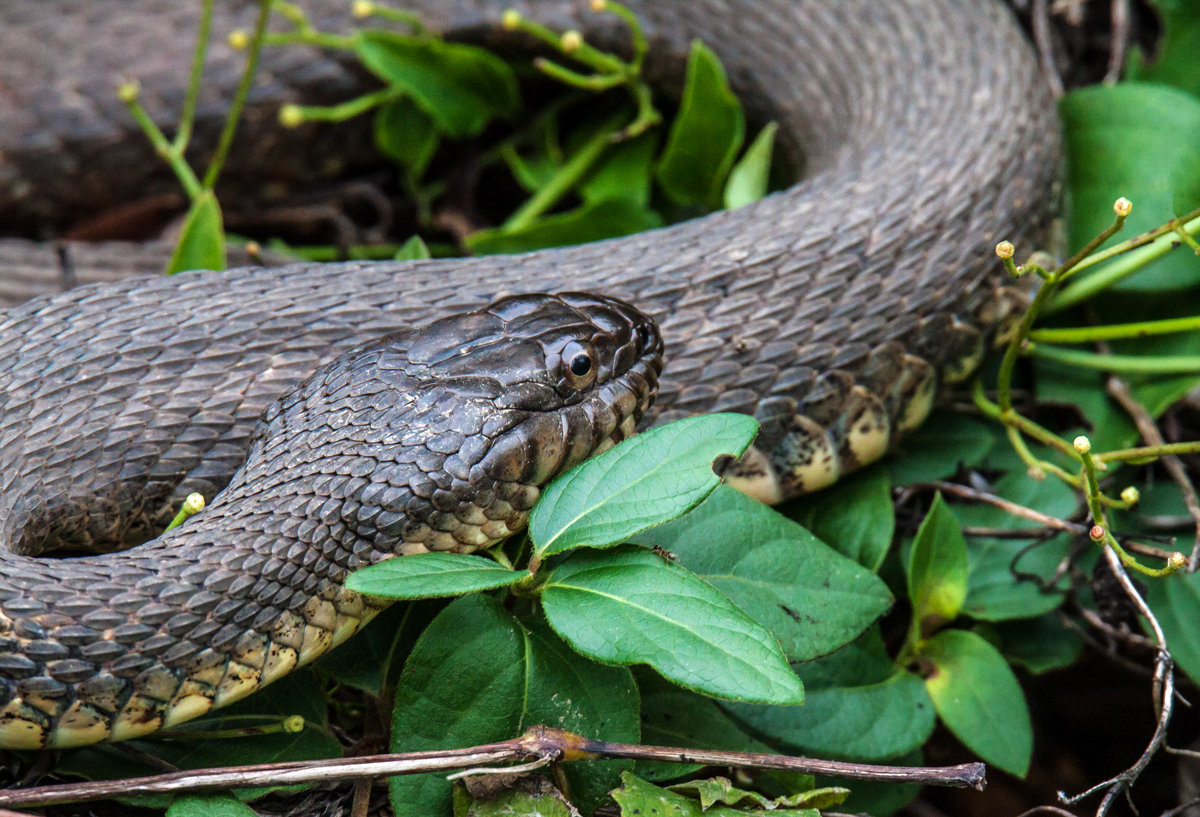
I spent much of my time Friday at Occoquan Bay National Wildlife Refuge scanning the trees for birds. On one of the rare moments when I was looking down, I ended up looking into the eyes of what appears to be a Northern Watersnake (Nerodia sipedon).

Although it may look like I was dangerously close to this snake, I took these shots with my Tamron 150-600mm lens, which has a minimum focusing distance of almost 9 feet (274 cm). Northern Watersnakes are not poisonous, but I have been told that their bites can be very painful and that the snakes inject an anti-coagulant when they bite, so wounds tend to bleed profusely.

I particularly like the way that I was able to capture some of the details of the snake, including its scales and its head. If you look closely, you can even see a miniature landscape in the eyes of the snake.

UPDATE: One of the viewers on my Facebook page commented that this looks more like an Eastern Ratsnake (Pantherophis alleghaniensis) than a Northern Watersnake. I am hoping to get some clarification on the species of this snake and would welcome the views of any readers with expertise in this area.

Northern Watersnake

Northern Watersnake

Northern Watersnake

© Michael Q. Powell. All rights reserved.


Read Full Post »

It was cool, wet, and a little breezy yesterday, not exactly a perfect day for photography, but I made a trip anyways to Occoquan Bay National Wildlife Refuge.  My persistence was rewarded when I was able to capture some images of several cute little Yellow-rumped Warblers (Setophaga coronata).

When it comes to warblers, I generally have two big problems. Warblers seem to like to perch in the center of clusters of branches and it is often virtually impossible to get unobstructed shots of them. Even if I am able to get a clear shot, I am faced with the equally daunting challenge of identifying the bird. There appear to be a large number of warblers with similar patterns and colors and there are innumerable variations based on season, age, gender, and region.

I was pretty confident that the birds in these images were Yellow-rumped Warblers, but for reassurance I checked with some experts on a Facebook birding forum. One of them humorously noted that this bird is often informally referred to as “Butterbutt.”

Yellow-rumped Warbler

Yellow-rumped Warbler

Yellow-rumped Warbler

© Michael Q. Powell. All rights reserved.


Read Full Post »

Do you ever get so obsessed with a single species that you return over and over again to the same location, seeking another glimpse (and hopefully more photos) of that species? Generally I describe myself as an “0pportunistic” shooter—I like to walk around and photograph whatever I happen to see—and only rarely do I have specific goals for a photo shoot.

My normal approach changed this past month as I became somewhat obsessed with the Fine-lined Emerald dragonfly (Somatochlora filosa). My good friend and local dragonfly expert Walter Sanford encouraged me to seek out this rare species, which has been seen at only a single location, Occoquan Bay National Wildlife Refuge, in our area. I started spending most of my free time at this wildlife refuge, rather than at Huntley Meadows Park, my most frequent shooting location.

Mostly on my own, though occasionally shooting with Walter, I learned more and about this species, including its preferred perches and patrolling techniques. Over time, I learned to recognize Fine-lined Emeralds as they flew towards me at knee-level with their shiny green eyes glinting in the sunlight and spent endless hours chasing after them. Eventually I acquired a collection of shots of them perching and even managed to capture an image of one in flight and some shots of a couple mating.

I was painfully aware that, as the old saying indicates, all good things must come to an end. The excellent website Dragonflies of Northern Virginia showed the record late date for this species of 4 October in our area, so last Friday, 6 October, I went out to shoot with high hopes, but low expectations. I was thrilled to have multiple sightings of Fine-lined Emeralds during the day and the images below are among my favorites of the day.

We have now entered into a period of rain in our area and I fear that I may have seen my final Fine-lined Emerald dragonfly for the year. I am a bit stubborn and unusually persistent, though, so I may make a trip again on Friday, my next free day for shooting, hoping against the odds to see my Fine-lined friends one more time.

Fine-lined Emerald

Fine-lined Emerald

Fine-lined Emerald

© Michael Q. Powell. All rights reserved.

Read Full Post »

Some movement in the leaves of a tree at Occoquan Bay National Wildlife Refuge caught my eye on Friday afternoon. I thought it might be a squirrel, but it turned out to be a pretty large praying mantis. There is entire order of mantises (Mantodea) that includes over 2400 species, according to Wikipedia, so I hope that you can forgive me for not identifying the specific species of this praying mantis.

I love how well its shape and color help it to blend in with its surroundings—if it hadn’t moved, I am pretty sure that I would never have noticed it.

praying mantis

© Michael Q. Powell. All rights reserved.

Read Full Post »

A small flock of wild turkeys yesterday at Occoquan Bay National Wildlife Refuge moved off of the trail and into the woods as I approached. Peering through the vegetation a few seconds later, I was able to catch a glimpse of one of them that may have though it was well hidden.

It would be hard for me to say that Wild Turkeys (Meleagris gallopavo) are beautiful, but they sure do have a distinctive look.

wild turkey

© Michael Q. Powell. All rights reserved.

Read Full Post »

This Great Blue Heron (Ardea herodias) looked to me like a stealth aircraft as it flew low over the water from one side of a small pond to the other on Monday at Occoquan Bay National Wildlife Refuge.

 Great Blue Heron
© Michael Q. Powell. All rights reserved.

Read Full Post »

Autumn seems to be the season for migration—it’s hard to miss the flocks of honking geese that fill the skies and mysterious warblers taunt me with their songs from hidden haunts behind the foliage as they rest before continuing their journeys. Did you know that some species of dragonflies are also migratory?

Most of the migratory species unsurprisingly spend a lot of time in the air. They are visible as they pass through our area, but are tough to photograph. This past weekend I manage to get shots of two of the migratory species at Occoquan Bay National Wildlife Refuge. The first one is a Wandering Glider (Pantala flavescens) and the second is a Black Saddlebags (Tramea lacerata). What really stands out to me is the perfect condition of their wings, in contrast to the wings of the remaining resident dragonflies that are often tattered and torn this late in the season.

Wandering Glider

Black Saddlebags

© Michael Q. Powell. All rights reserved.

Read Full Post »

As October begins, I renew my search for red dragonflies. Autumn is quite naturally the season when Autumn Meadowhawks (Sympetrum vicinum) appear along with their more gaudily-colored brethren, the Blue-faced Meadowhawks (Sympetrum ambiguum). Both of these species have bright red bodies that should be easy to spot, but they like to perch low to the ground and sometimes even on fallen leaves, so you really have to pay attention.

I was a bit shocked on Monday to see some other small red dragonflies—at least three male Calico Pennant dragonflies (Celithemis elisa) were active at a small pond at Occoquan Bay National Wildlife Refuge. Calico Pennants are generally a summer species and I have featured them a couple of times earlier this year in this blog. According to the Dragonflies of Northern Virginia website, their peak flight time is June to July and their late date is 23 September (I saw the one below on 2 October).

There are still other active dragonflies, but over time their numbers will continue to drop. Autumn Meadowhawks, though, usually stay with us into December and, if I remember correctly, occasionally even into January. I’ll be continuing my October hunt for red dragonflies into November and beyond.

Calico Pennant

Calico Pennant on 2 October at Occoquan Bay National Wildlife Refuge


Blue-faced Meadowhawk

Blue-faced Meadowhawk at Occoquan Bay National Wildlife Refuge


Autumn Meadowhawk

Autumn Meadowhawk at Occoquan Bay National Wildlife Refuge

© Michael Q. Powell. All rights reserved.

Read Full Post »

As we move inexorably deeper into autumn, more and more flowers and leaves are fading and falling. Many of the familiar dragonflies of the summer also are disappearing. I was heartened yesterday at Occoquan Bay National Wildlife Refuge to spot this Fine-lined Emerald dragonfly (Somatochlora filosa), a survivor that is tattered and torn, but is still flying in October.

I mentioned in a recent blog posting that I am experimenting with carrying two cameras with me when I go out shooting. The first photo was shot with my Canon SX50, a super-zoom camera and the second was taken with my Canon 50D DSLR. The depth of field is so shallow with the DSLR, normally shooting close to the 600mm end of my zoom lens, that it seems more ideal for shots like the second image where the subject is flatter. The SX50 gives me more depth of field and I love the way that it allowed me to capture the background as circles of color.

Fine-lined Emerald

Fine-lined Emerald

© Michael Q. Powell. All rights reserved.

Read Full Post »

The early morning light was soft and beautiful, allowing me to capture these images of a young Turkey Vulture (Cathartes aura) on Saturday at Occoquan Bay National Wildlife Refuge. I am not sure I have ever seen a vulture look so handsome (and maybe even a little cute in the second photo).

Turkey Vulture

Turkey Vulture

© Michael Q. Powell. All rights reserved.

Read Full Post »
As I looked down one of the trails yesterday morning at Occoquan Bay National Wildlife Refuge, I spotted a group of large birds sprawled across the entire width of the trail. Having seen Wild Turkeys (Meleagris gallopavo) a couple of times at this refuge, I correctly identified them, but I couldn’t figure out what they were doing. I later learned from the website of the National Wild Turkey Federation that wild turkeys use dust baths as part of their preening and plumage maintenance.

wild turkey

I tried to be stealthy and moved quietly forward, but the trail was wide and clear and the turkeys became aware of my presence. The flock slowly moved away— several of the turkeys flapped their wings to get a little additional momentum. I was uncertain if wild turkeys can fly and was surprised to learn from one internet source that wild turkeys can fly swiftly, with a maximum speed of 55 miles per hour (88 kph) and can run up to 25 mph (40 kph).

wild turkey

After a brief period of frantic movement, the birds settled down and began to forage. They seemed a little confused and looked around in different directions. When I got a bit closer, they eventually decided to move into the woods and did so in a rather leisurely fashion.

wild turkey

I could not tell for certain, but it looked to me that this flock of turkeys was made up of females and juveniles—I did not see any of the turkeys that look like the stereotypical male turkeys that are featured in the run-up to Thanksgiving. I will be alert for any sign of those males during future trips to this wildlife refuge.

© Michael Q. Powell. All rights reserved.

Read Full Post »
« Newer Posts - Older Posts »