Feeds:
Posts
Comments

Posts Tagged ‘Occoquan Bay National Wildlife Refuge’

Common Whitetail dragonflies (Plathemis lydia) often perch flat on the ground, where they are relatively easy to spot. When this pretty little Common Whitetail female decided on Wednesday to perch on the side of a large tree, however, she almost disappeared from sight—the pattern of the light and shadows and the muted tones of the bark and the vegetation growing on the tree served to camouflage her presence almost perfectly.

I really like the limited palette of colors in this image and the relative simplicity of the composition. The rough texture of the bark helps to break up the background of the image and add some visual interest without being overly distracting.

Common Whitetail

© Michael Q. Powell. All rights reserved.


Read Full Post »

Although dragonflies do not actually have teeth, I could not help thinking that this female Blue Dasher dragonfly (Pachydiplax longipennis) had a bit of an overbite problem when she smiled and posed for me on Wednesday at Occoquan Bay National Wildlife Refuge. I wonder if an orthodontist would recommend Invisalign treatment for her problem—I cannot imagine seeing a dragonfly with traditional metallic braces on its mouth.

Have a happy Friday and a wonderful weekend.Blue Dasher

© Michael Q. Powell. All rights reserved.

Read Full Post »

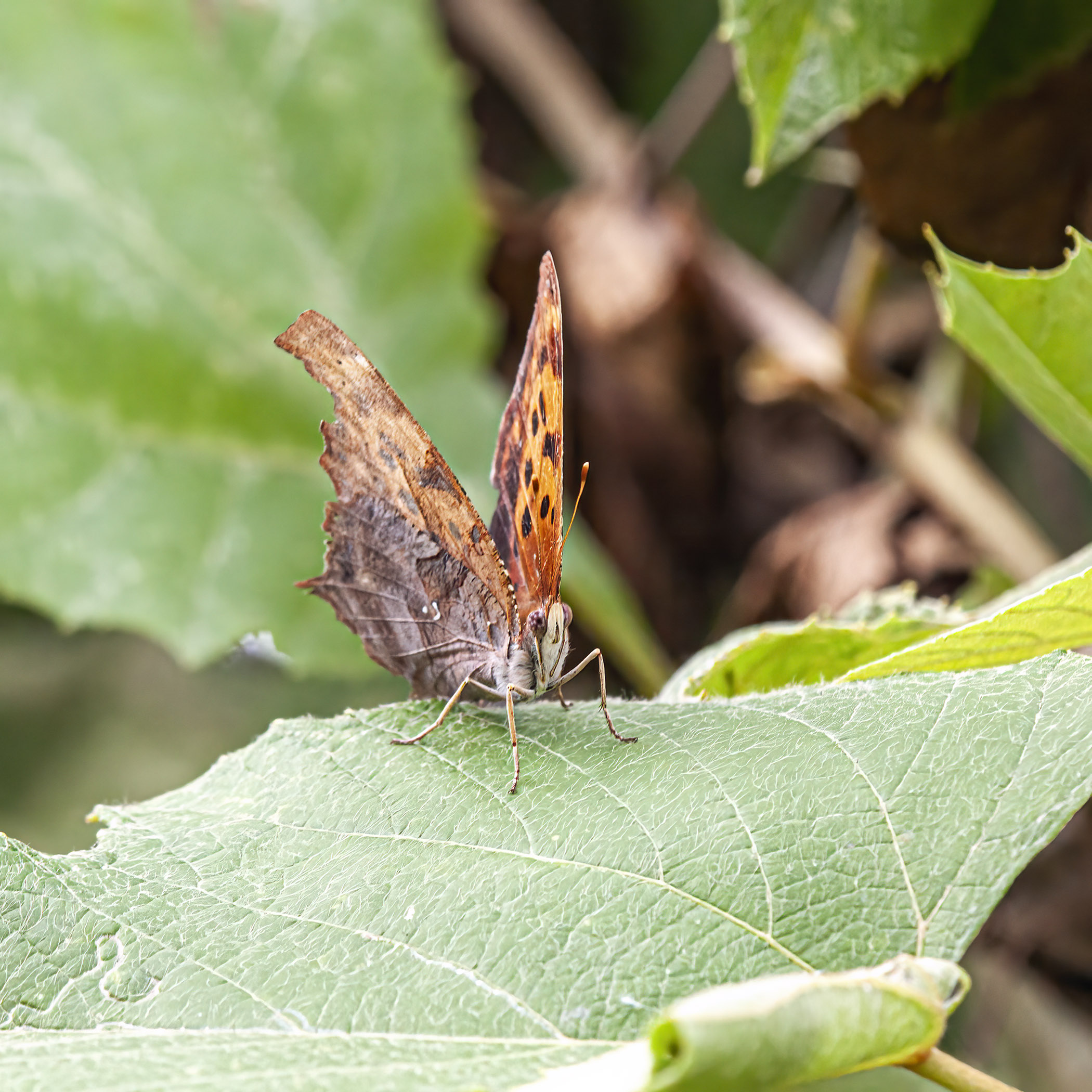
I love it when I can get a shot that simultaneously shows the exterior markings and internal colors of a butterfly, especially when the butterfly’s outward appearance is somewhat drab. That was certainly the case with this Question Mark butterfly (Polygonia interrogationis) that I spotted last Saturday at Occoquan Bay National Wildlife Refuge. When it kept its wings closed, the butterfly blended right in with the dried vegetation in the background. As it opened its wings, the butterfly gave me a glimpse of the beautiful warm tones of its orange and brown interior.

In case you are curious about the name of this species, it comes from the white markings on the hind wing that some scientist decided resembled a question mark. The similar-looking Eastern Comma butterfly has a smaller “hook” and does not have the “dot” of the question mark. That dot is sometimes faded or missing, but fortunately there is also a way to tell the two species apart on the basis of the pattern of spots on the interior of the wings.

Question Mark butterfly

© Michael Q. Powell. All rights reserved.

Read Full Post »

I was happy to see that some of my favorite dragonflies were still around when I visited Occoquan Bay National Wildlife Refuge last Saturday, including this beautiful female Calico Pennant dragonfly (Celithemis elisa). The bright colors—yellow for the female and red for mature males—and beautiful patterns on the wings of this species never fail to delight and amaze me.

This is the only location in our area where I can find Calico Pennants. As we move closer to the end of summer, I am never sure when I will see the last one of the season, so I look carefully for them each time I am at this refuge. You might think that it would be easy to spot Calico Pennants, because of their bright colors, but their small size—about 1.3 inches (33 mm) in length—makes them a real challenge to find and photograph.

Calico Pennant

Calico Pennant

Calico Pennant

© Michael Q. Powell. All rights reserved.

Read Full Post »

As I focused on this male Great Blue Skimmer dragonfly (Libellula vibrans), he wearily looked up at me. His wings were tattered and his body was scratched—it had already been a long summer for him.

I was fascinated by the shape and texture of the branch on which he was perched and positioned myself to capture those details. I made sure that the nearest eye was in focus, but did not worry that most of the body was blurry and that the angle made the wings almost disappear.

The resulting photo reminded my of the diagrams in my childhood geometry textbook depicting various angles—a cute dragonfly in an acute angle.

Great Blue Skimmer

© Michael Q. Powell. All rights reserved.

Read Full Post »

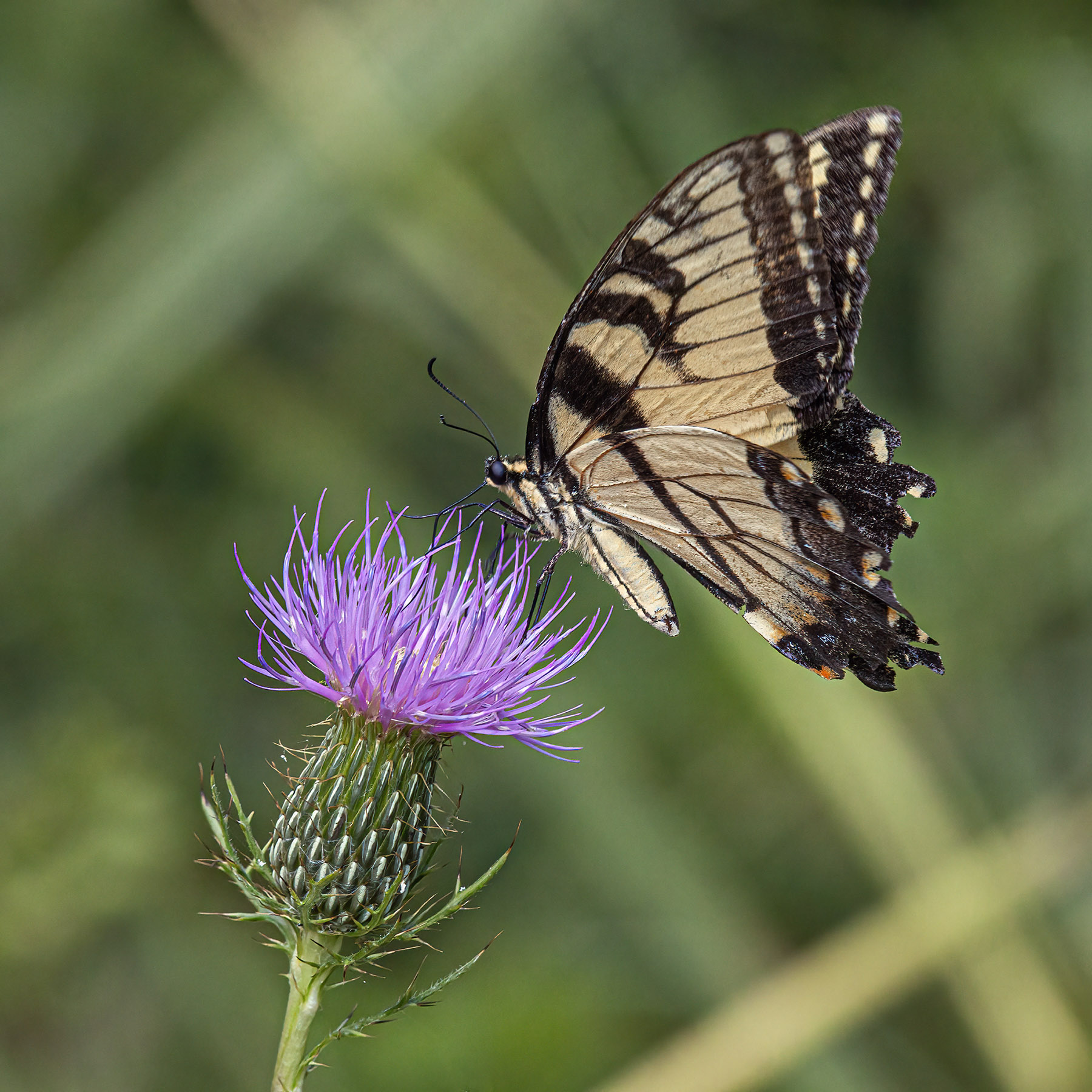
Some days I am guilty of overanalyzing my images, trying to figure out why I like or do not like them. Today, I decided to simply present this shot of a pretty Eastern Tiger Swallowtail butterfly (Papilio glaucus) that I spotted yesterday at Occoquan Bay National Wildlife Refuge as it fed on what looked to be some kind of sunflower.

I remember so well the words of the old Shaker song, “Simple Gifts” that I sang as part of a high school chorus:

‘Tis the gift to be simple, ’tis the gift to be free,
‘Tis the gift to come down where we ought to be;
And when we find ourselves in the place just right,
‘Twill be in the valley of love and delight.
When true simplicity is gained,
To bow and to bend we shan’t be ashamed;
to turn, turn, will be our delight.
Till by turning, turning we come round right.

Have a wonderful Sunday.

Eastern Tiger Swallowtail


© Michael Q. Powell. All rights reserved.

Read Full Post »

How do I find all of the different dragonflies that I feature on my blogs? I like to visit a variety of habitats starting early in the spring and going later into the autumn. When I am out in the wild with my camera, I try to move relatively slowly as my eyes scan the ground, the vegetation, and the air for indications of dragonflies. Most of the time I need movement for me to detect a dragonfly and track a dragonfly, but sometimes I am able to spot a perched dragonfly.

During a recent visit to Occoquan Bay National Wildlife Refuge, I photographed two dragonflies that help to illustrate the importance of looking up as well as down when hunting for dragonflies. The male Widow Skimmer (Libellula luctuosa) in the first photo was perched low in some vegetation at the edge of a small pond. I watched the dragonfly fly to that perch, but my view was blocked by vegetation until I found a small visual tunnel that gave me a relatively clear view as I pointed my camera down at the dragonfly.

The male Great Blue Skimmer (Libellula vibrans) in the second photo, on the other hand, was perched high in the air in a field. Visually I had no trouble getting this shot as I pointed my camera toward the sky, but the ground was uneven and mucky and thorns were pricking my ankles as I composed the shot.

Down? Up? Straight ahead? My eyes are constantly moving when I am in target acquisition mode—that is one of the “secrets” of my dragonfly photography.

Widow Skimmer

Great Blue Skimmer

© Michael Q. Powell. All rights reserved.

Read Full Post »

I am fond of challenging myself by photographing difficult subjects like tiny spiders and dragonflies in flight. However, I find equal joy in capturing the beauty of more common subjects in simple portraits, like this image of a male Big Bluet damselfly (Enallagma durum) that I spotted on a recent trip to Occoquan Bay National Wildlife Refuge.

Beauty is everywhere.

Big Bluet

© Michael Q. Powell. All rights reserved.


Read Full Post »

I am still waiting to see my first Monarch butterfly of the year, but was nonetheless excited to spot this similar-looking Viceroy butterfly (Limenitis archippus) recently at Occoquan Bay National Wildlife Refuge. The butterfly was looking a bit tattered, but its flight abilities seemed unaffected. Every year I am shocked anew at the ability of butterflies to function with significant wing damage.

The Monarchs and Viceroys have the same orange and black coloration, though the Viceroy is a bit smaller in size. The main visual difference between the two species is the black line across the Viceroy’s hind wings that is not present in Monarchs.

This is a modest little shot of this butterfly, but I really like the curve of the vegetation that is serving as a perch and the wonderful shadow that the butterfly is casting onto that vegetation.

Viceroy butterfly

© Michael Q. Powell. All rights reserved.


Read Full Post »

How close should I try to get to my subject? How much attention should I pay to environmental elements when composing a shot? When is the decisive moment to grab a shot when the subject is in motion? These were some of the thoughts swirling through my head when I spotted this Black Swallowtail butterfly (Papilio polyxenes) last Friday at Occoquan Bay National Wildlife Refuge.

There are several dark swallowtails in our area, including the Spicebush Swallowtail, the Pipevine Swallowtail, the dark morph of the Eastern Tiger Swallowtail, and the Black Swallowtail. Sometimes it is hard to tell them apart, but in this case I spotted the black dots inside of the orange dots in the area between the wings, one of the identifying marks of a Black Swallowtail.

The first shot was one of the earliest shots that I took and I remember staying far enough away from the butterfly to be sure that I included the curl of the leaf coming out of the stalk of vegetation. I also tried to time my shot to catch the butterfly with its wings spread wide and was mostly successful.

I moved in closer and captured the second image, which shows more of the details of the butterfly. Although the camera settings remained the same, the background is more out of focus than in the first shot, because depth of field tends to get shallower when you get closer to a subject. I also tried to shoot from a slightly higher angle by standing on my tiptoes—you can see more of the vegetation over the butterflies left eye in the second image than in the first.

I chased this butterfly around as it flew about and waited patiently for it to perch again. I captured the final image when it landed on a different kind of plant. Normally a shot like this when the subject is facing away from you is not a good shot and is derisively referred to as a “butt shot” by many photographers. In this case, however, I was struck by the way that the angle of the butterfly’s wings complemented the angular shape of the plant’s leaves and I like the abstract feel of the image that I captured.

Black Swallowtail

Black Swallowtail

Black Swallowtail

© Michael Q. Powell. All rights reserved.


Read Full Post »

I am always excited to see the brightly colored bodies and patterned wings of Calico Pennant dragonflies (Celithemis elisa). Calico Pennnants are small in size, with a length of only 1.1 to 1.3 inches (29-34 mm), and often perch in dense vegetation of fields adjacent to the water, so they are often difficult to spot. I can usually plan on getting scratched up a bit when photographing them and sometimes come away with chigger bites.

Last Friday I was particularly happy when I managed to get shots of both a male and a female Calico Pennant at Occoquan Bay National Wildlife Refuge. Males have a red and black pattern on their bodies, while females (and juvenile males) are yellow and black—the Calico Pennant in the first photo is a male and the one in the second is a female. Both genders have exquisitely detailed patterns on their wings that also help to distinguish them from other dragonflies.

Calico Pennnant

Calico Pennant

© Michael Q. Powell. All rights reserved.


Read Full Post »

Halloween Pennant dragonflies (Celithemis eponina) are among the most photogenic dragonflies that I am blessed to photograph. The way that they perch at the extreme tips of vegetation makes it relatively easy to separate them from the background and highlight the beautiful patterns of their wings. Often I am able to move relatively close and shoot upwards with the sky as the background, as in the second image, though at other times I enjoy including the green shades of vegetation instead.

I spotted this striking dragonfly, which I believe is a female Halloween Pennant, last Friday as I was exploring a field at Occoquan Bay National Wildlife Refuge. Unlike many dragonflies that are found at the edge of a pond or a marsh, the Halloween Pennants that I see are usually perched in the tall vegetation at the edge of fields away from the water.

My final photo was my attempt to see eye-to-eye with the dragonfly. I really like the unusual perspective in the resulting photo and the way that the angle of view causes the wings, which usually play a dominant role in photos of dragonflies, to almost disappear from view.

Halloween Pennant

Halloween Pennant

Halloween Pennant

© Michael Q. Powell. All rights reserved.

Read Full Post »

The dragonfly was high in the tree and almost completely silhouetted when I spotted it on Friday at Occoquan Bay National Wildlife Refuge. Conditions did not seem optimal for capturing an image, but as I looked through the viewfinder of my camera, my eyes were attracted to the curlicue shape of the branch on which the dragonfly was perched. The branch, I realized, was actually the main subject of the image that I wanted to create.

I was far enough away that I could move about freely without fear of spooking the dragonfly, so I tried a number of different angles of view and shooting positions. As I later looked through the images on my computer, the placement of the sky and the clouds in the frame made me decide to feature this particular shot.

As for the dragonfly, I believe that it is a female Great Blue Skimmer (Libellula vibrans). Despite the shadowy silhouette created by shooting into the sun, there are just enough details for me for me to identify the dragonfly with a reasonable degree of certainty, though, as I noted earlier, my primary goal was to draw the viewer’s attention to the spiral shape of the curlicue branch.

Great Blue Skimmer

© Michael Q. Powell. All rights reserved.

Read Full Post »

I spotted this Big Bluet damselfly (Enallagma durum) couple in flagrante delicto on Monday at Occoquan Bay National Wildlife Refuge. Although I could not help but notice the sidewards heart that their bodies form when they are mating, it was the other elements of the scene that really caught my eye. The shapes and shadows of the leaf and its gnawed-away holes all add visual interest and make a perfect backdrop for this little vignette of an intimate moment in the lives of these damselflies.

Big Bluet

© Michael Q. Powell. All rights reserved.

Read Full Post »

I was shocked and thrilled to spot a Prince Baskettail dragonfly (Epitheca princeps) perched in a tree on Monday at Occoquan Bay National Wildlife Refuge. This was only the second time that I have seen one that was not flying—they never seem to take a break. As the Dragonflies of Northern Virginia website succinctly states, “Flies almost constantly, rarely perches.”

Earlier in the day I had seen Prince Baskettails several times, flying overhead as I walked along a trail parallel to the waters of Occoquan Bay. Those of you who have followed my blog for a while know that I can never resist the chance to attempt to capture a shot of a dragonfly in flight. This time was a bit different, though, because I was using my long telephoto zoom lens and the dragonfly was not flying over the water, but was high in the air. The second image was one of my more successful attempts.

Normally the only place where I see Prince Baskettails at this time of the year is at a small pond at Jackson Miles Abbott Wetland Refuge, where the Prince Baskettails fly repeated patrols low over the water. I have had some success in capturing shots of them in flight, like the final photo that I took last Thursday as a Prince Baskettail was flying by parallel to my position on the shore.

Prince Baskettail

Prince Baskettail

Prince Baskettail

© Michael Q. Powell. All rights reserved.

Read Full Post »

I was happy to spot this Halloween Pennant dragonfly (Celithemis eponina) on Monday at Occoquan Bay National Wildlife Refuge as it perched high in the air on a tall stalk of Eastern Gamagrass. This is my first Halloween Pennant of the season and I have always loved seeing the beautifully patterned wings of this species. As you can see from this photo, Halloween Pennants like to perch on the uppermost tips of vegetation, which causes them to flap in even the slightest breeze, like a pennant.
I had made a trip to this wildlife refuge to check on the status of the bald eagles that I featured in yesterday’s posting and was walking around with my 150-600mm telephoto lens on my camera when I saw this dragonfly. Normally I am reluctant to to try to photograph dragonflies with this lens, because the shots are sometimes a little soft when the zoom lens is fully extended. However, the lighting was good and I am happy with the amount of detail that I was able to capture—click on the photo if you want to check out all of the cool details of this colorful dragonfly.

Halloween Pennant

© Michael Q. Powell. All rights reserved.

Read Full Post »

It has been several months since I last checked on the Bald Eagle (Haliaeetus leucocephalus) nest at Occoquan Bay National Wildlife Refuge, so I made a visit there on Monday to check on the eaglets. The young eagles that I found still hanging around the nest are definitely no longer babies, though most people would not yet recognize them as Bald Eagles—it takes almost five years for them to acquire their distinctive white heads and tails.

I am pretty sure that these two eaglets are now capable of flight, though they remained in place on the branches overlooking the nest the entire time that I observed them. For the first time in quite some time I had my 150-600mm lens on my camera that allowed me to zoom in on each of the eaglets and then zoom back for the final shot to give you an idea of how close they were to the nest.

The bedraggled plumage makes it look like it was really windy, but in fact there was no wind when I captured the images. The eaglets clearly have a lot of work to do on their grooming before they are ready to take their place as one of our national symbols.

I did not see any adult Bald Eagles until much later in the day when I spotted one in another part of the wildlife refuge. Although the eaglets appear to be more or less full grown in terms of size, I question the degree to which they are self-sufficient and suspect that they are still dependent on their parents to provide them with food. As their flying skills improve, the eagles will almost certainly venture out farther and farther and it will become correspondingly more difficult for me to spot them.

Bald Eagle

Bald Eagle

Bald Eagle

© Michael Q. Powell. All rights reserved.

Read Full Post »

I have not seen many baby birds this spring, so it was exciting to spot this little Canada Goose family last week swimming together in the waters off of Occoquan Bay National Wildlife Refuge. Canada Geese (Branta canadensis) are so common where I live that many people consider them to be a nuisance, but I love to observe and photograph them.

Earlier this spring I noticed that a Canada Goose had established a nest on top of one of the wooden duck blinds and I wonder if these little goslings were hatched in that nest. Whatever the case, springtime is such a wonderful time to celebrate new life in all of its forms—and you have to admit that those three baby geese are really cute.

Canada Goose

© Michael Q. Powell. All rights reserved.


Read Full Post »

Great Blue Herons remain in my area throughout the winter, but the much smaller Green Herons (Butorides virescens) depart in the autumn for warmer locations. It is always exciting for me when these colorful little herons return in the spring. Green Herons have always struck me as having more outgoing personalities than the more stoic Great Blue Heron and I love to watch them.

Normally I see them down at water level, often partially hidden by the vegetation, which makes them a challenge to photograph. Last week during a visit to Occoquan Bay National Wildlife Refuge, however, I spotted a Green Heron that had chosen a higher perch that allowed me to get an unobstructed shot. I really like the heron’s pose as it alertly surveyed the surrounding area.
Green Heron

© Michael Q. Powell. All rights reserved.


Read Full Post »

When I saw an osprey couple trying to build a nest earlier this spring on a channel marker in the waters off of Occoquan Bay National Wildlife Refuge, the building site seemed way too small. Amazingly the ospreys (Pandion haliaetus) found a way to add an overhanging extension that seems to defy gravity. The couple seemed comfortable in the nest, which appear to be capable of easily holding their weight.

A neighboring osprey couple had the opposite problem—they had too much space. The ospreys used only half of the space for their nest and could easily have shared the other half with another couple, but I think that ospreys like to keep their neighbors at arm’s length, or maybe it would be better to say “at wing’s length.”

osprey nest

osprey nest

© Michael Q. Powell. All rights reserved.


Read Full Post »

I was delighted to spot these beautiful Calico Pennant dragonflies (Celithemis elisa) on Tuesday at Occoquan Bay National Wildlife Refuge. The one with the yellow markings is a female and the one with the red markings is a male.

The combination of bright colors and intricate wing patterns makes Calico Pennants one of the most stunning dragonflies species that I am blessed to see and photograph. They sure do pack a lot of beauty into their tiny bodies that are only 1.3 inches (33 mm) in length.

Calico Pennant


calico pennant

calico pennant

© Michael Q. Powell. All rights reserved.

Read Full Post »

As some of you know, I have been monitoring two Bald Eagle (Haliaeetus leucocephalus) nests this spring at Occoquan Bay National Wildlife Refuge. This past month I have devoted most of my photography time to dragonflies, so yesterday I grabbed my long lens and headed off to the refuge, hoping to see some baby eagles. One of the nests is huge and has high walls, so it is hard to know what, if anything, is going on inside it.

I waited and waited and finally the head of an eaglet popped up over the edge of the nest. As I reviewed the first photo, I noticed that there is another eaglet on the other side of the tree trunk, just a little lower. (You may need to click on the image to spot the second eaglet.) Both of the baby birds were facing the tree trunk and I soon learned why.

It turns out that one of there was an adult eagle behind the tree trunk. In the second image, it looks like the adult eagle, whose only visible part was its beak, was giving a bite of food to one eaglet while its sibling looked out from the other side of the tree trunk and did not seem very happy about the situation.

In the final shot, you get a better look at the adult eagle and a partial view of one of the eaglets. I now know for sure that there are at least two eaglets in that nest—some years there have been three eaglets. As the eaglets get older, I hope they will be more active and curious and that will allow me to get some better shots of them.

eaglet

eaglet

bald eagle

© Michael Q. Powell. All rights reserved.


Read Full Post »

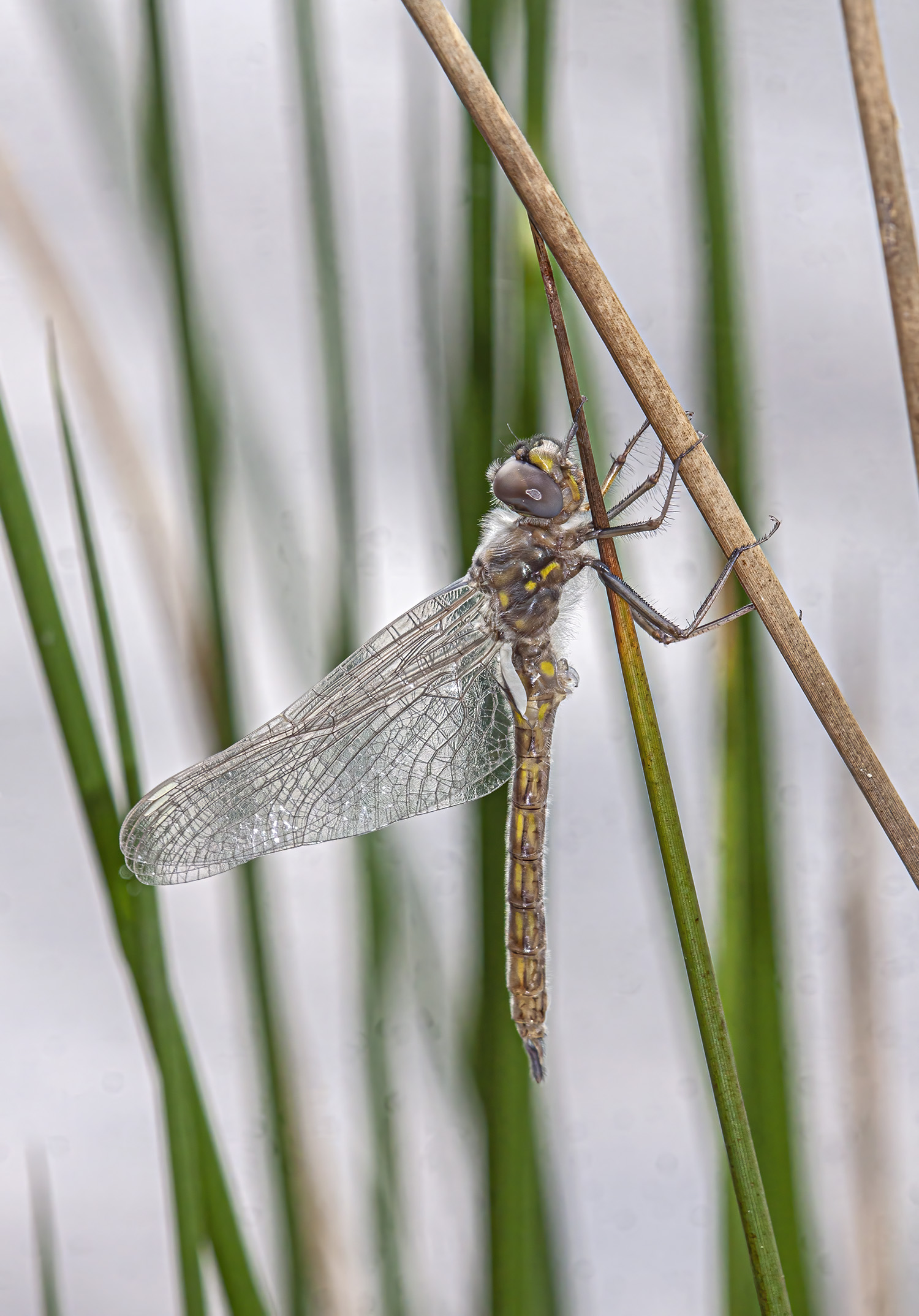
On a recent visit to Occoquan Bay National Wildlife Refuge I stumbled upon a Common Baskettail dragonfly (Epitheca cynosura) at the edge of a pond that was in the final stages of the process of emergence. The first photo shows the dragonfly only seconds after it popped open its wings for the first time—note how shiny and clear the fragile wings are at this stage. The second photo shows the dragonfly a few minutes earlier, when its wings were still closed and its markings were just beginning to appear.

The dragonfly remained in place for a few minutes as its wings began to harden. It then made a short fluttering flight to some nearby vegetation, a safer and less exposed location to rest and complete its amazing metamorphosis.


Common Baskettail


Common Baskettail

© Michael Q. Powell. All rights reserved.

Read Full Post »

If you want a fun photographic challenge, try to photograph a dragonfly in flight. It is definitely a test of your skill and patience to track and photograph a subject this small (about 1.6 inches (41 mm) in this case) while it is flying past you. I captured this image of a male Common Baskettail dragonfly (Epitheca cynosura) last Thursday at Occoquan Bay National Wildlife Refuge.

Longtime readers of this blog know that I will try to photograph dragonflies in flight at least several times every season. Some dragonfly species, like this one, will hover a little at times, which gives me a slightly better chance of getting a shot that is in focus. My camera does not focus quickly and accurately enough for me to use autofocus, so I end up focusing manually most of the time.

This shot is unusual in that I managed to freeze all of the motion of the wings—most of the time the wings are blurry. If you click on the image to see it in higher resolution, you will also note the way that the Common Baskettail (and many other species) folds its legs up under its “chest” (technically it is called the “thorax”) while flying to minimize wind resistance.

For those of you who might be curious, I ended up cropping the original image significantly, because I took the photograph with “only” my 180 mm macro lens and the dragonfly was flying over the water—I would have to have been in the water to get any closer.

Common Baskettail

© Michael Q. Powell. All rights reserved.

Read Full Post »

I was quite surprised and delighted to spot a male Calico Pennant dragonfly (Celithemis elisa) yesterday at Occoquan Bay National Wildlife Refuge. I thought I would have to wait another couple of weeks to find one of these tiny dragonflies that are only 1.3 inches (33 mm) in length, but perhaps our recent warm weather prompted this dragonfly to emerge early.

The Calico Pennant is one of a small group of dragonflies known as “pennants.” As you can see from these two images, pennant dragonflies like to perch on the very tips of flimsy stalks of vegetation where they are whipped about by the slightest breezes like pennants in the wind.

Calico Pennant


Calico Pennant

© Michael Q. Powell. All rights reserved.

Read Full Post »

When I photographed this dragonfly on Friday at Occoquan Bay National Wildlife Refuge, I had no doubt in my mind that it was a Common Baskettail dragonfly (Epitheca cynosura).  I had seen dragonflies of this species several times near that area of the refuge, including once earlier this year. Besides, what else could it be?

I got a quick response to that question when I posted a photo to the Virginia Odonata group, a Facebook forum devoted to dragonflies and damselflies. One viewer suggested that it looked more to him like a Slender Baskettail dragonfly (Epitheca costalis) than a Common Baskettail. Eventually several experts weighed in and also opined that it looked like a male Slender Baskettail, though one acknowledged that it was difficult to make a definitive call based on my photos that he judged to be “suboptimal.”

So how do you tell the species apart? Slender Baskettails tend to have a narrower waist and are relatively slimmer, but the only way to know for sure is by the length of the cerci, the dark black terminal appendages at the tip of the abdomen (the “tail”). The cerci are longer on male Slender Baskettails than on Common Baskettails. (If you want to know more about dragonfly terminal appendages, check out a posting by fellow dragonfly enthusiast Walter Sanford entitled Dragonfly terminal appendages (male, female).)

The folks who suggested that this dragonfly is a Slender Baskettail did so on the basis of my photos, but that is not really a reliable method, because the angle and lighting can distort perceptions. How do you know for sure? One expert stated that “you can really only ID them by measuring the cerci which I do of a specimen under a microscope.” I may be a little geeky when it comes to dragonflies, but I am not about to measure a specimen’s anatomical parts with a microscope.

I am left therefore with a bit of a scientific mystery. Is it a Slender Baskettail or a Common Baskettail dragonfly? It might be a bit of heresy to some, but it does not really matter to me. I was simply happy to capture these cool photos of a beautiful creature.

Shakespeare’s words about a rose in “Romeo and Juliet” could easily be applied here, “A rose (or a dragonfly) by any other name would smell (or look) as sweet.”


Slender Baskettail

Slender Baskettail

© Michael Q. Powell. All rights reserved.


Read Full Post »

I was thrilled yesterday at Occoquan Bay National Wildlife Refuge to spot my first Blue Corporal dragonfly (Ladona deplanata) of the season. This little dragonfly—about 1.4 inches (36 mm) in length—is one of the earliest dragonflies to reappear each spring in my area and was one of my target species for the day.

If you look carefully at the upper part of the thorax (the “shoulders”) you can see the two light-colored stripes, the traditional military insignia for a corporal, that are responsible for the name of this species. Blue Corporals most often perch flat on the ground, which can make them really hard to spot when they land. In this case, the ground was so cluttered with dried reeds that I could barely detect the dragonfly’s wings. (You can see the wings more easily if you click on the image to enlarge it.)

Blue Corporal

© Michael Q. Powell. All rights reserved.

Read Full Post »

I was thrilled yesterday to spot this Snowberry Clearwing Moth (Hemaris diffinis) as I was wandering about in Occoquan Regional Park. This fascinating insect looks a lot like a bumblebee, but acts a lot like a hummingbird and hovers when it is feeding. Unlike a hummingbird that has a long pointed beak, members of this species have a long proboscis that they curl up when it is not in use, as you can see in the first photo.

The active little moth was very focused on the tiny violets and did not seem bothered by my presence, so I was able to move in quite close for these shots. However, the moth did not linger long on any flower, so I had to move quickly. I do not know how fast the moth was moving its wings, but the shutter speed for these photos was as high as 1/2000 of a second and there was still some wing blur. In case you are curious, Snowberry Clearwing Moths are about 1.25-2.0 inches (32–51 mm) in length.


Snowberry Clearwing Moth

Snowberry Clearwing Moth

Snowberry Clearwing Moth

© Michael Q. Powell. All rights reserved.


Read Full Post »

I spent most of my time looking for birds during a trip last week to Occoquan Bay National Wildlife Refuge and I managed to capture the images of the bald eagles that I featured yesterday. The day had started off cool and overcast, more suitable for birds than for dragonflies, but when the sun finally broke through in the late afternoon, I decided to swing by a small pond on my walk back to the parking lot on the off chance that I might find a dragonfly.

My hunch paid off when I spotted this female Ashy Clubtail dragonfly (Phanogomphus lividus) perched low to the ground. At that moment I had my Tamron 150-600mm lens attached to my camera and that presented a challenge, because its minimum focusing distance is 8.9 feet (2.70 meters), so I had to back up. At that distance it is hard to locate and focus on a subject that is only 2 inches (50 mm) in length. Fortunately I have been in this situation before and I steadied myself, focused manually, and captured the first image before the dragonfly flew away.

Having established that there there was at least one dragonfly in the area, I switched to my Tamron 180mm macro lens, my preferred lens for dragonflies, and continued my search. A few minutes later I spotted another female Ashy Clubtail when it flew up into some low hanging vegetation and I captured the second image. There is a good chance that this was the same individual that I photographed earlier—both of them are pale in color, suggesting that they had only recently emerged from their larval state.

As I moved a little closer for the final shot, the dragonfly closed its wings overhead, reverting briefly to an earlier stage when it was in the process of emerging. I have seen this happen before when a newly emerged dragonfly, sometimes referred to as a teneral, flew for the first time and its wings were still in a very fragile state. At this point, I decided to stop shooting, fearful that I might spook this newly emerged dragonfly into flying at a time when she clearly needed to rest.

If you are unfamiliar with the amazing process that a dragonfly goes through in transforming itself from a water-dwelling nymph to an aerial acrobat, check out my blog posting called Metamorphosis of a dragonfly that documents the entire process in a series of photos.

Ashy Clubtail

Ashy Clubtail

Ashy Clubtail

© Michael Q. Powell. All rights reserved.

Read Full Post »

Perhaps these Bald Eagles (Haliaeetus leucocephalus) were singing or maybe they were trying to scare off incoming osprey, but most importantly they were doing it together as a couple on a shared perch when I spotted them on Monday at Occoquan Bay National Wildlife Refuge at a moment when the skies were completely overcast.

Bald Eagles


© Michael Q. Powell. All rights reserved.


Read Full Post »

Both members of a Bald Eagle (Haliaeetus leucocephalus) couple were active on Monday in and around the big nest at Occoquan Bay National Wildlife Refuge—neither of them appeared to be sitting continuously in the nest.  Perhaps there are eaglets already, though the nest is so deep I could not see any little heads.

I captured this image as one of the eagles was making its final approach to land on the nest. I really like the position of the wings that help the eagle slow its forward progress and the way that the light coming from the side was illuminating the tail feathers.

I will be continuing to monitor this nest and the other one at the wildlife refuge for signs of baby eagles and hopefully will have the chance to capture some shots of them soon.

bald eagle

© Michael Q. Powell. All rights reserved.

Read Full Post »

« Newer Posts - Older Posts »