August 3, 2020 by Mike Powell
I am catching up on some photos and thought I’d post this image that I captured in mid-July of a cool-looking fishing spider that Walter Sanford spotted while we were hunting for dragonflies at a creek in Fairfax County. I am not sure of the specific species of the spider, but I am pretty confident that it is of the genus Dolomedes. Most of the times in the past when I have spotted similar spiders, they have actually been in the water, but this one seemed to be hunting from a crevice in the rocks at the edge of the water.
I love the texture of the rocks and especially the lichen that add a lot of visual interest to this image. If you would like to see Walter’s take on our encounter with this spider, check out his post ‘Fishing spider Friday.’ Walter noted that he sees “a mean monkey face on the front half of the spider and a baboon face on the back half.” Be sure to click on the image to see the spider more closely, if you dare and let me know what you think.

© Michael Q. Powell. All rights reserved.
Posted in Arachnids, Nature, Photography, spiders, Summer, wildlife | Tagged Canon 50D, creek walking, dolomedes, Fairfax County Virginia, fishing spider, spider, Tamron 50D | 20 Comments »
August 2, 2020 by Mike Powell
July was a crazy month no matter how you look at it. Who knows what the new month will hold for us all? When I checked the garden of my friend and neighbor Cindy Dyer a few days ago, I was thrilled to see that some of her gladiolas are now in bloom, symbolic of the new life and growth that is still possible in our own lives, even in these troubled times.
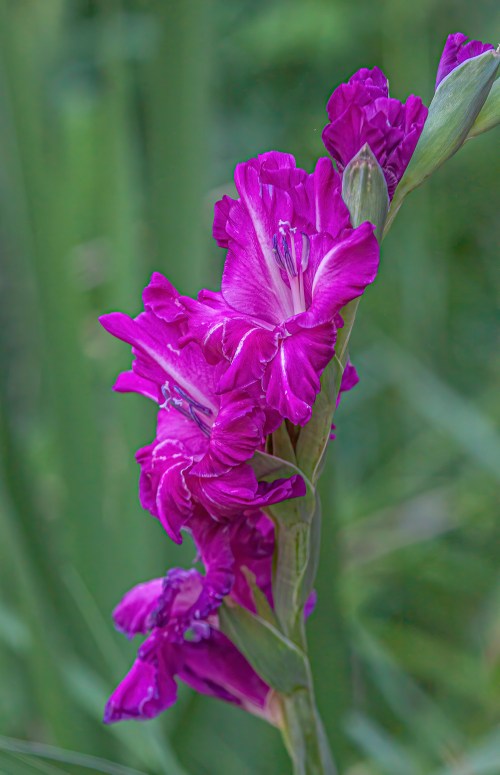
© Michael Q. Powell. All rights reserved.
Posted in Flowers, Gardening, Inspiration, Nature, Photography, Summer | Tagged Alexandria VA, Canon 50D, Cindy Dyer, gladiolas, hope, Runnymeade, Tamron 180mm | 21 Comments »
August 2, 2020 by Mike Powell
I had forgotten how small Fragile Forktail damselflies (Ischnura posita) are until I spotted one perched in some vegetation last week while I was exploring at Jackson Miles Abbott Wetland Refuge. Even by damselfly standards, Fragile Forktails are tiny at only .8 to 1.1 inches (21-29 mm) in length. The good news is that they are relatively easy to identify, because they have pale interrupted shoulder stripes that look like exclamation points.
I love how the green of the damselfly’s thorax and in its eyes match the soft green palette of the rest of the image. For me, there is something really soothing about this simple portrait of a tiny damselfly.

© Michael Q. Powell. All rights reserved.
Posted in damselfly, Insects, Macro Photography, Nature, Photography, Summer, wildlife | Tagged Canon 50D, Fort Belvoir VA, Fragile Forktail, Fragile Forktail damselfly, Ischnura posita, Jackson Miles Abbott Wetland Refuge, Tamron 180mm | 11 Comments »
August 1, 2020 by Mike Powell
I have now successfully completed the World Watercolor Month challenge of doing some kind of watercolor painting each day of July. I have had a tremendous amount of fun and improved my skills and confidence. Thank you all for your support and encouragement for my painting efforts throughout this month.
If you want to see the first four installments of my painting efforts this month, check out my previous postings ‘More fun with watercolor‘, ‘World Watercolor Month 2020—part 2 ,’ ‘World Watercolor Month 2020—part 3,’ and Word Watercolor Month—part 4. This final installment highlights my painting efforts over the past nine days in reverse chronological order.
Day 31 and the prompt was “do-over,” so I had another go at painting a scene that I painted last November while in Paris of a lady with a red umbrella crossing a pedestrian bridge over the Seine that I had photographed. Here is a link to the posting ‘Playing with watercolor in Paris‘ that shows the November version of the painting, and a link to the post ‘A few more umbrellas in Paris‘ that shows the photo on which the paintings were based.
Day 30 and the prompt was “pose.” I decided to be my own model and painted a version of the photo that has been my profile image for a while. Thanks to my friend, Cindy Dyer, for taking such a good photo of me.
Day 29 and the prompt was “yesterday.” Immediately thinking of the Beatle song by that name, I was flooded with memories of growing up in the 1960’s, so I did a colorful little painting reminiscent of a tie-dyed t-shirt as a kind of homage to that period in my life.
Day 28 and the prompt was “complementary.” Purple and yellow are complementary colors, so I decided to paint a field of imaginary wildflowers in those colors. I made no attempt at realism or nuance in the painting—I just wanted to play with the paint.
Day 27 and the prompt was “shine,” so I painted a little landscape with the moon shining down on a grove of shadowy trees.
Day 26 and the prompt was “favorite song.” I remembered that one of my parents’ favorite hymns was “His Eye is on the Sparrow,” so I painted a little sparrow. The final line of the wonderful hymn is, “His eye is on the sparrow and I know He watches me.”
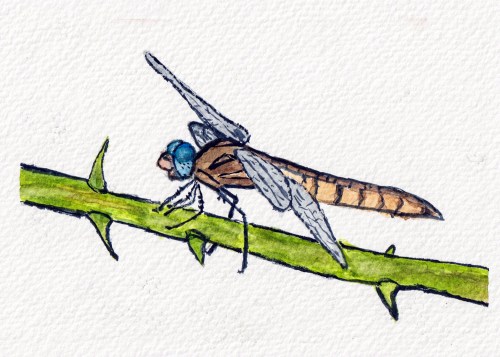
Day 25 and the prompt was “sharp.” I decided to paint a version of a photo I had previously taken of a dragonfly that had chosen a precarious perch on a thorny vine.
Day 24 and the prompt was “abundance,” so I did a tiny painting (3×3 in/76 x 76 mm) of a field full of bright red poppies following a YouTube tutorial by Ellen Crimi-Trent (https://www.youtube.com/watch?v=IUDC7Aojxm4&t=83s). It’s fun to paint something so small, where details are only suggested.
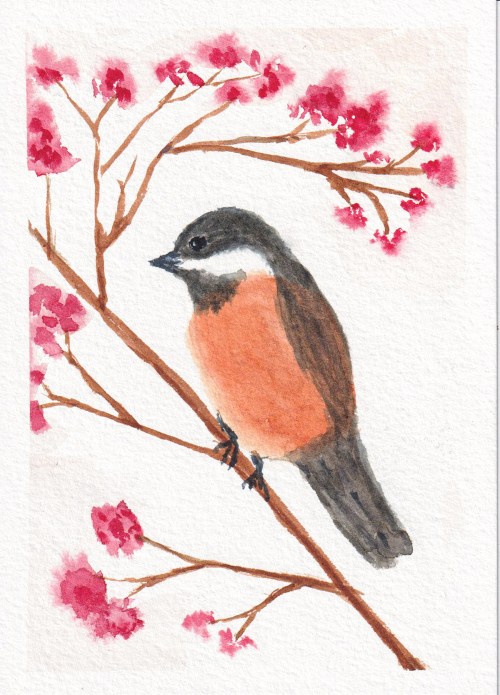
Day 23 and the prompt was “alone,” so I painted a solitary bird perched amidst some blossoms. It kind of looks like a cross between a chickadee and an American Robin. I later learned that the bird looks to be a Varied Tit, a bird found in the Far East. I had loosely followed a YouTube tutorial that did not identify the bird (https://www.youtube.com/watch?v=BtlLzgfnQxw&t=1222s).
I plan to continue with my watercolor painting, having seen that frequent practice really helps, but it will probably be a while before I post any paintings here on the blog. Thanks again for your support and indulgence as I have veered off my normal creative path.
We should be back to my regularly scheduled nature photography, though you have probably noticed that the photography continued without any discernible pause in July.



© Michael Q. Powell. All rights reserved.
Posted in Art, Nature, painting, Portraits, watercolor | Tagged #world watercolor month, #worldwatercolormonth, beginning watercolor, watercolor painting | 29 Comments »
July 31, 2020 by Mike Powell
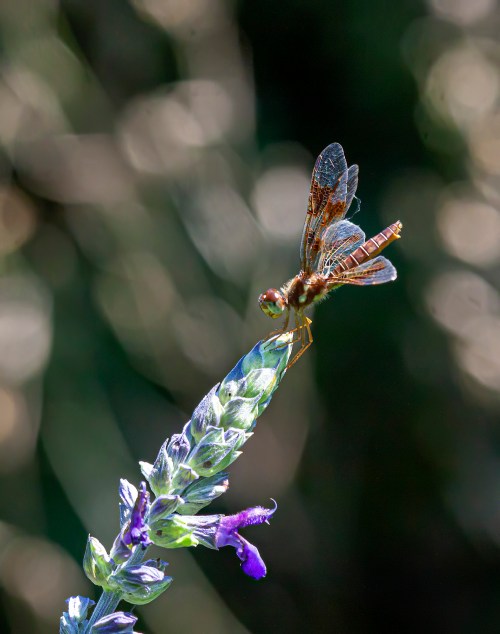
It love it when dragonflies cooperate and choose particularly photogenic perches, as these female Eastern Amberwing dragonflies (Perithemis tenera) did on Tuesday at Green Spring Gardens in Alexandria, Virginia, not far from where I live. The males of this species, whose wings are a solid amber in color, mostly seemed to be hanging out at a pond at the bottom of a hill, while the females were flitting about among the flowers in the gardens at the top—the gender separation reminded me of the awkwardness of junior high dances when I was growing up.
As many of you may recall, dragonflies and damselflies are part of the Odonata order of flying insects. My friend and fellow dragonfly enthusiast Walter Sanford has coined the term “odonart” to refer to artsy-style photos that we manage to capture of our favorite aerial acrobats. I think that both of these images qualify to fit into that self-created category, given the beauty of the dragonflies and their particularly photogenic perches.

© Michael Q. Powell. All rights reserved.
Posted in Art, Dragonflies, dragonfly, Insects, Nature, Photography, Summer, wildlife | Tagged Alexandria VA, Canon 50D, Eastern Amberwing, Eastern Amberwing dragonfly, female Eastern Amberwing, green spring gardens, odonart, Perithemis tenera, Tamron 180mm | 30 Comments »
July 30, 2020 by Mike Powell
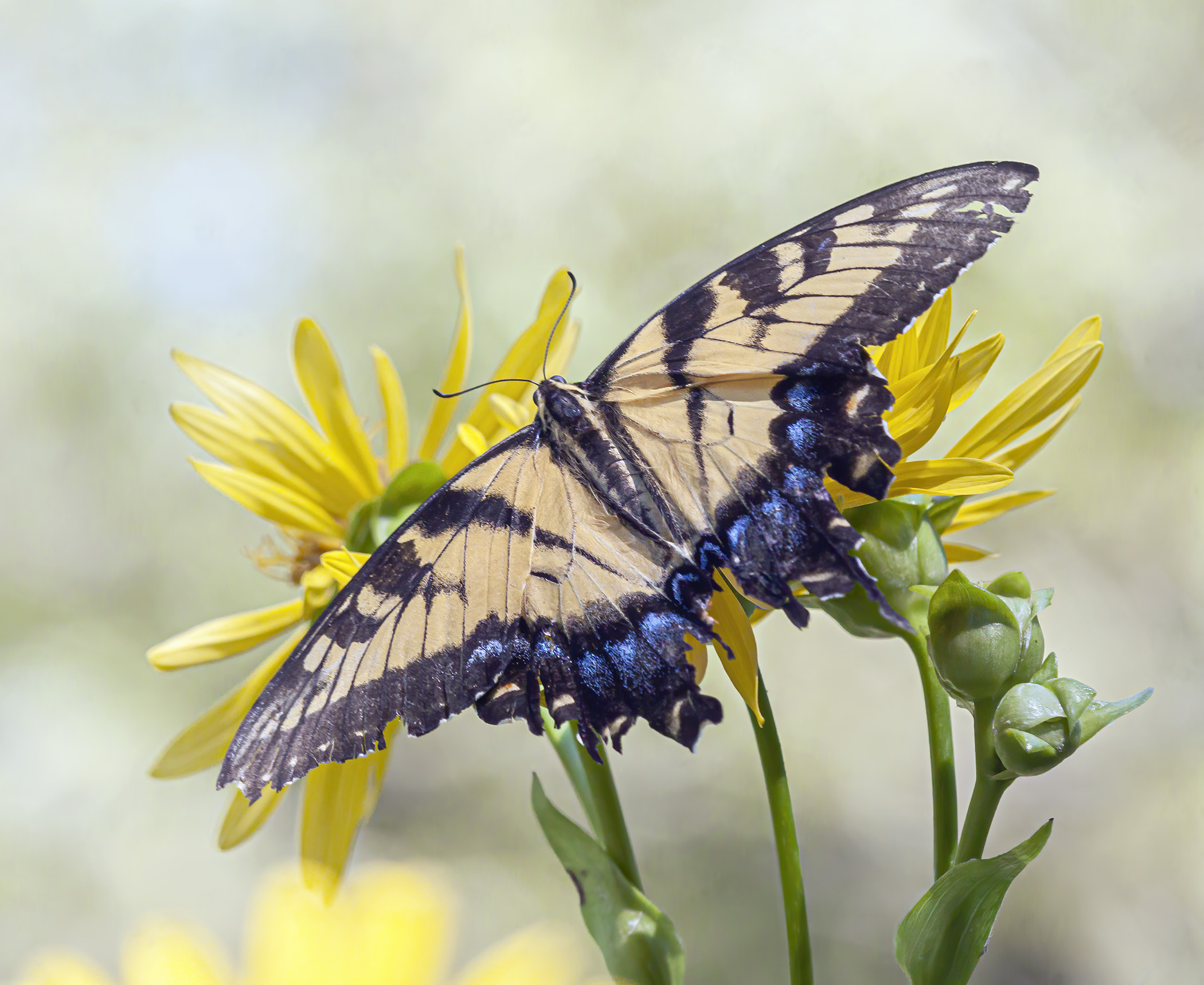
Many butterflies are looking a little tattered this late in the season, like this Eastern Tiger Swallowtail (Papilio glaucus) that I spotted on Tuesday at Green Spring Gardens, but I still find their beauty to be breathtaking. True beauty, I would argue, is often to be found in imperfection, not in some superficial notion of perfection.


© Michael Q. Powell. All rights reserved.
Posted in Art, Butterflies, Nature, Photography, Summer, wildlife | Tagged Alexandria VA, beauty, Canon 50D, Eastern Tiger Swallowtail, Eastern Tiger Swallowtail butterfly, green spring gardens, Papilio glaucus, perfection, Tamron 180mm | 15 Comments »
July 29, 2020 by Mike Powell
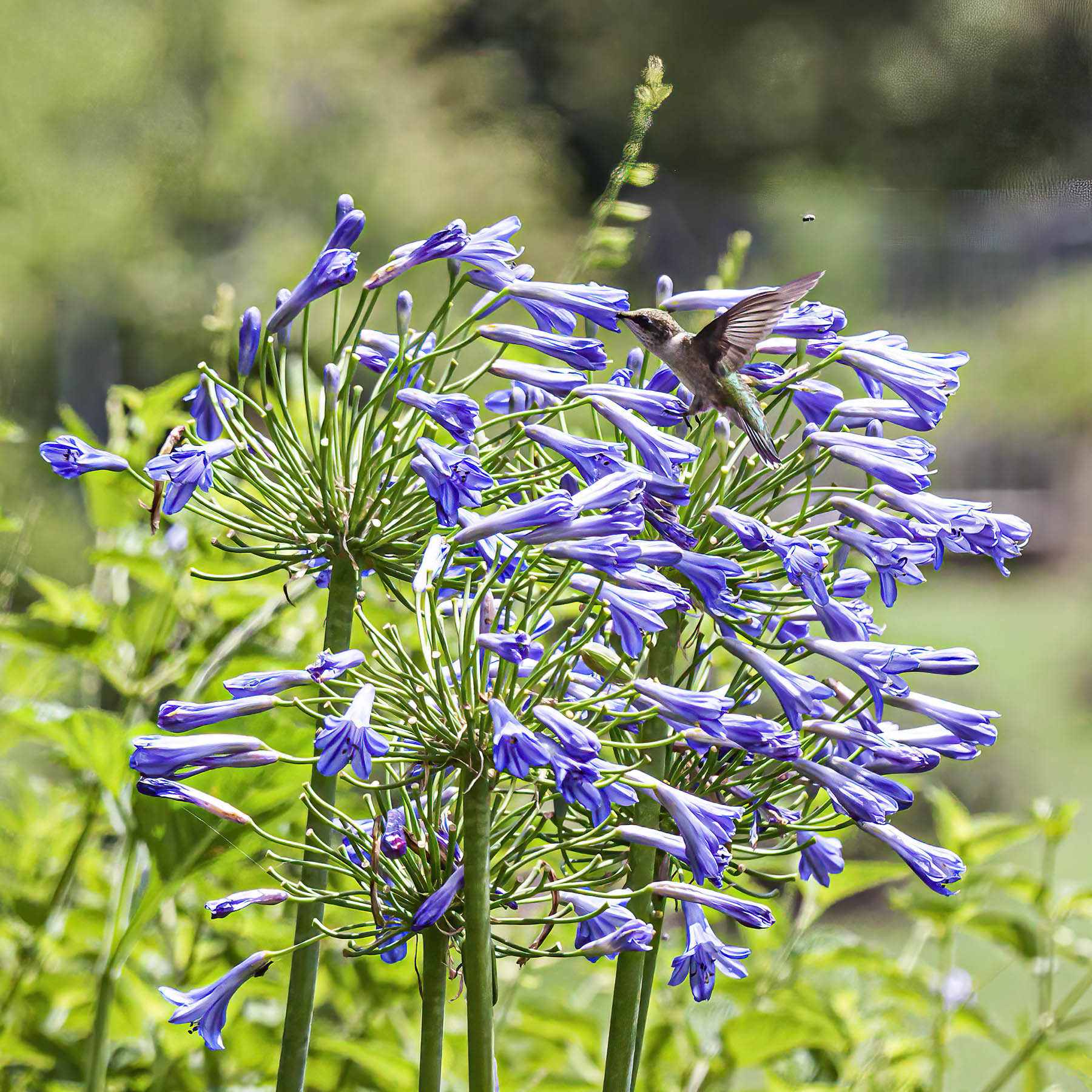
During a short visit to Green Spring Gardens yesterday I was thrilled not only to see some Ruby-throated Hummingbirds (Archilochus colubris), but also to get some shots of at least one of them. I am not sure that a 180mm macro lens is optimal for this subject, but it worked, albeit with a need for an often significant crop of the original images.
Even though it was over 90 degrees (32 degrees C) when I set out, I felt a need to get out of the house, stretch my legs, and shoot a little. I chose this county-run historic garden because it is not far from where I live and I knew it had some shady areas. I expected to be photographing mostly insects and flowers, so my trusty 180mm macro lens was affixed to my camera.
As I was chasing some little dragonflies in one patch of flowers, I remembered that I had seen hummingbirds in this same patch a few years ago. Recently I have seen some awesome shots of hummingbirds on Facebook taken by local photographers at this garden, so I was certainly aware I might spot the speedy little birds. Once I spotted a hummingbird flitting among the flowers, I decided to stay at this spot and see if I too could capture a shot.
This sun-lit patch of flowers was long and narrow and the hummingbird would make short forays into one part of it and then would fly up into the shade of a tall tree. I never could establish if I was seeing a single hummingbird, which looked to be a female, or if there were multiple hummingbirds taking turns.
As you can see from the photos below, the hummingbird gave attention to a variety of different flowers, none of which I can identify for sure—maybe that is bee balm in the second shot. I have read that hummingbirds prefer red-colored flowers, but this hummingbird did not seem to discriminate on the basis of color. It is interesting to see how the hummingbird’s approach varied a little depending on the characteristics of the flower, such as the length of the tubular section into which the hummingbird inserted its long, thin bill.
Be sure to click on the final photo and you will see that the hummingbird is using its tiny feet to perch on an unopened flower to get greater leverage and a better angle of attack. You’ll also see a little bee in flight that had been disturbed by the hummingbird’s efforts.
When I returned home, I saw an amazing close-up hummingbird photo on Facebook taken earlier that morning on the same bluish-purple flowers that you see in my final photo. When I asked the photographer how far away he was when he took his photo, he said he was at the minimum focusing distance of his lens—15 feet (457 cm)—so I suspect he was shooting with a 600mm lens. I think that I might have been at the same distance when I took my shot.
Periodically I think about purchasing one of those monster lenses, but am somewhat deterred by the $12,999 price tag for the newest Canon 600mm lens and by its weight and size. All in all, I am quite content with the results I get from my current camera gear, including these images of hummingbirds in July.


© Michael Q. Powell. All rights reserved.
Posted in Birds, Flowers, Nature, Photography, Summer, wildlife | Tagged Alexandria VA, Archilochus colubris, Canon 50D, green spring gardens, Ruby-throated Hummingbird, Tamron 180mm | 32 Comments »
July 28, 2020 by Mike Powell
When dragonflies and damselflies complete the metamorphosis from water-dwelling nymphs to air-breathing aerial acrobats, initially their wings are clear and shiny, their bodies are pale and colorless, and they are very vulnerable. At this stage of development, it is often difficult to identify the species to which they belong. Over time, their wings harden, their bodies take on the markings and coloration of their species, and identification becomes easier.
During a dragonfly-hunting trip earlier this month with fellow dragonfly enthusiast Walter Sanford, I spotted several damselflies that had recently emerged, a stage often referred to as “teneral.” The first one was perched on a rock in the creek that we were exploring and the second was perched in some vegetation alongside the creek.
If you click on the images to get a more close-up view of the damselflies, you will note some indication of stripes on the thorax and thin rings around some of the segments of the abdomen. During the day, we saw adults of at least three different damselfly species, so we can infer that these tenerals belong to that small group of species, but there is not enough information to make a call. I’m happy that I was able to capture some cool images of the damselflies.
If you would like to read Walter’s discussion of the first damselfly and to view his photos, check out his blog posting that he titled “Acceptable uncertainty.”


© Michael Q. Powell. All rights reserved.
Posted in damselfly, Macro Photography, Nature, Photography, Summer, wildlife | Tagged Canon 50D, damselfly, Fairfax County Virginia, Tamron 180mm, teneral damselfly, Walter Sanford | 21 Comments »
July 27, 2020 by Mike Powell
In one corner of Jackson Miles Wetland Refuge there is a patch of wildflowers that I love to explore whenever I visit the refuge. In the past I have spotted bird, butterflies, and dragonflies amidst the flowers. Black-eyed Susans are now in bloom in that patch and I was thrilled on Saturday to capture this image of a Silvery Checkerspot butterfly (Chlosyne nycteis) feeding on one of the flowers. As I noted in an earlier posting, I have not seen many large butterflies this season, so it is especially nice to see the smaller ones.
I am pretty sure that this is a Silvery Checkerspot butterfly, though I have sometimes had troubles in the past distinguishing between Silvery Checkerspots and the somewhat similar Pearl Crescent butterflies (Phyciodes tharos).

© Michael Q. Powell. All rights reserved.
Posted in Butterflies, Insects, Nature, Photography, Summer, wildlife | Tagged Canon 50D, Chlosyne nycteis, Fort Belvoir VA, Jackson Miles Abbott Wetland Refuge, Silvery Checkerspot, Silvery Checkerspot butterfly, Tamron 180mm | 16 Comments »
July 27, 2020 by Mike Powell
Dragonflies are carnivorous—they feed on other live insects. Most of their diet consists of gnats, mosquitoes, and other small insects, but they also prey upon bees, butterflies, damselflies, and even on other dragonflies.
When I first spotted this male Eastern Pondhawk dragonfly (Erythemis simplicicollis) on Saturday at Jackson Miles Abbott Wetland Refuge, it had just perched on a stalk of vegetation. As I moved a little closer, the dragonfly changed its position, looking almost like it was trying to hide behind the stalk. What I did not realize at the time was that the dragonfly had just snagged a damselfly and was preparing to eat his lunch. Obviously he did not want to share it with me.
Almost all of the times that I have seen dragonflies with prey, they been Eastern Pondhawks, which seem to be particularly fierce predators. Some dragonflies eat their prey in mid-air and I never see them do so. It may also be the case that some other dragonflies fly up into the trees and consume their prey out of sight, while the Eastern Pondhawk is content to eat in public.
It is often difficult to judge the relative size of dragonflies and damselflies. This images lets you see how much smaller and thinner damselflies are than dragonflies. An Eastern Pondhawk is about 1.7 inches (43 mm) in length and the unidentified damselfly looks to a bit over an inch (25 mm) in length.

© Michael Q. Powell. All rights reserved.
Posted in damselfly, Dragonflies, dragonfly, Insects, Nature, Photography, Summer, wildlife | Tagged Canon 50D, Eastern Pondhawk, Eastern Pondhawk dragonfly, Erythemis simplicicollis, Fort Belvoir VA, Jackson Miles Abbott Wetland Refuge, Tamron 180mm | 26 Comments »
July 26, 2020 by Mike Powell
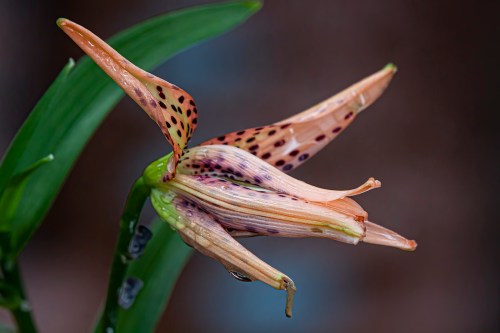
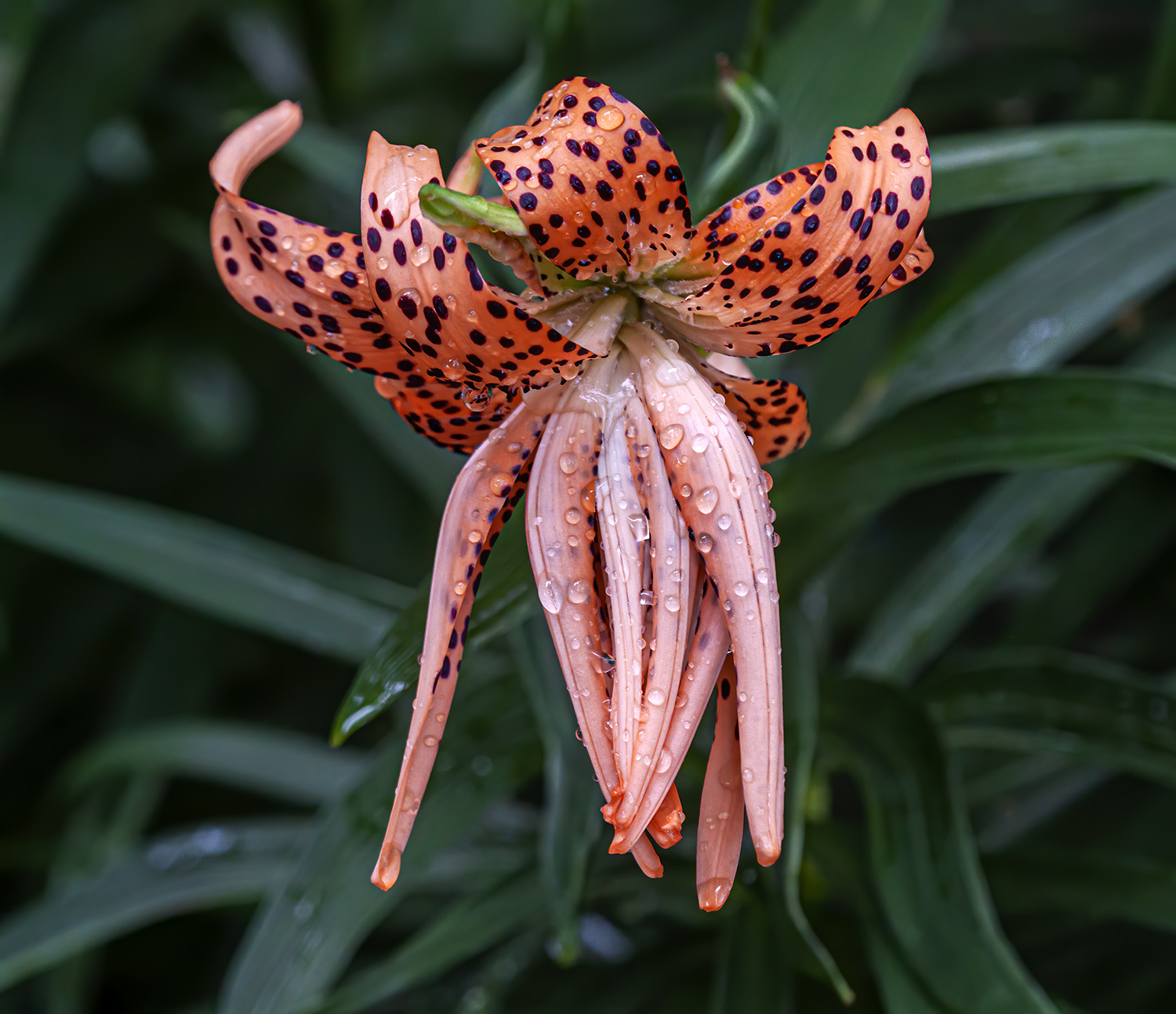
I was a little shocked when I first spotted the newest flowers blooming in the garden of my neighbor Cindy Dyer—they looked like some mutant variant of a lily, with octopus-like tendrils coming out of the center of the spotted flowers. Cindy had previously told me that she had planted some tiger lilies that she had bought at a half-price clearance sale, but it is safe to say that these are not like any tiger lilies that I had ever seen.
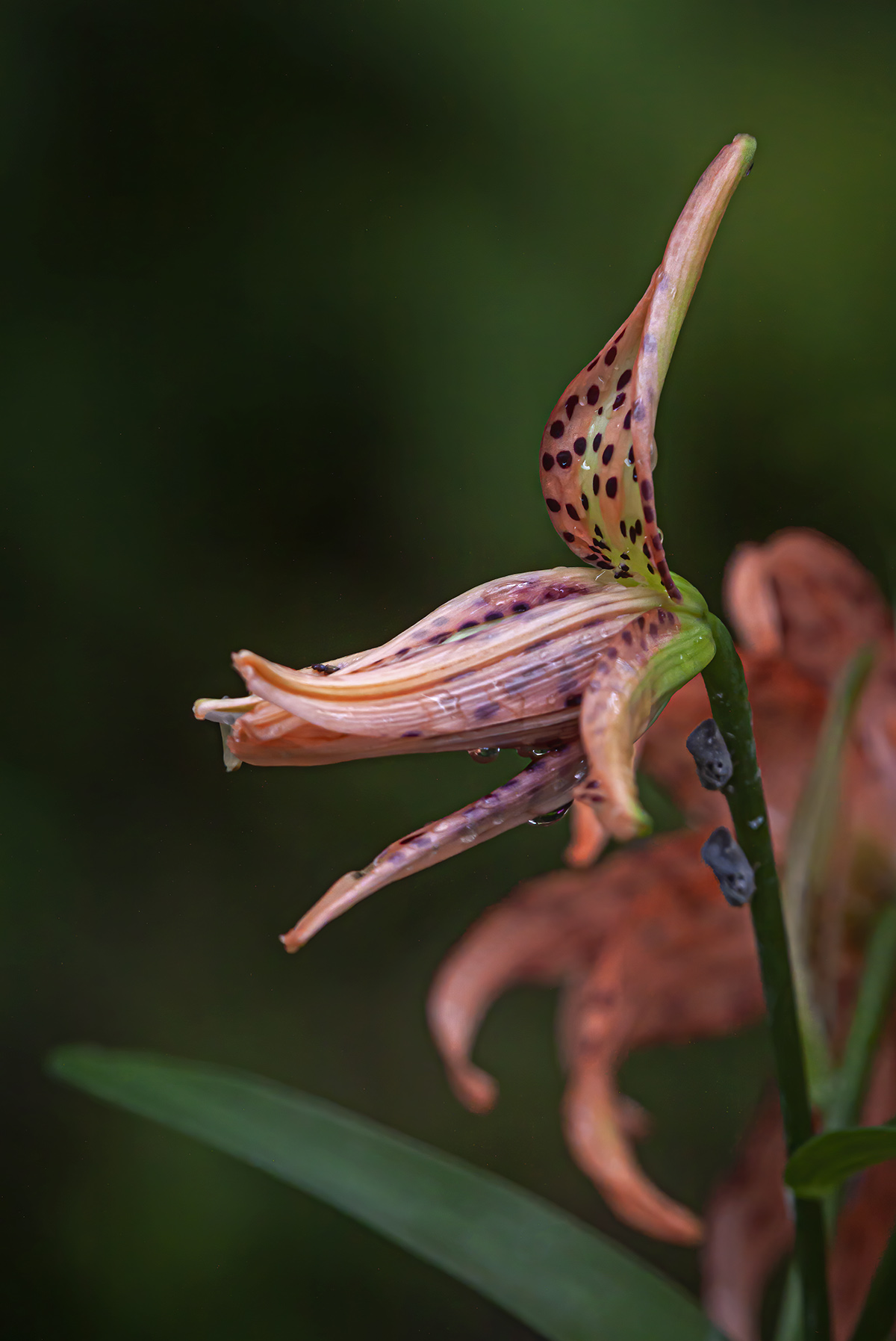
Yesterday I learned that these are double Tiger Lilies (Lilium Lancifolium ‘Flore Pleno’), a variety that has double the normal number of petals. Wow. It looks like only one set of petals had opened for the lily in the first image, with more to come soon. The flower in the second and third photos is at an ever earlier stage of growth, but I was intrigued by its exotic shape, colors, and patterns. Every time that I look at the middle image, I see a dragon’s head with an open mouth, but perhaps my imagination is simply in overdrive these days.
While taking the photos, I noted the two little gray things on the stem in the second and third images. I did not investigate more closely, but Cindy believes that they are insects of some sort.


© Michael Q. Powell. All rights reserved.
Posted in Flowers, Gardening, Nature, Photography, Summer | Tagged Alexandria VA, Canon 50D, Cindy Dyer, double tiger lily, Lilium Lancifolium 'Flore Pleno', Runnymeade, Tamron 180mm, tiger lily | 18 Comments »
July 25, 2020 by Mike Powell
It seems like I have seen fewer butterflies this year than in previous years, so I was especially thrilled to spot this Eastern Tiger Swallowtail butterfly (Papilio glaucus) last week during a trip to Green Spring Gardens with my photography mentor Cindy Dyer. Normally by this time of the year I have seen lots of Monarchs and Eastern Tiger Swallowtails, but I have not seen a single Monarch yet and only a few swallowtails. This butterfly was the only large butterfly that I saw that day—all of the others that I spotted were the much smaller skipper butterflies.
Generally I prefer to have a natural background when photographing wild subjects, but that was not possible in this case. The blurred background is part of the welcome center of the gardens. The bands of color at the bottom of the image add some visual interest without being distracting, so I am not all that dissatisfied with the way the shot turned out.

© Michael Q. Powell. All rights reserved.
Posted in Butterflies, Insects, Nature, Photography, Summer, wildlife | Tagged Alexandria VA, Canon 50D, Eastern Tiger Swallowtail, Eastern Tiger Swallowtail butterfly, green spring gardens, Papilio glaucus, Tamron 180mm | 33 Comments »
July 25, 2020 by Mike Powell
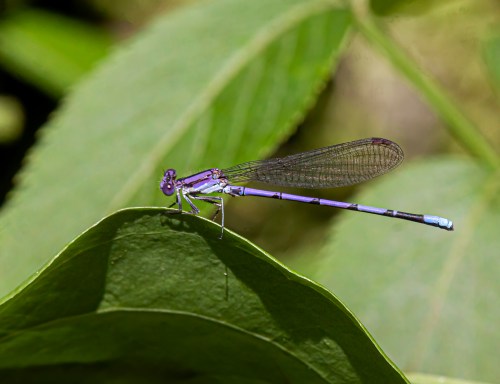
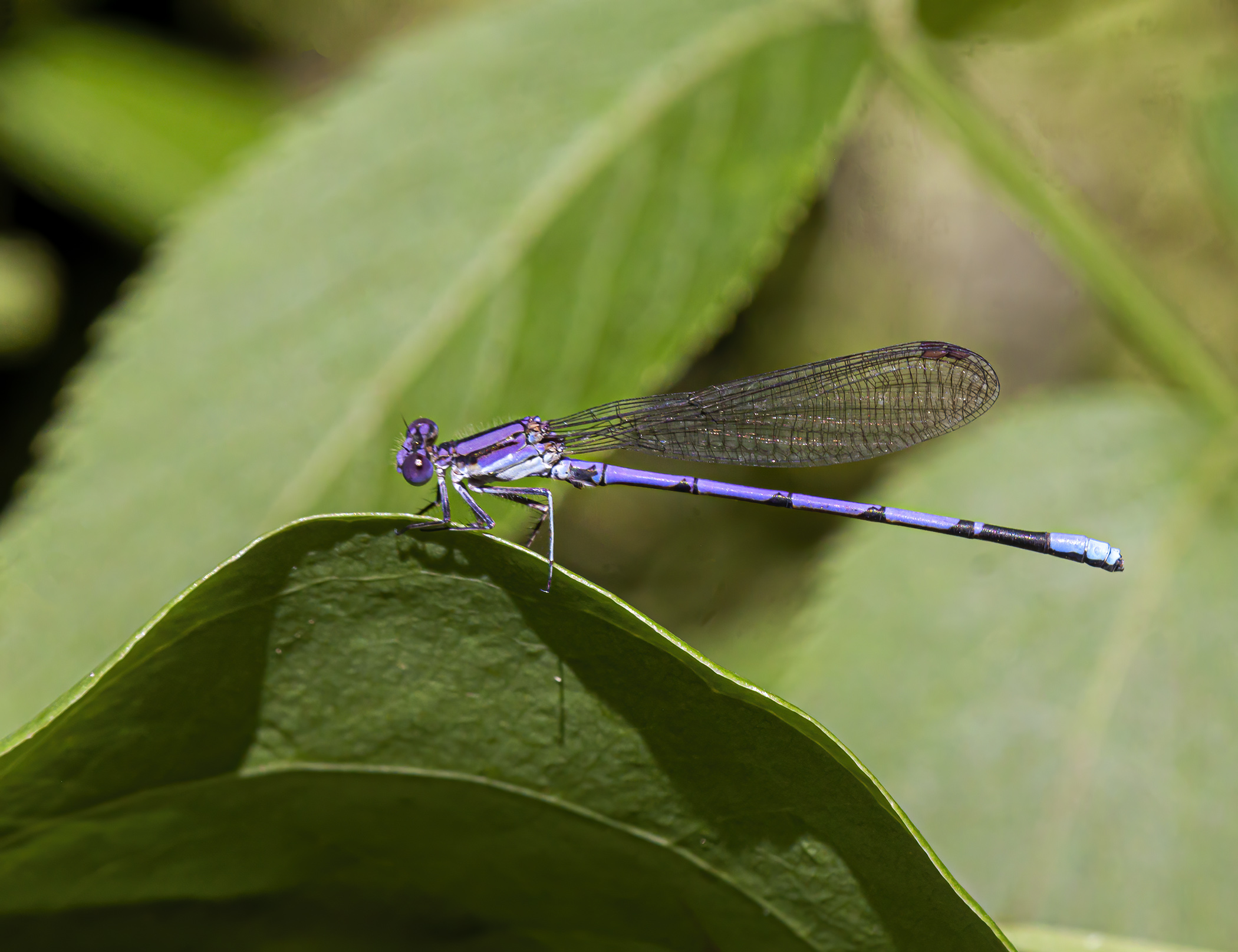
This stunning Variable Dancer damselfly (Argia fumipennis) was living life on the edge when I spotted him amidst the leaves last week during a trip to Green Spring Gardens with my good friend Cindy Dyer. Many of you probably realize that this violet-colored beauty is one of my favorites, given that my most frequently used banner image for this blog is a photo of a Variable Dancer. Perhaps there are other insects that are this color, but none come to mind.
As for the title of this post, consider it to be a sign of the times—the content could easily have gone in multiple directions.
© Michael Q. Powell. All rights reserved.
Posted in damselfly, Insects, Macro Photography, Nature, Photography, Summer, wildlife | Tagged Alexandria VA, Argia fumipennis, Argia fumipennis violacea, Canon 50D, green spring gardens, Tamron 180mm, Variable Dancer, Variable Dancer damselfly | 21 Comments »
July 24, 2020 by Mike Powell
How do you capture the beauty of a water lily? Claude Monet chose to paint massive canvases with wide expanses of ponds dotted with water lilies. My normal instinct is to focus on a single flower and to capture images like the first one below.
My photography mentor Cindy Dyer likes to challenge me to slow down and to look for interesting groupings of flowers. So I lingered longer at the water lilies and tried to compose images in different and more creative ways, resulting in the the second and third images below that contain more than just a single flower.
I took these photos last week during a trip with Cindy to Green Spring Gardens, a local county-run historical garden. In previous postings I have featured the pink water lilies and the lotuses at the small pond there. My goal today was to turn the spotlight on the more “traditional” white water lily.
If you click on these images to examine them more closely, you will see that I captured a number of “bonus bugs” on the leaves of the lily pads. “Bonus bugs” is a term that Cindy coined to refer to insects that show up when you are processing your photos that you never saw when you were taking them.


© Michael Q. Powell. All rights reserved.
Posted in Art, Flowers, Nature, Photography, Summer, Water Lilies | Tagged Alexandria VA, Canon 50D, Claude Monet, green spring gardens, Nymphaea, Tamron 180mm, waterlilies, waterlily | 17 Comments »
July 23, 2020 by Mike Powell
July is World Watercolor Month, a month-long challenge in which watercolor painters of all ages and skill levels are encouraged to paint daily and post their work on-line. I have joined this challenge and am trying to paint something every day using the daily prompts at worldwatercolormonth.com. So far, I have managed to paint something every single day, generally following the daily prompt. Thanks to all of you for your support and encouragement as I have taken this little artistic detour on my photography journey.
If you want to see the first three installments of my painting efforts this month, check out my previous postings ‘More fun with watercolor‘, ‘World Watercolor Month 2020—part 2 ,’ and ‘World Watercolor Month 2020—part 3.’ This fourth installment highlights my painting efforts of the past six days in reverse chronological order.
The prompt for 22 July was “valuable.” I decided to depict nature in a landscape done entirely in Payne’s Gray, because during this time of quarantine, nature has been a refuge for me, of inestimable value for my peace of mind. There is no particular significance to the color—I imply liked the idea of using a single color and focusing on values.
The prompt for 21 July was “organic.” When I thought of the word organics, all I could think of was fruits, vegetables, and fertilizer, none of which I wanted to paint. Instead I painted an “organic” landscape with no man-made objects in it. As you can see, all of the objects were stylized as I experimented with a different shape and brush strokes for pine trees.
The prompt for 20 July was “wiggle.” I decided to do a little painting of a Northern Water Snake that I photographed swimming in the shallow water of the Potomac River earlier this year. The color and pattern is not quite realistic, but I like the way that I captured the snake’s undulation.
The prompt for 19 July was “favorite scent.” I love the smell of pine trees, so I tried to paint a mountain scene with pine trees in the mist after watching a YouTube tutorial by Grant Fuller. My version seems to have an almost Asian feel to it that I really like. This is probably my favorite painting of this little group.
The prompt for 18 July was “soft.” It’s a bit of a stretch, but I like to think the two little sumi-e style birds that I painted have soft feathers on their tummies and are soft-spoken. The birds look a little cartoonish, but I like the way that they seem to be engaged in a conversation.
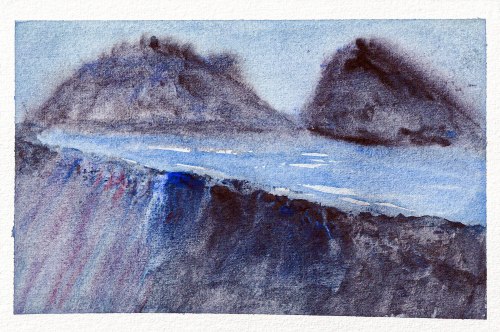
The prompt for 17 July was “spontaneous.” After watching some YouTube videos about painting loose landscapes, I decided to try an imaginary landscape without any reference photo. I had no idea what my result would look like and used techniques that included applying some of the paint with a palette knife, which explains the brilliant splotch of ultramarine blue in the middle of the painting. I like the colors and the feel of the painting and like to imagine that it is a lake in the crater of an inactive volcano, but you may well see something different.
As I look over these six paintings, I realize that I have used no bright colors at all—it seems that everything is blue, gray, or brown. That definitely was not intentional. Perhaps I will try to brighten things up a bit for the next installment as I push on towards the goal of trying to paint each day in July. Thanks again for your support and indulgence as I veer off my normal creative path.
If you want to learn more about World Watercolor Month, click on this link or go directly to doodlewash.com. In addition to raising awareness and interest about watercolor painting, World Watercolor Month raises support for The Dreaming Zebra Foundation, a charity providing support so that children and young adults are given an equal opportunity to explore and develop their creativity in the arts.


© Michael Q. Powell. All rights reserved.
Posted in Art, Birds, Inspiration, Landscape, painting, Summer, watercolor | Tagged #world watercolor month, #worldwatercolormonth, beginning watercolor, Doodlewash, watercolor painting | 19 Comments »
July 23, 2020 by Mike Powell
We are definitely in the summer doldrums, with day after day of oppressive heat and humidity. This week has been a bit different only because we have had some violent thunder storms. In terms of dragonflies, the common skimmer species are flying about in great numbers. In my area, that means that on a trip Tuesday to Occoquan Bay National Wildlife Refuge, I saw lots of Common Whitetails, Eastern Pondhawks, Needham’s Skimmers, Blue Dashers, and Great Blue Skimmers.
Although I have photographed these species many times, I still chase after them, trying to capture new behavior or interesting portraits, perches, or backgrounds. That is why I was able to capture this image of this smiling female Great Blue Skimmer dragonfly (Libellula vibrans) as she perched on some stalks of Eastern Gammagrass (Tripsacum dactyloides). I do not know vegetation very well, but I remember my friend Walter Sanford identifying this type of grass to me a few years ago and somehow the name has stuck with me.
In many ways, this photograph is indicative of my favorite approach to wildlife photography. Although I will sometimes look for rare species to photograph, I especially enjoy photographing common species and highlighting their uncommon beauty. Beauty is everywhere.

© Michael Q. Powell. All rights reserved.
Posted in Dragonflies, dragonfly, Insects, Nature, Photography, Summer, wildlife | Tagged Canon 50D, Eastern gamagrass, female Great Blue Skimmer, Great Blue Skimmer, Great Blue Skimmer dragonfly, Libellula vibrans, Occoquan Bay National Wildlife Refuge, Tamron 180mm, Tripsacum dactyloides, Woodbridge VA | 18 Comments »
July 22, 2020 by Mike Powell
I ventured out into the heat for a couple of hours yesterday and was rewarded for my efforts by this beautiful female Halloween Pennant dragonfly (Celithemis eponina) that I spotted at Occoquan Bay National Wildlife Refuge.
What makes a portrait perfect? For me, an optimal portrait captures an interesting subject in a dynamic pose with good lighting and a complementary background. I think that this images ticks all of those boxes. Why, then, do I call it “almost” perfect in the title? I guess that there is a part of me that is never completely satisfied, that is steadfastly convinced that I can do better. That is why I was out walking the trails yesterday when temperatures soared above 95 degrees (35 degrees C). Don’t worry, I stayed in the shade, carried lots of water, and took it slowly. The good news was that social distancing was a breeze—I saw only one other crazy person walking about in the midday heat.

© Michael Q. Powell. All rights reserved.
Posted in Dragonflies, dragonfly, Insects, Nature, Photography, Portraits, Summer, wildlife | Tagged Canon 50D, female Halloween Pennant, halloween pennant, Halloween Pennant dragonfly, Occoquan Bay National Wildlife Refuge, Tamron 180, Woodbridge VA | 20 Comments »
July 21, 2020 by Mike Powell
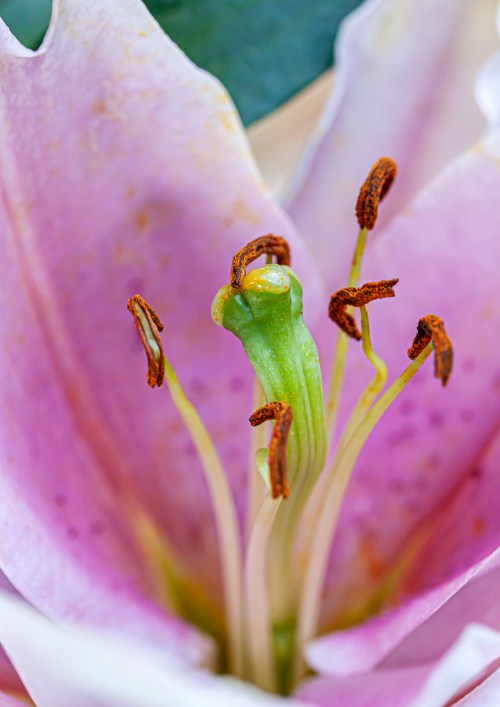
The garden of my neighbor and photography mentor Cindy Dyer continues to provide me with an almost inexhaustible supply of subject matter for my photography. Among the flowers currently blooming are some beautiful pink lilies. The first image shows a pair of pink lilies blooming in a container in Cindy’s backyard garden. One of the coolest things about that part of her garden is that there are all kinds of decorative elements scattered everywhere, like the copper-colored butterfly in the background of the image.
The world changes and is often abstractly beautiful when viewed through a macro lens, as you can see in the second photo below featuring an extreme close-up view of a lily. I am utterly entranced as I explore the shapes, colors, and textures in the image, unconstrained by practical considerations like figuring out what it is.

© Michael Q. Powell. All rights reserved.
Posted in Art, Flowers, Gardening, Nature, Photography, Summer | Tagged Alexandria VA, Canon 50D, Canon 60mm, Cindy Dyer, lily, pink lily, Runnymeade | 6 Comments »
July 21, 2020 by Mike Powell
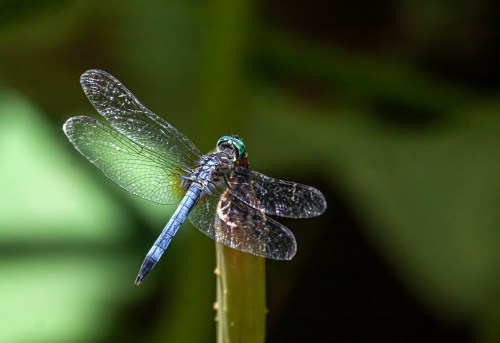
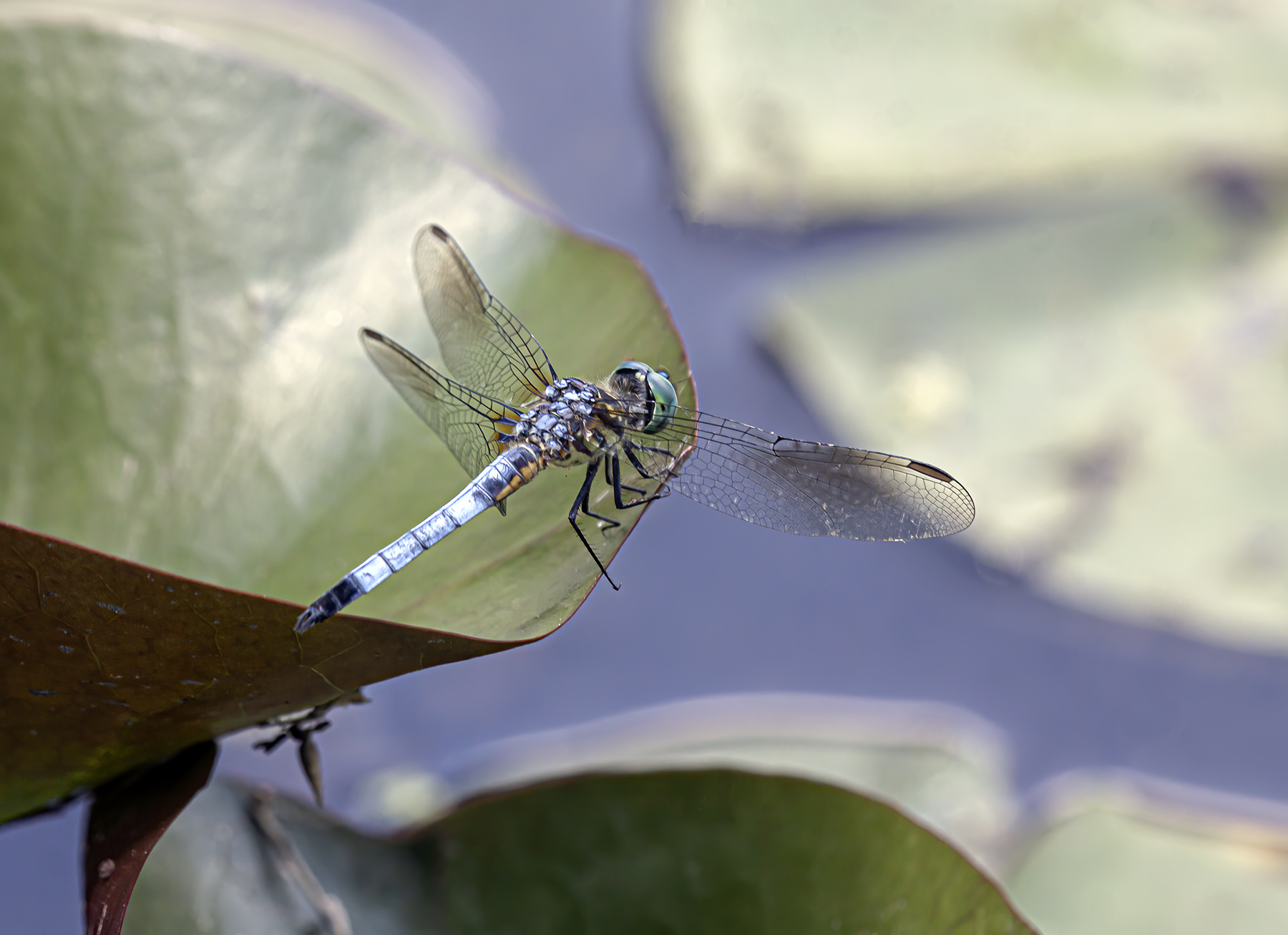
Blue Dashers (Pachydiplax longipennis) are one of our most common dragonflies and were an early favorite when I started to get more serious about my photography eight years ago. I still enjoy capturing images of them, especially when the lighting is as interesting as it was last Tuesday during a visit to Green Spring Gardens with my friend and photography mentor Cindy Dyer.
I had a lot of fun trying to track the male Blue Dasher dragonflies as they flew among the lotuses and water lilies at a small pond. Most of the time they would perch on distant plants, out of range of my macro lens, but on a few occasions they came closer. The first image shows one perched on the broken-off stalk of a lotus, partially in the shadow of other lotuses. The second image shows a Blue Dasher perched in the light, atop what I believe is one of the lily pads, though there is a slight chance that it might be a lotus leaf.
Yes, Blue Dashers are still among my favorites, even after all of these years.

© Michael Q. Powell. All rights reserved.
Posted in Dragonflies, dragonfly, Insects, Nature, Photography, Summer, wildlife | Tagged Alexandria VA, Blue Dasher, Blue Dasher dragonfly, Canon 50D, green spring gardens, male Blue Dasher, Pachydiplax longipennis, Tamron 180mm | 24 Comments »
July 20, 2020 by Mike Powell
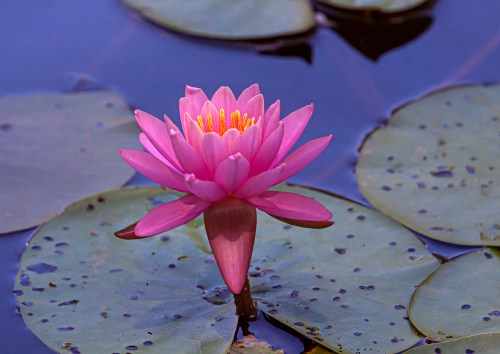
There were only a few water lilies in bloom when I visited Green Spring Gardens last week, one of my favorite local gardens, but I was thrilled to see that a few of them were pink ones. I love all water lilies, but there seems to be something extra special and exotic about the pink ones.
I was using my trusty 180mm macro lens, which meant that if I wanted a closer view, as in the first image, I had to physically move closer to the flowers, which, of course were floating in the water. It was interesting to try to vary the angle of view of the same flower by, shooting from a low angle for the first image and shooting the same flower from a higher angle (and farther back) for the second shot.
I also played around with including and excluding the lily pads. The water lily in the final shot, for example, is almost in the center of the frame, which is generally frowned on when composing a shot, but I liked the arrangement of lily pads so much that I kept it there.
I am very much a child of my generation, so I can’t help but think of the video game Pac-Man when I look at the second image. Did anyone else have that same response?


© Michael Q. Powell. All rights reserved.
Posted in Art, Flowers, Nature, Photography, Summer, Water Lilies | Tagged Alexandria VA, Camon 50D, green spring gardens, Pac-Man, pink water lily, Tamron 180mm, water lily | 27 Comments »
July 19, 2020 by Mike Powell
This bee seemed to be having a great time inside of a lotus flower when I spotted it last Tuesday during a brief visit to Green Spring Gardens with my friend and photography mentor Cindy Dyer. This county-run historical garden has only a relatively limited number of lotuses and waterlilies at a small pond, but it is much more accessible and less crowded that Kenilworth Park and Aquatic Gardens, an amazing facility in Washington D.C. operated by the National Park Service that has multiple acres of cultivated ponds with a wide array of water lilies and lotuses.

© Michael Q. Powell. All rights reserved.
Posted in Bees, Flowers, Nature, Photography, Summer, wildlife | Tagged Alexandria VA, bee, Canon 50D, green spring gardens, lotus, lotus flower, Tamron 180mm | 11 Comments »
July 18, 2020 by Mike Powell
Usually when I see a Brown Thrasher (Toxostoma rufum), it is buried in the underbrush, so I was excited to spot this one in the open during a visit on Tuesday to Green Spring Gardens with my friend and photography mentor Cindy Dyer. Two things that always stand out to me whenever I see Brown Thrashers are their extremely long tails and their beautiful yellow eyes.

© Michael Q. Powell. All rights reserved.
Posted in Birds, Nature, Photography, Summer, wildlife | Tagged Alexandria VA, brown thrasher, Canon 50D, Cindy Dyer, green spring gardens, Tamron 180mm, Toxostoma rufum | 11 Comments »
July 18, 2020 by Mike Powell
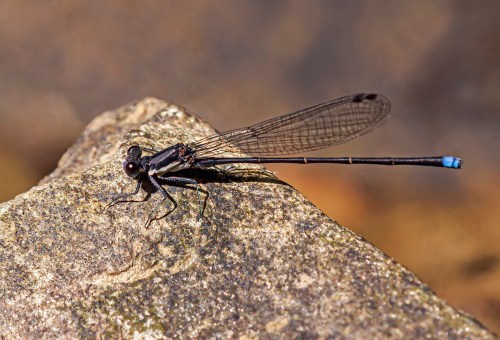
Many of the species that I photograph have names that do not match up that well with their physical appearances. While I was exploring a creek this week with my friend Walter Sanford, it was wonderful, therefore, to spot a dark damselfly with blue at the end of its abdomen that is appropriately called the Blue-tipped Dancer (Argia tibialis). If you click on the images, you will note that this male damselfly has beautiful purple stripes on its thorax (upper body) in addition to that blue tip.
When photographing damselflies like this one that perch on the ground, I try to get as low as I can in order to see eye-to-eye and simplify the background. I managed to do that in the first image and I really like the soft glow in the background from the waters of the creek.
I did not get as close for the second shot, in part because the damselfly was a bit skittish. However, I do like the way that I was able to capture the colors and textures of the rocky environment along the edge of the stream, giving the viewer a better idea of this damselfly’s habitat.
Like most damselflies, Blue-tipped Dancers are tiny, no more than 1.5 inches (38 mm) in length, so it is always a challenge to get detailed shots of them. The largest damselflies that I have ever photographed were the appropriately named Great Spreadwings, that are as much as 2.4 inches (61 mm) in length. If you want to see what one of those beautiful “giants” looks like, check out this posting from October 2015 entitled “Great Spreadwing damselfly (male).”

© Michael Q. Powell. All rights reserved.
Posted in Art, damselfly, Macro Photography, Nature, Photography, Summer, wildlife | Tagged Argia tibialis, Blue-tipped Dancer, Blue-tipped Dancer damselfly, Canon 50D, creek, Fairfax County Virginia, streamwalking, Tamron 180mm | 6 Comments »
July 17, 2020 by Mike Powell
I tend to associate dragonflies primarily with marshes and ponds, but a few dragonflies also like sandy beaches. Most of the times that I have observed Common Sanddragon dragonflies (Progomphus obscurus) they have been perched directly on the sandy edges of forest streams, which makes sense, given their name. On Monday I was thrilled to spot some Common Sanddragons at Wickford Park, a small park adjacent to Huntley Meadows Park, a marshland refuge where I used to do a lot of shooting before it became too popular.
Although the dragonfly in the first image may look like he was perched on the ground, he was actually on the slanted side of a concrete drainage ditch. Normally I try to avoid man-made backgrounds for my subjects, but this shot provided a good overall view of the entire body of the Common Sanddragon. It might be my imagination, but it looks to me like this little guy was glancing up at me and smiling. Double-click on the image and see what you think.
In many ways I prefer the second shot, with the Common Sanddragon dragonfly perched amidst the rocks at the edge of the stream. I love the different colors, shapes, and textures of the rocks and don’t mind that the dragonfly itself is harder to spot. I consider the image to be a kind of environmental portrait.


© Michael Q. Powell. All rights reserved.
Posted in Dragonflies, dragonfly, Insects, Nature, Photography, Summer, wildlife | Tagged Alexandria VA, Canon 50D, Common Sanddragon, Common Sanddragon dragonfly, Progomphus obscurus, Tamron 180mm, Wickford Park | 7 Comments »
July 17, 2020 by Mike Powell
July is World Watercolor Month, a month-long challenge in which watercolor painters of all ages and skill levels are encouraged to paint daily and post their work on-line. I have joined this challenge and am trying to paint something every day using the daily prompts at worldwatercolormonth.com. So far, I have managed to paint something every single day, generally following the daily prompt. Thanks to all of you for your support and encouragement as I have taken this little artistic detour on my photography journey.
If you want to see the first two installments of my painting efforts this month, check out my previous postings ‘More fun with watercolor‘ and ‘World Watercolor Month 2020—part 2.’ This third installment highlights my painting efforts of the past six days in reverse chronological order.
The prompt for 16 July was “machine.” I recalled an old mill with a waterwheel that I photographed in July 2012 that hinted at all kinds of machinery inside the mill building and did today’s little painting using one of my photos as inspiration. Here is a link to the original posting called ‘Stepping outside of the box.’ What I had forgotten, though, is that I had converted the images to black and white for the posting and I have no idea of the original colors of the structure, so I just made them up. My sketching skill are pretty weak still, so I printed a copy of the blog photo, rubbed a pencil on the back of it, and transferred a simplified version of it to the watercolor paper.
The prompt for 15 July was “forgotten.” Nothing came to mind, so instead I attempted to paint some Black-eyed Susans like the ones that I had seen while hunting for dragonflies earlier that day.
The prompt for 14 July was “green,” which made me think of flowers. So I painted a little patch of wildflowers, mostly by spattering paint—it turns out that it is a lot of fun to throw paint at paper in a somewhat controlled way.
The prompt for 13 July was “twisted.” Herons have such long necks that they often seem to be twisted, so I painted this little sumi-e style scene with three herons, some cattails, and a disproportionately large dragonfly.
The prompt for 12 July was “favorite place.” It is hard to represent Paris in a single image, so I chose to depict it with this view of the Eiffel Tower looking upwards from one of its “feet,” using one of my photos from last November as the the inspiration for this little painting —about 5″ x 7″ (127mm x 177mm). If you would like to see my original posting, check out ‘Eiffel Tower perspectives.’ I used the same transfer method for the sketch that I described above for 16 July.
The prompt for 11 July was “round,” so I did a little painting of a bicycle, loosely based on an artsy photo I took in Paris last November. If you would like to see my original posting, check out ‘Bicycle in Paris.”
I am experimenting with a number of different styles and subjects as I play with watercolor painting, but a few things are already clear. First, my greatest creative inspiration continues to come from my memories of Paris—three of the sixteen paintings I have completed so far were based on my experiences in the ‘La Ville Lumière’ (‘the city of light’).
Style-wise I continue to be drawn to the minimalist East Asian brush painting style known more commonly as sumi-e and have used this approach in three paintings already. Technically this is the freestyle version of sumi-e (xieyi) that tries to capture the essence of a subject in a minimum number of strokes rather than striving for a realistic representation of it. There is another more detailed sumi-e style called gongbi that I would not even attempt to imitate.
If you want to learn more about World Watercolor Month, click on this link or go directly to doodlewash.com. In addition to raising awareness and interest about watercolor painting, World Watercolor Month raises support for The Dreaming Zebra Foundation, a charity providing support so that children and young adults are given an equal opportunity to explore and develop their creativity in the arts.


© Michael Q. Powell. All rights reserved.
Posted in Architecture, Art, painting, Paris, watercolor | Tagged #world watercolor month, #worldwatercolormonth, bicycle, black-eyed susan, dragonfly, heron, Paris, watercolor painting, watermill | 24 Comments »
July 16, 2020 by Mike Powell
I was both shocked and delighted to spot this brilliant male Prothonotary Warbler (Protonotaria citrea) on Monday during a trip to Huntley Meadows Park, a local marshland refuge. All of the other times that previously I spotted these colorful little birds were during the early spring and I did not know that they were still around in our area.
It is hard for a bird so brightly colored to hide itself completely, but I am used to seeing only flashes of yellow amidst the foliage high in the trees. In this case I spotted the warbler when it was perched on a wooden fence. As I got a little closer, it dropped down to ground level, but I was able to find a small visual tunnel that gave me an unobstructed view of this beautiful little warbler and was able to capture this image.

© Michael Q. Powell. All rights reserved.
Posted in Birds, Nature, Photography, Summer, wildlife | Tagged Alexandria VA, Canon 50D, Huntley Meadows Park, Prothonotary Warbler, Protonotaria citrea, Tamron 180mm, warbler | 16 Comments »
July 16, 2020 by Mike Powell
As I was exploring the banks of a creek yesterday hunting for dragonflies with my friend, Walter Sanford, I stumbled upon a really cool-looking caterpillar. I love fuzzy white caterpillars and apparently I am not the only one—an August 2013 posting that I entitled “Fuzzy White Caterpillar” is my third most-viewed posting ever, with over 1820 views. The photos in that posting are definitely not among my best ever, but somehow people find their way to that posting when doing Google searches.
I was immediately struck by the bright red head and the “horns” and the front and back end of the caterpillar. Those characteristics made it easy to identify the caterpillar as a Sycamore Tussock Moth caterpillar (Halysidota harrisii). I do not know trees very well, so I cannot tell if the fallen log that the caterpillar was exploring was a sycamore, but perhaps one of my viewers can identify it for me.
Be sure to double-click on the images if your would like to get a closer view at the wonderful details of this unusual-looking caterpillar.


© Michael Q. Powell. All rights reserved.
Posted in Insects, Macro Photography, Nature, Photography, wildlife | Tagged Canon 50D, Fairfax County Virginia, Halysidota harrisii, Sycamore Tussock Moth, Sycamore Tussock Moth caterpillar, Tamron 180mm | 13 Comments »
July 15, 2020 by Mike Powell
As I was walking past one of the fields Huntley Meadows Park on Monday, I spotted a large dragonfly patrolling back and forth, flying low over the heavy vegetatation. I tracked the dragonfly’s movements with my camera as it flew tantalizingly close to me, only to abruptly change directions each time. All of the sudden, the dragonfly zoomed past me and disappeared into the foliage of a tree on the other side of the trail on which I was standing,
Fortunately I was able to see where the dragonfly had landed and eventually I found it perched on the underside of a branch. The second shot shows the view that I had after I had approached the dragonfly cautiously. If you look closely at the space between the dragonfly’s head and the branch, you will see that it is in the process of eating what looks to be a black and yellow insect of some kind. In my experience, when dragonflies are eating, they tend to be so focused on their food that I can get closer to them than might otherwise be possible.
From that distance I could already identify it as a Swamp Darner dragonfly (Epiaeschna heros), one of the largest dragonflies in our area, almost 3.5 inches in length (89 mm). I was happy to be able to get the side shot, but wanted a different angle, so I maneuvered my way around and captured the dorsal view shown in the first photo. From this angle you get a really good view of its amazing blue eyes and the wonderful circular ring markings on its abdomen. The angle of view also showed me some body parts that allowed me to determine that this is a male.
I spent only a couple of hours hunting dragonflies on Monday, but had a very successful day, finding the elusive Mocha Emerald that I featured yesterday and this gorgeous Swamp Darner. Folks frequently ask me why I like dragonflies so much and I think that the first photo is a convincing visual response to such a query—no further explanations should be required.


© Michael Q. Powell. All rights reserved.
Posted in Dragonflies, dragonfly, Nature, Photography, Summer, wildlife | Tagged Alexandria VA, Canon 50D, Epiaeschna heros, Huntley Meadows Park, male Swamp Darner, Swamp Darner, Swamp Darner dragonfly, Tamron 180mm | 17 Comments »
July 14, 2020 by Mike Powell
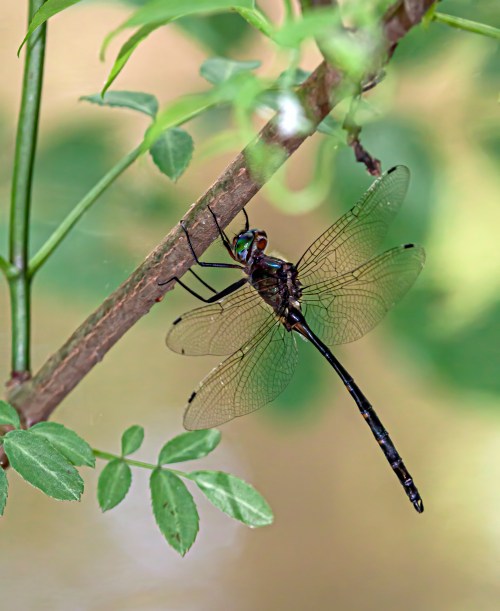
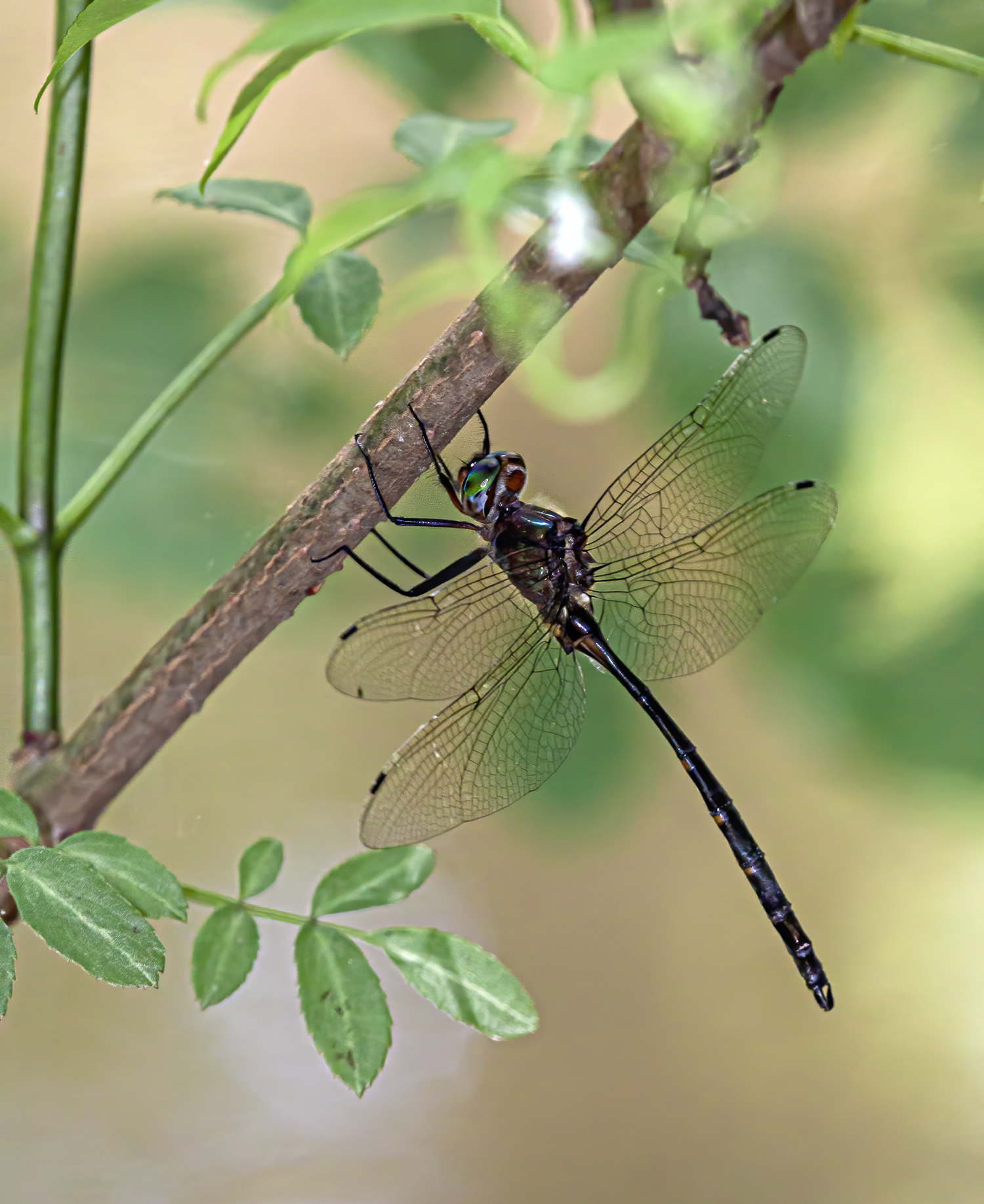
It has been a few years since I last saw a Mocha Emerald dragonfly (Somatochlora linearis), so I was excited when I spotted one yesterday while exploring at Huntley Meadows Park. The male Mocha Emerald was patrolling along above a small stream in a way that is typical, but infuriating—he would fly a bit and then hover, but before I could focus on him, he would fly some more, each time moving again before I could catch up to him. Fortunately, Mocha Emeralds perch pretty often and I was absolutely thrilled when this one chose a perch within sight of where I was standing.
As you look at the photos, you cannot help but notice that the dragonfly’s body long, dark, and skinny body, although you eyes may well be drawn first to his brilliant emerald eyes. You may also note that he does not really perch, but instead hangs from the branch to relax. The position reminds me of the one what I assume when I am doing pull-ups and definitely would not be my preferred position for resting.
I am often surprised by the amazing diversity in the dragonfly world. When I first started to focus on dragonflies, it was obvious that they came in different colors. As I have learned more about dragonflies and photographed them, I have grown more attuned to body shapes, behavior, and habitats. Yes, I am somewhat obsessed with these beautiful creatures and enjoy searching for hours for little jewels like this Mocha Emerald.

© Michael Q. Powell. All rights reserved.
Posted in Dragonflies, dragonfly, Insects, Nature, Photography, Summer, wildlife | Tagged Alexandria VA, Canon 50D, Huntley Meadows Park, Mocha Emerald, Mocha Emerald dragonfly, Somatochlora linearis, Tamron 180mm | 20 Comments »
July 13, 2020 by Mike Powell
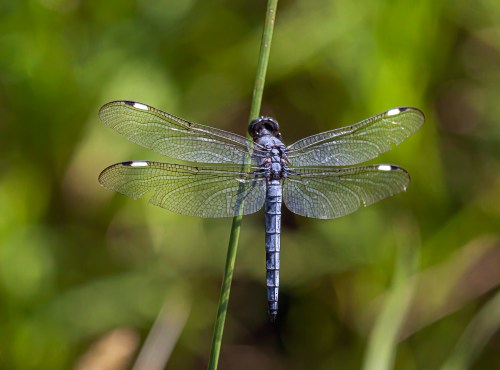
As summer progress, the once pristine wings of dragonflies and butterflies become increasingly tattered and torn. When I spotted this handsome Spangled Skimmer dragonfly (Libellula cyanea) last week at Occoquan Regional Park, I couldn’t help but notice that he has varying degrees of damage on the trailing edge of all of his wings. Comparatively speaking, the damage is minor and did not seem to inhibit his activity in any way—I have seen dragonflies with much more severe damage that were still able to fly.
How did his wings get damaged? Predators such as birds or even other dragonflies could inflict damage as could vegetation with sharp branches and thorns. When I looked closely at this dragonfly’s abdomen, I also noticed scratches there, which made me think of another potential source of some of the damage. It is now the prime season for mating and like most male dragonflies, this dragonfly is vigorously trying to do his part to perpetuate the species.
Dragonfly mating can be rough and could be the source of some of the visible damage. The final photo shows a mating pair of Spangled Skimmer dragonflies and, judging from the locations of the damage to its wings, the male in the first photo appears to be one of the participants.
In case you are curious about identifying this dragonfly species, the white “stigmata” on the trailing edge both male and female Spangled Skimmers, i.e. the “spangles” responsible for its common name, make this species an easy one to identify.

© Michael Q. Powell. All rights reserved.
Posted in Dragonflies, dragonfly, Insects, Nature, Photography, Summer, wildlife | Tagged Canon 50D, Libellula cyanea, Lorton VA, male Spangled Skimmer, mating Spangled Skimmers, Occoquan Regional Park, Spangled Skimmer, Spangled Skimmer dragonfly, Tamron 180mm, tattered | 14 Comments »
July 12, 2020 by Mike Powell
It is early Sunday morning, almost two hours before sunrise, still dark and silent outdoors. What shall I post? Some bloggers prepare their postings well in advance, but I tend to select photos and decide on an approach only when I am ready to begin composing the actual posting. I do keep a mental catalogue of candidate images that I have shot recently, but my final selection is frequently influenced by my mood and feelings.
This morning I am thinking of color and composition, a consequence perhaps of my recent efforts with watercolor. As many of you know, watercolor painting often forces you to mix your own colors, a critical factor if you want to create a mood or match something in real life. So, for example, to paint the flesh of a watermelon recently, I had to combine two different shades of red and to paint some gray stormy clouds, I had to mix a blue and a reddish brown.
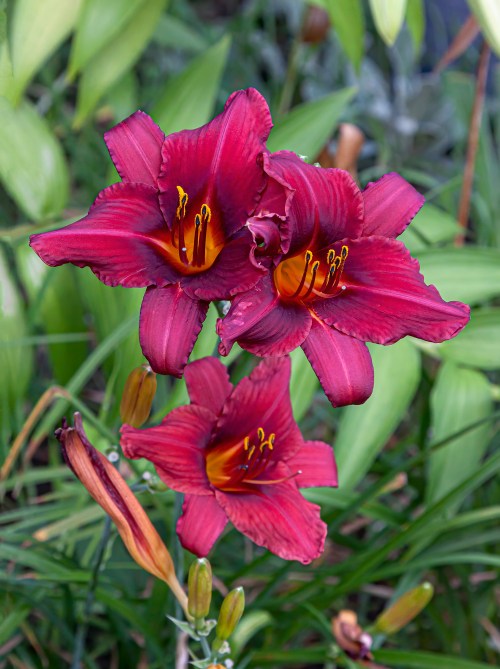
I was thinking of colors when I spotted these beautiful daylilies on Thursday in the garden of my friend and neighbor Cindy Dyer. I was struck by the deep red of the flowers and the yellow-tipped stamens that reminded me of flickering matches. I also really liked the triangular arrangement of the three flowers that presented itself. It is so much harder to compose an image with multiple subjects than one with a single subject, which is why you will rarely see me photograph groups of anything.
I hope that you enjoyed this little burst of color as you start (or continue) your Sunday activities. Have a blessed day and be sure to keep an eye out for the wonderful colors in your life.
© Michael Q. Powell. All rights reserved.
Posted in Art, Flowers, Gardening, Nature, Photography, Summer | Tagged Alexandria VA, Canon 24-105mm, Canon 50D, Cindy Dyer, color, color in your life, day lily, daylilies | 22 Comments »
« Newer Posts - Older Posts »





















 Mike Powell