I was delighted yesterday to photograph an eaglet in one of the Bald Eagle (Haliaeetus leucocephalus) nests at Occoquan Bay National Wildlife Refuge. Last week, several photographers posted photos in Facebook of the baby eagle, so I knew for sure that there was at least one in the nest. I have been keeping a close eye on this nest, a small one that was used by ospreys last year, and knew that it would have trouble comfortably accommodating an adult eagle and a growing eaglet.
When I first arrived at the barrier that closes the trail, I could see through the foliage that an eagle was sitting upright in the nest, but I could not see an eaglet. I watched and waited and the eagle eventually flew away. A short time later, another eagle flew in and landed on a tree branch above the nest rather than in the nest. As the eagle approached the nest, a little head popped up and I was able to capture the first image.
The eagle in the tree kept watch over the curious little eaglet and I never did see the adult sit in the tree. After a while, the eaglet disappeared from sight—it was probably time for its afternoon nap.
When I departed the area to check on another eagle nest, the adult was still on duty in the tree. I passed by this nest one last time and noted that an eagle was now sitting in the nest. It may be that one of the parents is small enough to fit into the nest and the other one is simply too large. As the baby grows, I suspect that both parents will be forced out of the nest. I would not see the eaglet until the adult lifted its wing and I was able to capture the final image.
As you can probably see from the blotches of green in the photos, I did not have an unobstructed view of the nest. I am hoping that the leaves on the trees do not fully block my view in the upcoming weeks.
Most of the time fishing spiders have some of their legs in the water to sense the vibrations of potential prey, but the large Six-spotted Fishing Spider (Dolomedes triton) that I spotted last Friday in Prince William County was perched on a log at the edge of a small creek. When I posted the photo on Facebook, one of my friends noted that he often finds fishing spiders far from the water, including in his wood pile.
I do not know how large this spider was, but it looked huge to me. Perhaps that is because the spider had all of its legs fully extended, unlike some spiders whose legs are partially bent when they are in a web.
Different dragonfly species perch in different ways. Some perch high and some perch low; some perch horizontally, others perch at an angle, and others hang vertically. I am always intrigued to look at the way a dragonfly is perched and, in particular, to see how the dragonfly is using its legs.
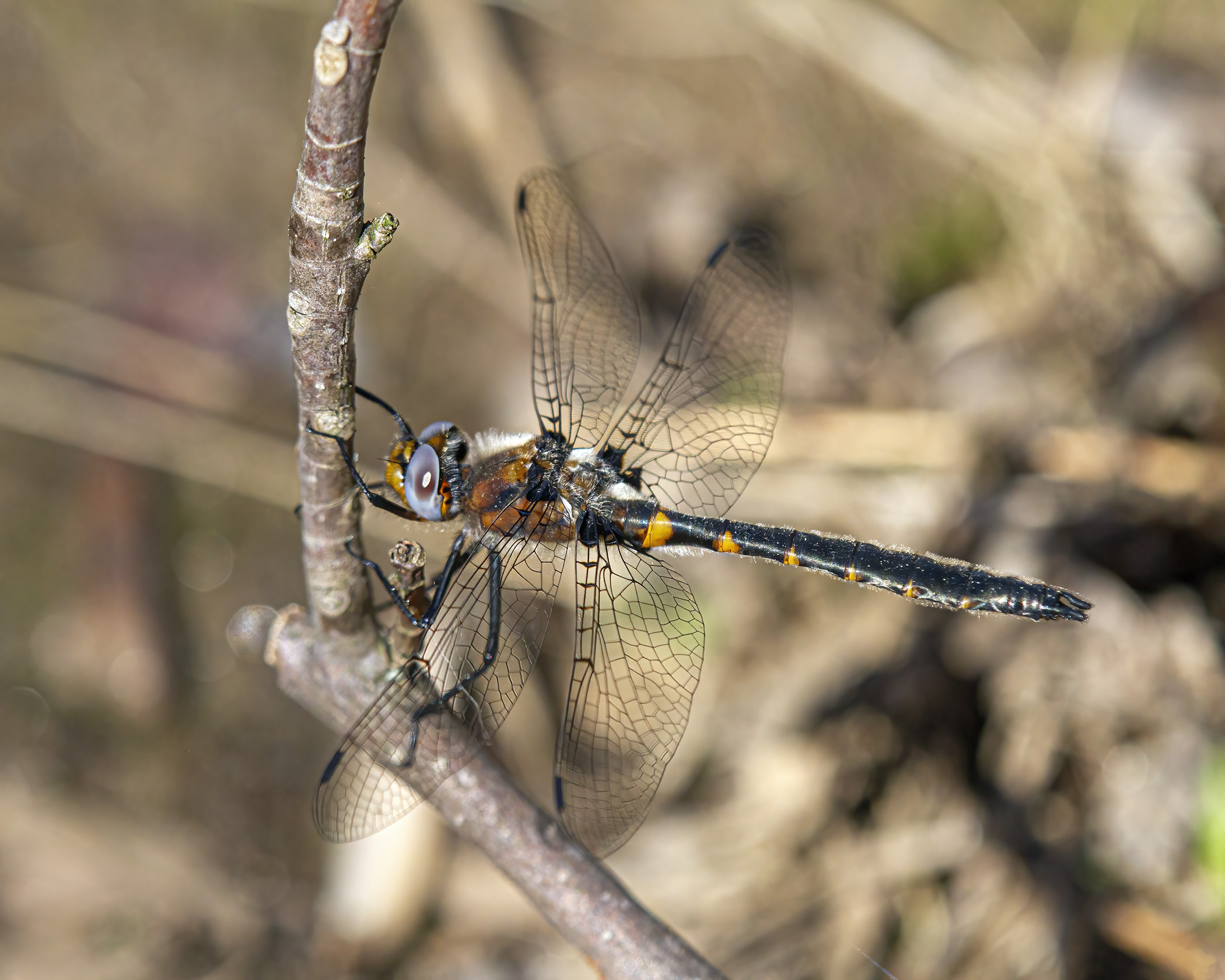
Last week I was delighted to spot a male Stream Cruiser (Didymops transversa) while I was exploring the edge of a creek in Prince William County, Virginia. The Steam Cruiser was perched low in the vegetation at an angle. Stream Cruisers have such long legs that they look somewhat uncomfortable when they are perching.
If you click on the image below, you can get a closer look at the dragonfly’s legs. The dragonfly does not seem to be using its front legs at all to perch and appears to be relying almost exclusively on its middle set of legs. The back set of legs look to be amazing long and are probably more useful for capturing prey than for perching.
It is almost impossible, but I can’t help but try to capture images of dragonflies in flight. It is arguably the most difficult challenge of my ability to use my camera and also of my patience. None of the dragonflies in these photos flew close to the shores of the streams that I was exploring in Prince William County, Virginia, and I was using only a modest telephoto lens that I was focusing manually—the autofocus on my Tamron 180mm macro lens is relatively slow and could not focus on the dragonflies as they zoomed on by.
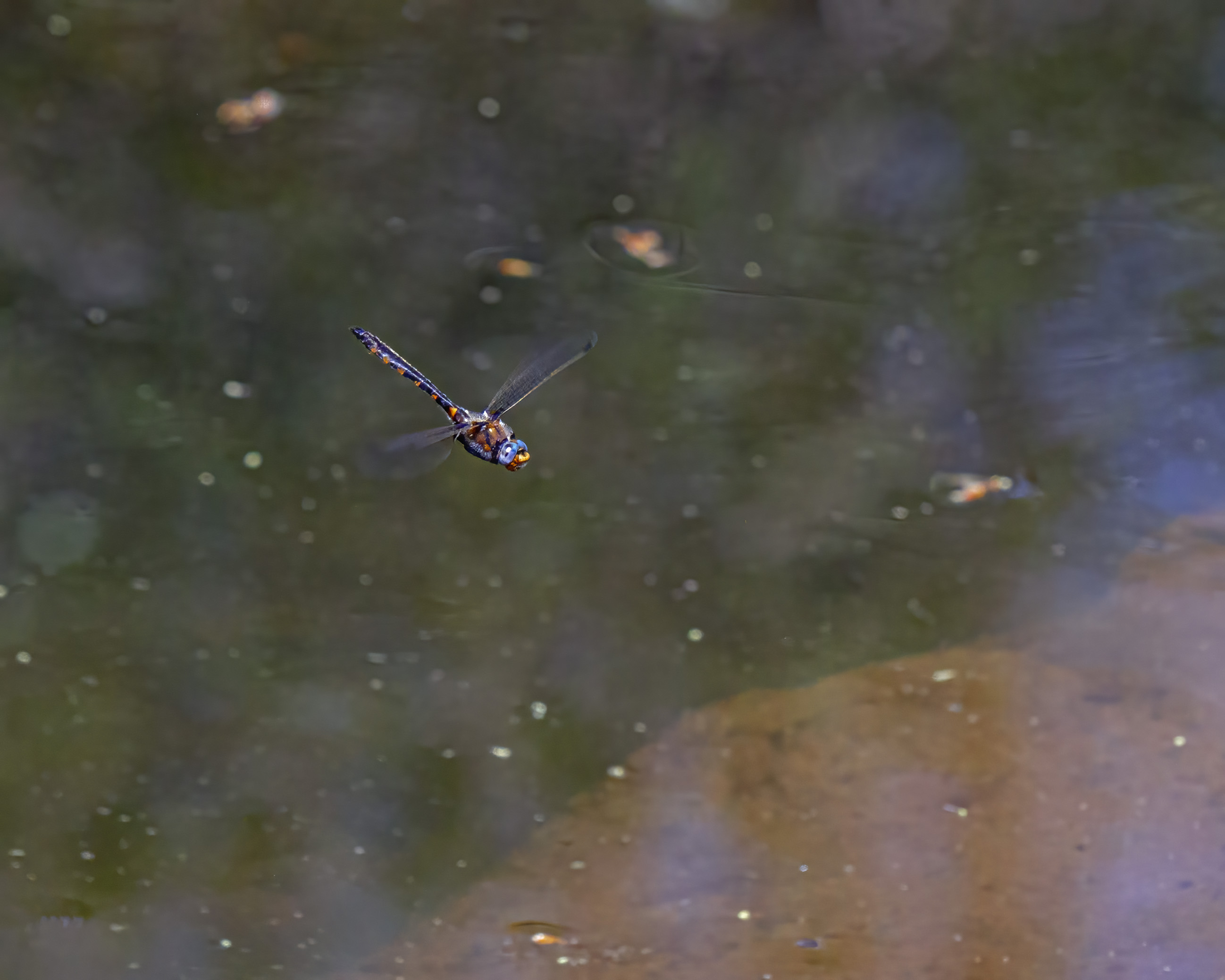
Last Wednesday I photographed the dragonfly in the first photo as it was patrolling over a creek. I believe that it is a Uhler’s Sundragon dragonfly (Helocordulia uhleri), which is about 1.8 inches (46 mm) in length. The dragonfly was not exactly following a pattern, but I was able to track it as it flew all around a small section of the creek.
The dragonfly in the second image may also be a Uhler’s Sundragon, though I am less confident of this identification. I really like the fact that the eyes of the dragonfly are in shart focus. It is probably just my imagination, but this dragonfly seemed to glance up at me and smile as it flew on by. In this photo, as in the first one, you really have a sense of the environment in which I found the dragonfly.
I captured the final image on Friday as I was exploring a different creek in Prince William County. The dragonfly in this photo was much larger than the ones in the other photos and was flying much faster and seemed to be conducting patrols over a much longer stretch of the creek. All the image was not completely sharp, I captured enough details to be able to identify it as male Stream Cruiser (Didymops transversa) dragonfly, a species that is about 2.2 inches (56 mm) in length.
Last year I did a short video on YouTube called Impossible Shots? Dragonflies in Flight in which I talked about one of my forays into the field and highlighted my approach to photographing dragonflies. Check it out if you want to see some more shots of dragonflies in flight or if you simply want to hear my voice and see my face. I included a link to the video in the title of the video (which should appear in color and underlined) and am also going to try to paste it into the end of posting, so you don’t have to go to YouTube to watch it. I am still just dabbling in video, but want to try to do more of it this year.
When it comes to photographs, do you prefer “pretty pictures” or “action shots?” If I were to judge from “likes” on social media platforms, “pretty pictures” are more popular, although I am often most proud of my “actions shots.” One of the coolest things about photography, of course, is that there is a wide latitude for individual styles and preferences and neither the viewer nor the photographer has to be forced into making false choices.
On Monday I took a couple of photos of small birds during a visit to Occoquan Bay National Wildlife Refuge. At this time of the year I am thrilled when I am able to spot the small birds that are often hidden by the increasingly dense foliage.
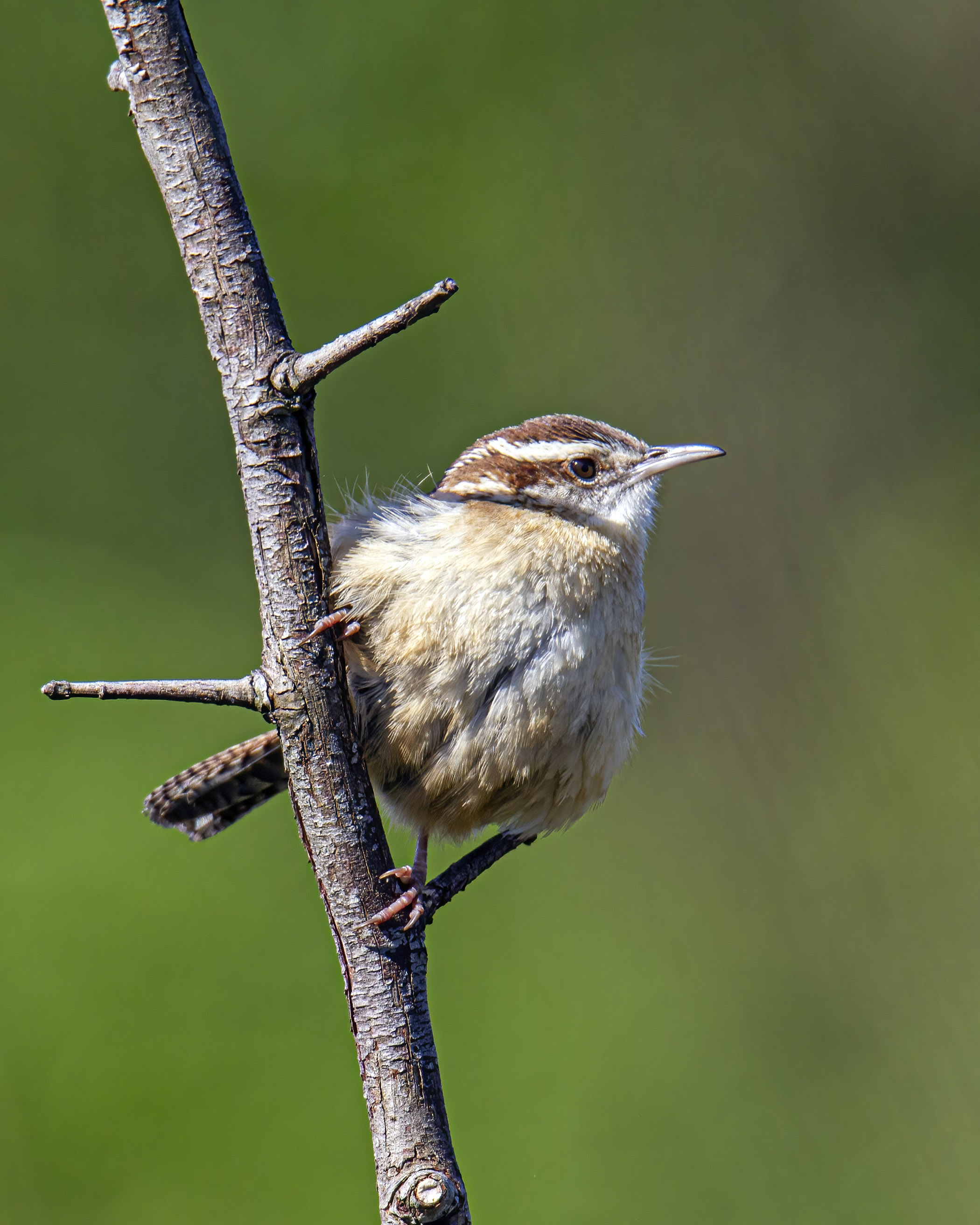
The bird in the first photo is an incredibly cute Carolina Wren (Thryothorus ludovicianus). Carolina Wrens frequently poke about in the undergrowth and I was delighted when this one chose instead to perch on a photogenic branch in the open. The result was this pretty portrait of the little wren that looks almost like it was taken in a studio environment.
The bird in the second photo is a White-throated Sparrow (Zonotrichia albicollis). It was not perched in the open and it was not stationary. The little sparrow was bobbing and moving as it attempted to grab some of the tender shoots growing on the tree. I was happy when I managed to get a shot in which the bird has one of the shoots in its mouth. The background in this image is cluttered and part of the bird’s body is hidden by a branch. However, I like the moment that I captured and the way that the image provides a sense of the bird’s environment.
When I am photographing wildlife, I am unconsciously making a series of creative choices in the way that I frame an image and the camera settings that I use, all of which affect the look and feel of the resulting images. Sometimes of those images will be “artsy” and others will be “documentary”—I love both styles of photography.
On Monday I was thrilled to photograph my first dragonfly of the year at Occoquan Bay National Wildlife Refuge, the location that I visit most frequently with my camera. The first prize goes to an immature male Blue Corporal dragonfly (Ladona deplanata)—males turn blue as they mature, but initially they have the same coloration as the females. Blue Corporals of both genders have two light-colored stripes on the front of their thoraxes, the traditional rank military insignia for corporals.
Later in the day I spotted a female Blue Corporal perched on some dry leaves, as shown in the second photo. Can you spot the differences between the dragonflies in the first and second photos? The male abdomen tends to be a bit thinner than the abdomen of the female. However, the biggest difference is in the terminal appendages, i.e. the specific parts at the very tip of their abdomens (their “tails”).
The following day I returned to the refuge and spotted another Blue Corporal perched in some vegetation—I think it is another immature male. Most of the time Blue Corporals like to perch on the ground, but this one looked like it had only recently emerged and may have been waiting for its wings to harden.
When dragonflies undergo their metamorphosis from water-dwelling nymphs to aerial acrobats, their wings are initially very clear and fragile and the creatures are very vulnerable, so I was careful not to disturb the dragonfly when I took a few photos. If you are interested to learn more, check out a 2016 blog posting Metamorphosis of a dragonfly in which I documented the entire transformation process of a Common Sandragon dragonfly in a series of 15 photos. At the end of that series you will be able to see why I characterized the wings of a newly-emerged dragonfly as “fragile.”
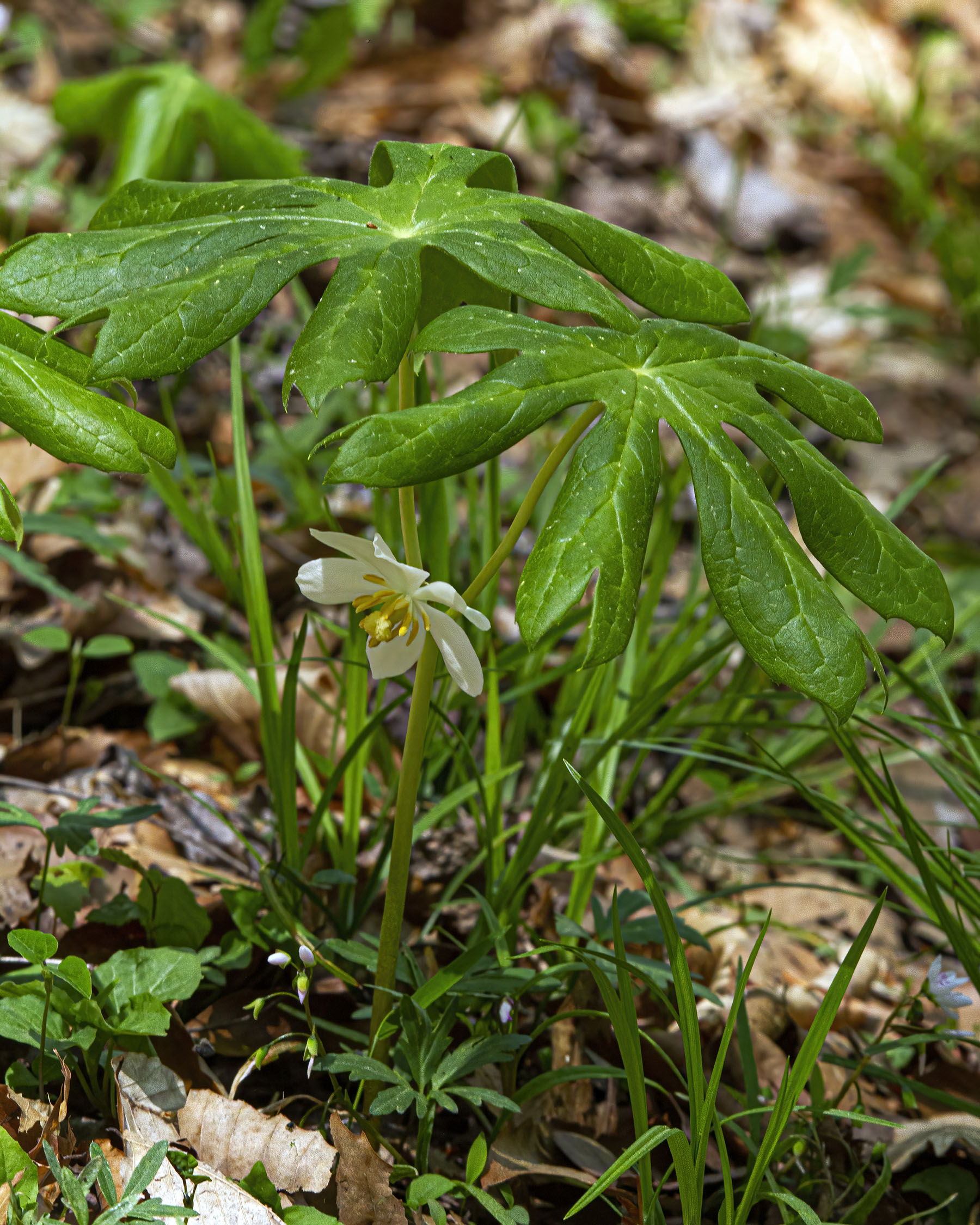
Mayapples (Podophyllum peltatum) are strange plants. Most of the time they grow in colonies and each plant has a stalk and a single umbrella-shaped leaf. Occasionally, though, the stem will branch off and there will be two leaves. In those cases, a single flower may emerge at the intersection of the two branches of the stem.
According to the Wisconsin Horticulture website, “The nodding, white to rose-colored flowers appear in April or May. Each flower is 2-3 inches wide, with 6 light green sepals, 6 to 9 waxy petals, and twice as many stamens with white filaments and yellow anthers. Although the flowers are quite showy, they are short-lived and usually hidden by the leaves. The flowers are fragrant, variously described as pleasant to putrid and are visited by bumblebees and other long-tongued bees.”
Yesterday I spotted a flowering Mayapple plant as I was exploring the area surrounding a creek in Prince William County, Virginia. I have been seeing Mayapple plants for the last couple of weeks as I have been searching for dragonflies, but this is the first one that I have seen in bloom this spring. You have to get pretty low to the ground to spot the flowers, and it was a bit of a challenge getting this shot.
There is something whimsical about a flower that has its own dual umbrella to provide it with shade—I can’t help but smile whenever I spot a Mayapple in bloom.
I was extremely happy yesterday to encounter several Twin-spotted Spiketail dragonflies (Cordulegaster maculata) during a visit to Occoquan Regional Park, a county-run recreational park in Lorton, Virginia. In the past I have occasionally seen Twin-spotted Spiketails at this location and I went there specifically to look for this species—I was hopeful, but realistic in my expectations of finding this relatively uncommon dragonfly.
Spiketails are a small family of large black or brown dragonflies with similar bright yellow stripes on their thoraxes and species-specific makings on their abdomens. Females have a spike-like pseudo-ovipositor at the end of their abdomens that is responsible for the “spiketail” name.
When I first encountered a spiketail yesterday, it was flying in the air and I was not sure what kind of dragonfly it was. Fortunately I was able to see where it landed and when I got closer, I was ecstatic, because I could actually see the dragonfly’s “spike,” as you can see in the first photo.
There are several other spiketail species in our area, but the Twin-spotted Spiketail is the only one that is flying this early in the season. The flight season for most of the early season dragonflies lasts for only a month or so, so I try to spend as much time outdoors as I can during April and May to maximize my chances of seeing these uncommon species. As you can probably judge, from the first photo, Twin-spotted Spiketails are large, almost 3 inches (76 mm) in length. Although you can’t really seen the markings in the first photo, there are a paired yellow spots or rounded triangles along the length of the abdomen.
I decided to hang around the area where I spotted the first spiketail to see if others would fly by and my patience was rewarded. I was able to capture shot of several other Twin-spotted Spiketails as you can see in the second and third photos. Both of these spiketails are males, I believe, and therefore do not have the visible “spike.” In those photos, though, you get a pretty good view of the pattern of the paired spots, which is why the species is called “twin-spotted.”
This dragonfly season is starting out with a bang and I feel blessed to have photographed several uncommon species already. Temperatures today are forecast to rise to about 84 degrees (29 degrees C) and I plant to continue my search for beautiful and elusive aerial acrobats, like these Twin-spotted Spiketails.
Yesterday was a beautiful spring day and I was delighted to capture this image of a Zebra Swallowtail (Eurytides marcellus), one of my favorite butterflies, at Occoquan Bay National Wildlife Refuge. I chased after this hyperactive butterfly and luckily was close enough to get a shot when it landed for a split second. I love the touches of red and blue on this mostly monochromatic butterfly and its distinctive long “tails.”
As I was doing a little research on this butterfly, I discovered that the Zebra Swallowtail has two seasonal forms, one occurring in the spring and the other in the summer. According to Wikipedia, the spring forms are smaller, more white, and have short, black tails with white tips. As you can see from the first photo below, yesterday’s Zebra Swallowtail was a spring form butterfly.
Summer forms of the Zebra Swallowtail are larger, have broader black stripes, and longer, black tails with white edges. For the sake of comparison, I reprised a photo from a 6 September 2021 blog posting. The butterfly in the second photo, a summer form butterfly, indeed looks darker than the one in the first photo and there are noticeable differences in the shape and coloration of the tails.
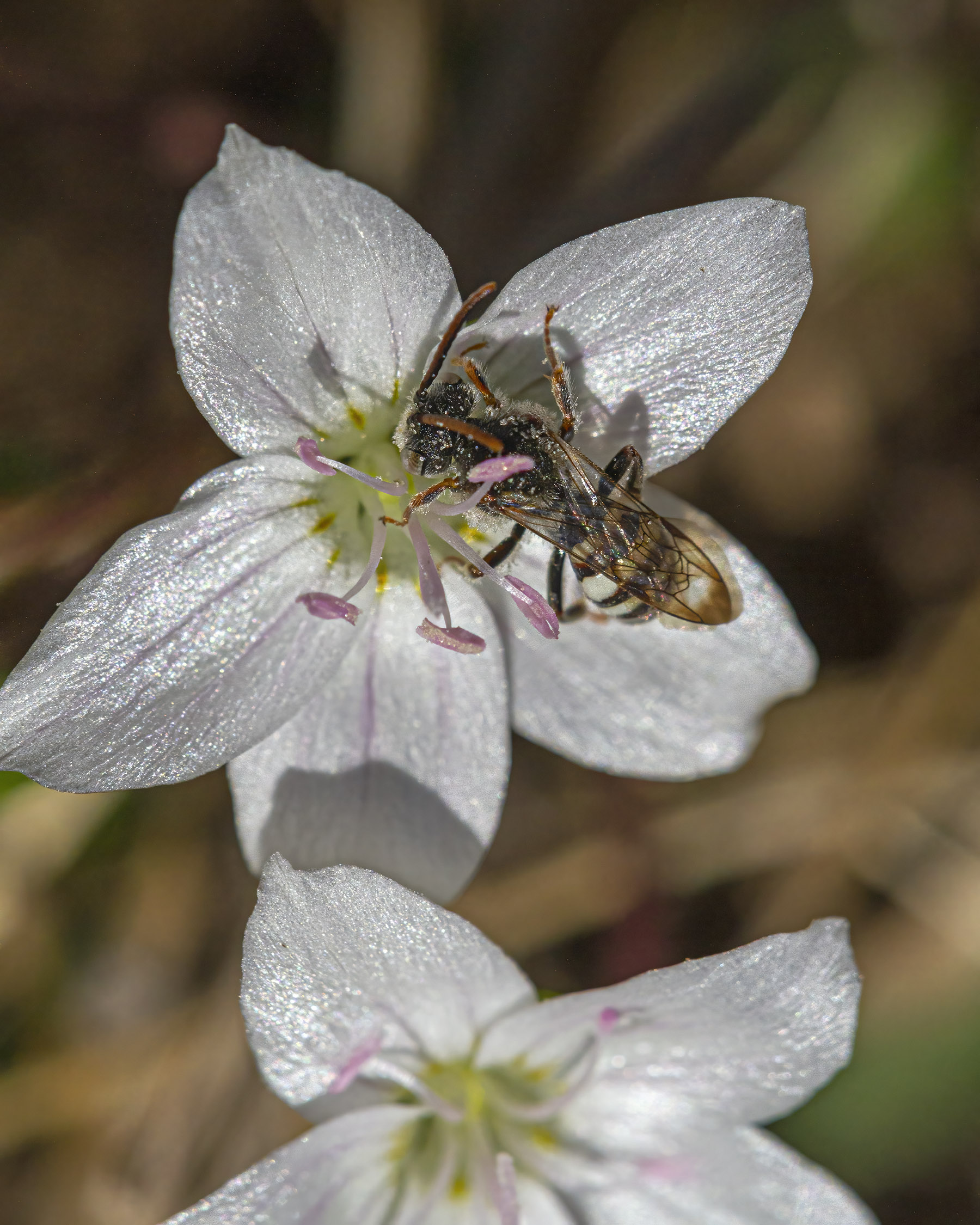
Early spring wildflowers, like the Virginia Spring Beauty (Claytonia virginica), are an important source of food for a host of small bees and other insects. Many insects gather pollen from these flowers and in doing so help to pollinate the plants.
Some species of bees, though, lack scopa (the pollen-collecting hairs) and do not collect pollen to feed their offspring. The genus Nomada, according to Wikipedia, is the largest genus of kleptoparasitic bees sometimes referred to as “cuckoo bees.” Kleptoparasitic bees are so named because they enter the nests of a host and lay eggs there, stealing resources that the host has already collected.
It is a little hard to see the body of the bee in the photo below, but if you look closely you can see its striped abdomen, which is wasp-like in appearance. I was not sure of the type of bee, so I posted it to BugGuide, a useful resource for insect identification, and one of the experts there identified the bee as belonging to the genus Nomada.
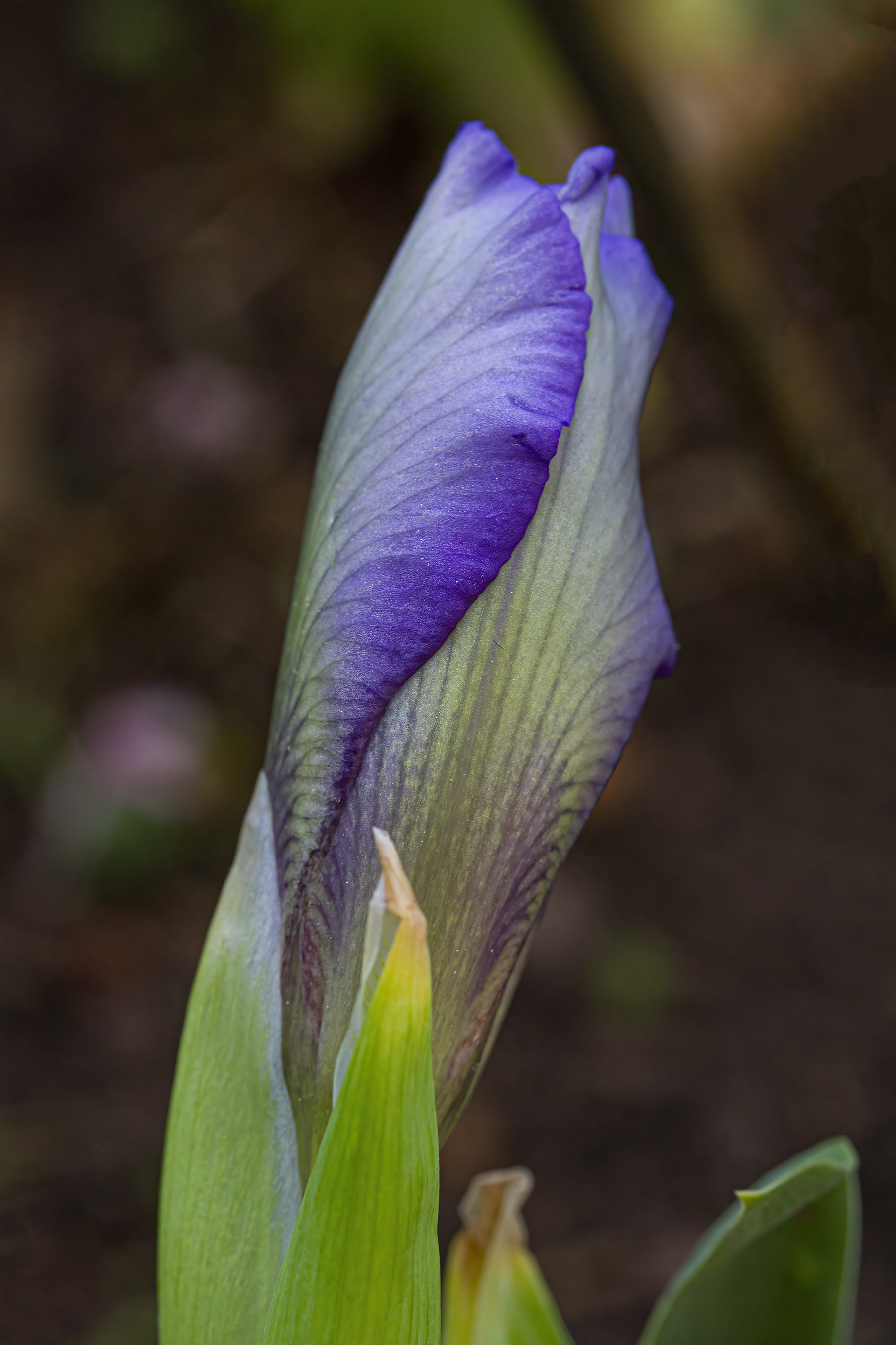
Yesterday I stopped by the garden of my neighbor and fellow photographer Cindy Dyer. Her early-season tulips were well beyond their prime, but more tulips are getting ready to bloom. I was a little surprised to see that some of her irises are already starting to bloom too. I love to photograph flowers when they are at this stage of growth—they are already beautiful and give hints of the additional beauty that is to come.
Happy Easter to all of you who are celebrating this holy day. Christ is risen!
Have you ever looked closely at a dragonfly’s legs? A dragonfly has six legs that are attached in pairs to its thorax. The main parts of the leg are the upper leg or femur, the lower leg or tibia, and the foot or tarsus, which is made up of three segments and ends with a pair of claws. The legs are covered with spiky hairs and fulfill a variety of functions, including perching, catching and holding onto prey, and cleaning its mouth and eyes.
The first photo is a close-up view of a Uhler’s Sundragon (Helocordulia uhleri) that I spotted on 4 April near a creek in Prince William County, Virginia. You get a really good view of one of the middle legs of the dragonfly, including the way that it bends at two joints and the way the tiny claws are used to hold onto the perch. I can’t be sure, but I believe that the dragonfly may be using one of its front legs to wipe its large compound eye. If you click on the photo, you can see some of the thousands of ommatidia, the faceted optical units that allow a dragonfly to see in almost 360 degrees around itself.
In the second photo, you can see that the sets of legs are of different lengths. The back legs, which are the longest, are the ones that are most often used to catch and subdue prey. The front leg nearest us, does not seem to be used and the moment for perching and the “elbow” appears to be touching the eye. At first I thought that this was merely an awkward perch, but the more I look at the photo, the more I think that the dragonfly is cleaning its eye.
The final photo, which was actually the first of these photos that I took, shows the entire body of the Uhler’s Sundragon. The Uhler’s Sundragon is visually similar to the Selys’s Sundragon, the first dragonfly that I spotted this year, with the notable difference that the Uhler’s Sundragon has little orange patches at the base of its wings, as you can see in the photo, that are not present with the Selys’s Sundragon. If you look at the front legs, it appears to me that the dragonfly was using both of them initially for perching—its “elbow” does not appear to bent as it was in the middle photo.
This post was a little more “geeky” than usual, delving deeper into dragonfly anatomy than I usually do. I think it is fascinating to try to observe and understand the behavior that I see in my subjects and hope that you may also find these details to be somewhat interesting.
As I was exploring the edge of the same small pond where I photographed the newt featured in yesterday’s blog posting, I spotted my first damselfly of the season. Damselflies and dragonflies both belong to the order of flying insects known as Odonata. Damselflies tend to be smaller and slimmer that dragonflies and most damselflies hold their wings above their bodies when at rest, unlike dragonflies that perch with wings extended.
Identification of this damselfly was somewhat difficult for me. On the one hand, I saw the broken shoulder stripe that looks like an exclamation point, which suggests that this is a Fragile Forktail damselfly (Ischnura posita). On the other hand, my identification guide states that there is no blue at the tip of the abdomen (the “tail”) of the Fragile Forktail, making me think it might be an Eastern Forktail.
I posted the photo to a Facebook forum called Virginia Odonata and one of the experts there made the following comment, “This is quite an unusual Forktail. Easterns rarely have the split shoulder stripe, but I am still inclined toward Fragile even though the amount of blue on S9 is unusual.” For your information, naturalists divide the abdomen of a dragonfly into ten segments and you start counting from the thorax area (the upper body), so S9 is the penultimate segment.
When it comes to identifying birds and insects, I have grown accustomed to living with some degree of uncertainty. Even experts will sometimes disagree, particularly if there is only a photo from a single angle, which was the case with this damselfly.
For me, the precision of my identification is not critically important—I can enjoy the beauty of this little damselfly without knowing its name. For the second day in a row, I am reminded of Shakespeare, who famously wrote in Romeo and Juliet, “What’s in a name? That which we call a rose, by any other name would smell as sweet.”
As I was exploring the edges of a small pond in Prince William County in Virginia on Tuesday, I spotted a lizard-like creature walking along the pond bottom underwater. I had no idea what this was, but had the presence of mind to snap a photo. The water was clear enough that I was able to capture a decent amount of detail.
I did some research and learned that this is the adult aquatic form of an Eastern Red-spotted Newt (Notophthalmus viridescens). That set me off on another series of internet searches, because I am not sure what a newt is. When I hear the word “newt” I immediately think of the three witches in Shakespeare’s Macbeth. As they stirred their cauldrons, they described the contents of the potion that included a newt, although it turns out that the witches were using codes words to refer to various plants.
“Eye of newt and toe of frog, Wool of bat and tongue of dog, Adder’s fork and blind-worm’s sting, Lizard’s leg and howlet’s wing, For a charm of powerful trouble, Like a hell-broth boil and bubble.”
Newts are a kind of salamander and are considered to be amphibians, not reptiles. Eastern Red-spotted Newts have an amazing life cycle, according to an article by the University of Virginia Mountain Lake Biological Station. They hatch from eggs and then spend the next 2-5 months of their lives living in the sediment and debris at the bottom of the pond, breathing through gills.
When they metamorphose into terrestrial red efts, the juvenile form of the aquatic newt, they acquire a pair of lungs which they use for the rest of their life. After 2-7 years as terrestrial efts, the newts return to the water to breed. They can live for up to 15 years in total, sometimes spending the entirety of their adulthood as aquatic newts.
Yesterday was an unusually warm spring day, with temperatures soaring to 82 degrees (28 C). I suspected that I might find some early season dragonflies and I was right. Last week I saw my first dragonfly of 2023, but it does not really count for me, because I was not able to get a photograph of it.
My first “official” dragonfly of 2023 turned out to be an uncommon one, a Selys’s Sundragon (Helocordulia selysii). According to the Maryland Biodiversity Project, “Selys’s Sundragon is an uncommon, early-season corduliid which breeds in small streams in wooded areas through much of the southeast.” Corduliidae, also known as the emeralds, emerald dragonflies, or green-eyed skimmers, is the family of dragonflies to which the Selys’s Sundragons belong.
As far as I can recall, I have seen this species only twice in the past, both times in 2021. Check my 16 April 2021 blog posting entitled Selys’s Sundragon Dragonfly for details about my first encounter, including some photos that compare the Selys’s Sundragon with the very similar-looking Uhler’s Sundragon.
As many of you know, dragonflies are my favorite subjects to photograph during the warmer months. There is something almost magical about this beautiful aerial acrobats that inspires me. I love the challenge of spotting and photographing these tiny creatures—the Selys’s Sundragon in these photos, for example, is only about 1.7 inches (43 mm) in length.
During the summer, many common dragonfly species can be seen in a variety of habitats, but the early season dragonflies tend to be habitat specialists and have very brief flight season, often less than a month. For that reason, I usually try to go out with my camera as often as I can during the month of April.
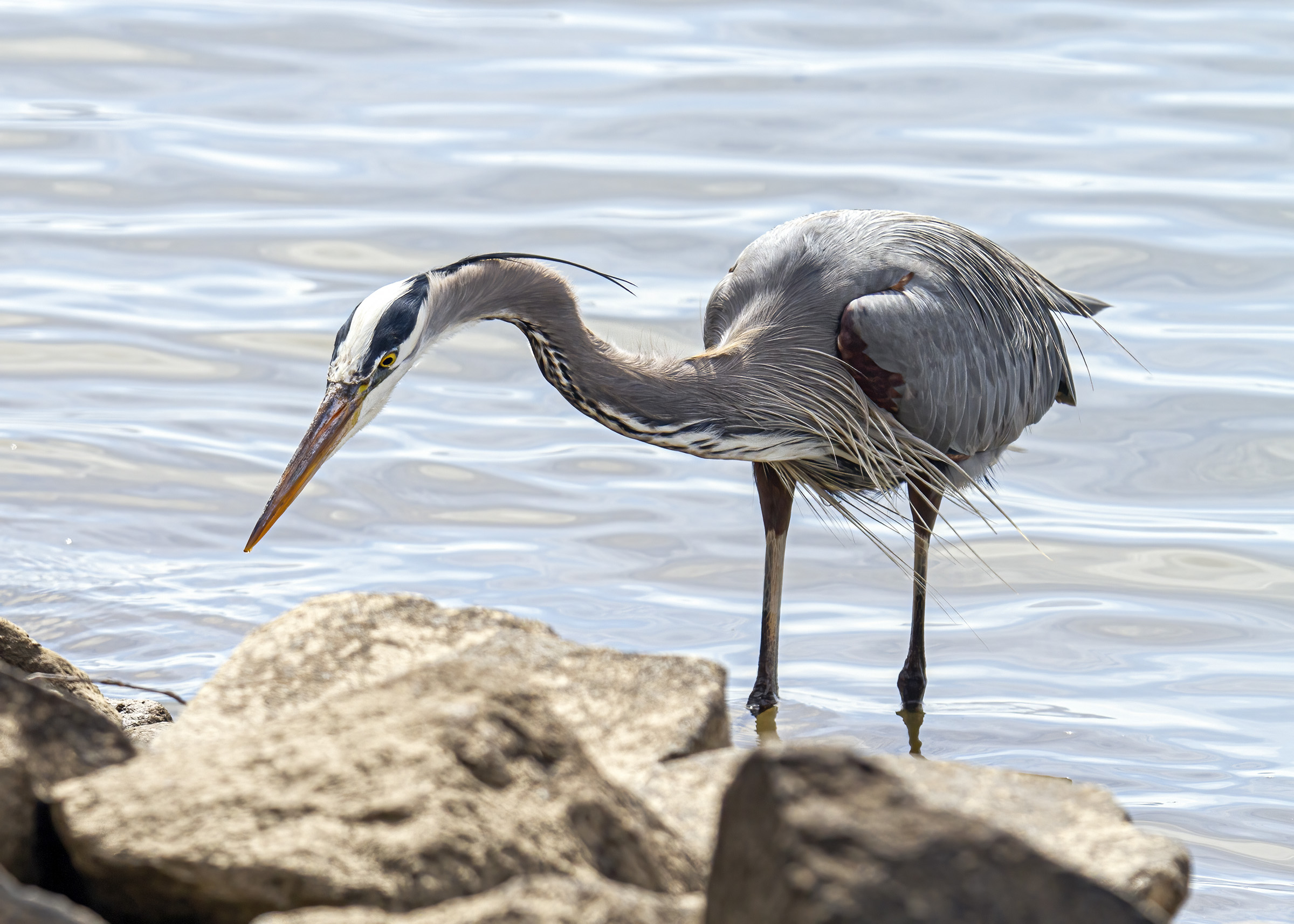
When I first spotted this Great Blue Heron (Ardea herodias) at Occoquan Bay National Wildlife Refuge, I immediately noticed how spiky its feathers looked—they were sticking out in all directions. When I was growing up (and had hair), there were times when I had some unruly strands of hair that were equally uncontrollable. I would sometimes resort to a little bit of Brylcreem to slick down my hair—to this day I remember one of the marketing slogans for this product, “Brylcreem—a little dab will do ya!” When I was really little, my Mom would sometimes use a little saliva on her fingers to control my wayward hairs—it worked.
The heron was intently focused on an area with rocks and slowly moved closer to it, gradually lowering its head. I waited and waited and eventually the heron struck. I did not see the actual strike, because the heron’s head was hidden by the rocks at that moment. I was excited to see what the heron had caught. As the heron lifted its head, I was shocked to see a tiny fish in its bill. Though the fish was only an appetizer at best, the heron carefully maneuvered it into position and swallowed it.
When I left the heron, it had returned to fishing, dreaming perhaps of its next catch, which would hopefully be bigger than this one.
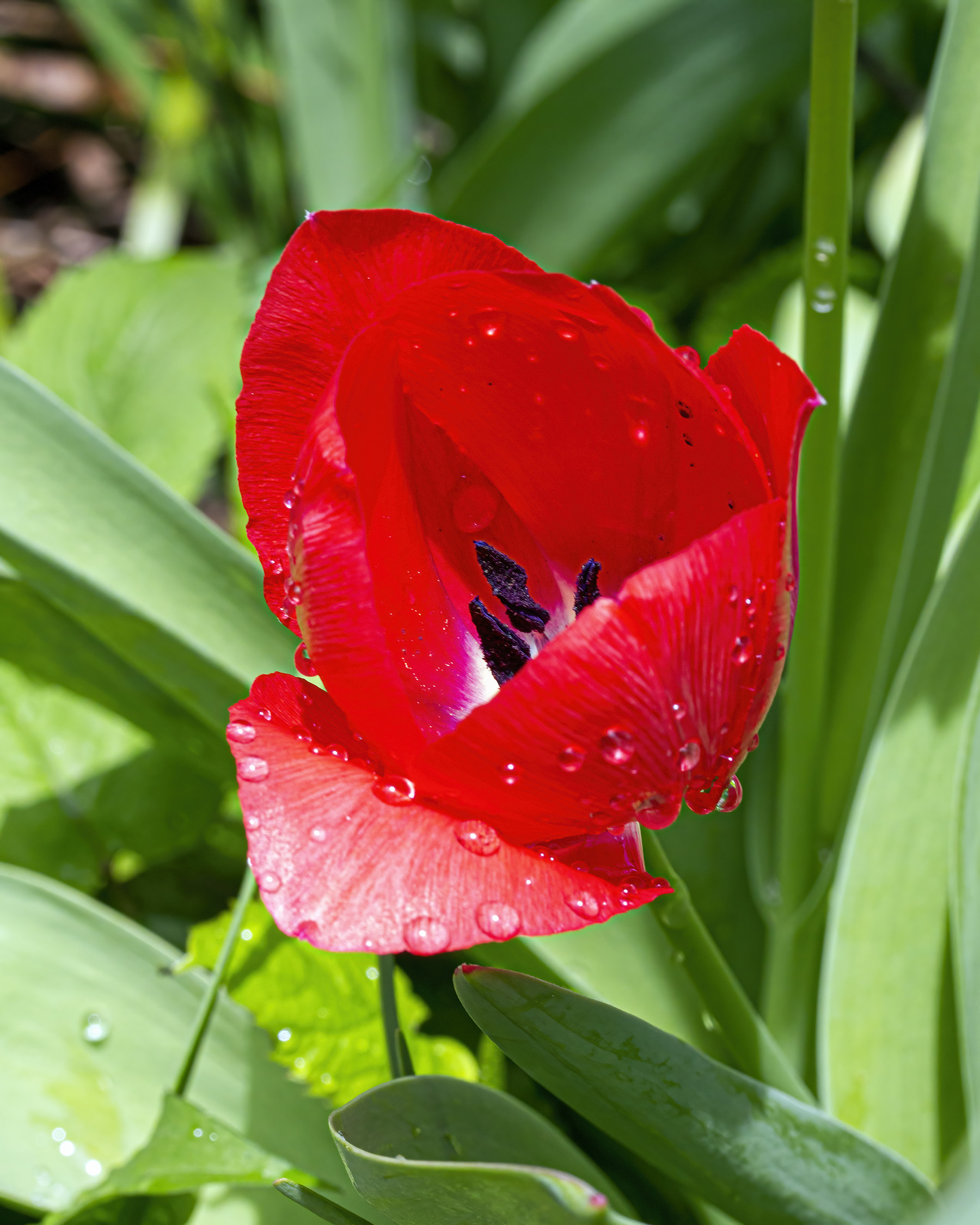
Raindrops were glistening in the sunlight after an April shower on Saturday, enhancing the beauty of these red tulips in the garden of my dear friend and photography mentor Cindy Dyer.
One of my favorite movies when I was growing up was “The Sound of Music” and I can still remember the words of many of the songs from the movie. In one delightful scene, Julie Andrews tells the children that when she is unhappy, she tries to think of nice things and begins a song with the words, “raindrops on roses and whiskers on kittens…these are a few of my favorite things.”
Raindrops seem almost magical, whether they are on roses, on tulips, or on any other vegetation. If you are not familiar with the song “My Favorite Things,” here is a link to a YouTube clip of that wonderful scene from “The Sound of Music.”
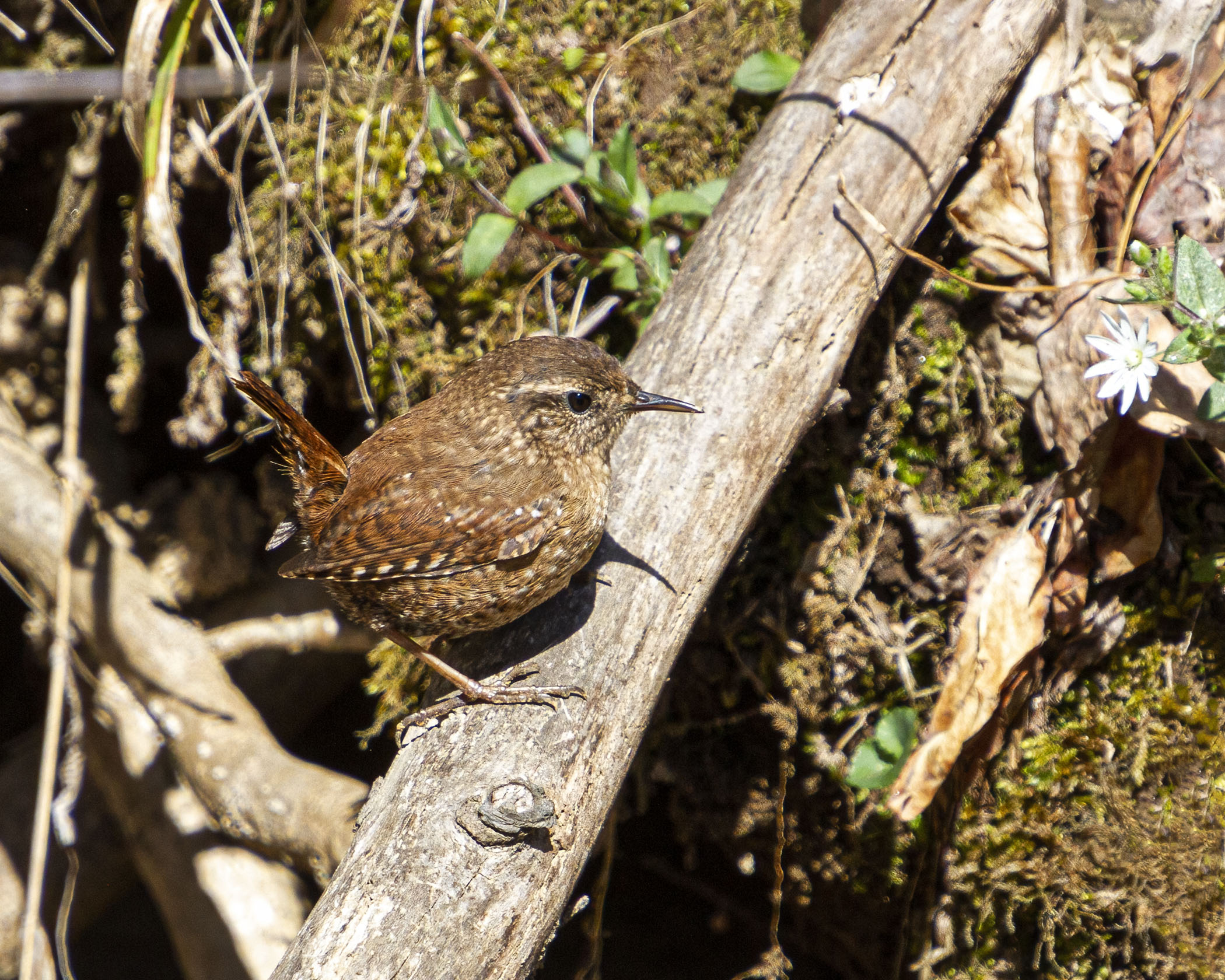
Throughout the winter I searched in vain for a Winter Wren (Troglodytes hiemalis), but finally managed to spot one last Thursday as I was exploring a stream in Prince William County, Virginia on a sunny spring day. According to the Audubon Field Guide, the Winter Wren is “A secretive little bird of dense woods. It often creeps about among fallen logs and dense tangles, behaving more like a mouse than a bird, remaining out of sight but giving an occasional kimp-kimp callnote.”
When I took these photos, I was standing in a dried-up stream bed, so I was almost at eye-level with this tiny bird. This angle of view allowed me to get much better shots that I would have gotten if I had been shooting downwards at the subject. I recommend that you click on the images to get a closer look at the beautiful details on this wren, including its speckled feathers, upturned tail, large feet, and sharp bill.
At this time of the year I am drawn to any insects that I see flying about and I have found myself chasing after even small flies. There’s usually a period of readjustment as I switch from searching for subjects that are far away to looking for tiny subjects that are often only an arm’s length away from me. Most of the time I have to rely upon movement to spot these insects—only occasionally am I able to spot a perched insect.
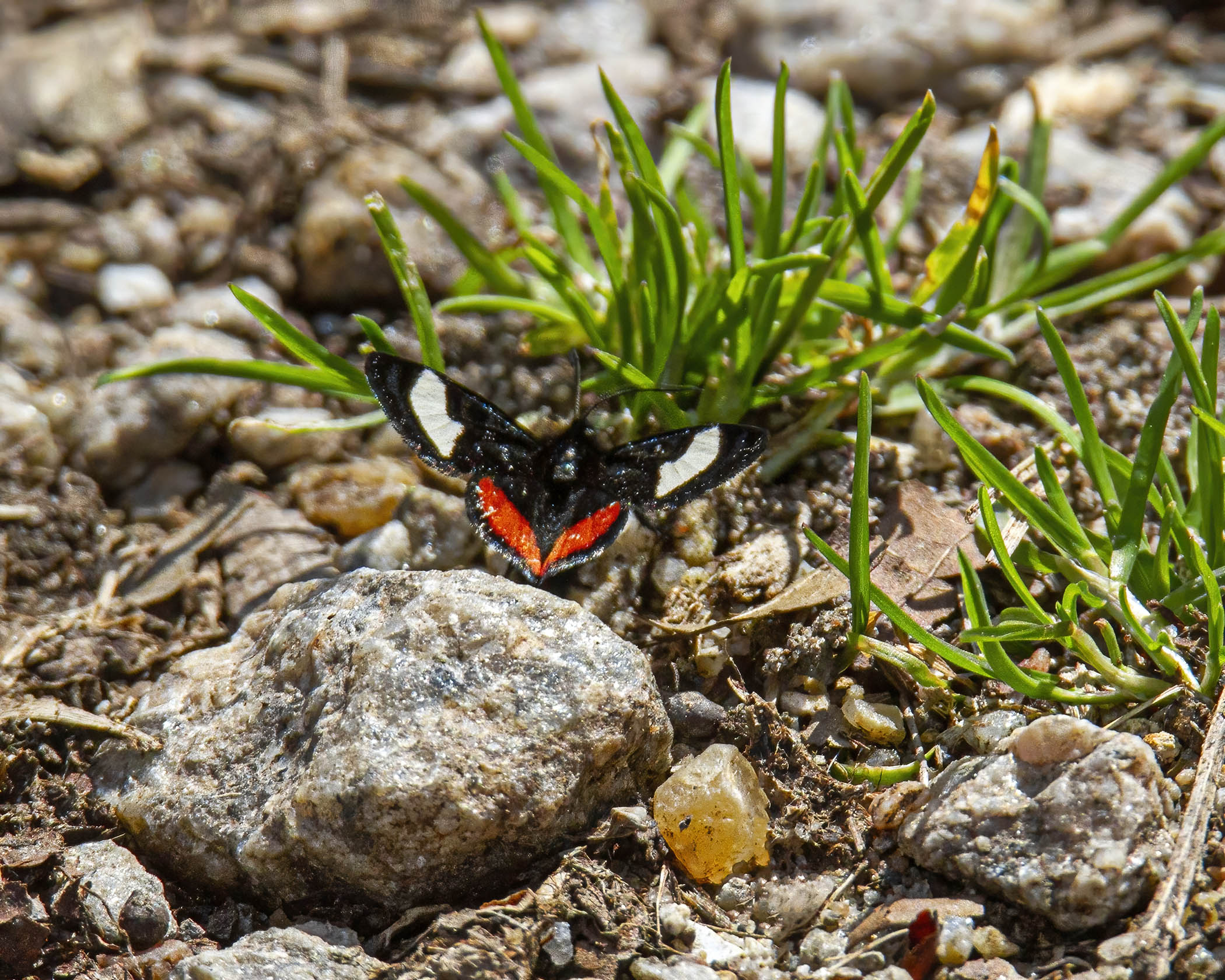
As I noted in yesterday’s blog posting, I finally spotted my first two butterflies of the spring. I thought I had spotted a third butterfly last Wednesday at Occoquan Bay National Wildlife Refuge when this colorful little insect flew in front of me. I am pretty familiar with the butterflies in my area, but did not recognize this one.
After doing some research, I have concluded that this is probably a Grapevine Epimenis Moth (Psychomorpha epimenis). According to the Missouri Department of Conservation, “The grapevine epimenis flies during daytime and would seem too colorful to be a moth, but a moth it is. A member of the noctuid family, its many drab, grayish relatives include dagger, owlet, armyworm, cutworm, and earworm moths.”
I finally spotted my first butterflies of the spring. As I was walking down one of the trails at Occoquan Bay National Wildlife Refuge on Wednesday, a fellow photographer excitedly pointed out this Mourning Cloak (Nymphalis antiopa) butterfly that was sunning itself on the trail. Mourning Cloaks overwinter as adults and are usually one of the first species to appear in the spring. According to Wikipedia, “These butterflies have a lifespan of 11 to 12 months, one of the longest lifespans for any butterfly.”
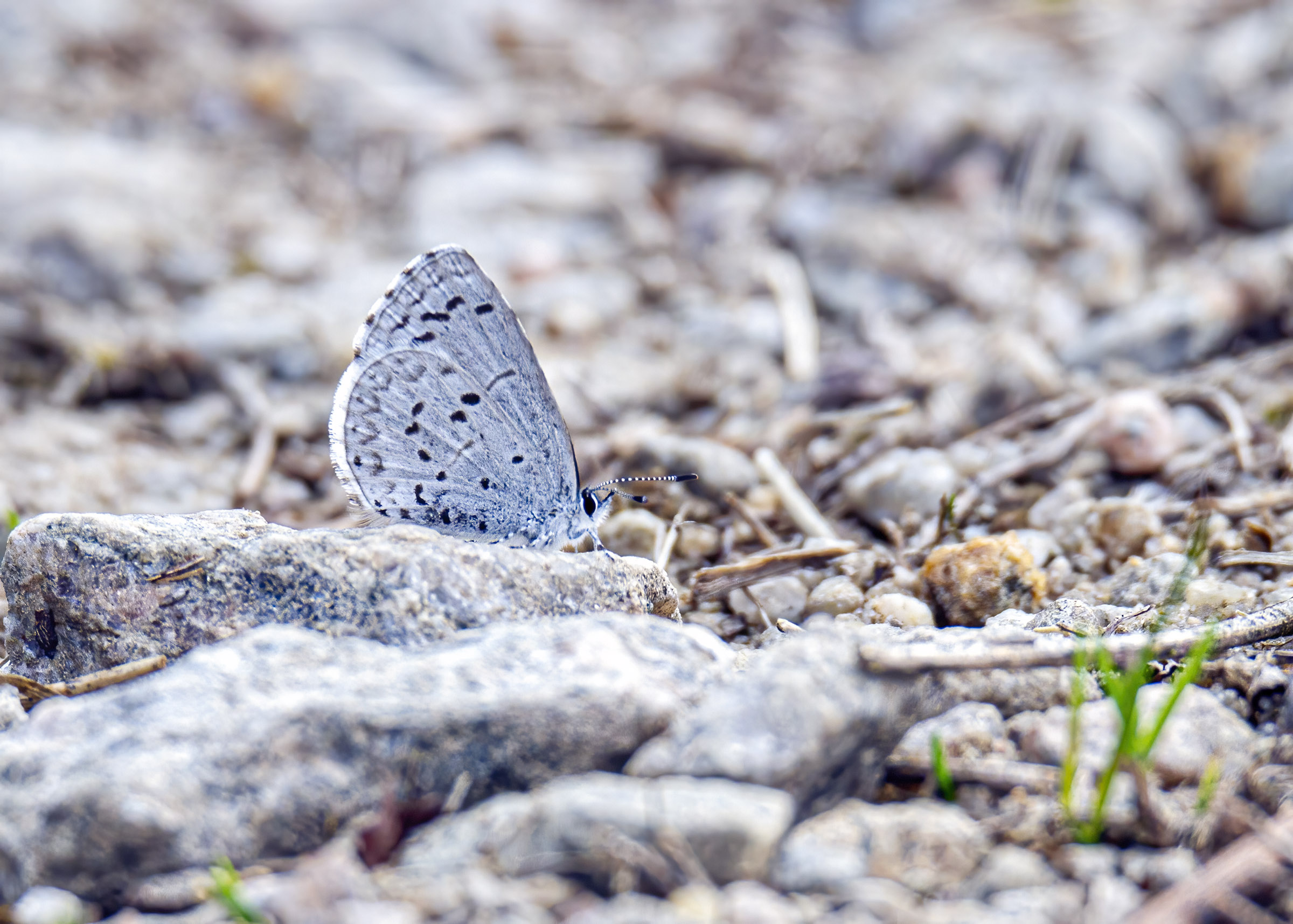
Later in the afternoon, I spotted a Spring Azure (Celastrina ladon) butterfly that was perched amidst the rocks on a gravely section of one of the trails. Spring Azure butterflies are very small—about one inch (25 mm) in size—and it was quite a challenge to get a shot of this one using the 150-600mm lens that was on my camera at that moment.
Yesterday I spotted an Eastern Tiger Swallowtail butterfly as I was searching for dragonflies at another location, but was unable to get a shot of it. I also briefly caught a glimpse of one dragonfly, but again was unable to get a shot. As the weather continues to warm, I’ll be out with my camera more often in search of these beautiful little creatures—it finally feels like spring is here.
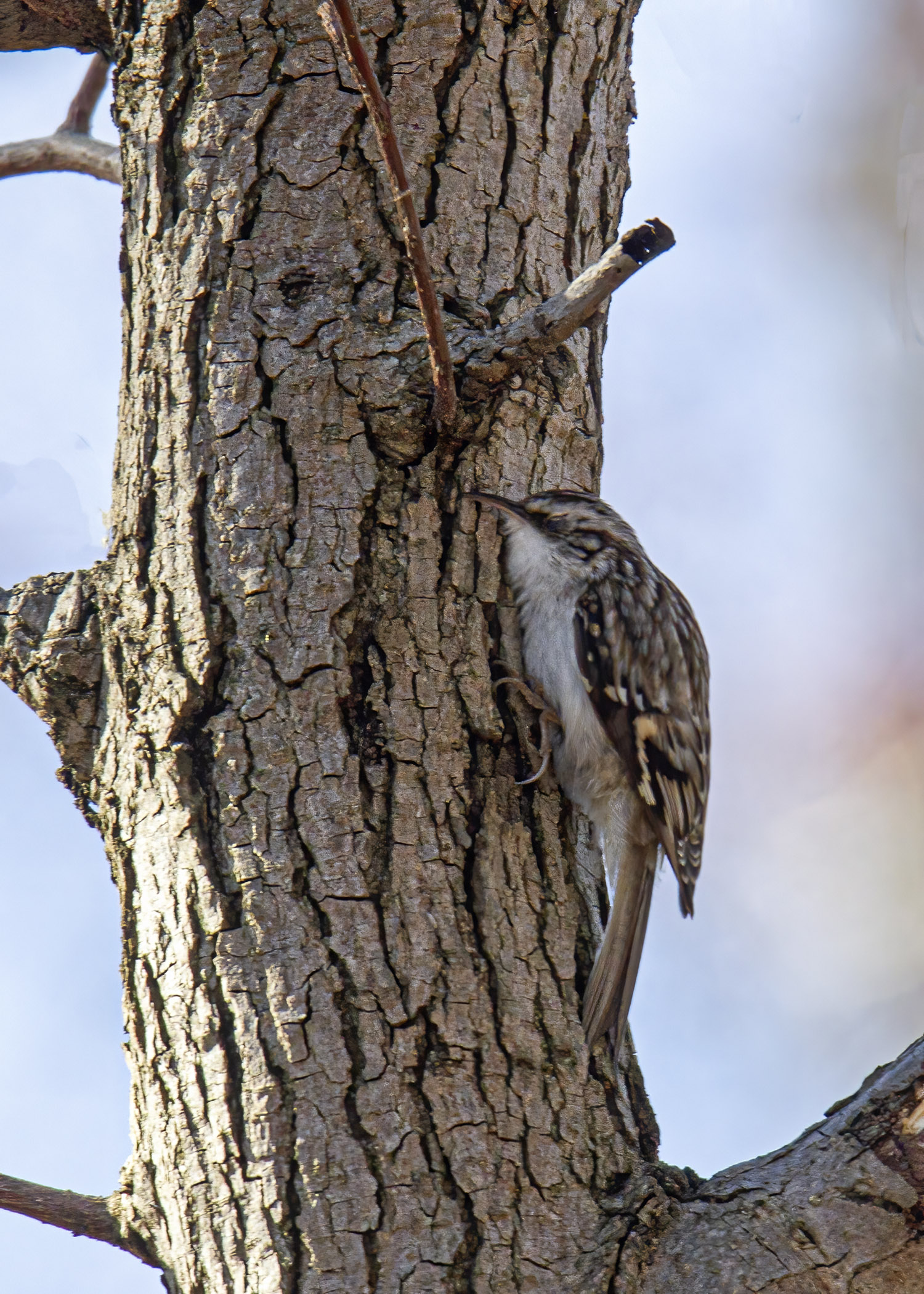
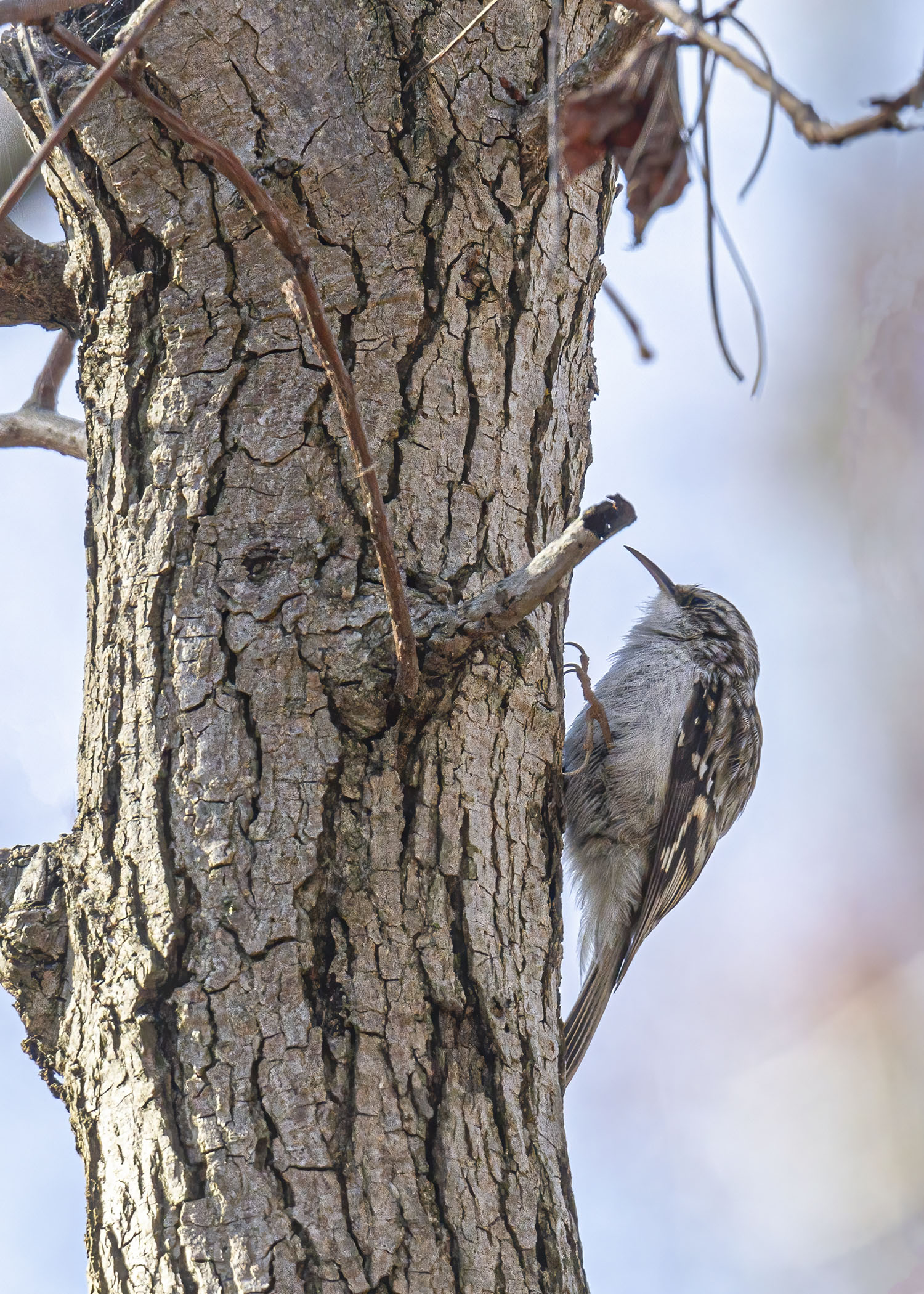
Brown Creepers (Certhia americana) are unusual-looking birds. They are relatively small songbirds (about 5 inches (13 cm) in length) that have long, curved claws and a sharp, curved bill. Their mottled bodies cause them to blend in really well with the bark of the trees on which they are usually found. Even when I manage to spot one, they tend to be in motion all of the time as they spiral their way up the trunk of the tree, making them tough to photograph.
Last week at Occoquan Bay National Wildlife Refuge I was thrilled to capture some shots of a Brown Creeper. I was particularly happy that the images show the bird’s distinctive bill and claws. In the middle photo, you can see how the creeper uses its curved bill to poke about in the crevices as it searches for insects, sometimes bracing itself with its stiff tail.
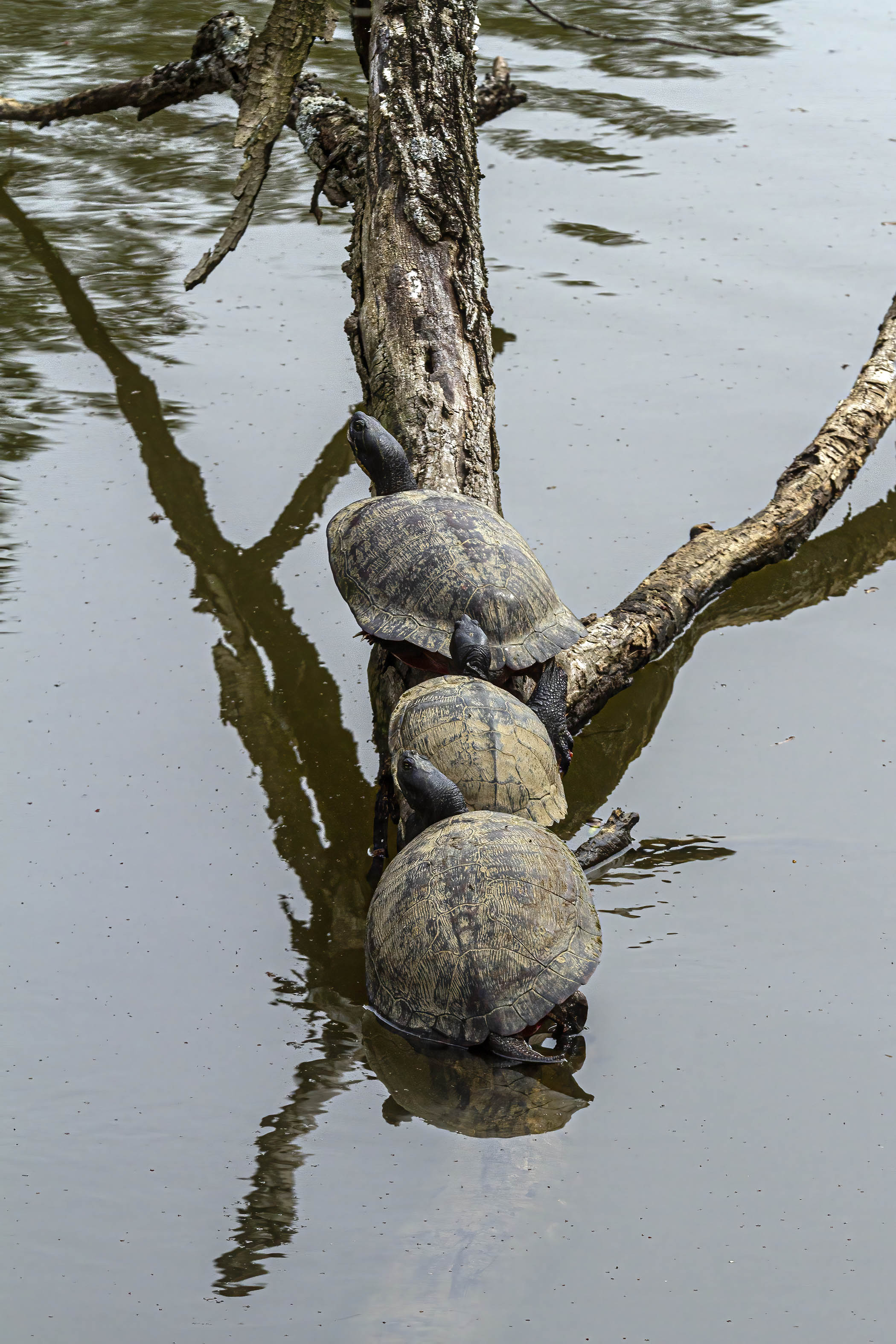
It is not unusual to see turtles in a row on a log, basking in the sunlight. Normally, though, the log is horizontal. In the case of the turtles that I spotted last week at Jackson Miles Abbott Wetland Refuge, the large fallen branch on which they were perched was sticking out of the water at an angle. The turtles, especially the one in the front, had to climb upwards on the branch and secure themselves firmly to keep from sliding back into the water.
I really like the way that this image turned out. I managed to capture the texture of the bark and of the turtles’ shells and the reflections were a nice bonus. The limited color palette allows the viewer to focus on the shapes and textures without being distracted by bright colors. It is a simple, almost abstract image, characteristics shared by many of my favorite photos.
Flowers are starting to bloom in the garden of my dear friend and fellow photographer Cindy Dyer. Yesterday I photographed several varieties of tulips and some cute little grape hyacinths.
As many of you know, I do not have my own garden. However, my photography mentor Cindy Dyer lives nearby and she has amazing gardens in her front, side, and back yards. She generally plants flowers that she knows are photogenic and I know that during the growing season that there will almost always be something to photograph.
Earlier this spring, I was able to photograph a few crocuses and a tiny red tulip, but now a whole lot more flowers are starting to appear. The multi-colored tulip in the first photo, I believe, is a variety known as the Lady Jane tulip (Tulipa clusiana var. ‘Lady Jane’). In the past, this tulip stood much taller—this one was growing close to the ground.
The red tulip in the second photo is a more traditional variety. I deliberately set my camera to have a shallow depth of field to blur out the background that at this time of the year is somewhat patchy and cluttered. As I processed the photos on my computer I noticed that I had inadvertently captured a shot of my first insect of the season, what Cindy likes to call a “bonus bug.” The weather yesterday was cloudy, so I did not have to worry about harsh shadows, which meant that the colors seemed especially vibrant and saturated.
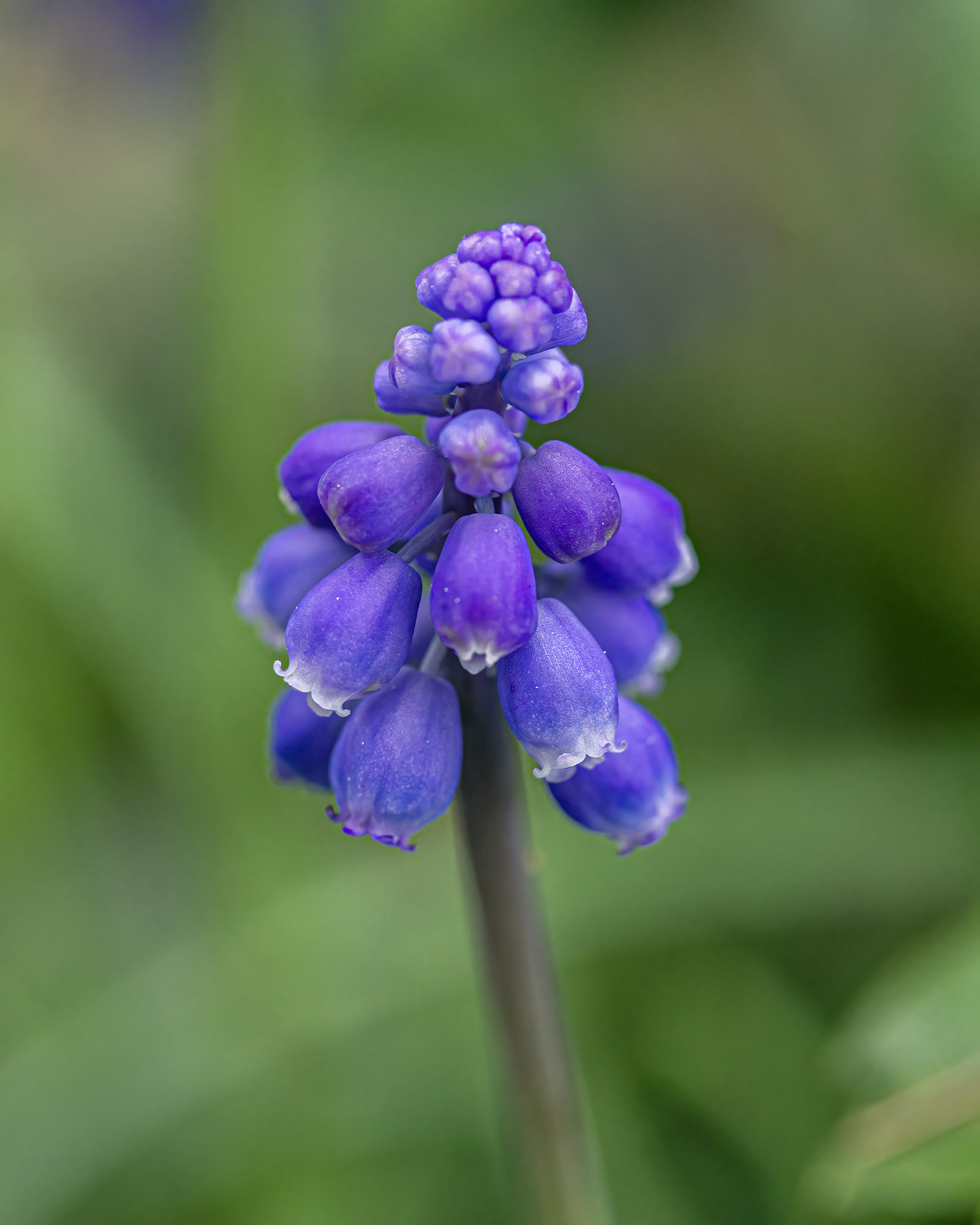
The final photo shows a tiny grape hyacinth (g. Muscari), one of many that have popped up in Cindy’s garden. These colorful little flowers grow really close to the ground, so I was sprawled out a bit to get this low-angle shot that isolated the flower from the background.
Most of the turtles that I see are either Painted Turtles or Red-eared Sliders, so I am delighted when I spot a member of another turtle species. Last Wednesday I was thrilled to spot several Spotted Turtles (Clemmys guttata), a relatively uncommon turtle species in my area. Spotted turtles tend to be found in marshy areas rather than in ponds, and it was indeed in a small wetland area at Jackson Miles Abbott Wetland Refuge that I photographed this turtle.
Species names can sometimes feel confusing or inappropriate, but the name of “Spotted Turtle” is perfect for these turtles that, as you can see in the photos below, have small yellow spots on their bodies and shells. For the first time this season I was walking around with my 180mm macro lens attached to my camera, hoping to photograph some butterflies, dragonflies, or other insects, but I came up empty-handed in that regard. I was happy, though, to be able to get a few shots of these little Spotted Turtles, perched on a log as they basked in the warmth of a sunny March day.
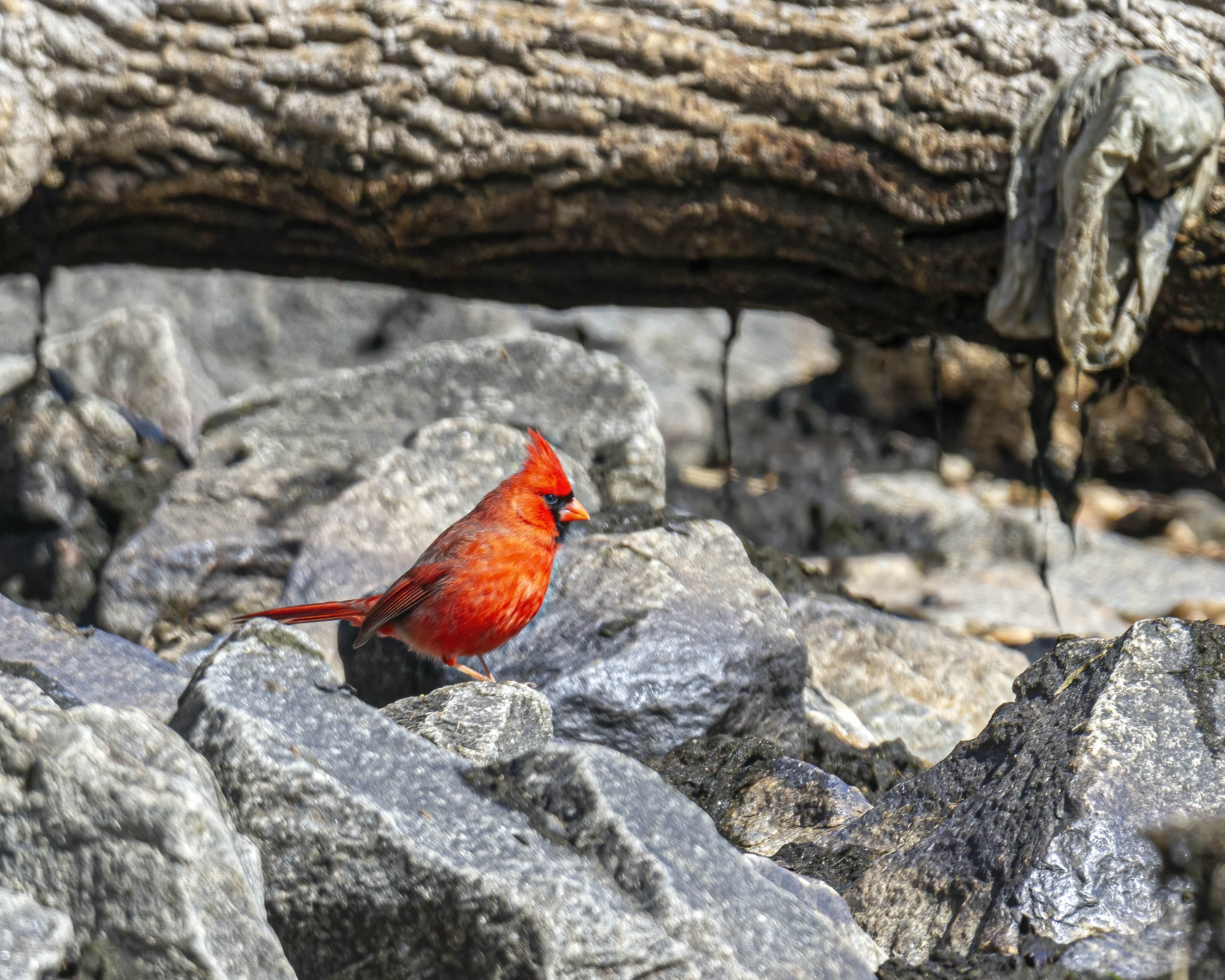
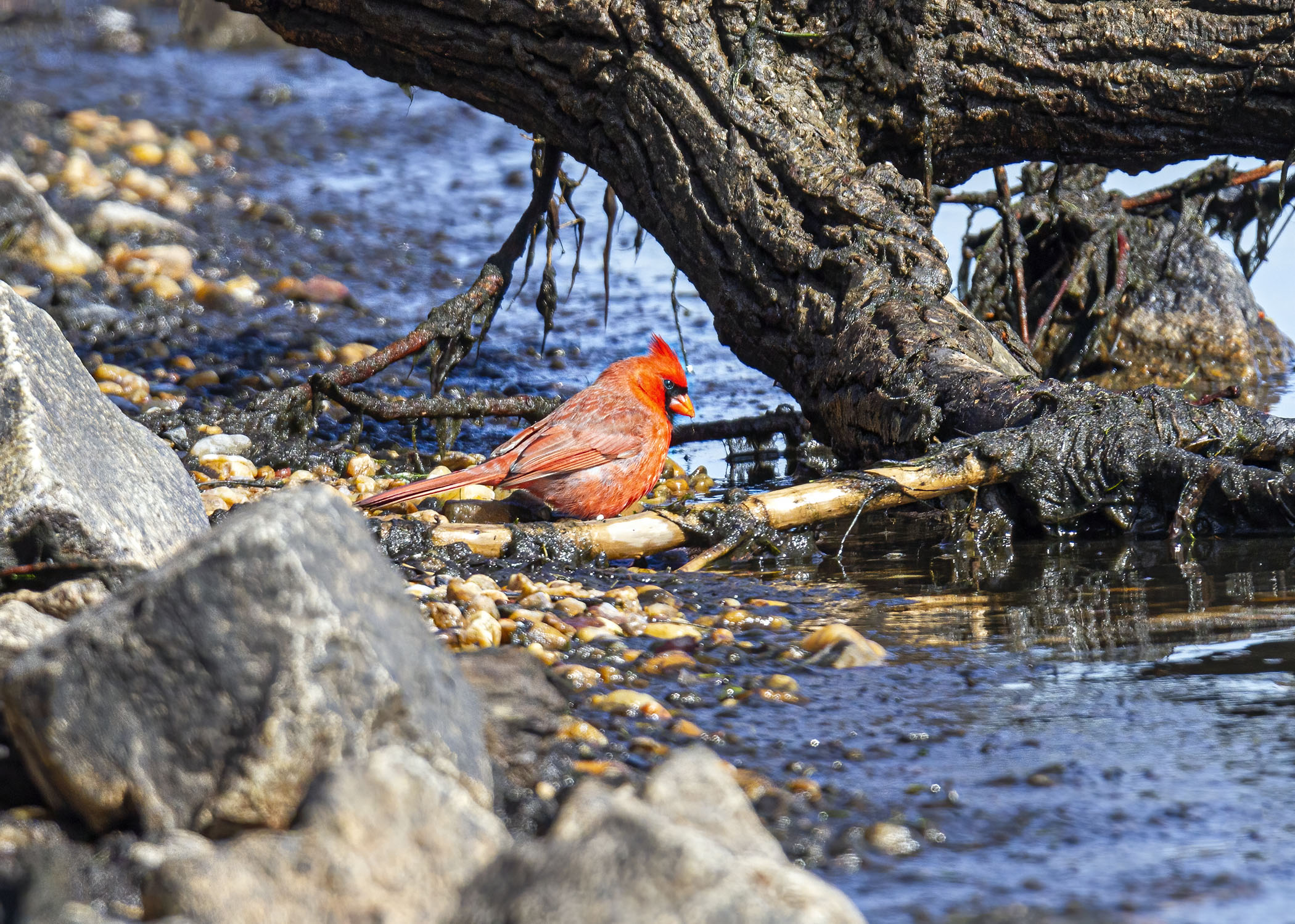
It is always fun to photograph familiar subjects in an unexpected environment. This past week I spotted a male Northern Cardinal (Cardinalis cardinalis) amidst the rocks and other debris at the edge of the water at Occoquan Bay National Wildlife Refuge rather than in the vegetation where I normally see cardinals.
I was delighted to be able to capture a series of images as the cardinal moved about on the rocks and eventually made his way to the water. He dipped his head to take a drink, but his face was completely hidden from view, so I was not able to capture that moment.
On the whole, though, I really like the balance I was able to achieve in showing both the primary subject and the environment in which I found him—the brightness of the cardinal’s red body definitely helped him to stand out from the somewhat cluttered background and foreground despite the fact that he filled only a small part of the frame.
Most of the nests of Ospreys(Pandion haliaetus) that I have seen in the past were in trees, but sometimes ospreys build their nests in readily manmade structures. On Tuesday I spotted an osprey couple that appeared to have taken over a nest on a channel marker in the waters off of Occoquan Bay National Wildlife Refuge.
In past years I have seen osprey activity at this same channel marker, but do not know for sure if ospreys were successful in hatching eggs there. The nest takes up only half of the space on the marker and there looks to be enough room to accommodate a second osprey couple. However, I doubt that the current occupants would tolerate the presence of neighbors that close, so it seems unlikely that I will see side-by-side nests in the future.
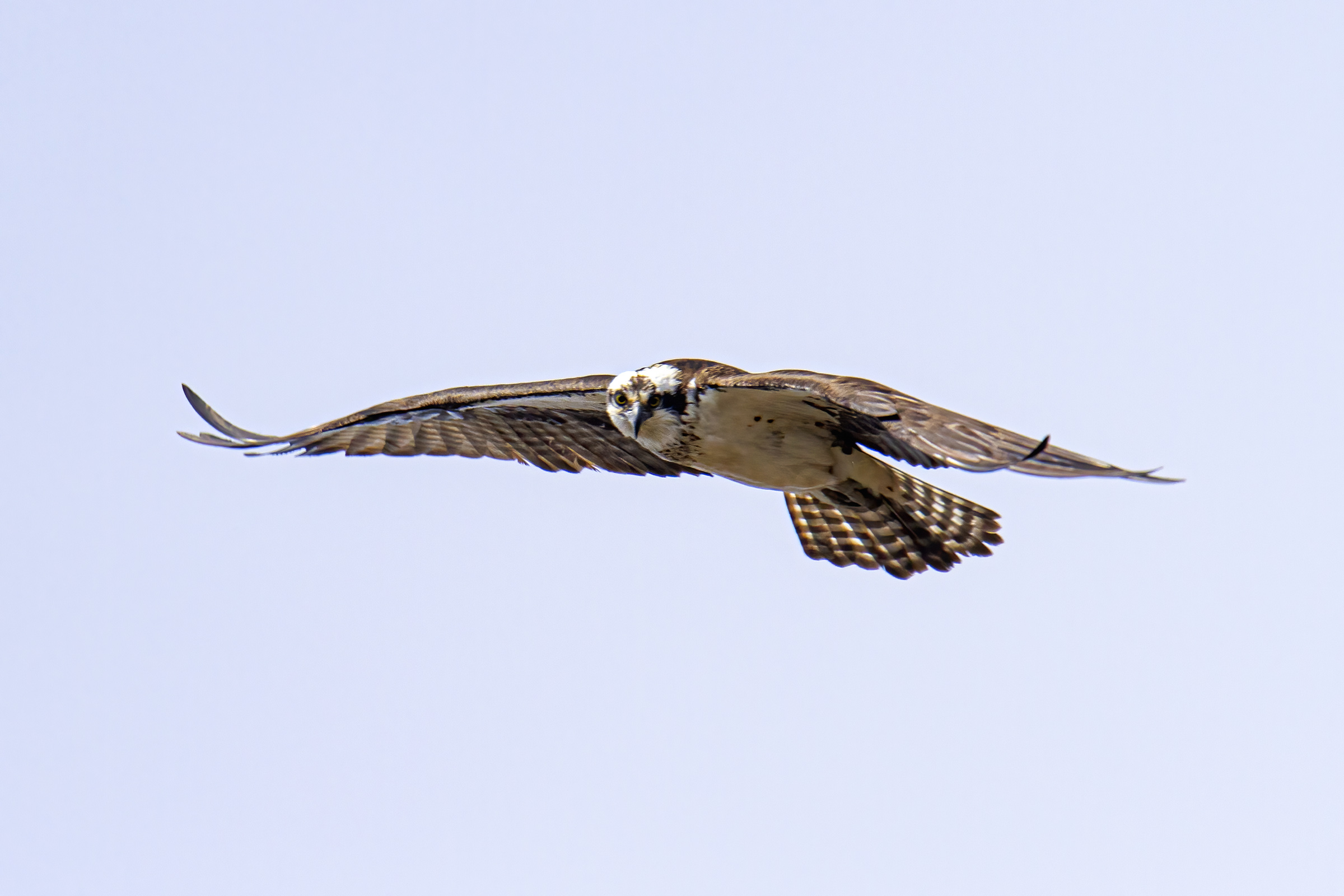
Like many other local photographers, I am thrilled that Ospreys (Pandion haliaetus) have returned to our area—they spend the colder months in warmer locations. On Tuesday, I captured several shots of one of the ospreys as it soared above me at Occoquan Bay National Wildlife Refuge.
Ospreys hover in the air a bit, so it is a bit easier to get shots of them flying than it is with eagles and hawks. However, it is still a challenge to get shots that have good wing and head positions. I was happy that the osprey was flying towards me in both of these images and its eyes are somewhat visible.
More osprey are sure to arrive soon and I am sure that I will get some better (and closer) shots in the upcoming months. I am content with these shots that that document the fact that the ospreys have returned, yet another sign of the arrival of spring.
I am not sure what was going on Tuesday in the waters off of Occoquan Bay National Wildlife Refuge, but two Bald Eagles (Haliaeetus leucocephalus) were perched on a structure and an aggressive Osprey(Pandion haliaetus) kept dive-bombing them repeatedly. The osprey would fly by right above them and each time the eagles would rear up with their talons extended as they screamed at the osprey. I took the shot below from a long way away, but it gives you a sense of the action.
Several of my friends on Facebook suggested that this might have been a territorial dispute. Others posited that the eagles had stolen a fish from the osprey and the osprey was angry about it. Another friend provided a link to a fascinating article at Natural Habitat Adventures entitled “Eagles and Ospreys: When Birds of Prey Clash.” According to the article, eagles will sometimes steal osprey chicks and ospreys may attack eagles while they are eating. It is too early for there to be chicks—ospreys have only recently returned to our area—but it is certainly possible that this was a food fight.
Bright colors are starting to emerge in the landscape as we move deeper into spring, a welcome sight after the long gray days of winter. I was delighted to see some equally bright colors in the feathers of several small birds that I photographed last Saturday in the vegetation surrounding a small suburban pond in Northern Virginia.
The first bird appears to be a female Yellow-rumped Warbler (Setophaga coronata). Normally I am not a big fan of a head-on shot of a bird, but in this case I really like the way that the photo shows both of the bird’s yellow patches on its breast (there is also a yellow patch on the warbler’s rump).
The bird in the second photo is a male House Finch (Haemorhous mexicanus). I was struck by the intensity of the red on the finch’s upper body, which reminded me of the color of a male cardinal.
In the coming months, warblers will be migrating northward through my area. Each year it is a real challenge for me to get shots of these colorful little birds, because they appear just as the trees begin to cover themselves with leaves—I often can hear warblers behind the leafy foliage without being able to see them.
On Saturday I encountered several female House Sparrows (Passer domesticus) with clumps of vegetation in their mouths and suspect that they are beginning to construct nests. According to the Cornell Lab of Ornithology, “House Sparrow prefers to nest in manmade structures such as eaves or walls of buildings, street lights, and nest boxes instead of in natural nest sites such as holes in trees.”
I know that some people resent the invasive presence of House Sparrows, which were introduced in the United States from Europe in 1851, because they sometimes displace native species. Personally I find them to be as interesting to observe and photograph as any other birds.
Perspective makes a difference—as a photographer I focus my attention on different aspects of my subjects than others may do. For, example, I know that farmers and gardeners will view some vegetation and insects as pests, while I may find them to be beautiful subjects. It is definitely a cliché, but there is also truth in the old saying that “beauty is in the eye of the beholder.”
Does the proverbial early bird always get the worm? I’m not sure if that is necessarily the case. I photographed this American Robin (Turdus migratorius) just before noon on Saturday. Perhaps this robin likes to sleep in late during the weekend. Whatever the case, I was delighted to capture this image of the robin snagging a juicy worm for its meal, which might have been brunch for a late-rising bird.

























 Mike Powell