October 23, 2015 by Mike Powell
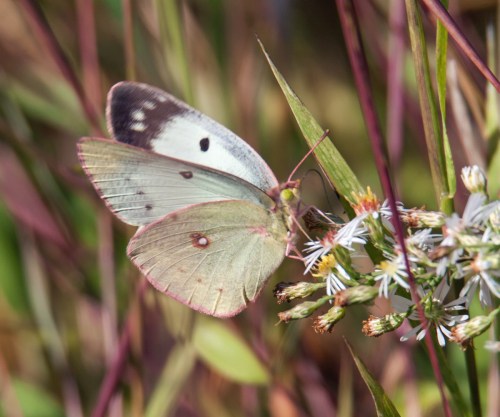
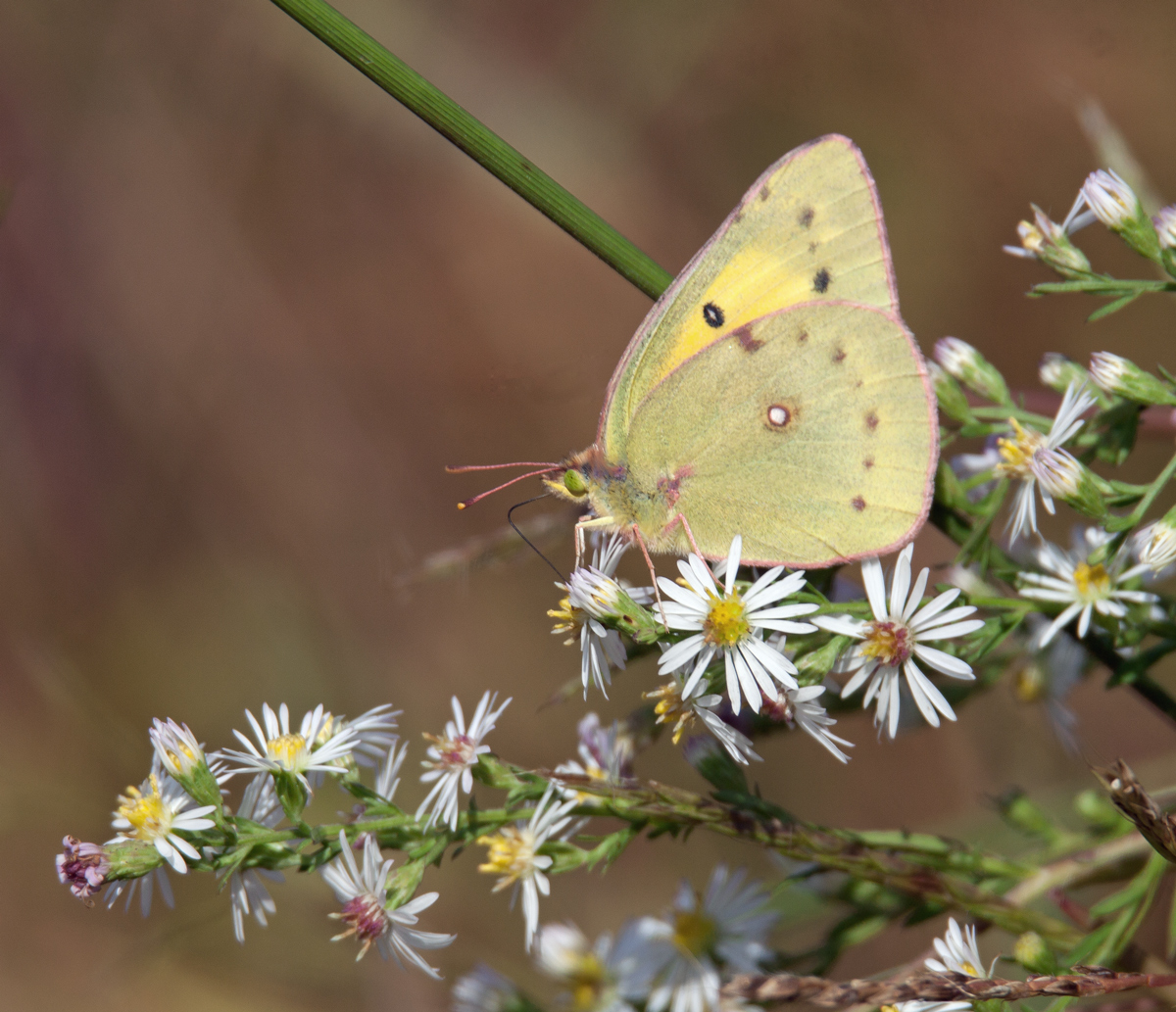
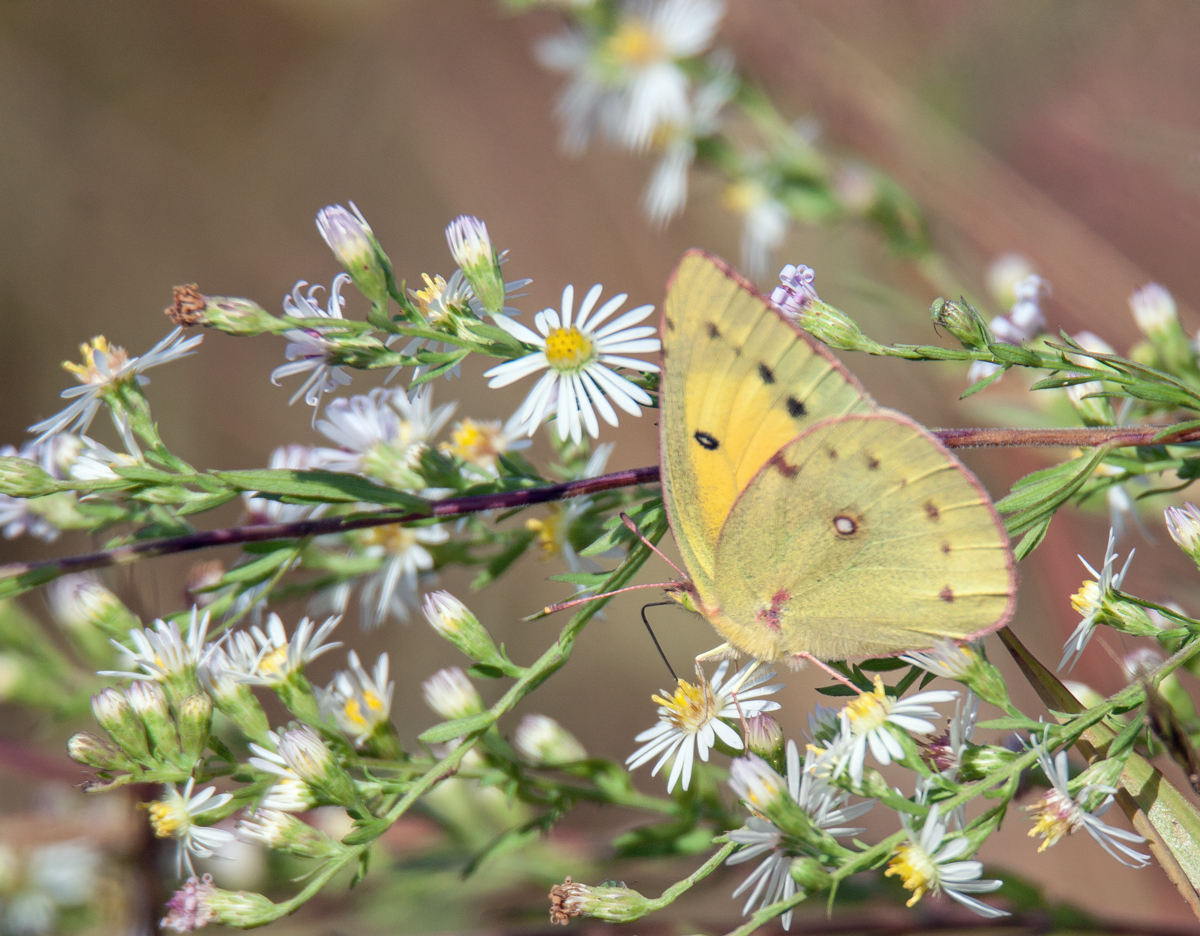
The large butterflies seem to be gone, but I continue to occasionally see smaller sulphur butterflies nectaring on late blooming flowers.
There are several different varieties of sulphur butterflies that look a bit alike, so I am not certain in identifying this butterfly. At first I thought that this might be a Pink-edged Sulphur (Colias interior), but the range maps suggest that we may not be in the correct geographic region for that species.
I think it is more likely that this is a Clouded Sulphur butterfly (Colias philodice). As for the flower, it looks to me to be some variety of aster.
The weather is definitely getting colder—I had to scrape frost off my car’s windshield earlier this week—so I don’t know how much longer I’ll be seeing these little beauties. Beauty so often is transitory; all we can do is enjoy it and appreciate it until it is gone.


© Michael Q. Powell. All rights reserved.
Posted in Autumn, Butterflies, Flowers, Nature, Photography | Tagged Alexandria VA, aster, Canon 50D, Clouded Sulphur, Clouded Sulphur butterfly, Colias philodice, Huntley Meadows Park, Tamron 150-600mm telephoto | 9 Comments »
October 22, 2015 by Mike Powell
When I arrived at the marsh in the early morning hours, it looked like the spiders had been busy all night preparing decorations for Halloween—there were spider webs everywhere.
The webs seemed to have been more hastily constructed than those of the orbweavers that I have observed recently and there did not appear to be any spiders in the center of these webs. What is the purpose of these webs if the spiders are not there to secure any prey that is caught in the web?
I can’t help but admire the amazing artistry of these fascinating little creatures as I examine the interlocking lines and curves of their incredible creations.
I’ve place these images in a mosaic collage—if you want to see larger versions of the images, just click on any one of them and you’ll move into a slide show mode that lets you scroll through them quickly.
© Michael Q. Powell. All rights reserved.
Posted in Arachnids, Art, Autumn, Nature, Photography | Tagged Alexandria VA, Canon 50D, Halloween, Huntley Meadows Park, spider art, spider webs, spiderwebs, Tamron 150-600mm telephoto, webs | 9 Comments »
October 21, 2015 by Mike Powell
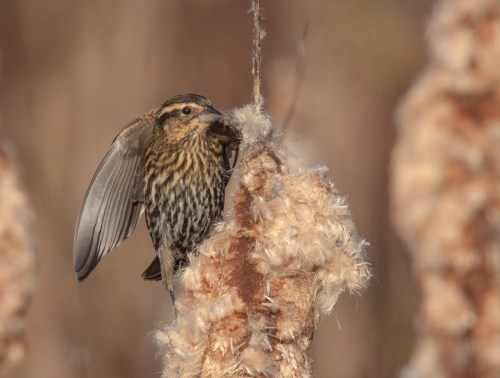
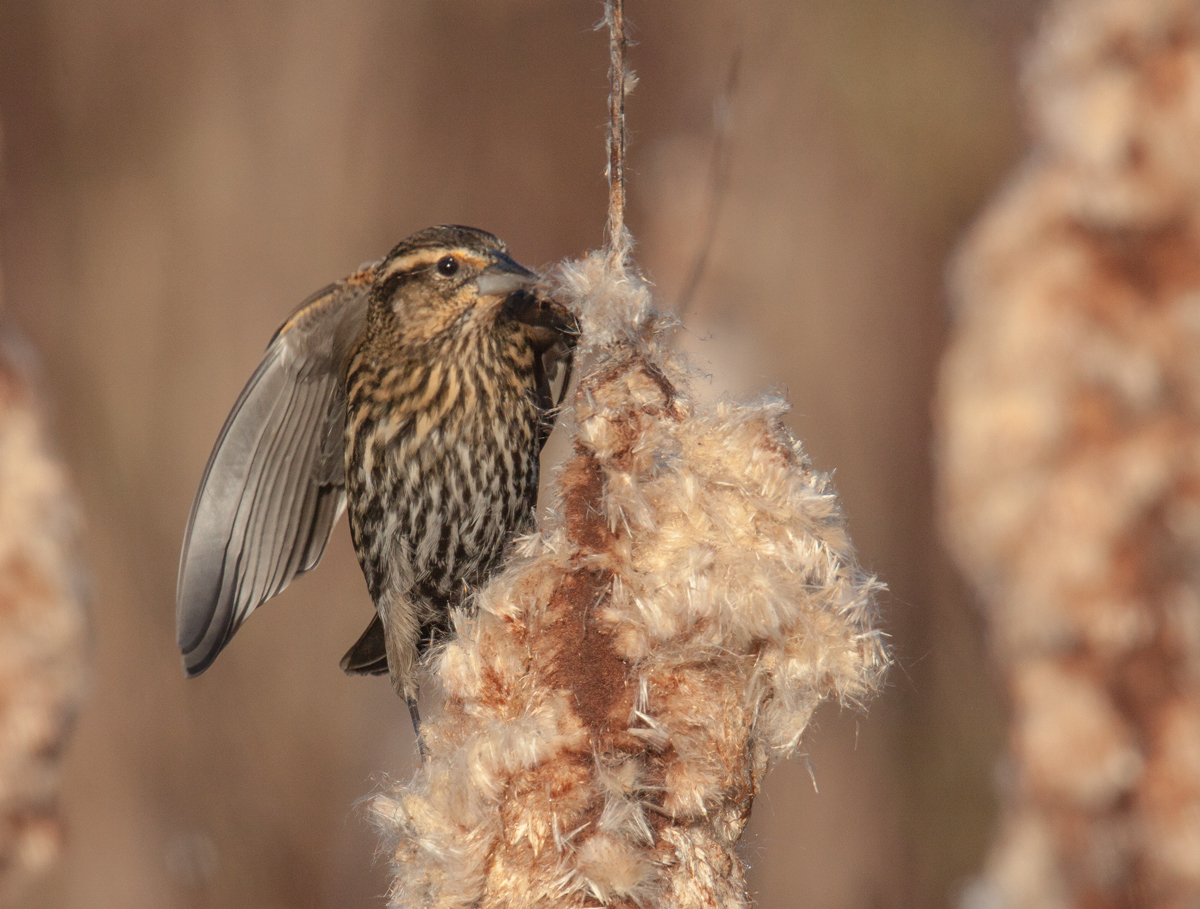
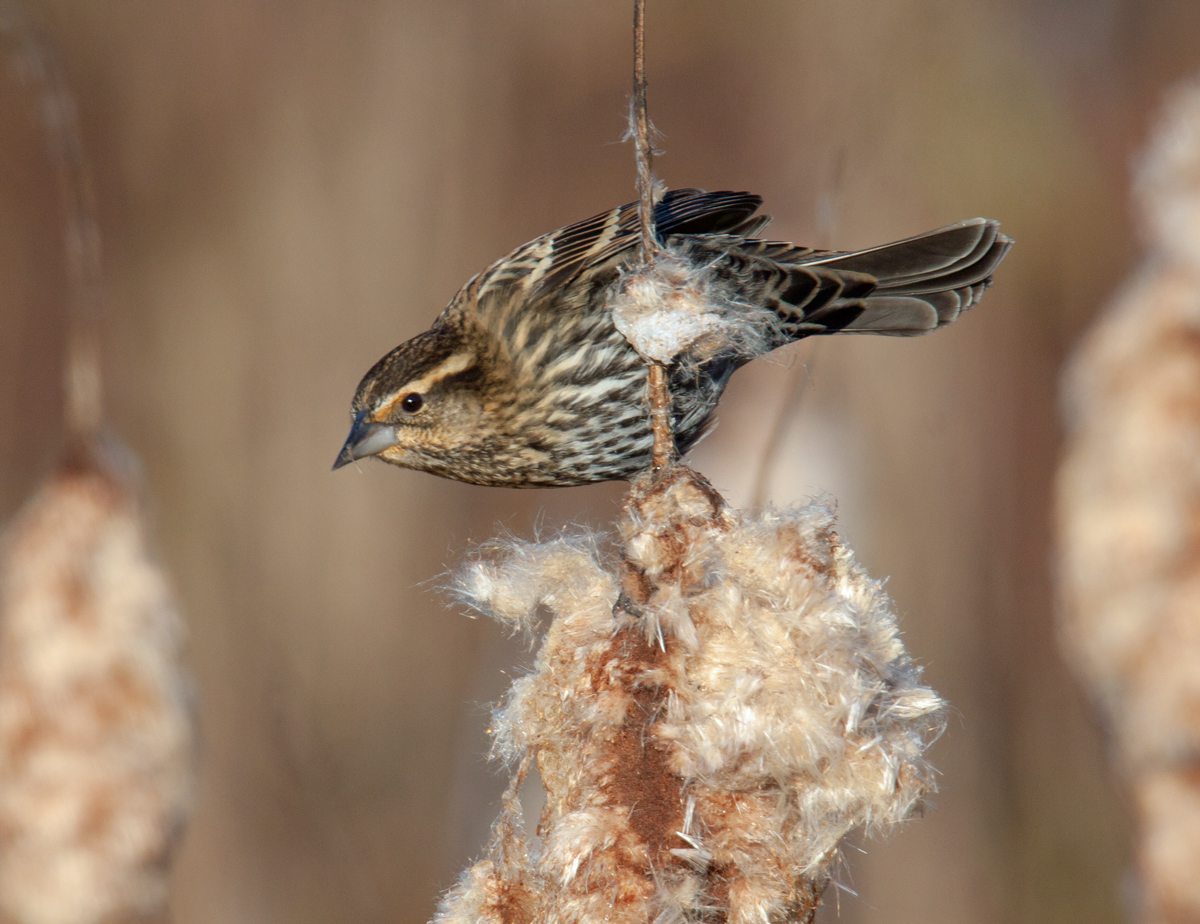
A small flock of Red-winged Blackbirds (Agelaius phoeniceus) was active in the cattails at Huntley Meadows Park on Monday morning. I was happy to be able to capture some action shots of one of the females, which, as you can readily see, are not black and don’t have red wings.
It was a real treat for me to be able to get some shots of the female blackbirds at the top of the cattails. Most of the time, the females peck about at the base of the cattails and only the male blackbirds are visible at the tops. For whatever reason, the majority of the members of this small flock appeared to be females.
I didn’t think that this female blackbird was aware of my presence as she diligently searched for insects, but the stare that I captured in the final photo seemed to be conveying a message that she did not want me there. I backed off and left a short time later.


© Michael Q. Powell. All rights reserved.
Posted in Birds, Nature, Photography, wildlife | Tagged Agelaius phoeniceus, Alexandria VA, Canon 50D, female Red-winged Blackbird, Huntley Meadows Park, red-winged blackbird, Tamron 150-600mm telephoto | 6 Comments »
October 20, 2015 by Mike Powell
A lot of scratching and movement was taking place down deep in the cattails and I stopped and waited, hoping to see what birds were responsible for the commotion. Finally, one of them popped to the surface and it looked to be a White-throated Sparrow (Zonotrichia albicollis) and I smiled.
Sparrows have a very special place in my heart, because they remind me of my deceased parents. When I was growing up, one of their favorite hymns at church was “His Eye is On the Sparrow.” The hymn has a simple, Scripture-based message that we should not be discouraged, because the same God who watches over the sparrows in the field cares even more for us.
Now, whenever I see sparrows, I smile as I am filled with memories of my parents, and the words of the chorus of the hymn play again in my mind, “I sing because I’m happy. I sing because I’m free. For His eye is on the sparrow. And I know He watches me.”
If you have never heard this song, there are many versions of it on YouTube, including, versions by such noted artists as Whitney Houston. Sandi Patty’s rendition is close to the version that I remember in the small Baptist churches of my childhood.


© Michael Q. Powell. All rights reserved.
Posted in Birds, Inspiration, Nature, Photography, wildlife | Tagged Alexandria VA, Canon 50D, His Eye is on the Sparrow, Huntley Meadows Park, sparrow, Tamron 150-600mm telephoto, white-throated sparrow, Zonotrichia albicollis | 6 Comments »
October 19, 2015 by Mike Powell
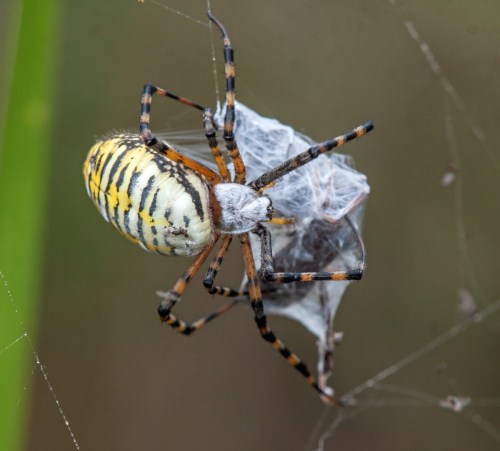
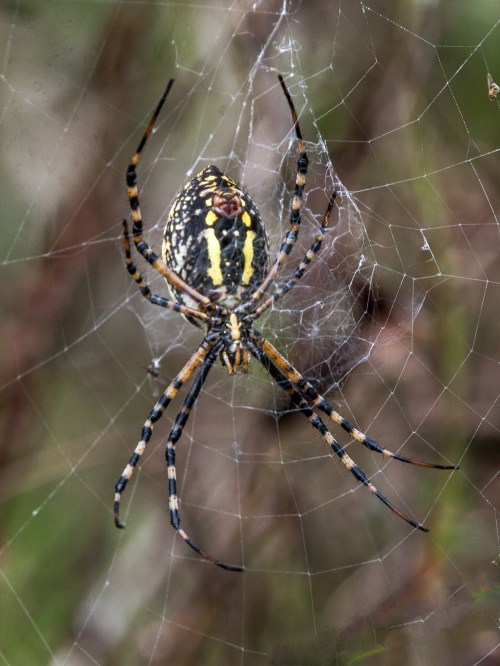
After a summer of not seeing many spiders, I was thrilled recently to spot this orbweaver spider as it dealt with an unidentified prey that it had captured.
Most of the large spiders that I observe are Black and Yellow Garden spiders (Argiope aurantia), but this one looks different from the ones that I have previously seen, especially in the first image. It may be that I am used to seeing the spider only in the center of her web, as in the second image, or perhaps this is a different spider species.
This was an unusual case for me, because I spotted the spider as I was walking through a field of waist-high vegetation and I was able to get pretty close to the spider and get these shot with my macro lens. Generally, I am forced to photograph spiders like this from a distance (which most people probably think is a good idea anyways).
There are some subjects, like cute birds, that I photograph that I know will have a broad appeal, but past experience has shown me that spiders tend to divide people into two camps—some people are fascinate and think spiders are totally cool, while others are thoroughly creeped out and find spiders to be repulsive.
What do you think about spiders?
© Michael Q. Powell. All rights reserved.
Posted in Arachnids, Autumn, Macro Photography, Nature, Photography | Tagged Alexandria VA, Argiope aurantia, Black and Yellow Garden Orbweaver spider, Canon 50D, Huntley Meadows Park, orbweaver, spider, Tamron 180mm macro | 17 Comments »
October 18, 2015 by Mike Powell
Posted in Autumn, Dragonflies, Macro Photography, Nature, Photography, wildlife | Tagged Alexandria VA, Huntley Meadows Park, Lestes forcipatus, Sweetflag Spreadwing, Sweetflag Spreadwing damselfly | 7 Comments »
October 18, 2015 by Mike Powell
In the early light of the dawn, I captured this solitary Great Blue Heron (Ardea herodias) in deep reflection, contemplating the start of a new day.
There is nothing really complex about this image, but I like the way that it conveys the mood of that moment, a moment when the world seemed to be totally tranquil, uncluttered by the hustle and bustle of everyday life.
I love the early morning.

© Michael Q. Powell. All rights reserved.
Posted in Art, Autumn, Birds, Nature, Photography, wildlife | Tagged Alexandria VA, Ardea herodias, Canon 50D, dawn, Great Blue Heron, heron, Huntley Meadows Park, Tamron 150-600mm telephoto | 5 Comments »
October 17, 2015 by Mike Powell
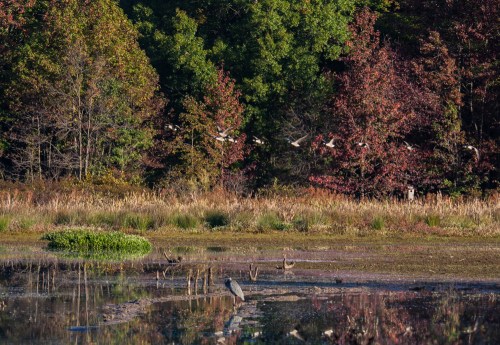
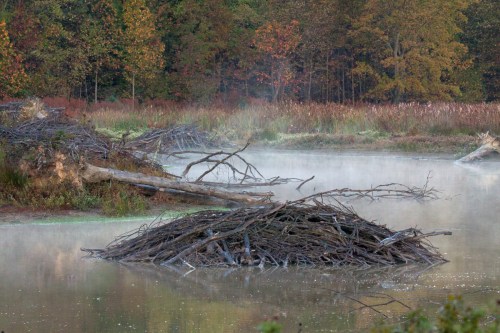
As the sun gradually illuminates the trees and burns off the mist on the water, Huntley Meadows Park is especially beautiful, especially at this time of the year, when the trees are showing off their changing colors. The park was silent when I arrived in the early morning darkness, but gradually I could hear the sounds of birds singing and I couldn’t help but notice the arrival of a small flock of Canada Geese (Branta canadensis).
The colors of the foliage here in Northern Virginia are not as bold and striking as in some other parts of the country, but there is an understated beauty in the muted tones or red and yellow. I am not used to taking landscape-style shots (and a 150-600mm lens is probably not optimal for doing so), but I tried to capture some different scenes to give you a sense of the park where I take so many of my photographs. It’s a wondrous location, particularly when you consider that it is found in a suburban location.


© Michael Q. Powell. All rights reserved.
Posted in Autumn, Birds, Landscape, Nature, Photography | Tagged Alexandria VA, autumn colors, Branta canadensis, Canada Geese, Canon 50D, Huntley Meadows Park, Tamron 150-600mm telephoto | 11 Comments »
October 16, 2015 by Mike Powell
Most of the frogs that I have seen in the last few months have been hopping away or diving into the water as I walked along small streams in search of dragonflies. Last weekend, though, I happened to notice a frog in the shallow water of a small pool in the woods of my favorite marshland park.
The light was nice and the frog was only partially submerged, so I moved closer to the frog to take some shots. I could tell was a Southern Leopard frog (Lithobates sphenocephalus), a pretty common frog where I live. I really like the distinctive spots that are responsible for its name.
Standing relatively upright, I was able to get a good shot of the frog’s entire body. I was happy with the shot, but not fully satisfied, so I decided to try for a lower shot. Sometimes I will lie on my stomach with my elbows propped on the ground for this kind of shot, but the ground was wet and muddy, so I settled for a low crouch. I was hoping to get as close to eye level with the frog as I could.
When you look at the two photos, you can notice some interesting differences caused by the change of perspective. The frog appears much flatter in the second shot and some interesting reflections of the eyes have now appeared, which might have been caused more by a change in sunlight than by the change of position. Somehow I feel a little bit more immersed in the frog’s world in the second shot.
I’m not sure I’d be able to judge which of the two shots is better—I like aspects of each one. More importantly, I reminded myself of the important of varying my perspective, of changing angles and distances when working with a subject.
You can learn a lot by getting down with a frog.


© Michael Q. Powell. All rights reserved.
Posted in Amphibians, Nature, Photography, wildlife | Tagged Alexandria VA, Canon 50D, frog, Huntley Meadows Park, Lithobates sphenocephalus, Southern Leopard frog, Tamron 150-600mm telephoto | 5 Comments »
October 15, 2015 by Mike Powell
When you are face-to-face with this toad, you might notice that he has a few skin issues, but when you see him from the side, you realize that he has a serious problem that anti-acne cream surely will not cure.
I don’t often see toads at my local marshland park, so I couldn’t help but move in for a closer look when I spotted this one last weekend. At the park, we have both Fowler’s toads (Anaxyrus fowleri) and Eastern American Toads (Anaxyrus americanus) and I have trouble telling them apart. To make matters worse, according to the Virginia Herpetological Society, these species hybridize, “making identification difficult.”
I was pretty amazed when I looked at my shots to see all of the different textures and patterns on the toad’s body body. There are warts and weaves and different kinds of stripes. I’m happy too that I was able to capture the toad’s toes, which most often are hidden.


© Michael Q. Powell. All rights reserved.
Posted in Amphibians, Nature, Photography, Portraits, wildlife | Tagged Alexandria VA, Anaxyrus americanus, Anaxyrus fowleri, Canon 50D, Eastern American Toad, Fowler's Toad, Huntley Meadows Park, Tamron 180mm macro lens | 10 Comments »
October 14, 2015 by Mike Powell
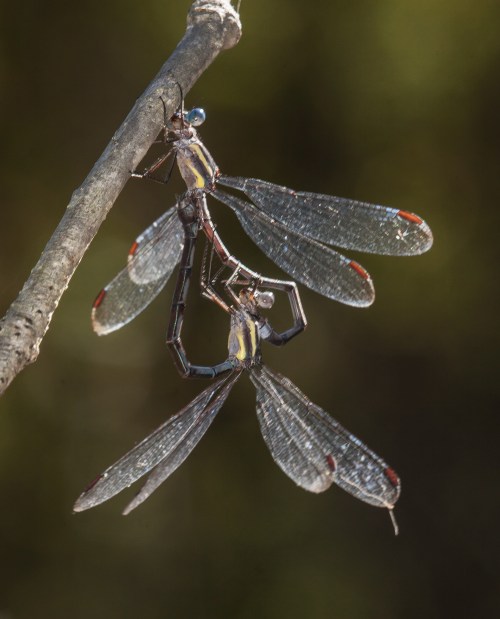
How do you feel when confronted with a graphic image of mating damselflies? Are you shocked, offended, fascinated, or intrigued? Is it art or is it pornography?
I couldn’t help but feel a little bit like a voyeur as I crept closer and closer on Monday to the mating Great Spreadwing damselflies (Archilestes grandis) with my macro lens. As I prepared the photos for this posting, it seemed like I had extracted a couple of pages from the Damselfly Kama Sutra. What exactly were they doing as they assumed more and more acrobatic positions? It was like watching an R-rated (or maybe X-rated) Cirque du Soleil performance.
Art or pornography? Sometime in the distant past I remember studying a Supreme Court case in which attempts were made to define obscenity. With the help of Wikipedia, I refreshed my memory. It was a 1964 case and Justice Potter Stewart wrote some words that have become a guideline for assessing a given piece of work:
“I shall not today attempt further to define the kinds of material I understand to be embraced within that shorthand description [“hard-core pornography”], and perhaps I could never succeed in intelligibly doing so. But I know it when I see it…”
So that’s it, “I know it when I see it.”
I’ll boldly contend that my photos are art. I am glad, however, that I am not a parent who has to respond to a young child’s curious question about what these damselflies are doing. The birds and the bees are simple to explain by comparison. With damselflies, I think the Facebook expression fits—”it’s complicated.”

© Michael Q. Powell. All rights reserved.
Posted in Art, Dragonflies, Insects, Macro Photography, Nature, Photography | Tagged Alexandria VA, Archilestes grandis, Canon 50D, damselflies mating, Great Spreadwing, Great Spreadwing damselfly, Huntley Meadows Park, Tamron 180mm macro lens | 10 Comments »
October 14, 2015 by Mike Powell
The loud screams of a hawk rang out for extended periods of time during one of my trips to Huntley Meadows Park this past weekend. I couldn’t tell for sure if it was a single hawk or more than one, but the screams seemed to be those of a Red-shouldered Hawk (Buteo lineatus). (You can hear the distinctive sound of this hawk by following this link to the Cornell Lab of Ornithology.)
The calls seemed to be coming from deep in the woods, but eventually a hawk flew overhead. The light was good enough that I was able to capture a pretty good amount of the beautiful details of this impressive-looking raptor, including the one feather at the tip of the wings that seems a bit frayed.
I think this is a juvenile Red-shouldered Hawk, perhaps the one that was making the calls that I had heard a bit earlier. As always, I welcome any corrections in my identification from more experienced birders.
UPDATE: One of my Facebook readers weighed in and noted that this is a juvenile Red-tailed Hawk.

© Michael Q. Powell. All rights reserved.
Posted in Birds, Nature, Photography, wildlife | Tagged Alexandria VA, birds in flight, Buteo lineatus, Canon 50D, Huntley Meadows Park, Red-Shouldered Hawk, Tamron 150-600mm telephoto | 3 Comments »
October 13, 2015 by Mike Powell
Do you pay any attention to the nondescript little birds pecking about in the underbrush? Do you even notice them?
I love trying to capture images of impressive, powerful hawk, owls, and eagles. There is no denying their beauty. However, I’ll also stop and try to get a glimpse of the small birds too, for I have learned that they have a special beauty all their own.
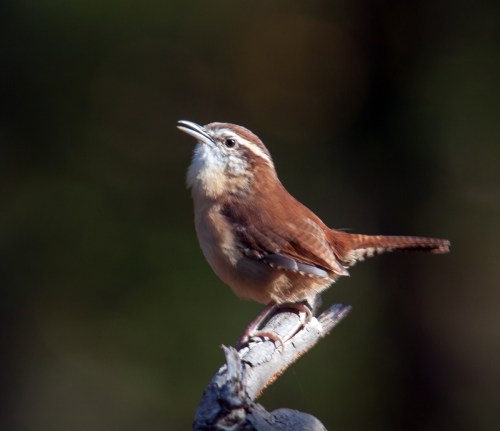
I am especially happy when I can get an unobstructed view of one of them, like this Carolina Wren (Thryothorus ludovicianus) that I spotted yesterday at my local marshland park.
The beautiful little wren seems full of personality and exudes a positive, happy attitude.
Don’t let that beauty go unnoticed.
© Michael Q. Powell. All rights reserved.
Posted in Birds, Nature, Photography, Portraits | Tagged Alexandria VA, Canon 50D, Carolina Wren, Huntley Meadows Park, Tamron 150-600mm telephoto, Thryothorus ludovicianus | 13 Comments »
October 12, 2015 by Mike Powell
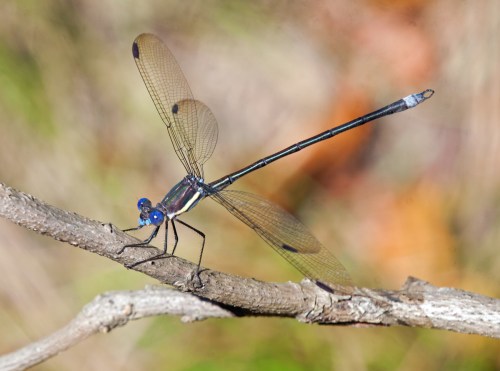
I just love the beautiful blue eyes and distinctive markings of the male Great Spreadwing damselfly (Archilestes grandis) and I was thrilled when I spotted one on Saturday at Huntley Meadows Park in Alexandria, Virginia.
I wonder if it damages this little guy’s self-esteem to be called a “damsel?” Perhaps he looks with envy at his odonate brethren with the more macho-sounding “dragon” in their names. Do we need a more gender-neutral name for damselflies?
© Michael Q. Powell. All rights reserved.
Posted in Art, Dragonflies, Insects, Macro Photography, Nature, Photography, Portraits | Tagged Alexandria VA, Archilestes grandis, Canon 50D, Great Spreadwing, Great Spreadwing damselfly, Huntley Meadows Park, Tamron 180mm macro lens | 7 Comments »
October 11, 2015 by Mike Powell
What’s the largest damselfly in North American? According to Dennis Paulson, in his wonderful book, Dragonflies and Damselflies of the East, that title goes to the Great Spreadwing damselfly (Archilestes grandis), which is more than two inches (5 cm) in length, i.e. bigger than many of the dragonflies that I so frequently chase.
My good friend and local dragonfly expert Walter Sanford spotted a male Great Spreadwing this past week and posted a photo of it and yesterday I felt inspired to try to find one myself. He had provided me the general location at Huntley Meadows Park, my favorite local place for nature photography, and I patiently searched near the water, in the tall vegetation, and under the trees for almost two hours.
As my patience was starting to wear thin, I finally spotted one. The Great Spreadwing damselflies have a yellow racing stripe on their thorax and are quite distinctive, in addition to their size. I took some initial shots with my big zoom lens and then switched quickly to my 180mm macro lens.
The first Great Spreadwing I spotted was a male, but eventually I spotted a female and a pair of them in the tandem position. I am still going through my shots, but wanted to post a couple initially. I will probably post some more images in another posting or two.
The first shot shows a female Great Spreadwing damselfly—you can tell from her coloration and her terminal appendages. She let me take quite a few photos and returned to nearby vegetation a couple of times when she was spooked. The second image is a close-up that shows her beautiful eyes and her blue upper lips, which I think technically are called labrum.
Perhaps blue lips are the new fashion craze for the autumn. I’ll look around and see if any of the young ladies in the Washington D.C. area are sporting this look.


© Michael Q. Powell. All rights reserved.
Posted in Dragonflies, Macro Photography, Nature, Photography, wildlife | Tagged Alexandria VA, Archilestes grandis, Canon 50D, Great Spreadwing, Great Spreadwing damselfly, Huntley Meadows Park, Tamron 180mm macro lens | 8 Comments »
October 10, 2015 by Mike Powell
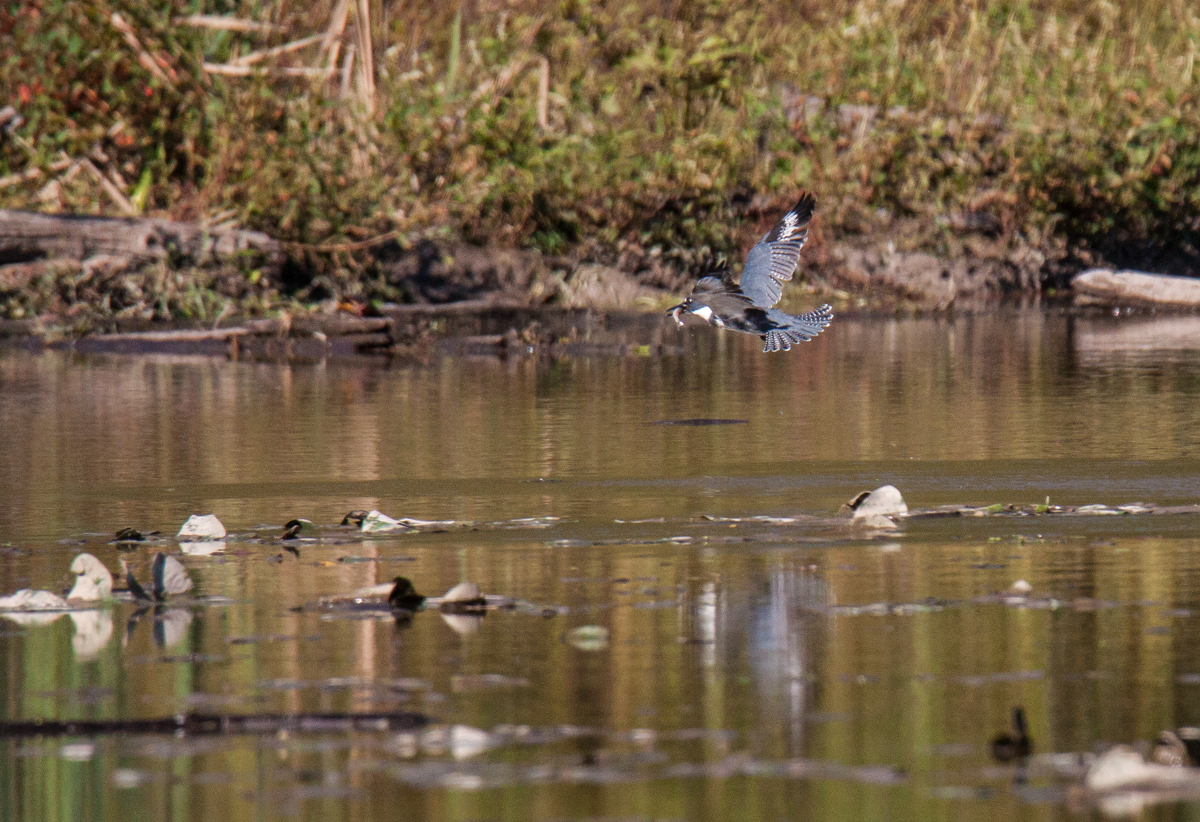
When I spotted a male Belted Kingfisher (Megaceryle alcyon) yesterday, I was really happy, because I have not seen a male in several years. He was pretty far away and I having a hard time getting a sharp shot, so I decided to switch to manual focus.
Just after I had switched, the kingfisher made a long shallow dive off of the rotten tree on which he was perched. Instinctively I tried to track the fast-moving bird as I frantically tried to focus. Not surprisingly, most of my shots were out of focus, but one came out pretty well. It shows the kingfisher just above the surface of the water with what appears to be a fish in his mouth. (You may want to click on the image to get a better look at the kingfisher.)

A bit later in the day, I took this shot of the male Belted Kingfisher on the same perch that he had been on earlier. He seemed to be in a good mood and almost looked like he was singing. Unlike the female, which has both a chestnut and a blue stripe or her chest, the male Belted Kingfisher has only the blue stripe.

The kingfisher was happy and I was overjoyed with my shots. It was a wonderful day.
© Michael Q. Powell. All rights reserved.
Posted in Birds, Nature, Photography, wildlife | Tagged Alexandria VA, Belted Kingfisher, birds in flight, Canon 50D, Huntley Meadows Park, male Belted Kingfisher, Megaceryle alcyon, Tamron 150-600mm telephoto | 9 Comments »
October 9, 2015 by Mike Powell
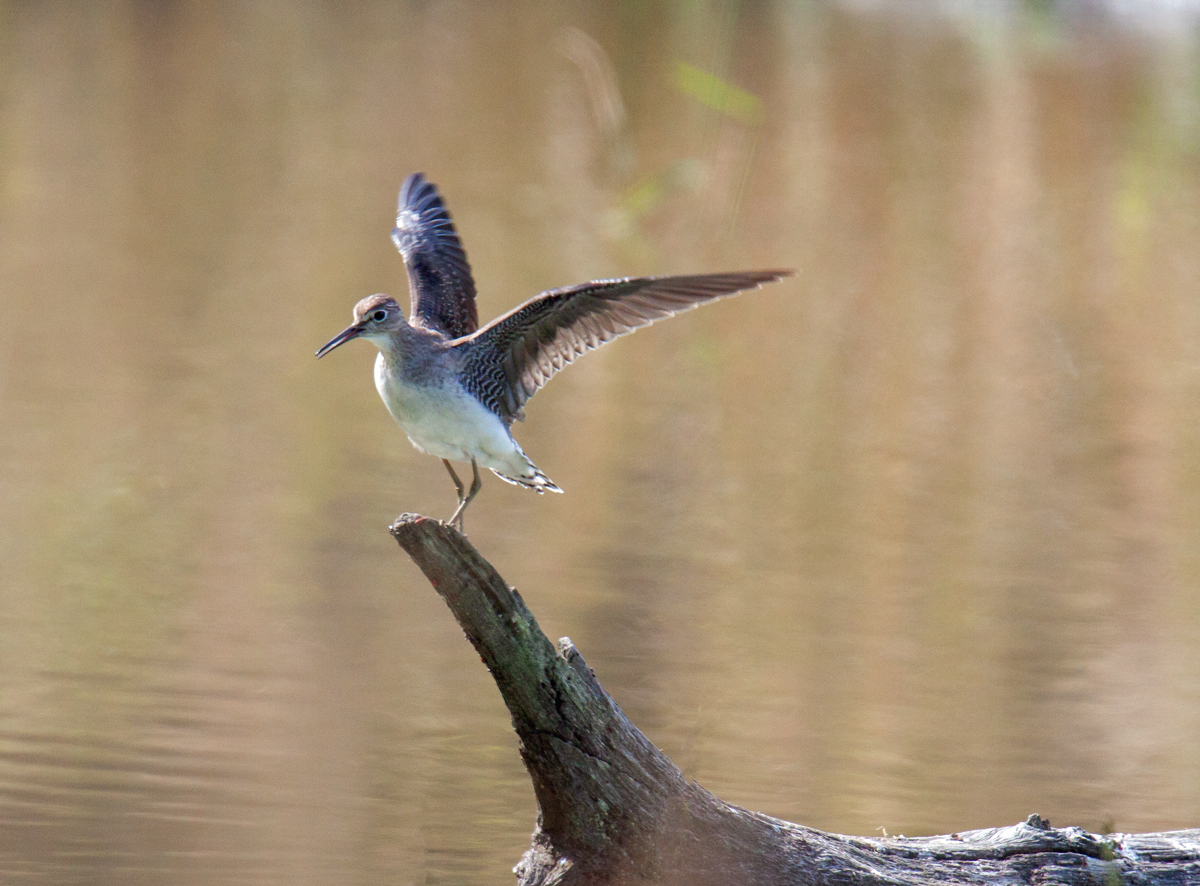
With Celine Dion’s voice echoing in his head, this Solitary Sandpiper (Tringa solitaria) reenacts a scene from his favorite movie and loudly exclaims, “I’m the king of the world.”
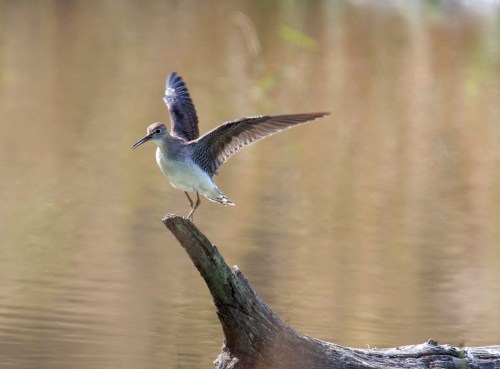
Despite believing that his heart will go on, this sandpiper is still feeling very solitary. Imagine how different that the movie “Titanic” would have been if Jack Dawson had followed the lead of this little bird and jumped from his perch.

In the interest of full disclosure, I’m not completely sure that this is a Solitary Sandpiper, but I didn’t want to let accuracy get in the way of a good story. Please let me know if my identification is incorrect.
© Michael Q. Powell. All rights reserved.
Posted in Birds, Humor, movies, Nature, Photography | Tagged Alexandria VA, Canon 50D, Celine Dion, Huntley Meadows Park, My Heart Will Go On, Solitary Sandpiper, Tamron 150-600mm telephoto, Titanic, Tringa solitaria | 5 Comments »
October 8, 2015 by Mike Powell
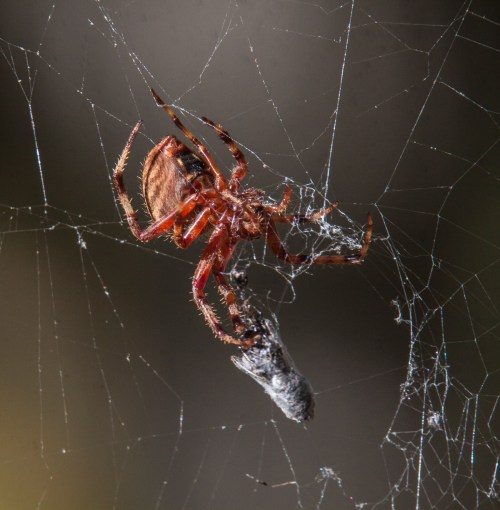
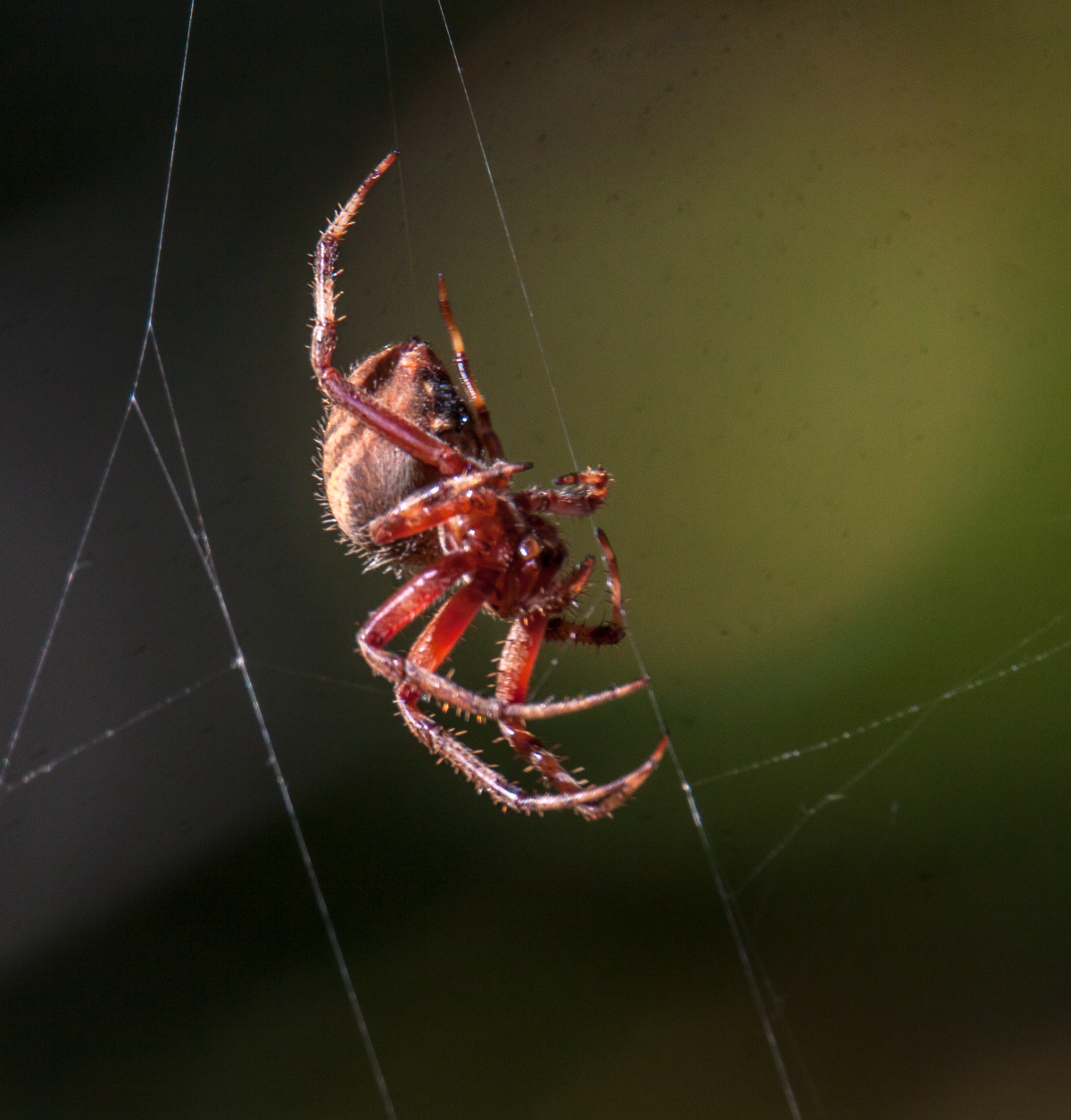
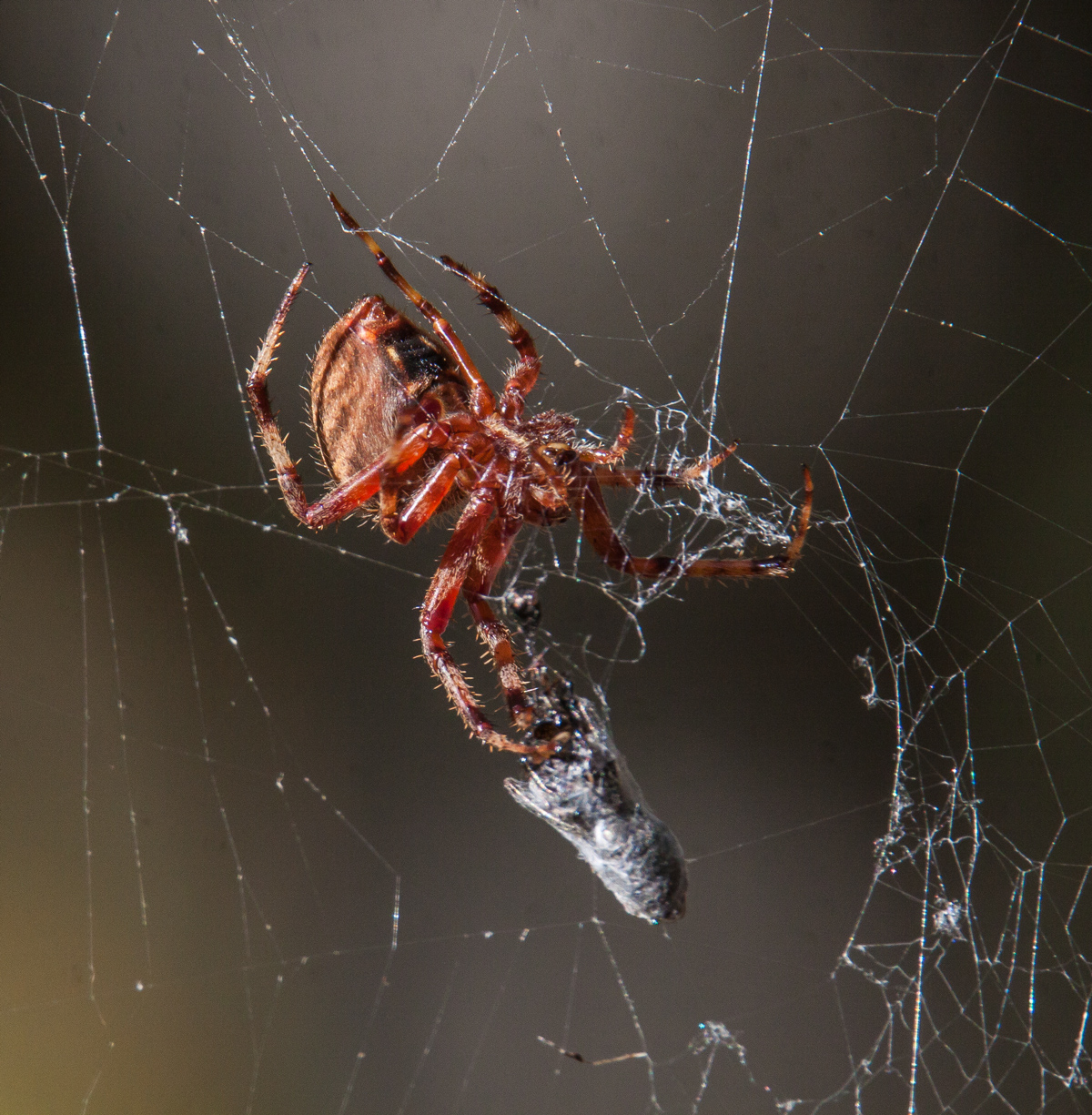
I spotted this barn spider (Neoscona crucifera) hanging in the air about the same time she sensed my presence. She scampered up her web as I moved in a little closer. Eventually she climbed back down and I managed to get these shots of her in motion.
Initially I couldn’t figure out why she was hurrying down the strands of her web. When she stopped, however, I could see that she was anxious to finish off the snack that she had wrapped up earlier.
Although these shots may look like they were taken with a macro lens, they were actually taken at 600mm on my Tamron 150-600mm zoom lens. I ended up focusing manually on the spider, because my camera kept wanting to focus on the background, which was a good distance away. Additionally, I used my pop-up flash on at least some of these images to bring out some of the details of the spider.


© Michael Q. Powell. All rights reserved.
Posted in Arachnids, Macro Photography, Nature, Photography, wildlife | Tagged Alexandria VA, barn spider, Canon 50D, Huntley Meadows Park, Neoscona crucifera, spider in motion, Tamron 150-600mm telephoto | 15 Comments »
October 7, 2015 by Mike Powell
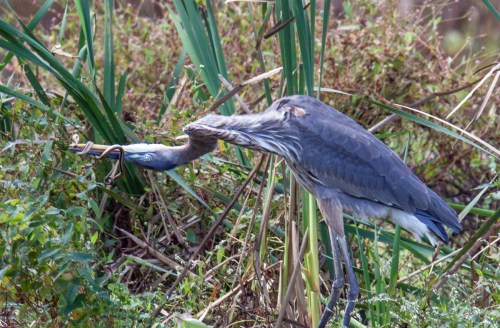
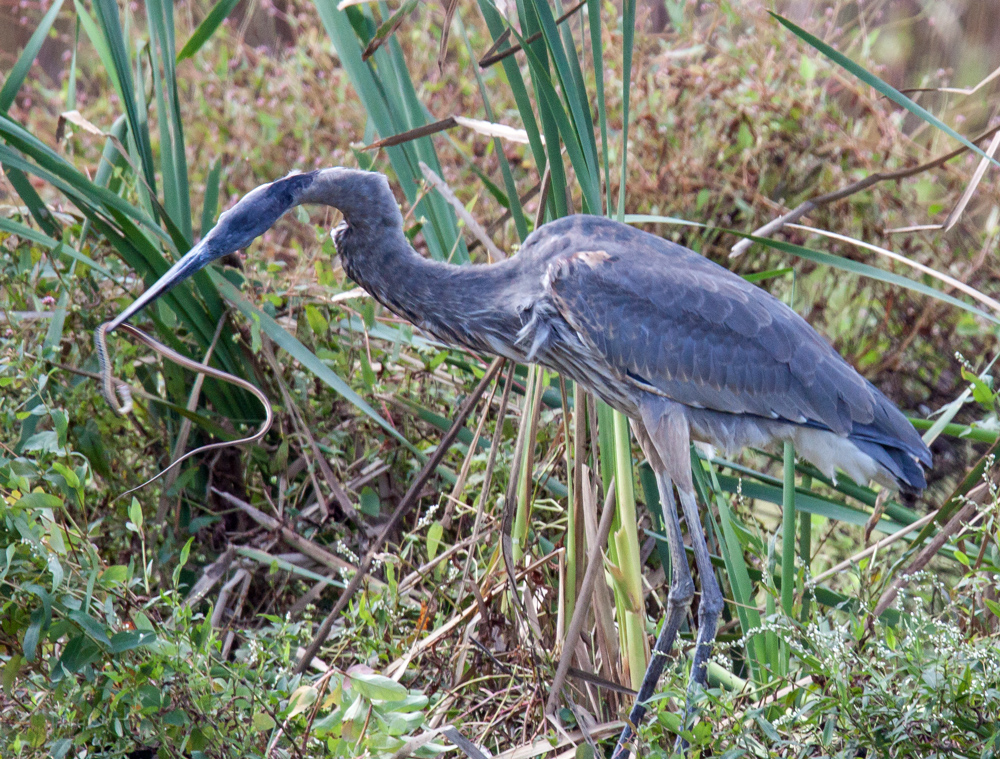
A snake struggled mightily when snagged by a Great Blue Heron (Ardea herodias). The heron looked a little confused by the actions of its prey and seemed to be having trouble figuring out how to grip the snake. I was a bit far away when I took these shots so I couldn’t tell for sure, but it looked to me that the heron eventually dropped the snake and the snake escaped into the thick vegetation.


© Michael Q. Powell. All rights reserved.
Posted in Birds, Nature, Photography, Reptiles, wildlife | Tagged Alexandria VA, Ardea herodias, Canon 50D, Great Blue Heron, Huntley Meadows Park, snake, Tamron 150-600mm telephoto | 11 Comments »
October 6, 2015 by Mike Powell
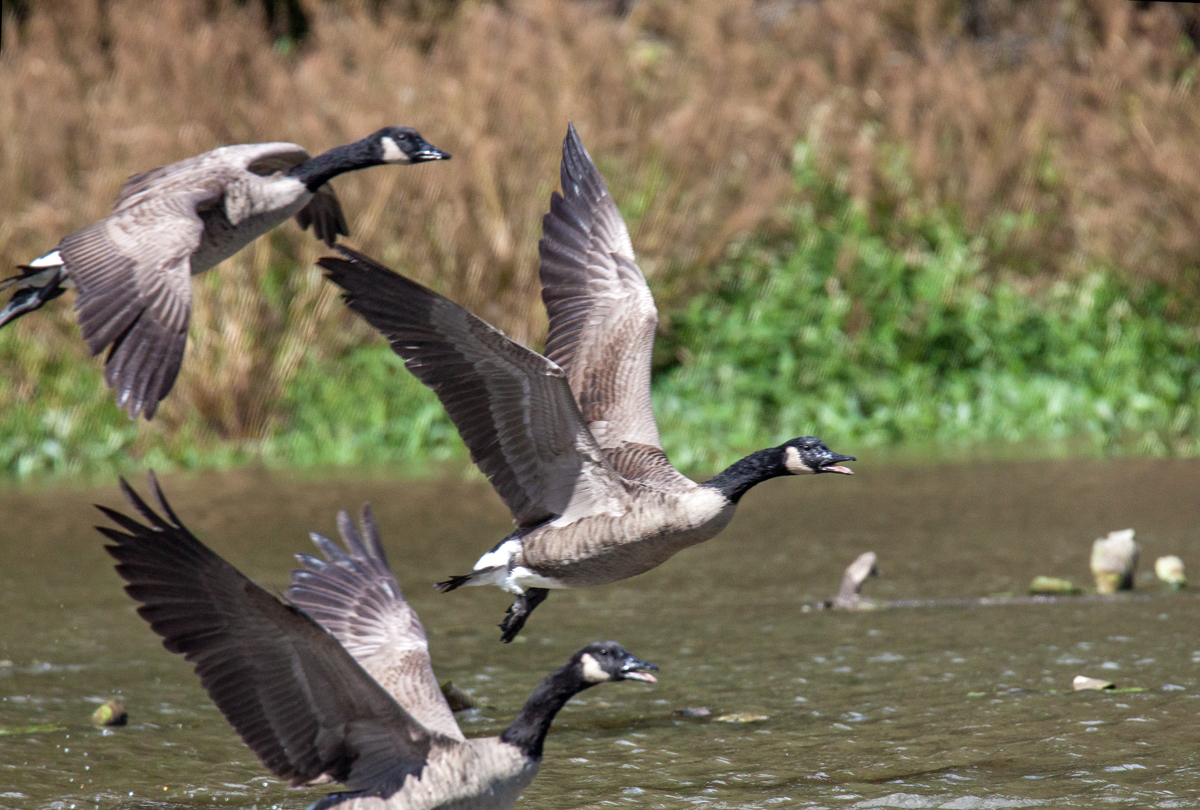
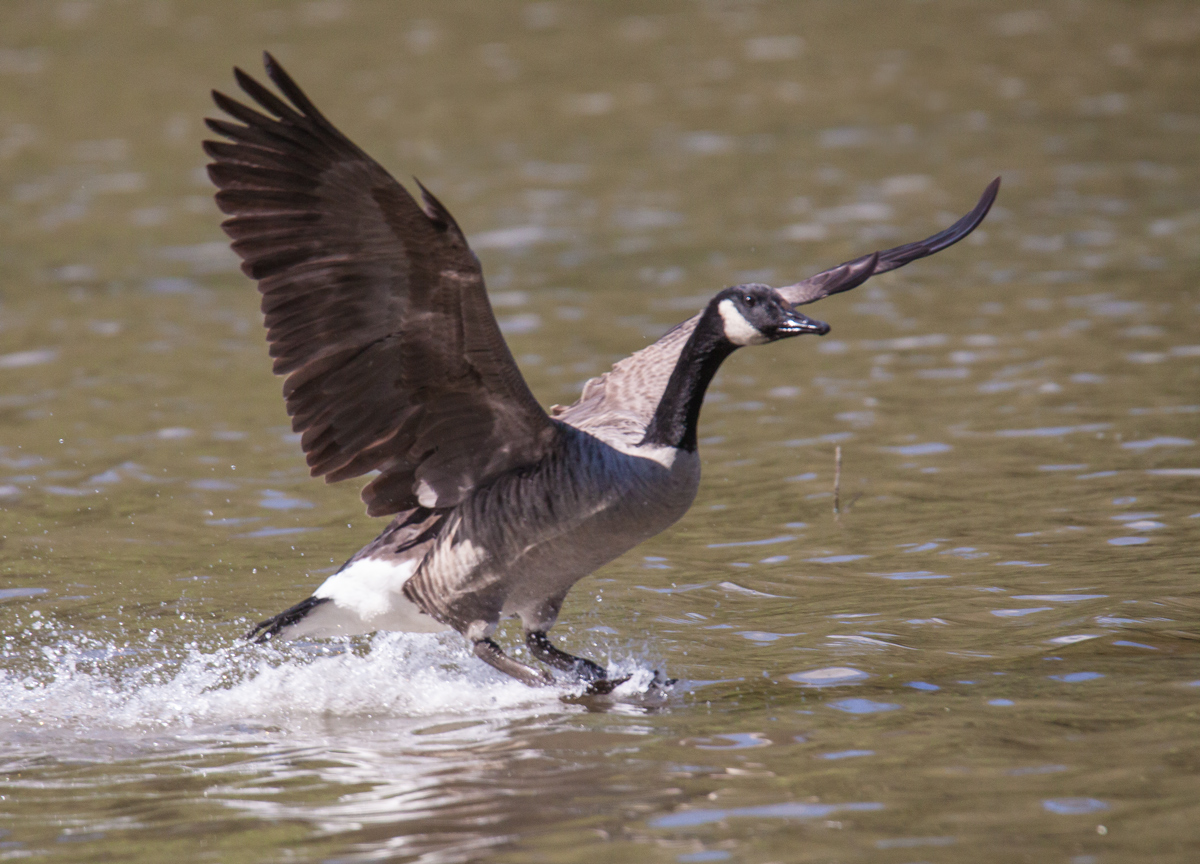
Canada Geese (Branta canadensis) are our constant companions at my favorite marshland park throughout the fall and the winter as the geese migrate south or choose to overwinter at the park. Several small flocks flew in yesterday, accompanied by the usual amount of honking and splashing to announce their arrival.
Folks at the park either love the geese or hate them (because of the mess they make). I enjoy seeing them and they provide me with lots of practice subjects to hone my skills in capturing birds in flight. Their interactions with each other are also fun to watch.


© Michael Q. Powell. All rights reserved.
Posted in Autumn, Birds, Nature, Photography, wildlife | Tagged Alexandria VA, birds in flight, Branta canadensis, Canada Geese, Canon 50D, Huntley Meadows Park, Tamron 150-600mm telephoto | 10 Comments »
October 5, 2015 by Mike Powell
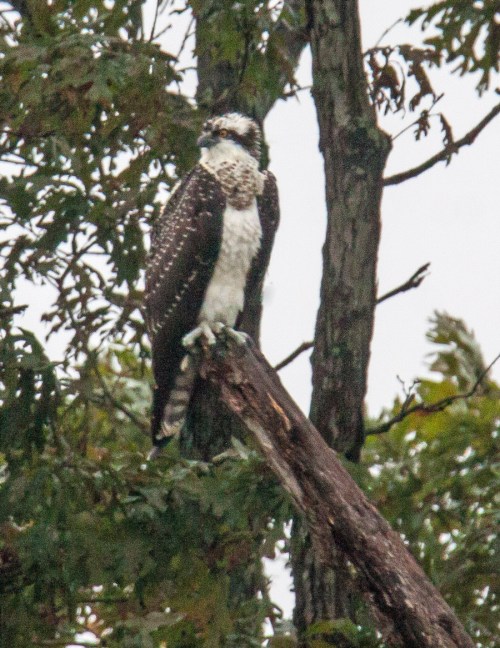
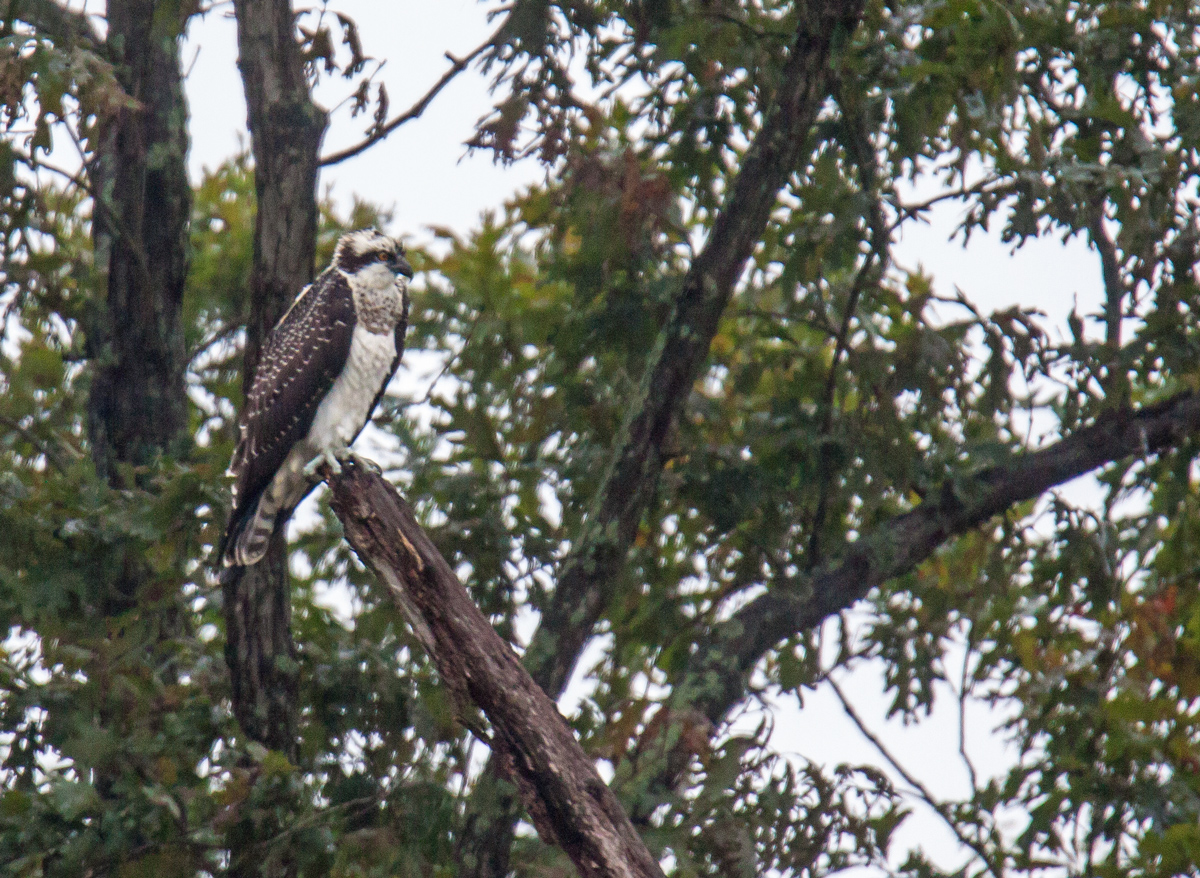
On Saturday morning, this juvenile Osprey (Pandion haliaetus) at Huntley Meadows Park seemed interested in only one thing—seeking shelter from the rain. The osprey was hunched over and seemed to be doing its best to retain body heat on a cold, wet, and windy day. Although it could almost certainly see me across the water of the pond, the young bird showed no inclination to move from its comfortable, sheltered perch.
The scalloped edges of the wing feathers are what cause me to think this is a juvenile osprey—the wings are a solid brown in adults.


© Michael Q. Powell. All rights reserved.
Posted in Autumn, Birds, Nature, Photography, wildlife | Tagged Alexandria VA, Canon 50D, Huntley Meadows Park, juvenile osprey, Osprey, Pandion haliaetus, Tamron 150-600mm telephoto | 5 Comments »
October 4, 2015 by Mike Powell
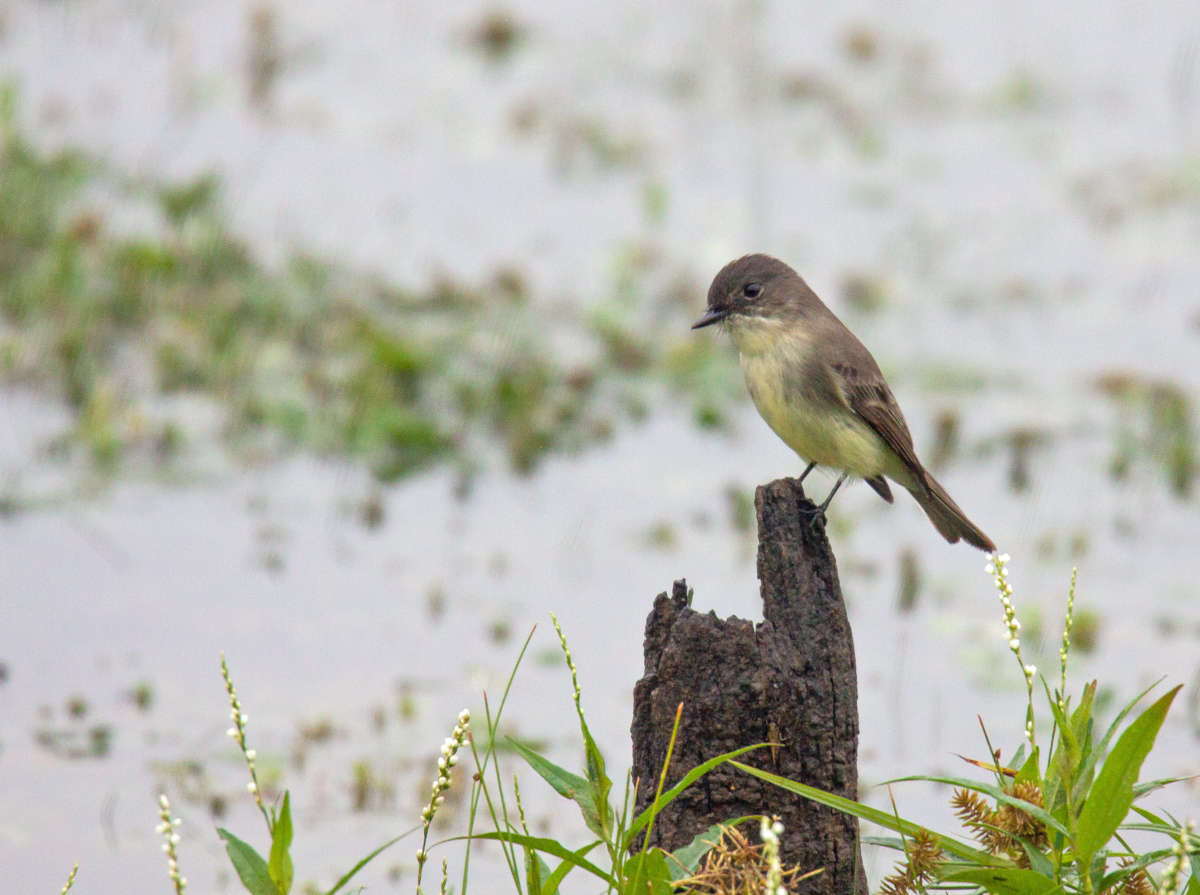
Despite the light rain, a few birds were flying about at Huntley Meadows Park yesterday morning. It was beautiful and peaceful, a feeling that I was able to partially capture in this image of one of my rainy day feathered friends, an Eastern Phoebe (Sayornis phoebe).

© Michael Q. Powell. All rights reserved.
Posted in Autumn, Birds, Nature, Photography | Tagged Alexandria VA, Canon 50D, Eastern Phoebe, Huntley Meadows Park, phoebe, raine, Sayornis phoebe, Tamron 150-600mm telephoto | 11 Comments »
October 3, 2015 by Mike Powell
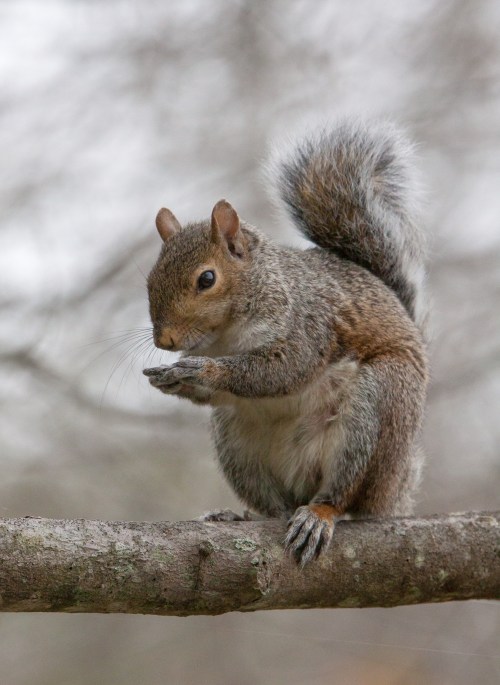
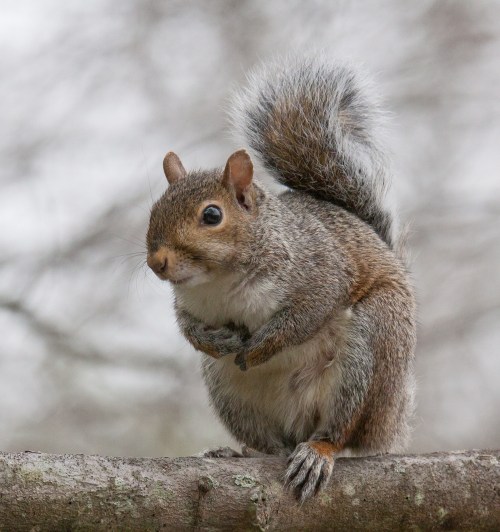
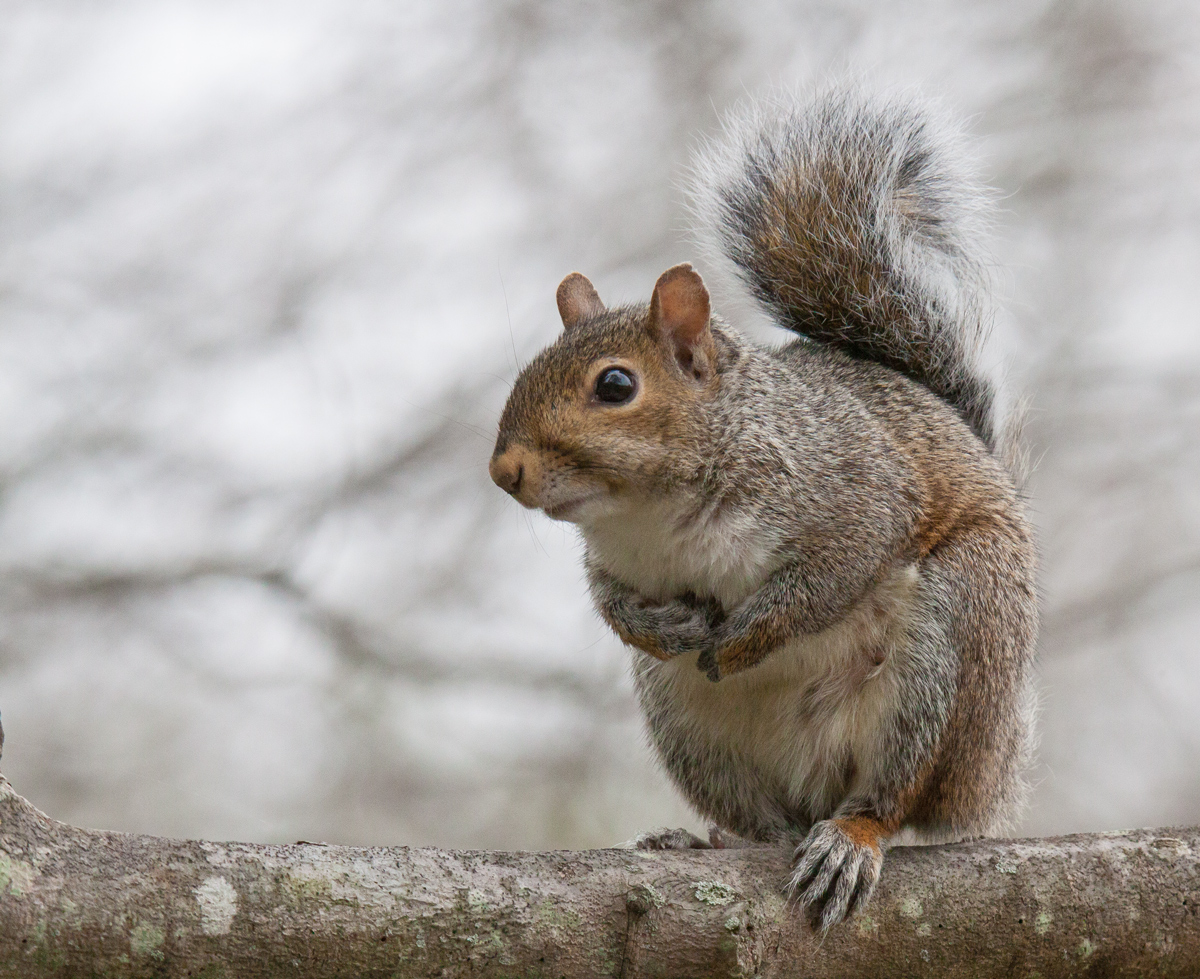
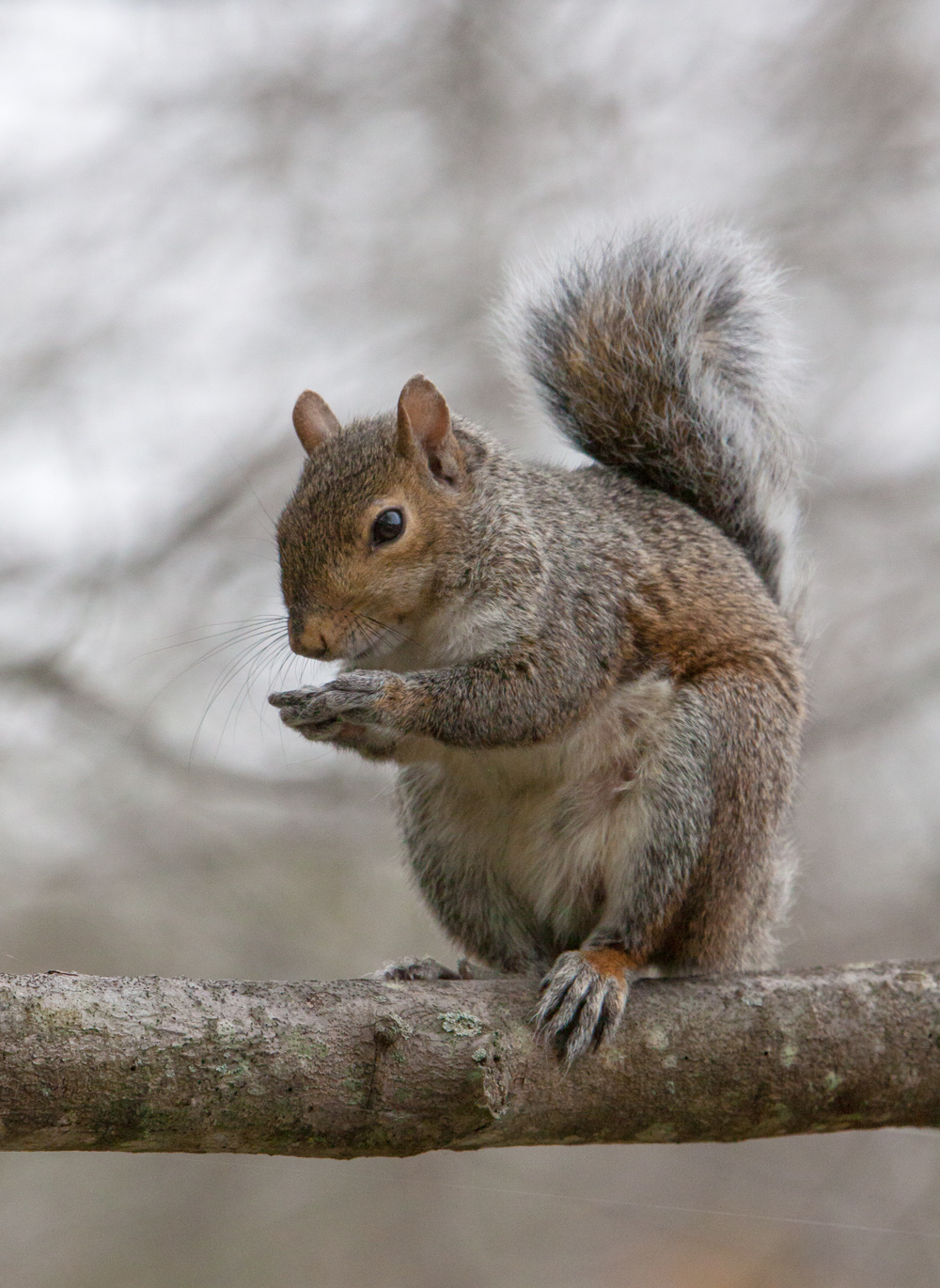
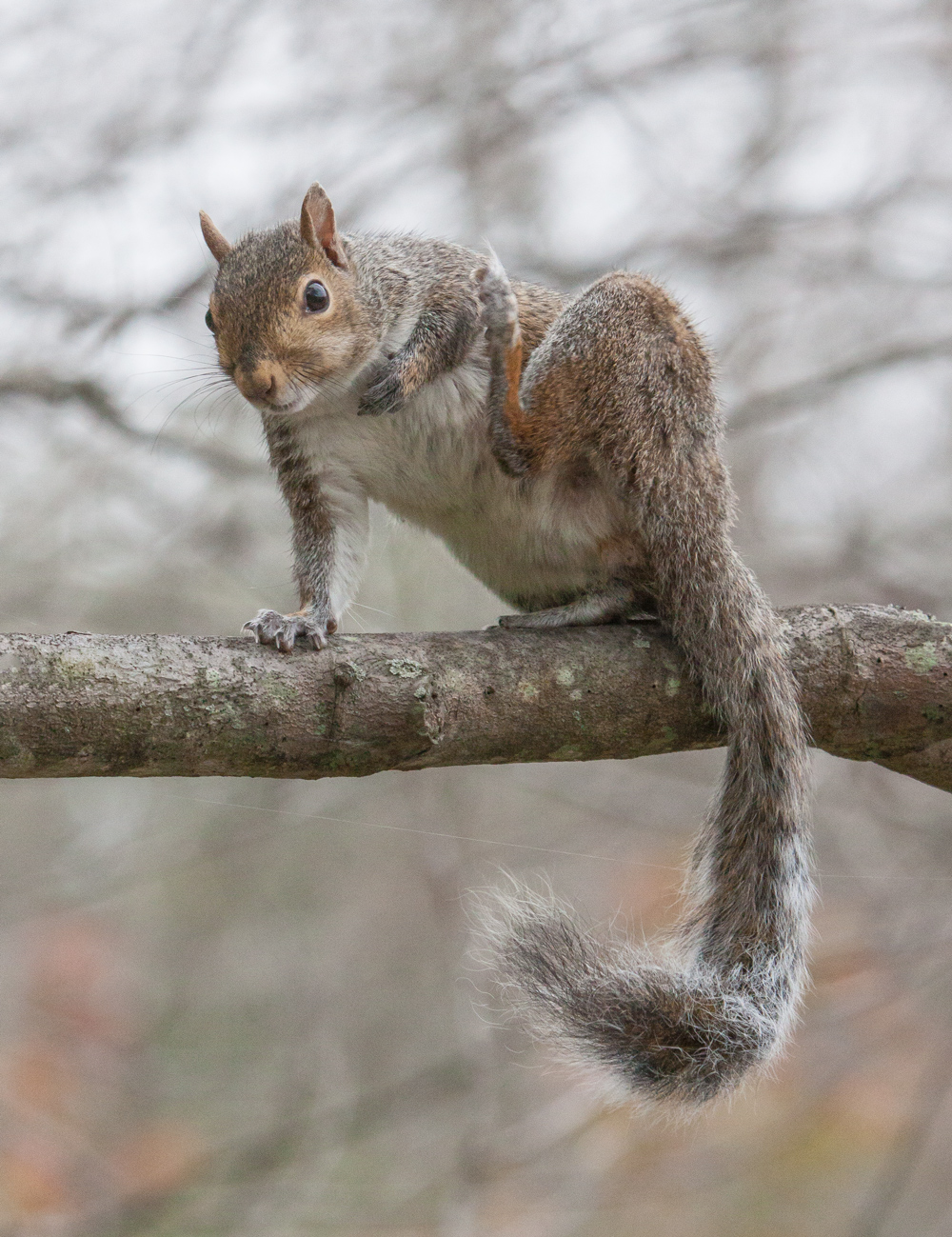
When you happen to catch sight of a squirrel, do you just keep walking? I love to watch squirrels. They are so energetic and industrious, traits that I admire in humans as well.
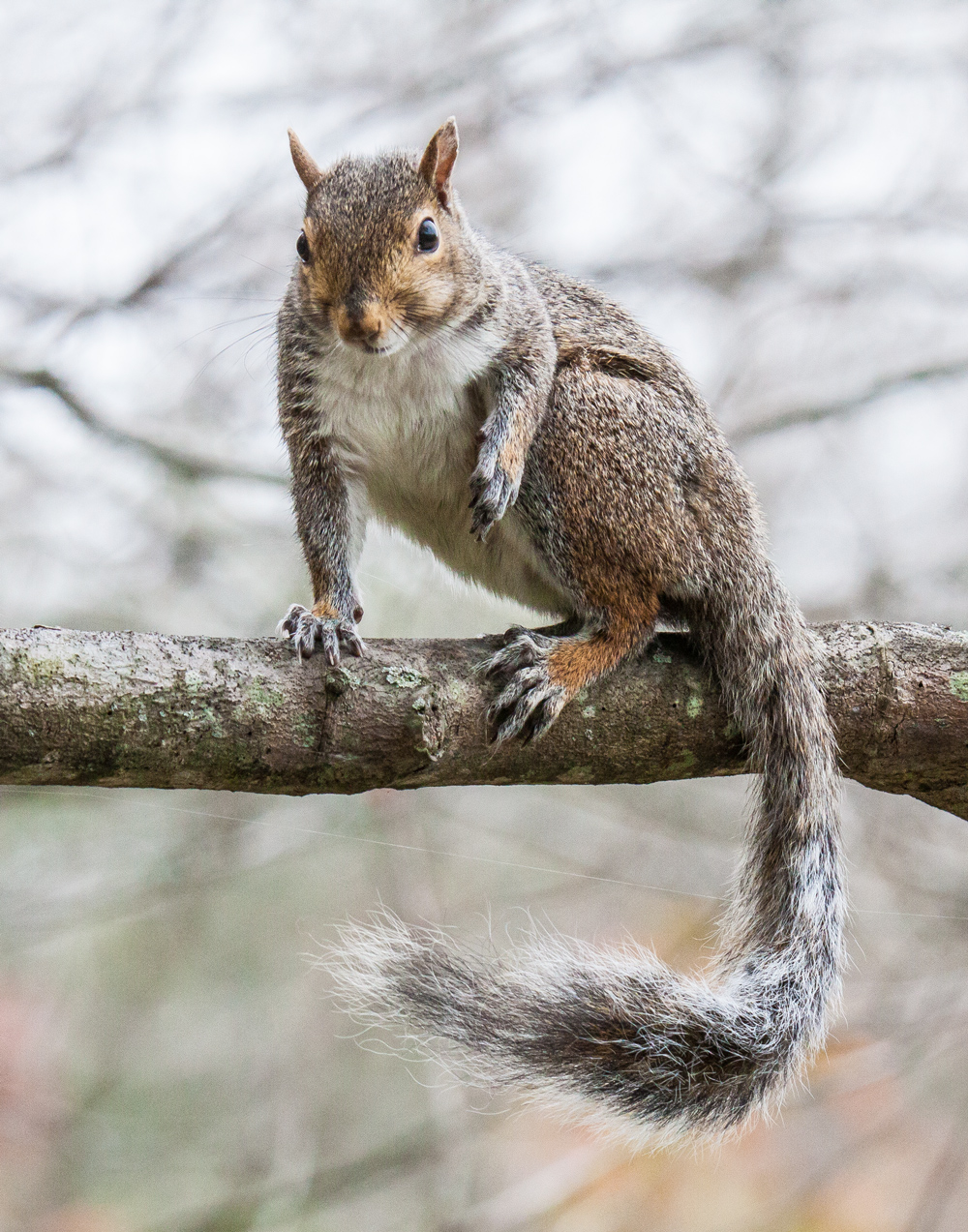
Last week, this Eastern Gray Squirrel (Sciurus carolinensis) at Huntley Meadows Park seemed to be posing for me and we had our own little portrait session. The squirrel made many minor adjustments to its body position to provide mw with a lot of different looks. Towards the end of our photo shoot, the squirrel had to take a short break.
Sometimes when you have an itch, you just have to scratch it, as you can see in the final image.



© Michael Q. Powell. All rights reserved.
Posted in animals, Nature, Photography, Portraits, wildlife | Tagged Alexandria VA, Canon 50D, Eastern Gray Squirrel, Huntley Meadows Park, Sciurus carolinensis, squirrel, Tamron 150-600mm telephoto | 13 Comments »
October 2, 2015 by Mike Powell
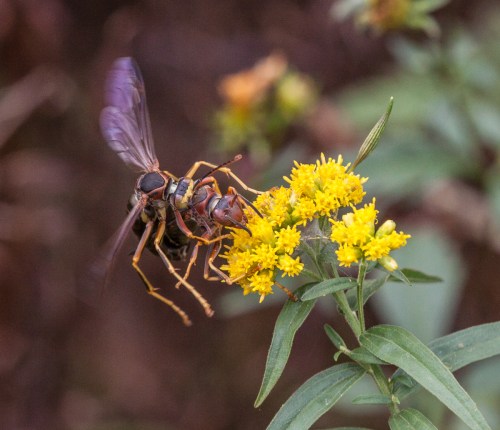
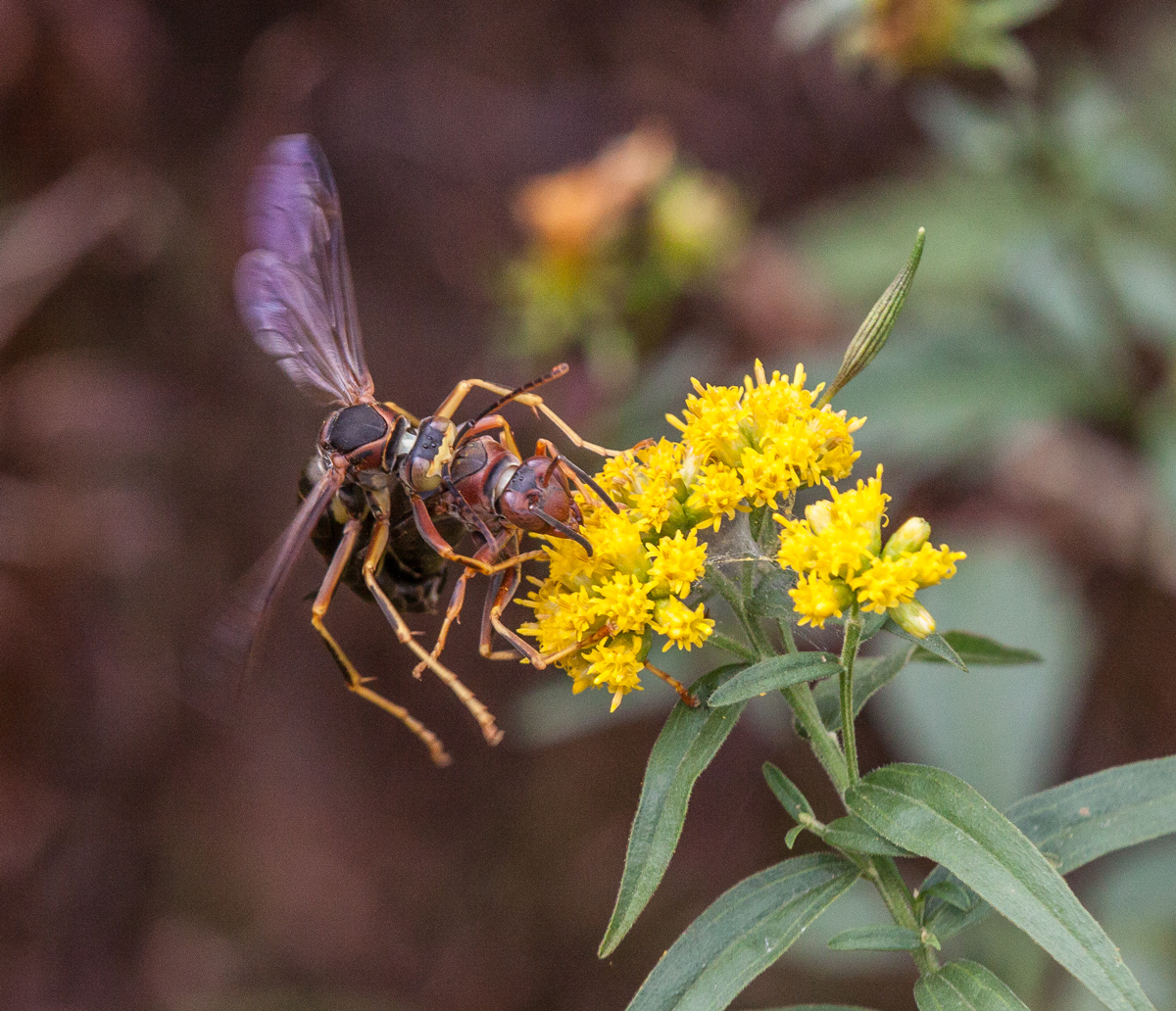
Cole Porter famously wrote that, “Birds do it, bees do it, even educated fleas do it…” Apparently he could have included wasps, judging from this shot I took on Monday of mating wasps at Huntley Meadows Park.
I had my macro lens on my camera and was checking out a yellow flowering plant, which I think is goldenrod, when I heard the buzzing of an insect. I assumed that it was a bee, but when it landed, I realized it was a wasp. As I looked through my viewfinder and focused more closely on the subject, it became apparent that it was not one wasp—it was a mating pair.
They didn’t stay long, but I was able to get a reasonably clear shot of the couple as they “do it.”
If you are not familiar with the Cole Porter song that I referenced, “Let’s Do It (Let’s Fall in Love), check out a YouTube video of Ella Fitzgerald singing a jazzy version or a more traditional arrangement by Conal Fowkes.
© Michael Q. Powell. All rights reserved.
Posted in Insects, Macro Photography, Nature, wildlife | Tagged Alexandria VA, Canon 50D, Cole Porter, Huntley Meadows Park, Let's Do It, Let's Fall in Love, mating wasps, Tamron 180mm macro lens, wasps | 14 Comments »
October 1, 2015 by Mike Powell
I have been seeing Common Green Darner dragonflies (Anax junius) hunting high over the fields the last couple of weeks as they prepare for migration, but have not been able to get any shots of them. In theory, they are easier to photograph when they land, but these dragonflies like to hang vertically low to the ground, often in areas with heavy vegetation. I have been repeated frustrated by spotting them only after they have taken to the air as I got close to them.
This past Friday, though, I saw one land nearby when I was already in a field of waist-high vegetation. Judging from the blue abdomen, it’s a male Common Green Darner. I was struck by the relatively dark color of much of the abdomen of this particular individual. When doing a little research at my favorite website for local dragonflies, dragonfliesnva.com, I learned that Common Green Darners deal with the problem of cool weather “by having dark-colored platelets in their blood that rise to the surface when it’s cold, darkening their abdomen color, therefore attracting more sun. On bright, hot days, those dark platelets sink, and the abdomen turns bright bluagain, now reflecting light.”
The dragonfly was surrounded by dried vegetation and there was no way that I could get an uncluttered background for my shots. Fortunately, however, the the colors of the vegetation are so muted that the gorgeous blue and green of the dragonfly really stand out. In the first shot, I zoomed all the way to try to capture the maximum amount of detail, while in the second shot I pulled back a little on the zoom to capture the dragonfly’s entire wingspan.


© Michael Q. Powell. All rights reserved.
Posted in Dragonflies, Nature, Photography, wildlife | Tagged Alexandria VA, Anax junius, Canon 50D, Common Green Darner, Common Green Darner dragonfly, Huntley Meadows Park, Tamron 150-600mm telephoto | 6 Comments »
September 30, 2015 by Mike Powell
We usually think of springtime as the season of love, but apparently autumn is also a good season if you are a damselfly. I don’t know what was so special about this one plant sticking out of the water, but mating damselfly couples seemed to be competing for a spot to land and deposit their eggs on it this past Monday at Huntley Meadows Park in Alexandria, Virginia.
I’m no expert when it comes to identifying damselflies, in part because so many different species have similar patterns of black and blue, but I think these couples, all in the tandem position, may be Big Bluets (Enallagma durum). I’d welcome any corrections or confirmation of my initial identification.
UPDATE: My local odonate expert, Walter Sanford, weighed in with a correction to my identification—these damselflies are Familiar Bluets (Enallagma civile), not Great Bluets. When it comes to my initial identification, you might say that I blew it.
For those who might be curious about the technical aspects of the photo, I took this with my Canon 50D at 600mm on my Tamron 150-600mm lens, which is the equivalent of 960mm when you take into account the crop sensor of my camera. I continue to be pleased with the amount of detail that I can capture with the relatively affordable long lens, even when it’s extended to its maximum length. If you click on the image, you can see even more of those wonderful details.

© Michael Q. Powell. All rights reserved.
Posted in Autumn, Dragonflies, Insects, Macro Photography, Nature, Photography | Tagged Alexandria VA, Big Bluet, Canon 50D, Enallagma civile, Enallagma durum, Familiar Bluet, Huntley Meadows Park, mating damselflies, Tamron 150-600mm telephoto | 15 Comments »
September 29, 2015 by Mike Powell
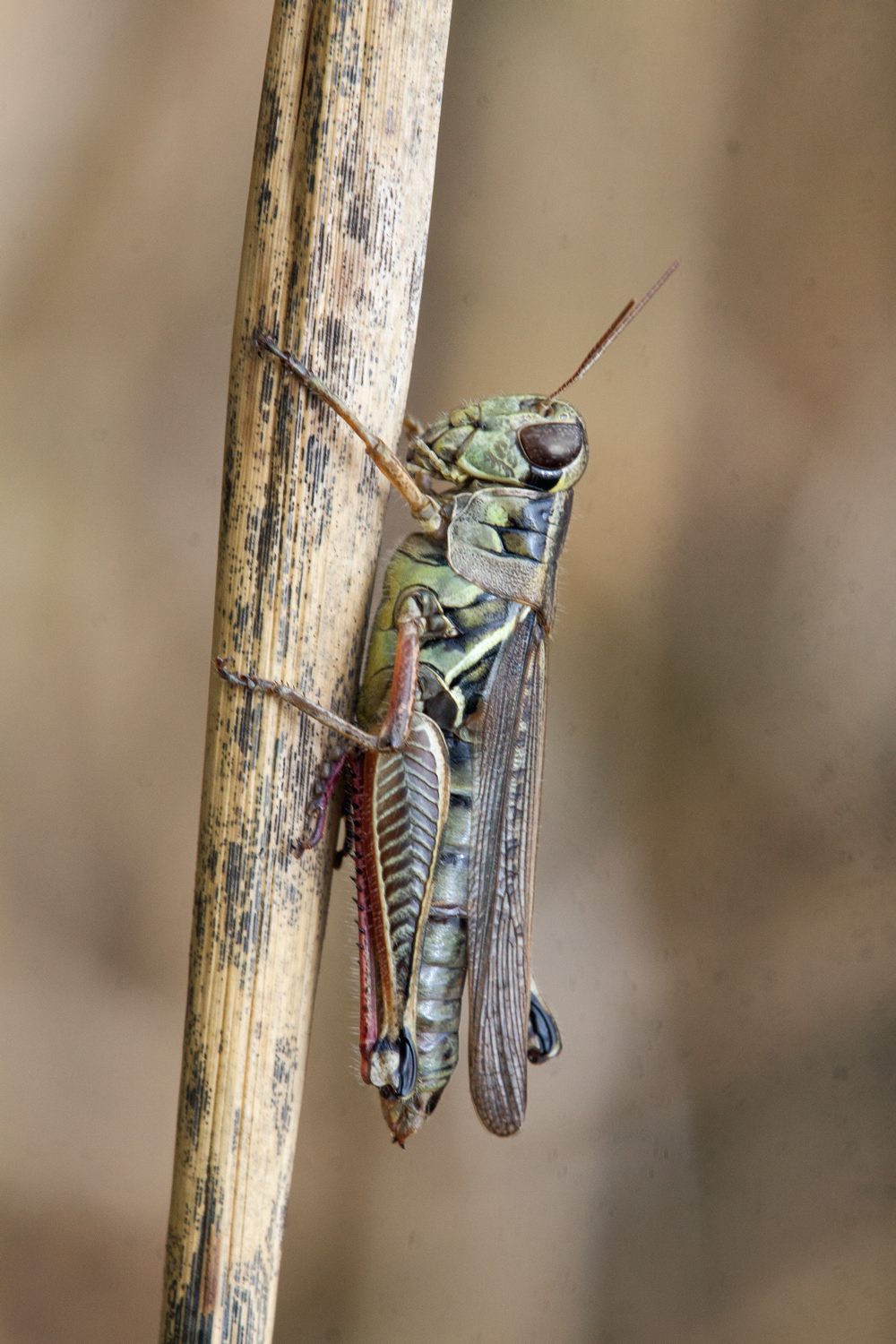
The dragonfly population continues to decrease as we move deeper into autumn, but my little winged friends seem to have been replaced by grasshoppers. Whenever I walk through the fields of my favorite marshland park, I am preceded by mini explosions of insects. Most of the grasshoppers hop far away, but yesterday one of them chose a nearby stalk of grass and posed for me.

© Michael Q. Powell. All rights reserved.
Posted in Insects, Macro Photography, Nature, Photography | Tagged Alexandria VA, autumn, Canon 50D, grasshopper, Huntley Meadows Park, Tamron 180mm macro lens | 6 Comments »
September 28, 2015 by Mike Powell
What do you do when an invasive species threatens a sensitive habitat? Since about 2004, Northern Snakeheads (Channa argus), a predatory Asian fish that threatens native fish populations, have been spotted on the Potomac River. They have now become established in many locations in Northern Virginia, including Huntley Meadows Park, the marshland park where I take many of my wildlife photos.
Throughout this summer, many of us have cheered when ospreys and Great Blue Herons have pulled snakeheads out of the waters, but I suspected that the birds couldn’t control the snakehead population on their own. We have not had much rainfall the last couple of months and most of the remaining water is concentrated in a series of scattered pools of muddy water.
This past Friday, I was privileged to watch a dedicated group of employees from Fairfax County enter those pools of water to remove as many snakeheads as possible. How did they do it? I don’t know the details of the equipment, but essentially two guys walked through the water delivering jolts of electricity from the “juice boxes” on their backs and other members of the group captured the stunned fish with handheld nets and deposited them into five-gallon buckets.
It may sound easy, but in practice it looked really challenging. The pools were slippery and of uncertain depth, so everyone had to move cautiously and slowly, undoubtedly conscious all of the time of the electricity. I don’t know about you, but I am just not really comfortable even thinking about mixing water and electricity.
In total, the group managed to capture about two dozen snakeheads, including several that looked to be about two feet long (61 cm). Unfortunately, the snakeheads are here to stay and I expect that efforts will have to be made every year to reduce and control the population of these fierce predators.
I was granted permission to take photos of the fishing process with the stipulation that I not interfere with the work. It was quite a challenge to try to capture action shots and avoid getting stuck in the mud. I am including an assortment of images to give you a feel of the action and the people involved in the effort,
My good friend and fellow photographer Walter Sanford also captured the action and did a blog posting today called Electrofishing for Northern Snakeheads. Walter included lots of wonderful details about snakeheads in our local area and links to related articles to accompany his images. He and I have different backgrounds and use different camera gear and periodically we like to do companion postings to provide viewers with different perspectives on the same subjects. Be sure to check out his posting.
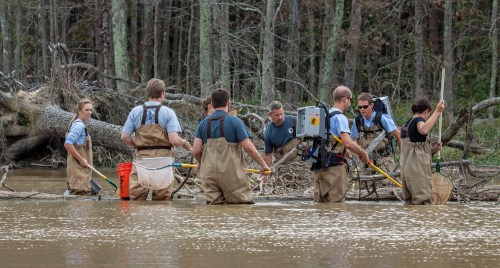
Initially the group was all together, but it eventually split up into subgroups.

A drop in the bucket after netting a fish.

When the catch was bigger, it was safer to bring it to shore.

Net gain

Teamwork

Intensity

Electrifying performance

Can you figure out why it’s called a “snakehead?”
© Michael Q. Powell. All rights reserved.
Posted in Nature, Photography, wildlife | Tagged Alexandria VA, Canon 50D, Channa argus, Huntley Meadows Park, Northern Snakehead, Tamron 150-600mm telephoto | 8 Comments »
September 27, 2015 by Mike Powell
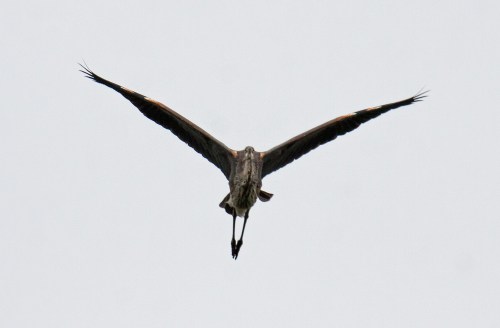
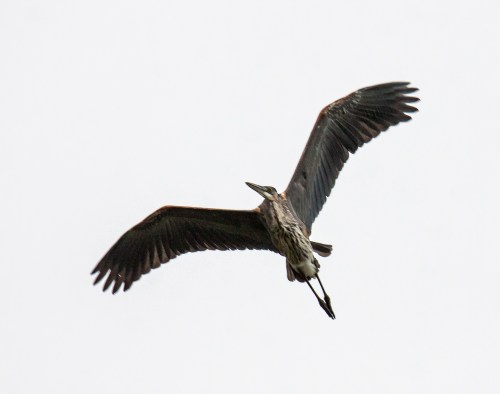
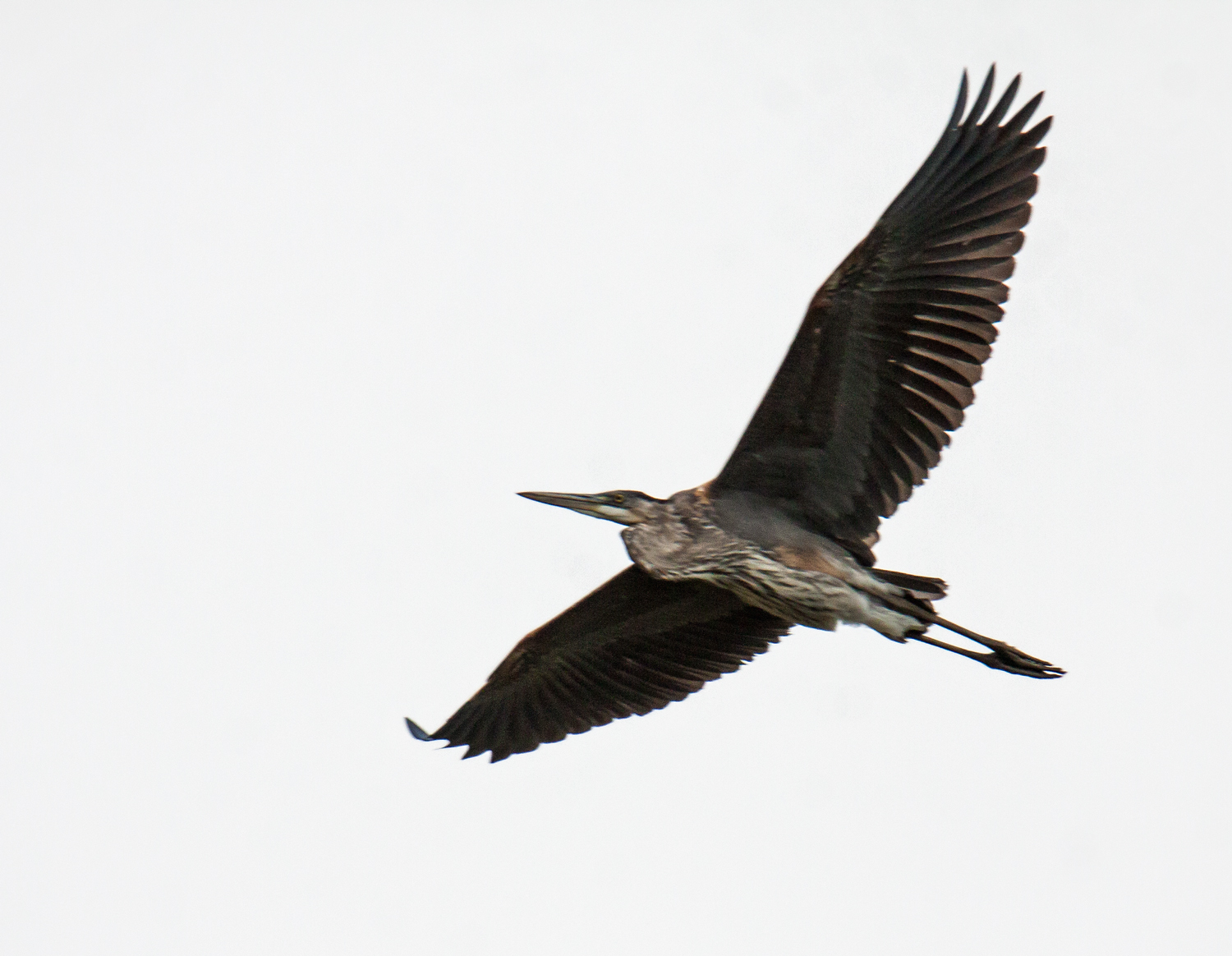
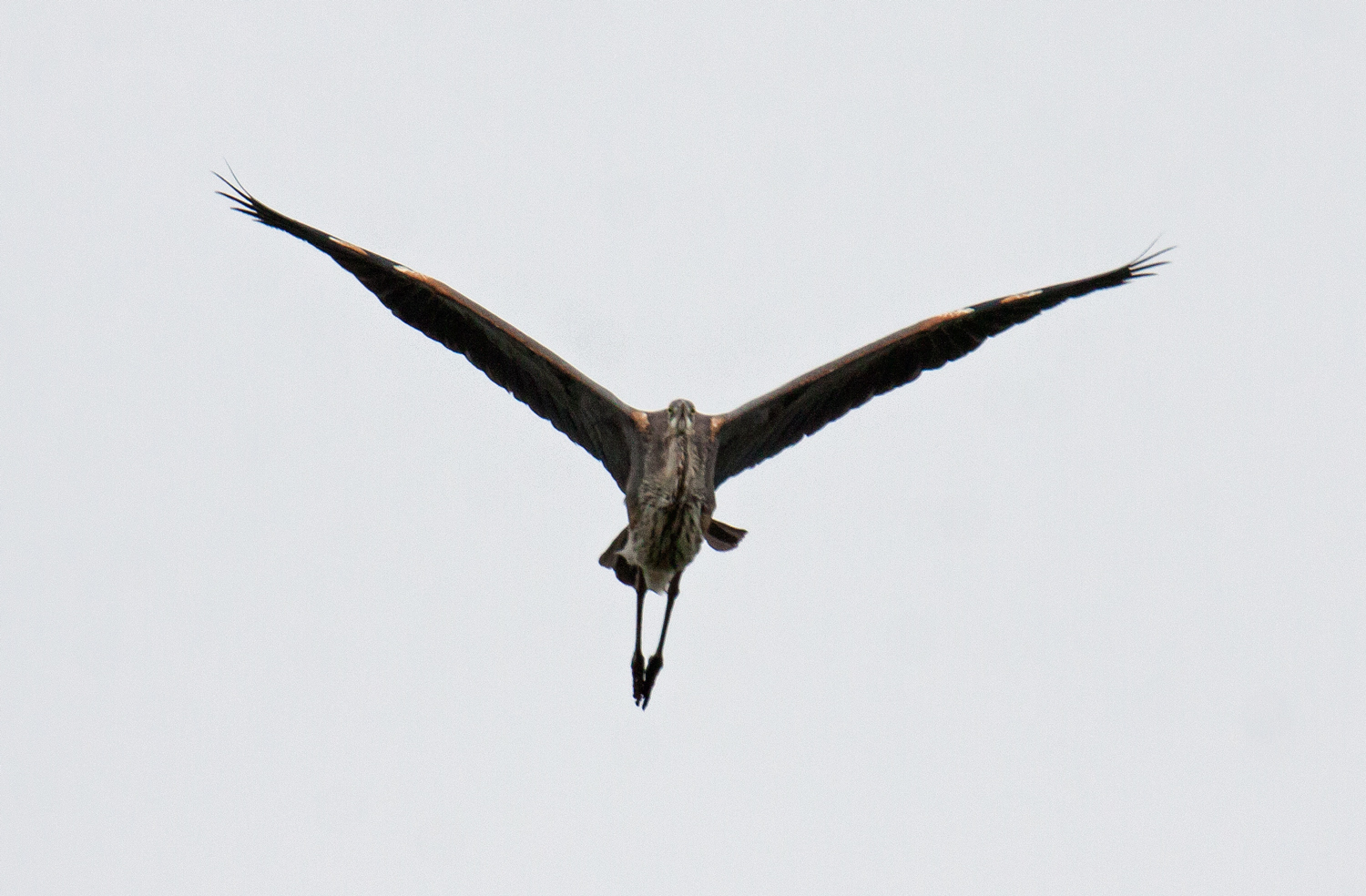
The sky was completely overcast early yesterday morning and most of the birds seemed to be sleeping in. One notable exception was this Great Blue Heron (Ardea herodias).
I spotted him in the distance flying in my direction at a pretty good speed. Normally Great Blue Herons seem to fly at a leisurely pace, but this one appeared to be in a hurry. Although the heron looked beautiful when its wings were fully extended, as in the first image, the heron appeared menacing—almost like a predator—when he was flying straight at me with legs extended.
As the Great Blue Heron flew overhead, I was treated to a great view of the underside of its body and wings, an angle of view that I rarely see, given that herons are usually flying away from me when I spot them.
I am on the fence about whether I like the white sky or not as a background. It is certainly uncluttered, but it seems a bit unnatural, almost like I was posing the bird in a studio setting.

© Michael Q. Powell. All rights reserved.
Posted in Birds, Nature, Photography, wildlife | Tagged Alexandria VA, Ardea herodias, birds in flight, blue heron, Canon 50D, Great Blue Heron, Huntley Meadows Park, Tamron 150-600mm telephoto | 8 Comments »
September 26, 2015 by Mike Powell
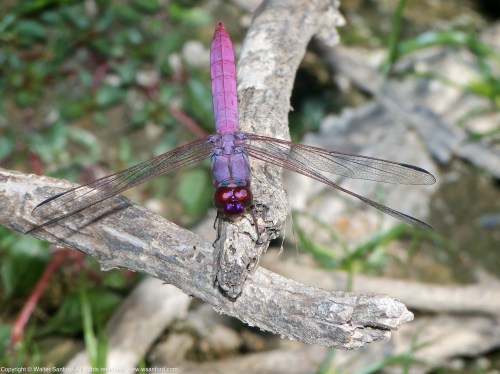
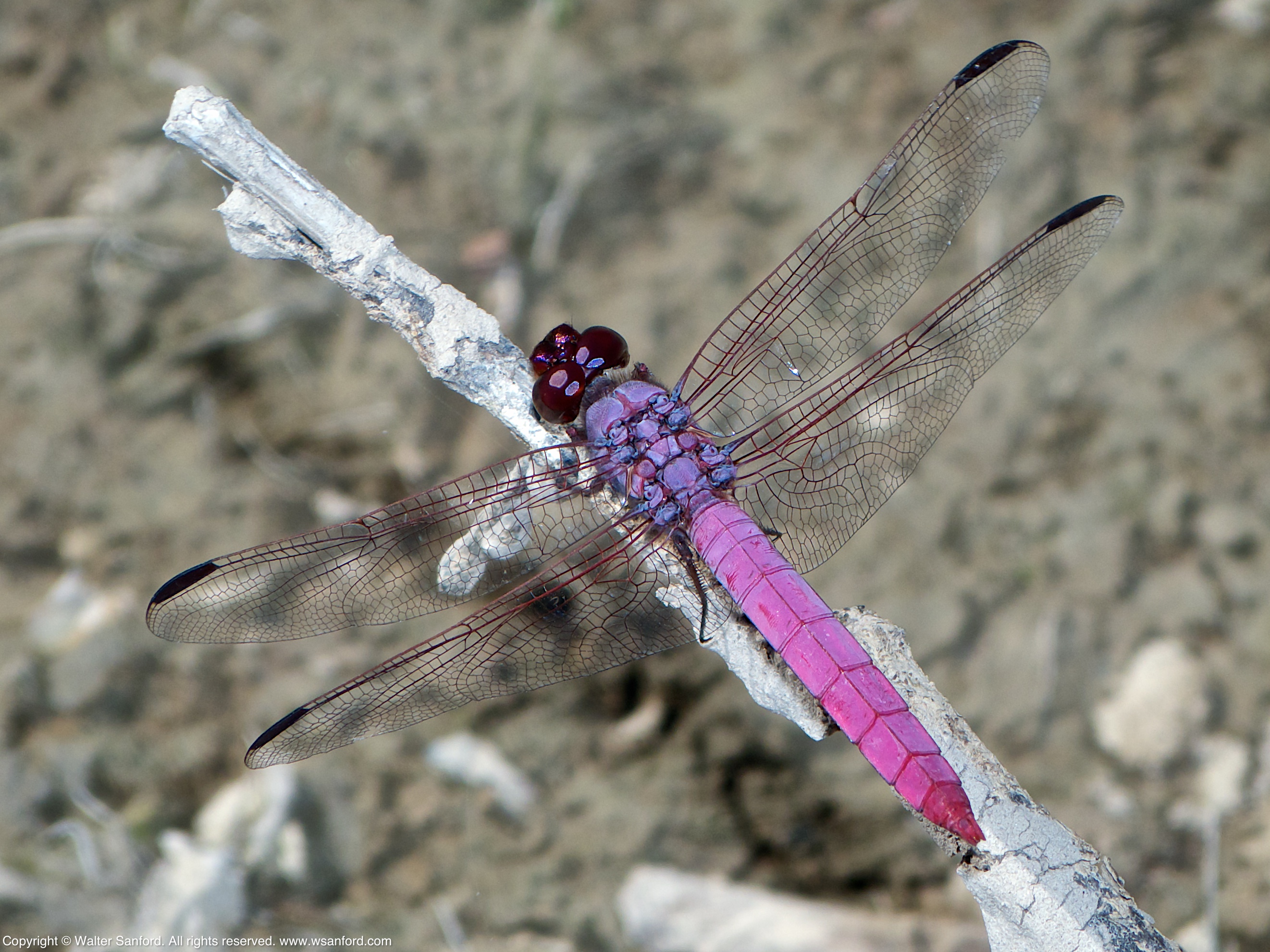
A pink dragonfly? Fellow photographer and good friend Walter Sanford was not hallucinating when he recently spotted this Roseate Skimmer dragonfly at Huntley Meadows Park, one of only a small handful of sightings ever of this species in Virginia.
He spotted one last year too, but this year managed to capture a wonderful series of images of this beauty. Be sure to check out his original posting as well as other spectacular images on his blog.
 walter sanford's photoblog
Breaking news: I discovered a new species of dragonfly at Huntley Meadows Park — a Roseate Skimmer dragonfly (Orthemis ferruginea). This is the first official record of Orthemis ferruginea in Fairfax County, Virginia.
Actually, I discovered this species last year but was unable to shoot a photo to prove I wasn’t hallucinating pink dragonflies! On 10 September 2014, I spotted a male Roseate Skimmer that made one patrol around a pool near an old beaver lodge (one that overlapped the boardwalk that goes through the central wetland area), landed for one second (no kidding) and flew upstream along Barnyard Run; I never saw it again. This year, I have photographic proof.
This individual is a male, as indicated by its coloration and terminal appendages.
 23 SEP 2015 | Huntley Meadows Park | Roseate Skimmer (male)
Dig that crazy metallic purple face!
 23 SEP 2015 | Huntley Meadows Park | Roseate…
View original post 272 more words
Posted in Dragonflies, Insects, Nature, Photography, Portraits, wildlife | Tagged Alexandria VA, Huntley Meadows Park, Orthemis ferruginea, Roseate Skimmer | 8 Comments »
September 26, 2015 by Mike Powell
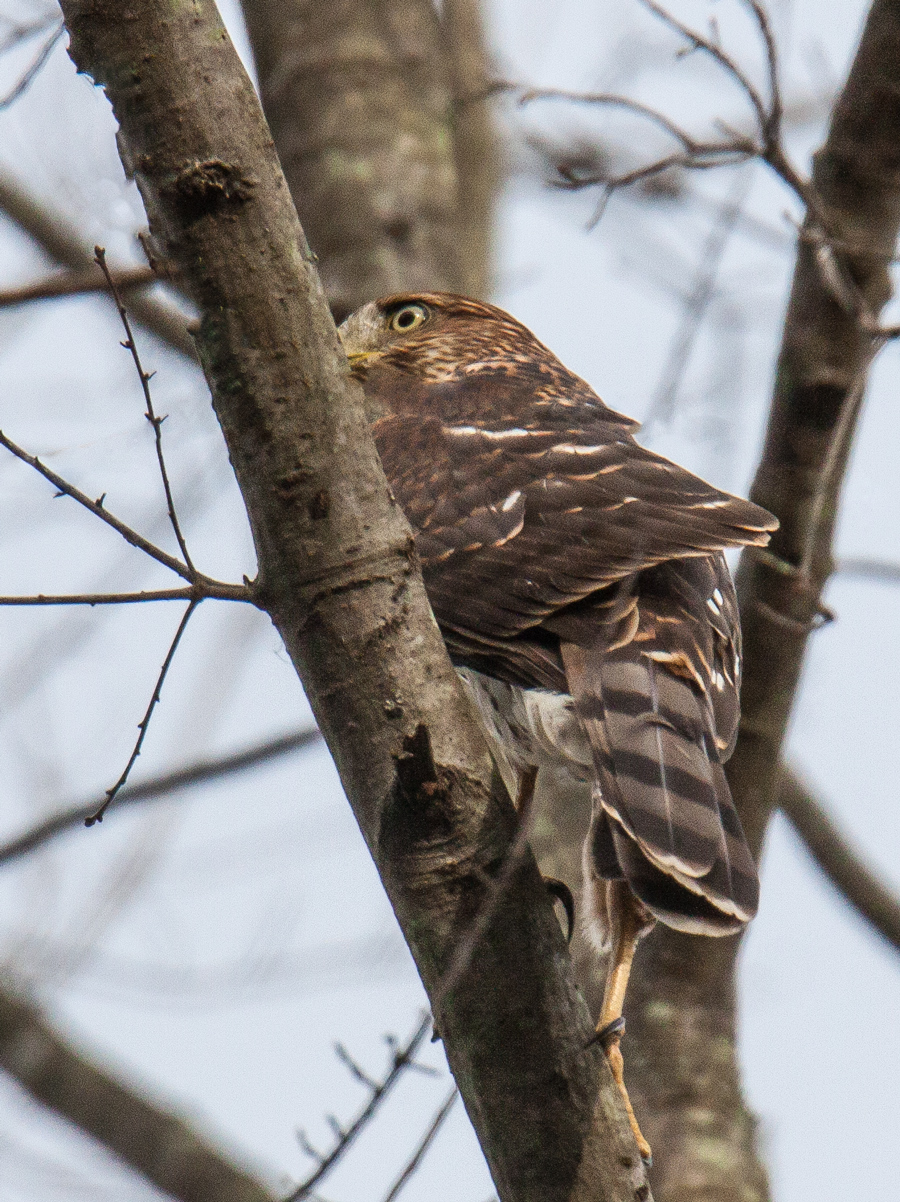
As I walked toward a brush pile yesterday at my favorite marshland park, I flushed a bird. It flew to a a nearby tree and perched. Slowly I moved closer, hoping to get a better look at the bird, which seemed pretty large, though not as large as the eagles, ospreys, and hawks that I occasionally see at the park.
I took a series of shots and was disappointed at first that the head was not visible in any of them—the bird was hunched over and facing the opposite direction. Upon closer examination, I was thrilled when I noticed a bright yellow eye in one of the shots. That yellow eye and the long, rounded tail suggest to me that this is an immature Cooper’s Hawk (Accipiter cooperii). According to the Cornell Lab of Ornithology, adult Cooper’s Hawks have red eyes, while juveniles have yellow eyes.
The young hawk’s face is partially hidden in the image and the background is cluttered, but I am excited that I was able to capture an image of a species that I knew lived in the park, but that I had never before seen. Leaves are starting to fall from the trees and I hope that I will be able to spot more birds as the density of the foliage decreases. I can hear so many birds as I walk about, but so often they remain hidden from view.

© Michael Q. Powell. All rights reserved.
Posted in Birds, Nature, Photography, wildlife | Tagged Accipiter cooperii, Alexandria VA, Canon 50D, Cooper's Hawk, hawk, Huntley Meadows Park, Tamron 150-600mm telephoto | 6 Comments »
« Newer Posts - Older Posts »



























 Mike Powell

