Feeds:
Posts
Comments

Archive for the ‘Summer’ Category

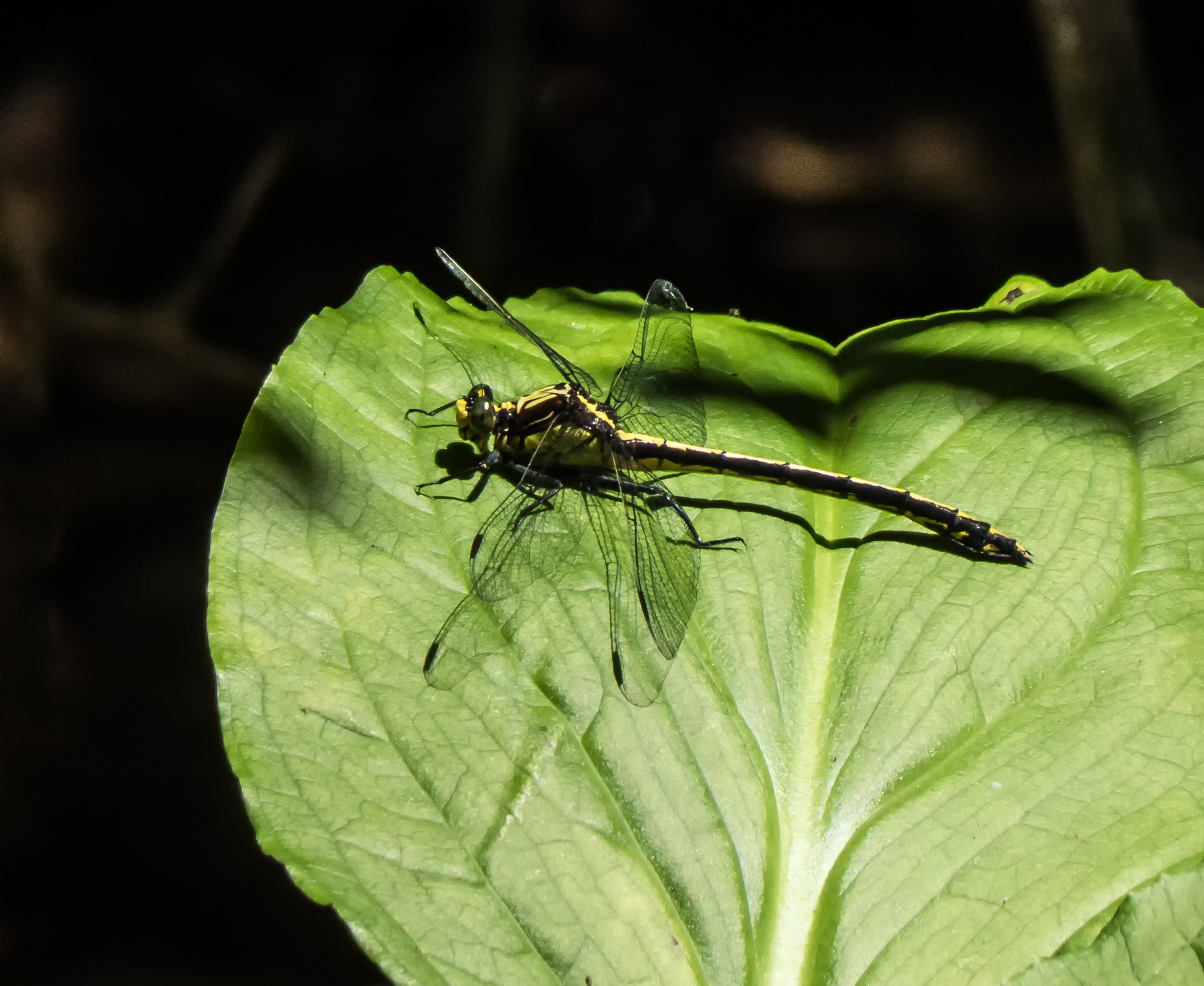
Perhaps there are dragonflies with longer names than the Black-shouldered Spinyleg dragonfly (Dromogomphus spinosus), but none of them immediately come to mind. Sometimes I will complain about the inaccurate names given to various species, but in this case the descriptors are accurate. Alas, when I spotted this dragonfly in a boggy area of Prince William County, Virginia last week, I couldn’t get close enough to capture those details very well.

The vegetation on which the dragonfly is perched is skunk cabbage, a plant that grows in the mucky confines of seeps and swamps. It is said that bruised leaves present a fragrance reminiscent of skunk, so I try to step carefully  whenever I am near any skunk cabbage.

Black-shouldered Spinyleg

© Michael Q. Powell. All rights reserved.

Read Full Post »

Last Tuesday as I was exploring Occoquan Bay National Wildlife Refuge I spotted this handsome male Calico Pennant dragonfly (Celithemis elisa). Unlike some species that perch close to the ground and are hard to see, Calico Pennants perch on the uttermost tips of vegetation. Although they are visible, they are often hard to photograph, because their precarious perches start to sway at the slightest hint of a breeze.

Calico Pennant

© Michael Q. Powell. All rights reserved.

Read Full Post »

On Monday I spotted this small patch of Butterfly Weed (Asclepias tuberosa) at Jackson Miles Abbott Wetland Refuge. True to its name, the Butterfly Weed had attracted several butterflies, which I think are Pearl Crescent butterflies (Phyciodes tharos), as well as several metallic green sweat bees (genus Agapostemon). The insects seemed to love the plant’s nectar and the scene provided a visual feast for viewers like me.

butterfly weed

© Michael Q. Powell. All rights reserved.


Read Full Post »

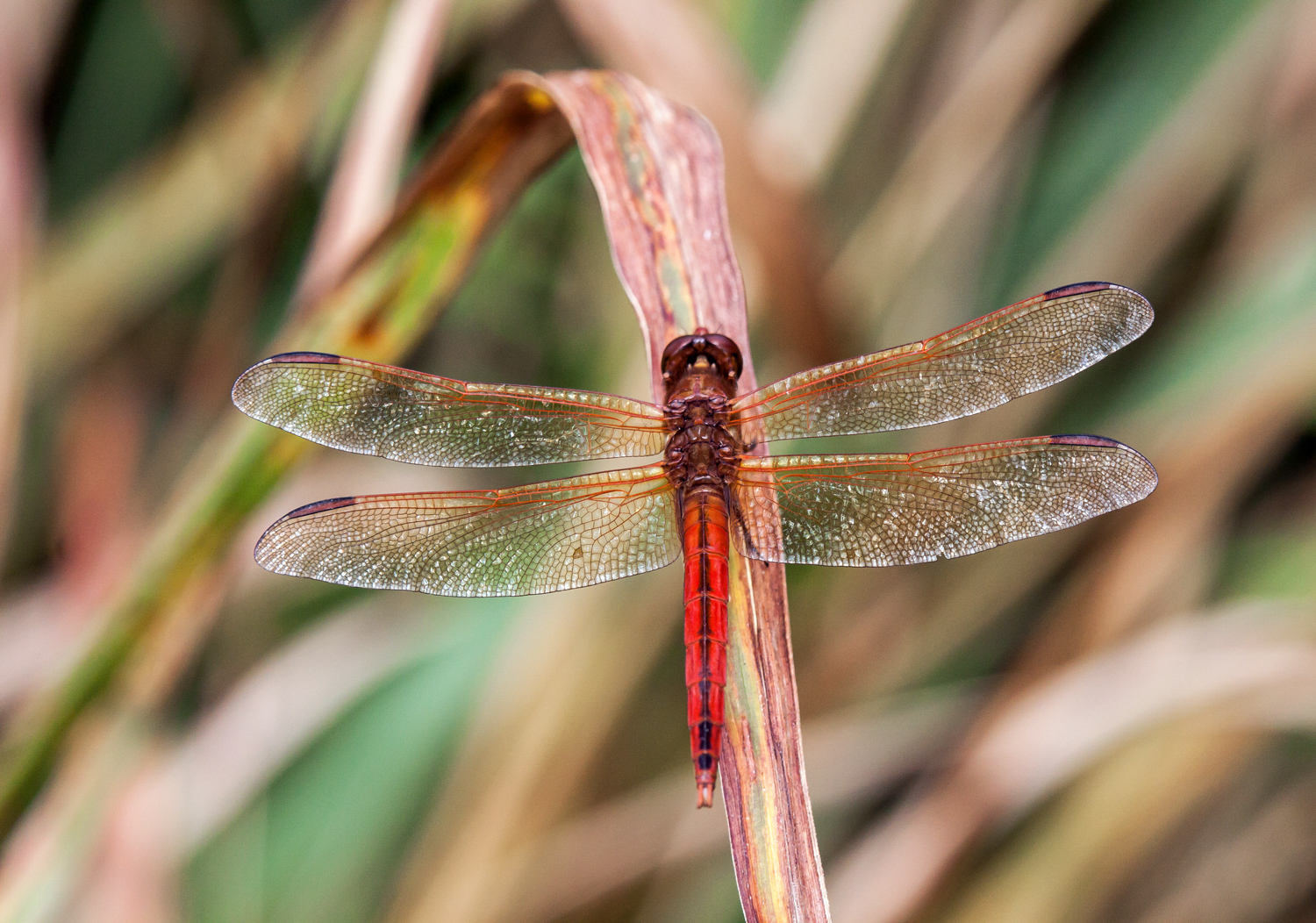
Although I love seeing my old familiar dragonfly friends, it is always exciting to observe new species. Last week while I was exploring in Prince William County, Virginia with fellow dragonfly enthusiast Walter Sanford, I spotted this dragonfly perched on a small tree. I really liked the pose and moved closer for some shots.

I initially thought it was a Needham’s Skimmer, a fairly common species in our area, but the more I looked at my photos afterwards on my computer screen, the more I began to note some differences in the colors and patterns on wings and the body. After consultations with some dragonfly experts on Facebook, I learned that it is a Yellow-sided Skimmer (Libellula flavida).

As far as I know, this is the first time that I have seen a Yellow-sided Skimmer. There is a possibility that I have unwittingly seen one in the past and dismissed it as “only” a common species.  I try not to do that, because this is not the first time that I have photographed something new without realizing until later that it was in fact new.


Yellow-sided Skimmer

© Michael Q. Powell. All rights reserved.


Read Full Post »

Dragonhunter dragonflies (Hagenius brevistylus) love to perch and wait for their prey to come by and then use their powerful back legs to snag that prey, which is often another dragonfly. Those legs are so long and ungainly, though, that Dragonhunters’ poses often seem awkward when they are perched—they remind me of teenage males who have undergone a recent growth spurt and haven’t gotten used to their longer limbs.

Last Friday as I was exploring a stream at Prince William Forest Park with fellow blogger and dragonfly enthusiast Walter Sanford, he spotted this female Dragonhunter perched at the edge of the water. I was walking toward him when I spotted the Dragonhunter on the rocks that I featured yesterday and was delayed in getting to see this dragonfly. Fortunately, she was relatively tolerant of our presence and remained in place long enough for me to get some shots.

All of the images that I captured show a side view of the Dragonhunter, because she was facing toward the water and I was trying not to get wet. Walter, however, wanted more of a frontal view  and waded into the water to get that shot. Check out today’s posting on his blog and you can compare the results of our different approaches.

dragonhunter

© Michael Q. Powell. All rights reserved.


Read Full Post »

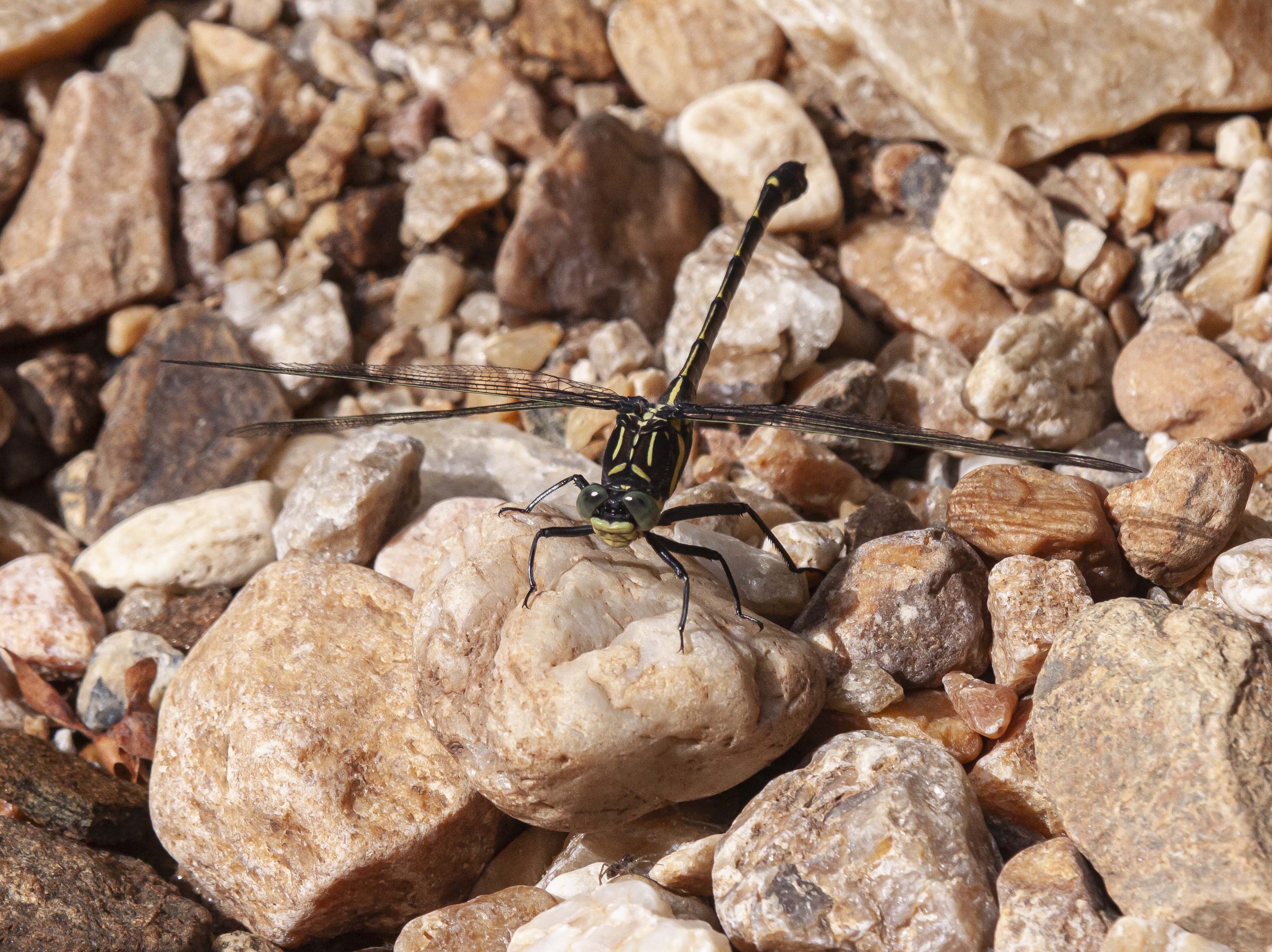
Dragonfly on the rocks? It sounds like a summertime beverage, but it accurately describes what I saw last Friday while exploring a stream in Prince William County, Virginia with fellow dragonfly enthusiast Walter Sanford. I think it is a Dragonhunter dragonfly (Hagenius brevistylus), but the unusual angle makes it tough to made a definitive determination of the species, because I am not able to see critical portions of the dragonfly’s anatomy.

In the past when I have spotted Dragonhunters, they have been perched on branches overhanging the water and that is where I expect to find them. This encounter is a good reminder for me to stay alert at all times—my subjects may not have read the identification guides about how they are supposed to behave.

dragonhunter

© Michael Q. Powell. All rights reserved.

Read Full Post »

When the weather gets hot, some dragonflies will raise their abdomens (the “tail”) in what is believed to be an attempt at thermoregulation. I can’t say for sure if it works, but the theory is that in this position, sometimes referred to as the “obelisk,” dragonflies are able to stay cooler by reducing the amount of their bodies subject to direct sunlight.

Earlier this week I spotted this male Eastern Amberwing dragonfly (Perithemis tenera) in a modest obelisk position at Jackson Miles Abbott Wetland Refuge. I characterized the position as “modest,” because sometimes a dragonfly will elevated its abdomen until is almost vertical.Eastern Amberwing

© Michael Q. Powell. All rights reserved.


Read Full Post »

When I spotted a small patch of milkweed while exploring Occoquan Bay National Wildlife Refuge earlier this month, I stopped and waited. I knew that numerous butterflies are attracted to this plant. Before long, several butterflies in fact appeared.

Here are photos of two of them, both swallowtail butterflies. The first one, a Spicebush Swallowtail (Papilio troilus), appears to be in perfect condition. Its wings and “tails” are intact and its colors are vibrant. By contrast the second butterfly, a Zebra Swallowtail (Protographium marcellus), is clearly a veteran. There are chunks missing from its wings and its long beautiful swallowtails are gone.

Do you find one of the butterflies to be more inherently beautiful than the other? Here in the United States, we tend to worship beauty and a standard of supposed perfection. We are daily bombarded with advertising messages that tell us we can look young again, that we can cover up our imperfections. The current focus on selfies and dating apps that allow you to judge others with a swipe encourages a kind of narcissism and attention to superficial appearances that I personally find to be unhealthy.

I remember watching a video several years ago about photographing nature. The photographer encouraged viewers to photograph only perfect specimens of flowers and insects, following the lead of those who say that in order to create beautiful photographs, you need beautiful subjects.

The photos here are my response to that kind of thinking. There is an incredible beauty to be discovered in the ordinary, everyday subjects that surround us, full of imperfections and blemishes. Take a moment today to slow down and truly experience that beauty.

Spicebush Swallowtail

Zebra Swallowtail

© Michael Q. Powell. All rights reserved.

Read Full Post »
I have not yet spotted any Monarch butterflies this season, but last week at Occoquan Bay National Wildlife Refuge I did see a number of the similarly-colored Viceroy butterflies (Limenitis archippus). Viceroy butterflies are smaller than Monarchs, but the main visual difference between the two is the black line across the hind wings that is present with Viceroys, but not with Monarchs.

I chased after one Viceroy last week for quite some time and eventually managed to get these shots.

Viceroy

Viceroy

Viceroy

© Michael Q. Powell. All rights reserved.

Read Full Post »

Last week as I was exploring Prince William County, I encountered this large dragonfly  perched in a tree overhanging a fairly large stream. When I captured these images, I was not sure what kind of dragonfly it was. After consultations with some experienced dragonfly experts, I learned that this is a female Dragonhunter dragonfly (Hagenius brevistylus).

Dragonhunters are among the largest dragonflies in our area. Unlike darners, another group of large dragonflies that fly almost continuously as they seek prey, dragonhunters prefer to perch and wait patiently before they strike. As their name suggests, they specialize in hunting other dragonflies, reportedly including members of their own species.

Dragonhunter

Dragonhunter

Dragonhunter

© Michael Q. Powell. All rights reserved.


Read Full Post »

Most of the dragonflies that I see at this time of the year—and there are a lot of them—are members of the skimmer family. This is the largest family of odonates (the insect order of dragonflies and damselflies) and includes the species most likely to be seen by a casual  dragonfly observer.

When I first started getting interested in dragonflies, I focused primarily on colors—there were blue dragonflies, white dragonflies, red dragonflies, and so on. Over time I began to notice more and more differences between somewhat similar species.

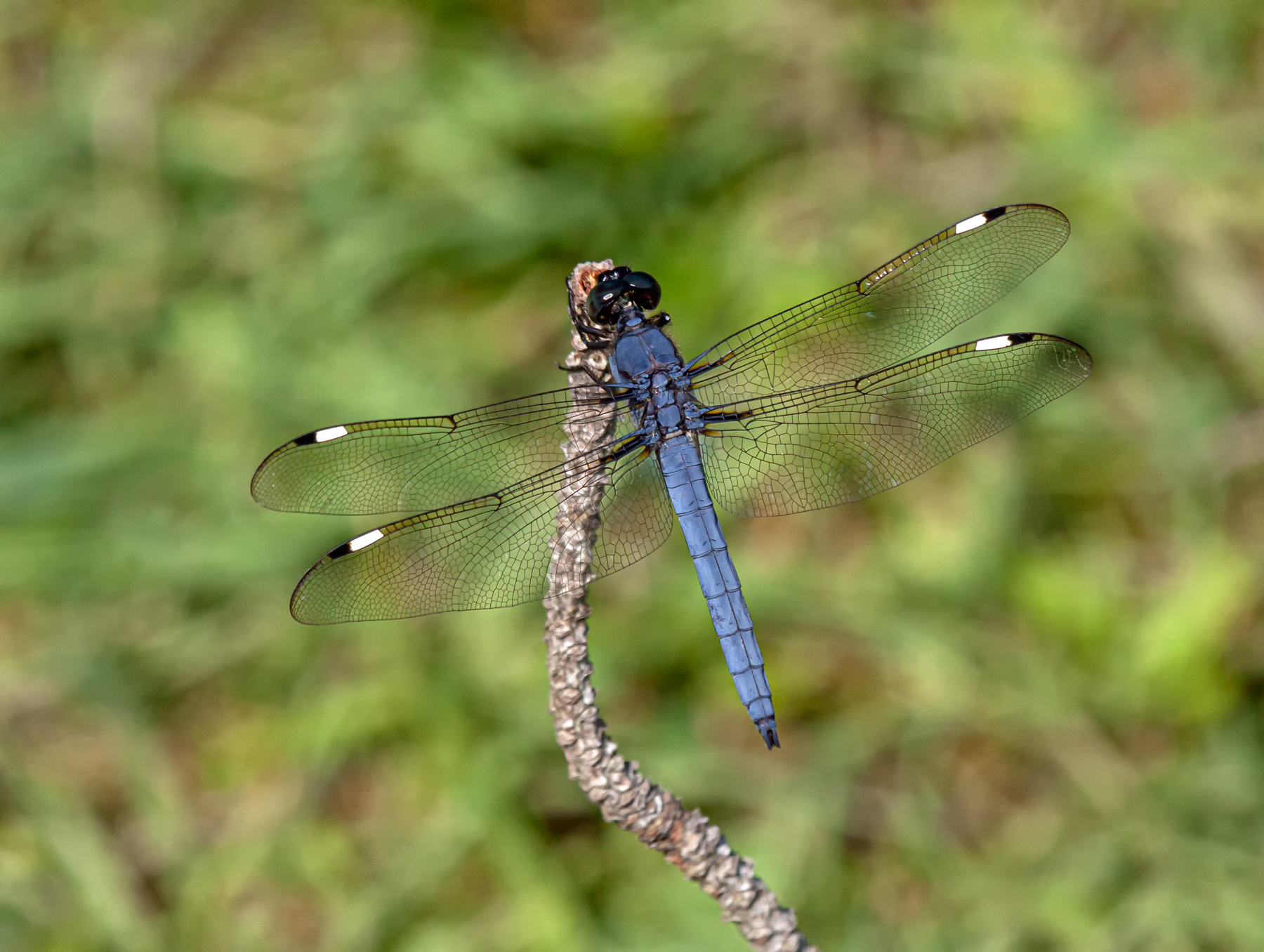
Today I decided to feature photos of two dragonflies that I spotted on Thursday at Jackson Miles Abbott Wetland Refuge. Both are male, both are blue, and both are perched in a similar position. The first one is a Spangled Skimmer (Libellula cyanea).  Even though it shares its blue coloration with several other species, the little white patches on the edge of the wings, known as “stigma,” are both distinctive and diagnostic. The second one is a Slaty Skimmer (Libellula incesta). It is probably the darkest colored dragonfly in our area in terms of both its body and its eyes, which sometimes appear to be almost black.

Do you see these two dragonfly species in your area? I encourage you to look closely at the ones that you happen to see and see if you can identify some of the differences. You may find yourself being drawn more deeply, as I have been, into the wonderful world of dragonflies.

Spangled Skimmer

Slaty Skimmer

© Michael Q. Powell. All rights reserved.

Read Full Post »
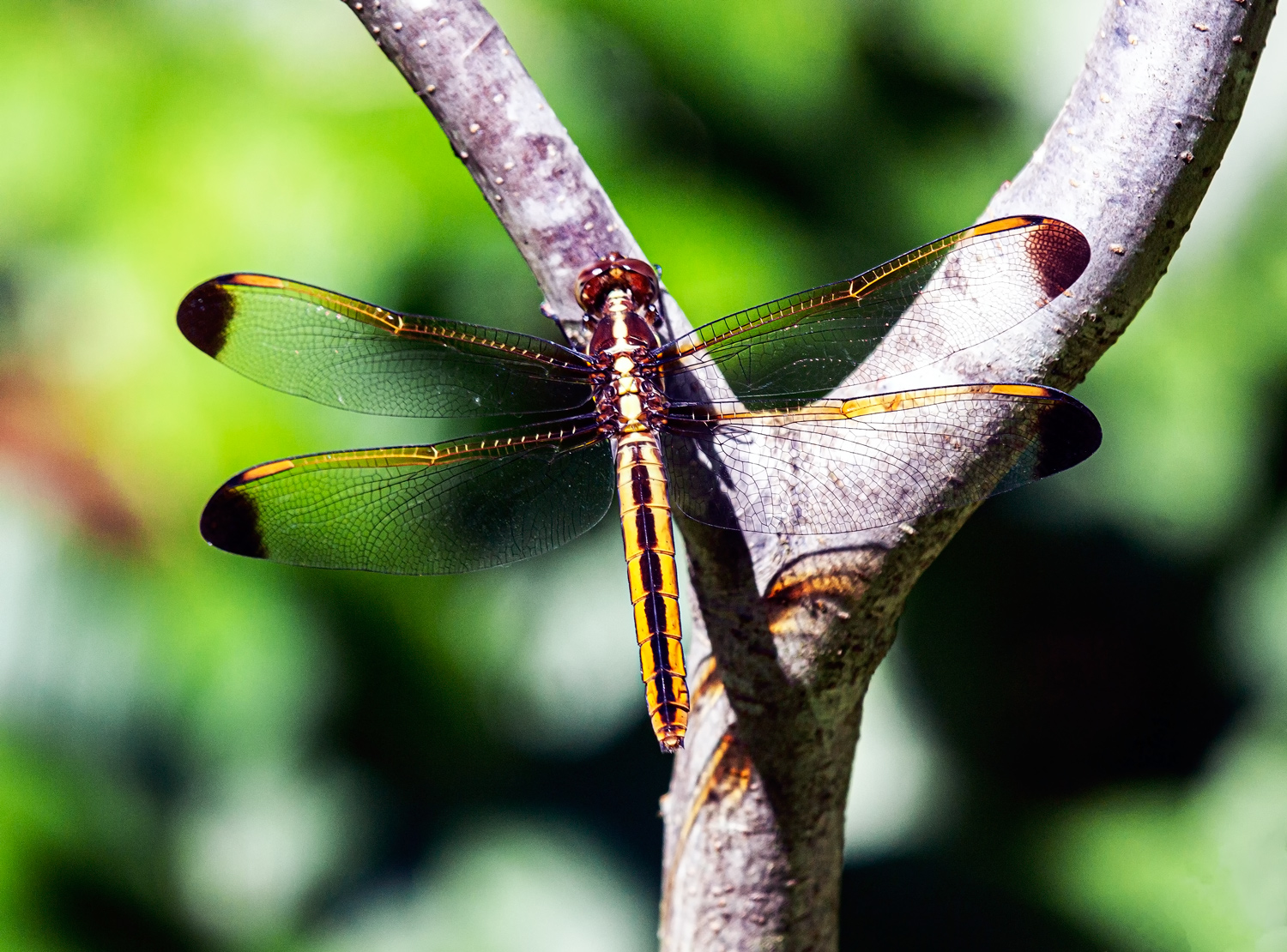
We are now in prime dragonfly season and many familiar species are reappearing, like this beautiful Needham’s Skimmer dragonfly (Libellula needhami) that I spotted on Wednesday at Occoquan Bay National Wildlife Refuge.

I love the beautiful orange-gold color on the leading edges of the wings of this species, a color that really sparkles in the sunlight. I was fortunate to capture this dragonfly in a way that blurred the background. Depth of field is always an issue in situations like this and you can probably see that the tips of the wings are not in sharp focus, but I am ok with that and think it helps draw the viewer’s eyes to the dragonfly’s main body and, in particular, to its wonderful eyes.

Needham's Skimmer

© Michael Q. Powell. All rights reserved.


Read Full Post »

Throughout the month of May I have struggled to identify the dragonflies and damselflies that I have photographed. So many of the species seem so similar that I have had to defer to experts for help. Over the years I have learned that the best way to get help on a Facebook forum is to misidentify a subject—some experts, who might not respond to a request for help, feel compelled to correct you and demonstrate their superior knowledge.

This past Friday at Jackson Miles Abbott Wetland Refuge, it was nice to spot a familiar dragonfly species that was immediately identifiable—there is simply no other dragonfly in our area the looks like an Eastern Amberwing (Perithemis tenera). Even the name is helpful in drawing attention to the key identification feature, the distinctive amber wings.

These dragonflies are among the smallest ones in our area, but they tend to perch on low vegetation overhanging the water (especially males like this one), so they are relatively easy to spot. Although they tend to be a little skittish, if you are patient and persistent you can snag some shots that show the beautiful details of the Eastern Amberwing dragonfly.

Eastern Amberwing

© Michael Q. Powell. All rights reserved.

Read Full Post »
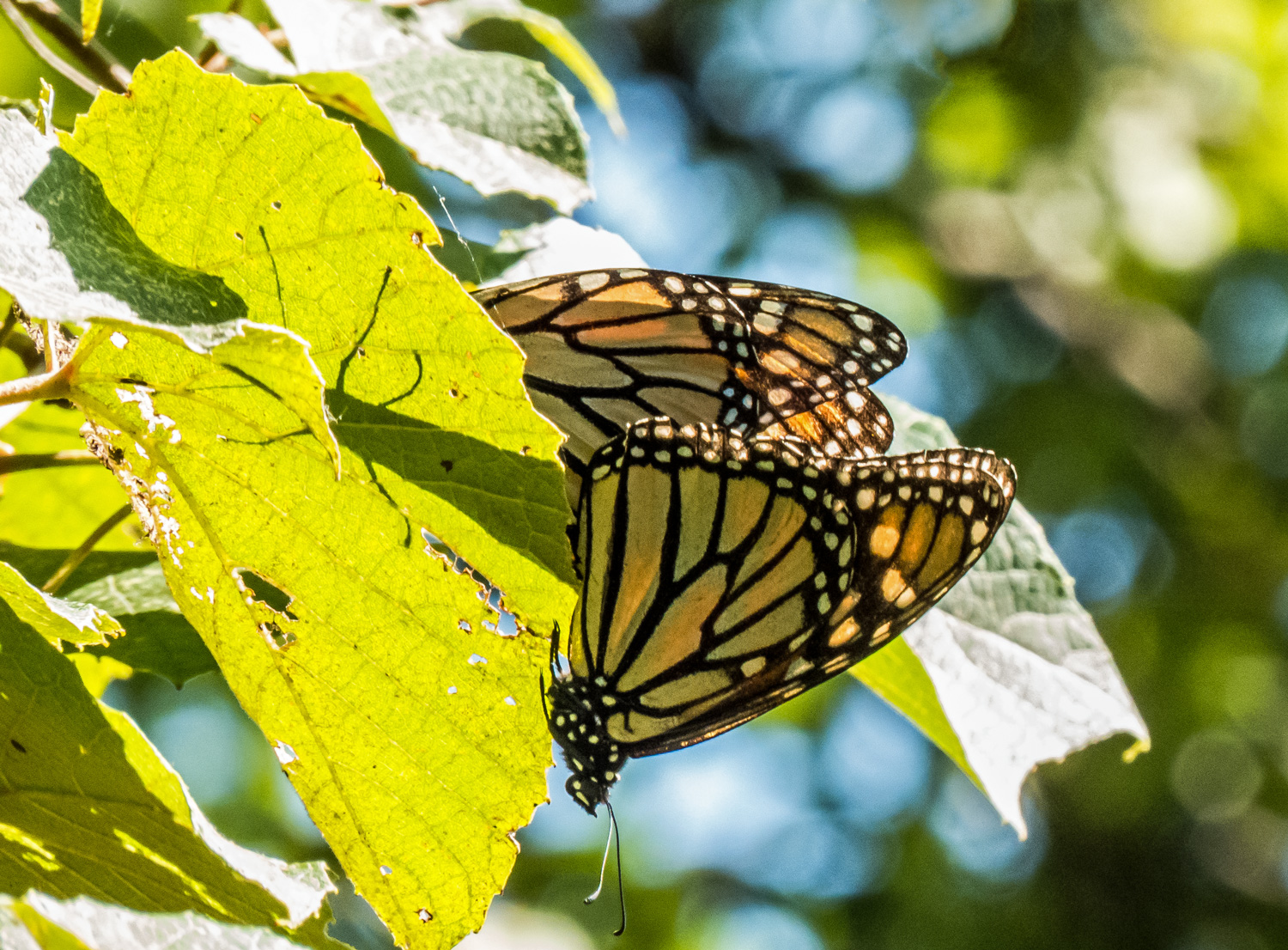
Nestled gently in the leaves of a tall tree, these two Monarch butterflies (Danaus plexippus) were mating, doing their part to perpetuate a species often considered at risk. I captured this image in late August at Occoquan Bay National Wildlife Refuge and re-discovered it yesterday when I was going through my photos from the week before my recent trip to Brussels.

I love the way that the upper butterfly is discreetly hidden by the leaves, but is revealed in its shadow. I find the colors in this image to be especially beautiful. with a wonderful contrast between the warmth of the orange and the coolness of the blue. Most of all, though, I love the way that the background turned out, with its soft circles of out-of-focus highlights.

This is the kind of image that I strive to capture, one that gently draws in viewers and speaks to them softly, reminding them of the undiscovered beauty that surrounds them all of the time.

mating monarchs

© Michael Q. Powell. All rights reserved

Read Full Post »

The incessant rain and cooler weather since my return from Brussels make it feel like it’s already autumn. Like this Monarch butterfly (Danaus plexippus) at Occoquan Bay National Wildlife Refuge, however, I am not quite ready to cease sipping the sweet nectar of summer.

I captured this image on 31 August, the day before my departure for my recent overseas trip. The combination of rainy weather can jet lag have so far kept me from venturing out with my camera, but I hope to do so this coming week.

monarch butterfly

© Michael Q. Powell. All rights reserved

Read Full Post »

As a nature photographer, I am used to living with compromises. Unlike some other kinds of photographers, I don’t have the luxury of waiting for perfect light or photographing only perfect subjects. I can make a few adjustments or move about a bit to improve my composition, but most of the time I deal with imperfections of one sort or another.

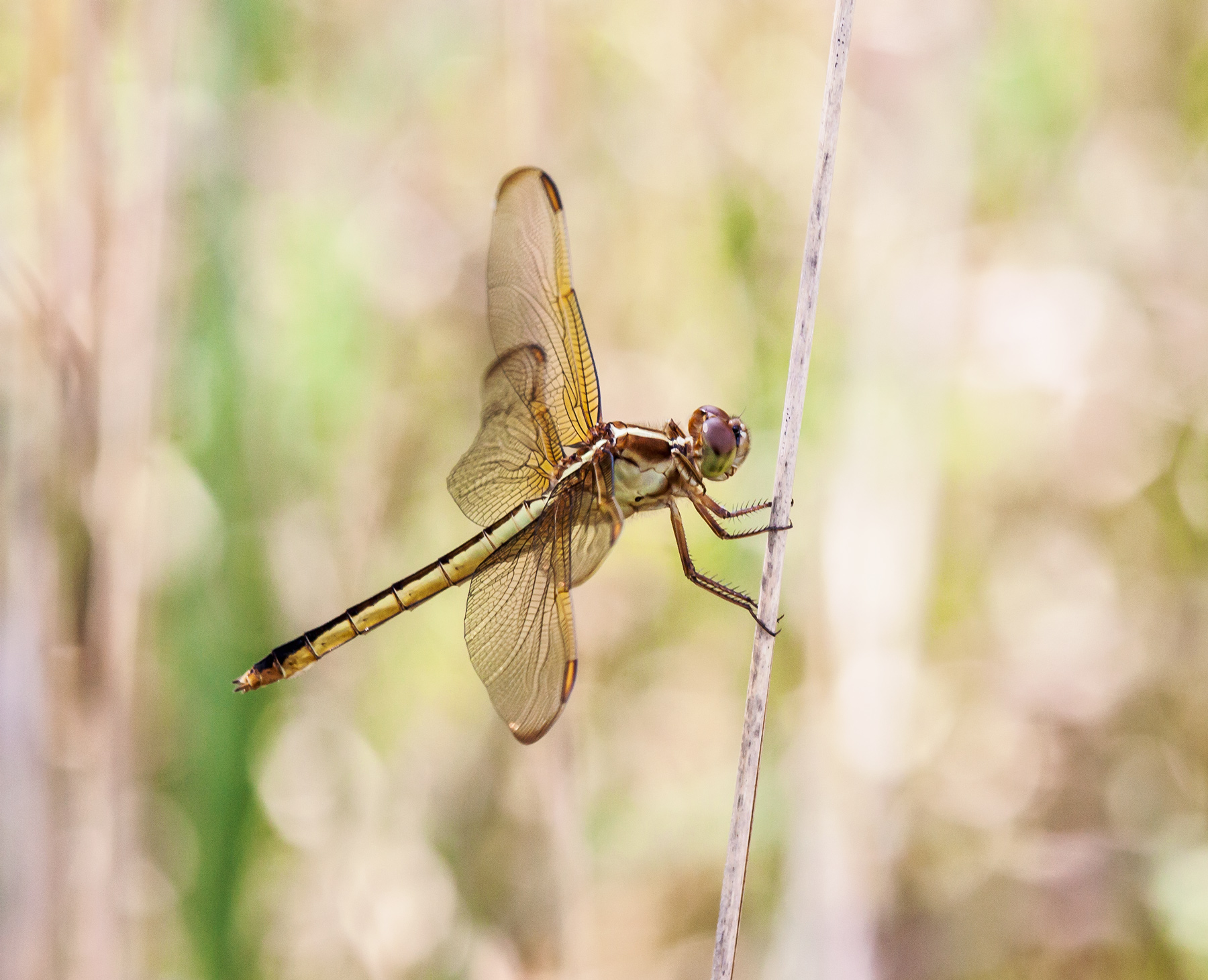
Every once and a while, though, I’ll take a photo that doesn’t require any substantial adjustments or even cropping–it looks just like I imagined it would. That was the case with a recent image I captured of a female Eastern Amberwing dragonfly (Perithemis tenera) at Occoquan Bay National Wildlife Refuge.  I like the way that I captured the subject, I like the curved of the vegetation on which it is perched, and I like the background. It’s a bonus that I didn’t need to crop.

Perfection is elusive in any pursuit—this is about as close as I can come to it in my photography.

Eastern Amberwing

© Michael Q. Powell. All rights reserved

Read Full Post »

I tend to be an opportunistic photographer, content to wander about and shoot whatever I happen to find. For the last couple of weeks, though, I have been searching diligently for a particular species of dragonfly, the Fine-lined Emerald (Somatochlora filosa), and yesterday, the final day of August, I finally found one at Occoquan Bay National Wildlife Refuge.

What makes this dragonfly so special? In his excellent website Dragonflies of Northern Virginia, Kevin Munroe described some of the allure of this particular species— “One of Northern Virginia’s most rare dragonflies, possibly our rarest, this species is seldom seen and little known throughout its range, from New Jersey to Florida, and west to Kentucky and Texas. Most field guides describe its breeding habitat as “unknown”.”

Last year I was lucky enough to see a Fine-lined Emerald several times, but I wanted more. As befits its name, my first glimpse yesterday of the dragonfly was of its brilliant green eyes as it flew by me. Unlike some species that fly high the air, Fine-lined Emeralds often patrol at waist to eye level. I was able to follow and track the dragonfly until it perched. This species hangs vertically from vegetation when perching, so it can be tough to spot one unless you have seen it land.

I was fortunate to be able to photograph this beautiful dragonfly on several different perches until it finally disappeared from sight. Here are a couple of my favorite shots from our altogether too brief encounter yesterday.

Fine-lined Emerald

Fine-lined Emerald

© Michael Q. Powell. All rights reserved

Read Full Post »

Two different colored dragonflies, a Needham’s Skimmer (Libellula needhami) and a Great Blue Skimmer (Libellula vibrans), were peacefully sharing a prime perch on Monday at Occoquan Bay National Wildlife Refuge.

Why is it so hard for us to peacefully coexist with one another?

peaceful co-existence

© Michael Q. Powell. All rights reserved

Read Full Post »

Have you ever gotten into a staring contest with a dragonfly? Dragonfly eyes can have an almost hypnotic effect on you when you look directly into them..

I went eye-to-eye with this Eastern Pondhawk dragonfly (Erythemis simplicicollis) on Monday at Occoquan Bay National Wildlife Refuge. She was the one to break eye contact first as she cocked her head, smiled at me, and decided the contest was over.

Eastern Pondhawk

Eastern Pondhawk

© Michael Q. Powell. All rights reserved

Read Full Post »

It is great to see that at least a few colorful Calico Pennant dragonflies (Celithemis elisa) are still around. I photographed this handsome male last Friday as he perched at water’s edge at the small pond at Occoquan Bay National Wildlife Refuge.

Summer is slowly slipping away. Some species of dragonflies are already gone for the year and others will soon follow suit. A few species have yet to appear, so all of the news is not bad. Still, as kids return to school and the daylight hours become noticeably shorter, it’s hard not to have the feeling that the lazy days of summer are coming to a close.

Autumn is my favorite season for a number of different reasons, but I am not quite ready to give up on summer. So I’ll keep sweating and searching, seeking to capture the summer beauty that still surrounds us. Like this dragonfly, I’m still holding on.

calico pennant

© Michael Q. Powell. All rights reserved

Read Full Post »

Dragonflies have amazing compound eyes that wrap around their heads. With up to 30,000 facets (ommatidia, to be technical), dragonflies have incredible vision and can even see colors beyond human visual capabilities, like UV light. For an easy to read discussion about dragonfly eyes, i.e. not overly scientific, check out this posting by “grrl Scientist” that was posted on scienceblogs.com.

I captured this close-up image of a Great Blue Skimmer dragonfly (Libellula vibrans) yesterday at Occoquan Bay National Wildlife Refuge. At least once a season, I manage to get a shot like this when a cooperative dragonfly lets me get close. I captured the image below with my trusty Tamron 180mm macro lens on my Canon 50D DSLR. This lens, which has a longer focal length than most macro lenses, gives me some stand-off distance so I can get a macro shot like this without actually being on top of the subject. The only downside to the lens is that it has no built-in image stabilization, so I have to pay extra attention to remaining steady when shooting with it—I generally use a monopod to help reduce camera shake and I think it helped for this image.

The image is framed just as I saw it in my viewfinder. Most of the time I end up cropping my images as part of my normal post-processing, but in this case it looked pretty good without any cropping whatsoever.

Great Blue Skimmer

© Michael Q. Powell. All rights reserved

Read Full Post »

Sometimes when I have my camera in my hands, my attention is drawn to the amazing shapes, colors, and pattern of the natural world—I don’t need a specific animate subject to shoot. Here are a few of my more abstract shots from Monday at Occoquan Bay National Wildlife Refuge.

Even though I may not have had a main subject, in the traditional sense,I wouldn’t say that I was photographing nothing—au contraire, I was photographing everything.

ferns

grass

lily pads

© Michael Q. Powell. All rights reserved

Read Full Post »

I just love the colors of this Red Admiral butterfly (Vanessa atalanta) that I photographed on Monday at Occoquan Bay National Wildlife Refuge. I mean, really, how can you not like an insect that sports the red, white, and blue?

You don’t have to be American to like those three colors—it seems like there are an awful lot of countries that use them in various shades and patterns in their national flags.

Red Admiral

© Michael Q. Powell. All rights reserved

Read Full Post »

I was thrilled to capture some shot of a Spicebush Swallowtail butterfly (Papilio troilus) this past weekend at Green Spring Gardens as it fed on a lantana flower. I am so used to more muted colors when I am shooting in the “wild” that the brightness of these flowers seem almost unnatural.

If you look closely at the butterfly’s legs in the first image, you will see that one of them is blurred. Obviously the butterfly was moving about and my camera’s shutter speed was too slow to stop the motion. In many cases I would be disappointed with that lack of sharpness, but I find that it acceptable here, because it doesn’t really distract the viewer’s eyes.

There are a number of dark-colored swallowtails in our area, but the Spicebush Swallowtail is the only one with a blue swoosh on its wings in the middle of a row of orange spots.

Spicebush Swallowtail

Spicebush Swallowtail

© Michael Q. Powell. All rights reserved.

Read Full Post »

The vegetation at Occoquan Bay National Wildlife Refuge was so high recently that these two foraging wild turkeys (Meleagris gallopavo) disappeared from view each time they leaned forward. It was like a game trying to figure out where they would pop up next. I played the game for for quite some time before I was able to capture them both in a single frame with their eyes visible—in most of the other shots the turkeys were looking away from me.

wild turkeys

© Michael Q. Powell. All rights reserved.


Read Full Post »

Imagine an insect so powerful that it is reportedly able to take down a hummingbird. Then give it the macabre monniker of Red-footed Cannibalfly (Promachus rufipes). If I were an insect, I would be really worried. Actually I don’t think that I would want to allow one to bite me, because a cannibalfly stabs its prey with its proboscis and injects saliva that help to liquify the prey’s insides. Then the cannibalfly sucks out the liquid through its proboscis.

I don’t know why exactly, but the last week or so I have seen a lot of Red-footed Cannibalflies during my trips to Occoquan Bay National Wildlife Refuge. Here are a few of my recent shots. The first one reminded one of my Facebook viewers of The Lorax, a Dr. Seuss character with a big mustache. Maybe this insect needs to overhaul its public image so that it is viewed as being less threatening. One possible first step might be to change its name to the Bee Panther, a nickname that is sometimes used for this species.

On a side note, each of the last four years, including this year, a 2013 posting entitled simply Red-footed Cannibalfly has been my most viewed posting. If I calculated correctly, the posting has been viewed almost 2400 times, including 293 times in 2018.

Why is that posting so popular? Apparently a lot of people do Google searches for “red-footed cannibalfly” and stumble onto my blog posting. I’m proud of a number of my postings and the images that I have captured, but I must confess that I don’t consider that 2013 posting as one of my best.

It’s a little scary to think that I may be inextricably linked in some people’s minds with Red-footed Cannibalflies. Yikes!

Red-footed Cannibalfly

Red-footed Cannibalfly

Red-footed Cannibalfly

© Michael Q. Powell. All rights reserved.

Read Full Post »

There were only a few water lilies in bloom at the small pond at a local garden that I visited this past weekend. Surprisingly, they were all pink in color and not the white ones that I am more used to seeing—perhaps it is late in the season for the white ones. Not surprisingly, there were quite a few dragonflies buzzing about and I decided that I wanted to get a shot of one of them perched on one of the water lilies.

So I waited and hoped and waited some more. My patience was eventually rewarded when a tiny male Eastern Amberwing dragonfly (Perithemis tenera) landed on a partially open water lily bud and perched momentarily.

I really like the image that I managed to capture because of the way it conveys a sense of the mood of the moment, a calm, almost zen-like feeling of tranquility. The colors are subdued and the composition is minimalist—there is a real beauty in simplicity.

Dragonfly and water lily

© Michael Q. Powell. All rights reserved.


Read Full Post »

There were lots of flowers in bloom yesterday at Green Spring Gardens, a historic county-run garden not far from where I live. One of my favorites was the Zowie Zinnia and a Monarch butterfly (Danaus plexippus) seemed to like it a lot too.

I was at the garden with my dear friend and photography mentor, Cindy Dyer, and her husband. We were all taking a break at one point and I told Cindy that I was going to return to a patch of Zowie Zinnias to see if I could get a shot of a butterfly landing on one. We both recalled a photo that she took in 2010 (check out her blog posting) when an Easter Tiger Swallowtail butterfly appeared out of nowhere and landed on one of the two Zowie Zinnias that she was focusing on with her camera on a tripod.

Imagine her surprise when a couple of minutes later I returned with this photo. She grabbed her camera and went to the patch of zinnia, but, alas, the butterflies were not as cooperative for her as they had been for me.

Monarch butterfly and Zowie Zinnia

© Michael Q. Powell. All rights reserved.

Read Full Post »

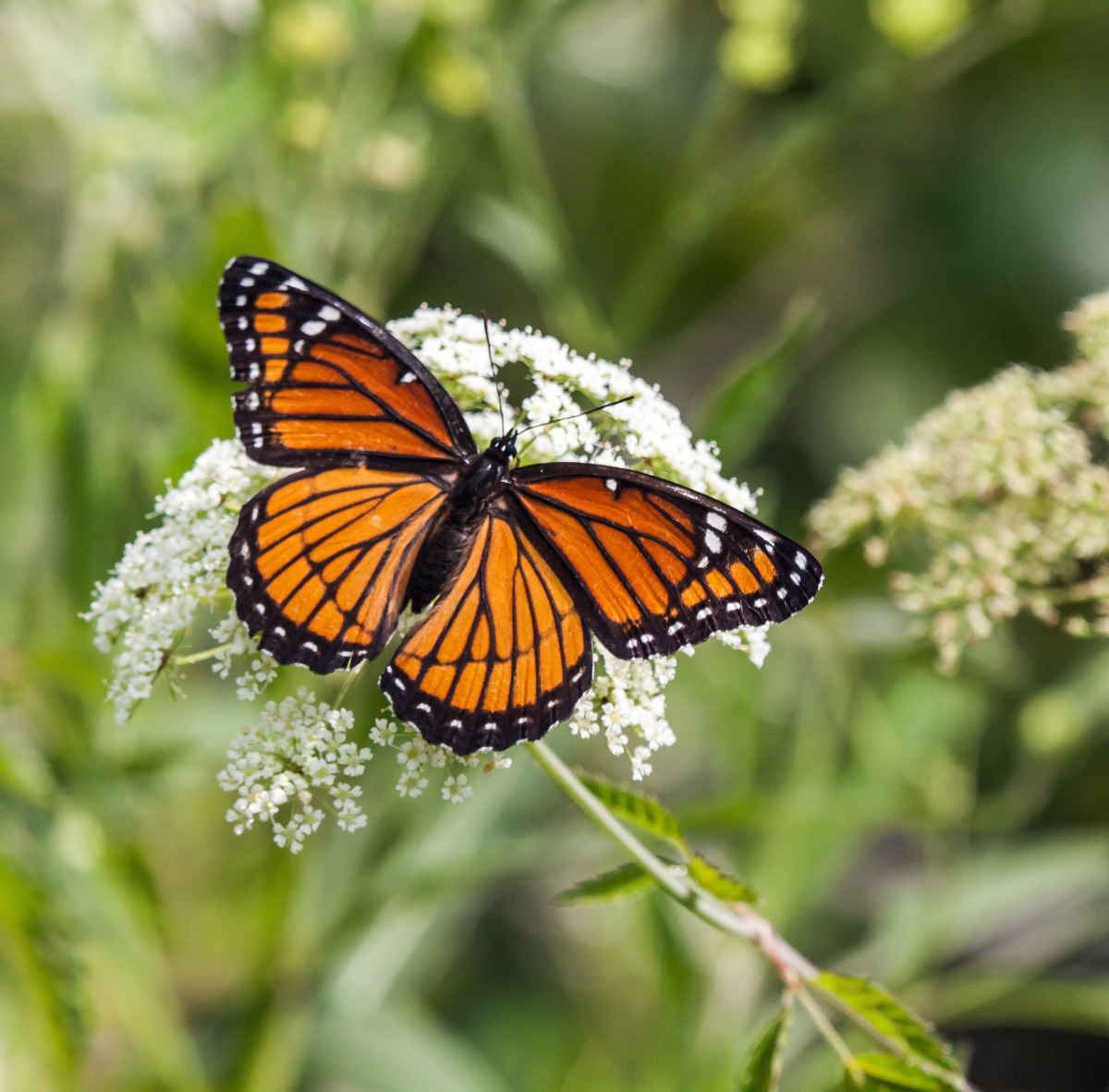
I suppose that I should call this a royal posting for it features both a viceroy and a queen. Of course, here in the USA we don’t have a monarchy, but that doesn’t keep us from having Viceroy butterflies (Limenitis archippus) and Queen Anne’s Lace (Daucus carota). I spotted this royal pair on Monday at Occoquan Bay National Wildlife Refuge where the Viceroy repeated probed the clusters of Queen Anne’s Lace.

You probably have noticed that the coloration of the Viceroy butterfly matches that of the Monarch butterfly. One of the easiest ways to tell them apart is the black line across the hind wings which is present with Viceroys but not with Monarchs.

Viceroy butterfly

Viceroy butterfly

© Michael Q. Powell. All rights reserved.

Read Full Post »

Unlike those that construct elaborate webs, some spiders instead perch at the shore with extended legs and sense prey through vibrations on the surface of the water. When the prey is detected, the spider runs across the top of the water, prompting some to call it the “Jesus spider.”

I spotted this cool-looking Six-spotted Fishing Spider (Dolomedes triton) in the shallow water of a pond this past Monday at Occoquan Bay National Wildlife Refuge.

Six-spotted Fishing Spider

© Michael Q. Powell. All rights reserved.

Read Full Post »

I love the stunning red-orange coloration of a male Needham’s Skimmer dragonfly (Libellula needhami), especially when the sunlight dances across its gold-tinged wings, as it did on Monday morning at Occoquan Bay National Wildlife Refuge.

Generally I prefer an uncluttered background for my subjects, but in this case I think the soft patterns of the grasses in the background enhance the image more than would have been the case with a uniform single color.

Needham's Skimmer

© Michael Q. Powell. All rights reserved.


Read Full Post »

« Newer Posts - Older Posts »