Feeds:
Posts
Comments

Archive for the ‘Nature’ Category

I have been hearing the cries of Red-shouldered Hawks (Buteo lineatus) frequently at my local marshland park, but I have had a lot of trouble spotting them. At this time in the autumn there are still lots of leaves on the trees that obscure my view. Gradually some of the leaves are starting to change colors and fall from the trees, but that process takes place a bit later here in Northern Virginia than in more northern areas of the United States.

As I was walking along the boardwalk at Huntley Meadows Park on Saturday morning, I saw a brightly colored object at the top of a tree. Looking through my telephoto lens, I was thrilled to see that it was a juvenile Red-shouldered Hawk that was out on a limb, giving me an almost unobstructed line of sight for a shot. In most of my shots, the hawk was looking away, but I was thrilled to be able to get a few shots in which one of the hawk’s eyes is visible. The bright blue sky and the red leaves surrounding the hawk were a nice bonus.

Res-shouldered Hawk

© Michael Q. Powell. All rights reserved.

Read Full Post »

Some birds seem to explode out of the water when they are taking off, but Great Blue Herons (Ardea herodias) often seem to gently lift off with almost no splash at all. The Great Blue Heron at Huntley Meadows Park were really active early yesterday morning, frequently flying from one location to another. They seemed to be more intent on socializing with each other than with finding food. In a future post, I’ll look more closely at that behavior, which might be related to courting, but today I’m focusing on one heron’s gentle liftoff.

I’ve watched herons take off hundreds of times, but this is one of the first times that I have been able to capture the moment of liftoff from the water. In this little sequence of three images, you can see the heron rising up, leaving the water, and gradually gaining altitude. The stillness of the early morning helped create some wonderful reflections,  a nice bonus that adds some additional visual interest to the images.

heron liftoff

heron liftoff

heron liftoff

© Michael Q. Powell. All rights reserved.


Read Full Post »

Is it distracting to have a man-made object in an otherwise natural landscape? The ocean really inspired me during my recent short trip to Maine. I am amazed at the number of beautiful images that I was able to capture. I particularly like the colors and simple composition of a shot I took of a small river that rises and falls with the tide.

As I was working on the image, I noticed that there was a solitary warning sign in the upper left-hand corner that alerts folks to the dangers of the tides. I actually like the juxtaposition of this hard vertical line with the gentle curves of the image and the hazy coastline in the background. I began to wonder, however, if others would see the sign as a discordant element in the image, so I created a second version of the image without the sign.

Which image do you prefer, the one with the sign or the one without it?

Old Orchard Beach

O;d Orchard Beach

© Michael Q. Powell. All rights reserved.

Read Full Post »

The sky was mostly clouded over as I made my way toward the beach in the early morning, but the dawn’s early light helped me to see the wooden pathway through the dune grass at Old Orchard Beach in Maine. Although I couldn’t see the sun itself, a reddish glow was reflected on the clouds and sometimes onto the water.

It was a fun challenge to try to capture the beautiful light in different ways, from the very realistic to the almost abstract.

dawn's early light

dawn's early light

dawn;s early light


© Michael Q. Powell. All rights reserved.

Read Full Post »

Do you like clams? I don’t care for them much, but this Great Black-backed Gull (Larus marinus) really seemed to be enjoying the one it found when I spotted it this past weekend on the shore at Old Orchard Beach in Maine. As the tide was going out there seemed to be quite a few partially opened clams on which the gulls were feasting.

Great Black-backed Gull

© Michael Q. Powell. All rights reserved.

Read Full Post »

I don’t often shoot landscapes (or seascapes), but the beauty of the ocean and the waves crashing on the shore inspired me to give it a shot. Normally I take photos with a macro lens or a telephoto zoom, but I was fortunate to have brought along a 24-105mm lens. Here are a few favorite images that I captured yesterday at Old Orchard Beach, Maine.

Old Orchard Beach

Old Orchard Beach

© Michael Q. Powell. All rights reserved.

Read Full Post »

A walk along the beach early Halloween morning in Ocean Park, Maine helped to refresh my mind, my body, and my spirit. I had made a quick trip to Maine for a family emergency and was feeling really stressed. The peace and power of the ocean had an amazing therapeutic effect on me.

The tourists are now almost gone from this vacation area south of Portland and the beach was mostly deserted except for me, some shore birds and an occasional dog walker.

gull at dawn

shorebirds at dawn

© Michael Q. Powell. All rights reserved.
Read Full Post »

I love the way that the folks at Nalls Produce Center chose to display their wide variety of autumn produce—it is almost like a work of art. It was a challenge to photograph the wall of produce and I never did get the angles quite right. so all my photos were crooked to one degree or another. I thought about trying to photograph individual boxes, but decided to photograph them in multiples of varying numbers.

As I look overt the images I continue to marvel at the differences in size, shape, color, and texture of the fruits and vegetables on display.

autumn produce

autumn produce

autumn produce

© Michael Q. Powell. All rights reserved.

Read Full Post »

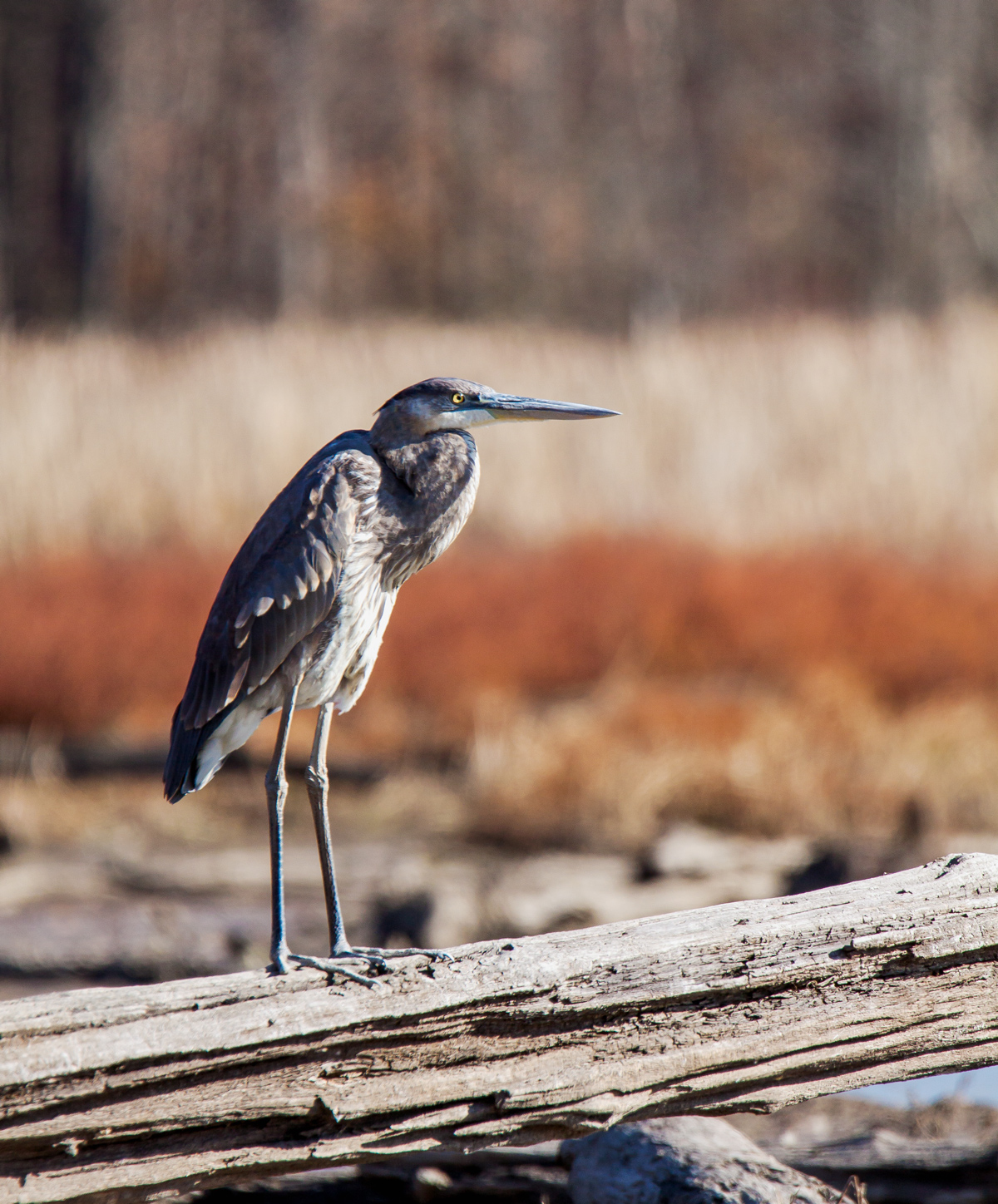
I never get tired of watching the Great Blue Herons (Ardea herodias) at Huntley Meadows Park. Quite often they ignore me and focus intently on catching a fish. I marvel at their patience and persistence.

During one recent encounter, though, I had eye-to-eye contact with a heron. The heron looked right at me and seemed to be sending a distinct warning message that it was not going to share the small fish that it had just caught.

I backed off and let the heron enjoy his fish appetizer in peace. It was gone in a quick gulp and the heron went back to work and I moved on in search of more subjects.

Great Blue Heron

© Michael Q. Powell. All rights reserved.
Read Full Post »

I grew up in the suburbs and don’t know much about domestic fowl, but it seems to me that this colorful bird must be some kind of funky chicken. I love the colors and the patterns in the feathers of this chicken.

I spotted this chicken during a visit to Nalls Produce Center, a wonderful location in our area to see all kinds of colorful produce and plant. While there, I also took some shots of pumpkins that I will probably feature in a posting later this week.

funky chicken

funky chicken

© Michael Q. Powell. All rights reserved.
Read Full Post »

How do you capture the beauty of autumn? If you live in a location where there are broad expanses of trees full of brightly colored leaves, it would be pretty easy, I think. In Northern Virginia where I live, the colors tend to be muted and isolated. There are patches of colors here and there, but it seems like many of the leaves go straight from green to brown.

On some recent trips to Huntley Meadows Park, my favorite shooting location, I tried to capture some glimpses of the changing season using my telephoto zoom lens. The colors and patterns of the fall foliage turned into abstract patterns when viewed through a telephoto lens.

Here are some of my favorite shots as I focused in on the autumn foliage. I am also including a final image that attempts to capture the feeling of walking down a trail in the crisp morning air with fallen leaves crunching underfoot.

fall foliage

fall foliage

fall foliage

fall foliage

fall foliage

autumn trail

© Michael Q. Powell. All rights reserved.
Read Full Post »

Common subjects like this Northern Mockingbird (Mimus polyglottos) have a special appeal and challenge for me. Can I photograph them in an unusual way?

The foreground and background in this image almost blend together and highlight the beauty and personality of the mockingbird. The background makes it look a bit like it was taken in a studio setting. Only the chipped paint gives away the fact that the curious bird was perched on the man-made railing of a boardwalk. I also really like the way that the color and pattern of the weathered wood almost perfectly match the bird’s feathers.

Northern Mockingbird


© Michael Q. Powell. All rights reserved.


Read Full Post »

As I was exploring yesterday at Huntley Meadows Park, I came upon this Rough Green Snake (Opheodrys aestivus) stretched out in the thorns at the edge of one of the fields. My first instinct was to move in close, but I actually remembered to take a shot of the entire snake before doing so.  The “wide-angle” shot was taken with my 150-600mm telephoto zoom lens, which gave me a slightly wider view than the 180mm macro lens that I used for the close-up shot.

Rough Green Snake

Rough Green Snake

© Michael Q. Powell. All rights reserved.


Read Full Post »

Generally it’s best to have the sun behind you when taking photos, but sometimes you are forced to shoot almost directly into the sun. When the conditions are right you can sometimes get wonderful silhouettes, like these images of Double-crested Cormorants (Phalacrocorax auritus) that I spotted on the Potomac River near Dyke Marsh in Alexandria, Virginia this past Monday.

The shot of the perched cormorant was a conscious composition—I assessed the light and knew that I was shooting a silhouette. In the case of the flying cormorant, however, I was reacting to the movement of a bird taking off from the water and trying so hard to hard to capture focus and keep the bird in focus that I was not paying much conscious attention to the lighting.

Double-crested Cormorant

Double=crested Cormorant


Double-crested Cormorant

© Michael Q. Powell. All rights reserved.

Read Full Post »

Periodically I’d catch a glimpse of a warbler in the trees of Huntley Meadows Park last Friday, but they mostly remained hidden deep within the branches. This Yellow-rumped Warbler (Setophaga coronata), however, ventured out of the shadows just enough that I was able to get this long-distance shot of it.

Yellow-rumped Warbler

© Michael Q. Powell. All rights reserved.

Read Full Post »

I am not about to make a sign proclaiming that “The End is Near,” but I couldn’t help feeling a slight sense of impending doom when I spotted an Autumn Meadowhawk dragonfly (Sympetrum vicinum) this past weekend. In our area, Autumn Meadowhawks are the ultimate survivors of the dragonfly season and they can usually be found well into December and occasionally into January.

This pretty red and brown dragonfly is a harbinger of doom—inexorably  winter is approaching and dragonflies will eventually cease to fly until the spring.  For now, though, I’ll continue to search for these spectacular aerial acrobats and enjoy their beauty and skill when I am lucky enough to find one.

Autumn Meadowhawk

© Michael Q. Powell. All rights reserved.

Read Full Post »

Yesterday I spotted this beautiful Double-crested Cormorant (Phalacrocorax auritus) in the vegetation along the shore of the Potomac River as I explored Dyke Marsh Wildlife Preserve in Alexandria, Virginia. Although “heavy-boned” is a euphemism sometimes used for large people, it is literally true for cormorants and is one of the reasons why they ride so low in the water. Additionally, their feathers don’t shed water like those of ducks and can get waterlogged, which makes it easier to dive deeper, but requires them to dry them out periodically.

I hoped to catch a cormorant with its wings extended for drying, but none of the cormorants I saw were accommodating in that regard yesterday. I’m no psychic, but I foresee a return trip to that area in the near future.

Double-crested Cormorant

© Michael Q. Powell. All rights reserved.

Read Full Post »

At first glance I thought that this Great Blue Heron (Ardea herodias) was getting ready to swallow a flying bird, but then I realized it was “only” a small, freshly caught fish that the heron had tossed into the air last week at Huntley Meadows Park.

A split-second later, the fish had disappeared.

Great Blue Heron

© Michael Q. Powell. All rights reserved.

Read Full Post »

I am not sure if it is the cooler autumn weather or the impending winter, but all of the sudden the trees are alive with the sounds of woodpeckers. I can hear them pecking away  and calling out to each other high in the trees. Unfortunately there are still a lot of leaves on the trees, making it hard to spot these busy birds.

On Friday at Huntley Meadows Park, I did manage to get a clear view of a beautiful little Red-bellied Woodpecker (Melanerpes carolinus) feverishly  foraging in a tree. Suddenly the woodpecker turned its head in my direction as though it wanted to proudly show me the bright red fruit that it had discovered.  With the fruit firmly in its bill and a slight smile on its face, the woodpecker flew away, perhaps to cache its find for another day.

Red-bellied Woodpecker

Red-bellied Woodpecker

Red-bellied Woodpecker

© Michael Q. Powell. All rights reserved.
Read Full Post »

Bluebirds are often considered to be a symbol of happiness and I was definitely happy to spot this beautiful Eastern Bluebird (Sialia sialis) yesterday at Huntley Meadows Park. I saw bluebirds a number of times during my walk around the park on a sunny autumn day, but this was one of the only ones that was within range of my camera.

Eastern Bluebird

© Michael Q. Powell. All rights reserved.

Read Full Post »

Many dragonflies are very skittish and will fly away as you get close. Blue-faced Meadowhawks (Sympetrum ambiguum), however, appear to be unusually inquisitive, like this one that perched on my knee Monday at Huntley Meadows Park as I was trying to photograph another dragonfly.

He seemed to want to check me out at close range and I returned the favor.

Blue-faced Meadowhawk

© Michael Q. Powell. All rights reserved.

Read Full Post »

Have you ever tried to shoot a group portrait? You get everyone lined up and facing the camera, but there is always one uncooperative subject. That was certainly the case with these Canada Geese (Branta canadensis) at a little suburban pond on Monday. The gaggle of geese was preening and cleaning themselves all in a row on a on a concrete bar sticking out of the water.

Canada Geese

© Michael Q. Powell. All rights reserved.
Read Full Post »

As we move deeper into fall we will be seeing more and more migrating birds in Northern Virginia, where I live . Some will just be passing through the area, but others will probably overwinter here, like these Ring-necked ducks (Aythya collaris) that I spotted yesterday at a small suburban pond less than a mile from my townhouse.

Unlike most of the ducks that I see, Ring-necked ducks are diving ducks, not dabbling ducks. As a consequence, they spend most of the time in the middle of the pond, making them a bit tough to photograph. Fortunately the sun was shining brightly yesterday, so that I was able to capture the ducks’ golden eyes even when shooting at a distance.

Ring-necked duck


© Michael Q. Powell. All rights reserved.

Read Full Post »

The beautiful orange and brown colors of this Eastern Comma butterfly (Polygonia comma) that I recently spotted at Huntley Meadows Park make it a perfect symbol of this autumn season. This species seems to like to perch on trees, sometimes facing downward, as was the case this time.

Not long ago I did a posting that featured a Question Mark butterflya species that closely resembles this one, but the relatively clear white marking on the hind wing make me think this is an Eastern Comma butterfly. My recent record in correctly identifying butterflies has not been great, however, so I welcome a correction if my identification is incorrect.

It is not immediately apparent from this image, but Eastern Comma butterflies blend in really well with the bark of the trees. The sun was shining through the wings from behind, making the orange color of the inner wings much more prominent than usual, allowing us to see both the colors and the shape of this beautiful butterfly.

Eastern Comma

© Michael Q. Powell. All rights reserved.

Read Full Post »

This spooky spider image that I took late Friday afternoon while hiking along part the Potomac Heritage Trail is probably more suitable for later in the month, but I just couldn’t wait until Halloween to share it.

Normally when I use fill flash I try to be subtle, attempting to add a little pop without making it obvious that I used flash. In this case, you can’t help but notice my use of the popup flash. Normally I would take a shot of a spider like this with my macro lens, but I was travelling light with just my superzoom Canon SX50. The 50x zoom of this camera has helped to bring distant subjects closer, but I had never tried to use the camera’s macro mode. I quickly learned that you have to be really close to your subject, literally only a few inches away. I was pretty happy when I was able to get the second shot below, but wanted to add to the drama of the shot.

I dropped the exposure compensation in the camera down to a minus three stops and got my favorite shot. The darkened sky and the way that the flash illuminates the spider give the image a kind of creepy look that feels appropriate for a spider that was just about at eye level.

spooky spider

spooky spider

© Michael Q. Powell. All rights reserved.
Read Full Post »

Earlier this week I chased after this beautiful little butterfly at Green Spring Gardens, in Alexandria, Virginia. I am pretty sure that it’s a Clouded Sulphur butterfly (Colias philodice), but have no idea of the identity of the flower on which it is feeding. Although at first glance it may look like I used flash for this image, a close examination of the shadows shows the direction of the bright sunlight. I was using spot metering for this light-colored subject, which meant that the background was significantly underexposed when getting a proper exposure of the primary subject.

Clouded Sulphur

© Michael Q. Powell. All rights reserved.
Read Full Post »

I love trying to capture images of fierce raptors and other large birds, but there is something equally gratifying about getting a glimpse of gentle little birds, like this Eastern Phoebe (Sayornis phoebe) that I spotted recently at Huntley Meadows Park. Most of the time birds like this are invisible to me, hidden among the leaves high in the trees. On the day I took this shot, however, the phoebe was perched in a sheltered area, perhaps because of the intermittent rain, and I was able to capture this simple little portrait.

Eastern Phoebe

© Michael Q. Powell. All rights reserved.

Read Full Post »

Cabbage White butterflies (Pieris rapae) are quite common, but many people ignore them, assuming they are “only” moths. I find real beauty in their simple elegance, like this one I spotted last weekend in the garden of my friend Cindy Dyer.

The butterfly was already white and black, so I decided to play around and remove color from the rest of the image too. I like the look of the black-and-white image, but decided to include the color version so that you can decide for yourself which one you prefer.

Cabbage White

Cabbage White

© Michael Q. Powell. All rights reserved.
Read Full Post »

I love ladybugs but don’t see them very often.  I was therefore pretty happy on Monday when I spotted this one crawling around in the vegetation at Jackson Miles Abbott Wetlands Refuge. So often a ladybug will keep its head so close to the vegetation that it’s hard to see it, but this one cooperated by raising its head, almost like it was posing for me.

ladybug

© Michael Q. Powell. All rights reserved.

Read Full Post »

There are a lot of fallen leaves scattered all about my neighborhood and at first I thought this butterfly was merely one of them. Then it opened its wings, revealing its inner beauty. Wow!

I am pretty sure this is a Question Mark butterfly (Polygonia interrogationis), though there is also a chance that it might be an Eastern Comma butterfly (Polygonia comma). Yes, there are butterflies named after punctuation marks.

How do you tell them apart? Well. there is a little white marking on the wings and if it has a single part, it’s a comma, and if it has two parts, it’s a question mark. My challenge in this case was that the marking was not very distinctive. I looked through a lot of material and photos on the internet and the wing shape and coloration started to push me toward the Question Mark, but I still had questions. I came across a posting by TrekOhio.com that illustrated the differences in the spots on the inner wings and I convinced myself the spots in the second photo look like those of a Question Mark.

Whatever the case, the butterfly’s resemblance to a fallen leaf and its beautiful orange color are reminders to me that autumn is surely here, my favorite time of the year.

Question Mark butterfly

Question Mark butterfly

© Michael Q. Powell. All rights reserved.
Read Full Post »

I am not sure what this Great Blue Heron (Ardea herodias) was doing when I spotted it this past weekend at Huntley Meadows Park, but it looked to be admiring its most recent manicure.

Great Blue Heron

© Michael Q. Powell. All rights reserved.

Read Full Post »

« Newer Posts - Older Posts »