Feeds:
Posts
Comments

Archive for the ‘Insects’ Category

Yesterday I took this shot of a bee on a purple cone flower.

The subject matter is pretty ordinary; everyone with a camera has probably taken a similar shot. Somehow, though, the different elements of the photo—the colors, the shapes, the background, and even the bee—worked together to create an image that I really like.

What it beauty? In this case, I find beauty in the simplicity of a photo like this one. The photo is not perfect. That does not bother me, however, for my experience has shown me beauty too is rarely flawless.

© Michael Q. Powell. All rights reserved.

Read Full Post »

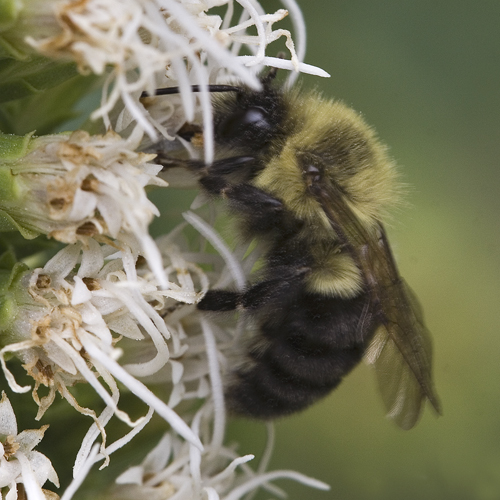
Bees were the very first insects that I tried to photograph close up when I got interested in macro photography a few month ago. (You might say I followed the advice of Julie Andrews as Maria in The Sound of Music when she said, “Let’s start at the very bee-ginning, it’s a very good place to start.”) It was a challenge without a macro lens but I managed to get some pretty good results by shooting at the extreme end of the focusing capability of my digital SLR.

Since that time I have “graduated” to a macro lens and to more exotic insects, but from time to time I am drawn back to the bees. Today, for example, as I was reviewing  images from a session that included colorful butterflies and dragonflies, I realized there were also a few images of bees that I wanted to share.

Most of the time I try to feature a single photo in my postings, but tonight I couldn’t make up my mind. Like Shakespeare’s Hamlet I was caught up in an internal struggle, “Two bees or not two bees, that is the question.”  I’m including them both—I don’t want to decide which is better.

As I end this post, the words of an old Carly Simon song come to mind, “Nobody does it better…bee-bee you’re the best.”

© Michael Q. Powell. All rights reserved

Read Full Post »

I have always admired my friend Cindy D’s photos of an unusual dragonfly that she has featured in her postings.  He is called a Halloween Pennant dragonfly (celithemis eponina).

Wikipedia has some interesting information about this dragonfly including the fact that, “Sexual activity normally occurs between 8 and 10:30 am.” Who knew? I imagine there are scientists somewhere keeping track of the mating habits of the different species of dragonflies using stopwatches.

Today I was happy finally to see a Halloween Pennant dragonfly at Brookside Gardens and take some photographs of him. I love this shot but his wingspan was really wide. I decided to crop out part of the wings so that you can see the details of his face and his wings. I find that dragonflies have wonderfully expressive faces and didn’t want you to miss this face. How can you not love such a face?

I’ll soon be on the lookout for new dragonflies to photograph. Do they have one named for all of the American holidays?

© Michael Q. Powell. All rights reserved

Read Full Post »

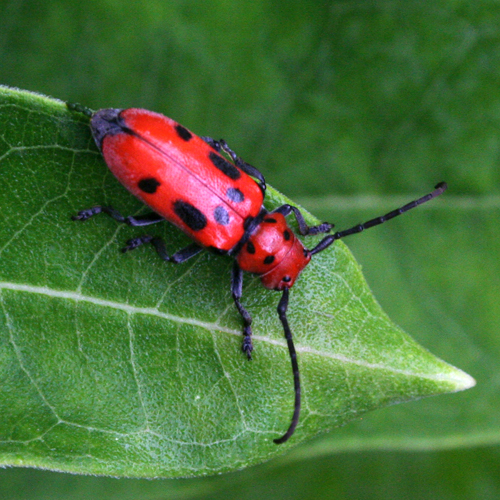
Focus on the eyes! That’s one of the first tips that I was given to improve my shots and I tried to follow that advice when photographing this red milkweed beetle. (One of my earlier blogs chronicled my obsession with these little creatures.)

I like the way the antennae turned out in this photo. They remind me of a Texas longhorn steer’s horns which, according to Wikipedia, can extend to 7 feet (2.1 meters) tip to tip.

Can you imagine a red milkweed beetle with an equivalent antenna span?

© Michael Q. Powell. All rights reserved

Read Full Post »

What’s a harvestman?

a. A man who harvests. like a farmer or a migrant worker;

b. A pocket electronic device made by International Harvester (like a Walkman or Discman);

c. An insect related to a spider; or

d. Spiderman’s adversary in the new Spiderman movie

Until earlier this week I might have responded with selection  “a” if  I had been posed this question—it is the most obvious answer. I would have been wrong. The correct answer is “c.”

As I was finishing up a photo shoot in a local garden one of my friends excitedly pointed to a bush and exclaimed, “There’s your first harvestman.” I did not have a clue what she was talking about. All I could really see in the bush was a bunch of long legs connected to a body. (My friend Cindy D. has some photos of the entire body of a harvestman in one of her blog postings in case you are not familiar with this insect.)

I shot some photos anyways and when I looked at them on my computer I was shocked. There appeared to be two eyes on a stalk in the middle of the insect’s back, with the eyes looking sidewards in completely opposite directions. Could they really be eyes?

Here is one of my photos of the harvestman. It is not a technically perfect photo but it gives you a pretty clear view of the unusual eyes of this strange insect.  If you want to learn more, check out this page, which is full of fascination factoids and photos.

© Michael Q. Powell. All rights reserved

Read Full Post »

Do you find yourself being drawn back inexorably to photographing the same subjects over and over again?

Last month my friend and mentor Cindy D. “outed” me in a wonderful posting on her blog. She confessed that “we’ve become a little obsessed with photographing Red milkweed beetles (Tetraopes tetraophthalmus).” (She also published some interesting facts about the beetles in another blog posting.) She’s right, of course, in her assessment of me, but I might quibble with her on one point. Is it possible to be only a “little” obsessed?

What are the symptoms of my obsession? After work today, in between thunder and rain storms, I rushed to Green Spring Gardens to take some photos. I shot a few flowers but I couldn’t resist the pull of the milkweed plants. I know exactly  where they are located in the gardens and I know if I look hard enough on the milkweed plants I will find the cute little beetles.

By the time I found my beloved beetles the light was starting to fade. How bad was the light? Despite shooting at ISO 800, I needed exposures around 1/5 of a second at F11. Fortunately the beetles were willing to pose and I had my tripod with me. I managed to get a few nice shots with beautiful color saturation in the late day, overcast light. Here is one photo (out of many) of the object of my obsession—a red milkweed beetle.

Is there a twelve-step program for people with this problem?

© Michael Q. Powell. All rights reserved

Read Full Post »

Red and green—they are colors that I usually associate with Christmas. As the temperature climbed to 105 degrees yesterday in the Washington DC area I could easily be forgiven for letting my thoughts drift to a cooler season. While I was photographing lotus flowers and waterlilies in the Kenilworth Aquatic Gardens, though,  I encountered these colors in an unexpected place—in dragonflies. Over the last few months I have taken lots of photos of dragonflies, mostly blue ones (especially the blue dasher) and an occasional, brown, white, or amber one. One time I saw—but was unable to photograph—a green one but until yesterday I had never even seen a red dragonfly. My photos of these two dragonflies are not technically perfect but they show the vivid colors of these two types of dragonflies. I think the red one is a Ruby Meadowhawk and the green one an Eastern Pondhawk. As we enter into our 11th consecutive day with high temperatures over 95 degrees, we all could use a little Christmas, in both the air temperature as well as in our hearts.

© Michael Q. Powell. All rights reserved

Read Full Post »
As I start out with this blog I am posting a few of my favorite photographs. This is a close-up of what I am pretty certain is an Eastern Swallowtail butterfly. I shot it on 1 June at Meadowlark Botanical Gardens in Vienna, VA. I love this unusual perspective. It reminds me a little of a hang glider.

© Michael Q. Powell. All rights reserved.


Read Full Post »

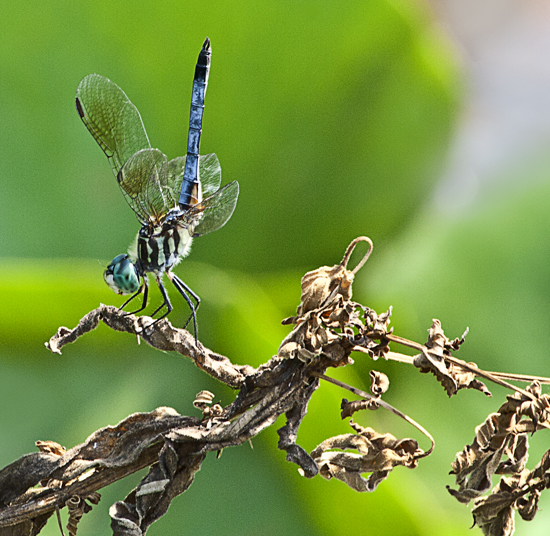
I photographed this Blue Dasher dragonfly (Pachydiplax longipennis) at Kenilworth Aquatic Gardens this morning.

© Michael Q. Powell. All rights reserved.

Blue Dasher

Read Full Post »

« Newer Posts