Feeds:
Posts
Comments

Archive for the ‘Insects’ Category

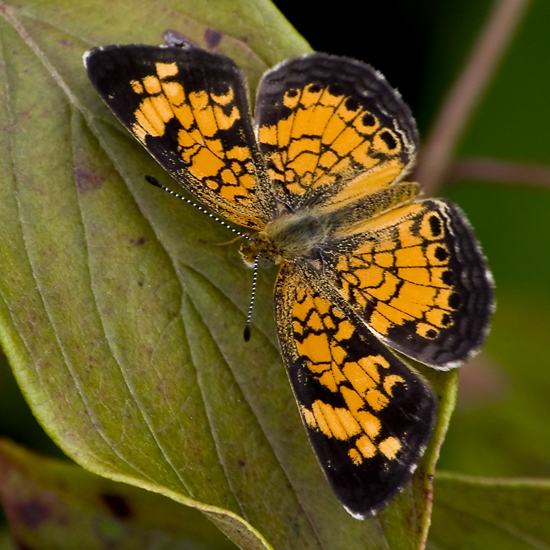
Here are a couple of shots of a Pearl Crescent butterfly (Phyciodes tharos) that I took yesterday at Huntley Meadows Park in Alexandria, Virginia. The Gardens With Wings website cautions that the Pearl Crescent resembles several other butterflies and the patterns of Pearl Crescent butterflies are variable, according to Wikipedia. I apologize in advance, therefore, if I have misidentified this butterfly, but I think we can all agree that he is amazingly beautiful.

© Michael Q. Powell. All rights reserved.

Read Full Post »

Let me begin with a disclaimer—no actual stabbing of bugs took place in the making of this posting. Believe it or not, this bug really is called the Twice-stabbed Stink Bug (Cosmopepla lintneriana). Why? The namer of bugs (whoever that is) decided the two red spots on the bug’s back look like stab wounds.

Yesterday I spotted this little bug while photographing with my friend and photo mentor Cindy Dyer. Cindy has a wonderful posting with a sharper photo of this specific bug and some fun information about him, including the fact that he is also known as the Wee Harlequin Bug. For additional information on the bug, check out his page at Bugguide.

I like the overall effect of this photo, acknowledging that it is far from perfect technically. I’m looking forward to improving my skills as I practice and learn new techniques.

© Michael Q. Powell. All rights reserved.

Read Full Post »

It’s pretty cool to photograph big, gaudy butterflies but today I photographed the smallest butterfly I’ve ever seen. I was shooting photos with my mentor Cindy D. and her husband when Cindy spotted this little guy. He seemed too small to make a good photo and they needed to leave.

Undeterred I lay on my stomach and got as close as my lens would permit me (I did not have time to switch to my macro lens and had to make do with the 18-55mm kit lens that happened to be on the camera). To give you an idea of his size, note that he is perched on a single clover flower.

I’m pretty happy with the result and hope eventually to figure out what kind of butterfly he is. For now, though, I am content to have gotten this shot.

Image

Tiny butterfly on a clover flower

© Michael Q. Powell. All rights reserved.

Read Full Post »

I haven’t seen too many butterflies yet this season so I was happy yesterday to encounter several Eastern Tiger Swallowtail (Papilio glaucus) butterflies at a local garden. The few that I have seen during the past few weeks have been pretty damaged but the male I photographed was in great condition. The female had some damage to one of her “tails” but otherwise was almost perfect.

Eastern Tiger Swallowtail male in perfect condition

Eastern Tiger Swallowtail female with damaged tail

© Michael Q. Powell. All rights reserved.

Read Full Post »

What do bees do when it’s raining? I never really gave the question much thought until this morning when I saw a really cool photo by the unUrban Studio showing a bee seeking shelter in an orchid in an early morning rain. In an earlier post today I showed a bee clinging to the underside of a leaf for protection from the rain.

During a walk in the light rain this afternoon I was pleased to also discover the bee shown below, sheltered inside of a red hibiscus flower. He appeared to be completely protected and may have been napping. As you can probably tell, I had to lighten the image a little to reveal the bee more clearly. This caused the sky, which was light already, to go totally white and produced an effect that I really like.

I enjoy walking in the rain and sometimes carry my camera under an umbrella if it is not raining too hard. From now on I’ll make a point of peeking into flowers and under leaves to discover more secret hiding places of the bees.

© Michael Q. Powell. All rights reserved.

Read Full Post »

What do bees do when it’s raining? I never really gave the question much thought until this morning when I saw a really cool photo by the unUrban Studio showing a bee seeking shelter in an orchid in an early morning rain.

When I took a walk in the light rain earlier this afternoon I decided to look carefully to see if I too could find bees hiding from the rain. Much to my surprise I found the bee shown below, clinging to the underside of a leaf. Apparently it protects him pretty well, though you can see a couple of drops of water on his lower body. The moisture also seems to have caused his hair to frizz a little.

I remember when I too had hair that frizzed when it was humid but those days, alas, are long gone (as is my hair).

© Michael Q. Powell. All rights reserved.

Read Full Post »

One of my earlier post identified my obsession with the red milkweed beetle (Tetraopes tetrophthalmus). As I hang around the milkweed plants, it’s hard not to notice another really colorful creature, especially because this seems to be its prime mating season. After a little research I’ve started to become better acquainted with the large milkweed bug (Oncopeltus fasciatus). Wikipedia provided me with some good information to start and BugGuide added some additional details. I am still getting used to shooting with my macro lens so I apologize in advance that not all of the photos are super sharp. I think they help, though, in explaining some of the traits of these fascinating bugs.

It has been relatively easy to get shots of the mating milkweed bugs and my research identified why. Milkweed bugs while mating can remain connected for up to 10 hours, according to Wikipedia. Yikes! I guess those television commercials about seeing your doctor after four hours don’t apply to these bugs.

What happens after mating? An article from the Life Sciences Depart at the University of Illinois at Urbana noted that a female lays about 30 eggs a day and 2,000 during her lifetime. Egg-laying begins 1 to 15 days after mating and peaks at about 20 days.

A few days ago I came across this group of milkweed bugs. The photo is technically lacking (it was hard to get the needed depth of field) but it gives you an idea of what the large milkweed bug looks like in various stages of development. As a “true” bug, milkweed bugs undergo incomplete metamorphosis. They go through a series of nymph stages, known as instars. For the large milkweed bug there are five instars. Buzzle has an article that explains the bug’s life cycle.
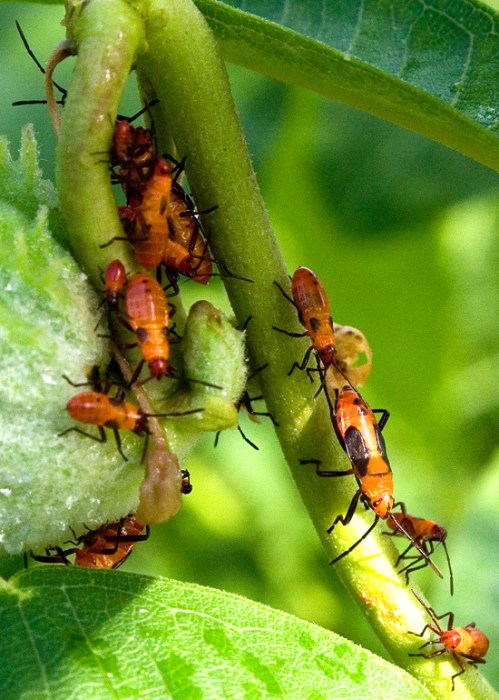
At each stage the bug is covered by an inflexible exoskeleton that constrains its growth. Periodically he bursts out of the exoskeleton and can grow to twice his size in minutes as the new exoskeleton develops and hardens, according to the Buzzle article. Here’s a shot of a bug in one of the earlier nymph stages.

As the milkweed bugs get older the wing pads increase in size in each molt. In the next three photos the wing pads are visible but not yet really prominent.
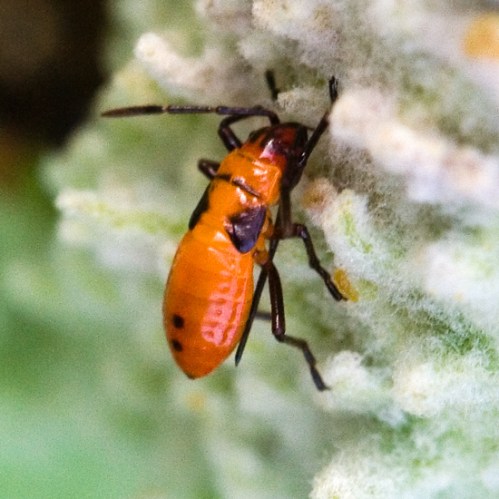
The wings on this nymph are much more prominent, leading me to think he might almost be an adult. The Buzzle article noted that the entire process of metamorphosis, from egg to adult takes 4-8 weeks, depending on the temperature of the habitat.

Once the large milkweed bug has become and adult (as shown in the last couple of photos) mating begins 5 to 12 days after the last molt for females and two to three days for males, according to the University of Illinois article. And the circle of life continues.

© Michael Q. Powell. All rights reserved.

Read Full Post »

Yesterday I took this shot of a bee on a purple cone flower.

The subject matter is pretty ordinary; everyone with a camera has probably taken a similar shot. Somehow, though, the different elements of the photo—the colors, the shapes, the background, and even the bee—worked together to create an image that I really like.

What it beauty? In this case, I find beauty in the simplicity of a photo like this one. The photo is not perfect. That does not bother me, however, for my experience has shown me beauty too is rarely flawless.

© Michael Q. Powell. All rights reserved.

Read Full Post »

Bees were the very first insects that I tried to photograph close up when I got interested in macro photography a few month ago. (You might say I followed the advice of Julie Andrews as Maria in The Sound of Music when she said, “Let’s start at the very bee-ginning, it’s a very good place to start.”) It was a challenge without a macro lens but I managed to get some pretty good results by shooting at the extreme end of the focusing capability of my digital SLR.

Since that time I have “graduated” to a macro lens and to more exotic insects, but from time to time I am drawn back to the bees. Today, for example, as I was reviewing  images from a session that included colorful butterflies and dragonflies, I realized there were also a few images of bees that I wanted to share.

Most of the time I try to feature a single photo in my postings, but tonight I couldn’t make up my mind. Like Shakespeare’s Hamlet I was caught up in an internal struggle, “Two bees or not two bees, that is the question.”  I’m including them both—I don’t want to decide which is better.

As I end this post, the words of an old Carly Simon song come to mind, “Nobody does it better…bee-bee you’re the best.”

© Michael Q. Powell. All rights reserved

Read Full Post »

I have always admired my friend Cindy D’s photos of an unusual dragonfly that she has featured in her postings.  He is called a Halloween Pennant dragonfly (celithemis eponina).

Wikipedia has some interesting information about this dragonfly including the fact that, “Sexual activity normally occurs between 8 and 10:30 am.” Who knew? I imagine there are scientists somewhere keeping track of the mating habits of the different species of dragonflies using stopwatches.

Today I was happy finally to see a Halloween Pennant dragonfly at Brookside Gardens and take some photographs of him. I love this shot but his wingspan was really wide. I decided to crop out part of the wings so that you can see the details of his face and his wings. I find that dragonflies have wonderfully expressive faces and didn’t want you to miss this face. How can you not love such a face?

I’ll soon be on the lookout for new dragonflies to photograph. Do they have one named for all of the American holidays?

© Michael Q. Powell. All rights reserved

Read Full Post »

Focus on the eyes! That’s one of the first tips that I was given to improve my shots and I tried to follow that advice when photographing this red milkweed beetle. (One of my earlier blogs chronicled my obsession with these little creatures.)

I like the way the antennae turned out in this photo. They remind me of a Texas longhorn steer’s horns which, according to Wikipedia, can extend to 7 feet (2.1 meters) tip to tip.

Can you imagine a red milkweed beetle with an equivalent antenna span?

© Michael Q. Powell. All rights reserved

Read Full Post »

What’s a harvestman?

a. A man who harvests. like a farmer or a migrant worker;

b. A pocket electronic device made by International Harvester (like a Walkman or Discman);

c. An insect related to a spider; or

d. Spiderman’s adversary in the new Spiderman movie

Until earlier this week I might have responded with selection  “a” if  I had been posed this question—it is the most obvious answer. I would have been wrong. The correct answer is “c.”

As I was finishing up a photo shoot in a local garden one of my friends excitedly pointed to a bush and exclaimed, “There’s your first harvestman.” I did not have a clue what she was talking about. All I could really see in the bush was a bunch of long legs connected to a body. (My friend Cindy D. has some photos of the entire body of a harvestman in one of her blog postings in case you are not familiar with this insect.)

I shot some photos anyways and when I looked at them on my computer I was shocked. There appeared to be two eyes on a stalk in the middle of the insect’s back, with the eyes looking sidewards in completely opposite directions. Could they really be eyes?

Here is one of my photos of the harvestman. It is not a technically perfect photo but it gives you a pretty clear view of the unusual eyes of this strange insect.  If you want to learn more, check out this page, which is full of fascination factoids and photos.

© Michael Q. Powell. All rights reserved

Read Full Post »

Do you find yourself being drawn back inexorably to photographing the same subjects over and over again?

Last month my friend and mentor Cindy D. “outed” me in a wonderful posting on her blog. She confessed that “we’ve become a little obsessed with photographing Red milkweed beetles (Tetraopes tetraophthalmus).” (She also published some interesting facts about the beetles in another blog posting.) She’s right, of course, in her assessment of me, but I might quibble with her on one point. Is it possible to be only a “little” obsessed?

What are the symptoms of my obsession? After work today, in between thunder and rain storms, I rushed to Green Spring Gardens to take some photos. I shot a few flowers but I couldn’t resist the pull of the milkweed plants. I know exactly  where they are located in the gardens and I know if I look hard enough on the milkweed plants I will find the cute little beetles.

By the time I found my beloved beetles the light was starting to fade. How bad was the light? Despite shooting at ISO 800, I needed exposures around 1/5 of a second at F11. Fortunately the beetles were willing to pose and I had my tripod with me. I managed to get a few nice shots with beautiful color saturation in the late day, overcast light. Here is one photo (out of many) of the object of my obsession—a red milkweed beetle.

Is there a twelve-step program for people with this problem?

© Michael Q. Powell. All rights reserved

Read Full Post »

Red and green—they are colors that I usually associate with Christmas. As the temperature climbed to 105 degrees yesterday in the Washington DC area I could easily be forgiven for letting my thoughts drift to a cooler season. While I was photographing lotus flowers and waterlilies in the Kenilworth Aquatic Gardens, though,  I encountered these colors in an unexpected place—in dragonflies. Over the last few months I have taken lots of photos of dragonflies, mostly blue ones (especially the blue dasher) and an occasional, brown, white, or amber one. One time I saw—but was unable to photograph—a green one but until yesterday I had never even seen a red dragonfly. My photos of these two dragonflies are not technically perfect but they show the vivid colors of these two types of dragonflies. I think the red one is a Ruby Meadowhawk and the green one an Eastern Pondhawk. As we enter into our 11th consecutive day with high temperatures over 95 degrees, we all could use a little Christmas, in both the air temperature as well as in our hearts.

© Michael Q. Powell. All rights reserved

Read Full Post »

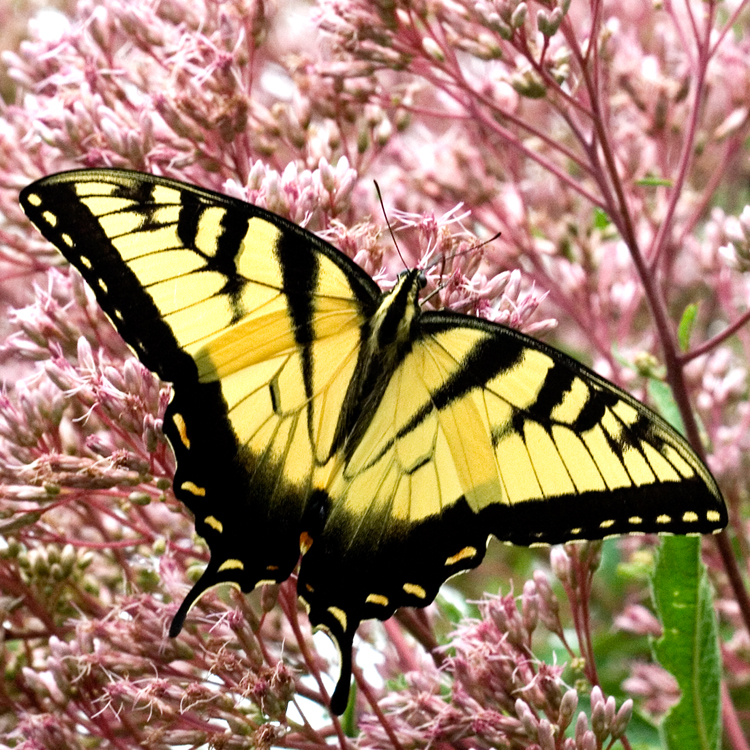
As I start out with this blog I am posting a few of my favorite photographs. This is a close-up of what I am pretty certain is an Eastern Swallowtail butterfly. I shot it on 1 June at Meadowlark Botanical Gardens in Vienna, VA. I love this unusual perspective. It reminds me a little of a hang glider.

© Michael Q. Powell. All rights reserved.


Read Full Post »
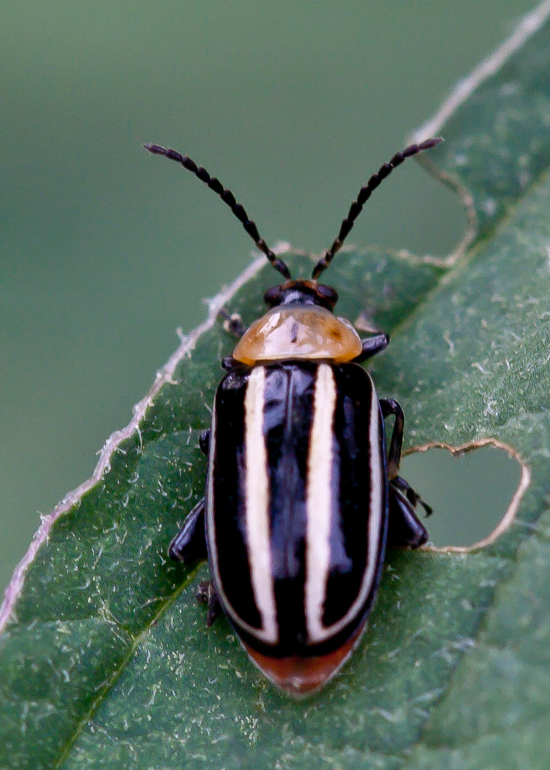
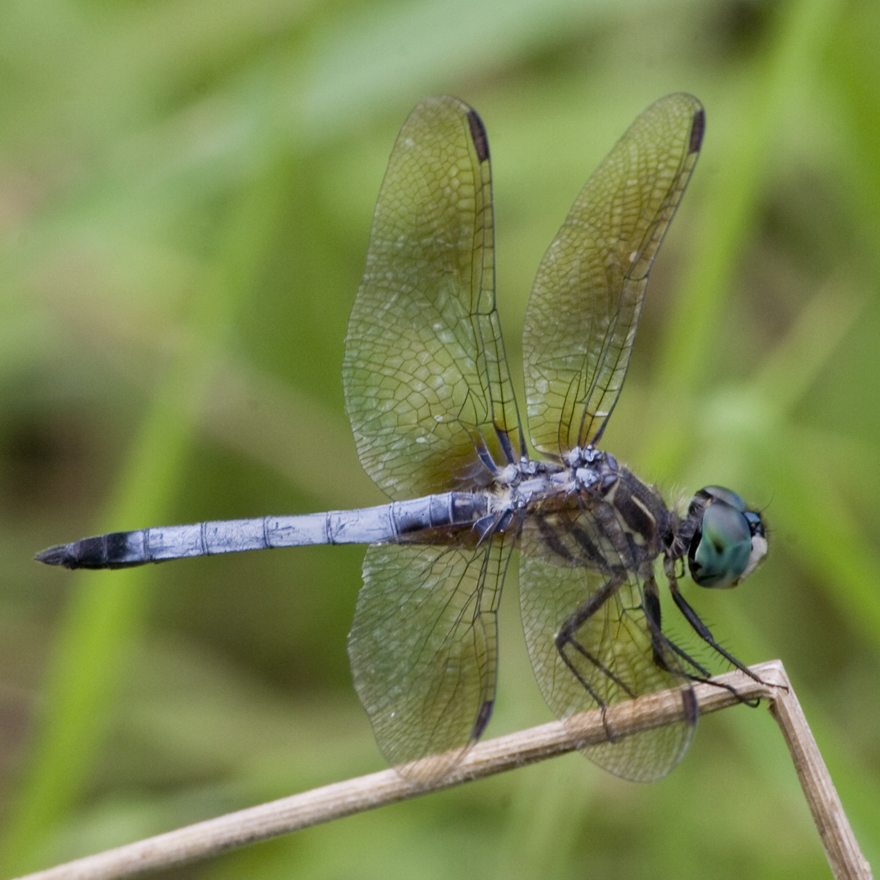
I photographed this Blue Dasher dragonfly (Pachydiplax longipennis) at Kenilworth Aquatic Gardens this morning.

© Michael Q. Powell. All rights reserved.

Blue Dasher

Read Full Post »

« Newer Posts