Feeds:
Posts
Comments

Archive for the ‘Insects’ Category

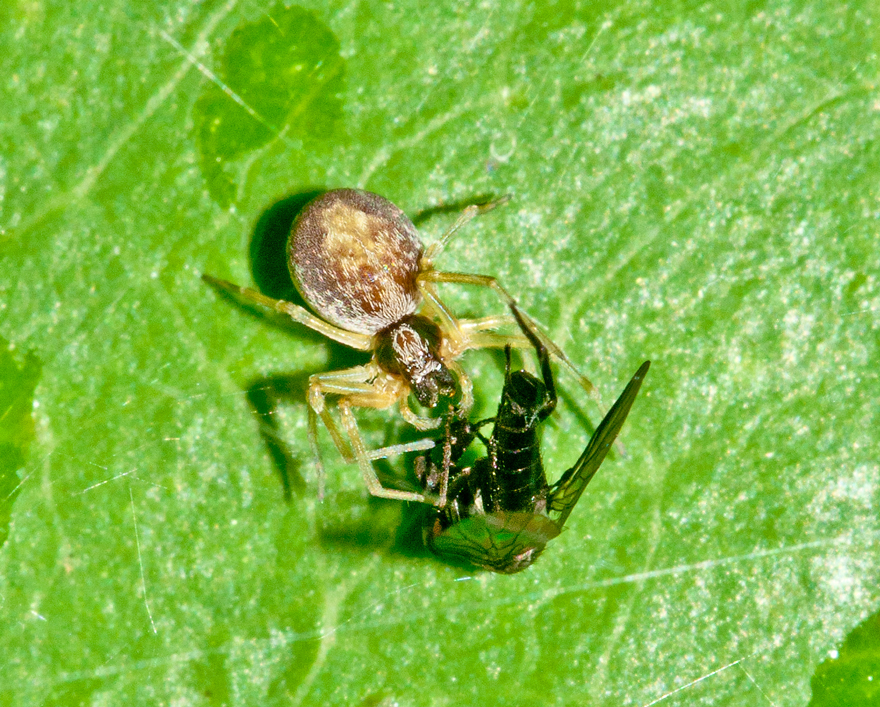
This past weekend I was off in search of spiders again and came across this little spider perched on a leaf, munching on a flying insect.

The lighting was poor, so I used the pop-up flash on my camera to provide a little extra light. Generally I don’t like it if the flash causes a shadow, but in this case it seems to add a somewhat more menacing and sinister look to the spider.

I am still trying to identify the spider and would welcome assistance. The patterns on its body, and especially the front section, are particularly cool and should assist me in finally being able to identify it.

spider_fly_blog

Michael Q. Powell. All rights reserved

Read Full Post »
One of my neighbors, fellow blogger Cindy Dyer, now has lavender blooming in her garden. It smells wonderful and this Cabbage White butterfly (Pieris rapae) seemed to be really enjoying it earlier this afternoon.

cabbage1_blog

Michael Q. Powell. All rights reserved

Read Full Post »

Although I usually try to get close-up shots of dragonflies, there is something really peaceful about this longer distance shot of a male Common Whitetail dragonfly (Plathemis lydia) from this past weekend. I really like the arc of the branch and the reflection of both the branch and the dragonfly in the still water of the marsh. If you click on the image, you’ll see that there is a pretty good amount of detail in the dragonfly—I chose not to highlight those details in this posting.

Click the photo to see a higher resolution view.

Click on the photo to see a higher resolution view.

Michael Q. Powell. All rights reserved

Read Full Post »

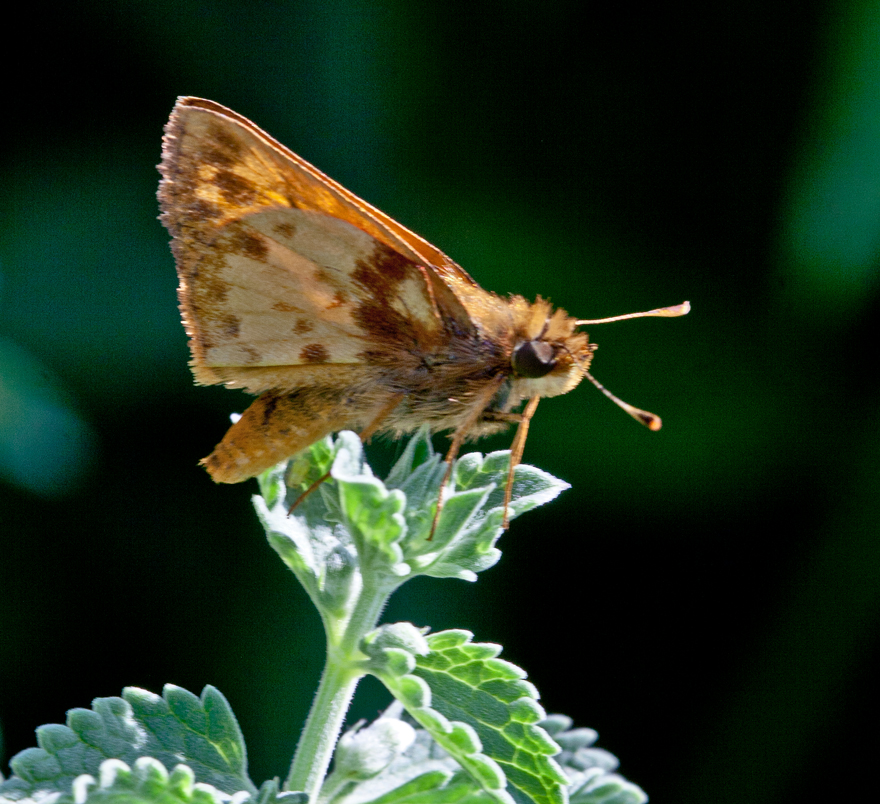
I have trouble identifying a lot of my photographic subjects, but skipper butterflies are among the toughest. Wikipedia says that are more than 3500 recognized species of skippers worldwide, so I don’t feel too bad about my difficulties.

As I perused photos on the internet, I came across a few shot of butterflies that looked at lot like the one that I photographed, and on that basis I am going to tentatively identify it as a Fiery Skipper (Hylephila phyleus).

I like the way in which the skipper was lit and he stayed perched long enough to permit to use my macro lens.

skipper_blog

Michael Q. Powell. All rights reserved

Read Full Post »

Who hasn’t wished for an extra set of hands to get more done in this multi-tasking world?

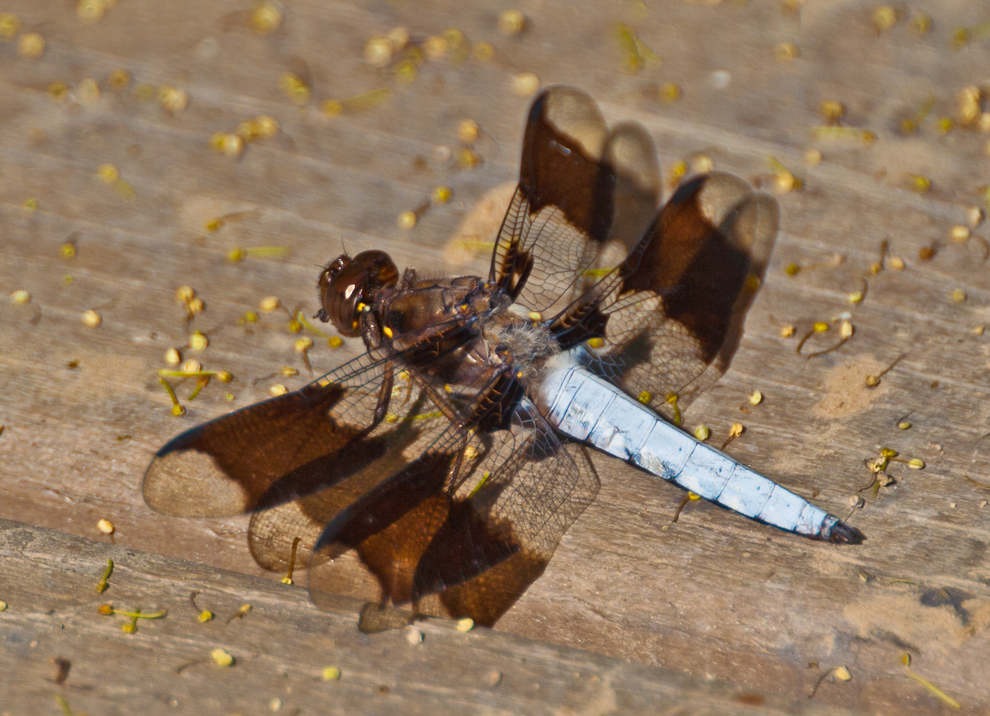
When I first looked at this photo that I took of a male Common Whitetail dragonfly (Plathemis lydia), it looked like he had grown two extra sets of wings. Had a genie granted one of his wishes? Could he now fly faster than his friends (he is a male, after all)? Will this impress the ladies?

A close look at the image, however, reveals that the extra wings are merely illusions, shadowy reflections of a more ordinary reality.

That doesn’t mean, though, that he has ceased to dream and to wish from time to time for those extra wings.

wings_blog

Michael Q. Powell. All rights reserved

Read Full Post »

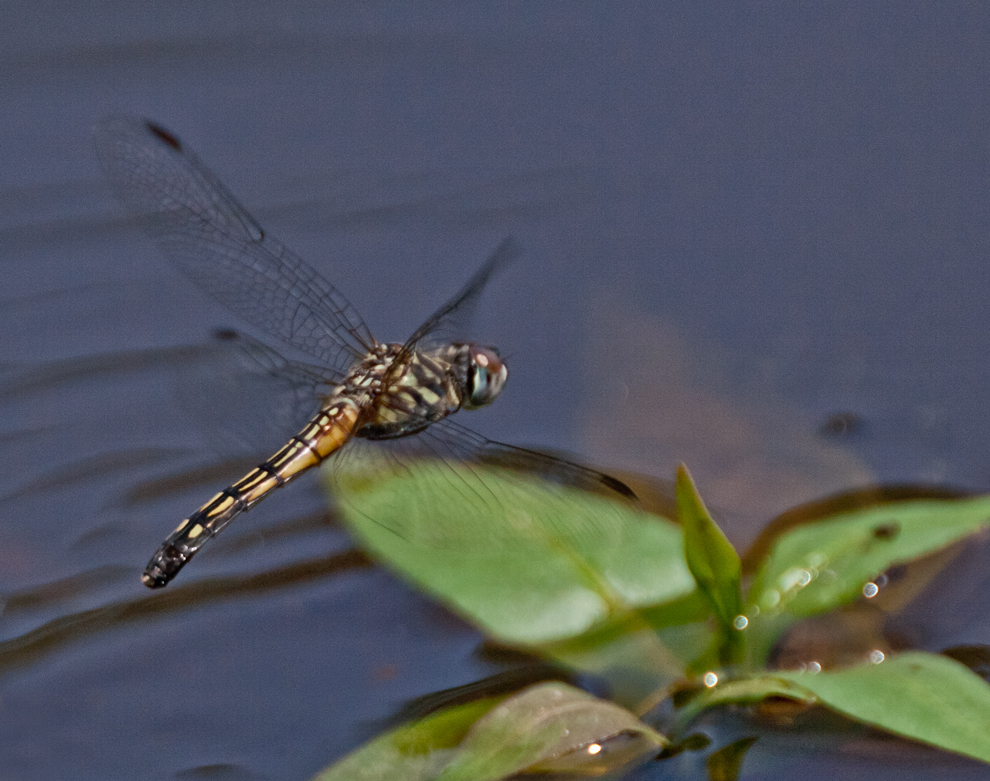
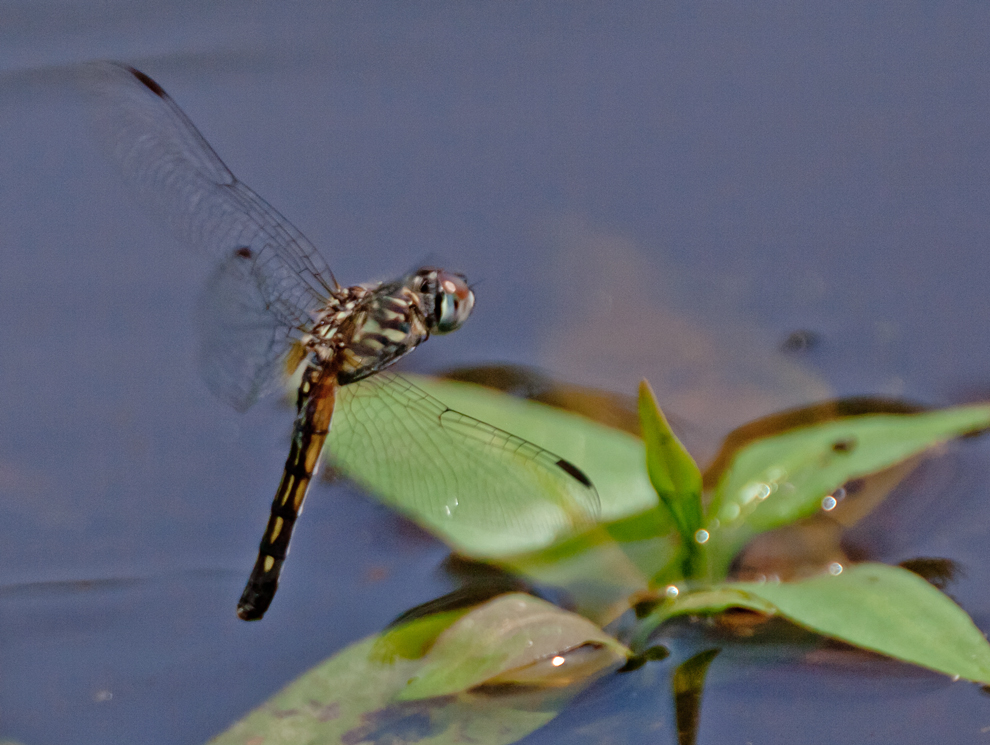
How can you photographing a dragonfly while it is flying? As we have moved into dragonfly season, I have been thinking a lot about that question and earlier this week, I had some success in getting images of a female Blue Dasher dragonfly that I believe was ovipositing.

female_dasher2_blog

Last year, I was content to photograph perched dragonflies (and still love to do so) and occasionally would capture one as it was leaving a perch. This year I am challenging myself and am actively seeking out opportunities to follow dragonflies with my lens and, if possible, to catch them in motion. They are so agile in flight, that the challenge is somewhat daunting. I have experimented with auto focusing and manual focusing. I have tried pre-focusing on an area and waiting and hoping a dragonfly would fly into it. I have had my best luck so far when I can catch the dragonfly as it is hovering.

This female Blue Dasher dragonfly (Pachydiplax longipennis) approached this little clump of vegetation several times and would begin to hover. Then she would bend her tail forward and move it rapidly back-and-forth for a few seconds, which I think meant that she was laying eggs.

female_dasher1_blog

I am definitely not an expert on dragonfly behavior and may be totally wrong about what she was doing. However, from a purely photographic point of view, this offered my best chance of getting some shots of this dragonfly in flight. As I recall, I got my best shots when focusing manually and snapping as many shots as I could when it looked like things were coming into focus.

female_dasher3_blog

The Blue Dasher female (and you’ve probably noticed that the females of this species are not blue, despite their name) flew away and returned several times, but eventually was done with her business. I am continuing to observe the different species of dragonflies and hope to identify the types of behavior they exhibit that will maximize the chance of me getting some more shots like these ones.

Michael Q. Powell. All rights reserved

Read Full Post »

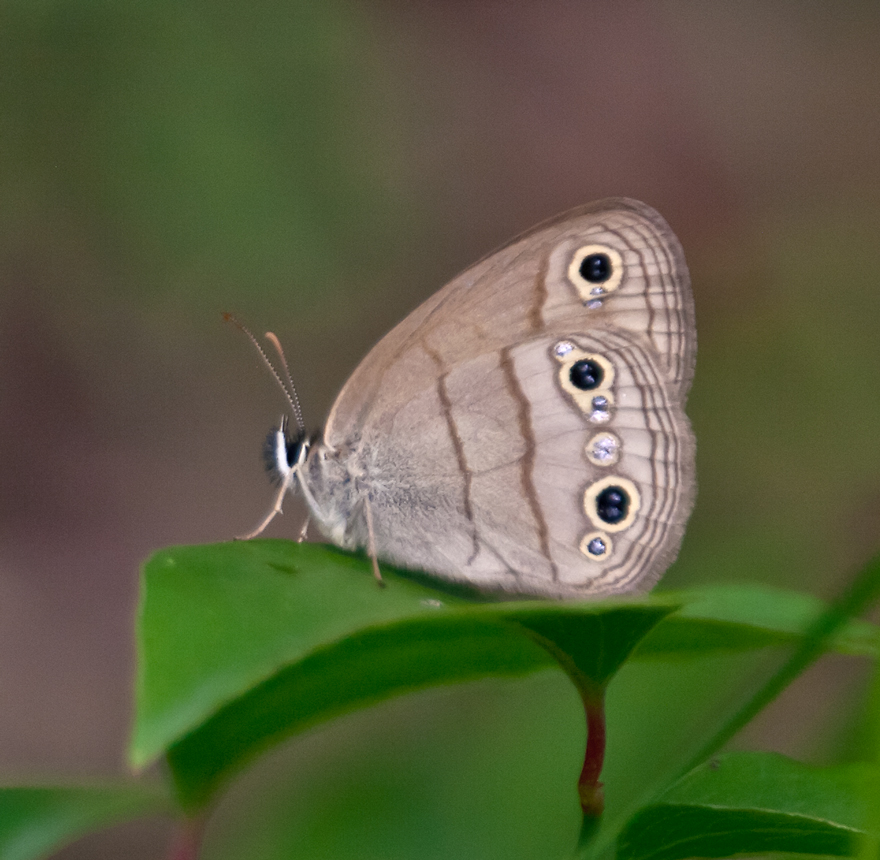
I have been seeing little brown butterflies (or moths) flitting about in the woods recently, but have not gotten a good look at any of them, so I was thrilled when a Little Wood Satyr butterfly (Megisto cymela) landed on a nearby leaf this past Monday and remained long enough for me to get some shots.

I am not a hundred percent certain of my identification, because there are a lot of similar butterflies and the distinctions seem pretty subtle to me at the moment. Please let me know if you can identify this little butterfly with greater precision.

This is another photo in which I took the time to use my tripod and to focus carefully, shooting at a focal length just short of 400mm. The focus is a little soft, particularly for the leaf, but I think that it helps to give the image a kind of dreamy feel, though it’s a little early for a midsummer night’s dream.

brown1_blog

Michael Q. Powell. All rights reserved

Read Full Post »

Normally, I try to have an uncluttered background for my dragonfly shots, but the brilliant green body of this female Eastern Pondhawk (Erythemis simplicicollis) really helps it to stand out (and this was the first pondhawk that I saw this spring).

Most of the dragonflies that I observe at my local marsh are either Blue Dashers or Common Whitetails, so I was really excited when a flash of emerald green caught my eye—the color is distinctive enough that I knew immediately what it was. Without paying too much attention to my surroundings, I moved forward to try to get a better angle on the dragonfly.  The next thing I knew, I was ankle-deep in marsh mud, but did manage to get some shots.

I haven’t yet seen any male Eastern Pondhawks, which are mostly blue, but I am keeping my eyes open and hope that it is only a matter of time until I photograph one this spring.

pondhawk1_blog

pondhawk2_blog

Michael Q. Powell. All rights reserved

Read Full Post »

Walking through the woods today at my local marshland park, I managed to photograph my first damselfly of the spring, what appears to be some type of spreadwing damselfly, possibly a Slender Spreadwing (Lestes rectangularis).

My camera was already on my tripod, with my 135-400mm zoom lens attached, when the damselfly flew by and perched on a thorny vine right in front of me. I decided to try to get a shot and the first thing that I had to do was to back up, because the minimum focusing distance of the lens at full extension is 7.2 feet (2.2 meters). Secondly I had to switch to manual focus—the damselfly is so slender that my camera refused to autofocus on it. Finally, I had to adjust the aperture manually, when I realized that there was a lot of direct light falling on the vine and on the damselfly.

The two shots that I am posting may look like they were taken using flash, with an almost black background, but the damselfly was in a little pocket of light and the rest of the area was pretty heavily shaded.

damselfly_blog

damselfly2_blog

Michael Q. Powell. All rights reserved

Read Full Post »

Last summer, my favorite photographic subject was the Blue Dasher dragonfly (Pachydiplax longipennis) and I was really excited on Friday to see that they are once again present at my local marshland park.

It continues to be a challenge to get close enough to capture the wonderful details of the dragonfly and to manage the background so that it is not too cluttered. I am happy to have gotten a few good images of male Blue Dashers to start the season, with the promise of more shots to come.

dasher1_blogdasher2_blog

Michael Q. Powell. All rights reserved

Read Full Post »
With thousands of gorgeous flowers blooming at Brookside Gardens in Wheaton, Maryland today, this beautiful butterfly, which I think is a Variegated Fritillary (Euptoieta claudia), chose to land on a lowly dandelion growing at the edge of a walkway. Why did it make that choice?

I had been chasing this butterfly around though several sections of the garden, hoping desperately that it would land somewhere within range of my 100mm macro lens. When it did finally land, I approached it cautiously and got a few shots handheld that came out pretty well. I am also including a shot that gives you an idea of the setting—there was a landscape timber to the left and a series of stone tiles that made up the walkway, and the dandelion was growing low to the ground at the edge of the walkway. The lighting was less than optimal, but sometimes you have to work with what you have, especially when the subject is likely to fly away at any moment.

I deliberated for quite some time over the identification of the butterfly. At first, I was sure that it was a Pearl Crescent (Phyciodes tharos), which is orange and has brown spots. As I looked at more photos, though, I changed my mind and now think that it may be a Variegated Fritillary.

As always, I welcome assistance on the identification of my subjects.

pearl2_blogpearl1_blogpearl3_blogMichael Q. Powell. All rights reserved

Read Full Post »

After spending most of their lives underground as nymphs, the 17 year cicadas (Magicicada septendecim) spend the few weeks of their adult lives looking for love. The males are very loud in their “singing” as they seek to attract females. I watched one cicada couple go through a very brief introduction and courtship phase and then suddenly they were mating.

I guess that you have to move quickly when your days are numbered.

love1_blog

Michael Q. Powell. All rights reserved

Read Full Post »

From a distance, I couldn’t tell why the stems of this plant were bright red in color, but when I got closer, I realized it was covered in little red insects. I think that these might be aphids, but I am not completely sure. There were ladybugs in some nearby plants, and if these are in fact aphids, the ladybugs may be in for a feast.

Does anyone have a better idea what kind of insects these are?

bugs_blog

Michael Q. Powell. All rights reserved

Read Full Post »

What do you get when you place two six year old boys in an outdoor environment filled with cicadas? You get a whole lot of energy and excitement. One of the boys came running up to me with a cicada perched on his fingertip and almost desperately asked me to take his picture. How could I refuse a request like that?

I decided that the best backdrop for the cicada was the colorful t-shirt that he was wearing. I am not sure exactly what was displayed on the shirt, but it seemed to be some sort of monsters and superheroes, which somehow seemed to be appropriate.  Be sure to click on the photo to get a higher resolution of the cicada, which is a really cool-looking insect (in a slightly creepy way).

boy_cicada_blog

Michael Q. Powell. All rights reserved

Read Full Post »

Like Paul Revere’s call in 1775, the cry went out in early May, “The cicadas are coming, the cicadas are coming.” After 17 years in the ground, the cicadas of Brood II  (Magicicada septendecim) were coming back in force. The Washington Post ran a story with the sensationalist headline of Bug-phobic dread the looming swarm of Brood II cicadas” and hysteric anticipation gripped the metro D.C. area.

Like most of the snowstorms forecast in this area, the invasion of the cicadas has been underwhelming. I had not seen a single cicada until I traveled to Manssas, VA for a cookout and the got to see and hear a large number of these scarey-looking insects. Apparently we are past the peak moments, but the noise in some places was just short of deafening and there were some bushes that were covered with the giant insects.

I was struck by the contrast between the fierce look of this cicada and the delicate beauty of the purple iris on which he was perched.

beast1_blog

Michael Q. Powell. All rights reserved

Read Full Post »

It took some time for this tiny insect to ascend to the top of this leaf, which may have looked like a mountain to him, and once there he seemed relax and pose for me, as though he was really proud of his accomplishment.

I don’t have any idea what kind of insect he is and would welcome any additional information (or even guesses) from fellow bloggers. To aid you in identification, I have loaded a higher resolution view that you can access by clicking on the photo.

littleinsect_1a_blog

Michael Q. Powell. All rights reserved

Read Full Post »
I was thrilled yesterday when I spotted this Red-spotted Purple butterfly (Limenitis arthemis astyanax), which brought to mind the two things that bothered me about this butterfly last year when I first encountered it.

The first thing is that the name makes no sense at all—there is not purple at all in the Red-spotted Purple butterfly. Secondly, I recalled that it was almost impossible to get a photogenic background with this butterfly. Bugguide notes that adult butterflies of this type take moisture from mud puddles, rotten fruit and animal feces and last year I always found them in the latter situation. I guess I should be happy that the background for these photos was a concrete path!

I took these shots with my telephoto zoom at close to 400mm and realize the limitations of the lens for this type of shot. Most significantly, I couldn’t get close enough to be able to frame this better and the size of the lens limited my agility, the more so because I had it on a tripod. Still, I am happy to capture colors like this that always help to brighten my day.

butterfly2_blogbutterfly1_blogbutterfly3_blog

Michael Q. Powell. All rights reserved

Read Full Post »
This ladybug was not in a very good position for me to get a shot, but I usually try to photograph every ladybug that I see, so I took the shot, totally oblivious to the fact that she was not the only bug in the frame.

Occasionally, when I am photographing a flower or an insect, there is an additional insect in the photo that I notice only when reviewing the  images, what my friend Cindy Dyer calls a “bonus bug.” How did I miss almost a dozen bugs in my viewfinder?

Can anyone identify the little bugs?

bugs_blog

Michael Q. Powell. All rights reserved

Read Full Post »

I really enjoy the challenge of trying to photograph insects and this ladybug was a relatively cooperative subject. She sat still for quite a while, which allowed me to experiment a little with techniques. The first show was taken after she started to move a little.

The light was fading a little, so I decided to see what would happen if I used my pop-up flash. It’s obvious to me that I risk having a hot spot, which is most visible in the second shot, but it seems that the additional light helped to bring out some additional details. I have seen the fancy setups advertised that use dual external flashes, but don’t think that I am ready to make that kind of financial commitment. Perhaps I will experiment with a cheaper, LED light or possibly a ring light and see how well they work.

ladybug2_blogladybug1_blog

Michael Q. Powell. All rights reserved

Read Full Post »

Do you prefer to take photos alone or with others?

Normally I prefer to shoot alone, to move at my own pace and shoot whatever catches my eye at a given moment. However, there are advantages to working side-by-side with another photographer. The other person can serve as a spotter and point out opportunities and subject that you might have otherwise missed. It’s also interesting and instructive after a shoot is done to compare images and see the same scene through another set of eyes.

Friday late in the afternoon, I noticed that my neighbor, friend, and photography mentor, Cindy Dyer, was out in her garden taking photos of her beautiful flowers. Cindy, a noted photographer, has been a constant influence on my photography this past year, encouraging me and inspiring me. She loves this time of the year, when nature explodes with color, and her blog is full of beautiful images of flowers of all varieties (and lots of other cool photos too).

When I started shooting with Cindy, I was shooting a lot of flowers and a few insects, but gradually moved to shooting more insects than flowers. Somehow my eyes are attracted to insects. Shortly after joining Cindy in her garden with my camera and tripod, I spotted what I thought was an interesting looking insect. Upon closer examination, it turned out to be a pair of mating moths, that together were about one inch long (2.5 centimeters). They were positioned in such a way that the only way to capture them was to shoot from directly overhead. I had real problems with depth of field as I got my macro lens as close as it would let me get.

I challenged Cindy (in a friendly way) to photograph this couple and she took up the challenge and posted an image in her blog. It was an interesting challenge pitting Nikon against Canon and teacher against student as we explored the limits of our macro lenses and photography skills.

This little incident helped to remind me of the benefits of shooting with someone else, especially someone who gently pushes me forward. It usually works best for me when we travel somewhere and shoot side-by-side part of the time and wander on our own the rest of the time—the best of both worlds.

moths_mating_blog

Michael Q. Powell. All rights reserved

Read Full Post »

Yesterday was warm and humid, which felt almost like summer here and brought out more dragonflies.

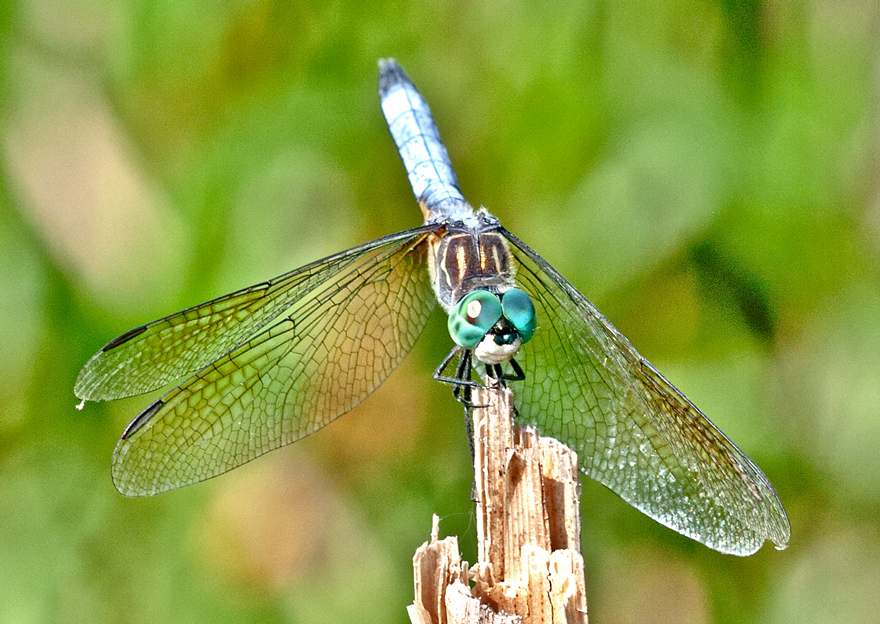
The sun was a little harsh just before noon, but I couldn’t help chasing after the dragonflies and got this shot of a male Common Whitetail dragonfly (Plathemis lydia).

head-on_blog

Michael Q. Powell. All rights reserved

Read Full Post »
Ladybugs are often considered symbols of good luck and many people look at them as cute. Consequently, you have probably never considered them as menacing (assuming that you are not an aphid), but that is the descriptor that came to mind when I first looked at this head-on image of a ladybug that I photographed yesterday.

Perhaps I am just not used to looking eye to eye with a ladybug, but this one seems to have a deadly serious look on its face, like it was not happy that I was disturbing it.

I took the shot in my neighbor’s garden, using a macro lens and a hand-held diffuser to cut down on the intensity of the sunlight. Although I stopped down the lens to get some additional depth of field, the back portion of the ladybug, including its rear legs, are out of focus, which helps to draw attention to the face.

The change in seasons means that I will probably be featuring fewer birds in my blog than during the winter, and a whole lot more insects and flowers.

ladybug1a_blog

Michael Q. Powell. All rights reserved

Read Full Post »

Is it just me, or does this image look like it came from a low budget science fiction movie, with a strange-looking alien creature hovering over a Martian landscape?

I was chasing dragonflies again this past weekend, trying to capture images of them in flight, and ended up with this image of a female Common Whitetail dragonfly (Plathemis lydia). It’s pretty tough to try to track these flying insects with a hand-held telephoto zoom lens extended to almost 400mm. My autofocus seemed too slow and I adapted a technique of trying to focus manually, while trying to keep the lens steady. I can’t tell for sure if this image was auto-focused or was manually focused.

Female Common Whitetail dragonflies do not have a white tail and in many ways that makes them a little easier to expose correctly. The wings are blurred, but you can still see the brown markings that identify this as a female, and not an immature male.

Last summer I was content to get a shot of a dragonfly when it was stationary, but this summer I am going to work hard to capture some more images of dragonflies in flight.

whitetail2_blog

Michael Q. Powell. All rights reserved

Read Full Post »

Although most people probably associate the descriptor “whitetail” with deer, it’s also part of the name of this dragonfly that I photographed yesterday, an immature male Common Whitetail dragonfly (Plathemis lydia).

I remember seeing the adult male Whitetail a lot last summer, and its body is a chalky white in color, as its name suggests. Males start out looking a lot like the female, which has a brown body with some white or yellow markings, according to Bugguide. However, it’s relatively easy to tell the immature males from the females, because their wing patterns are different. Males have wider bands of brown and clear wingtips (no, they are not wearing dress shoes—I am talking about the literal tips of the wings).

I am sure that I’ll get lots more photos of Common Whitetail dragonflies this summer, including some in much better light, but it was nice to see them appearing already in April.

dragonfly1_blog

Michael Q. Powell. All rights reserved

Read Full Post »

I was really surprised today when I saw the the familiar shape and color of a female Eastern Tiger Swallowtail butterfly (Papilio glaucus). Somehow I had expected to see them much later in the spring.

Normally I like to try to get photos of these beautiful butterflies perched on colorful flowers, but there are no colorful flowers yet in the marsh. Unfortunately, the butterfly that I was able to photograph decided to perch on the decomposing carcass of a snapping turtle (as you can see in the first photo). Most of my other shots were at least partially obscured by the grass.

Gradually the cast of characters is coming together that will probably play leading  roles in my blog postings in the upcoming months, the birds and beasts, and the reptiles and amphibians, not to mention the plants and flowers. I can hardly wait.

swallowtail1_blogswallowtail2_blog

Michael Q. Powell. All rights reserved

Read Full Post »

An insect on the edge of a leaf is a perfect candidate for a macro shot and when I saw this one from a distance in my neighbor’s garden, I got to work without a clue about its identity.

When I looked at the photos initially, I thought I had captured images of a Red Milkweed Beetle (Tetraopes tetrophthalmus), because of its bright red body and curved, segmented antennae. (I have a self-identified obsession with this insect that I discussed in a blog posting last year.) However, there were a few problems with that identification. This beetle seemed smaller; it was on a plant that was definitely not a milkweed plant; and it seemed too early to be seeing a milkweed beetle. My identification was further complicated by the fact that I never did see the back of the beetle.

So what insect did I photograph? I have been going over photos at bugguide.net, one of my favorite sources and wonder if this might be a Lily Leaf Beetle (Lilioceris lilii). Tentatively, though I like the name that I invented for this post, Red Spring Beetle.

I may not be sure about the identification of this insect, but I know that I like the photos that I managed to get, especially the first one. I captured a pretty good amount of detail and I like the way that he posed, looking directly at me.

red_bug3_blogred_bug2_edited-1

Michael Q. Powell. All rights reserved

Read Full Post »

As I was admiring the beautiful tulips in my neighbors’ garden, I noticed this fly perched on the edge of one of them. In a different setting he might have gone unnoticed, but here the details of the fly provide a nice contrast with the wonderful primary colors of the tulips in the background.

With spring here in full force, I am reacquainting myself with my macro lens, causing me to look more closely at details like the red compound eyes of this fly and his hairy back legs.  It’s fun too to note the details of his tiny little feet.

I am now remembering how much I have to pay attention to lighting, depth of field, and shutter speed when shooting macro shots, particularly because my macro lens is not image stabilized. Very minor problems can really be magnified when I try to get in this close, especially with an animate subject.

fly_tulip_blog

Michael Q. Powell. All rights reserved

Read Full Post »

We’ll have more ladybugs in our neighborhood even sooner than I expected.

My neighbor and photography mentor, Cindy Dyer, has ladybug larvae in her garden as I showed in a recent posting. Some of them have already entered the pupa stage, the final stage before adulthood. Once metamorphosis is complete, the shell splits open and a full-grown ladybug emerges. Initially, the shell is soft, but pretty rapidly the exoskeleton hardens and takes on the look that we associate with ladybugs.

Here’s a photo from today of a ladybug pupa. I think that it is probably from a Harlequin Ladybug (Harmonia axyridis), a type that is also known as the Multicolored Asian Lady Beetle. If you want to know more about the life cycle of a ladybug, check out the posting that I did last fall entitled Baby Ladybugs.

larva2_web

Michael Q. Powell. All rights reserved

Read Full Post »

I was checking out the plants yesterday in my neighbor’s garden when I came upon this cool-looking spider, a type that I had never before encountered. From an initial check on-line, it looks like this might be a kind of jumping spider, though I really am out on a limb with the guess. In any case, I really like the combination of red and black on his body and the multiple eyes that are just visible.

With the arrival of spring, I am starting to see some familiar insects from last year and some new “friends.” It’s an exciting time for me.

spider_blog

Michael Q. Powell. All rights reserved

Read Full Post »

Standing at an apparent crossroad, I was struggling to decide if I should continue to focus my attention on birds, as I did much of the winter, or switch back to the insects that populated so many of my photographs last summer.

This photo of a Red-winged Blackbird (Agelaius phoeniceus) from yesterday suggests that maybe I don’t necessarily have to choose one or the other, that maybe I can live in both worlds at least some of the time.

I wonder how often in my life I set up these kind of false choices, when I would be better served by thinking more expansively and creatively.

blackbird_bug_blog

Michael Q. Powell. All rights reserved

Read Full Post »
Today I saw my first dragonflies of the spring, which I am pretty sure were Common Green Darners (Anax junius). They buzzed by me several times, but never stopped to perch.

I had reconciled myself to the likelihood that I would not get a single shot.  Suddenly a dragonfly that I was chasing stopped and hovered over the water. I have never had any success before in capturing an in-flight image of a dragonfly, but somehow I was able to grab focus and got several pretty good shots. The beautiful, two-toned colors of this dragonfly are amazing.

I look forward to a new season of chasing dragonflies, but suspect that I will have to work hard to top this first dragonfly of the spring.

dragonfly_blog

Michael Q. Powell. All rights reserved

Read Full Post »
« Newer Posts - Older Posts »