Feeds:
Posts
Comments

Archive for the ‘Insects’ Category

We had a foggy start to one of the weekend mornings and I traveled to my local marshland park with the hope (but no real expectation) of seeing some spider webs. When I arrived at the park, the ground was covered in places with funnel webs, but that was not really what I was looking for.

As I walked along, I suddenly came upon this modestly-sized web. It is not really ornate and is broken in places, but I was thrilled to find it nonetheless. I did not see any spiders, but the web is clear evidence that they are around.

It’s only a matter of time now before I post a shot of a spider!

web2_blog

Michael Q. Powell. All rights reserved

Read Full Post »

Yesterday while walking along the banks of Cameron Run, a tributary stream of the Potomac River, I encountered this unknown insect. I have been so starved for insects (photographically-speaking, not literally) that I decided I had to try to photograph it.

The insect was pretty small and would fly (or hop) when I approached, so I decided to give it a shot with the lens that was on my camera, a 135-400mm telephoto zoom. I was pleasantly surprised with the resulting photo, which almost looks like it was shot with a macro lens.

I will try to identify this little insect, but am happy with the shot and am now convinced that spring is here if insects are reappearing.

insect_blog

Michael Q. Powell. All rights reserved

Read Full Post »
Walking along the Augusta Canal for a final time yesterday morning before returning home, I encountered this spider, hanging in the air from a concrete supports of an overpass, and took shots of him without a flash and with one. After being starved for insects over the winter (photographically speaking), I was thrilled to have a chance to photograph one.

I probably should have taken out my macro lens, which I had with me in my bag, but opted instead to shoot with the 55-250mm zoom lens that was on my camera. It was still relatively early in the morning and the the spider was mostly in the shade, so lights was an issue. I upped the ISO to 800, but still needed an exposure of 1/8 of a second at f/9. Fortunately I had my tripod with me, so I used that to get a relatively sharp shot. I shot with the zoom at 250mm and used manual focus.

The first image was with natural light and the second one was taken using the camera’s built-in flash. The light coming from behind the spider in the first shot helps to illuminate the spider’s legs, which look almost translucent. The flash in the second photo reveals some additional details of the spider, although it did add some reflections, because I did not have a diffuser for the flash.

Which one do you prefer?

spider1_blogspider2_blog

© Michael Q. Powell. All rights reserved

Read Full Post »
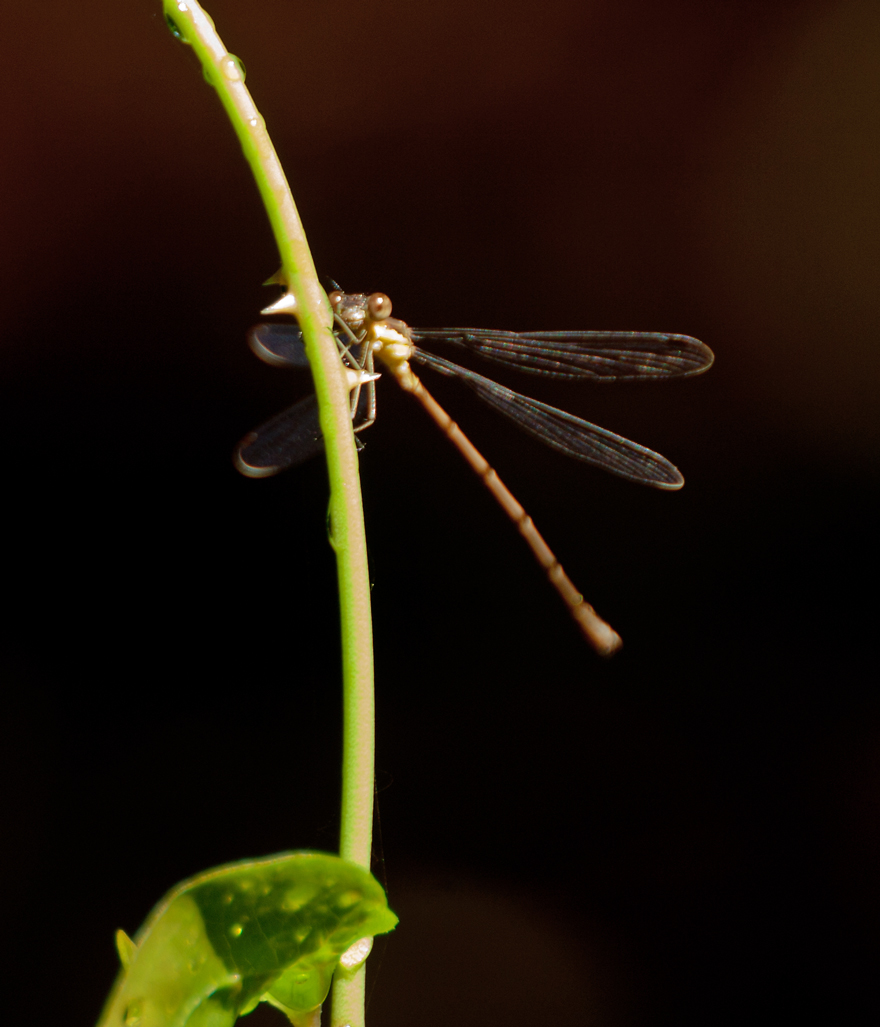
As I was walking on a low boardwalk yesterday at the Phinizy Swamp Nature Park in Augusta, GA, I spotted this Six-spotted Fishing spider (Dolomedes triton) at the edge of the water on a leaf. These spiders wait for prey with several of their legs in the water and capture other invertebrates, tadpoles, and sometimes even small fish, according to Wikipedia, when they feel the vibrations in the water.

It will probably be several months before I begin to see insects in Northern Virginia, but my brief trip to Georgia has given me a foretaste of things to come.

spider1_blog

© Michael Q. Powell. All rights reserved

Read Full Post »

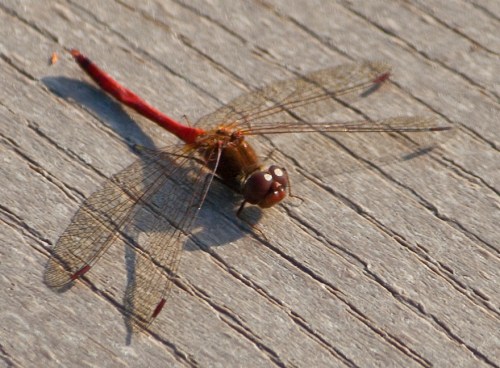
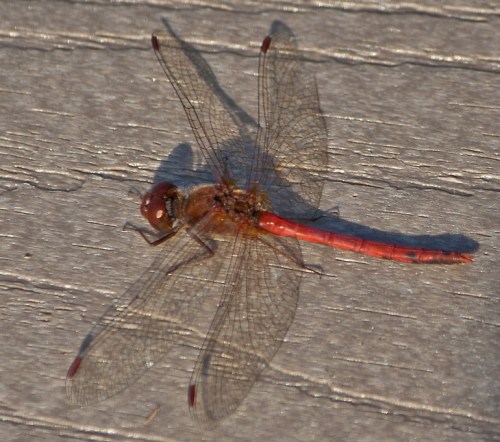
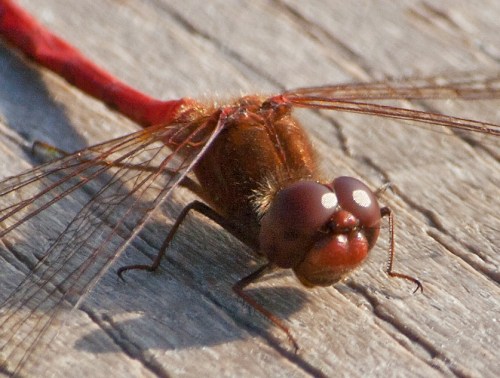
It was sunny yesterday afternoon and got up to 50 degrees F (10 degrees C), relatively warm compared to recent frosty mornings. The faded foliage and the coolness of the breeze reminded me that it is late fall. I was therefore shocked when I spotted a little red dragonfly perched on the boardwalk in front of me.

I recognized this one immediately as an Autumn Meadowhawk dragonfly (Sympetrum vicinum), the last dragonfly that I saw weeks ago and I had done a little research. For an instant I lamented that the setting was not a natural one (the boards are of a composite material), but I managed to get off a couple of shots before the dragonfly flew away. For the rest of the afternoon I keep my eyes alert and managed to spot another one in a similar pose. The second time I got down low and tried to get a shot at the level of his beautiful eyes. The first shot below is a cropped version of the resulting photo, intended to highlight some of his features that get lost when you include his wide wings. The second image is the same photo, but showing his wings. I was shooting with a telephoto zooms lens, so his tail is foreshortened a bit from this angle. The third photo is similar to the second, but was taken from a steeper angle looking down. The final image, which was actually the first one taken, was shot looking almost straight down and provides the best view of the details of the tail.

I love dragonflies, but I never expected to see one in December in Northern Virginia.  Once again I realize that I need to dream bigger, that I need to be prepared for the unexpected blessings that may come into my life, even modest ones like a beautiful red dragonfly.

Close-up of Autumn Meadowhawk dragonfly

Close-up of Autumn Meadowhawk dragonfly

Full front view of Autumn Meadowhawk

Face-to-face with Autumn Meadowhawk dragonfly

View from above

Front view of Autumn Meadowhawk dragonfly

View from above of Autumn Meadowhawk dragonfly

View from above of Autumn Meadowhawk dragonfly

© Michael Q. Powell. All rights reserved.

Read Full Post »

This bumblebee seems to be cleaning or adjusting one of his antennae and it caused me to wonder why. What are the antennae used for? Bumblebee.org had the answer—the antennae are used for smelling and touching. Taste and smell are conveyed to the bee through tiny hairs on the antennae.

Amazingly, bumblebees have a built-in antenna cleaner on each front leg, a notch between the metatarsus and the tibia. As bumblebee.org describes it, “The antenna is inserted into the notch then the metatarsus is bent enclosing the antenna. The antenna is then pulled through the notch and any debris or pollen is caught on the comb fringing the notch.” That site has lots more great information on the bumblebee, including electron microscope photos of the bee and a diagram of the antenna cleaner.

Bumblebee grooming an antenna

© Michael Q. Powell. All rights reserved.

Read Full Post »

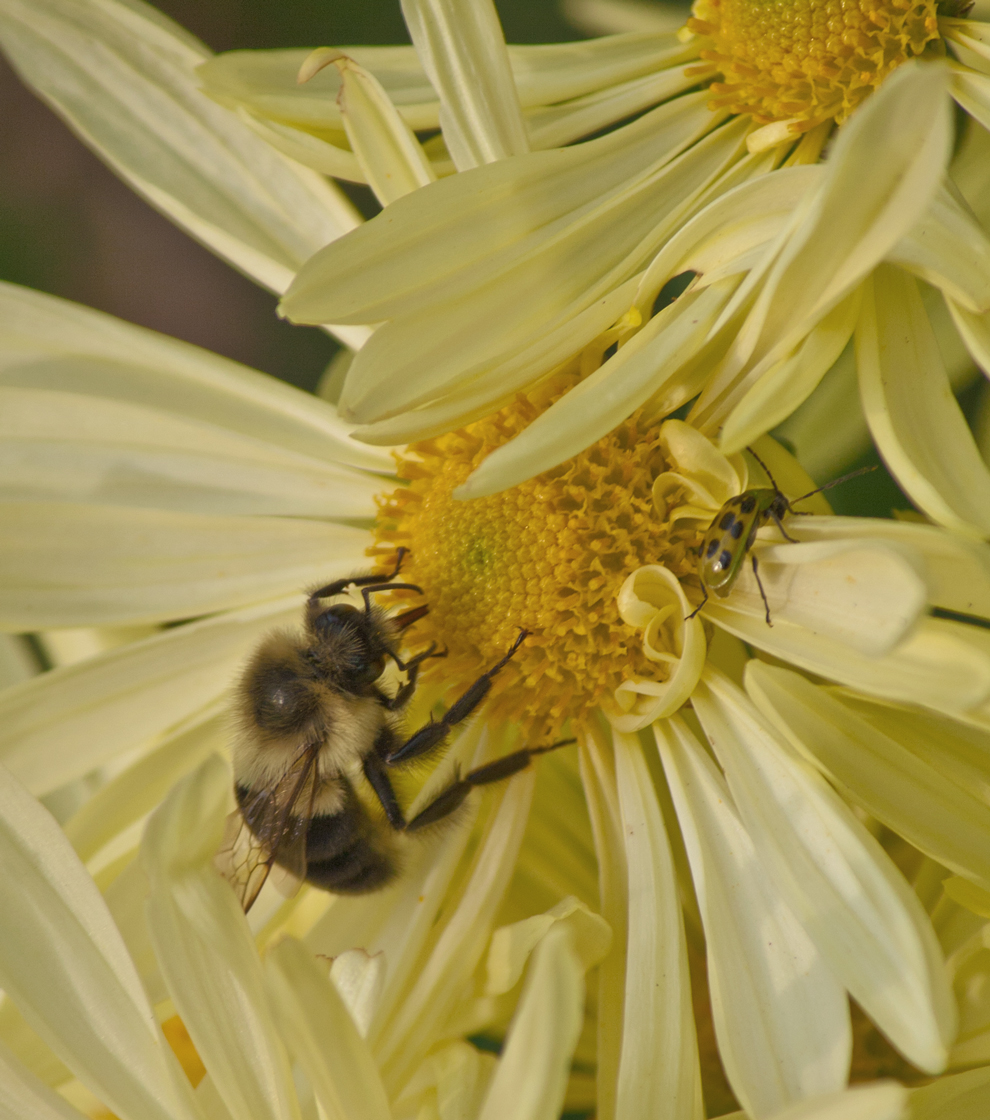
Yesterday I did a posting on a couple of interactions between birds of two species, a heron and a goose. Continuing on the same theme, here is a photo from last weekend of an interaction between insects of two species, a bumblebee and a Spotted Cucumber beetle (Diabrotica undecimpunctata). The beetle was already on the flower when the bumblebee arrived. Looking at the size of the invader, the beetle seems to have decided that a strategic retreat was the best course of action.

Interesting insect interaction

© Michael Q. Powell. All rights reserved.

Read Full Post »

Last weekend was warm and sunny and the bees were very active again after a period of cold weather and little activity. In a short period of time I was able to see (and photograph) several different varieties of bees. In addition to the familiar honeybees and bumblebees, I encountered what I thought was a new kind of bee.

Well, actually, it looked more like a hover fly (or flower fly), but the coloration was different. (Check out one of my earlier postings to see a photo of a hover fly.)  The unknown insect, featured in the third photograph below, acted a lot like a bee, buzzing from flower to flower feeding on nectar or pollen. I am still not completely certain about its identification, but it looks like it might be a Yellowjacket Hover Fly (Milesia virginiensis), a mimic for the Southern Yellowjacket (Vespula squamosa), according to information at Bugguide.

The weather has turned cold again and I may not see these insects again until spring, but it was nice to have an encore performance before the show is closed for the season.

Honeybee in November

Bumblebee in November

Yellowjacket Hover Fly in November

© Michael Q. Powell. All rights reserved.

Read Full Post »
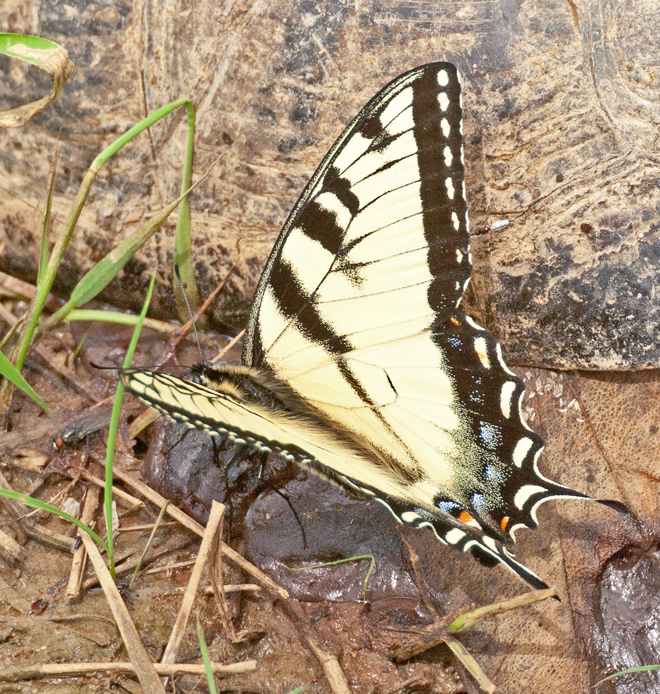
We had a few warm days this past weekend and there were a lot more insects around the still-flowering plants than there had been the week before. I focused a lot of my attention on some white flowers, where bees were active (I may post some bee photos later), but my eyes were especially drawn to a tiny fly with red eyes, clear and black patterned wings and a shaggy-looking body. Despite his diminutive stature, I managed to get a pretty clear shot of him. If you click on the photo, you can even see the hairs on his head. I searched the internet and couldn’t seem to find and identification of my little fly. His wings look a little like a scorpion fly, but the tail is all wrong.

The other photo is a spotted cucumber beetle (Diabrotica undecimpunctata), a photogenic insect whose photo I’ve posted several times already. I especially like the pose of the beetle as he is climbing up the flower. The photo also gives you an idea of the size differential between this beetle and the tiny fly.

Tiny fly on a white flower

Ain’t no mountain high enough…

© Michael Q. Powell. All rights reserved.

Read Full Post »

The light was starting to fade when I spotted a large insect on a flower. I already had my macro lens on my camera and my tripod  was with me, so I thought I’d try to get some shots of the specimen.

To give myself a chance at a decent depth of field, I set the camera at f/18 and then dropped the ISO to 100 for the best possible quality. Finally, I decided to use my pop-up flash (at its lowest setting) to add a little light. I was in aperture priority mode, so I let the camera choose the shutter speed. I figured the shutter speed would be pretty slow, so I used the self-timer to minimize movement. The camera chose an exposure of 30 seconds.

Do you know how long 30 seconds feels as you check the insect to see if he is moving and hope that the wind will not blow? I took a couple of shots and got some pretty good results.  Before I show you the entire insect, I’ll show you a close-up of the face. The antennae are amazing and the eyes are pretty cool looking too.

Close-up shot of really cool insect

So, what kind of an insect is this? It is a Yellow-collared Scape Moth (Cisseps fulvicollis). Yes, for those of you interested in collar ID, I realize that it is more orange than yellow, but even Bugguide acknowledges that it would be more appropriate to call it “orange-collared.” You can’t help but notice the amazing antennae with teeth like a comb—the technical term for antennae like this is “pectinate.”

Here is a photo of the entire insect. Sharp-eyes readers will  notice that the first photo is merely a blow-up of a portion of this image. You can see the light shadow from the flash, but it seems to have helped reveal an amazing amount of detail. Surprisingly, it looks like neither the insect or the plant moved during the exposure.

Yellow-collared Scape Moth

I have a lot to learn about using a flash for extra illumination for macro shots, but this image convinced me that it can be beneficial, though I probably need to diffuse the light and use off-camera flash.

© Michael Q. Powell. All rights reserved.

Read Full Post »
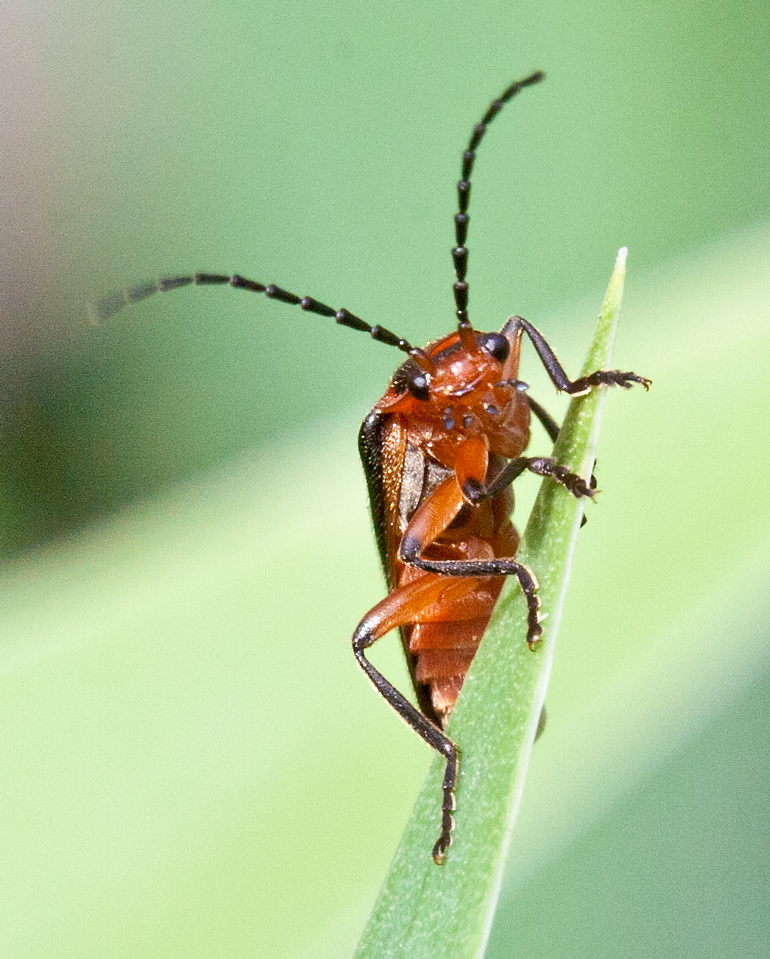
If I were a woodpecker, I would want to be a male Downy woodpecker (Picoides pubescens) and slam my head into something soft as a pillow—like this cattail—and not always into solid wood. Of course, you can end up with a mouthful of cattail fibers, and not just a tasty bug.

Downy woodpecker with mouthful of cattail

Downy woodpecker on cattail

More seriously, scientists are doing research to figure out why woodpeckers don’t end up with concussions, given that they can slam their heads into wood with the force of 1,000 times that of gravity, according to an article on livescience.com. By comparison, humans can survive a force of up to G’s, according to Air Force research, though there are reports of race car drivers surviving a force of over 100 G’s. According to the article, Chinese researchers are studying the microscopic structure of the bones surrounding the brain and also the beak to try to understand how the woodpecker’s brain is protected. If you are interested in the research, an article on a website called Inkfish explains in layman’s terms the research methodology and some of the preliminary conclusions.

© Michael Q. Powell. All rights reserved.

Read Full Post »

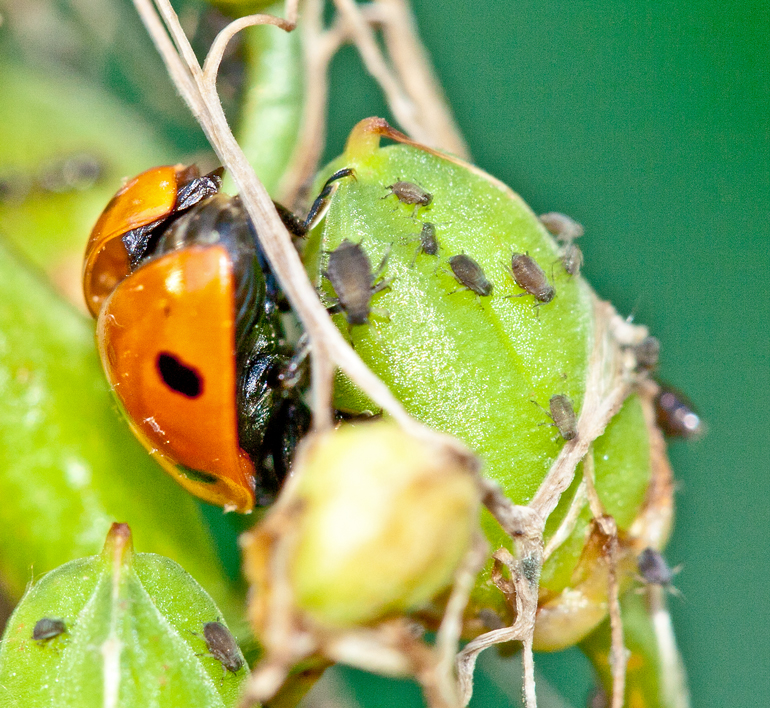
Last weekend, I took some shots of Multicolored Asian Lady Beetles (Harmonia axyridia) in the larval and pupal stage and discussed the phases of ladybug development in a post called Baby Ladybugs. Yesterday, I returned  to see if I could find any fully developed ladybugs that had been in pupae the last time I encountered them. (Yes, I realize I would not be able to recognize them individually, but it’s nice to imagine that we’re gradually getting to know each other.)

So, what happened? I left the shoot thinking that I had not seen any adult ladybugs, but when I looked at some of the photos on my computer of different pupae, I was uncertain. Right outside of an empty pupa shell in one of the photos is something that looks like an adult ladybug, if I squint my eyes, tilt my head, and use a little imagination. What do you think?

Newly emerged ladybug?

If you haven’t been following this story, let me catch you up with a couple of photos. (I feel like I’m doing an intro for a new television series, Lifestyles of the Ladybug.Ladybugs start out as eggs and them become larvae. As they grow, they molt several times and each time they develop a new exoskeleton. Yesterday, I saw quite a few discarded skins that, at first glance, looked a lot like the larvae themselves. Here is what a ladybug larva looks like in a later phase of development. (I took some new shots of the larvae and pupae yesterday.) They are not as cute in this stage as they will become as adult ladybugs.

Ladybug larva

Once they are fully grown, the larvae enter into a pupal stage, somewhat akin to the cocoons into which caterpillars develop into butterflies. The pupae look a little bit like ladybugs themselves and are attached to leaves. While they are in this phase, the metamorphosis takes place in which they turn into ladybugs. Here is my favorite shots of a ladybug pupa.

Ladybug pupa

After about five days, a ladybug emerges from the pupa. According to ladybug-life-cycle.com, “When the metamorphosis is complete, the skin of the larvae will split open and the full grown ladybug will emerge, but it still won’t look like the ladybug that you know so well. It will look soft and pink or very pale for a couple of hours until its shell becomes hard.”

Was I really lucky enough to catch the ladybug just after it had emerged from the pupa? My response is a firm, “Maybe,” but others with more experience may be able to respond more definitively. Here is one last photo of the possible new ladybug, from a slightly different angle than the first photo, to help your deliberations.

Welcome to this world

© Michael Q. Powell. All rights reserved.

Read Full Post »

When I first saw this insect, my initial thought was to wonder about its identification—I still don’t have an answer to that quandary. My second thought was that it would be cool to try to take a photo looking into the flower from just over the edge of one row of  petals, which were standing almost straight up. I’m still a relative neophyte with my macro lens, and depth of field and critical focus are sometimes real problems.

I am pretty happy with the results I achieved in capturing images consistent with my mental picture.  The first photo is the closest to what I had in mind, but I also like the position of the insect in the second photo.


© Michael Q. Powell. All rights reserved.

Read Full Post »

It seems that as long as plants are blooming, some insects, especially those considered to be pests, will continue to be active. This past weekend as I was looking at flowers at a local garden, I spotted a familiar insect, the Spotted Cucumber beetle (Diabrotica undecimpunctata). I consider this beetle to be attractive, with his different shades of green and multiple black spots, but recognize that it causes a lot of destruction (and you can see some of the petals of the flower that it has chewed through).

Several cucumber beetles were on the flowers and I was able to get some pretty good shots with my 100mm macro lens, a lens that has fallen into disuse as I have focused more of my attention on birds. The photos show the beetles in several different “poses”—I especially like the first one that seems to have caught the beetle as he is chewing on the flower. You may want to click on the photos to see higher resolution views.

© Michael Q. Powell. All rights reserved.

Read Full Post »
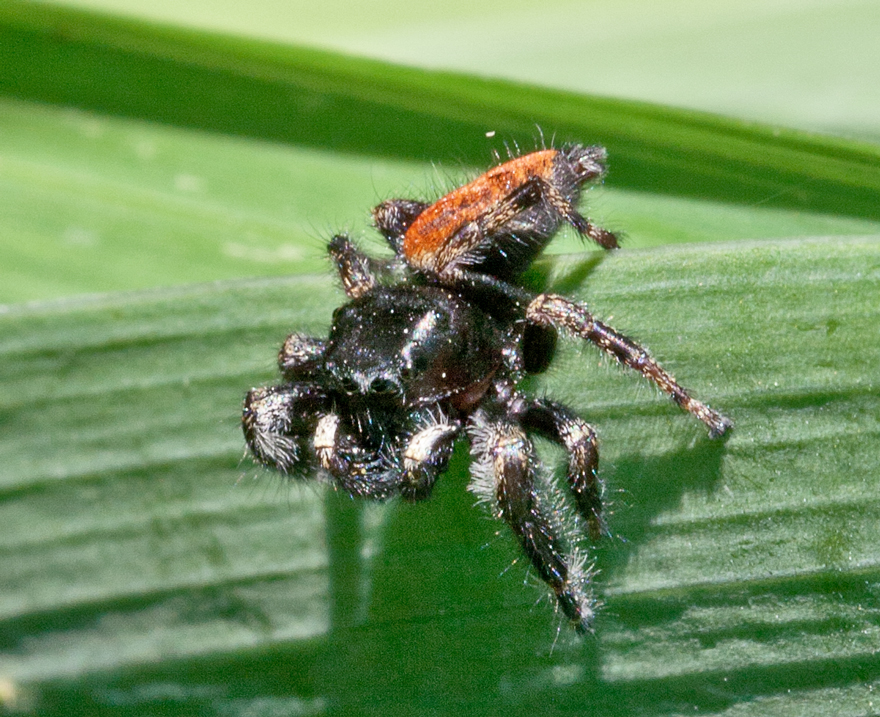
I know that ladybugs don’t really have babies, but, seriously, how many people will read a posting with words like “larva” and “pupa” in the title? A more accurate title would be something like “Larva and Pupa of the Multicolored Asian Lady Beetle (Harmonia axyridis).”

This past weekend I was wandering through a local garden when I spotted a strange-looking little yellow and black insect. Upon closer investigation, I discovered several more of them on the plant, along with some orange and black objects that I thought might be insects too, but they were not moving. This was a good excuse to take out my macro lens and to follow the old adage about shooting first and asking questions later.

After a bit of research, I realized that I had captured two different phases in the life cycles of a ladybug. Lady-bugs.org and ladybug-life-cycle.com offer additional details on the stages of development of a ladybug, but allow me to summarize for folks like me who don’t follow insects for a living. The ladybug’s life cycle is about four to six weeks long, with four stages (egg, larva, pupa, and adult). During the larval stage, the ladybug larvae shed their exoskeletons three times before the pupation stage begins. It is during the pupa stage that the metamorphosis takes place that is almost as magical as it is for butterflies and the insect that I photographed turns into a full grown ladybug.

Thanks to bugguide, I was able to identify my bug as the Multicolored Asian Lady Beetle (Harmonia axyridis). The article notes that the larvae look like tiny alligators and grow to be larger in size than the eventual ladybug. It describes the pupa as “an elongated dome shape, usually found attached to a leaf, with the spiky remains of the last larval skin usually clinging to one end. The branched spines of this skin are usually visible.”

It was fascinating to discover the details of what I had photographed—metamorphosis never ceases to amaze me. Here are a couple of my favorite shots of the ladybug larvae and several of different pupa. Be sure to click on them to see more details.

© Michael Q. Powell. All rights reserved.

Read Full Post »

Yesterday I returned to my photographic roots at Green Spring Gardens, a county-run historic park, to shoot flowers and bugs, the subjects I started with six months ago when Cindy Dyer, my mentor and muse, helped me get serious about my photography. It was cloudy and cool (about 47 degrees F (8.3 degrees C) and I didn’t expect to see many insects active. There was quite a variety of flowers blooming, including many that have been present all summer. Perhaps when we have a hard freeze, some of them will die off, but for now they provide a blast of bright color that contrasts with the now fading fall foliage.

Bee in early November

I was surprised when I encountered this bee, the only one that I saw all day. It seemed to be moving slowly in the colder weather, but was industriously working on this purple flower. Judging from its relatively hairless abdomen, I think that this might be a carpenter bee rather than a bumblebee, though I am not completely sure about the identification.

I have always mentally associated bees with spring, but now, as I look more closely at nature, I realize that I have to question all of my previous assumptions. That’s probably a good thing for me to do regularly, and not just in my photography.

Bee working in the cold

© Michael Q. Powell. All rights reserved.

Read Full Post »

Looking down in the water, I was a little surprised to see a Banded Wooly Bear caterpillar (Pyrrharctia isabella) swimming, albeit not too quickly. He would slowly undulate his hairy body for a stroke and pause, and then repeat the process. It was fascinating to see the little air bubbles surrounding his mouth and the gentle ripples produced by his movement.

This caterpillar will almost certainly overwinter in his current state and pupate in the spring into an Isabella Tiger Moth. Bugguide notes that there are normally two broods, on that pupates in the summer and the other in the following spring. I have looked at some photos of the moth and can’t help but note that the caterpillar stage is a lot more attractive and interesting.

Wooly Bear caterpillar swimming (click for higher resolution)

Wooly Bear caterpillar pauses for a breath (click for higher resolution)

© Michael Q. Powell. All rights reserved.

Read Full Post »

Originally posted on 25 August 2012

I am re-posting this image for three primary reasons.

  • Today’s Halloween and what could be more appropriate for an insect with Halloween in its name?
  • This is one of my absolutely favorite images and many of you may not have seen it yet (and I like the text too).
  • I’m a bit of a contrarian and want to post something beautiful today, rather than the creepy images that others may choose to post.

Happy Halloween!

Text of original post:

I remember my excitement the first time I saw a really cool dragonfly a few months ago that turned out to be a Halloween Pennant dragonfly (Celithemis eponina). He had a very distinctive look with brown spots and stripes on his wings and orange veins. That first time I was happy to get any shot of the dragonfly.

Today I think that I encountered a Halloween Pennant for a second time. I was still very much taken by his looks but I had the presence of mind to circle about a bit, trying to get a good angle for the shot. The shot below is the one that I like the best of those that I took.

As I think about it, I go through this cycle a lot. I’m so in awe and wonder when I encounter something new that photography is not my first priority. Instead I am living the experience. Maybe my photos the first time are not the best, but that’s ok for me, because living my life is more important than merely recording it in my photos. That may be why I like to go back to places a second time and then focus a bit more on getting good shots.

Halloween Pennant dragonfly (Click for higher resolution view)

© Michael Q. Powell. All rights reserved.

Read Full Post »

It seems appropriate to post a photo of a spider on the evening before Halloween. I was not able to get a look at the spider’s front side when I photographed it this past weekend at Huntley Meadows Park, so I can’t identify it. I know for sure, though, that I never want to wake up in the morning and have this view of a spider. With my near-sighted vision, that would mean that it was way too close to me for my comfort. Happy Halloween!

UPDATE: Thanks to the assistance of my mentor and fellow blogger, Cindy Dyer, I am now pretty sure that the spider is the orb-weaver spider Neoscona Crucifera, sometimes known as Hentz’s orb-weaver or a barn spider (though there are other spiders known as barn spiders too).

Pre-Halloween spider enjoys a snack

© Michael Q. Powell. All rights reserved.

Read Full Post »

This past weekend I came across a caterpillar that I had never seen before.  Its black, yellow, and white markings somehow made me think of the Pittsburgh Steelers NFL team that wears those same colors. For now, I am referring to it as the Steelers caterpillar, though, of course, it has a “real” name.

I’m having trouble identifying it—it may be a Smartweed caterpillar, also known as a Smeared Dagger caterpillar (who makes up these names?), although it seems to be lacking the red coloration in the hairs that I see in most photos. If anyone can make a positive identification, please let me know. Who knows, maybe the Steelers need a fuzzy new mascot?

Pittsburgh Steelers caterpillar

© Michael Q. Powell. All rights reserved.

Read Full Post »

Yesterday when I was walking the marsh, I glanced down and saw a spider web shining a foot or so above the surface of the brown, muddy water. There was a long, skinny insect on the web and my first thought was that this was a spider’s prey, but no spider was visible. I took some photos and did some internet research and was shocked to learn that strange insect is a spider, probably a Long-jawed Orb Weaver spider of the Family Tetragnathidae. Check out Bugguide if you want to learn more about this unusual-looking spider and click on the image to see more details.

Long-jawed Orb Weaver spider

© Michael Q. Powell. All rights reserved.

Read Full Post »
A few days I posted a photo of a giant spider web (which one blogger said looked to be big enough to catch a dog) processed in a couple of different ways. I received lots of helpful comments about adjustments that I made or didn’t make. With those comments in mind, I worked on this photo of a different web that I photographed earlier in October. It’s not quite as big as the previous one, but is in better condition and the spider is still present. The web was suspended between two cattails and I had enough room to set up my tripod on the boardwalk that runs through the marsh, so hopefully my shot is pretty clear (although I confess that manual focusing is still a challenge for me). I may work on some more variations of this photo, but here is my initial effort.

So what do you think of this spider web (click on it to see a higher resolution view)?

Almost giant spider web with spider

© Michael Q. Powell. All rights reserved.

Read Full Post »

I was going over some photos from earlier this month and came across these photos of a Monarch butterfly. I remember how excited I was when I shot them and decided to share a few of them. Early in the summer I took lots of photos of swallowtails, but I longed to photograph a Monarch butterfly. The first few that I saw flew away before I could raise my camera. Eventually, I managed to get some decent shots, but my pulse still quickens whenever I see a Monarch. Other insects may be cool or interesting or unusual, but for me there is nothing that really matches the beauty and elegance of a Monarch butterfly.

© Michael Q. Powell. All rights reserved.

Read Full Post »

I was really happy when I came across this large dew-covered spider web early one morning this past weekend. I am not sure exactly how big it was, but I think it was probably about 18-24 inches across, with an amazing number of rows, especially at the bottom part that is fully intact.

I processed the same photo in two ways to get different looks. In the first photo, I desaturated most of the color to try to draw attention to the strands of the web (and you should click on the photo to get a somewhat higher resolution view of the web). In the second photo, I tried to punch up the colors a bit by increasing the vibrance and saturation settings.

Which one do you think works best?

Spider web (mostly desaturated)

Spider web (increased vibrance)

© Michael Q. Powell. All rights reserved.

Read Full Post »

Out of the corner of my eye, I noticed something fly past me and land on a nearby leaf. At first I thought it was a big dragonfly (my peripheral vision is not that great), but closer examination revealed that it was a praying mantis.

Earlier in the summer I spotted my first praying mantis “in the wild,” but it moved away as I was getting my camera ready—I was hoping to avoid the same fate this time around. As I tried to frame a shot, I realized that praying mantises are not easy to shoot. Their bodies are so long and skinny that it’s hard to fit them into a photo, especially when there is heavy vegetation that prevents an unobstructed view. I finally managed to find a narrow visual pathway through the branches that resulted in this shot.

It almost looks like the praying mantis is impatiently posing for me, with its tilted head and inquisitive facial expression. The eyes are wonderful too—they seem to be expressive. The orange tones of the leaves in both the foreground and the background help to give this portrait of a praying mantis an autumnal feel.

Praying mantis in the fall

© Michael Q. Powell. All rights reserved.

Read Full Post »

Throughout much of the summer I posted photos Black and Yellow Garden Orbweaver spiders (Argiope aurantia). Having not spotted one in several weeks,  that they were gone until next year. I was happy to be wrong, however, and photographed one yesterday. I was even more delighted that the background colors work well for autumn and for Halloween (and nothing says Halloween more than a creepy spider).

Autumn spider

© Michael Q. Powell. All rights reserved.

Read Full Post »

Does Halloween have an official insect mascot? Maybe we need an election, since it seems to be season for campaigning.

When I first saw this photo of a Cattail caterpillar (Simyra insularis) that I took a week ago, I was struck by the fact that its black and orange colors seemed perfectly appropriate for Halloween. (In a previous posting about this species, it was the pattern of the caterpillar that was its most notable feature.)

Does anyone else have a viable candidate? If so, post your photos and let’s make this a race!

Vote for me to be the official insect mascot for Halloween

© Michael Q. Powell. All rights reserved.

Read Full Post »

As the weather has cooled off, there have been fewer and fewer dragonflies buzzing around in the marsh area. Occasionally I see a Common Whitetail dragonfly, but that has been pretty much it. This past weekend, however, I encountered some new, colorful dragonflies that I am pretty sure are Autumn Meadowhawk dragonflies (Sympetrum vicinum).

It was relatively early in the morning when some fellow photographers pointed out an orange-colored dragonfly perched on some leaves. According to their information, the dragonfly was unlikely to move until the temperature rose to about 70 degrees. I wasn’t so sure about their calculations and so I hastened to take some shots with my 55-250mm zoom lens. Here is an overall shot to give you an idea what an Autumn Meadhawk looks like (the sun was a bright and I couldn’t shield it so there are some unfortunate hot spots).

Autumn Meadowhawk dragonfly

Once I had a record shot, I became a bit bolder and decided to try my 100mm macro lens. The major problem I had was that the dragonfly was about a foot below me and about two feet away from me (I was on a raised boardwalk), so holding the lens steady was a problem. I did get a couple of close-up shots, like this one. I am always amazed when you can see the little hairs on a dragonfly’s “face.”

Close-up shot of Autumn Meadowhawk dragonfly

There were still some harsh shadows and hotspots, so I decided to use my collapsible diffuser to soften the light. Unfortunately, the dragonfly must have thought I was a predator, because it flew away as soon as I cast a shadow on it with the diffuser. Later that day, however, I encountered the Autumn Meadowhawks several times, but they refused to perch on plants, preferring to land on the boardwalk. Feeling a little frustrated, I took some shots of them on the boardwalk and ended up with the following image that I like, even if it’s not exactly a “natural” environment.

Autumn Meadowhawk dragonfly on the boardwalk

I am not sure how long these dragonflies will hang around, but it is nice seeing some new species as the seasons change, an unexpected bonus for me this past weekend.

© Michael Q. Powell. All rights reserved.

.

Read Full Post »

It’s the middle of October and grasshoppers are still hopping, though it seems that there are fewer of them than a month ago. This grasshopper was willing to stay still long enough to pose for this informal portrait. The sunlight was coming from the side and the back, helping to illuminate the underside of the grasshopper that is usually in the shadows and there is a nice glow to the grasshopper. I like the effect.

Illuminated fall grasshopper

© Michael Q. Powell. All rights reserved.

Read Full Post »

Have you ever woken up on a fall morning and noticed the dewy grass and bushes littered with spider webs? I don’t mean the beautiful geometric-patterned webs of the orb-weaving spiders, but webs that appear to be nothing more than loosely woven sheets of spider silk. Normally I don’t give them a second glance, but one morning this weekend I stopped and looked at one of them more closely.

Close-up of web in the grass

I discovered a beautiful little world, filled with tiny beads of water, captured by the threads of the web. I think the spider is a grass spider of the genus Agelenopsis. Wikipedia notes that the webs of grass spiders are not sticky, but the spiders makes up for that by being able to run really quickly.

Here is a view of an entire web through a telephoto lens. I was on a walkway several feet above ground-level when I took the shots, so I was not able to get actual close-up shots. The photo is not a very good one, but it gives you an idea of how nondescript the web looked at first glance.

Web in the grass

© Michael Q. Powell. All rights reserved.

Read Full Post »

The large yellow-and-black spiders (Argiope aurantia) that I have observed throughout the summer seem to have disappeared. I was hoping to see the egg sacs that they produce in the fall, but I guess I’ll have to wait until next year.

However, there must be spiders still around, because early yesterday morning there were quite a few dew-covered spider webs. Last month I did a couple of postings about webs at the same location at Huntley Meadows Park (see Amazing Spider Webs and More Spider Art), but I am so fascinated by the individuality of the webs that I thought I’d post one from yesterday (and I think there might be a few more shots coming). I do not know how the spiders figure out the designs of the webs, but it seems that there is creativity involved in fitting a web into a specific spot, even if there is a “standard” pattern for different varieties of spiders.

This web was located behind the railing of a little bridge that crosses part of the marsh land and joins two sections of a boardwalk. I was shooting into the sun that was still very low in the sky. The sunlight reflecting on one side of the railing suggests that I was not facing directly east. but was angled a little. Behind the web is a field of cattails, though you can’t really see any details.

Spider webs are like snowflakes for me (and it won’t be too long before we see them again). At first they all may seem to be the same, but when you take the time to look more closely at them, you realize each is unique. People are like that too.

Early morning spider web

© Michael Q. Powell. All rights reserved.

Read Full Post »

« Newer Posts - Older Posts »