Feeds:
Posts
Comments

Archive for the ‘Insects’ Category

I love photographing the nondescript butterflies that are so common that they fly by virtually unnoticed, like this beautiful little sulphur butterfly that I spotted last week at Occoquan Bay National Wildlife Refuge. I believe it is an Orange Sulphur butterfly (Colias eurytheme), though it is often hard to distinguish that species from the Clouded Sulphur (Colias philodice), so I am a little uncertain of the identification.

What I am certain of, however, is the delicate beauty of this butterfly and I am happy that I was able to capture some of that beauty in this image. As I gaze at this photo, I am reminded of the moment when I took it, a moment when I was enveloped by a sense of deep tranquility as the gorgeous sunlight illuminated the wings of the butterfly. Quite often when I am pursuing a subject, I can feel my heart racing a little as adrenaline kicks in.  This was one of the rare circumstances when I had the opposite physical reaction.

It is hard to describe in words what I was feeling, though it was definitely cool to experience. I hope that some of you will get a sense of that tranquility from this image. Iam becoming more and more convinced of the value of taking life a little more slowly, of opening myself up to experiencing the beauty that surrounds us every day.

sulphur butterfly

© Michael Q. Powell. All rights reserved.

Read Full Post »

Do you consider yourself to be artistic? All of my life I have been in awe of people who can draw and paint and create art, but have never considered myself to be artistic. Increasingly, though, my photography has opened up a creative side that I am trying to nurture.

As some of you know, I decided that I want to try my hand at watercolor painting and did a posting not long ago on my first efforts at doing a landscape. I don’t usually shoot landscapes with my camera, so I thought that I would try a more familiar subject for my second project—I decided to try to paint a dragonfly. In retrospect, I probably should have chosen an easier subject, but I am so inexperienced in art that I didn’t realize what I was getting myself into.

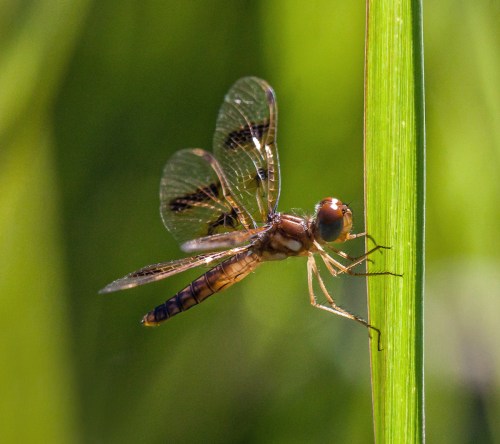
For inspiration, I used a recent photo that I took of a female Eastern Amberwing (Perithemis tenera). I have already included it in a blog posting, but am reprising it as the final photo, so you’ll know what my artistic efforts were supposed to look like.

I tried a couple of different approaches to my subject. First I tried sketching the dragonfly. I didn’t have a pencil handy, so I used a Bic ballpoint pen. My observation skills and sense of proportion are definitely lacking, but it was surprisingly fun to try. Without an eraser to correct my errors, I felt a bit like I was walking on a tightrope without a net.

Then I tried to draw with Crayola crayons? Why? I happened to be at Walmart yesterday and picked up a pack of 24 for only 50 cents at a back-to-school sale. My drawing looks a bit like a cartoon to me.

Finally I was ready to try watercolor. I decided that I would do the painting without bothering to sketch it out. Oops. I was using some inexpensive paper and it started to buckle a bit when I tried to cover the entire area with an overly wet wash of light green. I think I then attempted to put on the next layer before the first one was fully dry. I still feel like a second-grader in my watercolor skills, but it still was enjoyable trying to see what worked and what didn’t.

I did my final attempt in a sketchbook that is not intended for watercolor. I sketched out the dragonfly with a mechanical pencil and then colored the sketch with my watercolor paints. Out of all of my attempts, this is the one that I like the most. I felt a bit more confident in using the paints and in some of my strokes.

So what did I learn? Most significantly I learned that it’s worth taking a risk of feeling embarrassed; that it’s ok to try something new and achieve only a limited amount of success;, and that the amount of enjoyment that I can derive from a creative pursuit is not directly tied to any specific outcome.

dragonfly sketch

dragonfly crayon drawing

#worldwatercolormonth

#worldwatercolormonth

Eastern Amberwing

© Michael Q. Powell. All rights reserved.


Read Full Post »

Eastern Amberwings (Perithemis tenera) are the smallest dragonflies in our area. You can often find males buzzing around at the water’s edge, but females are harder to spot because they hang out in vegetation away from the water. I was thrilled therefore to see a beautiful female this past Friday at Occoquan Bay National Wildlife Refuge in some beautiful morning sunlight.

I decided to give a male Eastern Amberwing dragonfly equal billing in this post, because I really like the way that the shadows and the reflections make it look like he has an elongated body and extra sets of wings.

Eastern Amberwing

Eastern Amberwing

© Michael Q. Powell. All rights reserved.

Read Full Post »

In a moment of calm amidst the storms this past Monday, I captured this shot of a beautiful little Cabbage White butterfly (Pieris rapae) in the garden of my neighbor and fellow photographer Cindy Dyer. The shot is a little grainy, because there was not a great deal of light, but somehow the image fills me with an overwhelming sense of serenity.

Cabbage White

© Michael Q. Powell. All rights reserved.

Read Full Post »

I love the dark, slate-blue tones of the male Slaty Skimmer (Libellula incesta), one of the most common dragonflies in our area.  The beauty of this handsome Slaty Skimmer was further enhanced by the colorful backdrop that I managed to capture this past Friday at Occoquan Bay National Wildlife Refuge.

It is hard to come up with a composition that is more basic—beauty can often be found in simplicity.

Slaty Skimmer

© Michael Q. Powell. All rights reserved.

Read Full Post »

Many of my photographer friends have been posting photos of hummingbirds and I felt a little left out. I didn’t see any yesterday, but did spot several Snowberry Clearwing moths (Hemaris diffinis) at Occoquan Bay National Wildlife Refuge. This species, along with other clearwing moths, is sometimes called a “hummingbird moth” because of its appearance and behavior, which reminds some folks of a hummingbird.

Most of the times in the past that I have seen a hummingbird clearwing moth, it has been a “cousin” of this species, the very similar Hemaris thysbe. That species, however, has more red on its body and has lighter colored legs, according to the butterfliesandmoths.org website.

As you might suspect, these moths are in almost constant motion.  Its is quite a challenge, therefore, to track them and keep them in focus as they dart among the flowering plants.

As I was tracking one, a second one flew in and seemed intent on dislodging the first one. I reflexively I pressed the shutter button and was a little shocked to see that I managed to capture them both in a single frame. It’s cool that they both had their long proboscises curled up at the moment I took the shot.

Snowberry Clearwing Moth

Snowberry Clearwing moth

Snowberry Clearwing moth

© Michael Q. Powell. All rights reserved.

Read Full Post »

Yesterday as I was exploring Riverbend Park in Great Falls, Virginia, I encountered several damselflies that were new to me. When you spend as much time as I do  searching for insects to photograph, you develop a sense of what is “normal” and I am able to decide almost immediately whether a subject is a familiar one or not. Those of you who know my work are aware that familiarity with a subject is not a criterion for photographing it—I am just as likely to take a shot of a common subject as a rare one.

As I looked though my reference books and material on line, I was able to determine that I had captured images of both the male and the female American Rubyspot damselfly (Hetaerina americana). One of the experts in a Facebook dragonfly forum pointed out the dragonfly in the first photo below is an immature male, which helps to explain why the red spot for which the species is named is not yet prominent.

I won’t go into the details of damselfly anatomy, but if you compare the dragonflies in the two photos, you can see some of the gender differences that often help in identification. The very tip of the abdomen, the part of the body that many folks refer to as the “tail,” is quite different for the male and the female. There is also some color differentiation. Alas, these are general rules that don’t apply in all cases, so I am often confounded when trying to identify the species of a given subject.

It is really cool that I continue to encounter new species. Part of the reason for that, I suspect, is that I am exploring some new locations. More importantly, though, my observational skills have improved dramatically over time and I am seeing things that I might not have noticed several years ago.

American Rubyspot

American Rubyspot

© Michael Q. Powell. All rights reserved.

Read Full Post »

From time to time I will try to capture images of dragonflies in flight. Even under the best of circumstances it is a tough challenge for dragonflies are small, fast, and agile. Occasionally they will hover briefly, though most of the time it seems they choose to do so only when they are a long way away from me.

This past Monday I visited Jackson Miles Abbott Wetland Refuge and was surprised at the number of Swift Setwing dragonflies (Dythemis velox) that I observed there. As far as I know, this is the only location in our area where this species can be found. Swift Setwings are primarily a southern species, but seem to be migrating slowing northward.

Swift Setwings are  pretty small, about 1-6 to 2 inches long (42 to 50 mm), and the males, the only ones that I generally see, tend to perch at the edge of the water in overhanging vegetation. On this particular day, the dragonflies seemed to be particularly skittish, flying off as soon as I approached them. That was what prompted me to try to photograph them in flight. My Tamron 180mm macro is notoriously slow in focusing and tends to hunt a lot, so I switched to manual focusing. I made a lot of attempts and managed to get a few photos that were relatively in focus like the second image below.

While I was tracking one Swift Setwing in my viewfinder, a second one flew in and the two hooked up in mid-air in a mating position. They held the position for only a brief moment before disengaging and flying away in separate directions. I will spare you the anatomical details, but, as you can see in the first photo, dragonflies are quite acrobatic and flexible when mating.

So if you want a real photographic challenge, go out and see if you can capture some images of dragonflies in flight. It’s a fun challenge for me, even when I am not successful. If others see you doing so, it will reinforce the notion that wildlife photographers are a bit crazy, a perception that is accurate in many cases.

Swift Setwing

Swift Setwing

© Michael Q. Powell. All rights reserved.


Read Full Post »

When I came upon this little praying mantis during a recent trip to Occoquan Bay National Wildlife Refuge, I couldn’t decide if it was the predator or the prey. Although the mantis seemed to be at least partially trapped in a spider’s web, the spider no longer seemed to be present. In addition, the mantis appeared to be trying to work its way out of the web.

There is definitely a story here, but I can’t figure out for sure what it is. You’ll have to choose an ending to the story on your own.

praying mantis


praying mantis

© Michael Q. Powell. All rights reserved.

Read Full Post »

As I was exploring the edge of the Potomac River yesterday at Riverbend Park, I flushed a fairly large dragonfly. Rather than fly away, it perched in a nearby tree, just above eye level. I suspected that I had interrupted a meal and that it wanted to enjoy its prey in peace.

The dragonfly was in the shade and the light was filtering in from in front of me, so the shadows made it hard to tell exactly what was going on. I fired away anyways, hoping that I would be able to salvage the images afterwards.

It turns out that the dragonfly is a Black-shouldered Spinyleg (Dromogomphus spinosus). You definitely can see the large spines on the dragonfly’s back legs, which help in capturing and holding prey, and you can sort of see the black shoulders. As I suspected, there was a prey–the dragonfly had captured some kind of damselfly.

I decided to try a couple of different techniques to try to capture a usable image. In the first shot, I used software to adjust the exposure levels and remove some of the shadows, which had the side effect of brightening the entire image and blowing out some of the detail in the background. As a result, the leaves also look a little washed out. In the second shot, I used my camera’s pop-up flash to help eliminate some of the shadows. The resulting image retains a bit more of the full range of tonal values, but may still be a little too dark. Neither image is perfect, but wildlife photography is so often about making compromises.

Black-shouldered Spinyleg

Black-shouldered Spinyleg

© Michael Q. Powell. All rights reserved.

Read Full Post »

You never know for sure when a dragonfly will let you get close. Although some species tend to be less skittish than others, each individual dragonfly seems to have its own sense of “personal space.” Some will let you get really close and may even perch on you, but others will take flight or keep their distance as soon as they detect your presence.

On a recent trip to Occoquan Bay National Wildlife Refuge I was able to see eye to eye with this handsome male Widow Skimmer (Libellula luctuosa). I love the wonderful symmetry of looking straight into the multi-faceted eyes of a dragonfly, as in the first photo below, though I will admit that it really limits the depth of field in the image and does not let you see much of its body. For the second photo, I moved a little and shot if from a slight angle.

I tend to prefer the first image. What do you think?

Widow Skimmer

Widow Skimmer

© Michael Q. Powell. All rights reserved.

Read Full Post »

When they are immature, the males and females of many dragonfly species are very similar in coloration. To make matters worse, immature dragonflies of several different species are also similar in appearance, with only subtle differences to distinguish one species from another, like the color of the upper portions of their legs.

As a result, I am not really sure of my identification of this particular dragonfly. I lean towards it being an immature male Great Blue Skimmer (Libellula vibrans), but it might instead be a Slaty Skimmer (Libellula incesta). (The adults of these two species, by contrast, are very different in appearance and would never be mistaken for each other.)

Whatever the case, I love the two-toned eyes and overall body position of this beautiful dragonfly. It might be my imagination, but it seemed to me that the dragonfly had tilted its head a bit to check me out.

Great Blue Skimmer

© Michael Q. Powell. All rights reserved.

Read Full Post »

Although many damselflies are black and blue in coloration, I was particularly struck by the powdery blue coloration on the upper body of this damselfly when I first spotted it, a beautiful shade of blue interrupted only by a very thin line of black. I did some searching about on the internet and have concluded that this is probably a Blue-fronted Dancer damselfly (Argia apicalis).

I really like the way that the blue colors of this damselfly help it stand out in an otherwise mostly monochromatic image. I also enjoy the fact that this damselfly comes from a family of dancers, a term that seems appropriate for these aerial acrobats.

Dance on, tiny damselflies, dance on through the summer.


Blue-fronted Dancer

© Michael Q. Powell. All rights reserved.


Read Full Post »

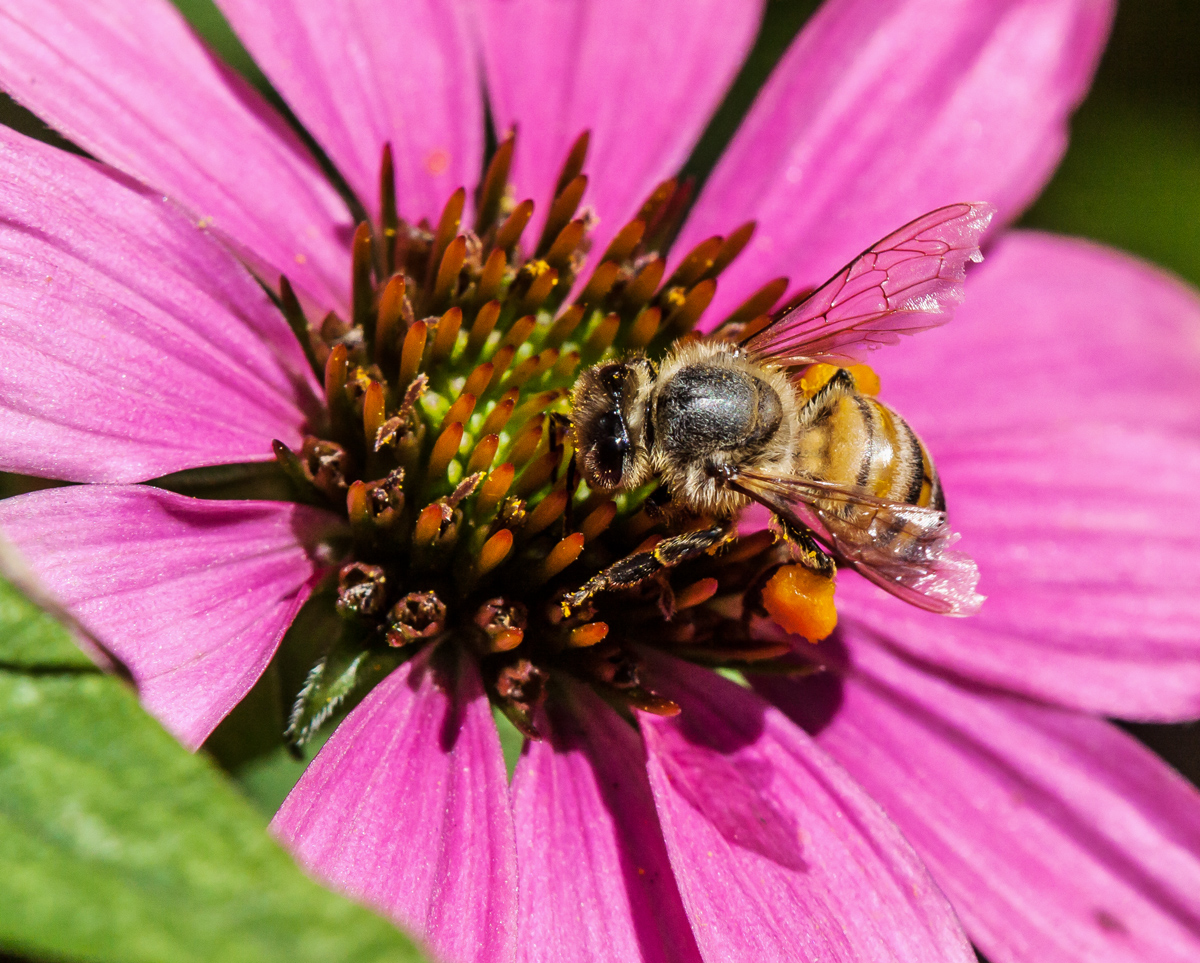
I love to watch bees as they gather pollen—they seem so industrious and focused as they systematically work their way through a group of flowers. This honey bee had both of its pollen sacs almost completely filled when I spotted it yesterday on a cone flower in the garden of one of my neighbors, fellow photographer Cindy Dyer.

One of the joys of shooting with a macro lens is that it lets you capture so many fine details, like the pollen grains on the legs of this bee and the slight damage on the trailing edges of the bee’s wings. Bees are also a great subject to practice macro techniques, because they often let you get really close without being spooked and flying away.

honey bee

© Michael Q. Powell. All rights reserved.

Read Full Post »

A breeze was blowing on Saturday morning at Occoquan Bay National Wildlife Refuge and this male Halloween Pennant dragonfly (Celithemis eponina) seemed to be struggling to maintain its perch as it was buffeted from side to side.

Halloween Pennant

© Michael Q. Powell. All rights reserved.


Read Full Post »

The combination of springtime rain and summertime heat in our area has caused a real explosion of insects. Some of them, like deer flies and mosquitoes, mercilessly harass me when I go out with my camera, but a lot of them are amazingly beautiful, like this spectacular Common Wood Nymph butterfly (Cercyonis pegala) that I spotted this past weekend at Occoquan Bay National Wildlife Refuge.

Many woodland butterflies are rather drab in appearance and it is hard for me to identify their species. With the Common Wood Nymph, though, the yellow patch on the wings makes them almost instantly recognizable.

Common Wood Nymph

© Michael Q. Powell. All rights reserved.


Read Full Post »

I watched a dragonfly flying around in the air for quite some time yesterday morning at Occoquan Bay National Wildlife Refuge and was thrilled when it finally perched for a moment on some vegetation low to the ground. Initially I thought that it was a Wandering Glider, a migratory species that I had seen a few times previously at this wildlife refuge.

After I posted an image to a couple of Facebook dragonfly fora, I learned that the dragonfly was in fact not a Wandering Glider, but instead was a close relative, a Spot-winged Glider (Pantala hymenaea). I like the way that Kevin Munroe described this species on his website Dragonflies of Northern Virginia—”Along with the Wandering Glider, this is the albatross of the dragonfly world. Both species are highly-evolved for sustained, efficient flight, drifting over summer fields for hours, like sea birds over a green ocean.”

If you look closely at this dragonfly’s hind wings, you will see that they are broader and appear less fragile than those of many other dragonflies. According to Dennis Paulson in his book Dragonflies and Damselflies of the East, within the genus Pantala, “The very broad hindwings represent an important adaptation for gliding, as does the ability to deposit fat and then use it for energy during a long flight just as a migratory bird does.”

It boggles my mind to think of these tiny creatures migrating for hundreds and in some cases thousands of miles. Wow!


Spot-winged Glider

© Michael Q. Powell. All rights reserved.

Read Full Post »

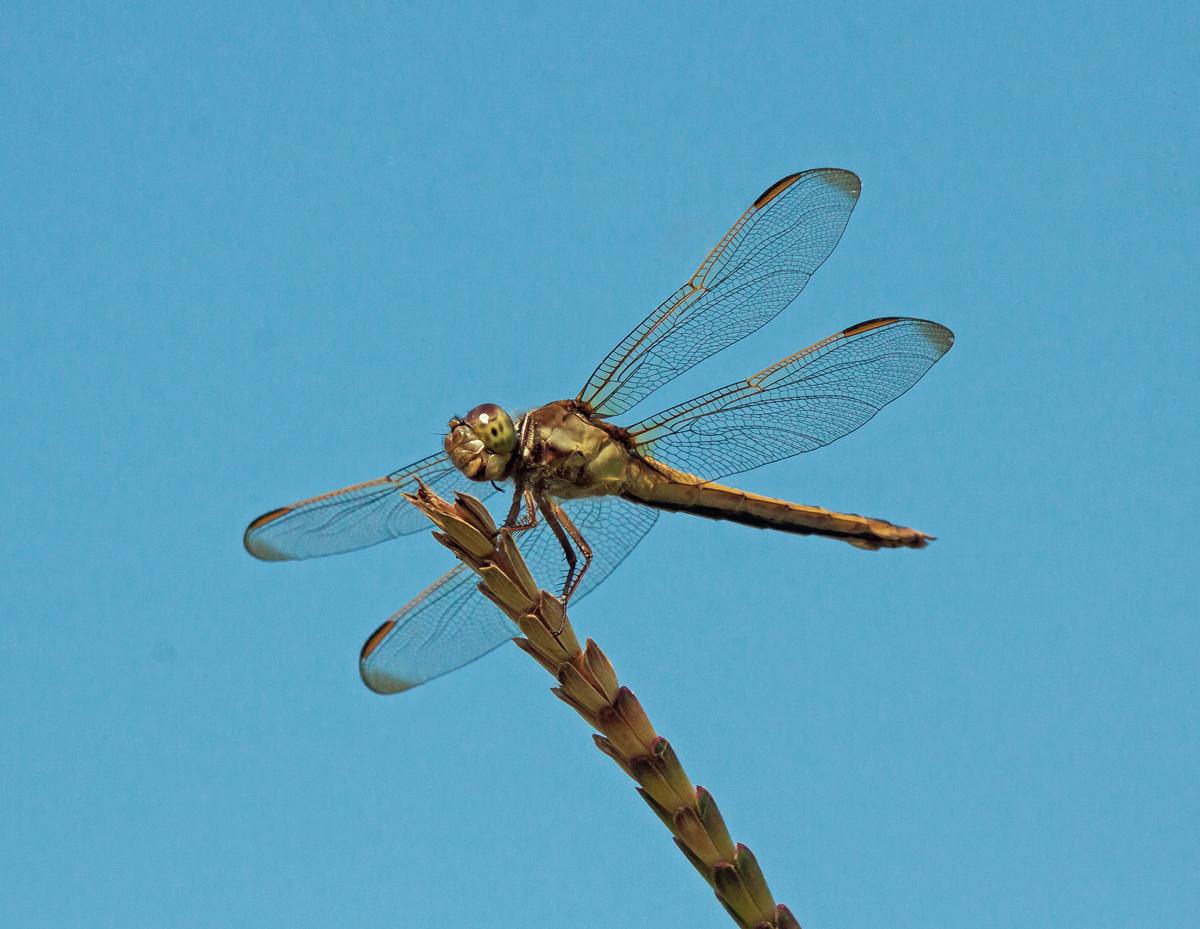
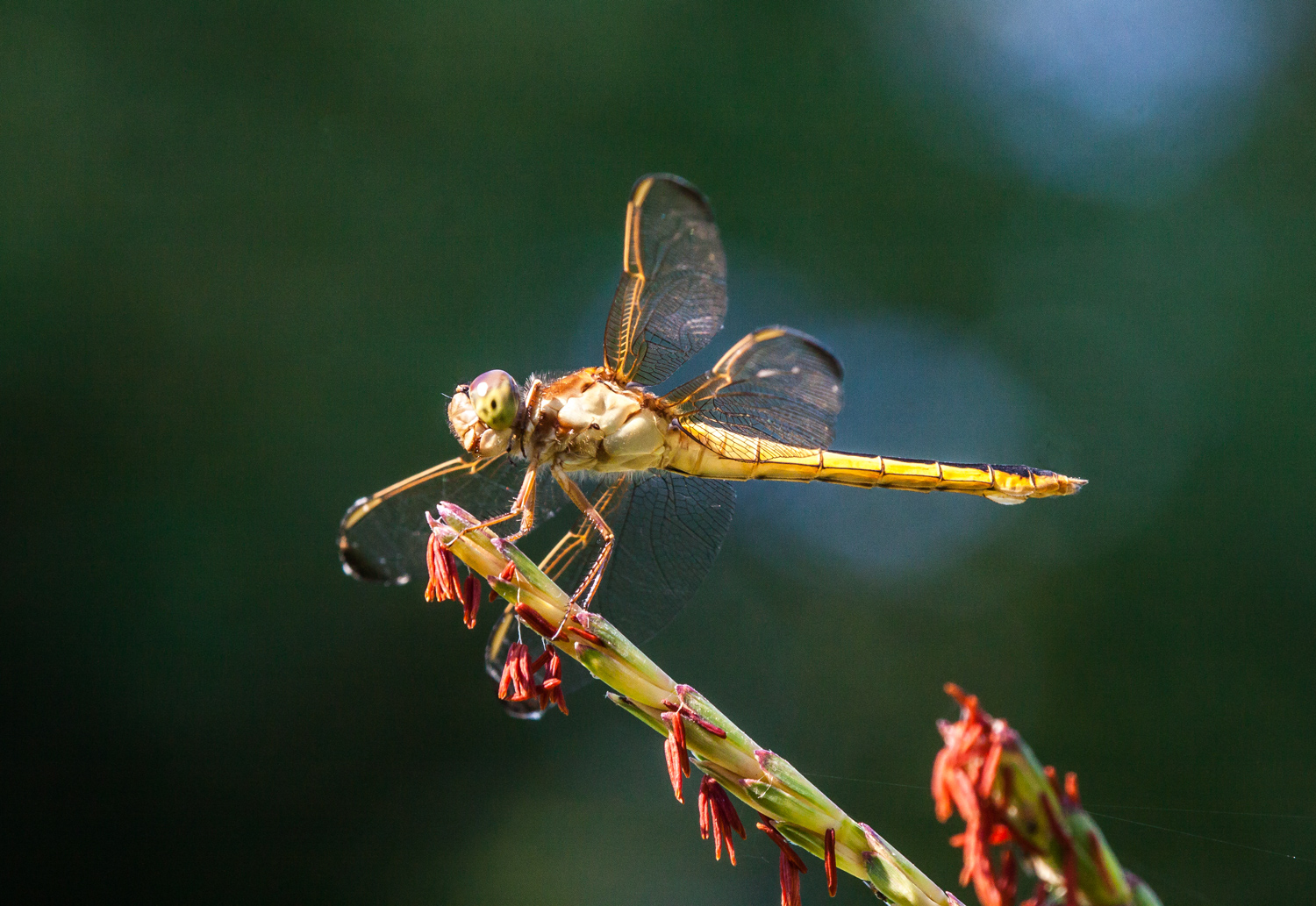
What a difference a background makes. Recently I have been seeing a lot of beautiful female Needham’s Skimmer dragonflies (Libellula needhami) at Occoquan Bay National Wildlife Refuge. It is often a challenge to try to separate them from the background vegetation so that you can focus in on the dragonfly’s wonderful details, like its gorgeous speckled green eyes.

Here are two images that I was able to capture with uncluttered backdrops, one with sky and one with vegetation. I tend to like the first shot a little bit more because of the beautiful blue sky, though I like the lighting and the wonderful Eastern gamagrass in the second shot.

It is fascinating to see what a different feel the background gives to images of similar subjects. Do you prefer one image over the other?

Needham's Skimmer

Needham's Skimmer

© Michael Q. Powell. All rights reserved.

Read Full Post »

Insect identification is really tough for me. When I saw this insect crawling about on the top of what I believe is a Shasta daisy, I was pretty sure that it was a beetle. Beyond that, I really had no idea what it was. A quick search on the internet made me conclude that it was a kind of scarab beetle.

I posted a photo on the website bugguide.net and asked for help. Responders provided a couple of possibilities and it looks most likely that this is an Oriental Beetle (Exomala orientalis) or (Anomala orientalis). In some ways it’s not that important to identify my subject, but it is something that I strive to do as much as I can and I usually end up learning a lot in the process of figuring out what I have shot.

I took quite a few shots of this beetle and especially like this one, because the beetle raised its head momentarily and I was able to get a look at its cool forked antennae. I also like the way I was able to capture some of the drops of water on the petals of the daisy.

In case any viewer is worried that I have given up on dragonflies, I can reassure you that I still have shots of lots of beautiful dragonflies to be posted and am always seeking more. I just figured that I would mix things up a little and provide a little glimpse at the world through my macro lens.

Oriental Beetle

© Michael Q. Powell. All rights reserved.

Read Full Post »

A macro lens helps to open up a whole new tiny world that is often beautiful and occasionally a little scary. I think that a tiny insect that fellow photographer Cindy Dyer pointed out to me in her garden yesterday fits into the latter category. The insect in question was moving about on an orange cone flower and at first we thought it might be a spider. When we counted the legs and looked a little closer, we realized it was probably a bug, a bug with massive spiked front legs and additional spikes on its body. It was a bit chilling to learn that this was the nymph of an assassin bug, a Spiny Assassin bug in the genus Sinea.

As I was taking this photo, I was reminded once again now much I enjoy macro photography. It has its own set of challenges, but it is rewarding to be able to get shots like this. In this image I particularly like the way that the spikes in the center of the cone flower mirror those of the fearsome little insect, which would be a real monster if it were larger.

Spiny Assassin Bug nymph

© Michael Q. Powell. All rights reserved.


Read Full Post »

Happy 4th of July! It is Independence Day here in the USA and in honor of this holiday I thought I’d post this shot of a patriotic Blue Dasher dragonfly (Pachydiplax longipennis) that was sporting a bit of red, white, and blue on its head this past Monday at Occoquan Bay National Wildlife Refuge. (Be sure to click on the image to see a higher resolution version of the dragonfly that shows the tiny hairs on its thorax (the torso) and its legs.)

Blue Dasher

© Michael Q. Powell. All rights reserved.


Read Full Post »

Some of my readers know that I especially love dragonflies with patterned wings and one of my favorites is the Halloween Pennnant (Celithemis eponina). Despite its name, it is a summertime dragonfly and I was thrilled to spot a beautiful female Halloween Pennant yesterday at Occoquan Bay National Wildlife Refuge.

The “Halloween” part of its name comes from the orange-brown color of its wings. The “pennant” comes from this predisposition of members of this genus to perch on the very tip of vegetation, which causes them to wave back in forth in even the slightest breeze.

In the photo below, the Halloween Pennant is perched on a stalk of very distinctive Eastern gamagrass (Tripsacum dactyloides). I have frequently seen this kind of grass with red bits hanging from its stalks, but it was only yesterday that I learned what it was called from fellow dragonfly enthusiast Walter Sanford.

Halloween Pennant

© Michael Q. Powell. All rights reserved.


Read Full Post »

It is easy to be so dazzled by the beauty and the aerial skills of dragonflies that you forget that they are also fearsome predators. I had a stark reminder of this grim reality on Friday when I encountered a Cobra Clubtail dragonfly (Gomphurus vastus) that had captured a Hackberry Emperor butterfly (Asterocampa celtis) at Riverbend Park. The dragonfly was starting to consume the butterfly and in the photo below almost appears to be suspended in mid-air.

In the past I have observed dragonflies with small butterflies, but this was the first time to see one with a larger butterfly. I really like butterflies and so I felt a mixture of horror and fascination when I stumbled upon this scene. Life in the wild can be brutal and today’s predators can become tomorrow’s prey—a fellow photographer posted a photo yesterday of a bird that had captured a dragonfly.

All in all, this moment served as a sober reminder to me of the fragility of life and of beauty. Somehow it brings to mind a country music song that I really like by Tim McGraw, a song that recommends that you live like you were dying. If you have not familiar with the song or simply want to hear it again, check out the official music video here on YouTube.

Cobra Clubtail

© Michael Q. Powell. All rights reserved.


Read Full Post »

With the temperatures today reaching almost 100 degrees (38 C), I long for the cooler weather of autumn, my favorite season of the year. The aptly named Autumn Meadowhawk (Sympetrum vicinum) is generally one of the last surviving dragonfly species each year and I was therefore a bit surprised last week when I spotted this young female Autumn Meadowhawk. The very clear wings and pale body coloration are an indication that it had only recently emerged.

Summer, though, is the prime season for dragonflies and I hope to be able to take advantage of this season to see lots more of them. I’ll just have to make sure that I pace myself and stay well hydrated as we move through a period of exceptionally hot weather.


© Michael Q. Powell. All rights reserved.

Read Full Post »

On Friday I kept encountering dragonflies that were clearly different from any I had seen before. There is a family of dragonflies known as “clubtails” in which the ends of their abdomens (the “tail”) are enlarged. I have seen a number of different members of this family, but none of them had as large a “club” as the ones that I spotted repeatedly as I explored Riverbend Park along the Potomac River.

I suspected and eventually was able to confirm that these are Cobra Clubtails (Gomphurus vastus). Isn’t that a cool name for a dragonfly—someone obviously thought that the “clubtail” looked like a cobra’s hood.

The Cobra Clubtails perched on the rocks and in the vegetation along the water’s edge and I was able to capture images of several of them. I am leading with a photo that provides a good look at the “clubtail,” though I tend to be drawn more to photos like final one in which you get to look into the eyes of the dragonfly.

This is probably the closest I want to be to staring into the eyes of a cobra.


Cobra Clubtail

Cobra Clubtail

Cobra Clubtail

© Michael Q. Powell. All rights reserved.

Read Full Post »

On Monday I was thrilled to get a shot of one of my favorite damselflies at Occoquan Regional Park, the beautifully colored Violet Dancer (Argia fumipennis violacea), a subspecies of the Variable Dancer damselfly (Argia fumipennis). I love the color combination of this tiny beauty, a spectacular shade of violet on its body and the wonderful blue accents. Sharp-eyed viewers may have noted that a photo of this same type of damselfly has been my banner image for quite some time.

Violet Dancer

© Michael Q. Powell. All rights reserved.

Read Full Post »
The Biblical book of Ecclesiastes reminds us that “to every thing there is a season, and a time to every purpose under the heaven” and that is certainly the case with dragonflies. Some dragonfly species are with us for the entire summer, but other species can be seen for only days or weeks and then their season is over. Short flight seasons and specific habitat requirements combine to make some dragonfly species uncommon or even rare.

This past Monday I was happy to capture some more photos of one of those uncommon species, the Gray Petaltail dragonfly (Tachopteryx thoreyi). Earlier this month I observed several of these gray and black beauties for the first time and I was thrilled to be able to take photos to document my sighting. That was the start of a familiar cycle for me—my momentary joy at documenting a new species was replaced by a desire to capture better images, ones that appeal to me artistically.

This may well be my last Gray Petaltail dragonfly sighting of the season, and that makes me a little sad, but other dragonflies will soon be coming onto the scene. So I’ll keep moving forward in search of my next subject, content to photograph familiar ones, but with eyes wide open as I scan my surroundings for new ones too—to everything there is a season.

Gray Petaltail

© Michael Q. Powell. All rights reserved.

Read Full Post »

This shot from Monday is for Cindy Dyer, my photography mentor, who used to refer to me as her “grasshopper” and taught me some important lessons when I was just starting to get serious about my photography six years ago.

Folks of a certain age may recall that “grasshopper” was the nickname used by Master Po for his young student Kwai Chang Caine in the western martial arts television series Kung Fu in the 1970’s. The name is a reference to a wonderful scene in the pilot episode for the series in which the blind teacher helps to teach his new student that “seeing” requires more than the simple use of your eyes.

Here, from Wikipedia, is a snippet of dialogue with some of the wisdom of Master Po:

Master Po: Close your eyes. What do you hear?
Young Caine: I hear the water, I hear the birds.
Po: Do you hear your own heartbeat?
Caine: No.
Po: Do you hear the grasshopper which is at your feet?
Caine: Old man, how is it that you hear these things?
Po: Young man, how is it that you do not?

In case you have never heard of the Kung Fu television series or want to relive a moment from your past, here is a link to a short YouTube video of the above-referenced scene.

As a nature photographer, I think a lot about “seeing” as I seek a closer connection with the natural world and so many of its inhabitants. My observations have caused me to conclude that the pace of the natural world is different from that of my everyday life and that I consequently have to slow down in order to be in synch with it.

grasshopper

© Michael Q. Powell. All rights reserved.

Read Full Post »

Have you ever watched sprinters prepare for the start of a race? They get into their starting blocks and lean forward, ready to push off at the sound of the gun. Well, that’s what some scientist had in his mind when he first saw today’s dragonfly, the Swift Setwing (Dythemis velox). The forward tilting of the wings is very distinctive and makes this dragonfly easy to identify.

This is mostly a southern dragonfly and I was thrilled when I spotted one two years ago, the first time that a Swift Setwing had been documented in my county. Since then I have looked forward to finding them each year at Jackson Miles Abbott Wetland Refuge, where they appear to have established themselves.

Last weekend I spotted my first Swift Setwing of the season and I was able to capture these images.

Swift Setwing

Swift Setwing

© Michael Q. Powell. All rights reserved.

Read Full Post »

As I was working on a post earlier today about an unusually colored damselfly, the Citrine Forktail damselfly, I realized that I had not posted any photos of the beautifully colored ones that I saw during my trip to Brussels earlier this month. They were not yellow in color, but instead were a bright red. The first ones that I saw were a couple in the tandem position that is used for mating and also, for some species, when depositing eggs. A few days later I spotted a singleton damselfly perched on some vegetation.

I don’t think that I have seen any red damselflies in Northern Virginia, so I had to do some research. What I discovered is that these damselflies have the very unexciting name of Large Red Damselflies (Pyrrhosoma nymphula). The name seems to fit, but it strikes me that the scientist must have been tired or was otherwise feeling uncreative when he came named the species. This particular species is mainly a European one with some populations in Northern Africa and Western Asia, according to Wikipedia, so I am not at all likely to spot one on my frequent photowalks here.

Large Red Damselfly

Large Red Damselfly

© Michael Q. Powell. All rights reserved.

Read Full Post »
Do you ever go out to shoot photos when it is raining? It was already raining when I set out on a photo walk yesterday morning at Occoquan Bay National Wildlife Refuge and it kept raining for several hours as I sought subjects to photograph. My camera is somewhat waterproof, but my lenses are not, so I carried an umbrella. It must have been quite a sight to see me balancing my umbrella and my camera, which was attached to an extended monopod.

Dragonflies generally do not fly in the rain, but I decided to search the edge of a small pond to see if I could spot any particularly hardy specimens. As I was doing so, I caught sight of a small flicker of yellow. As I drew closer to it, I could see that it was a tiny damselfly. Now damselflies are always pretty small, but this one was even smaller than normal. Since many damselflies are a combination of black and blue, the brighter coloration of this one really made this one stand out.

It was not hard to find this damselfly in my guidebook because of its coloring. It is a Citrine Forktail damselfly (Ischnura hastata), a diminutive damselfly that is only .8-1.1 inches (20 to 27 mm) in length. I am really happy that I was able to capture so many of the details of this cool damselfly: the tiny blue eyespots; the narrow green shoulder stripes; and the mostly yellow abdomen.

Citrine Forktail

© Michael Q. Powell. All rights reserved.

Read Full Post »
« Newer Posts - Older Posts »