Feeds:
Posts
Comments

Archive for the ‘Insects’ Category

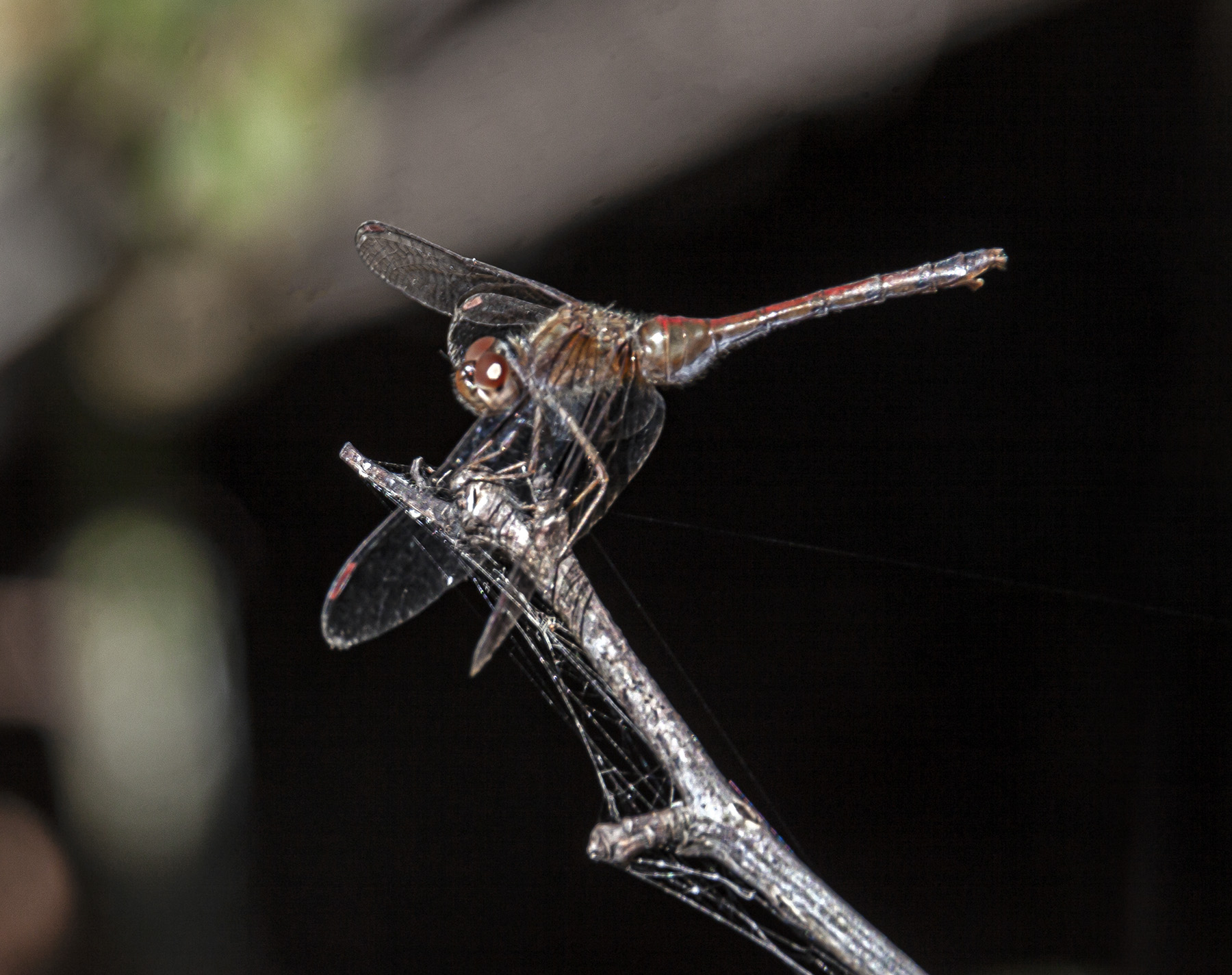
Female Blue-faced Meadowhawk dragonflies (Sympetrum ambiguum) come in several different color variations. Some, like the one in the first image below have a reddish colored body, like the male of the species—they are known as andromorphs. Others are brownish in color, like the one in the second image below, and are know as heteromorphs. Irrespective of the body color, though, all of the females have striking blue eyes.

Usually it is harder to spot females than the more brightly colored males, but for some reason, these two females were the only Blue-faced Meadowhawks that I saw as I was exploring Occoquan Bay National Wildlife Refuge one day last week.

Where were all the males? Maybe they were watching a sporting event or were congregating at a local bar (or both).  🙂

Blue-faced Meadowhawk

Blue-faced Meadowhawk

© Michael Q. Powell. All rights reserved.


Read Full Post »

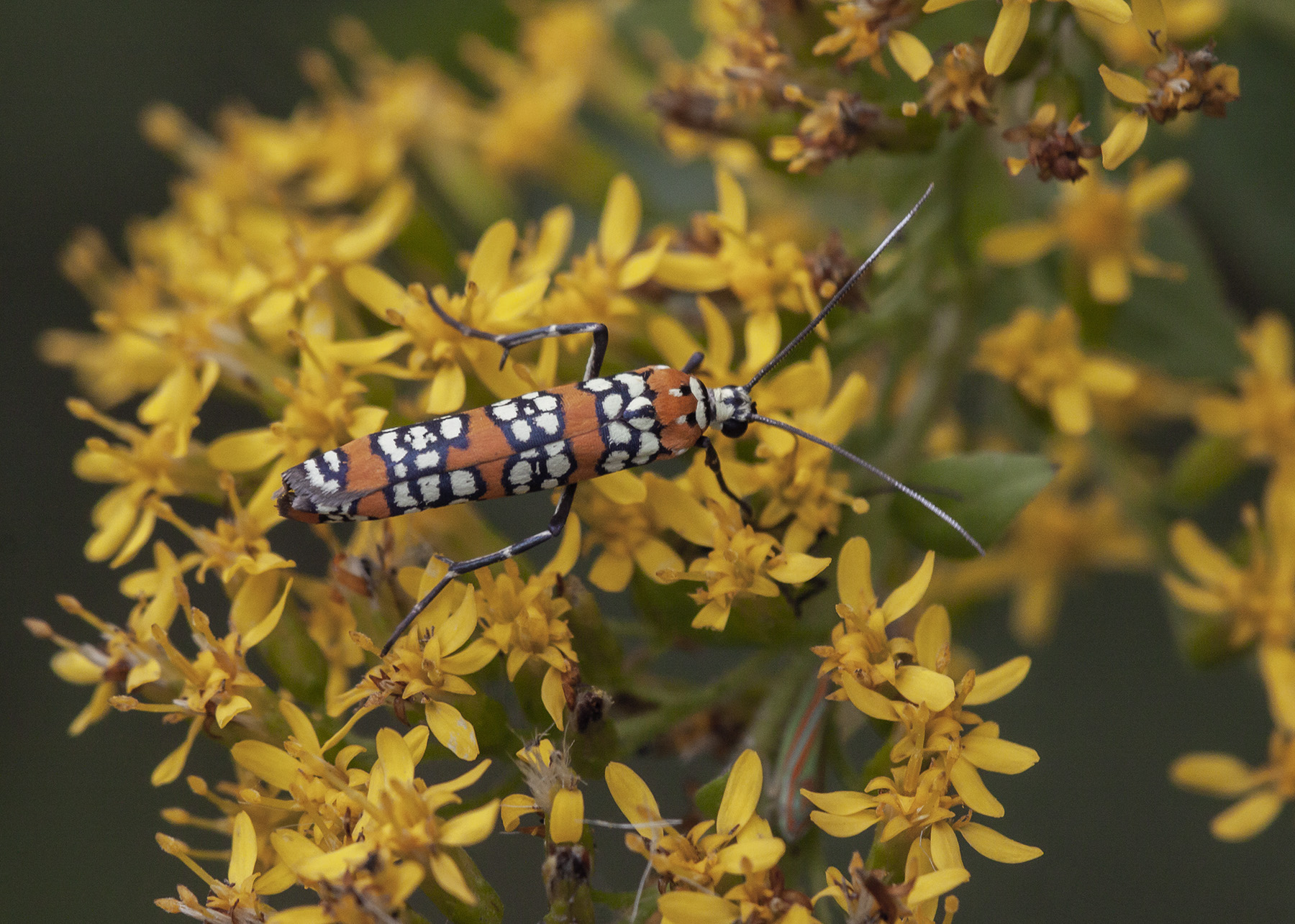
Whenever I see an Ailanthus Webworm moth (Atteva aurea), I assume that it is some kind of beetle. It is hard to believe that the colorful patterns are actually part of the wings and not a hard exterior shell. I spotted this beautiful little moth on some goldenrod last week while exploring Occoquan Bay National Wildlife Refuge.

The pattern on this insect’s body reminds me of an animal print. Wouldn’t it be cool to have fabric printed with this bold pattern? I can imagine throw pillows and even fashion accessories. From a marketing perspective, though, I think we would have to come up with a new name for the insect—a name like “webworm” probably would not attract many customers.

Ailanthus Webworm moth

© Michael Q. Powell. All rights reserved.


Read Full Post »

Do you ever stop to look at grasshoppers? A lot of them are really cool, like this giant one that I spotted on Thursday at Occoquan Bay National Wildlife Refuge. I love how it looks like the grasshopper is wearing a helmet on its head and a suit of armor on its torso.

I am not very good in identifying grasshopper species, but after looking through various internet sites, I wonder if this might be an Eastern Lubber grasshopper (Romalea guttata). This species is found only in the southeastern part of the United States. Virginia, where I live, is not within its listed range, so it is possible that this is a related species. Whatever the case, I definitely love the bold coloration of this giant grasshopper.

yellow grasshopper

© Michael Q. Powell. All rights reserved.
 

Read Full Post »

As many of you know, I love to photograph dragonflies and will often try to get close-up shots of them. Initially I captured a head-on shot of a female Blue-faced Meadowhawk dragonfly (Sympetrum ambiguum) that I spotted on Thursday at Occoquan Bay National Wildlife Refuge.

As I was observing this dragonfly at close range, she began to groom herself. I am not sure if she was cleaning her eyes or merely scratching an itch, but it was a bit eerie when she rotated her head more than 90 degrees to do so, as you can see in the second image. It brought back memories from my youth of Linda Blair’s spinning head in the original version of The Exorcist, though fortunately the dragonfly’s head did not rotate 360 degrees.

Blue-faced Meadowhawk

Blue-faced Meadowhawk

© Michael Q. Powell. All rights reserved.

Read Full Post »

Butterflies in October? October has been a crazy month weather-wise in Northern Virginia where I live. Yesterday we had a record high temperature of 98 degrees (37 degrees C) and it feels a lot more like summer than autumn. Therefore it did not seem at all strange that I saw lots of butterflies on Tuesday when I visited Huntley Meadows Park.

I spent quite a while chasing after this beautiful little butterfly, which I think is an Orange Sulphur butterfly (Colias eurytheme). Most of the time the butterfly would perch sidewards and then fly away when I tried to circle around to get a better angle for a shot. I was thrilled when I finallly managed to capture this image with the butterfly’s wings partially open. I also like the way that the light helped to illuminate some of the details in the wings.

I look forward to the cooler autumn weather that will eventually come, but for now I am continuing to enjoy some of the delights of this endless summer.

Orange Sulphur

© Michael Q. Powell. All rights reserved.


Read Full Post »

My dragonfly season is not over yet! Yesterday, the 1st of October, I managed to get my first good shots of the year of Blue-faced Meadowhawk dragonflies (Sympetrum ambiguum). This species emerges a bit earlier in the season, but generally does not make an appearance until September. (Fellow dragonfly enthusiast Walter Sanford posits that they spend that interim time in the tree tops.)

I really love the combination of colors of the Blue-faced Meadowhawk—I find the colors to be striking without being garish. You might think that these colors would make it easy to spot these dragonflies, but they are small in size with a length of 1.4 inches (36 mm) and are found only in very specific habitats.

I have been searching unsuccessfully for these little beauties the last few weeks at Occoquan Bay National Wildlife Refuge, my most frequent “habitat,” and ended up returning to Huntley Meadows Park, where I had seen them in the past. Huntley Meadows Park is a wonderful county-run marshland refuge and used to be my favorite location for nature photography. In recent years, though, the park has become a victim of its own success and there are often mobs of photographers on its boardwalk through the wetlands.

Perhaps I am a little selfish, but I do not like to share my wildlife experience with a large group of other people. For me, my treks with my camera are most often a solitary pursuit, a meandering one-on-one experience with nature.

What about you? Do you prefer to experience nature alone or with others?

Blue-faced Meadowhawk

Blue-faced Meadowhawk

Blue-faced Meadowhawk

© Michael Q. Powell. All rights reserved.


Read Full Post »

If you were a dragonfly, one of the constant hazards that you would face would be the ubiquitous spider webs that threaten to entangle you. At this time of the year those same webs annoy me as well—there is just something “icky” about an unexpected facial encounter with spider silk.

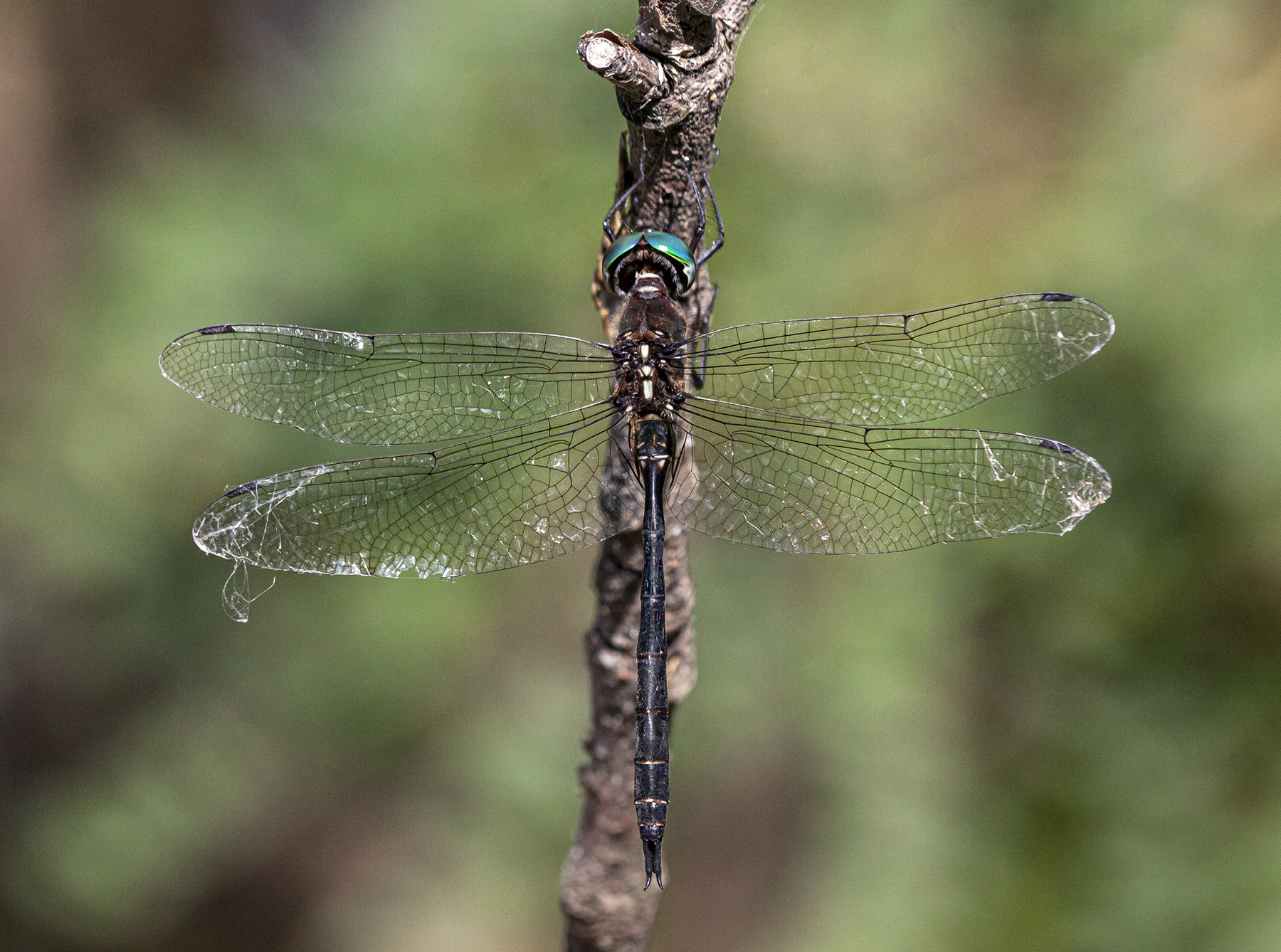
Last week I captured some more images of Fine-lined Emerald dragonflies (Somatochlora filosa) at Occoquan Bay National Wildlife Refuge. These rare and exotic dragonflies are always one of the highlights of my early autumn days.

In both images below there seems to be evidence of a spider’s work. What appears to be spider silk is hanging from the dragonfly’s wings in several place in the first image. In the second image there are remnants of a spider web on the branch from which the dragonfly was hanging.

I know that spiders have to eat too, but I must confess that I am rooting for the dragonflies when it comes to struggles between spiders and dragonflies.

Fine-lined Emerald

Fine-lined Emerald

© Michael Q. Powell. All rights reserved.

Read Full Post »

This female Great Blue Skimmer dragonfly (Libellula vibrans) seemed to be grinning at me one morning this past week at Occoquan Bay National Wildlife Refuge. Smiling is contagious, I have found.

I hope that your Sunday brings an equivalent smile to your face.

Great Blue Skimmer

© Michael Q. Powell. All rights reserved.
 

Read Full Post »

Last week I spotted this male Common Green Darner dragonfly (Anax junius) while exploring with fellow photographer and dragonfly enthusiast Walter Sanford . This beauty was part of a swarm of dragonflies we observed that was probably preparing for migration.

As I processed these images I was struck by the wonderful range of colors on this dragonfly’s body. As its name suggests, a Common Green Darner has lots of green, but this one also has beautiful shades of blue and violet. I have included two images that may look very similar, but in fact were taken with two different cameras from the same spot.

In the first shot, I zoomed in close with my SX50 super zoom camera to try to capture as much detail as I could. I took the second shot with a fixed-focus lens. The heavy vegetation did not permit me to get any closer, so I tried to compose the image to include more of the environment.

Personally I like the second shot a bit more than the first—I prefer the additional “breathing space” around the subject and I think the second shot is a little sharper. Do you prefer one of them over the other?

Common Green Darner

Common Green Darner

© Michael Q. Powell. All rights reserved.

Read Full Post »

On Monday I was really happy to spot this male Twelve-spotted Skimmer dragonfly (Libellula pulchella) at Occoquan Bay National Wildlife Refuge. Most dragonflies have clear wings and it is always special to see one with boldly patterned wings, like the Twelve-spotted Skimmer. This species is not particularly rare, but this is the first one that I have photographed this season.

Those of you who are mathematically inclined may wonder why this species is called “twelve-spotted” when there are clearly more than twelve spots. For the purposes of counting, however, only the dark spots matter and there are three on each wing. The female of the species also has twelve spots, but lacks the distinctive white spots of the male.


Twelve-spotted Skimmer

© Michael Q. Powell. All rights reserved.

Read Full Post »

Although the astronomical calendar indicates that it is now autumn, the summer season continues for many dragonflies. Many of them are showing a lot of wear and tear, like this female Great Blue Skimmer (Libellula vibrans) with tattered wings that I spotted last week at Occoquan Bay National Wildlife Refuge.

At this time of the year it is not uncommon to see dragonflies and butterflies with damaged wings, but this is one of the most extreme cases that I have ever witnessed. Amazingly, she was still able to fly.

Great Blue Skimmer

© Michael Q. Powell. All rights reserved.

Read Full Post »

For those of us in the Northern Hemisphere, today is the first day of autumn. In my area, today’s high temperature is forecast to reach 90 degrees (32 degrees C), so it does not really feel like autumn yet. However, it is beginning to look like autumn, with browns and orange tones starting to appear in the landscape.

Fortunately there are still lots of butterflies around, like this Viceroy Butterfly (Limenitis archippus) that I spotted last Wednesday at Occoquan Bay National Wildlife Refuge. The color palette of this shot really speaks to me of this new season.

Given that seasons are determined differently in different places by using meteorological or astrological calendars, I probably should try to be scrupulously inclusive and wish everyone a Happy September Equinox Day rather than Happy Autumn.

UPDATE: I took this shot while photowalking with fellow photographer and blogger, Walter Sanford. We did not talk about when we/if we might post an image of this butterfly, but it turns out he also posted one today. Checking out his posting if you like to read another take on our adventure and see a slightly different approach to photographing this butterfly. Walter and I have different backgrounds that affect the way we express ourselves in our words and in our images. Our complementary posts help to remind me that “reality” is as much subjective as it is objective.

Viceroy

© Michael Q. Powell. All rights reserved.

Read Full Post »

Dragonflies are remarkably uncooperative—I can rarely get them to perch in places where the light is good and the background is photogenic.  I love photographing butterflies in patches of colorful flowers, for example, and have often thought that it would be cool to shoot a dragonfly in a similar environment. Alas, dragonflies don’t seem to be attracted by nectar and pollen. I have repeatedly been frustrated by dragonflies that zoom past flowers and refuse to stop.

This past Wednesday, though, an emerald green female Eastern Pondhawk dragonfly (Erythemis simplicicollis) that I had been chasing surprisingly set herself down in a patch of bright yellow flowers. Moving as stealthily as I could with a racing heart, I managed to get close enough to the dragonfly to capture this image before she flew away.

When I am walking about with my camera, I try to be ready for the unexpected and on this occasion my persistence and quick reaction paid off.

Eastern Pondhawk

© Michael Q. Powell. All rights reserved.

Read Full Post »

I will often shoot the same subjects over and over again. Each photo opportunity offers the possibility of a difference setting, a different pose, and different lighting conditions. I guess that is why I like the excitement and unpredictability of nature photography versus the more controlled environment of studio photography.

Last week I captured this image of a female Big Bluet damselfly (Enallagma durum) at Occoquan Bay National Wildlife Refuge. The single leaf on which the damselfly is perched makes for a simple composition that helps the subject to stand out, which is really important when the subject is so small. The sunlight helped to create a cool elongated shadow on the leaf that add additional visual interest to the shot. The minimal color palette works well too, I think.

Sometimes it is nice to have a little extra drama in our lives, even if it is only a dramatic damselfly.


Big Bluet

© Michael Q. Powell. All rights reserved.

Read Full Post »

On Monday I spotted this freshly emerged female Common Green Darner dragonfly (Anax junius) at Occoquan Bay National Wildlife Refuge.  It won’t be long before it will be time for her to migrate southward. Yes, some dragonflies actually migrate.

When I first started getting into dragonflies, it never struck me that dragonflies could travel long distances. I figured that they lived and died in a relatively confined geographic area. Although that may be true for some dragonfly species, that is not the case for the Common Green Darner. One of my favorite websites, Dragonflies of Northern Virginia, describes the amazing saga of this species in these words:

“They emerge in the Southeast and fly north, arriving here late March thru May. After their long flight, they mate, lay eggs and die. Their young emerge in July and August. Congregating in large swarms, this 2nd generation begins flying south in September. They lay eggs that fall, after arriving in their southern destinations, and die. When their young hatch in March, they fly back to Northern Virginia and it starts again – a two generation migration.”

Many of us have gotten used to using Global Positioning System (GPS) devices to help us navigate or use Google Maps. How do these dragonflies know where to go? How do they find a destination that they have never visited before? It boggles my mind and fills me with awe and wonder when I contemplate questions like these.

Common Green Darner

Common Green Darner

© Michael Q. Powell. All rights reserved.


Read Full Post »

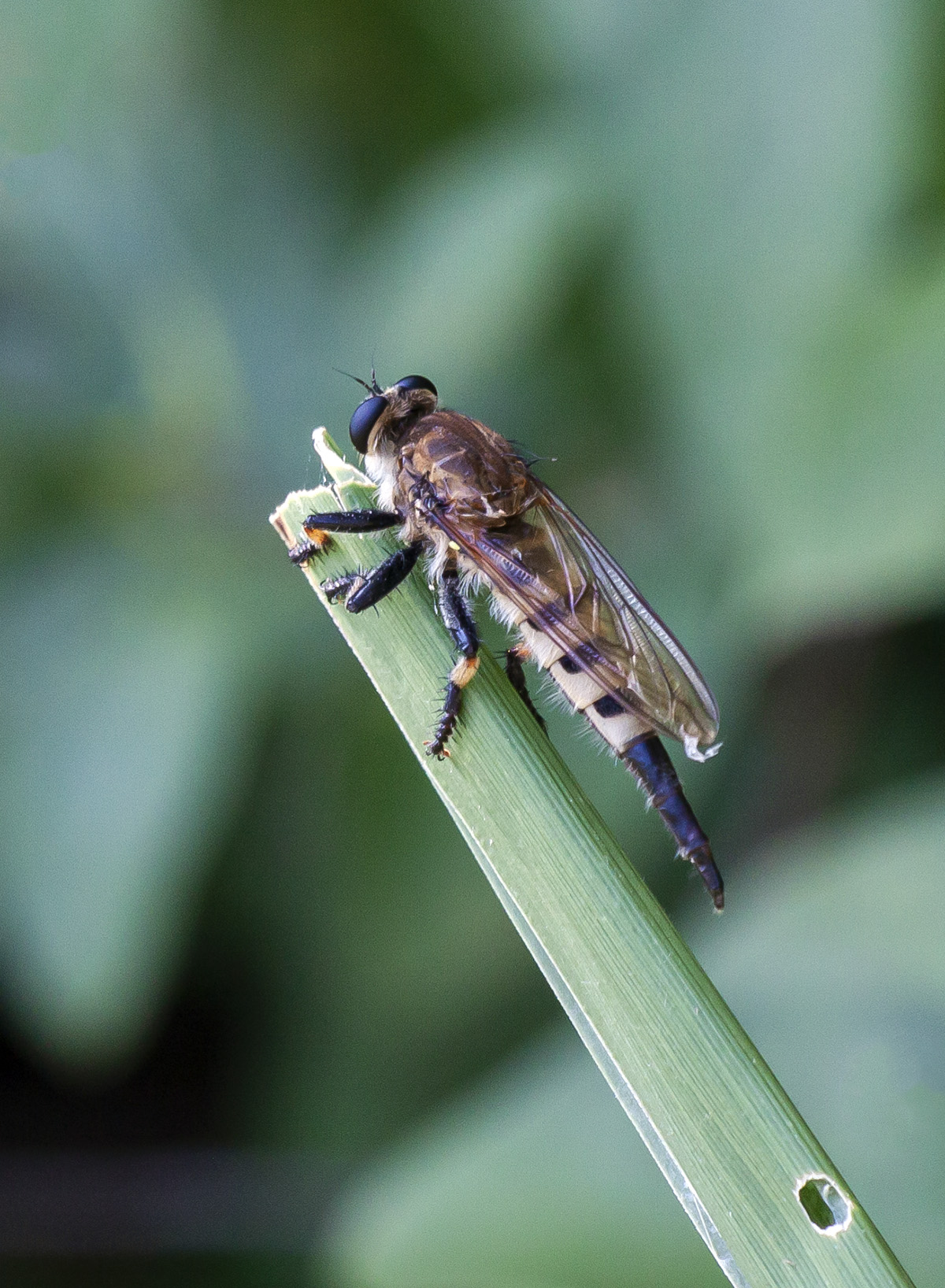
The Red-footed Cannibalfly (Promachus rufipes), a kind of robber fly has just about the coolest (and creepiest) name of any insect. I spotted this female Red-footed Cannibalfly last week at Occoquan Bay National Wildlife Refuge. If you look very closely at the image, you can actually see some of its tiny red feet. However, this insect is not known for being cute—it is a particularly fierce predator that can take down much larger prey, reportedly including hummingbirds.

On a personal basis, I have a particular fondness for the Red-footed Cannibalfly. On 31 August 2013, I did a posting called simply Red-footed Cannibalfly. The posting had some decent photos and and some interesting information and had a modest degree of success, with a total of 44 likes.

Amazingly, though, the posting has been viewed 2530 times to date. Apparently when folks go searching with Google, Bing, or some other search engine, they come across my posting and are intrigued enough to view it. I know that search engine algorithms are closely-guarded secrets, but for this one particular topic, I seem to have broken the code. If you do a search for “red-footed cannibalfly,” you might see my name pop up on the first page of results—it’s a weird claim to fame, but life on the internet is often a mystery.


Red-footed Cannibalfly

© Michael Q. Powell. All rights reserved.
Read Full Post »

Do you have a favorite insect? Although I like dragonflies a lot, my favorite insect is probably the rainbow-colored Handsome Meadow Katydid (Orchelimum pulchellum). I was thrilled to spot this beauty on some colorful vegetation last Saturday at Occoquan Bay National Wildlife Refuge.

I remember well the sense of incredulity that I felt when I saw one of these insects for the very first time—I simply could not believe that the bright colors were real. The beautiful curling leaves hide the details of the katydid’s body a little, but add a wonderful artistic element to this image. If want to see the brilliant colors of a Handsome Meadow Katydid on full display, check out this link to a 2013 posting that I entitled Rainbow Grasshopper—it is one of my most popular posts to date with over 315 views.

The vivid colors of this katydid are sure to grab your attention, but you should also be sure to check out its eyes. I am still blown away every time that I see those amazing eyes that seem to be looking deeply into me.  Here’s looking at you, kid.

Handsome Meadow Katydid

© Michael Q. Powell. All rights reserved.


Read Full Post »

If you were to pit a mantis against a spider, which one would have the advantage? I thought it would be the mantis, but that was clearly not the case this past week at Occoquan Bay National Wildlife Refuge. This spider had a large web stretched over a path on which I was walking, and I guess the mantis was unlucky enough to get stuck in its sticky strands as it was moving through the air.

mantis versus spider

© Michael Q. Powell. All rights reserved.

Read Full Post »

What signposts mark for you the transition from summer to autumn? Many folks might point to changes in the foliage colors or cooler weather, but for me the spotting of my first Fine-lined Emerald dragonfly (Somatochlora filosa) marks an unofficial beginning to the new season.

Fine-lined Emeralds are a relatively uncommon dragonfly species, both locally as well as nationally. They seem to prefer a coastal plain and are active for only about a month, generally the month of September. Yesterday I visited Occoquan Bay National Wildlife Refuge, a place where I have seen Fine-lined Emeralds in the past, and I was thrilled when I eventually spotted one. However, it took me several hours before I was able to capture this shot, because most of the Fine-lined Emeralds that I saw flew by me without stopping and I would lose them when I gave chase.

You probably noticed a few things about this dragonfly when you looked at the photo. First, it is clear why the family to which this dragonfly belongs is called “Emerald”—those brilliant green eyes are mesmerizing. Secondly, you can’t help but notice that Fine-lined Emeralds do not perch horizontally like most dragonflies you are likely to encounter. Instead, they hang almost vertically from bare branches. As a result, their slender bodies are hard for the eye to detect and also tend to confuse a camera’s autofocusing system. Most of the time I end up having to manually focus, as I did in this situation. Lastly, if you click on the image, you can see this dragonfly’s beautiful markings on the thorax (the “chest”) and the abdomen (the “tail”).

So, for me autumn has begun with the arrival of the Fine-lined Emerald dragonfly. Has autumn started for you yet or are you waiting for some additional personal signs of the season?

Fine-lined Emerald

© Michael Q. Powell. All rights reserved.

Read Full Post »

I guess that the main subject of this image is the tiny male Eastern Amberwing dragonfly (Perithemis tenera), but I must confess that I was equally drawn to the curving shapes of the branches sticking out of the water during my recent trip to Jackson Miles Abbott Wetland Refuge. Normally I try to fill as much of my frame with my primary subject by using a zoom lens or by moving closer, but in this case I actually moved back in order to be able to capture more of the vegetation.

I really like the way that the warm amber color of the aptly named Eastern Amberwing stands out against the muted tones of the rest of the image. The style of this image is different from most of my shots (assuming that I have an identifiable style), but I enjoy mixing it up from time to time by shooting from different angle or distances.

Eastern Amberwing

© Michael Q. Powell. All rights reserved.

Read Full Post »

The milkweed plants were dirty and dried up, but I knew from past experience that there might be ladybugs crawling around on them. The first two plants that I checked were full of aphids, a favorite food of ladybugs, but I did not see any ladybugs at all. As I approached a third plant, I saw a flash of red and spotted a small ladybug crawling quickly down the stem of the plant. I was not as close as I could have like to have been, but managed to capture some images before the ladybug disappeared from sight.

I like the way that this shot turned out because the reddish-orange of the ladybug really stands out against the blues and greens in the rest of the photos. In case you are curious, the little specks of yellow are aphids. In this case, the aphids were safe, for this ladybug seemed to be in too much of a hurry to stop for a snack.

ladybug

© Michael Q. Powell. All rights reserved.

Read Full Post »

I spotted this beautiful American Lady butterfly (Vanessa virginiensis) during a quick visit this past Saturday morning to Green Spring Gardens, a county-run historic garden not far from where I live. A lot of butterflies were active that day, but my eyes were immediately drawn to this American Lady, a species that I do not see very often. I had to chase it a bit before it stopped to feed on this flower, which was so popular that the American Lady had to share it with a much smaller skipper butterfly. The flower was growing near a fenced in area of public plots where people grow vegetables and the fence caused the striped effect in the background.

Although I spend most of my time photographing subjects in the wild, it was nice to visit a more cultivated place that was still ablaze with summer colors. I am quite conscious of the fact that the summer is slowly slipping away.

American Lady

© Michael Q. Powell. All rights reserved.

Read Full Post »

What do you see first when you look at this image? Do you see the beautiful colors, textures, and shapes of the rock that makes up both the foreground and the background? Are you drawn to the lines and somber coloration of the Powdered Dancer damselfly (Argia moesta) and its shadow? Do you focus on the damselfly’s brightly shining gray eye?

I spotted this little damselfly this past week while exploring a creek in Fairfax County with fellow dragonfly enthusiast Walter Sanford. There is a simplicity to this image that I find really appealing. I especially like the limited color palette and the sense of harmony in the way that the colors work together.

What do you think?

Powdered Dancer

© Michael Q. Powell. All rights reserved.


Read Full Post »

Really, an image of a horsefly? That sentence fragment was part of an internal dialogue that I had with myself when considering whether to post this image. I know that most people find flies to be fairly disgusting.  However, I was really taken with the details that I managed to capture when this enormous horsefly—it looked to be about 2 inches (50 mm) in length—perched in front of me earlier this week as I was resting alongside a rocky creek.

The fly’s eyes seem to have multiple colors and its body has several wonderful patterns. It is not all beauty, though, and I find those sharp points protruding from the face to be menacing, an impression enhanced by the enlarged shadow that cast by the fly.

I have to admit that I was fascinated by this giant horsefly and that fascination prompted me to post the photo despite my initial inhibitions. What do you think?

horsefly

© Michael Q. Powell. All rights reserved.

Read Full Post »

Yesterday I was thrilled to spot this spectacular female American Rubyspot damselfly (Hetaerina americana) while exploring a creek in Fairfax County, Virginia with my good friend and fellow  dragonfly enthusiast Walter Sanford.  This species is found along streams and rivers and this in only the second time that I have ever seen American Rubyspots. The green and brown colors on the thorax (the “chest”) of this damselfly are incredible and I highly recommend you click on the images to get an even better look at the amazing details.

Signs are starting to appear that we are approaching the end of summer. Already I have noted that the number of dragonflies is dropping, though there still seem to be plenty of butterflies. It was therefore particularly gratifying to see this unfamiliar damselfly yesterday. The dragonfly season, though is far from over—there are some autumn dragonfly species that I have not yet seen.  Birds are starting to migrate through this area, so some may appear in this blog soon, but there should still be dragonfly photos for the next few months at least.

American Rubyspot

American Rubyspot

© Michael Q. Powell. All rights reserved.

Read Full Post »

The only other time that I can remember a butterfly perching on me was when I was in an indoor enclosed butterfly garden. This time, though, it was out in the wild and I was a bit shocked when Walter told me that there was a butterfly on my head. Thanks to Walter Sanford, my friend and fellow dragonfly enthusiast, for capturing this encounter. Be sure to check out his blog for lots of wonderful images of dragonflies and other cool creatures.

waltersanford's avatarwalter sanford's photoblog

There’s a butterfly on your hat. A Red-spotted Purple butterfly (Limenitis arthemis astyanax).

16 AUG 2019 | Occoquan Bay NWR | Red-spotted Purple butterfly

This comical butterfly-man union was observed during a photowalk with Michael Powell at Painted Turtle PondOccoquan Bay National Wildlife Refuge, Prince William County, Virginia USA.

16 AUG 2019 | Occoquan Bay NWR | Red-spotted Purple butterfly

The weather was extremely hot and humid. (Notice the Cumulus congestus clouds building in the background.) Both Mike and I were soaked with sweat as soon as we started our photowalk earlier the same day at another site. The butterfly was feeding upon mineral salts on Mike’s “Duck Dynasty” hat.

Copyright © 2019 Walter Sanford. All rights reserved.

View original post

Read Full Post »

Great Blue Skimmer dragonflies (Libellula vibrans) are really common, but I enjoy photographing them anyways, like this grizzled male that I spotted earlier this week at Jackson Miles Abbott Wetland Refuge. The curling vines of the plant on which this dragonfly chose to perch add some additional visual interest to these photos.

I must confess that ordinary blue dragonflies have a special place in my heart, because my very first blog posting on July 7, 2012 featured a photo of a Blue Dasher, another common species. My photography skills and my knowledge about dragonflies have increased significantly since that time, though I am still quite proud of that initial photo that started me on this long journey into photography.


blue dasher

Blue Dasher

© Michael Q. Powell. All rights reserved.

Read Full Post »

Yesterday I spotted this amazing looking caterpillar alongside a pond at Jackson Miles Abbott Wetland Refuge. I have not yet been able to identify it, but I was really struck by the stunning blue dots and the prickly spikes that run the length of the caterpillar’s body. Often these types of spikes are an indication of a venomous stinging caterpillar, so I kept my distance as I was taking this shot. Click on the image if you want to get a closer look at the wonderful details of the caterpillar.

UPDATE: Several helpful folks have weighed in and have identified this as a Common Buckeye caterpillar (Junonia coenia). Thanks for the help.

caterpillar

© Michael Q. Powell. All rights reserved.
Read Full Post »

There were quite a few grasshoppers yesterday at Occoquan Bay National Wildlife Refuge and this one cooperated for me by posing momentarily. Initially the grasshopper hung upside down as shown in the first image, but eventually it climbed around on the stalk of vegetation and assumed a more upright pose.

I couldn’t help but notice that the background of the two shots seems really different. I think this was caused by the fact that I shot them from very different angles, even though I remained more or less in the same spot.

grasshopper

grasshopper

© Michael Q. Powell. All rights reserved.

Read Full Post »

As many of you know, I love trying to capture images of dragonflies in flight. This Slaty Skimmer dragonfly (Libellula incesta) cooperated by periodically hovering a bit during a recent trip that I made to Jackson Miles Abbott Wetland Refuge. The first two images show you some of the details of the dragonfly’s body, including the way it tucks in its legs when in flight, and the final image gives you a wider view of the environment in which I was shooting.

Slaty Skimmer

slaty skimmer

slaty skimmer

© Michael Q. Powell. All rights reserved.

Read Full Post »

I spotted this strange looking caterpillar recently while exploring Jackson Miles Abbott Wetland Refuge. I was intrigued by all of the tufted spines sticking out of its back—I am pretty sure that it is upside down in this photo. Over the years, I have learned that it is best to avoid spiny caterpillars, because many of them are poisonous.

I sent a copy of a photo of this caterpillar to the helpful folks at bugguide.net and one of the viewers there suggested that this is an Eastern Buck Moth caterpillar (Hemileuca maia). I have not yet been able to get a confirmed identification, but according to Wikipedia, the caterpillars of this species are, “covered in hollow spines that are attached to a poison sac. The poison can cause symptoms ranging from itching and burning sensations to nausea.”

Fortunately I kept my distance when I captured this image with my long macro lens. I have no desire for a close encounter with a spiny caterpillar.

Eastern Buck Moth

© Michael Q. Powell. All rights reserved.

Read Full Post »

« Newer Posts - Older Posts »