Feeds:
Posts
Comments

Archive for the ‘Insects’ Category

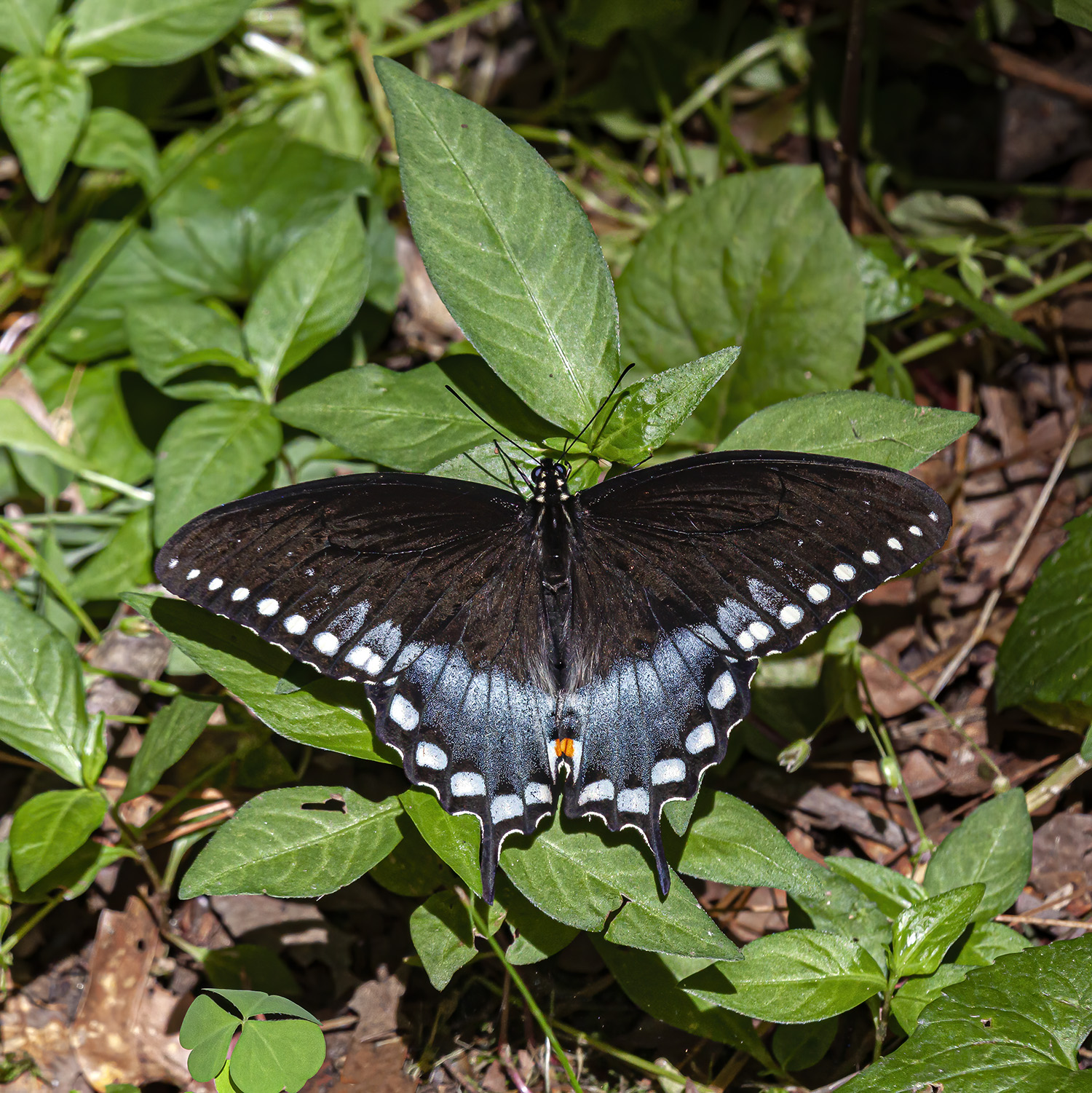
I was thrilled on Monday to see lots of butterflies as I was exploring Occoquan Regional Park. Many of them were small skippers that skittishly flew away whenever I approached them. Only a few were large and colorful, like the Red-spotted Purple butterfly (Limenitis arthemis) in the first photo. When it first landed on the plant, its wings were closed, but I waited and eventually the butterfly opened its wings. The damage to one of those wings this early in the season really emphasizes the fragility of these beautiful little creatures.

I also saw some brown woodland butterflies and I chased after several of them. I was out of breath but finally managed to catch up to one. Identification of this type of butterfly is always problematic, because there are quite a few similarly-colored species that vary only in the number and placement of the the eyespots. I think that the butterfly in the second shot is a Little Wood Satyr butterfly (Megisto cymela). I contemplated cropping closer, but decided I liked the little plant on the right side of the image and kept it. With this framing, I am able to create the illusion that the butterfly is staring at the plant.

Red-spotted Purple

Little Wood Satyr

© Michael Q. Powell. All rights reserved.
Read Full Post »

Names can sometimes be misleading. There is a genus of damselflies, consisting of 35 species, called American bluets. As the common name “bluet” suggests, most members of the genus are primarily blue in color. One notable exception is the adult male Orange Bluet (Enallagma signatum) that often does not appear to have even a speck of blue on its body.

I spotted this little guy last Friday at Jackson Miles Abbott Wetland Refuge and was a bit shocked by his bright red eyes when I looked through the viewfinder of the camera. The male Orange Bluet was perched at the extreme end of some vegetation overhanging a pond.

I would have liked to have gotten a shot in which more of its body was in focus, but I did not want to risk falling in the water, which looked to be pretty deep at that spot. As I look at the photo now, I realize that the soft focus of the body may actually be a good thing, because it draws a viewer’s attention even more to the eyes of the handsome little damselfly.

orange bluet

© Michael Q. Powell. All rights reserved.
Read Full Post »

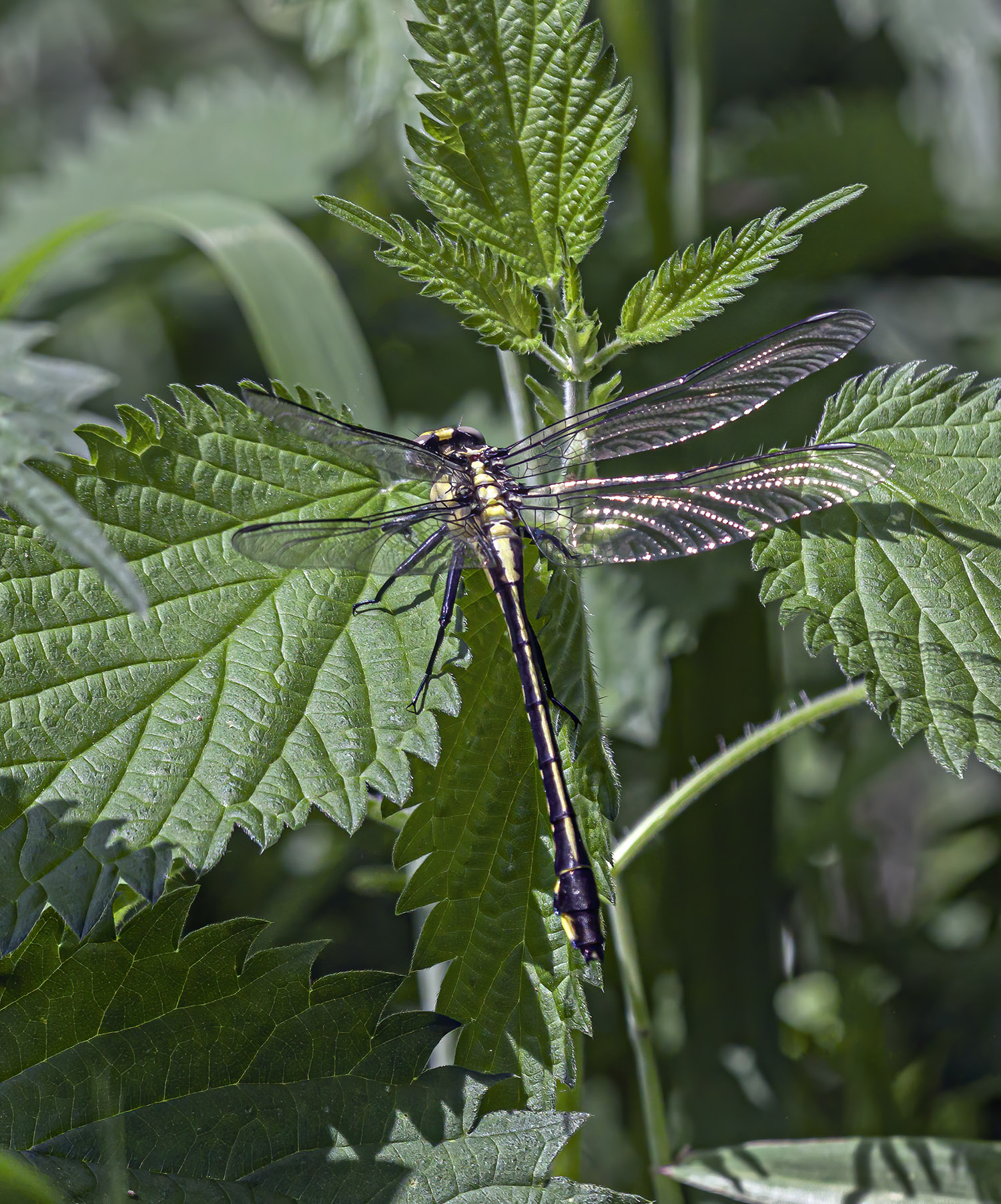
UPDATE: Some experts have looked at the photos that Walter took of and it appears that the dragonfly in the first photo (and possibly all of the ones in this posting) is a Splendid Clubtail (Gomphurus lineatifrons), a new species for me. The differences between the two species are subtle enough that I am definitely relying on the expertise of others in making this identification.

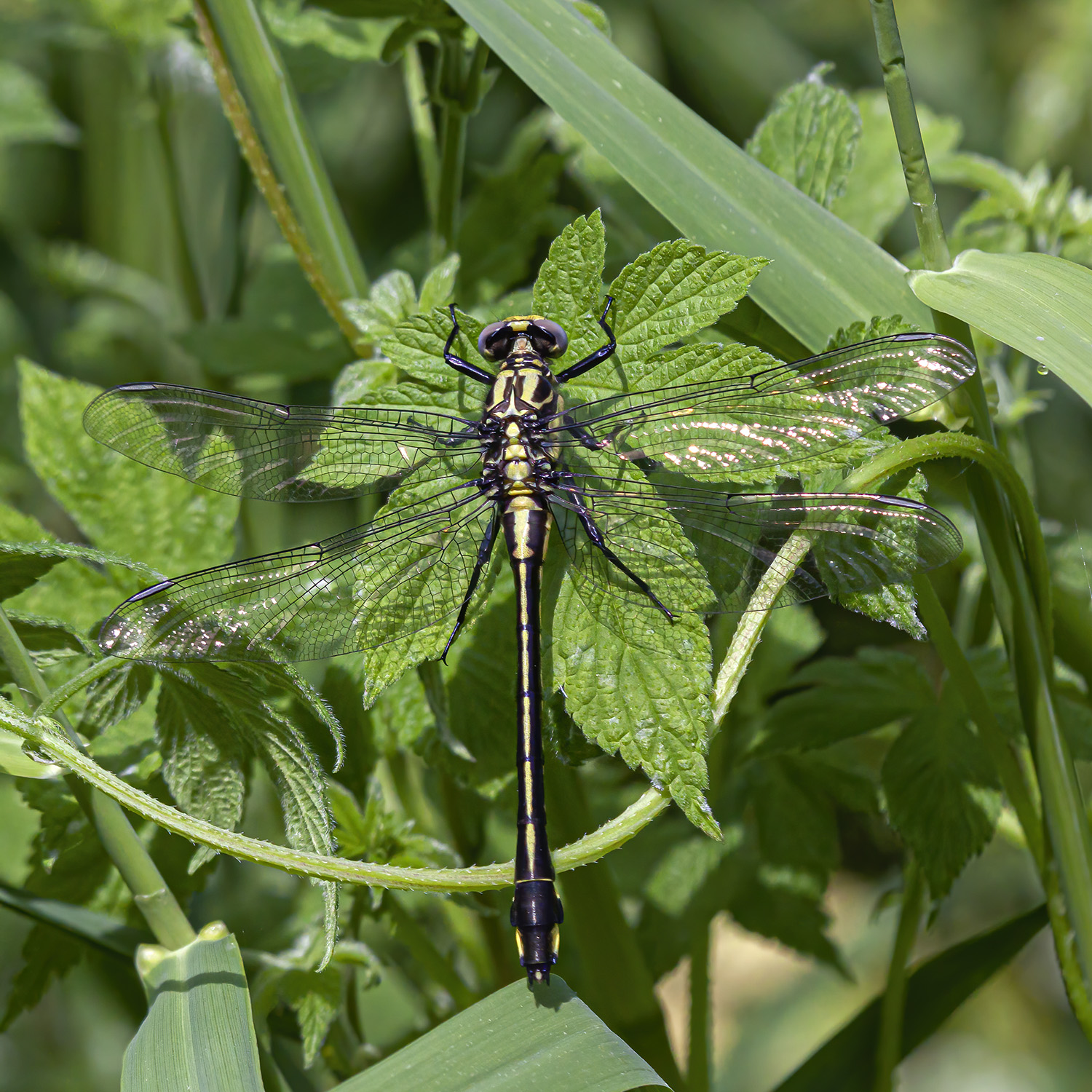
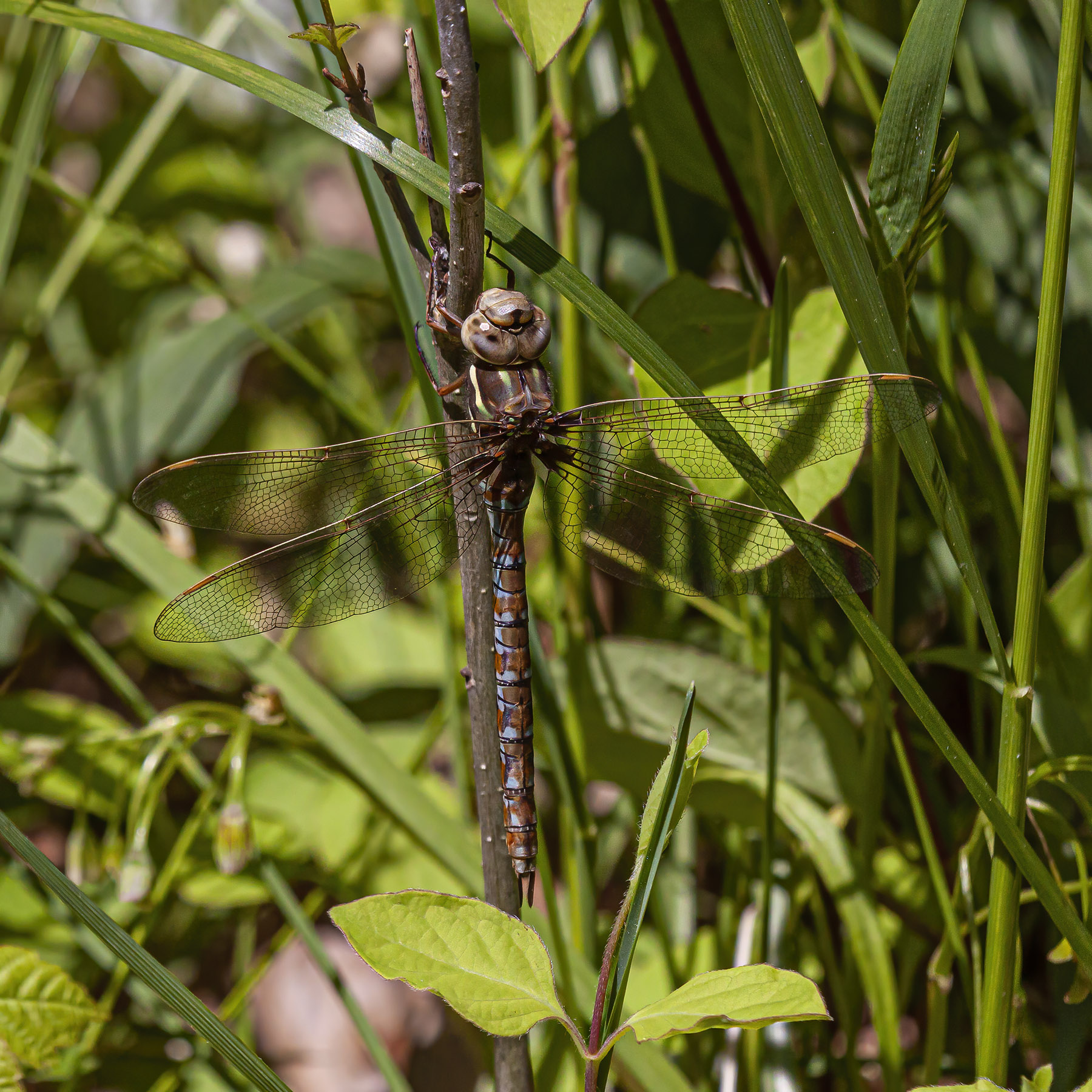
I spent most of this past Tuesday exploring wild areas in Fairfax County, Virginia, hunting for dragonflies with my friend and fellow dragonfly enthusiast Walter Sanford. It is still a little early for many species, so we had to work really hard for each one that we were able to find.  I was really excited when we spotted several Cobra Clubtail dragonflies (Gomphorus vastus) during the day, all of which turned out to be females.

As you can see from these photos, the Cobra Clubtails were hanging vertically with their abdomens pointing downwards, which made them hard to spot when they landed in the abundant green vegetation. In one nearby location, there is an annual mass emergence of Cobra Clubtails, with dozens emerging at the same time. We made a brief stop there, hoping to see more Cobra Clubtails, but learned from employees there that the Cobra Clubtails have not yet arrived this year—we may make another try sometime fairly soon.

If you would like to see Walter’s posting on our adventures with the Cobra Clubtails, click on this link to his blog.

Cobra Clubtail

Cobra Clubtail

Cobra Clubtail

© Michael Q. Powell. All rights reserved.
Read Full Post »

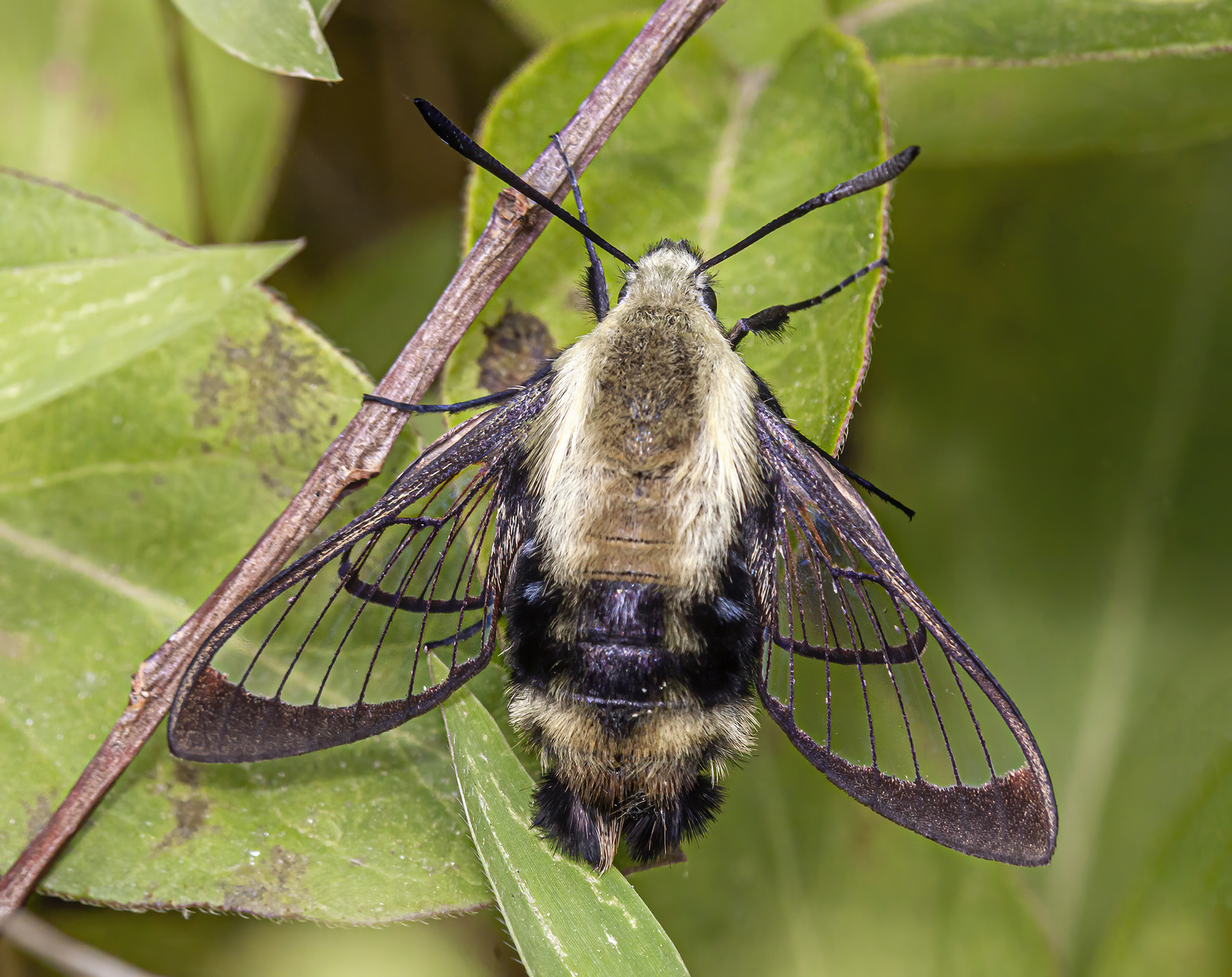
When I first spotted this insect last Thursday at Occoquan Regional Park, it looked like a large bumblebee. I tracked it visually as it buzzed about and when it landed, I could see from its distinctive wings that it was definitely not a bee. In our area we have two species of clear wing moths that are similar in appearance and behavior, the Snowberry Clearwing Moth (Hemaris diffinis) and the Hummingbird Clearwing Moth (Hemaris thysbe). Identification guides warn that both species are variable in color, which complicates identification, but the Hummingbird Clearwing Moth has light-colored legs, so I am pretty confident that this one is a Snowberry Clearwing Moth.

Most of the time when I see clearwing moths they are beating their wings rapidly and hovering in the air as they collect nectar from a variety of flowers, which causes some people to think they are hummingbirds. I do not know why this one was perched in the low vegetation—perhaps it was taking a break—but its static position allowed me to get a detailed look at its wings and the rest of its body.

Snowberry Clearwing moth

© Michael Q. Powell. All rights reserved.
Read Full Post »

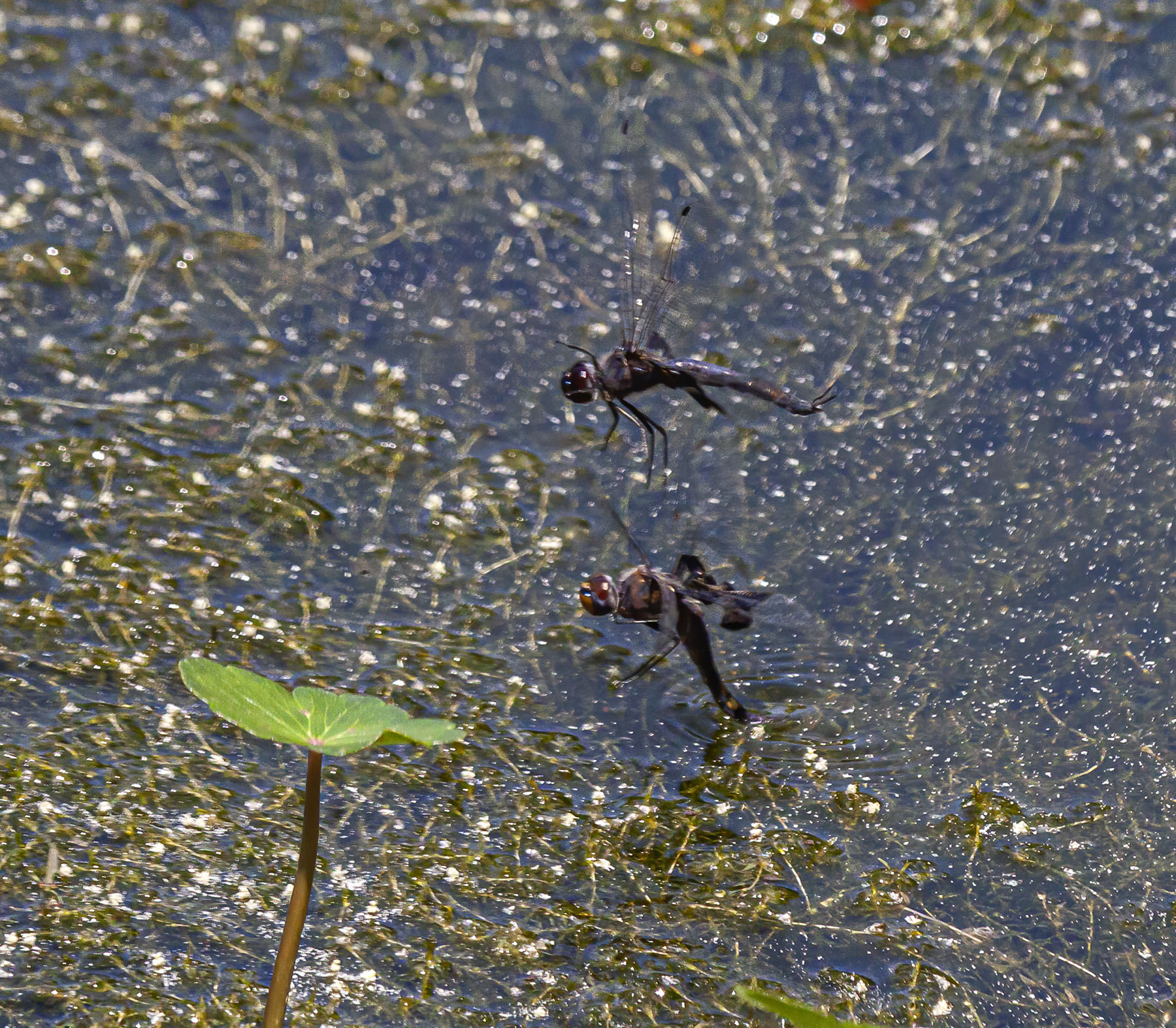
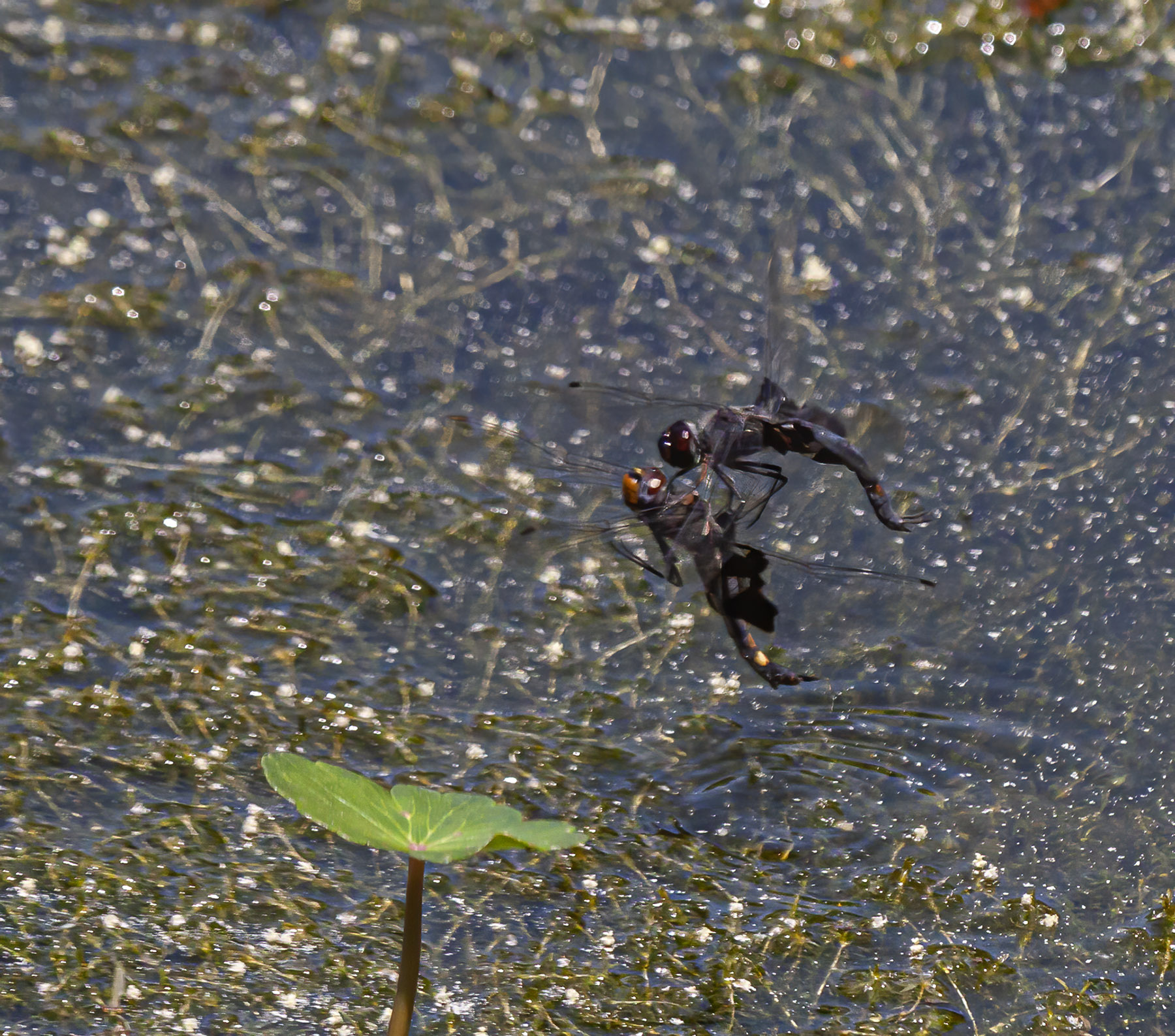
Generally when I spot a Black Saddlebags dragonfly (Tramea lacerata), it is flying. The distinctive dark blotches, which some scientist decided look like saddlebags, are visible even when the dragonfly is in the air. Some dragonflies spend most of their time perching, while others spend most of their time flying—the Black Saddlebags is in the latter category. I was therefore quite excited when I saw this one land in the low vegetation last Thursday at Occoquan Regional Park.

When a subject is this close to the ground, the background is almost inevitably going to be cluttered. In an effort to soften the potential distraction, I opened up the aperture to f/6.3 and tried to shoot almost directly down on the subject. I like the resulting image that has most of the dragonfly in sharp focus and most of the background a bit blurry.


Black Saddlebags

© Michael Q. Powell. All rights reserved.

Read Full Post »

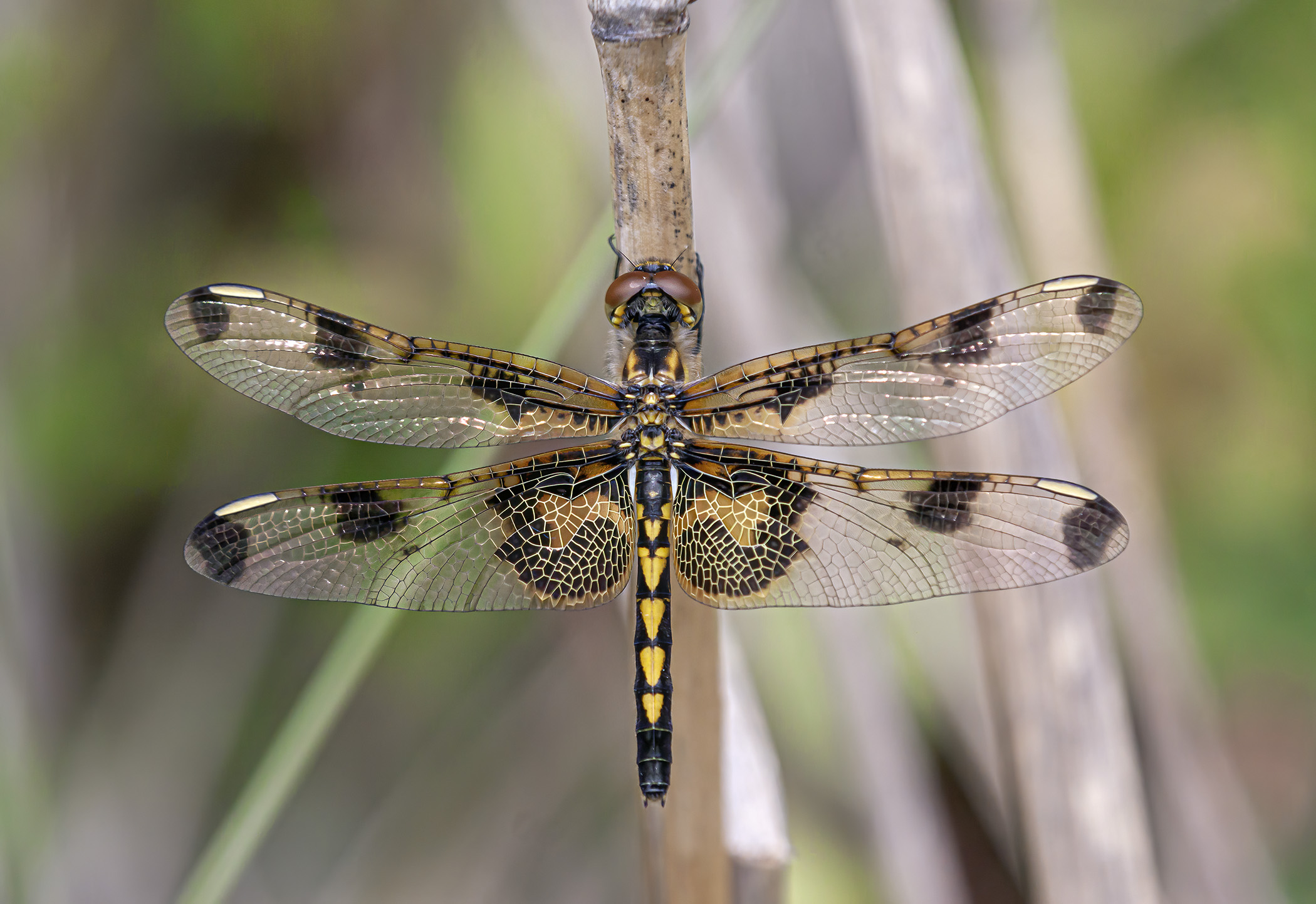
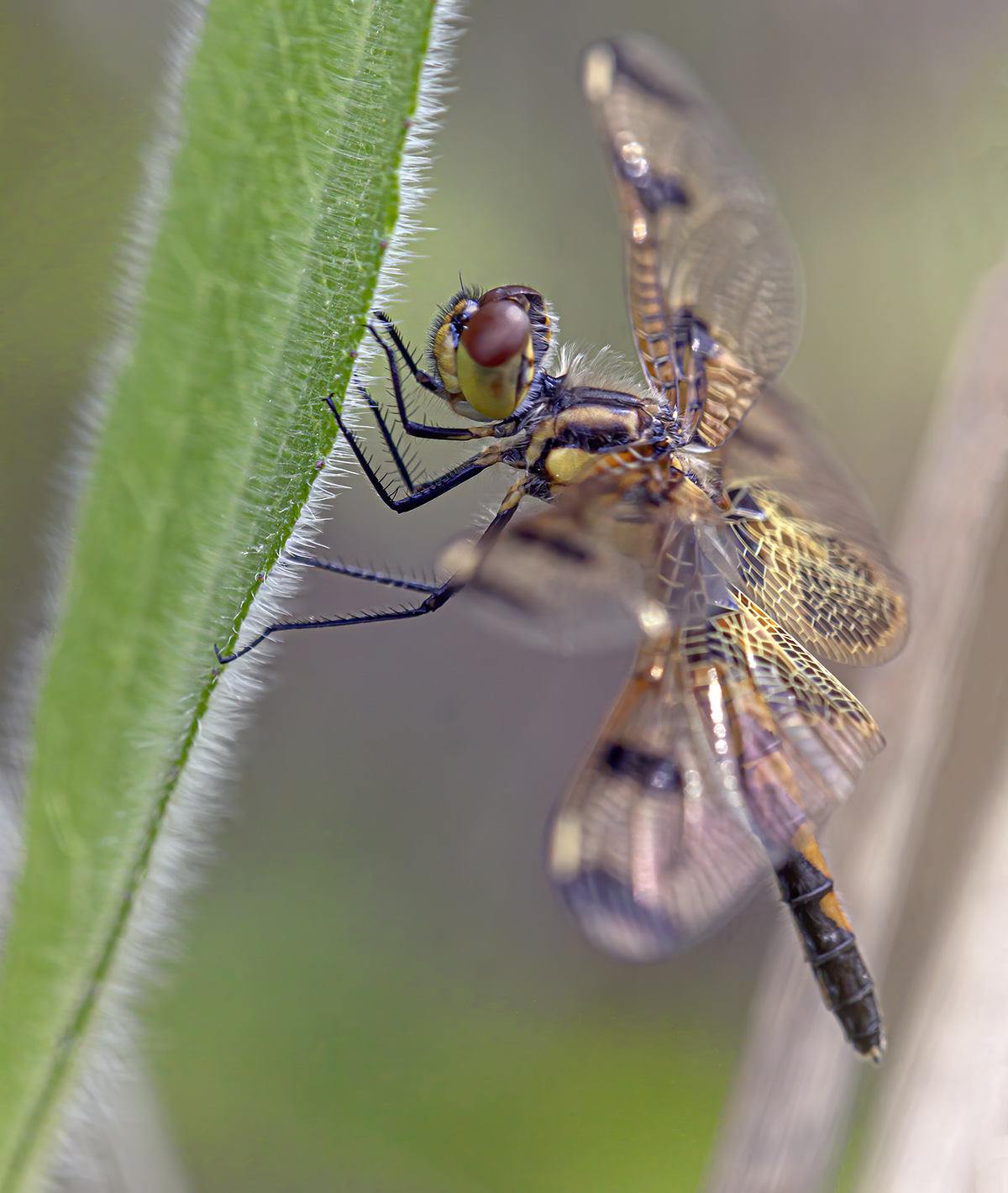
On Tuesday I spotted this beautiful female Calico Pennant dragonfly (Celithemis elisa) during a visit to Occoquan Bay National Wildlife Refuge.  I always love to see the wonderfully patterned wings of this dragonfly species and the first shot provides a good view of the wing details, especially if you click on the image to enlarge it.

In the second image, I focused primarily on the dragonfly’s head and body and the wings are mostly out of focus. I love the way that you can see the dragonfly’s tiny feet and the tenuous grasp they have on the fuzzy plant stem from which the dragonfly is hanging.

Calico Pennant

calico pennant

© Michael Q. Powell. All rights reserved.
Read Full Post »

I wasn’t sure if Uhler’s Sundragon dragonflies (Helocordulia uhleri) would still be around when I set out exploring in Prince William County earlier this month. This species of dragonfly is one of the first to appear in the spring and generally is flying for only a month or so. I had spotted several females on the third of April—see my posting Female Uhler’s Sundragons for details and photos—so I knew that the clock was ticking.

I scoured all of the locations where I had seen them in the past and was about to give up hope when some movement low in the vegetation caught my eye. I was excited to see that it was a Uhler’s Sundragon, my target species. As I tried to control my racing heart and slow down my breathing, I maneuvered into position and was able to capture this image of a handsome male Uhler’s Sundragon. As it turned out,  this dragonfly was the only one of its species that I would see that day and I have not seen one since. In this case, though, one was more than enough.

Uhler's Sundragon

© Michael Q. Powell. All rights reserved.

Read Full Post »

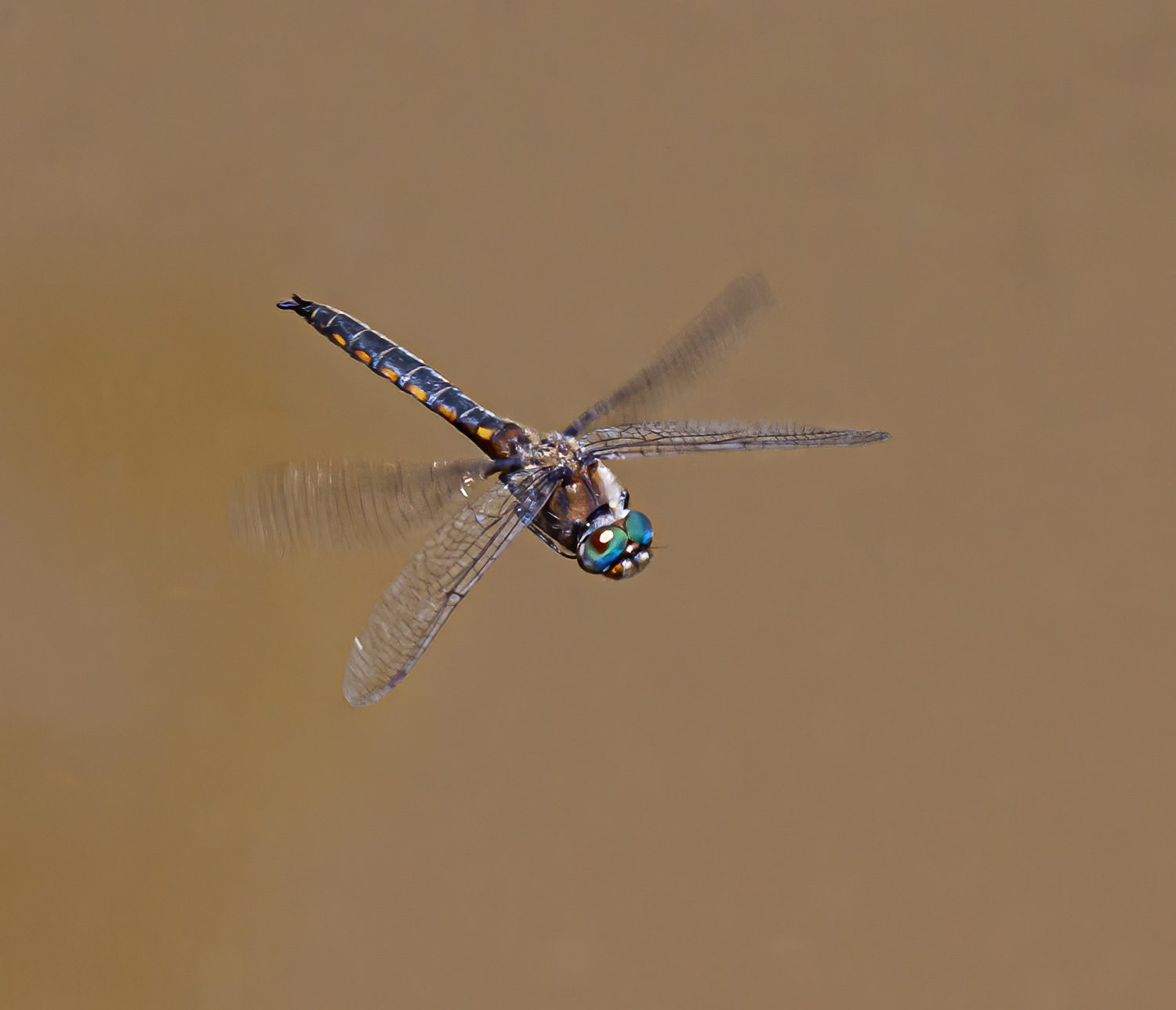
On Friday, temperatures in my area soared to 84 degrees (29 degrees C), which I thought might trigger the emergence of new dragonflies. However, when I arrived at Jackson Miles Abbott Wetland Refuge, a nearby park with a small pond, the only dragonflies that I could find were a half-dozen Common Baskettail dragonflies (Epitheca cynosura) patrolling over various parts of the pond.

I walked around the perimeter of the pond multiple times, searching in vain in the undergrowth and in the vegetation at water’s edge. Periodically I stopped and attempted to photograph the dragonflies in flight. Their flight paths were somewhat predictable, which gave me hope, but the dragonflies varied their distances from the shore and changed their altitude unexpectedly.

Here are a few of my favorite shots from the photo excursion. As a frame of reference, Common Baskettail dragonflies are about 1.6 inches (41 mm) in length, so I think you can appreciate the challenge of photographing one on the fly.

Common Baskettail

Common Baskettail

Common Baskettail

© Michael Q. Powell. All rights reserved.

Read Full Post »

Many beetles are dark-colored and go about their business in the underbrush, unseen by human eyes. Six-spotted Tiger Beetles (Cicindela sexguttata), on the other hand, are hard to miss—their metallic-green bodies sparkle as they perch in the middle of the sun-lit forest trails on which I have been hiking in recent weeks.

The beetle’s common name refer to the six small white spots on the beetle’s metallic-green elytra (the beetle’s hardened wing cases), although the number of spots is somewhat variable—I think I count eight spots on this individual. As I was doing a bit of research, I stumbled upon the fact that elytra is the plural form of elytron—I think that I have almost always seen the word used in the plural form and the spell-check highlights elytron as an unknown word.

It is often hard to get a shot of one of these beetles, because they are skittish and often fly away as I bend down to photograph them. For this photo, I was fortunate that the beetle chose to perch on a trunk of a tree at eye-level and no contortions were therefore required on my part.

Six-spotted Tiger Beetle

© Michael Q. Powell. All rights reserved.

Read Full Post »

During a recent dragonfly hunting trip with my friend and fellow dragonfly enthusiast Walter Sanford, I was thrilled when we stumbled upon several Springtime Darner dragonflies (Basiaeschna janata). As their name suggests, they are in flight early in the dragonfly season and are gone well before many of the summer dragonfly species arrive.

I first spotted one flying low over the vegetation in an overgrown field. It dropped down into the vegetation, but I was fortunately to be able to find where it was perched. As you can see in the first photo, Springtime Darners perch vertically, making it hard to see them amid all of the nearby stalks and stems. The female in the first photo was relatively cooperative and I was able to position myself well enough to have most of her body in focus. I encourage you to click on the image to see all of the wonderful details and colors of this beautiful dragonfly.

Although we had several more encounters with Springtimes Darners, all of those individuals were very skittish and it was tough to get any good shots. I included the second shot below because it shows really well the body of a male Springtime Darner, although the head is a bit out of focus because of the way he was perched.

Walter also did a blog posting on our encounter with these beautiful dragonflies. Be sure to check it out at this link and you will find more information about this dragonfly species and his photos and “take” on our dragonfly adventure.


Springtime Darner

Springtime Darner

© Michael Q. Powell. All rights reserved.

Read Full Post »

On Thursday I was excited to spot these two Stream Cruiser dragonflies (Didymops transversa), one female and one male, in a sunny area adjacent to a creek that I was exploring in Prince William County, Virginia. Authorities have closed the park that I was visiting to vehicular traffic, so I had to hike in to reach my target area, which took over an hour and a half each way.

It was the end of a long and tiring day and I had already begun the trek back to my car. By 4:00 in the afternoon, much of the trail along the creek was in the shade. Periodically, though, I would pass patches of sunlit vegetation and I stopped to explore them, knowing that many dragonflies like to bask in the sunlight. I was searching one such spot when my eyes detected a dragonfly in flight. I was able to track the dragonfly in the air and to see it land. The male Stream Cruiser (shown in the second photo below) perched at an odd angle on some low-hanging vegetation, but I managed to get a shot of it before it took off again.

I decided to stay in that spot and wait and after a while another dragonfly flew by, landing this time much higher in the vegetation. Initially I thought that it might be the same dragonfly that I had already photographed, but when I got closer, I could see that the second one (shown in the first photo below) was a female. The female Stream Cruiser chose to perch about chest-high, so I was able to get a much better angle for this shot than for the first one and compose the image more carefully.

This experience is a good reminder for me to stay alert at all times when I have my camera in my hands until I am actually back to my car. I had not even been thinking of Stream Cruisers, a species that I have seen only a couple of times previously, when I decided to make this trip. However, I was ready when this opportunity unexpectedly presented itself to me.

I cringe a little sometimes when well-meaning folks see my photos and say, “You are so lucky.” Yes, I have more than my share of good fortune, but it often takes hours and hours of effort for a decisive moment to arrive and even then I have to be quick enough and skillful enough to get a shot. Rather than going to the trouble to explain all of that, though, I will usually nod my head and agree that I was lucky to get my shots.


Stream Cruiser

Stream Cruiser

© Michael Q. Powell. All rights reserved.


Read Full Post »

How close can you get to a dragonfly when trying to photograph it? As with most things in life, the vexing answer is that  “it depends.” In my experience, some dragonfly species tend to be more skittish than others and will fly away for good at the first indication of your presence. Other species will fly away, but return to the same perch a short time later. Occasionally I will encounter a dragonfly that remains in place and permits me to get as close as I want, although I still have to pay close attention to where I place my feet, so that I do not disturb its perch, and to the location of the sun, so that I do not cast my shadow on the dragonfly.

Last Saturday I went hunting for dragonflies with my friend and fellow dragonfly enthusiast Walter Sanford at a remote location in Fairfax County, Virginia, the county in which we live. Under normal circumstances, we probably would have made multiple excursions together by this time of the year, but this was our first trip of the season.

The first dragonfly that we encountered was a female Ashy Clubtail dragonfly (Phanogomphus lividus) and she proved to be remarkably cooperative. Why? I think that the dragonfly was a little distracted because she was in the process of consuming a cranefly. In some of my photos I could see remnants of the legs, wings, and other body parts of the victim.

The three photos show in inverse chronological order how I started out photographing the entire body of the dragonfly and them moved in closer and closer. Each of shows some pretty remarkable details of the dragonfly’s anatomy and it is definitely worth clicking on them to get a better look. For example, the third photo shows the beautiful coloration of the body; the second shot shows the spines on the legs and the hook-like tips of the feet; and the first image draws your attention to the dragonfly’s amazing compound eyes.

I took all of the photos below handheld with my Canon 50D DSLR and Tamron 180mm macro lens. My partner in this adventure used totally different gear and his approach to capturing images was definitely not the same as mine. In the past Walter and I have done companion postings on our respective blogs when we have taken photos together and we decided to continue the tradition.

Walter and I have different backgrounds, writing styles, and shooting styles and it has always been fascinating to contrast our “takes.” Even though we were shooting the same subject under the same conditions, I can almost guarantee that the images we post will be quite different. Be sure to check out Walter’s blog at waltersanford.wordpress.com for all kinds of wonderful postings, mostly about dragonflies.

I will include a link to his posting on our encounter with this Ashy Clubtail dragonfly after I publish this posting—I have not yet seen how he described our adventures.

UPDATE: Here, as promised, is a link to Walter’s posting about our encounter with this female Ashy Clubtail dragonfly.

Ashy Clubtail

Ashy Clubtail

Ashy Clubtail

© Michael Q. Powell. All rights reserved.


Read Full Post »

At this time of the year there are still so few dragonflies around that I will try to photograph almost every single one that I see. Sometimes that involves photographing them when they are flying, as I showed in a posting earlier today. At other times, I am forced to shoot them when they are a long way away, as was this case with the male Common Whitetail dragonfly (Plathemis lydia) in the photo below.

I had already made one loop around Occoquan Bay National Wildlife Refuge looking primarily for insects and decided to switch to my telephoto zoom lens and focus on looking for birds during a second loop. When I was walking past a small pond, however, I spotted the dragonfly flying over the water. I could tell that it was a Common Whitetail, a species that perches fairly often, so I decided to see if it would land.

Eventually the dragonfly perched atop some thick vegetation not far from the water’s edge. Unfortunately the area between the two of us was marshy and there was no way that I could get any closer. Even with the lens cranked out to its longest length (600mm), the dragonfly filled only a small portion of the frame.

I decided to try to treat the shot like a landscape and include the water of the pond in the background and the curling stem on which the dragonfly was perched in the foreground. I am pretty happy with the way the shot turned out, a kind of environmental portrait of the Common Whitetail dragonfly.

Common Whitetail

© Michael Q. Powell. All rights reserved.


Read Full Post »

Yesterday my friend and photography mentor Cindy Dyer and I were photographing flowers in different parts of her garden when she excitedly called out to me that she had spotted a ladybug inside one of the irises. I rushed over and spotted a tiny Multi-colored Asian Lady Beetle (Harmonia axyridis) feverishly crawling around inside of a beautiful yellow bearded iris.

I had a mental picture of composing an image in which the viewer would looking from the outside into the interior of the flower.  That meant that I could not get too close to the ladybug. It also meant that the ladybug had to cooperate by crawling into the right part of the frame. I watched and waited and eventually was able to capture the kind of artsy image that I had imagined.

ladybug in iris

© Michael Q. Powell. All rights reserved.


Read Full Post »

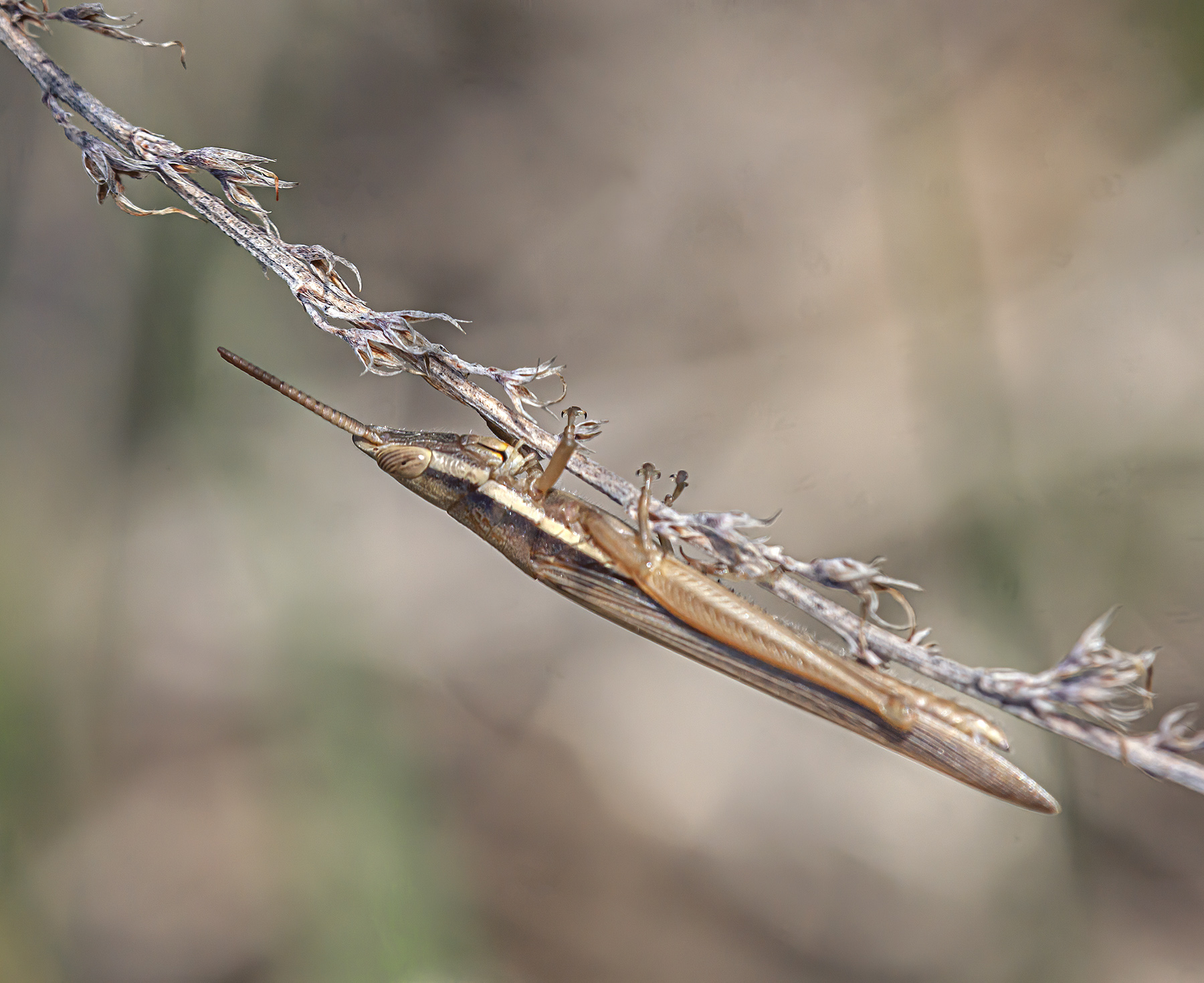
Have you ever stopped to look closely at grasshoppers? They come in all shapes, sizes, and colors. I spotted this elongated one with fluted, unicorn-like antennae this past week at Occoquan Bay National Wildlife Refuge. I knew that I had seen one like this before, but could not recall its name. After some research, I rediscovered that it is the colorfully-named Cattail Toothpick Grasshopper (Leptysma marginicollis).

If you try chasing grasshoppers, you will discover that they often stay in place after the first hop, giving you a chance to examine them for a moment before they hop away.

So whether you are in your backyard or in a park, be sure to check out the grasshoppers. You might be surprised by what you discover.

Cattail Toothpick Grasshopper

© Michael Q. Powell. All rights reserved.

Read Full Post »

One of the earliest dragonflies to emerge in the spring in our area is the Blue Corporal (Ladona deplanata). Adult males are bluish in color and both the male and the female have two white stripes on their thoraxes in an area that you might think of as their shoulders. In the military of the United States, the rank insignia for corporals is two stripes, which accounts for that portion of the common name for the species.

The dragonfly in the first photo is a female Blue Corporal. She will remain that tan color for her entire life. If you look closely at the very tip of her abdomen (the “tail”) and compare it with the same area of the dragonfly in the second image, you can probably see some physiological differences. This is often the best way to tell the gender of a dragonfly.

The dragonfly in the second photo is a newly emerged male Blue Corporal, a stage known as teneral. During this stage, the wings are very clear and shiny and are very fragile. As the male matures, he will gradually turn bluish in color. His corporal stripes may turn light blue and eventually fade away.

You probably noted that the male Blue Corporal is perched flat on the ground—this is the most frequent perching position for this species. I was a little surprised that the female in the first photo was perching vertically a few inches above the ground, but I am not complaining, because it gave me a better chance to get a photo of her wings.

It is still a bit early in the season for dragonflies, so I was really happy to spot these two on Wednesday at Occoquan Bay National Wildlife Refuge. The refuge is still open and there were a number of other cars in the parking lot when I arrived. All of the other visitors, though, seemed to be either birding or walking in other areas of the refuge, leaving me the chance to muck about at the edge of a small pond all by myself, safely distanced from human contact.

Blue Corporal

Blue Corporal

© Michael Q. Powell. All rights reserved.
 

Read Full Post »

This insect is fuzzy like a bee and acts as a pollinator as it sips nectar, but it is not a bee, it is a fly, a Greater Bee Fly (Bombylius major). Are you confused yet? Unlike bees, bee flies have only two wings instead of four, large eyes, skinny long legs and very short antennae. Bee flies also seem hyperactive, hovering in midair rather than landing as they suck up the nectar with a really long proboscis and thereby avoiding potential predators like crab spiders.

When I did a little research, though, I learned that bee flies have a dark side. According to an article entitled “A Pollinator With a Bad Reputation” by Beatriz Moisset, “The reason why it diligently hovers over bare ground early in the spring is that it is looking for bee nests, probably the same ones with which they compete for nectar. The bees dig tunnels and lay their eggs at their bottoms after collecting enough pollen to feed the larvae. This requires numerous trips, thus the bee fly takes advantage of the mother’s absence and lays its eggs in such nests. Making use of its flying prowess, it does not even need to land but it flicks its abdomen while hovering over the open burrow, letting one egg fall in or near it. The fly larva finds its way to the chamber where the mother bee has laid the provisions and the egg and proceeds to feed on the stored pollen. Afterwards it devours the bee larvae; when it is fully grown, it pupates and stays inside the nest until next spring.”

I was inspired to post this image by a recent posting by Pete Hillman entitled “Dark-edged Bee Fly” that featured a similar bee fly. In my zeal to post photos of all of the ephemeral wildflowers I had seen this spring, like the Virginia Spring Beauties in this photo, I had forgotten about this bee fly.

You may notice that the bee fly’s wings are blurred in this— image and assume that I was shooting with a slow shutter speed. I checked the EXIF data for the shot and found that the shutter speed was 1/2500 second—I think that it had consumed as much coffee as I had that late March morning. I recommend that you click on this image to see all of the amazing details of this fascinating insect, the Greater Bee Fly.


Greater Bee Fly

© Michael Q. Powell. All rights reserved.

Read Full Post »

When I first saw some tiny little flies buzzing around in the garden of my neighbor and photography mentor Cindy Dyer, I knew that they were not bees. I could tell that they were hover flies, because of the way they acted, or perhaps you know them as flower flies, because of where they can be found most often.

As I observed the flies, I was attracted to the beautiful, elaborate patterns on their bodies and realized that this was a different species of hover fly than I was used to seeing. Unfortunately, according to Wikipedia, there are over six thousand hover fly species worldwide. How could I possibly identify this species?

I was shocked, amazed, and delighted when a Facebook viewer informed me that this species is known as the Eastern Calligrapher Fly (Toxomerus geminatus). I love the thought of someone hand drawing the delicately etched pattern with pen and ink, creating a miniature work of art.

If you want to learn more fun facts about this cool little fly, check out an article from riveredgenaturecenter.org entitled “Bug o’the Week–Eastern Calligrapher Fly” by clicking on the name of the article.

Eastern Calligrapher Fly

Eastern Calligrapher Fly

© Michael Q. Powell. All rights reserved.
Read Full Post »

Yesterday I was excited to spot several tiny Eastern Tailed-Blue butterflies (Everes comyntas) during a brief visit to Jackson Miles Abbott Wetland Refuge. What was particularly striking was that these delicate butterflies were perched with their wings partially open, revealing a spectacular blue color. I maneuver to position myself almost directly above one perched close to the ground, waited for it to open its wings fully, and captured this shot.

If you click on this image, you can get a better look at the marvelous details of this male Eastern-Tailed Blue, including the tiny “tails” and the little orange chevrons at the bottom of the hind wings. I was struck by the apparent asymmetry of the butterfly’s wings—the right wings look bigger than those on the left—but wonder if that is simply a consequence of the angle at which I took the shot or perhaps the wings were not fully open and were at slightly different angles.

Eastern Tailed-Blue

© Michael Q. Powell. All rights reserved.
Read Full Post »

Does the pressure of confinement/isolation/social distancing weigh you down? I know that I definitely feel that way at times. What I found on Friday morning, though, was that I felt totally free and uninhibited when I was chasing after this Zebra Swallowtail butterfly (Protographium marcellus). From a distance I must have looked like a madman as I ran back and forth and in circles trying to stay close to this butterfly.

It was more than just hoping and passively waiting—I put all of my energy into my childlike desire to to get a closer look at this beautiful butterfly. Maybe one of the secrets to handling the stresses inherent in today’s crises is to seek pleasure in simple joyful activities, like chasing a butterfly.

Zebra Swallowtail

© Michael Q. Powell. All rights reserved.

Read Full Post »

When I saw this insect sipping nectar from a Spring Beauty wildflower on Tuesday, I was sure that it was some kind of wasp or hornet. Bees, I thought, do not have such narrow waists. I was wrong. Some of the experts at bugguide.net identified my insect as a male Nomad Bee (genus Nomada).

Nomad Bees are the largest genus of kleptoparasitic “cuckoo bees,” according to Wikipedia. “Kleptoparasitic bees are so named because they enter the nests of a host and lay eggs there, stealing resources that the host has already collected.” Nomad bees do sip nectar like other bees, as you can see in my photos, but do not collect pollen to feed their offspring.

I remember being shocked the first time that I read about cuckoos and cowbirds deliberating laying their eggs in the nests of other birds to avoid having to build their own nests and raise their own babies. I guess I can add nomad bees to the list of deliberately delinquent parents.


nomad bee

nomad bee

© Michael Q. Powell. All rights reserved.
Read Full Post »

I love ladybugs and was thrilled to spot this one on Monday at Jackson Miles Abbott Wetland Refuge. When I posted this photo on Facebook, one viewer noted that this is a Multicolored Asian Lady Beetle (Harmonia axyridis), a non-native species that has become the most common species in the United States since it was deliberately introduced into the country in 1916 in an attempt to control the spread of aphids.

How can you tell a native ladybug from the Asian ladybug? Several sources on-line note that the Asian ladybug has a white marking behind its head in the openings of what looks like a black M, as you can see on the ladybug in my photo. If you are interested in learning more about the differences, check out this fascinating article at thespruce.com, The Differences Between Ladybugs and Asian Lady Beetles.

Whether native or not, this ladybug in my eyes is beautiful. If you want to see something really cool, click on the photo and check out the details on the ladybug’s front foot. I never knew that ladybugs have two tiny toes.


ladybug

© Michael Q. Powell. All rights reserved.
Read Full Post »

It is still really early in the dragonfly season in my area, so each one that I am fortunate enough to spot is special to me. I was therefore thrilled to photograph this male Common Baskettail dragonfly (Epitheca cynosura) on Monday as it was hanging vertically from the leaves of a small tree at Occoquan Bay National Wildlife Refuge. If you double-click on the image, you can see the dragonfly’s tiny feet with which it is clinging to the leaf.

Most of the times in the past when I have seen members of this species, they have been flying out of reach of my camera. According to the Dragonflies of Northern Virginia website, Common Baskettails are hard to spot because they are small with mostly clear wings and spend much of their time hovering high over clearings, making them “probably our least seen “common” dragonfly.”

Common Baskettail

© Michael Q. Powell. All rights reserved.


Read Full Post »

I felt like I had hit the jackpot last Friday when I finally spotted several Uhler’s Sundragon dragonflies (Helocordulia uhleri) while exploring a stream in Prince William County, Virginia. Uhler’s Sundragons are a scarce and seldom seen dragonfly species with a brief and early flight period. There is a very active Virginia dragonfly group in Facebook that posts sightings and photos and it appears that my sightings of this species were the first in our state for 2020.

Last year I was able to do some reconnaissance of an area where this species had been spotted in previous years using information shared with me by fellow dragonfly fanatic and blogger Walter Sanford. Eventually I found and photographed some Uhler’s Sanddragons and he and I were able to spot them again several times.

This species generally is found in a specific type of habitat—”Clean, sandy or gravely forest streams with a mix of riffles and pools,” according to the excellent Dragonflies of Northern Virginia website. So Friday I scoured the locations where had spotted them last year and it was in one such location that I spotted the Ashy Clubtail and Common Green Darner that I featured recently in my posting First dragonflies of the season. I looked for Uhler’s Sundragons there but came up empty-handed.

It was at a second spot that I finally spotted one as it flew through the air and landed on a piece of vegetation. There is not much flying this early in the season and I could tell from the way that it perched that it was probably my target species. I think I was shaking a little bit and certainly my heart rate had accelerated, but I managed to get a shot of that one (the middle shot below), before it flew away. A few minutes later, I had another spotting and captured the last shot below—it might have been the same dragonfly or a different one.

Part of my long walk back took me along another stretch of the same stream and I was absolutely thrilled when I spotted yet another Uhler’s Sundragon and captured my favorite shot of the day, the first one below. It turns out that all of the Uhler’s Sundragons that I photographed were females. I am not sure if the males were all out patrolling or were simply in other locations.

Many of the locations where I might normally search for dragonflies are closed and some of the others are potentially crowded, so I am not willing to go there. As you can see from my recent postings, I am staying really close to home most of the time, with trips like this one to remote locations being a rare exception.

Uhler's Sundragon

Uhler's Sundragon

Uhler's Sundragon

© Michael Q. Powell. All rights reserved.
Read Full Post »

What do you call a group of butterflies? I have always been fascinated by the collective nouns that we use in English for groups of creatures. I was delighted to learn that one of the collective nouns used for butterflies is a kaleidoscope.

“A kaleidoscope of butterflies” seems to be the perfect descriptor for this group of beautiful Eastern Tiger Swallowtail butterflies (Papilio glaucus) that I spotted yesterday. They appeared to be engaged in a behavior known as “puddling,” during which the butterflies, most often the males, gather minerals and other nutrients from the soil or other organic material.


Eastern Tiger Swallowtails

© Michael Q. Powell. All rights reserved.

Read Full Post »

Last Friday I photographed my first dragonflies of the spring, a male Common Green Darner (Anax junius) and a female Ashy Clubtail (Phanogomphus lividus). The Common Green Darner is probably a migratory dragonfly that is just passing through as it heads north—we do have local-born members of this species, but it is too early for them to have emerged.

The Ashy Clubtail, which was actually the first dragonfly that I photographed, almost certainly emerged locally. When a dragonfly emerges, its wings are really shiny and the wings of this Ashy Clubtail were definitely sparkling in the sunlight. According to the local flight calendar, the Ashy Clubtail is one of the earliest dragonflies in our area to emerge, but I have never seen one this early before.

As you can see, I captured the images of both of these dragonflies when they were perched flat on the ground. There were dry leaves all around, which made a stealthy approach almost impossible and focusing on the dragonfly was a bit of a challenge.

Common Green Darner

Ashy Clubtail

© Michael Q. Powell. All rights reserved.

Read Full Post »

Did you know that some bees have green speckled eyes? I was really startled by the brightness of this bee’s eyes as I was taking its photo last Monday while exploring in Prince William County, Virginia. Some research on-line revealed that this is a male Eastern Carpenter Bee (Xylocopa virginica).

I was pretty sure that I had never before seen a bee like this, but I was wrong. As I was preparing this posting, I discovered that I had seen a similar bee in October 2012 and published a posting entitled “Green-eyed Eastern Carpenter bee.” Wow. It’s been a long time between sightings, so maybe I can be forgiven for having forgotten about the previous time, though at my age I can simply claim that I had a “senior moment.” Ages has its privileges.

Eastern Carpenter Bee

© Michael Q. Powell. All rights reserved.

Read Full Post »

Although the temperatures were cool on Tuesday afternoon, this little bee was busy in the garden of my neighbor and friend Cindy Dyer. The plant on which the bee was feeding technically bight be considered to be a weed, and not a flower, but the bee surely did not mind.

Most of the pollen that I am used to seeing is bright yellow, but in this case it appeared to red in color. As you can see in the second photo, the bee was using a headfirst approach—for extended periods of time it would bury its head among the small petals of this plant.

I went searching around on internet trying to identify the plant and I think it might be Henbit (Lamium amplexicaule). I would welcome a confirmation or correction of this identification by someone more familiar with flowers than I am.

bee

bee

© Michael Q. Powell. All rights reserved.
Read Full Post »

Nature photographers need to know their punctuation marks well. Last week I spotted an Eastern Comma butterfly (Polygonia comma) and this week on Monday I spotted its “cousin,” a Question Mark butterfly (Polygonia interrogationis) at Occoquan Bay National Wildlife Refuge.

I have always wondered what was going through the mind of the person that chose the official name of a given species. What caused them to focus on a particular characteristic in choosing the name? Was the person who named these butterflies a grammarian?

In the case of the Question Mark butterfly, the best identifying mark is visible only when the wings are closed. The Question Mark has white markings which more or less resemble a question mark (?) on the underside of its hindwings. (Check out the natureblog.org posting “A Question Mark, a Comma, and a Question of Origin,” to see examples of these markings.)

The good news is that there is also a way to identify a Question Mark when its wings are open—the Question Mark has four black spots in a line on each of its upper wings with the outermost spot somewhat elongated, as you can see in the first photo below.

For the sake of comparison, I am reprising a photo from last week of an Eastern Comma butterfly. I flipped it 180 degrees so it is easier to spot the differences. If you look at the butterfly in the second photo, you can see that there are only three spots on each of the upper wings, which makes it a Comma, rather than a Question Mark. (One sharp viewer last week suggested that they should have more appropriately named the butterfly with the three spots the “Ellipsis Butterfly” rather than the Eastern Comma Butterfly.) In case you are curious about the reasons for the “comma,” the butterfly has markings that look sort of like a comma (,) on the underside of its hindwings that are visible when the wings are closed.


Question Mark butterfly

Question Mark butterfly


Eastern Comma butterflyy

Eastern Comma butterfly

© Michael Q. Powell. All rights reserved.


Read Full Post »

Today I was thrilled to spot another species of butterfly, the aptly named Spring Azure butterfly (Celastrina ladon), while exploring Occoquan Bay National Wildlife Refuge. This tiny butterfly is only about an inch (25 mm) in size and I was therefore a little surprised to be able to capture some of its details with my 150-600mm lens cranked all the way out to 600mm.

It shouldn’t be long before I see my first damselfly or dragonfly, given the spring-like weather and temperatures today forecast to reach over 70 degrees (21 degrees C).


Spring Azure butterfly

© Michael Q. Powell. All rights reserved.

Read Full Post »

Yesterday was a beautiful spring-like day and I went on a long hike at Prince William Forest Park, the largest protected natural area in the Washington, D.C. metropolitan region at over 16,000 acres. It felt like the perfect weather for finding dragonflies, but it is still a bit too early for them.

I was, however, quite excited to get my first shots this year of a butterfly, an Eastern Comma (Polygonia comma). I saw my first butterfly, which was probably of the same species, a couple of weeks ago, but was unable to react quickly enough to take its photo, so it did not “count.” During yesterday’s hike, I spotted six or seven of these little butterflies, but only the first one was cooperative enough to stay still for a portrait.

Eastern Comma butterflies are members a small group of butterflies in our area that emerge in the autumn and overwinter as adults. Other species in that group including the similar-looking Question Mark butterfly (Polygonia interrogationis) and the Mourning Cloak butterfly (Nymphalis antiopa). When its wings are open, like the one in the photo, it is easy to tell that a butterfly is an Eastern Comma if it has three dark spots in a row on each of its front wings, rather than the four spots found on a Question Mark. (For more information about the two similar species, I recommend a wonderful article at trekohio.com entitled “Butterflies That Punctuate: The Eastern Comma and the Question Mark.”)

Eastern Comma

Eastern Comma

© Michael Q. Powell. All rights reserved.

Read Full Post »

« Newer Posts - Older Posts »