Feeds:
Posts
Comments

Archive for the ‘dragonfly’ Category

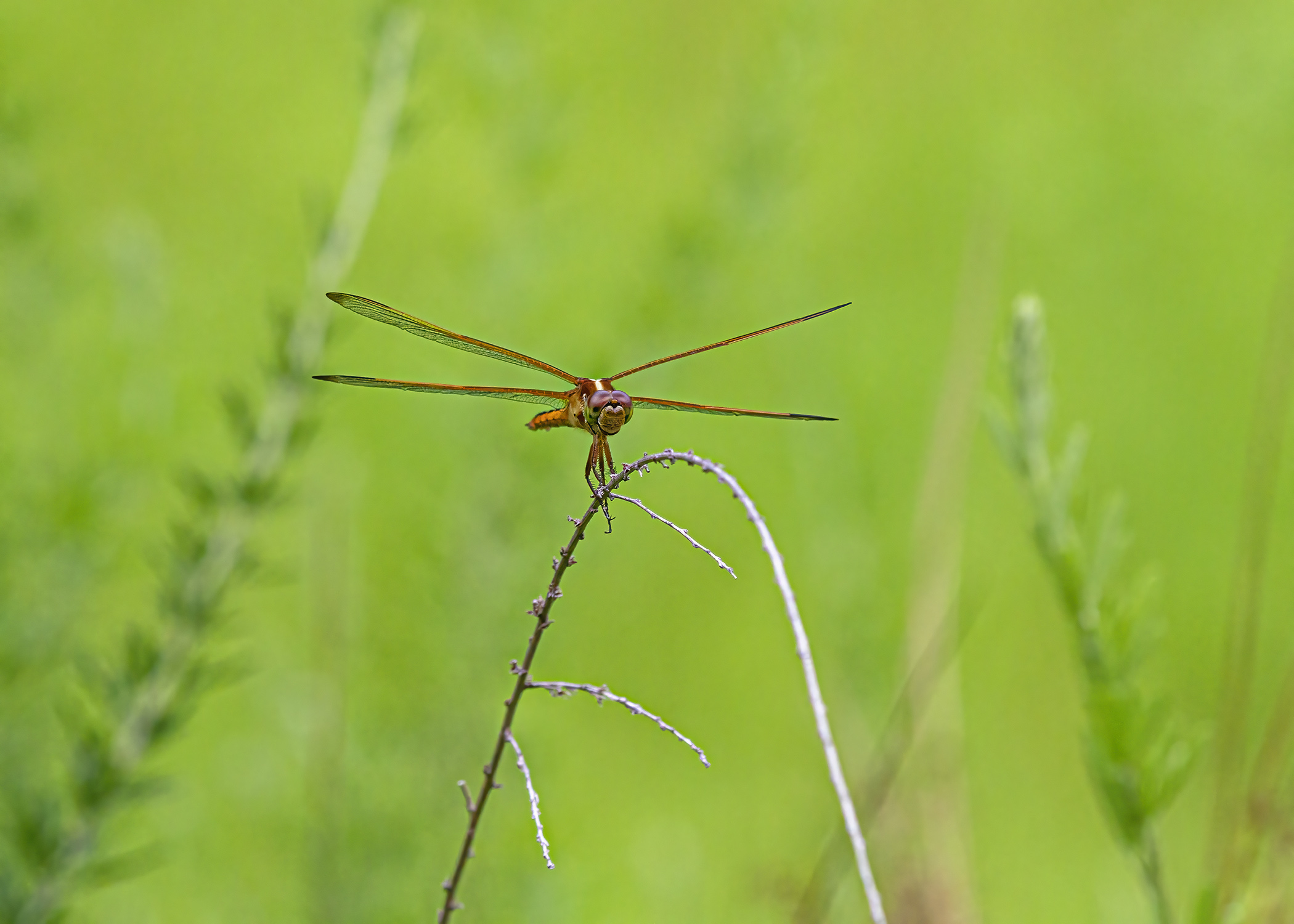
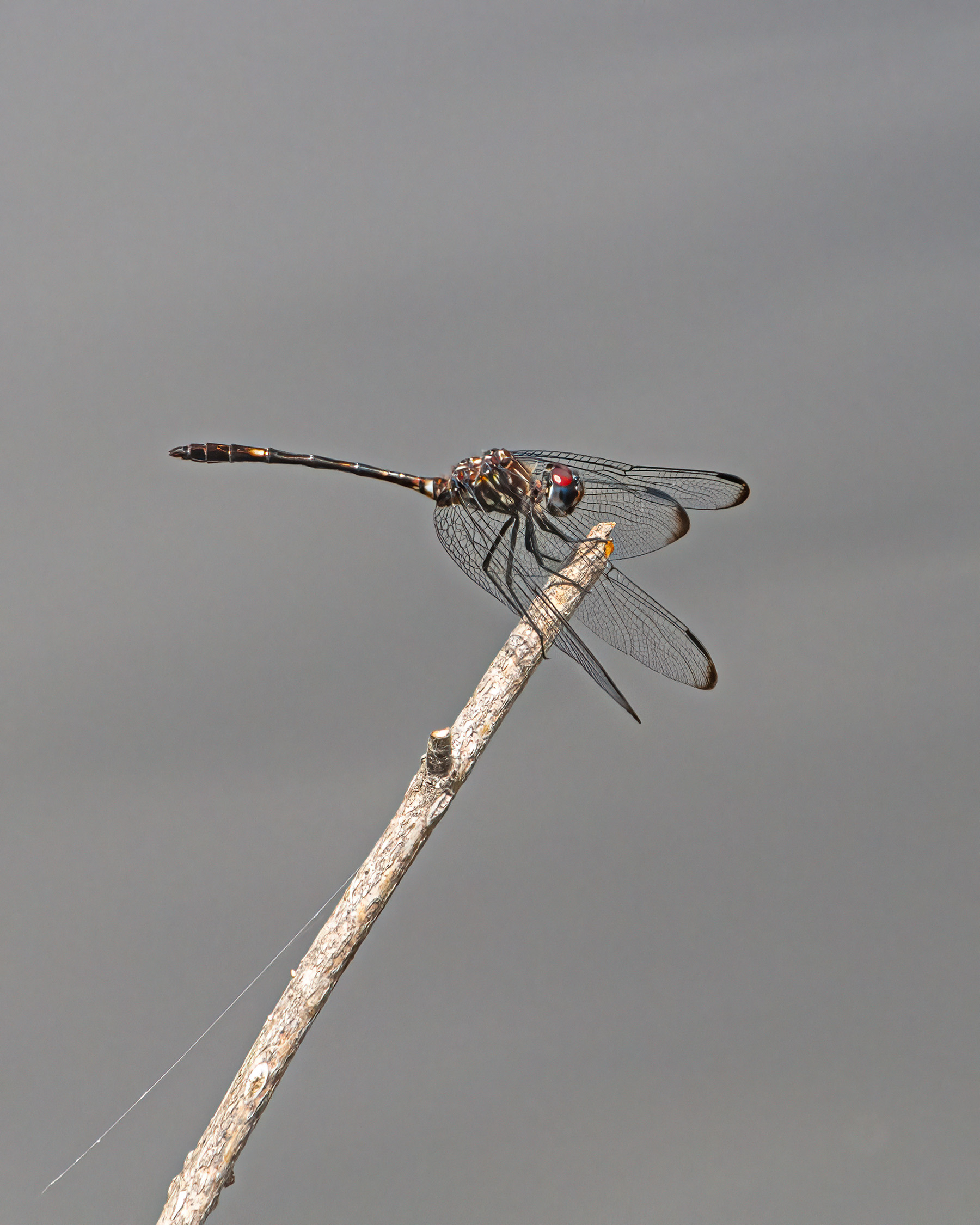
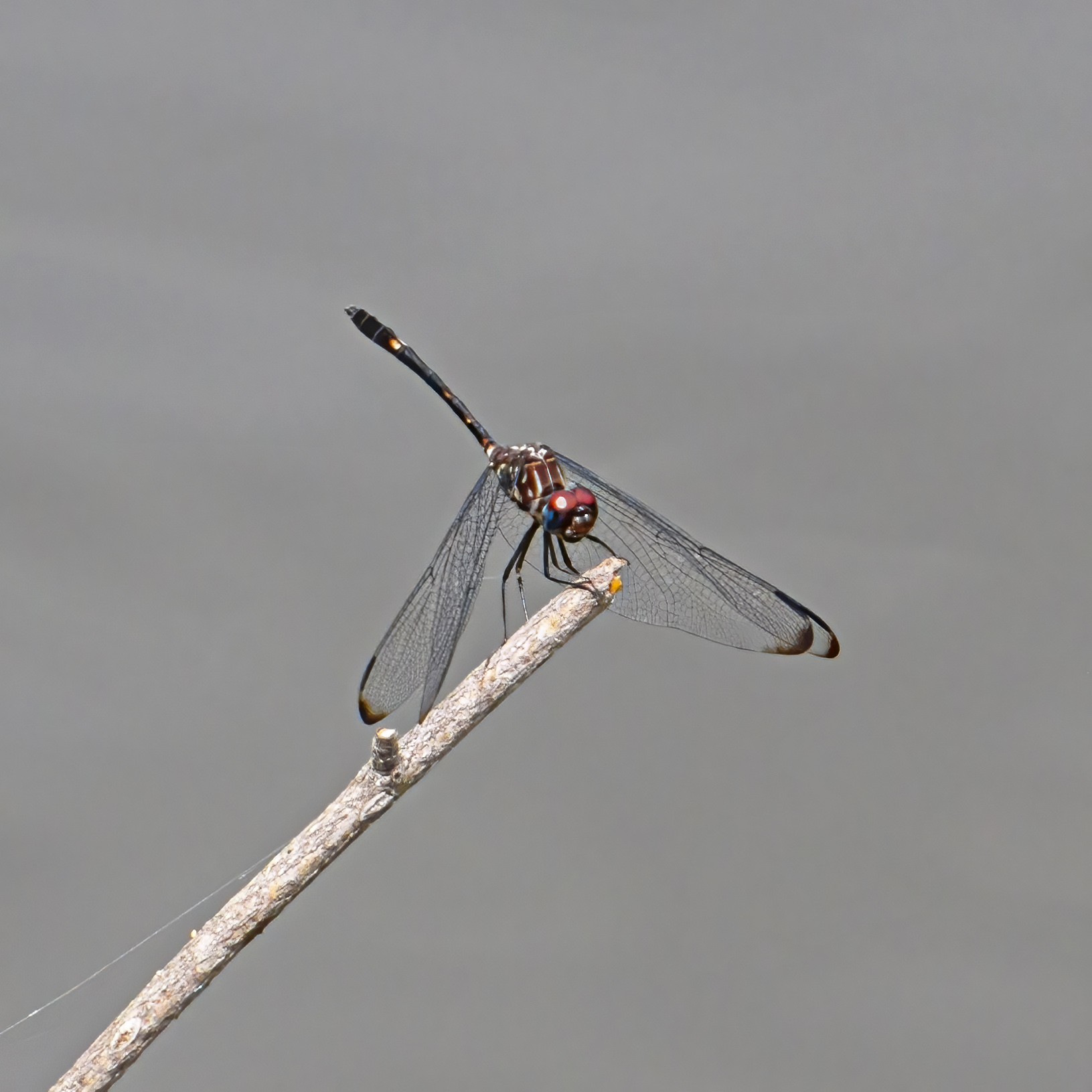
I was happy to see that at least a few Swift Setwing dragonflies (Dythemis velox) were still around this past Friday at Jackson Miles Abbott Wetland Refuge. We are gradually moving to a time of the summer when some dragonfly species decrease in numbers or disappear. Fortunately, a few fall species will appear soon to take their places.

Swift Setwing

© Michael Q. Powell. All rights reserved.

Read Full Post »

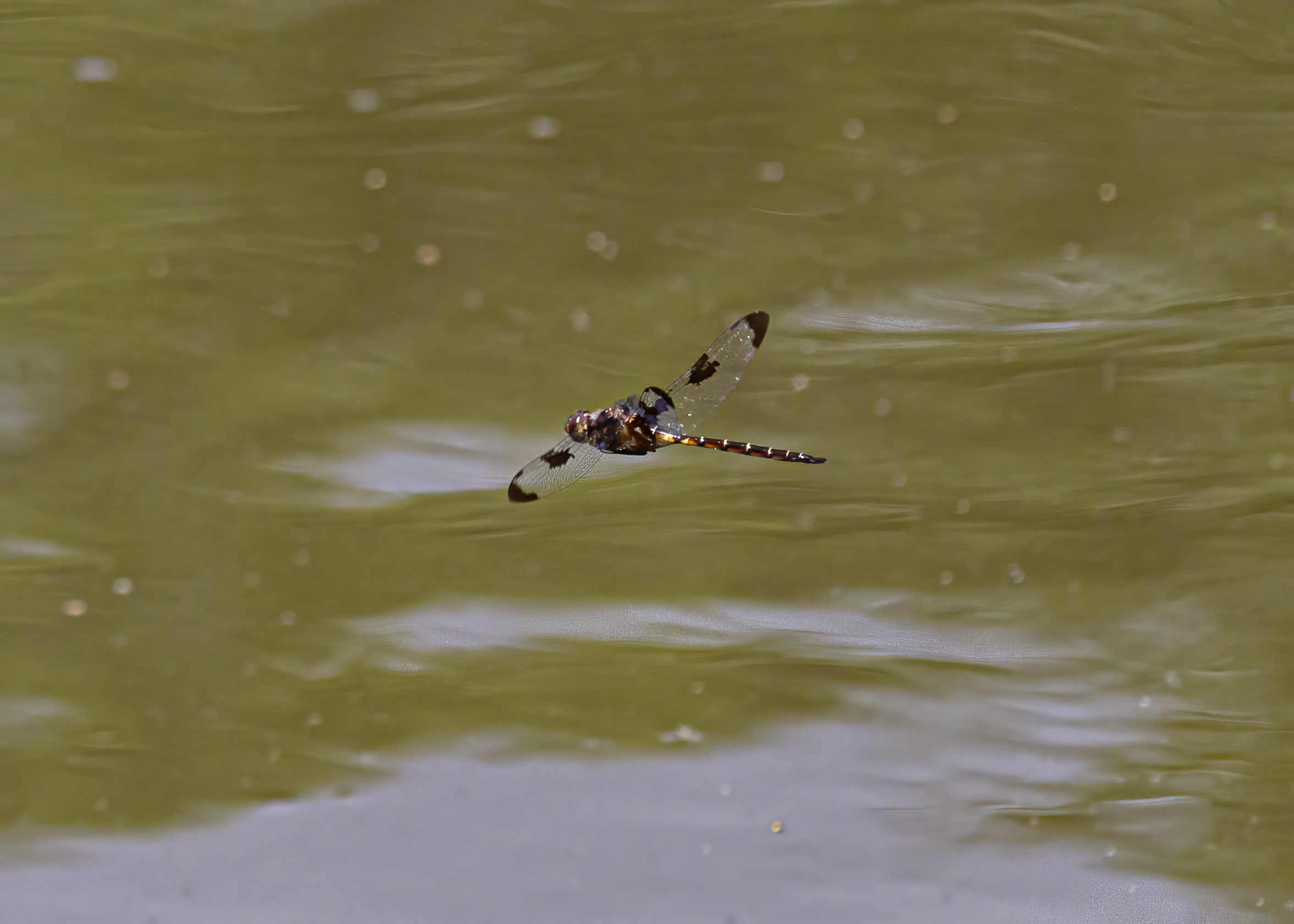
Yesterday I had the chance to test my skill and my patience as I tried to capture images of dragonflies in flight at Jackson Miles Abbott Wetland Refuge. I believe they are a Royal River Cruiser (Macromia taeniolata), a Prince Baskettail (Epitheca cynosura), and a Russet-tipped Clubtail (Stylurus plagiatus), members of three different families of dragonflies.

The Royal River Cruiser is the most uncommon of these three species—I have only seen one a few times and this is the first time that I have gotten a decent shot of one. Cruisers are large dragonflies with large eyes and long legs that generally fly up and down streams or rivers or along lake shores. I did not expect to see one at the small pond at this refuge, but there is an adjacent wetland and a small stream, so maybe the dragonfly made a detour in its patrol over those areas. This dragonfly followed the shore of the pond and flew fast in a single direction.

The Prince Baskettail is the most common of the three dragonflies and I have featured in-flight shots of this species multiple times. The Prince Baskettail appears to have a portion of the shoreline as its territory and it flies back and forth, giving me multiple opportunities to get a shot. This dragonfly has amazing stamina and rarely seems to rest—in ten years of observing dragonflies, I have seen a perched Prince Baskettail only a couple of times.

The Russet-tipped Clubtail is a dragonfly that appears in the late summer and I usually spot one when it is hanging from the vegetation. This one was the first sighting for me of the species this season. Although the dragonfly never came close to the shore, the distinctive color of its “tail” made it easy for me to identify it, even when it was flying.

In case any of you are curious, I captured all of these images with my Canon 7D DSLR and my Tamron 18-400mm zoom lens. Sometimes I focus manually when trying to photographing dragonflies in flight, but I believe I used my camera’s autofocus for these shots with a group of nine focus points in the center selected.

Royal River Cruiser

Prince Baskettail

Russet-tipped Clubtail

© Michael Q. Powell. All rights reserved.


Read Full Post »

On Tuesday I was thrilled to spot the distinctive color and patterns of a Halloween Pennant (Celithemis eponina) dragonfly as I was exploring a field adjacent to a creek in Prince William County, Virginia. The Halloween Pennant’s wings are orange in color with dark brown bands, the Halloween inspiration for its common name.

Like other “pennant” dragonflies, Halloween Pennants like to perch at the tips of plants, as you can see in these images, which causes them to wave like pennants in even the slightest breezes. I love the way the photos how the dragonfly uses its three sets of legs to grasp the vegetation, ensuring that it can hold on even when the wind is blowing hard.

Halloween Pennant

Halloween Pennant

Halloween Pennant

© Michael Q. Powell. All rights reserved.

Read Full Post »

I spotted this cool-looking dragonfly yesterday when it flew to a hanging perch in some shaded vegetation along a creek in Prince William County. I was walking along a trail parallel to the creek and was primarily looking towards the water. Out of the corner of my eye, I detected some movement and spotted where the dragonfly had landed.

A couple of things immediately stood out to me. The dragonfly was hanging vertically, which meant that it was probably not one of the more common skimmers that I am used to seeing at this time of the year. I noted too that the dragonfly was long and skinny and, realizing that my camera was going to have trouble focusing on the dragonfly, I switched to manual focusing. I was able to snap off only a couple of shots before the dragonfly flew away and despite my efforts to relocate it, I was not able to find the dragonfly again.

When I looked on the back of my camera at the images that I had captured, I was not able to identify the dragonfly. When I returned home, I looked through my dragonfly guides and determined that it was a Fawn Darner dragonfly (Boyeria vinosa), a new species for me. Some experts in a Facebook dragonfly group confirmed my identification.

According to the Dragonflies of Northern Virginia website, “Unlike most other darners, and in fact most dragonflies, Fawns shun open, sunny areas. They spend the day hiding in dense, shady underbrush, hanging from the branches of shrubs and young trees. Around 4PM they start venturing out to patrol their shady, forest streams, peaking from about 6PM-8PM.” I encountered the Fawn Darner around midday, so I may have been disturbing its resting period.

Wildlife and nature photographers use many different approaches. Some of them go out to researched locations with a goal of seeing specific species—they are very targeted in their tactics. Others, like me, are opportunistic photographers who wander about, ready to react to whatever they encounter. Although I do love to spot species that are new to me, as was the case with this Fawn Darner, such encounters tend to be almost serendipitous—I tend to stumble upon new species.

Fawn Darner

© Michael Q. Powell. All rights reserved.

Read Full Post »

Last Saturday morning at Occoquan Bay National Wildlife Refuge I was delighted to spot this male Needham’s Skimmer (Libellula needhami), one of the most brightly colored dragonflies in our area. In addition to its beautiful reddish-orange color, this dragonfly has stunning gold accents on the front edges of each of its wings.

Needham's Skimmer

© Michael Q. Powell. All rights reserved.

Read Full Post »

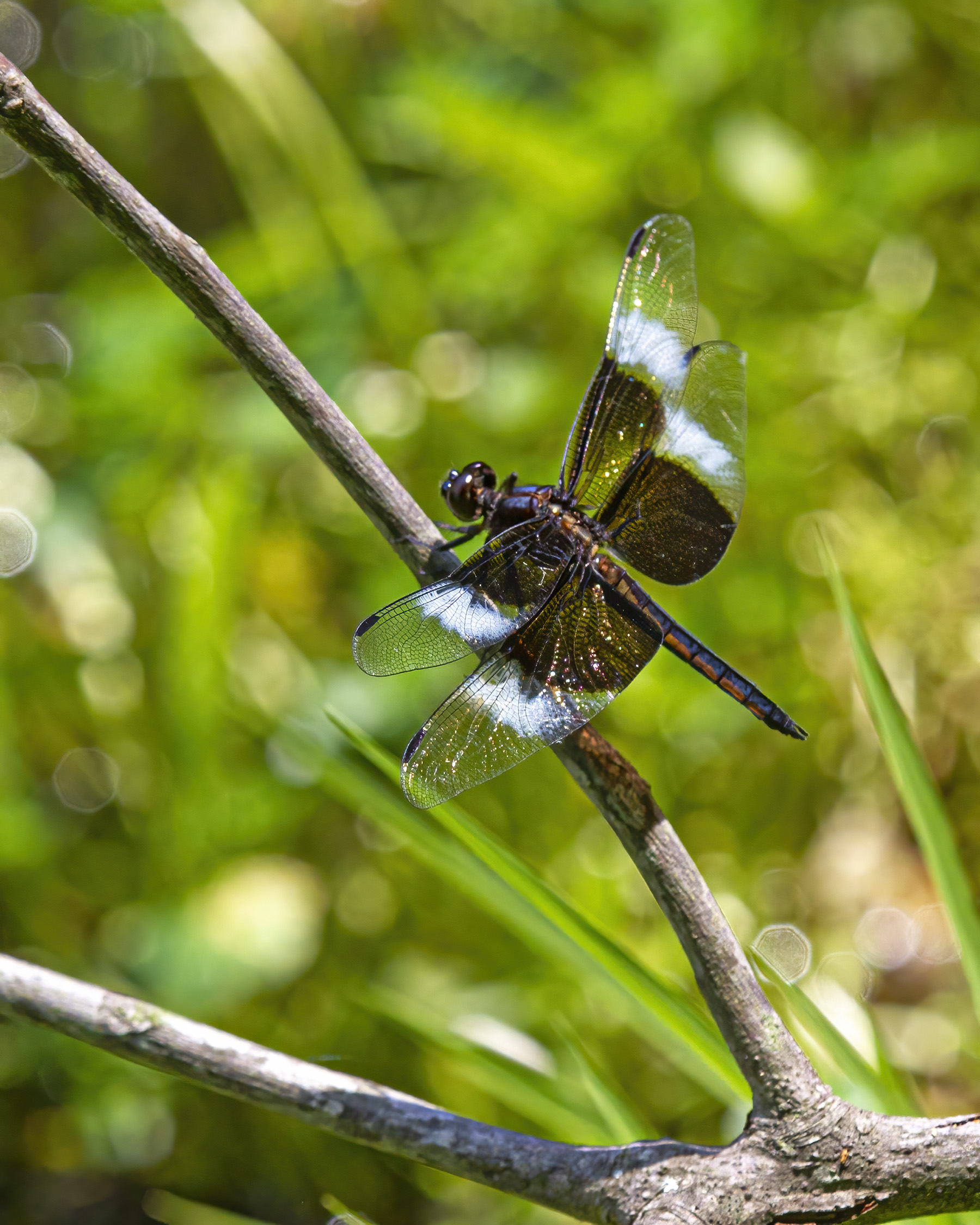
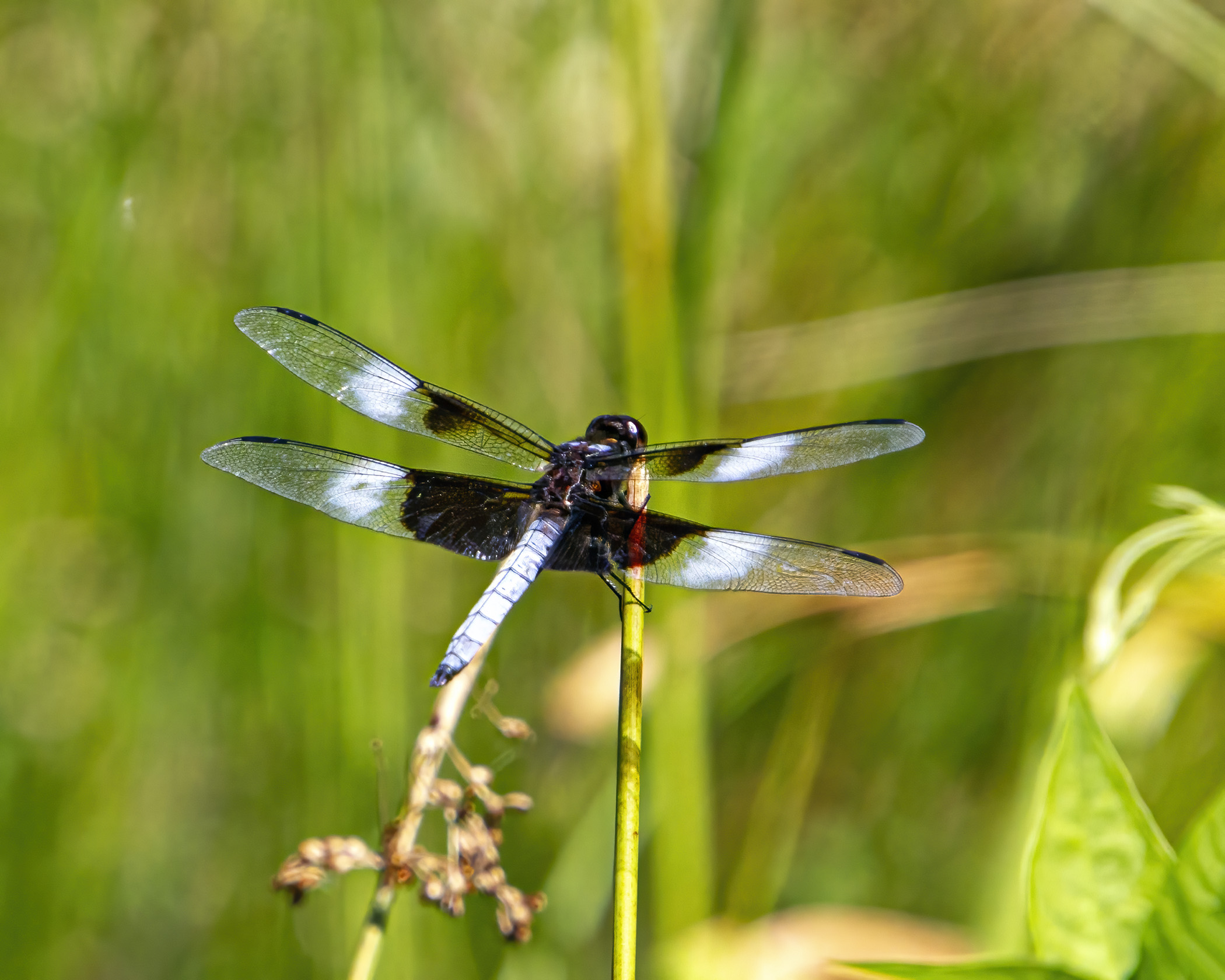
Here’s a shot of a handsome male Widow Skimmer dragonfly (Libellula luctuosa) that I spotted this past Monday at Jackson Miles Abbott Wetland Refuge. The Widow Skimmer is one of only a few dragonfly species that I have encountered that has both white and brown markings on its wings. (the male Twelve-spotted Skimmer dragonfly is the only other one that immediately comes to mind and you can see what one looks like in my 31 May 2021 posting entitled Twelve-spotted Skimmer.

Backgrounds are always tricky when photographing insects perched in highly vegetated areas. I think the stalks of vegetation are blurred enough in the first image that they do not draw attention away from the main subject. I think, in fact, the the green and tan lines add some visual interest to the image that would be lacking if the entire background were a solid color. The background in the second image is a bit busier, but you get a much better view of the dragonfly’s wing patterns—wildlife photography is often a matter of compromise in which “perfection” is often unachievable.

Widow Skimmer

Widow Skimmer

© Michael Q. Powell. All rights reserved.


Read Full Post »
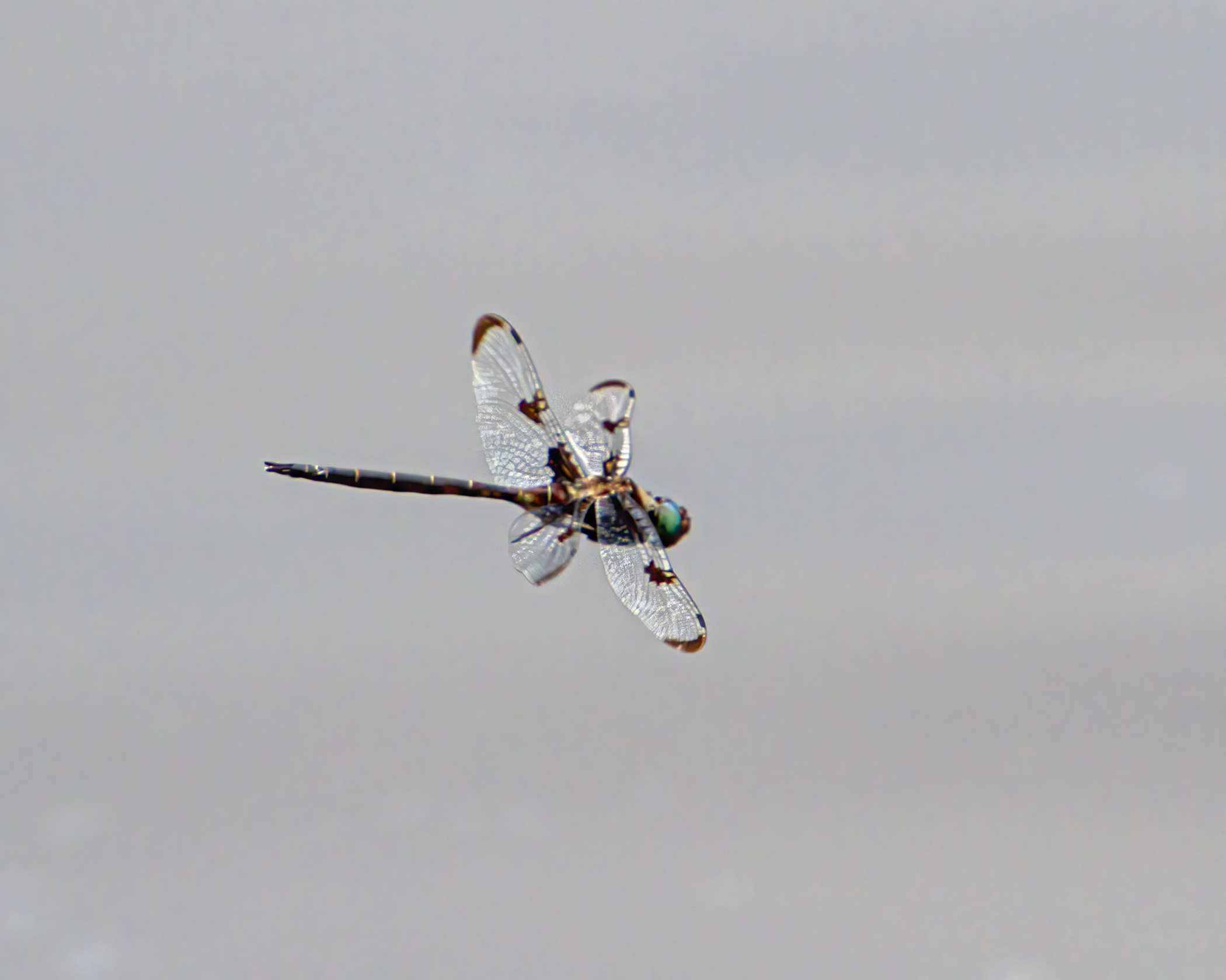
On Monday I spent several hours at Jackson Miles Abbott Wetland Refuge, focusing my attention primarily on trying to capture shots of Prince Baskettail dragonflies (Epitheca cynosura) in flight. There appeared to be several of them patrolling over the waters of the small pond and I managed to find some good vantage points that gave me unobstructed views of them as they passed by.

One of the locations where I spotted a Prince Baskettail included some lily pads and I decided to try to include them in the shots to give a sense of the environment. The downside of this approach, though, was that it made it even harder to keep my camera’s focus on the dragonfly—the camera kept trying to focus on the background. I was persistent, however, and managed to get a few good shots, as you can see in the first three images below.

I took the final image at a different spot where there were no lily pads. This shot is undoubtedly the sharpest one of today’s photos. Although you can’t see much of the environment in the image, the ripples in the water do add some visual interest.

I couldn’t help but notice that the dragonfly in the final photo had its legs in a lower position than normally—generally a Prince Baskettail flies with its legs held tightly against its thorax to present the most aerodynamic profile. I know that some dragonfly species catch prey on the fly with their legs extended like a basket and wonder if that was what this dragonfly was attempting to do.

Prince Baskettail

Prince Baskettail

Prince Baskettail

Prince Baskettail

© Michael Q. Powell. All rights reserved.


Read Full Post »

Eastern Amberwing (Perithemis tenera) dragonflies are the smallest dragonflies in my area at less than an inch (25 mm) in length, but are quite common. I often spot the distinctive amber wings of the males as they fly low over the waters of many ponds. Females of this species, however, do not have amber wings—they have brown patches on their wings—and I rarely see them.

According to the Dragonflies of Northern Virginia website, female Eastern Amberwings are often found far from water, in meadows among summer wildflowers. “They’re probably hunting even smaller visitors to these summer blooms like midges, flower flies and tiny bees. They also share their colorful perches with hornets and other wasps. Perhaps, this is how their mimicry behavior evolved, and may explain why females appear to practice it more than males.”

On Monday I was thrilled to spot this female while I was exploring a pond at Jackson Miles Abbott Wetland Refuge. I am not sure if she had ventured down to the pond to mate, but whatever the case I was happy to capture some shots of her as she buzzed about the vegetation surrounding the pond. I love her two-toned eyes and the beautiful markings on her body.

Eastern Amberwing

Eastern Amberwing

Eastern Amberwing

© Michael Q. Powell. All rights reserved.

Read Full Post »

I was excited to spot several Swift Setwing dragonflies (Dythemis velox) last Saturday along the edges of the pond at Jackson Miles Abbott Wetland Refuge. This species gets its name from the way that the way the Swift Setwings perch with their wings forward and abdomens up, like the “ready, set, go” position of a runner at a track meet.

The Swift Setwing is primarily a southern species that may never before have been spotted in Fairfax County, Virginia, the county where I live, until June 2016, when I spotted one at the same wetland refuge. (See my 25 June 2016 blog posting for details on my first sighting of the species.) Every year since then, I have excitedly looked forward to seeing these little dragonflies—it is pretty clear by now that there is an established breeding population at this pond. This is the only location where I have seen Swift Setwings, though I heard from a friend that they may have also been found at another local spot.

I am driving up to Massachusetts and Maine on Tuesday to handle some family issues and suspect that I will not be posting a blog until my return late on Saturday. After then I hope to return to my normal schedule of doing a blog posting almost every day.

Swift Setwing

Swift Setwing

Swift Setwing

© Michael Q. Powell. All rights reserved.


Read Full Post »
During the summer, most of my dragonfly photos tend to be variations of the stereotypical “dragonfly on a stick.” I am always on the lookout, though, for more interesting or photogenic perching places and behaviors.

The first shot shows a male Eastern Amberwing dragonfly (Perithemis tenera) perched on the end of a piece of rebar that sticks out of the water near a small fishing dock at Jackson Miles Abbott Wetland Refuge. Generally I try to avoid having manmade objects in my nature photos, but in this case I really like the juxtaposition of the natural and manmade elements in this shot. The warm tones of the amber wings contrast nicely with the cooler rust color of the rebar and the lines on the rebar are mirrored by those on the dragonfly’s body. Almost every year I return to this spot to capture a similar image, though each encounter is unique in its own way.

The second image shows another male Eastern Amberwing perched on a large rock jutting out from the water. I couldn’t get close to the dragonfly so I took the opposite approach and zoomed out to capture the dragonfly’s reflection (as well as the amber shadow it was casting on the rock). I really like the contrast between the diminutive size of the dragonfly and the large jagged rock—it seems almost like a visual metaphor for life’s challenges.

These two shots are examples of how I try, when possible, to visualize a shot before I take it. Frequently, though, I am forced to react instantaneously to a given situation, with a primary goal of keeping my subject within the frame and hopefully in focus. It’s a weird mental juggling act to simultaneously attempt to think creatively, instinctively, instinctively, and analytically—that’s wildlife photography in a nutshell.

Eastern Amberwing

Eastern Amberwing

© Michael Q. Powell. All rights reserved.


Read Full Post »

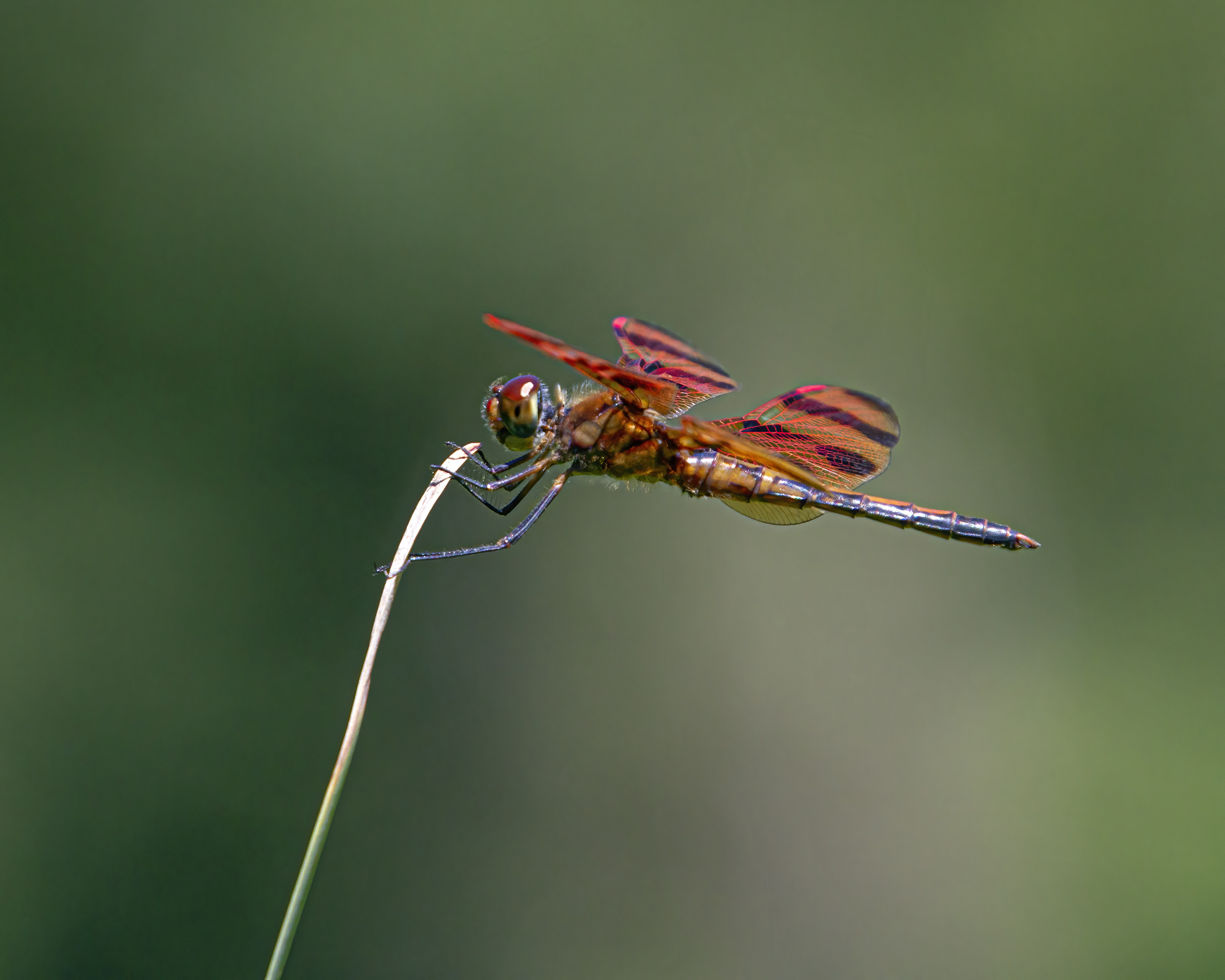
There is only one local location where I have found Banded Pennant dragonflies (Celithemis fasciata) in the past and in some years I have not seen a single one there. I was hopeful that I would see some on Thursday when I returned to Jackson Miles Abbott Wetland Refuge and my hopes were rewarded. Not only did I spot several Banded Pennants, but they were cooperative in choosing some photogenic perching locations for me.

Like other pennant dragonflies, Banded Pennants like to perch on the very tips of vegetation, which causes them to flap around a bit in the slightest breeze, like a pennant. I love the patterned wings of Banded Pennants, which cause them to stand out from several other small blue dragonflies that I saw that day. As you can see from the photos, the Banded Pennants mostly perched on plants overhanging the water or on vegetation growing out of the water.

At the last minute I decided to add the final photo, despite the fact that the dragonfly occupies only a small part of the frame. I really like the reflections of the plants in the water and did not want to zoom in and lose them. I also like the way that the image shows a Banded Pennant zooming low over the water in between the plants. If you look closely you can see the way that the dragonfly has tucked in its legs in order to be a bit more aerodynamic when flying.

Banded Pennant

Banded Pennant

Banded Pennant

Banded Pennant

© Michael Q. Powell. All rights reserved.


Read Full Post »

Yesterday I visited Jackson Miles Abbott Wetland Refuge and spent a lot of my time there trying to get shots of dragonflies in flight. The dragonflies were not very cooperative and kept their distance most of the time, but eventually I managed to get a few decent shots. What was especially cool was that I captured images of dragonflies from three different families—Skimmer, Darner, and Emerald.

The first photo shows a Banded Pennant (Celithemis fasciata), a Skimmer, as he was flying toward me. Banded Pennants are pretty small at about 1.3 inches (33 mm) in length, so I was pretty thrilled to capture this shot as he was flying toward me. This was actually the first time that I had seen a Banded Skimmer this season.

The second photo shows a Cyrano Darner (Nasiaeschna pentacantha). Despite the fact that I took the shot from a long distance away, you can still see the prominent “nose” that is supposedly reminiscent of the long nose of literary character Cyrano de Bergerac.

The last two photos show Prince Baskettails (Epitheca cynosura) that are members of the Emerald family. Prince Baskettails, which are about 2.9 inches (74 mm) are quite easy to identify, because they are the only large dragonfly in our area with patterned wings. I had more opportunities with this species that with the others, because several Prince Baskettails were flying repetitive patrols only various parts of the pond and passed by me multiple times. Although it is a little easier to focus on a dragonfly in flight when the background is clear, I think it is even cooler when I manage to include reflections in the water in a photo, as was the case with the reflections of the branches in the final photo.

Banded Pennant

Cyrano Darner

Prince Baskettail

Prince Baskettail

© Michael Q. Powell. All rights reserved.


Read Full Post »
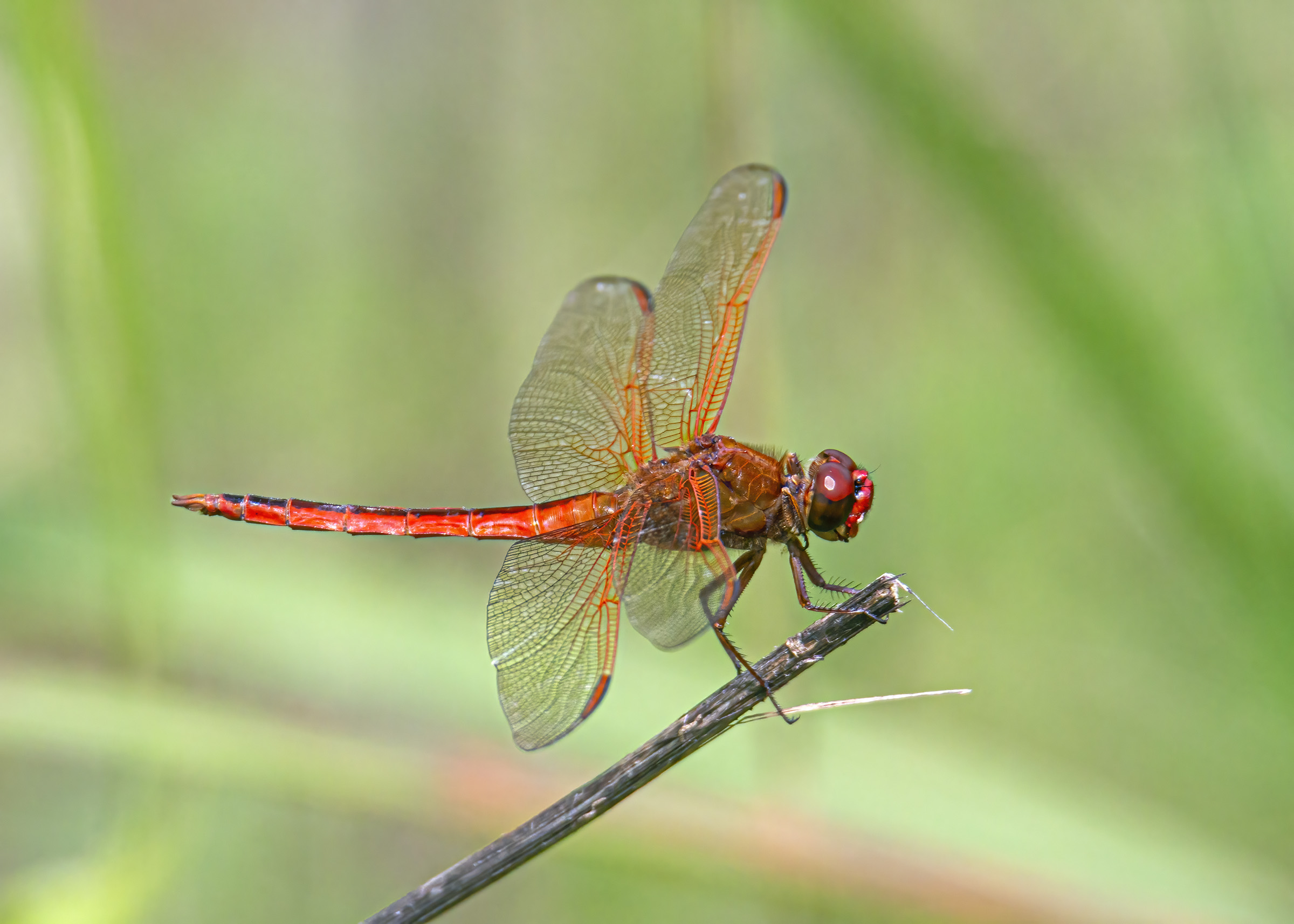
I love the abstract feel of this image that I captured last week at Occoquan Regional Park. The shapes and colors in the photo are much more important than the details of the subject, which I think is a Needham’s Skimmer dragonfly (Libellula needhami). From this angle, dragonflies often remind me of the biplanes of World War One, like the Sopwith Camel that was sometimes featured in Snoopy comic strips.

Photography allows for such a wide range of approaches to express myself creatively. I can be geeky and technical, as I usually am, striving to capture the minute details of my often tiny subjects or I can be as “artsy” as I choose, focusing on capturing and creating moods or feelings with the basic elements of light and darkness, of colors, lines, and shapes.

Professional photographer’s are sometimes advised to create a signature style and to stick with it. I am proudly an amateur, who captures images for love—the root word in “amateur”—and I defiantly refuse to stick to a single style. My photos and words help you to see the world through my eyes and hopefully my unbounded curiosity and enthusiasm about the world are evident in my postings. If you meet me in person, you’ll see that the “me” in my postings is not a social media persona—it is genuinely who I am.

Needham's Skimmer

© Michael Q. Powell. All rights reserved.

Read Full Post »

I love the distinctive wing markings on male Widow Skimmer dragonflies, one of only a few dragonfly species that I have encountered with both light and dark patches on their wings. I spotted this handsome male Widow Skimmer last week during a brief visit to Occoquan Regional Park in Lorton, Virginia.

One of the cool things about this dragonfly is that it looks almost like a butterfly when it is flying. With most dragonflies, the transparent wings seem to almost disappear when they are flying, but with the male Widow Skimmer, the wings are much more visible when the dragonfly is in motion.

Widow Skimmer

© Michael Q. Powell. All rights reserved.

Read Full Post »
I was thrilled on Wednesday to photograph my first Common Sanddragon dragonfly (Progomphus obscurus) of the year as he was enjoying a sandy beach near Wickford Park in Alexandria, Virginia. Unlike most dragonflies that prefer to perch on vegetation, Common Sanddragons are usually found perched flat on the sunny, sandy sections of shallow creeks.

According to the Dragonflies of Northern Virginia website, “Despite its name, this species is rare in Northern VA. In other parts of the country, where clean, sunny, shallow creeks with plenty of sandy/gravely banks are common, so too are Common Sanddragons. Our urban waterways are too influenced by stormwater, flowing fast and unchecked off impervious surfaces (roads, parking lots, roofs, etc.). This creates deeply incised, eroded banks and streambeds, with excess silt, unstable flows.”

This species is special to me because I was the first person to document its presence at Huntley Meadows Park, a county-run marshland park where I used to do a lot of my photography before it became overcrowded with photographers. Check out my June 2014 blog posting New dragonfly species in the park for the details of how I stumbled upon this “new” species.

Common Sanddragons are also special to me because in June 2016 I was lucky enough to observe and document the thirty minute metamorphosis of a water-dwelling nymph into a Common Sanddragon dragonfly. I had been collecting some discarded exoskeletons of already emerged dragonflies on a sandy bank of a stream when suddenly I felt one moving in my hand. I quickly placed it on the sand and was able to photograph the dragonfly as it was emerging. It was a remarkable encounter and I encourage you to check out my blog posting Metamorphosis of a dragonfly.

Nothing quite that exciting happened during my most recent encounter. I was able to capture some images of the dragonfly on various parts of the “beach” where I initially spotted him. He was pretty skittish and flew away multiple times, but kept returning to the same general are of the creek, sometimes choosing the sandy areas and sometimes opting for the more rocky spots. I particularly like the first photo that has a mixture of rocks and sand and has some green algae that matches the stunning eyes of this Common Sanddragon.


Common Sanddragon

Common Sanddragon

Common Sanddragon

© Michael Q. Powell. All rights reserved.

Read Full Post »

On Monday I was thrilled to spot this Prince Baskettail dragonfly (Epitheca cynosura) flying patrols over the small pond at Jackson Miles Abbott Wetland Refuge. Previously I had spotted Common Baskettails doing the same thing at this location—see my recent posting Common Baskettails in flight—but they seem to have been supplanted by the Prince Baskettails. How do you tell them apart? Although they are both part of the Emerald family, only Prince Baskettails have patterned wings, as you can see in these photos.

I really like the description of this species on the Dragonflies of Northern Virginia website:

“This sleek, elegant dragonfly could in fact be called King Baskettail, as it is the largest member of the Emerald family. There are seven families of dragonflies in the US–Emeralds are known for their glowing green eyes (hence the family name), and their endless, acrobatic flight. Like other members of this family, Prince Baskettails rarely land and can spend many hours in ceaseless flight. Look for this powerful flier making long, repeated, low patrols over open water habitats such as lakes, ponds, canals, and sluggish river sections.”

As a result of the repeated patrols, I was able to track the dragonfly as it flew by me and capture these images. The dragonfly did not get really close to the bank on which I was standing, so my autofocus would not detect my subject and I had to resort to focusing manually. I am pretty happy with the results and I encourage you to click on the images to see the beautiful markings on the body of this Prince Baskettail dragonfly.

Prince Baskettail

Prince Baskettail

Prince Baskettail

© Michael Q. Powell. All rights reserved.

Read Full Post »

Although Blue Dashers (Pachydiplax longipennis) are among the most common dragonflies in my area during the summer, they are very special to me. I remember visiting a photography show by my dear friend Cindy Dyer in 2012, I believe, and marveling at the photos that she had taken of Blue Dasher dragonflies. I decided that I wanted to be able to take photos like hers of these beautiful creatures.

I went out on numerous occasions and she taught me a lot about both the creative and technical sides of photography. She also served as a muse to me, encouraging me and gently pushing me along my path. She had a well-established blog and decided that I needed one too, so on 7 July 2012, she sat me down I created my blog. My first blog posting on the same day was entitled Blue Dasher dragonfly and it featured a male Blue Dasher dragonfly in the obelisk position, similar to the pose of the dragonfly in the final photo in today’s post. That’s one of the main reasons why Blue Dashers are so special to me.

I spotted these Blue Dashers, all of which are males, on Monday during a brief visit to Jackson Miles Abbott Wetland Refuge. Each of the three photos represents a different approach I used in attempting to capture the”feel” of my encounters with these dragonflies. The first image shows the details of colors and patterns of the body quite well. The second image gives you a sense of their environment. The final photo focuses on the obelisk pose that is believed to be a form of thermoregulation—by raising its abdomen the dragonfly reduces its exposure to the direct sunlight on hot days.

Some days I will post only a single photo, but most often I enjoy posting a small set of photos that complement each other and provide different perspectives on the living creatures that I love to photograph. Beauty is everywhere.


Blue Dasher

Blue Dasher

Blue Dasher

© Michael Q. Powell. All rights reserved.

Read Full Post »

During a recent visit to Jackson Miles Abbott Wetland Refuge I was delighted to spot a female Eastern Amberwing dragonfly (Perithemis tenera) as she was depositing her eggs in the vegetation in a small pond. Initially she would hover for a moment, as you can see in the first image, and then dip the tip of her abdomen straight downwards to release some eggs, as shown in the second image. The dragonfly repeated this process multiple times at this spot before moving on to other spots.

I have observed this process multiple times, but have rarely been able to photograph it. Eastern Amberwings are the smallest dragonflies in my area and are only about an inch (25 mm) in length, so they are a challenge to photograph. Fortunately when the female is ovipositing, she hovers a bit, which gives me time to focus on her. Sharp-eyed viewers may have noticed that the wings of this dragonfly have patterns, but are not amber in color—only male Eastern Amberwings have amber wings.

Eastern Amberwing

Eastern Amberwing

© Michael Q. Powell. All rights reserved.


Read Full Post »

Whenever I see a dragonfly in flight when I am traipsing about with my camera, I can’t help but stop and try to get a photograph of the dragonfly in the air. My success rate in not high, but sometimes I am able to capture a good image as the dragonfly zooms by me.

In mid-June I spotted a Common Baskettail dragonfly (Epitheca cynosura) as it flew back and forth over the pond at Jackson Miles Wetland Refuge. During one of its passes I managed to freeze its motion in this shot. I like the way that you can see all four wings and also the distinctive markings on its body. The bluish-green eyes really “pop” and if you look really closely, you can see the that the dragonfly folds its legs under its thorax (the torso part of its body) while it is flying.

I returned yesterday from my five-day trip up to Massachusetts and Maine to deal with a family emergency. Hopefully I will be able to get out this week and capture some new images. It’s hard to believe that it is already July.

Common Baskettail

© Michael Q. Powell. All rights reserved.

Read Full Post »

I just wanted to alert readers who may be used to me publishing a blog posting almost every day that I will be absent from this space for the rest of this week. A family emergency requires me to travel to Massachusetts and Maine and I will not have access to the internet for most of this time.

I decided though to leave you with a shot of a dragonfly facing away. While I was exploring Occoquan Regional Park earlier this month, I managed to get only a single angled view of this dragonfly before it flew away, but it was enough to confirm that it was my first Carolina Saddlebags dragonfly (Tramea carolina) of the season. Despite the odd angle, I was able to capture the patches on the hind wings that are thought to resemble “saddlebags” and its distinctive red color, so identification was not a problem.

I really like the colors and patterns of this shot, which has more of an “artsy” feel rather than a “scientific” one. Normally eye contact is desirable with a subject, but I look at that “rule” as more of a suggestion than a requirement.

Carolina Saddlebags

© Michael Q. Powell. All rights reserved.


Read Full Post »

As I was seated in my car at a stoplight, I glanced across the intersection at the traffic in the oncoming lanes and was delighted to spot a giant dragonfly on the side of a U-Haul truck. I grabbed my camera off of the passenger seat where it was seated and managed to take this photo before the lights changed.

In case you are viewing this and cannot read the words on the graphic, it say “#105 Venture Across Canada, British Columbia, A Secret Urban Wilderness/Un Coin Sauvage Et Secret En Ville, Burn Bog.” According to its website, Burns Bog is “a raised bog ecosystem covering approximately 3,000 hectares of the Fraser River delta between the south arm of the Fraser River and Boundary Bay” in the greater Vancouver area of British Columbia. The site claims that the bog is the largest undeveloped urban landmass in North America at 8,000 acres.

I think that my eyes are so finely tuned to recognizing the shape of a dragonfly that I manage to spot them in the most unlikely places, like on the side of a U-Haul truck.

U-Haul dragonfly

© Michael Q. Powell. All rights reserved.

Read Full Post »

This handsome Common Green Darner dragonfly (Anax junius) does not have all of the colors of the rainbow, but it does have many of them and I love its mix of vibrant colors. The dragonfly was perched vertically really low in the vegetation when I spotted it during a recent to Occoquan Regional Park. I ended up sprawled almost flat on the ground to get this shot—my position would have made for an amusing photo, but fortunately no one else was around to capture that moment.

Mature male Common Green Darners have bright blue abdomens. The reddish pink color of this dragonfly’s abdomen suggest to me that it is an immature male. Early and late in the season, the abdomens of male Common Green Darners may appear purple. Common Green Darners have dark-colored platelets in their blood that rise to the surface when it is cold, darkening their abdomen color and attracting more sun. On bright, hot days, those dark platelets sink, and the abdomen turns bright blue again, now reflecting light.

Common Green Darner

© Michael Q. Powell. All rights reserved.

Read Full Post »
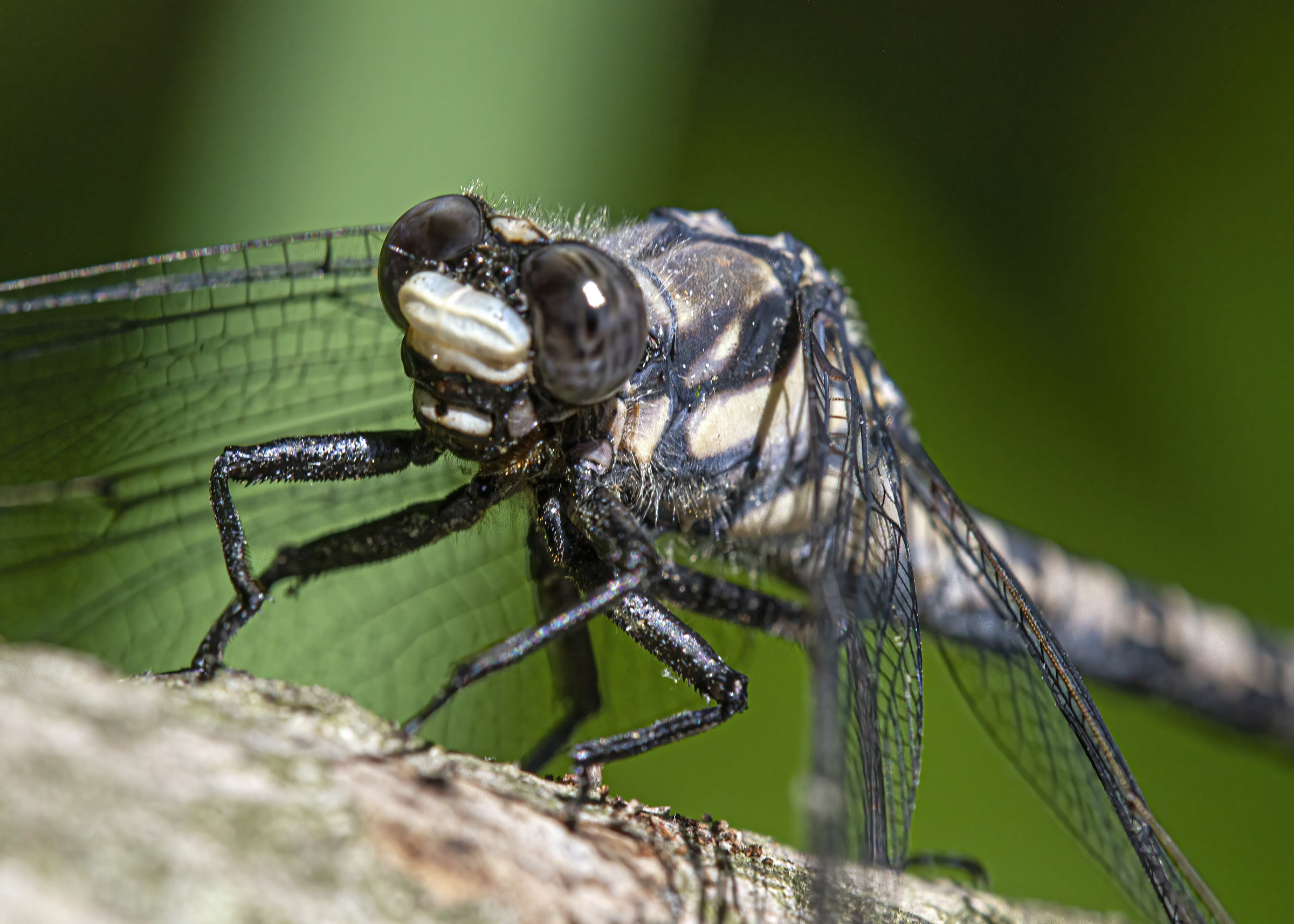
This Gray Petaltail dragonfly (Tachopteryx thoreyi) was quite cooperative and let me take a close-up portrait last week as I was exploring a small pond in Fairfax County, Virginia. Gray Petaltails are known to be quite friendly and inquisitive and I have had one perch on me on multiple occasions. During one such encounter in 2019, fellow dragonfly enthusiast Walter Sanford snapped a couple of photos of one perched on me when I was wearing a gray sweatshirt that must have made me look like a tree to the dragonfly. If you want to see the photos, check out Walter’s blog post entitled “You look like a tree to me.

Most of the time I am not able to approach a dragonfly from this angle to get a close-up shot. Dragonflies have incredible vision and I am certain that this one could see me coming. However, he apparently did not see me as a threat and stayed in place while I took several shots. As you can see, the depth of field was incredibly shallow for this shot—only a small portion of the dragonfly’s body was in focus—but I was able to keep the striking gray eyes in focus and capture a lot of details that highlight their beauty.

Gray Petaltail

© Michael Q. Powell. All rights reserved.

Read Full Post »

There were lots of Slaty Skimmers (Libellula incesta) flying about on Tuesday at the small pond at Jackson Miles Abbott Wetland Refuge, but none of them were cooperative in perching within range. They seemed to content to buzz around over the lily pads and land occasionally in vegetation overhanging the water—I was willing to lean a little to get closer to the dragonflies, but did not want to risk falling into the water.

Slaty Skimmers are one of our most common summer dragonfly species and they find themselves at home in almost any habitat. The mature males are really easy to identify because of their dark bodies and eyes. Immature males and females are a lot harder to distinguish from a number of other species in the skimmer family, like the Great Blue Skimmer and the Bar-winged Skimmer.

Slaty Skimmer

Slaty Skimmer

© Michael Q. Powell. All rights reserved.


Read Full Post »
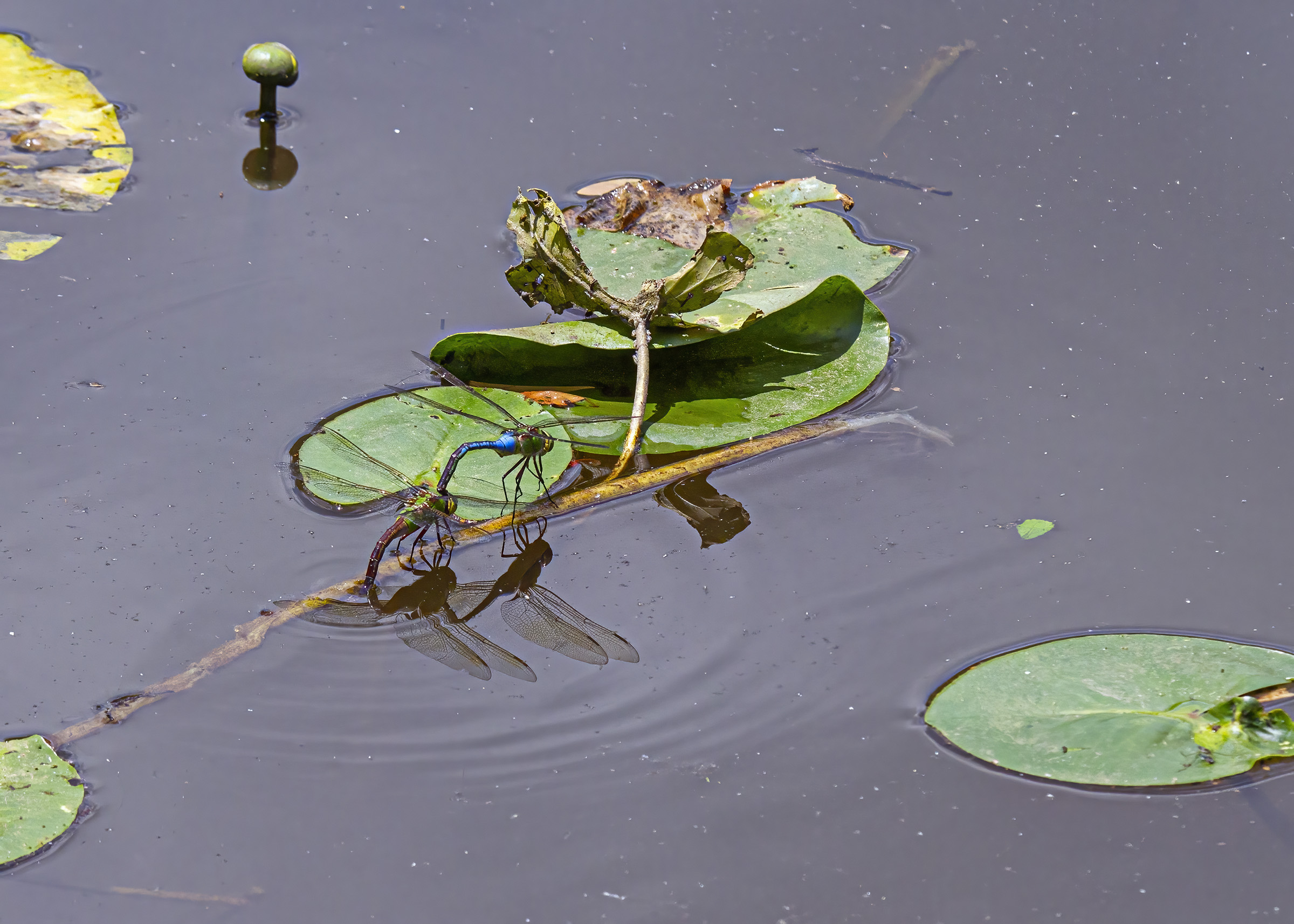
I spotted a female Common Green Darner dragonfly (Anax junius) as she was ovipositing while her male partner held onto her last Saturday at the edge of the small pond at Jackson Miles Abbott Wetland Refuge. Common Green Darners are large dragonflies—about 3 inches (76 mm) in length—so it was relatively easy to track the pair as they moved about placing eggs in various patches of vegetation in the water.

After mating takes place, the males of some species of dragonflies disappear.  In other species, the male stays nearby, guarding the female and fending off other males that might remove the initial suitor’s sperm and replace it with their own.  Some species, like this Common Green Darner, remain attached to the female in a position known as “tandem.” while egg-laying takes place.  The female Common Green Darner submerges her abdomen and lays her eggs in or on the aquatic vegetation, as you can see in these images. If you look really closely at the first image, you can see what I believe is the dragonfly’s curved ovipositor that she uses to make a little slit into the vegetation in which to place the eggs.

According to an article on Animal Diversity Web, there are two different lifecycles for Common Green Darners, one for the dragonflies that have migrated northward and one for the resident population. “Migratory adults mate and oviposit in June. Unlike resident populations, nymphal development for migrant offspring takes only 3 to 5 months, and they do not overwinter. They emerge as tenerals typically around late-August and September. They often begin their migration as tenerals, feeding along the way and developing into adults.” The timing of the activity that I observed suggests that these could be migrant Common Green Darners.

“For residents in the north, the adults mate and oviposit in late July to August. The resulting offspring hatch and develop to mid-instars and then overwinter when temperatures drop. Total nymphal development time can take 11 to 12 months for residents, as the nymphs finish development when temperatures warm in the spring and then emerge as adults in the following June and July.”

I highly recommend the article that I referenced, which has lots more fascinating information about this colorful dragonfly species.

Common Green Darner

Common Green Darner

Common Green Darner

Common Green Darner

© Michael Q. Powell. All rights reserved


Read Full Post »

I love the look of male Eastern Pondhawk dragonflies (Erythemis simplicicollis) when they are transitioning to adults. When they are juvenile, male Easter Pondhawks have emerald green thoraxes and black striped abdomen, like their female counterparts. Gradually the body coloration shifts to blue as they mature. I really like their appearance when, as was the case with these pondhawks that I photographed last week at Occoquan Regional Park, their bodies have beautiful shades of both green and blue.

In the second and third photos, you get a glimpse of the pondhawk’s beautiful eyes that are also a combination of blue and green. Although you can’t see it very well in these photos, Eastern Pondhawks of both genders have bright green faces, which helps to distinguish the male Eastern Pondhawks from a number of other dragonfly species that have blue bodies.

Eastern Pondhawk

Eastern Pondhawk

Eastern Pondhawk

© Michael Q. Powell. All rights reserved


Read Full Post »

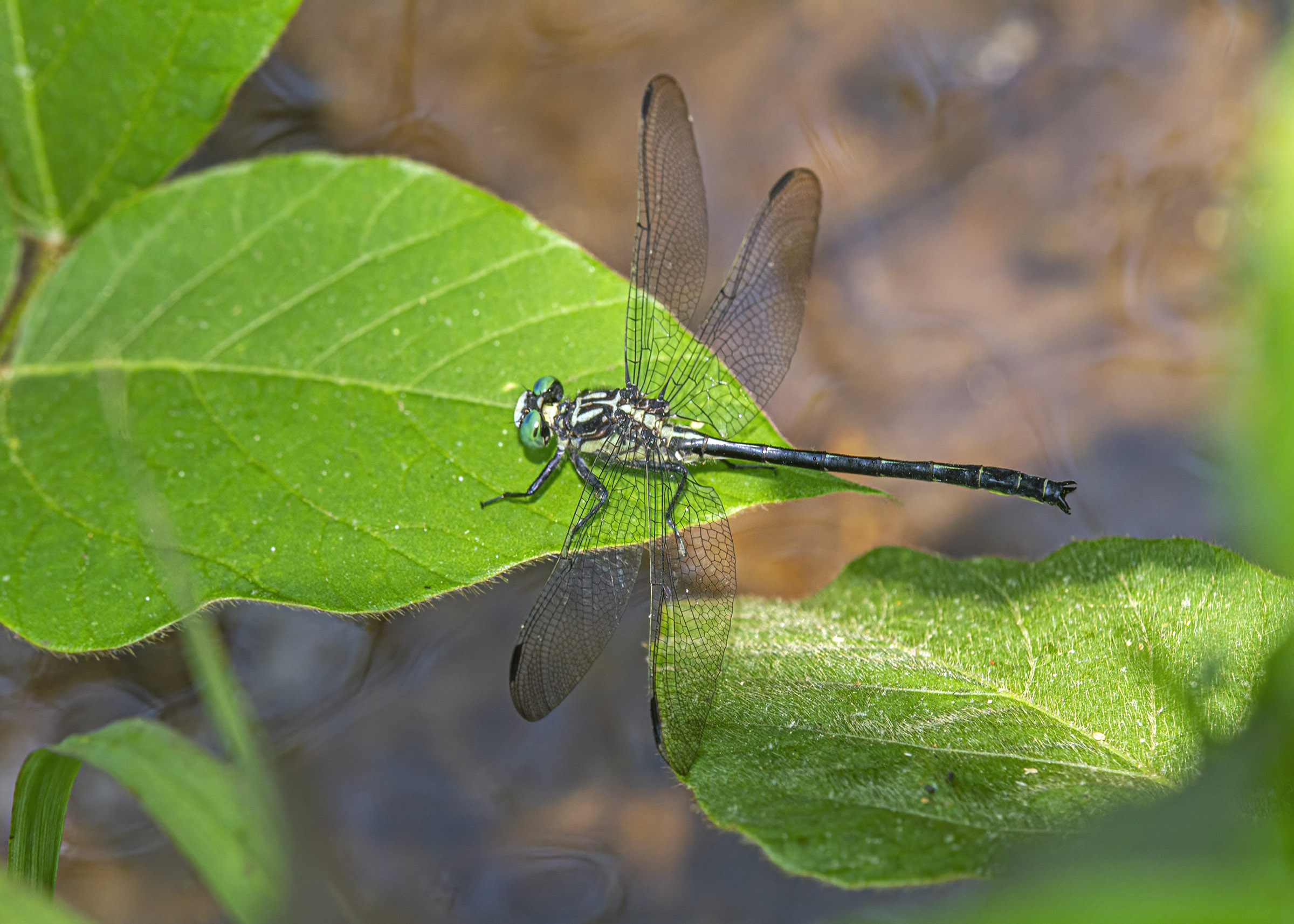
I was thrilled to spot at least one male Sable Clubtail dragonfly (Stenogomphurus rogersi) last Saturday while I was exploring a small stream in Fairfax County, Virginia. I visited that section of the stream several times during the day and had multiple sightings of a Sable Clubtail, but I am not sure if there was more than one of this species or if I was seeing the same individual each time.

As you can see from these two photos, Sable Clubtails like to perch low in vegetation just above the level of the water of the stream. As a result I had to crouch really low to be able to capture these images. The lighting was brighter for the first photo and you can see many of the details of the markings on the dragonfly, but I really like the cool shadow in the second image, which has a more “artsy” feel.

Sable Clubtails are rarein our area. Fellow dragonfly enthusiast Walter Sanford did extensive research and rediscovered this species in 2018 and I have been fortunate to see a Sable Clubtail at this stream in most years since then. If you are interested in the backstory of Walter’s efforts, check out his June 2018 blog posting entitled Off-season homework pays dividends.

Sable Clubtail

Sable Clubtail

© Michael Q. Powell. All rights reserved


Read Full Post »

Many summer dragonfly species are now emerging on the scene, like this immature male Widow Skimmer dragonfly (Libellula luctuosa) that I spotted last Tuesday at Occoquan Regional Park in Lorton, Virginia.

Anecdotally, someone thought that these dragonflies appeared to be draped in mourning crepe and that is the source of the “widow” in the name of the species. The Loudon Wildlife Conservancy website states that “This dragonfly got the “widow” name because, unlike most other dragonfly species where the male stays near the female after she lays the eggs, the male in this pair leaves her after the eggs have been laid.” Either explanation is plausible, though I have seen more references to the first explanation than the second one.

I was quite fortunate that the dragonfly chose a high perch that allowed me to separate it from the rest of the background. Quite a few of the dragonflies that I have photographed recently have perched on the ground or in dense vegetation and the backgrounds in those photos have been quite cluttered.

Widow Skimmer

Widow Skimmer

© Michael Q. Powell. All rights reserved

Read Full Post »

Usually I see Gray Petaltail dragonflies (Tachopteryx thoreyi) perched vertically on tree trunks, but this one perched horizontally on a fallen branch and stared at me after landing momentarily on my shoulder on Tuesday at Occoquan Regional Park in Lorton, Virginia.

I really like to get eye-to-eye contact with dragonflies—somehow it makes the encounter more personal and intimate. One of the consequences of shooting from this angle, though, is that much of the body of the dragonfly will be out of focus. I am ok with that and in fact it tends to pull the viewer’s eyes towards those bits that are in focus, particularly the dragonfly’s wonderful compound eyes.  Gray Petaltail

© Michael Q. Powell. All rights reserved.


Read Full Post »

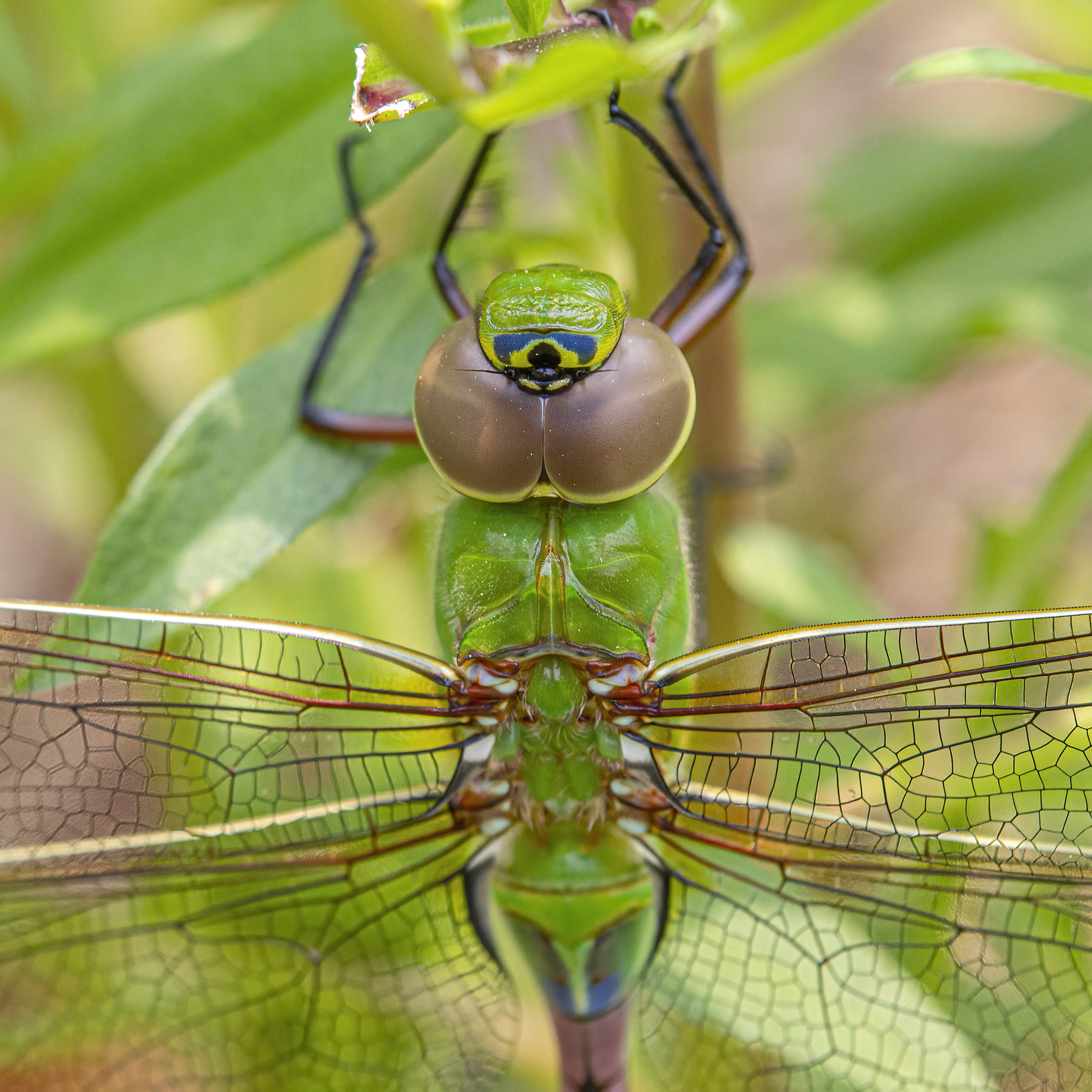
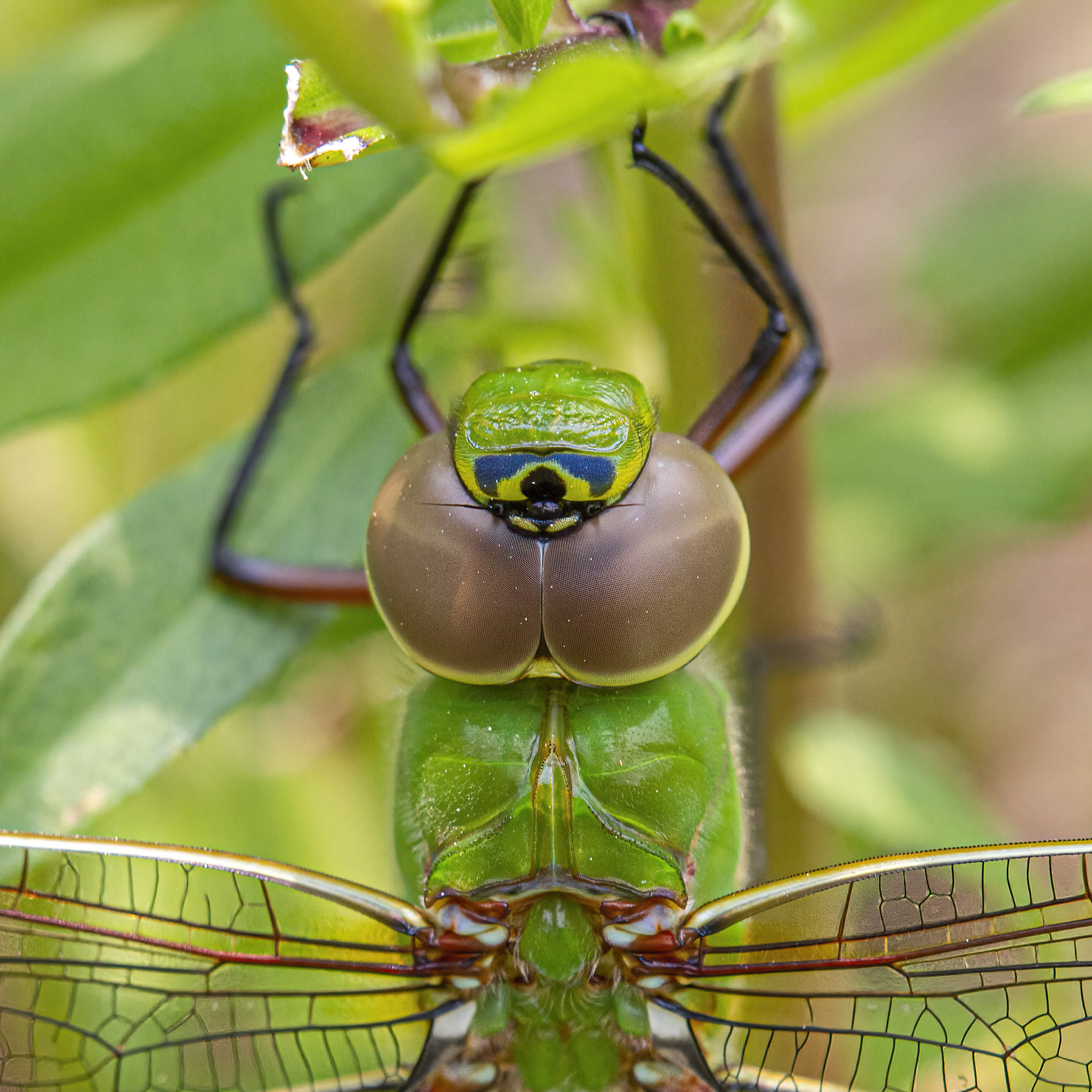
I am used to seeing Common Green Darner (Anax junius) dragonflies flying overhead, but on Tuesday I had the relatively rare chance to see one up close at Occoquan Regional Park. The Common Green Darner is a large, colorful dragonfly that is known for its long distance migratory flights. According to Wikipedia, “By attaching micro-radio transmitters to Common Green Darners, researchers have found them to be capable of migrating up to 140 kilometers in a day, though they typically cover less distance per day. ” Wow!

I spotted this dragonfly when I saw it fly to a perch in the vegetation just inches above the ground. I slowly made my way towards the vertically-perched Common Green Darner and surprisingly it did not move. I am not certain, but I had the impression that the dragonfly had newly emerged and was resting as its body parts dried out.

My 180mm macro lens gives you the impression that I was right on top of the dragonfly, but I was actually quite a bit farther away than it seems. After I took a few shots and moved away, the Common Green Darner remained in place. In fact, when I passed by the same area about twenty minutes later, it was still perched there.

I was thrilled by the amount of detail that I was able to capture. You can easily see the distinctive “bullseye” marking, for example, on the “face” of the dragonfly. The second image is a closer crop of the first image and it helps you to see some of the ommatidia, the thousands of faceted optical units that make up the dragonfly’s amazing compound eyes. You may want to click on the image to make it larger on your screen.

According to an on-line article called Dragonfly’s Eyes, “Dragonflies have very large eyes and have very good vision. Vision dominates their behaviour, including predation and looking for mates. The compound eye is made up of ommatidia which is a visual unit consisting of a lens system and a group of light sensitive cells. A large dragonfly may have up to 30,000 ommatidia in each compound eye. Each ommatidium collects one visual information, together form a mosaic image in the dragonfly’s brain. It is believed that the insects’ compound eyes are not as high resolution as vertebrate eyes. However, the dragonfly’s visual system is extremely sensitive to movement and it points in almost all direction and gives the 360 degree visual field.”

Common Green Darner

Common Green Darner

© Michael Q. Powell. All rights reserved.

Read Full Post »

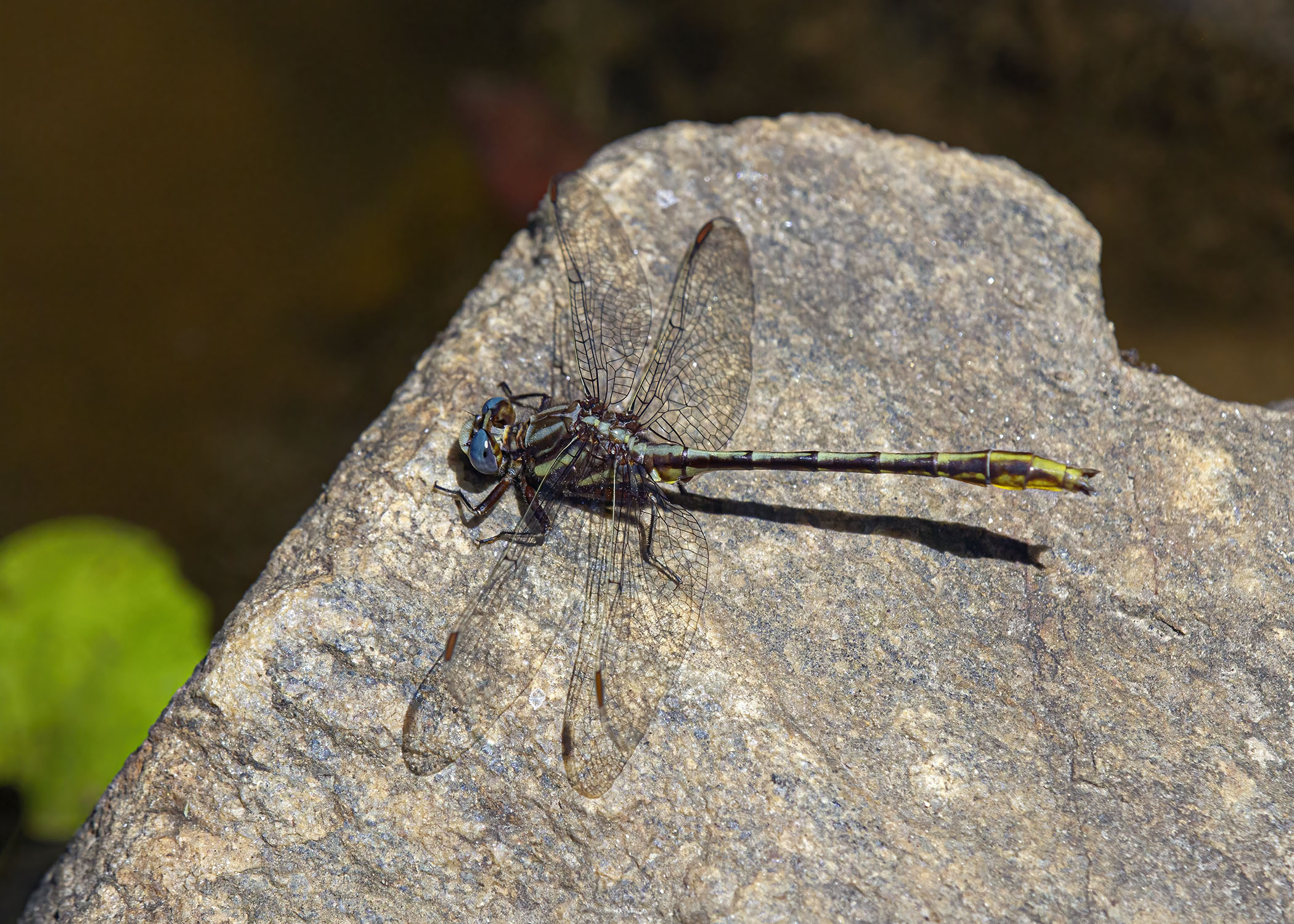
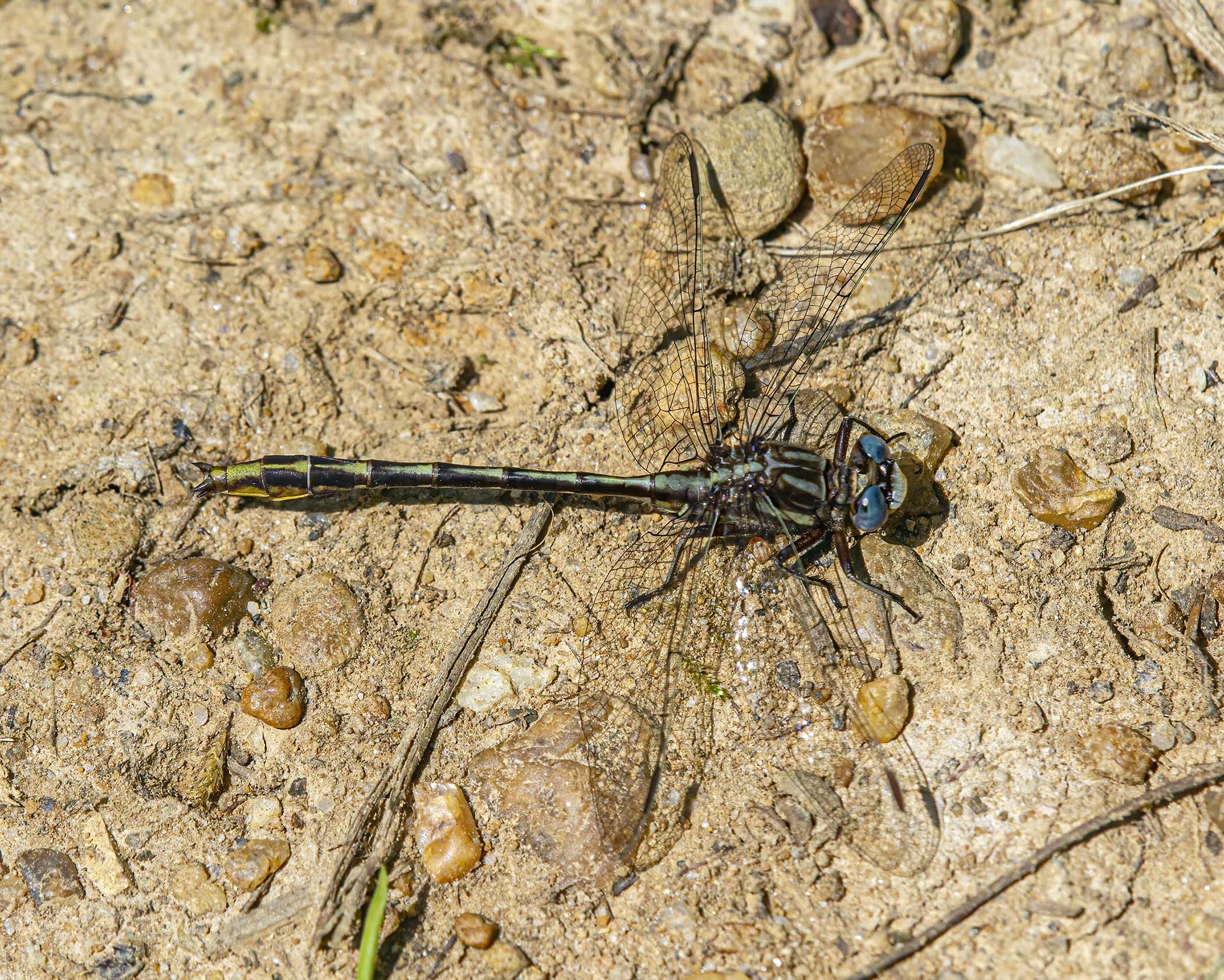
I was delighted to spot several handsome Lancet Clubtail dragonflies (Phanogomphus exilis) during a recent visit to Jackson Miles Abbott Wetland Refuge, my first sightings of this species this season. As you can see from these two photos, Lancet Clubtails like to perch flat on the ground and I spotted both of these near the edge of the pond.

I love the bright blue eyes of Lancet Clubtails and the yellow flange near the tip of the abdomen, a feature that helps to distinguish Lancet Clubtails from the visually-similar Ashy Clubtails. Some members of the Clubtail family have large and obvious “clubtails,” but the one on the male Lancet Clubtails is relatively small—you have to look at the proper angle to see it well. I like the way that the shadow in the first photo makes it easy to see the enlarged area near the end of abdomen that constitutes the “clubtail.”

Lancet Clubtail

Lancet Clubtail

© Michael Q. Powell. All rights reserved.

Read Full Post »

« Newer Posts - Older Posts »