Feeds:
Posts
Comments

Archive for the ‘dragonfly’ Category

Ten years ago today I started this blog. After reviewing some of my photos from earlier that fateful day, my dear friend and photography mentor Cindy Dyer told me I needed a blog. I was a little skeptical, but we sat down at a computer and she helped me to set up this blog. I could not come up with a cute or creative name, so I simply called it “Mike Powell—My journey through photography.”

My first posting was a modest one that showcased a single photo of a Blue Dasher dragonfly (Pachydiplax longipennis). In case you are curious, here is a link to that first posting that was entitled “Blue Dasher dragonfly.”

I figured that my blog would be primarily a place to display my photos. I rapidly realized, however, that I enjoyed expressing myself with my words as much as with my images. My postings are often a direct reflection of my thoughts or feelings at the very moments when I am composing the post. I do not compose them in advance, so my postings sometimes ramble around a bit, but I have found that many of my readers enjoy this conversational, stream-of-consciousness style.

According to WordPress statistics, I have done 4462 postings, with almost three hundred sixty thousand total views. I have written most of these postings myself, though occasionally I have reblogged the postings of others. My favorite subjects over the years have been insects and birds, but I have also done postings on a wide range of other topics including animals, travel, poetry, and painting.

Today it seemed appropriate to post a photo of a male Blue Dasher—the dragonfly that started it all—that I photographed yesterday at Green Spring Gardens, a local, county-run historical garden. When I was starting to get more serious about photography ten years ago, Cindy and I would often photograph flowers and insects at this garden.

I owe a special debt of gratitude to Cindy for the initial push to start this blog and for her continued encouragement and inspiration. However, I am equally indebted to so many readers who have provided thoughtful comments, support, and motivation as we have made this journey together. Thanks to all of you—I could not have done it without you.

Blue Dasher

© Michael Q. Powell. All rights reserved.

Read Full Post »

It is fairly uncommon for me to see a Cyrano Darner dragonfly (Nasiaeschna pentacantha), so when I do, I try my best to get a shot of it. The problem, though, is that they always seem to be patrolling over the water far from the shore and rarely seem to perch.

Last Wednesday I spotted this Cyrano Darner flying around a heavily vegetated area, which made it even tougher to focus on the dragonfly. I was thrilled to be able to get a recognizable shot of the dragonfly, though the background is so cluttered that you may have to look hard to see it in the first image. The second image is a little less sharp, but gives you a clearer view of the dragonfly.

In case you are curious, the species is named for its long, protruding, greenish forehead that is somewhat reminiscent of the long nose of literary character Cyrano de Bergerac. This is the only species that I have encountered where the “nose” helps me to identify it—most of the time I focus on other parts of a dragonfly’s anatomy.

Cyrano Darner

Cyrano Darner

© Michael Q. Powell. All rights reserved.


Read Full Post »

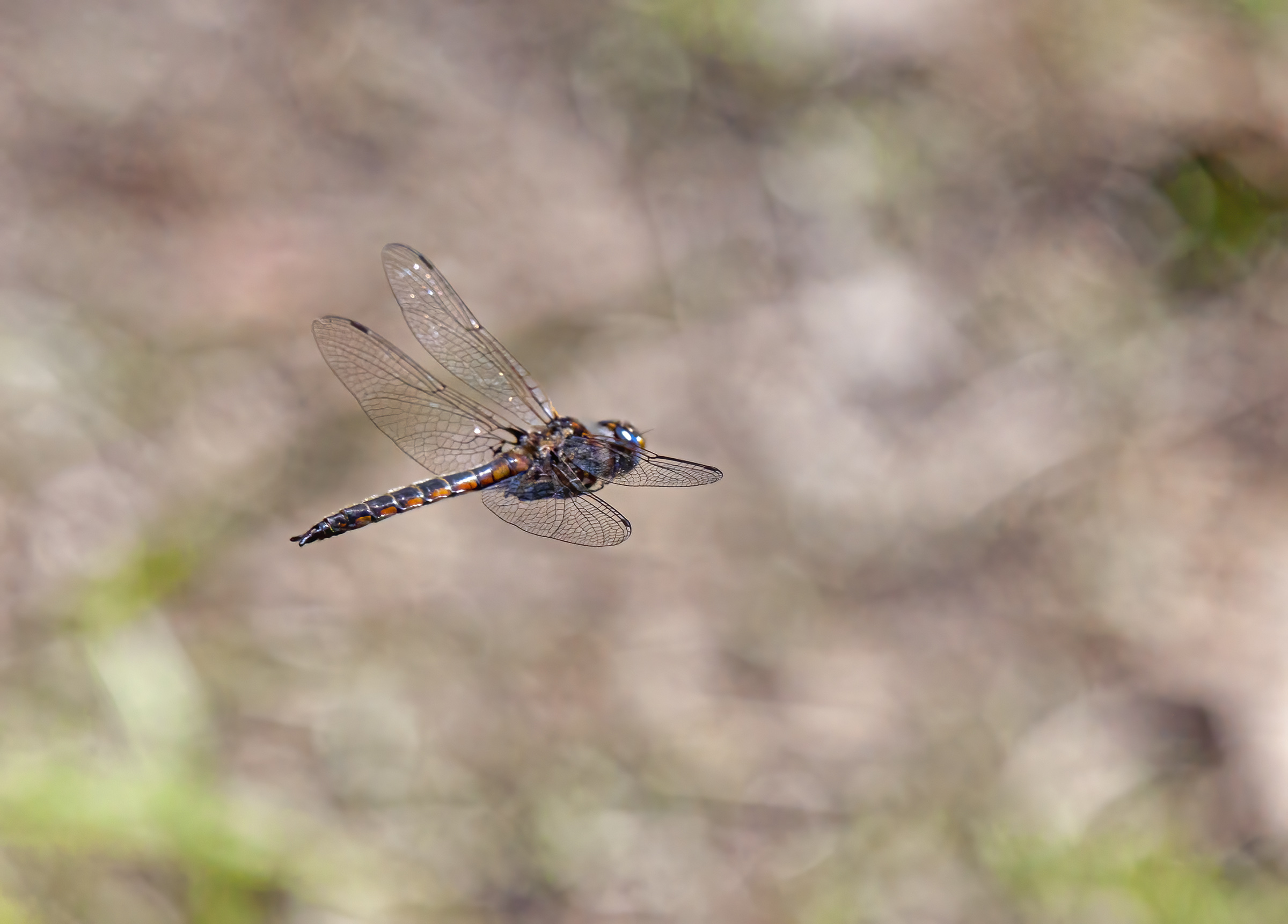
I sometimes feel like male Slaty Skimmer dragonflies are checking me out—they often seem to hover and look right at me when I encounter them. Perhaps it is is a sign of curiosity or maybe one of territoriality. Whatever the case, I love their dark, good looks, like those of these Slaty Skimmers (Libellula incesta) that I encountered last Wednesday at Jackson Miles Abbott Wetland Refuge.

The first image is a traditional shot of a perching Slaty Skimmer. In the second shot, I attempt to capture an image of a Slaty Skimmer as he zoomed on past me. I like the feel of the shot, even though I was a little slow in pressing the shutter and caught him as he was flying away. As many of you know, I love to try to photograph dragonflies while they are flying. It is possible to do so, but the degree of difficulty is pretty high.

Slaty Skimmer


Slaty Skimmer

© Michael Q. Powell. All rights reserved.

Read Full Post »

I generally prefer to photograph dragonflies on natural perches, not on manmade ones. However, whenever I visit Jackson Miles Abbott Wetland Refuge I always check a piece of rebar that sticks out of the water of Mulligan Pond near one of the fishing platforms, because I have found that dragonflies love this photogenic perch.

Last Wednesday, I spotted a male Eastern Amberwing dragonfly (Perithemis tenera) perched on the rebar. It flew away as I approached, but I waited patiently and it eventually returned. I tried a number of different approaches in framing my shots, taking advantage of the changing background caused by the movement of the brownish waters of the pond.

I love the contrast between the colors, patterns, and textures of the natural object, the dragonfly, and those of the man-made subject, the rebar. The muddy waters of the pond provide a mostly uniform background color that really complements the amber and rust tones of the primary subjects.

Eastern Amberwing

Eastern Amberwing

Eastern Amberwing

© Michael Q. Powell. All rights reserved.


Read Full Post »

Each summer season I look forward to photographing Swift Setwing dragonflies (Dythemis velox) at Jackson Miles Abbott Wetland Refuge. These little dragonflies perch in a distinctive pose with their wings pulled forward, which looked to some scientist like the “ready-set-go” position of a sprinter and is reportedly the reason for the name of the species. One of my fellow photographers recently posted some photos of the species in Facebook, prompting me to set out last Wednesday to see if I could find some of them myself.

Six years ago I spotted my first Swift Setwing dragonfly at this same location. This primarily southern species had never before have been documented in Fairfax County, Virginia, the county where I live, so it is kind of special for me to see them each year. (You can see details of that first sighting in my 25 June 2016 posting Swift Setwing dragonfly.)

Members of this species like to perch at the very tip of vegetation overhanging the water and almost always face the water. It can therefore be quite a challenge to get profile shots and almost impossible to get the kind of head-on shots that I love to take.

I had a number of encounters with Swift Setwings and tried a variety of compositions to capture images of these cool little dragonflies. My favorite shot is probably the first one—I really like the way that the colors of the dragonfly’s head are mirrored in the colors of the berries in the background.

Swift Setwing

Swift Setwing

Swift Setwing

© Michael Q. Powell. All rights reserved.


Read Full Post »

I was thrilled on Wednesday to spot some Banded Pennant dragonflies (Celithemis fasciata) at Jackson Miles Abbott Wetland Refuge. Earlier this season I photographed Calico Pennants and a Halloween Pennant and it is nice to capture images of another “pennant” species with patterned wings. This is the only local spot where I have reliably seen them in the past, and in some years I have not see a single one.

Adult male Banded Pennants are blue, like so many other dragonflies, but the distinctive pattern on their wings make them easy to distinguish from the others. They may be easy to identify, but they are small in size—about 1.3 inches (34 mm) in length—and perch in vegetation right at the edge of the water, so you have to look carefully to spot them.

I was fortunate to have multiple opportunities to photograph Banded Pennants that day. The colorful little dragonflies would make short forays over the deeper waters of the pond, but would sometimes would return to the same clumps of vegetation. The banks of the pond are pretty steep in many spots, so I had to really pay attention as I leaned over the edge to capture some of these images, but I managed to stay dry.

Have a wonderful weekend.

Banded Pennant

Banded Pennant

Banded Pennant

© Michael Q. Powell. All rights reserved.

Read Full Post »

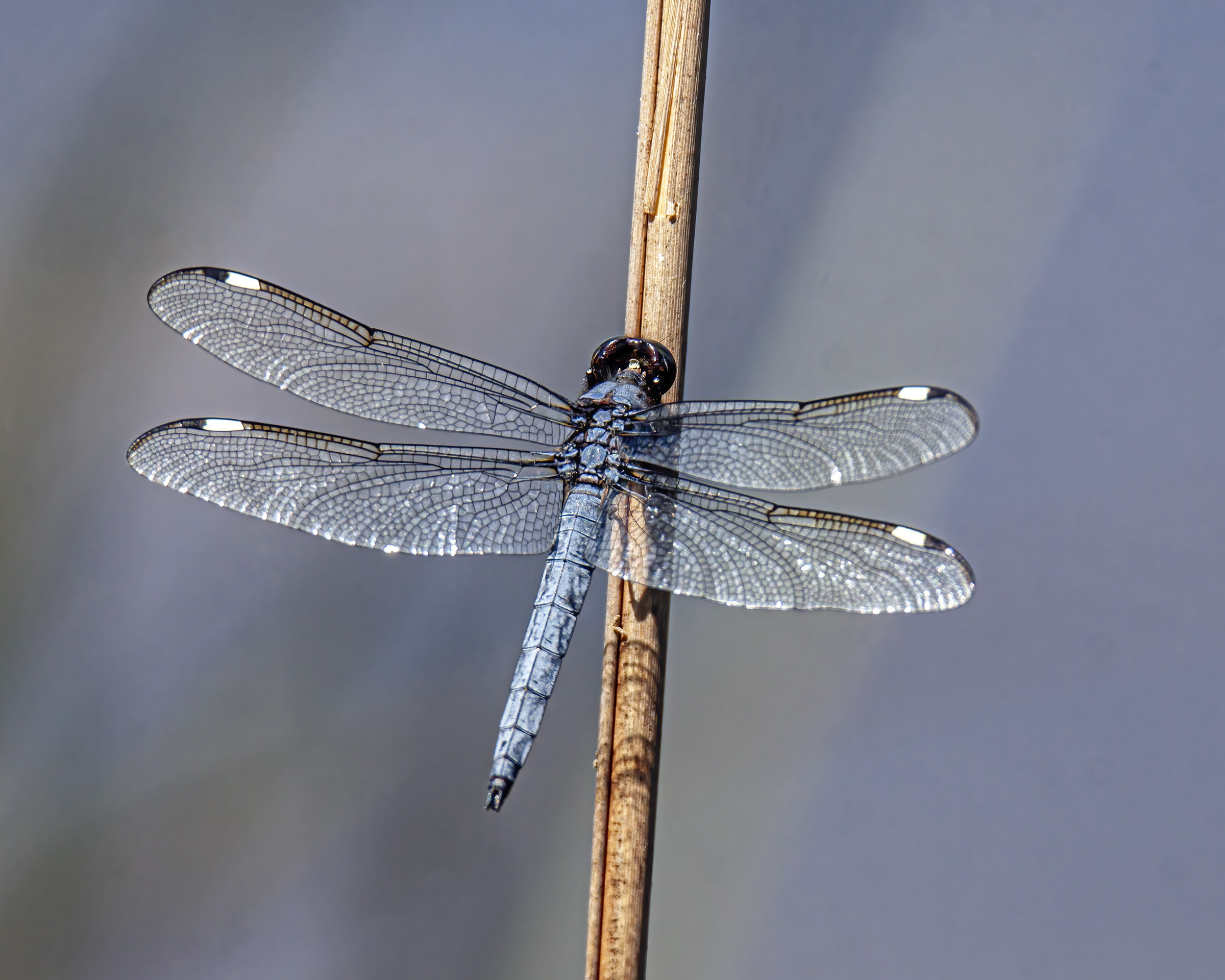
There are quite a few blue dragonflies where I live, so I can’t simply rely on color to tell them apart. Fortunately, it is very easy to identify a male Spangled Skimmer (Libellula cyanea), because it has a white spot beside a black spot on the outer leading edge of each wing—as far as I know, no other dragonfly in our area has multi-colored stigmata, the technical name for those spots.

The stigmata are not there for decoration, but serve an important role in the flight of dragonflies. I do not really understand the physics of flight, but have read that the stigmata are heavier than the adjoining cells and help to stabilize the vibrations of the wings.

I spotted these two mature male Spangled Skimmers during recent trips to Occoquan Regional Park. Earlier this year I saw some immature male Spangled Skimmers at the same location that were brown and yellow in coloration, just like the females of the species. (See my posting from 30 May 2022 entitled Spangled Skimmer dragonflies to see photos of an immature male and a female of this species.) Although the color of the males changes completely as they mature, the distinctive stigmata are present even when they are young.

Spangled Skimmer


Spangled Skimmer

© Michael Q. Powell. All rights reserved.

Read Full Post »

The calendar and the temperatures both tell me that we have entered into the long, hot, lazy days of summer. Here in the Washington D.C. area, where I live, that often means a lot of humidity too. Some days it can be a bit of a challenge to motivate myself to go out into the wild with my camera.

However, many dragonflies seem to love this kind of weather and the fields and ponds are abuzz with dragonfly activity. One of our common species is the Great Blue Skimmer dragonfly (Libellula vibrans). This past week I noticed a sharp increase in their numbers as I wandered the trails at Occoquan Bay National Wildlife Refuge.

Great Blue Skimmers have stunning blue eyes and white faces, which help to distinguish them from similar species. The Great Blue Skimmer in the first photo, which looks to be a young male, was cooperative and let me get quite close to him to get this close-up view of his head. Dragonflies of this species seem to have a pronounced overbite, which gives them a goofy grin that I find endearing.

I think that the dragonfly in the second shot is a female Great Blue Skimmer. Several dragonfly species share the same black and yellow coloration and pattern for juveniles and for females, so it can often be a real challenge to make a definitive identification. Fortunately, the differences among the species become more pronounced as the dragonflies mature.


Great Blue Skimmer

Great Blue Skimmer

© Michael Q. Powell. All rights reserved.


Read Full Post »

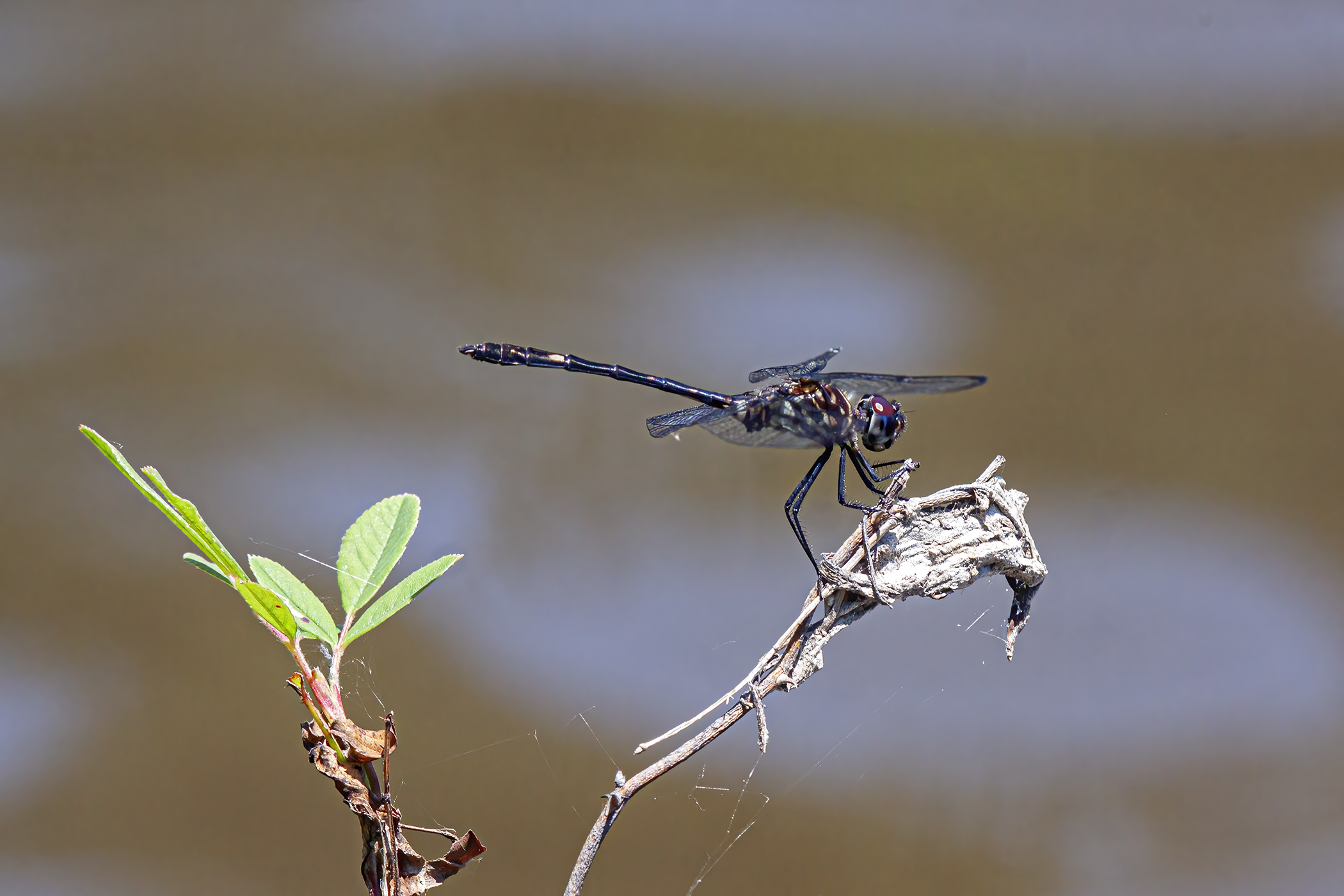
I was excited last Monday to spot this Halloween Pennant (Celithemis eponina), one of my favorite dragonflies, as I was exploring a small pond in Fairfax County. I especially love the beautiful patterns on its wings and the way that it perches on the very tip of flimsy vegetation, causing it to flutter in the slightest breeze, like a pennant.

Halloween Pennant

© Michael Q. Powell. All rights reserved.
Read Full Post »

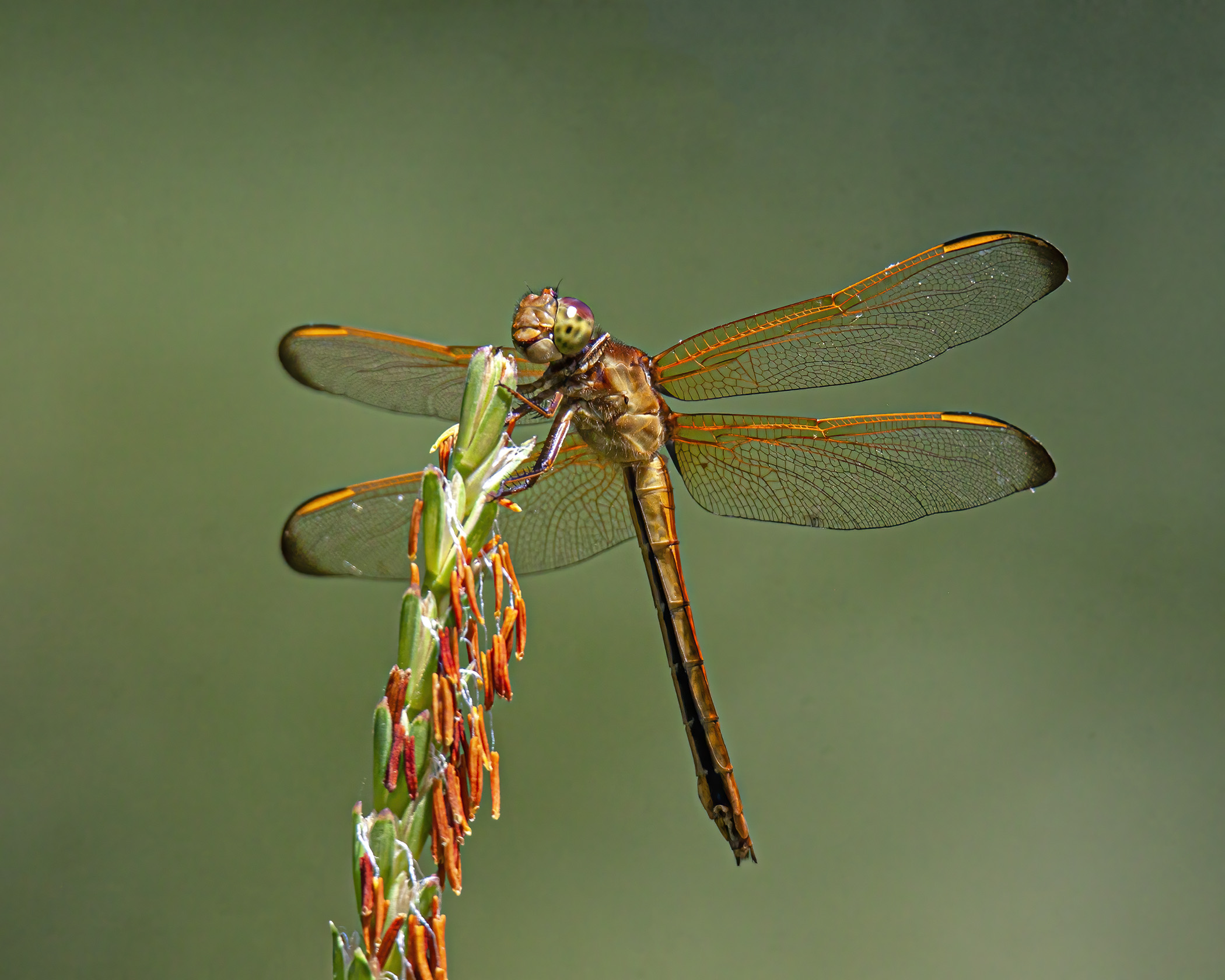
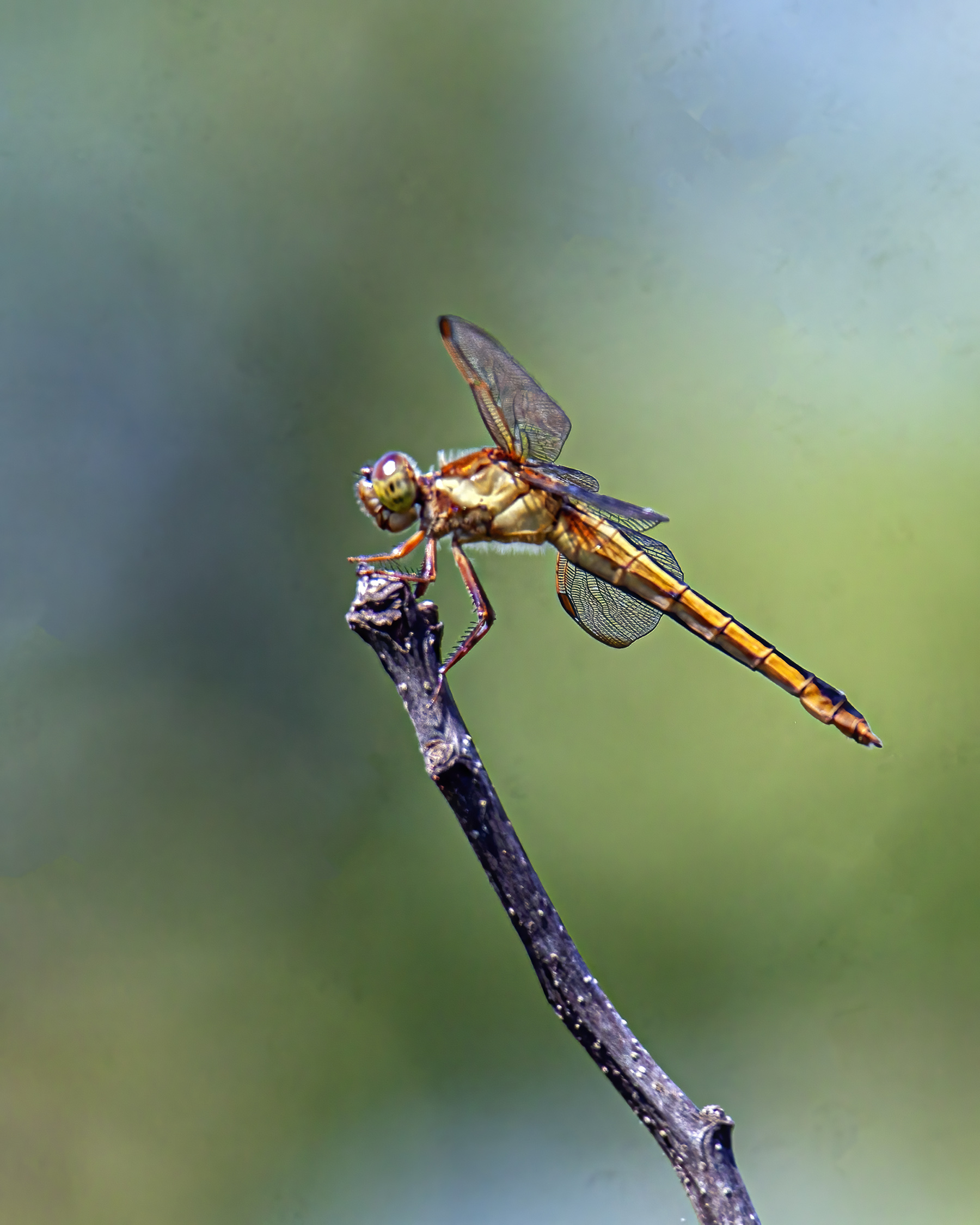
Numerous Needham’s Skimmer dragonflies (Libellula needhami)) have recently emerged at Occoquan Bay National Wildlife Refuge. Yay! I just love the golden leading edges on the wings of this species. Male Needham’s Skimmers eventually turn reddish-orange in color, but initially have the same yellow and black coloration as the females.

In the first shot, I was thrilled to photograph a beautiful female as she perched on some colorful Eastern Gamagrass (Tripsacum dactyloides).  I cannot identify very many plants, but this one is distinctive enough that it has stuck in my memory. I love the expression on the dragonfly’s face–she seems to be either smiling at me or sticking out her tongue at me.

The Needham’s Skimmer in the second image also seems to be smiling. I think that it is a male, but cannot be certain from this angle of view.

Have a wonderful weekend. Needham's Skimmer

Needham's Skimmer

© Michael Q. Powell. All rights reserved.


Read Full Post »

It is a simple law of nature that all creatures have to eat and many of my subjects are carnivores. The question of whether a creature is predator or prey is often a relative one—today’s predator can easily become tomorrow’s prey.

I try not to get emotionally involved when I witness one creature feeding on another, but that is not always possible. For me it is somewhat jarring when I see one dragonfly eating another—it feels like cannibalism.

For some reason, most such encounters that I have witnessed have involved Eastern Pondhawk dragonflies (Erythemis simplicicollis). This species is not at that large or powerful, but seems particularly fierce. Some other dragonflies catch their prey and eat while they are flying, their version of “fast food,” so that may be why I don’t see dragonflies consuming other dragonflies very often.

In the first photo, a female Eastern Pondhawk was feasting on a male Calico Pennant dragonfly (Celithemis elisa) that it had just caught. As you can see, the dragonfly holds its prey in its long legs and begins by eating the head.

In the second photo, taken at a different location, another female Eastern Pondhawk was munching on an unidentifiable damselfly. Readers sometimes ask me about the differences between dragonflies and damselflies and this photo gives you a general idea of the relative size and shape of their bodies.

According to a fascinating posting called “What do Dragonflies Eat?” on The Infinite Spider website, “All adult dragonflies are insectivores, which means they eat insects they catch with their spiny hairy legs.  The insects are then held in a basket-like device while flying. They particularly delight in mosquitoes (30-100+ per day per dragonfly!) as well as other pesky flight bugs  such as flies, butterflies, bees, and even other dragonflies.”

Check out the posting that I referenced in the previous paragraph, if you dare, for details about how dragonflies actually eat. Here is a sneak preview, “The main thing to notice is that they have jaws that work side to side and that are shaped like wicked meat hooks, mandibles that go up and down and maxillae that act like a lower lip and hold food.” Yikes!

Eastern Pondhawk


Eastern Pondhawk

© Michael Q. Powell. All rights reserved.


Read Full Post »

There has been a recent explosion of dragonflies in my area. Yesterday was a hot, humid day and I encountered hundreds of dragonflies as I walked along the trails of one of my favorite wildlife park. They were almost all relatively common species, including Common Whitetails, Needham’s Skimmers, Eastern Pondhawks, and Great Blue Skimmers. These dragonflies thrive in a variety of habitats, are numerous, and are easy to see.

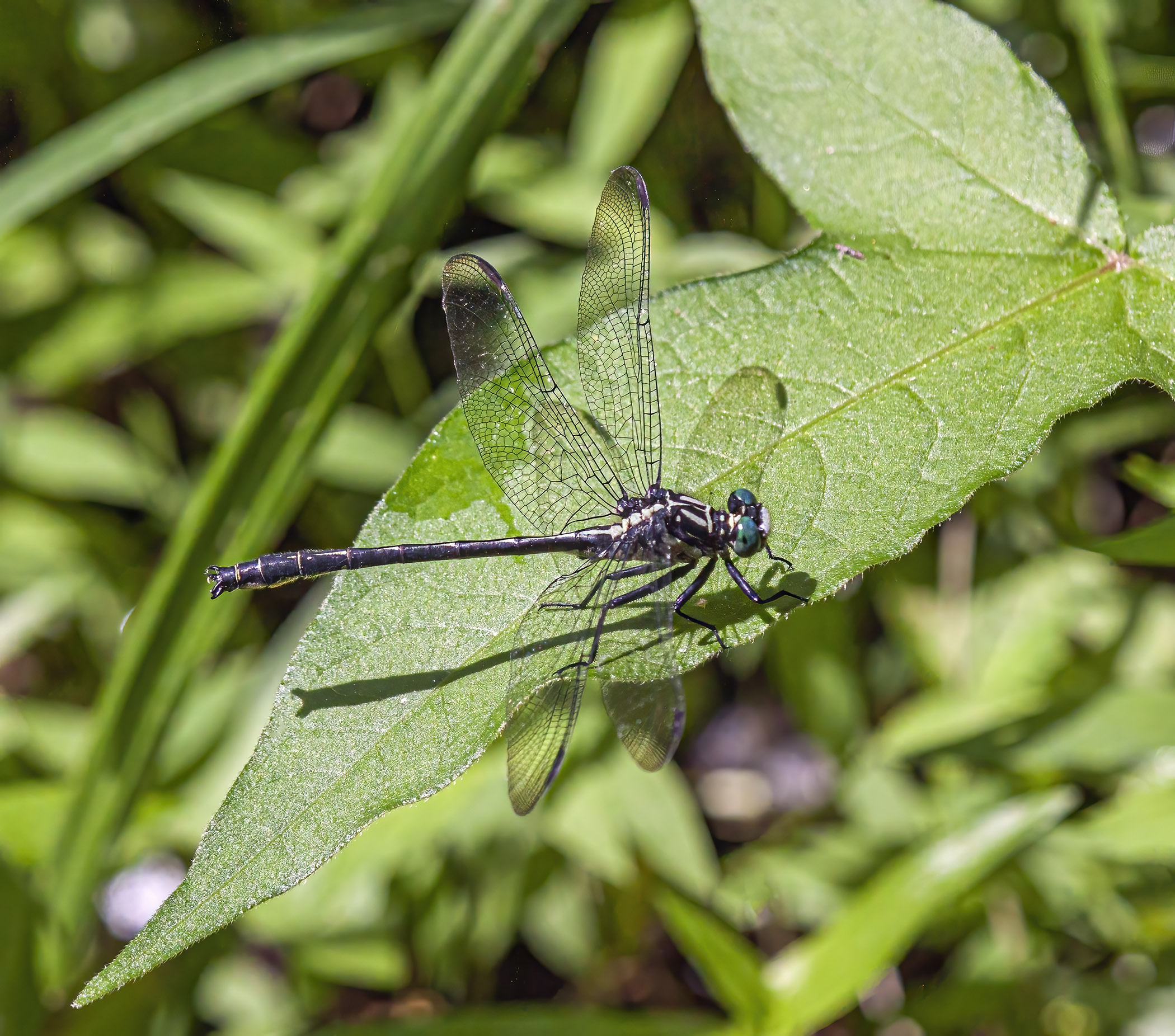
Some of the rarest dragonflies in our area, however, are quite muted in their appearance, like these male Sable Clubtail dragonflies (Stenogomphurus rogersi). Sable Clubtails are generally found only in very small numbers, have a short flight period, and require very specific habitats,—this species prefers small, clean forest streams. This past two weeks I have spent hours exploring a stream in Fairfax County in Virginia, the county in which I live, and spotted a grand total of two Sable Clubtails.

As you can see from the first photo, my most recent sighting, Sable Clubtails like to perch flat on leafy vegetation, just above the level of the stream. They are often in shadowy areas and are incredibly skittish, so it is tough to get a good shot of a Sable Clubtail.

The dragonfly in the second and third photo was initially spotted by a fellow dragonfly enthusiast a little over a week ago. I was upstream from him (and had not noticed that he was there) when he called out to me and informed me that he had spotted a Sable Clubtail. I hurried over in the direction of his voice and photographed the dragonfly in the middle photo. I was able to capture the markings of the Sable Clubtail by shooting almost directly downwards, but the sunlight produced harsh specular highlights.

As I crouched to get a better angle, I spooked the dragonfly.  Fortunately it flew only a few feet away and perched higher on a leaf in a slightly shaded area, which let me capture the third shot before it flew away.

I don’t know if I will see another Sable Clubtail this season, but it was gratifying to be able to have two encounters with this uncommon species. Habitats are fragile and changeable, so I never know from year to year if one of these low-density species will reappear or not. At this location, I have been blessed to photograph a Sable Clubtail for three of the last four years. I’ll probably check it out at least another couple of times before I call it quits for this species for the season.

Sable Clubtail

Sable Clubtail

Sable Clubtail

© Michael Q. Powell. All rights reserved.


Read Full Post »

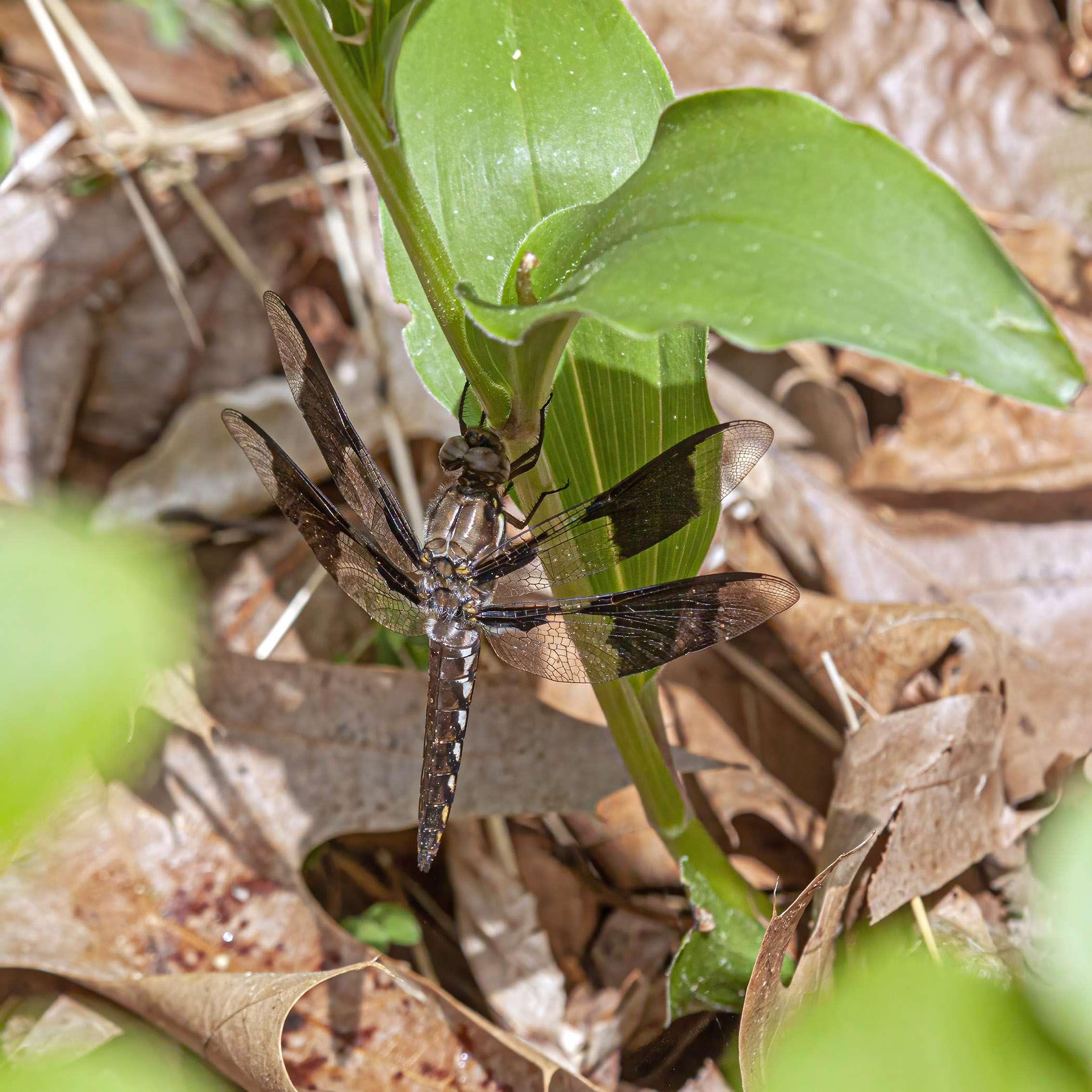
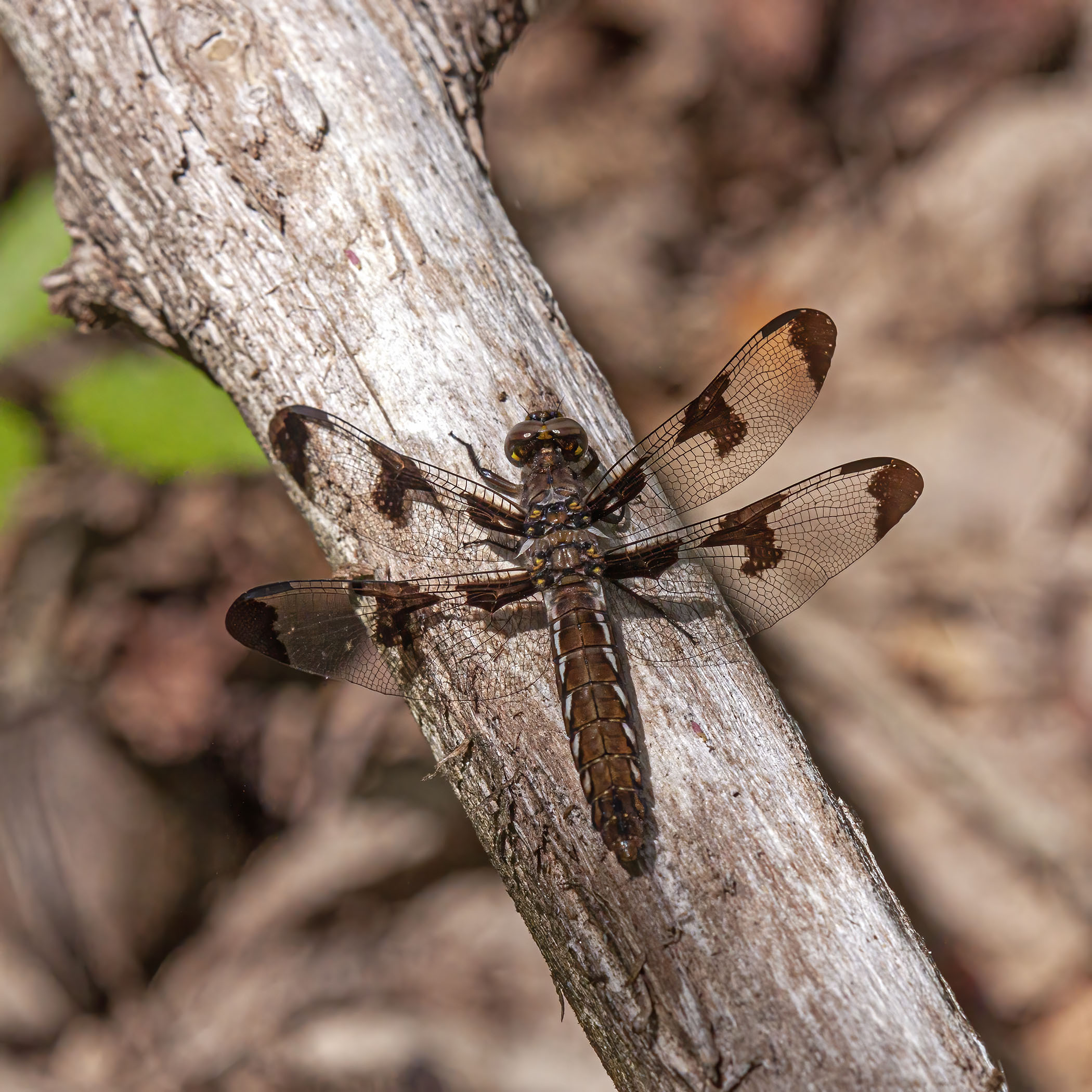
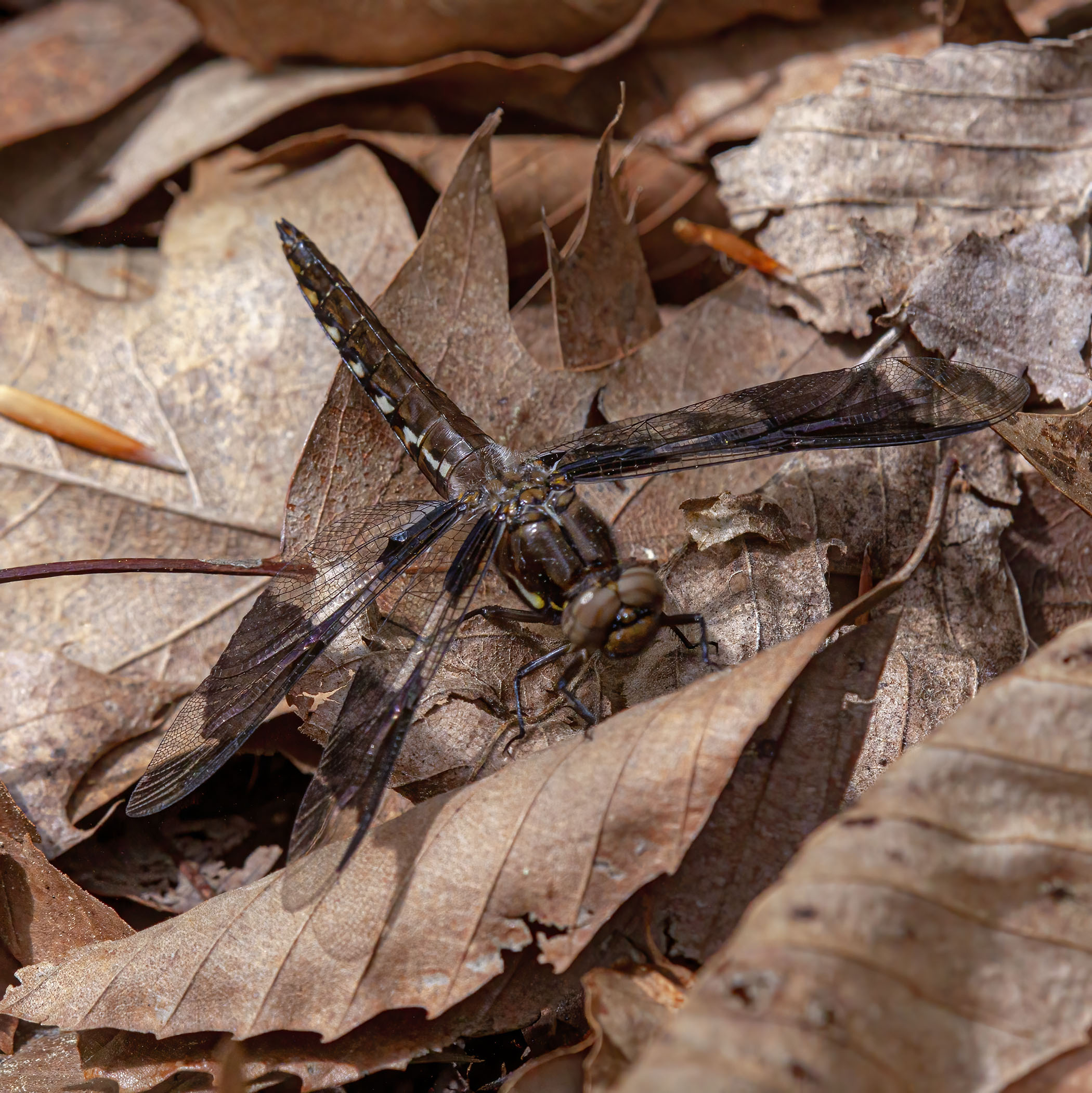
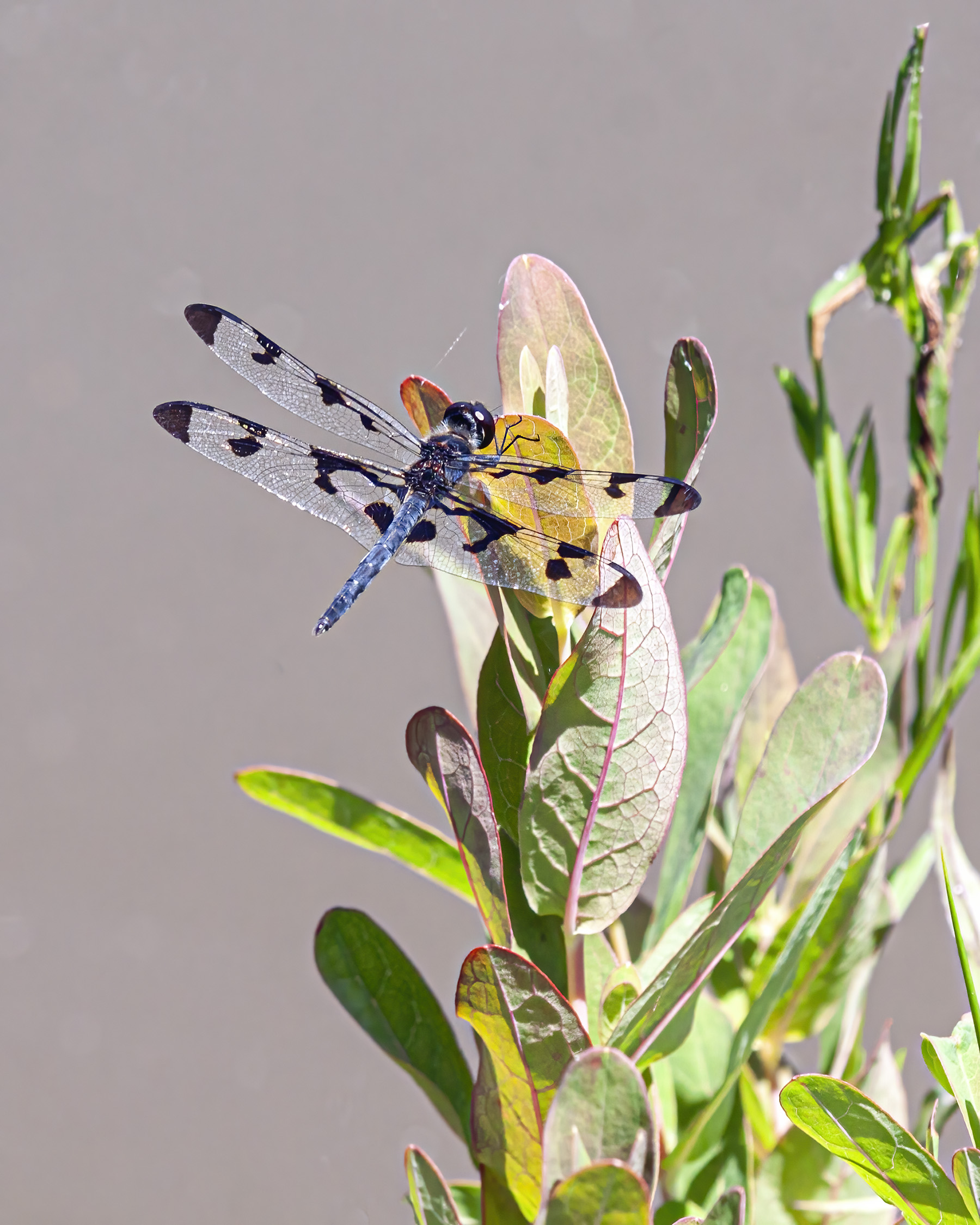
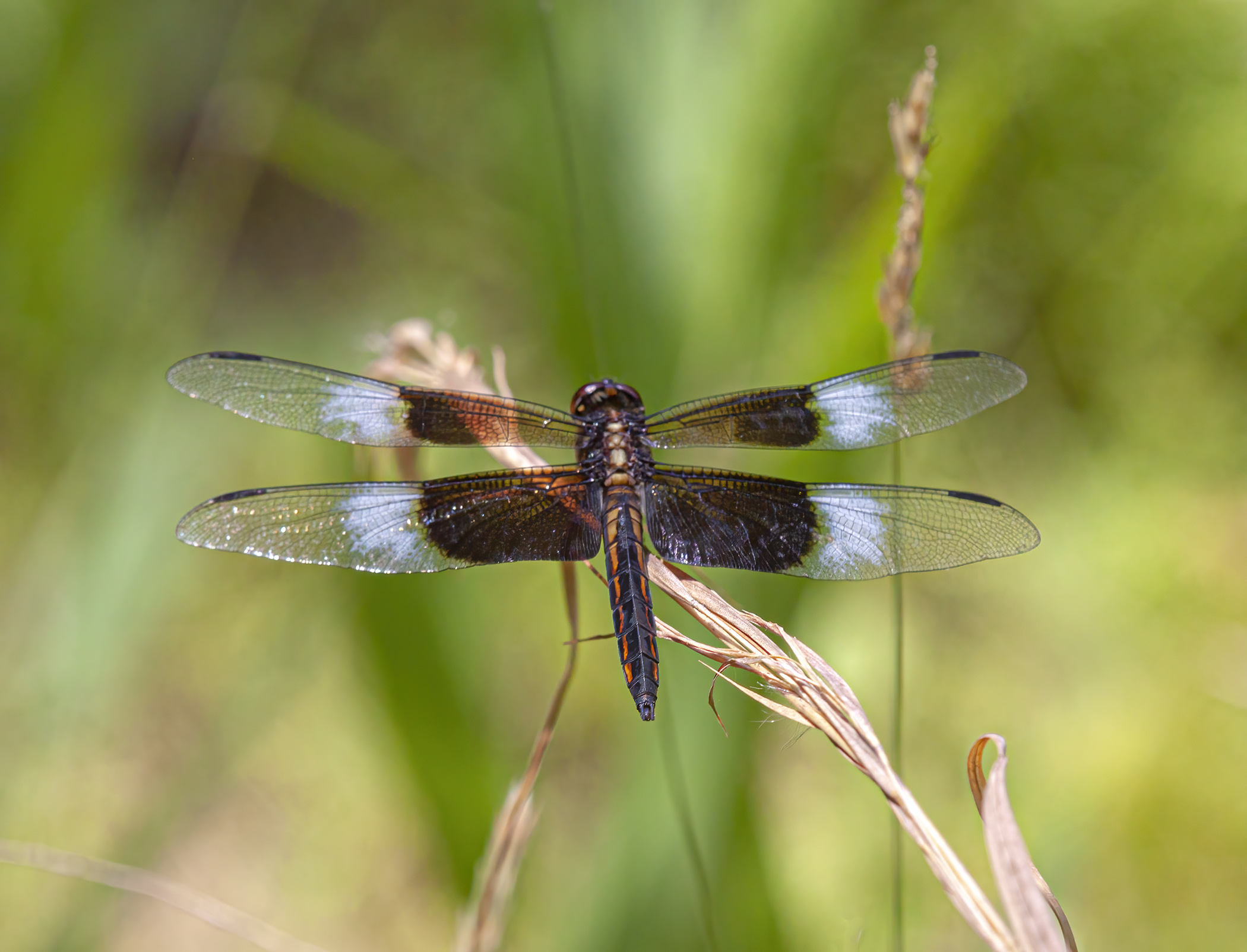
I love dragonflies with patterned wings and one of the coolest ones in our area is the male Widow Skimmer (Libellula luctuosa), which has a distinctive combination of one dark and one white blotch per wing. Eventually the immature male in the first photo will turn bluish in color, but for now he has the brown and yellow colors that he shares with the females. The females have only a single large blotch on each wing, so usually I can tell the genders apart.

When the male first emerges, however, the white blotches may be hard to see, so I have to look more closely at other aspects of the dragonfly’s body. I am pretty confident that the dragonfly in the second photo is a very young male Widow Skimmer.

It was really easy to track a male Widow Skimmer dragonfly in the air, because its colorful wings made it look almost like a butterfly. However, the dragonfly in the first photo was remarkably skittish and would perch only momentarily in between its patrols over the waters of the small pond that I visited on Monday. Eventually my patience paid off and I was able to get a shot, albeit from a relatively long distance away.

Widow Skimmer

Widow Skimmer

© Michael Q. Powell. All rights reserved.


Read Full Post »

I was delighted to spot this female Lancet Clubtail dragonfly (Phanogomphus exilis) on Thursday in Prince William County, the first member of this species that I have seen this season. She seemed to be glancing upwards at me as she smiled and posed for me.

When I was doing some research on this species, I got a little confused, because sometimes the Latin name for the species was given as Phanogomphus exilis and sometimes as Gomphus exilis. As far as I can understand it, the Lancet Clubtail used to be included in Gomphus genus. However, according to Wikipedia, “As a result of phylogenetic studies, Gomphus subgenera Gomphurus, Hylogomphus, Phanogomphus, and Stenogomphus were elevated in rank to genus in 2017. With the removal of their member species, Gomphus ended up with 11 of its previous 54 species, none of which are found in the Western Hemisphere.” Yikes!

Lancet Clubtail

Lancet Clubtail

© Michael Q. Powell. All rights reserved.

Read Full Post »

Although Eastern Pondhawks (Erythemis simplicicollis) are among the most common dragonflies in my area, I never fail to be startled by the brilliant emerald green color of the females and immature males. Their matching green faces and the striped pattern on their abdomen makes for a stylishly stunning look.

In many ways, however, I am even more drawn to the less flashy, two-toned look of the transitional males as shown in the second image. Males start out with the same look as the females, but eventually transition to become entirely blue, though they retain their green faces and eyes. I love the way the blue gradually fades into green during the intermediate phase of a male Eastern Pondhawk.

So what about you? Are you drawn more to the colors of the dragonfly in the first photo or the one in the second photo? If I am truthful in answering my own question, I’d have to say that my personal preference varies, depending on a number of factors including my mood and the weather.

Eastern Pondhawk

Eastern Pondhawk

© Michael Q. Powell. All rights reserved.
 

Read Full Post »

One of the cool things about traveling is having the chance to see species that are not present in my home area. This past weekend I drove north about 600 miles (965 km) to Gill, Massachusetts, the home of Northfield Mt Hermon School, where I celebrated my 50th graduation from high school. There was plenty of wild life at the reunion, with loud music, firepits, and adult beverages, but I also managed to squeeze in a few quieter moments with wildlife.

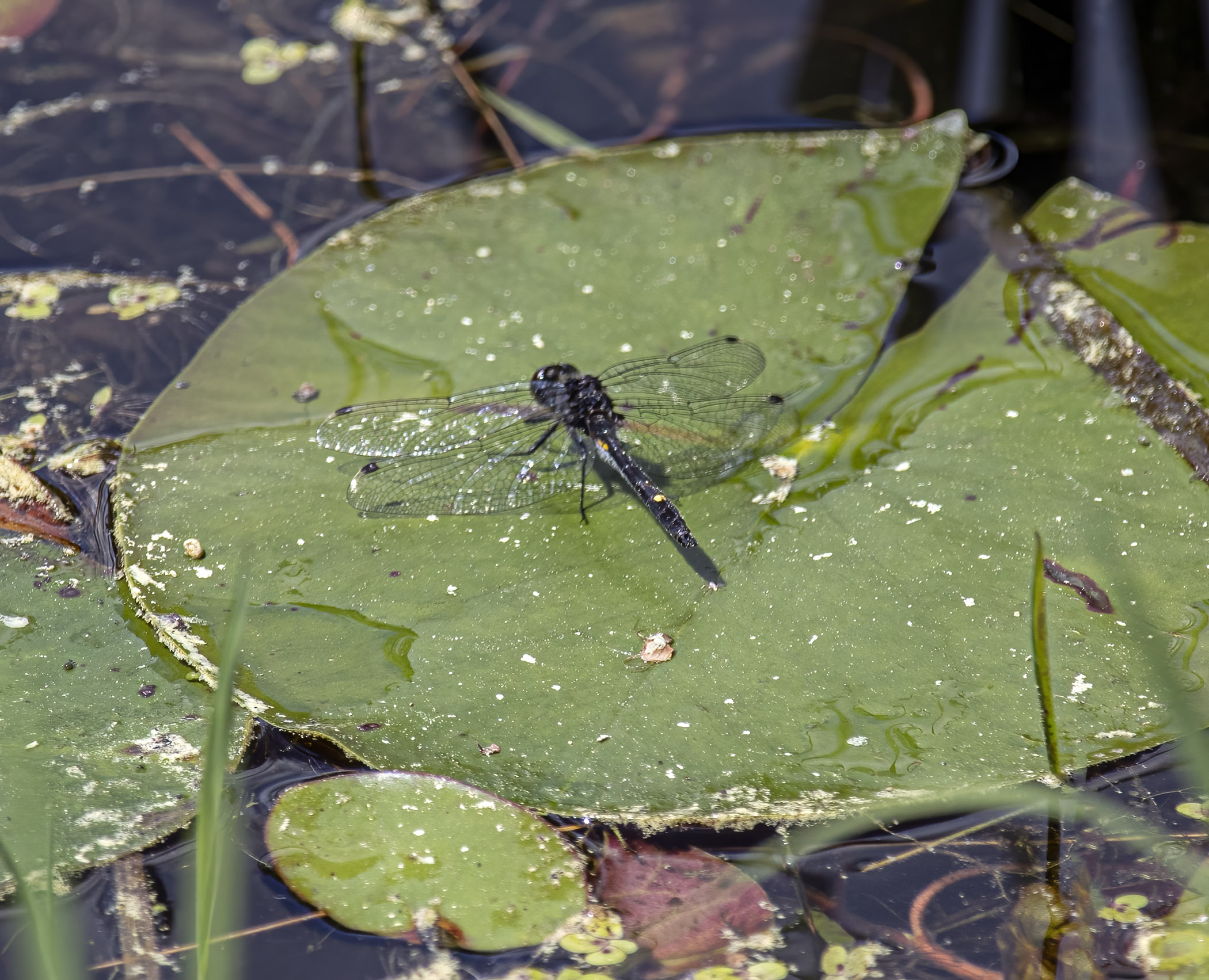
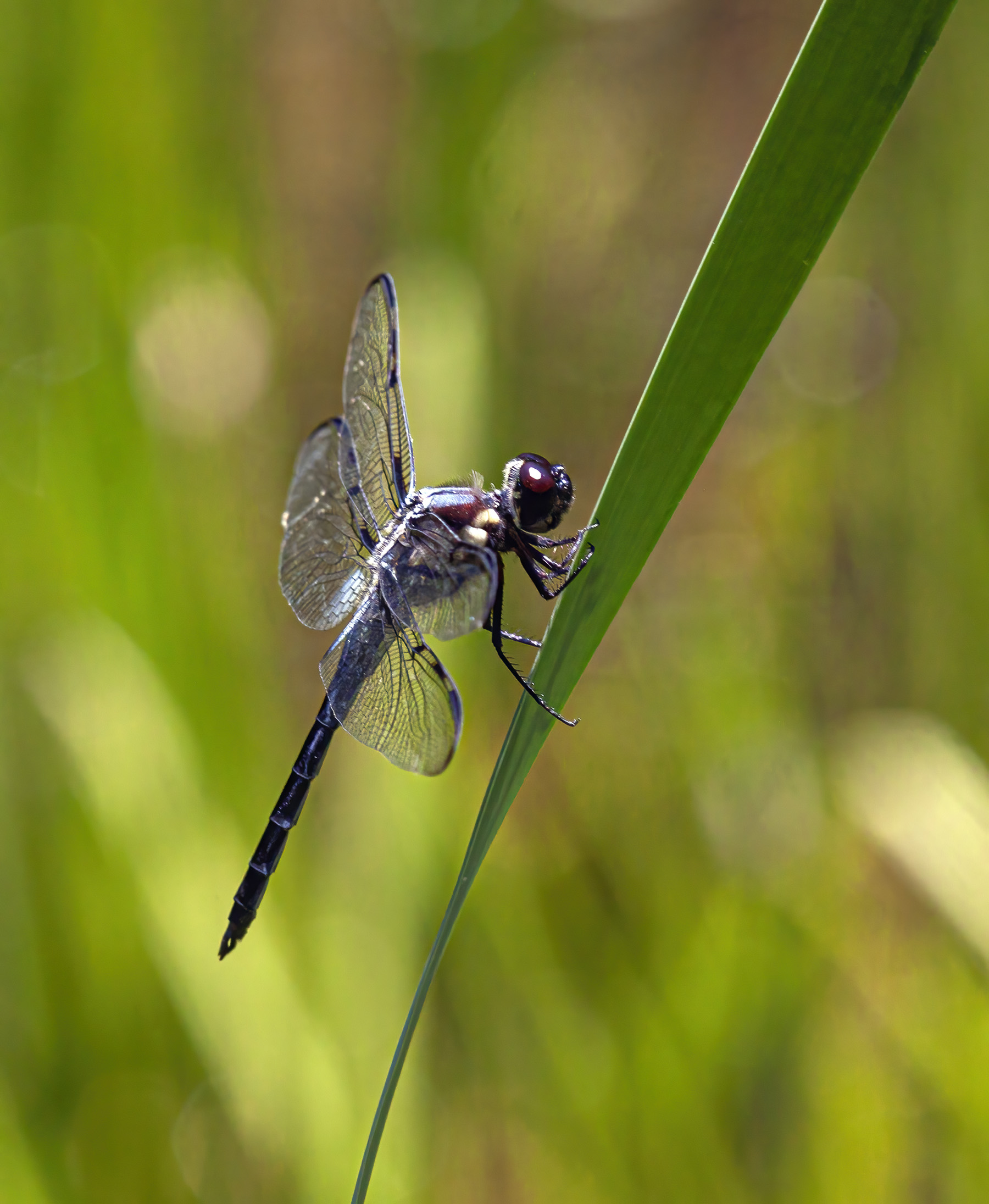
While I was walking along the edge of Shadow Lake, a small marshy lake on campus, I spotted some unfamiliar dragonflies on the floating lily pads. As I examined the dragonflies through my 55-250mm telephoto lens, the longest lens that I had with me, I was struck by the bright white faces of the dragonflies and the prominent dots on the top of their abdomens. I was a little shocked to learn later that the dragonflies that I photographed are Dot-tailed Whiteface dragonflies (Leucorrhinia intacta)—rarely has the name of a species fit so well.

The range map for Dot-tailed Whitefaces shows that it is primarily a northern species that does not exist in Virginia. I get the impression that this is a fairly common species, so locals would probably not be very excited to spot one. For me, though, it was a rare and exotic species that I was seeing for the very first time and I was thrilled. It is amazing how our reactions in so many areas of our lives are influenced as much by our perspectives as by the “objective” facts of a situation.

Dot-tailed Whiteface

Dot-tailed Whiteface

Dot-tailed Whiteface

© Michael Q. Powell. All rights reserved.

Read Full Post »

Last Tuesday I spotted several beautiful Bar-winged Skimmer dragonflies (Libellula axilena) while I was exploring a small pond in Prince William County, Virginia. The dragonflies kept choosing beautiful, but flimsy perches, so I did not have much time snag shots of them before they flew away.

According to the Dragonflies of Northern Virginia website, Bar-winged Skimmers have relatively specific habitat needs and consequently are one of the less common skimmers in our area. “It prefers very shallow marshy pools in the full sun. If there’s enough water for fish, it’s too deep for Bar-winged Skimmers. And of course shallow pools in the full sun tend to quickly evaporate and dry up, so stable populations in Northern Virginia are few and far between.”

I really like the backgrounds that I was able to capture in these shots—they are colorful, but not at all distracting. If you look closely at the leading edges of the wings, you can see the black spots and stripes that give rise to the name of this species.

Bar-winged Skimmer

Bar-winged Skimmer

Bar-winged Skimmer

© Michael Q. Powell. All rights reserved.

Read Full Post »

Although “treehugger” is a term that is sometimes used for environmentalists, it is even more applicable to Gray Petaltail dragonflies (Tachopteryx thoreyi), like these ones that I spotted last Tuesday in Prince William County. Gray Petaltails love to perch on the trunks of trees, where they blend in almost perfectly with the bark, as you can see especially well (or almost not see) in the second photo.

I have been told that Gray Petaltails especially like the color gray and a number of times one has perched on me when I was deliberately wearing a gray shirt. Fellow dragonfly enthusiast Walter Sanford capture that phenomenon in 2019 in one of his blog postings that he called “You look like a tree to me!

I drove up to Massachusetts this past weekend for the celebration of my 50th high school reunion at Northfield Mount Heron School, the private college preparatory boarding school that I attended for three years. I disconnected from the internet during that time there, which is why I have not posted in several days—my apologies to those of you who may be used to a daily “fix.”

It was fascinating to reconnect with high school friends, often for the first time in 50 years, and to meet some classmates for the first time. Northfield was founded as a girls school in 1879 by evangelist Dwight L. Moody and two years he established Mount Hermon as a boy school. In 1971 the two schools formally merged and those of us in the class of 1972, my class, were the first to graduate from Northfield Mount Hermon School. At that time there were close to 1300 students divided between the two campuses, which made it difficult to know everyone—in recent years the school consolidated onto the Mount Hermon campus and it currently has a student body of about 700 students.

Gray Petaltail

Gray Petaltail

© Michael Q. Powell. All rights reserved.


Read Full Post »

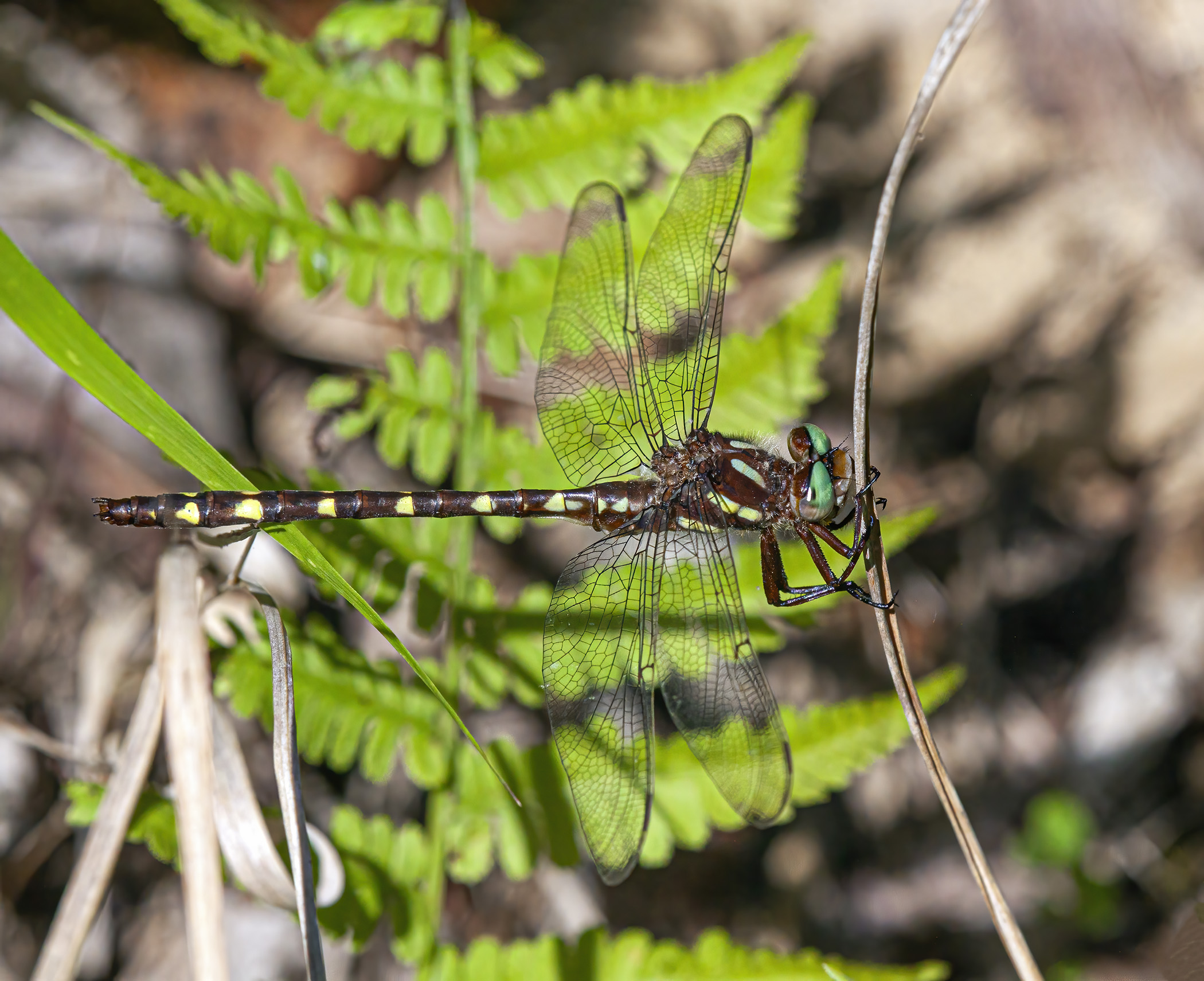
On Tuesday I was thrilled to spot this male Brown Spiketail dragonfly (Cordulegaster bilineata) while I was exploring a marshy area in Prince William County, Virginia. Spiketail dragonflies are quite rare in our area and this was the first one that I have spotted this year.

Brown Spiketails are found only in a specific type of habitat. According to the Dragonflies of Northern Virginia website, Brown Spiketails prefer “clean, small, sunlit, forest streams and seepages” and “perch often and low on grasses and shrubs in clearings, meadow edges and sunny forest edges.” As you can see from the background in these two images, the location where I found this dragonfly was full of ferns.

In case you are curious, spiketail dragonflies are so named because the long ovipositor of the female extends beyond the tip of the abdomen. The females lay their eggs by hovering over shallow water and driving the long ovipositor vertically into the shoreline mud or stream bottom in a fashion reminiscent of a sewing machine. Since these photos show a male, there is no “spike” to see for this spiketail.

I love the striking eyes of this dragonfly and the colorful markings his entire body and was happy to be able to capture such a detailed look at his beauty.


Brown Spiketail

Brown Spiketail

© Michael Q. Powell. All rights reserved.
Read Full Post »

On Saturday I spotted my first Spangled Skimmer dragonflies (Libellula cyanea) of the year at Occoquan Bay National Wildlife Refuge. It is remarkable easy to identify this species, because it is the only dragonfly in our area that has both black and white stigmata.

The stigmata, or pterostigmata, which is the more technical name, are the pigmented hollow structures on the leading edge of dragonfly wings. They are slightly heavier than the adjoining cells and have a significant effect on the aerodynamics of the wing, particularly while gliding, according to an article entitled “Dragonfly wings: tried and tested over millennia!” I confess that I don’t understand aerodynamics at all and look at dragonfly flight as nothing short of miraculous.

You may have noted that all the dragonflies in all three photos look pretty much the same, but the first two are male and the third is a female. Mature males are blue in color, but when they are young, the immature males share the brown and yellow coloration of the females. The easiest way to tell them apart is to look at the tip of the abdomen (the “tail”)—the terminal appendages of the two genders are quite different in appearance.

Spangled Skimmer

Spangled Skimmer

Spangled Skimmer

© Michael Q. Powell. All rights reserved.
Read Full Post »

I was busy this week, so I was not able to spend as much time out in nature as normally. The last two days, temperatures have soared well above normal to over 90 degrees (32 degrees C), so it has been really uncomfortable to spend much time outdoors. Later in the summer, my body will grow accustomed to the heat, but right now the high temperatures are unbearable.

I was able to make a short trip on Wednesday to Jackson Miles Abbott Wetland Refuge, a small nature preserve not far from where I live, and was delighted to spot this female Ashy Clubtail dragonfly (Phanogomphus lividus). Ashy Clubtails are an early spring species—they appear in April and are gone by June—and I have seen them several times already this year. Most of the ones I have spotted have been males, so it was a treat to be able to photograph a female.

Ashy Clubtails like low perches and often perch on the ground, where they often are camouflaged by the vegetation. In this case, the dragonfly perched a bit above ground level, so I was able to get a pretty good shot of her profile. It is probably my imagination, but it seems to me that she was glancing up at me and smiling a little as she posed for this portrait.

Ashy Clubtail

© Michael Q. Powell. All rights reserved.li

Read Full Post »

It is getting late in the season for Uhler’s Sundragon dragonflies (Helocordulia uhleri), so I was particularly happy when I spotted several of them last week while I was exploring a creek in Prince William County. Uhler’s Sundragons appear in early April and their flight period lasts for only a month or so, so it is always a challenge to find them and photograph them for the season.

Both of the dragonflies in the photos are males, judging by the appendages at the tips of their abdomens and their indented hind wings. I think that they are two separate individuals, but cannot be sure, since I spotted them in the same general area.

Some of you may have noticed that I did not do postings on Saturday and Sunday. I try to do a posting every day and during the past year “missed” only four days. I spent this past weekend in the mountains of Virginia at a church retreat and disconnected myself from the internet during that time. I had a wonderful time and feel uplifted emotionally and spiritually. After all of the covid-related travel limitations of the past two years, it felt good to get away and break out of my normal routine.

Uhler's Sundragon

Uhler's Sundragon

© Michael Q. Powell. All rights reserved.


Read Full Post »

Last Monday I was really excited to spot several male Stream Cruiser dragonflies (Didymops transversa), one of the early spring dragonflies that heretofore had eluded me this season. Stream Cruisers are habitat specialist, according to the Dragonflies of Northern Virginia website, and prefer “stable, small to medium, forest streams, with good flow and rocks. The best place to find them is hunting in sunlit meadows near their woodland waterways.”  That is am accurate description of the spot where I photographed these Stream Cruisers alongside a stream in Prince William County, Virginia.

I love the overall look of a Stream Cruiser, with its distinctive green eyes, its colorful markings, and its long, gangly legs. If you look closely at the first image, you can see that the dragonfly is holding onto both sides of the forked branch with its long legs. I marvel too at the way that the Stream Cruiser is hanging in the second and third images—the pose looks awkward and precarious, but somehow the acrobatic position worked for the dragonfly.

Stream Cruiser

Stream Cruiser

Stream Cruiser

© Michael Q. Powell. All rights reserved.


Read Full Post »

Every year I challenge myself by attempting to capture images of dragonflies in flight. Some dragonfly species help out by flying in somewhat predictable patterns or by hovering a bit, but it is still pretty tough to capture a tiny moving subject like a dragonfly.

This week I managed to photograph Common Baskettail dragonflies (Epitheca cynosura) in flight on two consecutive days at different locations using different lenses and techniques. Male Common Baskettails often patrol around the edges of small ponds in fairly limited areas. If you observe them long enough, you can get a general sense of the track that they are following.

For the first photo, I extended my Tamron 150-600mm lens to its maximum length and pre-focused on an open area that appeared to be part of the patrol route at a small pond at Occoquan Bay National Wildlife Refuge. My camera was on a monopod and when the dragonfly entered the target area, I would attempt to track it and focus the lens manually. It sounds pretty straightforward, but the hand-to-eye coordination required makes this approach quite daunting. However, as you can see in the first photo, it is possible to get a decent shot. If you click on the image, you can see lots of cool details, including the way that the dragonfly has folded up its legs under its thorax.

The next day I was exploring a small pond in Prince William County when I spotted a patrolling dragonfly—it was another male Common Baskettail. I had my Tamron 180mm macro lens on my camera and was not using a monopod. I was able to track the dragonfly a bit more freely with this lighter lens, which proved to be beneficial when the dragonfly deviated from its flight path. Once again I focused manually and was thrilled with the results I got in the second and third images below. I particularly like the way that I was able to capture some of the pond environment in the second shot, while managing to get the dragonfly in sharp focus.

Why do I use manual focus? My Canon 50D is a long in the tooth and has a relatively primitive focusing system with only nine focus points, which means that my camera can’t focus fast enough or accurately enough to shoot a dragonfly in mid-air. More modern camera have much faster and more sophisticated focusing systems and theoretically can produce better results. I saw a video recently, for example, in which a photographer was able to use animal eye focus on a moving dragonfly. Yikes! You pay a real premium, though, for that advanced technology, with camera bodies costing up to $5,000 and lenses up to $12,000.

I am not all that impressed by fancy camera gear and would rather focus on mastering the more modest gear that I have and spending as much time as I can out in the wild. In my mind, that recipe sets me up best to take advantage of the opportunities that arise as I wander about in nature.

Common Baskettail

Common Baskettail

Common Baskettail

© Michael Q. Powell. All rights reserved.


Read Full Post »

I was absolutely delighted yesterday to spot several colorful Calico Pennant dragonflies (Celithemis elisa) while I was exploring a pond at Occoquan Bay National Wildlife Refuge. There is something really special about dragonflies with patterns on their wings, and Calico Pennants have wonderfully intricate patterns on their wings, particularly on their hind wings.

Yesterday was our first sunny day in a week or so and the weekend had been unseasonably cold, so it felt especially good to be outdoors again. It is still early in the season for many dragonflies species, but I try to be diligent in searching areas where they might be present. Some days, like last Friday when I spotted the Lady’s Slipper orchids that I featured yesterday, I am not able to find any dragonflies at all, while other days my persistence pays off—that is the fate of a wildlife photographer.

Calico Pennant

Calico Pennant

Calico Pennant

© Michael Q. Powell. All rights reserved.

Read Full Post »

I spotted this Common Green Darner dragonfly (Anax junius) during a recent trip to Occoquan Bay National Wildlife Refuge. It was patrolling overhead within a fairly confined area and I was able to track it visually until it finally landed. The photo makes it look like the dragonfly was climbing its way out of a deep pit. In reality, however, it was hanging from some roots sticking out from a big pile of dirt.

I was a little surprised that I was able to capture as much detail as I did, given that I was shooting with my Tamron 150-600mm lens fully extended to 600mm. Supposedly the lens is soft at 600mm, but good stabilization techniques (including using a monopod) and a little tweaking with software produce images that are acceptably sharp to my eyes.

I love the multi-colored bodies of Common Green Darners, one of the largest dragonflies in our area with a body length of about 3 inches (76 mm). I think that this is a male. Mature males normally have bright blue abdomens, but they may turn purple when temperatures are low, which seemed to be the case when I took this photo. Females, by contrast, have abdomens that tend to be a mixture of tan and gray-green. For both genders, the thorax (the “chest” area) is bright green.

If you click on the image, you can get a better look at the dragonfly’s “bullseye” marking, the black and blue dot that is found on the “nose” of both male and female Common Green Darners. I am always thrilled when I manage to get a shot that captures the bullseye so well.

We are in the midst of a spell of cool, rainy weather so I have not seen any dragonflies in over a week. The weather is forecasted to warm up a bit, so I am hoping that I will have better success in the upcoming week.

Common Green Darner

© Michael Q. Powell. All rights reserved.
 

Read Full Post »

Common Whitetail dragonflies (Plathemis lydia) are probably the most common dragonflies in my area. They are among the first species to appear in the spring and among the last to be seen in the autumn and can be found in a variety of habitats. I photographed my first Common Whitetails of the season last week at Accotink Bay National Wildlife Refuge.

When they are adults, it is easy to distinguish the male Common Whitetails from the females—the males have white-blue abdomens and the females have brown abdomens. Immature males, however, have the same coloration as the females. If you look at the first two photos below, you can see that the coloration and markings on the two dragonflies is quite similar, but the first one is an immature male and the second one is a female.

For Common Whitetails, the first thing I do is to look at the pattern of dark patches on the clear wings. Males have two patches per wing and females have three, including one that extends to the wingtip. This is really easy to see in the first two photos, because the dragonflies were perched above the ground.

Quite often, though, Common Whitetails will perch flat on the ground in the leaf litter, as in the third photo, and it is a little tougher to see the wing markings. As long as you can see a clear wingtip, however, you can tell that it is a male.

There are, of course, other ways to tell the gender of a Common Whitetail, if you can’t see the wings. If you look really closely at the tips of the abdomen (the “tail”), for example, you can see that they are shaped differently—the male’s terminal appendages are more tapered, while the female’s are more stubby in appearance.

I don’t consider myself an expert in dragonflies and my background is not in science, but I have learned about these colorful aerial acrobats over the last ten years of photographing them. Folks sometimes ask me how I can tell the gender of a dragonfly and I think it cool to be able to explain what is going on in my mind when I am trying to figure out what I have photographed. This is especially true when I have photos that show both the male and female of a species, as was the case with these Common Whitetail dragonflies.

Common Whitetail

Common Whitetail

Common Whitetail

© Michael Q. Powell. All rights reserved.
Read Full Post »

I was tracking a Common Green Darner dragonfly (Anax junius) in my viewfinder yesterday at Occoquan Regional Park, when suddenly another dragonfly flew into the frame. The two dragonflies appeared to hook up in mid-air and I assumed that they were mating. When they landed in some nearby vegetation, however, I discovered that it was hunger and not lust that had brought them together. The Common Green Darner was having lunch with a Common Whitetail dragonfly (Plathemis lydia), and it was the main course.

Dragonflies feed on other live insects and they aren’t picky eaters—they will eat any insect they can catch, including other dragonflies. Midges and mosquitoes make up the bulk of their diet, but dragonflies also prey on flies, bees, beetles, moths, butterflies, and other flying insects. The larger the dragonfly, the larger the prey insect it can consume.

As you can see from the photo, Common Green Darners are quite large, with an overall length of approximately three inches (76 mm), while Common Whitetails are considerably smaller, with an overall length of approximately 1.7 inches (43 mm).

Common Green Darners are really powerful fliers too and are one of only a handful of dragonfly species that migrate. The adult Common Green Darners that I see this early in the season are likely to be migrants from locations further south. Kevin Munroe described their migration really well on the wonderful Dragonflies of Northern Virginia website:

“They emerge in the Southeast and fly north, arriving here late March thru May. After their long flight, they mate, lay eggs and die. Their young emerge in July and August. Congregating in large swarms, this second generation begins flying south in September. They lay eggs that fall, after arriving in their southern destinations, and die. When their young hatch in March, they fly back to N. VA and it starts again – a two generation migration.”

The Common Whitetail in the photo probably emerged only recently and may have been particularly vulnerable. Some may find this photo to be a little disturbing or a bit too graphic, but I think it shows the “circle of life” in nature. Yesterday the Common Green Darner was the predator, but tomorrow it could become the prey of a bird or some other creature higher up on the food chain—all creatures have to eat.


Common Green Darner

© Michael Q. Powell. All rights reserved.

Read Full Post »

When the dragonfly season first starts, I am content to get a record shot of each species, which is to say that I am looking primarily to document the species and am not all that concerned about the quality of the initial images or their artistic merits. After the first excitement dies down, I try to get better and better images and one of the things that I often try to do is to photograph males and females of each species.

How do you tell the gender of a dragonfly? In some dragonfly species, the mature males and females have different colors and are easy to tell apart. However, quite often immature males have the same coloration as the females, so color alone is rarely a reliable marker. I have found that the best way to determine the gender is to look at the tips of the abdomen (the “tail”)—I won’t go into the details of dragonfly anatomy, but suffice it to say that the males and females have different shapes in this area so they can fit together for mating.

Over the last two weeks I have had several encounters with Uhler’s Sundragon dragonflies (Helocordulia uhleri) and was able to get shots of both a male and a female. The dragonfly in the first image is a female. I can tell its gender by the shape of the “terminal appendages” and also by the curved shape of the hind wings where they join the body.

If you look closely at the second image, which is a shot of a male, you can see that the lower portion of the abdomen is slightly enlarged—the abdomen is more uniformly shaped with a female—and the shape of the tip of the abdomen is different. You might also notice that the shape of the hind wings is “indented” where they meet the body, unlike the smooth curves of the female.

With some species, you can find the males and the females in the same area, so it is not hard to get shots of both genders. However, with other species, the females hang out in separate areas and do not mingle with the males until the females decide it is time for mating, which forces me to search a much wider area to photograph males and females.

I apologize if I got a little “geeky” in this posting. I am a little obsessed with dragonflies and am endlessly fascinated by them, so it is easy for me to get a little lost in the details.

female Uhler's Sundragon

male Uhler's Sundragon

© Michael Q. Powell. All rights reserved.

Read Full Post »

As I was wandering about on Friday in Prince William County, a dragonfly zoomed by me and perched on some nearby vegetation. At the time I took the shots, I had no idea what it was because of the poor lighting. I was able to capture a few images and when I opened them on my computer I was delighted to discover that I had photographed a beautiful female Stream Cruiser dragonfly (Didymops transversa).

This was the first live Stream Cruiser dragonfly that I have photographed this spring. A week earlier I stumbled upon a Stream Cruiser that had had some unspecified problem in emerging and was dead, as shown in the second photo. Dragonflies are extremely vulnerable when they are emerging and unfavorable weather conditions and predators  almost certainly lower their survival rate. Given the magnitude of their remarkable metamorphosis, it seems remarkable to me that any of them can survive.

My experience with the Stream Cruiser in the first photo reminds me of the importance of being constantly vigilant. I was walking down a hill, headed towards a stream, when I glanced to the side and saw the flying dragonfly. I made a quick 180 degree turn and tracked the dragonfly as it landed. I took two steps forward and and had time to snap off only a few photos and that was it.

Fortunately I had my camera settings were somewhat appropriate and I was able to react quickly. As is often the case with wildlife photography, those two factors were key to capturing a shot. If the circumstances had been different, I might have been able to get a better image, but I am pretty happy with the image I captured. Needless to say, success is not guaranteed—I have plenty of stories from that day of the ones that got away.

Stream Cruiser

Stream Cruiser

© Michael Q. Powell. All rights reserved.

Read Full Post »

Ashy Clubtail dragonflies (Phanogomphus lividus) like to perch on the ground, which makes them really difficult to spot. Fortunately I saw these two dragonflies land last Friday during separate encounters in Prince William County and was able to get close enough and low enough to photograph them. If I had not seen them move, I probably would not have been able to detect them.

Both dragonflies had really shiny wings, an indication that they had emerged fairly recently. Initially the wings are fragile when a dragonfly emerges and they are folded above its head. The dragonfly gradually pumps fluid through the veins of the wings and they progressively harden and pop open into the normal outstretched resting position. Sometimes, as you can see in the final photo, a dragonfly will temporarily hold its wings closed over its head in their former position.

Dragonfly metamorphosis is a fascinating phenomenon, a remarkable transformation of a water-dwelling larva into an incredible aerial acrobat. Several years ago I managed to witness the entire process with a Common Sanddragon dragonfly and documented the thirty-minute process in a blog posting entitled Metamorphosis of a dragonfly. Be sure to check out that posting to see photos of the different stages of the amazing transformation.

Ashy Clubtail

Ashy Clubtail

Ashy Clubtail

© Michael Q. Powell. All rights reserved.

Read Full Post »

« Newer Posts - Older Posts »