Feeds:
Posts
Comments

Archive for the ‘Dragonflies’ Category

I just love the beautiful blue eyes and distinctive markings of the male Great Spreadwing damselfly (Archilestes grandis) and I was thrilled when I spotted one on Saturday at Huntley Meadows Park in Alexandria, Virginia.

I wonder if it damages this little guy’s self-esteem to be called a “damsel?” Perhaps he looks with envy at his odonate brethren with the more macho-sounding “dragon” in their names. Do we need a more gender-neutral name for damselflies?

Great Spreadwing damselfly

© Michael Q. Powell. All rights reserved.

Read Full Post »

What’s the largest damselfly in North American? According to Dennis Paulson, in his wonderful book, Dragonflies and Damselflies of the East, that title goes to the Great Spreadwing damselfly (Archilestes grandis), which is more than two inches (5 cm) in length, i.e. bigger than many of the dragonflies that I so frequently chase.

My good friend and local dragonfly expert Walter Sanford spotted a male Great Spreadwing this past week and posted a photo of it and yesterday I felt inspired to try to find one myself. He had provided me the general location at Huntley Meadows Park, my favorite local place for nature photography, and I patiently searched near the water, in the tall vegetation, and under the trees for almost two hours.

As my patience was starting to wear thin, I finally spotted one. The Great Spreadwing damselflies have a yellow racing stripe on their thorax and are quite distinctive, in addition to their size. I took some initial shots with my big zoom lens and then switched quickly to my 180mm macro lens.

The first Great Spreadwing I spotted was a male, but eventually I spotted a female and a pair of them in the tandem position. I am still going through my shots, but wanted to post a couple initially. I will probably post some more images in another posting or two.

The first shot shows a female Great Spreadwing damselfly—you can tell from her coloration and her terminal appendages. She let me take quite a few photos and returned to nearby vegetation a couple of times when she was spooked. The second image is a close-up that shows her beautiful eyes and her blue upper lips, which I think technically are called labrum.

Perhaps blue lips are the new fashion craze for the autumn. I’ll look around and see if any of the young ladies in the Washington D.C. area are sporting this look.

Great Spreadwing damselfly

spread2_female_blog

© Michael Q. Powell. All rights reserved.

Read Full Post »

I have been seeing Common Green Darner dragonflies (Anax junius) hunting high over the fields the last couple of weeks as they prepare for migration, but have not been able to get any shots of them. In theory, they are easier to photograph when they land, but these dragonflies like to hang vertically low to the ground, often in areas with heavy vegetation. I have been repeated frustrated by spotting them only after they have taken to the air as I got close to them.

This past Friday, though, I saw one land nearby when I was already in a field of waist-high vegetation. Judging from the blue abdomen, it’s a male Common Green Darner. I was struck by the relatively dark color of much of the abdomen of this particular individual. When doing a little research at my favorite website for local dragonflies, dragonfliesnva.com, I learned that Common Green Darners deal with the problem of cool weather “by having dark-colored platelets in their blood that rise to the surface when it’s cold, darkening their abdomen color, therefore attracting more sun. On bright, hot days, those dark platelets sink, and the abdomen turns bright bluagain, now reflecting light.”

The dragonfly was surrounded by dried vegetation and there was no way that I could get an uncluttered background for my shots. Fortunately, however, the the colors of the vegetation are so muted that the gorgeous blue and green of the dragonfly really stand out. In the first shot, I zoomed all the way to try to capture the maximum amount of detail, while in the second shot I pulled back a little on the zoom to capture the dragonfly’s entire wingspan.

Common Green Darner

Common Green Darner

© Michael Q. Powell. All rights reserved.

Read Full Post »

We usually think of springtime as the season of love, but apparently autumn is also a good season if you are a damselfly. I don’t know what was so special about this one plant sticking out of the water, but mating damselfly couples seemed to be competing for a spot to land and deposit their eggs on it this past Monday at Huntley Meadows Park in Alexandria, Virginia.

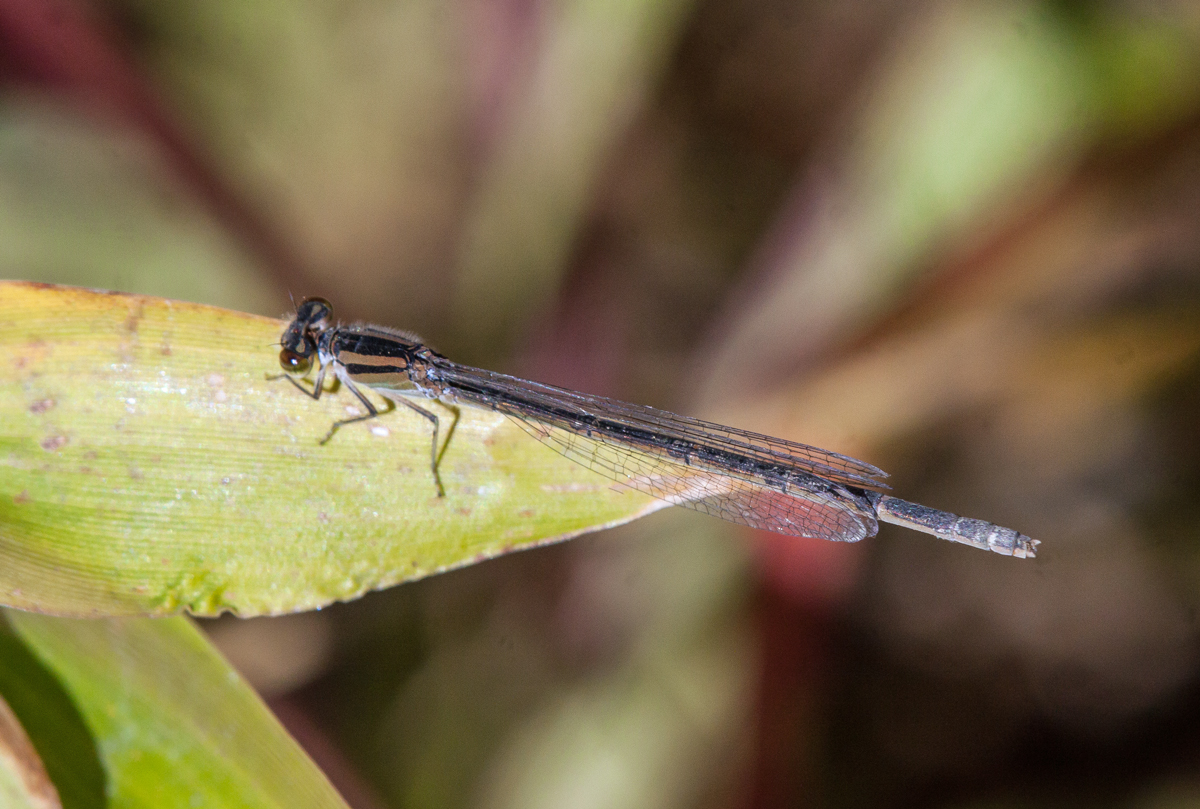
I’m no expert when it comes to identifying damselflies, in part because so many different species have similar patterns of black and blue, but I think these couples, all in the tandem position, may be Big Bluets (Enallagma durum). I’d welcome any corrections or confirmation of my initial identification.

UPDATE:  My local odonate expert, Walter Sanford, weighed in with a correction to my identification—these damselflies are Familiar Bluets (Enallagma civile), not Great Bluets. When it comes to my initial identification, you might say that I blew it.

For those who might be curious about the technical aspects of the photo, I took this with my Canon 50D at 600mm on my Tamron 150-600mm lens, which is the equivalent of 960mm when you take into account the crop sensor of my camera. I continue to be pleased with the amount of detail that I can capture with the relatively affordable long lens, even when it’s extended to its maximum length. If you click on the image, you can see even more of those wonderful details.

mating damselflies

© Michael Q. Powell. All rights reserved.

Read Full Post »

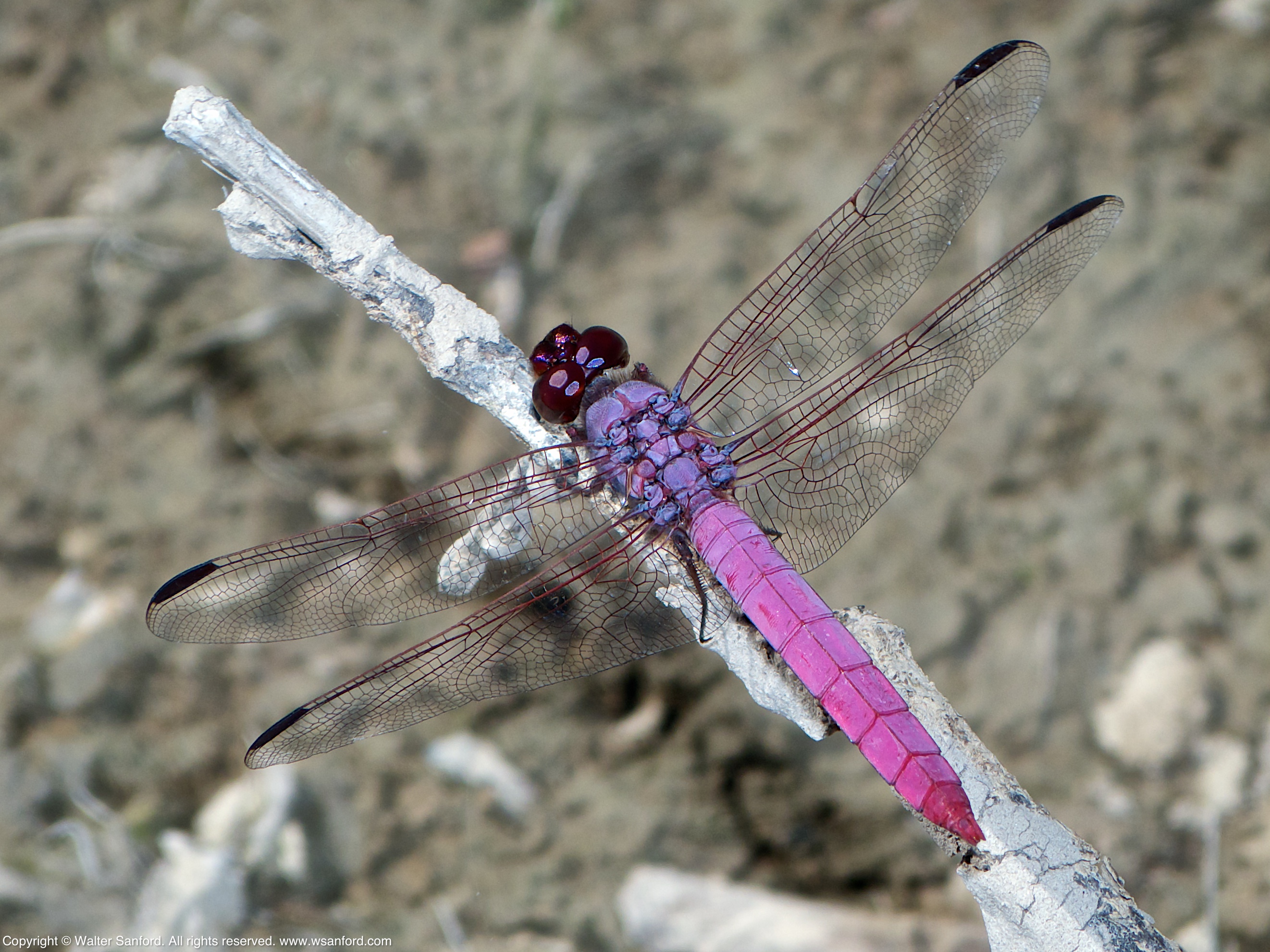
A pink dragonfly? Fellow photographer and good friend Walter Sanford was not hallucinating when he recently spotted this Roseate Skimmer dragonfly at Huntley Meadows Park, one of only a small handful of sightings ever of this species in Virginia.

He spotted one last year too, but this year managed to capture a wonderful series of images of this beauty. Be sure to check out his original posting as well as other spectacular images on his blog.

waltersanford's avatarwalter sanford's photoblog

Breaking news: I discovered a new species of dragonfly at Huntley Meadows Park — a Roseate Skimmer dragonfly (Orthemis ferruginea). This is the first official record of Orthemis ferruginea in Fairfax County, Virginia.

Actually, I discovered this species last year but was unable to shoot a photo to prove I wasn’t hallucinating pink dragonflies! On 10 September 2014, I spotted a male Roseate Skimmer that made one patrol around a pool near an old beaver lodge (one that overlapped the boardwalk that goes through the central wetland area), landed for one second (no kidding) and flew upstream along Barnyard Run; I never saw it again. This year, I have photographic proof.

This individual is a male, as indicated by its coloration and terminal appendages.

A Roseate Skimmer dragonfly (Orthemis ferruginea) spotted at Huntley Meadows Park, Fairfax County, Virginia USA. This individual is a male. 23 SEP 2015 | Huntley Meadows Park | Roseate Skimmer (male)

Dig that crazy metallic purple face!

A Roseate Skimmer dragonfly (Orthemis ferruginea) spotted at Huntley Meadows Park, Fairfax County, Virginia USA. This individual is a male. 23 SEP 2015 | Huntley Meadows Park | Roseate…

View original post 272 more words

Read Full Post »

The autumnal equinox arrived yesterday, marking another change of seasons. I love the autumn, but there is something a little wistful about it, as so many of the bright summer colors begin to fade and the leaves dry out and fall off of the trees. Somehow for me it is a reminder of the inexorable passage of time and of the fragility of life.

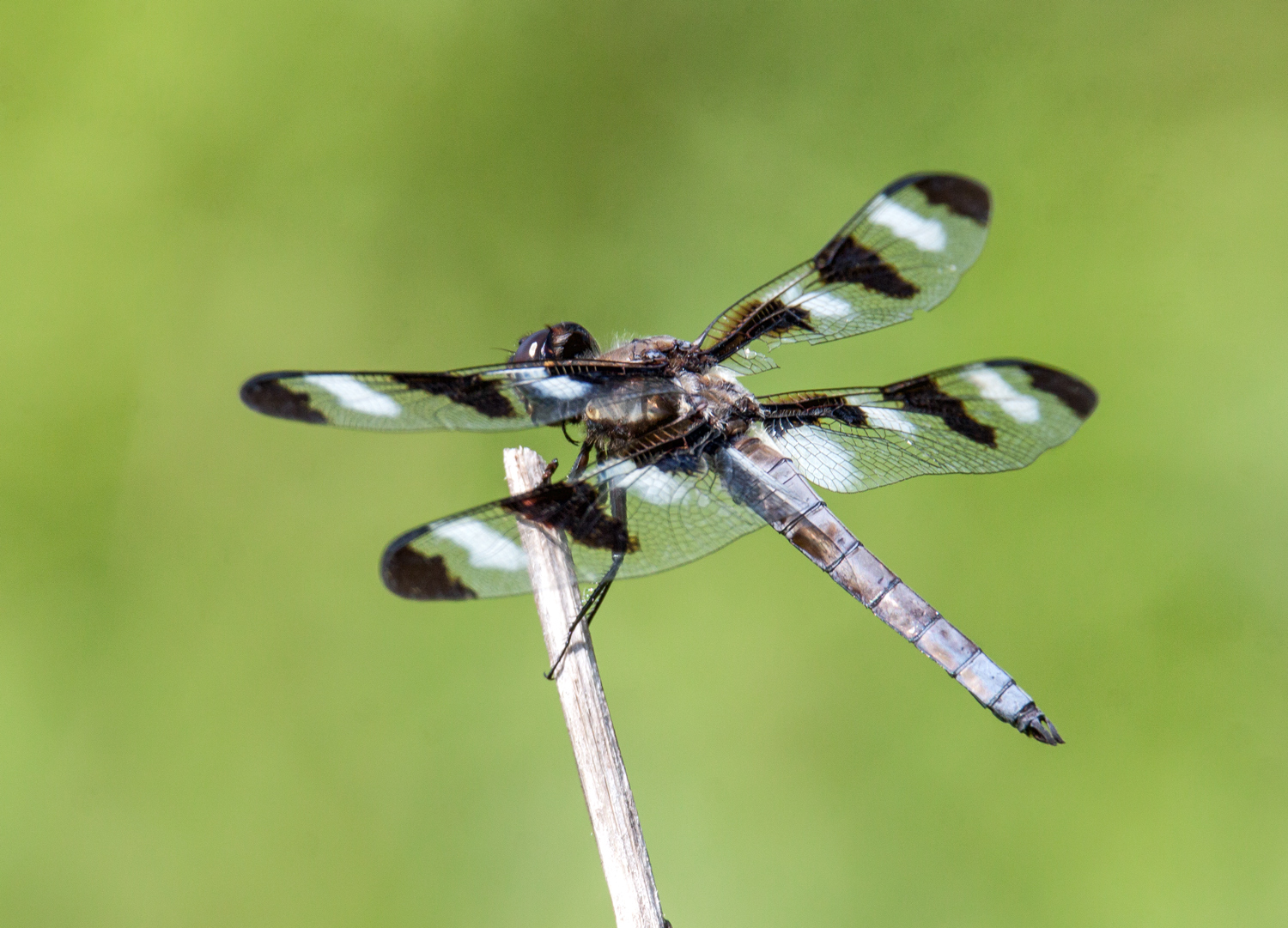
Earlier this week I saw a faded male Twelve-spotted Skimmer dragonfly (Libellula pulchella) that put me in a pensive mood, remembering how this boldly-patterned species really stood out in the spring. Now he has has almost become a part of the background, less notable, less distinctive, less likely to attract attention.

How many of us are like that? Our society worships youthful beauty and older people are often pushed out of the spotlight in favor of unblemished youths. It’s nice to have memories of the way we were, remembering our youthful beauty and capabilities, but I think it’s important to celebrate who we are and who we are becoming.

So here’s a look at that male Twelve-spotted Skimmer and a female Twelve-Spotted Skimmer that I observed last week. Wouldn’t you agree that they are still beautiful despite (or perhaps because of) their senior citizen status.

Twelve-spotted Skimmer

Twelve-spotted Skimmer

© Michael Q. Powell. All rights reserved.

Read Full Post »

What’s your most challenging subject as a photographer? Do you chase the perfect lighting for your landscape photos or pursue the decisive moment in your street shots or wait endlessly for an elusive creature to appear?

At least several times a year, I will attempt to photograph dragonflies in flight. Dragonflies are small, fast, and agile. Some of them seem utterly unpredictable and almost impossible to track or fly high in the air, out of range of even long telephoto lenses.

What’s an ideal scenario? In the best of all worlds, I would like to find a dragonfly that flies a repeated route, such as patrolling a portion of a stream, and periodically hovers at my eye level or below.

Yesterday I spotted a dragonfly as I was following a stream in a remote part of my favorite marshland park. The dragonfly would hover for a while and then move a short distance away and hover again.

I was pretty excited as I put my camera to my eye and tried to find the dragonfly in the viewfinder. With my zoom lens extended to 600mm, it’s a little like looking through a straw—there is a pretty limited field of view. I set my focus to manual mode, having learned in the past that it is almost impossible for me to gain and hold focus on small moving subjects in auto mode. One of the challenges of the Tamron 150-600mm lens is that the focus ring is at the back of the lens near the lens mount, which means that it is tough to hold the lens steady and focus manually.

The dragonfly was cooperative and gave me a number of chances before it flew away. When the magical moments ended, I looked at a few of my images on the back of my camera and couldn’t immediately identify the dragonfly. Initially I thought it was a Mocha Emerald, like the one that I seen near that same location earlier in September, but the coloration and body shape was all wrong. Once I got home, I did a little research and figured out that I had photographed a Shadow Darner (Aeshna umbrosa), a call confirmed by local dragonfly expert Walter Sanford.

I am pretty happy with these shots. I know that I was lucky to see this dragonfly, but I also know that the hours and hours that I have spent shooting with this camera and lens helped me to take advantage of the situation. A combination of luck, patience, and a bit of skill—it sounds like a good recipe for handling your most challenging subjects as a photographer.

Shadow Darner

Shadow Darner

© Michael Q. Powell. All rights reserved.

Read Full Post »

How was your summer? Did you take a vacation and relax or at least take some time off from work?

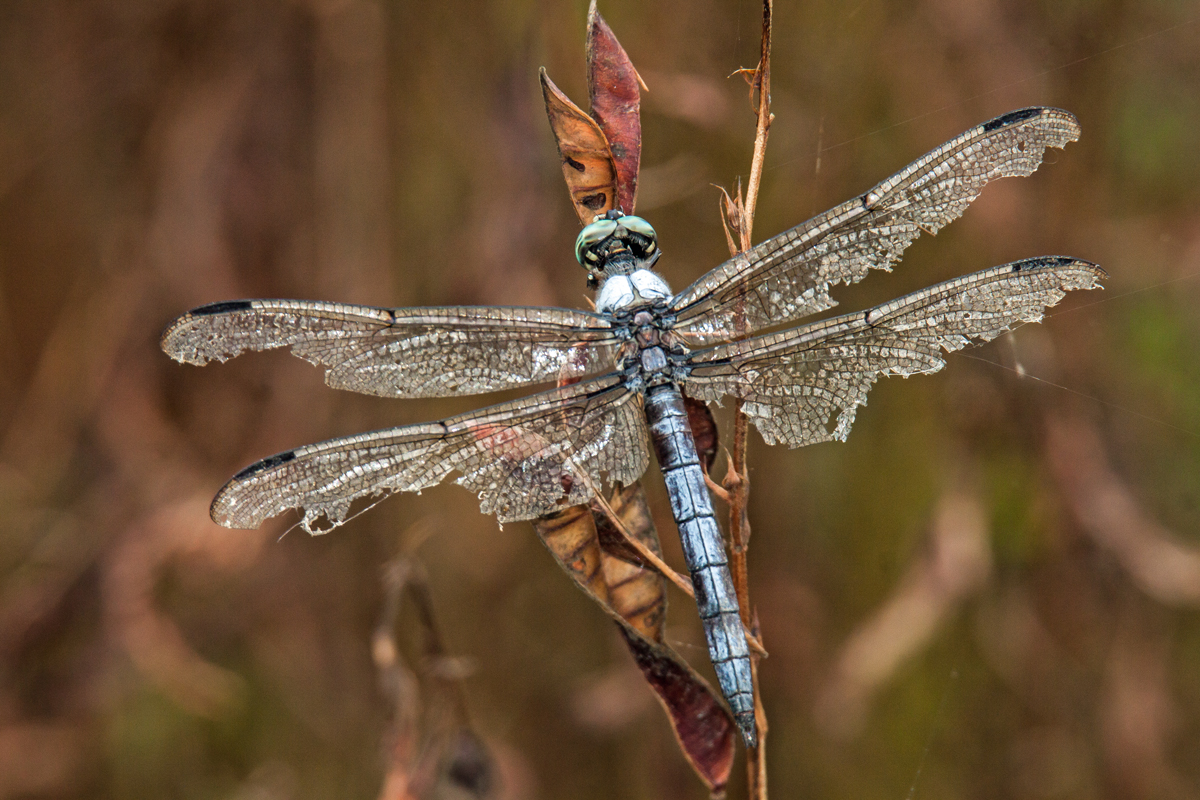
There are no vacations for dragonflies. It looks like this has been a long, hard summer for the male Great Blue Skimmer (Libellula vibrans) that I spotted earlier this month, judging from the almost shredded condition of his wings. Yet somehow, he is still able to fly and continues to survive

Autumn is almost upon us and the number of dragonflies that I observe is dropping. Before long, only a few hardy species will remain. For now, I take joy in seeing the tattered survivors, whose beauty is undiminished in my eyes.

Great Blue Skimmer

© Michael Q. Powell. All rights reserved.

Read Full Post »

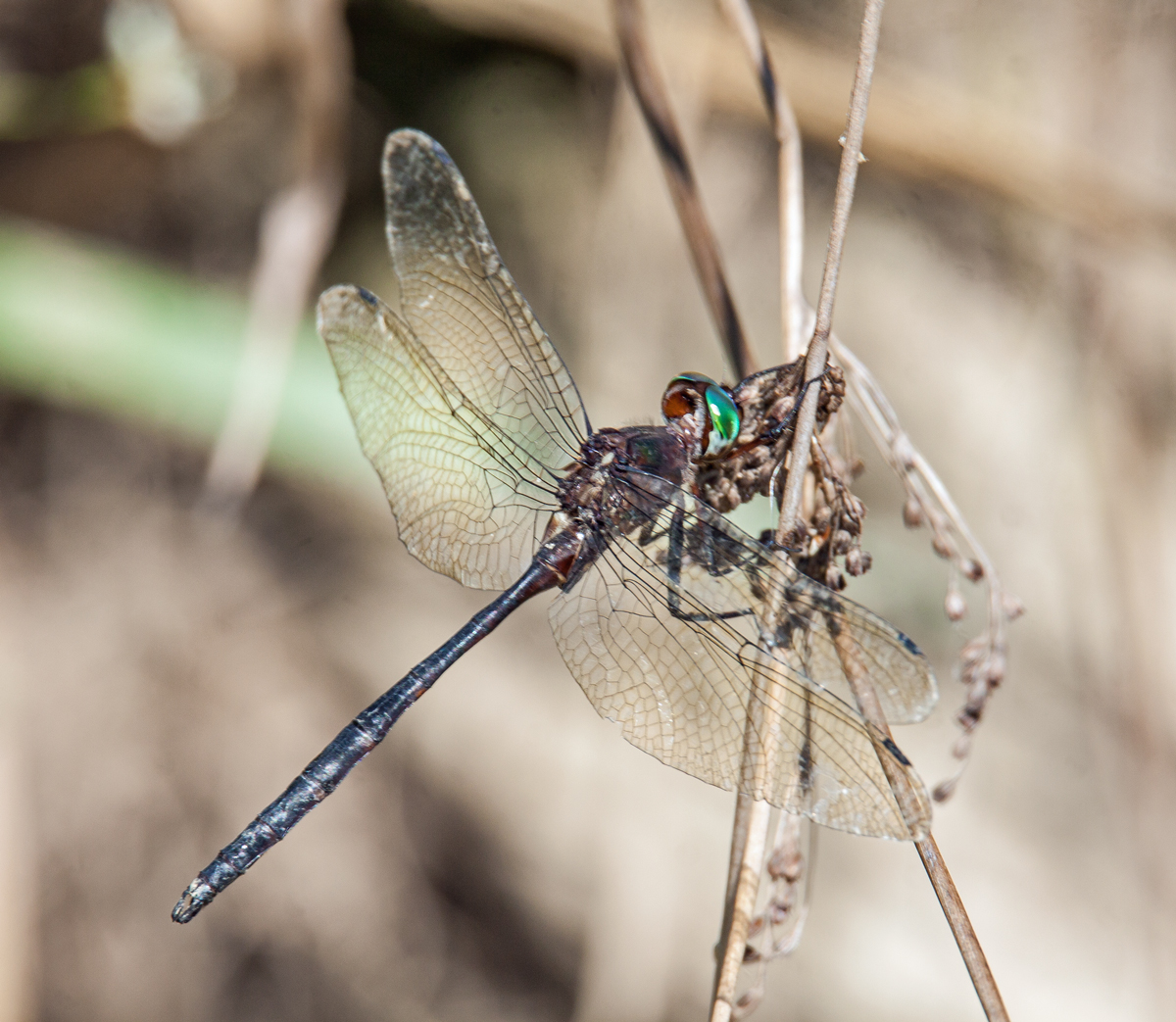
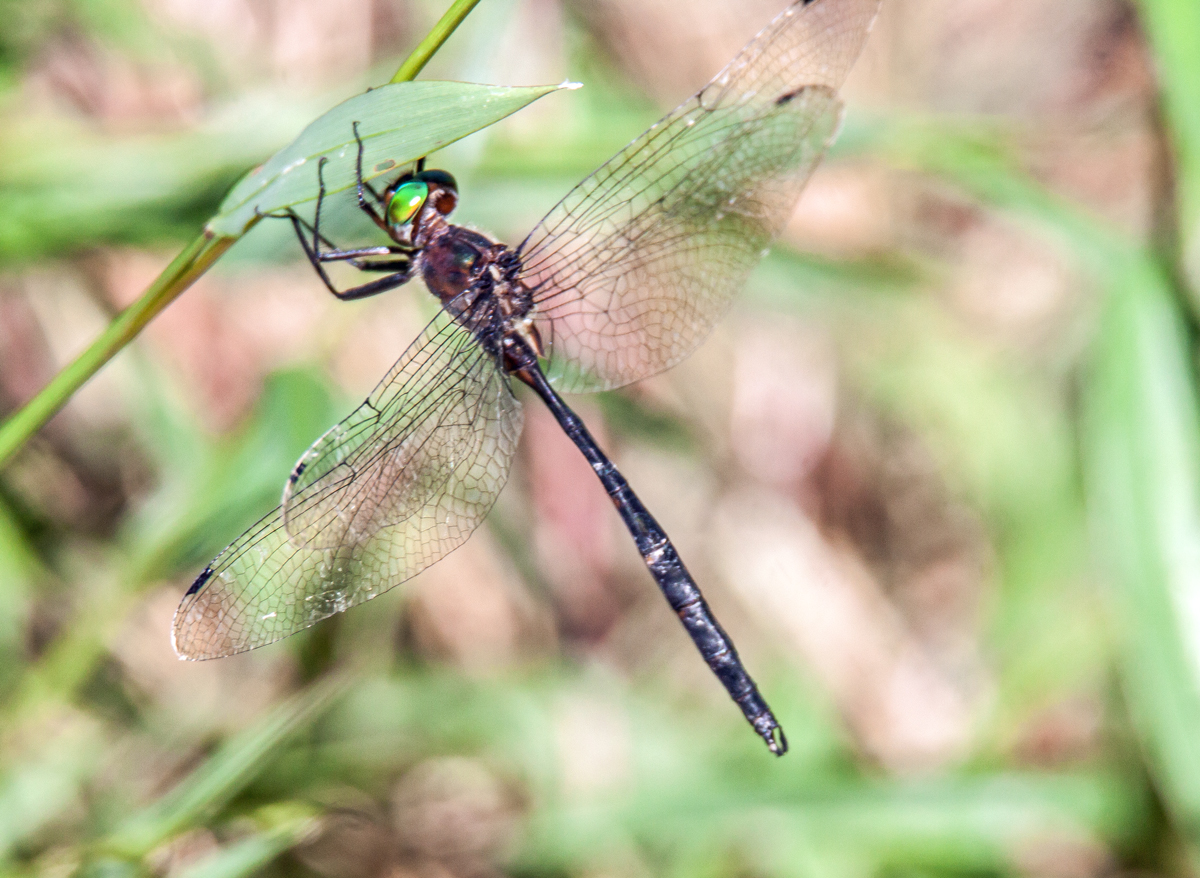
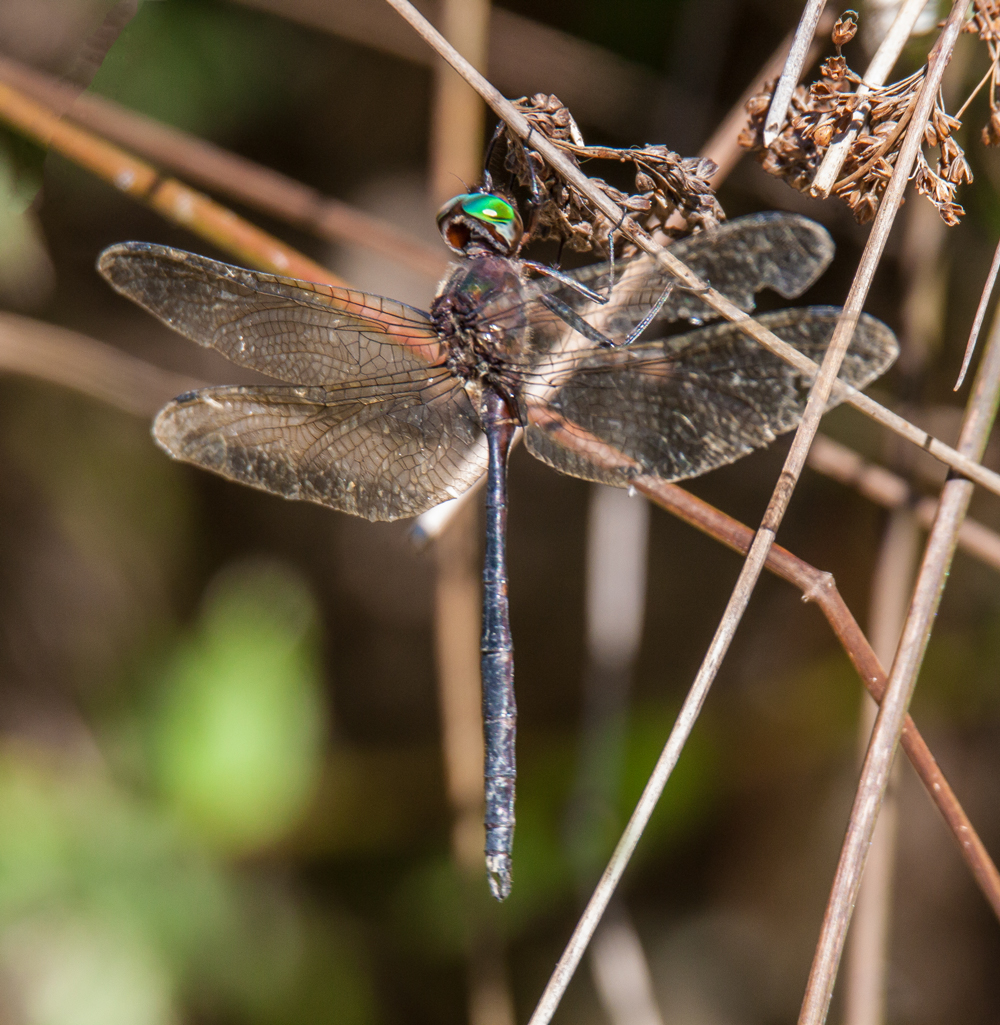
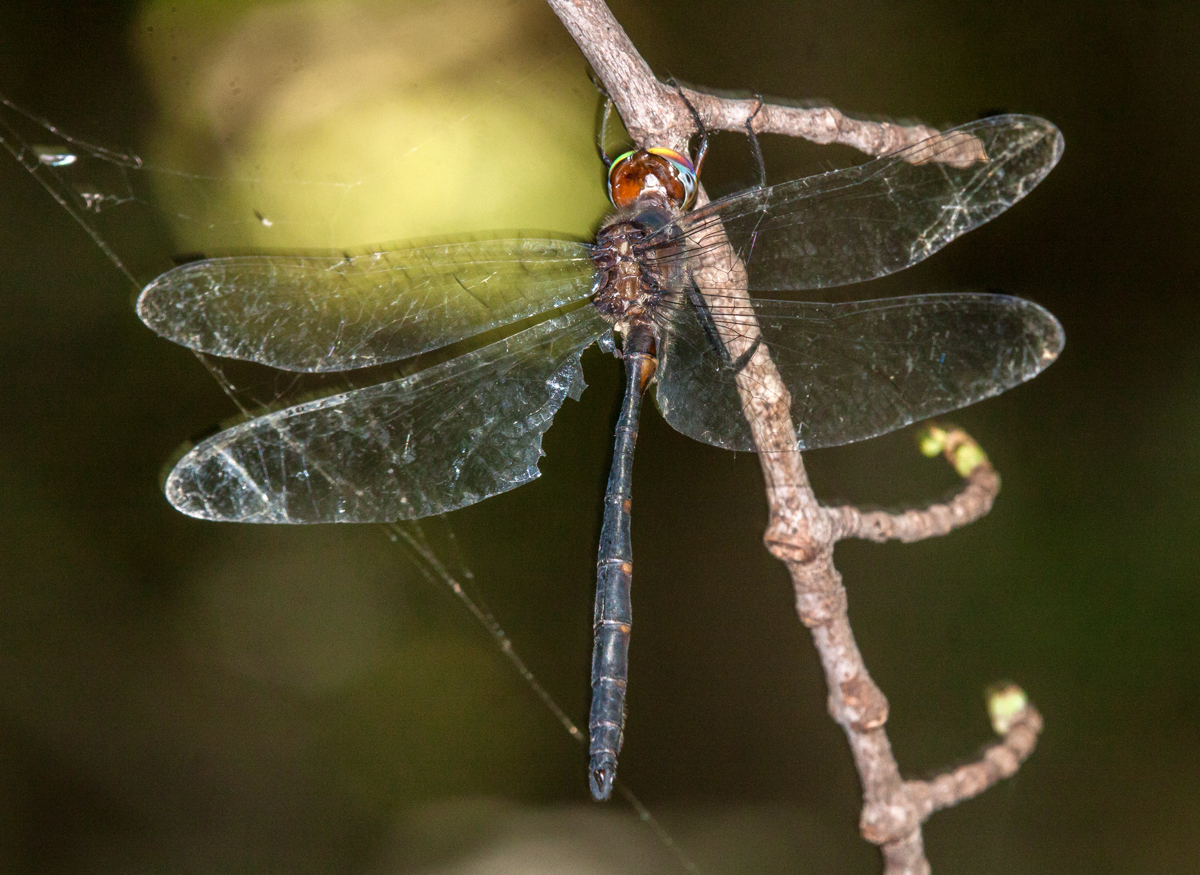
Yesterday I spotted this male Mocha Emerald dragonfly (Somatochlora linearis) while exploring one of the streams at Huntley Meadows Park and was struck again by the way this species perches vertically, rather than horizontally like so many of the other dragonflies that I see.

The words of the old Supremes song come to mind, “You keep me hangin’ on…” and now that song is stuck in my head. On the off chance that one of my readers has never heard that song (and I can’t believe that is possible), here’s a link to a really old video of the Supremes performing the song.

Mocha Emerald dragonfly

© Michael Q. Powell. All rights reserved.

Read Full Post »
Unlike Pumpkin Spice, Mocha Emerald is not a fall Starbucks flavor—it is a cool-looking dragonfly species that I was excited to spot yesterday at my favorite marshland park.

Mocha Emerald

Every other time that I have observed a Mocha Emerald (Somatochlora linearis), the dragonfly has been perched in the shadows, so I was surprised yesterday to see one in full daylight. This Mocha Emerald, which looks to be a male seemed to be patrolling a stretch of a small stream. Occasionally it would stop to rest and perch vertically on vegetation sticking out low from the bank of the stream.

Getting a decent shot of the Mocha Emerald was quite a challenge. My camera’s auto focus had trouble fixing focus on the dragonfly’s long thin body so I had to focus manually; there was a breeze that was blowing that caused the dragonfly to swing in and out of my field of view as I looked through the viewfinder; and the background tended to be really cluttered.

The first shot is my favorite, because I was able to isolate the dragonfly by hanging over the stream (and almost falling in), although the other shots show some of the details of its body better.

Maybe there should be a Mocha Emerald latte, perhaps for Saint Patrick’s Day—I would be thrilled if it supplanted the green beer that still makes an appearance at some locations.

Mocha Emerald

Mocha Emerald

Mocha Emerald

© Michael Q. Powell. All rights reserved.

Read Full Post »

“Blue eyes
Baby’s got blue eyes
Like a deep blue sea
On a blue blue day”

Somehow the words to the old Elton John song come to mind when I gaze into the stunning blue eyes of this Blue-faced Meadowhawk (Sympetrum ambiguum). This dragonfly was unusually cooperative and let me move in to take this close-up portrait with my macro lens.

Blue-faced Meadowhawk

If you have never heard “Blue Eyes” or just want a blast from the past, here’s a link to a YouTube video of Elton John performing the song.

© Michael Q. Powell. All rights reserved.


Read Full Post »

What signs do you look for that point to the change of seasons? Throughout most of my life, the changing colors of the fall foliage have been the primary indicator of the end of summer and the beginning of autumn.

The last few years, however, I have become increasingly sensitive to seasonal changes in the dragonfly population as I have increasingly focused my attention and my camera lens on these fascinating and colorful aerial acrobats. Summer is prime time for many dragonfly species, but certain species show up much later in the season and stay with us throughout much of the autumn days.

One of these late-arriving species is the Blue-faced Meadowhawk (Sympetrum ambiguum) and I was thrilled yesterday to spot a male of this species at Huntley Meadows Park, the marshland where I take a lot of my wildlife photos. This is my first spotting of a Blue-faced Meadowhawk this season and I suspect it won’t be long before I also start seeing his “cousin,” the Autumn Meadowhawk (Sympetrum vicinum).

I particularly like the bright red color and bold pattern of this dragonfly’s body and its beautiful turquoise face. Although I may vacillate a bit from time to time, I think this is the most beautiful dragonfly species that I have ever encountered. What do you think?

Blue-faced Meadowhawk

© Michael Q. Powell. All rights reserved.

Read Full Post »

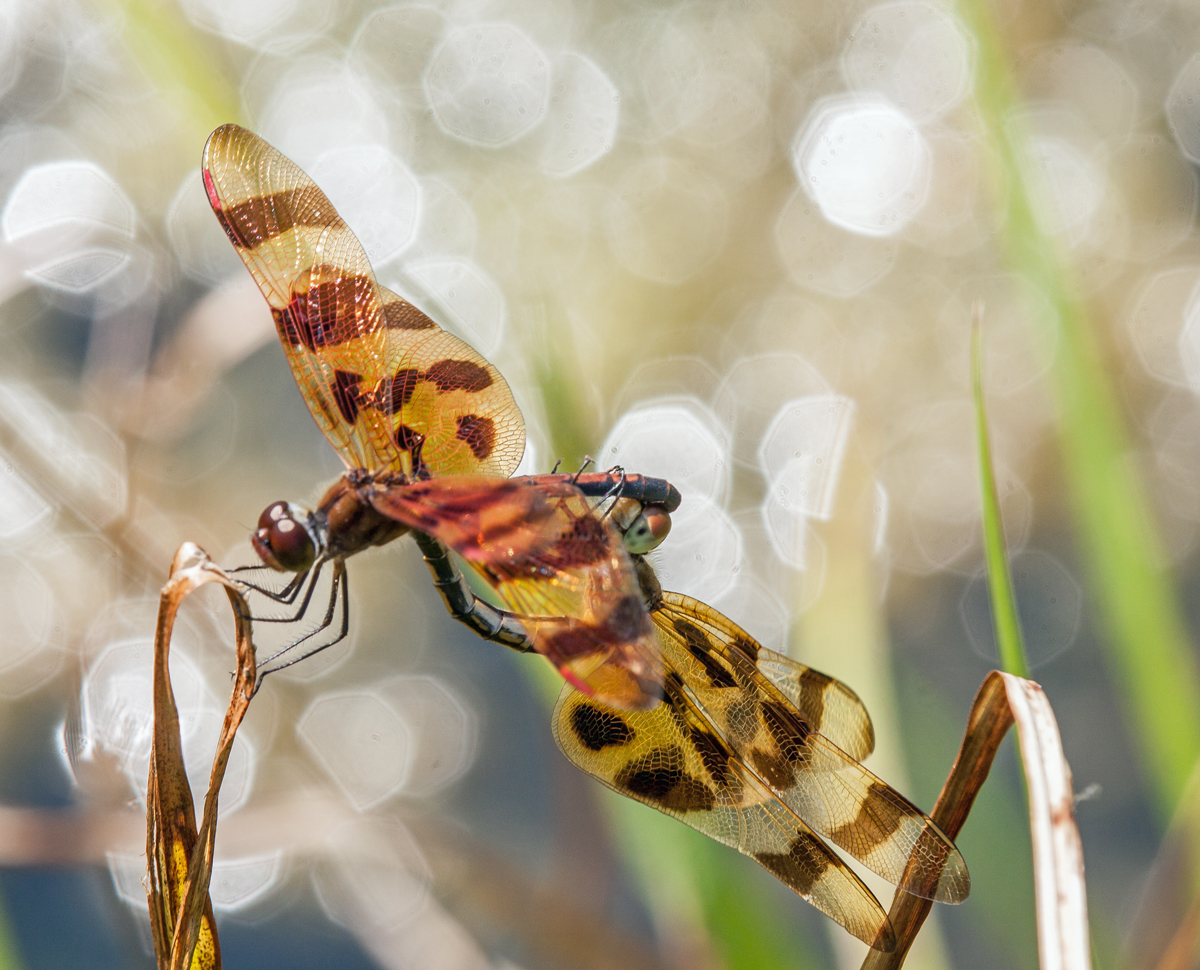
Summer days are drifting away and the biological clocks are almost certainly ticking loudly for some dragonflies. This past weekend at Meadowlark Botanical Gardens in Vienna Virginia, I spotted these two Halloween Pennant dragonflies (Celithemis eponina) engaged in a little summer loving.

It’s hard not to feel a little bit like a voyeur as I move in closer to photograph the acrobatic intertwining of the tiny dragonfly bodies. Summer loving happens so fast and soon my colorful little friends will be gone for the season,

Halloween Pennant

Halloween Pennant

© Michael Q. Powell. All rights reserved.

Read Full Post »

One of the highlights for me of a short visit yesterday to Meadowlark Botanical Gardens in Vienna, Virginia was spotting this spectacular dragonfly, which I think is a female Banded Pennant (Celithemis fasciata).

Earlier this summer, I spotted a male Banded Pennant, whose body was blue, but the coloration of this one suggests to me that it is a female. The dragonfly was perched on the highest branches of a small tree, which allowed me to isolate it against the beautiful blue sky. You may notice that the branches are different in the two photos—the dragonfly flew away a few times, but returned to the same tree a short time later.

CORRECTION: My initial identification was incorrect. My local dragonfly expert, Walter Sanford, with whom I neglected to consult in advance, provided a correct identification. This is a female Halloween Pennant (Celithemis eponina), not a Banded Pennant.


Banded Pennant

Banded Pennant

© Michael Q. Powell. All rights reserved.

Read Full Post »

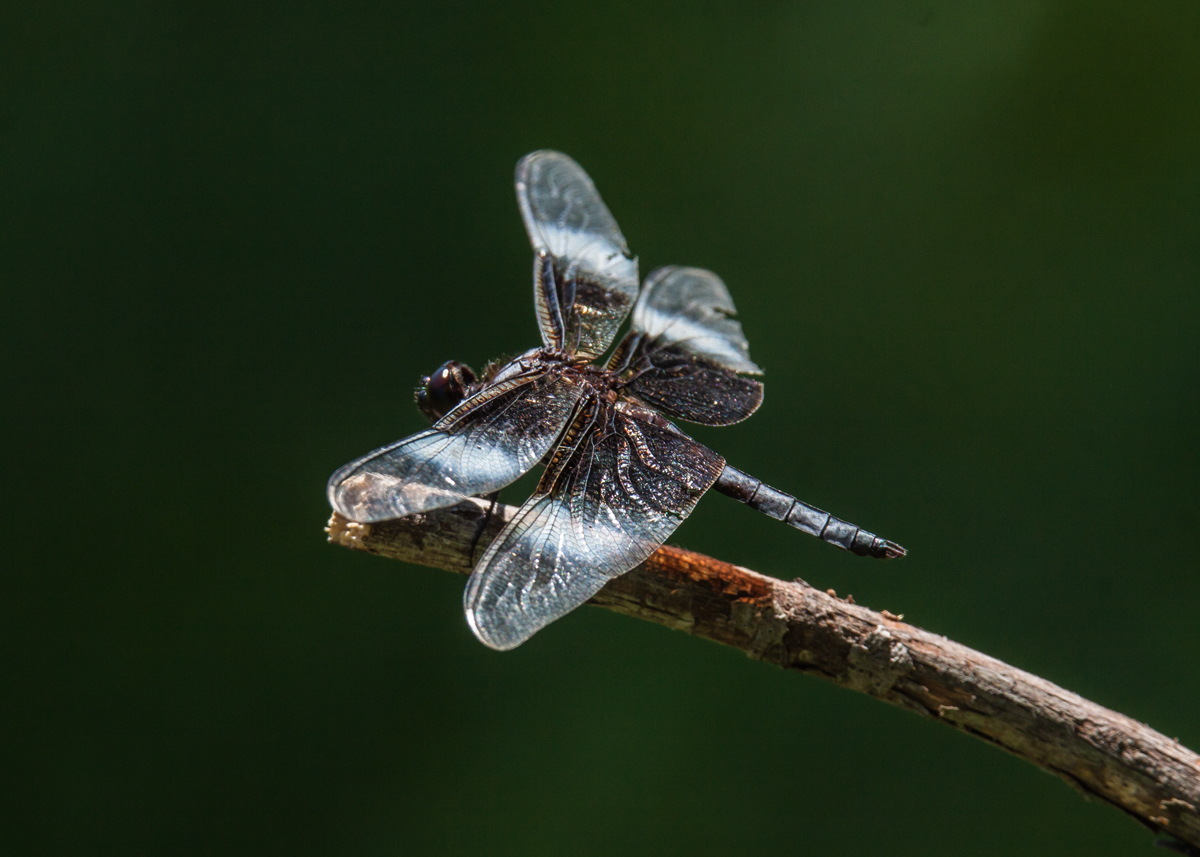
I love the dramatic lighting, the graphic quality, and the simple composition of this shot of a male Widow Skimmer dragonfly (Libellula luctuosa) that I took earlier this month at Jackson Miles Abbot Wetlands at Fort Belvoir, a nearby military installation here in Virginia.

There is a real beauty in simplicity.

Widow Skimmer

© Michael Q. Powell. All rights reserved.

Read Full Post »

When photographing a subject, how important are the surroundings to you? Most of you know that I like close-up shots and often I zoom in or crop to the point where you don’t have a good sense of the environment.

This past weekend, I went for a walk along the Potomac River (on the Virginia side) and observed a lot of damselflies. I had my Tamron 150-600mm lens on my camera and soon realized that I had a problem—even at the minimum focusing distance (approximately 9 feet/2.7 meters), there was no way that I could fill the frame with a damselfly.

Still, I was drawn to the beauty of the damselflies, which I believe are Blue-tipped Dancers (Argia tibialis), and I took quite a few shots of them.

As I reviewed the images on my computer, I realized how much I liked the organic feel of the natural surroundings. In the first shot, there are lots of vines on the surface of the rock on which the damselfly is perched that add texture and visual interest. In the second shot, I love the twist in the vine and the single leaf hanging down.

All in all, the surroundings on these two shots were so interesting that I didn’t feel any desire to crop the images more severely, and the environment has become just as much the subject as the damselfly. It’s probably worth remembering this the next time when I am tempted to move in really close to a subject—I should at least attempt to get some environmental shots too.

UPDATE:  It looks like my initial identification was off—there are lots of blue damselflies and this one more probably is a Big Bluet (Enallagma durum). Thanks to my local odonata expert, Walter Sanford, for the assist.

Blue-tipped Dancer

Blue-tipped Dancer

© Michael Q. Powell. All rights reserved.

Read Full Post »

I tend to focus on the realism of close-up details in most of my dragonfly shots, but sometimes the dragonfly seems almost abstract, a mix of colors, shapes, and patterns, like this male Twelve-spotted Skimmer (Libellula pulchella) that I encountered the past Friday.

For those readers who may not be familiar with this boldly-patterned dragonfly species, I am also including a more “traditional” shot of the same Twelve-spotted Skimmer.

Twelve-spotted Skimmer

Twelve-spotted Skimmer

© Michael Q. Powell. All rights reserved.

Read Full Post »

Most dragonflies appear to like the sunlight, but this Mocha Emerald dragonfly (Somatochlora linearis) that I encountered yesterday seemed to prefer the heavy shade, which made it a bit of a challenge to photograph.

I was walking along a small stream, moving in an out of patches of sunlight when I first spotted the dragonfly. I had my long telephoto lens on my camera and took some initial shots, which turned out blurry—there didn’t seem to be enough light for my camera’s autofocus to function well. I quickly set up my tripod and tried to focus manually, but that didn’t work out too well either.

Fortunately, the dragonfly seemed oblivious to my actions. I switched to my 180mm macro and moved in closer and finally was able to see well enough to focus. Because of the limited amount of light, I had the ISO cranked up to 1600 and used the pop-up flash.

As I moved about trying to get a better angle, I slid twice down the slippery bank of the stream into the shallow water and somehow managed to lose one of the little rubber feet of my tripod, but managed to get a couple of decent shots of this shadow-dwelling dragonfly.

Mocha Emerald

Mocha Emerald

© Michael Q. Powell. All rights reserved.

Read Full Post »

I can understand how an adept female Red-winged Blackbird (Agelaius phoeniceus) can catch one dragonfly, but how in the world did this one manage to catch two at once?

I can’t tell for certain, but the dragonflies in the bird’s mouth look to be female Common Whitetails (Plathemis lydia) or possibly immature males, which look like the females. The wings seem to be very transparent, so it’s possible too that these may be newly emerged dragonflies—when they first transition from the water nymph stage into dragonflies, they are very vulnerable.

Red-winged Blackbird

© Michael Q. Powell. All rights reserved.

Read Full Post »

It violates one of the basic rules of photography to have your subject in the center of an image, but for both of these shots of a male Widow Skimmer dragonfly (Libellula luctuosa), that’s precisely what I did.

In the first image, the blade of grass that bisects the image helps to emphasize the symmetric patterns on the wings of the Widow Skimmer.

Widow Skimmer

In the second image, I was so fascinated by the geometric lines of the grass and their varying degrees of sharpness that I did not want to crop them at all, so I left the Widow Skimmer more or less in the center.

Widow Skimmer

When it comes to my photography, I tend to look at “rules” as general guidelines that apply in many—but not all—situations. That approach helps me to remain centered and flexible.

© Michael Q. Powell. All rights reserved.

Read Full Post »

Yesterday I made a trip to Jackson Miles Abbot Wetlands Refuge at Fort Belvoir, a local military base, and was thrilled to see a Banded Pennant dragonfly (Celethemis fasciata), a cool-looking species that fellow photographer Walter Sanford spotted at that location on 24 July. (Check out his posting of that encounter to see some more shots of a Banded Pennant.)

Like other pennant dragonflies, such as the Halloween Pennant that I photographed earlier this summer, the Banded Pennant likes to perch at the very tip of tall grass and other vegetation. A pennant dragonfly is sometimes easier to spot than those species that perch lower, but the slightest breeze sets the dragonfly in motion and makes it more difficult to photograph.

I spotted only a single Banded Pennant yesterday, but managed to get a number of shots before it flew away, though most of them were from pretty much the same angle. As I looked over the images, I couldn’t decide which was the most effective way to present the dragonfly. Was it better to maximize the size of the dragonfly by cropping it a square or to emphasize the height of the vegetation by using a vertical format?

In the end, I didn’t choose, but instead presented a shot in each of the two formats? Do you have a preference for one over the other?


Banded Pennant

Banded Pennant

© Michael Q. Powell. All rights reserved.

Read Full Post »

Last Saturday at Lilypons Water Gardens in Adamstown, Maryland I spotted a large dragonfly that I had never seen before, a Black-shouldered Spinyleg (Dromogomphus spinosus). That’s definitely a cool (and descriptive) name for a spectacular-looking dragonfly.

The dragonfly remained perched in the vegetation surrounding a small pond long enough for me to get shots from a few different angles and distances with my macro lens. I was particularly struck by the length of the long black legs, which somehow reminded me of those of a spider.

Black-shouldered Spinyleg

Black-shouldered Spinyleg

Black-shouldered Spinyleg

© Michael Q. Powell. All rights reserved.


Read Full Post »

I haven’t taken very many damselfly photos this summer, in part because often I have been attempting to shoot dragonflies with my long telephoto lens. That lens has a minimum focusing distance of almost nine feet (2.7 meters) and it’s hard to see and focus on a tiny damselfly at that distance.

This past weekend, however, I was using my 180mm macro lens and was happy to be able to capture some images of this beautiful female Fragile Forktail damselfly (Ischnura posita) during a trip to Lilypons Water Gardens in Adamstown, Maryland.

Damselflies are really small, but they pack a lot of beautiful details and colors into that tiny package. This particular species is special to me this year, because way back in April a female Fragile Forktail was the first damselfly that I spotted this season and presented in this posting.

Fragile Forktail

© Michael Q. Powell. All rights reserved.

Read Full Post »

I really enjoy photographing familiar subjects, but there is still something really special about finding new ones, like this female Eastern Ringtail dragonfly (Erpetogomphus designatus) that I stumbled upon yesterday during a photo excursion with some friends to Adamstown, Maryland.

The goal of our visit was to explore Lilypons Water Gardens, a large facility that specializes in all kinds of aquatic plants and includes a series of interlocking ponds with waterlilies and lotuses. I suspected that there would be lots of dragonflies and I was not disappointed.

While my friends were photographing the flowers, I started walking along the barely trampled paths that had knee-high grass and other vegetation. Most of the dragonflies that I spotted were familiar friends: Widow Skimmers, Eastern Pondhawks, Slaty Skimmers, Common Whitetails, and Blue Dashers, but a couple that I saw immediately struck me as being new and different.

The very colorful and distinctive rings on the abdomen of today’s featured dragonfly, the Eastern Ringtail, really attracted my attention and somehow reminded me of the photos I had seen of a coral snake. Fortunately the dragonfly, unlike the snake, is not poisonous. I chased the dragonfly for quite a while but never managed to get a shot of it with an uncluttered background—it kept perching on vegetation low to the ground.

When I returned home, I didn’t have a clue where to start with identification, because I hadn’t gotten some of the kind of diagnostic shots that I need, as relative neophyte, to identify a dragonfly. So I did what I usually do in cases like this—I contacted Walter Sanford, my local dragonfly expert. He tentatively identified it as a female Eastern Ringtail and another expert in the Northeast Odonata Facebook group agreed with Walter.

I’m pretty happy with my newest dragonfly find, a species I might have trouble finding again. According to the Maryland Biodiversity Project, the Eastern Ringtail is designated S2, which means that it is rare in the state of Maryland.


Eastern Ringtail

Eastern Ringtail

© Michael Q. Powell. All rights reserved

Read Full Post »
In vain I have searched this month for Common Sanddragon dragonflies at the places where I spotted them earlier this season. My good friend and fellow photographer and blogger, Walter Sanford, captured some beautiful shots of the last ones that we spotted. Be sure to check out the other wonderful photos and fascinating information in his blog.

waltersanford's avatarwalter sanford's photoblog

Common Sanddragon (Progomphus obscurus) is a member of the Clubtail Family of dragonflies that is spotted during June and July in mid-Atlantic United States like Virginia. Common Sanddragons are habitat specialists that prefer sandy woodland streams, so don’t look for them in wetland areas like the hemi-marsh at Huntley Meadows Park.

This post features two male Common Sanddragon dragonflies, as indicated by their terminal appendages. As fate would have it, they are the last Sanddragons spotted during Summer 2015.

The water level was near the top of the stream banks after near record-setting rainfall for the month of June. (Notice the discoloration of the vegetation from siltation during a recent flood.)

A Common Sanddragon dragonfly (Progomphus obscurus) spotted at Dogue Creek, Huntley Meadows Park, Fairfax County, Virginia USA. This individual is a male. 29 JUN 2015 | Huntley Meadows Park | Common Sanddragon (male)

The conditions for hunting Sanddragons were less than ideal. Male Common Sanddragons prefer perching on a sandy beach, facing the water; there weren’t any beaches, so Sanddragons were…

View original post 178 more words

Read Full Post »

Do you find yourself shooting the same subjects over and over? I often take repeated pictures of familiar subjects, knowing that the weather, the lighting conditions, the environment, and the subject’s pose will be different each time.  Although I try to control the exposure, the framing, and the angle of view, I am sometimes pleasantly surprised at the results.

I don’t see Spangled Skimmer dragonflies (Libellula cyanea) very often, so I was happy to spot this beautiful male last week. The markings on the wings are so distinctive that it is pretty easy to identify a member of this species when I do come upon one. (The second shot gives a really good view of those markings.)

I like the way that the background turned out in these shots and I have captured pretty detailed images of a Spangled Skimmer. I am confident, though, that I will be snapping away again if I stumble across another one. Who knows what kind of a photo I might be able to capture the next time?

Spangled Skimmer

Spangled Skimmer

© Michael Q. Powell. All rights reserved

Read Full Post »

When damselflies are connected in the tandem mating position, they are large enough to be noticed, especially when they fly right by me, as was the case this past Friday. They were pretty skittish, but I managed to get a couple of relatively clear shots.

My identification task was greatly eased by the fact that these were not one of the multiple blue species that inhabit my local marshland park—there was only a little blue on the tip of the male’s abdomen. Imagine my shock when I learned that these damselflies are Blue-tipped Dancers (Argia tibialis). In my experience, names generally are not that helpful when it comes to identification, but this is an obvious exception.

Sharp-eyed readers may notice that these damselflies look a bit like the one currently featured in the banner of my blog. That damselfly is a Violet Dancer, a subspecies of the Variable Dancer species (Argia fumipennis). Apparently damselflies do a lot of dancing!

If you are interested in seeing some photos and descriptions of the bluet family of damselflies at our local park, check out this recent posting by fellow blogger and photographer Walter Sanford entitled Blue for Bluets.

Blue-tipped Dancer

Blue-tipped Dancer

© Michael Q. Powell. All rights reserved


Read Full Post »

This young male Halloween Pennant dragonfly (Celithemis eponina) let me get close enough to use my macro lens to good effect, but an intermittent light breeze caused him to sway back and forth, greatly increasing the challenge of getting sharp shots.

Halloween Pennants are spectacular dragonflies with their two-toned eyes and patterned wings. They almost always choose to perch at the very tip of flimsy branches and blades of grass and often do look like pennant blowing in the wind.

I included a shot of the entire body of this dragonfly to give you a full appreciation of its wildly wonderful wings.

Halloween Pennant

Halloween Pennant

Halloween Pennant


© Michael Q. Powell. All rights reserved

Read Full Post »

Yesterday I visited Kenilworth Park and Aquatic Gardens in Washington D.C. for the annual Lotus and Water Lily Festival and I was thrilled to be able to get some of my favorite kind of dragonfly images—dragonflies perched on the buds of colorful flowers. Generally I manage to get shots only of the Blue Dasher dragonfly (Pachydiplax longipennis), but this time I was also able to get a shot of a Slaty Skimmer (Libellula incesta) on a lotus flower bud.

Blue Dasher

Blue Dasher on purple water lily bud

Slaty Skimmer

Slaty Skimmer on lotus bud

Blue Dasher

Blue Dasher on water lily bud

© Michael Q. Powell. All rights reserved

Read Full Post »

Dragonflies are colorful and flowers are colorful too, but it’s rare that I get to see the two of them together. I was thus thrilled when fellow photographer Cindy Dyer spotted a colorful Blue Dasher dragonfly (Pachydiplax longipennis) perching on a beautiful purple water lily during our recent trip to Kenilworth Park and Aquatic Gardens in the District of Columbia.

I took some initial shots with the 180mm macro lens that I had on my camera at that moment, but wasn’t really able to fill the frame with my subject and the background was a little distracting. (The second photo below was one of those first shots and it does a pretty good job of highlighting the water lily, but the dragonfly is merely an added bonus.) I couldn’t physically move any closer, because the water lilies were in a cement pond, surrounded by a three foot high wire fence.

I decided to change to a longer lens, though I sincerely doubted that the dragonfly would stay in place. Almost all of the times that I have done a rapid lens change in the field, the subject has departed before I was ready to shot. In this case, however, I got lucky and the Blue Dasher held his perch long enough for me to get a few shots with my 70-300mm lens.

I simply love the color combination of the different shades of blue of the dragonfly and the purple and yellow of the water lily.

Blue Dasher

Blue Dasher

© Michael Q. Powell. All rights reserved


Read Full Post »
Like most guys, I have trouble remembering anniversaries, so it is a good thing that WordPress sent me a reminder that three years ago today I started my blog. I still recall my feelings of doubt and uncertainty when my mentor and muse Cindy Dyer sat me down in front of a computer and told me that I was starting a blog. We had just finished reviewing and editing some shots that I had taken earlier in the day at Kenilworth Park and Aquatic Gardens. Cindy helped me through the mechanics of setting up the blog and shortly thereafter I made my first posting, Blue Dasher dragonfly.

Once I started, I couldn’t stop. I grew to look forward to writing the postings and taking photos to feature. As of right now, I’ve made 1638 postings and had 78743 views—that’s a lot of words and a lot of photos.

I was struck from the outset by the sense of community and mutual support that exists in the blogging world and there is a small group of fellow photographers with whom I feel a particular affinity, including Sue, Gary, Leanne, Ed, Lyle, Emily, Allen, and Chris. The amount of encouragement that I receive from them and countless others is overwhelming. Closer to home, Cindy continues to be a constant source of inspiration and instruction and Walter and I help to push each other as we explore remote areas of our favorite marshland park.

When I started this blog, I didn’t really think of myself as a photographer. I was taking a lot of photos and knew that I was improving, but there was a kind of psychological barrier that kept me from thinking in those terms. Now, I can confidently say that I am a photographer.

My journey into photography has been full of highlights, but two moments from 2014 really stand out. In November, I witnessed the rescue of a bald eagle at my local marsh and my photos and links to my blog posting were featured on the websites of several Washington D.C. media outlets, resulting in a total of 3344 views of my posting Rescue of an injured Bald Eagle. A short time before that incident, I was really honored when I was featured in an Introductions post by noted Australian photographer Leanne Cole.

If you have read this far, you may be wondering about my reference to “cannibals” in the title of this posting. What do cannibals have to do with my blog? Well, if I set aside the abnormally high number of views of my eagle rescue post, for the longest time my most popular post was one with the innocuous title of Fuzzy white caterpillar. There is not a whole lot special about the prose or the photos, but it has had 489 views to date.

Earlier this week the caterpillar was passed in the stats by my post Red-footed Cannibalfly, with 492 views to date—the cannibals have taken over the lead. As a guy, I feel happier that a more macho sounding insect is now leading the field of “normal” posts. As far as I can tell, the post’s popularity is a function of the search engines. The post was not particularly popular when it first appeared and has only 36 likes. Now, though, it even shows up on the first page of Google results if you type in “Red-footed Cannibalfly.”

So what’s ahead? I hope to be able to keep improving my writing and my photography. I have certain aspirational shots in my mind of different subjects or different locations.

Yesterday, when I was taking photos of water lilies with Cindy Dyer, I mentioned that I had always imagined taking a shot a frog on a lily pad, but had never even seen a frog perching on one. A short time later, Cindy excitedly pointed out a partially submerged frog on a lily pad and I managed to snap a couple of shots before he dove into the water. (Check out Cindy’s blog posting to see her beautiful shot of this frog.) Dreams do come true.

Thanks again to all my readers and supporters, whose encouragement has helped motivate and sustain me this past three years. I look forward to sharing my journey with my fellow travelers.


Frog on a lily pad

© Michael Q. Powell. All rights reserved

Read Full Post »

« Newer Posts - Older Posts »