Feeds:
Posts
Comments

Posts Tagged ‘Tamron 150-600mm telephoto’

Shortly after sunrise at Huntley Meadows Park on Tuesday, a mother Hooded Merganser duck (Lophodytes cucullatus) checked on her seven babies and got them ready to start the day. I don’t know if the little family spent the night on the log, but it was probably a good idea to get moving before the numerous snapping turtles woke up. Most of the babies seem to be paying attention to the Mama in the first shot, though the one on the end seems to be daydreaming or is distracted.

Hooded Merganser

A short while later the family dropped into the water and started to swim away. This second shot is my favorite one from an artistic perspective. I just love the interplay of the light and the shadows.

Hooded Merganser

As the Merganser family continued to swim, it got tougher and tougher to track them amid all of the vegetation growing in the pond. Only occasionally would I get an unobstructed glimpse of them. I managed to get most of the family in this shot. One of the ducklings was a bit ahead of the group, perhaps the adventurous one on the end of the log in the first shot.

Hooded Merganser

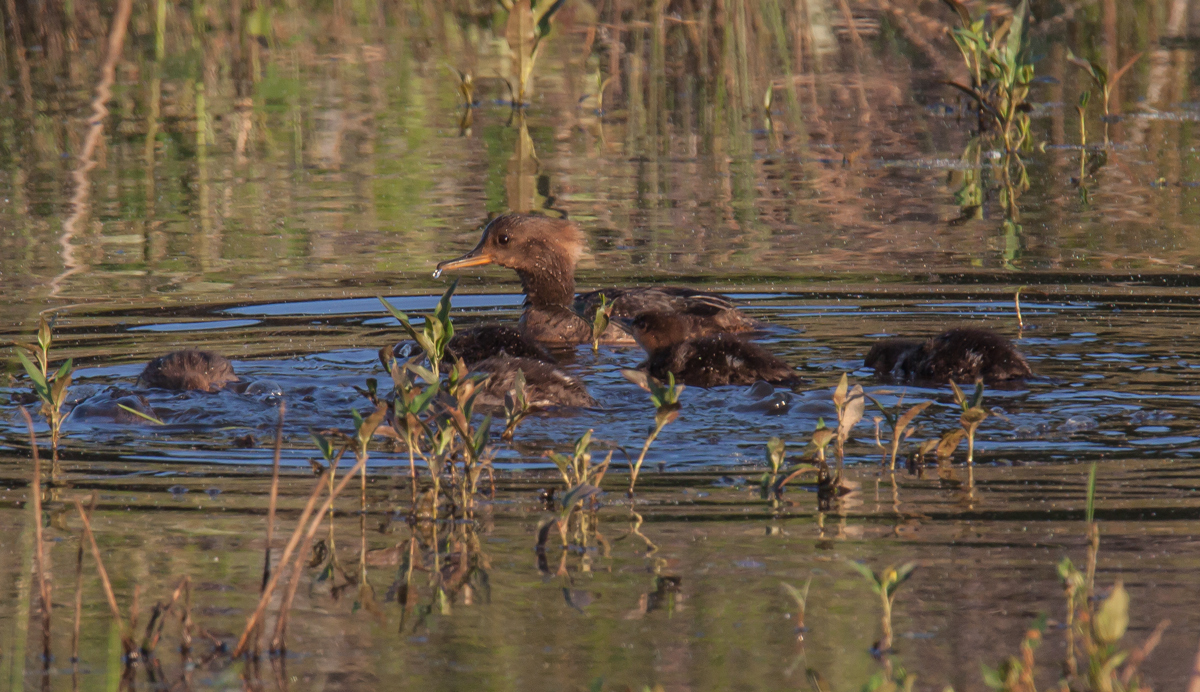
When they reached a spot that Mama Merganser considered to be safe, all of the babies began to stick their heads under the water. I don’t know if they were bathing or playing or if this was a lesson in fishing. Whatever the case, the mother duck remained vigilant.
Hooded Merganser

It’s at moments like this that I regret that the father Merganser does not stay around to help in raising the ducklings. It would sure ease the burden on the Mama and would enhance the chances for survival for the cute little babies.

© Michael Q. Powell. All rights reserved.


Read Full Post »

This osprey’s glare in my direction suggests that he is NOT willing to share the fish that he worked so hard to catch. (I already posted a shot of this osprey munching on the fish, but additional photos showing its facial expressions seemed too good not to share as well.)

Osprey

Sometimes, especially when I am in a hurry, I will quickly look through my recent photos, choose a single one I really like, and write a short post. That’s exactly what I did with the initial Freshly Caught Fish posting a few days ago. I knew that I had gotten some good shots of the Osprey (Pandion haliaetus), who was so cooperative that I was able to set up my tripod, but I knew it was going to take a fair amount of time to look through the photos. It was nice to be able to use the tripod, but I learned how tough it is to shoot almost straight up with a long telephoto zoom—I was crouching and on my knees as I sought to look through the viewfinder.

I now have sorted through my photos from that morning and selected a few more that show the osprey as he was eating and as he was sending me unambiguous messages.

OspreyOspreyosprey

© Michael Q. Powell. All rights reserved.


Read Full Post »

The sun was barely up, but this little Green Heron (Butorides virescens) was already busy, trying to find something to eat for breakfast. Alas, I didn’t see the heron catch anything this time before it moved out of sight. (If you want to see a fun shot of a Green Heron looking directly at a frog that it had just captured, check out my post from July 2012 entitled Not Seeing Eye to Eye.)

Green Herons are a lot smaller than the Great Blue Herons that I see fairly often  and quite a bit more elusive. This heron seemed to be just waking up and wandered about a little on the muddy edge of a former beaver pond before entering the water. That is how I was able to get the second shot that shows the heron’s legs.

I was probably at the limits of my ability to take photos in limited light. I was shooting at ISO 1600, about as high as I dared go with my somewhat dated Canon 50D. As is usually the case, I was using aperture-preferred mode with a selected setting of f/8. What I didn’t realize until afterwards was how slow the shutter speed was—as low as 1/20 sec for these shots, quite a bit slower than optimal for a focal length of 500mm on my 150-600mm lens. Focusing in the limited light was a little slow, but seemed to be pretty accurate. Usually I don’t dwell quite so much on the technical aspects of my shots, but I know that some folks have questions about the capabilities of the Tamron 150-600mm lens in low light and wanted to share my experiences (which are mostly positive).

Green Heron

Green Heron

© Michael Q. Powell. All rights reserved.

Read Full Post »

There is nothing quite like the taste of a freshly caught fish and this Osprey (Pandion haliaetus) seemed to be devouring its breakfast with gusto early on Saturday morning at Huntley Meadows Park in Alexandria, Virginia.

Osprey

© Michael Q. Powell. All rights reserved.

Read Full Post »

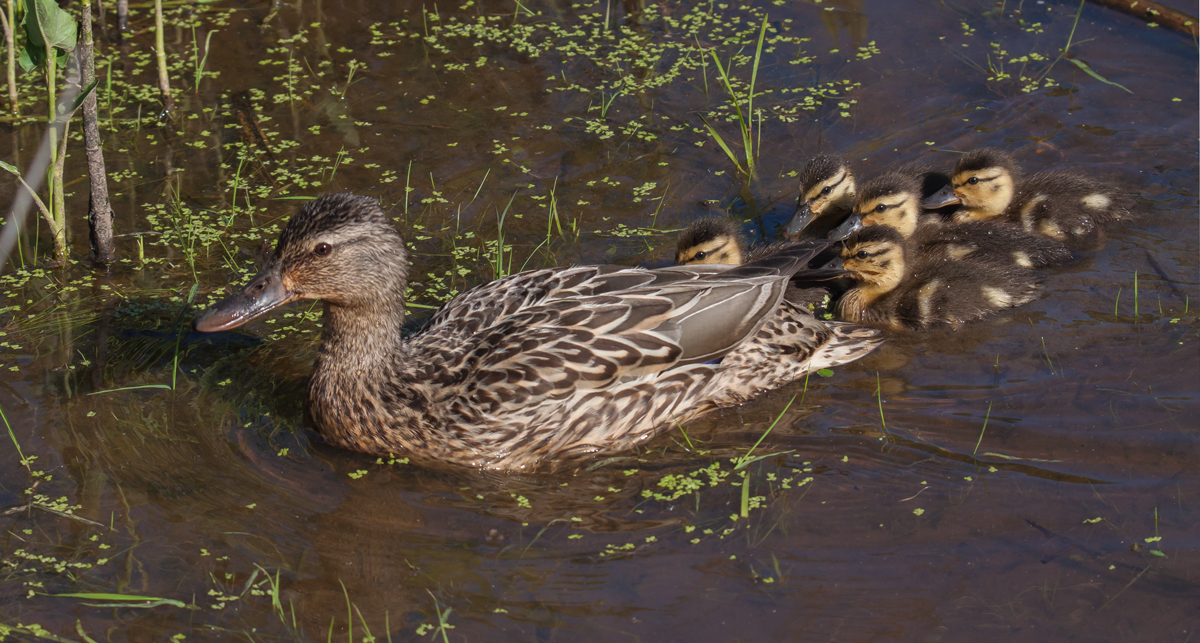
Make way for ducklings! Yesterday I finally saw my first Mallard baby ducks of the season at Huntley Meadows Park. I have spotted Canada Geese goslings multiple times this month and they are already growing quite large.

Mallard ducklings

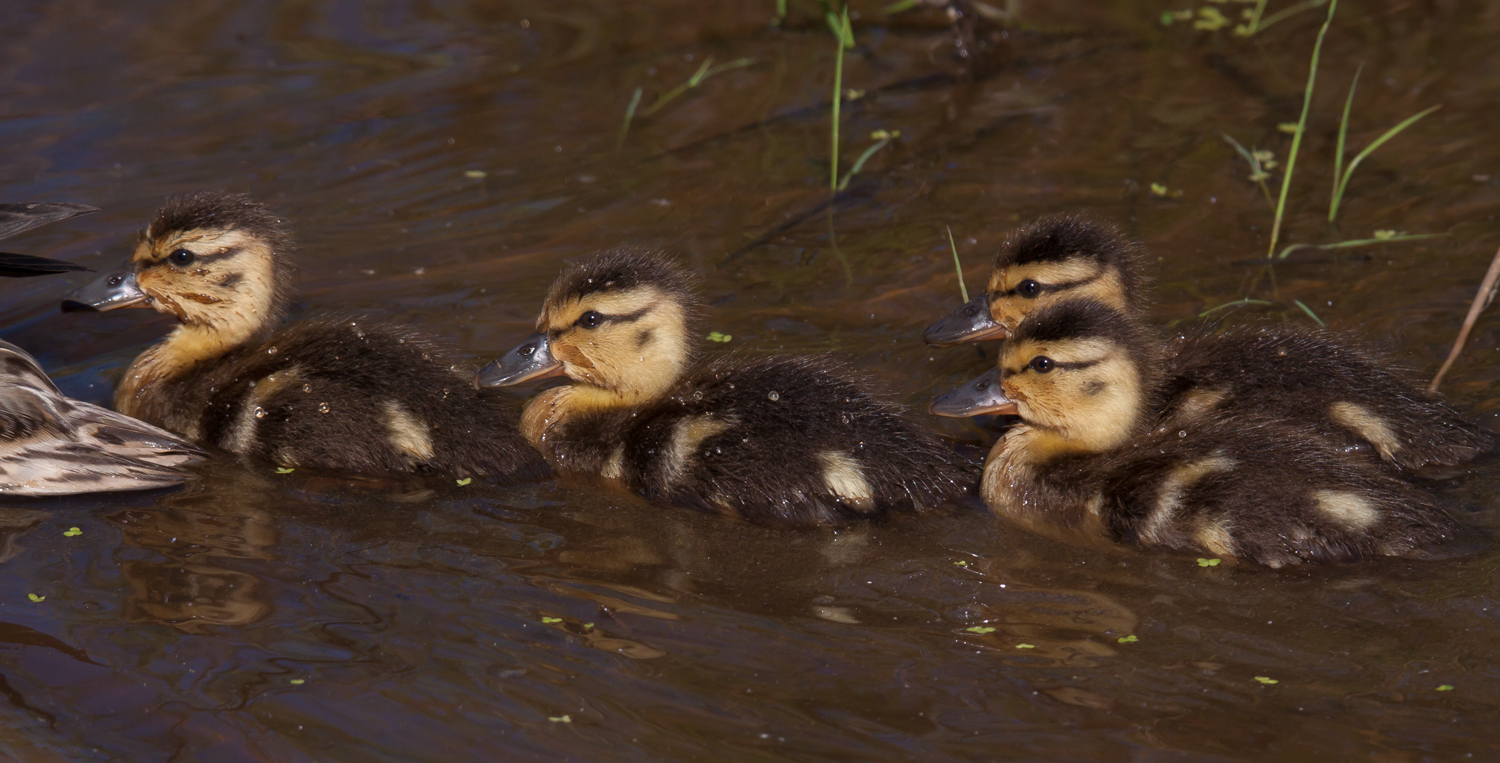
The ducklings look so small and fragile and the Mallard Mom (Anas platyrhynchos) seemed to be doing her best to keep them tightly bunched together as they made their way slowly through the shallow waters of the marsh. When they paused for a moment, though, some of the ducklings wanted to explore their surroundings. When I zoomed in for a close-up shot of the babies, one of them wandered out of the frame, leaving only four to be featured.

This Mom is going to be really busy raising and protecting these little ones.

Mallard ducklings

© Michael Q. Powell. All rights reserved.


Read Full Post »

Unlike some other species of birds, Hooded Merganser ducks (Lophodytes cucullatus) don’t seems to sit on their eggs continuously. They will often lay them in nesting boxes and periodically check on them, perhaps adding more eggs to the nest.

Hooded Merganser

I took this first shot earlier today at Huntley Meadows Park as a female Hooded Merganser was getting ready to eventually enter a nesting box. When I first spotted the female duck, she was standing on top of the nesting box. During previous springs I learned that this was a sign that she had eggs in the nesting box and that eventually she would fly into it. So I waited and waited, hoping to catch the moment.

It may look like she is actually preparing to enter the box, but in fact she had just stepped off of the roof and was gliding to the ground. Unfortunately, she dropped behind a virtual wall of vegetation and I could not see her when she lifted off from the ground and flew straight into the box and I missed that shot.

Here are a few shots of the female Hooded Merganser as she paced back and forth on the roof of the nesting box, peering to the right and to the left to makes sure that all was safe before she entered the box.

Hooded Merganser

Hooded Merganser

Hooded Merganser

As I was doing some research on Hooded Merganser ducks, I came across a blog from Lee Rentz Photography that includes a video from inside a nesting box of a Hooded Merganser. Be sure to check it out.

© Michael Q. Powell. All rights reserved.


Read Full Post »

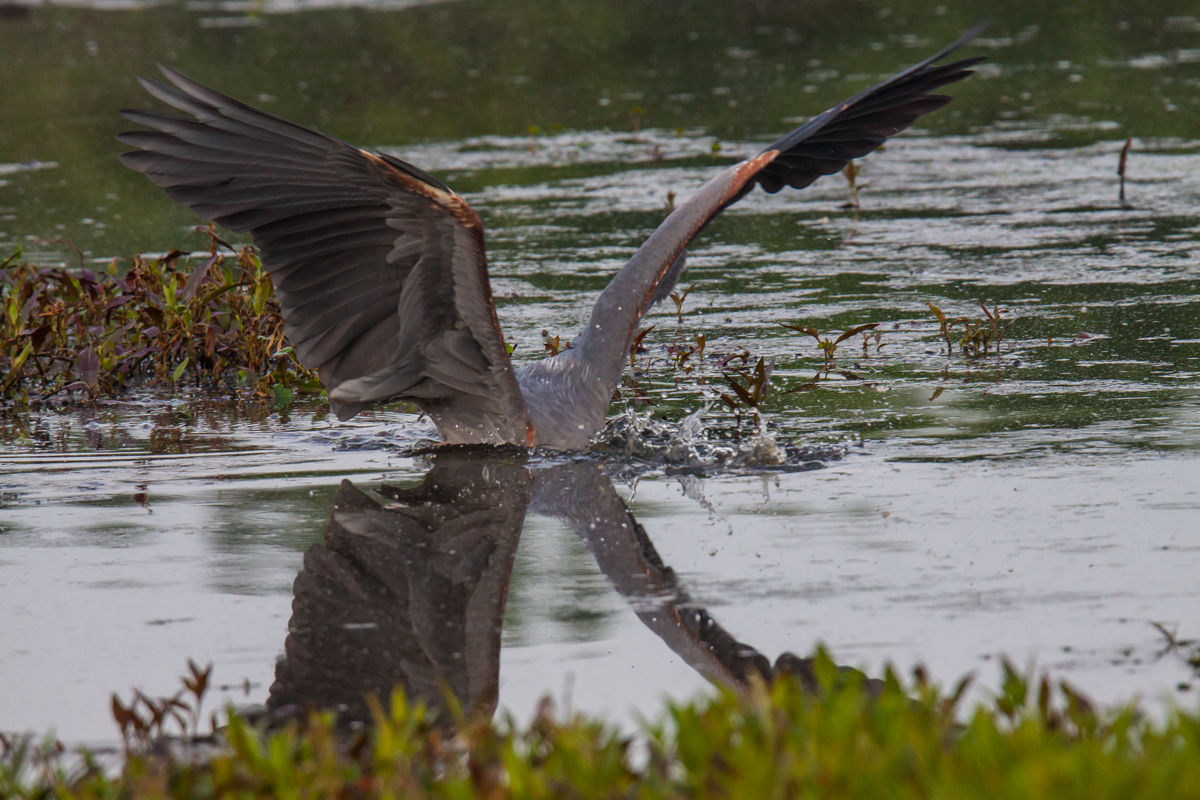
I am thrilled that I was able to get a shot of a Great Blue Heron triumphantly holding a freshly caught fish and I followed my initial instinct to post that photo. However, I also managed to capture a sequence of shots of the action that led to that culminating moment that I really like that I thought would be fun to share.

In this first shot, the heron has just made the strike and has plunged its head deep into the water. I am not sure why the heron extended its impressive wings like this, but suspect it was either to generate greater force or to maintain stability.

Great Blue Heron

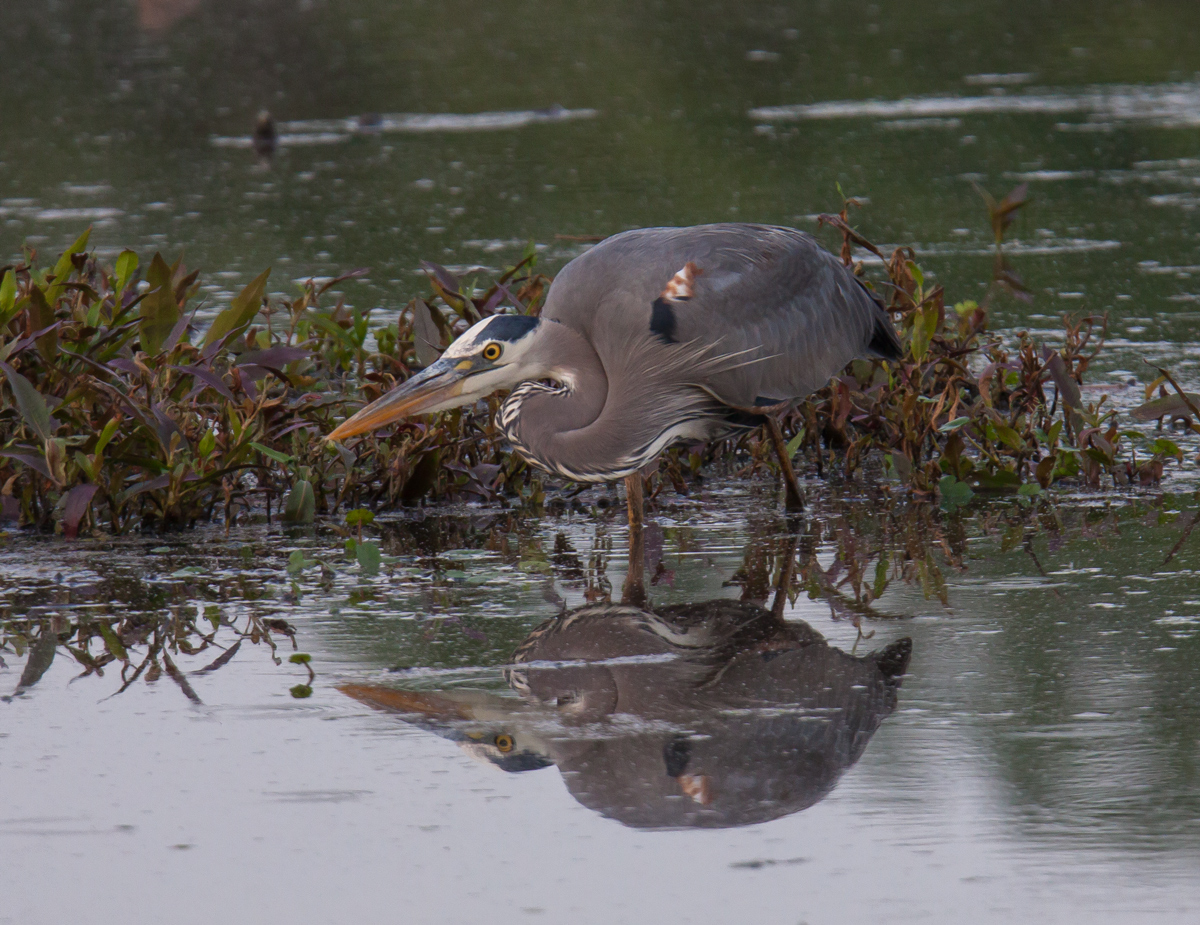
When I first spotted the Great Blue Heron (Ardea herodias), it was obviously focused on finding a fish. When it bent over like this, I suspected that the heron had already spotted one and was tracking it.

Great Blue Heron

Suddenly the heron turned to the side and made the strike that I showed in the first shot. Some of the herons that I have observed in the past have been amazing in their ability to catch fish, but I have seen others, especially the young ones, that would strike repeatedly at branches and floating leaves. As a result, I knew that success was not guarantee and I waited to see how the heron had done. In this next shot, the heron’s head is just starting to reemerge from the water. At that moment it certainly knew if it had a fish in its grasp, but I still was in the dark.

Great Blue Heron

At last the heron lifted its head a bit more and I could see that indeed it had caught a fish. I really like this shot shows the little vortex that was created in the water as the fish is pulled up into the air.

Great Blue Heron

Now, after the fact, it’s easy for me to sit back and analyze what the heron was doing. During the brief moments when I was taking the shots, it was all I could do to concentrate on keeping the heron centered in the viewfinder and hoping that the buffer in my camera would not fill up too quickly as I fired away in burst mode.

© Michael Q. Powell. All rights reserved.


Read Full Post »

Early one morning last week at Huntley Meadows Park, I watched and waited as a Great Blue Heron (Ardea herodias) sought to catch some breakfast. He was successful and I left the scene equally satisfied when I captured this image.

Great Blue Heron

© Michael Q. Powell. All rights reserved.
Read Full Post »

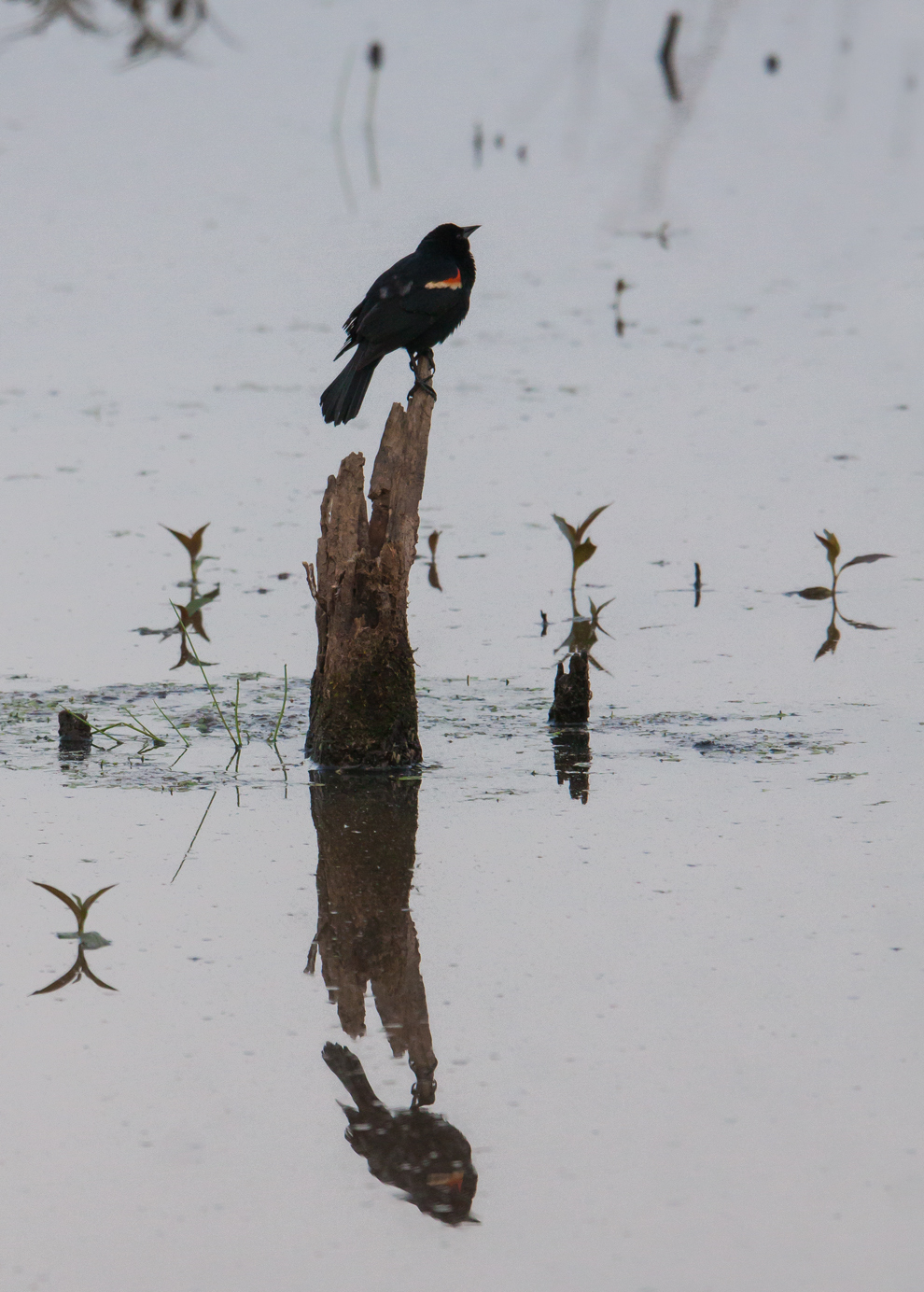
The marsh is especially beautiful early in the morning, as birds like this Red-winged Blackbird (Agelaius phoeniceus) welcome the first rays of the rising sun. The water is still, reflecting the glory of the new day, and a sense of peace overwhelms me.

Red-winged Blackbird

© Michael Q. Powell. All rights reserved.
Read Full Post »

In the early morning hours above Huntley Meadows Park, all kinds of birds are flying about, like this immature Bald Eagle (Haliaeetus leucocephalus) that I spotted yesterday.

A year ago, I probably would have guessed that this was a hawk, but my identification skills have improved somewhat and I can tell this is an eagle. Given that it takes about five years for a Bald Eagle to mature, I’d guess that this one is about two to three years old, though I defer to more expert birdwatchers on this point.

As you can probably tell, the eagle was moving from right to left as I tracked it over the treetops. I was shooting over a small pond at a pretty good distance in early morning light that was not yet bright, so my ISO was cranked up a bit. I especially like the shots that include the trees. Although I will try to photograph an eagle every time I see one, I think it is a nice extra when I manage to include part of the surroundings in the shot.

Bald EagleBald EagleBald Eagle

© Michael Q. Powell. All rights reserved.

Read Full Post »

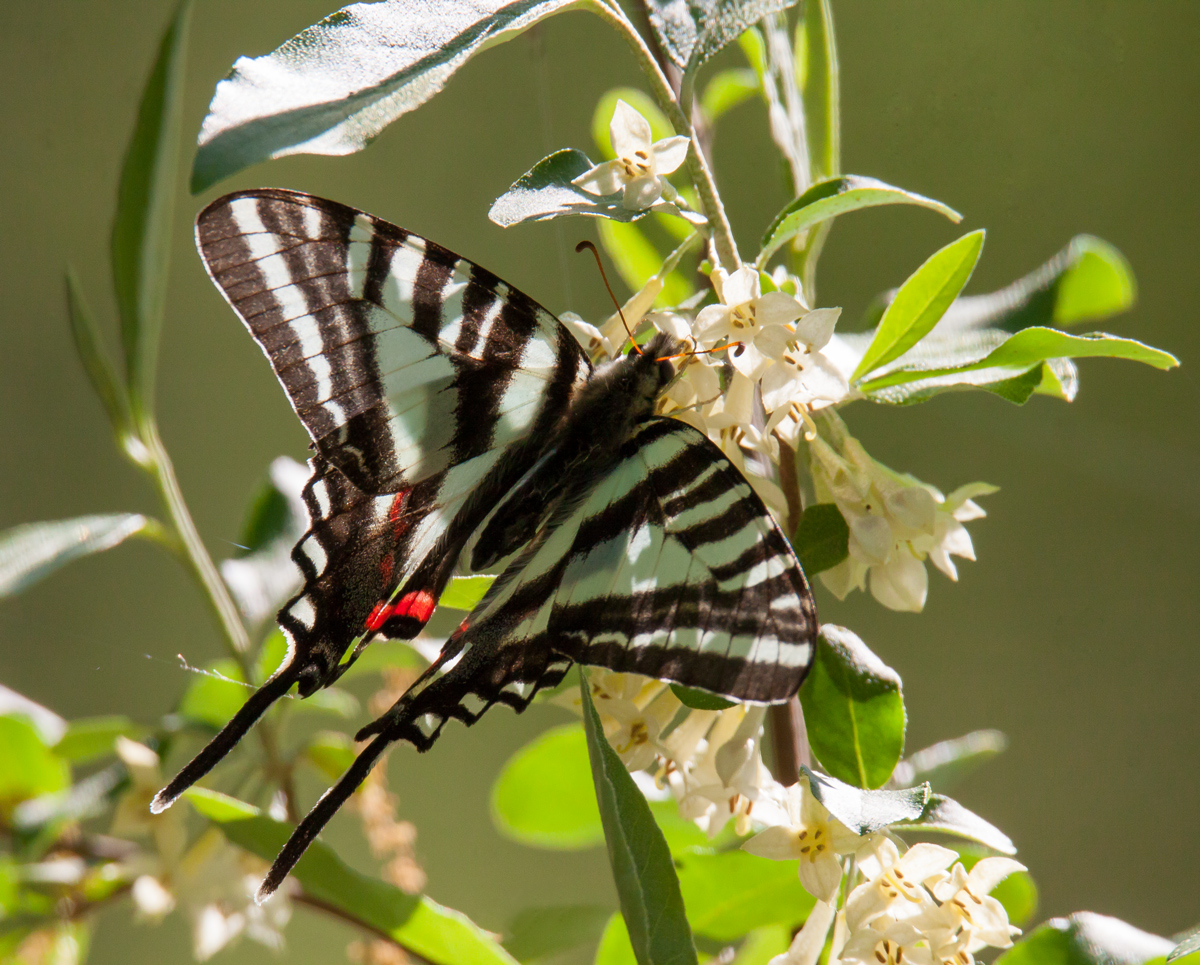
As I was out searching for dragonflies in the heat of the midday sun, a butterfly came fluttering into view. I haven’t seen many large butterflies yet this spring, so I followed after it, trying to identify it. When the butterfly paused for a moment to feed on one plant, I scrambled to get a shot.

The light was harsh and coming from a bad direction, but my long telephoto showed me clearly that it was a swallowtail butterfly, but definitely not at all colored like the Eastern Tiger Swallowtails that I often see during the summer. The markings were distinctive enough that it was easy to determine later that it is a Zebra Swallowtail butterfly (Eurytides marcellus), a species that I had never before encountered.

Multiple sources indicate that the Zebra Swallowtail is closely associated with the pawpaw tree, though I don’t know enough about trees and blossoms to determine if that is the plant on which this butterfly was feeding.

As I was poking about on the internet, I also learned from ereferencedesk.com that in 1995 the Zebra Swallowtail was designated as the official state butterfly of Tennessee. I must confess that I didn’t know that states have official butterflies.

Zebra Swallowtail

© Michael Q. Powell. All rights reserved.

Read Full Post »

Happy Mother’s Day to Moms everywhere, who loved us and supported us as we took steps toward independence, all the while keeping a watchful eye over us.

Thanks especially to my Mom, who is now in heaven.

Canada Geese

© Michael Q. Powell. All rights reserved.

Read Full Post »

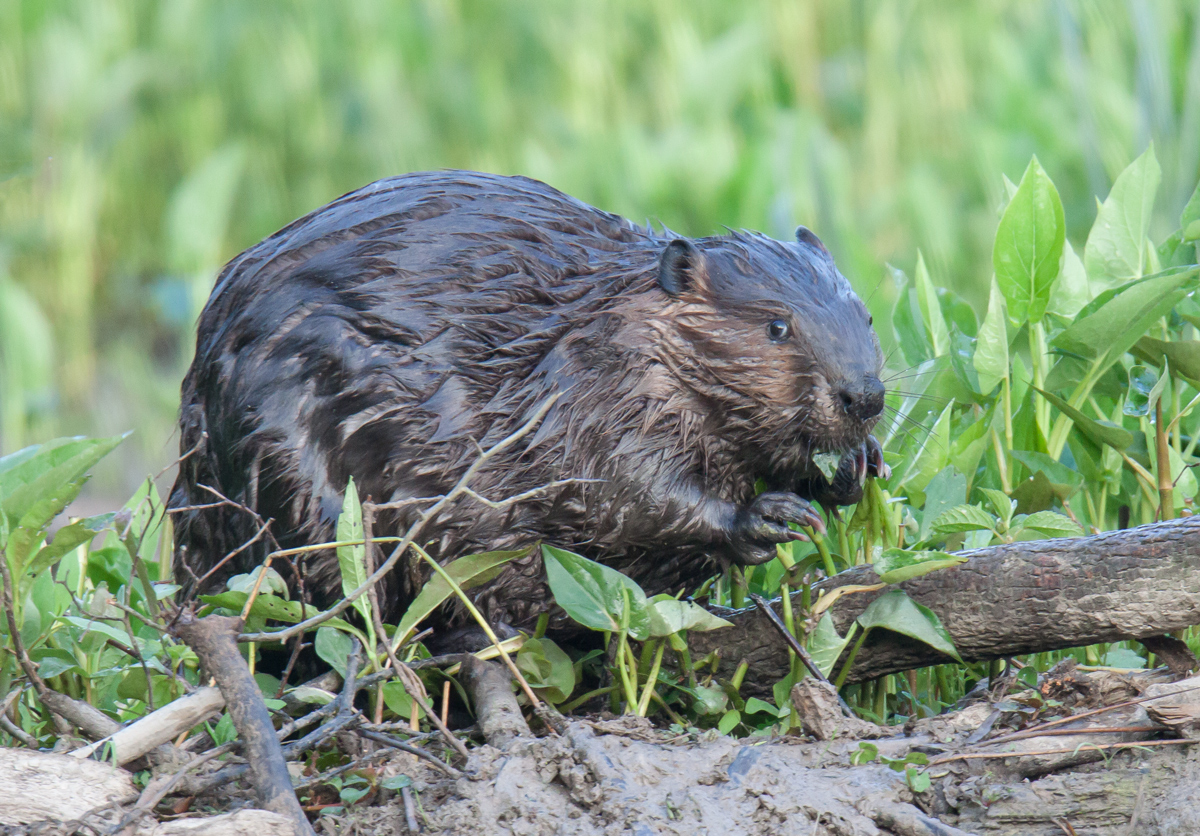
I don’t take photos of people very often but it seems like there are some informal rules including not photographing a subject who is eating and not photographing someone who is bending over. Fortunately those “rules” do not apply when photographing wildlife.

In the first shot, the North American Beaver (Castor canadensis) at my local marsh seemed to be glancing up at me mid-chew, having sensed my presence. I can’t tell if the beaver is shy or irritated, but I am happy that I was able to capture some of the details of the beaver’s “hands.” The beaver probably was aware that he had some leaves stuck between his teeth, but, as a friend, I probably would have mentioned it to him if he was going to go out in public.

In the second shot, the beaver’s posterior is facing the camera and I don’t want to be indelicate, but that part of the beaver’s anatomy looks huge. I can’t imagine what I would have said if the beaver had turned to me and asked, “Does this pose make my butt look big?” Perhaps I could have responded honestly to the question, but most guys know that is best not to respond at all if a female human poses that same question.

If you take wildlife photos, you too probably have a collection of “butt shots” of animals and birds that were running or flying away or simply sending an unsubtle message that they did not want to be bothered by a photographer. One of my favorite photographers and bloggers, Lyle Krahn, periodically does an entire humorous posting of wildlife shots devoted to this genre. Be sure to check out his The Inauguaral Butt Collection.

North American Beaver

North American Beaver

© Michael Q. Powell. All rights reserved.

Read Full Post »

Early yesterday morning I was thrilled when I saw one of the beavers at Huntley Meadows Park swimming around the beaver pond. My joy was compounded when the beaver climbed out of the water to grab a little breakfast.

North American beavers (Castor canadensis) are primarily nocturnal, so it’s difficult to get a glimpse of them during a time of the day when there is sufficient light to be photograph them. Previously I had seen a beaver at this pond in the early hours of the morning, but this is the first time that I have seen one of them climb over the logs block off one end of the beaver pond.

I am particularly happy that the first photo provides a good look at both the beaver’s very distinctive tail and its face. Most of the time that I was observing the beaver, I got a good look at only the tail end, which is interesting, but not especially photogenic.

In the second shot, the beaver is swimming away from the lodge with a small bunch of sticks. Was the beaver carrying them to another lodge? Is there a picnic somewhere else along the shore? It just seemed a bit strange for me to see the beaver heading off into the distance at a time when I assumed he would be getting ready for his long daytime snooze.

North American Beaver

North American Beaver

© Michael Q. Powell. All rights reserved.
 

Read Full Post »

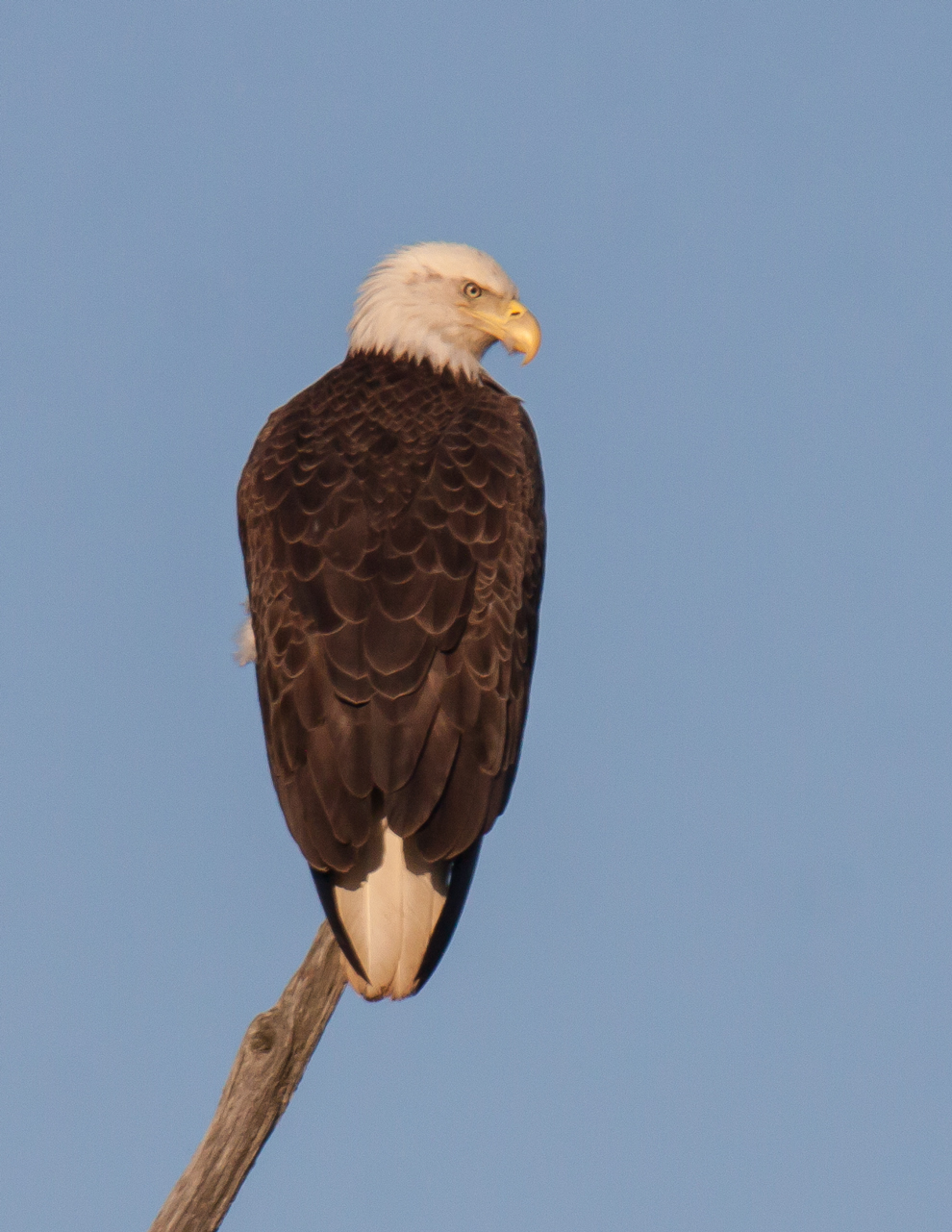
This past Monday was a wonderful day for eagles. In addition to the young eagle whose photos I posted earlier, I also managed to capture these images of a mature Bald Eagle (Haliaeetus leucocephalus) perched on a dead tree in the marsh.

Bald Eagle

Bald Eagle

© Michael Q. Powell. All rights reserved.


Read Full Post »

As I looked intently through my long telephoto lens at the stagnant, debris-filled water in a ditch, I became acutely aware of bright red eyes staring back at me. What was this unusual red-eyed marsh creature?

Eastern Box Turtle

Pulling my eyes away from the magnified view in the camera’s viewfinder, I could see the contours of a turtle’s shell in the water, partially obscured by all of the debris. The bright color and distinctive shape of the shell and the striking red eyes made it easy to determine when I got home that this is a male Eastern Box Turtle (Terrapene carolina carolina).

Eastern Box Turtle

Although these turtles spend most of their time on land, they seek damp mud or pools when temperatures get too high, according to information on the website of the Virginia Herpetological Society. On the day when I took this photo, temperatures soared above 80 degrees F (27 degrees C), and it’s probably pretty safe to assume that this turtle was simply trying to stay cool on an unseasonably warm spring day.

© Michael Q. Powell. All rights reserved.

Read Full Post »

At the edge of a steep-banked little creek, this Spotted Turtle (Clemmys guttata) lifted its head above the surface of the water. I must have spooked it a little with the sound of the camera’s shutter for it moved to a more concealed position underneath the vegetation, but continued to keep an eye on me.

Spotted Turtle

Spotted Turtle

© Michael Q. Powell. All rights reserved.

Read Full Post »

I was late in reacting when the Bald Eagle (Haliaeetus leucocephalus) took off from its perch and I was pretty sure that I had not gotten any decent shots of its departure. Consequently, I skimmed quickly through the shots during my initial review and none of them jumped out at me.

After I had done this morning’s posting, I had a few minutes before I had to depart for work and decided to review the images again. I was surprised to find this shot of the young eagle in flight, shortly after he had pushed off from the tree. It’s reasonably sharp and the wings are in a decent position, so I decided to post the photo as a complement to the first image that showed the eagle completing a difficult landing.

Bald Eagle

© Michael Q. Powell. All rights reserved.

Read Full Post »

No matter what else happened yesterday, I knew it was already an amazing day when I captured this shot of a Bald Eagle (Haliaeetus leucocephalus) early in the morning at Huntley Meadows Park.

bald eagle


© Michael Q. Powell. All rights reserved.
Read Full Post »

I love the morning light as it gradually illuminates different parts of the natural world. This Great Blue Heron (Ardea herodias) had turned its head toward the rising sun and the light was shining on its white face while other parts of its body were still hidden in the shadows.

In the limited light, I used a pretty slow shutter speed (1/80 sec) to keep from having to raise my ISO too high and I was able to get reasonably sharp shots when the heron was stationary. However, when the heron took off, I had a substantial amount of motion blur, as you can see in the final two shots.

I usually lead my postings with my favorite shot, but I had real trouble with this posting trying to decided which one to use. Should I choose one of the sharpest shots or should I go with one of the “artsy” blurred ones? I like different aspects of all four of these images and vacillated for quite some time before deciding to lead with the shot of the heron with his head tilted at an interesting angle.

Did I make a good choice?

Great Blue Heron


Great Blue HeronGreat Blue HeronGreat Blue Heron

© Michael Q. Powell. All rights reserved.


Read Full Post »

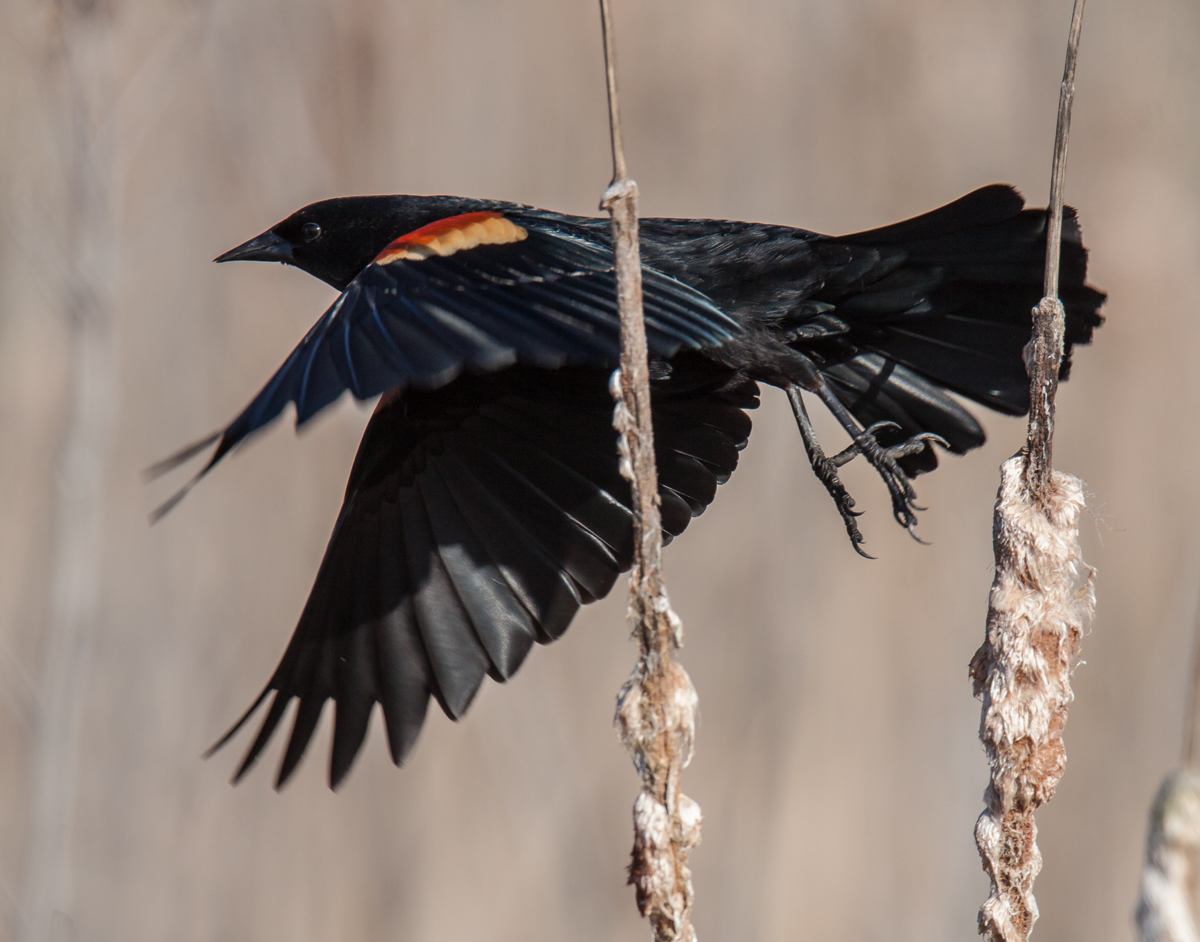
Sometimes accidents are good. I certainly didn’t expect this male Red-winged Blackbird (Agelaius phoeniceus) to move when I pressed my camera’s shutter release, but I managed to catch the bird in a much more interesting pose than the one I was originally trying to capture.

Red-winged Blackbird

© Michael Q. Powell. All rights reserved.

Read Full Post »

The forest floor is carpeted with tiny wildflowers at this time of the year and even this large black snake seemed to be taking time to appreciate their beauty.

The little flowers are Spring Beauties (Claytonia virginica) and I think the snake may be a Northern Black Racer (Coluber constrictor constrictor), though I must confess that I grow a bit confused when reading the descriptions about how to distinguish Black Racers from Eastern Ratsnakes.

Unlike an earlier shot this spring of another black snake, which I photographed with my telephoto zoom lens, I took this shot with my 180mm macro lens, getting as low as I could and as close as I dared.

Northern Black Racer

© Michael Q. Powell. All rights reserved.


Read Full Post »

I know that vultures don’t really stalk live prey, but when this Black Vulture leaned forward from its perch on a dead tree, it sure looked like it was following something on the ground.

Most of the vultures that I see at my local marsh are Turkey Vultures, which have a distinctive red head, but occasionally I will also spot Black Vultures (Coragyps atratus) like this one. I was in a remote area of the park searching for dragonflies when this vulture flew in my general direction and decided to perch for a while high on a nearby tree.

Initially the bird spent some time grooming itself, but then it assumed the pose that you see in this image. I tried to move closer to get a better shot and eventually I was almost underneath the tree. As I looked at my images on the computer, I initially thought that I might have photographed an immature Turkey Vulture, which also has a dark head, but I’m pretty sure this is a Black Vulture, because of its short tail.

When I was doing a little research on the Cornell Lab of Ornithology website, one of my favorite resources for birds, I learned that Black Vultures often hang out with Turkey Vultures to compensate for their weaker sense of smell. “To find food they soar high in the sky and keep an eye on the lower-soaring Turkey Vultures. When a Turkey Vulture’s nose detects the delicious aroma of decaying flesh and descends on a carcass, the Black Vulture follows close behind.”

In addition to its pose, I was struck by the dead-looking eyes of this vulture, which I can’t help but find a little creepy. I am not really paranoid, but somehow I am happy that it had not fixed those eyes on me.

Black Vulture

© Michael Q. Powell. All rights reserved.
Read Full Post »

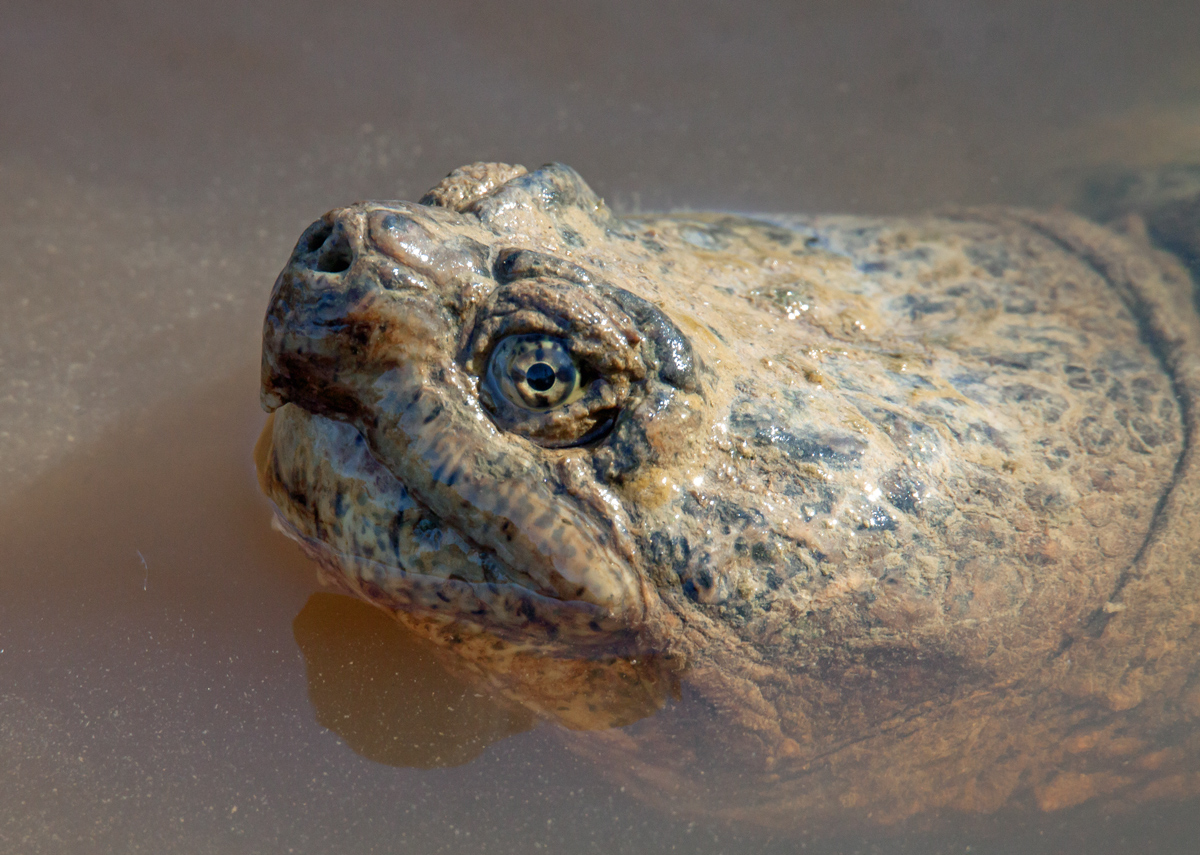
It’s springtime. Love is in the air and mating is on the mind of many marsh creatures, including these Snapping Turtles (Chelydra serpentina). The first image makes it look like love is a tender affair for these turtles, but the reality seems to be that mating is brutal and violent.

Most of the activity takes place underwater so it is hard to know what is going on, but it looks like the male jumps the female and essentially tries to drown her. Periodically she is able to struggle to the surface to grab a breath of air before the weight of the male forces her underwater. After a half hour or so, the female managed to decouple and to swim away, leaving the male, as you can see in the final shot,with a look of satisfaction on his face.

snapping turtlesnapping turtlesnapping turtlesnapping turtle

© Michael Q. Powell. All rights reserved.

Read Full Post »

As I was going over my photos of my recent encounter with a North American Beaver (Castor canadensis), I was struck by the beautiful quality and color of the early morning light. Sure, it was cool to be able to get some close-up shots of the beaver swimming around, but the light was equally spectacular.

I’ve tried to convey in these two images a sense of the golden glow that surrounded us during the magical moments I shared with this beaver, though somehow the colors seem to get a bit desaturated when I move the image into WordPress.

Check out my previous posting to see more images of this beautiful beaver.

North American Beaver

North American Beaver

© Michael Q. Powell. All rights reserved.
Read Full Post »

One early morning this past weekend I spent a few magical morning moments with this North American Beaver (Castor canadensis)  at Huntley Meadows Park during that short period of time when the light is golden and extraordinarily beautiful.

There is a beaver pond in a fairly remote area of the park that is my favorite spot in the park. In the past, I have observed an otter, a fox, a racoon, deer, and multiple bald eagles and hawks from that spot, but until a week ago, I had never observed the beavers that live there. A week ago, in the early morning hours I was pleased to see a beaver swimming away from the lodge and then back to it. I got some ok shots on that occasion, but decided I’d return to that spot again to see if I would get lucky again.

On Saturday, I returned and stood and waited as I drank in the beauty of the location. There is something really peaceful and special about those early morning moments. Suddenly a beaver’s head broke the surface of the water and a beaver began to swim slowly around in circles. The beaver seemed to be simply enjoying itself.

I crouched down and began to take photos. The light was beautiful, though not abundant, and my subject was moving, so I struggled a little to get the right settings. At one point, the beaver started swimming right at me and grew larger and larger in my viewfinder to the point that I actually stood up and startled the beaver. The beaver dove under the water, bur soon resurfaced and continued its swim.

Time seemed to stand still and I don’t really know how long my encounter with the beaver lasted, but eventually the beaver went under water and returned to its lodge.

I am still sorting through my photos, but wanted to share a couple of my initial favorites. Perhaps you will see some more of them in a future posting. (I am also including a shot of the beaver’s lodge to give you an idea of the surroundings.)

North American Beaver

North American Beaver

beaver lodge

© Michael Q. Powell. All rights reserved.

Read Full Post »

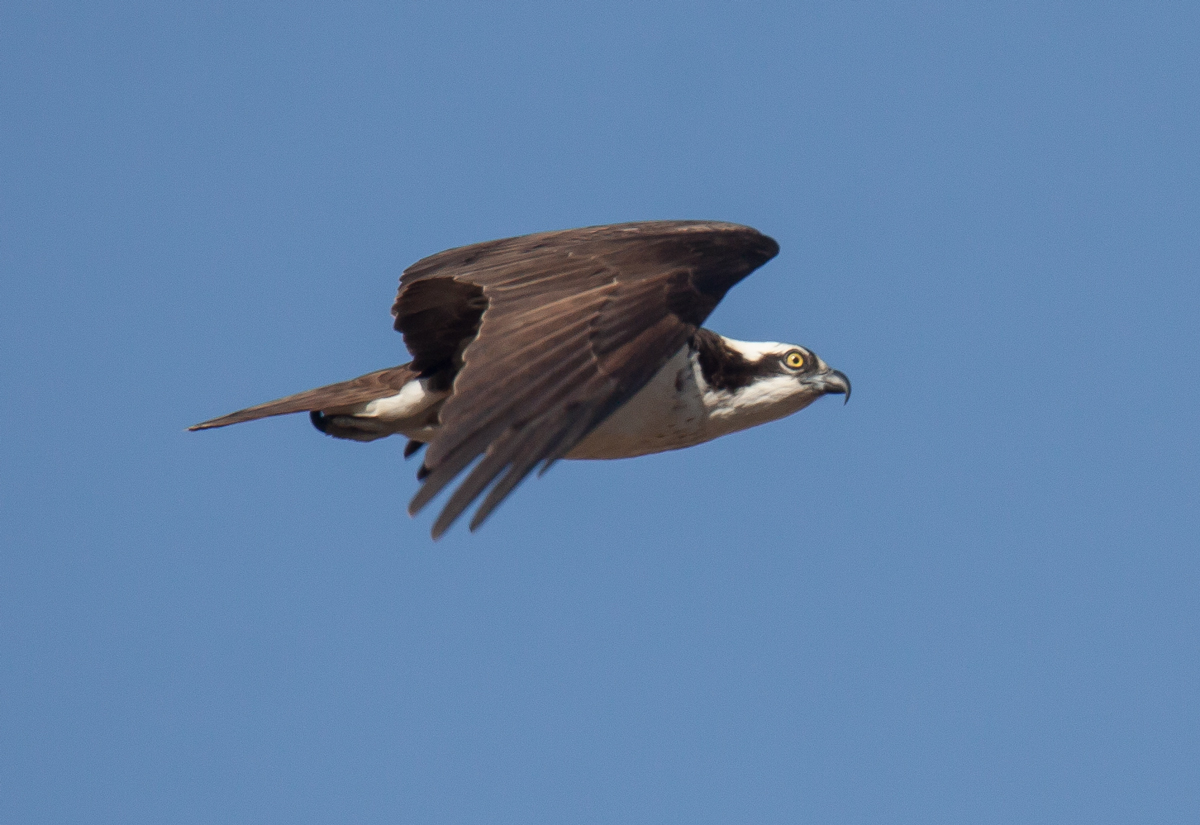
In some of my photos, the ospreys (Pandion haliaetus) look really majestic, but in these two shots, the osprey looks almost like a cartoon caricature to me.

Osprey

osprey

© Michael Q. Powell. All rights reserved.

Read Full Post »

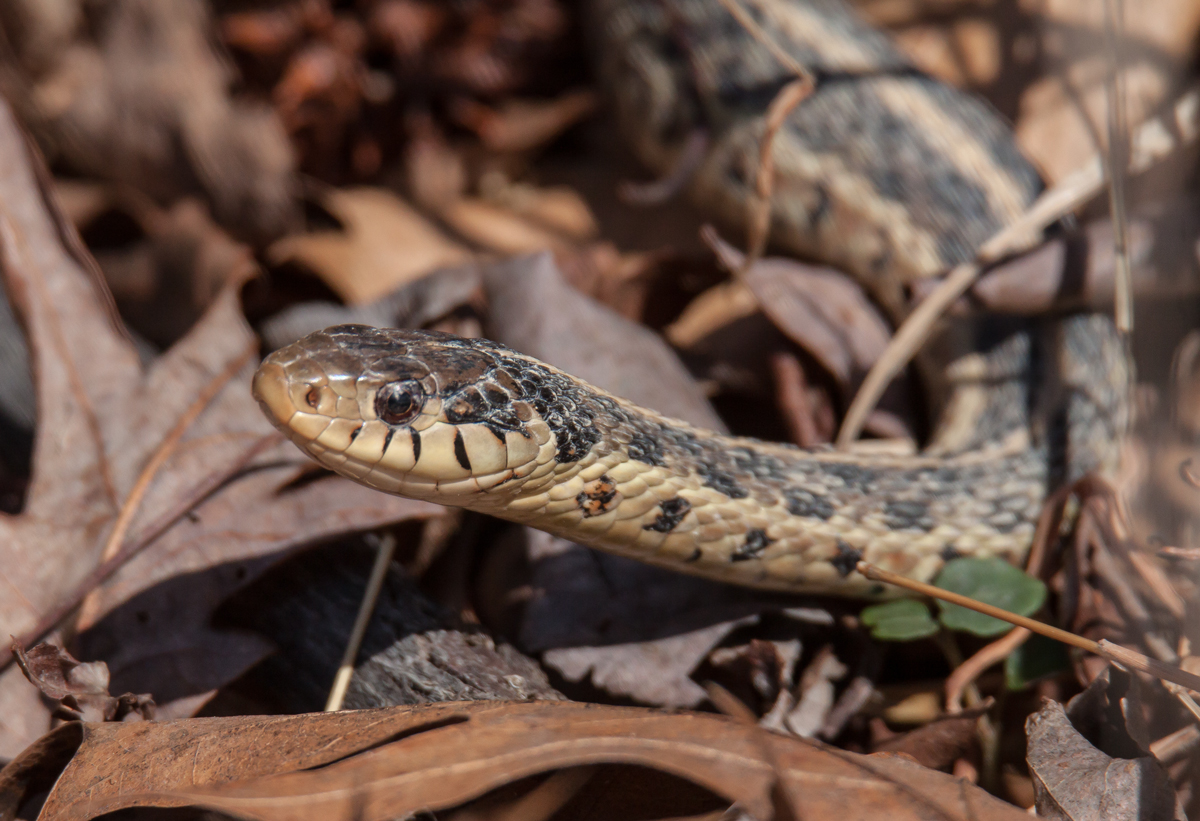
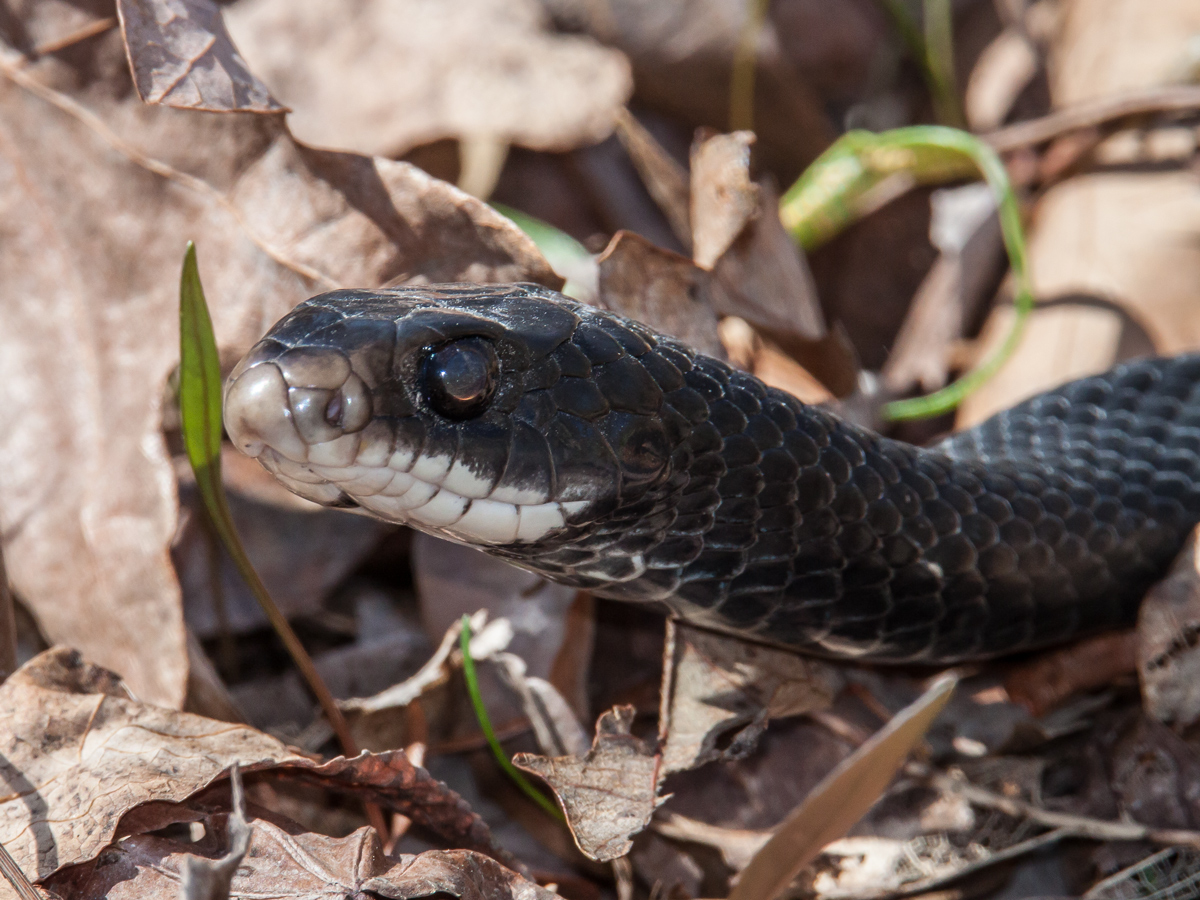
I am seeing more and more wildlife as we move deeper into spring and even encountered a couple of snakes this past Monday as I was walking along some of the informal trails at my local marshland park. When I say “encountered,” I mean that I almost unwittingly stepped on them and was shocked when they made sudden movements.

The smaller of the two was a cute little Eastern Garter snake (Thamnophis sirtalis sirtalis) a pretty common species in out area. The second, much larger snake is probably an Eastern Ratsnake (Pantherophis alleghaniensis), formerly known as the Black Ratsnake.

According to the Virginia Herpetological Society, the Eastern Ratsnake is the only snake in Virginia that can grow to a length of more than six feet (1.8 meters).  This snake was not quite that long, but it was pretty big and rather fierce looking. Although I occasionally have photographed snakes with a macro lens, I was more than content to get this shot with my telephoto zoom lens extended to it maximum 600mm focal length.

Eastern Garter SnakeEastern Ratsnake

© Michael Q. Powell. All rights reserved.


Read Full Post »

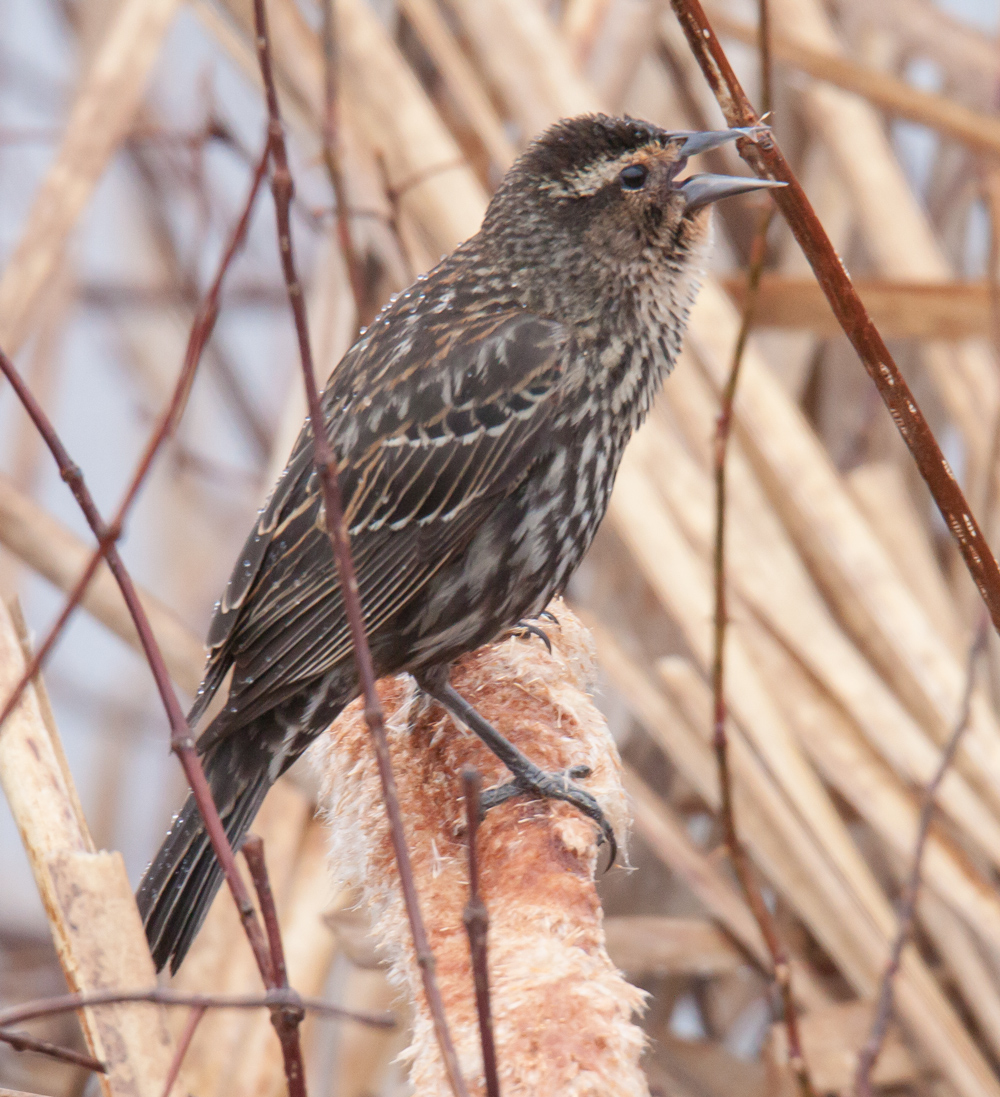
My life was much simpler before I started to photograph birds. I naively assumed that all Red-winged Blackbirds were black and had red wings. There is no way in the world that I would have even guessed that the bird in this photograph is a female Red-winged Blackbird, but I know now that’s what it is.

With experience comes wisdom, perhaps, but I generally feel more confused than wise when it comes to identifying birds. There are so many variables to consider, including the geographic location, the time of the year, the age of the bird, and, of course, its gender. Sure, there are lots of resources available over which to pore, but I’m often left with a certain degree of uncertainty about a bird’s identification. Apparently I am not alone, because I have overheard heated discussions among experience birds trying to identify a distant bird that they can barely see in their spotting scopes.

Female Red-winged Blackbirds (Agelaius phoeniceus) are amazingly beautiful and I would love to feature them more often in this blog, but I find them to be unusually difficult to photograph. Unlike their male counterparts, who are visible and vocal to the point of being a bit obnoxious, the females tend to spend their time pecking about industriously in the undergrowth, rarely coming out into the open.

I was pleased to be able to get this mostly unobstructed shot of this female blackbird recently as she was singing in the rain. If you look closely, you can see a series of raindrops beading up on her back. Other birds may have been seeking shelter from the rain, but she kept working.

As the foliage reappears on the trees and bushes, it’s going to get tougher and tougher for me to spot birds. I’ll still be trying to photograph them for a while longer until I switch to macro mode and focus more on insects and flowers, which have their own identification challenges.

Red-winged Blackbird

© Michael Q. Powell. All rights reserved.

Read Full Post »

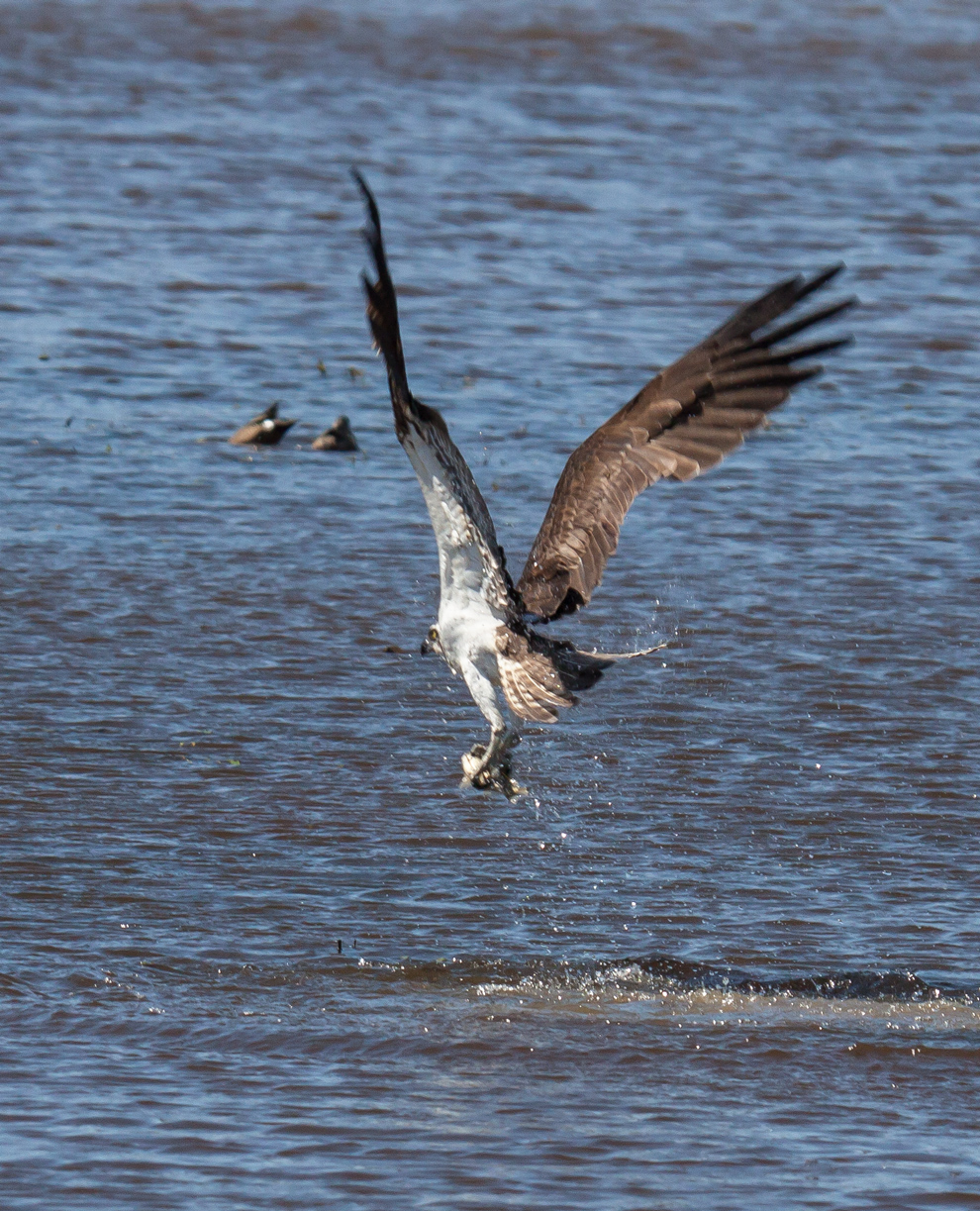
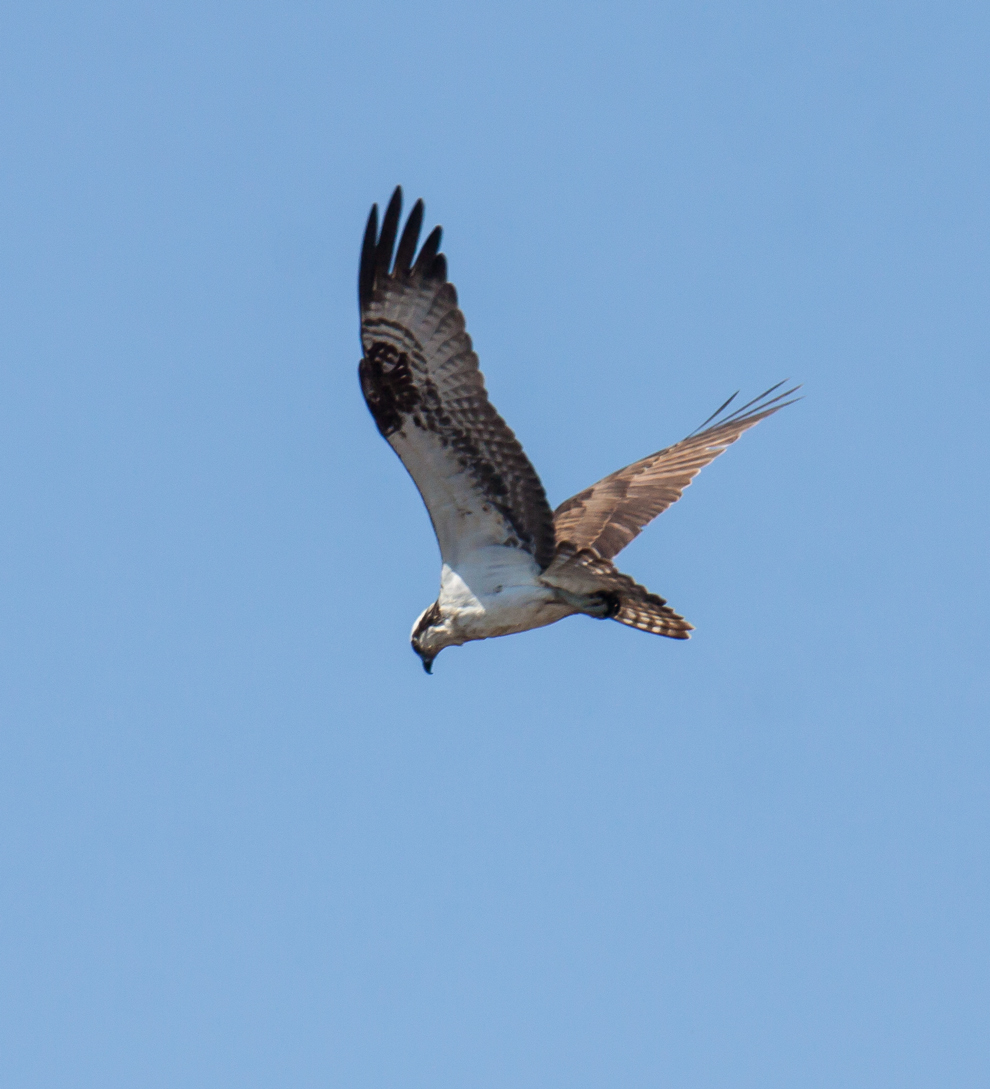
Earlier this week I watched a pair of Ospreys (Pandion haliaetus) at my local marsh circling about in search of a meal and captured a sequence of shots of a successful effort. I have previously seen ospreys flying with fish in their talons, but I had never actually seen an osprey catch a fish.

The first shot, my favorite, shows the osprey flying away with its prize, just after it plucked the fish out of the water. Initially the osprey spotted the fish (photo 2) and arrested its forward motion to prepare to dive (photo 3). I tried to track the osprey as it dove, but it dropped so quickly that all I got in the frame was the tail end of the bird. It looks like ospreys dive head first toward the water and then at the last minute bring their legs forward so that they hit the water feet first.

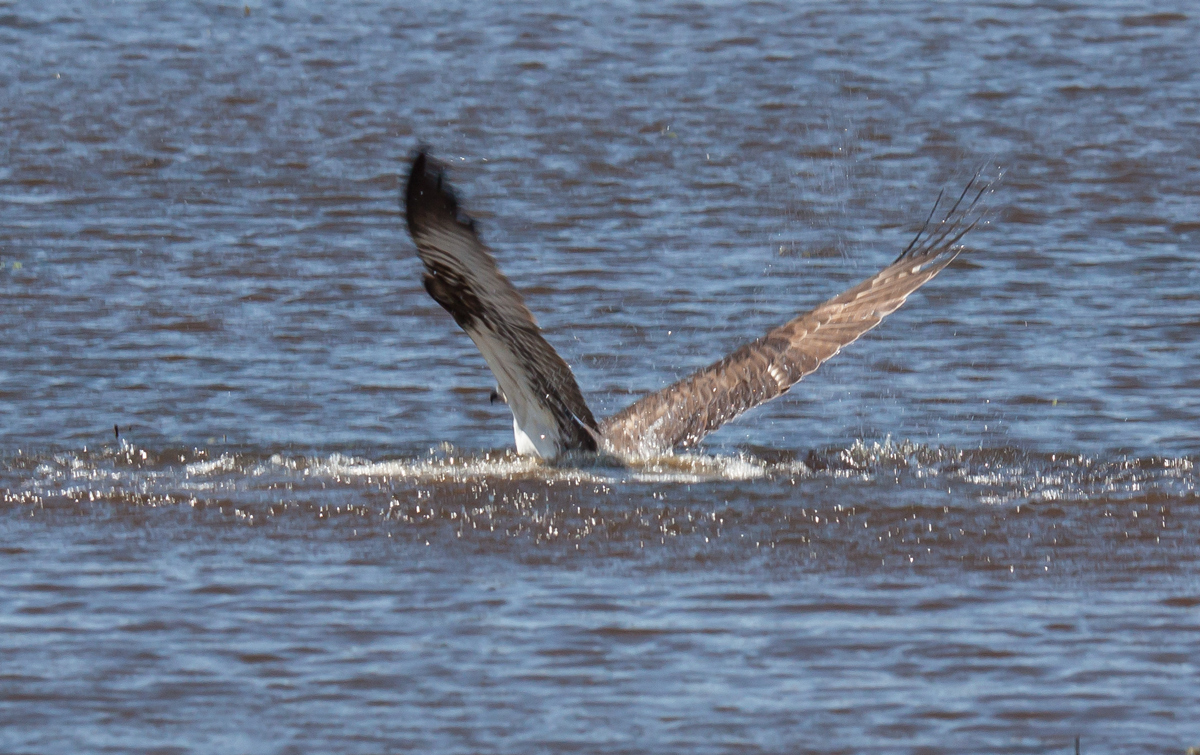
The fourth photo gives you an idea of how forcefully the osprey hit the water. It made a loud splash and much of its body looks to be submerged. The final shot shows the osprey emerging from the water, using its impressive wings to generate an amazing amount of power.

OspreyOspreyOspreyOspreyOsprey

© Michael Q. Powell. All rights reserved.
Read Full Post »

When this Common Five-lined Skink (Plestiodon fasciatus) is standing up, it looks pretty tall, but as the second image shows, it can get down so low that I don’t think that you could want to challenge it to a limbo contest.

How low can you go?

skinkCommon FIve-lined Skink

© Michael Q. Powell. All rights reserved.

Read Full Post »

« Newer Posts - Older Posts »