Feeds:
Posts
Comments

Posts Tagged ‘Tamron 150-600mm telephoto’

With patches of red, white, and blue, this Red Admiral butterfly (Vanessa atalanta) that I spotted earlier this week seems to be perfectly attired to celebrate Independence Day today here in the United States.

Happy Fourth of July!

Red Admiral

© Michael Q. Powell. All rights reserved.

Read Full Post »

A few years ago I probably would have misidentified this butterfly as a Monarch because of its coloration. Now, however, I can tell immediately that it is a Viceroy butterfly (Limenitis archippus), because there is a black stripe across the hindwings that the Monarch lacks.

I spotted this beautiful little butterfly this past Monday as I was searching for dragonflies and other creatures in a remote area of Huntley Meadows Park, the marshland area where I take many of my photos. A significant number of the areas that I like to visit are at least partially flooded. The month of June that we just ended turned was the second most rainy June on record for the region (and the rain has continued into July).

As I take more and more photos, I keep learning more and more about my subjects as I try to figure out what I have shot. What amazes me is that I manage to retain some of that information and can use it to identify a subject, as I did in this case. It’s not that easy most of the time (at least for me).

Viceroy butterfly

© Michael Q. Powell. All rights reserved.

Read Full Post »

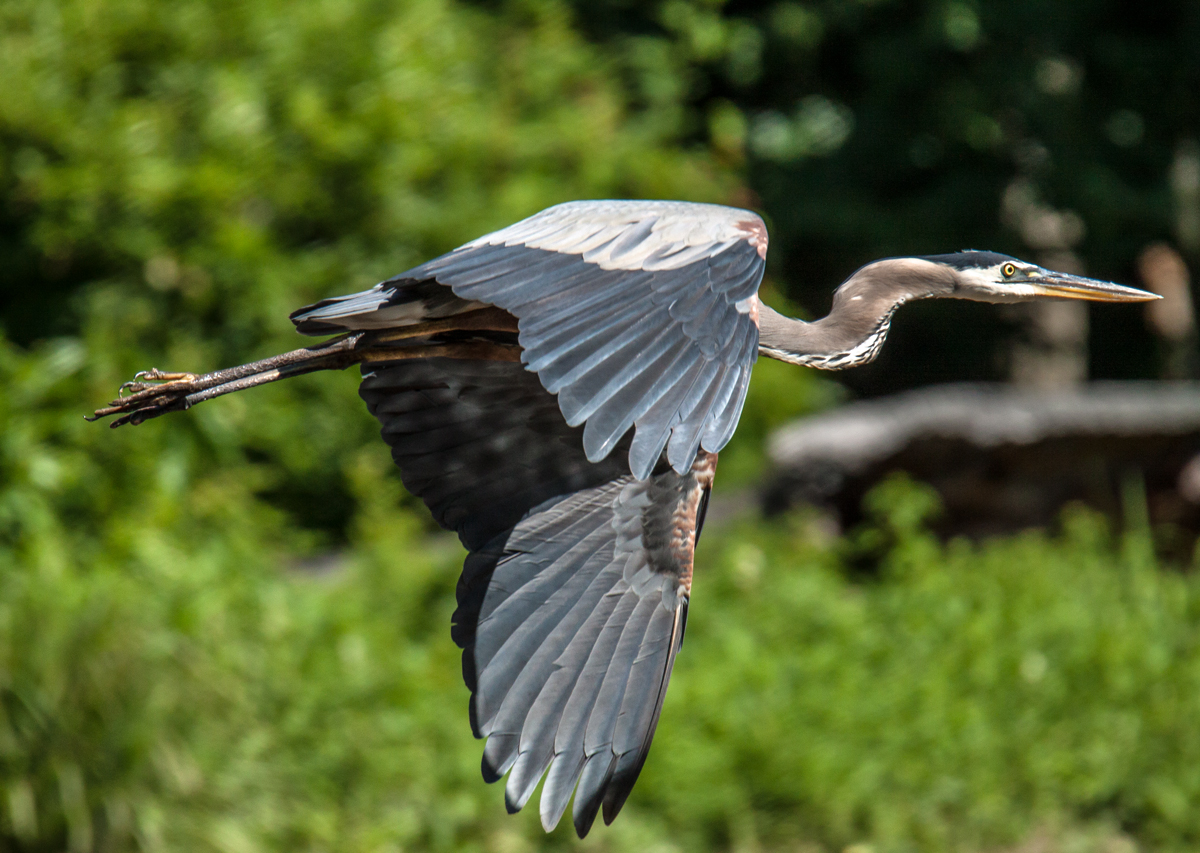
I was concentrating so intently on tracking this Great Blue Heron (Ardea herodias) in flight on Monday that I didn’t realize he was so close to me that I actually should have zoomed out a bit—the heron barely fit within the viewfinder.

Fill the frame with your subject? I can’t remember the last time that I was able to do so with a bird as the subject.

Great Blue Heron

© Michael Q. Powell. All rights reserved.

Read Full Post »

Instinctively I try to get as close to a subject as possible, often ignoring the “big picture.” One recently early morning, however, there was a substantial amount of water between me and the Belted Kingfisher (Megaceryle alcyon) that I spotted on a fallen tree and there was no way I was getting closer.

I concentrated on focusing, thinking I would probably have to crop a lot, and on composition. Almost despite myself, I ended up with an image that I really like, an image in which the kingfisher is only one element of an early morning landscape.

There is definitely a benefit sometimes in not getting closer to the subject.

Belted Kingfisher

Michael Q. Powell. All rights reserved.

Read Full Post »

I probably watched too many horror movies as a child, because I couldn’t help but think of Count Dracula when I first saw the posture of this male Red-winged Blackbird (Agelaius phoeniceus) at my local marshland park. The blackbird seemed to have assumed the traditional bat-like Dracula pose and appeared to be getting ready to swoop in and suck my blood. Involuntarily, my neck began to twitch a little.

Fortunately, the blackbird flew off in another direction and, at least for now, I have not been turned into a vampire.

Red-winged Blackbird

Michael Q. Powell. All rights reserved.

Read Full Post »

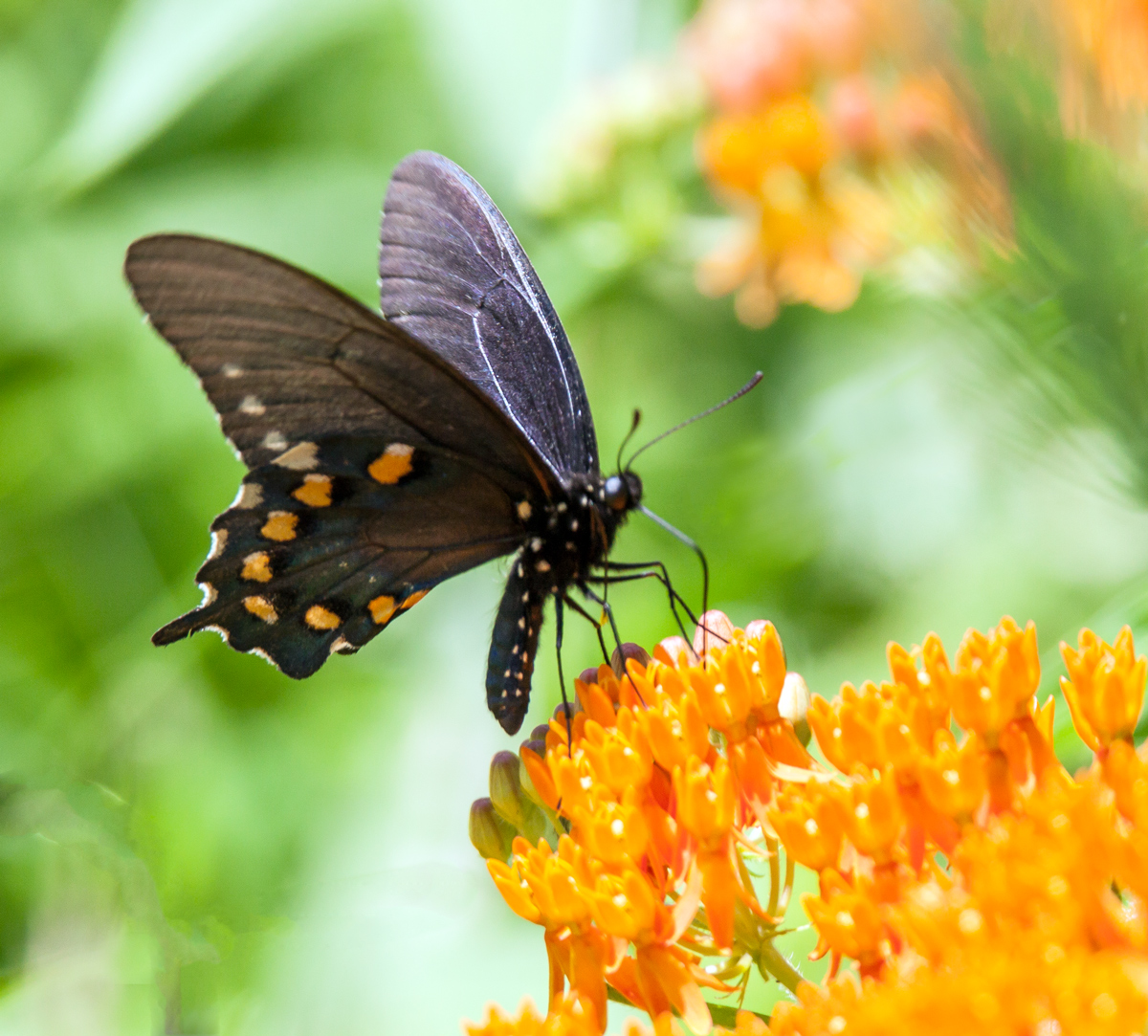
This past weekend I spotted a black swallowtail fluttering about some bright orange flowers, never stopping for more than a split second. Could I get a shot before it flew away?

Well, I managed to get some shots and then came the tough part—figuring out which black-colored swallowtail I had captured. How hard can that be? For a casual observer like me, there were at least three candidates that immediately came to mind—the black version of the Eastern Tiger Swallowtail, the Spicebush Swallowtail, and the Pipevine Swallowtail. I recalled that one of the key indicators is the pattern of the orange spots, but I couldn’t remember which one had which pattern.

After some quick research, I’ve concluded this is probably a Pipevine Swallowtail butterfly (Battus philenor). I was also really taken by the orange plant and think it might be butterfly weed (Asclepias tuberosa), a type of milkweed that, as its name suggests, attracts butterflies.

Pipevine swallowtail

Michael Q. Powell. All rights reserved.

Read Full Post »

When it is really hot and the sun is directly overhead, Blue Dasher dragonflies (Pachydiplax longipennis) will often perch in a handstand-like pose that is generally referred to as the “obelisk posture.” By doing this, they minimize the direct exposure of the abdomen’s surface to the sun and stay cooler. Some other dragonflies will also engage in this kind of postural thermoregulation, but I see it most commonly in Blue Dashers.

Blue Dashers, one of our most common dragonflies,  were largely responsible for my initial fascination with dragonflies. In fact, almost three years ago my very first posting on this blog featured a Blue Dasher in an obelisk posture.

Since that time, I have grown in experience and knowledge and have cranked out over 1600 posts. My fascination with dragonflies has broadened and grown into a quasi-obsession, but I am always drawn back to the little Blue Dasher dragonfly, whose acrobatic poses never cease to amaze and entertain me.

dasher1_june_obelisk_blog

Michael Q. Powell. All rights reserved.

Read Full Post »

I know that there are deer at Huntley Meadows Park, the suburban marshland park where I take many of my photos, but I rarely see any of them. Perhaps they too see the posted signs warning of archery hunting to keep the population in control.

Saturday morning, however, I spotted three White-tailed deer (Odocoileus virginianus) in an open area in front of a stand of cattails.  The deer grazed for a little while before fading silently back into the forest and I managed to get a few shots of them.

It’s a nice change of pace to get some shots of mammals at a time of the year when so many of my postings are devoted to insects.

White-tailed deer

Michael Q. Powell. All rights reserved.

Read Full Post »

Yesterday, the last full day of spring, I spotted a Halloween Pennant (Celithemis eponina), one of my favorite dragonflies, at Huntley Meadows Park, a place where I had previously never seen one. It was an auspicious end to spring, even if it seems a bit strange to speak of spring and Halloween in the same posting.

As you can see, these dragonflies like to perch on the very top of the vegetation in the fields. That’s an advantage in isolating the subject, but the slightest breeze causes them to wave back and forth like a pennant.

I snapped away when I spotted the Halloween Pennants and have not yet gone through all of my images, but I am so excited that I can’t help but share a couple with you now. There may be a few more to come later.

Halloween Pennant

Halloween Pennant

Michael Q. Powell. All rights reserved.

Read Full Post »

Early yesterday morning I thought that this female Red-winged Blackbird (Agelaius phoeniceus) was gathering nesting materials, which seemed a little strange this late in the season. When I looked at the images on my computer, however, I was surprised to see that she had instead captured an immature male Eastern Pondhawk dragonfly (Erythemis simplicicollis), a species that itself has a reputation as a ruthless predator.

As the old adage suggests, sometimes the predator becomes the prey.

Eastern Pondhawk

Eastern Pondhawk

Michael Q. Powell. All rights reserved.

.

Read Full Post »

If I had wings as fragile as those of this male Spangled Skimmer dragonfly (Libellula cyanea), I am not sure that I would choose to perch on a branch with so many thorns. I can personally attest to the fact that those thorns are sharp, very sharp.

Although I see quite a few blue dragonflies, Spangled Skimmers are pretty easy to identify—they are the only local dragonflies with both black and white stigmas on their wings. I love it when the differences among species are that obvious.

On the day I took this shot, the field seemed to be full of Spangled Skimmers and Great Spangled Fritillary butterflies. If I had only seen an American flag, i.e. the Star Spangled Banner, I would have exhausted the short list of items that I associate with the word “spangled.”

Spangled Skimmer

Michael Q. Powell. All rights reserved.

Read Full Post »

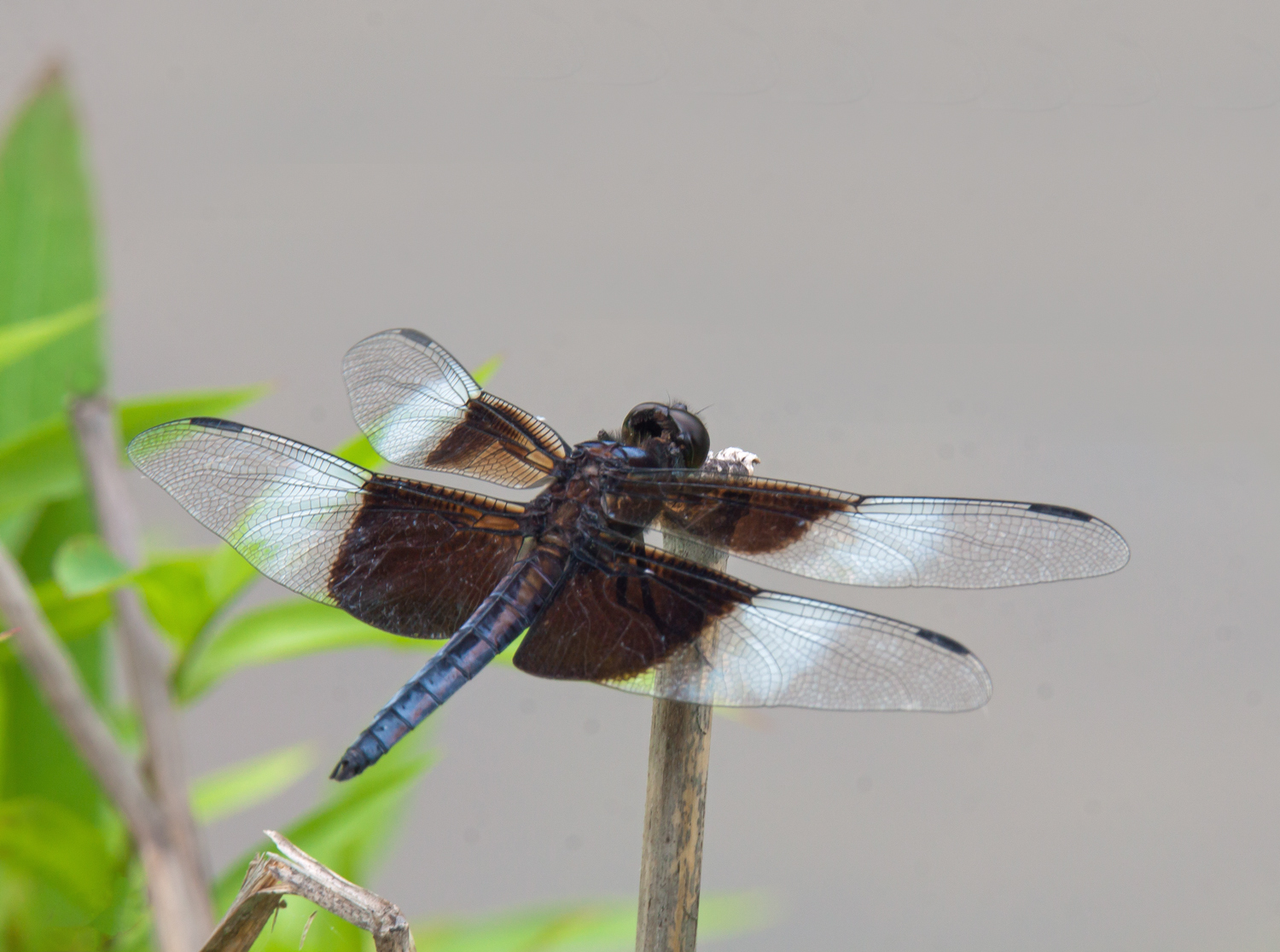
Flying slowly and weakly with its patterned wings, a male Widow Skimmer dragonfly (Libellula luctuosa) looks amazingly like a butterfly as it flutters by. Fortunately this one stopped to perch on some vegetation at the edge of a small stream and I was able to get this shot.

Widow Skimmer

This was the second time that I have seen a male Widow Skimmer this spring. It’s easy to tell that this is a male, because the females do not have the white spots on their wings. When I saw one last month, though, it was a little tougher to make the call. Immature male Widow Skimmers look a lot like females, as is the case with many dragonfly species. The colors of “fresh” dragonflies tends to be pale and wing patterns may not have developed fully yet. The photo below provides a pretty clear view of the “claspers” at the tip of the abdomen, which indicates that this is a male. Eventually he will grow up and begin to look more like the mature Widow Skimmer in the first photo.

Widow Skimmer

Michael Q. Powell. All rights reserved.


Read Full Post »

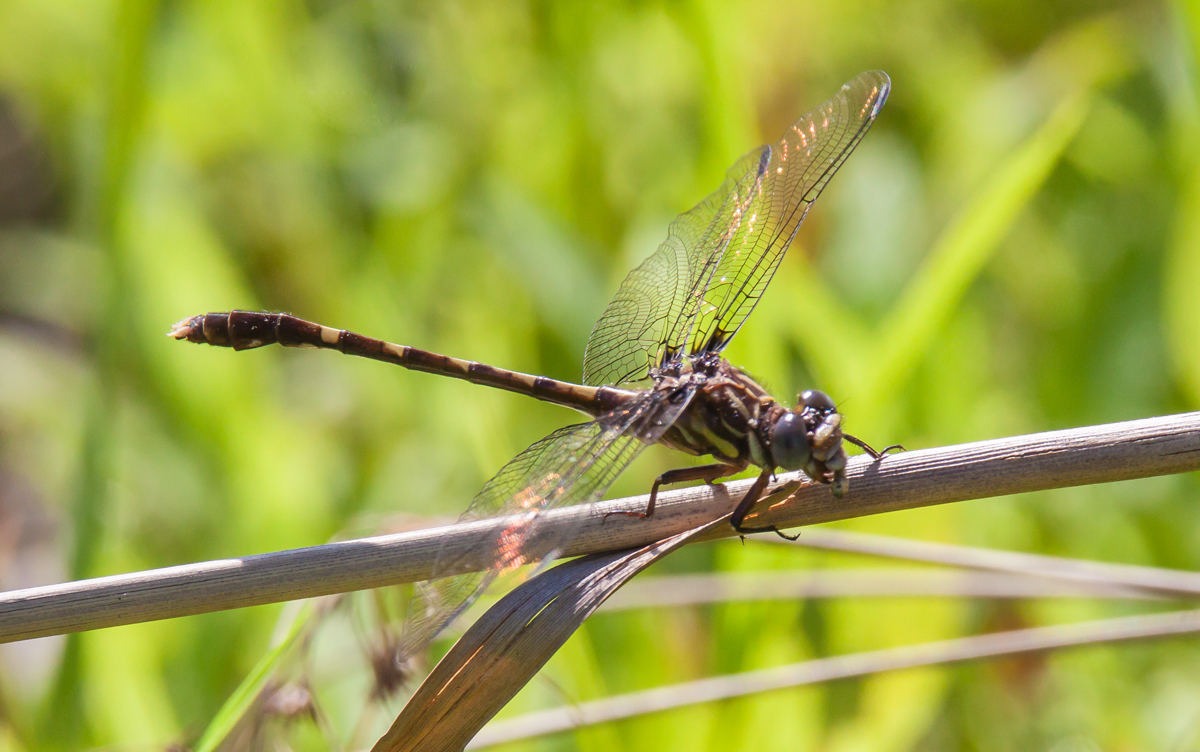
Unicorn Clubtail dragonflies (Arigomphus villosipes) have quickly become my favorite dragonflies this season. Their gorgeous turquoise eyes never fail to draw me in and their unusual clubtail and distinctive terminal appendages help to maintain my interest.

Unicorn Clubtails are a challenge to find and they are usually pretty skittish when you try to approach them. I have been fortunate enough to find a stream in my local marshland park where at least a couple of them can sometimes be found and patient enough to slowly search for them along the banks of the stream.

Here are a few of my favorite shots from this past Monday. I especially like the first one, in which the dragonfly seems to be cocking his head to the side and smiling at me. The second shot was taken from one side of the stream looking directly across at a Unicorn Clubtail that has assumed a defiant stance and looks to be ready to defend his territory. The final shot shows the dragonfly on a little sandy area at the edge of the stream, an area that he was sharing that day with a Common Sanddragon, a species that I will be featuring this blog sometime in the near future.

Unicorn Clubtail

Unicorn Clubtail

Unicorn Clubtail

Michael Q. Powell. All rights reserved.

Read Full Post »

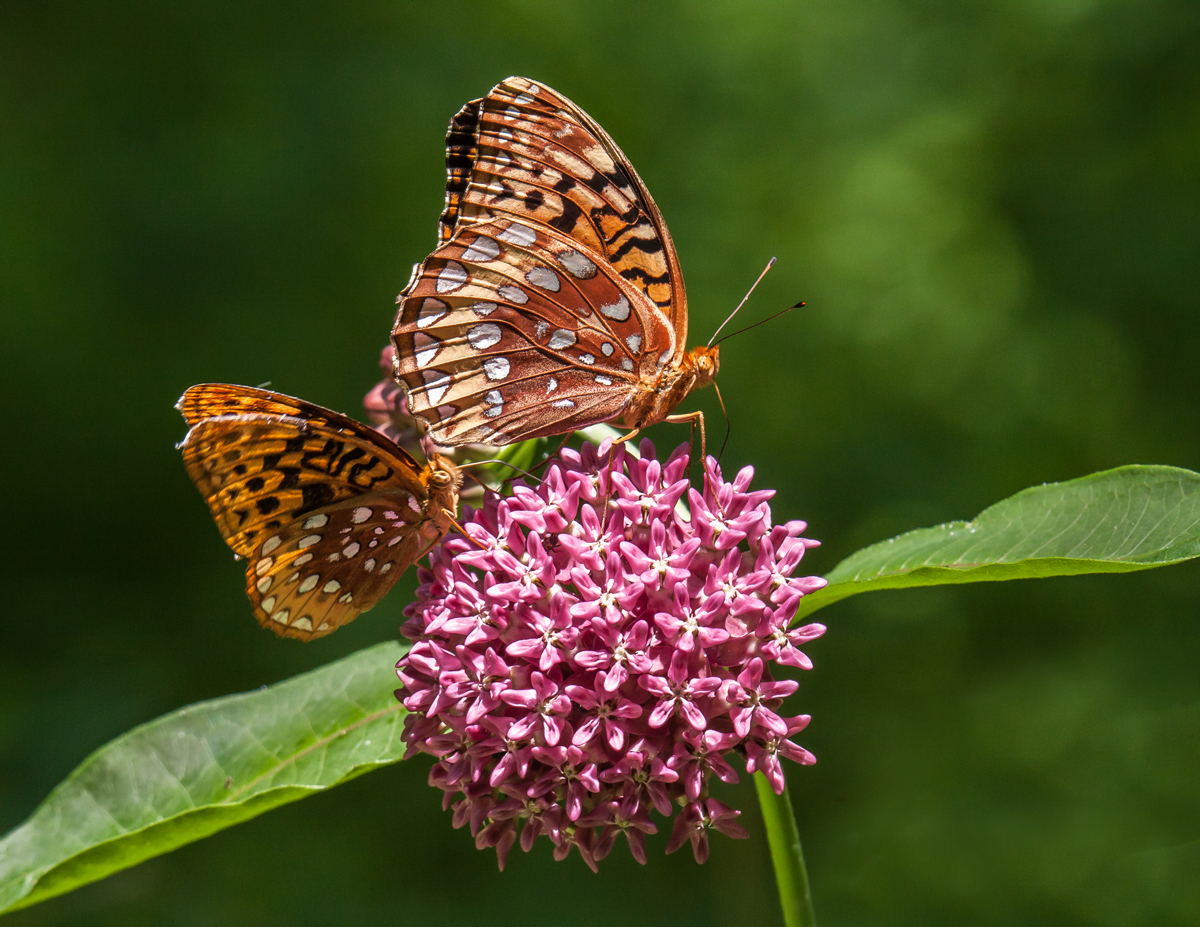
Swamp Milkweed (Asclepias incarnata) is now in bloom at my local marshland park and the Great Spangled Fritillary butterflies (Speyeria cybele) are loving it.

Great Spangled Fritillary

Michael Q. Powell. All rights reserved.

Read Full Post »

This is what Huntley Meadows Park looked like this past Friday morning around 6:00, with low hanging mist covering the fields, and the early morning silence broken periodically by the calls of Red-winged Blackbirds.

Normally I am so anxious to take close-up shots that I forget to try to capture the surroundings. This time I remembered and think the shot gives a pretty good idea of the way things felt and looked as the day began.

dawn_blog

Michael Q. Powell. All rights reserved.

Read Full Post »

Shortly after dawn one morning last week, I encountered a Great Blue Heron (Ardea herodias) that seemed to be pensively contemplating the new day. He glanced in my direction as I took a few shots, but remained in place as I continued on my way, both of us lost in our thoughts.

Great Blue Heron

Michael Q. Powell. All rights reserved.

Read Full Post »

One of my favorite summer dragonflies is the tiny Eastern Amberwing (Perithemis tenera). Its distinctive coloration makes it pretty easy to identify, even from a distance.

Eastern Amberwing

Michael Q. Powell. All rights reserved.

Read Full Post »

I spotted a beautiful Mourning Cloak butterfly (Nymphalis antiopa) this past weekend at Huntley Meadows Park and suspect that it recently emerged. I always thought of  Mourning Cloaks, which are apparently known as Camberwell Beauties in Great Britain, only as an early spring butterfly, because I knew that they overwinter with us as adults.

After doing a little research, I learned that the hardy winter survivors mate in the early spring and then die. The eggs turn into caterpillars that pupate and the new butterflies emerge in June or July. After briefly feeding, the butterflies will enter into a state of dormancy (called aestivation) for the summer. I must confess that I was not familiar with the word “aestivation” when I first ran across it and had to look it up. As far as I can tell, it’s the summer equivalent of hibernation. Last year I remember learning the word “brumation,” which is a hibernation-like state that helps turtles survive in the mud during the winter. Who knew there were so many hibernation-type states?

In the fall, the Mourning Cloak butterflies will go on a real feeding frenzy to store up energy for the long winter. It’s amazing to realize that these butterflies have a life span of 10 months, which is an eternity in the insect world.

Mourning Cloak

Michael Q. Powell. All rights reserved.


Read Full Post »

There was a heavy mist in the air when I left my house early one morning this past weekend, but I had hopes it would burn off quickly when the sun came up. I was wrong. As I walked deeper and deeper into the woods, the mist turned to drizzle and the drizzle turned into light rain. Over the course of the next few hours we repeated that cycle several times.

I had enough protection for my gear, but I was soon sopping wet from the often knee-high vegetation through which I was walking. More significantly, however, most potential photographic subjects were exhibiting amazing common sense and appeared to have sought cover in drier spots.

All of the sudden, at a moment when the rain had slowed down, I detected some motion and saw a damselfly moving slowly through the air. It came to rest on some vegetation at the edge of a small stream.

I tried to steady myself as well as I could, because shooting such a small subject at the far end of my 150-600mm zoom lens is a challenge. Given that my camera has a crop sensor, I was shooting at a 35mm equivalent of a 960mm focal length.

When I returned home and looked at my shots, I was happy that at least a few of them were in relatively sharp focus. Now I was faced with the equally daunting task of identifying my subject. There is a whole family of damselflies known as bluets and most of them are primarily black and blue in color with minor variations in patterns. (There is one that I have photographed called an Orange Bluet, a name that causes me to chuckle whenever I see those two words used together).

I turned to some experts on a Facebook page called Northeast Odonata and they were able to identify this damselfly as a Stream Bluet (Enallagma exsulans).

The clock is ticking for dragonflies and damselflies, many species of which have very limited seasons, so I’ll be out as often as I can to try to spot some familiar ones and maybe even some new ones. Light rain does not deter me, though heavier rain and/or high winds will keep me at home.

Stream Bluet

Michael Q. Powell. All rights reserved.

Read Full Post »

I love the delicate beauty of dragonflies and they can be spectacular, especially in dramatic lighting and from unusual angles, like these recent shots of a Painted Skimmer (Libellula semifasciata).

Painted Skimmer

Painted Skimmer

Michael Q. Powell. All rights reserved.

Read Full Post »

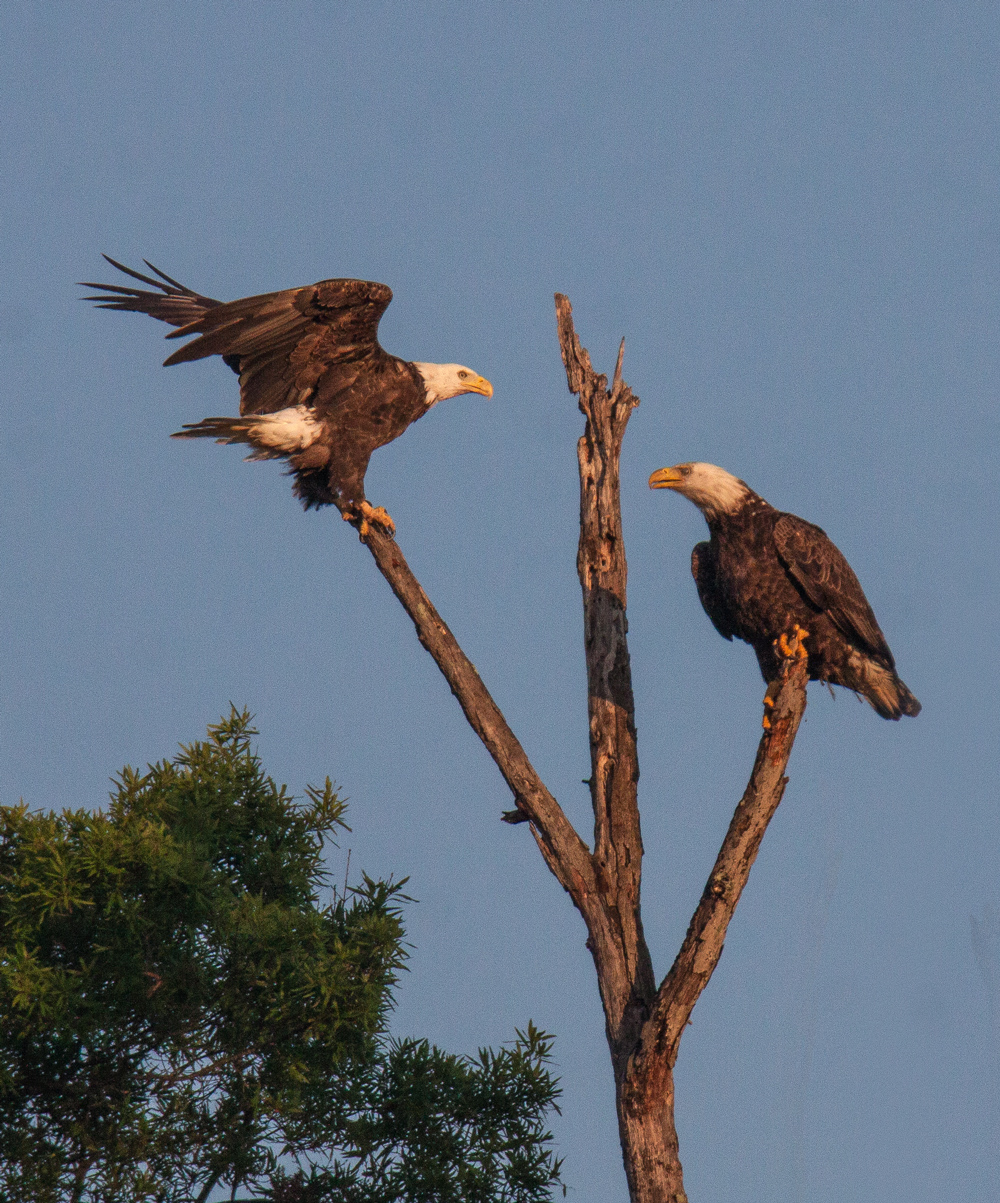
What could possibly be a better way to start a day than seeing a Bald Eagle (Haliaeetus leucocephalus)? Seeing two of them.

I spotted these eagles at Huntley Meadows Park at about 6:45 yesterday morning. Being an early bird helps me to capture the early birds like these.

Bald Eagle

Bald Eagle

Michael Q. Powell. All rights reserved.

Read Full Post »
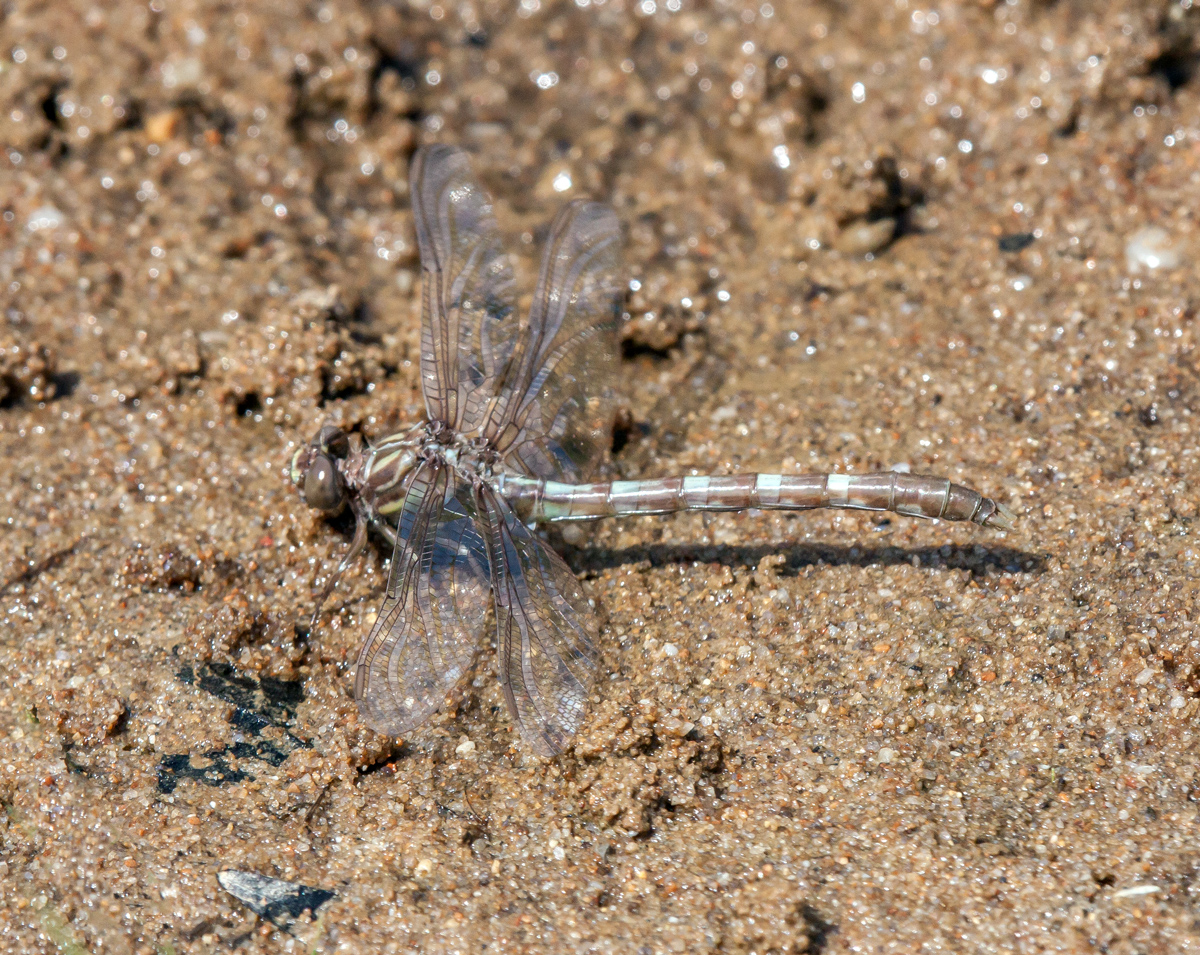
Where can I find a Common Sanddragon dragonfly? As its name suggests, this species is most often found  on the sandy banks of a stream and that is precisely where I found one earlier this week at my local marshland park.

Common Sanddragon

Almost exactly a year ago I stumbled onto a Common Sanddragon (Progomphus obscurus) as I wandered through a remote area of the park, so I had a pretty good idea where to look for one this year. That find was especially cool, because it was the first time that the species had been spotted in the park and it has since been added to the species list for Huntley Meadows Park.

However, this was not the first Sanddragon that I spotted this spring. A week earlier, I spotted one in the marsh vegetation, about halfway between the treeline and a little stream. It was definitely unusual to see this dragonfly away from the sand and perching above the ground.

Common Sanddragon

That find was unusual, but it was perhaps not as unusual as the teneral male Common Sanddragon that I saw the same day as the dragonfly in the first image. When dragonflies shed their exoskeletons and are transformed from aquatic nymphs to acrobatic flyers, they are initially pale in color and their wings are very fragile and shiny. The coloration on this one was so much different from that of a mature adult, that I had to consult with a more experienced friend to reassure myself that this in fact was a Common Sanddragon.

Common Sanddragon

I went out yesterday morning to search again for Common Sanddragons and was disappointed to see that all of the sandy banks were under water following several days of rain. Perhaps I will have better luck today.

Michael Q. Powell. All rights reserved.

Read Full Post »

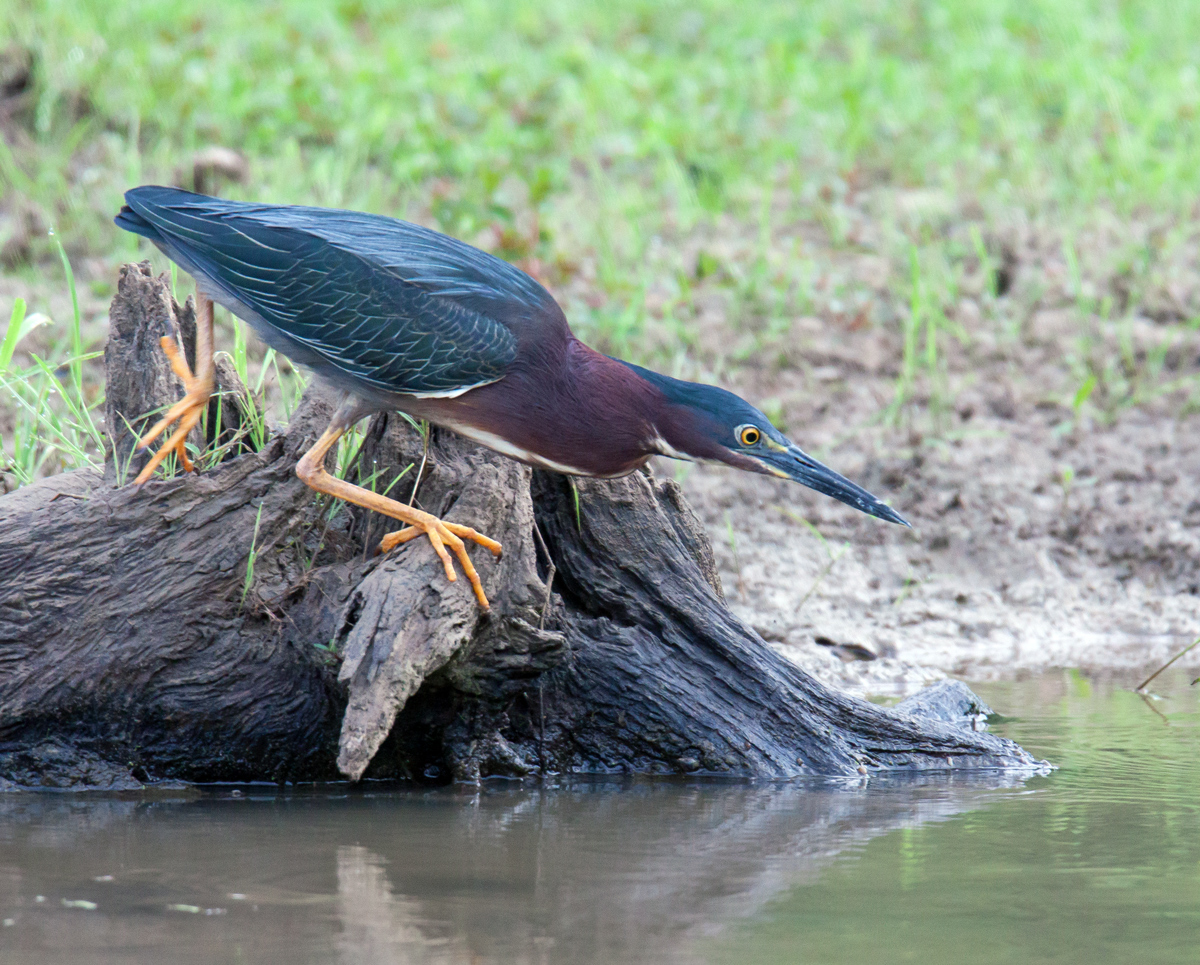
Like a ninja assassin, the Green Heron (Butorides virescens) moved slowly and stealthily forward, completely focused on an unseen prey. I watched and waited. After what seemed like an eternity, the heron relaxed. Whatever had attracted its attention was gone.

The heron was left empty-handed. Fortunately, I was more lucky and departed with this cool portrait of him in his natural environment.

Green Heron

Michael Q. Powell. All rights reserved.

Read Full Post »

I don’t see rabbits very often at Huntley Meadows Park, so I was thrilled to see this Eastern Cottontail (Sylvilagus floridanus) on Monday in one of the meadows in a remote area of the park. I suspect that the rabbits are more active at dawn and dusk, when I am not there, though one of my friends offered a more straightforward explanation—the raptors are efficient hunters.

Eastern Cottontail rabbit

Rabbits have become a part of my daily life since I recently adopted a friend’s rabbit. She moved into an apartment in the city and could not bring PR (Prime Rib) with her, so he now lives with me. I don’t know the full story of his name, but do recall that her former rabbit was called Porkchop.

PR spends most of his time in his cage, but for an hour or so each evening I let him run around the living room. Sometimes he runs and jumps at such high speeds that I wonder if there is caffeine in his food. I took this shot of him relaxing after one of his evening exercise sessions. I think the photo makes for an interesting comparison with the rabbit in the wild (and I also think he’s cute, though I may be biased).

PR

Michael Q. Powell. All rights reserved.

Read Full Post »
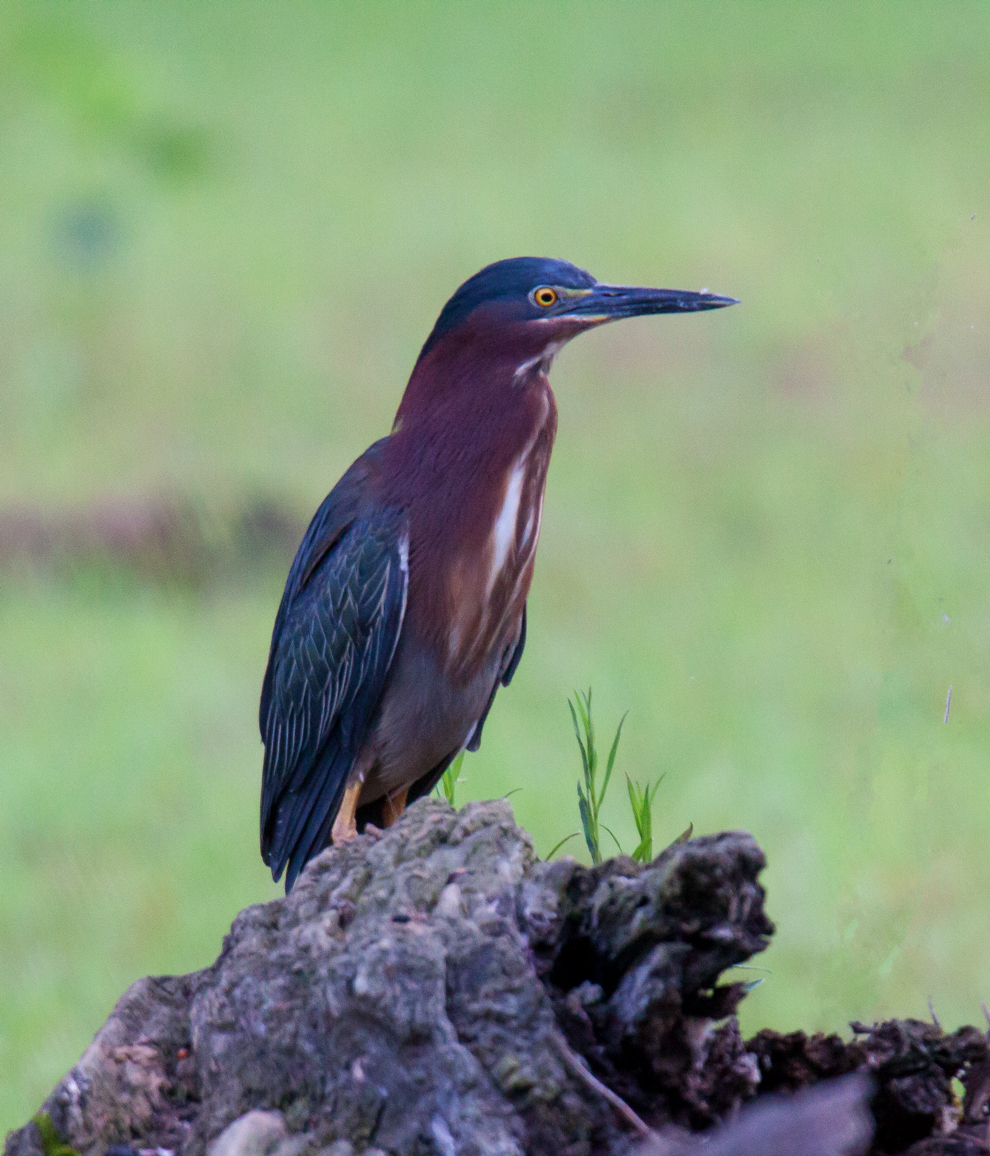
Green Herons seem so intense most the time when I seem them, standing motionless in one spot, ready for a strike.  What do they for relaxation or for fun?

Early this Monday, I caught a Green Heron (Butorides virescens) in some unguarded moments and learned some of its secrets. Who knew that Green Herons like to dance and to sing? They also appear to meditate, centering themselves as they start their days.

It’s not easy being green.

Green Heron

Practicing for a part in Riverdance

Green Heron

Anyone want to join me for show tunes?

Green Heron

Early morning reverie

© Michael Q. Powell. All rights reserved.

Read Full Post »

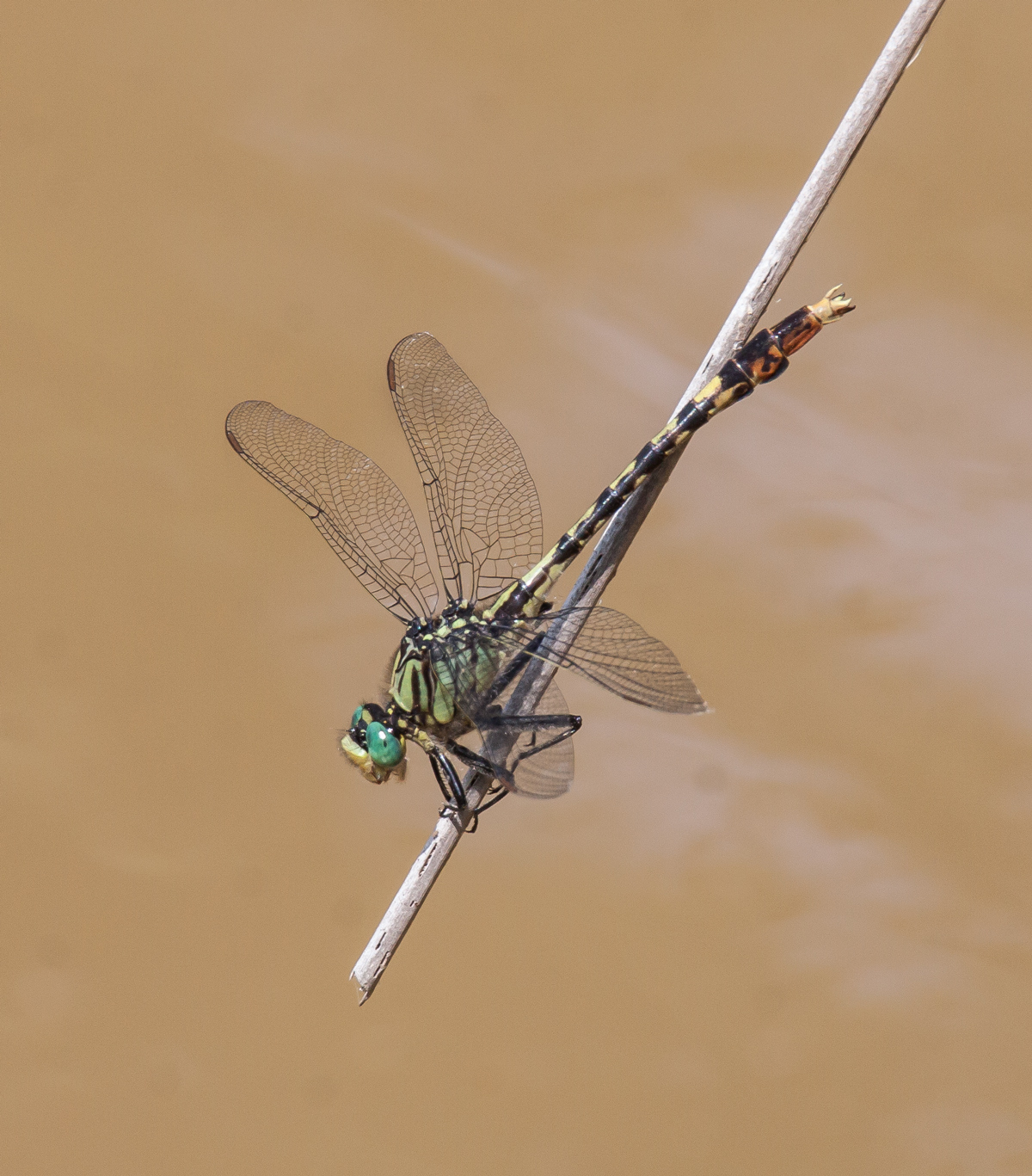
Do you believe in unicorns? I spent part of yesterday chasing a flying unicorn, although in this case it was the Unicorn Clubtail dragonfly (Arigomphus villosipes), not the one that looks like a horse.

Unicorn Clubtail

The Unicorn Clubtail is not a mythical creature, but I rarely see one—I am lucky if I manage to see a couple during an entire season of dragonfly watching. The u-shaped terminal appendage in the male Unicorn Clubtail is pretty distinctive and as soon as I saw this image on my computer screen, I knew that I had captured a unicorn.

When I first spotted this dragonfly, it was perched on a sandy area of the bank of a small stream. I mistakenly assumed that it was a Common Sanddragon, a somewhat similar species which is also part of the clubtail family (the members of this family have slim abdomens that end in an enlarged tip, i.e. the “clubtail”). When the dragonfly flew up into some vegetation that hung over the pond, I snapped off some photos as quickly as I could, because it is rare to get shots of these dragonflies with an unobstructed background.

One of my friends, Walter Sanford, a fellow photographer and blogger suggested to me earlier this spring that I use my Tamron 150-600mm lens, one that I use primarily for birds, to photograph dragonflies. I protested a bit, suggesting that I would not be able to capture the fine details of the dragonflies with the lens, which is reported to be a little soft at the long end.

There are some challenges, including the minimum focusing distance of 107.3 inches (2.7 m), which means I have to be a pretty good distance from my subject. However, shots like this one make me realize his advice was good—the extra reach helps me get shots that I might not be able to get otherwise, especially if I tried to move closer to take a shot with a shorter telephoto lens and risked spooking the dragonfly.

© Michael Q. Powell. All rights reserved.


Read Full Post »

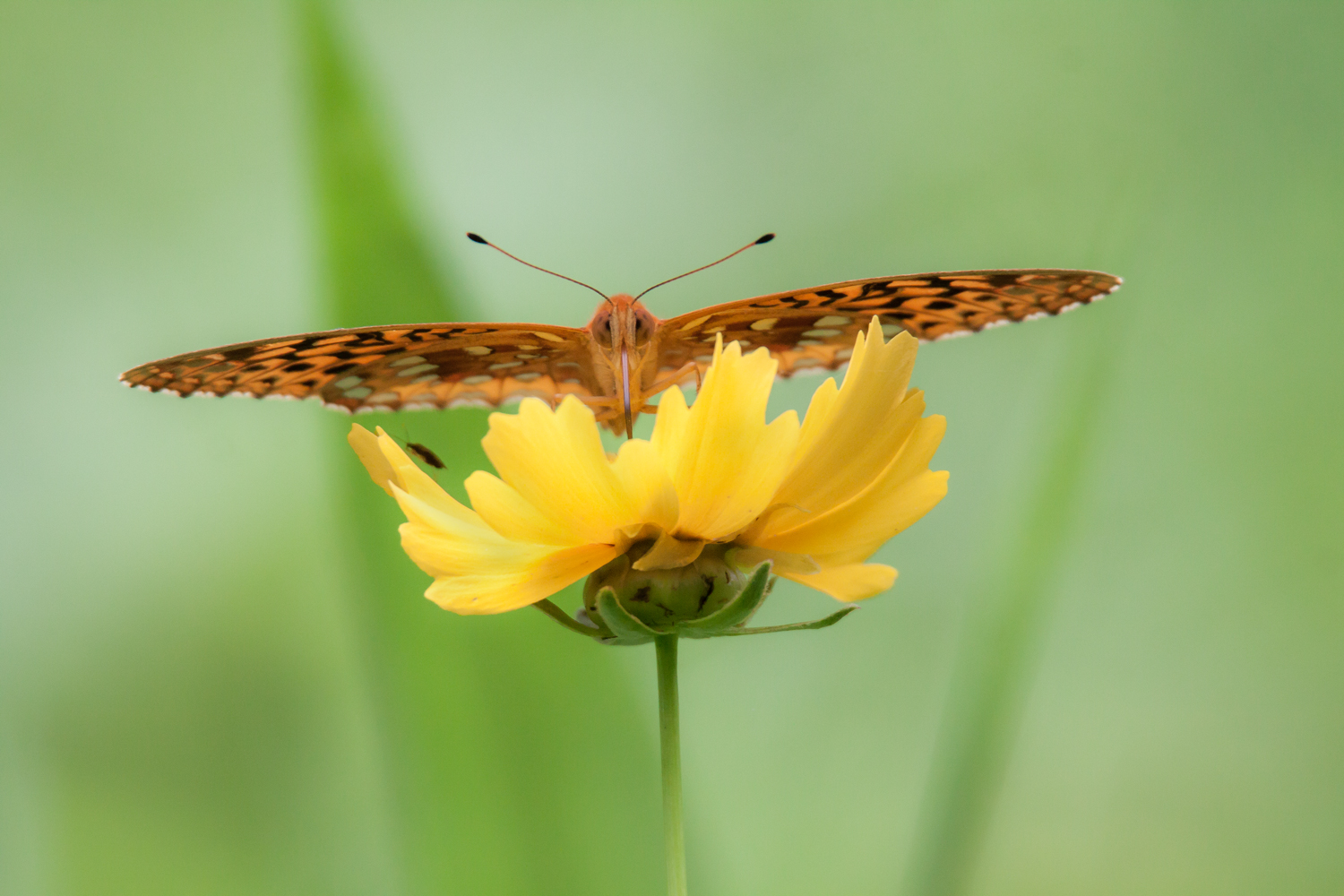
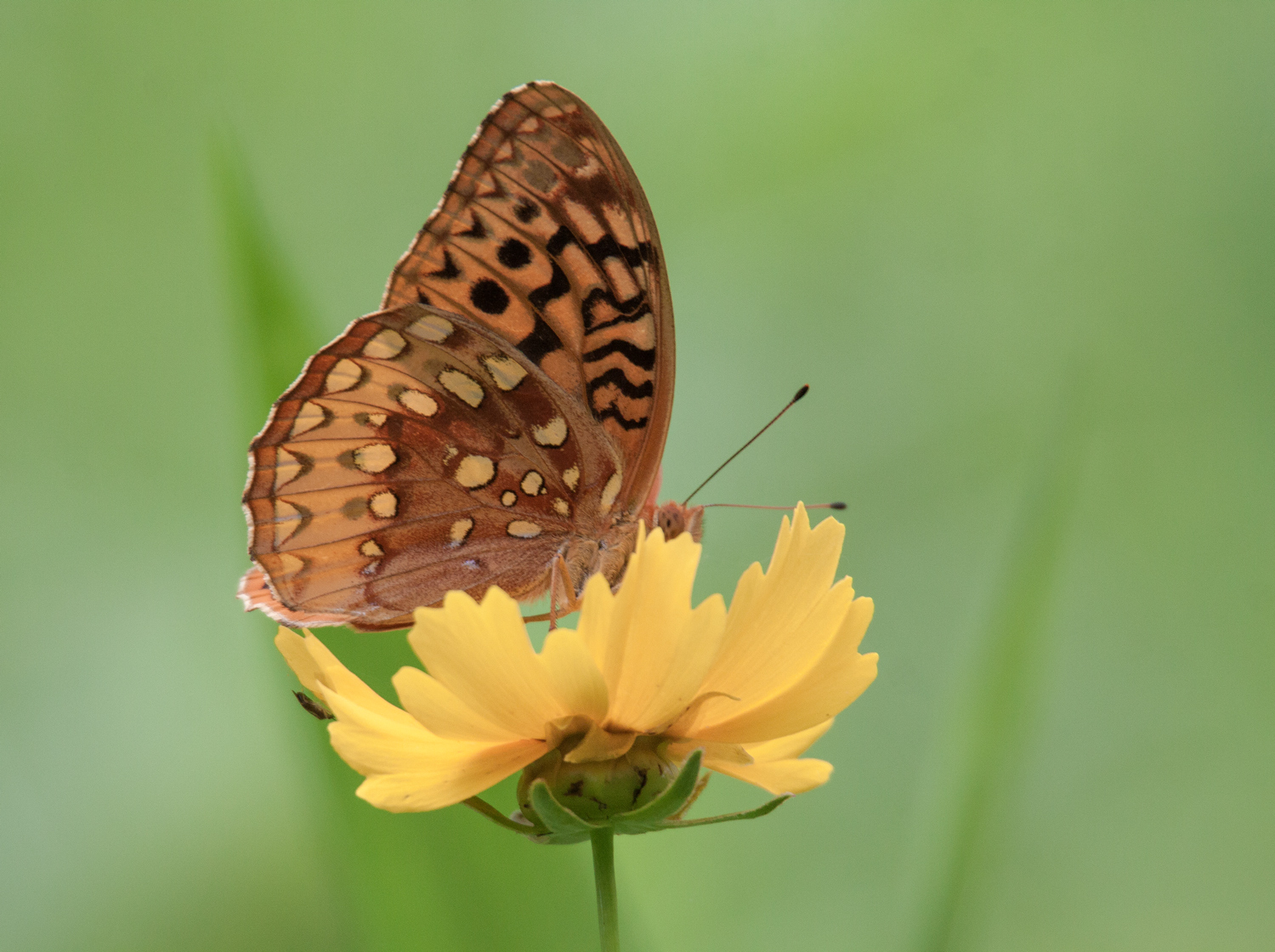
Eye to eye with a butterfly—it’s fun trying to capture subjects from different angles, in this case a Great Spangled Fritillary butterfly (Speyeria cybele) at Huntley Meadows Park in Alexandria, Virginia.

Great Spangled Fritillary

Great Spangled Fritillary

© Michael Q. Powell. All rights reserved.

Read Full Post »

At this time of the year many birds seem to hide behind the leaves of the trees, but this Barn Swallow (Hirundo rustica) was cooperative early one recent morning and perched at several spots out in the open. Click on any of the images to see them all in slide show mode.


© Michael Q. Powell. All rights reserved.


Read Full Post »

Dragonflies sometimes look like aliens to me, with their giant eyes and other worldly flying skills. My initial impression of this photo was that it looked like an alien landscape from a science fiction movie—the terrain perfectly matched the subject.

Common Whitetail

So what’s the reality? It’s a female Common Whitetail dragonfly (Plathemis lydia) in the process of depositing eggs in the shallow water at the edge of a pond. She is hovering over the water and then will drop down and dip the tip of her abdomen in the water, causing the concentric ripples you see in the image. A short while later, she repeats the process. What you don’t see in the photo is her mate, who is hovering nearby, keeping watch over her as she ensures the continuity of his genetic line.

There will be more aliens.

© Michael Q. Powell. All rights reserved.

Read Full Post »

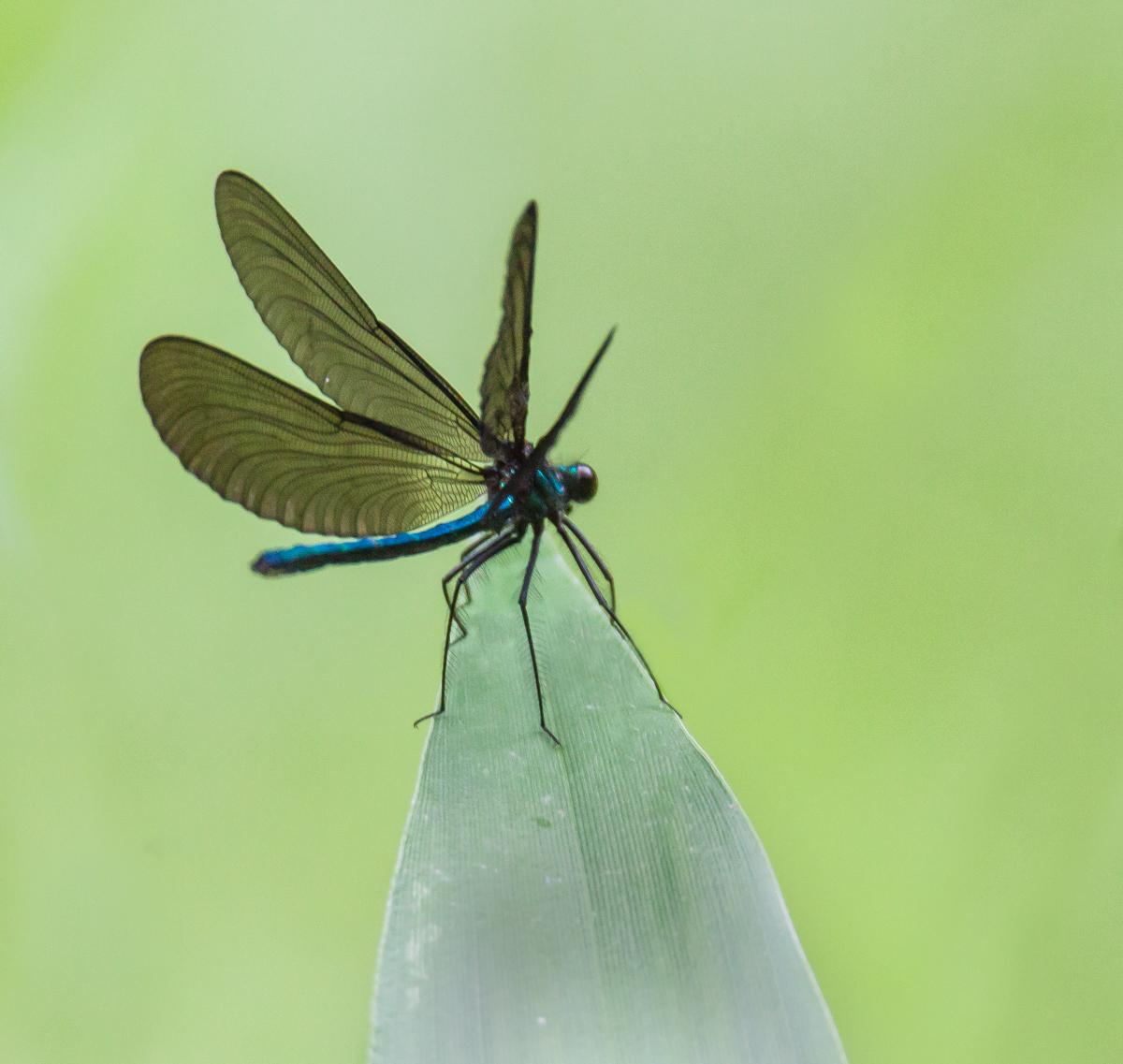
Ebony Jewelwings (Calopteryx maculata) are one of the most distinctive and easily recognizable damselflies because of their dark wings and metallic bluish-green bodies. So why is the female damselfly in the first shot so pale and colorless?

Ebony Jewelwing damselfly

When damselflies (and dragonflies) shed their exoskeletons and move  from being water-dwelling nymphs to acrobatic flyers, they are initially pale in color, a stage known as “teneral.” In a short time, the wings harden and gradually the newly emerged damselflies, like this one, become more colorful and look more like the one in the second image.

Ebony Jewelwing

As I was photographing this damselfly, it took off and I captured a somewhat blurry image of it in the air that I really like—it reminds me of a water color painting.

Ebony Jewelwing

I must be in an “artsy” mood this morning, because one of the other images that I really like of the Ebony Jewelwing is this final one, in which the damselfly was perched at the end of a leaf with wings spread wide, displaying the intricate details of those delicate wings.

Ebony Jewelwing

© Michael Q. Powell. All rights reserved.


Read Full Post »

Earlier this week I caught a glimpse of my favorite moth, the spectacular Hummingbird Clearwing moth (Hemaris thysbe). Normally these little beauties hover at high speeds as they collect nectar, but this one kept perching on leafy plants, permitting me to capture its wings at rest. I wonder if the moth was laying eggs.

I am always fascinated by the names of species and found this interesting bit of information about this moth’s Latin name on the bugguide.net website. “Pyramus and Thisbe were lovers who died tragically. Pyramus found Thisbe’s blood-stained scarf, assumed she had been killed, and committed suicide with his sword. It seems likely the reference to the story of Thisbe is a reference to the rusty, somewhat blood-like coloration of this moth.”

Hummingbird Clearwing

© Michael Q. Powell. All rights reserved.


Read Full Post »

« Newer Posts - Older Posts »